




Abstract
Objective
Our institutional Women in Medicine & Science Program (formerly the Office of Women in Medicine and Science) developed the Early Career Development Program for Women to promote the careers of women faculty. At 6 monthly sessions, participants learn relevant content (imposter syndrome, strengths, change style, career management, assertive communication, feedback, personal influence, conflict management, negotiation, importance of mentors, resilience, and self-care); exchange ideas; and expand their professional networks. Here, we report changes in participants’ career skills/knowledge, confidence, and perceptions of the current environment after attending the program.
Method
Between 2014 and 2017, participants (N = 65) completed pre- and post-program surveys that assessed career knowledge and skills, confidence, and perceptions of the current environment and provided program feedback.
Results
Most skills showed pre–post significant improvement. The greatest increases occurred in knowing paths to promotion, tailoring communication style, ability to manage conflict, and ability to handle personal–professional role balance. Women reported a significant increase for all items measuring confidence. Among these items, establishing networks, understanding institutional culture, providing feedback, motivating others, strategic planning, delegating, and conflict management had the largest increases. Overall, 89.3% of respondents rated the program impact as very strong/profound, 98.5% rated the concepts as essential, 95.2% rated the skills as essential, and 90.8% rated the sense of community with women in their class as very/extremely close.
Conclusions
Work-related skills/knowledge, confidence, and perceptions of the current environment increased significantly among program participants. These early-career women faculty indicated that the program augmented the skills needed to develop their careers in an academic medical center.
Introduction
A number of institutional/systemic barriers impede women’s career success and advancement in academic medicine. These include lack of gender equity for women at advanced ranks and in leadership roles, greater feelings of marginalization among women than men, implicit bias, inadequate resources to ensure retention, lack of commitment to family-friendly policies and career flexibility, and pervasive gender stereotypes.1–5
Women faculty may internalize cultural and institutional difficulties that they face and consequently underestimate their own abilities and limit their career goals, essentially creating a “personal glass ceiling.” 6 However, development of essential career skills may help build resilience and strong networks among women faculty, while forming a critical mass of more diverse faculty members and leaders. These changes ultimately affect the institutional culture and reduce institutional barriers to women’s success.5–8 Thus, emphasizing career development skills can help early-career faculty to develop resilience and become agents for cultural and institutional change. 2
Women faculty in academic medicine who participate in career development programs, including those tailored for early-career women faculty, reap multiple substantial benefits. Women report that they seek career development programs to increase their knowledge and skills critical to career success, advance their careers, build a network of colleagues and reduce isolation, and identify potential mentors, among other reasons. 3
Among participants in the Association for American Medical Colleges (AAMC) Early Career Women Faculty Leadership Development Seminar, 95% have reported an overall gain or improvement in important individual skills. 9 The content and curriculum of this program provide strong career guidance for early-career women faculty in academic medicine. 5 The top 5 improvements that attendees reported were interpersonal skills, leadership, negotiation, networking, and planning for promotion. 9 They also noted increased self-efficacy, awareness of institutional resources, greater visibility, and a critical source of support for their career development.5,10 Curriculum vitae (CV) review sessions can be useful for early-career faculty to assess academic progress and advance their careers.9,11 Additional topics that early-career women faculty said were important were balancing personal and professional demands, preventing or dealing with burnout, and time management. 12
Importantly, participation in women’s career development programs may help to increase retention of women faculty.5,7 This issue is particularly important as the proportion of faculty departures who are women has risen in recent years. 4 Three women’s career development programs reported that participants were less likely to leave academic medicine for up to 8 years after their appointment as an Assistant or Associate Professor, compared to male or female peers not in these programs. 7 These data suggest that a career development program for early-career women faculty can help women remain engaged in academic medicine, strengthen their career development, build and sustain the numbers of women in the academic medicine workforce (thereby strengthening gender equity), and reduce substantial costs related to faculty turnover.3,7
Targeting early-career women faculty is especially important, because this is the time when they are most vulnerable to attrition. Attrition is a more serious issue for women faculty compared to men and happens in the earliest career phases. Thus, interventions targeting women early in their career would have the greatest likelihood of retaining them. 5
Unfortunately, national-level programs of this nature are costly and have limited availability. Thus, it is critical to offer comparable career development programming locally. 5 Wake Forest School of Medicine has supported a leadership development program for mid-career and senior women faculty since 2008. In 2014, we initiated the Early Career Development Program for Women (ECDPW), based on the literature showing the importance of aligning programs in career development and career stage. 9 The ECDPW was designed with input from a planning team, all of whom had participated in the AAMC Early Career Women Faculty Leadership Development Seminar, and thus understood the goals that could be achieved with a career-stage appropriate program. Furthermore, the goals of our program are innovative in that it allows for a large number of participants from a given institution to participate (unlike the AAMC seminars), offers an environment in which participants are from diverse disciplines within and outside of academic medicine, provides an opportunity to network and form longstanding collegial bonds with similar-stage faculty with whom they would likely work with for years to come, and negates the need for faculty to travel. Sessions were designed to be highly interactive and experiential and included 1-on-1 CV and portfolio development sessions. Participants evaluate each session to ensure that intended learning outcomes are achieved and to provide feedback for necessary adjustments.
To date, relatively little work has been done to evaluate career development programs in academic medicine settings and to disseminate data from these programs. A recent national survey of career development programs offered at academic medical centers found that in-depth program evaluation beyond participant satisfaction was uncommon. 13 Most (86%) organizations evaluated impact on faculty members via satisfaction surveys; less than half assessed specific learning outcomes (38%) or pre–post program individual change/achievement (38%). Clearly, strong program evaluations of institutional career development programs are limited, and dissemination of these evaluations is virtually nonexistent. These data are needed to design evidence-based career development programming. Therefore, the goal of this study is to document changes in career skills, confidence, and perceptions of the current institutional environment before and after participation in ECDPW during the first 4 years of the program using a prospective pre–post design. These data will help increase the evidence base regarding the value of career development programming for early-career women faculty at academic medical centers.
Methods
Sample
Potential participants were recruited via letters sent to department chairs, announcements in a weekly newsletter, and advertisements to other institutions nearby. To qualify for consideration, department chairs had to provide release time and agree to cover tuition costs, and participants had to agree to attend over 80% of the program meetings. Participants were selected through a competitive application process by a committee.
Between 2014 and 2016, all ECDPW participants were faculty at the Wake Forest School of Medicine or Wake Forest University in Winston-Salem, NC. To expand regional networking opportunities, meet the needs of a broader group of women at academic institutions in our region, and increase the diversity of the participant pool, admission was opened to applicants from nearby universities (local colleges and universities in addition to our medical school) beginning in 2017. Between 2014 and 2017, 81 women completed the ECDPW (not including attrition of a single participant who left the institution mid-program); all participants were asked to respond to pre- and post-participation survey.
Program Description
Our institutional Office of Women in Medicine and Science developed the ECDPW to promote the careers of women faculty. At 6 monthly highly interactive sessions (6–8 h each), participants learn relevant content (imposter syndrome, assessing one’s strengths, change style, career management, assertive communication, giving and receiving constructive feedback, personal influence, conflict management, negotiation, importance of mentors, resilience, self-care; see Appendix 1 for additional details); exchange ideas; and expand their professional networks. Attendance was required; but participants could miss up to 1 session and complete the program. If missed due to unforeseen circumstances, they were invited to attend the missed session with the next year’s class. Program faculty included senior-level faculty from Wake Forest and other universities who had an interest and background in academic career development in women and had completed career development programs. Presenters also included highly experienced career development consultants, trainers, and coaches.
Procedures
We collected pre- and post-program surveys measuring work-related skills and knowledge, confidence levels, and perceptions of current environment and assessing the program’s overall impact and applicability of the curriculum for participants’ careers. Paper copies of the surveys were administered ahead of the first and last sessions and collected in person at these sessions. Completing the questionnaires was voluntary. This program evaluation was approved by the institutional review board at the Wake Forest School of Medicine.
Measures
Skills/knowledge and confidence
Items were adapted (with permission) from the Executive Leadership in Academic Medicine instrument.14,15 In this 35-item measure, the first 22 items measured work-related skills, knowledge, and current perceptions of the work environment. Questions were answered on a 7-point Likert scale (1 = strongly disagree to 7 = strongly agree). The remaining 13 items measured confidence levels. Confidence-level items were also measured on a 7-point Likert scale (1 = not at all confident to 7 = completely confident).
Statistical Analysis
We used descriptive statistics to analyze demographic characteristics. We summarized participants’ skills/beliefs, confidence levels, and perceptions of current environment with the means and standard deviations pre-, post-, and the change from pre- to post-program. We used paired t tests to evaluate whether changes were significantly different from zero. In addition, we categorized participants who responded with a 6 or 7 on the Likert scale as highly confident and calculated the relative percent increase of these values from the pretest. We used McNemar’s test 16 to evaluate pre- to post-program changes in the percentage of women who were highly confident. All statistical tests used SAS (version 9.4, Cary, NC) and had a two-sided .05 alpha level.
Results
Sample Description
Of the 81 participants, demographic data were completed for all of them, 79 (98%) completed the pre-program survey, and 65 women (80%) completed both pre- and post-program surveys. Median time between pre- and post-program survey completion was 4.9 months (range was 3.4–6.0 months). There were no significant differences in those who completed the post-surveys and those who did not in terms of race, age group, marital status, rank, number of children, years in rank, or years at current institution. Because we had too few participants from other universities to make meaningful comparisons, we combined data from all participants for analyses.
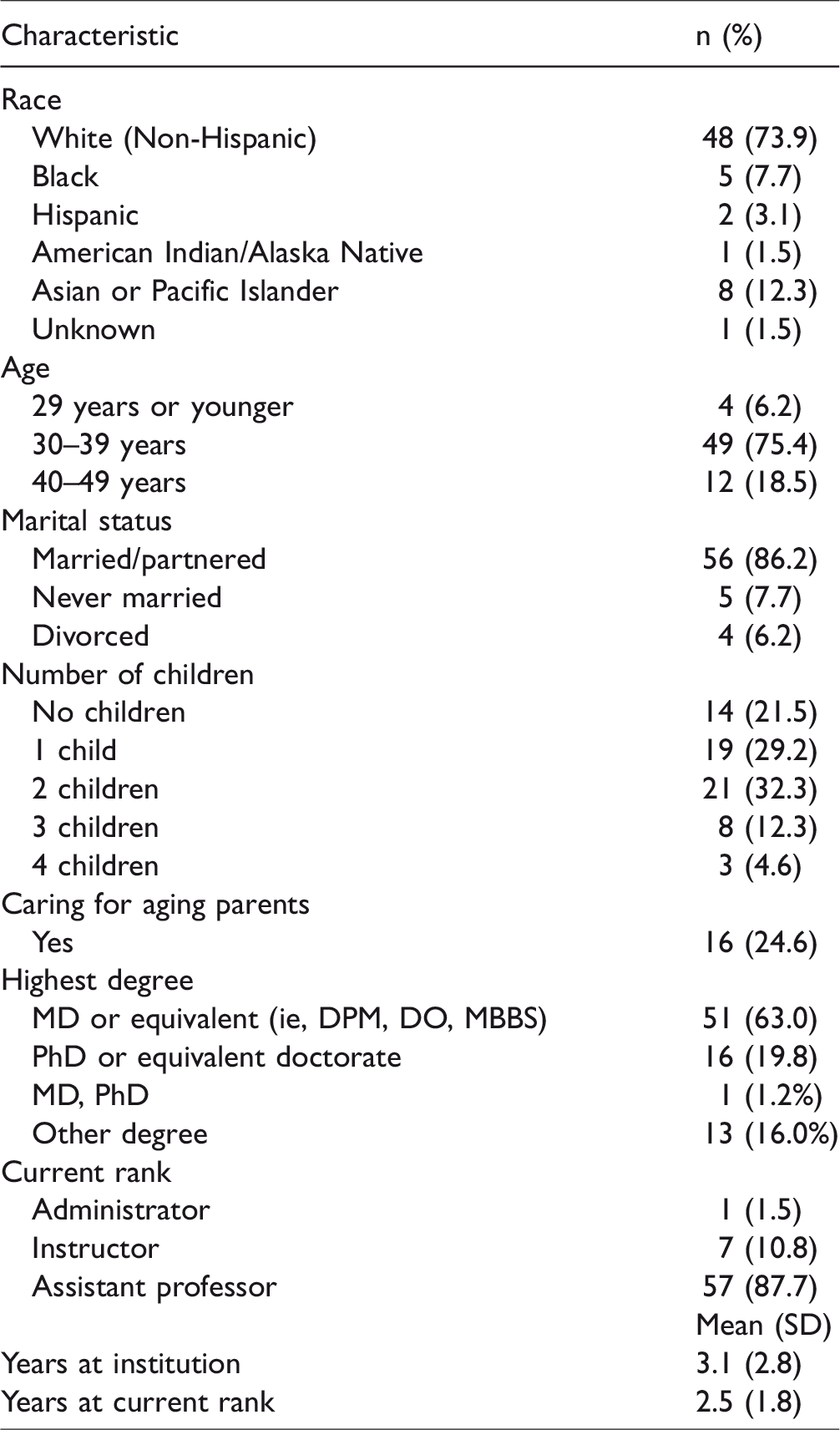
Table 1 shows baseline demographic and other descriptive data for participants. Most were White, married or partnered, and at the academic rank of assistant professor for 2 to 3 years. Of the 81 program participants, 63% (n = 51) had an MD or equivalent degree (ie, DPM, DO, MBBS), 20% (n = 16) had a PhD or equivalent doctoral-level degree, 1% (n = 1) had an MD and a PhD, and n = 13 (16%) had other degrees. Of the 81 participants, 90% (n = 73) were from Wake Forest School of Medicine and 10% (n = 8) were from other universities, and 88% (n = 71/81) have remained at their institution following program graduation.
Self-Reported Baseline Characteristics of Participants (N = 65).
Skills, Knowledge, and Perceptions of the Work Environment
Overall, participants reported significant improvement in 20 of 22 skills/knowledge statements, and among the subset who were highly confident, 18 of 22 of skills/knowledge statements improved (Table 2). The absolute percentage of women reporting moderate/strong agreement with the statements about their abilities/knowledge increased >30% post-program (absolute difference, compared to pre-program) and >150% relative increase for: (1) knowing several different paths to promotion (32.9% absolute, 428% relative) (ie, 7.7% pre-program, 40.6% post-program); (2) knowing how to effectively tailor communication style to fit different audiences (40%, 200%); (3) having a good understanding of how to work effectively with people who have differing work styles (46.2%, 375%); (4) feeling confident in the ability to solve conflicts (30.7%, 167%); (5) knowing what is appropriate in negotiating terms of employment (38.1%, 343%); (6) preparedness to deal with conflicting feelings in attempts to balance personal and professional roles (46.1%, 300%); and (7) understanding the various parameters involved in designing effective organizations (32.8%, 700%) (all P values < .001) (Figure 1). Selected items where relative pre–post improvement in work-related skills, knowledge, and perceptions of the environment was ≥150% (but absolute differences were <30%) include feeling confident in being able to resolve conflicts between self and others at work (150%) and feeling that one’s institution was sensitive to issues in women’s health in its education programs (225%) and in its clinical programs (174%) (all P values < .01).

Changes in skills and knowledge pre- and post-program. Percent indicates percentage who responded with 6 (moderately agree) or 7 (strongly agree) on a 1 to 7 rating scale.
Self-Reported Career-Related Skills and Knowledge Before and After the Program (N = 65). a
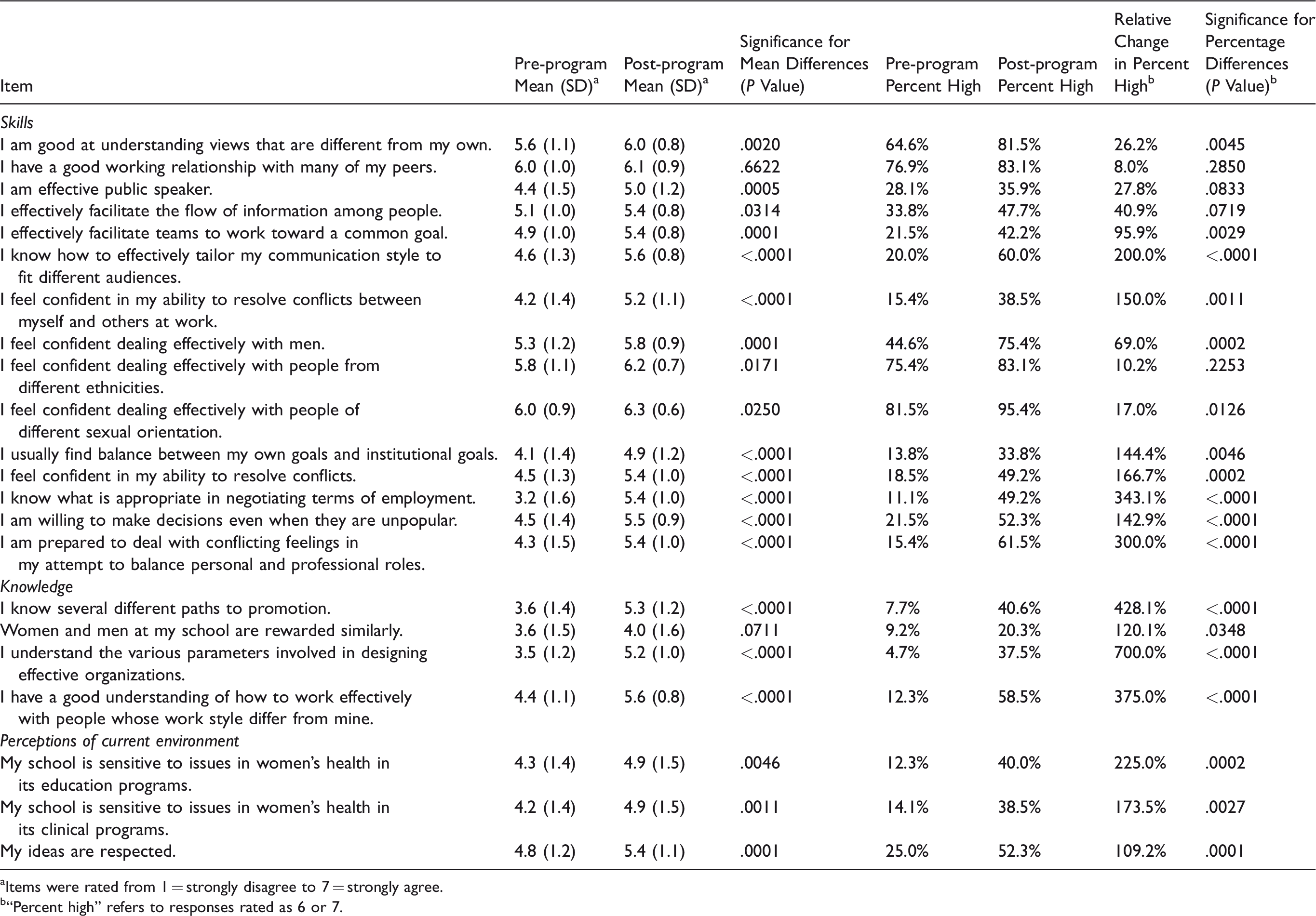
aItems were rated from 1 = strongly disagree to 7 = strongly agree.
b“Percent high” refers to responses rated as 6 or 7.
Confidence Levels
Participants reported a significant mean increase for all 13 items measuring confidence (all P values < .01; Table 3). The absolute percentage of women reporting the highest confidence levels increased >30% post-program and had relative increase of ≥150% (compared to pre-program) for establishing a network within one’s institution (35.1%, 150%) (ie, 23.4% pre-program, 58.5% post-program), understanding institutional culture (30.8%, 200%), providing feedback (36.9%, 200%), and establishing internal and external networks (30.8%, 200%), employing strategic planning techniques (43.0%, 550%), delegating responsibility (38.4%, 250%), conflict management (37.0%, 400%), and motivating others to productivity (32.3%, 263%) (Figure 2).
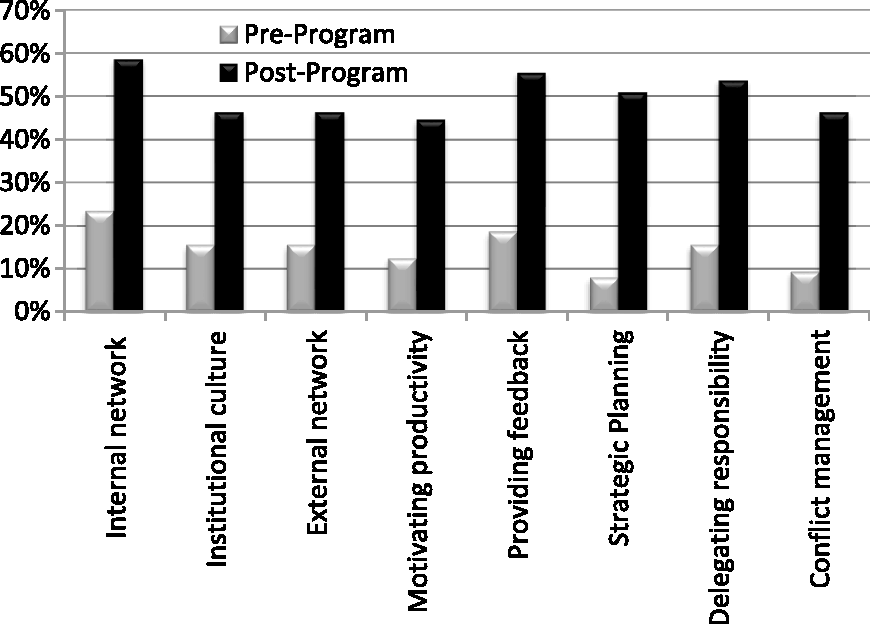
Changes in confidence pre- and post-program. Percent indicates percentage who responded with 6 (moderately agree) or 7 (strongly agree) on a 1 to 7 rating scale.
Career-Related Confidence Pre- and Post-program (N = 65).

aItems were rated from 1 = not at all confident to 7 = extremely confident.
bFrom paired t test.
c“Percent high” refers to responses rated as 6 or 7.
dFrom McNemar’s test.
Program Feedback
Overall, 89.2% of ECDPW participants rated the program’s impact as very strong or profound (38.5% rated as 4, 50.8% rated as 5, on a 1 to 5 scale). Nearly all (98.5%) participants reported that the ECDPW’s content was essential to their career development (30.8% rated as 4, 67.7% rated as 5), and 95.2% rated the skills they learned as essential (33.3% rated as 4, 61.9% rated as 5). Finally, 90.8% rated their feeling of community with women in their ECDPW class as very or extremely close.
The following are a few quotes from program participants about their experience in the ECDPW program: The Early Career Development program has already helped me immensely in communicating and feeling more confident in the workplace. I have been able to resolve conflicts and better represent my academic interests and goals. I now have a core group of female colleagues to count on and collaborate with. I think I would be totally lost as a junior faculty without this opportunity! The . . . Early Career Development Program for Women has been an extraordinarily helpful program for me for several reasons. First, it provides me with specific techniques and skills that I have been able to directly use in my professional career, such as in dealing with conflict management and promotion. Many of these skills and techniques have spilled over into my personal life, helping me with many of my challenges and relationships outside of work (which impact my ability to function best at work!) In addition, since the program unites women at this similar career stage from across the medical school in a variety of disciplines, I now have a unique cohort of women who are dealing with the very same issues that I deal with on a regular basis. Not only does this help me along my path as I am able to recognize the universality of my career stage, but I have a special “support system” of colleagues with whom I trust to discuss these important issues. Further, this program has allowed me to connect with many of the successful senior faculty at our medical school who have led many of the presentations and serve as role models for me in my career. Most importantly, this program has provided an opportunity for me to take a step back from my daily stream of activities to think about my overall career goals and what is most important to me as I move forward in my career. I have thus found this program to be unequivocally one of the best ways that I spend my time and I look forward to each session! It’s an incredible program, well designed and well run. It meets the needs of women faculty. I wish I had known about it in my first or second year at Wake. The very fact that this program exists at Wake makes me feel grateful to the leadership . . . . Having the entire day to think about your career and work on the skills is essential to making the most out of this program. Probably the most significant impact of the program was helping me to realize that many of the challenges I experience are common to other women faculty, and that there are host of individuals whom I can glean from their experiences.
Discussion
Participants in this institutional Early Career Development Program for women faculty reported that most skills/knowledge assessed significantly improved during the program. The greatest increases were in knowing paths to promotion, effectively tailoring communication style, ability to manage conflict, and ability to handle personal–professional role balance. Participants also reported significant increases in all items measuring confidence, especially establishing internal/external networks, understanding institutional culture, providing feedback, motivating others, strategic planning, delegating, and conflict management. Nearly all participants reported that the program had a profound or very strong impact; the concepts and skills covered were essential; and that the women in their class developed a very strong sense of community. The latter outcome seems likely due to attending a program locally. Thus, the three major outcomes of the program were increased career skills, increased confidence to meet the challenges of a faculty career, and forming a network of faculty women of similar career stage who were likely future colleagues. Moreover, at a time when faculty retention is a concern, the 88% retention rate is encouraging.
Pre-program ratings for the majority of career-related skills were evenly split between the low to midranges of agreement (5–6) and the neutral rating of 4. Skills scored in agreement ranges were ones that involve working with people, especially across differences (views, gender, ethnicities, sexual orientation), as well as with groups (peers and teams), and fit with the known strengths of women in collaboration and relationships.17–19 Indeed, post-program scores of these same skills increased on average only 0.1 to 0.5 from pre-program scores. In contrast, neutral ratings were given to skills related to conflict (with oneself and others) and communication styles (public speaking and different audiences), and the lowest rating given to negotiation skills, areas clearly needed for additional training. These skill sets showed the largest post-program average increases within this category, from 0.6 to 1.1, indicating that participants perceived their abilities had increased greatly in these skills by participating in our early career program. Collectively, the pre- and post-ratings of career-related skills indicate that while early career women would benefit from programs that cover a variety of skill sets, sessions on conflict and communication styles definitely need to be part of the curriculum. In addition, use of these ratings can be informative to making adjustments in program curriculum based on those skill sets that seem to show the most improvement by the programming.
In contrast to career-related skill sets, confidence levels generally across the board were low based on the pre-program scores and improved considerably (0.9–1.9) per the post-program ratings. These pre-program ratings substantiate the “imposter syndrome” phenomenon that women often experience. 20 The rise in confidence scoring for our participants after participating in our program strengthens the importance of providing early career programs for women faculty, not only to build important skill sets but also to fortify their confidence levels to be successful and to realize that they are not alone.
This initial evaluation of our early-career program for women faculty provided promising information regarding the program’s enhancement of participants’ skills/knowledge and confidence levels. Respondents reported that the ECDPW provided content and experiences instrumental to their career development. Such a program could enhance both recruitment and retention of early-career women faculty, deepening its value to the institution. Our program benefits, specifically increased confidence in negotiations, expanded networking, enhanced work/life integration, and developed plans for promotion parallel those found by Helitzer et al., for the early career development program they evaluated. 9 This was the only study we found that evaluated program outcomes beyond participant satisfaction.
Limitations of this work include a relatively small sample size and lack of long-term outcome data. Nonetheless, the program content mirrors topics emphasized in the literature, suggesting that our results may be generalizable.3,5 Although self-reported data have known caveats, 21 the survey responses reflect attendees’ impressions of their skills/knowledge and confidence soon after the specific career development activities. Program evaluation not only included satisfaction but also stressed learning and other program impact beyond satisfaction (skill/knowledge and confidence building). As a short-term study, our evaluation concentrated on the two lower levels (reaction and learning) of Kirkpatrick’s model for program evaluation. 22
Next Steps
Knowing how participants applied the skills learned (behavior) and their longer-term career development outcomes—Kirkpatrick’s levels 22 3 and 4—could be valuable for the future. Other program evaluation models also should be employed, to test whether intended or unintended changes associated with participation in the ECDPW exist. 23 A rigorous longitudinal program evaluation will use a model such as the Systems of Career Influences. 24 Next steps will incorporate focus groups with participants, track participant progress versus that of peers not in the program, and interviews with department chairs and section directors regarding the perceived value of the program. Interviews with leaders and those who have sponsored women to attend this and similar programs should explore how they create opportunities for program graduates to use their new skills. Since department chairs recommend applicants, guarantee release time for attendance, provide financial support for program costs, and create new opportunities to incorporate skills learned in the program, their input is critical to growth and development of the ECDPW—as would likely be true for similar programs at other academic medical centers.
Appendix 1: Early Career Development Program for Women Curriculum Description

Footnotes
Acknowledgments
The authors acknowledge the editorial assistance of Karen Klein, MA, in the Wake Forest Clinical and Translational Science Institute (UL1 TR001420; PI: McClain).
Authors’ Note
This study was presented at the Group on Faculty Affairs of the American Association of Medical Colleges Meeting, Austin, TX, July 2017.
Declaration of Conflicting Interests
The author(s) declared no potential conflicts of interest with respect to the research, authorship, and/or publication of this article.
Ethical Approval
Ethical approval was granted for this study by the Wake Forest School of Medicine Institutional Review Board, 7/13/17, IRB00043718.
Funding
The author(s) disclosed receipt of the following financial support for the research, authorship, and/or publication of this article: The Wake Forest School of Medicine Office of Women in Medicine and Science provided support for this project.