



Abstract
The growing rates of migration have been experienced by a wide range of age groups, with particular attention to youth, but the experiences of young adult migrants remain understudied. We used secondary qualitative data to conduct a thematic content analysis of reflections on migration from a course that is offered at a 4-year public university in Texas. Our analysis resulted in seven themes from students’ migration experiences. Our findings align with the previous literature on the unique challenges migrant students face. Likewise, they confirm the importance of social work educators in helping students navigate higher education.
Keywords
Migration continues to shape the social fabric of the United States, with increasing numbers of individuals arriving across all life stages. Among these, young adults represent a significant yet often overlooked demographic whose migration journeys intersect with critical periods of identity development, educational attainment and personal growth. While many migrated as children or adolescents, they now face the distinct challenges of navigating higher education and adulthood in a new country. These experiences are compounded by the unique stressors associated with forced displacement, family separation or undocumented status (Jacovkis et al., 2022).
For young adults who have migrated, the transition into adulthood often entails managing academic goals, financial responsibilities and workforce entry, all while adapting to new cultural, linguistic and social systems (Record-Lemon et al., 2021). First-generation and 1.5-generation migrants in particular may find themselves negotiating dual cultural identities, grappling with feelings of belonging and alienation, and acting as cultural brokers within their families (Ziaian et al., 2021). These complex experiences take place within an evolving legal and political landscape in which immigration policy and enforcement priorities continue to shift (The White House, 2025). Changes introduced through presidential administrations and Congressional action can directly impact the lives of migrants—affecting their legal status, access to education and employment, and sense of stability. For many, this policy variability contributes to a sense of precarity that influences day-to-day decision-making and long-term planning (Pillai et al., 2025).
Despite their aspirations—especially for higher education—migrant young adults often face structural barriers related to affordability, access and institutional support (Shakya et al., 2010). Moreover, while the experiences of immigrant children and families have been widely documented, there remains a gap in the literature that specifically centers the voices of young adult migrants navigating their lives in higher education. This study seeks to fill that gap by exploring the migration experiences of non-Latine students enrolled at a 4-year public university in Texas. Through a thematic analysis of reflective essays, we aim to better understand the challenges, strengths and perspectives of these students and identify opportunities for social workers—particularly those in university- and community-based settings—to provide more responsive and informed support that migrant students often require to be successful (NASW, 2011; Lambert & Siegel, 2018).
Cultural Identity and Mental Health
Migrant youth and young adults face particular challenges in developing their identity as they often straddle two worlds—one of their family and country of origin and another of their new home country. A meta-analysis of cultural identity among first-generation immigrants found youth migrants to identify more with their culture and country of origin compared with their country of residence, showing continual challenges in creating a coherent cultural identity (Maehler et al., 2021). This additionally creates challenges for young migrants to navigate a space within their new country and culture. Migrant youth have been found to explain their cultural identity as fluid, complex and multidimensional; they express that they can never fully connect to either space, but rather, they connect to a combination of both their country of origin and their receiving country (Khanlou et al., 2018). These difficulties in navigating their cultural identities, coupled with high levels of both direct and intergenerational trauma, lead to higher rates of mental health concerns (Flanagan et al., 2020). Among Hmong young adults in California, struggles with both a sense of belonging and difficult intergenerational relationships led to suicidal tendencies and mental health concerns (Lo, 2015). Notably, the acculturation of migrant youths’ parents has been found to have substantial impacts on migrant youth. Parents’ feelings of acceptance and their own language and cultural integration have significant impacts on the mental health of their children (Belhadj Kouider et al., 2015). Taken together, these identity-related challenges set the stage for additional structural and social barriers that shape migrant youths’ daily lives.
Barriers to Inclusion
Building on the identity-related challenges described previously, migrant young adults also encounter extensive systemic and structural barriers that affect their well-being and opportunities for integration. They report struggling to find employment that financially supports themselves and their family (Lauer et al., 2011). Additionally, they struggle with navigating higher education systems. While many young migrants report educational aspirations, challenges exist, often preventing or adding significant additional barriers to their ability to access higher education (Molla, 2021; Soong et al., 2022). Both their and their parents’ language barriers are an additional barrier to finding adequate employment and accessing needed health and social services. Young adult migrants also report that being the linguistic and cultural navigators of their family can feel like a barrier (Chao, 2019). Structural barriers, including lack of affordable housing and poor transportation infrastructure, can negatively impact young migrants’ abilities to successfully integrate, especially with individuals from outside of their ethnic community (Mansouri & Johns, 2017).
Racial and ethnic discrimination are reported by large numbers of migrant youth—often higher than that of their first-generation parents (Giuliani et al., 2018). These experiences of discrimination also have exacerbated impacts on second-generation migrants due to their greater identification with the majority population and their desire to fit into the majority (Hage, 2011). Refugee youth from Bhutan report experiencing racism both in and out of school, with these experiences further complicating feelings of cultural identity (Subedi & Maleku, 2021). A systematic review of youth with immigrant backgrounds identified experiences of discrimination to negatively predict mental health outcomes (Metzner et al., 2022).
Methods
Data for this study come from an undergraduate social work elective course at a public university in Texas; it is available to all undergraduates, regardless of the major, and is titled ‘The Latina Experience’, because it focuses on the experiences of female-identifying people migrating from Latine countries. Students in this course were required to complete a reflective paper discussing their experiences with migration, whether from a personal or a second-hand encounter. For this study, the inclusion criterion was that the migrating stories were to be only of students who were not of Latine/Hispanic descent. This selection criterion was intended to explore how non-Latine students engaged with and understood migration themes within a course grounded in Latine perspectives, highlighting the contrast and interplay between Latine and non-Latine migration narratives. From this course, 86 reflective papers were screened by the first author for fit with the inclusion criterion (n = 10). Papers that focused on Latine experiences (n = 7) were used to conduct a similar analysis focused on Latine higher education.
Data Analysis
The first and third authors used Braun et al.’s (2019) reflexive thematic content analysis approach; the first phase was to familiarise themselves with the 10 reflective papers that the students completed. This involved reading each paper several times. Phase 2 was to generate initial codes. For Phase 3, each author categorised their codes into themes. They then met to discuss thematic categories towards consensus—the fourth phase of theme review. After a thematic consensus was reached, relevant quotations were identified that best demonstrated each emerging theme. These themes were then presented to the second author, with expertise in forced migration, who was then consulted to review the themes and associated excerpts, offering critical feedback on their relevance, clarity and sensitivity to issues of forced migration. This step helped strengthen analytic rigour and ensure that the themes accurately captured migration-related experiences and closed Phase 6—theme definition and naming. Given the possibility of professional and personal experiences biasing results in qualitative research, the research team has included their positionality statements.
First Author
I identify as a second-generation bi-racial Latina; I hold bachelor’s and master’s degrees in social work and a doctorate in adult education. My mother immigrated to the United States from Belize to care for her mother, who was dying; she stayed thereafter on a work visa; she is a naturalised citizen. I originally created the Latina experience class and have taught it for more than 3 years; I have been a social work faculty member for almost 20 years. My areas of research include maternal mental health related to suicidality and preventive efforts around preventing suicide in the face of traumas. Early in my career, I piloted a financial literacy intervention with refugee women from Bhutan and conducted a quasi-experimental study of three different mental health interventions with refugees from Burma, the Democratic Republic of Congo, Rwanda and Bhutan.
Second Author
I identify as a white, cisgender woman and a forced migrant researcher. I hold a bachelor’s degree in psychology, a master’s degree in public health, a master’s degree in social work and a doctorate degree in social work. I have worked in the social work field for over a decade with refugee and immigrant populations, mainly focused on developing and implementing mental health interventions that are grounded in the cultures and beliefs of migrant communities. My research agenda extends from my practice experience with forcibly displaced communities to create culturally grounded interventions to improve mental health outcomes. I have conducted several studies investigating mental health and well-being outcomes among refugee and immigrant communities.
Third Author
I identify as a bi-racial Latina and a first-generation college student. I have a Master of Social Work degree, and I am enrolled in a doctoral programme of social work at a public university in Texas. My dad is originally from Chihuahua, Mexico, and migrated to West Texas when he was in his late teens. My focus is on working with Latina mothers as they navigate motherhood and mental health struggles. My subfocus involves working with Latine families around silencing in the household.
Results
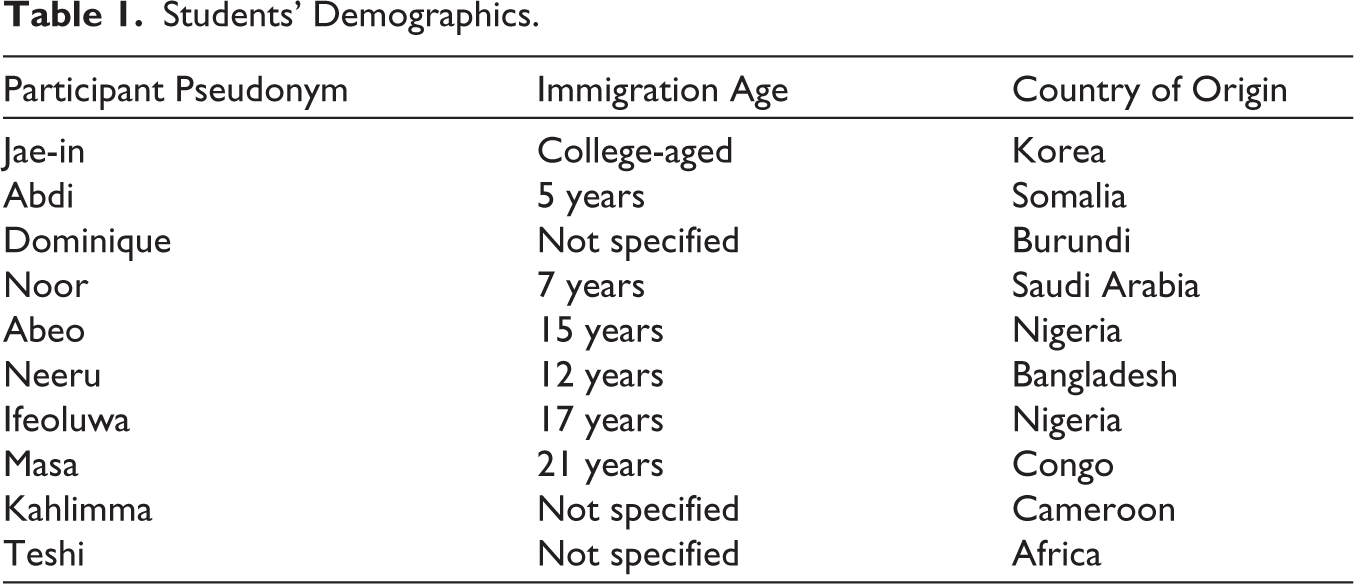
From our qualitative data analysis, seven themes emerged: (a) hybrid identity, (b) culture shock, (c) systemic barriers, (d) where do I belong?, (e) it is just a dream, (f) discrimination and (g) helps me to be a better professional and human being. Each theme is followed by supporting quotations and subthemes if relevant, from the students who completed the reflective paper in the course. Table 1 has pseudonyms, age and country of origin, if specified.
Students’ Demographics.
Hybrid Identity
Students consistently discussed the challenges of navigating how they would reconcile the culture of their country of origin with the culture they were adjusting to in the United States as their receiving country. For example, Jae-in from Korea notes:
I struggled so much to find my identity, but I found that identity doesn’t come from my immigration status. I am a Korean American who embraces two different cultures. In the beginning, I really didn’t like that I was divided into two persons. I was a Korean at home when I spoke Korean with my parents, and I was American outside of home when I spoke English with my friends. But now, I like that I can speak and practice two different languages and culture.
Similarly, Abdi from Somalia shares the strain of a hybrid identity:
School was difficult growing up and trying to keep up with two languages was even more difficult. In my household it was very important to keep the Somali language going and to only speak it in the house due to this it made it even more difficult to pick up the English language.
Dominique from Burundi notes the familial turmoil that emerged as they navigated hybrid identity:
My friends told me that change is important and it is a natural part of life; it is inevitable. I heeded to my friends’ advice and refused to abide to my parents’ instructions which led me into loosing trust from some of my family members. My friends were not all bad, but because of the different cultures, beliefs and how media presented ethnicity, my family was worried about me ending up being irresponsible. I later change back to the girl my family wanted me to be, but as we know, there is no perfect person. There are certain things I have no choice of and I respect and acknowledge my culture for playing roles into my life.
Not Hybrid but Assimilation
For others, the challenge was not in navigating two identities but the crisis of leaving the country-of-origin identity and embracing the identity of the receiving country. Jae-in (Korea) shares:
I’m still learning to find my identity as a Korean American after a long time of having identity crisis. I was neither a Korean nor an American. I wasn’t born in America, I didn’t know how to speak English when I first came here, my friends made sure I knew my place as an immigrant by calling me names, and my status always reminded me that I wasn’t a true American. But every part of me felt American; the way I think, the way I handle conflicts, the way I dress and talk, the beliefs I hold onto and the culture I abide by is all according to American standards.
Dominique notes how assimilation affected their family and the pressure that led them to consider assimilation:
Making friends here in America at the first time was a big challenge for me due to the barrier of not speaking English. I started to change after learning little English and became more Americanize without knowing that I was hurting my parents … From the experience of being an immigrant in this country, it has come to my knowledge that there are indoctrinations forced on immigrants and we are too quick to accept them without being dogmatic. (Burundi)
Culture Shock
Moving to new places often comes with adjusting to the differences, especially when transitioning to a receiving country that may be drastically different than one’s country of origin. Noor explained:
Moving to America at the age of seven from Saudi Arabia was a huge challenge as a kid from adapting to the new culture to learning the language and American lifestyle. My family and I had a tough time settling down in the US with little to no help since we did not have a lot of family here.
Their experience was amplified and validated by Dominique, who went on to explain:
Life was not easy again because of the language and cultural differences. Everything was different from what I had expected. Adapting to a new environment was a big challenge for my family. People did not understand us and our culture not because they did not want to understand us but because they were ignorant of other cultures. (Burundi)
In addition to adjusting to the receiving country, these students had to navigate coming to a place that is not always receptive to differences, especially compared to the ‘typical’ white American script. However, one student raised an interesting point about how their country of origin views others, compared to the diversity seen in the United States. They said:
One of my first observations was the diversity of the community and the different cultures that resided in the US. This was very different from my country of origin and was very nice to see everyone with different cultures and backgrounds living in harmony. You could not tell who was rich or poor, you just saw everyone as individuals. This was completely different from Nigeria, where there were clear class divides from the rich vs. the poor. (Abeo)
This highlights that though many migrants may have experiences that cause questioning as to whether migrating was the right choice, others are met with better realities than their countries of origin.
Food
As part of migration, students had to experience changes in the food they consumed. Food is a major component of culture, so for some students, having these changes allowed them to gain a better understanding of what it means to be American. Kahlimma explained:
the opportunity to meet new friends who explained to me that what I am experiencing is just being American, and my introduction to new menus like pizza, tacos and some Chinese food soon began to help me get acquainted with American lifestyle. (Cameroon)
Food can be a major source of comfort for individuals; however, when moving to a new area, having access to those luxuries is not always possible. This can create a bigger disconnect in identity if access to traditional cuisine is unavailable. Ifeoluwa (Nigeria) explained their gratefulness by saying, ‘Thank God for the Spanish stores, they sold African foods so we could still eat our staple African foods’. Having access to native foods can help individuals find comfort in the transition to their receiving country.
Fast-paced Environment
A common cultural difference observed when coming to the United States is moving from a slow to a fast pace. Kahlimma explained:
the cultural differences were staring us at the face. The fast way of talking, walking and the fresh new environment was our first experience. While in New York, Yonkers to be more precise, my family continue to experience cultural shocks like the fast pace of life, and the fact that we were both jobless compounded to our transitional struggles. (Cameroon)
Neeru talked about materialism and how that affects their transition. They said:
I learned in school that American culture is very materialistic, to dress up in a certain way and wearing name brand clothing and shoes. I used to feel under pressure and depressed that my parents could not or did not see the point of buying expensive clothing items. (Bangladesh)
This can reinforce feelings of not belonging in the receiving country and harm the transition period.
Weather
Lastly, we see that a part of this transition is learning about the new climate of the receiving country. Kahlimma explained:
Upon arrival in America, it was winter season and my first shock was the trees that had shed its leaves and looked all as dead. After noticing the trees, I asked why all trees in America are dried up? But the driver who picked us up from the airport said the trees are not dried, it is winter season … and during the winter trees shed its leaves and appear as dried and dead while motioning with his hands. (Cameroon)
Systemic Barriers
Many students talked about their experiences involving receiving support and either their parents or themselves finding a job. One student reflected on their parents’ struggles as they said:
My parents found it very difficult to find jobs that they qualify for. My father’s master’s degree and experience of working in bank was not recognised, which left him with no other choice but to work anywhere that would offer him a job. My mother found a job in a department store and my father took a position as a watchman for the same store. The hours were long and paid poorly with no vacation time or health benefits. (Neeru, Bangladesh)
Likewise, Kahlimma (Cameroon) talked about their job-hunting experience saying, ‘Every job application we completed was denied with reasons being that we have little or no experience’. These two instances point to a bigger issue that is related to how the United States views experience and education from other countries. Clearly, these individuals have the skills necessary to work at different jobs, but since their education and experience are not from the United States, their skills are ignored.
Despite these barriers, Dominque explained the fight that comes with those who have left their country of origin saying:
There were many barriers for my parents to support us such as lack of transportation, difficult[ies] in securing house, work, speaking and learning English. With all the barriers, my parents sacrificed a lot and still sacrificing for us to have successful lives. (Burundi)
Where Do I Belong?
Feelings of disconnect and lack of belonging deeply affected the students in this study including related to their appearance and the shock of entering an individualistic culture. For some, this was from their lack of choice in coming to America. For example, Abeo of Nigeria shares:
At the age of 15 my parents decided to relocate to the United States for me and my siblings to attain better opportunities in life. When we were informed of this move, I was not excited and was not interested in leaving my friends and extended families, but I didn’t have a choice.
Finding ‘home’ in America is a long journey. Jae-in describes:
I felt so lonely as if I was in a boat by myself in the middle of the ocean. I feel lonely because no one around me is struggling with the same immigration problems as I am, or at least none of which I’m aware of. I feel lonely because I call this place home, but this place doesn’t make me feel welcomed or belonged. I feel lonely because people don’t know how to help me … America is a difficult place for immigrants to survive and thrive in … this world can be a lonely and a cruel place that gives no grace to those who are not privileged. (Korea)
For others, part of the challenge was finding the right city in the United States; Noor from Saudi Arabia notes: ‘I despised being in America and felt rejected in school until I moved to Texas. My family and I moved from city to city in Texas until finally settling down in Irving which was a more diverse city’. Abeo (Nigeria) similarly stated, ‘Dallas was reassuring because there was a small community of Nigerians, which was welcoming and made us feel more at home away from home’.
Some were immediately met with support to offset the bewilderment of a new culture. This was in having family with them, as Ifeoluwa of Nigeria experienced: ‘I shared a house, family house with three of my siblings who were here before me; this helped with the loneliness/sadness of being away from home and my parents and made settling down a little easier’. Similarly, as experienced by Neeru (Bangladesh):
The school administrators intentionally put us in classes with other Bengali students in order to help us navigate the school. It was like having a ‘buddy system’, wherever I need to go I had support. I found this experience to be very positive and helpful, especially being new to a country and lots of things were unfamiliar to us.
However, as Neeru tried to move beyond the Bengali circle, ‘Not being able to speak English was another problem and it stopped me from making friends while also knocking my confidence’ (Bangladesh).
Everyone Looks Different
Aside from feeling out of place due to their language and lack of a social circle, their appearance seemed to add additional strain to finding belongingness. As Abdi illustrates:
The change was unreal I felt like I was in a different planet, being that young all I could remember is just feeling frighten all the time. I remember my mom telling me that this older Caucasian lady at the airport complementing my shoes when all of the sudden I started crying because she looked very different from what I’m used to seeing. (Somalia)
As Noor noted:
Initially, before moving to America, I was not aware of diversity considering I grew up around only Arabs and we all shared the same similar culture for the most part as well language despite dialect differences … After moving to America and being surrounded by only white people, I was shocked to see the other side of the spectrum in Texas with diversity … There were mostly Hispanics in my school and I was so happy to see the physical similarities of our appearances as well as learn about cultural similarities. I was instantly accepted by the Hispanics at school which turned my immigration experience in a positive direction. (Saudi Arabia)
Individualistic
For the students in this study, a shock was transitioning from communal cultures where interdependence was a defining characteristic to an individualistic one. As Kahlimma of Cameroon notes:
While in my apartment complex, I noticed that my neighbours had no time to greet or respond to my greetings. It was a shocking experience for me to see people living all alone, hardly respond to greetings, always on the run and living an individualistic lifestyle. On the contrary, I was brought up to knowing that it is wrong to meet your neighbour and pass without greetings. Back in Cameroon, we live a more community base lifestyle where families will share dinner in the evening, sit together at the fireside and tell stories with jokes that make each other laugh … Such community lifestyle makes me feel more connected to one another much more than what I experience in America as an immigrant.
This individualism impacted multiple aspects of life; for example, Abdi explains:
In primary school my family was not given the proper basic information in regards to policies and regulations of the school. The school staff just automatically makes the assumption that these rules are already told to us or is just a matter of common sense, but a newcomer like my family and I come from a rural country where school is not requirement and sometimes very far from us, so these school rules and basic information are not taught to us. (Somalia)
Others were able to experience the interdependence they were accustomed to: ‘I overcame this [isolation] fast though after a couple of semesters, I made friends with other international students who had similar experience’ (Ifeoluwa, Nigeria). Similarly, Masa experienced:
As I prayed God for help, I met a couple who asked me where I was from. I couldn’t talk to them. The language I was speaking was French. The following night, they came with an interpreter. That was when they welcomed me to their home. They helped me as one of their children. Thereafter, they sent me to [Community] college to study ESL. (Congo)
It Is Just a Dream
This theme resulted from common experiences in realising that the American Dream is out of reach for many immigrants. For Jae-in, their perceptions were shattered as they explained:
I’m realising more and more of how unrealistic the American Dream is. Immigration is not an easy decision, and people risk their lives to have a better life. Out of desperation for hope, immigrants reach out to a land that has so many opportunities and freedom, only to find a place of defeat and fear of losing their homes again. I wish that America was more gracious and loving towards people who struggle with finding comfort and safety in a place where they call home. (Korea)
As previously mentioned, shifting from a collectivist to individualist perspective poses different challenges for students. Adjusting to the views of money can be distressing during the transition. Masa (Congo) talked about this in depth by explaining:
The United States of America it is a prosperous country with many opportunities: jobs, education and many more. But it is very hard to build a relationship. Even in church, people do not care. I have been to Europe, and Canada, but the USA is very different. If you do not have money, you will die. Nothing is for free; even water cost something.
It shows that the luxuries that are common in the United States come at a price and are not always accessible to everyone. We see in the words of Dominique that everyone in the United States is struggling in some shape or form:
Before coming here, I have always thought that US was a country where people did not have many obstacles in life because of how it is presented on media. From the information published on news and what friends told us, I did not except to see people struggling with life, not talk of poverty and homelessness issues. (Burundi)
Emotional Impact
In this process of migration, some of the students experienced emotional burdens that came with leaving their country of origin. For Jae-in, their worries stemmed from the possibility of not being allowed in the United States and being deported. They explained:
Every time I travel to Korea to visit my parents, I get anxious from the thought that I wouldn’t be allowed back into America. I call Dallas my home, but home isn’t really home when I’m living in fear that I might be deported back to Korea because of my immigration status. (Korea)
These feelings were further backed by another student, who expressed being an immigrant comes with many conflicting emotions. They explained:
My experience with immigration has been a roller coaster just because even after living in this country for almost 20 years I still face issues with it today … Immigration has set a large impact in my life that it affects the choices and decisions I make today. Moving from my country at a young age with almost nothing in hand and leaving everything I have behind will always be a memory that will never leave my mind. (Abdi, Somalia)
To some, migrating may not appear to be a burden; however, moving to a new home is not something that is taken lightly. In the process of finding a new home, some students are reminded of the adversity that they have been through to get to this point.
Discrimination
As might be expected, these students faced discrimination. Regarding accent and language, students had heart-wrenching experiences during childhood. For example, Noor notes, ‘I was bullied and made fun of because I looked different, had a different accent, and overall had a polar opposite culture compared to the white kids around me’ (Saudi Arabia). Abeo was surprised at the source of discrimination:
there was a clear divide between two different kinds of students. Being African and black, I thought that I would be closer to the black kids, and they would be very welcoming, but it was the other way around … There was a lot of misconception through our dialogue that made me feel I had to defend my country of origin. There were some kids that truly wanted to understand the culture more, and others were just being mean (bullies) and vocally ignorant to culture. To my surprise, the kids that sounded more vocally ignorant to culture were the black kids that were just like me. This shocked me and compromised my relationship with the kids that I thought I would have more similarities and commonalities. (Nigeria)
Places of work were also discriminating:
people telling me that I have an accent, and that my English was not good, further demoralises me to an extent of causing me doubt my ability to live and work in America … I was constantly a subject of racial discrimination from the team lead that we had at my first job. (Kahlimma, Cameroon)
Sadly, discrimination even came in spaces one would not expect such as the college classroom:
I came in the summer and started school immediately, I took summer classes, and one of them was English 101. My first paper had so much red ink I thought I wrote my paper in red ink. Nigeria, my home country, was British colonised, so we wrote/spelt and pronounced words the British way. Words like labor, color, we spelt labour, colour. I got so many papers with so much red ink the instructor had a one on one with me after so many corrected papers, saying I know you were taught the British way but you are in America now; learn the American way period … I had so much trouble with my accent, people heard the accent first and have already decided they will/do not understand what I was trying to communicate and was always met with ‘huh or what did you say’ before I finished. I am a shy person and don’t like attention, this made me not ask questions in class even when I didn’t understand what was being taught because I didn’t want people to make fun of my accent. (Ifeoluwa, Nigeria)
Stereotypes
Stereotypes were a painful aspect of discrimination. As Masa noted, ‘I believe immigrants and refugees contribute to American development. People who come here to find job and to help their family back home are doing sacrifice. I don’t know why American still stereotypes regarding immigrants and refugees’ (Congo). Similarly, Dominique reflects:
Even if it is known to be a country of freedom, immigrants are treated otherwise. We are being judged, discriminated and prejudiced by society. Being immigrant has made me realise how most of things presented on media about US are not the same in reality. I have also recognised how one immigrant can cause all immigrants to be seen as bad people just because the society is overgeneralisation, selective and have illogical reasoning. (Burundi)
Ifeoluwa notes: ‘My friends were asked if we lived on trees in Africa, where are your tails etc. Some people actually believed we lived on trees and swung around like Tarzan’ (Nigeria). Finally, Masa notes the difficulty facing discrimination, ‘I was very impacted and very depressed during my first days in Fort Worth, but I am so proud of who I am today’ (Congo).
Helps Me to Be a Better Professional and Human Being
Salient among the reflections was the recognition that their experiences help to make them better in terms of their careers and their empathy towards others, especially cultural humility. In 6 out of 10 of the reflection papers, students identified that their personal experience migrating helped inform their decision to enter the field of social work. Kahlimma shares ‘ my approach to my client will always be from a standpoint of openness, acceptance, empathy, tolerance, listening and paying attention to the fact that the actions of individuals are often determined by their environmental background’ and ‘the experiences taught me the sense of being open in my approach to other cultures from a non-bias view point’ (Cameroon). Masa notes ‘I am working on my social worker degree, and I will be able to help and advocate for others empowering them to become sufficient without struggling like me’ (Congo). And Neeru shares, ‘I will be able to understand their frustration and be more compassionate towards them’ (Bangladesh). Dominique and Abeo note growth in cultural humility:
It is important and beneficial to be aware of other’s values, behaviours, concepts and cultural norms. In addition, I have learned that it is important to take time to know someone before judging him or her because that can help us to be more aware of cultural differences. (Dominique, Burundi) I learnt to try and listen a little better and understand where people with negative misconceptions about culture were coming from. I made it my goal to educate individuals on my culture when asked and not get offended because it was important to me to educate and broaden their negative perspectives of Nigeria. It is important to try and bring individuals into cultural understanding to better interact with others like me or other immigrants from other countries. (Abeo, Nigeria)
And finally, from Ifeoluwa:
It has taught me to be more patient, ignore the ignorance of a few and to be more open to other cultures. My experience, I believe, helped me be more culturally humble. I try to teach people to be more open minded, accepting of people ask questions instead of passing judgements or assuming information they already have is enough, be more self-aware and think how you will want to be treated if you migrated to a different country. (Nigeria)
Discussion
The findings from our qualitative analysis of reflection papers with migrant young adults reveal a complex tapestry of experiences shaped by their migration journeys. Seven prominent themes emerged, each highlighting distinct yet interconnected facets of their lived realities. These themes collectively paint a nuanced picture of the migrant young adult experience, providing valuable insights into their struggles, strengths and evolving identities. Our findings align with the existing literature on migrant young adults and contribute valuable insights for social workers serving diverse populations in higher education. Additionally, these enhance our understanding of the impact migrant experiences may have on future social workers entering the profession.
Similar to past research, our findings highlight the difficulties migrant young adults have in navigating their hybrid identities and new worlds post-migration. As migrant youth work to adjust to their new life, they often struggle in how to navigate their new identity between the culture of their place of birth and the new culture of the United States. This idea of ‘spiritual homelessness’ has been reported among other international students (Maleku et al., 2022), and our findings expand this understanding into other migrant populations. Our participants stated how factors such as using two languages in different places and code switching between two cultures impact their overall well-being. Another difficulty participants reported was adjusting to the individualistic culture of the United States compared to their home country’s collectivist culture. This change to an individualist culture has been found to be difficult on migrant’s well-being and may additionally hinder migrant young adults’ ability to adjust post-resettlement (Salinas & Salinas, 2021).
Another difficulty experienced by young migrant adults is discrimination. Discrimination among migrants is well-documented and has been found to have detrimental impacts on their well-being and adjustment in the United States (Alemi & Stempel, 2018; Szaflarski & Bauldry, 2019; Ziersch et al., 2020). Second-generation and 1.5-generation immigrants may experience higher levels of discrimination compared to their parents (Giuliani et al., 2018). Participants in our study experienced discrimination in a variety of places including work and school. These experiences left participants feeling deflated and rejected by their peers for what they looked like, their accents and their overarching culture. Experiences of discrimination in migrant youth can have detrimental impacts in the long term. Our study supports previous findings that discrimination can impact migrant young adults’ mental health and overall adjustment (Metzner et al., 2022).
Given their experiences and the themes of this study, of concern for these young adult migrants is the risk for suicidality, aligning with findings from Lo (2015). Per Joiner’s interpersonal theory of suicide the young adult migrant’s experiences such as those shared in this study demonstrate a proneness for suicide risk. Suicide risk can be divided among three necessary constructs: lack of belongingness, acquired capability and perceived burdensomeness. Lack of belongingness is perhaps the most exacerbated construct for these migrant young adults as evidenced across the themes. For many, the acquired capability (e.g., exposure to experiences that desensitise one to the fear of death) emerged during the migration process or from the reasons for the migration. Perceived burdensomeness—seeing themselves as a burden to their loved ones—is not as readily visible among these themes, but, given the presence of lack of belongingness and acquired capability, if perceived burdensomeness were present, the risk for suicide would be a concern requiring focus and attention, especially from social workers and other mental health professionals. Looking deeper into the data, one can surmise where perceived burdensomeness might emerge including the turmoil experienced in the family as the young adult migrants navigated hybrid identity choices; fears around immigration status and the negative outcomes on family should status be lost (or if undocumented, should they be found out as such); challenges with earning potential and systemic barriers related to the ability to provide for one’s family; and more broadly, internalised negative media messages about migrants and their supposed negative impact on the United States. This amalgamation of situations that might increase risk is important in considering holistic care of migrant young adults in educational settings.
Our research adds to the understanding of the role of social workers in supporting migrant young adults. While extensive research exists on the role of social work for students in primary and secondary education (Duman & Snoubar, 2019; Popescu & Libal, 2018), less is understood about how social workers can support first-, 1.5- and second-generation immigrants in higher education. Findings from our study show students needing support in navigating their identities and feelings of belongingness, accessing needed resources and navigating past and current experiences of discrimination. For young migrants, struggling with cultural identity can mean not feeling like they are fitting in around peers while also feeling as if they no longer fit into their native culture at home with their family. Creating spaces on university campuses where migrant students can gather to reduce isolation may be helpful. Additionally, working at the university level to create spaces and environments where all students feel welcome may be more successful than individual interventions that may leave migrant students feeling like it is their own personal responsibility or their fault for feeling like they do not belong (Janke et al., 2024). Additionally, university support services such as counselling centres and academic advising offices could be engaged to address these challenges more holistically. Training staff to understand the specific migration-related stressors and cultural identity conflicts faced by students could improve access, relevance and trust in these services. Such cross-campus collaborations would help ensure that migrant students receive integrated, culturally responsive care.
Finally, participants discussed how their migrant experience impacted their desire to be social workers themselves. As the number of foreign-born individuals in the United States continues to grow and is expected to exceed 60 million individuals by 2030 (Center for Immigration Studies, 2024), the number of social workers needed to support these individuals in navigating their new environment will also continue to grow. Previous research has focused on the need to listen to migrants themselves in how social services are delivered to them (Mitschke et al., 2017). Additionally, there is the need for immigrant and migrant leaders to serve in leadership positions, including in social work, for the leaders of the profession to match that of the clientele being served (Kirsch et al., 2025). Our study adds to this knowledge in showing that migrant young adults in higher education are driven by their own migration experiences to serve their community led by their own personal experience.
Footnotes
Declaration of Conflicting Interests
The authors declared no potential conflicts of interest with respect to the research, authorship and/or publication of this article.
Funding
The authors received no financial support for the research, authorship and/or publication of this article.