




Abstract
Migrants contribute to their origin countries not only through monetary remittances but also by transferring ideas and practices, which can drive development, social change and entrepreneurial activity. These tangible and intangible resources hold immense potential to transform rural communities, where entrepreneurship is a critical pathway to economic growth. Research indicates that migrants, including returnees, are more likely to become entrepreneurs than other population groups. Additionally, remittances are not only a source of investment but also inspire local entrepreneurial initiatives. However, despite growing scholarly interest in rural entrepreneurship, few studies examine how migrant-driven entrepreneurship unfolds in rural contexts. This study fills this gap by adopting an exploratory and conceptual approach to examine the interplay between remittances, migration and rural entrepreneurship. Drawing on qualitative insights from Kosovo, it investigates the motivations, constraints and characteristics of rural migrant entrepreneurs. The findings highlight the role of both financial and knowledge-based remittances in fostering entrepreneurship. Furthermore, the study introduces a tentative typology of rural migrant entrepreneurs, distinguishing between classical entrepreneurs, social change–driven innovators and home-focused business owners. By advancing the conceptualisation of rural migrant entrepreneurship, this research lays the groundwork for future studies and policy interventions to leverage migration for rural economic transformation.
Introduction
Entrepreneurship is widely regarded as a cornerstone of economic growth and innovation, yet its dynamics differ significantly between urban and rural settings. Rural entrepreneurs face unique challenges and opportunities that set them apart from their urban counterparts (Calispa Aguilar, 2021; de Guzman et al., 2020; Deller et al., 2019; Fortunato, 2014). These differences stem from rural environments’ more conservative nature, which can limit openness to new ideas, as well as structural barriers such as low local market demand (de Guzman et al., 2020). Rural areas are often characterised by lower levels of diversity and educational attainment, depopulation and limited access to finance and infrastructure (e.g., Fortunato, 2014; Yu & Artz, 2019). However, strong community ties and social cohesion in rural areas can provide valuable support for entrepreneurial initiatives (Steiner & Atterton, 2015).
Migration and migration-induced remittances, both tangible and intangible, play a pivotal role in rural entrepreneurship. Tangible remittances, comprising money and material goods, offer vital capital in resource-poor regions, while the transfer of ideas and practices—referred to as ‘intangible’ or ‘social’ remittances—links rural areas to urban and global innovations (Levitt, 1998; Pinkow-Läpple & Möllers, 2022). Together, these tangible and intangible remittances can fuel entrepreneurship by providing the capital and innovative ideas necessary for local ventures.
Despite growing interest in rural entrepreneurship, a notable research gap persists regarding how migration-driven entrepreneurship unfolds in rural origin areas and how tangible and intangible remittances shape entrepreneurial dynamics. This article introduces and develops the concept of ‘rural migrant entrepreneurship’ to describe entrepreneurial activity that emerges in rural areas under the influence of migration experiences and remittance flows. This concept—which should not be confused with migrant or ethnic entrepreneurship (Baycan-Levent & Nijkamp, 2009; Berntsen et al., 2022)—is still largely overlooked in the entrepreneurship literature, as evidenced by its absence in the World Encyclopaedia of Entrepreneurship (Dana, 2021). 1 Drawing on a qualitative, exploratory data set from Kosovo, the study investigates the key enablers and constraints of rural migrant entrepreneurship, offering both conceptual clarification and empirical insights. In doing so, it highlights how migration-exposed rural entrepreneurs are positioned as potential game changers, serving as catalysts for local economic transformation by creating jobs, stimulating demand and introducing new knowledge or norms.
Review of the Literature
Understanding rural migrant entrepreneurship requires an integrated perspective that brings together insights from entrepreneurship studies, rural development research and migration scholarship. Each of these domains offers essential but partial explanations of the phenomenon. Entrepreneurship theory helps illuminate the traits, motivations and behaviours of individuals who create and grow businesses. Rural studies draw attention to the structural constraints and context-specific opportunities that shape entrepreneurial activity in non-urban areas. Migration research contributes an understanding of how mobility and transnational connections influence access to resources, knowledge and ideas. Combining these lenses forms the foundation for our conceptualisation of rural migrant entrepreneurship. This perspective is consistent with broader theoretical approaches that highlight how entrepreneurial behaviour is influenced not only by individual agency but also by structural conditions (Sarason et al., 2006; Shane, 2003). In our case, both migration and rurality form the specific structural environment in which entrepreneurial opportunities are recognised and pursued.
Entrepreneurship is a broad field that involves identifying, creating and pursuing business opportunities. It includes both self-employed individuals and employers, with self-employment considered a simplified form of entrepreneurship (Croitoru, 2020). In Schumpeter’s (1934) seminal work, entrepreneurs are described as risk-takers and innovators who drive economic progress by disrupting existing markets. Shane et al. (2003) emphasise that psychological traits—such as risk tolerance, need for achievement, locus of control and tolerance for ambiguity—play a central role in shaping entrepreneurial behaviour. The psychological traits of urban and rural entrepreneurs do not vary significantly (Babb & Babb, 1992, p. 353). Additionally, Deller et al. (2019) highlight strong parallels between the characteristics and preferences of migrants and entrepreneurs, suggesting that individuals with migration experience may already possess qualities that make them more inclined towards entrepreneurship.
In addition to personality traits, entrepreneurial motivations offer another important lens for understanding entrepreneurial behaviour. Entrepreneurship literature distinguishes between ‘opportunity entrepreneurs’ and ‘necessity entrepreneurs’ (Smallbone & Welter, 2019; Williams, 2007). Opportunity entrepreneurs are driven by the desire to pursue business ideas or exploit market opportunities, while necessity entrepreneurs are compelled into self-employment due to a lack of wage employment options. In relation to return migrants, recent work by Silva et al. (2025) has challenged the rigid binary between necessity- and opportunity-driven entrepreneurship, arguing that entrepreneurial action often unfolds along a continuum shaped by migrants’ preparedness to return, access to resources and the constraints of the home-country context. Their review emphasises that home-area constraints (e.g., weak job markets, limited infrastructure) can nudge returnees into necessity entrepreneurship. Conversely, strong social networks or community support can enable entrepreneurial activities, even among modestly resourced returnees.
Beyond financial motivation, entrepreneurship can be socially oriented. Social entrepreneurs prioritise social value creation over profit (Lundstroem et al., 2014). As Carraher et al. (2021) highlight, social entrepreneurship is motivated by the desire to make a difference in the world such as through promotion of women’s education and employment. Along these lines and in the context of migrant entrepreneurs, Williams et al. (2023) find that returnees to post-conflict economies are often more motivated by a feeling of moral obligation than by the wish to capitalise on migration-related resources for opportunity entrepreneurship.
Wortman (1990) was among the first to advocate for the study of rural entrepreneurship, and it has since evolved into a growing field of research (Barber III et al., 2021; Fortunato, 2014). Although still underexplored, academic interest in rural entrepreneurship has grown in recent years (Gaddefors & Anderson, 2018), largely due to its recognised role as a key driver of economic development in rural areas (e.g., Basson & Erdiaw-Kwasie, 2019; McElwee & Atherton, 2021). Rurality constitutes a distinctive context in which rural entrepreneurs encounter specific structural constraints, including ageing populations, outmigration, weak infrastructure and restrictive social norms (e.g., de Guzman et al., 2020; Deller et al., 2019). Nevertheless, strong local networks can offer important non-financial support (Steiner & Atterton, 2015).
Given this specific context, McElwee and Atherton (2021) describe rural entrepreneurs as individuals who leverage regional resources to generate social or economic capital within their local area. Gaddefors and Anderson (2018) emphasise the importance of engaging with the rural milieu in their definition of rural entrepreneurship. They argue that entrepreneurs should be considered ‘rural’ only if they actively interact with the rural context, rather than merely operating within it.
Finally, migration presents a double-edged sword in rural entrepreneurship, serving as both a challenge and a resource. Stockdale (2006, p. 357) highlights this duality, stating that ‘migration has the potential to introduce or remove human resources, and as such, the prospects for endogenous development are inextricably linked to contemporary migration processes’. Outmigration often depletes rural areas of human capital necessary for entrepreneurial growth (Deller et al., 2019). However, mobility can also drive rural entrepreneurship (McElwee & Atherton, 2021), for example, through remittances.
Remittances—both tangible and intangible—are key mechanisms through which migration enables entrepreneurship. Tangible remittances (e.g., money, tools, equipment) provide essential start-up capital, while intangible remittances (e.g., work ethics, business ideas, social norms) carry ideas and practices that can trigger innovation. Building on and extending Levitt’s (1998) concept of social remittances, intangible remittances (Pinkow-Läpple & Möllers, 2022) describe the ideas and practices migrants transfer to their origin communities. These can encompass economic, environmental, political or sociocultural content.
Similarly, return migration has been shown to enable entrepreneurship, where prior migration increases the likelihood of engaging in entrepreneurial activity (Williams & Krasniqi, 2018). Croitoru (2020) provides a recent overview of the numerous empirical studies on the relationship between (return) migration and entrepreneurship. These studies examine economic capital accumulation, as framed by the New Economics of Labour Migration concept (Stark, 1991; Stark & Bloom, 1985), returnees’ increased work-related skills and their improved stocks of knowledge, reflected in the concepts of social and intangible remittances (Levitt, 1998; Pinkow-Läpple & Möllers, 2022), as well as their capacity to develop transnational social networks (Cassarino, 2004).
Research has shown that repatriated savings play a key role in shaping return migrants’ occupational choices, often leading them to self-employment (Démurger & Xu, 2011). Studies also indicate that migrant resources are successfully invested in business operations (Kadriu, 2024; Wassink & Hagan, 2022; Yavuz & Bahadir, 2021). Thus, the financial resources and experiences gained abroad create favourable conditions for entrepreneurial ventures in rural areas by expanding opportunities—not just financially but also by enabling individuals to see ‘the future for what it could be … in ways that other people don’t see’ (Hunter, 2013, p. 128).
However, some scholars caution that not all returnees become migrant entrepreneurs, and expectations should remain modest (e.g., Croitoru, 2020). Naudé et al. (2017) emphasise that migrant entrepreneurship does not automatically lead to sustainable job creation, and many businesses fail within a short period of time. Additionally, Arapi-Gjini et al. (2024) highlight that remittances are often consumed rather than invested. Moreover, it has been argued that return migration does not necessarily lead to innovation—particularly when migrants return at retirement or engage in traditional forms of self-employment (Stockdale, 2006).
These reservations are reflected in the types of ventures typically established in rural migratory contexts, where low-innovation, imitation-based ventures are more commonly found than complex forms, such as discovery-based opportunities, that involve recognising and capitalising on structural economic changes. According to Hunter’s (2013) framework in entrepreneurial opportunity, imitative require minimal innovation and slight modifications of existing business models. Entrepreneurs who pursue imitation often replicate ventures observed during their time abroad. For return migrants with limited entrepreneurial experience or inclination, imitation serves as a practical entry point into business. This reactive form of entrepreneurship aligns with the typical remittance-driven venture. Allocative opportunities arise from supply and demand mismatches. While still reactive, this type of venture requires more market scanning and innovation than imitation (Hunter, 2013). Return migrants or remittance recipients may leverage their familiarity with foreign markets to introduce products or services unavailable to their rural communities.
Despite these limitations, Göler (2007) argues that in the context of Southeast Europe, migration can play an important role in rural development. By enabling informal capital transfers and knowledge sharing, migration may substitute for traditional incubators in fostering business start-ups. Transnational connections, arising at the intersection of return migration and the inflow of tangible and intangible remittances, align with a neo-endogenous development model (Deller et al., 2019), which draws on both local and global resources to foster economic transformation in rural areas.
Research Context, Definition of Rural Migrant Entrepreneurs and Methods
This section outlines the rural context of Kosovo, defines rural migrant entrepreneurship and presents the methods and data that inform the study.
Rurality in Kosovo as a Socio-Economic Context
Almost the entire territory of Kosovo is considered rural, with more than 60% of the population living in these areas. Only the capital, Pristina, along with the towns of Prizren, Gjilan, Pejë, Mitrovicë, Ferizaj and Gjakovë, is classified as urban area (MAFRD, 2021). Rural areas in Kosovo are often portrayed as underdeveloped with a strong dependence on agriculture and small-scale, non-modernised farms. Although wage employment in the public and private sectors is the main source of income for rural households, most of the rural residents are nonetheless engaged in some form of agricultural activity (Bajrami, 2017). The rural economy is also heavily dependent on monetary remittances. These supplement household incomes by around 80 million euros per month (MAFRD, 2021), with a significant share directed to rural recipients. Limited employment options encourage emigration, particularly among the younger generation, who are disproportionately affected by unemployment (MAFRD, 2021).
Business ecosystems in rural Kosovo are generally deemed weak. Although starting a business is relatively easy, the high share of unregistered businesses and informal labour, widespread migration from rural areas (especially among young people) and structural barriers are hindrances to development (MAFRD, 2021). Among the barriers are poor basic infrastructure (e.g., rural roads and water and sewage systems), difficult access to finance, limited institutional support and underinvestment in education and healthcare (MAFRD, 2021; Mujčinović et al., 2025). Together, these structural challenges—combined with a widespread reliance on family and diaspora networks—shape the socio-economic environment in which rural migrant entrepreneurship in Kosovo emerges.
Defining Rural Migrant Entrepreneurs
We define rural migrant entrepreneurs as individuals who initiate entrepreneurial activities in migration-affected rural areas by harnessing the unique experiences, skills and perspectives acquired through their migration journeys or by utilising remittances transferred to them. These entrepreneurs capitalise on the opportunities presented by their migration experiences or remittances and may engage in both economic and social entrepreneurship. They often encounter distinct challenges inherent to the rural context, which they actively engage with. When successful, they contribute significantly to the economy and societal change by creating jobs, fostering innovation and promoting social advancements, such as improved work ethics or women’s rights.
Methods and Data
This article adopts a conceptual approach to explore and categorise the phenomenon of rural migrant entrepreneurship. We examine the interconnections between remittances, return migration and entrepreneurial activities in rural settings. To enrich this conceptual discussion, we incorporate a case study approach (Groenland, 2021), drawing on qualitative insights derived from research conducted in rural Kosovo. Kosovo, with its long-standing migration culture and predominantly rural population heavily impacted by migration (Gollopeni, 2016; Möllers et al., 2017), provides an ideal context for this case study (see the above section ‘Rurality in Kosovo as a Socio-Economic Context’). Our exploratory data set investigates the factors that motivate or constrain rural migrant entrepreneurship and highlights the key characteristics and conditions that define migrant entrepreneurs in these environments.
The qualitative data underpinning this study were collected as part of the international research project TraFFF (Transnational Families, Farms and Firms), which examines the social effects of migration and return. As part of this initiative, in spring 2023, we conducted interviews in Kosovo with a diverse sample of rural residents affected by migration and remittances in one way or the other. For this article, we analyse a subset of 13 in-depth interviews conducted with rural farm and non-farm migrant entrepreneurs. An overview of the interview sample, including basic demographic and entrepreneurial characteristics, is presented in Table 1.
Descriptive Overview of Respondents.
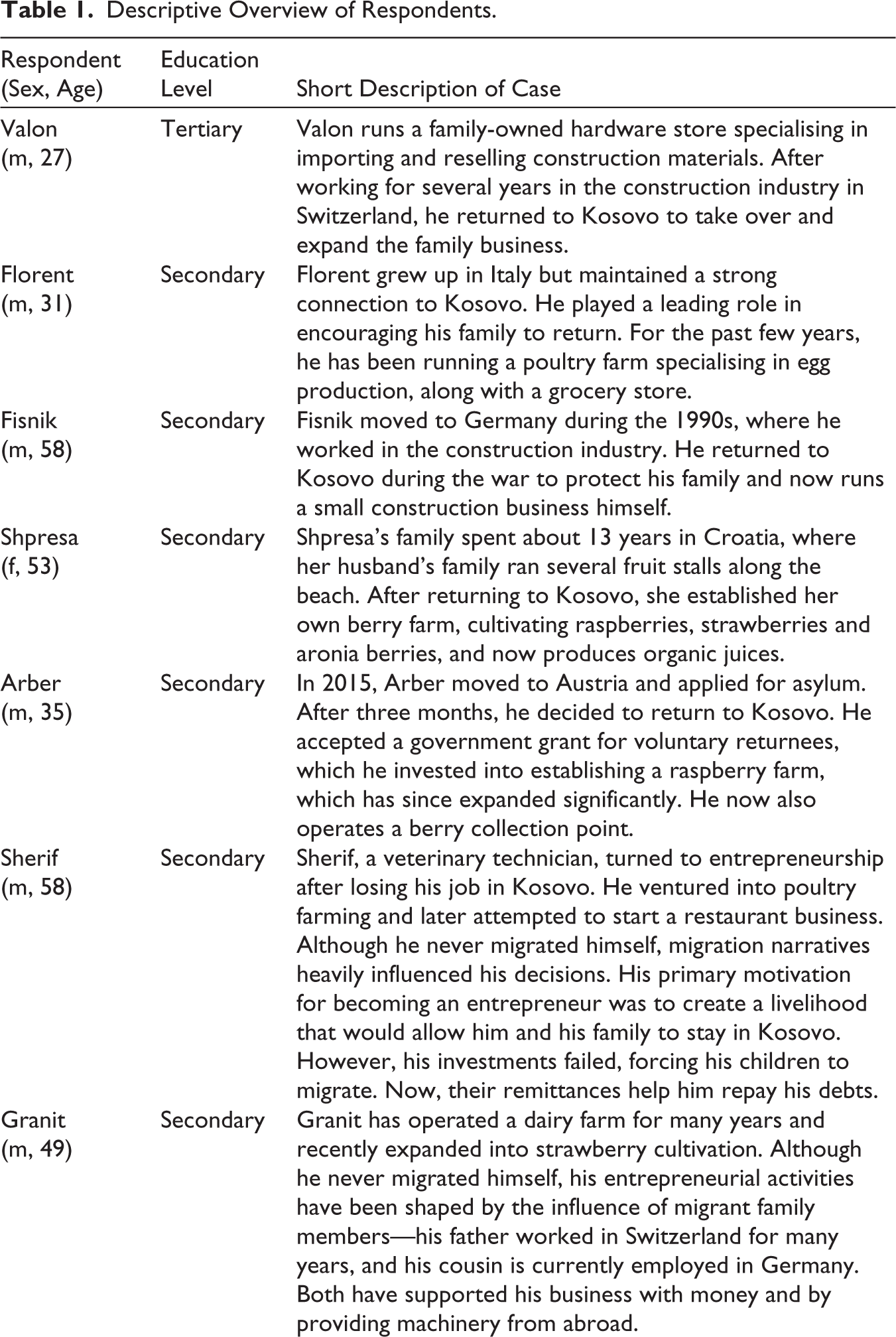
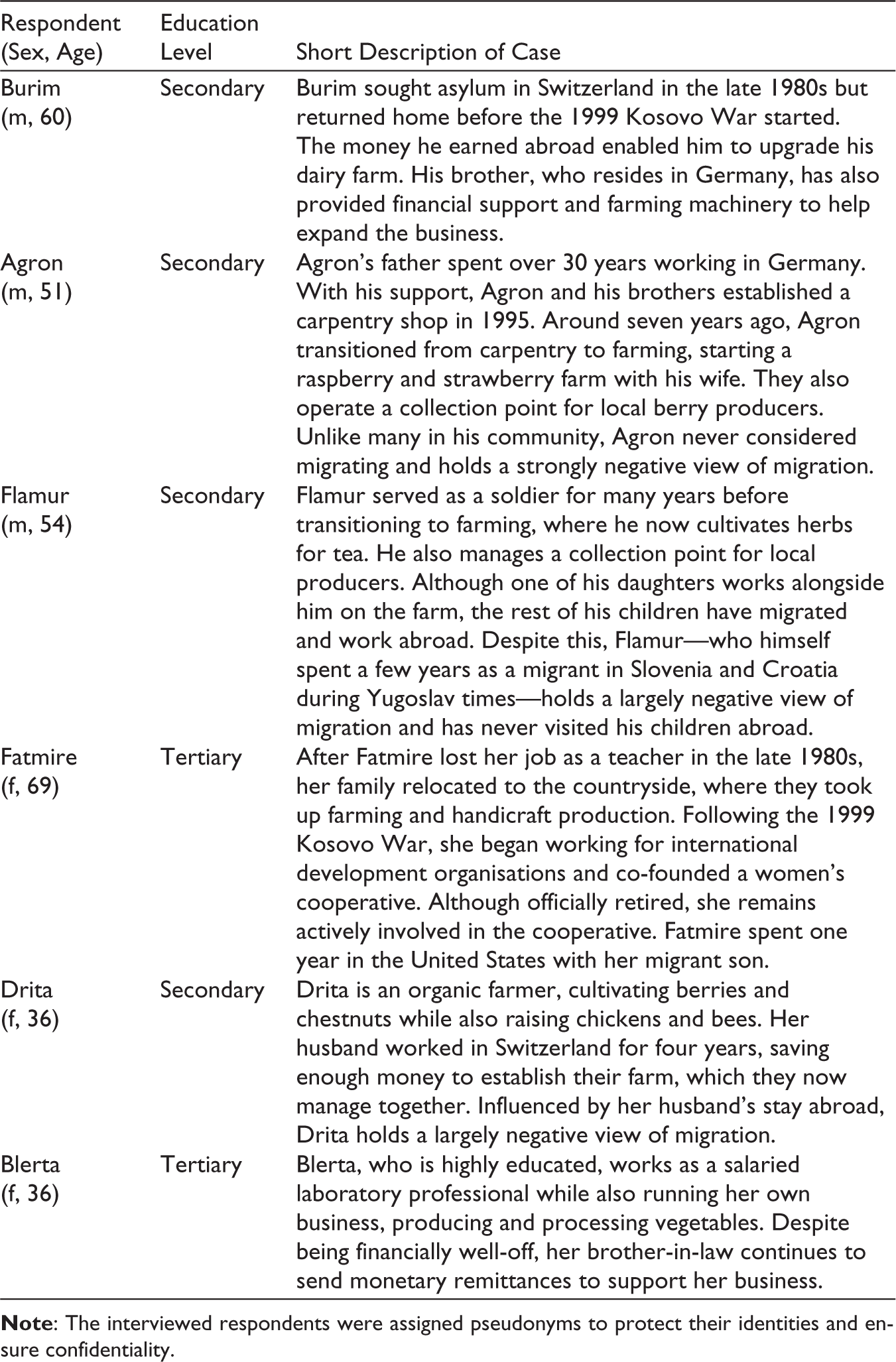
The interviewed entrepreneurs ranged in age from 27 to 69 years and included four women and nine men. All were married and had children. Six were engaged in non-farm businesses such as retail stores or construction enterprises, while 11 were farmers (partly combining farm and non-farm businesses). All interviewees were either return migrants or received tangible and/or intangible remittances, including financial, material or knowledge-based support from family members abroad. We analyse these groups together based on the shared influence of migration-related inputs—whether through direct experience or transnational connections—on entrepreneurial activity. While we do not consider them analytically identical, both are shaped by exposure to migration-driven resources, which is central to our focus on rural migrant entrepreneurship. This framework allows us to examine the broader role of migration in shaping business development at the rural origin while leaving space for future research to further differentiate these trajectories.
The interviews explored a range of themes at the intersection of migration and entrepreneurship, with particular attention to the role of remittances—especially intangible ones—in shaping entrepreneurial trajectories. The semi-structured interview guide was designed to cover the following key areas: (a) the acquisition, transfer and use of intangible remittances for entrepreneurial activities; (b) the origins and channels of these remittances, including the lived experiences of migration and return; (c) exposure to (return) migrants and the role of these networks in entrepreneurial activity; (d) engagement in farm and non-farm businesses, with a particular focus on how these businesses were linked to both tangible and intangible remittances and (e) migration narratives within the rural context of origin. While both migration and entrepreneurship were covered in all interviews, emphasis was placed on understanding how migration experiences and transnational connections enabled or shaped entrepreneurial activities in rural Kosovo. The focus on intangible remittances emerged as a central analytical lens throughout the interviews.
Interview partners were identified through multiple methods. Pre-established contacts provided by our Kosovo research partner—whose expertise ensured diversity in the sample—served as the primary sampling approach. Additionally, snowball sampling and random walk technique were employed in villages where previous participants resided. The interviews lasted between 30 and 90 minutes and were facilitated by an interpreter. They were conducted across multiple rural locations in Kosovo. The 13 interviews cover 10 municipalities; only the territory of Northern Kosovo, distinct due to its substantial Serbian-majority population and higher degree of autonomy, was deliberately excluded.
Standard ethical protocols were followed. Participants were informed of the study’s purpose, the interview process, their role and data usage. They were briefed on confidentiality, voluntary participation and their right to withdraw at any time. Before recording, participants had the chance to ask questions and provided oral consent. The interviews were transcribed, translated into English and analysed using MAXQDA qualitative data analysis software.
Drivers and Patterns of Rural Migrant Entrepreneurship
Entrepreneurial Traits and Remittances as Drivers of Rural Migrant Entrepreneurship in Kosovo
The first analytical thread in this section explores individual attributes as foundational to rural migrant entrepreneurship. While entrepreneurial traits and migration often go hand in hand, migration also offers additional, concrete inputs for those with access to tangible and intangible remittances. The second and third analytical threads, therefore, examine how these two forms of remittances enable rural entrepreneurs to recognise and act on entrepreneurial opportunities.
Building on Entrepreneurial Traits
Entrepreneurs come from diverse backgrounds and experiences, yet traits such as openness, curiosity, proactiveness and passion form a common foundation for entrepreneurial success. The rural migrant entrepreneurs in our sample exhibited high levels of curiosity and passion for their entrepreneurial pursuits. These traits were often closely tied to their migration motivations and experiences.
For example, Valon (27) described how his strong desire to learn, explore and achieve more than what was possible in Kosovo motivated him to migrate. Similarly, Florent (31), who had recently returned to Kosovo after spending most of his life in Italy, reflected on the limitations he had perceived in the conversations and ideas prevalent in rural Kosovo, which often failed to satisfy his broader curiosity. He noted, ‘When I take into consideration the conversations I have with other people here …, they do not offer me diverse topics to talk about. They will talk about politics or about cars’. Florent’s observation underscores the contrast between the more inspiring dialogues he experienced abroad and the comparatively narrow discourse in his rural community.
Valon also reflected on his curiosity and openness that had set him apart from other Kosovars abroad, many of whom were not prepared to engage with the culture of their new environment. In contrast, Valon embraced integration, proudly recounting how ‘within the first year, I was able to go by myself to the city hall, to the hospital’. His curiosity extended beyond language acquisition to exploring new places, building lasting friendships and actively adopting practices that later proved valuable for his business.
Granit (49), a dairy and strawberry farmer without personal international experience, actively sought innovative practices online. He explained, ‘We live in an internet-driven world, and I always look for new ways to carry out my business or improve strawberry cultivation’. Granit’s approach to work is deeply driven by passion. He stated, ‘When one has the will and the passion to do something, it doesn’t get tiring. What I am doing—for me, it’s a kind of passion, not work’. His example demonstrates how passion and curiosity can foster continuous innovation and improvement, with or without the direct influence of migration.
Female rural migrant entrepreneurs, in particular, stood out for their resilience and determination to overcome challenges, and strong self-efficacy and internal locus of control—demonstrating confidence in their skills and a belief in their ability to shape outcomes. Fatmire (69) exemplifies openness to learning and adaptability in her approach to agriculture. Reflecting on her early struggles, she candidly shared, ‘In the beginning, I had no idea how things in agriculture worked, but I read some books about it, and I learned how to do it’. Armed with this self-taught knowledge, Fatmire confidently began cultivating her own plants.
Shpresa (53), a return migrant and rural entrepreneur, illustrates how working abroad can bolster self-confidence and entrepreneurial drive. Reflecting on her time in Croatia, where she worked in her husband’s business, she shared, ‘Working in my husband’s business, gave me the confidence to believe I was capable of opening my own business’.
High self-efficacy was also evident among self-confident male entrepreneurs such as Fisnik (58), who stated, ‘I can do everything’, and Valon (27), who confidently remarked, ‘I saw myself as capable of something bigger’. Self-efficacy not only empowers entrepreneurs to pursue their aspirations but also equips them with the resilience needed to navigate setbacks.
These examples highlight that self-efficacy and an internal locus of control are not merely innate traits but can be developed through experiences, such as migration. Closely related to these traits is risk tolerance, another key dimension of entrepreneurial behaviour. Sherif (58) exemplified a high tolerance for risk: despite facing significant setbacks, including failed business plans, debts and prolonged legal battles with the municipality, he remained undeterred. His determination was evident in his willingness to sell an apartment to fund his projects and his ongoing consideration of further real estate sales to finance future ambitions.
However, the interviews revealed that risk-taking was not a dominant theme among the rural migrant entrepreneurs studied. Several factors may explain this trend. Many entrepreneurs appeared to be motivated more by necessity than by a deliberate willingness to take risks. While entrepreneurship inherently involves uncertainty, the risks these individuals encountered were often relatively modest. Investments were typically small-scale, and business growth tended to occur incrementally, reducing the overall exposure to significant financial or operational risks.
Rather than highlighting risk-taking, other qualities—such as stress tolerance, stamina, determination and a strong need for achievement—emerged as crucial in the discussions with rural migrant entrepreneurs. These traits enabled them to overcome challenges, persevere in difficult circumstances and sustain the hard work required to build and grow their businesses.
Take Valon (27) as an example. For him, the need for achievement was a key motivator, shaping both his decision to migrate and his entrepreneurial ambitions. Driven by curiosity and a desire for greater achievements, he explained, ‘I migrated to accomplish things I couldn’t achieve here. I saw no motivation to move forward in Kosovo’. Upon his return, Valon channelled his ambitions into establishing a hardware store and importing construction materials, demonstrating his drive to create opportunities for himself in Kosovo.
Determination and a strong need for achievement are key traits that enable individuals to overcome challenges and transform their aspirations into reality, even when faced with adversity and resistance. The rural context often amplifies these obstacles, particularly in highly conservative settings where introducing new ideas or innovations can be met with scepticism and social resistance. Successfully navigating such environments requires a high tolerance for stress and ambiguity. The experiences of rural migrant entrepreneurs in our sample vividly illustrate this reality.
Florent (31) exemplifies how the migration experience can heighten differences with the local population, leading to increased stress and ambiguity. Having recently returned to Kosovo after living in Italy, he reflected on how his migration experience shaped his behaviour, often setting him apart from the social norms in his home country. He recounted how his insistence on receiving or giving exact change—a common practice in Italy—often confused or irritated locals, who dismissed his habit with comments like ‘Why do you care about that 1 cent?’ and ‘We’re not in Italy’.
Despite this, Florent remained steadfast in his approach, demonstrating strong stress tolerance in the face of cultural friction. When people questioned how someone returning from Italy could lower themself to doing physically demanding farm work, he was undeterred. Instead, he fully embraced the work and continued with dedication.
As women entrepreneurs, Shpresa (53) and Fatmire (69) had to defy gender norms. In Shpresa’s case, people questioned how it was ‘possible that a woman can sell in the market’ and wondered how her husband allowed her to do this. However, Shpresa chose to ignore the detractors—she ‘never listened to them’—and stayed focused on her goals. Fatmire, despite facing resistance and criticism, began cultivating plants at a time when women were rarely involved in fieldwork, boldly challenging societal norms. Over the years, she transitioned into a social entrepreneur, actively supporting female employment and empowering other women to break similar barriers.
These stories also reflect a deep commitment to independence and forging one’s own path. The desire for autonomy was another important trait driving of rural migrant entrepreneurship. For instance, Blerta (36), who started a food processing business in 2020, stated, ‘I wanted to do something by myself’. Similarly, Flamur (54), a manager of a farm business and collection point, expressed his distaste for dependency, explaining, ‘Honestly, I did not like the idea of working for someone else or being dependent on someone else. I wanted to have something of my own. I always aimed to work only for myself and for my children’.
Doing Business with Family Support: Tangible Remittances
This section will discuss how tangible (monetary and in-kind) remittances are utilised in rural migrant entrepreneurship and examine their role in the emergence of entrepreneurial ventures. The New Economics of Labour Migration (Stark, 1991; Stark & Bloom, 1985) suggests that a lack of access to capital triggers migration as a strategy to accumulate start-up funds. Drita (36) and her husband exemplify this deliberate approach, viewing migration as a means to an end rather than a permanent state. Drita explained: ‘We got married very young, and to start something (a business) here, we needed some money’. For the couple, the husband’s migration served a singular purpose: to earn and save money for investment in Kosovo.
Unlike Drita, most of our respondents did not cite limited access to finance as their primary reason for migrating. However, all rural migrant entrepreneurs in our study relied on monetary remittances to either start or expand their business ventures. For example, Blerta (36) used financial and material support from her migrant brother-in-law to establish a small food processing business. The remittances were pivotal, enabling her to build the necessary infrastructure for her operations. Burim (60) invested financial support from his sons working in Germany to improve the family’s agricultural operations. The funds were used to purchase cows and construct a cow shed. Moreover, the farm relies on machinery brought in as in-kind remittances, including tractors delivered by his migrant brother in the early 2000s and, more recently, by one of his sons.
The experiences of Granit (49) and Agron (51) further illustrate the transformative power of tangible remittances. While neither had migrated themselves, remittances from family members abroad had allowed them to establish and expand their farming operations. Granit’s story highlights the broader impact of remittances on both his family business and the wider community. His family business profited from remittances in the form of agricultural machinery, including a mower, a milking machine, an automatic waterer and an irrigation system, many of which were novelties in Kosovo: ‘These things did not even exist here in Kosovo’, Granit remarked.
Most stories we encountered underscore how remittances can empower entrepreneurs to create sustainable livelihoods. In contrast, Sherif’s (58) experience serves as a cautionary tale about the risks inherent in business ventures. His efforts to invest locally in the hope of keeping his family in Kosovo ultimately failed, resulting in financial difficulties and the eventual migration of his children. The remittances he later received from them were used to service debt and covering basic living expenses.
Collectively, our researched accounts provide a rich tapestry of how tangible remittances are used in Kosovo’s rural economy. While the motivations and outcomes vary, the central theme is clear: migration and remittances are vital tools that, when strategically employed, can lead to significant entrepreneurial activities and hence development. They also play a critical role in bridging financing gaps. As Granit aptly noted, he feels ‘lucky’ to have been able to invest and create something lasting, thanks to the support of his migrant family, acknowledging that ‘many people don’t have enough resources (to start a business)’.
Ideas That Travel: Intangible Remittances
Rural migrant entrepreneurs often gain not only financial support through remittances but also valuable ideas and practices influenced by migrants’ experiences abroad. These intangible remittances extend beyond business concepts; they can reshape local practices, introduce new norms and drive innovation. Intangible remittances take different forms, such as knowledge, normative structures and practices, and cover a broad spectrum of contents, including economic, environmental, political and sociocultural dimensions (Pinkow-Läpple & Möllers, 2022). Our findings demonstrate how these intangible remittances provide valuable resources for entrepreneurial endeavours.
We begin with Granit (49), who reflected on the dual nature of new ideas spreading into Kosovo, engaging with a common narrative in the region: the concern that migration and intangible remittances may pose a threat to Kosovar identity. When he acknowledged that ‘migration has its positive side’, he primarily referred to financial investments and work-related intangible transfers, such as improved working methods. Regarding other forms of intangible transfers, Granit recognised their impact, stating: ‘Look, regarding new ideas, new mentalities, or new cultures, of course, they [the migrants] have brought something back here. I cannot deny it’. However, he emphasised the selective adoption of these ideas, asserting, ‘We only take the good things’, and stressed that they should not equate to abandoning traditions.
Business ideas were a common form of intangible remittance among rural migrant entrepreneurs. Arber (35), who operates a business sourcing berries from around 50 farmers for export, shared his experience: ‘While I was coming back from Austria, I saw a plantation with raspberries, and I thought about how I could do this kind of business here in Kosovo’.
Florent (31) and Shpresa (53) both capitalised on allocative opportunities by identifying products that were in high demand abroad but not yet available in Kosovo. Shpresa explained that her idea to produce exclusively organic products was inspired by her time in Croatia, where health-conscious consumers prioritised organic options. Reflecting this demand, she stated, ‘The idea to produce only organic products came from Croatia because people there take care a lot of their health. Based on that, I only produce products that are 100% organic, without added sugar’. Florent, on the other hand, developed his business idea while working in Italy. After observing reports about frequent food poisoning caused by eggs in Kosovo, he identified a gap in the local market for high-quality eggs similar to those available in Italy. This insight led him to establish his own farm business with a focus on quality and food safety.
Moreover, many migrant entrepreneurs bring back specific skills and work practices acquired abroad, which they integrate into their businesses in Kosovo. For instance, during his stay in Italy, Florent adopted a modern approach to quality in egg production, which he later implemented in his business upon returning to Kosovo. He explained: ‘We try to sell the production of the current day on the same day’. He also avoids selling in green-open markets, citing poor practices: ‘If you go there, you can see terrible things. They [the people who sell the eggs] do not care if the eggs are exposed to the sun the whole day’. Valon (27) transferred innovative sales and marketing strategies from Switzerland, such as advertising businesses with posters at construction sites, a practice he successfully implemented in his own business. Similarly, Fisnik (58) brought back advanced construction skills from his six years of experience working in Germany. He shared, ‘I advanced my skills there. … I learned things related to facades, the construction of tiles, as well as the external insulation of buildings’. Not only does he apply these skills to his own work, but he also actively transfers them to others: ‘Yes, and many people learn from my work too’.
Migrant entrepreneurs also frequently adopted and implemented work ethics and practices observed abroad. The structured work culture in countries such as Switzerland, Germany and Italy contrasts sharply with the more informal approaches prevalent in Kosovo. Those who have experienced these environments often return with a renewed emphasis on discipline, structured scheduling and long-term planning, integrating these principles into their businesses.
Valon (27) exemplifies this transfer of work culture. Having worked in Switzerland, he adopted a strong sense of work ethic, extending his business hours beyond conventional limits to ensure client satisfaction. Similarly, Granit (49) reflects on how exposure to international work ethics reshaped his perspective, emphasising the importance of following a strict schedule. In his case, this was a lesson he learned from his father’s experiences abroad. He acknowledges that adopting the practices he received as an intangible remittance has yielded positive results, motivating him to maintain them in his own business. Florent (31), drawing from his experiences in Italy and Germany, critiques the short-term mindset prevalent in Kosovo, contrasting it with the structured and forward-thinking approaches he witnessed abroad: ‘Here we think only for today. In Italy, people think in the long term’.
These narratives underscore the transformative power of intangible remittances in reshaping local work cultures. Exposure to structured and disciplined work environments abroad fosters a shift towards higher standards of professionalism, efficiency and long-term thinking, providing a foundation for sustainable business practices in Kosovo.
However, intangible remittances extend beyond the work sphere. Respondents also highlighted influences in the sociocultural sphere, such as politeness in social interactions and the embrace of individualism, as well as in the political sphere, particularly the state’s role in providing infrastructure and public transport. Additionally, they noted differences in attitudes towards the environment and gender roles. All these influences have a clear potential to shape entrepreneurial endeavours directly or indirectly.
While many of the work-related ideas were seamlessly adopted, others faced resistance due to cultural and social norms, challenging the traditional role of women, for example, encountered pushback, as seen in Fatmire’s case. Similarly, Blerta (36), who recognised the different treatment of women abroad through observing her brother-in-law’s more progressive behaviour, felt constrained in asking her husband for similar changes, highlighting the challenges of translating progressive norms into traditional settings.
Three Archetypes of Rural Migrant Entrepreneurs
Our empirical work in Kosovo led us to develop three tentative prototypes of rural migrant entrepreneurs. These archetypes differ in their underlying motivations for entrepreneurship and are shaped by entrepreneurial traits, migration attitudes and experiences, and the ways in which rural entrepreneurs use tangible and intangible remittances in their entrepreneurial endeavours. While these types inevitably overlap, they offer a useful framework for capturing the diversity of rural migrant entrepreneurs and the key characteristics that define them.
Importantly, these archetypes are not rigid categories directly mapped onto individual respondents. Rather, they are conceptual constructs informed by recurring patterns in the data and complemented by the authors’ broader research experience. As such, the archetypes serve as analytical tools for interpreting the diversity of rural migrant entrepreneurship rather than fixed categories based on demographic or migration-related variables. They are intended as a starting point for conceptualising this diversity and may be further developed or refined in future research.
Moreover, this typology also builds on the literature. It draws from research linking entrepreneurship to individual traits and migration-related exposure (Deller et al., 2019; Shane et al., 2003), as well as the broader body of work on tangible and intangible remittances as enablers of entrepreneurial action (Levitt, 1998; Pinkow-Läpple & Möllers, 2022). While financial motivations are clearly present, our findings also resonate with studies highlighting the role of moral obligation and community-focused values, particularly among returnees and socially engaged entrepreneurs (Carraher et al., 2021; Williams et al., 2023). Together, these insights help to position our archetypes within the existing conceptual landscape and underscore the diverse motivations and mechanisms through which migration shapes rural entrepreneurship.
First, classical rural migrant entrepreneurs or ‘Resilient Pragmatists’ focus on utilising both tangible and intangible remittances to establish or grow businesses in their rural communities. Driven by an entrepreneurial mindset and pragmatic approach, they capitalise on their migration experiences or received remittances to identify opportunities and implement practical solutions. Empowered by self-efficacy, determination and resilience, their primary motivation is economic success. However, their ventures can also yield significant spillover effects, such as job creation and contributions to the broader well-being of their communities. One example of a classical rural migrant entrepreneur is Valon, whom we showcase in Box 1).
Classical Rural Migrant Entrepreneur: ‘Resilient Pragmatist’—Valon.
Valon, 27 years old, operates a hardware store specialising in importing and reselling construction materials. His decision to start the business was driven by financial ambition and a commitment to contributing to Kosovo’s economy. By identifying a strategic market opportunity, Valon has built a thriving enterprise, attributing his success to exceptional customer service, which he believes sets his business apart from competitors.
As a former migrant to Switzerland, Valon viewed migration positively. He returned to Kosovo, convinced that his business had greater potential there. His time in Switzerland provided him with both monetary and intangible resources. He invested his savings as seed capital for his business. While he described these remittance funds as ‘a drop in the ocean’, he acknowledged their importance in getting started. Beyond financial resources, he adopted intangible assets, such as structured work ethics and a focus on work safety. He explained, ‘I got the work system, but not the culture from them [Switzerland]’, emphasising the practical lessons he applied, such as Swiss-inspired marketing strategies.
Valon embodies the traits of a classical rural migrant entrepreneur, characterised by high self-efficacy, proactiveness and a strong sense of personal responsibility. He believed himself to be ‘capable of something bigger’, a mindset that drives his ambition. His initial migration was driven by curiosity and a desire for personal growth—qualities that reflect his entrepreneurial nature. While abroad, he demonstrated exceptional adaptability and openness, which helped to broaden his perspective. His resilience and ability to handle stress have enabled him to forge his own path and achieve his goals.
Second, societal change rural migrant entrepreneurs, or ‘Progressive Innovators’, channel their entrepreneurial spirit into promoting social advancements within the context of their rural origins. Like classical rural migrant entrepreneurs, they are motivated by an inherent entrepreneurial spirit. However, what sets them apart is their intrinsic commitment to improving society by introducing positive changes inspired by their migration experiences or exposure to intangible remittances. Progressive innovators generally maintain a positive attitude towards migration and actively spread new ideas, norms and practices from abroad, such as progressive gender norms, better work conditions or environmental sustainability. Their ventures serve as vehicles for these ideals, positioning them as agents of both economic and social change. Despite their contributions, they often face resistance, especially in conservative rural settings where deeply ingrained traditions may clash with their initiatives. Nonetheless, their persistence and vision can lead to significant long-term benefits, as the gradual acceptance of their ideas can foster more inclusive, sustainable and resilient rural communities. One example is Fatmire, whom we present in Box 2).
Societal Change Rural Migrant Entrepreneur: ‘Progressive Innovator’—Fatmire
Fatmire, 69 years old, was a founding member of the Women-of-Krusha agricultural cooperative, established in 2010, which has since become a symbol of female empowerment in Kosovo. As a progressive innovator, she defied societal norms by stepping into farm work and leadership roles traditionally reserved for men. Her entrepreneurial activities were motivated by a desire to empower women and bringing them into work. To achieve this, she cooperated with various NGOs.
Fatmire’s exposure to migration came primarily through a one-year stay in the United States with her migrant son. During her stay, she acquired intangible remittances that have had a lasting impact on her life and work. She adopted a disciplined work ethic and came to expect higher standards of legal protections in Kosovo, particularly regarding women’s rights. She strongly believes in the transformative power of migration, viewing it as an opportunity for individuals to broaden their perspectives and to gain skills and knowledge. She encourages young people to migrate, not as a means to leave permanently, but as a way to acquire intangible remittances that foster change in their origin communities.
Fatmire is a remarkably open-minded, progressive and resilient individual. Raised in an urban environment and highly educated, her personality is marked by adaptability and a courageous willingness to challenge societal norms. Despite initial hesitation—such as refraining from driving when she first moved to her village in 1990 out of fear of judgement—she ultimately demonstrated immense strength and leadership.
Third, home-focused rural migrant entrepreneurs, or ‘Rooted Resisters’, combine the entrepreneurial spirit of classical rural migrant entrepreneurs with an aversion to migration, which they view as a threat, burden or suboptimal choice. These entrepreneurs seek to create business opportunities within their rural origins, focusing on viable, locally rooted solutions. Their motivation often stems from personal migration experiences they do not wish to see repeated by their children or family members, or from negative migration narratives that emphasise its downsides. 2 As a result, they are committed to addressing the root causes of emigration, such as limited local opportunities. Rather than merely resisting migration, they actively work to develop strategies to counteract the forces driving depopulation. While they tend to oppose migration, these entrepreneurs may still benefit from remittances. However, their primary goal is to improve local conditions, making staying a viable option. This combination of resistance to migration and entrepreneurial initiative positions them as critical contributors to the revitalisation of rural communities facing depopulation pressures. Sherif is as an example of a rooted resister, as illustrated in Box 3).
Home-focused Rural Migrant Entrepreneur: ‘Rooted Resister’—Sherif.
Sherif, 58 years old, is a veterinary technician who started an organic chicken farm after losing his job. He is a risk taker and very convinced of himself—in his own words, he is ‘the ideas guy’. His farm was meant to create the condition for him and his family to live well in Kosovo. However, when it failed over the Covid-19 crisis, his sons were forced into migration. He also attempted to start a restaurant but became a victim to nepotism and corruption. Despite these setbacks, Sherif never abandoned his entrepreneurial ambitions: he never stopped trying to create a business to create conditions for his sons to return.
Sherif has never migrated himself. However, like most rural Kosovars, he has been heavily exposed to migration in his community and, later on, received monetary remittances from his sons. His view of migration shifted over time: ‘I used to envy and be jealous of them (migrants). But now that I saw the situation (he visited his sons in Germany) I am not anymore’. He saw how his children experienced de-skilling, now working in the fast food sector abroad despite holding high school diplomas or university degrees.
Sherif’s profoundly negative opinion about migration—he is convinced that migration has a very negative impact on Kosovo—makes him feel bitter about not having been able to keep his sons in Kosovo. He is so frustrated and angry about the situation that he has even tried to convince strangers on the street not to emigrate.
Together, the three archetypes—resilient pragmatists, progressive innovators and rooted resisters—illustrate the varied ways in which rural migrant entrepreneurship is shaped by individual traits, migration experiences and the use of tangible and intangible remittances. While not exhaustive, this typology captures key patterns in our empirical material and demonstrates how entrepreneurs navigate both opportunities and constraints in migration-affected rural contexts.
Concluding Remarks
This study highlights the strong and underexplored link between rural entrepreneurship and migration. It addresses a critical research gap by examining how migration-driven entrepreneurship unfolds in rural origin areas, a topic still largely overlooked in entrepreneurship literature. Rural migrant entrepreneurs utilise remittances and migration experiences for business development and social entrepreneurship. By introducing the concept of rural migrant entrepreneurship and identifying three archetypes—resilient pragmatists, progressive innovators and rooted resisters—we offer a novel, albeit still tentative, framework for understanding how migration shapes entrepreneurial dynamics in rural settings. These archetypes serve as a starting point for conceptualising the varied ways in which migration influences rural entrepreneurship and invite further research to explore, refine and adapt them across different contexts.
Our research in Kosovo reveals that while some entrepreneurs capitalise on migration to drive economic growth, others use their ventures as platforms for societal change or to strengthen local resilience against outmigration. These findings contribute to ongoing debates about the diverse motivations and pathways shaping entrepreneurship, and extend previous work on remittances, return migration and neo-endogenous rural development.
At the same time, we recognise several limitations to our methodological approach. The study is based on a small, purposively selected sample of rural entrepreneurs in Kosovo and does not aim to offer statistical generalisations. Our archetypes are conceptual rather than representative categories; they are grounded in recurring empirical patterns but are shaped by interpretive analysis. Moreover, while our focus on tangible and intangible remittances provided rich insights into transnational influences, the data did not allow for a systematic comparison between different migrant-sending regions or a detailed analysis of variations in gender dynamics. Future research could expand on this foundation through larger comparative studies, longitudinal approaches or a more targeted focus on entrepreneur types that have so far been overlooked.
Despite structural challenges such as limited market access, social resistance and reliance on external financial flows, rural migrant entrepreneurship emerges as a powerful yet complex force for economic and social transformation. Since only a minority of returnees and remittance recipients possess the entrepreneurial traits needed to become agents of economic or social change, rural migrant entrepreneurship may only achieve broader impact through indirect effects or community-level spillovers. Nonetheless, the financial capital, knowledge and values transmitted via migration can help to catalyse rural innovation and support rural development strategies. Importantly, as several respondents suggested, migration need not always be longer-term or permanent to have impact—short-term stays, educational exchanges or circular mobility may also equip rural residents with valuable (in-)tangible remittances and a renewed sense of what is possible at home.
Footnotes
Acknowledgements
The authors wish to thank Iliriana Miftari (University of Pristina, Kosovo) for her invaluable support in data collection. We also extend our sincere thanks to the two anonymous reviewers for their insightful and constructive feedback.
Declaration of Conflicting Interests
The authors declared no potential conflicts of interest with respect to the research, authorship and/or publication of this article.
Funding
The authors disclosed receipt of the following financial support for the research, authorship, and/or publication of this article: This research was funded by the Leibniz Association under the Leibniz Cooperative Excellence Programme, project title TraFFF - Transnational Families, Farms and Firms