




Abstract
Cambodian cities continue to experience major growth, due principally to in-country migration. However, the recent trajectory and historical context of urbanisation differs from other Asian countries and as such are less investigated. Using a framework of interconnected migration factors, this article reports on rural-to-urban migration in five provinces around Phnom Penh—from the perspective of both urban migrants and their rural family members. The work examines the economic, environmental, and sociocultural factors influencing migrants’ current and desired movements, changing livelihood activities, and the permanency of migration choices. While there is evidence to support three major theories of migration—income differentials, environmental change, and social networks—it is argued that none of these alone explains current migration patterns. Explanations of Cambodian migration must account for the powerful attraction of home villages and kin relations, as well as the inseparability of two exogenous factors: the proliferation of microfinance (MFI) and the rise of the garment industry. The results show distinct patterns of migration with implications for adaptation, precarity, and rural livelihoods.
Introduction
Global urbanisation continues to accelerate with 68% of the world’s population projected to live in cities by 2050 (United Nations Department of Economic and Social Affairs, 2019). Since the 1980’s, Cambodia has followed this trajectory with rapid population growth in cities and expansion of secondary towns. Currently, over 24% of the country’s population lives in urban areas with urban growth rates of over 3% a year, mainly via pathways of internal migration (Diepart & Ngin, 2020; World Bank, 2021a).
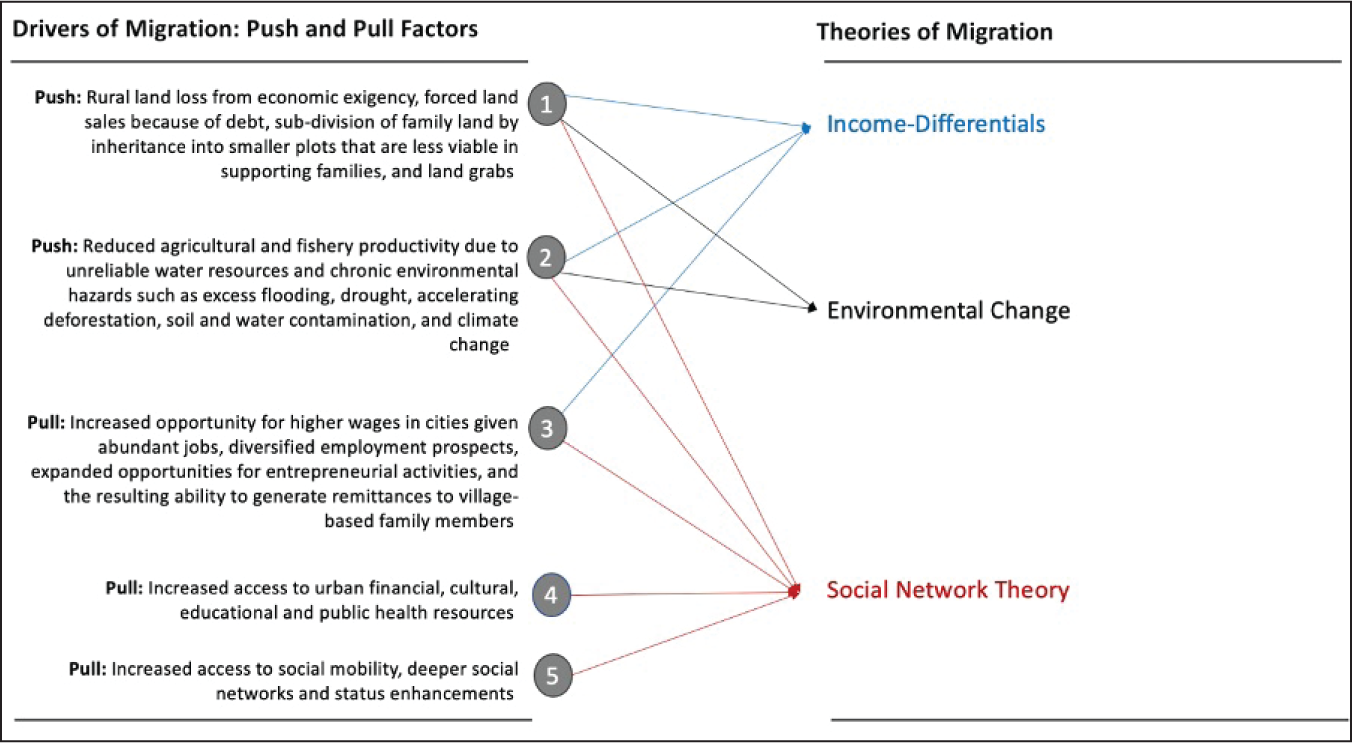
Rural-to-urban migration can be seen as both a coping mechanism and an adaptation strategy generated by the confluence of local and market-based factors following short-term environmental shocks and longer-term changes in local ecologies and production systems (Black et al., 2011; Bylander, 2015; Hunter et al., 2015; McLeman & Smit, 2006; Suhrke, 1994; Tacoli, 2009). Although cross-country comparisons can inform our understanding of this process, the factors leading to such population movements in Cambodia must account for its historical, economic, ecological and cultural specificities, which reveal a complex web of interacting socio-environmental drivers of migration to Cambodian cities. In this article, we describe three theories of migration that focus on different drivers of migration and apply these to the Cambodian case through analysis of focus groups and key informant interviews (Figure 1). Our results indicate that the interplay and integration of these three migration theories and their associated drivers capture, in large part, how economic, environmental and social forces affect rural populations and create movement between rural and urban areas in Cambodia.
Hypothesized Drivers and Theories of Migration from Rural to Urban Areas in Cambodia.
Recent descriptive studies examine Cambodian migration through local accounts of the factors driving younger people and women to cities (Ballard et al., 2007; Bylander, 2015, 2017; Derks, 2008, Dun, 2011; Peou, 2016), and the migration related to the loss of fishing and farming livelihoods (Middleton & Un, 2017). Quantitative studies of Cambodian migration have been limited, but recent ones include an examination of propensity scores of migration’s impact on poverty reduction (Roth & Tiberti, 2017), as well as an analysis of mobility, population redistribution, and internal migration flows (Diepart & Ngin, 2020). There is also emerging research connecting migration to climate change and environmental risk and vulnerability in Cambodia (Middleton et al., 2017, Parsons & Chann, 2019, Parsons & Nielsen, 2021).
Yet, there are challenges to telling a more detailed story of Cambodian internal migration. There is a lack of sufficient household-level data, detailed insights into perceptions and motivations of migrants, comprehensive documentation of the informal economy, local models of human–environment relationships, and an understanding of the regional differences that exist based on village-level conditions and proximity to cities. We address some of these lacunae by focusing on the current context of rural-to-urban migration through the eyes of both migrants living in the city and their families back home in the countryside in southern provinces surrounding Phnom Penh. Using a framework of an interconnected theory of migration, we use qualitative data of in-country migration collected in 2017 and 2018 to explore the reasons for movement to cities, and how families that separate seek to maintain kinship and other socio-economic relationships with their home villages. Through treatment of the perspectives of members of rural households, both those who have stayed in the villages and those who have recently migrated to the city, we contribute to understanding the migration decisions of households and individuals.
Our fieldwork reveals a marked pattern of movement from the countryside to urban centres, principally among young adults. This migration pattern appears to be driven by changing socio-economic and environmental conditions, including the rise of microfinance (MFI) loans and associated indebtedness, expanding regional access to garment factory and construction jobs, the decline of agricultural labour prospects versus urban wages, economic land concessions (ELC), short and long-term environmental change, and the impact of kinship norms.
The Cambodia Context
Historical Significance
Over the past 50 years, the lower Mekong basin of Cambodia experienced profound political, social, economic, and land-use change. In 1975, as part of its ideologically driven program to transform Cambodian society, the Khmer Rouge rapidly evacuated the capital of Phnom Penh, forcing city dwellers into communal agricultural labour in the countryside. The regime’s brutality between 1975 and 1979 resulted in the deaths of an estimated 1.7 million people, complete upheaval of urban life, and radical changes to traditional farming practices (Chandler, 2000; Heuveline, 1998; Heuveline & Poch, 2007). During this period, the Cambodian urban population fell by a factor of six and the capital of Phnom Penh was devoid of city life, aside from activities associated with military occupation. It was not until the 1980s that Cambodian cities underwent rapid repopulation, followed in subsequent decades by steady rural-to-urban migration.
The Vietnamese invasion of Cambodia in 1979 facilitated the fall of the Khmer Rouge regime and also induced major socioeconomic transformations (Rowley, 2006). During the initial years of Vietnamese occupation in the early 1980s, desultory agricultural collectivisation with some private holdings resulted in a patchwork of large, medium, and small farms (Nesbitt, 1997), but many rural areas remained dormant due to ongoing conflict and the presence of land mines. As mines were gradually removed, Cambodian refugees resumed farming in restricted areas. After the Vietnamese withdrawal in 1989 and a subsequent United Nations’ intervention in 1991 to usher in a democratically structured Cambodian state, villages were resettled and agricultural activities on traditional landholdings were privatised. Market economies were reintroduced, initiating a rapidly accelerating phase of capitalist development (Chandler, 1996; Martin & Bare, 1994). Since 2000, many depopulated rural areas have been re-occupied by both small-holder, village-scale farms and larger plantations of high-value commodities controlled by Cambodian and multinational agribusiness firms through economic and social land concessions (Diepart, 2015).
Rural Livelihoods
Despite the reconstitution of village life, Cambodia’s historically rich agricultural countryside, fueled by the annual flood cycles of the Mekong River, has experienced major alterations. Relative economic opportunity, coupled with declining prospects for agriculture, has increasingly led people of working age to migrate to cities in search of more lucrative employment opportunities.
The explanations for the decline in agricultural incomes are multifaceted. They include lower farming and fishing productivity and returns, low product prices, loss of land, and rising debt, all of which have been connected to environmental change. While many villagers attempt to cope with these and other stressors, mitigating livelihood loss depends on their ability to generate alternative forms of employment and supplemental income-generating activities, the capacity to adopt novel farming practices, access to infrastructure and markets, and proximity to other natural resources, such as forests (Felkner et al., 2022; Jiao et al., 2017; Kelley et al., 2020).
Borrowing is an increasingly common coping mechanism. Indebtedness has risen in the countryside over the past decade, in large part through a transition from informal to formal borrowing as MFI and commercial lending institutions proliferated in the countryside (Bateman, 2010; Bylander & Hamilton, 2015; Felkner et al., 2022; Nang, 2013). Based on data from MIX Market, an information clearing house for MFI data, the number of Cambodians with active loans increased from just over 492,000 in 2005 to 2.3 million by 2015. 1 Parallel to this explosive growth in total borrowers is an increase in the average loan per borrower, from 66% of Gross National Income per capita in 2005 to over 240% in 2015. Given the difficulty of generating positive returns from farming, the inability to pay back loans often leads to further borrowing and unsustainable debt burdens (Bylander et al., 2018).
At the same time, changes to the agrarian economy have occurred due to loss of smallholder lands, conversion to industrial agriculture focused on large-scale production of export crops, and migration away from farm work (Kelley et al., 2020; Neef et al., 2013). In particular, the increase in legal ELC has resulted in many small-scale farmers losing their land to government-sanctioned economic development schemes, pushing many into wage labour on larger plantations (Bateman, 2010; Bylander & Hamilton, 2015; Jiao et al., 2015).
Even as movement from rural villages to urban centres intensifies, the majority of Cambodians still continue to live in rural areas as small-scale, subsistence farmers, weathering the impacts of accelerating urbanisation and commercialisation of farming. Although the movement to cities has contributed to a dramatic decrease in national poverty rates, many Cambodians remain on the brink of falling back into poverty as rural livelihoods continue to decline (World Bank, 2021b). The rural poor lack adequate resources to fully adapt their agricultural practices, which, coupled with lower mobility, makes them most vulnerable to external shocks and deteriorating agroecological conditions.
Environmental Change
Myriad forces have contributed to changing agro-ecological landscapes in the Mekong region over the past several decades. Rapid construction of hydropower dams and other large-scale land-use changes along the entirety of the Mekong have altered river hydrology, sedimentation rates, nutrient fluxes and associated components of agricultural and fishery productivity (Arias et al., 2012; Davis et al., 2015; Dugan et al., 2010; Hecht et al., 2019; Kondolf et al., 2018; Pearse-Smith, 2012; Piman et al., 2015, 2016; Pokhrel et al., 2018; Sabo et al., 2017). Moreover, extensive legal and illegal logging for timber and charcoal production, and conversion of land for cash crops, such as rubber, cashew, and tobacco, have accelerated already rapid rates of deforestation in Cambodia (Gaughan et al., 2008; Imai et al., 2018; Laurance, 2007; Lohani et al., 2020). ELCs have been a major contributor to deforestation, with Davis et al. (2015) estimating that between 29% and 105% higher rates of forest loss on land within such concessions, most of which occurred after the land was contracted. Today, Cambodia faces the highest forest loss and deforestation rates among all countries in the Mekong basin (Lohani et al., 2020).
Climate change poses additional risks to Cambodia’s agroecological landscapes (Nang, 2013). Projections of the impacts of climate change indicate significant losses of ecosystem productivity in the lower Mekong River basin (Arias et al., 2014), although more research is needed on the human impact of such changes (Felkner et al., 2020). As the lived experiences of climate change continue to accumulate, movement out of the Mekong Delta into cities is increasingly likely (Kim & Minh, 2016). Land use change and resource shifts in Cambodia are greatly influenced by power relationships, which also drive both mobility and immobility – an important considerations in the spatial configuration of the migration landscape (Parsons & Chann, 2019). Recent studies in Cambodia expand the theoretical framing of the unequal distribution of climate risk and associated adaptation measures in Cambodia, using political economy frameworks of ‘precarity’ induced by power relationships (Natarajan et al., 2019), and ‘rupture’ of nature-society relationships over different spatial and temporal scales (Mahanty et al., 2023).
Farmers’ responses to these changing environmental conditions vary depending on their ability to cope, mitigate and adapt. Crop changes can have relatively short-term benefits while adapting farming practices and increasing mechanisation require larger investments with longer payback periods. The return on these investments relies on future returns from agriculture, which are influenced by changing environmental conditions, and other factors driven by political economies that influence crop prices, access to markets and credit, and wage labour opportunities.
Migration and Urbanisation in Cambodia
Urban land area in Southeast Asia continues to increase, as does the urban population (Schneider et al., 2015). Much of this influx is attributed to internal migration. The Cambodian Rural Urban Migration Project (CRUMP) found that one in four households had a member of the family move for employment (Ministry of Planning, 2012). Of these migrants, nearly 90% were 15–34 years of age, and 57% had moved to cities. This movement of the younger population and in particular, young women of reproductive age, has concentrated people of working age in urban areas and children and older people in rural areas, resulting in changing household structure and dynamics, and transformation of rural lifeways (Brickell, 2011; Bylander, 2015; Derks, 2008; National Institute of Statistics, Ministry of Planning, 2009; Peou, 2016).
These migration trends reflect shifting demographic and economic patterns in Cambodia as the productive labour force is increasingly concentrated in cities and non-agricultural industries. Over the past two decades, the service sector gained dominance in urban areas, growing from 60.7% of the urban workforce in 2008 to 73.6% of employment in Phnom Penh in 2017. In this same period, rural agricultural employment dropped from 85% to 46.5%, despite the majority of the population still residing in rural areas 2 (MOP, 2009, 2017).
Theories of Migration
To understand these emergent demographic patterns, we examine three frameworks for migration—income differentials, environmental change, and social networks—and assess their applicability to the Cambodian case. We apply the interconnectedness of these migration frameworks through the lens of ‘home and away’, from the perspective of urban migrants working in the city and their rural kin back home.
Since the 1950s, theoretical formulations of rural-to-urban migration have focused on contrasting macroeconomic conditions to explain the flow of migrants from the countryside to the city (cf. Lewis, 1954). This theory entailed a concept of a ‘dual economy’ in which the rural sector was portrayed as embedded in a traditional, static, and low-innovation culture in contrast to a rapidly modernising, dynamic urban culture of capital accumulation and technological innovation. Conceptual framing of a dual economy characterised by these ‘two cultures’ implicitly conditioned the emergence of a series of push versus pull models in which ‘rural push factors include poverty, inequitable land distribution, environmental degradation, high vulnerability to natural disasters, and violent conflicts, while urban pull factors include better employment and educational opportunities, higher wages, diverse services, and possibilities for increased status in the cities’ (Hoffmann et al., 2019, p. 2).
In this article, we consider these push-pull factors for the Cambodian context using interconnected frameworks of migration as shown in Figure 1.
Income Differentials: Explanations from Economic Development
Theories of income differentials between rural and urban employment result from the interaction of drivers (1), (2) and (3), inducing a migratory flow to cities based on comparisons of income potential (Figure 1). In this framework, migration is considered an investment in human capital based on the comparison of the expected present value of income between rural and urban employment opportunities (Harris & Todaro, 1970; Lucas, 1997; Sjaastad, 1962). Under this premise, movement from rural to urban areas will continue as long as the returns to labour are higher in non-agricultural jobs (Gollin et al., 2014; Larson & Mudlak, 1997). However, labour movement is not smooth given that changing occupations and locations is costly and affected by age, education, distance and other factors that drive utility comparisons of lifetime earnings (Larson & Mudlak, 1997).
While the income differential explanation for migration is shaped by nuanced factors, including positive selection, access to formal credit, proximity to cities, land tenure, and support from informal rural networks, there is ample evidence that urban employment increases labour productivity (Bylander & Hamilton, 2015; Larson & Mudlak, 1997; Young, 2013). Migration of a subset of the family also serves as a form of collective self-insurance in the absence of formal insurance programs in the rural sector (Stark & Levhari, 1982; Stark & Lucas, 1988). Remittances to families remaining in the countryside can be invested in asset-generating activities, such as land purchases, house construction, new agricultural technologies, and inputs to intensify production, or as seed capital for rural entrepreneurship, including creation of family-run small businesses (De Brauw, 2019).
However, there are often negative social and economic implications for those who remain in rural areas, as well as for urban migrants who face risky conditions in cities. Beyond returns to labour, there are sociocultural transitions that occur with migration that affect gender roles, family structures, local support networks, land transfers, and social capital (Brickell, 2011; Derks, 2008; Kelly, 2011; Lawreniuk & Parsons, 2017; Parsons et al., 2014; Peou, 2016; Zimmer & Knodel, 2013; Zimmer & Treleaven, 2020). As urbanisation intensifies, the future of migrant employment opportunities in Cambodia is tenuous because of its dependency on macroeconomic conditions influenced by political economies, including increasing urban land values, the status of global trade agreements, fluctuations in foreign direct investments, and, as witnessed with COVID-19, mandated closures of factories and small and medium-sized businesses.
A key assumption of the income differential motivation for migration is that the potential increases in income outweigh other social values, such as sustaining multi-generational families, attachment to place, and solidarity with kin. While there is significant evidence to support the human capital theory of migration, we seek to uncover the more complex motivations for migration in our study area, including historical context, varied perceptions of environmental change, and specific social norms.
Depauperate Landscapes: Explanations Related to Environmental Change
A common variant of push versus pull models envision migration as heavily influenced by climate change and environmental degradation that create depauperate landscapes and ecologies of production, which, in turn, force population dispersal (Feng et al., 2010; Myers, 1997; Westing, 1992, 1994). This is a theory focused principally on centrifugal forces, ‘push’ factors (1) and (2), driven by instability in and depletion of rural resources (Figure 1).
Environmental theory of migration proposes a direct, linkage between environmental shocks, climate change, natural resource degradation and migration, with some accounts predicting an imminent global crisis of ‘climate refugees’ (Hulme, 2010; Piguet, 2013; Sluyter, 2003). The theory that climate change will induce massive population displacement and dislocation from vulnerable regions retains significant influence in international policy forums, advocacy networks, and some academic research (Intergovernmental Panel on Climate Change, 2014; United Nations Refugee Agency, 2021; Myers, 2005).
However, more recent assessments of the role of environmental change and ecological degradation in inducing migration emphasise the complex interaction of context-specific social, psychological, political, economic, and environmental variables (Adams & Adger, 2013; De Sherbinin, 2020; Foresight, 2011; Felli, 2017; Jónsson, 2010; Warner et al., 2010). Abrupt environmental shocks, as well as the cumulative effects of climate change, influence a population’s decision to migrate. However, these environmental drivers rarely act in isolation, nor are they exclusively determinative factors for individuals and households contemplating migration (Foresight, 2011). Further, vulnerability and risk associated with climate events is driven by myriad factors including policies intended to facilitate climate adaptation, infrastructure development and built environments, unstable property regimes and governance structures.
Rural populations navigate environmental change through alteration of farming practices and adoption of new agricultural technologies, often financed through remittances, microcredit, or commercial borrowing, and by attempts to find new sources of income through wage labour and business creation (Deshingkar, 2012; Natarajan et al., 2019). These responses are often not sufficient to manage the ongoing effects of climate change and land transformation. The confluence of such factors may ultimately lead to migration (Bylander, 2015, 2017; Dun, 2011; Heinonen, 2006; Le Texier, 2013).
Explanations from Social Network Theory
Theories of migration related to social networks have focused on kinship as a driver for locational choices. A personal connection to the city can reduce the costs of migration by facilitating housing and employment (Yap, 1977), enhancing information, and reducing perceived risks of urban living (Lucas, 1997). While other forces may influence movement to cities, kin and non-kin forms of social relations, such as patron–client networks, facilitate the process.
Social network theories of migration emphasise the interconnected nature of households that have members residing in the village of origin and others in the city, with regular remittances serving as the economic bond across these partible, yet socially and economically conjoined households (Demont & Heuveline, 2008; Deshingkar, 2012). Today, these households interact frequently via cell phones and periodic return visits to the village to participate in seasonal farm work and life events. Such partible, yet conjoined households frequently reflect a cultural pattern of intergenerational solidarity in which dependent children, productive adolescents and young adults, and elder members of the households are linked through a single system of subsistence, economic aspiration, and social reproduction (Chan et al., 2002; Lawton et al., 1994; Silverstein & Bengston, 1997; Vanwey, 2004).
The establishment of these partible households relates to the positive valence of driver (3) interacting with the negative valence of drivers (1) and (2), with the non-employment opportunities of city life represented in drivers (4) and (5) serving as additional centripetal forces that can enhance individual and household well-being by increasing social capital.
This focus on the critical role of social networks in motivating rural-to-urban migration is particularly important in the context of Cambodian culture, which places a high value on the nuclear and extended family, intergenerational-solidarity, and the establishment of non-kin-based patron–client relationships (Ebihara, 1987; Hinton, 2005; Vickery, 1999).
Social network and income-differentials theories both focus heavily on drivers (1), (2) and (3); however, they differ in significant respects. Income differentials theory represents migration as a collective strategy that diversifies livelihood portfolios across rural and urban sectors. Social network theory claims kinship per se serves as an ethic and a moral paradigm of asymmetrical aid cutting across several generations premised on cultural ideals of mutual obligation to kin and kith and of perduring attachment to place, specifically to family, farm, and village of origin.
Although other bodies of migration theory could be mobilised to analyse and interpret the patterns of movement we observed in our case study, the interaction of the three discussed here offers a compelling framework to understand recent migration between the Cambodian countryside and the capital city of Phnom Penh.
Methods and Materials
The data for this research were collected using three separate instruments: (a) focus groups among members of rural households in villages within 100 km of Phnom Penh in December 2017; (b) focus groups of urban migrants from these same villages in Phnom Penh in December 2018; and (c) a small sample of face-to-face surveys with urban migrants from these same villages in Phnom Penh in December 2018. All data were collected in collaboration with the Cambodian Development Resource Institute (CDRI). 3
Rural Focus Groups: Village Sampling
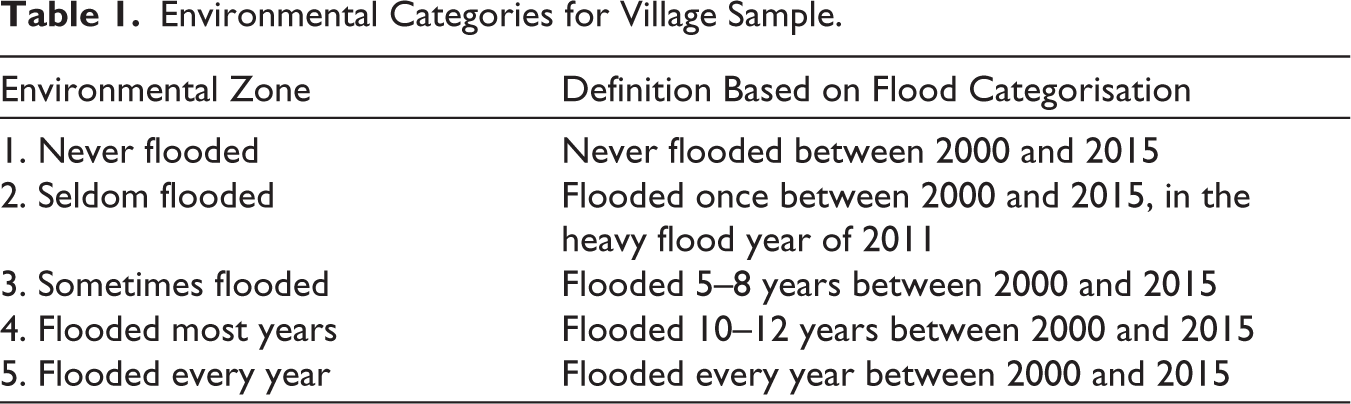
To ensure diversity in economic and agro-environmental conditions, especially in terms of the effects of changing flood regimes (Grundy-Warr & Lin, 2020), sample villages were selected in Kampong Cham, Prey Veng, Takeo, Kampong Speu, and Kandal provinces using a stratified random method defined by relative flooding frequency. Villages were selected from the 2008 General Population Census of Cambodia by defining the universe of villages that had experienced Mekong River flooding at least once between 2000 and 2015, along with villages that were just outside the flooding zone and had never been flooded. Villages within a two-kilometre buffer zone beyond the flooded villages were added, and the universe was stratified into five categories by frequency of flooding, as shown in Table 1. The flood extent within village boundaries was defined using the MODIS 16-day composite Enhanced Vegetation Index with 250-m spatial resolution (Data products MOD13Q1 and MYD13Q1 from Terra and Aqua satellites, respectively) from NASA.
Environmental Categories for Village Sample.
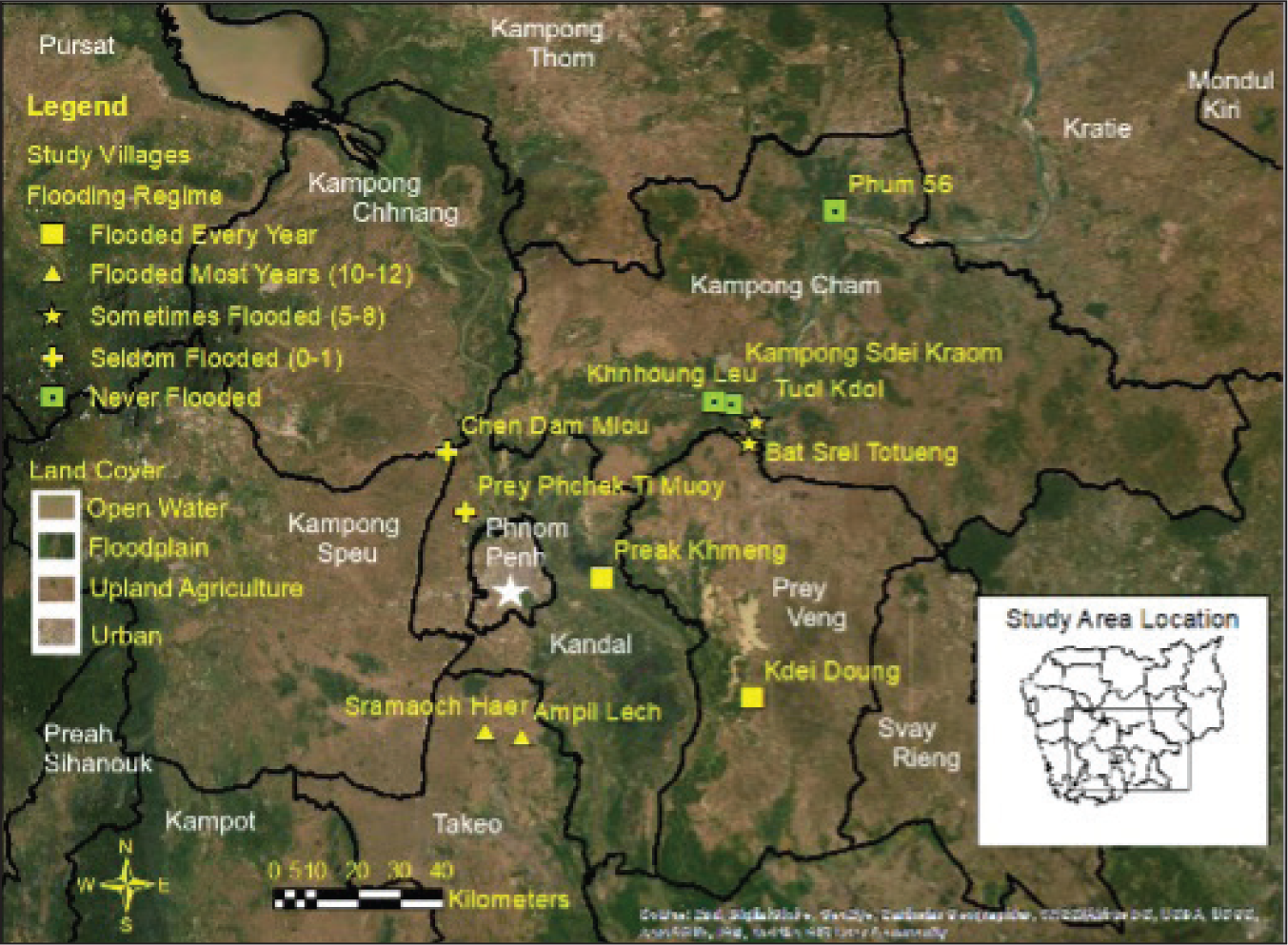
Villages were selected randomly from this sample, along with a set of replacement villages if any proved to be inaccessible. Ultimately, 11 villages (listed in Table A1 in the appendix) were visited as shown on the map in Figure 2. Due to the inaccessibility of some villages in each zone, three replacement villages were selected with one extra village in the ‘Never Flooded’ environmental zone. Ultimately, a total of eight key informant interviews and 10 focus groups were conducted in the 11 villages visited.
Map of 2017 Sample Villages by Environmental Zone Classification and Regional Distinctions.
Rural Focus Groups
Following the acquisition of the necessary permits to conduct fieldwork, researchers at CDRI obtained household lists from village heads who also provided background and context on the villages and residents. Since our research is largely qualitative and inductive, and due to the informal nature of village networks and reliance on word of mouth, we did not impose strict parameters on recruitment beyond guidance to vary age and gender given the constraints of current village composition. From the household lists, CDRI selected head of household or decision-making male and female adults (over 18) representing a range of occupations. At least one elderly household member was recruited per focus group to provide the historical context of the village.
The 10 village-level focus groups were conducted over one week involving 87 total participants. All focus groups were conducted in Khmer and simultaneously translated for our research team in the field. Focus group facilitators were instructed to keep the discussion informal, using prompts, rather than specific interview questions, to allow participants to determine the flow of the conversation. The components of the focus group discussion are detailed further in Table A2.
Interviews with village heads as key informants were conducted concurrently and included similar questions but from a village-wide perspective. These data are not explicitly analysed here but provide important context regarding village and commune-level investments by various actors, access to markets, financial credit and insurance, and the role of social networks and informal support for residents.
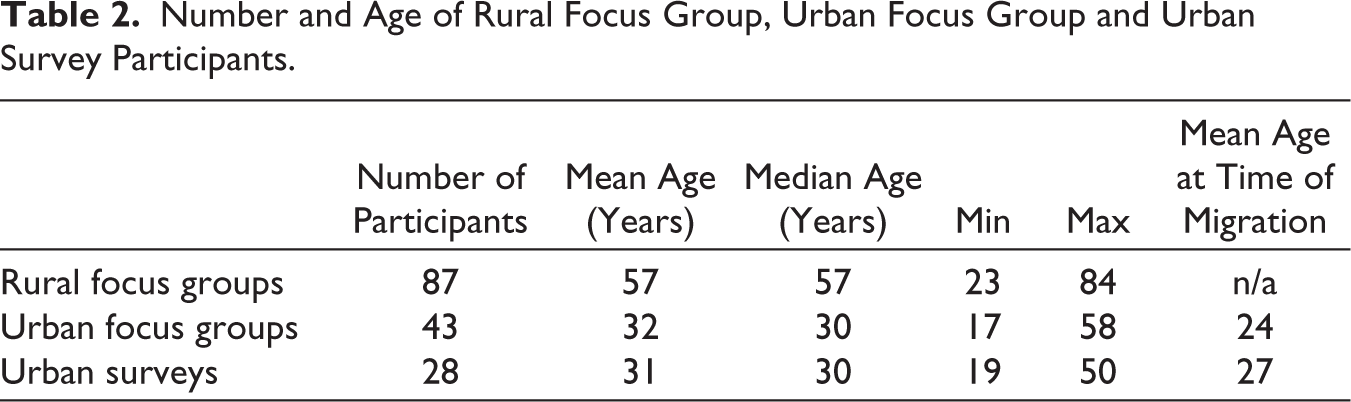
The composition of the focus groups illustrated the pronounced migration of working-age adults in recent years. Many of those present in the villages were not of working age but rather grandparents tending to children while parents worked in Phnom Penh or other cities. This was evidenced by the mean/median age of the focus group participants of 57 years. Recognising the limitations of understanding migration only from the perspective of older residents who remained in villages motivated a second phase of fieldwork focused on those who had already left the villages to work in the city.
Urban Migrant Focus Groups and Survey
We returned to Cambodia in 2018 to interview migrants who primarily had left the sampled rural villages to work in Phnom Penh. Focus groups and a separate survey were conducted at the CDRI offices in Phnom Penh on a holiday and weekends when participants were not working. Initial participants were identified by family members from the villages represented in the 2017 fieldwork, followed by snowball sampling to recruit others from those same villages. Since many migrants reside or work with friends or family from their villages, we were able to recruit via word of mouth. The urban participants, who were not asked to provide their names, were male and female adults who worked primarily in construction and garment factories, respectively.
Over the course of several days, three exclusively female and three mixed-gender focus groups with a total of 43 participants were conducted in Phnom Penh. In addition, 28 surveys of a different sample of urban migrants in Phnom Penh were conducted using one-on-one interviews by enumerators who recorded the responses to a combination of closed and open-ended questions using KoBoToolbox on tablets. Women comprised 77% of the focus group participants and 61% of the survey respondents, mainly representing garment workers. As expected, the average age of our participants was lower in the city. Table 2 shows this breakdown of rural and urban focus group and survey participants by mean and median age, and the average age at the time of migration.
Number and Age of Rural Focus Group, Urban Focus Group and Urban Survey Participants.
The urban migrant focus group explored different aspects of the participants’ lives before and after moving to the city, while the one-on-one multiple-choice surveys were conducted with a smaller, separate sample of migrants to augment the focus group data with more explicit, discrete information. More details on the urban migrant focus group and survey are provided in the appendix in Table A3 and Table A4, respectively.
From the instruments described above, we sequentially analysed the translated transcripts and interview summaries to organise content, extract relevant common themes, and identify empirical patterns related to the migration theories outlined earlier and other factors influencing decisions to migrate from the perspectives of both older family members who stayed ‘home’ and younger ones who were ‘away’.
Results
Income Differentials and the Proximity of Garment Factories
In line with the basic tenets of the theory of income differentials, both rural villagers and urban migrants agree that a lack of non-farm opportunities for income in the village contributes to migration. Further, consistent with driver (3), every urban survey respondent cites employment opportunities as a reason for their move to Phnom Penh regardless of other motivations. Similarly, many urban focus group participants claim that poverty, inconsistent income streams, or low-paying rural employment led to their move. A factory worker in Phnom Penh remarked that she migrated because ‘while I was living in the village, I and my children fell sick, and the income I earned was not enough to buy two meals. My job was gathering cow dung for sale in which one sack could barely earn 3,000 riel [~$0.74 USD]’ (10/12/2018). 4 Another migrant mother said she moved ‘because of poverty. I did not have enough money to send my children to school. I did construction work in the village but it was not stable’. A male participant referred to his inability to farm: ‘There is no job to do in my home village, and I have no farmland’.
However, the villages in our sample showed distinct patterns of migration based on access and proximity to garment factory jobs in or near the villages, further supporting the argument that income maximisation drives migration. Villagers report temporary, limited, and even return migration when factories move closer to the village due to improved incomes, local job opportunities, and amenities. Residents in villages that still rely primarily on agricultural products—whether as subsistence farmers in staple goods like rice or wage labourers in cash crops like tobacco—describe more consistent and permanent migration to cities given the need for higher wages in urban areas.
Respondents from the southwest 5 sample villages primarily report or predict temporary, return, or minimal migration because of the increased number of factories being built in these areas, which then fuels the success of local non-agricultural industries and increases the standard of living in the community.
If there will be factories near the village, those who work in Phnom Penh will come to work near the village. If there is no factory operating in the village, there will be more people leaving (10/12/2017).
—Villager, Ampil Lech Village, Takeo Province, 12/10/2017
Nowadays, most people in the village are factory workers, in the neighbourhood of up to 50%… There aren₹t any family moving out. On the other hand, the families that migrated now want to come back since they still own their land here…
—Commune Councilor, Prey Phceck Ti Mouy Village, Kandal Province, 14/12/2017
It is [the village] better because of the factory. There is a market. Youngsters have jobs to do, selling foods and other stuff mostly to factory workers. Those who do not own a small business can work for the factory. Some work at the factory and help parents to sell other groceries. It depends. But mostly work is available at the factory. Before there was no factory nearby, only in Phnom Penh. Now, it comes very close to the village.
—Chen Dam Mlou Villager, Kampong Speu Province, 12/12/2017
In contrast, villages in the east and southeast, predict permanent migration because they do not have factories nearby and primarily continue to grow low-yield staple crops or take on the financial burden and risk of transitioning to more lucrative crops. One Toul Kdol farmer put it bluntly: ‘Most [young] people move out but none move in. They migrate to find a job because there is no job in the village beside farming. Moreover, there is no land in the village for them to live’. Even in Bat Srei Totueng village where textile weaving presents an additional form of livelihood, migration remains pronounced due to the lack of local income streams. As one villager commented: ‘We get some money from our children who work in Phnom Penh and, because of their help, our income is better than before. No, there are not [other sources to improve our income]. As you can see, this village is so silent because after our children are able to work, they go to Phnom Penh or other provinces to find a job as garment workers and in construction’. Without off-farm employment options in the village, migration to the city becomes increasingly likely.
Recent migration data from the 2017 Commune Survey administered by the Cambodian Ministry of Planning further support our qualitative insights (Ministry of Planning, 2017). Although these data look at all forms of in-country migration for those 18 and over rather than migration specifically to Phnom Penh, the same regional patterns exist for the villages where our focus groups were conducted: 27% of the population of villages in southeast provinces migrate internally for work, but only 7% move from villages in the southwest provinces. Except for Sramaoch Haer village in Takeo province 6 , all the southwestern villages experience significantly lower work-based migration than the southeastern villages as shown in Figure 3. These data support the narratives from our fieldwork that most villages in southwestern villages around Phnom Penh experience less rural-to-urban migration for work, most likely given the growth of manufacturing employment opportunities.
Percentage of 18+ Migrants Moving for Work Nationally from Sample Villages.
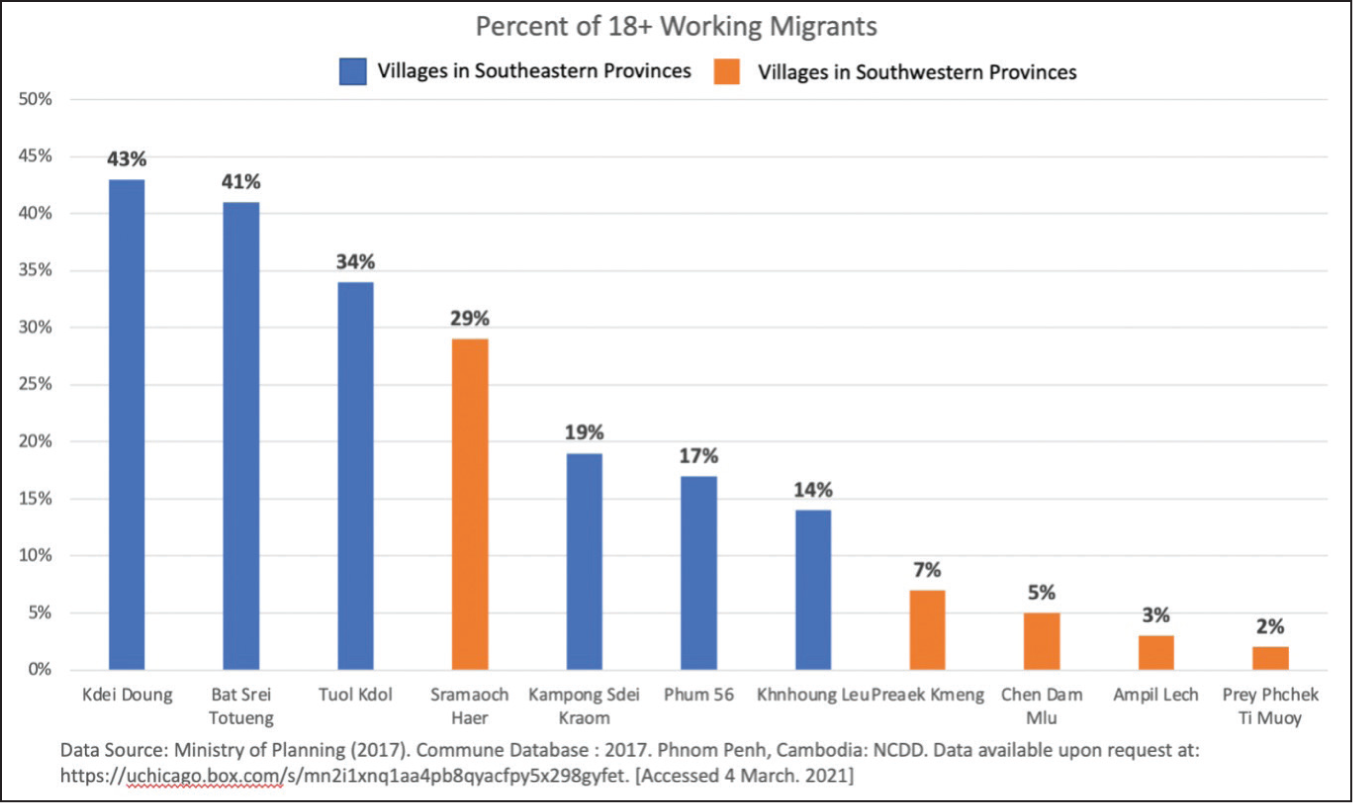
The income-differential theory provides a strong basis for why migrants move. This basis though is heavily influenced by changing agro-environmental conditions and the focused creation of alternative employment opportunities in cities. Given the strong desire expressed by the focus group participants to maintain deep attachments to kin, continue working household lands, and participate in the collective life of their home village, they first describe their efforts to cope with and adapt to changing socio-economic and environmental conditions that have undermined rural livelihoods locally. These coping and adaptation mechanisms can, nevertheless, create unsustainable conditions that lead some villagers to migrate for higher incomes in urban areas.
The Environment’s Foundational Role in Urban Migration
Environmental shifts, among other factors, have transformed the rural landscapes and agricultural practices in our sample of Cambodian villages with small-scale rice farming becoming increasingly less common. We find villagers and migrants perceive hydropower development, deforestation, extreme environmental events, and climate change as contributing factors to declining farm conditions and indirect causes of migration.
Coping and Adapting to Environmental Change
The participants in the rural village focus groups describe attempts to diversify away from traditional rice growing. For instance, Khnhoung Leu villagers report selling primarily mangoes; Bat Srei Totueng villagers grow tobacco; and other villagers plant an assortment of crops, including sesame and green beans, along with rice. Both rural and urban respondents attribute these new agricultural practices as responses to damaging floods and droughts, but also to more chronic conditions, such as soil loss and the negative impacts of deforestation.
Several urban migrants cite environmental conditions as their principal reason for migrating to cities, though the indirect path and connection to income are clear. For example, an urban migrant lamented the fact that he was forced to leave Sramaoch Haer village because of a flood: ‘I have never thought to leave my hometown for sure, but we were flooded, and my rice field got flooded, and I lost the income’ (10/12/2018). A Kampong Sdei Kraom farmer echoes the migrant’s sentiments that volatile weather makes farming an uncertain enterprise and leads to migration: ‘If we rely on farming, we can get into trouble; that is why we have to find an extra job to do. As you can see, last year there was a drought, so we got nothing from farming. We migrated last year’ (3/12/2018).
Environmental shocks lead some migrants to advocate for improved water infrastructure in their home villages. Over half of the urban migrant survey respondents reported that their home village did not have enough water to grow crops and lacked adequate irrigation canals. As one migrant expressed, ‘In the next 5 years, I hope that there will be more irrigation systems and enough water for farming, especially for paddy rice. I believe that people will plant more trees so that we can solve the drought and flood problem…’ (10/12/2018). This signifies an acute awareness that both physical infrastructure, such as irrigation canals and natural improvements from forest restoration practices, will enable villagers to better handle the increasingly variable weather patterns that can destroy crops, degrade soil conditions, and hamper rural livelihood generation.
These sentiments are driven by cautious optimism based on observations or stories of other rural farmers who have adapted relatively well to hydrological change by utilising irrigation canals or other new water sources, adopting regenerative soil practices, and employing new agricultural technologies to increase yields and transition to more lucrative crops. Villagers report that governmental partners, such as the Cambodia–Australia Agricultural Value Chain Program, or government agencies, like the Ministry of Water Resources, have improved some irrigation systems and promoted the use of traditional water resource management practices, including well digging, pumping water from aquifers, creating man-made ponds, and harvesting rainwater. Individual farmers have also incorporated new equipment, fertilisers, and technological inputs to improve yields or transition to other crops in their efforts to strengthen the prospects for rural income.
Under certain conditions, environmental shocks can directly result in urban migration, undercutting farmers’ attempts at resilience and adaptive responses to sustain their rural livelihoods. But taken together, our data indicate that environmental changes, whether abrupt, chronic, or both, are rarely perceived as prompting immediate migration to the city. Rather, they cause many farmers to invest in alternative crops, buy yield-increasing inputs, or adopt new agricultural practices first, suggesting that environmental change is a foundational, but not necessarily a proximate cause of migration.
Socio-environmental Drivers: Debt, Market Volatility, and Environmental Shocks
The more complex driver of migration is an interrelated process of socioenvironmental change that connects income differential and environmental theories of migration. This process entails a convergence of debt, volatile market prices, and increasingly unpredictable weather and farming conditions that engender poverty and land dispossession. Farmers can be one depressed crop price or unexpected flood or drought away from being unable to pay back the debt they incurred to attempt to withstand the accumulating effects of climate change. This cycle of loss can force households to sell their land and other possessions to pay off loans or send working-age adults to the city for temporary work that often becomes permanent.
In the absence of reliable farming conditions, planting new crops or buying equipment to increase existing yields is often sought after, but this requires significant capital. When asked why he was growing tobacco instead of traditional food crops such as green beans, sesame, and corn, a Bat Srei Totueng villager from Kampong Cham declared that a lack of consistent flooding resulted in soil depletion which decreased yields and increased the costs for seeds and fertiliser for traditional crops: ‘Yes, because the yield is not good. In the past, when there is a flood, our field is full of fertiliser [sediment deposits from the flood waters], but now there is no flood, so it causes soil depletion. You know, when we buy green bean seed, it costs around 210,000 riel (~$52 USD) and also chemical fertiliser. Oh, we spend a lot when we start doing farming’ (4/12/2018).
To fund their initial strategies to counteract the effects of environmental change, most, if not all, impoverished farmers turn to MFI institutions that proliferate in rural areas, even though villagers also borrow from friends and family in a traditional system of credit circulation known as Bangvil Luy. Sending their children to work in the city is rarely the first option.
– Bat Srei Totueng Village, Kampong Cham Province (4/12/2018)
Although MFI loans enable farmers to invest in new farming practices to face changing soil conditions and weather patterns, they often result in a trade-off of risk, from a small or perceived reduction in vulnerability due to ecological shifts to a significantly increased exposure to financial indebtedness.
The formal loans taken to cover the costs of coping or livelihood adaptation strategies leave many villagers at risk of an unexpected event that can lead to land dispossession or migration. Respondents often referred to their inability to pay back loans taken out after poor crop years. As one female migrant and former farmer explain, ‘While farming, we need to spend on the rental fee for labour, rice ploughing, fertiliser and harvesting. When there is a drought or flood, farmers are confronted with paying back loans because they do not have rice for sale’ (16/12/2018). Although loans may provide an opportunity for farmers to gain economic stability, they can leave villagers financially vulnerable and further exposed to the risk of underlying conditions that negatively affect their livelihoods.
In addition, loans leave farmers vulnerable to market factors outside their control. In particular, even farmers who have transitioned to relatively lucrative crops still face variable and often-depressed prices for their crops. As a Khnhoung Leu mango planter remarked, ‘The price of mango is unstable, sometimes it declines to 600 riel/kg [~$0.15 USD]. In the past, the [sale] price of our crop yield was acceptable but now the price is cheap, so we lose hope in farming. We almost give up on this job’ (4/12/2018).
Farmers from Kampong Cham Province, in particular, feel subject to unpredictable market forces or the whims of intermediate buyers, decrying the low and volatile prices that do not cover the debt they assumed to grow existing crops or transition to new products. In a focus group in Kampong Sdei Kraom village, for example, a farmer exclaimed: ‘The price of the crop yield is unstable. This year the price of sesame is 3,000 riel/kg [~$0.75 USD], but next year it can be 2,500 riel/kg [~$0.625 USD] or cheaper than this. We do not know what exactly it will be…’ (3/12/2018).
This cycle of depressed and unpredictable prices, MFI debt, environmental shocks and chronically poor growing conditions can quickly trap small-scale farmers in a downward spiral that leaves many unable to pay back their loans through rural incomes alone, forcing them to settle their debts by selling animals, household goods, and even farmland itself. Although urban migrants and village elders are less explicit about the seizure of collateral to repay debts, rural villagers vividly explain how the variable prices buyers are willing to pay for their crops can cause many farmers to pay their debts with the only form of significant collateral they have: their land (in most circumstances a deed to a plot of land or house is required to access an MFI loan). This was described by two farmers:
The second point is the low price of tobacco. When they lost money which has been invested, they have to sell their own stuff to pay the debt sometimes. However, during these two years the price of the tobacco is stable. You know in the past, some people who grew tobacco, they sold their animal and house to pay the debt, even me, I almost faced this problem too. But for these two years, its price is stable at 8,000 riel/kg [~$2 USD]. —Bat Srei Totueng Villager, Kampong Cham Province (4/12/2018). The problem is no market. Because the price of our crop yield is quite low, and there is no market for our crop yield. And now we are in debt. Some people sell their land, animals to pay the debt. —Tuol Kdol Villager, Kampong Cham Province (5/12/2018).
Emerging from this debt-induced land dispossession cycle appears unlikely. The average migrant in our 28-person survey moved to Phnom Penh roughly five years prior, yet 20 report that their families still have loans to repay. Further, 19% of these urban migrants claim their families primarily use their remittances to make loan payments – the second highest response – suggesting that paying back debt is a major concern and constant challenge. Urban respondents indicated that the majority of their remittances are allocated to cover basic needs back home, including food (37%), school expenses (15%), and baby milk (11%), complicating their ability to repay loans. Finally, almost all migrants in focus groups who wanted to return, but felt they could not, attributed this to the transfer of their land to settle debts. As an 18-year-old female migrant from Kandal who migrated when she was 16 succinctly stated, ‘My family has no farmland. I came to Phnom Penh to work for money to pay back the loans’ (16/12/2018). Her terse statement emphasises how debt and land dispossession catalyse permanent migration.
Overall, migrants and villagers agree that debt incurred in support of farming is a major driver of temporary and, ultimately, permanent urban migration. Whether exacerbated by a lack of control over the market price of their goods or a devastating flood or drought, borrowing and indebtedness are significant drivers of migration and land dispossession. The former socio-economic driver of migration often necessitates a collective risk management portfolio, with those of working age temporarily sent to the city to remit money back to families for loan payments and subsistence needs; the latter environmental factor makes this collective, spatially distributed strategy nearly impossible by eradicating crops and thus farmers’ incomes. When this happens, borrowing increases and the risk of default can result in permanent urban migration for the entire family or land-dispossessed rural kin.
Social Network Theories of Migration: Motivations for Leaving and Returning
I am saving money to get back my rice field from pawning, and I will go back to the village as I miss my child and aging mother.
—22-year-old migrant, mother, and garment worker, Kandal Province (24/12/2018)
Consistent with social-network theories of migration, we find ample evidence that migrants move to support their families, rely on village networks to navigate urban life, and maintain strong ties with friends and families in the villages. However, we do not find that urban amenities and status enhancements spark initial or permanent migration, despite elderly villagers believing so. Rather, strong attachment to kin and kith results in migrants desiring to bring urban economic activities and amenities to their home villages so that they can have the ‘warmth’ of village life rather than live permanently in the ‘cold’, sometimes discriminatory city.
All informants reported knowing someone in the city before moving. In our survey of villagers who migrated to Phnom Penh, all but one sent remittances on a monthly or weekly basis; the majority found jobs and housing in the city through relatives and close friends; most of the friends they have in the city also moved from their village of origin; and, on average, they make around seven return trips per year to their home village.
Despite migrants’ testimonials that migration is undertaken to support their families and continue to maintain their rural ties, many older villagers suggest that young migrants aspire to move permanently to the city. One father from Bat Srei Totueng village exclaimed, ‘My children, they do not really want to live here. Sometimes, my children say, ‘Father! Please do not raise your hope that your children will live with you…’ (4/12/2018).
Different explanations for this desired urban lifestyle abound. Some claim it is because adolescents and young adults want immediate earnings rather than delayed farming income: ‘The kids in this generation do not want to do farming anymore. They do not want to because when they work in the city, they work today, then they get the money today’ (4/12/2018). Others argue that youth want to be unshackled from kin-centred village life: ‘For us, we have no choice since we have been living here from childhood until now, so we have memories in this village, and we know our relatives who live in this village too; moreover, the villagers love each other. But I think in the next generation, they would not live here. Now we all are worried about this’ (4/12/2018). From the perspective of kin in the village, cosmopolitanism, urban status, and capitalist impulses are eroding the structure and duties of the nuclear family and home village, causing elders to worry their children will leave them and their village behind.
In contrast, most urban migrants we interviewed claim not to prefer urban life given its lack of familial ties and the discrimination they often face. Many in the urban migrant focus groups commented that the advantages and allure of city life fail to match the emotional security and pleasures of association with close kin and neighbours in their home villages. In particular, several note that urban dwellers or coworkers readily discriminate against rural migrants for their perceived social inferiority, which is particularly acute for female migrants from Prey Veng. As one such worker explained: ‘When I first arrived in Phnom Penh, I got discriminated against. People did not really talk to me. For colleagues, when they are rich or have fair skin, they would be arrogant to me; they would not talk to me unless I approached them first. When they were informed that we are from Prey Veng province, they usually accused most of us of being beggars. But we responded that now we quit begging and do construction and factory works instead’ (10/12/2018). Finally, none of the urban migrant survey respondents stated that they wished to or have permanently moved to Phnom Penh, despite acknowledging improved income, living conditions, and other amenities that they can access in the city, as well as the enhanced status they achieve when they return to their home village.
Instead, the majority across our different research instruments desire to return to the village to care for their family and enjoy the intimacy of village life. All eleven of the twenty survey respondents planning to return will do so to care for their parents or children, aptly captured by one respondent’.
I have got to be well dressed and can get access to water and electricity when I am here in Phnom Penh doing business, but I feel insecure when I do not live near my child and my parents. Furthermore, I am worried as my children are still young and my mother is always sick. I will get back to the village when I save enough money.
—24-year-old female urban migrant working as a housemaid, Takeo Province (24/12/2018).
The centrality of village life and the nuclear family does not obviate the fact that young people need higher incomes, desire occupations apart from farming, and hope to bring some urban amenities and recognition to their villages. For example, one female focus group participant argues the financial benefits alone hold powerful sway despite missing the warmth of village life: ‘Although living in Phnom Penh creates many challenges, such as insecurity, feeling not so warm, and being surrounded by people who look down at us, we can find jobs with stable and regular incomes, which is better than the village’ (10/12/2018). An older male construction worker who migrated from Prey Veng paralleled her claim about accessing steady income in the city but also pointed out that the social and economic status rural kin place upon migrants belies the higher costs of living and challenging working conditions: ‘People in the village perceive that those who work in Phnom Penh can earn more and are good-looking. They do not realise the bad conditions or how challenging the job is… in Phnom Penh, I need to spend money on everything. However, in Phnom Penh, I can get a job with regular pay. And there is nothing in the village’ (10/12/2018). These comments showcase the essential economic pull of the city, but reveal that the status enhancements migrants receive back home are often incongruent with many of their lived experiences in Phnom Penh.
While access to urban economic and social resources influences younger migrants, urban entrepreneurial opportunities and the prospect of social mobility rarely motivate initial migration, the desire to remain in the city, or have their families move to the city. Rather, most young migrants express a keen desire to bring these new enterprises, amenities, and opportunities back home so that they can partake in the familiarity and kin-based intimacy of village life. As a 34-year-old migrant and current seamstress from Tboung Khmum province told us, ‘Even though I and my husband can earn money easily in Phnom Penh… living here we always worry about our old parents in our hometown. We plan to save money for investing in agriculture and practice new techniques from other villagers [on] how to tolerate floods’ (23/12/2018).
In sum, both urban and rural respondents agree the near-term economic opportunities of city life and the powerful role of kinship obligations motivate initial migration, but generational debate abounds about whether urban social resources and status enhancements or the deep affective ties and cultural meaning of village life more powerfully influence initial or return migration.
Discussion: Implications for Theories of Migration in Cambodia
The stories told reveal a nuanced set of interrelated social, economic, cultural, and environmental dimensions to migration from rural areas in the south of Cambodia to Phnom Penh. Without access to viable alternative forms of employment in the village, the combination of inconsistent market prices for crops, environmental shocks, and longer-term ecological degradation force villagers to take on debt to buy essential transitional materials. Environmental change drives farmers to adopt expensive inputs to intensify production of traditional crops or transition to new cultivars, and when weather-based or market misfortune befalls them, unsustainable borrowing ensues, sometimes leading to land loss and temporary or permanent migration for more lucrative incomes in the city.
Given these dynamics, the push factors of rural land loss from debt (1) and the deleterious effects of environmental shocks and long-term change (2) together with the pull factor of urban resources (3) play a significant and interrelated role in explaining rural migration from the southern provinces to Phnom Penh. Urban amenities (4) and status enhancements (5) play ancillary roles and do not seem to be as desired by younger populations as perceived by elders in the villages. In turn, migration theories related to income differentials and environmental change appear more pertinent than those connected to social networks, but all play a role in the dynamic migration story.
These perspectives demonstrate the need for multiple theories of migration to explain how, when, and why urban migration occurs in Cambodia, particularly in a rapidly changing climate. Describing the nuanced, multifactorial drivers of migration requires acknowledging the interdependence and analytical challenges of disentangling push and pull factors. Although the ‘pull’ factor of increased income influences broader migration patterns in Cambodia, ‘push’ factors exacerbated by the socio-environmental drivers described earlier—regularly occurring anthropogenic environmental changes and longer-term ecological shifts—alongside deeper kinship and affective attachments of rural village life are central to understanding both existing outbound and desired return migration. Context-specific dimensions matter in explaining the temporary, permanent, and return forms of migration proliferating in the various provinces near Phnom Penh.
Importantly, none of the three migration frameworks alone fully capture the deeper meanings associated with the nuclear family, extended kin relations, attachment to land, and collective village life that remain powerfully influential for Cambodians’ mobility. Environmentally driven and income-focused theories cannot explain the entrepreneurial drive to invest in home villages that stands in stark contrast to the current declining economic prospects of various forms of village labour and the economic security and higher incomes of employment in urban centres. Social network arguments, on the other hand, overplay the salience of status enhancements and symbols of urban modernity in the motivations of our informants.
Only through an acute awareness of the cultural significance of kinship and birthplace per se, alongside the recognition of the recursive interplay of all these drivers, can we explain the paradox between current and desired patterns of migration. Migrants’ narratives of family reunification and village investments both take stock of and seem to defy, the economic and environmentally based realities of Cambodian village life. By investing in local businesses or advocating for improved irrigation systems and rural infrastructure, young migrants are attempting to create a collective portfolio to enhance income, increase assets, mitigate environmental risk and market volatility and gain some forms of social mobility, but at the same time to keep village life and family together back home. Overall, the village remains a potent symbolic space—not simply a material location with specific amenities, income streams, and infrastructure—emblematic and constitutive of the deeper meanings associated with family and belonging (Ebihara & Mertha, 2018). This explains in part why most Cambodian villagers initially attempt to keep the nuclear family together by adapting their farming practices and, when that fails, why most young people who migrate to the city still desire to return home to start new businesses and advocate for improved irrigation systems, paved roads, and sanitary water supplies with village and commune leadership.
Our research also suggests locational differences based on access to factories between the southwest and southeast villages affect the viability of villagers’ livelihoods, levels of borrowing, and return migration, but further data is required to quantify these spatial effects. Many families in Takeo, Kandal, and Kampong Speu villages can afford to use MFI-backed loans, savings, or remittances to buy land for their migrant children because of the number of factories now operating nearby. In contrast, families from Prey Veng and Kampong Cham villages are more likely trapped in a precarious cycle of debt, migration, and land dispossession that is altering the structure of the nuclear family and may erode the traditional meanings associated with village life, obligations to kin, and gender responsibilities.
Through the lens of intersecting migration drivers, this study demonstrates the simultaneous fragility and resilience of traditional cultural institutions in the context of massive social transformations driven by changes to the flooding regime, decreasing soil quality, infrastructure development, and urban migration. Obligations and duty to the nuclear family, as well as deeply rooted affective ties to home villages, remain central in migration narratives. Yet, the quest for higher incomes, induced by declining agricultural prospects for smallholders and the resulting webs of debt in which they become enmeshed as they seek to adapt to changing economic and environmental circumstances, is increasingly leaving behind depauperate rural landscapes that may significantly impact concepts of kinship obligations, urban and rural life, and village dynamics, thereby accelerating social change and transforming traditional institutions.
Footnotes
Acknowledgements
This initial phase of research has been generously supported by the Center for International Social Science Research and Social Science Research Center and the Neubauer Collegium for Culture and Society at the University of Chicago. Our deep appreciation is extended to Monin Nong, Chandarany Ouch and the team at the Cambodian Development Resource Institute who oversaw fieldwork, recruitment, translation, and research assistance. We thank Yunhan Wen who provided valuable research support and Ava Hedeker and Peyton Sanborn, who contributed greatly to formatting and proofreading.
Declaration of Conflicting Interests
The authors declared no potential conflicts of interest with respect to the research, authorship and/or publication of this article.
Funding
This work was supported by the Center for International Social Science Research, the Social Science Research Center, and the Neubauer Collegium for Culture and Society at the University of Chicago.