



Abstract
We examine the strength of the relation between letter sound knowledge, word reading, and reading comprehension in Spanish and in English for 1,010 bilingual first grade students learning to read in both languages in the United States. Students were assessed in both languages on multiple beginning reading measures and on reading comprehension in Spanish and in English at the end of the year. Findings from structural equation modeling indicated that the best model fit for the bilingual data was when all pretest measures in each language loaded into the same latent language factor, and into a bilingual factor consisting of letter naming in Spanish, and pseudoword reading in Spanish and in English. This finding suggests that a bilingual latent factor supports the development of metalinguistic awareness, and it contributes to the prediction of reading comprehension in both languages. Thus, students receiving bilingual reading instruction, might not need to be taught letter sound correspondence for letter sounds that are similar in both languages twice, once in Spanish and once in English. Instead, learning this skill in their native language, provides teachers with more time to discuss letter-sounds that are different in both languages. Implications for teaching and research are discussed.
Introduction
Possessing knowledge of letter sounds is fundamental to read words both fluently and accurately, which in turn is essential for understanding connected text in alphabetic languages such as English and Spanish (Baker, Crespo et al., 2022; Hoover & Gough, 1990; Kim, 2020; Perfetti & Stafura, 2014). For Spanish-English bilingual students of Latinx heritage who communicate in both languages and participate in bilingual education, their reading comprehension is closely linked to how effectively they can recognize and read words in each language (Mancilla-Martinez, 2020).
To achieve automatic and precise word reading in alphabetic languages, learners must develop (a) an awareness of the different segments of sounds in speech, (b) how these sound parts are represented by letters, and (c) how to decode words or word parts to be able to read words automatically (Ehri, 2014; Moats, 2020, National Reading Panel [NRP], 2000). Decoding refers to student ability to (a) see a word, (b) recognize the letter sounds in the word, (c) associate the correct phonemes with each letter, (d) and blend these letter sounds together to read a word (Lane et al., 2022). Readers who can build a strong representation of a word—encompassing both spelling and meaning—store these words in memory that can then be retrieved effortlessly (Perfetti & Stafura, 2014).
This study aims to closely investigate how four early literacy indicators—letter-sound correspondence, letter name fluency, pseudoword reading, and word reading in isolation and within a sentence in Spanish and in English—are associated with reading comprehension in both languages. We excluded from this study the results from the phonemic awareness measure we used in the beginning of first grade because the measure we used had a floor effect meaning that most students received a score of 0.
Students in this study were first-grade Spanish-English bilingual students (SEBs) who were attending dual language programs where they were learning to read in Spanish and in English. We focus on Spanish native speakers learning to read in Spanish and in English, as they make up most English learners in the United States (76%, Irwin et al., 2022). We used as our theoretical framework the simple view of reading (SVR; Hoover & Gough, 1990), which is becoming increasingly common in bilingual education settings (Durán et al., 2023). In SVR reading comprehension is determined by the interaction between decoding skills and language understanding (i.e., student ability to listen and understand what they are hearing (Moats, 2020). A student who excels at decoding but has limited language comprehension will not read as effectively as one who is strong in both areas. Similarly, even with advanced language skills, a lack of automatic word recognition due to insufficient decoding skills can hinder overall reading proficiency.
Developing Reading Skills in Bilingual Learners
Students who are acquiring literacy in both Spanish and English often face greater challenges than those who are monolingual, as they must interpret and apply two sets of language rules. Fortunately, the similarities between the alphabets of Spanish and English—especially the consistent sounds of most consonants—allow learners to use their knowledge from one language to facilitate reading in the other, potentially making the process less demanding. Additionally, many morphemes rooted in Latin, such as the plural suffix “s” or the prefix “anti-,” retain their meaning in both languages, which can make vocabulary acquisition easier for students who understand these morphemic elements (Honig et al., 2018). For instance, recognizing that “in” means “not” helps students decode and comprehend words like “independiente” in Spanish and “independent” in English.
Gaining insight into how Spanish-English bilingual students (SEBs) utilize both linguistic systems is valuable from both theoretical and practical perspectives. On the theoretical side, examining how reading in Spanish and English interact can shed light on the mechanisms behind bilingual language development. Practically, this understanding can guide the design and improvement of dual language programs, which have seen rapid growth in the United States, expanding from 200 programs a decade ago to 3,600 by 2020 (American Council for International Education, 2021).
The current research specifically focuses on the predictive role of decoding and word reading in isolation or in a sentence to reading comprehension in Spanish and in English. The study does not include native English speakers learning Spanish, as dual language programs for SEBs primarily aim to build their English proficiency (Texas Education Agency, [TEA, Chapter 89]). In addition, previous research suggests that SEBs who first learn to read in their home language do better in English literacy assessments than those taught exclusively in English (August & Shanahan, 2006; Durán et al., 2023; Francis et al., 2019).
Reading Across Spanish and English
Numerous studies have explored whether decoding in Spanish contributes to reading comprehension in Spanish, and in English (Mancilla-Martinez, 2020; Nakamoto et al., 2007, 2008). Results have been mixed. For example, Author found that reading pseudowords in English and in Spanish was linked to English reading comprehension. However, for Spanish reading comprehension, Spanish pseudoword reading and oral language were the only significant predictors. As another example, Nakamoto et al. (2008) found that understanding how letters correspond to sounds in Spanish was closely linked to students’ ability to comprehend Spanish texts, but not English texts. A similar connection was observed between English letter-sound skills and reading comprehension in English. Oral language proficiency in both languages played a smaller role in predicting reading comprehension, and its influence was greater among students with stronger letter-sound correspondence abilities.
Nonetheless, how exactly do early literacy indicators together impact SEBs’ ability to read and understand text in both languages is still unclear. Moreover, while we acknowledge that these skills are not the only factors influencing reading success, multiple studies highlight the important role of these early literacy indicators on reading comprehension (see e.g., Baker et al., 2016; Ehri, 2014, NRP, 2000; Perfetti & Stafura, 2014).
In this paper we hypothesize that there may be a bilingual latent factor that captures shared reading skills across both languages. This latent factor could have an impact on comprehension beyond the individual effects of Spanish and English early literacy skills, encompassing features common to both languages. For example, similar consonant sounds and words with comparable spelling and meaning (e.g., “observe” in English and “observar” in Spanish) facilitate the learning of these sounds and words in both languages.
Theoretical Framework: Transfer and Interdependence
Our hypothesized bilingual latent factor aligns with Cummins’ (1979) Interdependence Hypothesis and the concept of cross-linguistic transfer. The Interdependence Hypothesis posits that there is an underlying construct common to all languages that supports bilingual development. Cross-linguistic transfer refers to the ability of students to apply knowledge from one language when learning another. For example, knowing that the consonant “n” is pronounced the same way in both Spanish and English can help SEBs make connections between the two languages and transfer this knowledge when reading texts in either language. This transfer works best when sounds are similar, but less so when pronunciations differ, as is often the case with English vowels, which can have multiple sounds depending on context (Baker, Crespo, et al., 2022; Francis et al., 2018; Honig et al., 2018). In contrast, Spanish vowels typically have only one sound, such as “a” pronounced as /a/ in “artist” These differences require explicit instruction and practice (Baker, Cummings, et al., 2022; Honig et al., 2018). Therefore, teachers play a vital role in helping students draw connections between languages and most importantly develop their metalinguistic awareness (Verhoeven, 1994).
Metalinguistic Awareness and Literacy
The capacity to think about and work with different aspects of language, known as metalinguistic awareness (Bialystok et al., 2005; Verhoeven, 1994), plays an important role in learning a second language. This includes understanding that letters represent sounds and that morphemes are the smallest units of meaning (Peng et al., 2021). For instance, if SEBs recognize that the letter “s” represents the /s/ sound in both Spanish and English, and that adding “s” at the end of a word indicates plurality in both languages (e.g., “cat/cats” in English and “gato/gatos” in Spanish), they can apply this knowledge to decode unfamiliar words and understand changes in meaning when the suffix “s” is used.
The Significance of Automatic Word Reading
Research by Perfetti and Stafura, 2014, highlight that difficulties in recognizing words are a major contributor to reading challenges, as successful comprehension relies on the effective use of foundational literacy skills. Once students acquire these skills, and they have formed a mental representation of the words they encounter allowing them to read these words automatically, their attention can be devoted to understanding connected text. While Perfetti and Stafura (2014) focused on English reading skills, extending this analysis to Spanish, and considering early bilingual literacy skills as predictors of reading comprehension in both languages, can enhance our understanding of how these skills impact reading comprehension in bilingual students.
Study Focus and Research Questions
This study investigates how early literacy skills in the beginning of first grade in Spanish and in English, concurrently, relate to reading comprehension in both languages at the end of first grade. Specifically, the research seeks to answer the following questions:
What model best captures the structure of early literacy skills in Spanish and in English for SEBs in first grade?
○ How accurately does a single-factor model reflect early literacy indicators? ○ To what extent does a two-factor model represent these indicators? ○ How effective is a three-factor model in representing these indicators? ○ Which measurement model, via confirmatory factor analysis (CFA), offers the strongest fit and predictive value for reading comprehension?
How well does the most suitable CFA model forecast reading comprehension in both languages at the end of grade 1, taking student language proficiency into account?
To address Research Question 1 (RQ1), three conceptual models are compared, each examining the relations among early literacy measures in Spanish and English. The observed indicator variables include letter naming fluency, pseudoword reading, word reading, and sentence reading in both languages. Each model evaluates whether these measures form one or more underlying constructs (latent factors) that account for shared variance:
Model 1: All indicator measures contribute to a single latent factor (f1).
Model 2: Indicator measures are grouped into two latent factors—one for Spanish (f1) and one for English (f2).
Model 3: Indicator measures are organized into separate factors for each language, with an additional bilingual factor that encompasses print concepts and decoding in both languages (see Figure 1, Model 3).

Competing measurement models of literacy development in a bilingual sample.
Based on the best-fitting measurement model from RQ1, Research Question 2 (RQ2) employed a structural equation model (SEM) to examine how these indicators predict reading comprehension, in Spanish and English, at the end of first grade.
Method
The study’s data were obtained from a large-scale randomized controlled trial that evaluated a Tier 1, whole-class Language Arts intervention. Schools were grouped according to their demographic profiles and then assigned at random to the treatment or the comparison condition. The treatment group received targeted training and coaching in structured Spanish and English reading instruction for first graders, while the comparison group maintained their usual teaching routines. Given that the results suggested no substantial differences between the two groups, data from all first-grade students were pooled to analyze how early reading skills in Spanish, English, and both languages predicted later outcomes, regardless of instructional method. Tier 1 instruction refers to lessons delivered to the entire class.
Participants and School Characteristics
The study involved 37 schools spread across nine districts, with six located in Oregon and Washington State, and three in Texas. All teachers signed a written consent form indicating their willingness to participate in the project. Parents signed a consent form to allow their students to participate in the study. Students also had to assent to participate before being included in the study. Consent and assent forms were translated into Spanish and approved by the Institutional Review Board of the universities where the researchers worked. There was no risk for teachers or students in participating in the study given that all activities were typical activities and assessments teachers used to teach children to read in either Spanish or English. Our research design was based on theory and evidence of best practices on teaching students how to read. Therefore, this study did not cause any risk or harm to students besides the additional time it took to assess students. We purposefully organized the data collection in a way that students did not have to be assessed for more than 30 min at a time. Spanish and English assessments were scheduled on different days, or at least an hour apart to reduce confusion between the languages.
Most of the schools in the districts (43%) were situated in rural areas, with the remainder in urban (27%) and suburban or near-urban (30%) settings. The proportion of students eligible for free or reduced-price lunch varied widely, from 33% to 93%. Latino students comprised between 20% and 83% of the student body in these schools. Results from state assessments revealed considerable differences in academic performance; for instance, the percentage of bilingual third graders passing the English state exam ranged from 25% in some schools to 91% in others. All participating schools provided bilingual education, although the specific program models differed.
Bilingual Program Variability
The implementation of bilingual programs differed widely between schools, even within the same district. For instance, transition programs (n = 15) provided reading instruction in Spanish for grades K-2, supplemented by pullout sessions for English language development. As students’ English skills improved, they were gradually moved into English-only classrooms, with the timing of this transition varying by school. One-way dual language programs (n = 20) focused exclusively on SEBs, while two-way programs (n = 3) included both SEBs and English monolingual students. The amount of time of Spanish reading instruction ranged from 45 to 140 min, depending on the program. Schools with less Spanish instruction often supplemented with English reading instruction and, in some cases, English language proficiency support (ESL).
Student Demographics
All participating students spoke Spanish at home, and they were receiving bilingual reading instruction. The sample included 1,010 students, with data collected over two school years. Approximately half were female, and about 7% received special education services. The age range of students in the start of grade 1 was 5 years. The age range at the end of first grade was 7 years and 5 months, with an average age of 6.5 years.
Teacher Experience
Across the 37 schools, there were 113 bilingual teachers. On average, teachers in the Pacific Northwest had 11 years of experience in bilingual education, compared to 8 years in Texas.
Spanish Reading Instruction Details
Key aspects of reading instruction in grade 1—regardless of study group—include: (1) variability in the bilingual approaches across schools, (2) differences in the number of minutes used to teach reading in both languages, (3) district-specific reading programs, and (4) substantial fluctuations in class sizes, which ranged from 6 to 41 Spanish-speaking first graders.
We found considerable diversity in both the programs and instructional time. In Texas, among 17 schools, seven used the Scott Foresman Lectura (Blanco et al., 2000) Tier 1 program. For struggling readers, teachers used Esperanza (Valley Language and Learning Center); five used a mix of Spanish programs such as Cancionero: De Canciones a Cuentos (Hampton Brown, 2003), Solares (Solares, 2013), and district materials; and five relied on Esperanza and district resources. In the Pacific Northwest, 12 schools used Houghton Mifflin Lectura (Houghton Mifflin, 2005), five used Tesoros (Duran et al., 2008), and two used Trofeos (Harcourt, 2002). Some schools also implemented Estrellitas (Myer, 1990) as a supplementary resource for struggling readers.
Moreover, there was notable variation in the time devoted to comprehension instruction in Spanish as shown in Table 1. On average, first grade students received 20.7 min per day (SD = 10.9), with actual times ranging from roughly 10 to 31 min depending on the school, indicating significant differences in instructional time across sites on all the literacy components.
Time Spent on Core Components of Reading in Spanish in First Grade.
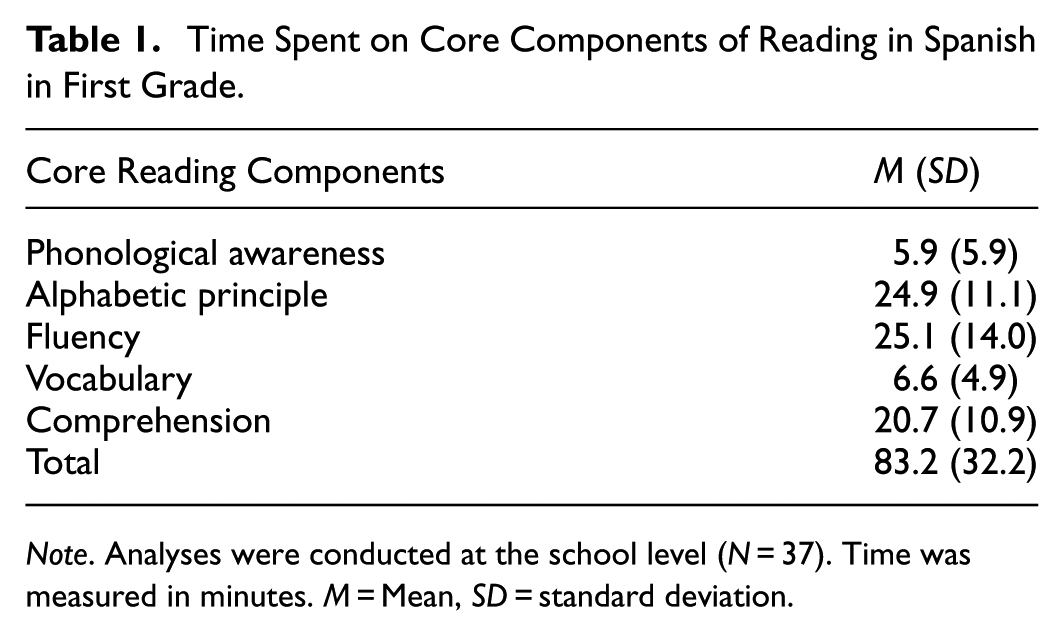
Note. Analyses were conducted at the school level (N = 37). Time was measured in minutes. M = Mean, SD = standard deviation.
English Reading Instruction
Schools that allocated approximately 40 min to Spanish reading instruction generally also taught 40 min of English reading. Most schools used the English version of their primary Spanish reading program (e.g., Houghton Mifflin Treasures for Tesoros, Trophies for Trofeos, Reading Street for La calle de la lectura). Supplemental programs for students needing additional support included Horizons (Western Michigan University, 1981), Reading Mastery, or Read Well (Sprick et al., 1998).
Spanish Reading Predictors
IDEL Fluidez en Nombrar Letras (IFNL)
The IFNL assessment evaluates how well students can name letters, a skill often linked to early print and literacy experiences at home (Foulin, 2005). This tool is considered highly effective for screening, with reliability (.86) reported in the fall of first grade (Watson, 2004). During the test, students are presented with a randomly ordered list of both uppercase and lowercase letters and are asked to name as many as possible within 1 min. The score indicates how many letter names students recognize in 1 min.
IDEL Fluidez en las Palabras sin Sentido (IFPS)
The IFPS subtest measures students’ ability to match letters to their sounds, which is key for decoding. Students read pseudowords aloud, either pronouncing each letter separately or reading the whole word, for 1 min (e.g., reading “numi” as a whole or saying each sound /n/ /u/ /m/ /i/). The IFPS score reflects the number of letter sounds students recognize in 1 min, whether individually or as part of a word. Reliability for IFPS was .76 after 3 weeks in mid-first grade (Watson, 2004) and .88 in a Spanish monolingual sample (Crespo et al., 2018). At the conclusion of first grade, the reliability coefficient between the Aprenda and the Woodcock-Muñoz was .72 (Watson, 2004).
Aprenda–3. (HBEM, 2005)
This measure is the Spanish version of the Stanford Achievement Test (Harcourt Brace Educational Measurement [HBEM], 2002) and is a standardized, norm-referenced assessment of academic achievement. It is administered to groups and has no time limit. The test was standardized using data from 73,000 Spanish speakers in 13 U.S. states, as well as in Puerto Rico and Mexico.
At the start of first grade, two subtests were given:
Lectura de palabras (ALP): This subtest measures single word reading. Students choose the word that matches a picture by filling in the corresponding bubble. Completion typically takes about 25 min.
Lectura de oraciones (ALO): This subtest assesses sentence reading comprehension. Students first select a picture that matches a sentence and then identify a sentence that matches a picture. This portion usually takes around 30 min.
English Reading Predictors
Nonsense Word Fluency (DNWF, DIBELS sixth Edition)
To identify what contributes to English reading comprehension, the study employed a range of standardized assessments. One key measure was the Nonsense Word Fluency (DNWF) from the sixth edition of DIBELS (Good & Kaminski, 2002). DNWF evaluates how well students can sound out and decode unfamiliar, made-up words—a critical early literacy skill. This assessment is timed, conducted individually, and mirrors the approach used for the Spanish IFPS test. DNWF has demonstrated reliability scores between .67 and .87, and previous research has shown that results from DNWF at the end of kindergarten moderately predict reading comprehension outcomes on the SAT-10 by the end of first grade (Fien et al., 2008)
Letter Naming Fluency (DLNF)
We also assessed students on DLNF in the beginning of first grade. DLNF measures the number of letters that have been randomly ordered in 1 min (from the sixth edition of DIBELS (Good & Kaminski, 2002). Students must identify uppercase and lowercase letters. Interrater reliability ranged from .86 to .98 and validity estimates from .31 to .74 (Dynamic Measurement Group, 2008). Given that the inclusion of DLNF in our models did not appear to improve the model fit we excluded it from the final model (see Supplemental Appendix 1).
Stanford Achievement Test-Tenth Edition (SAT-10; HBEM, 2002)
Students were assessed on the word reading (SWR) and the sentence reading (SSR) measure of the SAT-10. Just like the Aprenda-3, the SAT-10 is a norm-referenced exam administered to groups, lasting about half an hour, and is designed to reflect the performance of the broader U.S. student population. These subtests were given at the outset of first grade, using procedures consistent with those for the Spanish Aprenda-3 test.
All the reading predictor assessments, in both Spanish and English, took place at the start of first grade. IDEL and DIBELS subtests were delivered one-on-one, with strict adherence to standardized instructions and scoring methods. If a student was unable to complete a subtest, the testing was stopped in accordance with the discontinue rule set by the test designers (Baker et al., 2007; Good & Kaminski, 2002). The Aprenda-3 and the SAT-10 were group administered.
Bilingual Verbal Ability Test (BVAT; Muñoz-Sandoval et al., 1998)
To further assess students’ proficiency in both languages, the study administered the BVAT at the beginning of first grade. This test, conducted individually, examines how well a child can use Spanish and English to understand academic material. It incorporates three components from the Woodcock-Johnson Tests of Achievement-Revised: Picture Vocabulary, Oral Vocabulary, and Verbal Analogies. The BVAT provides scores for English language skills and additional knowledge in the child’s first language. The test was standardized with a large, diverse group of students and showed strong median alternate-form reliability (r = .84). In this sample, students averaged a BVAT score of 89.47 (SD = 12.29) at the start of first grade (Baker et al., 2023).
Outcome Measures
At the end of first grade, we evaluated students’ reading comprehension in both languages. For Spanish, the Aprenda—3 Comprensión de textos (ACT) subtest was used. For English, the SAT-10 Reading Comprehension (SRC) subtest was administered. Each assessment lasted approximately 40 min, requiring students to read ten brief passages from various genres—including informational, literary, and functional texts—and answer multiple-choice questions. Both tests followed consistent protocols for administration and scoring (HBEM, 2005).
Data Collection Procedures
Individuals responsible for collecting data received extensive training prior to and during the administration periods, which resulted in high levels of agreement between scorers (inter-rater reliability from .90 to .98). The IDEL and DIBELS assessments were administered during three separate windows in first grade—at the beginning, middle, and end—but only the results from the first and last sessions were included in the analysis. To minimize interference between languages, Spanish and English assessments were scheduled on different days, or at least an hour apart.
Data Analysis Approach
To respond to RQ1, we conducted confirmatory factor analysis (CFA) to explore the underlying latent structure of the seven early literacy indicators for three different models based on theoretical and prior research frameworks (Brown, 2015). To respond to RQ2, we applied structural equation modeling (SEM) utilizing the CFA model that best fit the data to investigate how these literacy factors predicted end-of-year reading comprehension. SEM allows for detailed examination of how underlying traits relate to outcomes, with path coefficients interpreted similarly to regression coefficients (Lei & Wu, 2007).
We employed Mplus 8.3 software (Muthén & Muthén, 2017) with maximum likelihood for model estimation. Missing data (7.1%) were treated as missing at random. Similar correlation estimates for the study variables were obtained when using a sample with complete data compared to a sample with missing data. We first evaluated different competing measurement models through CFA. Then we selected the best-fitting model to estimate a structural model that incorporates both Spanish reading comprehension (ACT) and English reading comprehension (SRC) scores at the end of first grade as outcome variables.
Model quality was judged using several fit statistics, including RMSEA, CFI, and TLI. The accepted standards were RMSEA below.08 and CFI/TLI scores of .95 or higher (Brown, 2015; Schreiber et al., 2006). The analysis also considered standardized residuals and modification indices to identify areas for improvement. CFI and TLI are incremental fit indices, where CFI assesses the relative fit of a model to a more restricted baseline model, and TLI considers model complexity and sample size. RMSEA values range from 0 to 1, with 0 indicating perfect fit. CFI and TLI range from 0 to 1, with values closer to one indicating good fit. We used commonly applied guidelines to assess model fit: RMSEA < .08, CFI and TLI ≥ .95 (Brown, 2015; Schreiber et al., 2006). Additionally, standardized residuals and modification indices were examined to identify potential focal areas of misfit in the CFA solutions for each model (Additional tables can be requested from the first author.
Results
Table 2 displays the significant correlations among all Spanish and English study variables. A particularly strong relation was observed between Spanish and English letter-sound correspondence skills, as measured by pseudoword reading (IFPS and DNWF, r = .74), suggesting that the higher the scores on Spanish pseudoword reading, the higher the scores on English pseudoword reading. The link between word reading and reading comprehension was also notable, with moderate to high within-language correlations for Spanish (r = .69) and English (r = .59). Students who scored higher on the word reading measure, also had higher scores on reading comprehension. We used the BVAT as a covariate given that language proficiency is also a factor in the SOR framework that is associated with reading comprehension. We report results by research questions.
Mean, Standard Deviation, and Pearson Correlations for the Study Variables (N = 1,011).

Note. *n = 696 students were excluded because a site did not administer this measure. All correlations were statistically significant at the p < .01. Aprenda tasks: Comprensión de la Lectura (ACL), Lectura de Palabras (ALP), and Lectura de Oraciones (ALO). SAT-10 tasks: Reading Comprehension (SRC), Word Reading (SWR), and Sentence Reading (SSR). IDEL tasks: Fluidez en el Nombramiento de Letras (IFNL), and Fluidez en las Palabras sin Sentido (IFPS). DIBELS tasks: Letter Name Fluency (DLNF) and Nonsense World Fluency (DNWF). Bilingual Verbal Ability Test: Bilingual Verbal Ability (BVA).
RQ1. What Model Best Captures the Structure of Early Literacy Skills in Spanish and in English for SEBs in First Grade?
How accurately does a single-factor model reflect early literacy indicators?
To what extent does a two-factor model represent these indicators?
How effective is a three-factor model in representing these indicators?
Which measurement model, via confirmatory factor analysis (CFA), offers the strongest fit and predictive value for reading comprehension?
To answer RQ1 and its sub questions, we first loaded all predictors into one latent factor (f1) of reading development. Model 1, however, did not have enough goodness of fit, (RMSEA = .19, CFI = .86, TLI = .80) so we created a model where all the Spanish measures loaded into one latent factor (f1) and all the English measures loaded into a second latent factor (f2). Model 2 (RMSEA = .18, CFI = .89, TLI = .82), also did not meet the threshold for good fit as indicated in Table 3. Further analysis of standardized residuals and modification indices revealed specific areas where Models 1 and 2 did not fit well. For example, in Model 2 notable residuals were found in the relations between IFNL-IFPS (2.78), IFNL-DNWF (2.97), and IFPS-DNWF (6.19), suggesting that additional model parameters might be needed (Brown, 2015). Model 3, a three-factor solution, substantially reduced these residuals and modification indices, resulting in a much better model fit as indicated in Table 3 (RMSEA = .08, CFI = .99, TLI = .97). Model 3 also aligned with prior empirical findings reinforcing its validity (Baker, Cummings, et al., 2022; Cummins, 1979).
Goodness-of-Fit Statistics and Information Criteria for Competing Measurement Models.

Note.
Table 4 presents the standardized factor loadings, standard errors, R2, and factor correlations for Model 3. Factor loadings ranged from .41 to .88, and cross-loadings ranged from .41 to .67, with higher values indicating stronger associations between measures and latent factors. Cross-loadings show that certain measures share variance across multiple factors; for instance, IFPS loaded on both the Spanish factor (.44) and the bilingual letter-sound factor (.67), indicating its relevance to both. Although some loadings were lower, values above .40 are considered acceptable in applied factor analysis (Brown, 2015). The bilingual letter-sound correspondence factor showed moderate correlations with the Spanish (r = .44) and English (r = .43) factors, suggesting that is both, shared and distinct. The Spanish and English factors themselves were highly correlated (r = .83), highlighting the close cross-language association for this bilingual group, indicating that the higher the scores in Spanish, the higher the scores in English.
Confirmatory Factor Analysis for the First-Order Three-Factor Measurement Model with Cross-Loadings (M3).

Note. All loadings and factor correlations are statistically significant (p < .001).
Aprenda.
IDEL.
SAT-10.
DIBELS measures.
RQ2. How Well Does the Most Suitable CFA Model Forecast Reading Comprehension In Both Languages At the End of Grade 1, Taking Student Language Proficiency Into Account?
Model 3 was adopted as the measurement model for the SEM analysis to determine how these latent factors predict reading comprehension in both languages at the end of first grade. The three-factor model accounted for a substantial proportion of the variance in both outcome variables, explaining 55% of the variance in Spanish reading comprehension (ACL), and 49% in English reading comprehension (SRC). The correlation between the two outcome variables (r = .46), indicates a moderate association between reading comprehension in Spanish and English (see Figure 2). This association between the Spanish and English factors made it difficult to reliably separate their unique contributions limiting the interpretability of each path coefficient. We also found that the increment or proportion of variance explained after taking the bilingual verbal ability into account, was relatively small (3%) for Spanish reading comprehension and non-observable for English reading comprehension (see the R2 in Table 5) suggesting that our model was not significantly affected by student bilingual language abilities.

SEM model for the Aprenda and SAT-10 reading comprehension measures.
Standardized Coefficients and Model Fit Indices for Two Structural Equation Models Predicting Reading Comprehension in Spanish and English.

Note. p < .05, ** p < .01, *** p < .001. Model 1 Fit:
Discussion
The aim of this study is to identify the best model for predicting reading comprehension in two languages for SEBs in first grade. We tested three models. The first model loaded all predictors into one latent factor of reading development. This model, however, did not have enough goodness of fit, so we created a model where all the Spanish measures loaded into one latent factor (f1) and all the English measures loaded into a second latent factor (f2). This model improved the goodness of fit, but it still did not meet our model fit criteria designed to determine which model captures most effectively the underlying structure of the relation between early literacy skills and reading comprehension (Brown, 2015). Therefore, we decided to create a third model with three latent factors that included the two factors in Model 2 in addition to a bilingual letter sound correspondence factor (f3). This bilingual factor included our letter sound correspondence skills measures in Spanish and in English, and letter naming in Spanish (i.e., IFPS, DNWF, IFNL). We excluded DIBELS Letter Naming Fluency (DLNF) from the final measurement model analysis due to data collection constraints (i.e., we were unable to assess all students on DLNF), as well as DLNF not significantly contributing to the model fit (see Supplemental Appendix 1).
Model 3 without DLNF fit the data well. Thus, we identified two important findings: (a) for SEBs learning to read in their two languages in first grade, the best model includes letter sound correspondence skills measures and word reading in Spanish predicting Spanish reading comprehension, and letter sound correspondence skills measures and word reading in English predicting reading comprehension in English; and (b) a model that includes a bilingual decoding latent factor that considers Spanish and English decoding together adds unique variance explained in predicting reading comprehension. We discuss our findings in the context of Perfetti and Stafura’s (2014) word knowledge and Ehri’s (2005) phases of word reading.
Predictors of Reading Comprehension in two Languages
Our study confirms the hypothesis that decoding skills, word reading in isolation, and sentence word reading are directly related to reading comprehension in alphabetic languages. In other words, to be able to comprehend text, the reader needs to be able to read words automatically and accurately (August & Shanahan, 2006; Baker et al., 2023; Cardoso Martins, 2001; Perfetti & Stafura, 2014). This relation is also apparent in languages that are not alphabetic, but that have symbols to represent the sounds in words such as Chinese (Peng et al., 2021).
Further, our findings suggest that early literacy skills in Spanish and in English are essential for SEBs to succeed in their ability to comprehend text in the two languages. More specifically, we identified that in the beginning of first grade letter naming fluency, pseudoword reading, word reading, and sentence reading are significant predictors of reading comprehension within languages, but not across languages. This finding corroborates previous studies that examined the role of letter sound correspondence skills and oral language proficiency as predictors of reading comprehension (see Baker et al., 2012; Nakamoto et al., 2008; Proctor et al, 2006). In these studies, just as in the current study, decoding and word reading do not appear to significantly predict reading comprehension across languages even though both languages, Spanish and English, use letters to represent sounds.
Nakamoto et al. (2008) also found a strong association between the English and the Spanish letter sound correspondence skills factors (r = .78) as we found in the current study (r = .74), even though their study examined the longitudinal prediction of early literacy skills on student ability to read and comprehend text from third grade to sixth grade. The current study examined the longitudinal predictors of reading comprehension from the beginning of first grade to the end of first grade.
Even though, these studies were conducted with different populations of SEBs attending a variety of bilingual programs, across different regions of the US, they indicate that there is a stronger association between early literacy skills and reading comprehension within languages than across languages suggesting that SEBs need to have strong word automaticity in both languages to comprehend text in both languages.
Role of the Bilingual Factor
However, in the current study, results from SEM also indicate that the model with three factors that include a bilingual latent factor, composed by letter naming and pseudoword reading in Spanish and pseudoword reading in English, has a better model fit representing the bilingual data. This finding suggests that for students learning to read in two alphabetic languages, a common bilingual latent factor contributes to the prediction of reading comprehension within and across languages. This finding can be explained theoretically by Cummins (1979) interdependence hypothesis as well as Verhoeven’s (2011) metalinguistic awareness that SEBs develop across time. Cummins suggests that languages with similar characteristics such as Spanish and English depend on each other and therefore, they can also contribute to the reading development across languages. Metalinguistic awareness proposes an underlying awareness of the structure of the orthographic system that supports learning to read in any language. Moreover, studies in neuroscience confirm the interdependence of languages (Bialystok et al., 2009). The bilingual factor is moderately related to early literacy skills in both Spanish and English independently of the relation between early literacy skills in each language. In other words, the bilingual factor (f3) depends on Spanish and English letter sound correspondence skills, but it also acts independently of each of them as illustrated in Figure 2.
Although studies have indicated that the same reading components proposed by the National Reading Panel, (NRP, 2000) can also be applied to other alphabetic languages (August & Shanahan, 2006; Baker, Crespo et al., 2022) and even to non-alphabetic languages such as Chinese (Peng et al., 2021), how much bilingual children incorporate what they know in both languages to support their reading comprehension in both languages can be explained, in part by the characteristics of the orthographic system. For example, in Spanish and in English all consonants sound very similar, and the same letters except for the letter “ñ” exist in both languages. This means that if students are learning to read in Spanish and in English, they might not need to learn the sounds of the consonants that are the same twice, but teachers may need to explicitly make the connections for students between the languages.
On the other hand, particular attention needs to be provided to the vowel sounds in English which tend to have multiple pronunciations depending on their position in a word and the meaning of the word. In addition, language comprehension and vocabulary as outlined in the SVR model (Hoover & Gough, 1990) and suggested by Kieffer et al. (2012), and Miller et al. (2006) are important and necessary processes to teach SEBs in Spanish and in English. Based on our study, however, vocabulary was the least taught reading component in the schools as indicated in Table 1 (e.g., 6.6 min were spent in vocabulary across schools, with a range of 1 min to 12 min approximately), corroborating previous findings. More language and vocabulary activities need to be included during reading instruction to increase student opportunities to practice their two languages and become strong text comprehenders in both. We cannot wait until SEBs acquire early literacy skills to teach vocabulary.
Limitations
This study has the following limitations. First, we only examined the relation between early literacy skills and reading comprehension in Spanish and in English in first grade. More studies examining this relation across grades and different languages would help understand better the contribution of early reading skills in Spanish and in English on reading comprehension across grades and languages. Nonetheless, this study corroborates the current emergent hypothesis that for students learning in two or more languages, a bilingual factor, independent of the contributions of each language, develops and impacts reading outcomes directly and indirectly in each language.
Second, we could not examine more closely the effect of the bilingual factor on reading outcomes by type of bilingual program because of the variability in these types of bilingual programs, instruction, and curricula used. Third, we were unable the capture the exact number of minutes that specific reading components or language proficiency was taught during reading instruction in English. We only captured this information for Spanish. Fourth, we used specific measures to answer our research questions. It is plausible that different measures would yield different results. Future research should include other measures to replicate our findings.
Implications for Practice and Future Research
Although the current study is correlational and not causal, it confirms the importance of word reading and its subcomponents to be able to later understand what we read. Kindergarten and first grade are a time to develop student decoding skills, and word automaticity and accuracy. Not teaching these components early in both languages can significantly reduce SEBs opportunities to access text later when they will be using reading to learn content in mathematics, science, and social studies. For teachers in bilingual programs, teaching these early skills in both, Spanish and English, is necessary considering that sounds that overlap can be taught in one language only. Moreover, making explicit the relation between Spanish and English letter sound correspondence skills can support students in their metalinguistic understanding of how we learn to read.
In addition, to strengthen the mental representation of words in memory (Ehri, 2014), SEBs also need to be able to understand the meaning of the words they are reading. In this study, we found that vocabulary was the least taught reading component during Spanish reading instruction. Other studies have also corroborated this finding when teaching reading in English. Thus, with the current focus on the implementation of evidence-based practices to teach early literacy skills, we need to make sure that teachers also incorporate robust vocabulary in the language of instruction even in the early grades starting with preschool (Baker et al., 2025; Coyne et al., 2022).
This study contributes to the emergent knowledge examining the relation between predictors of reading in two languages for bilingual students. Our findings suggest that for SEBs a bilingual decoding factor contributes to reading comprehension in Spanish and in English above the unique contributions of this factor in each language. More studies are needed that (a) corroborate our findings by conducting a similar analysis with different populations of bilingual children and in different contexts, (b) compare the model of reading of a bilingual child with the model of reading of a monolingual child. These additional studies can shed light on how bilingual and multilingual students learn to read and ultimately read to comprehend in their two or more languages.
Supplemental Material
sj-docx-1-sgo-10.1177_21582440261427727 – Supplemental material for Effects of Bilingual Letter Sound Knowledge and Word Automaticity in Spanish and in English on Reading Comprehension for First Grade Bilingual Students
Supplemental material, sj-docx-1-sgo-10.1177_21582440261427727 for Effects of Bilingual Letter Sound Knowledge and Word Automaticity in Spanish and in English on Reading Comprehension for First Grade Bilingual Students by Doris Luft Baker, José Palma and Keith Smolkowski in SAGE Open
Footnotes
Author Note
The views expressed within this article are those of the authors and do not represent the views of the US Department of Education or the Institute of Education Sciences.

Ethical Considerations
The study received final approval by the University of Oregon institutional review board (protocol no. 03032011.040) on April 16, 2014.
Consent to Participate
To obtain informed consent from teachers, parents, and students, we followed the University of Oregon (UO) institutional and ethical guidelines. The consent letter we provided teachers and parents included an explanation of the study, information about how to minimize risk to students, and our process to keep all data confidential, and in a locked place. Any time a student presented discomfort he/she was removed from the situation and the project, if necessary. Questions regarding the research were addressed by one of the principal investigators. Questions regarding potential risk to students were addressed by the Human Subjects Compliance office at the UO.
Funding
The authors disclosed receipt of the following financial support for the research, authorship, and/or publication of this article: This research was supported, in part, by a grant from the Institute of Education Sciences (# R305B077307, 2007-2012) titled: Reading Interventions with Spanish-Speaking Students: Maximizing Instructional Effectiveness in English and Spanish to the University of Oregon.
Declaration of Conflicting Interests
The authors declared no potential conflicts of interest with respect to the research, authorship, and/or publication of this article.
Data Availability Statement
Data are available upon request to the corresponding author.
Supplemental Material
Supplemental material for this article is available online.
References
Supplementary Material
Please find the following supplemental material available below.
For Open Access articles published under a Creative Commons License, all supplemental material carries the same license as the article it is associated with.
For non-Open Access articles published, all supplemental material carries a non-exclusive license, and permission requests for re-use of supplemental material or any part of supplemental material shall be sent directly to the copyright owner as specified in the copyright notice associated with the article.
