




Abstract
Physical inactivity is a significant global public health concern. The purpose of this study was to lay the foundation for adopting policies that encourage physical activity in classrooms. By evaluating stakeholders’ knowledge, attitudes, practices, and opinions regarding different policy options encouraging physical activity in schools, the goal is to provide policymakers and stakeholders with relevant information. Individuals aged 15 years and older were invited to participate in the study. The survey included five sections (demographic, participants’ physical activity recommendations and policy knowledge, participants’ attitudes toward physical activity in schools, current physical activity practices and available infrastructure in schools, and participants’ opinions about the applicability of physical activity policy options). Thousand six hundred and ninety seven participants (parents 49.9%, teachers 27.6%, students 21.7%, and other 0.8%) completed the survey. Physical activity knowledge was 41.5% ± 15.8%. This indicates that the respondents were able to answer three out of eight questions correctly on average. The attitude toward physical activity promotion in schools favored a positive attitude (91.8 ± 14.0). Teachers scored on average 55.0 ± 25.3 out of 100 in the physical activity promotion practice questions. Lastly, respondents indicated positive responses (65.4 ± 25.6) in the applicability of the proposed physical activity promotion in schools’ policy options. Conclusion: The survey findings highlight the urgent need to improve physical activity-related knowledge, attitudes, practices, and policies. Inclusive policy frameworks, tailored educational interventions, and regional adjustments are needed. To gain a deeper understanding of the changing attitudes and practices surrounding the promotion of physical exercise, future research might conduct a qualitative evaluation.
Introduction
Physical activity is defined as any movement other than sitting that requires skeletal muscle activation and causes energy expenditure (Caspersen et al., 1985). However, in the health context, being physically active means the achievement of physical activity recommendations for one’s age group. Thus, individuals that do not meet physical activity recommendations are considered physically inactive (Thivel et al., 2018). Physical inactivity is the fourth highest cause of mortality worldwide. The latest worldwide prevalence of physical inactivity is 27.5% in adults (Guthold et al., 2018) and 81% in adolescents (Guthold et al., 2020). In Saudi Arabia, the prevalence of physical inactivity ranges from 50% to 91% across the lifespan (Al-Hazzaa et al., 2011, 2014; Al-Zalabani et al., 2015; El Bcheraoui et al., 2016), with adolescents showing rates between 80% and 90% (Evenson et al., 2023).
Extensive research has shown that physical inactivity is both prevalent and associated with poor health outcomes across the lifespan (I. M. Lee et al., 2012). Furthermore, the worldwide burden of physical inactivity includes significant economic costs, such as direct medical care and indirect productivity losses (Ding et al., 2016; Mattli et al., 2020). Being physically active has numerous health benefits (Burini et al., 2020), such as preventing cardiometabolic diseases (Bucciarelli et al., 2023; Reiner et al., 2013) and better management of existing conditions (Budreviciute et al., 2020; Wake, 2020; Wyszyńska et al., 2020). It also leads to lower all-cause, cardiovascular, and non-cardiovascular mortality rates (Chastin et al., 2021; D. H. Lee et al., 2022), and improves cognitive function and mental health (Dzhambov et al., 2023; Schuch & Vancampfort, 2021; Singh et al., 2023).
Previous reports have concluded that the intensity, frequency, and duration of physical activity play significant roles in overall physical health. They suggested that maintaining a certain “threshold” of physical activity is necessary to achieve positive health effects (Shephard, 1997; Tolfrey et al., 2000). The Saudi 24-hr movement guidelines and WHO physical activity guidelines recommend that children and adolescents participate in at least 60 min of moderate to vigorous physical activity (MVPA) per day, along with muscle and bone-strengthening activities at least 3 days per week (Alfawaz et al., 2021; Chaput et al., 2020).
Failing to engage in adequate physical activity increases the likelihood that children will lead less healthy lives than their parents (Olshansky et al., 2005). Furthermore, physical activity has been found to be protective against depression and promote a better mental health in Saudi adolescents (AlYousefi et al., 2021; Baqal et al., 2020). The benefits of being physically active extend to school performance, as higher levels of physical activity are linked to better academic performance (Alghadir et al., 2020).
A recent study conducted in Saudi Arabia indicated that families are hesitant to enroll their children in sports (Rakha et al., 2022). This might be due to a lack of proper knowledge about the importance of physical activity (Amer et al., 2017) or due to fear of injury incidence due to sports. Another study has shown that educational seminars for both mothers and their children have led to improvement in physical activity levels immediately post-intervention and this improvement was sustained after 3 months follow-up (Ahmad Bahathig & Abu Saad, 2022).
Many factors have been identified as risk factors for physical inactivity in children and adolescents such as high use of technology, electronic gaming, parental education and sociodemographic, social support, and environmental factors(Alharbi, 2019; Al-Hazzaa, 2018; Al-Nuaim & Safi, 2023; Alotaibi et al., 2020; Alshehri & Mohamed, 2019; Alsubaie & Omer, 2015; Gülü et al., 2023). Furthermore, lack of knowledge of safe physical activity practices is a risk factor for physical activity-related injuries (Said et al., 2023).
Research indicates that establishing a lifestyle pattern of regular MVPA during childhood and adolescence can have long-term health benefits that extend into adulthood (Freedson & Rowland, 1992; Telama et al., 2005; Twisk et al., 2000; Xiao et al., 2022). Educational interventions aimed at adolescents can be effective in equipping them with the essential skills to engage in regular physical activity. Moreover, interventions that incorporate nutritional knowledge have been shown to enhance physical activity habits (Ahmad Bahathig & Abu Saad, 2022; Ahmad Bahathig & Abu Saad, 2022; Darabi et al., 2017). Therefore, it is important to integrate physical activity into all aspects of children’s lives, including homes, schools, and recreational activities. According to United Nations Children’s Fund (UNICEF), approximately 1 billion children worldwide attend school on any given day of the week. Since children spend a significant amount of time at school, it presents an excellent opportunity to provide high-quality physical activity education to a large audience. Moreover, schools have the ability to publicize positive physical activity messages to a wider community, including parents and caregivers of students (Inman et al., 2011). Schools are recognized as crucial settings for addressing a wide range of public health concerns (WHO, 2021). Hence, it is of the utmost importance to identify effective approaches that can increase and sustain activity levels among children and adolescents in environments where they spend substantial periods of time, such as schools (Dobbins et al., 2009).
Physical activity interventions for the general population have been shown to be effective in increasing baseline levels of physical activity in study participants up to 12 months post intervention (Love et al., 2018). However, these interventions implantation at population level remain a matter of active research (Al-Hazzaa & AlMarzooqi, 2018; An et al., 2019). Due to the lack of comprehensive physical activity policy within Saudi context, a policy level physical activity promotions are needed (Chaput et al., 2020; Ding et al., 2020; van Sluijs et al., 2021), especially, focusing on the early years of human lifespan (Kapoor et al., 2022; Lieberman et al., 2021; Matos et al., 2021).
School-based physical activity interventions have been shown to improve physical activity levels and reduce cardiovascular risk factors (i.e., obesity and pre-hypertension) in adolescents, and further improvement has been observed in academic performance (Evans et al., 2015; Paulsamy et al., 2021). Moreover, recent studies have shown that school based multicomponent interventions have been successful in improving physical activity levels and prevent obesity in children and adolescents (Angawi & Gaissi, 2021; Habib-Mourad et al., 2023). Schools can encourage physical activity through physical education. However, studies have shown that even though physical education classes contribute to increased levels of physical activity, physical education classes alone are not sufficient (Aljuhani & Sandercock, 2019).
Despite the known benefits of physical activity, there is a lack of comprehensive studies evaluating the effectiveness of policy options to promote physical activity in Saudi schools. Thus, this study aimed to prepare the groundwork for implementing policies to promote physical activity in schools. The objective is to Inform policymakers by assessing stakeholders’ (teachers, students, and parents) knowledge, attitudes, practices (teachers only), and opinions regarding various policy options for promoting physical activity in schools. Understanding the perspectives of teachers, parents, and students is vital for the successful implementation of physical activity policies, as these groups are directly impacted by and can significantly influence policy effectiveness.
Methods
Study Design and Ethical Considerations
This study utilized a cross-sectional design. Ethical approval was obtained from the Institutional Review Board (IRB) of Princess Nourah bint Abdulrahman University (Approval # 23-0595). The participants agreed to participate in the study by clicking on the “yes” button for the following question “Do you agree to participate in the study?” Furthermore, the participants were informed at the beginning of the survey that they could drop out at any time if they felt uncomfortable taking part in the study or they could choose not to answer any of the survey questions.
Study Participants
All teachers, students, parents, and individuals interested in promoting physical activity in schools living in Saudi Arabia at the time of the survey were eligible to participate in the study. No exclusion criteria were specified to ensure comprehensive and generalizable understanding. Potential participants were recruited through the internal Ministry of Education circulars, with links to the study survey, and via different social media outlets.
Study Survey
Policy creation requires several development stages, one of which is engaging stakeholders and surveying potential users (students their parents, and teachers; Bull et al., 2004). This study reports the results of the public survey launched between September to October 2023.
An online survey was developed to meet the specific needs of promoting physical activity in Saudi schools. Thus, it was developed to assess participants’ knowledge, attitudes, practices, and applicability of possible physical activity policy options. The survey was divided into five sections (Table 1). The first section gathered demographic information about the participants including nationality, age, marital status, educational level, city, employment status, and income. The second section of the survey assessed participants’ physical activity recommendations and policy knowledge of youths. The third section of the survey assessed participants’ attitudes toward physical activity in schools. The fourth section invited only teachers to indicate current physical activity practices and the available infrastructure in schools. The last section assessed participants’ opinions about the applicability of physical activity policy options.
Survey Sections Descriptions.
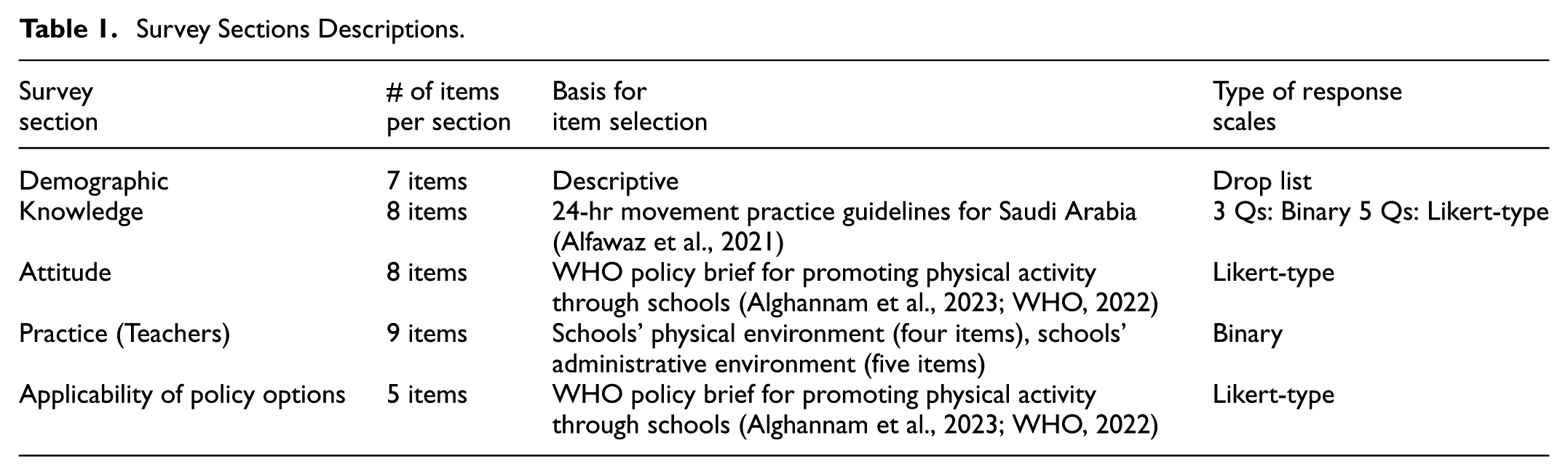
Knowledge questions in the survey on physical activity used the 24-hr movement practice guidelines for Saudi Arabia as a reference for questions and correct answers (Alfawaz et al., 2021). Selected physical activity policy options were based on the WHO policy brief for promoting physical activity through schools and recent reviews assessed effective policies to promote physical activity (Alghannam et al., 2023; WHO, 2022).
Survey Validity and Reliability
Content validity of the survey was completed before survey dissemination while construct validity was calculated after dissemination. Content validity was assessed via a qualitative experts’ review. A panel of four experts in exercise physiology and public health (physical activity) reviewed the survey items for relevance and clarity. Experts written feedback on survey items was thematically analyzed and used to revise item wording and content accordingly (Boateng et al., 2018).
Construct validity was assessed using confirmatory factor analysis (CFA) for attitude and participants’ opinions about the applicability of physical activity policy options. Model fit was evaluated using comparative fit index (CFI), Tucker-Lewis Index (TLI). Root mean square error of approximation (RMSEA) with 90% confidence intervals, and standardization root mean square residual (SRMR). Acceptable model fit was defined as TLI ≥ 0.90, RMSEA ≤ 0.80, and SRMR ≤ 0.08 (L. Hu & Bentler, 1999). Internal reliability was assessed using McDonald’s ω and Cronbach’s α coefficients with coefficients ≥.70 considered acceptable (Zinbarg et al., 2005).
Attitudes section showed acceptable model fit χ2(20) = 283.824, p < .001; CFI = 0.921; TLI = 0.889; RMSEA = 0.088 (90% CI [0.079, 0.097]); SRMR = 0.099. Standardized factor loadings ranged from 0.67 to 0.83 (all p < .001), and R2 values ranged from .45 to .69, showing moderate to high item reliability. Internal consistency was good, with ω = .84 and α = .76. Applicability section showed excellent model fit χ2(5) = 31.079, p < .001; CFI = 0.989; TLI = 0.979; RMSEA = 0.055 (90% CI [0.038, 0.075], p-close = .283); SRMR = 0.032. Standardized loadings ranged from 0.56 to 0.92 (all p < .001), and R2 values ranged from .21 to .68. Internal reliability was acceptable (ω = .70, α = .68). Practice section showed adequate internal consistency, with ω = .74, α = .74 (95% CI [0.70, 0.77]). Overall, the survey section demonstrated acceptable to excellent construct validity and internal consistency.
Sample Size and Sampling Technique
The study utilized a convenience sample from the Saudi Arabian population. All 13 administrative regions of Saudi Arabia were targeted during the participants recruitment. To ensure this process, all educational offices in these regions were contacted to distribute the study survey within their region. The sample size was calculated to be 377 participants (using the following sample size equation for proportions: n = [z2pq]/d2), assuming a population proportion that yields the maximum possible sample size required (p = .50), with a confidence level of 95% and a margin of error of 5% (Kamangar & Islami, 2013). However, because this study aimed to recruit participants from different age groups, regional areas, and educational levels, the sample size calculation was used as the minimal number of participants needed. Therefore, all responses to the survey were included in the final analysis.
Data and Statistical Analyses
Google Forms were used to create an online survey and collect participant responses. After all the responses were collected, all the data was exported as an Excel file. Data were checked, cleaned, and analyzed using JASP version 0.18.3 & GraphPad Prism version 10. Variables were summarized using frequencies, means, and standard deviations (SD). The multinomial Test was used to compare the participants’ characteristic sub-categories. A one-way ANOVA was used to compare the knowledge, attitude, practice, and applicability scores of the groups. Chi-square Test was used to compare categorical variables. The level of significance was set at p ≤ .05.
Results
A total of 1,697 individuals agreed that their data could be utilized for research purposes from 1,734 individuals who completed the survey. Parents were the majority of the respondents (49.9% [n = 847]), followed by teachers (27.6% [n = 468]), 21.7% (n = 368) of the respondents (other) 0.8% (n = 14) had a connection to physical activity in schools. Due to the small number of the classification group “other,” data from this group reported only in descriptive statistic and it was removed from all inferential statistical analysis. Respondents in the age groups 40–44, 15–19, and 45–49 constituted the majority of the study sample. Further, about two-thirds of the respondents were married and had either a high school or undergraduate degree. Almost half of the respondents live in the central region (44.3%), followed by the south (28.2%), east (18.3%), west (7.2%), and north (1.9%). Finally, about one-third of the respondents chose not to report on their income. Table 2 presents the participants’ characteristics.
Characteristics of study participants: data are presented as frequencies (%, [n]).

Note. A multinomial test was used to compare the sub-categories; The p-value was set at p < .05. Percentages are based on the total valid responses for each category.
The average score in physical activity knowledge was 41.5 ± 15.8 out of 100. Indicating that respondents were able to answer three out of eight questions correctly on average. Further, Table 3 indicates that only in the strength recommendation, about 60% of respondents answered correctly. Regarding attitudes toward physical activity promotion in schools, most of the respondents favored a positive attitude (91.8 ± 14.0 out of 100). Teachers scored on average 55.0 ± 25.3 out of 100 in the physical activity promotion practice questions. Lastly, respondents scored an average of 65.4 ± 25.6, in the applicability of the proposed physical activity promotion in school policy options. This indicates moderately positive responses. Figure 1 reports the mean scores of overall knowledge, attitude, practice, and applicability.
Responses to the Selected Knowledge Question.

Note. Data are presented as frequencies (%, [n]); percentages are based on the total valid responses for each category.

Overall knowledge, attitude, practice, and applicability scores.
A detailed analysis of knowledge, attitude, and applicability scores categorized by respondents’ classification (Figure 2) revealed no significant difference between the knowledge scores of all subgroups, while only parents exhibited a more positive attitude toward physical activity promotion (η2p = 0.019, small effect). Finally, teachers had significantly lower scores in the applicability of the proposed physical activity promotion in schools’ policy options (η2p = 0.052, small to moderate effect).

Knowledge, attitude, and applicability scores were categorized according to the respondents’ classifications.
When comparing knowledge, attitude, and applicability scores across regions, the results showed that only respondents living in the southern region had significantly more negative scores in attitude (88.8 ± 17.6, η2p = 0.019, small effect) and applicability (60.6 ± 27.0, η2p = 0.014, small effect) of proposed physical activity promotion in schools’ policy options, as shown in Figure 3. Comparing knowledge, attitude, and applicability scores based on education level, the analysis indicated that respondents with middle school or less had the lowest score in knowledge (37.8 ± 16.5, η2p = 0.012, small effect) and highest score in physical activity promotion in schools’ applicability (76.4 ± 20.5, η2p = 0.046, small to moderate effect). However, respondents with high school degrees scored significantly lower in the attitude section of the questionnaire (η2p = 0.008, small effect; Figure 4). Only applicability scores across income levels indicated a significantly lower income level score between 10 and 15000 and 15 to 20000 (η2p = 0.038, small to moderate effect; Figure 5).

The knowledge, attitude, practice, and applicability scores were categorized according to the respondents’ regions.

The knowledge, attitude, and applicability scores were categorized according to the respondents’ educational level.

Knowledge, attitude, and applicability scores were categorized according to the respondents’ income levels.
Most respondents believed that schools play a primary role in promoting physical activity. Furthermore, the respondents indicated that the school’s role in physical activity promotion is both educational and administrative (Table 4). Further, a higher percentage of parents and teachers indicated that schools have educational and administrative roles compared to students respondents.
Respondents’ Choices of Schools’ Role in Promoting Physical Activity: Data are Presented as Frequencies (%, [n]).

Note. The chi-squared Test was used to compare the respondents’ classifications; *The significance p-value was set at <.05; Percentages are based on the total valid responses for each category.
About half of the respondents indicated that the current number of PE sessions per school week was adequate (Table 5). Only teachers had a higher percentage of agreement. Teachers (49.4%) respondents had significantly higher awareness of the Ministry of Education’s physical activity policies than parents (30.8%) and students (30.4%).
Respondents’ Choices Regarding Current Physical Activity Policies Data are Presented as Frequency (%, [n]).

Note. Chi-Squared Test was utilized to compare between respondents’ classification; *The significance p-value was set at <.05; Percentages are based on the total valid responses for each category.
Table 6 reports respondents’ choices when asked to indicate which entity is responsible for the promotion of physical activity for students. A higher percentage of parents identified schools as responsible for physical activity promotion efforts. Students identified themselves and the Ministry of Sports as entities responsible for promoting physical activity. Teachers identified the community as the entity responsible for physical activity promotion efforts.
Respondents’ Choices of Physical Activity Promotion Responsibility.

Note. Data is presented as frequency (%, [n]); chi-squared test was utilized to compare between respondents’ classification; * The significance p-value was set at <.05; Percentages are based on the total valid responses for each category.
Discussion
This study aimed to assess perceptions and attitudes toward physical activity promotion among different stakeholders—parents, teachers, students, and others—in schools. The main results highlight significant findings across various demographic categories, shedding light on low knowledge of physical activity, positive attitudes toward physical activity policy options, and moderate practices of promoting physical activity.
The observed low levels of overall knowledge regarding physical activity, as evidenced by the average score of 41.5% out of 100%, is concerning. Furthermore, awareness of physical activity recommendations in our study was 26%, while it was only 3% in the United States. Only 10% of our respondents answered correctly when asked about aerobic physical activity recommendations compared to 28% in Untied States (Chen et al., 2023). This finding suggests a potential gap in understanding the importance and benefits of physical activity among the surveyed population in this and previous studies (Amer et al., 2017; Taha, 2005). Interestingly, similar to the United States study, the level of education appears to significantly influence this knowledge gap, with respondents having higher educational attainment generally demonstrating better knowledge scores (Chen et al., 2023). This underscores the importance of educational interventions and targeted programs to enhance physical activity-related knowledge, especially among groups with lower educational backgrounds (Wafi et al., 2024).
In a previous study, a person physical activity intention and positive attitude toward physical activity were predictors of their physical activity engagement (Alali et al., 2024). In this study, the majority of respondents expressed a positive attitude (91.8 ± 14.0% out of 100%) toward physical activity promotion. However, significant variations were noted across the demographic groups and regions. Parents and teachers generally exhibited more favorable attitudes than students and respondents from certain regions, such as the south. These differences suggest that cultural and regional factors may influence perceptions of physical activity, highlighting the need for tailored approaches to foster positive attitudes universally (Alghadir et al., 2021; Samara et al., 2015). Furthermore, a child’s parent-targeted physical activity promotion may increase physical activity engagement (Bashatah et al., 2023).
In terms of the practice and applicability of physical activity promotion policies, the average scores of 55.0 ± 25.3 for practice and 65.4 ± 25.6 for applicability indicate moderate levels of implementation and perceived effectiveness. Income level and educational background were found to impact these scores significantly, with higher income and educational attainment correlating with more positive perceptions of policy applicability. All these results were expected based on the wealth of studies highlighting similar barriers to implementing physical activity in Saudi Arabia (Alessy et al., 2023; Alghannam et al., 2023; Al-Hazzaa, 2018; Al-Hazzaa & AlMarzooqi, 2018). This disparity suggests potential socioeconomic barriers that could hinder effective physical activity promotion efforts, necessitating equitable policy interventions options.
Views of schools’ roles in physical activity promotion varied significantly among the respondent groups. While the majority agreed that schools played a primary role (71.1%), perceptions differed in the extent of educational versus administrative responsibilities. Parents and teachers tended to emphasize both roles, while students leaned toward more nuanced or external influences. Understanding these divergent perspectives is crucial for developing inclusive and effective physical activity promotion strategies that align with stakeholders’ expectations and capacities. Similar to existing research, the findings of this study also revealed mixed perceptions regarding the adequacy of current physical activity policies and responsibilities for physical activity promotion (Al-Hazzaa & AlMarzooqi, 2018). Teachers group demonstrated higher awareness of the Ministry of Education policies, suggesting potential for enhanced collaboration and awareness campaigns. These insights underscore the importance of clear communication and stakeholder engagement in shaping future physical activity policies that reflect diverse perspectives and needs (Alghannam et al., 2023; Evenson et al., 2023).
The overall study results indicate that individual-level factors (education, income) and institutional/contextual factors (region, school responsibility) influence perceptions of physical activity promotion within schools. Based on the socio-ecological framework, behavior is shaped by the interplay of individual knowledge and attitudes with interpersonal support, institutional practices, policy, and physical environment (D. Hu et al., 2021; Y. Lee & Park, 2021). Thus, the observed lower applicability among teachers and region-specific differences indicate institutional readiness and local policy environment vary. This supports studies indicating that school-based physical activity promotions are more effective when multi-support level is present (Hunter et al., 2016; Langille & Rodgers, 2010; Naylor et al., 2010). Within Saudi Arabia context, national physical activity policies exist (Alfawaz et al., 2021), however, their implementation, monitoring, and cross-sectoral collaboration remain scattered (AlMarzooqi et al., 2023; Alzahrani et al., 2024, 2025). Therefore, the results highlight the importance of tailoring the physical promotions designs to regional and institutional capabilities.
The limitations of this study include the potential biases inherent in self-reported data and the cross-sectional nature of the survey, which limits causal inference. Additionally, the study survey was distributed online only, thus limiting the sample to people with internet access. Although the majority (98%) of the Saudi population had internet access, this study did not include those with no internet access. Future studies may utilize both online and in-person data collection to reach all potential end users of the policy. A response bias may also be present, as participants with a greater interest in physical activity may have been more likely to respond, potentially skewing the results. Thus, future studies may offer alternative incentives to participate such as volunteering hours or bonus points in school for students. Finally, the study used convenience sampling with intense effort to distribute the survey among all administrative regions in Saudi Arabia. However, the study’s sample demographics may not fully represent all socioeconomic and regional diversities within the population. Future studies might enlist schools to facilitate data collection from a representative sample.
Policy Implications
In the Saudi Arabia context any future physical activity promotions in schools’ policy should consider the following:
There is a need for tailored educational programs about physical activity specific knowledge. For example: Using simpler language when targeting student versus teachers or educated parents. Including affordable examples of physical activity for people from all socioeconomic backgrounds. Include local representatives from the targeted administrative region to consult in design interventional programs.
Address physical activity implementation potential barriers within school and provide alternative solutions especially for teachers. These solutions should consider the infrastructure of the school and accepted social norms within the school administrative region.
Clearly define the role and responsibilities of applying physical activity promotions in school for students versus teachers versus parents’ versus other agencies.
Announce the policy options through marketing campaigns and measure it impact on students’ physical activity level at regular intervals for any future revision or modification of the policy.
Conclusion
In conclusion, this study highlights both the strengths and areas for improvement in physical activity promotion efforts within school settings. The results of this survey indicate a critical need to enhance knowledge, attitudes, practices, and policies related to physical activity. Specifically, targeted educational interventions, regional adaptations, and inclusive policy frameworks are needed. Future research should focus on longitudinal studies and qualitative assessments to better understand the evolving attitudes and practices toward physical activity promotion.
Footnotes
Acknowledgements
Public Health Authority supported in funding the project, co-designing and distributing the survey, providing necessary data, and facilitating communication with relevant partners, Public Health Authority, Riyadh, Saudi Arabia.
ORCID iDs

Ethical Considerations
Ethical approval was obtained from the Institutional Review Board (IRB) of Princess Nourah Bint Abdulrahman University (Approval # 23-0595).
Consent for Publication
The participants agreed to participate in the study by clicking on the “yes” button for the following question “Do you agree to participate in the research study?”
Author Contributions
All authors contributed to the study conception and design. Data acquisition was performed by TAM and SAA. Data curation was performed by TAM and MSA. Funding acquisition was carried by SAA. The formal analysis was performed by SAA. The first draft of the manuscript was written by SAA, MSA, TAM and all authors commented on previous versions of the manuscript. All authors read and approved of the final manuscript. The work reported in the paper has been performed by the authors, unless clearly specified in the text.
Funding
The authors disclosed receipt of the following financial support for the research, authorship, and/or publication of this article: Princess Nourah Bint Abdulrahman University Researchers Supporting Project number (PNURSP2026R714), Princess Nourah Bint Abdulrahman University, Riyadh, Saudi Arabia.
Declaration of Conflicting Interests
The authors declared no potential conflicts of interest with respect to the research, authorship, and/or publication of this article.
Data Availability Statement
Data can be provided by contacting the corresponding author. Further details are available from the corresponding author upon request.*