




Abstract
Addressing misconceptions is widely recognized as important for effective science learning. Refutation texts have been shown to reduce incorrect beliefs and enhance conceptual understanding. This quasi-experimental study examined the effects of the knowledge revision components (KReC) framework, digital stories containing refutation texts (DSRT), printed stories containing refutation texts (SRT), and a curriculum-based teaching method without refutation texts (TMC), on fourth-grade students’ conceptual understanding and misconceptions about Earth’s crust and movements. A pretest-posttest design was implemented with 156 students, using a three-tier test to assess their conceptual understanding and misconceptions. Results indicated that both DSRT and SRT significantly reduced misconceptions compared to TMC; however, neither intervention led to a statistically significant increase in conceptual understanding. These findings suggest the effectiveness of refutation texts in digital and narrative formats while emphasizing the need for further research on instructional design, learner characteristics, and long-term knowledge retention in science education.
Introduction
Identifying misconceptions is crucial for effective learning (Gilbert & Watts, 1983; Vasconcelos & Paz, 2023). For over 50 years, science education researchers have addressed how misconceptions can impede conceptual development (Guralnick, 1974; Kendeou & Johnson, 2024; Özmen, 2004; Rowell et al., 1990). Misconceptions formed early can persist into adulthood, coexist with scientific knowledge, and hinder new knowledge acquisition (Carey, 1991; Pine et al., 2001; Shtulman & Valcarcel, 2012; Vasconcelos & Paz, 2023). Children begin developing their understanding of earth science concepts early, which is crucial for comprehending natural phenomena (Vasconcelos & Paz, 2023). Research indicates that children have significant non-scientific knowledge about earth science prior to formal education (Carey, 1991; Vosniadou & Skopeliti, 2017; Wiser & Smith, 2008). The current limited earth science literacy is a major concern for educators (Bakopoulou et al., 2021; Küçükşen Öner et al., 2024; Vasconcelos & Orion, 2021; Vasconcelos & Paz, 2023). Misconceptions may arise from daily experiences and intuitive reasoning (Ganea et al., 2021; Venkadasalam et al., 2024). In instructional settings, effective strategies are necessary to help students develop scientifically accurate understandings (Engelmann & Huntoon, 2011; von Aufschnaiter & Rogge, 2010). Among these strategies, refutation texts have been shown to be effective in addressing misconceptions (Danielson et al., 2025; van Loon et al., 2015; Weingartner & Masnick, 2019). These texts present a misconception, refute it, and provide the correct explanation (Palmer, 2003; Tippett, 2010). While refutation texts have been shown to be effective in addressing and reducing misconceptions, their reliance on a text-based and structured format may limit engagement and accessibility, particularly for younger learners. Thus, further investigation is needed to evaluate the effectiveness of embedding refutation texts in alternative formats, such as narrative-based and digital stories (DS), to improve young students’ understanding of “Earth’s crust and the movements of our earth” and to refute misconceptions. This need focuses this study on the conceptual understanding of “Earth’s crust and the movements of our earth” of elementary school students with different forms of storytelling and at the same time to reveal and eliminate misunderstandings in detail.
Review of Literature
The Role of Refutation Texts in Students’ Understanding and Misconceptions Reduction
Refutation texts can play an important role in helping students address misconceptions and enhance their understanding of scientific concepts. When students encounter discrepancies between their prior knowledge and scientific content, this cognitive conflict necessitates explicit conceptual revision (Kendeou et al., 2014). Traditional expository texts often fall short in helping students recognize these conflicts (Guzzetti et al., 1993; C. Hynd et al., 1997). In contrast, refutation texts can effectively confront misconceptions by allowing students to compare their beliefs with scientifically accurate information, thereby facilitating the construction of more robust conceptual models (C. R. Hynd, 2001). These texts can also serve as transfer texts, enabling students to apply their knowledge in new contexts (Barnett & Ceci, 2002) and fostering critical reflection on misconceptions.
Research indicates the efficacy of refutation texts in correcting misconceptions and enhancing conceptual understanding (Tippett, 2010; Zengilowski et al., 2021). Their short reading time and high effectiveness have garnered interest from researchers (Flemming et al., 2020; Hunsu et al., 2023; Palmer, 2003). Numerous studies report that refutation texts significantly improve conceptual understanding compared to texts without refutations (Ariasi & Mason, 2011; Diakidoy et al., 2003; Donovan et al., 2018; McCrudden & Kendeou, 2014; Prinz et al., 2021; van Loon et al., 2015). However, in delayed posttests, students may partially revert to their initial misconceptions, suggesting that knowledge revision is not fully internalized (Donovan et al., 2018; Kendeou et al., 2014; Kowalski & Taylor, 2017; Lassonde et al., 2016; Nussbaum et al., 2017).
Research has also explored the relationship between text type and learning outcomes (Danielson et al., 2025; Hunsu et al., 2023; Mason et al., 2020; Weingartner & Masnick, 2019). For instance, Hunsu et al. (2023) found that elaborated refutation texts promoted deeper comprehension strategies among university students studying genetics, although neither text type nor prior misconceptions significantly influenced post-learning outcomes. Similarly, Mason et al. (2020) examined the impact of standard expository and refutation texts on elementary students’ understanding of food chains and energy, finding that both types improved understanding but did not significantly affect long-term learning outcomes. A criticism of refutation texts is their structured format, which may limit student engagement and active knowledge construction (Zengilowski et al., 2022). Critics argue for moving beyond a static “single story” structure to more interactive, student-driven approaches for students to construct scientific knowledge. Zengilowski et al. (2021) highlighted the need for deeper theoretical and methodological analysis of refutation texts to optimize learning outcomes. Promising alternatives could include embedding refutation texts in narratives and digital stories, leveraging narrative structure, interactivity, and multimedia for enhanced learning.
Stories and Digital Stories as a Learning Tool
Storytelling has long been a key method for transmitting knowledge, offering structured narratives that enhance conceptual development (Smeda et al., 2014). In his book, Digital Storytelling, Lambert (2013) asks, “Why tell stories?” and answers that stories are essential for human cognition, helping us understand the world (p. 6). This pedagogical approach can foster engagement and deeper understanding in general, scientific, and technical education (Sharda, 2007; Shelton et al., 2017). Research shows that storytelling effectively corrects misconceptions among young students by providing relatable contexts that promote clarity and understanding of complex concepts. Narratives can enhance students’ grasp of scientific practices, enabling them to revise misconceptions and build scientifically accurate mental models (Clough, 2024).
With the rise of technology-supported learning environments, educators are increasingly using digital media tools to create stories (Smeda et al., 2014). DS combine traditional narratives with multimedia elements, such as text, images, audio, and interactivity (Robin, 2016). DS serve as a multimedia-based instructional resource, allowing educators to present complex scientific concepts through engaging, narrative-driven explanations. Its use is growing due to its effectiveness in communicating information through diverse multimedia techniques, including mobile apps and web platforms (Ciğerci & Yıldırım, 2024; Robin, 2016). According to Mayer’s Cognitive Theory of Multimedia Learning (Mayer, 2005), combining visual and verbal representations enhances comprehension. DS have been particularly effective in reducing misconceptions in subjects like astronomy and fractions by promoting active participation and personal investment in learning (Wimpey, 2019; Karaoglan Yilmaz et al., 2018). Ultimately, integrating storytelling in education is a powerful strategy for transforming misconceptions into accurate scientific understanding (Kurniawan et al., 2019; Psomos & Kordaki, 2015; Wimpey, 2019).
The Knowledge Revision Components Framework as Theoretical Perspective of Refutation Texts
The knowledge revision components (KReC) framework (Kendeou & O’Brien, 2014) provides a structured model for addressing misconceptions through a systematic process. This framework outlines five key principles: (i) Encoding—the initial storage of information for future recall; (ii) Passive activation—the activation of existing knowledge when encountering related content; (iii) Coactivation—the simultaneous activation of new knowledge and prior misconceptions, allowing for comparison; (iv) Integration—incorporating new knowledge into existing frameworks, replacing misconceptions; and (v) Competing activation—strengthening scientific knowledge while suppressing incorrect information (see, Kendeou et al., 2014). The KReC framework serves as a solid theoretical foundation for understanding the refutation text effect, demonstrating that ideas compete in working memory. Prior knowledge and textual cohesion significantly influence knowledge updating (Danielson et al., 2025). The principles have been examined through refutation texts in literature (Kim & Kendeou, 2021; Prinz et al., 2022; van Den Broek & Kendeou, 2008) and have prompted studies exploring alternative formats, such as stories or digital stories, for implementing KReC principles. This approach is intended to address misconceptions and may enhance learning outcomes.
Integrating Refutation Texts Into Stories and Digital Stories
The impact of refutation texts can be enhanced when integrated into engaging narrative formats, such as printed stories and DS. While traditional refutation texts effectively foster knowledge revision, DS should not be viewed as the sole solution for eliminating misconceptions. Their effectiveness depends on instructional design, multimedia integration, and cognitive load (Schroeder & Kucera, 2022; Zengilowski et al., 2021). Some research indicates that embedding refutation texts within images or videos does not always improve learning outcomes compared to text-only formats, necessitating further empirical investigation (Danielson et al., 2016; Tippett, 2010). Robin (2008) notes that DS can enhance conceptual clarity, promote engagement, and reinforce prior knowledge, but more research is needed to evaluate their efficacy relative to traditional storytelling approaches. The KReC framework provides a theoretical basis for integrating refutation texts into narrative-based printed stories and DS, emphasizing coactivation and integration in knowledge revision (Kendeou & O’Brien, 2014). Within this framework, stories and DS can act as scaffolds for conceptual change, encouraging students to engage with conflicting information and restructure their knowledge frameworks.
The replacement perspective of Posner et al. (1982), which treated misconceptions as “cognitive pathologies” to be diagnosed and eliminated, initially framed conceptual change in science education. More recent views argue that learners rarely abandon naïve ideas, but instead integrate them with new knowledge, forming hybrid or synthetic models (Vosniadou, 2019). From a knowledge-in-pieces perspective (DiSessa, 1993), these intuitive elements are context-sensitive, explaining apparent inconsistencies in students’ responses. Misconceptions are thus no longer seen as barriers but as productive starting points among knowledge pieces that instruction can reorganize across contexts (DiSessa, 2018; Vosniadou, 2019). Conceptual change strategies are generally effective, though their impact varies with context, duration, and instructional design, which means that results are not uniform across studies (Pacaci et al., 2024). Refuting an existing misconception actually means activating that structure in the mind. In this light, consistent with diSessa-inspired views, refutation texts provide a valuable learning context by activating misconceptions as naïve knowledge elements that can be restructured into more coherent scientific models (Schroeder & Kucera, 2022; Zengilowski et al., 2021). Refutation texts serve both to correct misconceptions and to provide learning contexts that help reorganize fragmented knowledge into coherent conceptual structures.
Throughout the current study, the term “correcting” is used to describe the process of restructuring or refining students’ conceptual frameworks rather than simply “eliminating” misconceptions. The study aims to investigate the conditions under which refutation texts support the restructuring of students’ mental models, while also examining whether they simultaneously foster conceptual understanding—an essential consideration for assessing the full scope of their educational impact. Specifically, it explores whether embedding refutation texts within DS leads to greater knowledge revision compared to narrative-based printed stories. Given the multi-document nature of DS, which allows for audio, animations, and interactivity, it is hypothesized that DS may offer a more immersive experience, facilitating deeper engagement and correction of misconceptions (Mufida et al., 2023; Palácio et al., 2017). The KReC framework may further enhance this process by prompting students to reflect on prior knowledge and misconceptions while interacting with digital narratives (Nussbaum et al., 2017; Zengilowski et al., 2022). This research aims to contribute to a comprehensive understanding of knowledge revision through a multi-document approach (Butterfuss & Kendeou, 2021).
The Present Study
This three-group pretest-posttest quasi-experimental design study investigated the effects of interventions on students’ conceptual understanding of science and misconceptions regarding the topic “The Earth’s crust and the motions of our Earth,” when the pre-conceptual understanding and pre-misconception scores were controlled. In the first group, DS containing refutation texts in line with the KReC framework (DSRT); in the second group, stories containing refutation texts in line with the KReC framework (SRT); and in the third group, a curriculum-based teaching method without refutation texts (TMC) without refutation texts embedded stories or DS. Thus, the research questions addressed in this study are:
(1) What are the effects of the DSRT, SRT, and TMC interventions on students’ conceptual understanding and misconceptions for the unit “Earth’s Crust and the Movements of Our Earth?”
(2) Which misconceptions identified before the interventions were corrected across the DSRT, SRT and TMC groups for the unit “Earth’s crust and the movements of our Earth”?
Method
Study Design and Variables
The study followed a quasi-experimental pretest-posttest design with three intervention groups: DSRT, SRT and TMC. The independent variables of the application are three different teaching methods within these groups. Before the interventions, all groups completed the Earth’s Crust and Movements of the Earth Test (ECMET) as a pretest to assess students’ initial conceptual understanding and misconceptions. The pre-test scores of the students were assigned as co-variates. The conceptual understanding posttest and misconception posttest scores administered at the end of the intervention were taken as dependent variables. The intervention phase lasted 3 weeks, during which each group received different instructional treatments.
Study Groups
The accessible population was determined to be those students in four graders coeducational, public elementary schools in Antalya, Döşemealtı. The study group consists of 156 elementary school students attending the fourth grade of two public primary schools in the central district of Döşemealtı in Antalya province. Considering the opinions of school principals and teachers, as well as the technological equipment of the classrooms, three of them were determined from each school, and treatment and control groups were randomly assigned to these branches. There were 53 students (23 girls, 30 boys) in the Treatmet-1 group, 49 students (22 girls, 27 boys) in the Treatment-2 group, and there were 54 students (27 girls, 27 boys) in the control group who participated in the applications.
At the time of data collection, ethical review and research permission for studies conducted in public schools were under the legal authority of the Provincial Directorates of National Education, and this study was approved by the Research Evaluation and Review Commission (Document No: E15544293, Date: September 5, 2018). The study complied with the ethical principles of the American Psychological Association (APA) Ethical Code (Section 8.05) and followed all ethical standards for research involving minors. The study design involved no intervention or manipulation that could pose physical, psychological, or academic risk to participants, and procedures were limited to regular instructional activities to minimize any potential harm. Participation was voluntary and students were allowed to withdraw from the study at any time without penalty. Written informed consent was obtained from the parents/legal guardians of all participating students, and verbal assent was obtained from the students before participation. Confidentiality and anonymity were strictly maintained throughout the research process, and no personally identifiable information was collected or reported.
Teaching and Learning Tools in Treatment Groups
To ensure methodological credibility, the instructional materials were subjected to a multi-step validation process. The digital and printed stories containing refutation texts were reviewed by a group of nine experts including one academician in science education, five graduate students and three experienced primary teachers. They evaluated the materials for face and content validity, alignment with curriculum objectives, scientific accuracy, and age appropriateness of language. Minor revisions were made following their feedback, such as simplifying sentence structures, clarifying scientific terminology, and improving visual clarity in the digital format. Consensus was reached through discussion when divergent feedback arose, ensuring the reliability of the validation process.
Stories Containing Refutation Texts
Possible misconceptions were mainly derived from the related literature, considering the fourth-grade “Earth Crust and Movements of Our Earth” unit outcomes and basic concepts. Stories containing five refutation texts were created by placing these refutation texts in the plot of a story. Expert opinions were obtained for the face and content validity and grammar check of the stories containing refutation texts. During the 3-week treatment period, stories containing one refutation text were applied to the Treatment-2 groups in the first week, two stories in the second week, and two stories containing refutation texts in the third week. The stories containing refutation texts are as follows: “Rocks” (see Figure 1), “Shape of the Earth I,”“Shape of the Earth II,”“Movements of the Earth I,” and “Movements of the Earth II.”

A sample story with refutation text called “Rocks.”
Digital Stories Containing Refutation Text
DS were created by considering the seven elements of the digital story defined by Robin (2008) and by following the eight steps of the digital story creation process determined by Morra (2013). The DS in this study fall into the class of instructive/informative stories defined by Robin (2008). During the scenario writing phase of DS, stories containing refutation texts were used to correct misconceptions. In addition, since it would be more efficient for students to understand DS as short film animations of 2 to 6 min, the stories containing refutation texts were converted into this format as a continuation of each other. While creating DS, Powtoon© software is preferred due to its features such as being educational, guiding the user, presenting animated characters and objects in the online environment, allowing music and sound to be placed in the presentation, offering an uninterrupted story flow, and in fact, the videos can be saved to the computer as both in the format of pdf and ppt. Sample screenshots of the DS titled “Rocks” used by the DSRT group are shown in Figure 2.

A screenshots from the DS with refutation text, the “Rocks.”
All DS containing refutation texts were created similarly. During the applications in the Treatment 1 group, a total of eight DS were used: in the first week, Rocks; in the second week, Shape of the Earth I, Shape of the Earth II-1, Shape of the Earth II-2; in the third week, Movements of the Earth I-1, Movements of the Earth I-2, Movements of the Earth II-1, and Movements of the Earth II-2.
Data Collection Tool: Three-Tier Test
Three-tier tests allow researchers to distinguish incorrect answers due to lack of knowledge or carelessness from misconceptions because they provide the opportunity to explain the reason for the wrong answer (Korur, 2015; Göncü, 2013). This study used the three tier-ECMET that was prepared considering relevant learning objectives from the fourth-grade science curriculum (The Turkish Ministry of National Education [TMNE], 2018 The first-tier questions and second-tier options (reasons for the first-tier choice) were derived directly from misconceptions identified in existing literature. Third tier required students to select either “I am sure” or “I am not sure” indicating their confidence in responses provided in the second tier. Figure 3 illustrates how two distinct misconceptions within the same question (brown and blue arrows). For example, if a student selects option “B” in the first tier, chooses the corresponding misconception reasoning “B” in the second tier, and indicates confidence by selecting “I am sure” in the third tier, this indicates a misconception, as represented by the blue arrows. On the other hand, Figure 4 provides an example of how the same misconception can be assessed through multiple questions. The ECMET consists of 12 questions designed to detect 18 different misconceptions. Three questions (questions 3, 4, and 7) measure only a single misconception each, while the remaining questions measure multiple misconceptions (see Table S1 in the Supplemental Material for details).
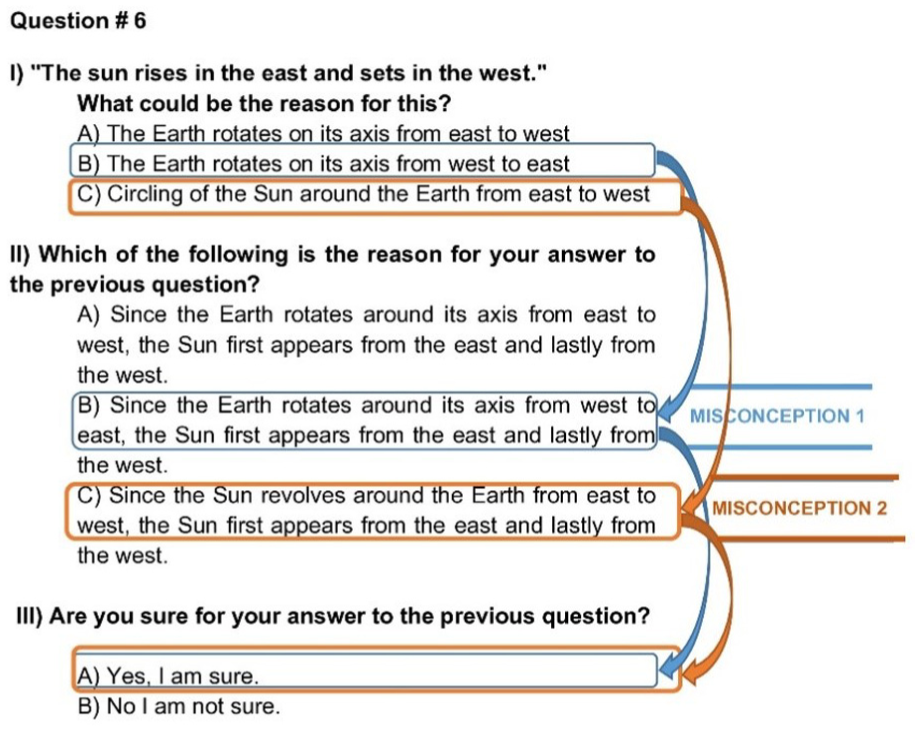
Sample for measuring two misconceptions in one question (MC6).

The same misconception was measured in two different questions (MC9 and MC10).
The Reliability and Validity of the “Earth’s Crust and Movements of the Earth” Test
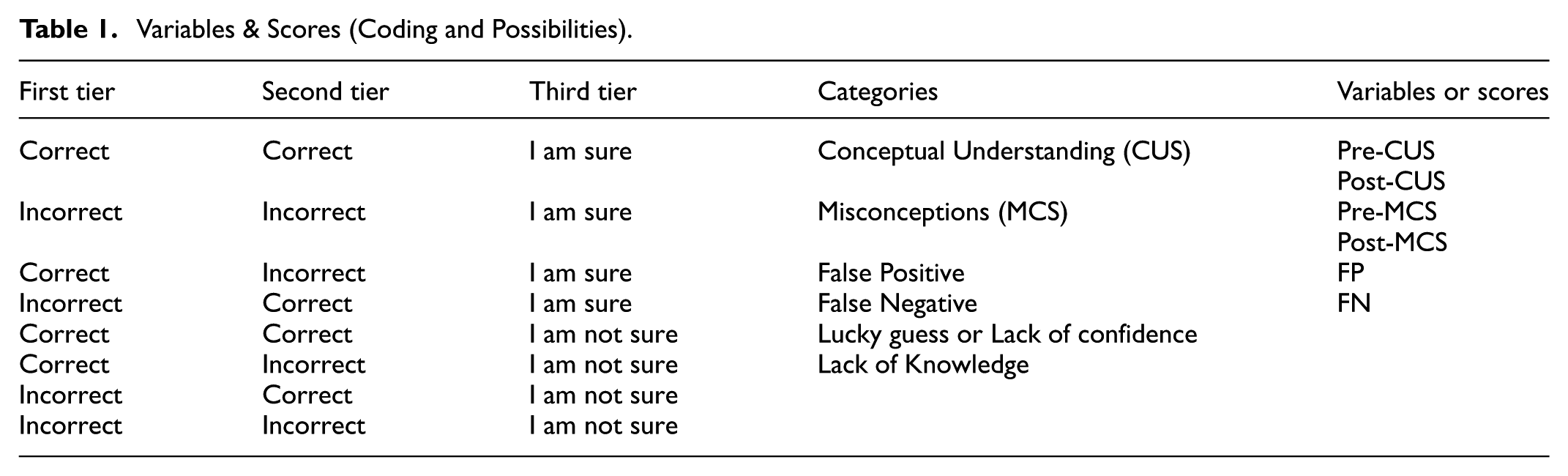
A pilot study for the ECMET, was conducted with 122 secondary school students to evaluate its validity and reliability. False positives (FP) and false negatives (FN) were calculated based on students’ responses to determine content validity (Hestenes & Halloun, 1995). Misconception scores represented the number of misconceptions where students selected incorrect answers (coded as 0) in the first two stages of the test and indicated certainty (“I am sure”) in the third tier (coded as 1). Conceptual understanding scores were the number of items that students answered correctly in both the first and second tiers (See Table 1).
Variables & Scores (Coding and Possibilities).
Item analysis using responses from the first two tiers revealed variations in test difficulty: one item was very difficult, three difficult, one moderate, four easy, and three very easy. Discrimination indices ranged from 0.20 to 0.80, showing adequate ability to distinguish students with high and low conceptual understanding. Six items with discrimination indices between 0.20 and 0.29 were revised based on expert feedback, who also confirmed the face validity of the ECMET.
In the pilot study, a significant correlation (r(122) = .610; p < .05) between scores from the first two tiers of ECMET and confidence levels in the third tier supported the instrument’s construct validity (Hestenes & Halloun, 1995). The internal consistency reliability coefficient (KR-20) was .748, which is acceptable given students’ unfamiliarity with three-tier tests (Korur, 2015). For content validity, false positive (FP; 1-0-1) and false negative (FN; 0-1-1) rates were required to remain below 10%, with FP exceeding FN. FP rates exceeding 10% for the first and seventh questions, and FN rates exceeding 10% in the third question led to item revisions based on expert feedback. Additionally, in the third and fifth questions modifications addressed instances where FN exceeded FP rates. In the pilot study, the average FP was 5.87%, and FN was 5.12%. After experimental applications, data from 156 students were collected with the revised ECMET and it showed all item-based FP and FN values were below 10%, with FP averaging 2.99% and FN averaging 2.88%, further confirming content validity.
Treatment and Control Group Applications
Table 2 provides a comparative overview of the instructional approaches used across the DSRT, SRT, and TMC groups, with a specific focus on how refutation texts are implemented in each group. This comparison also highlights the distinct teaching-learning strategies employed in the DSRT and SRT groups, emphasizing their role in facilitating knowledge revisions through different narrative formats. To maintain fidelity of implementation, teachers in the treatment groups participated in a 1-hr orientation on the instructional procedures. All treatment sessions were subsequently observed by a researcher using a structured checklist to ensure that the materials were delivered as intended. The implementation proceeded precisely as planned, with no deviations recorded, ensuring consistency across the treatment groups.
Instructional Features and Applications Within Three Experimental Groups, DSRT, ST, and TMC.

Intervention in the Group Incorporating Stories Containing Refutation Texts
In the treatment and control groups of the study, interventions were conducted over 3 weeks, focusing on learning outcomes regarding “The Earth’s Crust and the Movements of Our Earth.” In the SRT group, stories containing refutation texts were implemented using the the KReC-based approach. The interventions aligned with the five principles of KReC framework as follows:
Stage I (Encoding): Students were engaged in critical thinking through guided questions during an introductory activity/experiment designed to activate prior knowledge about Earth’s crust and movements, since information encoded in memory cannot be erased but can be reactivated.
Stage II (passive activation): Stories containing refutation texts were presented to students, aiming for passive activation of relevant prior knowledge. These stories allowed students to confront misconceptions naturally, followed by explicit refutations and detailed true scientific explanations (for instance, see Figure 1).
III. Stage (Co-activation): To facilitate co-activation, students were prompted to discuss examples from the stories, engage in classroom dialog, and review the stories freely, reinforcing clear conceptual understanding.
Stage IV (Integration): To support knowledge integration, students were encouraged to articulate their understanding by providing contextual examples, by participating in discussions, and by reinforcing the connection between prior misconceptions and accurate scientific concepts.
Stage V (competing activation): To suppress previous misconceptions and strengthen newly acquired scientific knowledge, students freely revisited the stories and provided written or verbal explanations to deactivate lingering misconceptions. They also participated in evaluation activities to further reinforce their learning.
Intervention in the Group Incorporating Digital Stories Containing Refutation Texts
In the DSRT group, stories containing refutation texts were transformed into DS using the Powtoon© DS creation web application. The first and third stages of SRT Group were conducted similarly to those of DSRT Group. However, in the second stage, DS containing refutation texts replaced printed stories. While the students in SRT Group received printed stories, those in DSRT Group accessed DS through Powtoon© application on computers or tablets.
The fourth and fifth stages followed the same methodology as SRT Group, but students in DSRT Group could control the DS’s playback-pausing, replaying, or restarting as needed. This digital format allowed for individualized learning experiences, enabling students to recognize their misconceptions and engage with scientifically accurate content at their own pace. Sample images of DS are provided in Figure 5.

(a) A sample screenshot demonstrating the integration phase of the KReC framework in the DS for misconception MC3 (see Supplemental Table S1). (b) A sample screenshot demonstrating the co-activation phase of the KReC framework within the DS addressing misconception MC12 (see Supplemental Table S1).
Applications in the Group Using the Teaching Method Without Refutation Texts
The control group does not include refutation text interventions. Throughout the application period, lectures were given by students’ classroom teachers using the methods and techniques specified in the science curriculum (TMNE, 2018). During the process of applications, in 3 weeks, classroom teachers used the science school book and science notebook to make students take various notes on the subject, including experiments on the subject, used worksheets, and various visuals were shown to the class using smart boards and computers. In the teachings in this group, refutation texts, stories containing refutation texts, or digital refutation texts were not used. However, if the teacher made an application to correct misconceptions, no intervention was made, and the teaching process continued in the same way as it had before this study.
Data Analysis
To ensure statistical robustness, a power analysis was conducted following Cohen’s (1988) guidelines. A medium effect size was assumed, given the expectation of comparable effects in both intervention groups. The probability of a Type I error (α) was set at .05, while the probability of a Type II error (β) was set at .01, ensuring a statistical power of .99. Sample size calculations were determined accordingly, using Cohen’s d = 0.05 for paired t-tests and η2 = .09 for multi-variate analysis of covariance (MANCOVA; Tabachnick & Fidell, 2007), confirming sufficient sensitivity to detect meaningful effects.
Before analysis, missing data and extreme values were examined. Sixteen extreme values were identified and removed, leaving a final sample of 140 students. Normality assumptions were verified through skewness (0.47 to −1.137) and kurtosis (0.109 to −1.021), both within the acceptable range (−1.5 to +1.5) (Gravetter & Wallnau, 2014). The similarity between mean and median values further supported the assumption of normality.
To address the first research question, MANCOVA was performed in SPSS 22, allowing for the analysis of multiple dependent variables while controlling for covariates (Tabachnick & Fidell, 2007). Pretest misconception scores (Pre-MCS) and conceptual understanding scores (Pre-CUS) were set as covariates, as they were significantly correlated with their respective posttest scores—dependent variables (Pre-MCS to Post-MCS: r = .199, p < .05; Pre-CUS to Post-CUS: r = .661, p < .05), ensuring statistical control over pre-existing differences.
Further assumptions for MANCOVA were tested. A custom model in SPSS verified the homogeneity of regression slopes, with no significant interaction effects (p = .275 for Post-CUS; p = .097 for Post-MCS), conforming the assumption was met (Pallant, 2005). The Box’s M test (p = .016) indicated covariance matrices equality within acceptable limits (Hair et al., 2006), as the MANCOVA remained valid, since it is robust to violations of this assumption, given the sample size exceeded 30 (Tabachnick & Fidell, 2007). Levene’s test showed homogeneity of error variances for Post-MCS (p = .326), while Post-CUS variances were not homogeneous (p = .028). However, the variance ratio test confirmed that the variance ratio for Post-CUS (0.563/0.337 = 1.670) was below the critical threshold of 2, ensuring variance equality across groups (Field, 2009). All statistical assumptions for MANCOVA were met. By implementing a robust power analysis, this study ensured adequate sensitivity to detect meaningful effects.
Results
Results of the First Research Question
In order to determine the effectiveness of the interventions carried out in the groups, the results of the MANCOVA analysis are given in Table 3. There are significant effects of the methods of the DSRT, SRT, and TMC interventions on the collective dependent variables, the Post-CUS and the Post-MCS, when the covariates Pre-CUS and Pre-MCS are controlled (F(4,268) = 2.803, p = .026, Wilks’s λ = 0.921, partial η2 = .040).
Analysis Results of the MANCOVA.

Note. N = 140.
p < .05.
For post-hoc analysis, the effects of the test between subjects were examined. Accordingly, while the methods have a statistically significant effect on the Post-MSC (F(2,135) = 5.411, p = .005, partial η2 = .074), they do not have a statistically significant effect on Post-CUS (F(2.135) = 0.910, p = .405, partial η2 = .013). The superiority of these methods in terms of the Post-MCS was examined by pairwise comparisons (see Table 4).
Results of the Pairwise Comparisons.

Note. N = 140.
p < .05.
There is a statistically significant difference between the Post-MCS averages of the students in the TMC group and the Post-MCS averages of the students in the DSRT group, see Table 3 (XTMC-XDSRT = .425; p = .034). Similarly, there is a statistically significant difference between the Post-MCS averages of the students in the TMC group and the Post-MCS averages of the students in the SRT group (XTMC-XSRT = .365; p = .007). The fact that the average differences in misconception scores favor the control group (where 0 points represent the situation where there is no misconception) shows that misconceptions are corrected more in the treatment groups, most probably because of the interventions applied in these groups. There is no significant difference between the Post-MCS averages of students in the DSRT and SRT groups.
Although within-group analyses indicated substantial pre–post improvements in CUS for all conditions, the adjusted posttest comparison across groups was not statistically significant (p = .405, partial η2 = .013). This pattern indicates comparable gains across groups rather than a differential effect of intervention type on CUS. The suggested notable improvements in conceptual understanding within-groups placed greater emphasis on examining the effectiveness of the interventions within each group individually. According to the paired sample t-test results for the DSRT group, there was a statistically significant difference (t(47) = −11.954, p < .05) between the Pre-CUS (
According to the paired sample t-test results for the SRT group, there was a statistically significant difference (t(45) = −10.214, p < .05) between Pre-CUS (
Results of the Second Research Question
The ECMET was applied to all three groups before and after the interventions to reveal the students’ misconceptions. In addition, the percentages of misconceptions were determined by examining the students’ answers on a question basis. In the three-stage questions, the wrong answer (0) in the first two stages and the answer “I am sure” (1) in the third stage ensured that the question option was counted as a misconception. Since each question expressed a different misconception, the question options were considered to determine the misconception percentages. The number of students was added up for 0-0-1 answers for the question options. Based on this option, this number was converted into a misconception percentage score (MCP) within the total number of students. When the misconception percentage score in the three-tier is below 10%, the statement in the relevant option is not a misconception. The misconceptions that were and were not corrected before and after the interventions in all three groups are presented in a holistic format with their respective percentages in Table 5. In the DSRT group, seven misconceptions with the MCP percentages above 10% were identified before the interventions (see Table 5).
Misconceptions Classified With Respect to the Groups Before and After the Interventions.


Note.* misconceptions in the given group, and ** misconceptions formed after applications. The shaded MC12 was the one that was not eliminated in either group.
In the DSRT group, only one misconception (MC12) was determined after the interventions. Six of the seven misconceptions that the students possessed before the application in this group (MC5, MC9, MC10, MC13, MC15, MC16) were corrected. In the SRT group, ten misconceptions (including all misconceptions determined in the Treatment-1 group) were determined to have MCP greater than 10% before the interventions (see Table 4). In the SRT group, two misconceptions (MC9 and MC12) were determined to have MCP greater than 10% after the interventions. These misconceptions showed a decrease in percentage compared to before the intervention. Eight of the 10 misconceptions that the students in this group had before the interventions (MC5, MC7, MC8, MC10, MC13, MC15, MC16, MC17) were corrected. The TMC group had the least number of misconceptions, six misconceptions, before the interventions (see Table 4). Only two of the misconceptions in this group before the interventions (MC10, MC17) could be corrected due to the interventions. Misconceptions numbered MC9, MC12, MC13, and MC16 that existed in the TMC group before the intervention could not be corrected, but a decrease was observed in the percentages of these misconceptions. It is also noteworthy that there were two misconceptions (MC3 and MC5) in this group that did not exist before but emerged after the intervention.
Discussion
The findings of this study revealed that both DSRT and SRT significantly reduced misconceptions compared to the control group (TMC). These results align with prior studies highlighting the benefits of digital stories in education (Karaoglan Yilmaz et al., 2018; Kurniawan et al., 2019; Robin, 2008; Sadik, 2008; Saritepeci, 2021) and the role of narrative stories in fostering conceptual integration (Sharda, 2007; Shelton et al., 2017). A notable outcome, however, was that although all groups demonstrated gains in conceptual understanding within their own groups, the between-group differences in posttest scores were not statistically significant. Such a pattern indicates that large within-group gains in conceptual understanding scores can coexist with non-significant between-group effects, as the former reflect mean differences over time within each condition, whereas the latter test differences in adjusted posttest means across conditions. This discrepancy may be explained in several ways. First, the ECMET, although valuable for diagnosing misconceptions, may be more sensitive to detecting changes in specific incorrect beliefs than capturing broader conceptual growth. Second, the relatively short duration and limited intensity of the interventions may have been sufficient to challenge misconceptions but insufficient to support the sustained reconstruction of students’ conceptual frameworks. Third, the design of the refutation texts may have promoted targeted correction without necessarily fostering deeper connections across related scientific concepts. Furthermore, the development of conceptual knowledge is a gradual process in which learners integrate new information into coexists with prior intuitive frameworks (Vosniadou, 2019). Short-term interventions may suppress specific misconceptions without reorganizing the broader conceptual networks necessary for robust understanding. While conceptual change strategies yield overall strong effects, their impact depends heavily on duration, instructional design, and assessment format (Pacaci et al., 2024). Refutation texts can help address misconceptions, but their effectiveness in fostering conceptual understanding depends heavily on design and context, meaning they should be seen as supportive tools for conceptual understanding rather than universal solutions (Schroeder & Kucera, 2022; Zengilowski et al., 2021).
The variation in effectiveness among the groups can be interpreted through the KReC framework, particularly its principles of coactivation, integration, and competing activation. The coactivation principle suggests that misconceptions and correct scientific explanations encountered together create cognitive conflict, fostering knowledge revision. Integration likely contributed by helping students in both groups incorporate newly acquired scientific knowledge into their existing conceptual frameworks. The interactive and multi-document digital storytelling format of the DSRT was anticipated to reinforce correct explanations and mitigate misunderstandings more effectively than the text-based SRT, with competing activation playing a greater role in the DSRT Group. On the other hand, both printed stories and DS containing refutation texts in line with the KReC framework in this study essentially corrected misconceptions. Although both interventions utilized KReC principles, their modes of engagement varied. The passive narrative structure of SRT may have promoted to gradual knowledge integration, while dynamic structure (such as presentation of cartoon characters, visual aids, discourse and intonation of the storyteller) and multi-document format of DSRT may have accelerated competing activation through repeated visual and auditory reinforcement. These findings suggest that different KReC stages contribute uniquely to misconception elimination. The importance of unique refutation texts within structured instructional approaches is well supported in misconception research (Kendeou & Van Den Broek, 2007; Tulis, 2022).
In the control group (TMC), while students showed some improvement in conceptual understanding, misconceptions persisted, with two new misconceptions emerging. This suggests that conceptual understanding and misconception reduction do not always occur simultaneously, as misconceptions can persist despite improved conceptual understanding. This finding is consistent with previous research indicating that traditional teaching methods, while effective in delivering factual knowledge, often fail to replace robust misconceptions (Korur et al., 2016; Halloun & Hestenes, 1985). Numerous refutation text studies support similar results (Kendeou & Van Den Broek, 2007; Tulis, 2022). Given the complexity of misconceptions (Vosniadou & Skopeliti, 2017), teachers should implement strategies that not only present true scientific knowledge but also actively challenge and restructure students’ prior beliefs and their misconceptions.
In the present study, DSRT and SRT interventions were quite effective in eliminating many misconceptions that could be considered robust, and one out of seven misconceptions in the DSRT group and only two out of ten misconceptions in the SRT group could not be corrected even though knowledge revision process. Among the many possible reasons, the most significant one can be best explained through the knowledge revision process. The encoding and passive activation principles of the KReC framework (Kendeou et al., 2014) emphasize that since the information encoded in the memory cannot be deleted, there is a possibility of reactivation, and the learner does not direct this process. At this point, since the learning environment is supported by some misconceptions that are thought to arise from children’s sensory-based observations and new information entering the coactivation process, the new information may not have come to the fore by suppressing the old information. Misconceptions that arise from sensory-based observations, for example they observe the Sun in different positions in the sky as if it were moving around the Earth, may persist despite formal instruction. Because students frequently observe such phenomena in their daily life, their intuitive explanations may be resistant to change, limiting the competing activation process. Scientific information and students’ misconceptions do not activated simultaneously to enable them to repair the conflict (van Den Broek & Kendeou, 2008).
For example, after the interventions, the misconception MC12, “The Earth revolves around the Sun once every day, causing day and night” (MC12) remained as a robust misconception across all groups (the only misconception that could not be corrected in the DSRT Group). While students can easily perceive the movement of the Sun in the sky, they have difficulty in conceptualizing the Earth’s rotation. Previous studies confirm that students struggle with understanding the day/night cycle (Bonus & Watts, 2021; Chiras & Valanides, 2008; Schwarz et al., 2011). Similar to our findings, Vosniadou and Skopeliti (2017) noted that replacing misconceptions related to the day/night cycle is particularly challenging for primary school students. Furthermore, Bonus and Watts (2021) indicated that young children with poor prior knowledge exposed a story including refutation narrative about the cause of the day/night cycle, either in its original form or in a format that was devoid of misconceptions, they can mistakenly perceive misconceptions as pieces of accurate information. They may form fragmented and/or synthetic concepts when exposed to a counterintuitive scientific explanation (Vosniadou & Skopeliti, 2017). The newly formed concepts may negatively affect their knowledge revision process. For this robust misconception (MC 12), the digital contents (such as characters, images, videos) may be responsible for prevalence of the MC12 especially in the DSRT Group. Falloon (2019) suggests that some digital applications, such as simulations, may inadvertently reinforce misconceptions if not carefully designed.
In addition, the persistence of MC12 can be interpreted through three interrelated factors. First, from a cognitive load perspective (Mayer, 2005), understanding the day/night cycle requires simultaneous processing of multiple spatial and temporal relationships—Earth’s rotation, axial tilt, and revolution—which can overload working memory, particularly for younger learners. Second, prior knowledge derived from repeated sensory observations—such as seeing the Sun apparently move across the sky—forms a coherent but incorrect mental model that is constantly reinforced in everyday life. This intuitive model can dominate during the passive activation stage, making it harder for accurate explanations to take precedence in the competing activation process. Third, the conceptual complexity of MC12 exceeds that of other misconceptions identified in this study (e.g., the Earth’s rotation direction), as it demands abstract, three-dimensional reasoning and temporal sequencing skills that many fourth-grade students have yet to fully develop. These combined factors may have limited the integration of accurate knowledge, even when refutation texts were embedded in engaging narrative or digital formats. Future instructional designs could address these challenges by reducing extraneous cognitive load, explicitly linking abstract astronomical models to concrete, observable experiences, and providing spaced, repeated opportunities for coactivation to strengthen the suppression of robust misconceptions.
Overall, no significant differences were found between the DSRT and SRT groups in eliminating misconceptions and improving conceptual understanding. This suggests that storytelling itself plays a crucial role in knowledge restructuring. Kendeou and van Den Broek (2005) emphasized that misconceptions persist both within and beyond formal education and that learning from text remains a crucial tool for independent lifelong learning. Nearly two decades later, this perspective is evolving, with texts increasingly being integrated into DS and similar digital applications as tools for lifelong learning.
However, the misconception that “the Earth rotates east to west.” (MC9), which was present with a high percentage in all groups before the application, was dramatically reduced and corrected in the DSRT group after the application, but MC9 stubbornly persisted in the other groups (SRT anc TMC). It reveals that the refutation texts embedded DS based on KReC framework developed with Powtoon can remarkably correct certain robust misconceptions. One of the reasons why MC9 was corrected only in the DSRT group may be that digital contents made it easier for students to remember the direction of rotation visually. Another crucial reason may be the combination of colors, visuals, and sound in animated videos may enhance the audiovisual memory and facilitate learning (Setiawan & Soniya, 2023). Additionally, the audiovisual components of DS may accelerate the competing activation process in the KReC framework, promoting the revision of prior knowledge more efficiently. Previous research also indicates that digital media based on the Powtoon© application facilitates student comprehension (Sanjaya et al., 2021; Setiawan & Soniya, 2023) supporting the findings of this study.
It may explain the stubborn presence of some misconceptions especially for students in the TMC Group. For example, the misconception that “The Earth completes its rotation around its axis in one year” (MC13), which was present in all groups before the application, was corrected after the interventions in the SRT and DSRT groups. This persistence of misconceptions, particularly among students in the TMC group, may be attributed to the absence of explicit stories including refutation texts, limited engagement with alternative explanations, and the reliance on traditional instructional methods that do not actively challenge prior misconceptions. In contrast, the SRT and DSRT interventions provided structured refutation and multi-document engagement, which facilitated the correction of misconceptions such as MC13 through narrative-based learning.
Before the interventions, some students in all three groups held the misconception that “The Sun revolves around the Earth” (MC10). This aligns with Vosniadou and Skopeliti’s (2017) view that young children construct misconceptions based on direct observations. MC10 likely emerged because students perceive the Sun as a round object appearing in different positions in the sky throughout the day, reinforcing their intuitive belief that it moves around the Earth (McDonald et al., 2019; Vosniadou & Brewer, 1994). Vosniadou and Skopeliti (2017) argue that such misconceptions are not random mistakes but rather structured attempts to reconcile counterintuitive scientific knowledge with pre-existing everyday experiences. Despite the persistence of MC10 before the interventions, the present study found that it was successfully corrected this fundamental astronomical misconception in all three groups after the interventions.
Beyond their demonstrated role in reducing misconceptions, the practical implementation of DSRT materials requires careful consideration of accessibility for teachers. Digital storytelling platforms such as Powtoon provide engaging opportunities for science instruction, but their effective use depends on factors such as teacher familiarity with the software, classroom infrastructure, and access to stable internet and devices. While extensive training is not always necessary, offering teachers opportunities to become more comfortable with digital tools—and ensuring institutional support for basic technological readiness—can help maximize the benefits of DSRT. In this way, the findings become more actionable for educators working across varied settings.
Conclusion
This study examined the effects of DSRT, SRT, and TMC on primary school students’ conceptual understanding and science misconceptions related to the topic of Earth’s Crust and Movements. The findings demonstrate that both DSRT and SRT significantly reduced misconceptions compared to the TMC group, suggesting that storytelling itself plays a crucial role in knowledge restructuring when paired with refutation texts. However, these significant gains in misconception reduction did not transform into statistically significant improvements in overall conceptual understanding between the groups, suggesting that while the interventions succeeded in correcting misconceptions, they did not substantially foster deeper scientific reasoning. Overall, no significant differences were found between the DSRT and SRT groups in eliminating misconceptions and improving conceptual understanding. Interpreted through the KReC framework, the results underscore the role of coactivation and integration processes in facilitating conceptual change. The persistence of certain misconceptions—particularly those grounded in strong intuitive or sensory beliefs—further highlights the complexity of knowledge revision in students. The conceptual complexity and constant reinforcement of intuitive, sensory-based observations may have made specific misconceptions highly resistant to change. Furthermore, the lack of significant differences between the DSRT and SRT results suggests that narrative structure, rather than the medium in which narratives are presented (multi-media or printed), plays a central role in promoting conceptual change. Given these results, both DSRT and SRT offer promising tools for addressing misconceptions, but their utility for broader conceptual understanding requires careful consideration. A key practical implication may be that in contexts where resources are limited, printed refutation stories remain a feasible and effective option for misconception reduction. These findings contribute to the literature by integrating narrative-based refutation texts, digital learning environments, and a validated three-tier diagnostic test within a robust conceptual framework. The integration of storytelling and refutation text into science education is therefore recommended as a promising strategy to address deeply robust misconceptions in primary students.
Limitations and Suggestions for Further Research
The findings of this study are primarily applicable to populations with similar access to digital resources and educational settings. Technological availability, instructional context, and students’ prior exposure to digital learning tools may have influenced the effectiveness of interventions. This study focused specifically on the existence and elimination of approximately 18 misconceptions related to Earth’s crust and movements, but it did not examine how individual learner characteristics may have impacted knowledge revision. As Van Hoof et al. (2021) highlighted, future research should explore how factors such as epistemological beliefs (Mason & Gava, 2007) affect students’ engagement with refutation texts. Moreover, since the researchers created the SRT and DSRT materials used in this study, future studies should investigate the impact of student-generated content in active learning environments.
Another limitation concerns the randomization procedure in this quasi-experimental study. While intact classrooms rather than individual students were randomly assigned to conditions—a necessary choice given administrative and technological constraints—this design may have limited internal validity by introducing classroom-level confounds (e.g., differences in teacher practices, peer interactions, or classroom climate). As such, the findings should be interpreted with this consideration in mind.
While outcomes in this study were measured using a three-tier test, future research should integrate qualitative evidence (e.g., interviews, observations) to capture how students revise misconceptions and build conceptual understanding over time, including delayed posttests. Combining quantitative and qualitative approaches would provide a more comprehensive understanding of how refutation text–based interventions influence both immediate and long-term conceptual change.
Although this study provides evidence for the effectiveness of DSRT and SRT interventions in reducing misconceptions among fourth-grade students in Antalya, Turkey, caution is needed when generalizing the findings to other contexts. Cultural factors—such as pedagogical traditions, student–teacher interaction norms, and the role of narrative—may influence how learners engage with printed and digital storytelling formats (Lisenbee & Ford, 2018; Rizvic et al., 2019). Curricular differences in the sequence, depth, and emphasis on Earth science topics could also affect the persistence of specific misconceptions (Bakopoulou et al., 2021). In addition, access to and familiarity with digital tools like Powtoon may vary widely across regions, influencing engagement and learning outcomes (Saritepeci, 2021). In settings with limited infrastructure or minimal experience with multimedia instruction, the implementation and impact of DSRT may differ substantially. These factors highlight the need to adapt refutation-based storytelling to local needs and resources. Future research could examine cross-cultural and cross-curricular replications, and compare settings with different levels of technological integration to assess the transferability of these strategies.
The most notable difference between the treatment groups was the integration of DS created using Powtoon in the DSRT group. The advantages and limitations of the Powtoon application may have affected the treatments. The Powtoon is a web 2.0 tool that functions similarly to PowerPoint, Impress, and Prezi in terms of its structure and functionality (Akmalia et al., 2021; Rioseco et al., 2017). It allows users to create animated videos with a limited number of preset characters and combine them with a limited number of specific background options. It is also a superior feature that allows uploading images, editing is required to integrate them seamlessly within the existing background. The effectiveness of DS depends not only on their visual and animated elements but also on the design skills of the user.
Finally, due to challenges related to timeframe constraints, accessibility of participants, and institutional permissions, it was not possible to include a delayed posttest, alternative digital storytelling tools, and qualitative data collection in this study. These potential methodological limitations may have constrained the scope of interpretation. Consequently, while both DSRT and SRT proved effective in reducing misconceptions, further research employing extended interventions with greater statistical power and cluster-adjusted designs will be essential to determine whether genuine differential effects on conceptual understanding emerge. Future investigations should also explore how various refutation text–supported KReC framework formats can foster deeper learning and promote conceptual understanding by considering different methodological approaches.
Supplemental Material
sj-docx-1-sgo-10.1177_21582440251403736 – Supplemental material for Comparison of the Effects of Stories and Digital Stories Containing Refutation Texts on Conceptual Understanding and Correction of Misconceptions in Primary Science Education
Supplemental material, sj-docx-1-sgo-10.1177_21582440251403736 for Comparison of the Effects of Stories and Digital Stories Containing Refutation Texts on Conceptual Understanding and Correction of Misconceptions in Primary Science Education by Fikret Korur, Dilek Erduran Avcı and Şule Gürkan in SAGE Open
Footnotes
Author Note
This study utilized a portion of the data from the master's thesis written by the third author under the supervision of the first author at the Institute of Educational Sciences, Burdur Mehmet Akif Ersoy University.

Ethical Considerations
This study was conducted in accordance with the ethical standards of the American Psychological Association (APA) Ethical Principles of Psychologists and Code of Conduct (Section 8.05). At the time of data collection, ethical review and research permission for studies conducted in public schools were under the legal authority of the Provincial Directorates of National Education in Türkiye, and this study was approved by the Research Evaluation and Review Commission (Approval No: E.15223617, Date: 31/08/2018). All ethical principles for research involving minors, including voluntary participation, anonymity, protection from harm, and confidentiality, were strictly followed.
Consent to Participate
In accordance with APA Ethical Principles of Psychologists and Code of Conduct (Section 8.05), written informed consent was obtained from the parents/legal guardians of all student participants, and verbal assent was obtained from the students themselves. Participation was voluntary, and students were informed that they could withdraw from the study at any time without penalty. No personal identifying information was collected, and no physical, psychological, or academic risk was posed to participants.
Author Contributions
FK(Fikret Korur): Supervision, conceptualization, literature review, methodology, analysis, and manuscript writing and editing, and funding acquisition. DEA (Dilek Erduran Avcı): Conceptualization, literature review, critical revision of the manuscript, manuscript writing and editing, contact with the journal, and funding acquisition. ŞG (Şule Gürkan): Literature review, methodology, data collection, analysis, interpretation of results, and funding acquisition.
Funding
The authors received no financial support for the research, authorship, and/or publication of this article.
Declaration of Conflicting Interests
The authors declared no potential conflicts of interest with respect to the research, authorship, and/or publication of this article.
Data Availability Statement
The participants of this study did not give written consent for their data to be shared publicly, so due to the sensitive nature of the research, supporting data is not available.
Supplemental Material
Supplemental material for this article is available online.
References
Supplementary Material
Please find the following supplemental material available below.
For Open Access articles published under a Creative Commons License, all supplemental material carries the same license as the article it is associated with.
For non-Open Access articles published, all supplemental material carries a non-exclusive license, and permission requests for re-use of supplemental material or any part of supplemental material shall be sent directly to the copyright owner as specified in the copyright notice associated with the article.
