



Abstract
The main question of this study asks about to what extent people’s identification with an ethno-racial category—in the case of Peru, Quechua, Aymara, Amazonian ethnic group, or Afro-descendant—is conditioned by “living” memory practises that are present in their daily routines and lives and are associated with historical characteristics linked to their places of birth, a process we have called rooting. To discuss it, we have used information from official Peruvian national surveys database and historical administrative data. We find an association between ethnic self-identification and characteristics of people’s districts of birth, such as presence of archaeological monuments, or existence of resettlements existed, or long-time presence of Afro-descendant populations. These results should open new research topics related to how the collective experiences of places of birth are reproduced over time to continue shaping the cultural practices of citizens.
Plain Language Summary
This paper is about people who self-identified as Quechua, Aymara, Afro-Peruvian and mestizo in Peru, a Southamerican country, and were born in greater proportions in districts where archaeological sites are present. Also about people who identified themselves as Quechua or Aymara and were born to a greater extent in districts with forced native resettlements. Analysis of the History of these populations conclude that the positive affirmation of an ethnic identity may be related to everyday memory.
Keywords
Introduction
The premise of this study is to document that people’s identification with an ethno-racial category—in the case of Peru, Quechua, Aymara, Amazonian ethnic group, or Afro-descendant—has strong correlation with “living” memory practises that are present in their daily routines and lives and are associated with historical characteristics linked to their places of birth. We analyze how the process of ethnic self-identification may be influenced by being born in a district where archaeological monuments are present, where historical resettlements occurred, or where Afro-descendant populations have long been established—all within the broader context of the strong dominance of the mestizo category as the default form of identification in Peru’s racialized social order.
Living memory practices enable individuals to recontextualize the past through present-day actions, crafting narratives of progress and envisioning the future (Nora, 1996; Blakely & Moles, 2019). These actions, particularly when carried out in historically significant locations, help create “places of memory”—sites imbued with collective feelings where a shared heritage crystallizes (Nora, 1996). Our aim is to expand this perspective by recognizing that living memory practices also shape discourses of identity, attachment to native spaces, and the categorization of social roles in the public sphere. This is both a deeply personal and inter-subjective process, and, as such, it is inherently social.
What, then, are these practises of living memory? Moreover, how do they foster processes of rooting or similar as those in our present interest? Halbswachs, in a foundational text on the sociology of memory, refers to the re-signification of past events in everyday life to give meaning to narratives that constitute social identities. A musical performance or a political activity, for example, can be current and vital practises within a human group while bringing up to date its ancestral myths. “Alongside a written history, there is a living history that perpetuates or renews itself through time,” he argues (Halbswachs, 2004, p. 66, our translation). Citing the case of Wagner’s Valkyries, he refers to pre-war European cultural movements, such as the Vienna music scene of the 1930s, and points to the re-contextualized use of symbolic grammars from Germanic and Scandinavian folklore. Through a collective memory formulated “from mouth to ear” and on the understanding that “culture belongs to an epoch, but (also) is an inexhaustible source for all epochs,” as his critic Namer stated (Namer, 1998, p. 55, our translation), Halbswachs argues their use in National Socialist military marches affirmed a nascent Austrian national identity.
Other scholars complement this work on the construction of living memory by focusing on material culture and the cultural use of space. The most influential, De Certeau (1988, p. 117), introduces in The Practice of Everyday Life the notion of “practised places,” understanding them as installations of living memory because they are forms “geometrically defined by urban planning (…) transformed into spaces by (the action of) walkers.” A “practised place” is thus “a system of signs” that is socially meaningful and an “order (of whatever kind) in accord with which elements are distributed in relationships of coexistence” (De Certeau, 1988, p. 117). Giddens, on the same subject, claims that “space is not an empty dimension along which social groupings became structured” but must be considered as a constituent part of “systems of interaction” (Giddens, 1984, p. 368). They are both alluding to buildings, monuments or residential facilities, but also rivers, mountains or trees, that is, elements that constitute “practised places” when these places and their objects are socially employed to materialise the experience of identity.
The ethnographic exercise of anthropology provides evidence of how living memory marks people’s day-to-day and social relations. Among the most influential works is Signifying Identities. Anthropological Perspectives on Boundaries and Contested Values. Here, its author, Cohen (2000, p. 5) offers ethnographic evidence about how diverse peoples—such as the Basseri, the Maori, the Celtic Asturians, or the Scots—assume an ethnic identity as a conviction “(…) all concerned with the senses which people make of themselves and with their lived experience” (Cohen, 2000, p. 5). He suggests that the lived experience, in that case, is connecting, sharing, or relating these acts constituting a form of genealogical “engagement” in people (Cohen, 2000, p. 5). Consistent with Barth, he defines living experience as an eminently cognitive process where language combines with the sensory and the reflective to foster identity awareness and rooting (Barth, 2000, p. 17).
Processes such as “living memory,”“practised places,” and “genealogical engagement” are thus constitutive of the experience of rooting. All of them, as Giddens points out, are enhanced in contexts of “co-presence” (Giddens, 1984), that is, they are conceived in cultural realities that are local in character, and they are constructed daily in face-to-face social practises characterized by the physical proximity of the participants. This being so, it is the daily routines and rituals that affectively involve people with their native places and spaces of significance, and which ultimately heighten their positive bonds of identity.
Place and its Memories in the Cultural Rooting Process: Literature Review
The following theoretical analysis shows how the probability of identifying oneself with a particular ethnicity increases when the living memory of places is very present, when they establish a social order and promote a shared narrative of the future. This applies to communities descended from those who lived in indigenous settlements or reservations across the Americas, for example, and as well as those of African descent in their diaspora. Today, these people exhibit resilient and proud cultural identities that are strengthened over time by the vitality of their everyday memories.
We see, for example, how the Quechua peoples, who today settle on what were once Spanish colonial resettlements in the valleys near Cusco, Peru, sustain their identity discourses through the experiences of living memory. The Q’ero people in Pisac are a case in point. Far from expressing resentment that their living space was “reduced” to resettlement (the Spanish translation for which is reducciones), today they extol their distinctive institutions, such as government by the envarados (DeLong, 2018; Pérez Galán, 2008). In southern Chile, the active leadership of the loncos is as present now for the Mapuche peoples as it has ever been (Balbontin, 2019). In each case, the self-government achieved has generated recognition and power whose result is ethnic self-affirmation. After negotiating over extended periods in a tense, unequal and asymmetrical relationship with authorities, they eventually achieved a degree of autonomy that has allowed them to sustain their own social orders (Foerster, 2002; Saito & Rosas, 2017). These examples show how, in local contexts where rooting is strong, an ethnic identity emerges that is more marked than elsewhere because of the strength of routines and rituals that are laden not only with memory but also by the agency of effective relational forms that activate the human group.
Whilst identity in individuals and human groups is a cognitive process, it is also experienced as a palpable material reality (Baker, 1998, p. 1). It occurs when local communities update their social dynamics and discourses in the face of emerging relational forms, such as those generated by cultural industries or tourism that entail the monetization of the host “place”; for example, archaeological discoveries or new economic activities that reconfigure identity narratives (Stronza, 2001). Of course, these processes of reinvention are by no means “natural.” Instead, they are rewriting processes by political and social elites who instrumentalize discourses by re-contextualizing everyday memories—forms historically present, such as art, food, language, clothing, landscapes, or buildings—and endowing them with new meanings. We see this in the renewal and restoration of monuments and traditions of “practised places”; for example, Wahren’s study of how La Paz elites used Tiwanaku monumental heritage in an early period of the twentieth century to “update the past (and) archaise the present” of Bolivian Quechua and Aymara identity, long before the “pink wave” of Evo Morales (Wahren, 2018). In Peru, Asensio shows how the “meta-narrative of heritage” (Finneran, 2013) also operated in the rebirth of Muchik identity evident in the pride that swelled among its members with the discovery of sarcophagi, jewellery, ornaments and archaeological monuments of the so-called Lord of Sipán (Asensio, 2012). The discoverer of these riches, Walter Alva, remarks on their importance in improving the economic dynamics of the region and in the rebirth of the local collective identity that is coupled with a vigorous movement in gastronomy and shamanic and mystical practises that find anchor in the ancestral (Alva, 2010).
Evidently, being born in places where traditions live on, valued monuments stand, and archaeological wealth survives make it more likely that one will self-identify with ancestral ethnicity. The same is true for Afro-descendant populations who have remained settled in the same places they have occupied since colonial times. After conducting 24 focus groups throughout Peru with Afro-descendants, Miranda et al. (2013) find that full feelings of pride and identification with their condition of blackness are evident among those who still inhabit former plantations, or towns where escaped slaves settled and performed their epic narratives of rebellion and liberation through chanting, music and dance. Places full of history and stories, they reinforce ties and feed identity subjectivities that are lived with intensity in “practised places,” even though today all are immersed in contingent processes of mobility, migratory flows and intercultural communication (Gupta & Ferguson, 1997). In the same way, Postcolonial approaches, alongside contemporary perspectives that emphasize transnational migration, diasporic movements, and multilateral exchanges, converge around the idea that understanding identity discourses related to ethnicity and race requires recognizing their relational nature (Wade, 2010). In this context, Escobar argues that the political formation of Afro-descendant communities in Colombia’s Pacific rainforest region was not only a resistance to the State but also a struggle for the recognition of an identity deeply rooted in the cultural and environmental richness of the biodiversity they inhabit. This relational identity is intertwined with a natural place, rich in living memory practices (Escobar, 2008).
Rooting Compared to Other Factors in Ethnic Self-Identification
Most empirical research on ethnic identification in Latin America has emphasized the role of individual factors. Even though factors such as the mother tongue continue to be central to ethnic self-identification (Moreno & Oropesa, 2011), the odds of identifying as indigenous decline for individuals who grow up in Spanish-speaking social environments. The odds of self-identifying as white or mestizo increase, consequently, for those with higher incomes and more education. In the case of Peru, Moreno and Benavides (2019) show that age, gender, education, migratory experience, and income levels are all ethnic self-identification mechanisms: long-distance migration and higher income and education, leads to greater mestizo self-identification. The authors’ findings coincide with previous qualitative research (De la Cadena, 2004; Sulmont & Callirgos, 2014), reinforcing the idea that cultural and social change processes favor the formation of the mestizo identity.
Nevertheless, the growth of mestizaje as a category of self-identification has features that allow it to be understood from other perspectives. Telles and PERLA (2014) do so by collecting and analyzing data on ethno-racial self-identification in Brazil, Colombia, Mexico, and Peru. Based on the idea that ethnicity and race are multidimensional phenomena that can be measured and evaluated in different ways, their central thesis is that the most critical determinant of ethnicity and race is phenotype: skin color. This characteristic is the most constant symbolic criterion in the social differentiation and discrimination people experience, although not the only one (Telles & PERLA, 2014). This explains why escaping from stigmatizing cultural and phenotypical categories will influence self-identifying with an ethno-racial category when individuals complete a survey or census. Telles argues that it is to avoid the stigma of categories such as black, Indian or indigenous that the majority choose neutral categories such as mestizo or, in the case of Peru, Quechua, Aymara or one of the Amazon ethnic groups. “Ethnicity may be self-identified,” he argues, “but it is also regularly defined by others” (Telles & PERLA, 2014, p. 10). Citing Siedler (2002), he states that “even in the case of indigenous, identity involves ‘a complex dynamic of self-identification and ascription’.” (Siedler, 2002 [cited in Telles & PERLA, 2014, p. 10]).
As Telles argues, “self-identification (…) allows individuals to escape from stigmatized cultural and phenotypic categories and identify with the dominant group” (Telles & PERLA, 2014, p. 1.). Along the same lines, more recent work has proposed how social context affects self-identification within an ethno-racial category. In contexts where rooting as an influence is weak, it is the economic and social structure that orders the lives of the subjects and exerts the greatest impact, as it determines their cultural practices, and their notions of prestige and status. Cosamalón (2017), for example, analyzes results from the 1860 Lima census and notes a complex “game of appearances” at work when people ascribe to neutral ethno-racial categories, such as mestizo (Cosamalón, 2017). As well as phenotype and geographic origin, factors such as housing, employment, education and choice of partner are intertwined in the categorization. Their strategic use is enabled so that people can escape stigmatizing or subordinate identifications, such as indigenous or Afro-descendant. The phenomenon of the mestizo as an emerging category, explains Cosamalón, comes to express a liberal discourse that promotes social ascent in Latin America in the 19th century but which “does not contradict the existence of two racial poles” (Cosamalón, 2017, p. 363, our translation). “What was considered white, on the one hand, and black—Indian, on the other, became increasingly rigid and distant,” claims the author. Similar trends were noted in the 18th century by Ibarra (2002), in Quito (see Estrategias del mestizaje), and at the start of the 20th century by De la Cadena (2004), in Cusco (see Indígenas Mestizos). In each case, the instrumentalization of the mestizo category has an impact even in ordinary life, being used as a strategy for positioning and social relations.
Like the reflections of Cosamalón and those of Telles earlier, more recent work has focused on how games of appearance explain the rationality of self-identification in response to official State requirements, censuses or surveys amongst them. An example is the work of Vasquez-Padilla and Hernández-Reyes, who “interrogate the racial grammar of whiteness” (Vásquez-Padilla & Hernández-Reyes, 2020, p. 65) and understand that the use of discursive resources, such as wanting to have a lighter skin color, activates a game conducive to reach class mobility and improving social status. However, working from responses to the Americas Barometer in Colombia, they find also that the manifest desire for whitening loses strength in Afro-Colombian groups, where blackness is assumed to be a historically accentuated identity trait. In the same vein, Roth et al. (2022) offer complementary reflections by proposing “social escalators,” in the case of Mexico, where purchasing power and access to finance enable individuals to pass along a “whitening” process that impact their self-perceptions and narratives.
Recent evidence points to the non-static, somewhat fluid character of ethnic self-identification (Trelles & Torche, 2019): ethnic boundaries are not fixed and can instead be transformed by the actors and their circumstances (Brubaker, 2002; Villarreal, 2014). Waters (1994) says such identities are dynamic, fluid, changeable, and situational. According to Villarreal (2014), Latin America stands out for the rather diffuse limits of its ethnic identities.
A Proposal of Rooting as a Contextual Approach
Our approach wants to discuss the role of living memory and the experience of rooting, in the ethno-racial self-identification in populations. Consequently, we pose the following working questions to critically think about ethnic self-identification in relation with aforementioned aspects: Beyond individual stories, how much do the historical characteristics of the place of birth influence ethno-racial self-identification, in competence with other contextual factors with different characteristics? How determinant does rooting turn out to be when the individual chooses an ethno-racial self-identification category during an official registration process for individuals?
At this point, we can specify our gaze on historical legacies (Liebler & Zacher, 2016). This concept locates different processes that seek to explain the relationship between contemporary experience and the social and cultural history of the socially arranged places where individuals were born. This occurs in terms of the general context: ethnic and racial narratives linked to people’s places of birth, as well as in the definition of social and symbolic boundaries amongst groups. Specifically, according to Pickett et al. (2019), research on places shows how both their historical legacies and the contextual characteristics of their population play a role in how people identify or are classified in ethno-racial terms.
To discuss both contextual aspects: historical legacies and population’s social characteristics, we can review referential study cases. On the one hand, there are those studies that explore the socio-demographic characteristics of the settlers who arrived in the Americas. A case in point is Brazil, where, according to MacNamee (2020), the differences between races and socio-economic whitening can be related to colonial demography, given the impact of the first European settlers in adopting national ideologies of whitening or racial mixing. The author claims these colonial legacies became dependent trajectories related to contemporary racial ideologies adopted by national elites. On the other hand, there are those who point to the historical relevance of institutions—such as the legal norms that operated in certain contexts—to understand current classifications of races. O’Connell et al. (2022) point to, for example, the putting in place of anti-miscegenation laws. These formal mechanisms are transformed into non-formal norms to establish racial identities that persist through social reinforcement.
Liebler and Zacher (2016) propose a more general model highlighting the importance of historical legacies and the specific memory events that took place there as predictors of contemporary ethno-racial classifications. According to the authors and based on previous work by Liebler (2010), historical narratives, traditions, religious ceremonies and language itself are related to some specific territorial and contextualized space. And the connections with those places affect conceptions, experiences and self-identifications, among other features. For example, African Americans tend to identify as blacks if they live in an area with a context of historical racial tension (Liebler, 2010). The local social structures expressed in events associated with memory influence, in this sense, the contemporary processes of self-identification. The same is found in their case study of American indigenous peoples, where they find that the positive effect of living in the place of birth is maintained in racial self-identification after controlling variables such as poverty and the area’s racial composition. Similarly, these contextual effects may influence different social groups in different ways. According to Pickett et al. (2019), the predictors of self-identification as “other” vary significantly from place to place, depending on context. In contrast, those for “black” display much less variability.
In Latin America, as we have already seen, while there have already been empirical studies that advocate a relational and situational approach to ethnoracial categories, other research using historical-contextual approaches investigating how legacies are reproduced over time is relatively new (one exception is the aforementioned work by MacNamee [2020]), and non-existent in the case of Peru. For this reason, we seek to problematize how in Peru, the demographic or socio-cultural history of a place affects the processes of ethnic self-identification. We will analyze the meso-contextual level, that is, the level on which places have a history from which narratives were built, have persisted over time and become part of the processes that contribute to the social construction of ethnicity. The idea that we will develop in this study is that beyond the individual and situational dimensions, racial and ethnic self-identification is contingent on the characteristics of the place where people were born (Liebler & Zacher, 2016).
Methodology and Analytical Strategy
An added contribution of this study is the use of different institutional databases never applied to empirical research on ethnic self-identification. We combine information from digitized historical archives with more recent records, allowing us to characterize certain attributes of birthplaces in combination with data on ethno-racial identity from the national census and National Institute of Statistics and Information (INEI) household surveys.
In this frame, we propose three characteristics of birthplaces of interest in terms of the contextual influence they influence on ethnic self-identification: the presence of pre-Hispanic archaeological sites, a history of forced indigenous resettlement, and the long-standing presence of Afro-Peruvians. We will explain it broadly in the following subsections.
Data Sources, Measures, and Variables
We propose that an individual choice of a particular ethno-racial identity is conditioned by the socio-historical characteristics of the district where one was born. The observed relationship is moderated by the exposure to migration, expecting that this factor modifies respondent’s choice.
Individual-level measures of interest such as ethnic self-identification come from Encuesta Nacional de Hogares (ENAHO) a national survey collected annually by the Instituto Nacional de Estadistica e Informatica (INEI), the Peruvian national statistics office. ENAHO is a extensive social survey of households with a sample design that allows statistical representation at national, regional, and departmental levels and of urban and rural settings. Analyses reported in this article use individual level data from surveys collected between 2012 and 2017, and results are estimated using a pooled analytical sample to improve the statistical precision of the estimates.
Contextual variables to represent place of birth characteristics originate from three different data sources:
- Presence of pre-Hispanic archaeological sites is extracted from the Sistema de Información Geográfica de Arqueología (SIGDA) version 3.0 of June 2022. SIGDA is an online GIS tool available at the Ministerio de Cultura del Perú (MINCUL) website (Ministerio de Cultura. Dirección de Catastro y Saneamiento Físico Legal DSFL/DGPA, n.d.). This database contains individual archaeological sites reported by MINCUL, their geographic coordinates, a classification of the sites, and other administrative characteristics.
- Forced indigenous resettlement: the geographic location of Indian “Reducciones” is taken from the Linked Open Gazetteer of the Andean Region-LOGAR (Wernke & Saito, 2019). LOGAR is a geo-referenced collection of towns and places established as of the massive relocation program of the indigenous population called Reducciones Generales de Indios during the Spanish Colonial rule in South America around the 16th century. “La reducción” was a program implemented from 1570 to 1575 as part of Viceroy Francisco de Toledo’s territorial reorganization process.
- Long-standing presence of Afro-Peruvian communities: population centers identified as places of historical settlement of Afro-Peruvian communities. This list of communities and their location are extracted from the Geo-Ethnic Map of Afro-Peruvian communities elaborated by CEDET (n.d.) with most of the places located in the Coastal areas of Peru. Each place was geocoded and assigned geographic coordinates to facilitate its aggregation.
Dependent Variable
This variable captures the ethno-racial category with which the interviewee identifies. The examined response categories were Quechua, Aymara, Amazonian, Afro-Peruvian, white, mestizo and other. Due to the reduced number of observations that used the “white” and “other” categories to self-identify, we decided to group them within the mestizo category. The responses to this question are closed, though, the respondent could provide a different response which could be collected in the “other” response category. The response categories have been validated by INEI, and collected in the survey and tabulated since 2012. The categories have been used in other national surveys and included in the 2017 National Population and Household Census. The question is answered by all individuals aged 14 or over who are members of the household and is included in the Governance and Democracy module of the survey.
Predictor Variables
We have constructed these variables using a combination of databases that make it possible to identify some historical characteristics of the contemporary boundaries of the district where the informant was born.
The presence of pre-Hispanic archaeological sites. This dichotomous indicator reflects whether the district where the respondent was born houses pre-Hispanic archaeological sites. They include huacas (revered monuments), cerros (hills), archaeological areas or locations that may have been so declared (by ministerial resolution) or are simply delimited as such on maps or registered as a georeferenced point. We identified these sites through an online query SIGDA.
A history of forced indigenous settlement. This variable shows whether, during the colonial period, there were indigenous resettlements in the vicinity of the respondent’s birth district.
To identify the location and geographic coordinates of each location where an indigenous resettlement existed, we accessed the Linked Open Gazetteer of the Andean Region (LOGAR). We constructed the variable that captures this characteristic using the geographical location of each point and matching it spatially with current district limits. We also constructed a dichotomous indicator to indicate if these modalities of mass relocation occurred in the birth district.
The long-standing presence of Afro-Peruvians. This dichotomy measure indicates whether the district where the respondent was born in a district containing at least one population center that has been identified as a historical place of settlement for the Afro-descendant population.
All these three measures were aggregated to the district-level using contemporary boundaries. Each measure is merged to the dataset with individual level characteristics used as controls.
Mediating Variable
Lifetime migration experience. This variable captures the respondent’s lifetime internal inter-district migration experience measured as the change from the district of birth to the district of current residence. The variable is measured as a dichotomous indicator and reflects migratory experience or the absence of it.
Control Variables
Sex. A categorical variable that assumes the values male or female.
Age. This continuous variable indicates the respondent’s age when the survey was completed.
Indigenous language learned in their childhood. A dichotomous variable that distinguishes whether the person learned Quechua, Aymara or any language from the Amazon or not, mainly Spanish or any foreign language.
Highest educational level achieved. This is a categorical variable that assumes the following values: without educational level; completed primary; completed secondary; higher university or technical education.
Region of residence. This categorical variable identifies whether the respondent currently resides within the Lima Metropolitan Area, along the urban coast or the rural coast, or in the urban highlands, the rural highlands, the urban jungle or the rural jungle.
Distance between the district of birth and the district of residence. This continuous variable captures the geodesic distance expressed in kilometers between the geographic coordinates (latitude and longitude) of the centroid of the district of birth with respect to the centroid of the district where the respondent resides at the time of completing the survey. This measure was calculated using the Stata geonear package (version 2.0).
Construction of the Analytical Database
The criteria for inclusion of observations in the database were:
Respondents who were born in Peru (excludes 936 cases).
Respondents who did not report information about their mother tongue (excludes 753 cases).
Respondents who answered “Don’t know” to the ethnoracial identification question (excludes 37,207 cases).
Respondents who omitted responses to the ethnoracial self-identification question (excludes 13,813 cases).
The analytical database with valid information on all the variables used in the main model comprises 488,087 observations of people over 14 years of age interviewed between 2012 and 2017.
Empirical Strategy
We start our analyses with the univariate distribution of the explanatory and control variables to characterize the differences according to the eth-no-racial categories used. To understand the choice of a specific ethno-racial category and the characteristics of the place of birth, we resort to multinomial regression methods to model the response when an interviewee can choose from more than one nominal response. Because we are interested in the variation of ethno-racial categories as a dependent variable, we use the category “mestizo” as a reference and estimate separate models for each of the district-level characteristics.
The decision to use mestizo as the reference category in the multinomial logistic regression is grounded in both substantive and methodological considerations. Substantively, this choice directly supports the study's primary research objectives: understanding how individuals differentiate themselves from the predominant modal identity by selecting ethnoracial identities typically associated with minority groups and examining how this selection process is shaped by historical elements tied to their places of origin. Methodologically, selecting the most frequent category as the reference follows established statistical practice for optimizing estimation efficiency. The larger effective sample size in the mestizo reference category yields more precise parameter estimates and reduces standard errors in pairwise comparisons with minority categories. This approach, combined with the application of survey weights, ensures that parameter estimates accurately reflect the target population despite the smaller sample sizes in the comparison categories of primary interest.
All estimates are interpreted as how a given identity (e.g., Quechua) is associated to a district-level predictor compared to those who identified as mestizo. In a model with a simple specification, we adjusted the dependent variable only for the year of the survey. A complete specification simultaneously controls individual characteristics, geography (elevation and size of the locality) and the distance between the district of birth and the district where the respondent lives. All specifications include adjustments for sample weights and design. To account for the heterogeneity of the migration experience in the population, we analyze the total sample and then focus on the internal lifetime migrant population sample. We report the result of the regressions are reported as odds ratios (or odds coefficients) and express the probability that a person chooses an ethnic category that is different from the mestizo category as a reference. An odds ratio coefficient associated with a predictor variable greater than one in an ethnoracial category indicates that the probability of reporting with the said category is greater than identifying with the mestizo category; a value less than one indicates that the explanatory variable reduces the probability of identifying with an ethno-racial category other than mestizo.
Results
Table 1 reports the distribution of contextual characteristics. Pre-Hispanic sites are widespread: in approximately three out of four districts, we find archaeological monuments. The average fluctuates between 3.2 and 4.8 in each district, depending on the type of site. The indigenous resettlements existed in 22% of the districts. Except for certain jungle areas, their distribution is heterogeneous throughout the territory. Afro-Peruvians were highly concentrated spatially, a fact reflected by the CEDET ethnic map, according to which only 29 districts—2% of the districts in the national territory—include towns that historically correspond to the presence of Afro peoples (see Map 1).
Contextual Ethno-Historic Characteristics of the Birth District.

Note. Authors’ estimates using ENAHO 2014 to 2017 pooled sample.

Spatial distribution of contextual characteristics at the district level.
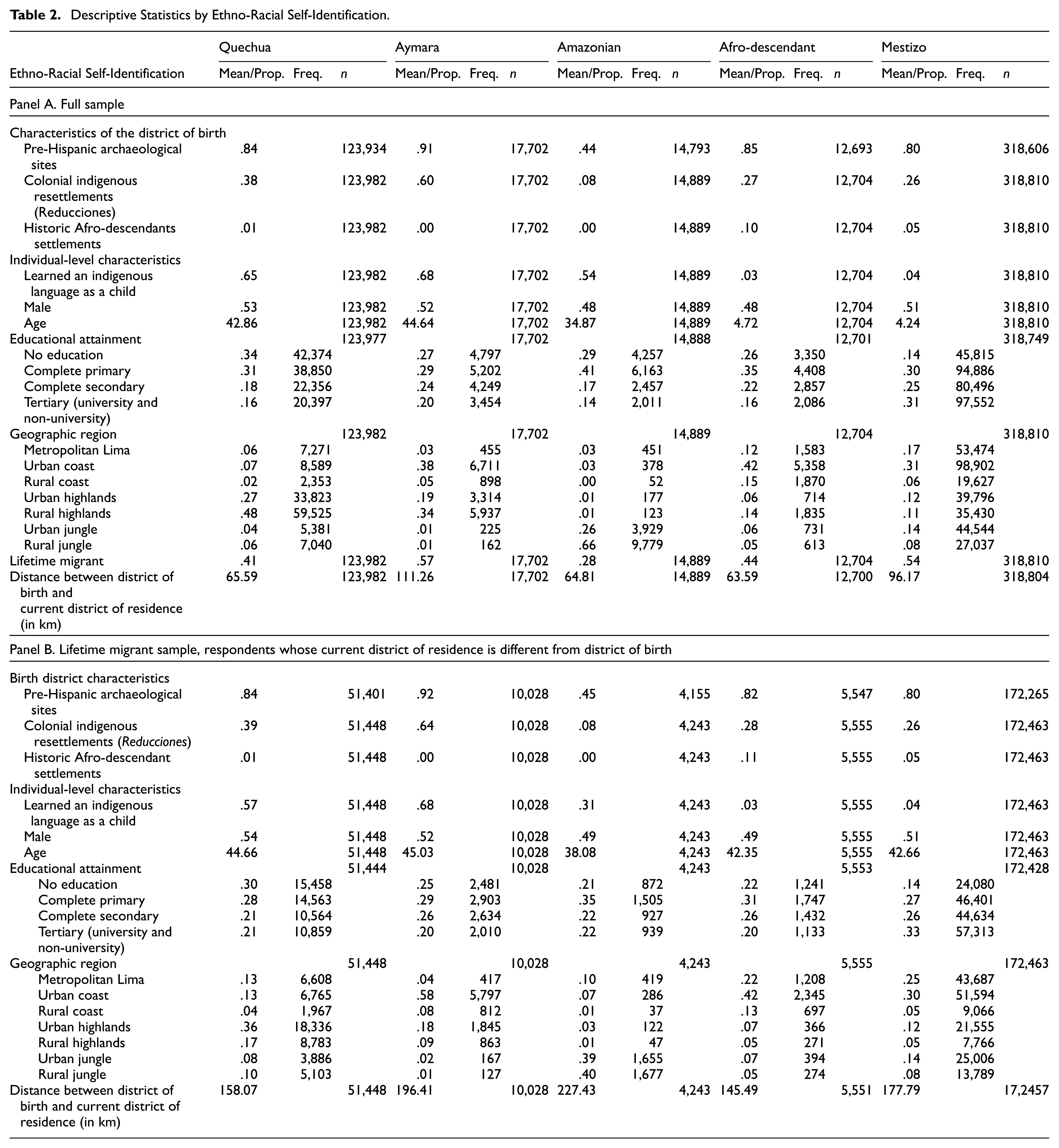
Table 2 shows that respondents who self-identified as Quechua, Aymara, Afro-Peruvian, and mestizo were born in greater proportions in districts where archaeological sites are present. On the other hand, respondents who identified themselves as Quechua or Aymara were born to a greater extent in districts with forced indigenous resettlements. Respondents who self-identified as Afro-Peruvian were born to a greater extent in districts with a long-standing Afro-Peruvian presence.
Descriptive Statistics by Ethno-Racial Self-Identification.
The next step was to estimate a multinomial regression model to identify whether the relationship between contextual features and self-identification processes holds and under what conditions. Table 3 reports the results of that analysis for the complete analytical sample. This table includes two regression models: a reduced model, adjusted only by the survey year, that regresses separately the ethno-racial category chosen by the respondent against the presence of any contextual characteristics in the district of birth and without controls; a full model that includes individual-level controls and some geographic attributes of the current place. To assess the role of migration status, we expanded the regression model to an interaction term of the contextual variables in the district of birth, self-identification and the lifetime migration status of the respondent. However, the interpretation of interaction terms on logistic models is non-linear and depends on the simultaneous change in the main terms. We transformed the odds ratios to a matrix of probabilities and contrasted the marginal change in the probabilities due to the change in the historical contexts and migration status. Table 4 reports the results. They are presented visually in Graph 1, comparing the migrant and non-migrant subpopulations.
Association of District of Birth, Ethno-Historic Characteristics and Ethno-Racial Self-Identification.

Notes. Authors’ elaboration pooling ENAHO 2012 to 2017 datasets. Models estimated with multinomial logistic regressions adjusted by the survey design weights. The dependent variable is the ethno-racial self-identification of the respondent with “mestizo” as the category of reference. Coefficients are expressed as odds ratios and standard errors are in parentheses. Coefficients reported in each line correspond to regressions estimated separately.
Significance levels: *p < .05. **p < .01. ***p < .001.
Heterogeneity in the Association Between District of Birth Ethno-Historic Characteristics, Ethno-Racial Self-Identification by Lifetime Migration Status.

Note. Authors’ elaboration pooling ENAHO 2012 to 2017 datasets. Predicted percentages reported in this table are estimated using a multiplicative multinomial logistic regressions adjusted survey design weights to include the interaction with respondent lifetime migration: respondents whose current district of residence is different than the district of birth. Logit coefficients are transformed into the probabilities scale and rescale in the 0 to 100 range. Contrasts are estimated within each group of those who experienced (or not) lifetime migration. p-values for the estimated contrasts are reported in brackets.
Significance levels: +p < .10. *p < .05. **p < .01. ***p < .001.

Marginal change in the probability of choosing an ethno-racial category adjusted by ethnohistoric characteristics of the District of Birth, Lifetime Migrant Population and Non-Migrant Population.
The estimates indicate that being born in a district with monuments increases the chances that a person identifies as Aymara, Quechua, and Afro-Peruvian (OR = 1.54, 1.11, and 1.22, respectively). But, after adjusting for individual and other contextual characteristics, the association disappears for those who identify as Quechua (OR = 1.01), and it decreases the chances of self-identifying from the Amazon (OR = .25). However, the effects differ for the lifetime migrant population (Table 4), where there is a positive effect on self-identifying as Aymara and Quechua when archaeological sites are present, though the significance of the difference is above the conventional level. The negative effect of self-identification from the Amazon is maintained while the effect of self-identification as Afro disappears. In other words, the impact of archaeological sites for the Aymara population is confirmed for the total population and for both subpopulations of migrants and non-migrants.
Analysis of the entire sample shows that the presence of indigenous forced resettlements in the district where the respondent was born significantly increases the chances of self-identifying as Quechua (OR = 1.32) and Aymara (2.254) for the model with controls (Table 3). Instead, it significantly decreases the chances of self-identifying as being from the Amazon (OR = .26). That same pattern is maintained for the subpopulation of lifetime migrants (Table 4 and Graph 1). This confirms that the presence of forced indigenous resettlements in the district of birth of the respondent matters for ethnic self-identification as Quechua and Aymara.
Additionally, for the entire sample, those born in districts with a historical Afro-Peruvian presence have significantly higher chances of self-identifying as Afro-Peruvian in the model with controls (OR = 2.29), and lower chances of self-identifying as Quechua, Aymara, or from the Amazon (Table 3). This pattern remains if we restrict the analysis to the sample of migrants (Table 4 and Graph 1) and confirms the importance of the narratives and traditions of places with Afro-Peruvian presence to increase the chances of ethnic self-identification with these groups.
Heterogeneity in Self-Identification by Gender and Place
The analysis reveals a differentiated association between gender and self-identification patterns, influenced by the characteristics of the district of birth. Overall, women exhibit a modestly higher and statistically significant probability of identifying as Quechua compared to men (.3–.8 percentage points), irrespective of whether they were born in districts with archaeological sites. A similar trend is observed for women in districts without the presence of reducciones or Afro-descendant settlements, whereas this pattern does not hold in districts with these characteristics. For Aymara self-identification, women tend to show a slightly higher probability of choosing this identity; however, this distinction becomes less clear when district characteristics are accounted for. In contrast, men are more likely than women to identify as Amazonian or Afro-descendant, regardless of district characteristics.
Discussion
In this article, we advance evidence that historical, social and material formations influence people’s self-identification with their cultural identities and their definition of belonging and memory. Through the combination of administrative and historical databases, and a quantitative analysis that highlights the existence of a significant correlation between ethnic self-identification and a set of variables considered: the presence of archaeological sites, a history of forced indigenous settlement, and the long-standing presence of Afro-Peruvians. Complementary, following the specialized literature, we consider that factors such as those we describe activate a strong living memory in the communities as identity narratives and that their use as practised places establishes historically significant rooting processes for the identity statements of people and their societies.
Thus, we see that the engagement with a cultural genealogy empirically constructed by living memory and local practises positively conditions people to self-identify with an ethnoracial category such as Quechua, Aymara or Afro-Peruvian with active rooting processes, the situational perspective of ethnic self-identification is concerned not only with individual experiences but also with collective experiences that impact an individual’s biography. Rooting could then operate as oral history, narratives that transfer intergenerationally and therefore end up also operating as determinants of contemporary processes. It is noteworthy that no matter how situational an identity is defined, there are legacies that manage to reproduce themselves, reinvent themselves and give meaning to the processes of ethnic self-identification.
This article also contributes a second element: the heterogeneity of these legacies and, therefore, the heterogeneity of the processes of ethnic self-identification based on them. Legacies are not the same among different groups. The importance of archaeological sites and colonial resettlements tends to self-identification such as Quechua or Aymara; but not so for identification from the Amazon, where these legacies do not constitute significant elements of the living traditions. Similarly, in the case of Afro-descendants, despite the constant migratory processes and the geographical dispersion they experience, their self-identification is strongly related to traditions associated with places where they have been historically present. Finally, it is the migratory processes that mainly explain the strong relationship with archaeological monuments, which thus become a source of oral narratives to be reproduced with greater force when people move away from their places of origin.
On balance, our findings lead us to consider the multidimensionality of cultural identities today and to believe that their processes of evolution and change do not lead only in one direction, nor do they entail a teleology or linear order of things that necessarily lead to mestizaje or whitening. Our evaluation leads us to contemplate what much of the recent literature affirms: that racism, whitening, migration, population mobility, the depopulation of rural communities, high socio-demographic turnover and the stigmatization of native identities are all leading to an irreversible process of hybridization and loss of ethnic identity. Although these processes are objective, empirically observable and measurable, especially in the metropolis, what this study shows from a contextual point of view is that other processes of cultural change are developing in parallel, with different signs, such as rooting, which activates the reaffirmation of living memories, particularly in local environments.
The practises of self-identification with ethnic categories are certainly social processes, but, as the literature consulted shows, they also reveal vivid political agencies on the part of elites who use rooting as a means to legitimize identity discourses. In such contexts, the question arises: would public policies such as intercultural education programs emphasizing rooting and living memory promote more robust and more progressive identity processes? Likewise, would other public policies such as socio-economic activation programs about archaeological monuments or living traditions allow the constitution of communities with improved resources for production and projections of better possible futures? The discussion is still pending.
We employed in this study a novel empirical approach to incorporate contextual quantitative data, aiming to better understand the complexities of self-identification at the individual level. However, some limitations persist. Although validated, the use of standardized categories for self-identification may constrain the interpretation of our findings, potentially leading to a coarser understanding. Additionally, the heterogeneity of the mestizo category, which is far from being a compact or operative classification, underscores the need for mixed methods to fully capture the dynamics of the identity-rooting process. Future studies could further validate and enrich these findings, offering new insights into this research area.
Structural Constraints on Ethno-Racial Identification: Limitations and Implications of Mestizaje in Peru and Latin America
While this study foregrounds the agency of rooting—the intentional, often place-based identification with Indigenous or Afro-descendant identities—it is essential to consider a key limitation in our analytical framework: the complexity and meaningful heterogeneity of the mestizo category itself. In Peru, as in many Latin American contexts, mestizaje has historically functioned not only as a descriptor of racial mixture but as a state-led ideological project since the independence era and the ensuing efforts to forge national cohesion (Martínez et al., 2025; Telles & PERLA, 2014). Long before independence, figures like colonial chronicler Garcilaso de la Vega articulated a vision of cultural and racial hybridity—what Majfud (2007) terms “mestizaje cosmológico”—that situated mixture as a civilizational ideal, though framed through a predominantly Eurocentric gaze. Building on these foundations, mestizo complex has also historically served as a dominant form of self-identification in the region—both a discourse and a social role—that contributed significantly to a constructed sense of belonging. Since independence, in particular, mestizaje has served as a cornerstone of national identity, promoted by state actors as a means of overcoming colonial rigid, hierarchical social system. Yet, this seemingly inclusive project has long operated through mechanisms of homogenization and erasure. Rather than eliminating ethno-racial divisions, the mestizo ideal has obscured deep structural inequalities, re-inscribing hierarchies by centering mestizaje as normative and relegating Indigenous and Afro-descendant identities to the margins of the national imaginary (Bonfil Batalla, 1996; Loveman, 2014).
As recent scholarship underscores, mestizaje is not a fixed or neutral identity, but a fluid and often strategic social position (Protzel, 2017; Saldívar et al., 2024). Individuals may adopt a mestizo identification to navigate racialized social structures, access opportunities, or dissociate from stigmatized markers of Blackness or Indigeneity. In this sense, self-identification as mestizo can operate as a form of “strategic whitening” or symbolic assimilation (Villareal, 2010), offering perceived social legitimacy and upward mobility within dominant frameworks of national belonging. Thus, the absence of Indigenous or Afro-Peruvian self-identification in certain areas should not be misread as a lack of cultural connection, but rather as a complex response to longstanding structural pressures—economic, spatial, discursive—that reward distance from racialized roots and consolidate mestizaje as the socially aspirational norm.
This broader historical and ideological terrain is essential for interpreting our empirical findings. While we observe a significant correlation between the presence of living cultural traditions, archaeological heritage, and ethno-racial self-identification, such processes unfold within a social context where mestizaje continues to function as both a discursive and institutional force. The expanded ideology of mestizaje often undermines or disincentivizes rooting, especially in urbanized or economically mobile sectors, where ethnic self-identification may be perceived as a liability rather than an asset. As such, rooting—understood here as an intergenerational transmission of cultural memory through place and practice—is both an expression of identity and a way of struggle against forgetting.
Situating Peru within a wider Latin American comparative framework allows us to more fully grasp the implications of these dynamics. Like Mexico or Brazil, Peru represents a context where racial fluidity exists but is heavily mediated by enduring hierarchies (Islas Weinstein & Ang, 2024). While mestizaje is often framed as evidence of racial harmony, it frequently operates as well as popular beliefs that impedes collective organizing and the public recognition of Indigenous and Afro-descendant groups (Hooker, 2005; Paschel & Sawyer, 2008). Our analysis thus reaffirms critiques that view mestizaje not only as an inclusive narrative but also as an ambiguous—but powerful—structure of exclusionary social references, one that reshapes individual identity choices and restricts the political visibility of rooted, ethnically affirmed everyday identities.
In this context, rooting must be understood not solely as a cultural or emotional act, but also as a political one. The decision to self-identify with an Indigenous or Afro-descendant group—especially in a nation-state historically committed to deleting or neutralizing these categories—reflects ongoing negotiations of power, memory, and belonging. As such, rooting practices are not just shaped by material legacies like archaeological monuments or forced resettlements, but also by the social possibilities and constraints produced by the dominant self-identification paradigm of mestizaje.
Conclusion
This exploratory study demonstrates strong correlations between a subset of meso-level characteristics and ethnic identification, though causal explanations remain beyond its scope. This set of significant findings are useful for understanding how complex processes of ethnic identification operate, particularly for local cases like those observed in Peru. Future studies could use these findings as a starting point to expand into research questions that deep dive into the associations found, offer new insights, and further validate them, with the aim of giving greater consistency to the proposed concept of rooting.
Further research should be carried out as well to better understand how the experiences of places and territories are reproduced over time and recovered in the form of collective memories and mechanisms of ethnic self-identification. Public policies such as those mentioned above could help certain societies to better integrate with their histories, which could result in the consolidation of better intercultural citizenship.
Footnotes

Ethical Considerations
This study relies exclusively on secondary data derived from nationally administered surveys and publicly accessible state databases, all of which were collected and disseminated by authorized government agencies under established ethical and legal protocols. No direct human interaction, intervention, or collection of personally identifiable information was conducted in this research, and all datasets were provided in aggregated or de-identified form to ensure that individuals could not be identified.
Consent to Participate
The authors request to be dispensed from the requirement of informed consent for this research, in accordance with Section 8.05 of the APA Ethical Principles of Psychologists and Code of Conduct. Only anonymized data from national surveys and archival sources were used, and the disclosure of responses does not place participants at risk of criminal or civil liability, nor does it jeopardize their financial standing, employability, or reputation.
Funding
The authors received no financial support for the research, authorship or publication of this article.
Declaration of Conflicting Interests
The authors declared no potential conflicts of interest with respect to the research, authorship, and/or publication of this article.