



Abstract
This paper investigates how students in a service-learning course “Entrepreneurial Marketing in Practice” organized in one of the higher institutions in Hong Kong helping young visual art entrepreneurs in the community to start up their own business. In-depth interviews were conducted with young entrepreneurs in 2024. A lack of sources of income, self-determination, self-center and limited business profile were found to be young visual art entrepreneurs’ characteristics. A collaboration model with stakeholders like non-government organization (NGO), young entrepreneurs, educational institutions with university students are put in the Stimulus-Organism-Response (SOR) model. Usually those underserved young artists have a clear mind set but lack of start-up capital and expert support. “Trial and error laboratory” project by a non-governmental organization assists the artists by providing a co-working space and peer support. Marketing students enrolled in serving learning course offers some marketing suggestions and works for entrepreneurs in the implementation process of the marketing promotion. As a result, the short-term goals of visual art entrepreneurs, including raising awareness of their artwork could be achieved with the help from a non-governmental organization and students in the Service-Learning courses.
Keywords
Introduction
The aim of this paper is to investigate how students in a service-learning course “Entrepreneurial Marketing in Practice” organized in one of the higher institutions in Hong Kong helping young visual art entrepreneurs in the community to start up their own business. Service-learning is like volunteerism and internship but more focused on enhancing learning of theoretical knowledge through service experience and its reflection in the community (Ferrari & Chapman, 2014). It has been reported that students have significantly higher satisfaction and engagement when teachers used a Service-Learning approach compared to traditional approach in the psychology course (Gomez-Estern et al., 2021).
The service beneficiaries of the Service-Learning course “Entrepreneurial Marketing in Practice” are underserved young entrepreneurs who need marketing support in their business. Those young people joined a non-government organization’s “Trial and error laboratory” scheme. The scheme “Trial and error laboratory” offered them a designated place to start their business and make their products by charging a low rental fee. The young people who joined the scheme were called as “Lab Fellow.” Almost all the laboratory fellows did not have formal training in marketing or sales promotion. They don’t know how to promote their products or services to their customers. The young people devoted ample time in their visual artwork. They cannot spare other time on business matters which are mostly transaction-based and usually interrupt the design and creative process of visual art start-up young people.
All the enrolled serving learning course students should have completed consumer behavior, integrated marketing communication and digital marketing strategy as pre-requisite subjects. The service-learning course components are subject-based essential knowledge, visual art market knowledge, the overview of “Trial and error lab,” fact finding of visual artists, presentation of draft and final presentation, implementation of selected marketing efforts and evaluation. The course components were delivered as seminars, visit to “Trial and error lab” exhibition, meeting with Trial and error lab’s organizer, discussion meetings with Trial and error lab fellows, attending guest talks by experienced entrepreneurs, debriefing session and various promotion activities.
These special types of young entrepreneurs have been labeled as “unconventional entrepreneur.” The word “unconventional” means “not adhering to established convention or accepted standards” (Guercini & Cova, 2018, p. 385). “Unconventional” entrepreneurship refers to neither bound nor accord with the conventional approach of setting up business, that is, planning, launching and developing a new start-up. Unconventional entrepreneurs are not subject to the transition from their status as consumers to fully-fledged entrepreneurs (Cova & Guercini, 2016).
Unconventional entrepreneurs are passion-driven people and choose to pursue their own dreams. Instead of joining the traditional workforce to earn a stable income, those young entrepreneurs prefer another career path. There is literature gap in how unconventional entrepreneurs can be survived (Wut et al., 2021). There are two research questions. The first research question is that how does an unconventional visual art entrepreneurial process unfold in a Hong Kong community context? The second research question is how far the final year marketing students could help in the visual art entrepreneurial process via the Service-Learning course? Those marketing students do not have work experience. How can they contribute to the success of the unconventional entrepreneurial story? Stimulus-organism-response (SOR) model was proposed by Mehrabian and Russell (1974) which has been used in social science field for decades (Wut et al., 2022). A collaboration model was proposed using Stimulus-Organism-Response (SOR) model with a non-government organization, young entrepreneurs, educational institution and university students to answer these research questions.
Literature Review
Service-Learning
In recent decades, service-learning, as a type of experiential learning, has been adopted in the higher educational sector as a contemporary teaching and learning strategy to enhance students’ understanding of concepts and theories in a practical environment (Salam et al., 2019). Based on Bringle and Hatcher (1995, p. 112), service-learning refers to a “course-based, credit-bearing educational experience in which students participate in an organized service activity that meets identified community needs and reflect on the service activity in such a way as to gain further understanding of course content, a broader appreciation of the discipline, and an enhanced sense of civic responsibility.” Service-learning can be embedded into the higher education curriculum which involves the integration of academic learning with community service. The benefits include increased student learning and practical experience (Meyer et al., 2016), civic engagement (Olberding & Hacker, 2015), enhanced institutional satisfaction and civic literacy (Rutti et al., 2016), enhance social responsibility and civic leadership among students (Weiler et al., 2013), enhanced understanding of course contents (Dienhart et al., 2016), and improving community life (Geller at al., 2016). The service-learning has been adopted in different academic disciplines such as health sciences and nursing to promote healthy eating, physical activity, evasion of obesity (Rosenkranz, 2012), injury prevention (Alexander et al., 2014) and healthy disparities in society (Jarrell et al., 2014). The adoption of service-learning pedagogy in the business and economics discipline includes developing frameworks for service-learning design and implementation (Martin, 2015; Petkus, 2000), improving business students’ organizational learning skills with moral reasoning and practical work experience (Young & Karme, 2015) and developing business, civic and leadership skills to promote civic-mindedness in business graduates (Snell et al., 2015). To conclude, service-learning is mostly used in health sciences, followed by business and economics, computer and information sciences and finally social sciences (Salam et al., 2019).
Numerous scholars also presented the challenges and issues to integrate service-learning in higher education curriculum such as Burke and Bush (2013), Peters (2011), Salam et al. (2019), and Toporek and Worthington (2014). These issues include difficulties in facilitating differing party involvement and interaction among students, instructors and community members (Toporek & Worthington, 2014), lack of financial support and resources to implement the service-learning programs (Salam et al., 2019), issues in scheduling field trips, overlapping activities and poor time management (Burke & Bush, 2013) as well as tremendous efforts to engage students and preparation for the service-learning programs (Peters, 2011).
Different service-learning frameworks were developed by previous scholars. Salam et al. (2019) presented a holistic and generalized framework by integrating technology with all phases and sub-phases for implementing service-learning. Kolb (1984) suggested an experiential learning cycle to design and implement service-learning course in business discipline which comprises of four elements: (1) practical on-site experience, (2) reflection on service-learning experience, (3) abstract conceptualization, and (4) active experimentation. The benefits of service-learning were also addressed in previous studies. Service-learning experiences allow students to comprehend better understanding and application of theories and course concepts learned in the classroom (Butler & Christofili, 2014). Apart from academic learning, service-learning is also beneficial to students’ overall personality development, character building, and growth (McLeod, 2013). Service-learning also promotes critical thinking and analytical skills of students (Sedlak et al., 2003), generates innovative solutions to problems (Salam et al., 2019), and develops a sense of civic responsibility and social awareness about cultural and domestic values in the society (Marshall et al., 2015). With no doubt, service-learning benefits both academia and community.
Young Entrepreneurs
Owing to youth unemployment as well as the concerns for economic and local development, universities promote entrepreneurship among students (Rusu et al., 2022). Starting a business requires both human and financial capital (Zhao et al., 2020). Few studies suggested the interdependencies between entrepreneurial intentions and access to finance (Nguyen, 2020; Rusu et al., 2022). Several theories were adopted to explain the entrepreneurial intentions of youth such as TPB—theory of planned behavior (Siu & Lo, 2011); SDT—self-determination theory (Andersen et al., 2000), BPNT—basic psychological needs theory (Teixeira et al., 2012). Female students are much eager to become entrepreneurs than male students (Anggadwita et al., 2017; Rusu et al., 2022). Students coming from urban areas have higher entrepreneurial intentions than rural areas as well (Rusu et al., 2022). Young entrepreneurship also relates to the education of the youth while higher educated youth may be more cautious about investing money and well aware of the possible risks of running a business (Oosterbeek et al., 2010; Rusu et al., 2022).
With the blooming of creative and cultural industries, it has drawn more attention of academic researchers. Artistic activities are now professionalized which bring their work remunerated through the sale of their artwork or obtaining grants or subsidies from relevant stakeholders (Bérubé & Gauthier, 2024). However, Thom (2016) stressed that artist entrepreneurs are mandatory to make a living in the marketplace. Therefore, artist entrepreneurs have to struggle between their artistic and entrepreneurial values because of the identity tension between the economic and artistic imperatives of their work (Bérubé & Gauthier, 2024). A study conducted in German pointed out that artist entrepreneurs were relatively young and well-educated because the start-up of creative business requires less money (Kohn & Wewel, 2018).
Theoretical Framework
The stimulus-organism-response (SOR) model is a fundamental concept in psychology and behavioral science that examines how individuals respond to different stimuli within their environment (Lee & Yang, 2022). As shown in Figure 1, the three elements of the SOR model include external environmental cues acting as stimulus (S) that triggers individuals’ internally cognitive and emotional organism (O) and further inspire behavioral responses (R) (Mehrabian & Russell, 1974). First, stimulus are external variables such as physical, social, or psychological event or object that elicits a response from an individual which affects organism. Then, organism refers to the individual who is responding to the stimulus, that is, a middle state between stimulus and response. It includes internal variables such as personality, attitudes, intention, motivations, and past experiences that influence behavior. Last, response refers to the behavior or action that an individual takes in response to the stimulus. It can be a physical behavior, an emotional reaction, or a cognitive response. SOR model is used to explain the research findings and provides a framework for understanding how different stimuli influence behavior (Wut et al., 2022). It can also be used as a tool for designing experiments and interventions that aim to change behavior.

Stimulus-organism-response (SOR) model.
Therefore, this study adapted SOR model as a framework to explain the various external factors influencing the achievement of visual artists’ goal via the Service-Learning subject in Marketing area. SOR can be conceptualized as a structure that exerts an external stimulus on the unconventional entrepreneurs (S), the internal processing organism reacting to that external stimulus (O), and the leading behavioral response (R). This study develops a new theoretical framework using SOR theory to explain how external environmental cues affect visual art entrepreneur organisms which in turn inspire the achievement of their goals such as entrepreneurial intention or arouse awareness of their artwork. SOR can also provide the structural underpinning for understanding the factors influencing unconventional visual art entrepreneurs’ behavioral responses, that is, achieving their goals.
The Service-Learning course involved in this study is “Entrepreneurial Marketing in Practice.” This is the Service-Learning course organized by one of the higher education institutions in Hong Kong. The target students of the course are the students majoring in marketing. The purpose of the course is to let students apply the marketing knowledge and skills acquired in the marketing subjects they learned to develop a marketing proposal for the underserved young entrepreneurs in principle. Visual art young entrepreneurs are the direct service recipients in the study. Furthermore, students need to implement part of the components of their proposal with the entrepreneurs. Thus, Service-Learning course is an external stimulus in our SOR model.
The rationale of the subject is to reach win-win-win situation for the students, visual art entrepreneurs and the non-government organization. Students enrolled in the Service-Learning course can apply what they learned in the subject. Visual art entrepreneurs can get help from the students, especially from the marketing perspective. The non-government organization can provide opportunities to students who are involved in real-life scenarios with entrepreneurs. As such, the non-government organization (NGO) is another external stimulus beside traditional marketing consideration like customers. NGO provides a co-working space for visual artists to do their artwork and offers a space for their intellectual exchange.
Methodology
A qualitative research method was adopted by the researchers because there is lack of established framework on unconventional entrepreneurs. Ethics approval was obtained from the institution before the commencement of the study. Through the non-government organization’s “Trial and error lab” program, a list of young entrepreneurs was obtained. Purposive sampling was employed so that the young entrepreneurs who were in their early or middle stage of their career development could be selected. In-depth interviews were conducted with those selected young entrepreneurs. To be more focused on the study, only visual artists were invited. Informed consent was obtained from all participants. Interviewees have to answer some open-ended questions. Their profiles are listed in Table 1.
Participants’ Profiles.

There were interview questions prepared based on two research questions presented in the “Introduction” section. The first interview question asked about why they (visual artists) take up the entrepreneur direction. The second question is related to their sources of income and business goals. The third question concerns their product and promotion channels. The choice of distribution channels in the competitive market is another question. Answers from those questions correspond to the research question one: how does an unconventional visual art entrepreneurial process unfold in a Hong Kong community context? In addition, how far the final year marketing students could help you in the entrepreneurial process corresponds to the second research question. Sufficient time was provided for the respondents to elaborate their answers. They were allowed to talk about some other matters as well including financial and non-financial support, and interaction with customers. Interviewees freely expressed his and her own views during the process. Each in-depth interview lasted for about 1 hr and was conducted in Cantonese. The number of artists invited depends on the point of saturation. When all the facts were repetitive from the sample, the invitation process would be stopped.
The interviews were then transcribed into scripts and coded by two independent researchers. If there is a dispute, the paragraph would be judged by the third researcher. Themes are emerged after the coding process. It was then translated into English. Back translation method was used to make sure the meaning is clear and accurate. The analysis process was divided into three phrases: initial coding, intermediate coding and advanced coding (Birks & Mills, 2015). Open coding is the same name to initial coding (Glaser, 1978). Intermediate coding often called as selective coding or axial coding. Data are put together in a way that making connections (Charmaz, 2014). Advanced coding is theoretical coding or selective coding (Birks & Mills, 2015).
Results
The following characteristics of the visual art entrepreneurs were derived from the interview scripts. The findings provide answers to the research questions. Self-determination is an underlying force to take the entrepreneur’s role. Self-center and limited business profile are the barriers for young entrepreneurs. Sources of income provide information on how visual art entrepreneurs can survive in the competitive market. The role of students can be found in the paragraph of support.
Sources of Income
Unconventional entrepreneurs like visual artists need to seek some part-time teaching job to provide some basic stable income. Teaching kids in drawing classes is the easiest way in Hong Kong. Stable income becomes crucial for other visual artists to pursue their personal vision and goal. The relevant extracts are as follows:
“I want to be a full time artist. But it is impossible right now. I must teach drawing class weekdays to make a living. Sometimes I must participate in many local bazaars.” (Visual artist D) “There are individual and group painting classes in my studio. However, it might not help me pay the rental fee” (Visual artist J)
Self-Determination
The visual artists usually have a clear goal and mind set because art is highly subjective. Therefore, they must learn to trust their instinct and become self-determined. Visual artists need to choose their own style and perspectives to be unique in the creative industry. Some extracts are as follows:
“I aim to have my personal art exhibition. I want more people know my names.” (Visual artist D) “I quitted my full-time job and used up my saving to open a studio to show my painting.” “I can help the other artists to show their painting my studio.” (Visual artist J).
Self-Center
Most visual artists are self-center because they have their own style and perspective. However, self-center may lead to a lack of customer focus and ignore market needs and wants. Self-center may also affect artists being accommodative to feedback. The feedback from the market is critical for entrepreneur to modify and customize their products to the market. Therefore, their products are subject to adaptation to meet the market need. Some relevant extracts are as follows:
“I don’t know how to do like a salesman.” (Visit artist A) “I focus on my creative idea and don’t care about market need.” (Visit artist A) “I must design and make our product to meet the market demand. My product is mainly memorial in nature so that it might welcome by tourists.” (Visual artist D) “The price of painting is based on the detail and complexity, I am not sure.” (Visual artist M) “The price of my painting is only according to the painting size because it is easy for customer budgeting and understanding.” (Visual artist J)
Limited Business Profile
Limited business and marketing knowledge prevents young people especially visual artists from developing their potential. They perceive themselves as incompetent and have no confidence in starting up their new business. Even though they have some basic business sense, they are reluctant to initiate a new product line. Some extracts are as follows:
“I don’t know what is meant by the marketing strategy. I place my products on the sales websites and wait for the buyer.” (Visual artist D). “I have no idea on market segmentation and targeting. I do not know how to do a breakeven analysis.” (Visual artist M). “I joined some business courses through the “Trial and error” lab project but no time to really think about them.” (Visual artist J).
Other Support
The non-governmental organization provides a cheap rent for young entrepreneurs through the project “Trial and Error Laboratory.” This support will ease the financial burden of initiating a new business and. The more the support, the lower the entry barrier to the start-up. Relevant extracts are as follows:
“The project provides us a space to create our works.” (Visual artist A). “Students’ ideas are creative and some of them I have never thought about.” (Visual artist A). “It is good for the students to promote my products.”“I don’t know much about digital marketing. Students provide a systematic approach to me formulate marketing strategy” (Visual artist J)
Exchange with Audience
The artist-audience interaction is also considered as stimuli to the visual artists. The artists may solicit feedback and support from the audience to recognize their efforts and contribution. This will also serve as an important influence to the artists’ achievement of their goals.
The extract from interviewee is as follows:
“I want to paint something to reflect my mind, then exchange opinion with audience.” (Visual artist M)
Table 2 presents the highlighted open codes, axial codes and selective codes.
Summary of Codes Within SOR Model.

Discussion
A modified SOR model for unconventional entrepreneurs was then proposed as follows (Figure 2):
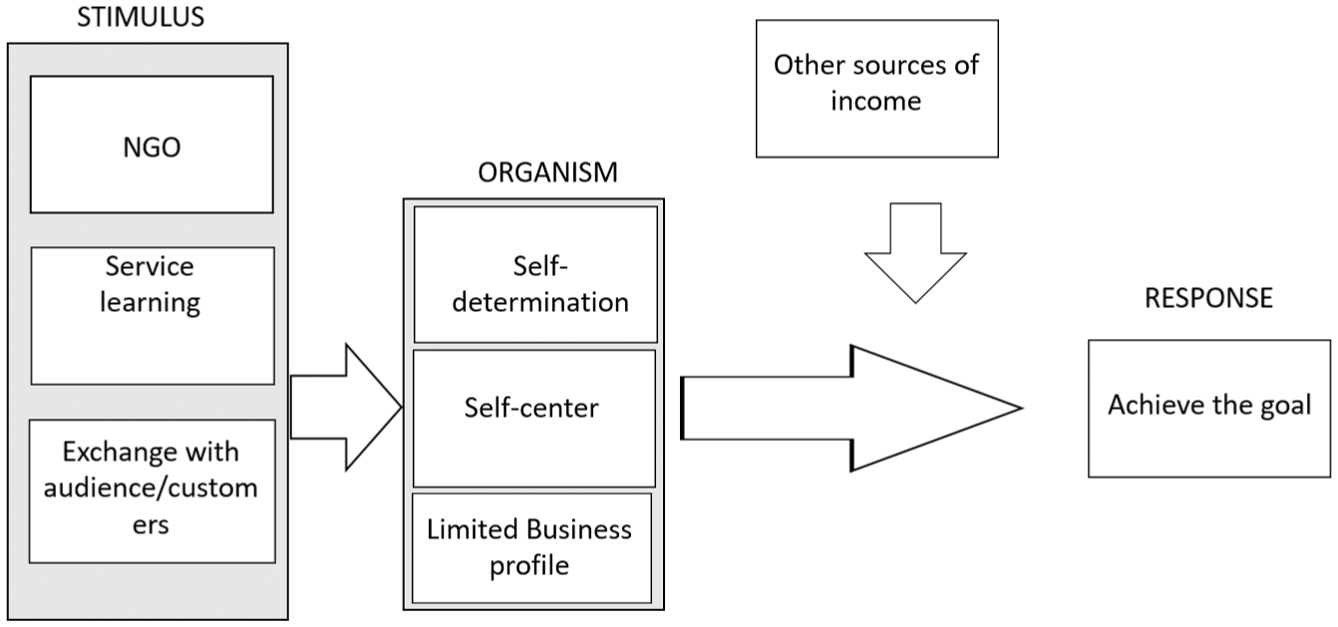
SOR model for unconventional visual art entrepreneurs.
In SOR theory, the concept of stimulus (S) are external environmental cues that trigger artists’ internal organism (Mehrabian & Russell, 1974). Support from NGO and service-learning course, and exchange with customers are considered as stimulus in the proposed research framework. Internal organism include self-center, limited business profile and self-determination.
One of the stimuli is the exchange with audience or customer. They can obtain feedback and support through the interactions. Then the products can be more marketable, that is, customized to the market needs, the visual art entrepreneurs will have more revenue to sustain their business. Product adaptation refers to the extent to which the physical characteristics and attributes of a product or its packaging differs across different national markets (Cavusgil et al., 1993). Product adaptation always leads to larger profits than selling the same product anywhere (Calantone et al., 2004). During the product adaption, artists need to interact with audience and prospective customers. Sometimes it is challenging to convince prospective customers to accept the original idea of artist. On the other hand, artists might insist their original thought and interactions with audience may persuade them further modify the products to the market needs.
Another stimuli is the NGO. In this context, Trial and Error lab project organized by the non-governmental organization indeed provides a lot of support to the visual art entrepreneurs. Support includes cheap rent for the work desk, an exchange area provided to artists and counseling support by the leader of the project. Furthermore, the marketing knowledge and promotion ideas are provided by the students through the service-learning course is also another stimuli. Both stimulus would serve as input to the visual artists’ mindset and trigger their internal organism.
Organism
Self-determination is reported as a visual artists’ organism. Self-determination is a construct with two meanings. The first meaning is about “determination of one’s own fate or course of action without compulsion” while the second meaning relates to “freedom of the people of a given area to determine their own political status; independence” (American Heritage Dictionary, 1992). Self-determination also refers to the idea that “one causes oneself to act in certain ways, as opposed to other people, settings, or events causing one to act in a certain way” (Wehmeyer, 2005, p. 114). Self-determination sustains passion which is vital for visual artists. Therefore, self-determination is crucial for visual artists to survive.
Passion is an essential element in unconventional visual art entrepreneurship. Though the high failure rate of start-up business, passion is especially crucial for entrepreneurs because it is the main drive for setting up their business. Research conducted by Wut et al. (2021) in Hong Kong reported that woman handicraft producers were driven by passion, which led them to start their own businesses. Conventional entrepreneurship involves planning, starting, developing, and maintaining a new business (Guercini & Cova, 2018). In contrast, unconventional entrepreneurs enjoy interaction with customers, peers, and pride in his or her own products (Light et al., 2024).
Another organism is self-center. Visual artists need to focus on their creative artworks. Interacting with customers might disrupt their creative process. They need a designated place or environment. However self-center is usually the artists’ characteristics which may hinder their focus on market adaptation and being less flexible to the market changes. Usually artists would be regarded as slowly reactive. They might alert in later stage, usually by their peers.
Limited business profile relates to their knowledge in entrepreneurship which has been confirmed by Duong (2023) that entrepreneurial education develops the mindset and competencies required for establishing and operating a business venture. This is essential to inspire all emotional psychological organisms by fostering individuals’ intentions and behaviors to engage in business start-up.
Moderator
Sources of income has been considered as an important moderator for the entrepreneurial mindset as financial resource is a significant determinant of the decision to enter into entrepreneurship for young people (Rusu et al., 2022). Since this study was conducted in Hong Kong, a well-developed city with high cost of living and business operations, the visual artists’ entrepreneurship intention and sustainability of their visual art business are deeply influenced by the sources of income. How can the visual artists survive and sustain their visual art businesses? They implied the importance of sources of income being a moderator in this framework. It has been found that those young people do have other sources of income like teaching children in drawing classes. Family members’ support is an implicit help so that young entrepreneurs can have the safety net even though their business is not going well.
Response
The response of the framework refers to the achievement of artists’ goals including enhancing awareness of their artwork, setting up their visual art business or artists’ survival.
It is assumed that the unconventional visual art entrepreneurial process can be explained in SOR model. The external variables are support from non-governmental organization, governmental support, helping from our students in the service-learning course in “Entrepreneurial Marketing in Practice” and family members, and peer support. Internal variables are self-determination, self-center and limited business profile of the young entrepreneurs. They then developed visual art pieces or drawings as their interest or even start up their visual art entrepreneurship as the outcomes.
Conclusions and Contributions to Theory and Practice
In summary, lack of sources of income, self-determination, self-center, and limited business profile are four characteristics of young visual art entrepreneurs. The interplay among students in the Service-learning course “Entrepreneurial Marketing in Practice,” non-governmental organization and the underserved young entrepreneurs contribute to the achievement of the goal of the unconventional visual art entrepreneurs.
This study makes a unique contribution to the SOR theory by investigating unconventional entrepreneurs, that is, young visual artists in Hong Kong. Usually those underserved young artists have a clear mind set but lack of start-up capital and expert support. “Trial and error lab” assists them by providing a cheap co-working space. Marketing students from Service-Learning course offer some marketing suggestions and works for them on implementation. Moderating effect is the other sources of income. It provides stable cash flow to support the basic needs of the young entrepreneurs.
There are FOUR distinct features of the Service-Learning course, which they offer to the students in practice. First, students have chances to implement their proposed marketing efforts. It makes students really consider about the feasibility of the recommendation, such as budget and manpower and finally come up a more specific suggestion in details. This makes the course distinct from other courses’ projects in which suggestions are usually presented in rather generic manner and without implementation part.
Second, students have chances to witness the result of their proposed marketing efforts. It makes them think over again whether their proposal is feasible and practical. Third, Lab fellows help students sharpened students’ marketing proposals. Fourth, experienced entrepreneurs were invited to deliver guest talks as well as commenting on the student draft marketing proposal. Thus, the proposal submitted by students to the visual artists would be more practical. Finally, students are more aware of their proposal because they have executed it and witnessed the outcomes. Students are obliged to think over again and again before finalizing their marketing proposal because of the business risk to lose money. Students are more aware of the feasibility and practicality of the marketing proposal after the service-learning course.
There are some limitations in the study. First, the respondents have different years’ experience in their business and process different expertise. Second, researchers relied on self-report data from young visual artists. Third, inputs from a single source of respondents. Future research directions are to explore the visual artists are all have less than 3 years’ experience, and other stakeholders like students in the course “Entrepreneurial Marketing in Practice” and Non-governmental organizations can be sought to cross validate the findings.
Footnotes

Ethical Considerations
The project has passed through the research committee for ethical approval.
Funding
This project was funded by the College of Professional and Continuing Education, The Hong Kong Polytechnic University.
Declaration of Conflicting Interests
The authors declared no potential conflicts of interest with respect to the research, authorship, and/or publication of this article.
Data Availability Statement
The data in the study is available upon resonable request.