




Abstract
This study aims to explore in depth the specific patterns and underlying causes of intra-generational conflict (elder–elder conflicts) within senior physical activity settings, using an ethnographic approach. To this end, the researcher conducted approximately 6 months of participant observation in public sports centers, private fitness facilities, and senior recreational clubs located in the Seoul metropolitan area. In addition, in-depth interviews were conducted with 15 older adults. Interview transcripts, field notes, and observation memos were repeatedly analyzed to identify types of conflict, contextual features, and cultural meanings. The findings identified four major types of conflict: conflicts over leadership and authority, competition over resources and space, differences in exercise methods and physical capacity, and interpersonal or emotional tensions. These conflicts were revealed to be structurally embedded phenomena, arising from intertwined issues such as facility shortages, hierarchical culture, divergent exercise goals, and personal or emotional disputes. When prolonged, these conflicts led to negative consequences including participant withdrawal, reduced motivation for exercise, and the breakdown of group cohesion. However, the study also found potential for conflict mitigation through democratic leadership education, improvement in resource distribution rules, and the establishment of communication mechanisms. The findings suggest that “elder-elder conflict” in senior sports is not a matter of simple interpersonal discord but a multilayered phenomenon shaped by group culture, structural conditions, and emotional dynamics. By presenting a rich ethnographic account of conflict within senior physical activity programs, this study offers meaningful implications for developing practical strategies to prevent and manage intra-generational conflict in aging societies.
Introduction
Amid the global trend of rapid population aging, South Korea is also witnessing an increase in life expectancy and a growing proportion of older adults, resulting in the diversification of senior physical activities (Y. R. Kim, 2006). Various exercise programs for older adults have been developed in public sports centers and private fitness facilities, including swimming, park golf, gateball, line dance, gymnastics, aerobics, aqua aerobics, and table tennis (C. J. Kim & Son, 2008). Beyond individual health management, older adults are now actively forming clubs and exercise groups, making physical activity a normalized and embedded part of daily life (Im, 2019; W. H. Lee & Lim, 2013).
Despite these developments, various conflicts among older adults—hereafter referred to as “elder–elder conflicts”—frequently emerge in senior sports settings. These conflicts are often dismissed as incidental or interpersonal, but they are, in fact, shaped by overlapping cultural, structural, and emotional factors. This study aims to explore the specific patterns and causes of elder–elder conflicts through an ethnographic lens, providing practical insights for resolving such issues in the context of a super-aged society.
According to the Korean Statistical Information System (2025), the proportion of adults aged 65 and older is projected to surpass 20% by 2025, officially classifying South Korea as a super-aged society. Although participation in sports and physical activities among seniors has steadily increased, nearly half report discontinuing due to interpersonal conflicts or the absence of supportive environments. In this context, intra-generational conflicts in senior sports should not be seen as minor interpersonal issues, but rather as significant barriers to sustaining active aging, social inclusion, and mental well-being (Phillipson, 2013; WHO, 2025).
While prior studies have primarily examined macro-level barriers such as accessibility and affordability, little attention has been given to the micro-level social dynamics within group activities. This study seeks to address that gap by exploring intra-generational relationships and conflicts among seniors, emphasizing their implications for sustainable participation and quality of life (Bae, 2024c).
From an ethnographic perspective, elder–elder conflict represents more than simple disagreements; it reflects culturally embedded customs, practices, and symbolic interactions centered on hierarchy and respect. The researcher’s initial interest in this topic arose from repeated observations of disputes within senior clubs, which raised questions about how such tensions reflect broader cultural dynamics. Accordingly, this study is guided by the central research question: How do intra-generational conflicts among seniors emerge and unfold in physical activity settings, and what cultural meanings do they carry? This inquiry is important because it reveals the hidden dynamics of community life in a rapidly aging society.
Literature Review
The expansion of senior sports has been driven by older adults’ desire to maintain physical function and foster social relationships (S. H. Kim, 2008; Lim & Park, 2006). Research consistently shows that participating in physical activities in later life enhances muscular strength, flexibility, cardiovascular function, and mental health by reducing depression and isolation (An, 2021; Baek, 2018; S. W. Kim & Bae, 2002; H. T. Kim & Kim, 2012). In addition, participation in exercise fosters social bonding and support networks, leading to improved life satisfaction and contributing to a community-based model of voluntary care (Bae, 2024a; Cho, 2020; Y. S. Kim & Park, 2012).
However, while these benefits are well established, the issue of interpersonal conflict among older adults in sports settings remains underexplored. Elder–elder conflicts arise in various forms. In public sports facilities with limited capacity, disagreements over equipment use or access order are common. Tensions also develop between long-term “senior members” and newly joined “junior members” over leadership roles and group norms. In some exercise clubs, emotional disputes emerge around membership fees, role assignments, and social gathering styles. These conflicts not only dampen enthusiasm for participation but can also result in the dissolution of groups and severed interpersonal relationships, thereby weakening the community’s cohesion (Kwon & Lee, 2022).
Most existing research on senior physical activity in Korea has focused on identifying participation motivations and barriers and proposing strategies to encourage engagement (Cho, 2021; Jeong, 2018; Y. S. Kim & Park, 2012). Key barriers include limited facility access, financial costs, and physical limitations. Corresponding recommendations have included infrastructure expansion, free or low-cost program provision, and professional instructor training (Goo & Kang, 2015; K. H. Lee, 2015; Yoon et al., 2017).
However, much of this literature centers on the relationships between “seniors and facilities” or “seniors and programs” (Hwang, 2011; K. S. Kim, 2010; C. J. Kim, 2013), with relatively less attention paid to the micro-level interactions among seniors themselves. Even when conflict is addressed, the focus often remains on surface-level factors—such as space shortages or poor leadership—without analyzing how these conflicts unfold in practice, or how individual perceptions and emotions interact within them.
To address these gaps, an ethnographic approach is particularly useful. Ethnography involves immersive fieldwork, including participant observation and in-depth interviews, to document and analyze cultural practices and lived experiences (Hammersley, 2006; Jones & Smith, 2017; Pak et al., 2010). This qualitative method captures nuanced social dynamics, unspoken meanings, and emotional undercurrents that are difficult to access through quantitative surveys. In the context of elder–elder conflicts, such an approach can illuminate how disputes are normalized, how hierarchies are maintained, and how relational tensions are experienced and negotiated.
Elder–elder conflicts are rarely caused by a single factor. Rather, they emerge from the interplay of various structural and cultural conditions—such as competition over limited resources, hierarchical status systems based on age or tenure, differing goals between those focused on health versus competition, and accumulated emotional tensions during informal interactions. Even subtle generational gaps within the senior population—for example, between individuals in their mid-60s and those in their late 70s—can shape complex relationship dynamics. These intricacies cannot be fully understood through numerical data alone and require in-depth narrative and observational analysis.
Accordingly, this study seeks to contribute to the existing literature in three main ways. First, it draws focused attention to the relatively understudied issue of elder–elder conflict within senior sports settings. Second, it employs ethnographic methodology to move beyond generalized diagnoses and instead capture the lived experiences, emotional responses, and cultural nuances of the participants involved. Third, it aims to offer practical insights and strategies for preventing and resolving conflict in senior sports programs, thereby promoting the long-term sustainability and inclusiveness of elderly communities.
To strengthen the coherence of the literature review, prior studies were synthesized into thematic areas: health benefits of participation, structural barriers, group dynamics, and conflict. This synthesis converges on the need to investigate intra-generational conflicts, which remain underexplored. In addition, this study is theoretically informed by perspectives such as symbolic interactionism (Blumer, 1986), which emphasizes meaning-making through social interaction, and conflict theory in aging (Coleman et al., 1961), which highlights how structural tensions and role transitions generate disputes among older adults. By situating elder–elder conflicts within these frameworks, this research contributes to the academic discourse by expanding beyond functionalist or health-centered views of senior participation.
In sum, understanding the causes, contexts, and consequences of elder–elder conflicts is not only crucial for program improvement but also for fostering a healthier, more supportive environment for seniors who increasingly seek autonomy and meaningful social engagement through physical activity.
Method
Ethnographic Approach
Ethnography is a qualitative research method that aims to richly and concretely describe the lifestyle, interactions, and value systems formed and maintained within a specific community by observing and documenting them in situ (Hammersley, 2006). This methodology is grounded in the premise that a phenomenon or group can be regarded as a distinct “culture,” and it emphasizes the researcher’s direct participation in the field, thereby allowing for a balanced use of both emic (insider) and etic (outsider) perspectives (Markee, 2013; Zhu & Bargiela-Chiappini, 2013).
Ethnography was selected for its unique suitability in capturing the lived, everyday dynamics of senior sports. It enables the researcher to trace not only overt conflicts but also subtle cultural meanings, emotional tensions, and hierarchical negotiations that cannot be revealed through surveys alone. This makes it especially appropriate for addressing our research questions on intra-generational conflicts.
The researcher alternated between roles as an active participant and peripheral observer, balancing insider and outsider perspectives. Trust was gradually built by consistently attending programs, joining informal gatherings, and sharing personal experiences with seniors. Fieldwork lasted for approximately 6 months, with two to three visits per week. This prolonged immersion enabled the researcher to gain a deeper cultural understanding. Data were analyzed through systematic coding, triangulation, and ethnographic narrative reconstruction, ensuring both rigor and transparency.
Research Sites and Participants
Research Sites
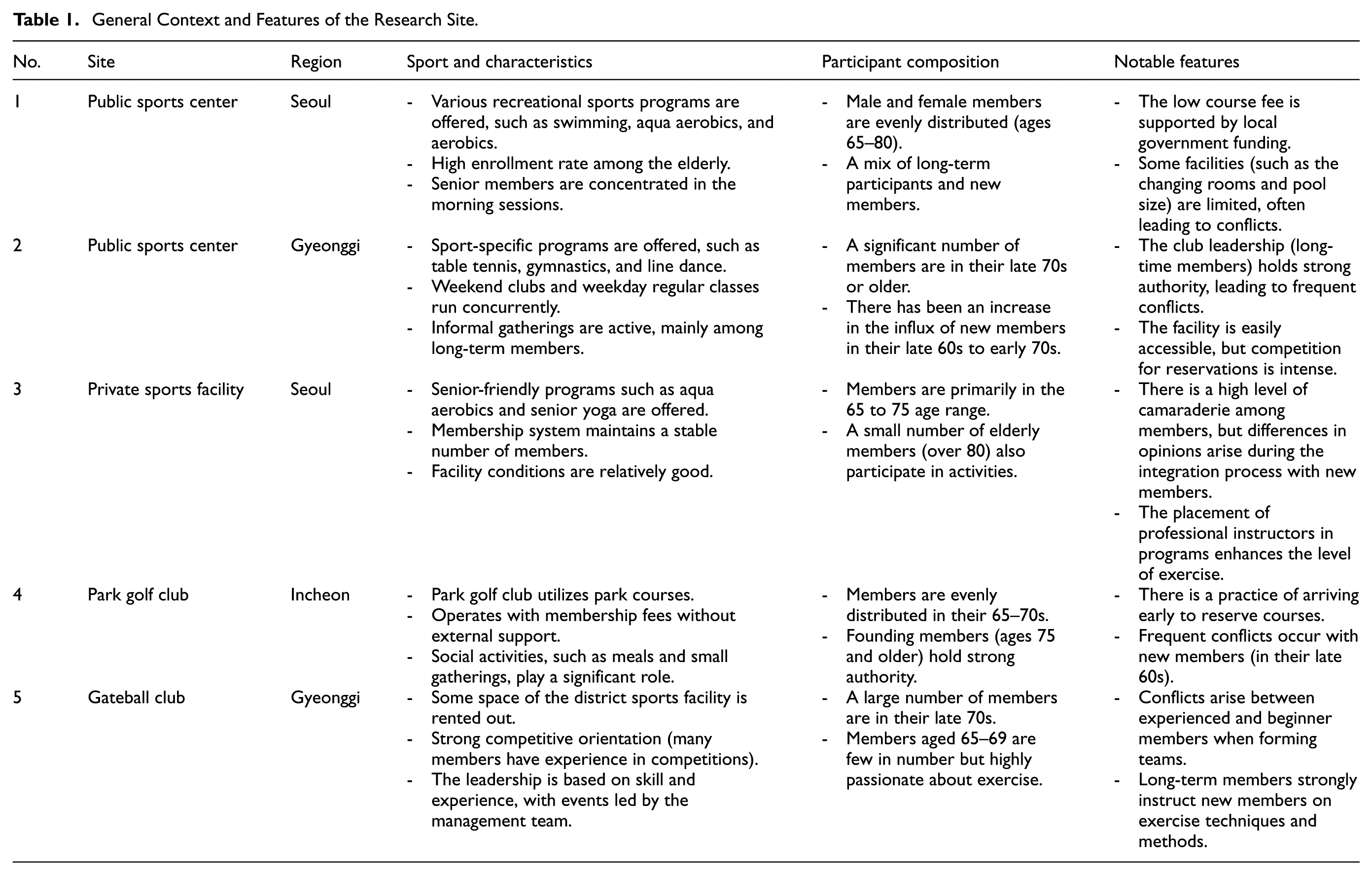
To comprehensively explore the various settings in which senior physical activity programs are actually implemented, this study selected five field sites within the Seoul metropolitan area (Seoul, Incheon, and Gyeonggi Province). These included two public sports centers, one private fitness facility, and two senior clubs that were independently organized and operated by older adults.
The public sports centers were chosen due to their high utilization rates among the elderly population and the diversity of programs offered—ranging from basic life-sports programs such as swimming, gymnastics, and aerobics to more specialized clubs such as table tennis and gateball.
The private fitness facility operated on a membership basis and offered age-specific programs (e.g., aqua aerobics, yoga for seniors). Compared to public centers, it had more stable group formations and internally regulated systems, allowing the researcher to extend the observational scope to include relatively structured and rule-governed dynamics.
The researcher conducted regular visits to these five sites two to three times per week over a period of at least 6 months. By attending at various time slots (morning, afternoon, and evening), the researcher aimed to capture how conflict patterns might differ according to program types and participant demographics. Sometimes, the researcher actively participated in classes or group exercises to experience the programs from an insider’s perspective; at other times, the researcher observed interactions from a peripheral standpoint, focusing on the overall atmosphere and participant dynamics (Zhu & Bargiela-Chiappini, 2013).
Throughout this process, the researcher documented both overt and subtle conflict situations as they unfolded, recording the contextual details and participants’ responses in detailed field notes. This approach enabled a multidimensional understanding of not only the structural and cultural aspects of senior physical activity programs, but also the interpersonal relationships and patterns of conflict embedded within them (Table 1).
General Context and Features of the Research Site.
Research Participants
A total of 15 older adults were selected for in-depth interviews from five senior physical activity sites: two public sports centers, one private fitness facility, and two self-organized senior clubs. The participants were recruited through a combination of purposeful sampling (Suri, 2011) and site-based snowball sampling conducted during fieldwork (Naderifar et al., 2017).
Initially, the researcher consulted with program staff and club leaders to gain an overview of the structure of senior physical activity programs and the distribution of participants. In order to ensure diversity of perspectives and experiences, both organizational leaders (e.g., club presidents, program instructors) and general members were included in the sample. Leaders were prioritized for interview invitations due to their potential to have either been directly involved in or observed various conflict situations from multiple angles.
Each of the 15 selected participants took part in at least two semi-structured in-depth interviews, scheduled through prior consultation regarding time and location. Prior to each interview, participants signed a written consent form approving the audio recording and transcription of the sessions. They were also informed in advance that the interview might involve discussions of sensitive conflict experiences, and were assured of full confidentiality. Each interview lasted approximately 30 to 60 min, and, when necessary, follow-up interviews (via phone or brief on-site conversations) were conducted to collect supplementary data (Scanlan, 2020).
In summary, the participant selection process was guided by multiple criteria:
(1) inclusion of key figures such as leaders and veteran members who had played roles in initiating, mediating, or witnessing conflicts;
(2) inclusion of general members who had either directly or indirectly experienced conflict or had been involved in noteworthy incidents;
(3) a balance between newcomers and long-term participants; and
(4) diversity in gender and age.
The total of 15 participants was selected through purposeful sampling (Suri, 2011) and snowball sampling (Naderifar et al., 2017), ensuring diversity in age, gender, leadership roles, and length of participation. Although the sample size appears small, this is consistent with ethnographic traditions that emphasize depth over breadth (Hammersley, 2006). This sample allowed prolonged immersion and detailed cultural analysis.
This approach enabled the researcher to secure participants who could offer multi-layered insights into the emergence, dynamics, and meanings of elder–elder conflicts, thus laying the foundation for a rich and contextualized analysis of conflict phenomena in senior physical activity settings. All participant names presented in Table 2 are anonymized pseudonyms to ensure confidentiality.
Characteristics of Research Participants.

Participants’ names are pseudonyms.
The age and exercise experience of the research participants are as of September 2024.
Data Collection
This study employed a multi-method qualitative approach for data collection, integrating participant observation, in-depth interviews, and detailed field notes. Participant observation was used to capture the lived dynamics of conflict in senior physical activity settings, while in-depth interviews provided access to the psychological, emotional, and interpretive dimensions of those involved. These various data sources were documented systematically through field notes, enabling triangulation and enhancing the analytical coherence of the study. This multi-dimensional strategy contributed significantly to developing a more comprehensive and nuanced understanding of the causes and unfolding of elder–elder conflict.
Participant Observation
Participant observation was one of the core data collection methods in this study. The researcher conducted regular visits to field sites where senior physical activity programs were actively taking place, either by joining the programs directly or by observing from the periphery. Visits were conducted two to three times per week over a period of at least 6 months, ensuring that conflict episodes could be understood not as isolated incidents, but within their broader social and temporal contexts (Kang, 2015).
These observations were meticulously documented in field notes, which captured not only overt conflict events but also subtle, underlying tensions as they quietly unfolded. This process enabled the researcher to construct a detailed and layered understanding of both the structural and cultural dimensions of senior physical activity programs, as well as the interpersonal relationships and conflict dynamics embedded within them.
In-Depth Interviews
Following the identification of actual or potential conflict contexts through participant observation, the researcher conducted in-depth interviews with individuals who had directly experienced or witnessed such events. These interviews were conducted in a semi-structured format, guided by a protocol that included key themes such as motivations for participating in senior physical activity programs, experiences of conflict, perceptions and emotional responses to conflict situations, and strategies for conflict resolution.
Interviewees included not only the direct parties involved in conflicts but also program leaders, club executives, and other participants who had played a role in mediating or observing the disputes. Interviews were conducted two to three times per participant, with each session lasting approximately 30 to 60 min, and prior informed consent was obtained for audio recording and transcription.
During the interviews, the researcher posed follow-up questions to explore the specific context in which the conflict occurred, the participant’s emotional reactions, and the impact of the conflict on their overall experience. Where necessary, participants were also asked to elaborate on their personal beliefs (e.g., values such as “respect for elders” or “rational management”) and to explain how these beliefs influenced their behavior or decision-making during the conflict. In addition, participants were invited to describe their interaction strategies, such as avoidance, negotiation, or escalation.
Field Notes
Throughout the entire research process—including participant observation and in-depth interviews—the researcher systematically documented impressions and information in the form of field notes. These notes were handwritten either in real time or as soon as possible after each field encounter, capturing events, conversations, and atmosphere during observations. Upon returning from the field, the researcher reviewed and supplemented these records, adding preliminary interpretations and personal reflections as marginal memos (Phillippi & Lauderdale, 2018).
The field notes were organized into three main sections:
(1) Basic information, such as the date, time, location, number of participants, and type of activity;
(2) Observed content, including the sequence of activities, significant situations and conflict episodes, verbal and non-verbal behaviors of key actors, and bystander reactions; and
(3) Researcher interpretation, which included inferred causes of conflict, observed coping strategies, and points for further verification or clarification.
Data Analysis
Data analysis involved an integrative review of diverse sources collected in the field—including interview transcripts, field notes, and participant observation memos—to derive meaningful categories and interpretations relevant to the research topic (Thorne, 2000). The aim was to capture elder–elder conflicts within senior physical activity settings from an ethnographic perspective, following a five-stage analytical process.
In summary, the data analysis process involved:
(1) immersive reading for familiarity,
(2) systematic coding and categorization,
(3) focused coding to identify similarities and contrasts,
(4) interpretation of the relationships among themes in cultural context, and
(5) narrative reconstruction of conflict events through ethnographic storytelling.
Through this process, the study was able to reveal how elder–elder conflict in senior sports settings is not merely a matter of individual disposition or isolated incidents, but rather a culturally and structurally reproduced phenomenon, shaped by hierarchy, group culture, and diverging expectations of physical activity in later life.
Trustworthiness and Ethical Considerations
Given the ethnographic orientation of this study and its focus on the complex nature of elder–elder conflict in senior physical activity settings, particular care was taken throughout the research process to enhance the credibility of interpretation and minimize researcher bias.
To begin with, the researcher actively employed triangulation (Morse, 1991), comparing data from multiple sources—including interview transcripts, field notes, and observation memos—to ensure consistency and reduce the influence of any single viewpoint. For instance, when analyzing specific conflict episodes, the researcher cross-referenced not only the statements of the involved parties but also the perspectives of bystanders and program leaders. This allowed for a more balanced and multi-angled interpretation of each event.
Furthermore, peer debriefing (Spall, 1998) was carried out by discussing both the raw data and preliminary findings with experts in senior physical activity and fellow qualitative researchers. This procedure enabled the researcher to encounter alternative interpretations or critical questions, thereby enhancing the reliability and confirmability of the conclusions.
In line with the principles of ethical qualitative research, this study aimed to present an accurate and nuanced account of elder–elder conflict in senior physical activity settings, while preserving the dignity, privacy, and autonomy of all participants (Fujii, 2012).
Findings
This section employed an ethnographic approach to explore the specific forms and causes of intergenerational conflict among older adults (“elder-to-elder conflict”) within senior physical activity settings. The main types of conflict observed in these contexts were categorized into four broad areas: (1) conflict over leadership and authority, (2) conflict over resource and space usage, (3) conflict over exercise methods and differences in ability, and (4) interpersonal and emotional conflict.
Conflict Over Leadership and Authority: “65 Is Still Young!”
Among the various forms of elder-to-elder conflict, issues related to leadership and authority emerged as one of the most frequent and intense. These conflicts were not merely the result of authoritarian attitudes of certain individuals but stemmed from the complex interplay of wide age differences among seniors, their accompanying physical and psychological disparities, and the collision between long-standing group traditions and emerging cultural norms.
For example, senior members over the age of 78 often treated younger elders in their mid-60s as if they belonged to the younger generation, asserting authority over them. Conversely, younger members frequently expressed frustration, claiming that “the older members are too conservative and irrational.” This type of conflict was often rooted in a clash between those advocating for the preservation of traditional norms—justified by “longstanding contributions and early membership”—and those pushing for reforms based on “efficiency and current realities.”
Moreover, when there is an age gap of over 10 years between older participants, differing perceptions often collide: one group sees people in their mid-60s as still healthy and energetic, while the other believes that those in their late 70s or older naturally deserve leadership roles. In such cases, “traditional elders” emphasize their longstanding commitment and acquired authority, while “younger seniors” feel frustrated that their ideas or attempts to improve operations are blocked. This reveals that senior physical activity spaces are not merely recreational gatherings for “the elderly” but complex arenas where different generations of older adults must negotiate new relational and organizational orders.
Such tensions were particularly visible in public sports centers or long-established clubs. One participant, Lee Jae-wook, who had led his group for years and secured facilities, recruited members, and managed fees, naturally assumed the position of club president. However, with the arrival of newer members in their mid-60s, calls to revise long-standing rules and decision-making processes increased. From Lee’s perspective, this was met with resistance: “I’ve built this group with hard work—who are they to suddenly tell me what to do?” Conversely, the “younger seniors” insisted, “Times have changed. We need to update old practices.” This dynamic led to a heightened divide between preserving elder authority and seeking greater operational efficiency.
Another factor intensifying the conflict is that even relatively small age differences can feel culturally or psychologically significant. For instance, when a member in her early 70s, Lee Min-ju, complained, “The president is only a few years older than me but acts so condescending,” another member, Lee Jae-wook, retorted, “I’m nearly 80. A five-year age gap at our age is not small. Don’t compare yourself to me.” This illustrates how subtle age hierarchies and differing values among seniors can further complicate leadership dynamics.
I spent years trying to secure this ping-pong facility, knocking on doors at the district office, putting in sweat and effort to build this group. And now some 65-year-olds come in and say things are outdated and inefficient? Honestly, it doesn’t sit well with me. They even ask, ‘Why should we always listen to the president?’—when the age gap is over tenyears, who else should they listen to? (Lee Jae-wook, Table tennis, Founding member of the club) In my opinion, people in their 70s and 80s tend to cling to the old ways too much. I do respect their history and contributions, but some things need to change with the times. But the moment we raise objections, we’re called disrespectful. I sometimes wonder if I still have to treat those in their late 70s or 80s like my grandparents, just because we’re all seniors. (Lee Min-ju, Table tennis, New member)
The researcher’s participant observation revealed that such generational differences significantly impacted leadership structures. Even within the senior cohort, individuals around age 65 and those over 75 differed in terms of physical ability, life experience, and communication style—leading to diverging perspectives on program management (Choi, 2001; Kim, 2006). While seniors in their late 60s often expressed a desire to remain active and reform-oriented, those in their late 70s tended to prefer maintaining long-standing practices for the sake of stability. These generational gaps, when concretized into roles such as “older equals leader” and “younger equals follower,” can result in overt conflict.
“At Sports Center A, a dispute arose between the club organizer (78 years old) and a new member (73 years old). The new member proposed transparent disclosure of fee usage, to which the organizer replied, ‘We’ve managed fine for years—trust us because we’re older. If you’re unhappy, try running it yourself.’ The new member responded, ‘Why should the oldest person make all the decisions?’ Tension rose. Although members in their late 60s attempted to mediate, elders over 75 formed a united senior bloc.” (Researcher field notes, Scenes related to age differences) “During a club meal, a 66-year-old member jokingly said to an 80-year-old, ‘We’re not that far apart in age—just 14 years.’ The elder sternly replied, ‘That’s a big difference. My grandson is your age,’ creating an awkward atmosphere. Throughout the meal, the 80-year-old continued to treat the younger member condescendingly, displaying clear discomfort.” (Researcher field notes, Scenes related to age differences)
These patterns highlight that senior physical activity spaces are not homogenous entities composed of a single category of “the elderly,” but rather diverse communities of individuals aged 65 to over 80, each with their own cultural perceptions and expectations (S. H. Kim, 2009). As a result, conflicts often arise from the collision between traditional “elder-centered” operations and reform-oriented participation, fueled by social norms such as “the older one deserves respect” clashing with relativized views like “a 10-year age gap between seniors isn’t that significant” (J. H. Kim et al., 2020).
Ultimately, conflicts over leadership and authority unfold not only between long-time organizers and new participants but also between age cohorts within the elderly population itself. If unresolved, such conflicts can lead to fragmentation between “traditional elders” and “younger seniors,” escalating tension within programs and clubs and potentially leading to organizational dissolution or member attrition. Moreover, if left unaddressed, these tensions may reinforce the authority of older leaders while excluding or distorting the voices of younger seniors.
Therefore, these findings suggest that activating and sustaining senior physical activity requires moving beyond a monolithic concept of “the elderly.” Greater attention must be paid to the subtle power dynamics tied to internal age differences (S. H. Kim, 2012). Treating those around 65 as perpetual “junior seniors,” or allowing those over 75 to monopolize leadership roles without question, can become triggers for conflict. To prevent this, organizing bodies should include diverse age groups in leadership, establish clear communication channels for submitting and reviewing new ideas, and create mechanisms that balance “respect for seniority” with “rational governance.” Only when the capabilities of younger seniors are acknowledged and their participation actively encouraged can tensions over leadership and authority be meaningfully addressed.
Conflict Over Resources and Space Usage: “If You’re Late, That’s on You—First Come, First Served!”
Another major and frequently observed type of conflict in senior physical activity settings revolves around the competition over limited resources and space (C. J. Kim, 2013; S. H. Lee et al., 2014). These tensions often arise in contexts where the number of program participants exceeds the available facilities or equipment. Whether in public sports centers or private gyms, conflicts frequently emerged during peak hours when space was scarce or when equipment allocation could not be managed smoothly (H. J. Lee & Kim, 2017). In facilities like swimming pools or gymnasiums, where limited zones must be shared among multiple programs or participants, competition over prime positions or equipment frequently escalated into disputes.
Participant observation revealed that conflicts stemming from insufficient facilities or equipment were not solely due to material limitations, but also deeply tied to differing perceptions of usage priority. Some participants claimed that “long-time members have earned the right to reserve space first,” while others advocated for a “first-come, first-served or more equitable distribution” principle. These differences in perception often extended beyond the activity space itself, influencing interactions in changing rooms, lounges, and even the reservation systems managed by staff.
The reason why conflicts over resources and space tend to erupt more quickly and emotionally than other types is because they are closely linked to immediate and tangible circumstances. Disputes arise over real-time occupation of space or use of equipment, and if not promptly resolved, can quickly escalate into heated arguments or even physical altercations. In public sports centers with fixed time slots, participants who felt they did not get sufficient time to exercise often directed their frustration toward others.
The class has a fixed schedule, and there are quite a few students. But the pool is small, so even a slight movement makes you bump into the person in front of you or get your arms tangled with someone next to you. The problem is, some people get very sensitive about this. I’ve been yelled at—‘Why are you pushing!’—and even heard people curse. I try to keep to the side to avoid bumping into anyone, but even that spot is usually already claimed by someone. (Park Han-na, Aqua Aerobics, Club member) There aren’t many courses in the park, so people come early in the morning to claim spots. They insist, ‘I was here first, so I’m not giving it up.’ But really, shouldn’t we all take turns? Here, older participants use their long-term involvement as justification for taking priority, while newcomers have to keep waiting. Once or twice is fine, but when it happens every time, it gets really stressful. Some people even start coming at dawn just to get a spot. (Son Hyun-ah, Park Golf, Club member)
In such physically constrained environments, conflicts over resource distribution and priority often result in informal hierarchies or unspoken rules. For example, beliefs such as “long-time members deserve the best spots in the pool or court” or “newcomers should step aside because they haven’t contributed to the group” tend to emerge and become reinforced. In contrast, newly joined seniors often believe that “access should be equal for everyone” and are less willing to conform to these unwritten rules, leading to resistance and complaints.
Through participant observation, the researcher identified how such conflicts unfolded in real-time and afterward. In most cases, they ended with either the “new member yielding to the veteran” or “voluntarily stepping aside to avoid confrontation.” However, when disputes became frequent, instructors or administrators occasionally intervened to “adjust the timetable” or “reallocate usage in a fairer manner.” Yet even these efforts were met with tension: veteran members protested, saying “why change the rules now,” while new members criticized the inconsistent enforcement of revised rules.
During an aqua aerobics class at the pool, a participant complained that someone was ‘taking up too much space by the wall.’ The person replied, ‘I need space to stretch my arms too.’ A nearby participant tried to mediate, but shouting ensued. The instructor intervened, citing safety concerns, but both parties were too emotionally charged, disrupting the session. After class, the complaining participant was overheard in the lounge telling others, ‘That person ruins the class atmosphere every time.’ (Researcher field notes, observation of resource and space usage conflicts) At a park golf club gathering, conflicts frequently arose over claiming holes early. One 72-year-old who arrived before dawn insisted that he had ‘reserved’ several holes and others shouldn’t use them. A 67-year-old who arrived later pushed back, but bystanders said, ‘He’s always been the first to line up.’ Eventually, the newcomer moved to another hole, but both parties continued to express dissatisfaction during lunch, leading to prolonged low-level tension. (Researcher field notes, observation of resource and space usage conflicts)
From an ethnographic perspective, these conflicts over resources and space are the outcome of both structural limitations (e.g., insufficient facilities, supply-demand imbalances) and internal group norms (e.g., seniority privilege, recognition based on past contributions). While all participants generally wish for a fair and enjoyable exercise environment, the reality is shaped by competition within physically limited settings. As a result, existing hierarchies and informal claims to priority often lead to the marginalization or resistance of newer members.
These conflicts sometimes escalated into direct and intense disputes, negatively affecting the overall group atmosphere. Some participants who had experienced such tensions shared sentiments like “I’ve lost motivation to exercise,” or “Maybe I’ll switch time slots or find a different facility altogether.” Such reactions reveal how these conflicts undermine the core benefits of senior physical activity and deter long-term engagement (K. S. Kim, 2010). Even when efforts are later made to expand facilities or adjust program schedules, these tensions are not easily resolved due to the lingering effects of informal power dynamics and entrenched hierarchies between veteran and newer members.
In sum, conflicts over resources and space usage are an inevitable challenge in senior sports settings. If left unaddressed without institutional or cultural efforts at conflict management, they can significantly damage participants’ satisfaction and group cohesion. Given that senior physical activity serves the dual purpose of promoting health and fostering social connection, it is imperative at the policy level to expand infrastructure, establish equitable reservation systems, and facilitate consensus on resource-sharing principles between long-time and new members (Goo & Kang, 2015; Kim, 2012).
Conflict Over Exercise Methods and Differences in Ability: “You Need Proper Form!” Versus “It’s Just About Having Fun!”
Another significant type of conflict observed in senior physical activity settings arises from differing exercise methods and individual ability levels. This study identified such conflicts particularly in group activities like gateball, park golf, table tennis, and line dance. The patterns of conflict generally fell into two categories. First, veteran participants with long experience often criticized new members for their “imprecise” movements or for maintaining “inefficient” styles, triggering tension. Second, value-based clashes emerged between those who viewed the activities as a source of enjoyment and those who emphasized skill improvement or competitive performance. The first type of conflict frequently overlapped with issues of leadership and authority, intensifying discord across different layers of senior sports communities.
Although senior sports programs are typically designed to promote health and social interaction—prioritizing enjoyment over expertise or competition (Y. R. Kim et al., 2004)—in reality, some programs have a competitive edge. Moreover, some members display strong enthusiasm for skill improvement, which can become a seed of conflict. For instance, gateball and table tennis are more likely to be linked to formal competitions, making participants more sensitive to disparities in skill levels.
Disputes also arose around the appropriate “method” of exercise itself. These disagreements often occurred between instructors and general members or between veteran and new members. Tensions mounted when those insisting on “correct form and technique” clashed with those advocating a more relaxed, adaptive approach suited to their physical condition.
Gateball requires precise angles and controlled strength. But if newcomers don’t learn the right way from the start, it’s much harder to correct later. So when I try to point things out or adjust their form, they say things like, ‘Stop nagging,’ or ‘I just want to take it slow and enjoy it.’ From my perspective, I can see that what they’re doing will lead to injury or hurt the team. But I guess they just see it as interference. (Hwang Yeon-ho, Gateball, Existing member) Rather than being technically perfect, I just wanted to have fun within the limits of my physical ability. Gateball didn’t seem too difficult at first, but the senior members kept saying, ‘You can’t hit the ball like that,’ or ‘You’re not controlling your power properly,’ and it became stressful. I know they mean well, but I also have my own pace. (Kang Sang-su, Gateball, New member)
The researcher’s participant observation revealed that such tensions were not merely clashes between “good” and “bad” players but were deeply rooted in differing values about what one seeks from exercise. For example, in a line dance group, some members prioritized taking breaks and socializing, while others sought precision in choreography and aspired to participate in performances or competitions. Although both groups engaged in the same activity, their differing purposes created ongoing tension. The first group believed that “it’s okay to miss a few steps as long as we’re having fun together,” while the second emphasized that “matching footwork and hand gestures creates collective beauty,” leading to subtle but persistent discord.
Another source of conflict related to differences in ability was the tendency of more skilled members to avoid pairing with less skilled ones, or even to exclude them altogether. In one case, advanced table tennis players refused to play doubles with beginners, preferring to pair only with those of similar skill levels. When beginners asked for help or expressed a desire to improve through joint practice, advanced players rejected the request, claiming it was a “waste of time.” This exclusion deepened the sense of alienation among newcomers and escalated the conflict.
Verbal clash between gateball club members: A (75) tried to correct B (67)’s posture, saying mockingly, ‘You’re still using that form?’ B responded, ‘If you keep nagging, it’s no fun anymore.’ Most of the surrounding members sided with A, but as the conflict deepened, no one intervened. B, visibly upset, sat on a bench for a while and then left early. Later, A complained, ‘With that attitude, the whole team suffers.’ (Researcher field notes, conflicts arising from differences in exercise methods and abilities) In a line dance program, a few members were determined to perform on stage, creating a serious tone during practice and repeatedly checking their moves. Others pushed back, saying, ‘I joined for light exercise and rehab—why is it so strict?’ Although the instructor emphasized the need to respect diverse purposes, in the instructor’s absence, the group split into subgroups, each playing different music to practice separately. Though the conflict was not overt, the fragmentation into cliques became more evident. (Researcher field notes, conflicts arising from differences in exercise methods and abilities)
These conflicts stem not only from differences in physical ability, experience, or personality but also from divergent goals and values regarding exercise. When such conflicts deepen, some participants leave the group, stating that “the atmosphere doesn’t suit me,” or subgroups form within programs, resulting in the fragmentation of the community. Crucially, such outcomes undermine the essential benefits of senior sports—social interaction and enjoyment—and thus impact the cultural fabric of the community, not just technical participation.
Nonetheless, even when conflicts arise, opportunities for mediation and compromise can foster constructive integration of diverse goals and ability levels (Kim, 2009). For example, programs might allocate separate time slots for technical coaching versus recreational play, or partially divide competitive and hobby-oriented subgroups. However, in practice, there is often resistance—some argue, “There’s no need to separate things that much,” while others contend, “It’s uncomfortable to practice together if the goals are too different,” leading to prolonged tension.
In conclusion, differences in exercise method and ability are a non-negligible source of conflict in senior physical activity settings. If not appropriately addressed, such conflicts risk undermining the physical and psychological benefits that these activities are intended to promote. The observed cases in this study show that these tensions are not simply about performance levels but reflect deeper value conflicts over “why” and “how” seniors engage in exercise. In planning and operating programs for aging populations, it is therefore crucial to consider these multidimensional factors to support inclusive and sustainable senior sports environments.
Interpersonal and Emotional Conflict: “You Didn’t Invite Me to Yesterday’s Dinner—Are You Excluding Me Again Today?”
Senior physical activity spaces function not only as arenas for improving physical fitness but also as vibrant social environments where emotional exchange and friendship are frequent. Accordingly, interpersonal relationships, emotional bonds, and intertwined personal interests among participants sometimes give rise to conflict (Bae, 2024a). Based on the researcher’s participant observations and in-depth interviews, these interpersonal and emotional tensions often began with seemingly minor arguments or issues arising from informal social gatherings unrelated to the exercise itself. However, once sparked, the emotional friction frequently spilled over into class hours and group activities, often becoming prolonged or exacerbated.
One prominent type of conflict involved feelings of exclusion. For instance, tensions arose when certain participants felt left out of post-class meals or café gatherings, or when they perceived others forming cliques that subtly marginalized them. In some cases, a group of participants who “shared similar preferences and personalities” formed exclusive sub-groups, leaving others out. These unspoken exclusions led to hurt feelings and occasionally resulted in open disputes in public settings. Critically, such personal disagreements often re-emerged during exercise sessions—particularly during partner assignments or group activities—interfering with the original goals of the program.
Conflicts also arose when participants felt others had violated norms of politeness or disregarded their feelings in the name of humor. Although participants may be similar in age, they often differ in cultural and social backgrounds, and sensitive topics—such as political or religious beliefs or personal family matters—sometimes triggered emotional friction. These interpersonal disputes, while seemingly unrelated to exercise, often had a direct and detrimental impact on the atmosphere of the program or club.
“At first, everyone said, ‘Let’s dance and enjoy together,’ so I joined. But one day, the instructor (72) and their close circle began eating separately, and I wasn’t invited anymore. I started wondering, ‘Did I do something wrong?’ and felt uncomfortable even during class. When we practiced line dance, my partner always paired with them, and I felt more and more excluded.” (Park Hyun-ja, Line dance, Participant) To be honest, Ms. OO is a bit sensitive and has a strong personality, so it was sometimes hard to approach her. No one was intentionally excluding her, but since she kept reacting defensively, others gradually started avoiding conversation. I think she saw this as being ostracized, and the misunderstanding grew. The tension in the program made me feel quite uneasy too. (Choi Min-hee, Line dance, Club manager)
These emotional conflicts often began with a minor comment or misunderstanding and proved difficult to resolve, with negative emotions gradually accumulating over time. In the researcher’s observations, when open communication between parties was lacking, subtle distancing became normalized—for example, replying curtly to greetings or avoiding being placed in the same group. This distancing was especially evident in programs that involved frequent partner rotations (e.g., line dance, aerobics, gymnastics), where certain participants were clearly isolated within the group.
In some cases, such emotional tension extended beyond the individuals directly involved and affected the overall group or class environment. Even when instructors or organizers tried to mediate, emotional disputes between individuals were not always visible, making early detection difficult. Once conflicts surfaced, the emotional divide often ran too deep to mend. Additionally, surrounding members frequently chose to observe passively or avoid involvement, fearing their own discomfort.
During a line dance class, Ms. OO (68) and Ms. OO (72) barely interacted. When asked to form pairs, both avoided eye contact and quickly joined other groups. The instructor said, ‘Pair up and match your movements,’ but the two remained distant. Other members, seemingly aware of the tension, naturally split into sides. (Researcher field notes, cases of interpersonal and emotional conflicts) After a session, at a small café gathering, Ms. OO (71) expressed disappointment to Ms. OO (69): ‘I said hello last time, but you ignored me.’ Ms. OO explained, ‘I wasn’t feeling well that day and was spaced out,’ but the other didn’t seem convinced. A minor issue of etiquette thus escalated into emotional conflict, with one participant believing the other had always looked down on her. (Researcher field notes, cases of interpersonal and emotional conflicts)
As these cases show, interpersonal and emotional conflicts in senior physical activity settings often originated outside the formal exercise program—in informal spaces like meals, cafés, or private friendships—but inevitably seeped into class environments. Even without direct confrontation, feelings of exclusion and perceived slights accumulated over time, leading to long-term, often unspoken tension. These tensions affected not only participants’ emotional comfort but also their ability to collaborate during exercises that required physical coordination or mutual assistance. Ultimately, this undermined the cohesion of the group and diminished participants’ motivation to continue.
In some instances, interpersonal tensions in senior physical activity programs echoed relationship conflicts experienced in earlier life stages, such as at work or within other social groups. Some participants shared that they joined these programs to cope with loneliness after retirement but later found themselves facing new interpersonal conflicts. These tensions sometimes led them to consider quitting the program or switching to another group. Moreover, when conflicts became chronic, instructors and club managers also reported psychological stress—caught in a dilemma between avoiding direct involvement and feeling responsible for maintaining a positive group atmosphere.
In conclusion, interpersonal and emotional conflict reveals the deeply human side of senior physical activity: even as participants build intimacy through shared movement, differences in personality, values, or even a single misunderstood comment can lead to emotional pain. These findings highlight that conflict in senior sports is not limited to exercise techniques or organizational issues but can arise from informal exchanges and spill over into the exercise space itself. Therefore, effective conflict management in these settings requires not only programmatic adjustments but also mechanisms that foster mutual understanding and emotional attunement among participants.
Discussion
This study analyzed intergenerational conflict among older adults (“elder-to-elder conflict”) within senior physical activity settings from an ethnographic perspective. The findings reveal that such conflicts are not merely individual or personality-based disputes, but are deeply intertwined with structural and cultural contexts. While previous studies have primarily focused on the effectiveness of senior physical activity—such as promoting physical health and alleviating social isolation (H. Lee & Wee, 2008; Son, 2020)—or explored motivations and barriers to participation (K. H. Lee, 2010; J. H. Lee, 2016), this study is distinctive in its focused examination of conflicts occurring within senior sports settings. It highlights, through rich field data, that elder-to-elder conflict emerges not as a result of isolated incidents but from a complex interaction of program operation systems, resource distribution mechanisms, intra-generational age hierarchies, and emotional exchanges.
The results suggest that conflict in senior sports contexts can be classified into four broad categories: (1) leadership and authority, (2) resource and space usage, (3) differences in exercise methods and ability, and (4) interpersonal and emotional factors. However, these categories are not strictly separable. For example, when long-term members (so-called “senior elders”) exert strong authority, decisions about resource allocation or exercise styles often become concentrated in the hands of the existing leadership. This dynamic is consistent with the concept of “role-norm interaction” in group dynamics theory (Tuckman, 1965), in which long-standing groups develop internal norms (e.g., “elders hold the leadership”) and role expectations (e.g., “those who came first have earned privileges”). These norms often trigger dissatisfaction among newer or younger participants and lead to open conflict between those defending the existing structure and those advocating change or reform.
Among the causes of conflict identified in this study, “limited resources” and “hierarchical culture” stood out as particularly salient due to the unique characteristics of the older population. While previous research has pointed to the shortage of facilities and limitations in program operation (Bae, 2024b; Kim, 2012), this study offers a more detailed ethnographic account of how such limitations unfold in real-world settings. Especially notable is the finding that substantial differences exist within the older population itself—between those around age 65 and those over 75—in terms of physical functioning, stamina, and exercise goals. This level of detail has been largely overlooked in earlier research. From the perspective of social exchange theory(Emerson, 1976), long-term members often justify their current authority or priority based on past contributions (e.g., time, effort, dedication), whereas newer participants emphasize the need for “fair distribution of resources,” bringing the conflict to a head. This indicates that seniors perceive such tensions not merely as disputes over facility use but as struggles for recognition—either for previous contributions or for new forms of participation.
Furthermore, this study reconfirms that senior sports are not only about physical activity but also involve strong social bonds and emotional exchanges. This dynamic can be understood through role theory (Merton, 1957), which suggests that when predefined roles—such as leader (elder) and follower (younger senior)—are disrupted, tensions and resistance often emerge. The recurring interpersonal and emotional conflicts observed here reflect the unique character of senior sports as spaces where group activities coexist with individualized physical needs and preferences. Emotional grievances accumulated in informal gatherings—such as post-exercise meals or subgroup meetings—frequently carried over into exercise sessions, further intensifying the conflicts.
These conflicts were not merely abstract but had tangible consequences in the daily lives of seniors. Participants reported emotional distress, reduced motivation to attend classes, weakened group cohesion, and in some cases withdrawal from programs. Such outcomes demonstrate that elder–elder conflicts significantly influence health, participation, and the overall quality of later life.
At the same time, the findings both support and extend existing theoretical perspectives. They reaffirm role theory (Merton, 1957) by showing how conflicts escalate when expectations of senior leadership are challenged, while also extending social exchange theory (Emerson, 1976) by illustrating how recognition for past contributions competes with calls for fairness among newer members. Importantly, the researcher acknowledges that interpretations are inevitably shaped by positionality—including cultural background and academic training—and that alternative readings remain possible.
Conclusion
This study employed ethnographic methods to examine elder-to-elder conflict in senior physical activity settings, identifying how disputes over leadership, resources, exercise methods, and interpersonal relations emerge from cultural and structural conditions. These findings demonstrate that conflicts are not incidental but socially and symbolically embedded.
The significance of this study lies in showing that senior communities are heterogeneous and conflict-prone, requiring nuanced management strategies. By highlighting both the risks and potentials of intra-generational relations, this research contributes to theory on aging and offers practical guidance for program design and policy.
The findings revealed that elder-to-elder conflict in senior physical activity settings can be broadly understood through four interrelated dimensions: conflicts over leadership and authority; disputes concerning the use of resources and space; tensions stemming from differences in exercise styles and ability levels; and interpersonal or emotional conflicts. For example, longstanding leaders or founding members frequently clashed with newer participants over issues of traditional authority and the demand for updated management practices—often intensified by wide age gaps within the group. In cases involving limited facilities and resources, veteran participants tended to assert seniority-based priority, whereas newcomers called for fairness and rational distribution. Disagreements also arose from differing values regarding physical activity, with some emphasizing technical precision while others focused on comfort and enjoyment. Furthermore, emotional conflicts that originated from feelings of exclusion or strained personal relationships were found to spill over into the activity setting, deepening divisions among members.
The significance of these findings lies in how they capture conflict within senior sports through a cultural and social lens. While prior research has emphasized the positive effects of exercise on older adults or strategies to increase participation, this study demonstrates that conflict is not simply a matter of individual disposition but is generated and reproduced within the structural and cultural context of the group. It underscores the need for program managers and policymakers to move beyond simplistic solutions such as stricter rules or punitive measures and instead consider how interpersonal interaction, power dynamics, and community culture can be adjusted and improved. By applying an ethnographic approach, the study also provides vivid accounts of how older adults interpret and respond to conflict, revealing that these tensions often stem not only from hierarchical structures or resource scarcity but also from emotional vulnerability, feelings of exclusion, and informal social dynamics.
Based on these implications, the study proposes several concrete strategies that can be applied in practice. First, potential sources of conflict should be anticipated and addressed during the program planning phase by carefully accounting for limitations in physical resources and space. Second, leadership and decision-making processes must be made transparent, so that both veteran and newer members can operate within a shared and agreed-upon framework. Rather than issuing top-down instructions, program organizers should consider holding regular small group meetings or open forums where a diversity of opinions can be expressed and addressed. Third, the structure of the programs themselves can be diversified to accommodate different goals and skill levels, such as separating competitive and recreational tracks or offering tiered classes for beginners, intermediate, and advanced participants. This flexibility can reduce friction and allow members to pursue their respective objectives without conflict. Fourth, interpersonal and emotional tensions should not be addressed only during physical activities but also through structured support for informal social interaction. By offering opportunities for facilitated dialog in settings such as group meals or social events, and by assigning neutral mediators (such as instructors or organizers) to assist in conflict resolution, it may be possible to prevent small tensions from escalating into deeper divisions.
Despite these contributions, the study also has several limitations. The research was conducted solely in the Seoul metropolitan area, which may limit the generalizability of the findings across other regional or cultural contexts. To address these limitations, future studies could employ comparative approaches across different regions and cultural settings, or expand the sample to include a wider range of age, gender, and social backgrounds. Comparative research across rural regions or international contexts would enrich understanding. Most importantly, extended fieldwork and repeated interviews will be necessary to track the long-term development of conflict and its cultural underpinnings in senior sports settings. Future longitudinal ethnographic studies may also trace how intra-generational conflicts evolve over time.
In conclusion, this study provides empirical and detailed insights into how elder-to-elder conflict emerges, develops, and reflects broader cultural dynamics within an aging society. It demonstrates that increasing participation alone is insufficient; effective conflict management and attention to intra-group relations are essential to fully realizing the benefits of senior physical activity. Ultimately, to unlock the full potential of senior physical activity, systematic and long-term efforts to anticipate and mitigate intra-group conflict must be prioritized.
Supplemental Material
sj-docx-1-sgo-10.1177_21582440251399745 – Supplemental material for “Sixty-five Is Still Young!”: An Ethnographic Study on Intra-Generational Conflicts in Senior Physical Activity Settings in South Korea’s Urban Areas
Supplemental material, sj-docx-1-sgo-10.1177_21582440251399745 for “Sixty-five Is Still Young!”: An Ethnographic Study on Intra-Generational Conflicts in Senior Physical Activity Settings in South Korea’s Urban Areas by Jaeyoon Bae and Wangsung Myung in SAGE Open
Footnotes

Funding
The authors disclosed receipt of the following financial support for the research, authorship, and/or publication of this article: This research was funded by Hanshin University.
Declaration of Conflicting Interests
The authors declared no potential conflicts of interest with respect to the research, authorship, and/or publication of this article.
Data Availability Statement
Data sharing not applicable to this article as no datasets were generated or analyzed during the current study.
Supplemental Material
Supplemental material for this article is available online.
References
Supplementary Material
Please find the following supplemental material available below.
For Open Access articles published under a Creative Commons License, all supplemental material carries the same license as the article it is associated with.
For non-Open Access articles published, all supplemental material carries a non-exclusive license, and permission requests for re-use of supplemental material or any part of supplemental material shall be sent directly to the copyright owner as specified in the copyright notice associated with the article.
