




Abstract
With Taiwan’s declining birth rate and aging population, the demand for long-term care institutions has increased, particularly for individuals with dementia. However, selecting a suitable institution remains a challenge for families. While social media, particularly Facebook fan pages, has emerged as a key information source, its influence on decision-making is underexplored. This study addresses this gap by examining how Facebook fan pages impact family members’ selection intentions for long-term care institutions. A survey of 300 respondents was conducted using a structured questionnaire, analyzed through structural equation modeling (SEM) and fuzzy-set qualitative comparative analysis (fsQCA). The findings reveal that information richness, social interaction, information reliability, emotional connection, and online service quality significantly influence selection intentions. Additionally, the fsQCA results highlight multiple configurations leading to both high and low selection intentions, indicating that these factors interact in complex ways. Demographic differences also affect perceptions, with younger respondents and those in certain occupational sectors engaging more actively. This study supports the information interaction theory, demonstrating how social media enhances transparency and trust in healthcare decision-making. The findings offer practical implications for long-term care institutions, emphasizing the need to optimize social media engagement strategies to improve trust, service perception, and ultimately, selection decisions.
Keywords
Introduction
As Taiwan transitions into an aging society, the elderly population continues to rise, with individuals aged 65 and above accounting for 18% of the total population by the end of 2023 (Statista, 2023). Among them, the number of individuals with dementia has been steadily increasing. The Ministry of Health and Welfare estimated that by the end of 2019, Taiwan had 235,000 individuals with dementia. The social cost of dementia care is projected to rise from NT$1.3 trillion in 2019 to NT$2.8 trillion by 2030 (Yu et al., 2024). By 2061, the dementia population is expected to exceed 850,000, meaning that more than 5 out of every 100 Taiwanese will be affected. Over the next 46 years, Taiwan will see an average increase of 36 individuals with dementia per day.
As families struggle to provide adequate care, the demand for long-term care institutions has surged. However, existing facilities, both in quantity and quality, have not fully met this demand, creating challenges in information transparency and decision-making (Ministry of Health and Welfare, 2018). In response, social media—particularly Facebook fan pages—has become a key communication channel between care institutions and families (Farsi, 2021), as well as a vital platform for dementia-related support and awareness. Several studies have highlighted the broader psychosocial benefits of social media for dementia care networks. J. Johnson et al. (2022) revealed how people living with dementia and their caregivers create online communities on platforms like Facebook to share experiences, reduce stigma, and exchange support. Similarly, Kohl et al. (2024) demonstrated that Facebook facilitates self-disclosure, advocacy, and dementia awareness, with usage patterns varying across age groups.
With Taiwan’s rapidly aging population and the increasing demand for long-term care institutions, families face significant challenges in assessing and selecting appropriate facilities due to information asymmetry and transparency issues. Given the rising use of Facebook fan pages as a communication and marketing tool for long-term care institutions, understanding their impact on families’ selection intentions is critical. However, research on how these platforms influence family decision-making remains limited. This study aims to address this gap by investigating how Facebook fan pages influence the decision-making process and selection intention of family members when choosing long-term care institutions for elders with dementia. By bridging this gap, this research not only contributes to the literature on social media’s role in consumer decision-making, but also provides practical and empirical insights for long-term care institutions on optimizing their online presence and marketing strategies to enhance transparency, trust, and engagement with potential clients.
Literature Review
Social Media
According to Russo et al. (2008), social media is defined as a tool that emphasizes participation and interaction among community members, helping businesses and members share content and experiences. Long-term care institutions provide a community platform where families can share their experiences and feelings. This interactivity helps families obtain more comprehensive information when choosing a long-term care institution, thereby enhancing their trust and selection intentions. Long-term care institutions can utilize Facebook fan pages to publish rich content and interact with families in real-time. This not only enhances the transparency of the institution but also promotes a better understanding and trust from the families, further influencing their selection intentions (Mitchell et al., 2016). Recent research has expanded this understanding. Azzahrani et al. (2025) conducted a scoping review demonstrating that social media supports caregivers by providing education, emotional support, and community engagement, though issues of misinformation, digital literacy, and privacy remain barriers. Similarly, Wang et al. (2024) found that social media–based bibliotherapy interventions significantly reduced caregiver stress, anxiety, and burden, highlighting that social media can actively improve caregiver well-being and possibly affect decision-making. Teano et al. (2024) reported on a structured social media outreach program designed to raise awareness and recruit participants for dementia-related initiatives, showing how thoughtful content strategies can strengthen public engagement.
Elderly Individuals With Dementia and Family Members
According to the World Health Organization (WHO), dementia in the elderly is defined as a condition affecting those aged 65 and above, with changes in emotions, behavior, and memory. Over time, symptoms become more severe, and eventually, most individuals with dementia will require assistance from others for daily activities. Symptoms of dementia include forgetting recent events, losing a sense of direction, and experiencing emotional changes (World Health Organization, 2023).
Civil Code of Taiwan ROC states that, persons who are not relatives but who live in the same household with the object of maintaining the common living permanently are deemed to be members of the house (Ministry of Justice, Taiwan, 2021). Brown (2019) described family members as individuals who live together and care for each other, forming a basic social unit.
Recent studies have highlighted the profound social consequences of dementia, particularly in LTC settings. Williams et al. (2025) examined the transition to LTC and argued that such transitions often disrupt the “social world” of people with dementia and their partners, sometimes resulting in “social death,” where social identity and connection are eroded even while physical life continues.
Selection Intention
According to Schiffman and Kanuk (2004), selection intention refers to consumers’ inclination or willingness toward a specific product or service, indicating their propensity to choose that product or service. This intention is influenced by various factors, including personal preferences, price, quality, and brand awareness. Selection intention is a critical concept in consumer behavior research. It facilitates our understanding of how consumers make purchasing decisions and exhibit consumption behaviors. Recent studies highlight that selection intention in healthcare is shaped by multiple factors. Guo et al. (2025) found trust mediates information quality and adoption intention, while Chadaga et al. (2025) confirmed similar effects among healthcare professionals. These insights suggest families’ selection intentions for long-term care are influenced by trust, technology perceptions, and transparent communication.
Consumer Value Theory
Sheth et al. (1991) proposed the consumer value theory, a framework used to explain why consumers make specific choices. The theory identifies five types of consumer values that influence consumer choice behavior: functional value, social value, emotional value, epistemic value, and conditional value. Functional value refers to the practical functions and utility provided by a product or service that satisfy consumer needs and solve problems. Ladhari et al. (2019) confirmed that the information richness on Facebook, such as updates on new products and unique monetary features like exclusive promotional offers, can increase consumer interest and influence purchase intention. In the decision-making process of family members choosing a long-term care facility for elderly individuals with dementia, the quantity and quality of service information provided on a Facebook fan page are crucial for meeting the needs of family members and solving their problems. Therefore, when a service can offer more comprehensive and detailed information, the richness of this information becomes a form of functional value.
Social value refers to the value that a product or service holds in social interactions, including aspects such as social status, social identity, and social influence. Gutierrez et al. (2023) demonstrated that brands must establish relationships through consumer-brand interactions to enhance purchase intentions while carefully managing consumer privacy. Through social interactions, consumers can gain social support, strengthen their sense of social identity, and be influenced and inspired by others. Hence, social interaction can be seen as an expression of social value, as it involves social interactions and relationship building. By engaging in interactions on the social media platforms of long-term care institutions, such as sharing experiences or posting comments, family members may strengthen their trust and emotional connection with these institutions, thereby increasing their willingness to choose them.
Emotional value refers to the sense of belonging, trust, and satisfaction that consumers derive from engaging with a product, service, or community, encompassing emotional connection, self-expression, and shared enjoyment within brand or care-related interactions. Consumer Value Theory highlights how such emotional and social value influences trust and decision-making. Chen et al. (2025) demonstrated that on Facebook fan pages, sense of belonging and interactivity enhance brand community identification, while positive word-of-mouth builds trust—both of which lead to greater loyalty and purchase intention. In dementia care, these dynamics support how emotional engagement fosters trust and strengthens caregivers’ connection with institutions online. Additionally, knowledge sharing on Facebook brand pages has a direct impact on satisfaction. Through emotional connections with the Facebook fan pages of dementia-specific long-term care institutions, family members can experience a sense of closeness, trust, and belonging with others, thereby strengthening their emotional attachment to the institution’s services and enhancing their perception of emotional value. Therefore, emotional connection can be seen as a manifestation of emotional value.
Epistemic value refers to the satisfaction and enjoyment that a product or service brings to consumers in terms of cognition, including knowledge acquisition, learning experiences, and curiosity fulfillment. AL-Sous et al. (2023) found that the quality and credibility of information on Facebook brand pages have a significant impact on consumers’ purchase intentions. The reliability of information on the Facebook fan pages of dementia-specific long-term care institutions plays a crucial role in how family members acquire and process information, ultimately influencing their perception and evaluation of the services. Therefore, information reliability can be considered an important factor in cognitive value.
Conditional value refers to the value that a product or service holds in specific situations or conditions, including meeting specific needs, adapting to situations, and fulfilling particular conditions. Indrasari (2019) defined service quality as the advantages and characteristics of a product or service that directly or indirectly meet consumer needs. When family members are in specific situations, such as needing to obtain the latest updates from dementia-specific long-term care institutions or seeking online consultations on long-term care policies, the quality of online services provided by the institutions’ Facebook fan pages directly affects their experience. Factors such as fast page loading speed, quick response times, and timely information updates enhance family members’ satisfaction with the Facebook fan pages of dementia-specific long-term care institutions, increasing their conditional value in specific situations.
This theory suggests that consumer choices result from the combined effect of multiple consumer values, each contributing differently in any given choice scenario. These consumer values are independent yet interrelated, gradually influencing decision-making. This theory can be used to predict, describe, and explain consumer behavior across various product types, including consumer goods, durable goods, industrial products, and services.
Based on the consumer value theory model, this study explores how the Facebook fan pages of dementia-specific long-term care institutions influence the willingness of family members to choose these institutions.
Information Processing Theory
Miller (1956) proposed information processing theory, a psychological framework designed to explain how humans receive, store, process, and apply information. This theory primarily focuses on cognitive processes, particularly how the brain handles and understands information. Miller suggested that human mental activities could be likened to a computer’s information processing, introducing concepts relevant to computer science, such as cognitive architecture and limited processing capacity. According to this theory, human cognitive functions are considered limited and constrained by factors such as memory capacity, processing speed, and attention. Furthermore, the theory emphasizes the strategies and techniques humans use during information processing, such as decomposing, simplifying, and organizing information. Recent research extends information processing theory into modern contexts. Mwambe (2024) showed adaptive systems can optimize learning by aligning with cognitive limits. Al-Moteri (2022) found that decision-making is shaped by mental models under information load. Samuel et al. (2022) proposed AI-augmented frameworks to enhance information processing and reduce cognitive burden.
Henry (1980) defined information processing ability as the individual’s capacity to receive, retain, and integrate information to form complex judgments. This ability involves how individuals process information, including how they understand, remember, integrate, and apply information to make judgments and decisions. In the decision-making process of selecting a long-term care institution for elderly individuals with dementia, family members obtain a large amount of relevant information through Facebook fan pages, such as details of the institution’s services, pricing standards, care quality, and customer reviews. The richness of this information influences their ability to understand and process it, which in turn affects their final selection intention.
According to Miller’s (1956) information processing theory, people seek to simplify and organize information during processing to understand and respond to it more effectively. In online transactions, consumers’ trust in online merchants may be influenced similarly—they might seek simplified and organized ways to assess the credibility of merchants and build trust based on these assessments. When the information on Facebook fan pages has a higher level of reliability, family members are more likely to trust it, thereby increasing their selection intention.
Information Interaction Theory
The information interaction process is complex for integrating the user, content, and the system of content delivery to the user within the process. Users perform iterative processes of information interaction before they terminate the session, they start with defining their goal of information-seeking or examining pieces of information. Then, they scan the text in menus, and examine it, and may achieve the required information and integrate it or not. This process involves a series of transitions that reflect the user’s interests within a specific moment in time. The process of information interaction changes for the same user with time (Toms, 2002).
The information interaction theory devotes special attention to users’ experience used to provide content and user engagement to the system represents interactivity. Still, the information interaction theory is different from online engagement, as it does not consider quality feedback and user-influencing factors. This makes the theory valid in research areas that consider blogs, social platforms that focus on content, and websites (Strumskyte & Irinca, 2012). Accordingly, the information architecture of information interaction implies that users implement processes that match their capabilities and help them transform their intentions into actions, interpret the output of the process, and manage information display. The system content management and its ability to communicate with the users impact the process of information interaction (Toms, 2002). Hence, information interaction theory considers the process of users’ communication with the computer interface. It can enhance the process of user engagement through participation and action. Hence, the information interaction theory is more focused on users who observe social media activities called “lurkers.” They avoid using the platform features but they use mere information (Hammarlund, 2019). Social interaction enhances family members’ information trust in long-term care institutions through information sharing, comment exchanges, and experience sharing. When family members’ trust in the institution’s information increases, they are more likely to make a selection based on that information.
Service Quality Theory
Regan (1963) introduced the concept of service quality, highlighting the characteristics of services such as intangibility, heterogeneity, inseparability, and perishability. He further defined service quality through two aspects: intrinsic value and extrinsic value. Intrinsic value: refers to the inherent qualities of the service itself, such as accurate diagnosis and correct treatment. Extrinsic value: refers to additional elements associated with the service, such as personal “care,” luxurious and spacious facilities, and the reputation of doctors or hospitals. In online services, these characteristics remain relevant. Heterogeneity is seen in the differences between various websites or platforms. Inseparability is illustrated by the difficulty in separating an online service into independent units. Perishability is demonstrated by the inability to permanently store online services. In online services: intrinsic value can include the quality of the service itself, such as website speed, stability, and functionality. Extrinsic value can encompass additional elements such as the aesthetic design of the website, user experience, and brand reputation. Parasuraman et al. (1985) defined service quality as the overall evaluation of the service provided by the service provider, encompassing five key dimensions: reliability, responsiveness, assurance, empathy, and tangibles. The relationship between service quality and customer satisfaction is that higher perceived service quality typically leads to increased customer satisfaction. These five dimensions of service quality can also be applied to online services: Reliability refers to the accuracy and dependability of the website. Responsiveness pertains to how quickly and effectively the website responds to user needs. Assurance involves the security and privacy assurances provided by the website. Empathy refers to the site’s ability to understand and address user concerns. Tangibles include the visual appeal and usability of the website. In the context of Facebook fan pages, family members selecting a long-term care institution are influenced by Online Service Quality, such as the reliability of information, response speed, and interactivity of the website. When Online Service Quality provides a good user experience, family members’ satisfaction with the service increases, thereby enhancing their Selection Intention toward the institution.
The Relationship Between Information Richness, Information Processing Ability, and Selection Intentions
Daft and Lengel (1984) introduced the concept of information richness, suggesting that different media have varying levels of richness that affect message transmission and understanding. Media with high richness can convey more information, including emotional and non-verbal elements, thereby enhancing understanding. Nikbin et al. (2022) observed that richer information on brand fan pages increases consumer perception and trust in the product, which also raises purchase intention. Similarly, if family members obtain rich information on Facebook fan pages, it will enhance their understanding and evaluation of long-term care institutions, thereby influencing their selection intentions. Based on these findings, this study proposes the following hypotheses:
The Relationship Between Community Interaction, Information Trust, and Select Intention
Trust plays a crucial role in helping consumers overcome risks and feelings of insecurity. The establishment of trust involves not only trust in the technology but also trust in online merchants and the overall online environment. The closer the social interaction among consumers, the stronger their perception and willingness to purchase related information (Yin et al., 2019).
Monfared et al. (2021) indicated that community member recommendations significantly impact community interaction, information support, intimacy, familiarity, and purchase intention. Moreover, community interaction, information support, emotional support, intimacy, and familiarity significantly affect consumer trust. Social interactions between brands and consumers via social media influence consumer perceptions, behavior, and purchase intention (Dwivedi et al., 2021; Onofrei et al., 2022).
Therefore, high interaction among family members on Facebook fan pages can enhance their trust in the information, thereby influencing their selection intentions for long-term care institutions. Based on these findings, this study proposes the following hypothesis:
The Relationship Between Information Reliability, Information Trust, and Selection Intentions
Information reliability refers to the accuracy and credibility of information in confirming previous reporting. A reliable information source is confirmed by other sources and true (Irwin & Mandel, 2019).
Dachyar and Banjarnahor (2017) found that trust and perceived risk significantly impact consumer purchase intention. Dogra and Kaushal (2023) indicated that the reliability of online product information and reviews affects trust in online shopping sites and purchase intention. Khan et al. (2023) noted that the surge in social media platforms has increased consumers’ exposure to both false and accurate information, which impacts the credibility of information and purchase intention. Therefore, when the information provided on Facebook fan pages is more reliable, family members’ trust in the information will increase, thereby influencing their selection intentions for long-term care institutions. Based on these findings, this study proposes the following hypothesis:
The Relationship Between Emotional Connection and Selection Intentions
Emotional connection on social media refers to bonds formed through sharing stories, emotions, and support. It enhances interaction and understanding. Kurnia et al. (2023) found it significantly influences purchase intention, highlighting the power of emotional marketing. The research findings by Bin (2023) indicate a significant positive correlation between social media emotional marketing and consumer trust. Additionally, the influencing factors of social media emotional marketing have a positive impact on consumer trust, suggesting that effective emotional marketing on social media will enhance consumer trust in products and increase their willingness to purchase. Therefore, when family members establish stronger emotional connections with other users on Facebook fan pages, their willingness to choose the long-term care institution will also increase. Based on these findings, this study proposes the following hypothesis:
The Relationship Between Online Service Quality, Satisfaction, and Selection Intention
Putri et al. (2021) defined electronic service quality as the quality of services provided through websites or applications that facilitate the sale and purchase of goods or services. Anderson and Srinivasan (2003) defined satisfaction as the customer’s satisfaction with their prior purchase experience of a given electronic product. Blut et al. (2015) found that different dimensions of electronic service quality, such as website design, information quality, and site organization, significantly impact customer satisfaction. High performance in these dimensions can increase customer satisfaction with the website, thereby enhancing repurchase intention and word-of-mouth. Ali et al. (2017) found that different dimensions of electronic service quality significantly affect customer satisfaction and reuse intentions. Therefore, if long-term care institutions can provide high-quality online services on their Facebook fan pages, family members’ satisfaction will increase accordingly, thereby influencing their selection intentions. Based on these findings, this study proposes the following hypothesis:
Methods
This study employs a quantitative, cross-sectional survey design to examine the impact of Facebook fan pages on family members’ selection intentions for long-term care institutions. It utilizes a structured questionnaire to collect data from family members of elders with dementia, employing a convenience sampling method.
Research Framework and Measurement Items for Research Variables
The research framework consists of nine dimensions in total, as shown in Figure 1. Supplemental Appendix 1 presents the measurement items for each variable, developed based on relevant literature. The measurement items in this study are measured using a seven-point Likert scale, with response options ranging from “Strongly Disagree” to “Strongly Agree,” rated from 1 to 7.
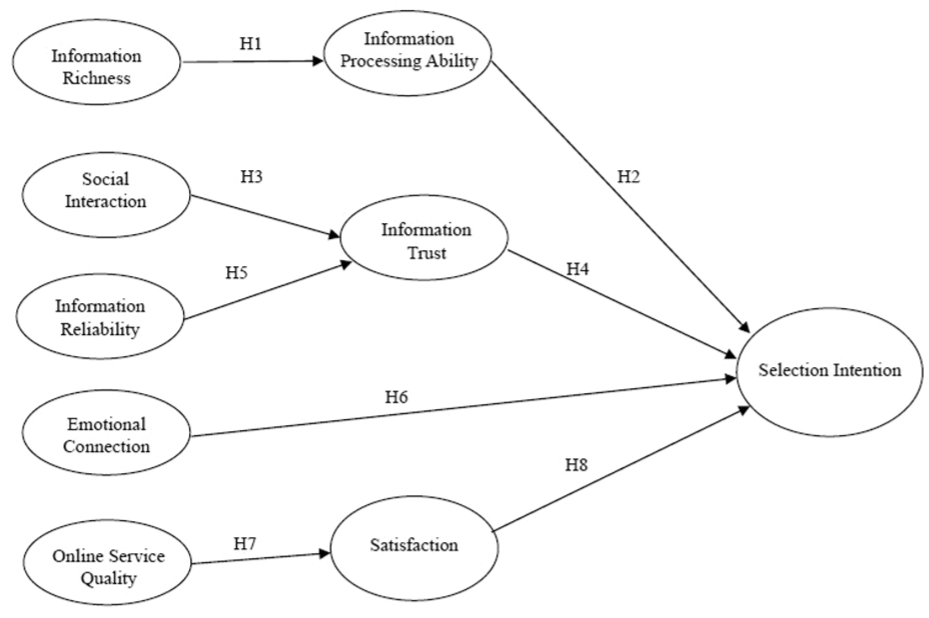
Research framework.
This study develops an integrated theoretical model combining Consumer Value Theory, Information Processing Theory, Information Interaction Theory, and Service Quality Theory to explain family members’ selection intentions for dementia care institutions via social media.
Consumer Value Theory clarifies why caregivers prioritize functional, emotional, social, epistemic, and conditional values when engaging with Facebook fan pages. Emotional and social value foster trust and strengthen selection intentions (H6). Information Processing Theory explains how information richness enhances cognitive understanding and evaluation of long-term care services, while processing ability mediates its influence on selection intention (H1, H2). Information Interaction Theory highlights how online community interactions and reliable information build trust, which subsequently affects decision-making (H3, H4, H5). Service Quality Theory links online service responsiveness, reliability, and interactivity to user satisfaction, which further enhances willingness to choose a facility (H7, H8).
The model integrates these perspectives into a cohesive pathway: social media features and interactions → cognitive processing → perceived value → trust and satisfaction → selection intention. Information processing ability, information trust, and satisfaction act as mediators, reflecting cognitive, emotional, and experiential mechanisms shaping online decision-making. This framework provides conceptual clarity by showing how social media engagement transforms information into trust and actionable caregiver choices.
Data Collection and Questionnaire Design
This study aims to explore the impact of Facebook fan pages on family members’ intentions to select long-term care institutions for elders with dementia. A 300 valid samples were selected, with a balanced gender distribution (150 males and 150 females). Convenience sampling was selected due to its efficiency and feasibility in reaching family members of elders with dementia. The use of convenience sampling in this study was driven by several practical considerations. First, it provided a rapid and resource-efficient means of collecting data from a highly specific group—family members of elders with dementia living in long-term care institutions in Taiwan. Given the targeted nature of the study, focusing on a well-defined group, convenience sampling ensured that respondents directly aligned with the research objectives, enhancing the relevance and quality of the data. To this end, a questionnaire specifically targeting the family members of elders with dementia was designed, with respondents required to be Facebook members to ensure that the sample is both targeted and representative, and the data collected was applicable to individuals likely to use social media for caregiving decisions. This method allows for the effective acquisition of target samples in a short period, ensuring the feasibility and accuracy of the study’s results.
The questionnaire was conducted online, this design not only enhances the representativeness of the sample data but also provides a solid basis for subsequent analyses comparing the gender differences in the influence of various variables. Prior to administering the questionnaire, this study explained the research purpose to the family members of the elderly and obtained their informed consent before they proceeded to complete the survey. An anonymous format was adopted to prevent any disclosure of participants’ personal information.
Model Diagnostics
Model diagnostics are a crucial step in ensuring the validity and reliability of a statistical model, contributing to the credibility and practicality of the research findings. The steps involved are as follows: (a) collinearity diagnosis of the structural model, (b) significance testing of path coefficients, (c) evaluation of the R2 value, (d) assessment of the effect size f2, and (e) evaluation of predictive relevance q2. Before model modification, some items had factor loadings below 0.7 and were therefore removed. The significance tests conducted using the bootstrap method indicated that all path coefficients in the revised model reached statistical significance. Upon checking the VIF values for each item and latent construct, some items exhibited collinearity issues. Consequently, items with VIF values greater than 5 were deleted sequentially from highest to lowest until the risk of collinearity was eliminated. Additionally, to ensure the robustness and predictive power of the model, the q2 value was examined to assess predictive relevance.
Data Analyses Methods
This study uses Structural Equation Modeling (SEM) to explore the path relationships between the main hypotheses and fuzzy-set Qualitative Comparative Analysis (fsQCA) 3.0 is used to analyze different paths for high and low selection intentions. Smart-PLS 4 is employed for the analysis of the measurement model and the structural model, including the reliability and validity analysis of the questionnaire in the measurement model.
The reasons for choosing Smart-PLS are as follows: (a) More robust when dealing with small samples, making it suitable for this study’s design of 300 samples, avoiding instability in model estimation due to insufficient sample size; (b) More adaptable for handling multivariate and multilevel structural models, which is particularly important for the complex structure with multiple mediating variables in this study; (c) It provides greater flexibility, making it suitable for path analysis and confirmatory factor analysis, meeting the needs of this research.
Regarding fsQCA analysis, it is adopted in this study because it can effectively handle the combinatorial effects between multiple variables and explore the impact of different combinations of conditions on the outcome. Particularly when the study involves the multiple factors influencing family members’ selection intentions regarding Facebook fan pages, fsQCA offers deeper insights than traditional regression analysis. It can also identify multiple influencing paths under different condition combinations, contributing to a comprehensive understanding of the impact mechanism of social media.
Condition configuration sufficiency analysis will be implemented by using fsQCA 3.0 software, as suggested by Ragin (2008), three types of solutions—simple, intermediate, and complex—can be obtained. Following the principle of prioritizing intermediate solutions and supplementing with simple solutions, the conditions common to both intermediate and simple solutions are defined as “core conditions,” while conditions appearing only in intermediate solutions are defined as “peripheral conditions.” Finally, to ensure the reliability of the research findings, two robustness checks were conducted.
Results
Respondent Demographics
Table 1 presents the descriptive analysis of the 300 respondents in this study. The gender distribution shows an equal split. In terms of age, the highest proportion being in the 20 to 30 age group. Regarding educational level, the majority of respondents are under graduates. For occupation, respondents working in the military, government, and education sectors represent the highest proportion of the sample. In terms of personal average income, more than half of the sample earn between NT$30,001 and NT$50,000.
Basic Details of Interviewees.

Model Diagnostics Results
Collinearity Diagnosis of the Model
Collinearity diagnosis of scale items (VIF Values): The VIF values were obtained by running the revised overall model fit using SmartPLS 4. A VIF value greater than 5 indicates potential collinearity issues between the items covered by the scale and the overall scale itself (J. F. Hair et al., 2011). As shown in Table 2, all VIF values for the scale items in this study are less than 5, suggesting that there are no significant collinearity problems among the scale items.
Collinearity Diagnosis of Scale Items (VIF Values).

Note. EC = Emotional connection; I = Social interaction; IPA = Information processing ability; IRS = Information richness; IRY = Information reliability; OSQ = Online service quality; IT = Information trust; S = Satisfaction; SI = Selection intention.
Collinearity diagnosis of latent constructs (VIF Values): The VIF values were obtained by running the revised overall model fit using SmartPLS. A VIF value greater than 5 indicates potential collinearity issues between the constructs of the scale and the overall scale (J. F. Hair et al., 2011). As shown in Table 3, all VIF values for the latent constructs in this study are less than 5, suggesting that there are no significant collinearity problems among the constructs of the scale.
Collinearity Diagnosis of Latent Constructs (VIF Values).
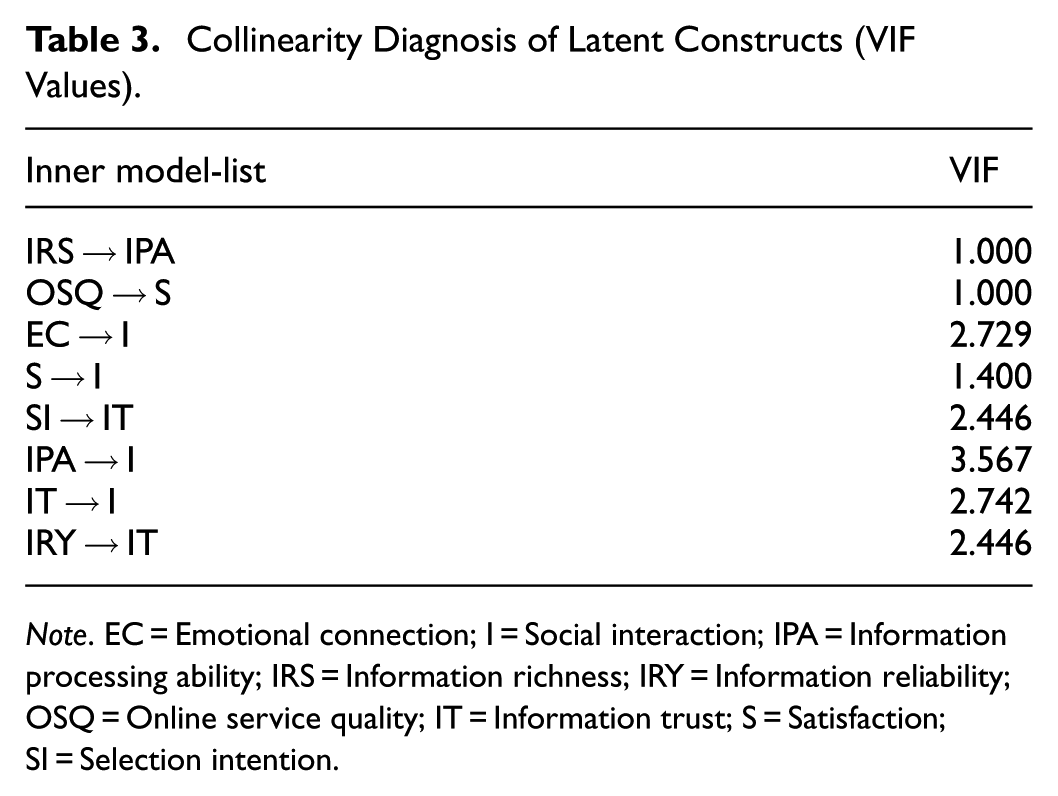
Note. EC = Emotional connection; I = Social interaction; IPA = Information processing ability; IRS = Information richness; IRY = Information reliability; OSQ = Online service quality; IT = Information trust; S = Satisfaction; SI = Selection intention.
Significance Testing of Path Coefficients
Factor analysis: The factor loadings of the scale items in this study range between 0.755 and 0.935, as shown in Table 4. All factor loadings exceed 0.7, indicating the importance of these items within their respective constructs.
Summary of Measurement Scales.

Note. EC = Emotional connection; I = Social interaction; IPA = Information processing ability; IRS = Information richness; IRY = Information reliability; OSQ = Online service quality; IT = Information trust; S = Satisfaction; SI = Selection intention.
Reliability: This also contributes positively to the calculation of composite reliability and the average variance extracted (AVE) values for the constructs. In the revised overall model fit, the results for composite reliability (CR) and validity show that the CR values for all constructs are above 0.7, demonstrating that the revised model meets the standard for good reliability. Additionally, the AVE for each construct is above 0.5, indicating that the revised model possesses good convergent validity (Fornell & Larcker, 1981).
Discriminant validity: Discriminant validity is assessed using the Fornell-Larcker criterion. This method involves comparing the square root of the AVE for each latent construct with the correlation coefficients between constructs. In Table 5, the diagonal elements (in bold) represent the square roots of the AVE for each construct, while the off-diagonal elements below the diagonal display the correlation coefficients between constructs. Discriminant validity is confirmed when the square root of the AVE for each construct is greater than the correlation coefficients between that construct and all other constructs (Anderson & Gerbing, 1988; J. F. Hair Jr et al., 2017).
Discriminant Validity.

Note. EC = Emotional connection; I = Social interaction; IPA = Information processing ability; IRS = Information richness; IRY = Information reliability; OSQ = Online service quality; IT = Information trust; S = Satisfaction; SI = Selection intention.
Significance of path coefficients for latent constructs: The overall effect of the revised model fit is shown in Table 6. The standardized estimated coefficients for the constructs in the revised model are all significant at the 0.01 level. Only the path indicating satisfaction relationship with selection intention exhibits significant positive effects at the 0.05 level. These results empirically validate the influence relationships among the latent constructs in this study.
Significance of Path Coefficients for Latent Constructs.

Note. EC = Emotional connection; I = Social interaction; IPA = Information processing ability; IRS = Information richness; IRY = Information reliability; OSQ = Online service quality; IT = Information trust; S = Satisfaction; SI = Selection intention.
p < .05, **p < .01.
Significance of path coefficients for scale items: Based on the factor loadings from the revised overall model fit (as shown in the “Original Sample” column of Table 7), all values exceed 0.7. This demonstrates that the items covered by the constructs in the revised model meet the standard for factor loadings and exhibit significant differences.
Path Coefficients Significance for Scale Items.

Note. EC = Emotional connection; I = Social interaction; IPA = Information processing ability; IRS = Information richness; IRY = Information reliability; OSQ = Online service quality; IT = Information trust; S = Satisfaction; SI = Selection intention.
p < .01.
Evaluation of R2
The R2 value of the revised overall model fit is an important criterion for assessing model adequacy. According to Chen (2018), R2 values of .02, .13, and .26 can be used to classify the model’s predictive capability as low, moderate, or high, respectively. In this study, the R2 values indicate that the predictive capability of the constructs in the revised overall model meets the higher standard. This demonstrates that the revised overall model fits the data well. This is illustrated in Table 8 and Figure 2.
R2 for Latent Constructs.

Note. I = Social interaction; IPA = Information processing ability; IT = Information trust; S = Satisfaction.

Standardized path coefficients and factor loadings for the revised theoretical model.
Evaluation of Effect Size f2
The f2 value is a key indicator for assessing the extent of the contribution of independent variables to dependent variables, quantifying the impact of constructs on the dependent variable. According to Cohen (1988), f 2 values are categorized as follows: (a) Small effect: f2 between 0.02 and 0.15 (b) Medium effect: f2 between 0.15 and 0.35 (c) Large effect: f2 greater than 0.35. This evaluation method is crucial for understanding the relative importance of each construct in the model, especially in multiple regression analysis, where it clearly presents the explanatory power of each construct. In this study, the f2 values for key constructs were assessed, as shown in Table 9.
Effect Size f2 Evaluation.

Note. EC = Emotional connection; I = Social interaction; IPA = Information processing ability; IRS = Information richness; IRY = Information reliability; OSQ = Online service quality; IT = Information trust; S = Satisfaction; SI = Selection intention.
The results indicate that large effects exist between information reliability and information trust, online service quality and satisfaction, and information richness and information processing ability (f2 > 0.35). These constructs have strong explanatory power on the dependent variables, indicating their critical role in the model. Small effects exist between information processing ability and selection intention, information trust and selection intention, emotional connection and selection intention, and satisfaction and selection intention (f2 < 0.15). Although these constructs show statistical significance, their explanatory power on the dependent variables is relatively weak. The results suggest that while some constructs have small effects on the dependent variables, they still hold significant importance in the overall explanatory power of the model when considering all constructs collectively.
Evaluation of Predictive Relevance
q2 measures the effectiveness of the model in predicting the dependent variables. It reflects the model’s ability to explain variations in the variables and can be used to assess the model’s predictive accuracy. According to the results of the summary and assessment of predictive relevance shown in Table 10. The path coefficient for H1 is supported, indicating a large effect of information richness on information processing ability at 0.01 significance level, where information richness interprets about 54% of the independent variable. The path coefficient for H2 shows significant differences and supports the hypothesis that information processing ability has a relatively small effect on selection intention at a 0.01 significance level. The path coefficient for H3 indicates a significant difference and supports the hypothesis that social interaction has a moderate effect on information trust at a 0.01 significance level. The path coefficient for H4 shows significant differences and supports the hypothesis that information trust has a small effect on selection intention at a 0.01 significance level. The path coefficient for H5 indicates significant difference and supporting the hypothesis that information reliability has a moderate effect on information trust at a 0.01 significance level. The path coefficient for H6 shows significant differences, supporting the hypothesis that emotional connection has a small impact on selection intention at a 0.01 significance level. The path coefficient for H7 indicates significant differences and supports the hypothesis that online service quality has a large effect on satisfaction, at a 0.01 significance level, where online service quality interprets about 68% of satisfaction of Facebook users. The path coefficient for H8 indicates significant differences and supports the hypothesis that satisfaction has a small effect on selection intention at a 0.01 significance level.
Summary and Assessment of Predictive Relevance (q2).

Note. EC = Emotional connection; I = Social interaction; IPA = Information processing ability; IRS = Information richness; IRY = Information reliability; OSQ = Online service quality; IT = Information trust; S = Satisfaction; SI = Selection intention.
p < .01.
Mediation Effect Analysis
This study used the bootstrapping method to test mediating effects following Baron and Kenny’s (1986) criteria. Partial mediation is confirmed when both direct and indirect effects are significant, while full mediation is indicated when the direct effect is non-significant, but the indirect effect remains significant. The results (Table 11) reveal both partial and full mediation across different pathways.
Mediation Effect Analysis.

p < .01.
Partial Mediation (IRS → IPA → I)
Information Richness (IRS) significantly influenced Selection Intention (I) directly (β = .153, p < .01). The mediator, Information Processing Ability (IPA), also exerted a significant indirect effect (β = .190, p < .01). The Variance Accounted For (VAF) was 55.38%, confirming partial mediation. This indicates that while IRS directly affects I, IPA enhances the effect via an additional cognitive processing pathway.
Full Mediation (SI → IT → I)
Social Interaction (SI) had no significant direct effect on I (β = .088, p > .05), but its indirect effect through Information Trust (IT) was significant (β = .053, p < .01). VAF was 37.64%, and as the direct effect was non-significant, this pathway represents full mediation. SI only influences I when mediated by IT, indicating that interaction alone cannot drive decisions without trust.
Full Mediation (IRY → IT → I)
Information Reliability (IRY) did not directly impact I (β = .115, p > .05), but its indirect effect through IT was significant (β = .144, p < .01). IT accounted for 55.56% of the total effect. This confirms that reliability shapes selection intention entirely through its ability to foster trust, highlighting IT as the core mechanism in this pathway.
Full Mediation (ISQ → S → I)
Information Service Quality (ISQ) showed no significant direct effect on I (β = .004, p > .05), while its indirect effect through Satisfaction (S) was significant (β = .054, p < .01). S mediated 93.15% of the total effect, indicating a very strong full mediation. Thus, the impact of ISQ on I depends almost entirely on satisfaction derived from online service quality.
Collectively, these findings confirm distinct mediating roles. IPA partially mediates IRS → I, enhancing but not fully explaining its effect. IT fully mediates both SI → I and IRY → I, underscoring trust as a necessary bridge between interaction/reliability and decision-making. S exhibits the strongest full mediation in ISQ → I, suggesting satisfaction is indispensable for translating service quality into selection intention.
These results emphasize the hierarchical nature of cognitive and affective mechanisms. Rich content may spark initial interest, but its influence depends on users’ ability to process and trust the information. Similarly, service quality fosters satisfaction, which is the ultimate driver of selection.
Demographic Difference Comparative Analysis
The descriptive statistics for the research constructs are shown in Supplemental Appendix 2.
Comparative Analysis of Demographic Influences on Information Richness, Social Interaction, and Information Reliability
The comparative analysis of demographic influences on information richness, social interaction, and information reliability is shown in Supplemental Appendix 3. The results indicate that considering the gender of the respondents, males show a significantly higher level of agreement with information richness, social interaction, and information reliability compared to females. The agreement level with information richness is significantly higher in the 20 to 30 age group, social interaction, and information reliability compared to the 31 to 40 age group, and those aged 40 and below have significantly higher agreement than those over 41.
Regarding the educational background, university and postgraduate education levels show significantly higher agreement with information richness and information reliability compared to those with a diploma. Individuals in the technology sector show significantly higher agreement with information richness compared to those in the service sector. Respondents from the technology sector show higher agreement to social interaction than those in the manufacturing sector, and those from the manufacturing sector show higher agreement than those in the tutoring sector. While individuals in the technology and tutoring sectors show higher agreement with information reliability compared to those in other sectors. Individuals with an income between NT$30,001 and NT$50,000 show significantly higher agreement with information richness and social interaction compared to those earning over NT$70,001.
Comparative Analysis of Demographic Influences on Emotional Connection, Online Service Quality, and Selection Intention
The comparative analysis of demographic influences on emotional connection, online service quality, and selection intention is shown in Supplemental Appendix 4. The results indicate that males show a significantly higher level of agreement with emotional connection, online service quality, and purchase intention compared to females. The agreement level with emotional connection is significantly higher in the 20 to 30 age group, online service quality, and purchase intention compared to the 31 to 40 age group, and those aged 40 and below have significantly higher agreement than those over 41.
Individuals in all sectors show significantly higher agreement with emotional connection and purchase intention compared to those in the others category. Respondents from the technology sector show higher agreement with online service quality than those in other sectors. Individuals with an income between NT$30,001 and NT$50,000 show significantly higher agreement with online service quality and purchase intention, compared to those earning over NT$70,001 and across different income levels, respectively.
Comparative Analysis of Demographic Influences on Information Processing Ability, Information Trust, and Satisfaction
The comparative analysis of demographic influences on information processing ability, information trust, and satisfaction is shown in Supplemental Appendix 5. The results indicate that considering the gender of the respondents, males show a significantly higher level of agreement with information processing ability, information trust, and satisfaction compared to females. The agreement level with information processing ability, information trust, and satisfaction is significantly higher in the 20 to 30 age group, social interaction, and information reliability compared to the 31 to 40 age group, and those aged 40 and below have significantly higher agreement than those over 41.
Regarding the educational background, university and postgraduate education levels show significantly higher agreement with satisfaction compared to those with a diploma. Individuals in the military, public service, technology, and manufacturing sectors show significantly higher agreement with information processing ability compared to those in other sectors. While those working in the technology and education sectors show significantly higher agreement with information trust and satisfaction compared to other sectors. Individuals with an income over NT$70,001 show significantly higher agreement with information trust compared to other lower categories.
FsQCA Analysis
Variable Calibration
In this study, the direct calibration method proposed by Ragin (2008) is used to calibrate the data. The 75th percentile, median, and 25th percentile values of the condition and outcome variables are used as the values for full membership, crossover, and full non-membership points, respectively. The calibration anchor points for the condition and outcome variables are shown in Table 12.
Fuzzy Set Calibration Anchors.

Single Variable Condition Necessity Analysis
This study further employs the fsQCA method to test the necessity of antecedent conditions for both high and low selection intentions. In the fsQCA method, a consistency level greater than 0.9 indicates that the condition can be considered a necessary condition for the outcome variable (Du & Jia, 2017). As seen in Table 13, the consistency levels of the eight condition variables in this study are all below 0.9, indicating that these conditions do not meet the consistency requirement for necessity.
Necessity Condition Analysis Results.

Note. (~) represents the absence of a condition.
The necessity analysis revealed that no single antecedent condition, including information richness, achieved a consistency level above 0.9, indicating that none can be considered universally necessary for high or low selection intention. This finding aligns with the principle of equifinality in fsQCA, which suggests that multiple alternative pathways can lead to the same outcome. In this context, information richness may act as a peripheral or complementary condition, becoming important only in specific configurations where, for example, high service quality or emotional connection are also present. This reflects the complex, multi-factor nature of decision-making, where no single factor dominates across all family members but rather interacts with other conditions in diverse ways.
Condition Configuration Sufficiency Analysis
Park and Mithas (2020) propose that the consistency value should be greater than 0.8, and the PRI consistency value should be above 0.75. In this study, the original consistency value was set at 0.8, and the PRI consistency threshold was set at 0.928. Through the practical analysis process, it was found that setting the PRI at 0.928 resulted in the best-performing seven paths. Firstly, this PRI level exceeds 0.75, indicating a high level that effectively avoids the issue of equifinality. Secondly, under this PRI condition, the paths obtained provide the most reasonable explanation of the research results and align best with the real-world situation. The default case frequency was set to 2 to ensure that at least 75% of the cases are included in the analysis.
High Selection Intention Configuration Analysis
According to the results shown in Table 14, there are five configurations that lead to high selection intention. The overall consistency coefficient is 0.952867, all of which are above the minimum threshold of 0.8 and indicate a high level, demonstrating that these five configurations are sufficient conditions for high selection intention. Additionally, the overall coverage of these configurations account for 47.07% of the samples achieving high selection intention.
High Selection Intention Configuration Analysis Results.
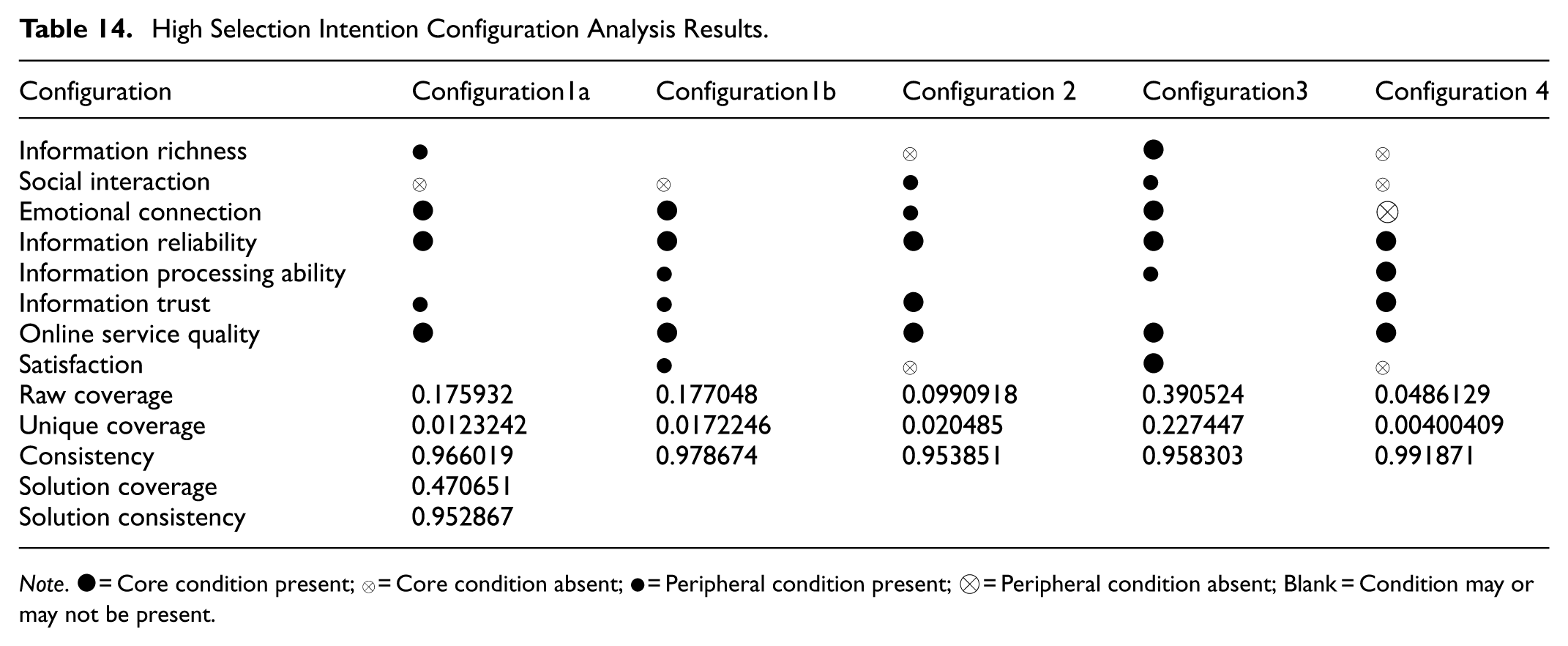

Note.  = Core condition present;
  = Core condition absent; • = Peripheral condition present;
  = Peripheral condition absent; Blank = Condition may or may not be present.
Configurations 1a and 1b: These configurations suggest that under the synergistic influence of emotional connection, information reliability, and internet service quality as core conditions, it is possible to achieve high selection intention despite a lack of community interaction. However, relying solely on these three factors is not sufficient to significantly enhance selection intention. It requires the marginal synergy of information richness and information trust in Configuration 1a, and message processing ability, information trust, and satisfaction in Configuration 1b. Configuration 1a explains 17.59% of families with high selection intention, with about 1.23% of these families being uniquely explained by this configuration. Configuration 1b explains 17.70% of families with high selection intention, with about 1.72% being uniquely explained by this configuration.
Configuration 2: This configuration indicates that under the synergistic influence of information reliability, information trust, and online service quality as core conditions, high selection intention can be achieved despite a lack of information richness and satisfaction. However, relying solely on these three factors is not enough to significantly boost selection intention. It requires the marginal synergy of community interaction and emotional connection to achieve high selection intention in the absence of information richness and satisfaction. This configuration explains 9.91% of families with high selection intention, with about 2.05% being uniquely explained by this configuration.
Configuration 3: This configuration demonstrates that high selection intention can be achieved under the synergistic influence of information richness, emotional connection, information reliability, online service quality, and satisfaction as core conditions. The synergy of these core conditions not only enhances families’ trust in long-term care institutions but also promotes their proactive decision-making, resulting in higher selection intention. However, relying solely on these core conditions is not sufficient to achieve high selection intention; it also requires the marginal synergy of community interaction and message processing ability. This configuration explains 39.05% of families with high selection intention, with approximately 22.74% being uniquely explained by this configuration.
Configuration 4: This configuration shows that high selection intention can be achieved under the synergistic influence of information reliability, message processing ability, information trust, and internet service quality as core conditions, despite a lack of information richness, community interaction, and satisfaction. The synergy of these core conditions compensates for the lack of information richness, community interaction, and satisfaction, effectively increasing families’ selection intention and promoting more proactive decision-making. However, relying solely on these factors is not enough to achieve high selection intention; it also requires marginal synergy with other conditions. This configuration accounts for 4.86% of families demonstrating high selection intention, of which 0.4% can be attributed uniquely to this specific configuration.
Low Selection Intention Configuration Analysis
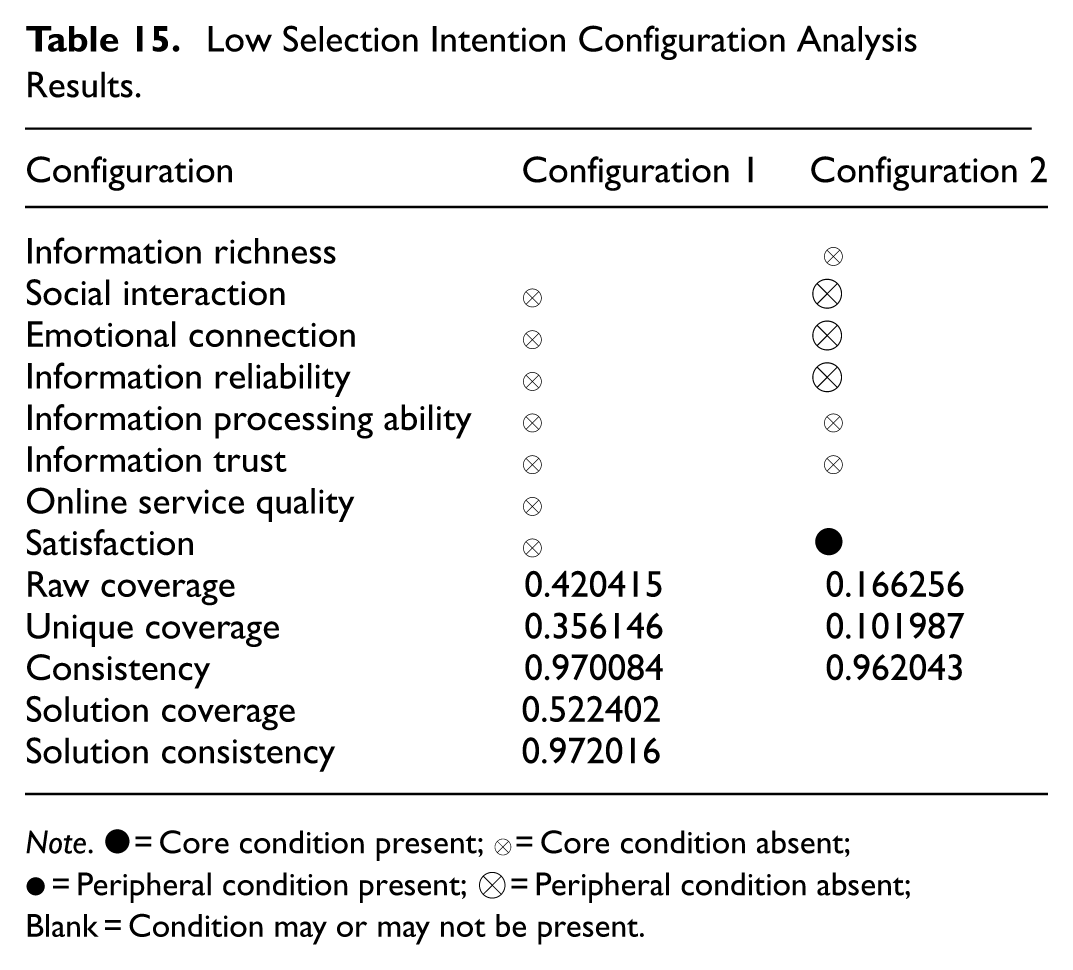
This study also analyzed the configurations that lead to low selection intention. The results, shown in Table 15, indicate that there are two configurations that result in low selection intention. When various antecedent conditions perform poorly, achieving high selection intention becomes challenging.
Low Selection Intention Configuration Analysis Results.

Note. = Core condition present; = Core condition absent; • = Peripheral condition present; = Peripheral condition absent; Blank = Condition may or may not be present.
From Table 15, it can be observed that there are two configurations leading to low selection intention, with consistency coefficients of 0.970084 and 0.962043, respectively. The overall consistency coefficient is 0.972016, all of which are above the minimum standard of 0.8 and are at a high level. This indicates that these two configurations are sufficient conditions for forming low selection intention. Additionally, the overall coverage of these configurations is 52.24% of the samples exhibiting low selection intention.
Configuration 1: This configuration indicates that a lack of core conditions such as social interaction, emotional connection, information reliability, information processing capability, information trust, and satisfaction leads to low selection intention. When these core elements are missing, family members may feel confused and insecure about choosing long-term care institutions for individuals with dementia, resulting in low selection intention. This configuration explains 42.04% of low selection intention cases.
Configuration 2: This configuration shows that while satisfaction is a core condition, the absence of core conditions such as information richness, information processing capability, and information trust, along with the lack of edge conditions like social interaction, emotional connection, and information reliability, leads to low selection intention. In this case, even though family members might have a certain level of satisfaction with the long-term care institution, this satisfaction cannot be translated into actual selection behavior due to the lack of other critical elements. This configuration explains 16.63% of low selection intention cases.
Robustness Check
Tables 16 and 17 show the results of adjusting consistency threshold (Raw Consist): The consistency threshold for cases was adjusted from 0.8 to 0.85. The results of the configurations obtained with this new threshold were consistent with the original findings. This adjustment confirmed that the configurations are robust to changes in the consistency threshold. Changing PRI consistency level, the PRI consistency level was adjusted from 0.928 to 0.942. The configurations obtained with this adjusted PRI level were fundamentally consistent with the original results. This indicates that the research conclusions are robust to variations in the PRI consistency level.
Robustness Results: Adjusting Consistency Threshold.


Note. = Core condition present; = Core condition absent; • = Peripheral condition present; = Peripheral condition absent; Blank = Condition may or may not be present.
Robustness Results: Adjusting PRI Consistency Level.


Note. = Core condition present; = Core condition absent; • = Peripheral condition present; = Peripheral condition absent; Blank = Condition may or may not be present.
Discussion
This study highlights how social media engagement on Facebook fan pages influences family members’ selection intentions for dementia care institutions, with a nuanced interplay between information richness, reliability, trust, and satisfaction. This highlights the importance of information transparency and content quality in the decision-making process. While information richness is generally considered a critical factor in online decision-making, our findings indicate that it does not consistently emerge as a core condition for selection intention. This outcome reflects the contingent nature of information richness, which aligns with Information Processing Theory. According to Miller (1956), individuals have limited cognitive capacity; when faced with high-stakes decisions such as choosing dementia care services, they may prioritize credible and easily interpretable information over sheer volume or variety of content. In this context, families might downplay richly detailed but cognitively demanding media and instead rely on simplified, reliable, and trust-enhancing cues, such as testimonials or verified service details. This explains why information reliability and online service quality appear more prominently in the causal configurations, as these factors reduce uncertainty and cognitive load—both central constructs in Information Processing Theory and trust transfer literature (Wang et al., 2021).
Additionally, the finding that information processing ability had only a modest effect on selection intention underscores the equifinality principle in fsQCA, where multiple pathways lead to similar outcomes. Families with lower information processing ability may still achieve high selection intention if other supportive conditions, such as emotional engagement or perceived service quality, compensate for their limited cognitive capacity. This aligns with Consumer Value Theory, where emotional and social values can offset functional cognitive limitations by fostering affective trust and a sense of belonging (Hamilton et al., 2022). In high-stakes, emotionally charged decisions like dementia care, trust derived from social interactions and emotional resonance often supersedes purely cognitive evaluations, explaining why community interaction and emotional connection emerge as stronger predictors in some configurations.
Moreover, the conditional role of information richness can also be understood through Information Interaction Theory, which emphasizes how users iteratively engage with platform content. Family members may selectively interact with content based on their immediate needs and emotional states, meaning that rich information alone is insufficient unless it is perceived as contextually relevant and easy to integrate into the decision process (Toms, 2002). This finding is consistent with Fu et al. (2020), who observed that social influences (e.g., perceived similarity and familiarity) can outweigh pure informational factors in online decisions, especially in low-involvement scenarios. In dementia care decisions, perceived trustworthiness and emotional reassurance from the online community likely carry more weight than the density of multimedia content.
Our results also reinforce Service Quality Theory, which posits that responsiveness, reliability, and assurance drive satisfaction, subsequently shaping behavioral intentions. In the dementia care context, families perceive Facebook fan pages not merely as informational repositories but as service touchpoints where prompt responses, interactive features, and transparent communication enhance perceived service quality. This finding extends prior commercial social media research (Chivandi et al., 2020; Wang et al., 2021) into the healthcare domain, where credibility and empathy are equally critical as functional service quality dimensions.
Taken together, this study integrates cognitive (information processing), emotional (trust, connection), and experiential (service quality) mechanisms to explain why some conditions, like information richness, have inconsistent effects on selection intention. Unlike transactional decisions in retail or travel (Maity et al., 2018; Sabate et al., 2014), dementia care decisions involve higher perceived risk and emotional stakes, which shift decision-making priorities from media richness toward trust-building factors. This highlights the need for tailored social media strategies, where care institutions balance rich content with reliability, emotional resonance, and responsive interactions to meet the distinct cognitive and emotional needs of different caregiver groups. Future research should test these boundary conditions such as cultural context, caregiver demographics, and health literacy using moderation or multi-group analysis to validate the differential impact of information richness across diverse populations.
While information richness and trust generally enhance selection intentions, their effects may not be universal. Cultural factors, such as uncertainty avoidance and collectivism, and individual differences like prior digital experience, health literacy, or caregiving history, may moderate these relationships. For example, in high-context cultures, trust may rely more on social relationships than information richness. However, these moderating effects were not empirically tested and remain theoretical. This is a limitation, and future research should validate such boundary conditions through multi-group SEM or moderation analyses.
Although multicollinearity can distort SEM results by inflating standard errors, weakening discriminant validity, and reducing the stability of path coefficients, the VIF values for both scale items and latent constructs in this study were below the recommended threshold of 5 (J. F. Hair et al., 2011). This confirms that the constructs are conceptually distinct and that there is no redundancy that could bias the estimation of path coefficients. Consequently, the relationships among variables—such as the effects of information richness on information processing ability or the mediating role of satisfaction—can be interpreted with greater confidence. The absence of collinearity issues also ensures the accuracy of model fit indices, R2, and f2 effect sizes, indicating that the SEM model produces reliable and unbiased estimates. Therefore, multicollinearity does not adversely affect the validity or explanatory power of the structural model in this study. Future research could explore advanced SEM techniques or alternative methodologies to address multicollinearity and further validate the findings.
The results show a moderate effect of social interaction with other users on trust in the information provided. When family members engage more actively by commenting, sharing experiences, or responding to questions, they experience a community connection, which enhances trust in the information. This result is supported by the results of an empirical study by Zhang and Gu (2015) that examined social interaction factors’ impact on consumer trust within the context of online group buying in China and found a significant relationship between them. In addition, research that investigated multi-platform perspectives to compare the use of trust-building mechanisms and their perceived importance in relation to the degree of social interaction by Hesse et al. (2020). The study provided robust evidence on the relationship between the degree of social interaction and expressive trust.
The study found that information trust has a small effect on the selection intention of the dementia care institution. Family members who perceive the information as accurate, reliable, and engaging are more likely to choose the institution based on this information. This result is supported by the findings of Tseng and Lee (2016), who explored the relationships among trust, information disclosure and reducing search cost, and online group-buying intention and found that information disclosure and trust positively influence online group-buying intention. Moreover, it is supported by the finding of a study that attempted to enhance the understanding of trust within the context of Internet banking and found that trust positively influences the use intention (Dimitriadis & Kyrezis, 2010).
The results indicate that information reliability has a moderate effect on information trust. Reliable and trustworthy information is crucial in the decision-making process for choosing a dementia care institution. This result is supported by the results of F. Johnson et al. (2015), who examined trust formation within the health information context and found that reliable content and assessing credibility lead to trust formation. In addition, it is partially supported by research results that proposed a reliability-based trust-aware collaborative filtering method to enhance trust-aware recommender systems accuracy and succeeded in obtaining reasonable user and rate coverage (Moradi & Ahmadian, 2015).
The results show that emotional connection has a small impact on selection intention. When family members establish emotional connections and experience support and resonance through interactions, their intention to choose the institution significantly increases. This result is supported by the findings of Pappas et al. (2017), who proposed and tested a model of customer persuasion in personalized online shopping based on information processing theory and found that positive emotions increase the effect of persuasion on purchase intentions. Moreover, a study that examined the relationship between emotional interaction in terms of familiarity and intimacy and purchase intention found that emotional interaction positively affected the purchase intention of users in social commerce (Wang et al., 2021).
The results indicate that online service quality has a large effect on satisfaction. The study emphasizes the importance of online service quality in enhancing family members’ satisfaction. This result is supported by Sharma and Lijuan’s (2015) findings, who investigated the e-commerce websites in online platform service quality and its contribution to e-business promotion and found that information quality and online service quality are major determinants of user satisfaction. This result contradicts the findings of Sheng and Liu (2010), who investigated factors that impact customer satisfaction and loyalty and found that e-service quality has no significant effect on customer satisfaction.
Recent systematic reviews underscore the increasing significance of social media in healthcare. Chen and Wang (2021) emphasize its role in research, social mobilization, and healthcare service facilitation. However, gaps remain in audience segmentation, impact evaluation, and privacy concerns. Furthermore, Patrick et al. (2022) highlight how the COVID-19 pandemic revealed both the advantages and challenges of social media, particularly regarding misinformation and disinformation. Emerging best practices now guide healthcare professionals in leveraging social media effectively, improving digital literacy, and enhancing patient care. By incorporating these insights, our study provides a more contextualized and theoretically grounded perspective on the evolving role of social media in healthcare.
The study results indicate that satisfaction has a small effect on selection intention. This result is supported by the findings of a study by Hue et al. (2022), who analyzed the gratification factors of a hotel’s Facebook page users and verified the relationship between satisfaction and the users’ intention to visit the hotel. In addition, research that investigated social media use for health communication found that satisfaction is the most important driver of users’ continuous intention on Facebook health fan pages (Khan & Saleh, 2023).
This study advances understanding of consumer behavior in social media contexts by integrating Consumer Value Theory, Information Processing Theory, Information Interaction Theory, and Service Quality Theory. It shows that information processing ability, trust, and satisfaction mediate selection intentions when engaging with social media content. Unlike prior research on general healthcare decisions, this study provides empirical evidence specific to long-term care. It also reveals demographic differences—younger caregivers prefer interactive formats (videos, live sessions), while older caregivers favor detailed text and testimonials. These insights refine consumer behavior models by highlighting content preferences, advancing digital consumer behavior theory in healthcare decision-making.
This study’s focus on Taiwan and Facebook fan pages limits the generalizability of its findings to other cultural contexts and social media platforms. Differences in cultural norms, user behaviors, and platform-specific features may lead to variations in engagement patterns and decision-making processes. As a result, the identified relationships may not hold consistently across different regions or social media environments. Future research should explore these dynamics in diverse geographic and platform settings to strengthen the robustness and broader applicability of the results.
Conclusion and Recommendations
Based on the consumer value, information processing, information interaction, and service quality theoretical models, and employing fsQCA analysis to explore the factors influencing high and low selection intentions of family members for long-term care institutions for individuals with dementia, all the study’s hypotheses are accepted and empirically supported.
Theoretical Contributions
This study provides deeper theoretical contributions by advancing the understanding of how social media influences consumer decision-making in sensitive healthcare contexts. First, it integrates Consumer Value Theory, Information Processing Theory, Information Interaction Theory, and Service Quality Theory into a unified framework, highlighting how emotional connection, information richness, community interaction, and service quality collectively shape decision-making on Facebook fan pages. While prior studies have examined social media in general consumer markets, this research extends these theories into the underexplored domain of long-term care for individuals with dementia, where decisions are emotionally charged, information-intensive, and trust-dependent. Second, the findings enrich consumer behavior literature in social media contexts by demonstrating that family members’ willingness to choose care institutions is not only influenced by rational factors such as information reliability but also by affective components like emotional connection and social trust cultivated through online interactions. This extends existing understanding beyond transactional behavior to emphasize the relational and community-building role of social media in healthcare decision-making.
Third, the use of fsQCA analysis uncovers multiple pathways leading to high and low selection willingness, showing that consumer behavior on social media is configurational rather than linear. This insight challenges the oversimplified one-dimensional explanations in previous research and highlights the need to consider demographic diversity and interactional complexity when analyzing consumer choices in virtual communities. Finally, the study refines Information Interaction Theory by contextualizing it in Facebook-based decision-making. Family members actively engage with content (institutional information), interact iteratively with other users, and integrate diverse inputs to reduce uncertainty before selecting a care institution. By showing how information richness enhances processing ability, which subsequently drives selection intention, this research provides a nuanced mechanism linking social media engagement to healthcare decisions, thus broadening theoretical applications beyond traditional e-commerce or branding contexts.
Managerial Implications
The present study contributes uniquely to the literature by empirically linking Facebook fan page engagement with families’ selection intentions for dementia-specific long-term care institutions an area that remains underexplored. Prior studies have largely examined social media’s role in general consumer decision-making (Lin & Lu, 2011), but few have focused on dementia care settings. By demonstrating that high-quality, interactive, and dementia-specific Facebook content significantly shapes trust and selection intention, our findings extend previous work on social media engagement by applying it to a sensitive healthcare decision-making context.
From a practical perspective, these results provide actionable guidance for managers of long-term care facilities. Institutions should elevate the quality of Facebook content with a dementia-focused lens, ensuring posts are accurate, reliable, and emotionally resonant. Sharing clinically verified dementia care tips, updates on personalized patient-centered approaches, and authentic family testimonials aligns with prior evidence that credible, transparent content fosters trust and reduces caregiver uncertainty (Guo et al., 2025). Formats such as caregiver guides, memory-care activity videos, and infographics on dementia symptoms may enhance comprehension and engagement, supporting more informed decision-making (Azzahrani et al., 2025).
Equally important is fostering a sense of online community. Consistent with research highlighting the value of social interaction and support networks for caregivers (Wang et al., 2024), managers should actively engage users by responding promptly to queries, initiating discussions on memory-care practices, and hosting live Q&A sessions with neurologists, geriatricians, or dementia nurses. Such interactions can humanize the institution, build emotional trust, and strengthen caregiver confidence in their selection. Encouraging user-generated content such as success stories or patient milestones can amplify positive word-of-mouth and enhance institutional reputation (Castillo et al., 2024).
Finally, our results suggest the importance of personalized marketing. Segmenting Facebook content based on caregiver demographics can optimize reach and relevance: younger caregivers may prefer short videos, interactive polls, or quick tips on managing behavioral symptoms, whereas older caregivers might engage more with long-form articles, step-by-step guides, or illustrated FAQs. This aligns with prior findings on tailoring health communication to user preferences to improve engagement and decision outcomes (Dao et al., 2025)
From a research perspective, this study opens avenues for further exploration. Future work could compare the effectiveness of different content formats (e.g., live sessions vs. static posts), evaluate long-term effects on institutional choice, and examine cross-cultural differences in how caregivers process online information (Samuel et al., 2022). Experimental or longitudinal designs would also strengthen causal inference and help generalize findings to a broader population. Overall, these dementia-centered, evidence-informed strategies can enhance long-term care facilities’ social media presence, build institutional trust, improve caregiver decision-making, and ultimately support better alignment between families and care services.
Research Limitations and Future Recommendations
The results of this study provide a new perspective for future research. A limitation of this study is that while some relationships are statistically significant, the small effect sizes (e.g., satisfaction on selection intention, emotional connection) limit their practical relevance. This suggests minimal real-world impact and highlights the need to explore unmeasured factors or alternative predictors that may better explain these relationships in future research.
Supplemental Material
sj-docx-1-sgo-10.1177_21582440251395709 – Supplemental material for Exploring the Impact of Facebook Fan Pages of Long-Term Care Institutions for Elders With Dementia on Family Members’ Selection Intentions
Supplemental material, sj-docx-1-sgo-10.1177_21582440251395709 for Exploring the Impact of Facebook Fan Pages of Long-Term Care Institutions for Elders With Dementia on Family Members’ Selection Intentions by Yi-Fen Chen and Tzu-I Jou in SAGE Open
Footnotes

Ethical Considerations
This study was granted exemption from requiring ethics approval because participants filled out anonymous questionnaire.
Consent to Participate
This study involved human participants through an anonymous online questionnaire. Participation was voluntary, and informed consent was obtained from all respondents prior to data collection. Participants were informed about the study’s purpose, the anonymity of their responses, and the protection of personal information. No identifying or sensitive personal data were collected, and the study design minimized any risk of harm to participants. As the study posed minimal risk and involved no intervention, formal ethics committee approval was not required under local regulations. The potential societal benefits of understanding decision-making in dementia care outweigh any minimal risks to participants.
Authors’ Contributions
Yi-Fen, Chen is responsible for guiding Tzu-I, Jou to complete the journal paper submission. Tzu-I, Jou is responsible for writing papers, including introduction, literature review and development of hypotheses, research methodology, data analysis and research results, conclusions, and modifying them into the format prescribed by the journal.
Funding
The authors received no financial support for the research, authorship, and/or publication of this article.
Declaration of Conflicting Interests
The authors declared no potential conflicts of interest with respect to the research, authorship, and/or publication of this article.
Data Availability Statement
All data generated or analyzed during this study are included in this published article and its supplementary file.
Supplemental Material
Supplemental material for this article is available online.
References
Supplementary Material
Please find the following supplemental material available below.
For Open Access articles published under a Creative Commons License, all supplemental material carries the same license as the article it is associated with.
For non-Open Access articles published, all supplemental material carries a non-exclusive license, and permission requests for re-use of supplemental material or any part of supplemental material shall be sent directly to the copyright owner as specified in the copyright notice associated with the article.
