




Abstract
The COVID-19 pandemic generated major health, social, and economic concerns that also influenced individuals’ childbearing decisions. Migrants have been disproportionately affected compared to natives, experiencing higher mortality rates, greater job losses, and more severe financial hardships. In Sweden, these disparities are reflected in a sharper decline in birth rates among migrants relative to Swedish natives in 2021, likely due to the pandemic’s more adverse effects on migrant communities. Drawing on data from the 2021 Swedish Gender and Generation Survey, this study employs Ordinary Least Squares (OLS) regression models to examine how pandemic-related concerns—and the perceived impact of the pandemic across various domains (work and financial conditions, relationship quality, and wellbeing)—are associated with short-term fertility intentions across different migrant groups (Swedish natives, European migrants, and migrants from elsewhere). Our findings reveal distinct patterns by both migrant background and domain. Among all migrant groups, deteriorating work conditions were linked to a reduced desire to have children. Financial concerns further discouraged childbearing among European migrants. In contrast, Swedish natives’ fertility plans were more strongly influenced by personal wellbeing and relationship quality than by economic factors. Notably, improved financial or employment conditions were associated with a decreased desire to have children among European migrants, possibly reflecting a prioritization of career over family among this highly educated group during the crisis. Conversely, for migrants from elsewhere, concerns about future pandemics were linked to a higher short-term fertility desire, suggesting a ‘now or never’ mindset, akin to fertility responses observed after natural disasters.
Plain Language Summary
The COVID-19 pandemic was mainly a health crisis, but it also caused big problems for people's jobs, money, and daily lives. People may have changed their plans during this time, like delaying having children. Migrants were hit harder by the pandemic compared to Swedish-born people. They faced higher death rates and more job and financial problems. In Sweden, the birth rate among migrants dropped in 2021, possibly due to their greater fear of health and financial risks from the pandemic. This study looks at how concerns about health and money during the pandemic influenced the decision to have children among migrants and Swedish-born people. We found that negative feelings about the future, especially about money and work, affected childbearing plans more for European migrants than for Swedish-born people. For non-European migrants, however, worries about the future seemed to make them more likely to want to have children soon.
Introduction
The COVID-19 crisis primarily represented a health emergency, but the pandemic also led to considerable social, financial, and labour market losses. During the crisis, its duration, consequences, and future prospects of societies were highly uncertain, affecting families’ abilities to make plans for the future. Individuals, therefore, may have adjusted their behaviour to the economic and health costs of the pandemic, postponing irreversible commitments, such as having children (Aassve et al., 2020, 2021; Bujard & Andersson, 2024; Charles-Edwards et al., 2021; Lappegård et al., 2020; Tavares et al., 2022; Wilde et al., 2020). Such expectation that the pandemic would have accelerated the long-term fertility decline witnessed in high-income countries for more than a decade was only partially confirmed by the empirical evidence (Aassve et al., 2021; Sobotka et al., 2024). While early findings pointed to generalized decreases in pregnancies and childbirths during the first wave of the pandemic (Wilde et al., 2020), subsequent studies covering a longer period of time presented instead a more complex picture with heterogeneous effects across pandemic waves and contexts.
Notably, the consequences of the pandemic not only varied over time but were also not equally shared across socioeconomic groups (Torres et al., 2024; Mamelund & Dimka, 2021; Mamelund et al., 2021). Literature on migration highlights how, in the aftermath of the pandemic, migrants have suffered disproportionately more than natives in both health and financial terms, with greater excess mortality and greater job and financial losses. Migrants have been at higher risk of COVID-19 infection, hospitalisation, and mortality than host country natives worldwide, and in Sweden in particular (Andersson et al., 2021; Aradhya et al., 2021; Diaz et al., 2020). Migrants worked jobs that placed them at higher risk of contracting the disease as well as in sectors with greater risk of job loss during the pandemic (Billingsley et al., 2021; ILO, 2021). At the same time, migrants were exposed to different sources of information from both the country of origin and the destination country’s media narrative of the pandemic, which may have contributed to rising levels of uncertainty (Aradhya et al., 2021).
In Sweden, the Total Fertility Rate (TFR) among migrants declined more markedly than among natives in 2021, possibly due to heightened perceptions of risk and the more severe consequences of the pandemic for foreign-born individuals. As the rationale behind changes in reproductive decisions during the pandemic remains largely under-researched, it becomes challenging to reconcile aggregate findings on fertility surges or declines across different social groups and contexts (Berrington et al., 2022; Castro Torres et al., 2024; Lindberg et al., 2020; Lindberg et al., 2021; Luppi et al., 2020). Furthermore, to the best of the authors’ knowledge, very little attention has been devoted to the investigation of whether the pandemic influenced the childbearing decisions of migrants differently than those of natives.
The current study addresses this gap by investigating how perceptions of the pandemic’s impact on several life domains differ between Swedish-born and foreign-born individuals, and how these perceptions correlate with their short-term childbearing intentions.
Using rich individual-level data from the 2021 wave of the Swedish Gender and Generation Survey, we first illustrate the heterogeneous perceived impact of the COVID-19 crisis between Swedish-born and foreign-born respondents. Second, we analyse how these perceptions are associated with the decision to have a(nother) child in the following three years.
Natives’ and Migrants’ Fertility Intentions
The Second Demographic Transition (SDT) theory posits that shifts to post-materialistic values and individualism translate into relationship postponement, instability, and below-replacement levels of intended and realised fertility (Lesthaeghe, 2020; Lesthaeghe & Van de Kaa, 1986). These societal changes form the backdrop against which fertility intentions and behaviours evolve. Ajzen’s Theory of Planned Behaviour (TPB) complements this perspective by emphasising how preferences, attitudes, and social norms, in interaction with external circumstances, shape fertility intentions. These intentions, subject to behavioral constraints, may (or may not) translate into actual fertility behaviour (Ajzen & Klobas, 2013). Together, the SDT and TPB offer a theoretical framework for understanding how broader societal shifts influence individual fertility decisions. Fertility intentions, as shaped by this complex interplay of cultural, socioeconomic, and demographic factors (Liefbroer, 2011), are also influenced by migration. It is well-documented in fact that fertility intentions vary widely between social groups and according to migrants’ backgrounds (De Valk, 2013; Hartnett, 2014; Kraus & Castro-Martín, 2018; Milewski and Mussino, 2018; Mussino et al., 2021). Understanding these variations provides valuable insights into the relationship between societal norms, individual intentions, and fertility outcomes in diverse populations. Evidence from Sweden shows more positive short-term fertility intentions among first generation migrants compared to natives. Over time, however, these intentions often align with the patterns observed in the destination country, as seen in the second generation, while the 1.5 generation occupies an intermediate position (Carlsson, 2018). The adoption of the host-country intention patterns among migrants and their descendants is partly explained by factors related to the integration process, such as language proficiency and having a native partner (Puur et al., 2018).
Fertility Intentions During the COVID-19 Pandemic
As mentioned, in the TPB framework, besides individual-level characteristics, reproductive decisions are strongly embedded in their social surroundings and are influenced by changes to these surroundings (Liefbroer, 2011), such as adverse economic and social conjunctures (Blossfeld and Hofmeister 2006; Busetta et al., 2019). A few studies focusing on the Great Recession demonstrate that fertility intentions were negatively affected (Fiori et al., 2018; Novelli et al., 2021; Testa & Basten, 2014). Fiori et al. (2018) showed that over the years of the Great Recession, there was a convergence of native Italian women and women of another nationality, with a similar 20% chance of not wanting a second child for economic reasons.
Like the Great Recession, the COVID-19 pandemic generated an unprecedented scenario characterised by instability and apprehension (Malicka et al., 2021). However, the COVID-19 pandemic differs from previous crises in several ways. Its nature – an exogenous health shock – may have initially led individuals to anticipate a faster recovery compared to economic crises like the Great Recession. Additionally, the pandemic may have elicited a more favourable perception of institutional responses, potentially weakening its impact on fertility intentions relative to past crises (Comolli, 2023). At the same time, the pandemic introduced unique challenges by combining a health crisis with significant economic and social disruptions. This dual nature may have significantly affected individuals’ long-term life plans, including decisions about childbearing (Aassve et al., 2020; Anser et al., 2020). The overall economic downturn and the prospect of job loss created great economic uncertainty and stress (Altig et al., 2020) which are known factors that make couples reconsider pregnancy timing and fertility plans (Lin et al., 2021; Sobotka et al., 2011; Vignoli et al., 2020). Studies on fertility intentions in Europe and in the United States conducted in the early stages of the COVID-19 pandemic revealed a negative revision of childbearing plans in response to the pandemic (Arpino et al., 2021; Lindberg et al., 2020; Luppi et al., 2020; Malicka et al., 2021).
The pandemic had a major impact not only on people’s physical health but also on their mental and sexual well-being (Gawrych et al., 2021; Zhou & Guo 2021, 2023), exacerbating fears and concerns and affecting couples’ decision-making process about the right time to have children (Malicka et al., 2021; Micelli et al., 2020). The worsening and more uncertain social climate during the pandemic have also been shown to be associated with more uncertain childbearing intentions among the childless, and more negative intentions among parents (Comolli, 2023).
Finally, although possibly less crucial in the context of this study (Sweden), the pandemic has forced childcare facilities to temporarily close or reduce their work hours (Aassve et al., 2020), imposing a heavy burden on parents who may have, in consequence, postponed their childbearing plans (Zhou & Guo, 2023). This is another difference from previous crises, when usually childless individuals tend to be more affected (Comolli, 2017; Sobotka et al., 2011).
Together, these findings underscore the multifaceted potential impact of the COVID-19 pandemic on fertility intentions. While past crises were largely economic, the pandemic's simultaneous health, social, and economic effects created unprecedented challenges for individuals and families. This context highlights the need for further research, particularly into how these dynamics have played out among different social groups and migrant populations, to better understand the pandemic's long-term implications for reproductive decisions.
Study context
Sweden presents a compelling case for examining how crises affect migrants, given its diverse migrant population and the marked socioeconomic disparities between migrants and natives. Migrants in Sweden come from a wide range of countries, resulting in substantial heterogeneity in cultural backgrounds, integration experiences, and fertility behaviours (Höhn et al., 2024; Mussino et al., 2021; OECD, 2018). Despite Sweden’s reputation for robust welfare provisions, international migrants and their descendants face notable disparities in employment rates, income levels, and educational attainment compared to natives (OECD, 2018). These inequalities were further exacerbated by the COVID-19 pandemic, during which migrants suffered disproportionately more than natives in both health and economic terms (Aradhya et al., 2021; Diaz et al., 2020; ILO, 2021).
Figure 1 (panel a) shows migrants’ and natives’ TFR in Sweden between the first quarter of 2019 and the third quarter of 2023 together with the World Uncertainty Index (WUI), measuring the frequency of the word ‘uncertainty’ in the Economist Intelligence Unit reports (per 1,000 words) for Sweden (Ahir et al., 2022). TFR declined substantially in these years in both groups but more strongly among migrants, especially during the first quarter of the pandemic when the WUI was extremely high. Once decomposed by parity (Figure 1, panels b–c), we observe a drop in both first and later births among migrants at the end of 2021 (around nine months after the onset of the pandemic), although only the decline in higher order births persists in the following years and substantially deviates from that of natives. This could be due in part to a compositional effect resulting from the severely reduced arrival of migrants due to pandemic restrictions, especially from high-fertility countries (González-Leonardo et al., 2023). However, part of the decline could also be related to the documented greater health and economic burdens that characterised the unfolding of the pandemic crisis among migrants compared to natives.
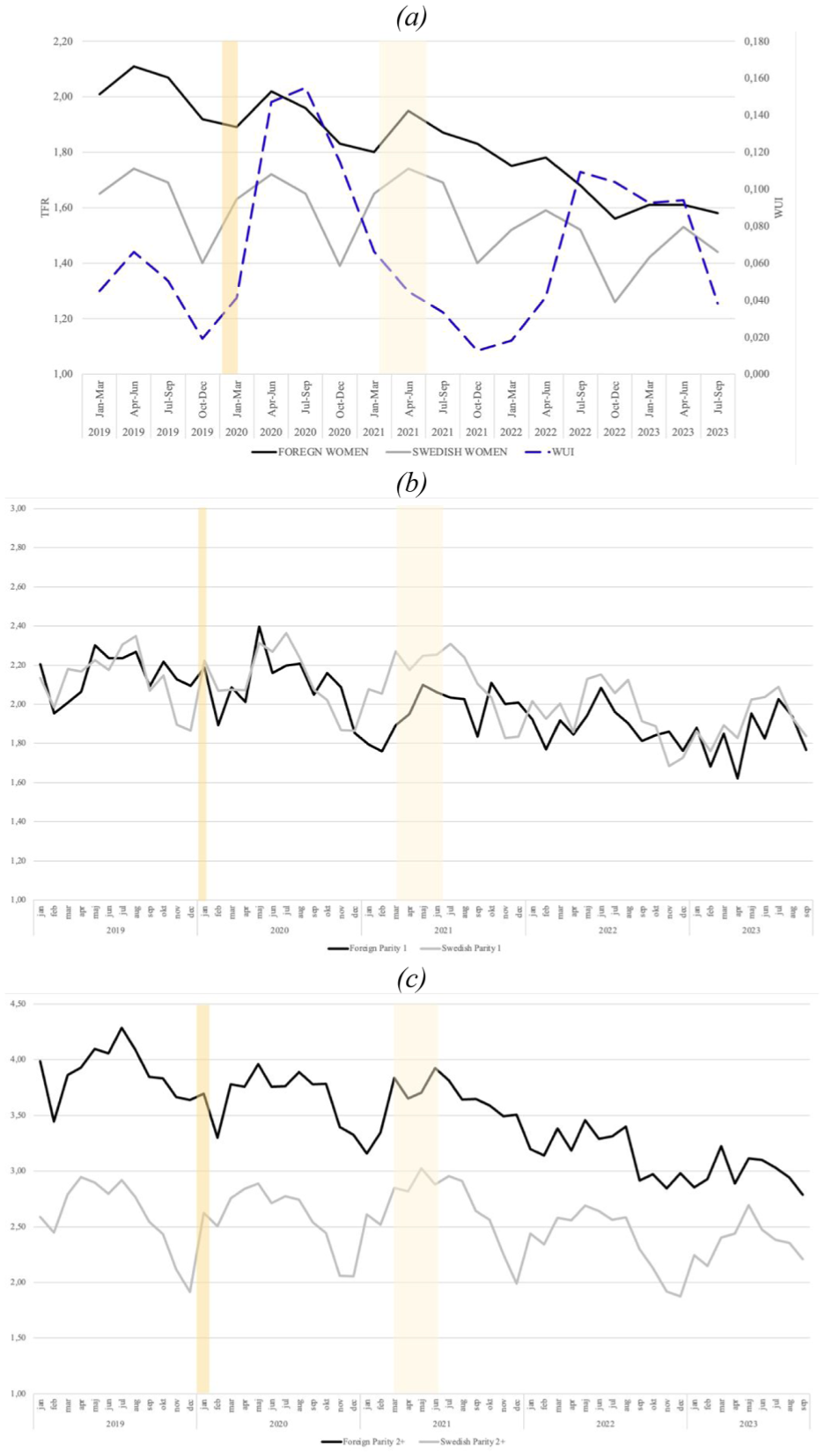
Total Fertility Rate (TFR) by quarter and first and second births per 1,000 women aged 15 to 44. 2019 to 2023 in Sweden.
Sweden represents a pivotal case for the study of the factors that may have shaped childbearing considerations during the pandemic. Although the measures to contain the pandemic were less invasive than in other countries (Esaiasson et al., 2021), especially early on during the pandemic, mortality in Sweden remained higher than in the other Nordic countries (Brandén et al., 2020; Drefahl et al., 2020; Kolk et al., 2022). Yet, despite the rising uncertainty (see Figure 1), the increasing number of deaths, and the polarized debates on restrictions, both trust in institutions and interpersonal trust increased in Sweden during the pandemic (Esaiasson et al., 2021). Few studies have examined fertility intentions during the COVID-19 pandemic (Berrington et al., 2022; Comolli, 2023; Flynn et al., 2021; Luppi et al., 2020; Naya et al., 2021). To our knowledge, no study has explored these differences based on migration background in the European context. In the US, research indicates a notable decline in fertility desires among Black and Hispanic women compared to White women shortly after the pandemic's onset (Koenig et al., 2022). This phenomenon is largely attributed to the disproportionate socioeconomic disadvantages and intensified economic hardships these groups encountered during the health crisis (Lin et al., 2021; Naya et al., 2021; Wilde et al., 2020). Additionally, research by Yang and Kao (2024) highlights a noticeable disparity, with White individuals displaying a greater likelihood of preserving their pre-pandemic fertility plans than their Black and Hispanic counterparts, underscoring the multi-faceted influence of COVID-19 across different communities.
Research Questions and Hypotheses
Against this background, this study aims to investigate the relationship between the perceived influence of the COVID-19 pandemic on several domains (financial, working, relational, and wellbeing) and short-term fertility intentions among migrants and natives in Sweden. More specifically, the paper aims to, first, compare the different subjective perceptions of the effects of the pandemic (past impact and future concerns) among migrant and native-born individuals. Second, the study investigates whether and how such subjective perceptions of the pandemic shaped short-term fertility intentions differently according to migrant background.
We focus on short-term fertility intentions because their role is pivotal in understanding the nuances of modern fertility patterns. Given the relatively low prevalence of unintended pregnancies in Sweden (the 2015–2019 annual average was around 36 per 1,000 women aged 15 to 49; Bearak et al., 2022), short-term fertility intentions represent an indicative predictor of future fertility behaviours (Ajzen 1991; Rossier & Bernardi 2009; Schoen et al., 1999; Testa, 2014). Moreover, in light of the continuing fertility declines witnessed in Sweden from the year 2022 onward (Figure 1), analysing the 2021 childbearing intentions for the subsequent 3 years offers valuable insights.
To the extent that the apprehension caused by the pandemic has been perceived differently by different social groups, the effect on fertility intentions could also be heterogeneous. However, most likely due to the lack of data, the literature on the impact of COVID-19 on fertility intentions is scarce, and, to our knowledge, no study so far has investigated the consequences by migrant background.
As mentioned, in Sweden, migrant men and women have been objectively more adversely affected by the economic, social, and health impacts of the COVID-19 crisis compared to natives. As a consequence, we hypothesise, first, that migrants in Sweden were also generally more concerned than natives about global epidemics (H1a). Relatedly, we hypothesise that, more than for natives, migrants’ subjective perception of their financial, working, relational, and wellbeing conditions had worsened compared to before the pandemic (H1b). Further, because fertility and fertility intentions decrease with economic constraints and uncertainty (Fiori et al., 2014), which are common challenges faced by migrants, we posit that such worries about future epidemics (H2a) and negative perceptions of the pandemic’s impact (H2b) play a more significant role in depressing short-term fertility intentions among migrants than among native Swedes.
Data and Method
To fulfill our objectives, we resort to the Generations and Gender Survey (GGS) data from Sweden which allows us to investigate differences across respondents’ migration backgrounds and at the same time provides insights into which factors may have shaped fertility decisions during the pandemic. The data collection has been approved by the Ethical Review Authority and the respondents gave consent before starting the interviews. We use the Swedish GGS 2021, which collected data during early summer 2021. Data collection therefore took place during the second year of the pandemic, at the time of declining mortality and the beginning of the first vaccination campaign (Neyer et al., 2023), but when restrictions were still in place. We investigate the association between pandemic concerns and the perceived impact of the pandemic on financial, working, relational, and wellbeing conditions, and migrants’ and natives’ intention to have a/another child during the following 3 years. Notably, Figure 1 shows that at the time of data collection, uncertainty was rather low, although not yet at its minimum since the onset of the pandemic, suggesting that our findings are not attributable to the initial, very temporary, and short-lived spike in uncertainty.
The Swedish GGS 2021 is representative of the Swedish population and combines cross-sectional with retrospective longitudinal information. The sample for the Swedish GGS2021 was randomly drawn from the Swedish national population register, targeting individuals aged 18 to 59. A total of 30,000 individuals were invited to participate, and data collection was conducted online, with an optional paper-based survey provided to non-respondents after the first reminder. Participants who did not respond initially were sent up to three reminders, which included the paper survey with the first and third reminders. The final response rate was 27%, amounting to 8,082 participants. The survey’s overall response rate was lower than expected but still higher than in many other countries participating in the Generations and Gender Programme, despite the absence of financial incentives. The linkage of the survey with register data provided a means of supplementing missing or sensitive information (e.g., demographic events and income), minimising non-response items on these variables (Neyer et al. 2023), and providing retrospective and prospective insights into demographic, employment, and familial events, enriching its longitudinal nature.
We selected couples in which the woman is of childbearing age (18–44 years old) and dropped observations for which the respondent or their partner cannot have children or if they are already pregnant during the interview or when a male respondent had a male partner, resulting in a final sample of 2,786 respondents (2,123 Swedish-born and 663 migrants).
All rounds of the GGS serve as optimal instruments to explore the causes and consequences of changes in family and fertility dynamics. However, the Swedish GGS 2021 also incorporates a novel sub-module aimed at examining uncertainties and resilience, which includes inquiries concerning the perceived effect of the COVID-19 pandemic and about more general uncertainty linked to global pandemics (Andersson et al., 2020). This inclusion allows us to explore the correlation between perceived uncertainties, the perceived impact of the pandemic, and fertility intentions.
The dependent variable is operationalised based on the question about short-term fertility intentions: ‘Do you plan to have (more) children in the upcoming 3 years?’ (with four possible responses: definitely not, probably not, probably yes, and definitely yes). In addition, we recorded as ‘definitely yes’ the positive responses of respondents to the question, ‘Are you (and your current partner) currently attempting to conceive?’. This interpretation assumes that the terms ‘currently’ and ‘now’ refer to intentions spanning a timeframe of up to 3 years, rather than indicating actual pregnancies or children that have already occurred, as suggested by Neyer et al. (2022).
Our principal explanatory variable is Country of Birth, categorised as ‘Swedish native’, ‘European migrant’, and ‘migrant born elsewhere’.
We draw our additional independent variables from the newly implemented modules of the GGS 2021. The modules focus on perceived global uncertainties and on the effect of the COVID-19 pandemic on individuals’ lives compared to the period immediately preceding the pandemic (Andersson et al., 2020, 2021). First, we consider the question, ‘Considering the future, how much do the following issues concern you?’, and among the list of potentially worrying items assessed in the survey we analyse the answers to the item ‘Global epidemics’. The questionnaire offers, as possible responses: very worrying, somewhat worrying, not particularly worrying, or not at all worrying, we further categorise this variable into worrying versus not worrying. Second, we consider the question, ‘When comparing your present circumstances to those just before the emergence of COVID-19 in March 2020, would you say the subsequent aspects of your life have improved, worsened, or remained the same?’ The assessed life aspects are the following: (1) sense of financial security, (2) mental well-being, (3) relationships with friends and family, and (4) satisfaction with work situation.
It is important to note that both the perception of the effect of the pandemic and fertility intentions may depend on individual characteristics beyond migration background. Factors such as demographic traits, socioeconomic status, and parity can influence both variables. In our analytical models, we incorporate a set of control variables to account for these potential confounders.
Timing and preferences of having a/another child could be different for men and women (Begall & Mills, 2011) and the impact of the pandemic on reproductive intentions may differ across gender as motherhood and fatherhood have different consequences for women and men (Begall & Mills, 2011; Berrington & Pattaro, 2014). Women, in comparison to men, experienced additional burdens due to COVID-19 in many aspects of household life, like extra childcare (Berrington et al., 2022; Voicu & Bădoi, 2021).
Besides gender, fertility intentions may differ across parities (Fahlén & Oláh, 2018; Fiori et al., 2013; Mussino et al., 2023). The transition to parenthood is particularly time-intensive and financially demanding, and it entails a life-changing decision (Kreyenfeld, 2021). In addition, different parity intentions may respond differently to the domains of the pandemic that were investigated. Even more than higher parities, first births tend to be postponed in response to economic uncertainty (Comolli 2017; Sobotka et al., 2011). In contrast, the sudden and prolonged cut to the outsourcing of family care services during the pandemic disproportionally affected parents of small children (Hipp & Bünning 2021; Steiber et al., 2021), and mothers even more (Collins et al., 2021; Cook & Grimshaw, 2021).
The influence of age on fertility intentions and decisions is extensively documented in existing literature (Delbaere et al., 2020; Mynarska, 2010). Generally, younger individuals possess greater flexibility to modify their fertility intentions in the face of alterations and uncertainties compared to their older counterparts (Berrington et al., 2022). In addition, research has shown variations in fertility intentions based on education level (Carlsson, 2023; Fahlén & Oláh, 2018; Mussino et al., 2021). As a result, all statistical analyses account for men’s and women’s age (and age squared) and education level (i.e., primary or low secondary, upper secondary, and tertiary education).
All respondents in our analytical sample are partnered at the interview, however, previous research shows that while childbirth for native Swedes often precedes marriage (Fahlén & Oláh, 2018), this is usually not the case for migrants (Carlsson, 2023). Hence, we control for partnership status (i.e., being married, cohabiting, or in a non-cohabiting relationship).
Theoretical arguments and empirical evidence show that economic and labour market instability are important factors explaining the postponement of family formation in contemporary society (Alderotti et al., 2023; Comolli, 2023; Kreyenfeld & Andersson 2014). Numerous studies have highlighted employment status as a key factor influencing short-term fertility intentions. For example, they've found that unstable employment conditions influence decisions about both initiating a family and expanding it with additional children (Fiori et al., 2013; Novelli et al., 2021; Testa & Basten, 2014). Hence, we control for employment status (i.e., being employed (includes employed and self-employed), student, or other, where ‘other’ includes unemployment, parental leave, and other). The distribution of all our controls is presented in Supplemental Table A1.
Our analytical strategy begins with an examination of the bivariate associations between migrant background and short-term fertility intentions, as well as reported changes in various domains (a–d) and general concerns about the pandemic. Next, we employ a stepwise multivariate approach. Consistent with prior research (see Thomson & Brandreth, 1995, and Billingsley & Ferrarini, 2014, for discussion), we treat the four potential responses about fertility intentions as interval measures. This implies that we interpret the intention as a continuum that spans from ‘definitely no’ to ‘definitely yes’. Accordingly, OLS linear models are appropriate. As shown in Figure 1, actual fertility behaviour in the aftermath of the pandemic differed across parities, time, and social groups. To account for these variations, in all models – including Model 0 – we control for gender and parity (childless vs. parent). Model 1 includes controls for all independent variables cited above. In Model 2 (a–e), we explore interactions between migrant background and the impacts of the pandemic across five domains: Model 2a: sense of financial security; Model 2b: mental well-being; Model 2c: relationships with friends and family; Model 2d: satisfaction with work situation; Model 2e: concerns about the global pandemic.
Confidence intervals are computed applying the method established by Goldstein and Healy (1995), which ensures an average 5% level for type I errors in pairwise comparisons of a collection of means (i.e., with a confidence level of 83.5%). And results are presented as predicted childbearing intentions. Due to the small migrant sample size, we did not stratify the analyses by groups; yet, for the sake of completeness, supplementary analyses of the paper include models by gender and parity (first vs. second or higher). We conducted several robustness checks to evaluate model fit. To address potential multicollinearity, we performed a variance inflation factor (VIF) analysis. Apart from the expected multicollinearity between age and age squared, no other indications of multicollinearity were identified. Furthermore, we estimated the models with and without robust standard errors and observed no significant differences in the results. To assess the impact of influential observations, we used Cook's Distance and leverage measures. The estimates for our main independent variable of interest remained stable after excluding high-leverage and/or influential observations.
Results
Bivariate Analysis
Descriptive analyses reveal, as previous research does, a greater propensity to report positive short-term fertility intentions among migrants coming from elsewhere compared to European migrants and natives in Sweden in 2021 (Figure 2). This difference is primarily driven by a more positive intention to have a first child, except for women born elsewhere who also display a relatively high share of intending to continue childbearing with a second- or higher-order birth (refer to Supplemental Figure A1).

Natives’ and migrants’ short-term fertility intentions in Sweden in 2021.
Notwithstanding, more frequently than natives and other Europeans, migrants from elsewhere report a decline compared to before the pandemic (Figure 3, panels a–d) in work satisfaction (47% vs. 40% and 39%) and an even greater decline in financial security (45% vs. 22% and 22%). Migrants from elsewhere also report worsened well-being compared to natives, like European migrants. They also show worse relationships compared to natives (36% vs. 31%) and European migrants (25%). Additionally, migrants exhibit greater overall concerns about the future impact of the pandemic than natives, with an almost double share of European migrants reporting being very worried about future global epidemics compared to natives (Figure 3, panel e).

Natives’ and migrants’ reported changes from before the pandemic in different domains (a–d) and natives’ and migrants’ concerns regarding the pandemic (e): (a) Financial security; (b) Mental wellbeing; (c) Relationship satisfaction; (d) Work satisfaction; (e) Concerns about the pandemic.
Multivariate Analysis
Table 1 displays the coefficients for Model 0, which adjusts only for age (and age squared), gender, and parity, and Model 1, which further adjusts for educational attainment, partnership status, and employment. In both models, especially after controlling for socioeconomic status factors, having a migrant background is positively associated with the intent to have a(nother) child within the next 3 years. Not surprisingly, being childless, having a stable partnership, and in employment are all associated with more positive intentions.
Linear Models of Childbearing Intentions in the Next 3 years. Sweden, 2021.

Source. Elaboration by the authors based on GGS 2021.
Note. In Models 2 the impact of the pandemic refers to: (a) sense of financial security, (b) mental wellbeing, (c) relationships with friends and family, and (d) satisfaction with the work situation. Model 2e refers to concerns about the global pandemic. Missing categories are not shown.
To understand how perceptions of the pandemic are associated with short-term fertility intentions differently for migrants than for native Swedes, we interacted the respondents' country of origin with the perceived pandemic consequences (in the various domains) and with the perceived global uncertainty (Models 2a–e). Each model labelled as Model 2 (a, b, c, d, e) introduces one explanatory variable at a time about perceived global uncertainty and the consequences of the pandemic, in interaction with the country of birth variable. All models are adjusted for gender, age (and age squared), parity, education, employment status, and type of partnership. To facilitate interpretation, Figure 4a to 4e present predicted childbearing intentions by migration background and pandemic impact derived from Models 2a–e in Table 1.

Predicted childbearing intentions in the next 3 years by migrant background on different domains (a–d) and Natives’ and Migrants’ concerns regarding the pandemic (e): (a) Financial security; (b) Mental wellbeing; (c) Relationship satisfaction; (d) Work satisfaction; (e) Concerns about the pandemic.
The findings from Figures 4a to 4d confirm a strong link between migrant status and fertility intentions, with migrants from elsewhere exhibiting higher short-term fertility intentions across all categories of pandemic impact in any domain. Interestingly, the perceived pandemic’s effect appears to be relatively weakly associated with childbearing intentions among both natives and migrants in Sweden. There are, however, a few exceptions to the weak correlation: among natives, a perceived improvement in relationships (family and friends) is associated with more positive intentions to have a child in the next 3 years, and perceived worsened mental wellbeing is related to more negative fertility intentions (Models 2b–2c). Among European migrants, those who perceive their financial security and their work satisfaction as unchanged display a significantly higher intention to have a child in the next 3 years relative to both European migrants who report deteriorated and improved circumstances (Models 2a and d). For the group of elsewhere migrants, despite the wide confidence intervals, we find that worsened conditions during the pandemic tend to be associated with more negative fertility intentions relative to unchanged or improved circumstances. The differences in both migrant groups seem more pronounced for the financial and work domains rather than for the wellbeing and relationship domains, which, in contrast, seemed more consequential for childbearing intentions for the Swedish natives. Finally, Model 2e in Table 1 and Figure 4e suggest that being worried about the pandemic is positively linked to future fertility planning for migrants coming from elsewhere as opposed to those who report being ‘not particularly’ worried. In contrast, for natives and European migrants, the absence of worry is positively related to childbirth intentions.
Patterns across gender are very similar (see Figures A2 and A3 in the Supplemental), with small significant differences only for European women. Among the latter, those who saw their wellbeing and work satisfaction improved during the pandemic report lower fertility intentions compared to those with worsened conditions. However, among men, elsewhere migrants who reported worsened relationships during the pandemic tend to report lower childbearing intentions than those who were not affected. In addition, a few parity-specific associations emerge, although the sample size, especially for the migrants’ group, becomes too small to draw definite conclusions (Supplemental Figures A4 and A5). However, it is worth mentioning that when looking at elsewhere childless migrants, a strong and significant negative association with perceived changes in relationship satisfaction appears; while among elsewhere migrant parents, improved wellbeing was positively associated with fertility intentions. It is worth keeping in mind that, despite introducing some more restrictive hygiene rules, kindergartens did not close in Sweden, unlike in other countries. This is likely one of the reasons why, differently from previous studies in other contexts, we do not find strong parity differences here.
In summary, on the one hand, the analysis indicates that migrants, particularly those coming from outside Europe (elsewhere), perceived a greater decline in financial security, mental wellbeing, and work satisfaction compared to natives. Yet, on the other hand, our findings point to a more complex association between migrants’ deteriorated circumstances and their intentions to have a(nother) child. For European migrants, short-term fertility intentions remain more optimistic when they report having been unaffected by the pandemic compared to when they report either worsened or improved situations. For elsewhere migrants, childbearing intentions remain higher among those who report an unchanged or improved situation, compared to those whose conditions worsened. Moreover, although elsewhere migrants report being more concerned about future pandemics, this worry paradoxically plays a positive role in their future fertility planning, as opposed to the negative role played by concerns about future epidemics for natives and European migrants.
Overall, our findings reflect more positive short-term fertility intentions among elsewhere migrants compared to natives and European migrants. Yet, given the greater adversity faced by migrants from outside Europe during the pandemic, we anticipate a significant drop when comparing the 2021 data with pre-pandemic childbearing intentions. We can use the first round of the GGS, a survey with identical questions on intentions that was collected a decade earlier, and fieldwork conducted between April 2012 and April 2013 (Thomson, 2015), to contextualise our results within a long-term comparison of migrants’ and natives’ childbearing intentions across time, both before and after the pandemic.
Figure 5 illustrates the predicted fertility intentions over the next three years for migrants and natives in 2012 and 2021. As hypothesised, migrants show higher fertility intentions than natives in both waves, but there is a considerable decline in the most recent wave and a steeper decline among migrants (in particular, European) compared to natives.

Predicted childbearing intentions in the next three years, comparing 2012 and 2021.
Nonetheless, the strong decrease in fertility intentions cannot be solely attributed to the COVID-19 pandemic. One possible explanation for the observed trends is the change in the composition of migrants, particularly regarding their countries of origin, as detailed in Supplemental Table A2. To ensure the robustness of our findings, we also analysed the data by macro area of origin (see Figure 6), this was not possible when looking only at the 2021 wave, because of the small sample size. This analysis revealed that while the fertility intentions of most migrant groups were higher than those of natives in 2012, this trend does not hold for many migrant groups in 2021. Moreover, even in the cases where migrants' fertility intentions remained higher in 2021 than those of natives, such as was the case for migrants from the Middle East and North Africa (MENA), the decline between their childbearing intentions in 2012 and 2021 is notably substantial.
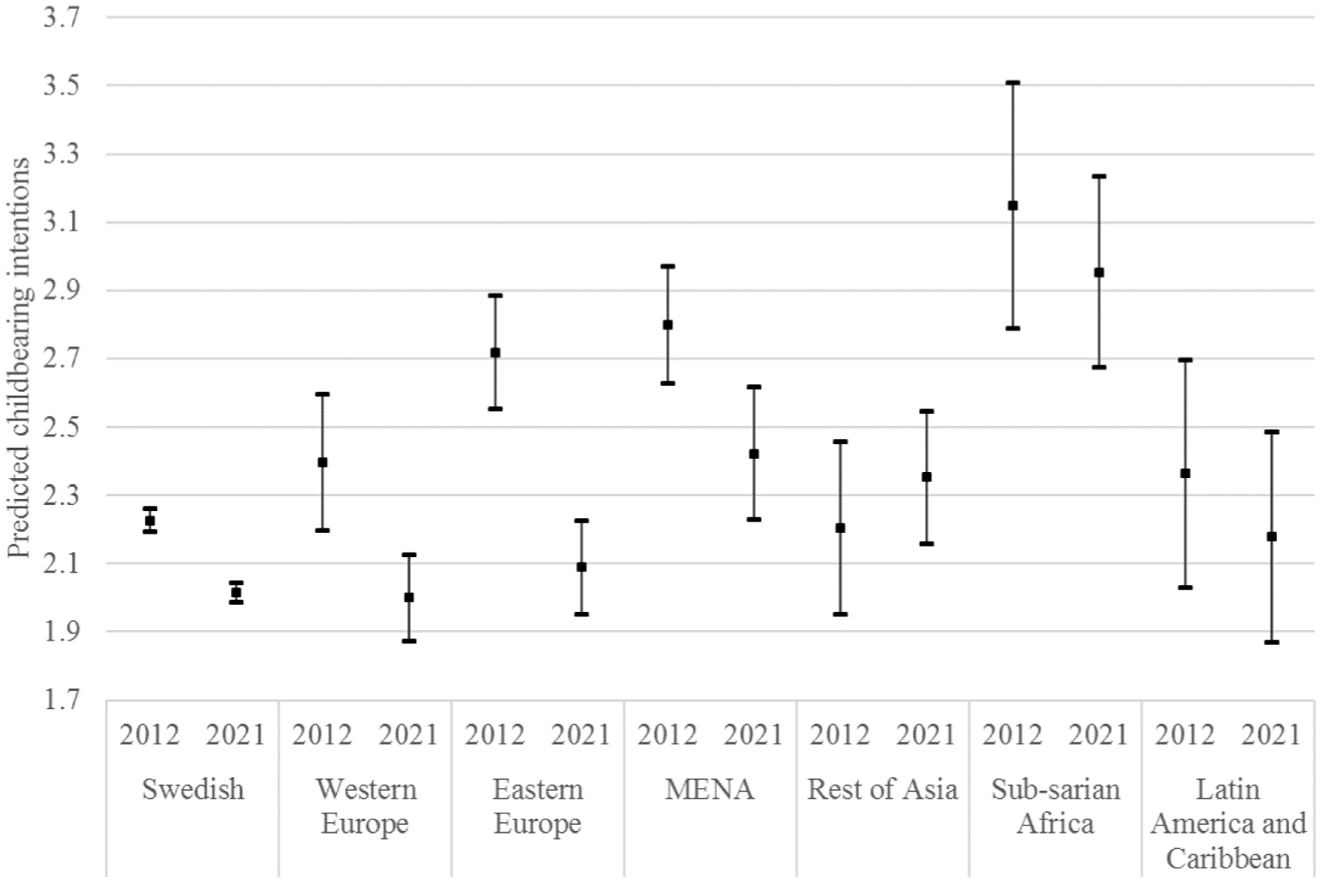
Predicted childbearing intentions in the next three years, comparing 2012 and 2021.
Conclusion
The aim of the study was to illustrate the heterogeneity in the perceived impact of the COVID-19 pandemic on several life domains between Swedish natives and migrants (European vs. born elsewhere) and to investigate the relationship between such perceived impact and short-term childbearing intentions by migration background. We expected that a more negative evaluation of the pandemic’s impact on respondents’ wellbeing, relations, financial and working conditions, and greater concerns about future pandemics would be negatively associated with fertility intentions, and, because of their greater vulnerability, this effect would be even stronger for migrants than for Swedish natives.
We found the expected association in relation to worsened work conditions among migrants in general and to financial conditions among European migrants, while Swedish natives’ fertility intentions during the pandemic seemed to be more strongly associated with wellbeing and relationship quality rather than financial or work-related concerns. Yet, among European migrants, we found that improved financial or working conditions also negatively correlate with fertility intentions. The latter finding is presumably explained by the fact that more than in other migration background groups, a significant share of European migrants in Sweden is high-skilled and less family-oriented. Among them, those who have experienced improved job conditions during the pandemic are probably the least likely to express positive childbearing intentions. Finally, we found a ‘now or never’ psychological effect for migrants coming from elsewhere about concerns for future pandemics: worries about the latter encourage short-term childbearing intentions, net of current social and economic conditions. This suggests that perceived uncertainty about future risks that are out of one’s own control (e.g. pandemics) compresses decision-making timelines around major life events. This finding aligns with research on crisis fertility following natural disasters (Nobles et al., 2015) and broader migration literature documenting how legal precarity and uncertain futures accelerate life course transitions among immigrant populations (Lounela 2023, Molinari et al. 2024). The urgency appears driven by concerns that circumstances may deteriorate, making childbearing more challenging or impossible later, and probably leading to a more fatalistic view of family formation among certain migrant groups.
Discussion
Our study illustrates the complexity of the consequences of the COVID-19 pandemic on reproductive decisions. Our findings show that different domains affected by the COVID-19 pandemic relate to fertility intentions in different ways depending on individuals’ migration background. Our results are partially compatible with compositional effects—if, for instance, migrants with particularly low fertility intentions (coming from particularly low fertility settings) were also the individuals reporting worsened work conditions—but we believe that changing migrant composition during the pandemic does not entirely explain our findings. We know from existing research, including Carlsson (2018), that migrants in Sweden have higher short-term fertility intentions than natives. Consequently, it is unsurprising that in 2021, short-term fertility intentions among migrants remained higher than those of natives. However, our analysis of the two Generations and Gender Survey (GGS) rounds reveals a more pronounced decline in fertility intentions among migrants compared to natives. This decline is not entirely attributable to changes in the composition by country of origin of migrants in Sweden, because our results show similarly negative trends in fertility intentions across different origin groups. However, we cannot argue either that this decline is entirely due to the uncertainty brought about by the COVID-19 pandemic. We could, in fact, additionally speculate that part of the observed decline in childbearing intentions may be due to a change in the composition of the migrant population by duration of stay in Sweden. Several mechanisms could explain this compositional shift and its connection to duration of stay patterns. First, travel restrictions and border closures may have differentially affected migration flows by origin region, depending on geographic proximity and existing migration corridors. This could have systematically altered the origin composition in ways that affect aggregate fertility intentions, given that migrants from different countries arrive with varying fertility preferences shaped by their home country’s demographic contexts.
Second, COVID-19 restrictions likely changed not only migration volume but also its composition by migration type. Family reunification cases, which often involve individuals with immediate childbearing plans, may have faced different processing delays compared to labour migrants or asylum seekers. The economic uncertainty generated by the pandemic may have also made migration more selective of individuals with higher human capital or stronger social networks, characteristics that could correlate with specific fertility timing preferences.
Third, literature on migrant fertility points out that for newly arrived migrants, the move could be connected to the aim of forming a family and consequently with the decision to have a child (Interrelation see Mussino & Strozza, 2012). However, due to COVID-19 restrictions, inflows of new migrants were limited via travel bans and other international policies, resulting in a lower number of arrivals. We could then expect the share of new migrants to be lower in 2021. This shift toward fewer newly arrived migrants is significant because previous literature shows that migrants who reside for a longer time in the country tend to adapt their fertility preferences to more closely resemble those of natives, resulting in lower fertility intentions (Adaptation; see Andersson, 2004).
This duration-based compositional shift matters because adaptation theory suggests that longer-residing migrants gradually converge toward native fertility patterns through changing economic circumstances, evolving partnership dynamics, and shifting normative frameworks about ideal family size and timing. The absence of fresh arrivals with potentially higher fertility intentions could thus mechanically reduce observed fertility intentions among the migrant population, independent of any pandemic-induced preference changes.
Additionally, the compositional shifts may reflect changes in legal status distribution, as temporary migrants (such as students or seasonal workers) were particularly affected by border closures, potentially leaving a higher proportion of permanent residents in the 2021 sample. Since legal precarity is associated with both fertility timing decisions and vulnerability to economic shocks, this compositional change could interact with pandemic-induced uncertainty in complex ways.
While these compositional hypotheses remain largely speculative due to our data limitations on migration histories and legal status, our finding of declining fertility intentions across different origin groups suggests that compositional changes alone cannot fully account for the observed patterns, pointing to genuine pandemic-related effects on reproductive decision-making among migrants. Future research with detailed migration histories, legal status information, and migration type data would be valuable for more precisely parsing these compositional effects from direct pandemic impacts.
Additionally, our study is limited by 1) the fact that it relies on respondents’ memory and subjective perceptions when answering questions that required comparisons to pre-pandemic circumstances. Such recall-based responses are susceptible to biases, potentially influencing the accuracy of the findings. 2) The study also lacks information regarding infection status among family members or at the local level. Such information could have offered deeper insights into the health impact of the COVID-19 pandemic on daily life and fertility intentions. 3) The cross-sectional design of our study prevents us from establishing causal relationships between the pandemic's perceived impact and changes in fertility intentions. While our findings reveal associations between changes in various domains (wellbeing, relational, working, and financial) and fertility intentions, we cannot determine the direction of causality or rule out the possibility of reverse causation. Future longitudinal studies would be needed to better understand the temporal sequence and causal mechanisms underlying these relationships.
Finally, for the sake of simplicity and clarity, we made a few analytical decisions that may lead to overlooking additional mechanisms through which the pandemic may have affected reproductive decisions. First, we recorded the answers to the short-term fertility intentions question ‘currently attempting to conceive’ as ‘definitely yes’. This approach assumes that respondents interpret ‘currently’ to be in alignment with the three-year timeframe specified in the survey, which might not always reflect their true intentions. Second, by focusing exclusively on partnered individuals, the study excludes non-partnered individuals, a demographic whose childbearing intentions may have also been influenced by the pandemic. Non-partnered individuals might hold intentions shaped by factors such as economic uncertainty or health-related fears, and their exclusion limits the generalisability of our findings.
Despite these challenges, our findings align with the existing literature regarding the negative association between financial and labour market insecurity and fertility intentions in general (Fiori et al., 2018; Novelli et al., 2021; Testa & Basten, 2014), and the one specific to the COVID-19 epidemics (Arpino et al., 2021; Comolli, 2023; Luppi et al., 2020). Yet, our study brings about new insights into the literature and contributes significantly to the understanding of COVID-19's perceived impact on fertility. We observed that improvements in personal relationships are associated with increased fertility intentions among natives. The recommendations to stay home during the pandemic might have helped natives improve their relationships, which in turn could have made them more interested in having children. In contrast, couples who did not see improvements in their relationships did not show a corresponding increase in fertility intentions. Furthermore, European migrants whose job satisfaction remained stable also exhibited significantly higher fertility intentions in the short term, suggesting a nuanced interaction between job satisfaction and fertility intentions among this group.
Finally, our results do not rule out the possibility that the pandemic and the uncertainty it generated affected actual fertility, namely the realisation of such childbearing intentions, as previous economic crises did (Alderotti et al., 2023). The COVID-19 pandemic may have affected the actual or perceived behavioural controls that enable individuals to realise their fertility plans (Ajzen & Klobas, 2013). For instance, some studies have argued that the COVID-19 pandemic may have affected biological factors (e.g., sperm quality) (Abdelhamid et al., 2023; Montano et al., 2021; Yuan et al., 2025). This would explain in part why intentions are higher among migrants, but TFR grew only among natives. In conclusion, our study sheds light on the intricate dynamics between migration status, relationship satisfaction, job satisfaction, and fertility intentions amidst the COVID-19 pandemic, providing valuable insights for policymakers and researchers in demography.
Supplemental Material
sj-docx-1-sgo-10.1177_21582440251389549 – Supplemental material for Migrants’ and Natives’ Childbearing Intentions in Sweden During the COVID-19 Pandemic
Supplemental material, sj-docx-1-sgo-10.1177_21582440251389549 for Migrants’ and Natives’ Childbearing Intentions in Sweden During the COVID-19 Pandemic by Eleonora Mussino and Chiara Ludovica Comolli in SAGE Open
Footnotes
Acknowledgements
We are thankful for the comments and discussion during the workshops ‘Fertility and Family Dynamics in Migrant and Minority Groups: Current Research and New Approaches in Times of Crises’, Wiesbaden 2023.

Consent to Participate
Respondents gave written consent before starting interviews. The data collection has been approved by the Swedish Ethical Review Authority (dnr 2020-05891).
Author Contributions
EM initiated the project and ran the analysis. Both authors drafted the manuscript together.
Funding
The authors disclosed receipt of the following financial support for the research, authorship, and/or publication of this article: The authors are grateful for financial support from the Swedish Research Council for Health, Working Life, and Welfare (FORTE), grant numbers: 2018-00310, 2023-00438. The authors also acknowledge funding from the Italian Ministry of Universities and Research pursuant to Decree No. 1236 of 01/08/2023 – Italian Science Fund – FIS 2 Call (Funding Admission Decree No. 23178 of 10/12/2024) for the project SO-UNFER (MUR code: FIS-2023-03148; CUP: J53C24004290001).
Declaration of Conflicting Interests
The authors declared no potential conflicts of interest with respect to the research, authorship, and/or publication of this article.
Data Availability Statement
Data are available through the Generation and Gender Programme data portal.
Supplemental Material
Supplemental material for this article is available online.
References
Supplementary Material
Please find the following supplemental material available below.
For Open Access articles published under a Creative Commons License, all supplemental material carries the same license as the article it is associated with.
For non-Open Access articles published, all supplemental material carries a non-exclusive license, and permission requests for re-use of supplemental material or any part of supplemental material shall be sent directly to the copyright owner as specified in the copyright notice associated with the article.
