




Abstract
This study explores Chinese EFL university teachers’ beliefs regarding the integration of Large Language Models (LLMs) into language education, drawing on the Expectancy-Value-Cost (EVC) theory. A total of 298 valid responses were collected via an online questionnaire, and Latent Profile Analysis (LPA) was employed to identify distinct belief profiles. The analysis revealed three teacher profiles: (1) Low EVC, (2) Medium EVC, and (3) High EVC. Teachers in the High EVC group reported strong expectancy beliefs and perceived value in using LLMs, despite recognizing potential costs, while those in the Low EVC group expressed limited confidence and high perceived barriers. Significant differences were also found across school type, LLM experience, class size, teaching mode, IT infrastructure, and accessibility of LLM use. The study offers theoretical insights by applying EVC theory to explain technology adoption among language educators and suggests practical implications for educational policy and teacher training. Promoting institutional support, improving IT infrastructure, and offering targeted professional development are essential for fostering positive teacher beliefs and successful LLM integration in language education.
Introduction
Recently, the emergence of large language models (LLMs) has revolutionized the AI-technology application, offering unprecedented prospects for its capabilities in various fields, especially in education and educational research (Jeon & Lee, 2023). In the field of EFL education among Chinese universities, the potential of LLMs to transform traditional teaching-learning practices has received increasing attention, which calls for a holistic investigation regarding the forefront of such change (Kasneci et al., 2023; Mageira et al., 2022). Against this backdrop, exploring the beliefs of Chinese EFL university teachers on integrating LLMs into language education is crucial for the following reasons:
Firstly, it paves the way for pedagogical innovation and efficiency by uncovering how LLMs can enhance language education practice, such as teaching methodologies, personalize learning experiences, and language acquisition efficiency. Teachers’ perspectives are vital in identifying the benefits and challenges of technology integration, which can introduce more effective and engaging education strategies (Wang et al., 2023). Furthermore, this research highlights the importance of teacher professional development and digital literacy in the AI era. It can also reveal the impact of language teachers’ preparedness, required training programs, necessary resources, and digital literacy to effectively promote LLMs and other innovative technology adoption (Spante et al., 2018). Lastly, understanding teachers’ beliefs can significantly influence educational policy and curriculum design. By doing this, we can ensure that LLMs and other technology integration can meet actual educational goals, standards, or students’ needs (Fives & Buehl, 2016). To sum, these dimensions emphasize the needs for understanding teachers’ beliefs in the digitalizing-trend of language education, which also advocates for a collaborative approach to integrating LLMs into EFL education.
This study employs a latent profile analysis (LPA) to explore Chinese EFL university teachers’ beliefs on the integration of LLMs into language education. Adopting LPA, an individual-centered approach, this study categorizes Chinese EFL university teachers based on their responses to reveal distinct belief-profiles considering LLMs integration.
The second innovation lies in the focus on LLMs, which marked as significant departure from traditional educational tools and methodologies. By examining teachers’ beliefs on these advanced models, this study can not only contribute to the field of technology integration in language education but also provide in-depth insights into the hidden barriers and facilitators of such innovative tools for the educators, policymakers, and curriculum developers.
Literature Review
LLMs in Language Education Field
Large Language Models (LLMs), such as ChatGPT, Claude, and Gemini, have exerted a transformative influence on the field of language education (Wang et al., 2025). These models offer learners and educators access to personalized learning experiences, real-time feedback, and adaptive instructional pathways that align with individual learning trajectories (Kasneci et al., 2023; Mageira et al., 2022; Yan et al., 2024). Such capabilities mark a substantial advancement over earlier forms of chatbot-based educational tools, which—while innovative in their own right—were largely constrained by rule-based systems and pre-programmed responses.
Prior to the emergence of LLMs, a substantial body of research had already examined the use of chatbot applications in language education. These studies demonstrated that even early-generation chatbots could enhance language learning through increased learner engagement, accessible conversation practice, and scaffolded interactions, despite limitations in flexibility and natural language understanding (Goda et al., 2014; Jia et al., 2012; Lin & Chang, 2020). Empirical findings from more recent investigations affirm that even these earlier systems held pedagogical promise, especially in areas such as vocabulary acquisition, pragmatic competence, and conversational fluency (Cheng & Jiang, 2020; Jeon & Lee, 2023; Kohnke et al., 2023).
The introduction of LLMs has since catalyzed a paradigm shift. Unlike their predecessors, LLMs offer human-like interactions, contextualized and adaptive language input, and the ability to generate customizable, level-appropriate learning materials (D’Mello & Graesser, 2024; Fryer et al., 2017). These affordances have been found to support not only students’ linguistic development but also their affective engagement. For instance, several studies indicate that LLMs can deliver consistent and authentic daily language exposure (Fryer et al., 2017; Namaziandost & Rezai, 2024), stimulate learners’ intrinsic motivation and interest in language learning tasks (Huang et al., 2022; Meniado et al., 2024; Wang et al., 2024a), and alleviate teacher workload by automating repetitive tasks such as error correction or feedback provision (Lin et al., 2023). Moreover, recent research has highlighted the potential of LLMs to serve as intelligent tutors or learning companions, capable of adapting to learners’ proficiency levels and supporting learner autonomy (D’Mello & Graesser, 2024; Zhang et al., 2022).
Despite these promising developments, a significant research gap remains concerning the beliefs of English as a Foreign Language (EFL) teachers regarding the integration of LLMs into language education. Teachers’ beliefs have long been recognized as a pivotal factor influencing the implementation and pedagogical use of educational technologies (Cheng et al., 2020; Er & Kim, 2017; Kim et al., 2013). In particular, in the context of rapid digitalization, understanding teachers’ perspectives is essential for assessing both the feasibility and sustainability of LLM adoption in educational settings. Investigating these beliefs can yield critical insights into factors that affect technology acceptance, instructional adaptation, and professional development in the age of artificial intelligence.
Teachers’ Beliefs on LLMs in Language Education
Teachers’ beliefs refer to their deeply held attitudes and perceptions about teaching, learning, and students’ roles in the educational process (Pajares, 1992). These beliefs serve as filters through which teachers interpret pedagogical practices, and they play a critical role in shaping instructional decisions, classroom behavior, and ultimately, student motivation and learning outcomes (Borg, 2011; Kim et al., 2013; Wang et al., 2022). Moreover, teachers’ beliefs are intricately linked to their professional identity, influencing not only how they perceive their roles and responsibilities but also their willingness to engage in professional growth and adapt to educational innovations (Heyder, 2019).
In the context of integrating LLMs within language education, there is a noticeable scarcity of research on teachers’ beliefs regarding LLMs. Previous literature primarily centered on a learner-based perspective, such as examining learners’ attitude and practice regarding LLMs (Liu & Ma, 2024; Liu et al., 2024; Xiao & Zhi, 2023), enhancing learners’ writing skills through LLMs’ real-time feedback (Algaraady & Albuhairy, 2023; Yan, 2023), and developing learners’ speaking skills (Muniandy & Selvanathan, 2024). Regarding teacher-related research, a limited number of studies have been identified (Chocarro et al., 2023). Even more concerning, most of the teacher-related research has concentrated on investigating the effectiveness or feasibility of integrating LLMs into daily teaching practice (Andujar & Spratt, 2023; Bao & Li, 2023; Mondal et al., 2023; Wang et al., 2024), which led to a dearth of literature exploring teachers’ beliefs. In sum, investigating teachers’ beliefs in the context of LLMs can provide us with valuable insights into educators’ perspectives on the use of such technologies for language education.
Given that teachers play a central role in determining how technologies are implemented in educational settings, exploring their beliefs about LLMs is both timely and necessary. Such exploration can yield valuable insights into the factors that influence teachers’ openness to technological innovation, their perceived pedagogical utility of LLMs, and the potential barriers to meaningful integration (Liu et al., 2024; Liu & Ma, 2024). Understanding these beliefs is essential not only for effective teacher training and policy development but also for ensuring that LLMs are used in ways that align with sound pedagogical principles and professional values.
Research Questions
Drawing from the previous literature, this study aims to investigate the following questions:
RQ1: What are Chinese EFL teachers’ beliefs on LLMs integration in language education?
RQ2: What distinct latent profiles can be identified among Chinese EFL university teachers’ beliefs on integrating LLMs in language education?
RQ3: What notable differences emerge among these latent groups?
Method
Research Design
This study adopted a quantitative, cross-sectional survey design to examine Chinese EFL university teachers’ beliefs about integrating LLMs into language education. Grounded in the EVC theory, the design aimed to capture patterns of belief and explore how these patterns relate to demographic and contextual factors. An online questionnaire was used to collect data, and a snowball sampling method was employed to ensure wide coverage across institutional types and regions. This design enabled a broad snapshot of current teacher perceptions within a defined time frame.
Participants
The present study centered on examining the beliefs of Chinese EFL university teachers regarding LLMs integration into language education. We employed an online-based snowball sampling method to gather diverse perspectives from the participants. This method was chosen due to the dispersed nature of the target population across different universities and regions in China, making it an effective approach for reaching a wide range of qualified respondents within a limited timeframe. The initial distribution of the survey began with EFL faculty members from three public universities located in eastern and central China, which helped initiate diverse participation across institutional contexts. From the initial pool, a total of 354 responses were received. During the data screening process, several responses were excluded for the following reasons: (1) 35 were removed due to respondents’ unfamiliarity with LLMs; (2) 10 were discarded for the failure of attention checks; (3) 11 were omitted due to the duplicated responses. As a result, the study proceeded with a final dataset comprising 298 valid responses. This sample size was consistent with established guidelines for latent profile analysis, which suggest that samples of approximately 300 are generally adequate for stable estimation when using a moderate number of indicators (Finch & Bronk, 2011; Nylund et al., 2007; Tein et al., 2013).
Table 1 presents respondents’ demographic-social characteristics. According to the results, the following characteristics were revealed: (1) A higher representation of female EFL university teachers was observed, standing at 54.7%; (2) A significant proportion of teachers had less than five years of teaching experience, indicating a relatively younger trend; (3) The majority of EFL university teachers handled class sizes of 21-50 students; (4) Though a high number of teachers (63.09%) are aware of LLMs, their integration of LLMs remained limited, signifying a notable gap between awareness and implementation.
Demographic-Social Characteristics.

Data Collection
The data for this study are gathered using an online-based snowball questionnaire, chosen for its efficiency and broad reach among EFL university teachers across China. This data collection took place from December 10, 2023, to January 3, 2024. At the beginning of the questionnaire, participants are presented with an informed consent form. This form is crucial for ensuring ethical research standards, as it outlines the study’s commitment to complete anonymity and confidentiality. Meanwhile, the form also reassures participants that their responses would be used for the present research only. All the participants can withdraw at any point without consequence.
The questionnaire is based on the work of Wozney et al. (2006). It utilized a 5-point Likert scale, ranging from Strongly Disagree to Strongly Agree, to measure various dimensions of teachers’ beliefs on integrating LLMs in language education.
Data Analysis
To align with the three research questions, a set of complementary quantitative analyses was conducted to ensure both descriptive and inferential insights into teachers’ belief patterns. Specifically, an LPA and subsequent Chi-square analysis are conducted using Mplus version 8 and SPSS version 26, respectively. This combination of statistical software tools aims at ensuring a rigorous and comprehensive examination of the EFL university teachers’ beliefs on integrating LLMs into language education.
To address RQ1, detailed information, including means, standard deviation (SD), and correlation of the sub-scale from the instruments is reported. This aims to provide a primary understanding of Chinese EFL university teachers’ beliefs on LLMs integration.
To address RQ2, an LPA is conducted. As a model-based and person-centered approach, LPA offers distinct advantages over the traditional methods. For example, it can: (1) discover unobserved heterogeneity within the sub-groups from the dataset (Wang et al., 2021). In the present context, such analysis can identify distinct patterns of Chinese EFL university teachers’ beliefs and thus group them accordingly. (2) ensure interpretability and representativeness through several model fit indices for evaluation process, such as BIC, ABIC, and AIC (Vermunt & Magidson, 2004). (3) outperform traditional linear regression while the present data violate normal distribution, linear relationships, or variance homogeneity (Magidson & Vermunt, 2002). Since LPA is particularly adept at uncovering hidden patterns within the dataset, it becomes an ideal method for the present study to explore the nuances of teachers’ beliefs on integration LLMs into language education. By adopting LPA, the respondents can be classified into distinct groups based on their responses, and thus provide a clear picture of the different belief systems and attitudes that exist.
To address RQ3, a Chi-square analysis was conducted to examine significant differences in demographic and contextual characteristics across the identified latent groups. This analysis provided insight into how background variables may influence teachers’ perspectives and adoption of LLMs in language education.
Overall, these distinct analytical strategies were selected to align with the specific nature of each research question, while remaining consistent within a unified quantitative research framework.
Instruments
The instrument employed in this study was adapted from the teacher belief scale developed by Wozney et al. (2006), based on the Expectancy-Value-Cost (EVC) theory (Vroom, 1964). This scale was chosen because it is a widely cited and theoretically grounded instrument that demonstrates strong reliability and aligns closely with the study’s focus on teachers’ beliefs about technology integration. The revised questionnaire was designed to assess Chinese EFL university teachers’ beliefs about integrating Large Language Models (LLMs) into language education. It consisted of 14 items across four dimensions: Value for Students (VS), Value for Teachers (VT), Expectancy (EP), and Cost (CT). Specifically, the scale included four items measuring perceived value for students (e.g., “LLMs motivate students to actively engage in language learning”), three items on value for teachers, three items capturing expectancy beliefs, and four items assessing perceived costs associated with LLM use. All items were rated on a 5-point Likert scale ranging from 1 (Strongly Disagree) to 5 (Strongly Agree). To ensure the reliability of the instrument, a Cronbach’s Alpha test is conducted. The result of Cronbach’s Alpha test is .910, confirming the internal consistency of the scale.
Ethical Considerations
The study protocol received approval from the authors’ institutional ethics committee. Before participation, an online information sheet described the study purpose, procedures, data use, confidentiality, and withdrawal rights; proceeding to the survey indicated informed electronic consent. Risk of harm was limited by voluntary participation, the option to skip any question or withdraw at any time without penalty, and the collection of no personally identifying information; responses were stored on encrypted, access-restricted drives. The anticipated scholarly and practical benefits (e.g., informing teacher professional development on LLM use) were considered to outweigh any potential discomfort associated with participation.
Results
RQ1: What are Chinese EFL Teachers’ Beliefs on LLMs Integration in Language Education?
Table 2 presents descriptive statistics (Means and SDs) and correlation matrix of Chinese EFL teachers’ beliefs on LLMs integration.
Descriptive Statistics and Correlation Matrix.

Note. VS = Value for Students, VT = Value for Teachers, EP = Expectancy, CT = Cost.
p < .01.
Specifically, (1) For the VS dimension, the means range from 0.702 to 0.802 with its SDs between 1.076 and 1.289. This indicates that, in average, Chinese EFL teachers perceived a moderate value of LLM integration for their students. (2) The VT dimension shows higher means which range from 4.34 to 4.45 and with SDs from 1.236 to 1.317, suggesting a strong perceived value for teachers themselves. (3) The EP dimension also displays high means (4.23 to 4.39) with similar SDs (1.204 to 1.342), which reflects positive expectations on LLM integration. (4) The CT dimension has means ranging from 3.98 to 4.25 and SDs from 1.331 to 1.445, indicating some concerns about the potential costs or challenges of LLMs integration.
Meanwhile, correlation analysis reveals significant positive relationships among all dimensions, with particularly strong correlations between VS and CT (r = .661, p < .01), and between VT and EP (r = .651, p < .01). These correlations suggest that teachers who perceive higher value in LLM integration for students and themselves also tend to have higher expectations and acknowledge the associated costs.
RQ2: What Distinct Latent Profiles can be Identified Among Chinese EFL University Teacher’s in Regarding Their Beliefs on Integrating LLMs in Language Education?
To determine the most suitable model for this study, each model’s fit is evaluated based on the following statistical criteria: (1) Akaike Information Criterion (AIC); (2) Bayesian Information Criterion (BIC); (3) Adjusted BIC (ABIC); (4) Entropy; (5) Lo-Mendell-Rubin Adjusted Likelihood Ratio Test (LMR); (6) Bootstrap Likelihood Ratio Test (BLRT). Table 3 presents the results of the statistical standards of the LPA.
Statistical Standards for Latent Profile Analysis.

Starting from the 1-class model, it shows the highest AIC, BIC, and ABIC values, suggesting it is the least fitting model. Moving to the 2-class model, there is a noticeable decrease in AIC (6067.844), BIC (6115.906), ABIC (6074.678), indicating a better fit than the 1-class model. However, the effectiveness of this model is still limited for its relatively lower Entropy value (0.749), which suggests further exploration of models with more class-size.
The 3-class model presents a more significant improvement. Compared to the 1-class and 2-class models, the AIC, BIC, and ABIC values decrease further to 5830.625, 5897.173, and 5840.089 respectively, suggesting a better fit. The entropy value for this model is high (0.866), indicating a clearer class separation. Importantly, LMR and BLRT tests show significant results, suggesting that this model is a statistically better fit than the 2-class model.
Although the 4-class model continue the trend of decreasing AIC, BIC, and ABIC values, the marginal reduction suggests diminishing returns in terms of model complexity versus fit improvement. Additionally, while the entropy remains high (0.889), the percentage distribution among the classes starts to show an imbalance, with one class representing only 3.356% of the sample.
Taking all these indicators into account, the 3-class model is finally chosen. It strikes a balance between statistical robustness and interpretability, with clearer class distinctions and a more even distribution of participants across classes (11.074%, 53.691%, and 35.235%). The 3-Class model included the following profiles: Group 1 (Low EVC group), Group 2 (Medium EVC group), and Group 3 (High EVC group). Figure 1 illustrates the mean scores among the 3-Class solution based on the raw data.

Mean scores among the 3-Class solution.
Table 4 presents the mean score of all the dimensions among the three identified groups. Group 1 (Low EVC Group), consisting of 33 participants, displays the lowest scores across all categories. This result suggests that Group 1 perceives a more cautious or skeptical stance towards the use of LLMs in language education, with the least value and expectancy and the highest relative costs.
Mean Score and Frequency across Latent Groups.
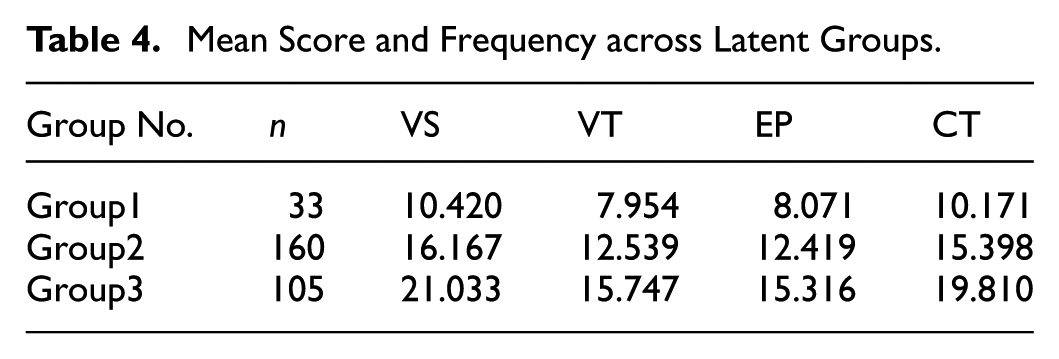
Group 2 (Medium EVC Group), the largest group with 160 participants, shows moderate scores in all dimensions. This group’s beliefs and attitudes are characterized by a balanced perspective, recognizing the benefits but also being mindful of the costs associated with the integration of LLMs in language education.
Group 3 (High EVC Group), comprising 105 participants, exhibits the highest scores across all the dimensions. The high scores in VS and VT indicate a strong belief in the value of LLMs for both students and teachers, while the high scores in EP suggest a high level of confidence in their ability to utilize these technologies effectively and receive promising outcomes. Despite recognizing the costs and efforts required, as indicated by the relatively high score in CT, this group perceives the overall benefits as outweighing these challenges.
RQ3: What Notable Differences Emerge Among These Latent Groups?
In this section, we present the results from the Chi-square analyses which explore the relationships between identified EFL university teacher groups (G1: Low EVC, G2: Medium EVC, G3: High EVC) and their demographic-social characteristics:
(1) School Type. The analysis reveal a significant variation (χ2(6) = 40.721, p < .01), which suggests that the type of educational institution (Engineering, Comprehensive, Art &Humanities, or other types of universities) significantly influences teachers’ beliefs on LLMs; (2) LLM Experience. A notable difference emerge (χ2(4) = 17.393, p < .01), which indicates that teachers’ prior experience with LLMs affects their perceptions and attitudes; (3) Class Size. The analysis reveal a significant association (χ2(4) = 14.703, p < .05), pointing to the influence of class dynamics on teachers’ views of LLM integration; (4) Teaching Mode. It shows a substantial impact (χ2(4) = 10.923, p < .05), illustrating the relationship between pedagogical preferences and attitudes towards LLMs; (5) IT Infrastructure Rating. The analysis yield significant results (χ2(8) = 19.920, p < .05), emphasizing how the quality and availability of IT resources play a crucial role in shaping teachers’ perspectives on LLMs; (6) Accessibility of LLMs use. Its influence is also significant (χ2(6) = 13.140, p < .05), suggesting that restrictions or limitations on using LLMs are important factors in determining teachers’ attitudes and beliefs.
Taking a step further, Table 5 provides an in-depth understanding of the demographic-social characteristics of the three identified groups: Group 1 (Low EVC group), Group 2 (Medium EVC group), and Group 3 (High EVC group). Details are discussed as followed:
(1) Type of University. Considering this factor, Engineering universities have a higher representation in Group 1 (45.5%) and Group 3 (34.3%). In contrast, comprehensive universities are significantly more prevalent in Group 2 (60.6%). Arts and Humanities universities show a relatively balanced distribution, with a slightly higher preference in Group 3 (27.6%). Other types of universities have minimal representation across all groups, with the lowest in Group 2 (3.8%). These variations highlight the influence of institutional focus and culture on teachers’ beliefs on LLM integration.
(2) LLM experience. A noticeable trend emerges with Group 2’s highest percentage of participants who have never tried LLMs. This suggests their limited exposure to the LLMs. Meanwhile, Group 1 have a considerable portion of teachers who formerly used LLMs. This possibly indicates a shift in their attitudes over time. Furthermore, the current usage of LLMs is similar in Group 1 and Group 2, but notably lower in Group 3.
(3) Class size. This factor also plays a role with medium-sized classes (21–50 students) being most common found in Group 2, indicating a preference for LLMs in such settings. On the other hand, Group 1 shows a larger representation in bigger class sizes (51–80 students), while the smallest and largest class sizes have lower representations across all groups.
(4) Teaching mode. Considering this factor, Group 3 shows a higher preference for teacher-centered approaches, which is possibly correlated with traditional teaching methods and perceptions of LLMs. Meanwhile, Group 2 leans more towards student-centered methods, and a balanced approach is evenly distributed across the groups, indicating a diverse range of pedagogical preferences.
(5) Accessibility of LLMs use. This factor also shows significant variations, with Group 2 having a higher proportion of teachers facing minimal limitations and a lower proportion facing more restrictions. The distribution of responses across different levels of limitations is relatively consistent in Group 3.
Demographic-Social Characteristics Among Group 1 to 3.

Note. a,b,c indicate statistic differences at p < .05 level.
Discussion
This study explored Chinese EFL university teachers’ beliefs regarding the integration of LLMs into language education, guided by three research questions. Drawing on the EVC theoretical framework, the findings provide detailed insights into teachers’ perceptions and highlight key demographic and contextual factors shaping their attitudes.
Addressing RQ1, the descriptive results indicated that Chinese EFL teachers generally hold positive expectancy beliefs about integrating LLMs, perceiving these technologies as valuable pedagogical resources for both teachers and students. Teachers particularly emphasized the benefits for their own instructional practices, suggesting they view LLMs as effective tools for enhancing teaching efficiency and pedagogical quality (Bao & Li, 2023; Bibauw et al., 2022; Huang et al., 2022). However, these positive attitudes were balanced by explicit recognition of potential costs or challenges, including the additional effort required for mastering new technologies, possible increases in students’ dependence on AI tools, and concerns about diminishing traditional teaching roles (Jeon & Lee, 2023; Yan, 2023). Such findings align closely with EVC theory, indicating that teachers’ overall attitudes toward educational technology are shaped by balancing their expectancy of success, perceived value, and anticipated costs (Wang et al., 2022; Wozney et al., 2006).
Concerning RQ2, the LPA revealed three distinct teacher profiles based on their expectancy-value-cost orientations: Low EVC, Medium EVC, and High EVC groups. This classification enriches existing literature, which typically views teacher beliefs in technology integration as more uniform (Cheng et al., 2020; Er & Kim, 2017; Kim et al., 2013). Teachers within the Low EVC group expressed low expectancy and limited perceived value alongside high perceived costs, indicating significant barriers to adopting LLMs. Prior literature has similarly documented how teachers’ lack of confidence, inadequate preparation, or previous negative experiences can create resistance to integrating innovative technologies (Barton & Dexter, 2020; Cheng & Jiang, 2020; Kohnke et al., 2023). According to the EVC framework, these low expectancy and high-cost perceptions arise primarily due to uncertainty about technical competencies and doubts regarding the feasibility or effectiveness of these technologies (Wozney et al., 2006).
The Medium EVC group, representing the majority, displayed balanced perceptions across expectancy, value, and cost dimensions. Teachers in this group acknowledged potential benefits yet remained cautious due to associated challenges. Such balanced views are commonly observed during the initial stages of technology adoption, suggesting teachers need further exposure, targeted professional support, and concrete evidence of pedagogical effectiveness to become fully convinced of the technology’s utility (Fryer et al., 2017; Mageira et al., 2022; Mondal et al., 2023). According to EVC theory, reducing perceived costs through professional development and strengthening expectancy beliefs through hands-on training can significantly improve teachers’ overall receptivity (Wang et al., 2021; Yildiz Durak, 2021).
Conversely, the High EVC group demonstrated robust expectancy and value perceptions while recognizing the associated costs. Teachers in this group displayed high confidence in their abilities to effectively integrate LLMs, perceiving these technologies as genuinely valuable for both teaching and student learning (Jeon & Lee, 2023; Zhang et al., 2022). The acceptance of associated costs by these teachers suggests informed, mature attitudes consistent with EVC theory’s proposition that strong expectancy and high perceived value can substantially offset perceived costs, thus encouraging proactive technology integration (Wozney et al., 2006). Teachers in this group likely view LLMs as tools aligned with constructivist and learner-centered pedagogies, which prioritize personalized, interactive, and autonomous learning experiences (D’Mello & Graesser, 2024; Spante et al., 2018).
In addressing RQ3, significant differences emerged among the three latent groups regarding demographic and contextual characteristics. Institutional type notably shaped teachers’ EVC beliefs, with comprehensive universities predominantly represented in the Medium EVC group, indicating balanced institutional support and constraints, whereas engineering-focused institutions showed varied responses, reflecting differing technological priorities and infrastructure (Spante et al., 2018). Teachers’ prior experience with LLMs also clearly distinguished profiles, aligning with EVC theory’s assertion that familiarity enhances expectancy and moderates perceived costs. Class size further influenced beliefs, with teachers managing medium-sized classes (21–50 students) more positively inclined toward LLM integration due to manageable logistical demands. Pedagogical orientation similarly impacted beliefs; teachers favoring traditional, teacher-centered approaches were prevalent in the High EVC group, viewing LLMs as complementary instructional resources. Lastly, strong IT infrastructure and clearly communicated institutional policies improved teachers’ expectancy perceptions and reduced perceived integration costs, whereas institutional restrictions increased perceived barriers and uncertainties.
Collectively, these findings highlight important implications for educational practice and policy. From an EVC perspective, successful technology integration requires addressing teachers’ expectancy beliefs through sustained, hands-on professional development. Clearly demonstrating the pedagogical value of LLMs through evidence-based practices can further strengthen teachers’ value perceptions. Additionally, mitigating perceived costs by providing robust technical support, clear institutional policies, and flexible integration guidelines is critical. By strategically addressing these areas, educational stakeholders can foster supportive environments that enhance positive teacher beliefs and facilitate effective LLM integration into language education.
Conclusion
This study investigated the beliefs of Chinese EFL university teachers regarding LLMs integration into language education and diverse attitudes influenced by various demographic-social characteristics. The results show that Chinese EFL teachers perceived a moderate value of LLMs integration for their students, a strong perceived value for teachers themselves, a positive expectation on LLM integration, and some concerns about the potential costs or challenges of LLMs integration. Besides, teachers who perceive a higher value in LLM integration for students and themselves also tend to have higher expectation and acknowledge on the hidden costs.
Furthermore, the results also show that based on their beliefs, Chinese EFL university teachers can be primarily categorized into three distinct groups: Group 1, Low EVC Group; Group 2, Medium EVC Group; Group 3, High EVC Group. Besides, the present study identifies significant relationships between teachers’ beliefs and demographic-social characteristics, including school type, LLM experience, class size, teaching mode, IT infrastructure, and accessibility of LLMs use. These findings reveal significant influence of external factors (including institutional support, IT resources) and internal factors (including personal experience with technology, pedagogical preferences) regarding LLMs integration into educational settings.
However, it is worthwhile noting that the present study also has some limitations. (1) This study primarily relies on a quantitative approach, which potentially overlooked the nuanced subjective experiences and perceptions of the participants. (2) This study lacks a longitudinal component. It only presents a snapshot of attitudes and beliefs at a specific point in time without considering how these beliefs may evolve with the increasing exposure and experiences with LLMs over time. (3) Although the sample size meets the methodological standards for latent profile analysis, it remains relatively modest, which may limit the generalizability of the findings.
In addressing the limitations of the present study, future studies can: (1) embrace a mixed-methods approach. Incorporating qualitative interviews, case studies, or ethnographic research could capture the complexities of teachers’ beliefs and practices with LLMs in a more holistic view. (2) Adopt a longitudinal design. A long-term tracking could offer invaluable insights into the dynamic nature of teachers’ beliefs and capture the evolving nature of beliefs on technology integration. This will significantly contribute to the body of knowledge in such field and inform more effective implementation strategies. (3) Involve larger and more diverse teacher samples to validate the identified profiles and improve the robustness and generalizability of the findings across different contexts.
Footnotes

Ethical Considerations
The study was approved by the Ethics Committee of the School of Foreign Studies, Xi’an Jiaotong University (Approval No.: XJTU-SFS-RECA-1-001) and conducted in accordance with the APA Ethical Principles and the Declaration of Helsinki. Informed consent was obtained electronically prior to participation; participation was voluntary with the right to withdraw at any time. Data were collected anonymously.
Consent for Publication
Participants provided consent for publication of aggregated, anonymized findings.
Funding
The authors disclosed receipt of the following financial support for the research, authorship, and/or publication of this article: The research was supported by the National Social Science Fund Project of China “Chinese College Foreign Language Teachers’ Beliefs and Practices of Value-Based Instruction” (23XYY005).
Declaration of Conflicting Interests
The authors declared no potential conflicts of interest with respect to the research, authorship, and/or publication of this article.
Data Availability Statement
The datasets generated and analyzed during the current study are available from the authors upon reasonable request.