




Abstract
This study explored how preschool children’s playfulness relates to their social skills and to the level of environmental supportiveness in their classrooms. The participants were 212 children aged 48 to 60 months from 16 preschools in Turkey. Children’s playfulness, the supportiveness of their classroom environment, and their social skills were assessed using culturally adapted versions of the Test of Playfulness, the Test of Environmental Supportiveness, and the teacher form of the Social Skills Rating System. Rasch analysis was applied to ensure measurement accuracy and reliability. Overall, children displayed relatively high levels of playfulness. Classrooms with highly supportive environments—characterized by accessible open-ended materials, safe and sensory play areas, and engaged peers—were associated with higher playfulness than less supportive settings. However, the level of environmental support did not appear to affect children’s social skills in a direct way. A modest positive link was found between playfulness and social skills, especially in areas related to self-control and the ability to engage in shared play frames. These findings suggest that while a rich and supportive environment fosters playfulness, the development of social skills may depend on additional factors beyond the classroom setting. Encouraging teachers to take active yet facilitative roles—joining children’s play without dominating it—could help strengthen playfulness. Creating opportunities for child-led, imaginative, and cooperative play should be considered a key element of early childhood education.
Plain Language Summary
This study looks at how playful preschool children are and how that relates to their social skills and the support they get for being playful in their schools. It involved 212 children, aged 4 to 5 years, from 16 different preschools. Specific tests were used to measure how playful the children were and how supportive their preschool environments were. It is found that the children were generally quite playful and that there were differences in how much support for playfulness each preschool provided. The study also showed that children’s social skills are connected to their level of playfulness. Overall, the findings highlight the importance of a supportive and playful environment in helping children develop their social skills.
Introduction
Play is a central and essential activity in childhood and is crucial for understanding children’s behavior and capabilities. Playfulness can be defined as a tendency to engage in play. Playfulness serves as both a behavior and an indicator of cognitive abilities and psychological well-being (Barnett & Kleiber, 1982; Lieberman, 1965, 1966, 1977). Understanding playfulness can help educators and researchers better interpret children’s play from the child’s perspective. Lieberman (1965) was among the first to conceptualize playfulness as a defining trait of young children. She described playfulness as a trait of the player, asserting that it arises when a player becomes accustomed to other individuals and derives enjoyment from objects rather than scrutinizing them. Lieberman (1965, 1966, 1977) identified five elements of playfulness: cognitive spontaneity, social spontaneity, physical spontaneity, sense of humor, and manifest joy. However, playfulness is not always consistent and may vary according to the environment and surroundings (Bronson & Bundy, 2001). Skard and Bundy (2008) emphasize the quality of children’s play in terms of motivation, perception of control, and suspension of reality. Their evaluation of playfulness describes different types of play interactions across ages rather than ranking them in a skill hierarchy (Westby, 2021). According to Bundy (1997), playfulness comprises four interconnected dimensions: (1) Perception of control—the extent to which a child feels they influence their own actions and the outcomes; (2) Intrinsic motivation—engagement in play driven by personal interest and enjoyment rather than external rewards; (3) Freedom to suspend reality—the ability to imagine and act beyond real-life constraints; and (4) Play framing—the use and interpretation of social cues to signal an activity as play. These dimensions form a unified structure, each varying in degree across different play situations (Bundy, 2005).
Playfulness and Social Skills
It is assumed that children’s playfulness is influenced not only by the environment but also plays a significant role in shaping their social skills. Engaging in pretend play is associated with improvements in children’s cooperation and self-control (Li, Hestenes & Wang, 2014; Singer, 2015). When children play make-believe, they practice adopting the perspectives of others, which helps them improve their social skills and interpersonal abilities (Fisher, 1992). Children often use play scripts to enact community roles—for example, feeding dolls or acting as firefighters. Through these playful activities, they discover new behaviors and meanings (Rodger & Ziviani, 2006). Research suggests that play helps children learn about their environment and social behavior, refining behavioral and mental functions, and developing social strategies (Singer, 2015). Playfulness can be beneficial as it exposes individuals to a variety of experiences that may foster creativity and problem-solving (Bateson & Martin, 2013). It can also foster an environment where individuals are not excessively fixated on narrow elements of their lives (Bateson & Nettle, 2014). Recent studies have demonstrated a meaningful relationship between children’s playfulness and social skills (i.e., Fung & Chung, 2023). However, previous research examining the links between playfulness, play, and social competence has produced mixed results (Barnett, 2018; Fink et al, 2020). For instance, Fung and Chung (2022) reported that higher levels of playfulness in children were linked to fewer challenges in social skills. The Children’s playfulness scale (Barnett,1991) was completed by parents or teachers, meaning that parental attitudes toward play may have influenced their ratings of the child’s playfulness (Fung & Chung, 2022).
Empirical evidence further supports the role of playful experiences in promoting social skills. For example, a recent intervention in preschools found that a structured program of playful activities during break times—such as re-organized traditional games and play with recyclable materials—led to significant improvements in children’s social skills over a 4-week period (Loukatari et al., 2019). Notably, the mediating role of adults in facilitating free play emerged as a key factor, aligning with prior findings that supportive social environments foster both playfulness and social skills.
Playfulness and Environment
Recent research has sparked controversy regarding the extent to which playfulness can be influenced by positive parenting and supportive school environments (Wustman et al., 2024). Several studies have demonstrated that playfulness can be shaped through experimental interventions and may change over time when viewed as a dynamic process. For example, Reed et al., (2000) found that after 1 year in Head Start programs, children’s playfulness scores improved. Different environmental activities can also change children’s level of playfulness, indicating that play is shaped by the interaction between personal traits and social as well as physical environments. (Bundy, 1999). The social environment of children includes peers, younger/older peers, caretakers. Adults’ involvement on children’s play can impede it by imposing rules, shaping attitudes toward risky play, controlling material usage, and directing the play activities of children (e.g., Hindmarsh-Hook, 2005). Conversely, researchers have documented positive effects when adults actively facilitate play through targeted intervention programs (Lobman, 2006; Kendrick, 2013; Rüdisüli et al., 2024). The influence of sensory materials and loose pieces in the surroundings has been shown to enhance playfulness, particularly for children with special needs (Barbour, 1999).
Drawing on prior research, it appears that a child’s playfulness may be influenced by their physical and social environment, either positively or negatively. Therefore, additional research is required to determine how environmental influences affect preschoolers’ playfulness. Previous research focused on special needs children and examined the differences among a child’s outdoor surroundings at home, in the hospital, in the lab, and/or at school (Bronson & Bundy, 2001; Bundy, et al., 2009). Due to the paucity of research on typically developing 5-year-old children in their typical preschool classroom setting, this study may offer novel and significant insights linking the degree of playfulness of these children with the supportiveness of their preschool environment. Furthermore, Bundy et al. (2008) suggest that providing a playful setting can help young children between the ages of 5 and 7 who are generally developing socially, creatively, and resiliently. This means that enhancing their playfulness fortifies individuals with deficient social abilities.
Evaluation of Playfulness
Playfulness has been conceptualized in two ways: as a trait and as a state. In the trait perspective, playfulness is viewed as a stable characteristic consistent across different contexts and activities (Barnett, 1991). In contrast, the state perspective emphasizes the close relationship between children’s playfulness and their immediate environment (Bundy, 1999). In the present study, the state model is adopted because it enables examination of how contextual factors shape playful engagement. Playfulness is defined here as a creative form of engagement in which a child willingly participates in play, remains mentally and physically engaged, takes initiative, uses imagination to step beyond reality, and interacts socially with both others and materials. This definition provides a multidimensional perspective that goes beyond simple participation in play, highlighting the importance of both cognitive and social aspects of playful behavior.
Building on this, recent multidisciplinary work by Masek and Stenros (2021) synthesizes 429 scholarly sources and identifies six thematic modes of playfulness operates: focused engagement, openness, framing, non-consequentiality, non-real reality, and unconventionality. These modes underscore that playfulness is a dynamic, context-sensitive way of interacting with the world. In early childhood classrooms, such a framework offers a nuanced lens for understanding how environmental supportiveness can foster diverse forms of playful engagement—for example, encouraging openness through varied materials, promoting non-real reality via pretend play, or enabling unconventionality by relaxing rigid rules (Masek & Stenros, 2021). This expanded conceptualization strengthens the theoretical rationale for expecting that supportive environments may enhance the breadth and depth of children’s playfulness, ultimately facilitating richer social interactions and the development of social skills.
Despite these insights, existing research has notable limitations. Much of them relies on informant ratings of playfulness (e.g., from parents or teachers), which may introduce bias (Fung & Chung, 2024). While observational measures such as TOP and TOES offer a more direct approach, further validation is needed, particularly in naturalistic preschool settings. The limited number of such studies underscores the need for further investigation.
Cooper’s (2000) model provides a useful conceptual framework, portraying play as an interactive exchange that connects the child with their physical and social surroundings in which supportive contexts promote, and restrictive contexts inhibit, playful engagement. The model also acknowledges that factors such as negative life experiences, cultural and socioeconomic conditions, and gender may influence playfulness in complex ways. Within preschool contexts, both the physical environment—space, materials, and layout—and the social environment—caregivers, peers, and classroom dynamics—are likely to shape and enrich children’s play experiences.
Guided by this framework, the present study aims to examine the relationships between preschool children’s playfulness, the environmental supportiveness of their classrooms, and their social skills. Specifically, it addresses the following research questions:
(1) Does a correlation exist between the playfulness of preschool children and the level of environmental supportiveness for play in preschool settings?
(2) Does a correlation exist between the playfulness of preschool children and their social skills?
Method
Research Model
The present study adopted a correlational design within a quantitative research framework. Correlation research is fundamentally concerned with understanding the relationships between two or more variables, without any intention to manipulate or alter them (Fraenkel & Wallen, 2006). The current investigation aimed to establish the correlation and strength of the association between children’s playfulness, social skills, and environmental support for playfulness. These variables are effectively measured through assessments and rigorous analyses that reveal their interconnections.
Participants
A total of 212 preschool children, aged 48 to 60 months, participated in the study. Of the participants, 118 (55.7%) were girls and 94 (44.3%) were boys. The children were recruited from 6 private and 10 public early childhood education centers located in various districts of Ankara, Turkey, during the 2015–2016 academic year. All participating early childhood teachers (N = 30) held at least a bachelor’s degree in early childhood education and had a minimum of 1 year of teaching experience. Each center had at least one qualified early childhood teacher. All teachers followed the national preschool curriculum of the Turkish Ministry of National Education and maintained similar daily routines. The curriculum was predominantly play-based, incorporating a balance of structured learning activities and child-initiated experiences. Daily plans included designated periods for free play, small-group activities, and large-group interactions, with free play being an integral component of the program aimed at fostering social, cognitive, and emotional development (Turkish Ministry of National Education [MoNE], 2013). Class sizes ranged from a minimum of 10 to a maximum of 20 children. According to teacher and parent reports, all children were typically developing.
Most of the data collection occurred during the children’s free play time in their own classrooms, primarily in the mornings, both indoors and outdoors, without altering the physical or social environment. Play settings were equipped with familiar toys and materials, and children played with their regular classmates under the supervision of their usual teachers. Teachers were informed to behave as they typically would during free play, ideally acting as playmates rather than directing or interrupting the children’s activities. The researcher employed unobtrusive video recording using multiple cameras to capture the interactions without disrupting the children’s play.
Data Collection Tools
Three different tools were used to gather information for this study. They were the Test of Playfulness (TOP), the Test of Environmental Supportiveness (TOES), and the pre-school teacher form of the Social Rating Skills System (SRSS).
The Test of Playfulness—TOP
TOP was chosen for its established validity and reliability in assessing children’s playfulness (Bronson & Bundy, 2001; Feldt, 2009; Okimoto, et al., 2000). Bundy (2010) standardized the Test of Playfulness (Version 4.2) to evaluate children’s playfulness. The TOP is designed to score video recordings of children engaged in free play. It is a 29-item observational based assessment measure was used for around 15 min following their unstructured play period (Bundy, 1997). Observations were coded according to Bundy’s four dimensions, as described earlier. Every item is evaluated on a 4-point skillfulness (highly, moderately, slightly, and unskilled), intensity (highly, moderately, mildly, and not), and extent (almost always, much of the time, some of the time, rarely, or never) scale (0–3) that measures several operationalized aspects of the play (Bundy, 1997).
To follow the TOP protocol, children were watched for 15 min while they played freely in their classroom. Each item was evaluated based on the item descriptions and scoring criteria specified in the manual (Bundy, 2010). Table 1 presented example items based on extrinsic, intensity, and skill factors related to these elements. Certain items, such as “is actively engaged,” are evaluated across all three criteria. Conversely, the item “decides what to do” is evaluated solely under extent. The TOP was put into practice by firsthand observation.
Example Items Based on Extrinsic, Intensity, and Skill Factors Related to These Elements.

TOP was translated into Turkish. In addition, the researcher sought input on the translation and appropriateness of the items from two doctorate-holding experts in early childhood education and one English translator. Final versions of the instruments were used in this investigation after revisions. The TOP exhibits high inter-rater reliability in many studies (e.g., Harkness & Bundy, 2001; Rigby & Gaik, 2007; Serrada-Tejada, et al., 2021; Tavoosi, et al., 2022). According to Cronbach’s alpha, the TOP’s reliability was found as .93 in this study.
Test of Environmental Supportiveness—TOES
The Test of Environmental Supportiveness (TOES) was created to assess the extent to which caretakers, peers, objects, and physical space support children’s playfulness (Bundy, 1997). It is applied to children between the ages of 15 months and 12 years old and contains 17 observational items. The TOES instrument was developed to examine how the environment influences playfulness. It is intended for use alongside the TOP and assesses the extent to which elements of the environment facilitate play. It aids teachers and therapists in understanding how children play, how the environment affects play, and how manipulation affects children’s playful emotions. Products are rated based on how well they support children’s interests. The 4-point TOES scoring system is used (–2, –1, +1, and +2). Four aspects of the environment are considered in the test: playmates, space, objects, and caretakers. In Table 2, the left column outlines situations that hinder playfulness, while the right column highlights those that encourage it.
Test of Environmental Supportiveness Includes a Variety of Items.
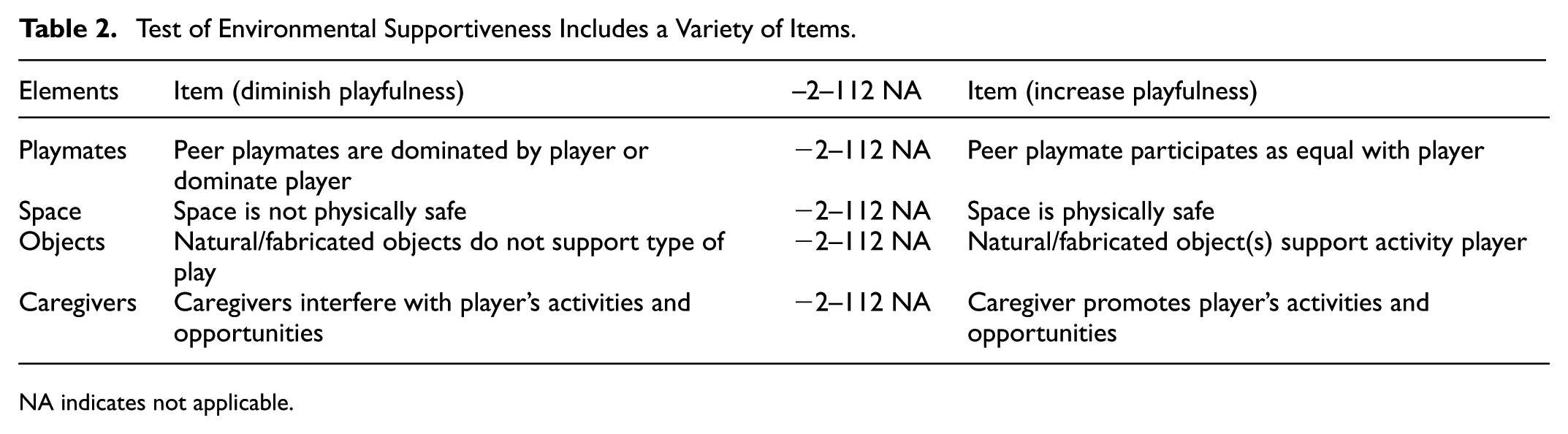
NA indicates not applicable.
Studies by Harding (1997) and Bronson & Bundy (2001) indicate that TOES demonstrates sufficient validity and reliability for assessing both typically developing children and those with various developmental challenges. Similarly, TOES was adapted into Turkish. Goodness of fit statistics were computed, and data from all raters aligned with the expectations of the Rasch model. The inter-rater reliability of items was .78.
Social Skills Rating System—SSRS
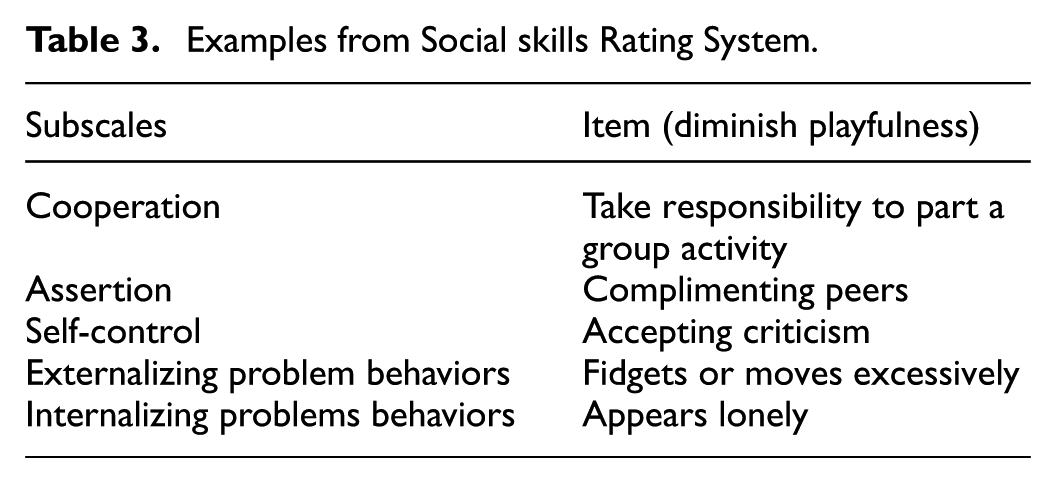
The Social Skills Rating System (Gresham & Elliott, 1990) assesses and categorizes the social abilities of students from preschool through secondary school. It aids in the creation of intervention programs targeting deficiencies in social skills. The Turkish version of the SSRS (for children aged 3–5) preschool teacher form was administered. Elibol-Gültekin (2008) translated and altered the instrument. Elibol-Gültekin (2008) conducted a study including 341 preschool-aged children and their teachers. The authors documented strong internal consistency reliability ratings for the SRSS social skills. The assessment requires a time commitment of 15 to 20 min and must be completed separately for each child. The SSRS-teacher version consists of 40 items, with 30 items assessing social skills across three subscales and 10 items evaluating problem behavior across two subscales. Table 3 shows example items which are related to subscales. The assessment employs a 3-point Likert-type scale, with response options of “never,”“sometimes,” and “very often.” The scale is comprised of two distinct subscales: social skills, which assesses cooperation, assertion, and self-control, and problem behaviors, which evaluates externalizing and internalizing behaviors. The current investigation yielded a Cronbach’s alpha coefficient value of .94.
Examples from Social skills Rating System.
Data Collection Process
This study was approved by the Research Center for Applied Ethics and the Ministry of National Education in Turkey. Written informed consent was obtained from all participating teachers, and verbal assent from parents/guardians. Participation was voluntary, and confidentiality was maintained. Parental consent forms were distributed to obtain permission for children’s participation. After receiving approval from parents, teachers, and school administrators, researcher began visiting schools to collect data. The study consisted of two waves of data collection. Teachers were informed about the study’s forms and procedures and were asked to select observation times that aligned with children’s regular free play routines. Following a period of at least 6 months of familiarity with the children, teachers completed the SSRS forms for each child. Completing the forms required approximately 10–15 min per child. The researcher observed children’s free play in their preschool classrooms or 30–45 min. After observations, separate DVD recordings were prepared for each classroom and each child. Tests were conducted using 15 min of footage from each child’s free play session. After analyzing the videos according to the TOP and TOES manuals and scoring protocols, raw scores were entered into an Excel file, and Rasch analysis was performed on the complete dataset.
Data Analysis
TOP and TOES were designed in an English-speaking country, and there are no versions available that are tailored to the Turkish people and may be used in a different language setting. Likewise, some studies have adapted the TOP for other contexts; to be meaningful in clinical assessments, it requires culturally adapted versions with acceptable psychometric properties. These versions should allow for longer use while maintaining the test’s original meaning (Serrada-Tejada et al., 2021; Tavoosi, et al., 2022). The Rasch Analysis was the primary analytical method, chosen to ensure accurate and reliable results for the study objectives. TOP and TOES were developed using Rasch analysis grounded in item response theory (Wright & Stone, 1979). The Rasch Analysis identifies variations in the children’s social skills, detecting even minor changes as measured by the SSRS. The Rasch model, used to evaluate personality, affect, and behavior is sensitive to subtle differences and enables the assessment of an individual’s proficiency. “It is the sole method that offers the requisite objectivity for developing a scale that is independent of the attribute distribution among the individuals” (Bond & Fox, 2001, p. 7). Accordingly, TOP and TOES were constructed using Rasch analysis to ensure accuracy and reliability. The rationale for employing Rasch analysis in this study was its ability to convert ordinal-level raw data into interval-level measures based on the difficulty and levels of children’s playfulness and social skills. These measurement scores enable the computation of descriptive and inferential statistics. All item and person measures are positioned within a single hierarchy (Bond & Fox, 2001; Linacre, 2005). In this study, Rasch analysis was used to clarify how specific items function and why individuals respond in unique ways. Additionally, an advantage of the Rasch model is its ability to accommodate missing data, allowing raters or respondents to skip items without compromising analysis quality (Bond & Fox, 2001). The data analysis was conducted using the Rasch analysis computer application Winsteps (Linacre, 2016) following the scoring of all items. The Rasch model enables the concurrent evaluation of multiple aspects: (a) whether the items represent a single underlying construct, (b) the comparative difficulty of each item, (c) the relative proficiency of each participant, and (d) the strictness level of each examiner (Wright & Stone, 1979). Although a larger sample number of 2000 would enhance the reliability of the Rasch model, it is still feasible to conduct Rasch analysis with smaller samples, even as low as 30 participants. Initially, Rasch analysis was used to calculate item- and person-level goodness-of-fit statistics. A Rasch analysis, assessing validity, was conducted on the TOP and TOES instruments (Skard & Bundy, 2008). Data from 96% of items, 93% of participants, and 95% of raters met Rasch model assumptions, supporting that the TOP items reflect a unidimensional construct of playfulness. Furthermore, statistical methods were used to provide calibrated (raw) scores, transforming the data from ordinal to interval scales. The measure scores represented the children’s levels of playfulness, environmental supportiveness, and social skills. The scores of all items were inputted into SPSS, a statistical analysis software (Version 23 of IBM SPSS Statistics). A correlation analysis was performed using this program to examine the relationship between social skills and playfulness. An analysis of variance (ANOVA) examined the association between environmental supportiveness in preschool classrooms and children’s playfulness and assessed variations among preschools.
Results
Descriptive Statistics
This section presents descriptive statistics for the Test of Playfulness (TOP) and the Social Skills Rating System—Preschool Teacher Form (SSRS). The children’s mean social skills score was 1.50 (SD = .35) out of 2.00, while their mean score on the playfulness test was 1.68 (SD = .45) out of 2.76. Overall SSRS scores ranged between .67 and 2.00. Skewness and kurtosis values for the entire group ranged from –1 to +1, indicating that the distributions of the SSRS and TOP scores conformed to a normal distribution.
Rasch Analysis of Test of Playfulness
In this study, raw scores were converted from an ordinal scale to an interval scale. Skard and Bundy (2008) argued that Rasch analyses can provide insights into children’s playfulness by examining the gap between their scores. Simple tasks are manageable for all children, while challenging tasks reflect the abilities of highly playful children. Success in these tasks often indicates engaging behavior. Consequently, the emphasis was not solely on performance levels but also on analyzing score differences to better understand children’s playfulness. In the present study, the TOP scores ranged between 4.52 and –2.84, with a mean score of 0.68 out of 2.76 and a standard error .31.
The item reliability was determined to be 0.99, indicating a high level of reliability. The item separation value was determined was 9.24. The mean discrepancy of items (.12 logits) was minimal. Thus, in this study, the values of 29 measured items fell within acceptable ranges.
Fit statistics accurately matched the model. The estimations of item reliability and item separation suggest that the number of items and individuals used to calculate person ability and item difficulty was sufficient. Each of the subscales has an item reliability of at least .70 and an item separation value greater than 2. The reliability value of the “freedom to suspend reality” subscale was below the acceptable threshold. However, the infit and outfit scores (0.99, 0.99) meet the criteria. Each person’s dependability values range from .75 to .86. Both the outfit and infit MNSQ values fall within acceptable ranges.
Each dimension’s results were analyzed separately. To comprehend the logic behind the hierarchy of items, it was crucial to acknowledge that in the context of playfulness studies, higher values of items reflect greater observed difficulty. The analysis outcomes for each TOP subscale were displayed on a linear logarithmic scale (Wright map). Each Wright map was analyzed based on the summary of test responses, the arrangement of items, and their spacing. Items were arranged from most challenging to least challenging. The left side of the map showed the difficulty ranking, while the right side displayed the item placements.
Perception of Control
Analysis of item scores indicated that the hierarchy of items was logically organized. This findings showed that the items “skill of initiating new activities” and “skill of modifying to maintain challenge or fun” were positioned significantly toward the central area of the item map (Table 4).
The Linear Logit Scale Is Employed to Illustrate the Perception of Control Items.

This indicates that there is a significant discrepancy between item measure.
Source. Adapted from the author's doctoral dissertation (Sicim Sevim, 2017), Middle East Technical University.
Source of Motivation
The linear logit scale comprises five items related to sources of motivation, as illustrated in Table 5. Item 4, “intensity of persistence,” was the most intrinsic of the five. In other words, teachers or other adults provided most of the motivation for continued participation. Most children exhibited engagement during play but did not sustain participation without external prompts.
The Linear Logit Scale Is Employed to Illustrate the Source of Motivation Items.

This indicates that there is a significant discrepancy between item measure.
Source. Adapted from the author's doctoral dissertation (Sicim Sevim, 2017), Middle East Technical University.
Freedom to Suspend Reality
The results of these five items indicated that children showed s in the areas of “extent of using people or objects unconventionally” and “skill of using clowning/joking” than in other items. The item “skill of pretending” was positioned near the midpoint of the spectrum. However, the “skill of employing mischief/teasing” and the “skill of utilizing individuals or objects unconventionally” were significantly lower compared to other items in this subscale. In particular. The scores indicated that most children were not entirely free from unnecessary constraints of reality. Calibrated items for this subscale were summarized in Table 6.
The Linear Logit Scale is Employed to Illustrate the Freedom to Suspend Reality Items.
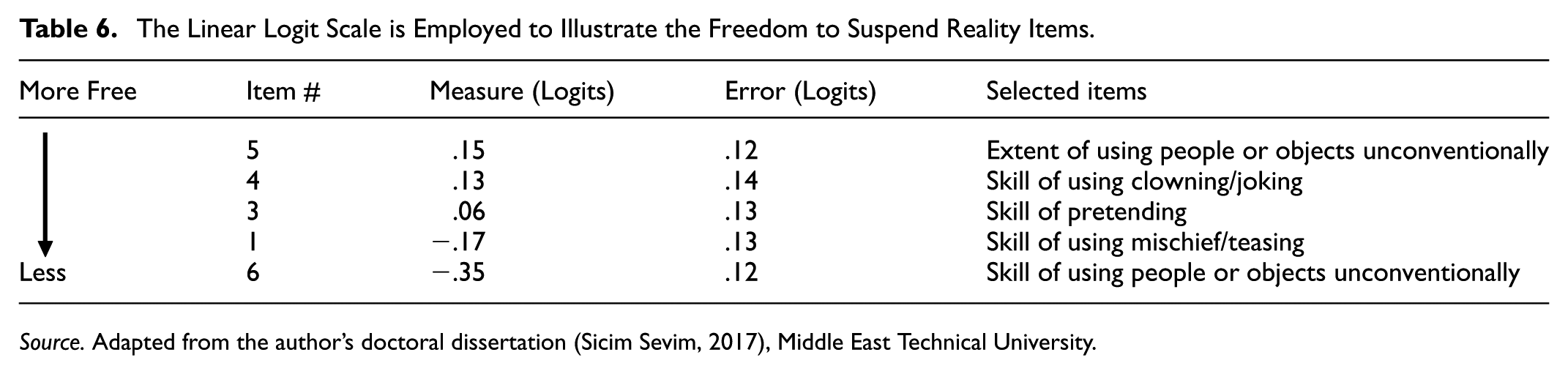
Source. Adapted from the author's doctoral dissertation (Sicim Sevim, 2017), Middle East Technical University.
Framing
Of the four criteria, item 3, “skill of being engaged,” was particularly challenging for children to demonstrate. The capacity to sustain a play frame and the ability to give and receive social cues were complex skills to master. Calibrated items for the “Framing” subscale were presented in Table 7.
The Linear Logit Scale is Employed to Illustrate the Framing Items.

Source. Adapted from the author's doctoral dissertation (Sicim Sevim, 2017), Middle East Technical University.
Rasch Analysis of Social Skills Rating System Scale (SRSS)
The results showed that a person reliability coefficient above 0.80 indicates that scores can reliably distinguish between individuals with high and low performance (Bond & Fox, 2001). The individual’s reliability for SRSS was 0.90, reflecting high consistency. It was expected that person separation would divide into a minimum of two units (Bond & Fox, 2001). For this investigation, the person separation estimator suggested classifying individuals into approximately three distinct levels (2.98). The term “person separation” refers to the categorization of measures based on children’s degree of sociability, from more to less sociable. The reliability of the person sample was excellent. The results fell within the permitted parameters. The fit statistics analysis revealed a strong alignment with the model. The items had a high level of reliability. Item reliability was 0.94 and item separation was 3.87. The subscales showed good item reliability and item separation, with all subscales except for the cooperation subscale meeting the criteria (item reliability ≥ .87 and item separation > 2). The mean scores for infit and outfit, MNSQ (1.01) and MNSQ (.99) respectively, were within the acceptable range. The fit statistics for each subscale of the SSRS are presented below. The individual reliability values ranged from .61 to .85. For the Problem behavior subscale, reliability was below the recommended value, but the infit and outfit values (.63, .97) met the requirements.
Rasch Analysis for Test of Environmental Supportiveness
Children’s TOES scores ranged from –5 to 22, with a mean of 8.1 (SD = 7.9). The Rasch analysis produced a separation value of 2.64 for educational contexts. The calculation ([4Gp + 1]/3) used in a study by Bronson and Bundy (2001) incorporated a separation value to determine the levels of environment. The abbreviation “Gp” stands for the separation value. The results showed that environments could be classified into three distinct levels. The reference point for the analysis was the average score. By adding and subtracting one standard deviation (about 8) from the average score, the school environment supportiveness levels were divided into three categories. The group, scoring between –5 and 0 was classified as low-supportive. Schools with a cumulative score between 0 and 16 were categorized as moderately supportive, whereas schools with a cumulative score ranging from 16 to 22 were categorized as highly supportive (Table 8).
Scores of Schools to Each Item in the Test of Environment Supportiveness (TOES).

Source. Adapted from the author's doctoral dissertation (Sicim Sevim, 2017), Middle East Technical University.
The item reliability estimate stood 0.78. Similarly, the school reliability estimate was measured at 0.87. Despite the school’s reliability level being above .80, item reliability considers sample size to accurately determine item difficulty levels. An insufficient number of schools led to lower item reliability scores, limiting the ability to determine item difficulty (Linacre, 2016). According to Smith (2002), reliability analysis scores above .70 are considered acceptable for tests witless than 20 items.
The Test of Environment Supportiveness (TOES) assessed children’s classroom environmental supportiveness for playfulness. By using TOES scores, three schools were categorized as low-supportive, moderately supportive, or highly supportive.
For low-supportive classroom environments, caregivers were often the least supportive element, primarily observing and supervising rather than engaging as playmates. Playmates provided limited support, and the environment reduced players’ abilities by offering toys and materials inappropriate for their age or developmental stage. Play spaces were safe but lacked sufficient space for gross motor activities.
Moderately supportive classrooms had more supportive caregivers, but they still acted more as rule enforcers than active playmates. Playmates sometimes attempted to continue peers’ activities, though their responses were occasionally unrelated or misunderstood. In moderately supportive classrooms, children often used non-play materials such as carpets, pillows, or cushions for play. The classrooms included designated spaces for LEGOs, housekeeping, kitchen play, and riding toys, but their limited size restricted opportunities for motor activities or large-group play.
Highly supportive classrooms had skilled caregivers, consistent teachers, and ample space for safe play involving whole groups. Objects matched children’s motivations, allowing for flexibility and appropriate challenges. Classrooms with diverse objects, such as parachutes and oversized LEGOs, encouraged cooperative play and large-scale constructions.
Relations Between Children’s Playfulness and Social Skills and Within Different Levels of Environmental Supportive
The researcher conducted the Test of Environmental Supportiveness and Test of Playfulness in all 16 preschools. Subsequently, an analysis of variance (ANOVA) compared the data across the various groups. Preschools were classified into three categories based on their degree of environmental support: low (–5 to 0), moderate (0–16), and high (16–22). The results revealed a significant difference in the level of environmental support for children’s playfulness. The statistical analysis produced an F-value of 7.49 with 2,211 degrees of freedom, yielding a p-value of .001. The effect size of 0.066 suggests a moderate impact according to Cohen’s (1988) standards. Post-hoc analysis using the Tukey HSD test revealed that both the low group (M = 1.06, SD = 0.38) and the intermediate group (M = 1.72, SD = 0.44) scored significantly lower than the high group (M = 1.93, SD = 0.49). Nevertheless, there was no substantial difference between the low and moderate groups. In addition, TOES and SSRS assessments were conducted in the same 16 preschools, followed by ANOVA to compare group outcomes. Subsequently, an analysis of variance (ANOVA) was conducted to compare the outcomes of the various groups. No statistically significant difference was found among the groups (p < .05). The SSRS scores for TOES did not show statistical significance, as evidenced by the F (2, 238) value of .180 and p-value of .836. The findings are shown in Table 9.
Multiple Comparison for Levels of Environmental Supportiveness.

Source. Adapted from the author's doctoral dissertation (Sicim Sevim, 2017), Middle East Technical University.
The relation between the TOP and SSRS was examined using bivariate correlations. Results, presented in Table 10, show a significant positive correlation between the two tests (r = .146, p = .031). Although the correlation coefficient is below 0.3, indicating a modest association, the findings suggest that children who are more playful tend to have higher social skills. Additionally, bivariate correlations were computed between the four components of the tests. A significant correlation was found between the Framing and Perception of Control components of the TOP and the Self-control subscale of the SSRS, as shown in Table 11. No other significant associations were observed among the remaining dimensions.
Correlation Analysis.

Source. Adapted from the author's doctoral dissertation (Sicim Sevim, 2017), Middle East Technical University.
Correlations Between Elements of Playfulness and Dimensions of the Social Skills.

p < 0.05.
Source. Adapted from the author's doctoral dissertation (Sicim Sevim, 2017), Middle East Technical University.
Discussion
This study examined the association between children’s playfulness, social skills, and environmental supportiveness for playfulness. The Rasch analysis of the TOP indicated a mean measure score of 0.68 (SE = 0.31). Additionally, the study found that typically developing children had a total raw mean score of 0.90 for playfulness. These findings expand upon previous research. Measure scores obtained using the same instruments have been 0.43 (Skard & Bundy, 2008). Indeed, research conducted by Saunders, et al. (1999) found average playfulness scores of –.093 among 19 randomly selected preschool children. Bundy et al. (2008) examined playfulness in a group of 20 typically developing children aged 5 to 7 years by observing free play in the playground. Their findings indicated that the average playfulness ratings increased from 0.58 to 1.09 following the intervention. The children’s scores appeared to be higher, possibly due to the recording of videos in both outdoor and indoor settings. Children may exhibit superior performance in a playground setting compared to an indoor environment. Thus, the relatively high playfulness levels observed among children in Turkey in this study may reflect the influence of diverse play contexts. The scores fell within the range of playfulness scores observed in both typically developing and atypical children. Possible explanations for the higher playfulness scores reported here include the fact that the sample consisted primarily of typically developing children, most of whom had attended preschool for at least 2 years. Another factor could be the timing and location of observations: children were assessed during free play in their natural settings, primarily after breakfast or at the start of the day. These conditions may have positively influenced their playfulness scores.
Perception of Control
Perception of control is widely recognized as the primary aspect of playfulness, as indicated by Neumann (1971) and Bundy (2012). Players who possess internal control over play can decide the duration of play, choose participants, and determine when to start and end activities (Bundy, 2012). According to Skard and Bundy (2008), the absence of certain characteristics can hinder a child’s ability to feel in control during play. In the present study, tasks such as “the ability to start new activities” and “the ability to modify and maintain challenges or fun” were among the most difficult. Children exhibited challenges in developing skills related to self-regulation, including starting activities, changing the rules with their peers, and participating in social play. The analysis of item scores indicated that the hierarchy of items was logically structured. These findings suggest that children face challenges in independently generating new activities. This difficulty may be influenced by overcrowded classrooms and constant adult supervision, which limit opportunities for autonomous play and require negotiation of control with peers.
Ensuring safety is one of the primary prerequisites for children to engagement in play (Skard & Bundy, 2008). Therefore, fostering a sense of trust in the environment is crucial for active participation in independent play (Brussoni, et al., 2012; Mitchell, et al., 2006). In this context, the subsequent section, Source of Motivation addresses the various factors that encourage children to participate in specific activities (Bundy, 2012).
Source of Motivation
Play is commonly recognized as intrinsically motivated, as essential and autonomous characteristics of play (Rigby & Rodger, 2006). Bundy (1991) defines play as engagement in activities motivated primarily by intrinsic interest, which distinguishes it from leisure or work. Children may be intrinsically driven by activities that foster social connections, provide sensory experiences, or enable goal achievement (Boyer, 1997; Bundy, 2012). In the present study, however, some children demonstrated low engagement intensity during activities. This may be attributed to the prevalence of structured activities primarily directed by teachers in preschool centers. Consequently, external motivations, directions, and warnings may have reduced children’s intrinsic motivation to participate (Poulsen & Ziviani, 2006). Furthermore, a meta-analysis by Deci et al. (1999) found that providing external, material rewards can significantly hinder the development of intrinsic motivation in children.
Freedom to Suspend Reality
Freedom from excessive reality constraints refers to a player’s ability to decide how closely their actions in play align with real-world rules (Bundy, 2012). For instance, a child might use puzzle pieces as intended or pretend they are cookies. Such departures from reality can be expressed through pretending, playful mischief, joking, clowning, and other imaginative forms of play (Bundy, 2012). The findings indicate that children often struggled to transcend real-world limitations during unstructured play. Using objects in nontraditional ways was observed infrequently. Pretending is one of the key characteristics of playfulness (Bundy, 2012). According to the scores on the “skill of pretending” item, children sometimes participate in pretend play. Two plausible explanations are proposed: (1) the age of the children and (2) the types of activities they engage in may influence the frequency of pretend behaviors observed (Skard & Bundy, 2008). The age of the participants may influence the outcomes because children typically begin engaging in pretend play around the ages of 2, but it is most observed between the ages of 3 and 5 (Fein, 1981; Pellegrini & Smith, 1998). Therefore, their creativity and divergent thinking can shape how they use imagination when creating roles in make-believe play. Engaging in joking can serve as alternative way for temporarily disregarding or reality. Children displayed these behaviors sporadically in this study. The presence of humor and playful behavior is closely associated with children’s high levels of energy and lively conduct (Zachopolulou, et al., 2004). Hence, the level of physical activity can impact TOP assessment, either positively or negatively. Mischief and teasing are generally intended to elicit amusement; however, if poorly executed, they may resemble intrusive behaviors and be less socially acceptable (Bundy, 2012). This study showed that children were more prone to displaying misbehaviors when engaging in joking, taunting, or mischief. According to Tyler’s (1996) research, one possible explanation is that these actions may be strongly influenced by the cognitive and language development of children.
Framing
Play framing involves the exchange of cues and continuous active participation in play. Cues refer to the indications or signal that players use to communicate how they should behave and interact with one another (Bundy, 2012). For instance, when a child engages in imaginative play as a doctor, they provide signals for others to interact with them as if they were a doctor, while other participants are expected to assume the role of patients. To continue participating in the play, children must provide clear and comprehensible signals while interpreting the signals given by other participants. The results indicated that preschool children showed a higher level of proficiency in engaging with framing compared to other variables. Therefore, considering their age range, the outcomes of the analyses align with the expected results for both receiving and giving cues. During observations, particular behaviors such as eye contact, smiling, and physical contact were considered. However, these actions may not always be captured on video. In addition, certain children opted to engage in solitary play, rendering it difficult for the observer to assess and rate these behaviors.
Environmental Supportiveness for Playfulness
The Rasch analysis on the Test of Environmental Supportiveness revealed that peer playmates had a good impact on supporting other children’s playfulness. On the other hand, the most challenging aspects were related to caregivers, particularly maintaining consistent and appropriate boundaries/rules. Gagnon and Nagle (2004) found that peer interactions were associated with stronger social bonds and fewer behavioral problems in preschool children. Nevertheless, the findings suggest that teachers had a minimal impact on children’s playfulness. Likewise, a study conducted by Lobman (2001) reported that preschool teachers rarely used playful techniques during children’s playtime, except when introducing new concepts. Kendrick (2013) also supported earlier evidence, noting that teachers tended to act as observers on the playground. This is noteworthy, because caregivers and teachers can assist shy children in engaging in play with their peers (Skaines, et al., 2006). Recent longitudinal research has shown that highly structured, goal-oriented teaching—often reflected in high “engaged support for learning” scores—can promote academic and cognitive outcomes but may reduce opportunities for spontaneous, child-led play. In particular, such approaches were found to have small negative effects on overall playfulness and significant negative effects on both cognitive and physical spontaneity (Rüdisüli, et al., 2024). These findings highlight the importance of balancing instructional goals with less directive, child-centered approaches during free play. Over time, while academically beneficial may promote academic gains, they might inadvertently constrain the development of playfulness, underscoring the importance of balancing instructional goals with opportunities for open-ended, child-led play.
Relations Between Playfulness, Environmental Support, and Social Skills in Young Children
This study examined the impact of environmental support on children’s playfulness. ANOVA results indicated that playfulness scores were significantly higher in highly supportive preschool environments compared to low and moderately supportive ones. These findings suggest that enriched preschool settings, characterized by unstructured materials such as construction sets, sensory toys (e.g., sand, playdough), and musical instruments, can enhance children’s playfulness. While not all classrooms had these items, most included unstructured materials which are essential for fostering creativity. This aligns with previous studies demonstrating that developmentally appropriate materials can significantly enhance playfulness (Gariepy & Howe, 2003; Haiat, et al., 2003; Ryan, 2011).
A major concern is that the correlations found—particularly between playfulness and social skills—were statistically significant but relatively weak. This suggests that while there is a link between these constructs, other factors may exert a stronger influence on the development of social skills in preschoolers. Possible explanations include measurement sensitivity limitations, cultural influences on play, and the homogeneous nature of sample. Consistent with Sanderson (2010), such modest correlations should be interpreted with caution, recognizing the limited practical significance. The strongest link was observed between the self-control subscale of the SSRS and the perception of control dimension in the TOP, suggesting that enhancing playfulness may foster self-control. Similarly, Ramani (2005) reported a positive association between the cooperative skills of preschool children and overall playfulness. Although no significant association was found between environmental supportiveness and children’s social skills, this finding aligns with prior literature suggesting that social competence is shaped by a combination of home, peer, and broader socio-cultural factors, rather than the school environment alone (Marinho-Casanova & Leiner, 2017; Obaki, 2017). The limited environmental diversity among the participating preschools—as all institutions followed similar curricula, daily routines, and had comparable teacher qualifications and class sizes—may have reduced the observed correlations (Florescu, 2020; ToPolska, 2023). In addition, contextual factors such as class size, curriculum models, and teacher-child ratios likely shaped the observed outcomes. Many participating classrooms relied heavily on teacher-directed activities, which may restrict opportunities for autonomous, intrinsically motivated play. Teachers owns playfulness can help bridge power dynamics, reduce rigidity, and promote a “play pedagogy” approach—one that combines safety, peer connection, humor, and gentle structure to foster creativity and autonomy (Singer, 2015). Prior research suggests that providing open-ended materials and unstructured time has been shown to foster complex pretend play, humor, collaborative problem-solving, and ultimately both playfulness and social competence. Moreover, evidence from experimental studies demonstrates that targeted playful interventions can enhance children’s social skills and peer relationships. For example, structured play-based programs can enhance cooperation, self-regulation, and peer interaction quality (e.g., Loukatari et al.2019, Oh & Lee, 2022). These findings suggest that embedding playful activities into early childhood curricula may not only foster playfulness but also lead to measurable improvements in social-emotional development.
Conclusion
The present study highlights the critical role of supportive social and physical environments in nurturing children’s playfulness. Higher environmental supportiveness—characterized by access to varied and open-ended play materials and active peer engagement—was associated with increased playfulness scores. These findings emphasize that the quality of the play environment can have meaningful effects on children’s engagement and creativity.
From a pedagogical standpoint, teachers should be encouraged to take on active yet facilitative roles in play, positioning themselves as co-players rather than passive supervisors. This can involve offering subtle prompts, scaffolding interactions, and modeling playful engagement without assuming full control of the activity. Teacher education programs should integrate training on how to balance guidance with autonomy, as well as foster intrinsic motivation during play. In addition, targeted professional development programs and school-based interventions should be designed to help teachers adopt more playful approaches, thereby enhancing their confidence and skills in integrating playfulness into daily routines.
It is important to acknowledge the limitations of this study. A primary limitation is the study’s reliance on teacher ratings for the assessment of social skills. This approach introduces the risk of informant bias, as teachers’ perceptions may be influenced by classroom management priorities, behavioral expectations, or familiarity with the children. Incorporating multiple informants—such as parents or independent observers—would strengthen the reliability and validity of social skill measurement in future studies. Ultimately, fostering playfulness should be recognized as a developmental priority rather than a peripheral goal. Policymakers, educators, and families share responsibility for ensuring equitable opportunities for play by providing supportive environments, adequate time, and resources. Such investments are likely to yield lasting benefits for children’s social-emotional development and overall well-being.
Footnotes
Acknowledgements
This study is based on a part of the author's doctoral dissertation. Preliminary findings from the pilot study were presented at the 2015 OMEP World Assembly and Congress, Washington, DC, United States. The author gratefully acknowledges Professor Feyza Tantekin Erden for her invaluable guidance and supervision throughout the development of this study. The author also extends sincere thanks to the children and teachers who participated.

Ethical Considerations
Permission from the Research Center for Applied Ethics of Middle East Technical University and the Ministry of National Education in Turkey was obtained to conduct research in the preschools. The ethics committee did not issue a reference number. Ethics approval documentation is available upon request. Written informed consent was obtained from all participating teachers, and the children’s parents/guardians prior to data collection. Participation was voluntary, and confidentiality and anonymity were maintained throughout the study.
I hereby declare that all information in this document has been obtained and presented in accordance with academic rules and ethical conduct. I also declare that, as required by these rules and conduct, I have fully cited and referenced all materials and results that are not original to this work.
Author Contributions
The Author collected data, conducted analysis, and prepared the manuscript.
Funding
The author received no financial support for the research, authorship, and/or publication of this article.
Declaration of Conflicting Interests
The author declared no potential conflicts of interest with respect to the research, authorship, and/or publication of this article.
Data Availability Statement
The data that support the findings of this study are available from the corresponding author upon reasonable request. Due to participant confidentiality, the data are not publicly available.