



Abstract
Self-determined learning skills are essential for postgraduate students, enabling independent engagement in complex research tasks and the development of critical skills needed to navigate the challenges of Industry 5.0 and the rapidly evolving educational landscape. However, the factors influencing the development of these skills remain underexplored at the postgraduate level. This study investigates the influence of heutagogical activities namely exploration, creation, connection, collaboration, sharing, and reflection, as well as the fulfillment of basic psychological needs on self-determined learning. A quantitative correlational approach was employed with a sample of 626 postgraduate students, comprising both master’s and PhD students, from a research university in Malaysia. The samples were selected from four academic disciplines: sciences, engineering, medical, dental, and health sciences, and arts. The results of structural equation modeling (SEM) showed that 57.2% (R 2 = .572) of the variance in self-determined learning could be explained by heutagogical activities and students’ psychological needs. Heutagogical activities had a significant direct effect on self-determined learning (β = .594, t = 13.436, p < .01), while students’ psychological needs also contributed, albeit with a weaker effect (β = .202, t = 4.681, p < .01). Additionally, psychological needs were found to mediate the relationship between the two variables. These findings highlight that postgraduate students are more likely to engage in self-determined learning when participating in heutagogical activities and when their psychological needs for autonomy, competence, and relatedness are met. The paper concludes with a discussion of the theoretical and practical implications, limitations and directions for future research.
Plain Language Summary
Self-determined learning skills are crucial for postgraduate students, as they enable independent learning and professional growth. However, the factors influencing the development of these skills are not fully understood. This study aimed to explore how certain activities, like exploration, creation, collaboration, sharing, and reflection, along with basic psychological needs, affect students’ self-determined learning. The research involved 626 postgraduate students from a university in Malaysia. The results showed that 57.2% of the variation in self-determined learning could be explained by these factors. Additionally, students’ psychological needs for autonomy, competence, and relatedness were found to play a significant role in supporting self-determined learning. The findings suggest that postgraduate students are more likely to engage in self-determined learning when they are given the opportunity to play an active role in learning and when their psychological needs are met. The study discusses the theoretical and practical implications, as well as limitations and suggestions for future research.
Introduction
Higher education is undergoing a significant transformation to meet the evolving demands of Industry 5.0 and to prepare students for an AI-driven, rapidly changing global environment. As technology becomes increasingly integrated in educational, economic and social systems, universities must develop graduates who are more adaptable, self-direct and future-ready (Abulibdeh et al., 2025). Traditional teaching methods are no longer sufficient, there is now a pressing need to equip students with skills suited to the complexities and uncertainties of a technology-driven world (du Plooy et al., 2024). Postgraduate education plays a crucial role in this transition, as students are expected to engage in advanced knowledge creation, independent research, and innovation, skills that require strong self-determined learning. Industry 5.0, envisioned as a human-centric approach to industrial development, emphasizes collaboration between humans and intelligent machines to enhance creativity and well-being (European Commission, 2021). In parallel, Education 5.0 promotes flexible, technology-enhanced ecosystems that foster creativity, adaptability, and self-directed learning (Majid et al., 2023). These competencies closely align with the evolving expectations of postgraduate education, where students must take greater responsibility for their learning, address complex challenges independently and contribute meaningfully to interdisciplinary research and innovation to achieve academic and professional success (Koch et al., 2025). To support these developments, it is crucial that postgraduate education remains widely accessible and aligned with the demands of a rapidly evolving global landscape. In Malaysia, the higher education system offers diverse and structured opportunities for postgraduate study, comprising 20 public universities and 55 private universities, including six local branch campuses and 10 foreign branch campuses (Ministry of Higher Education, 2025). The system is quality-assured and aims to produce graduates who are equipped to meet the shifting needs of industry and society (Sirat, 2024). However, traditional structured and teacher-centered approaches are becoming increasingly inadequate in addressing these emerging educational demands. Even though competency-based education fosters self-directed learning, practical skills, and real-world application, postgraduate students must transition to heutagogy, a more self-determined learning approach that emphasizes learner agency, reflection, and the ability to manage their own learning paths, as they advance in their professional careers (So, 2024).
To remain relevant, postgraduate education must shift toward more personalized, flexible, and learner-driven approaches that foster continuous learning, research excellence, and innovation. Heutagogy, with its emphasis on self-determined learning, learner agency, reflective practice, and the management of personal learning pathways, offers a more appropriate framework to support postgraduate students’ development in complex and dynamic environments (So, 2024). This emphasis on heutagogy is also reinforced by national policies such as the Malaysian Education Blueprint-Higher Education (2015–2025), the Eleventh Malaysia Plan (2016–2020), and the National Higher Education Strategic Plan (PSPTN) (2007–2020) (Tiew & Abdullah, 2021). Self-determined learning provides a promising foundation for this transformation by emphasizing learner autonomy, flexibility, and critical reflection (Black et al., 2025; Blaschke, 2023; Mwinkaar & Lonibe, 2024). Heutagogical approaches, particularly when supported by digital learning technologies, have gained traction in postgraduate education to cultivate independence, adaptability, and lifelong learning skills (Chumachenko, 2020; D’Souza, 2024). Heutagogy is grounded in four key principles: (a) learner-centeredness, (b) double-loop learning, (c) non-linear learning, and (d) capability and capacity development. Through activities such as exploration, creation, collaboration, and reflection, heutagogy aligns with the growing need for learners to take greater ownership of their educational journeys. However, empirical research remains limited on how heutagogical activities specifically support postgraduate students’ basic psychological needs for autonomy, competence, and relatedness, needs that are critical drivers of intrinsic motivation and sustained self-directed learning under self-determination theory (Deci & Ryan, 2000). Addressing this gap is crucial for designing postgraduate learning environments that not only leverage technological innovations but also nurture the internal motivation and adaptive capabilities necessary for success in an increasingly complex and uncertain world.
The importance of self-determined learning is becoming increasingly relevant for the current postgraduate population, which includes a significant proportion of Generation Z students. As digital natives, these learners are proficient and more inclined to utilize technology to access information, collaborate through digital platforms and engage with non-linear, flexible learning environments aligned with the principles of self-determined learning (Cook, 2019; Kavashev, 2025). Although heutagogy has emerged as a promising learner-centered approach for postgraduate education (Colin, 2024; Tiew et al., 2024), its implementation within Malaysian higher education institutions remains limited. Key challenges relate to pedagogical factors, including lecturers’ limited readiness for learner-centered teaching, a lack of expertise in heutagogical methods, and insufficient institutional support (Md Azmi & Daud, 2019; Tiew & Abdullah, 2021). These pedagogical limitations highlight the need to understand how heutagogical activities can be effectively integrated to support postgraduate learning. At the same time, supporting postgraduate learners requires a deeper understanding of their internal psychological drivers, particularly by fulfilling their needs for autonomy, competence and relatedness to effectively motivate and sustain self-directed learning (Wang et al., 2019). Despite increasing recognition of these factors, empirical research remains limited in three key areas. First, few studies have examined how heutagogical activities (exploration, creation, collaboration, connection, sharing, and reflection; Handayani et al., 2021; Richardson et al., 2017; Tiew & Abdullah, 2023) influence postgraduate students’ satisfaction of basic psychological needs and promote self-determined learning. Second, the direct influence of psychological need on self-determined learning outcomes has not been sufficiently explored at the postgraduate level. Third, the mediating role of psychological need satisfaction in the relationship between heutagogical activities and self-determined learning remains underexamined. Addressing these research gaps is crucial for strengthening both pedagogical practices and learner-centered support systems within postgraduate education. This study seeks to bridge the gap by examining how heutagogical activities, as pedagogical strategies and the satisfaction of basic psychological needs, as internal learner needs, interact to promote self-determined learning. The findings are expected to contribute both to theoretical advancements in research and to practical educational strategies to foster self-determined learning among postgraduate students.
Objectives
To investigate the influence of heutagogical activities on students’ psychological needs and self-determined learning.
To investigate the influence of students’ psychological needs on self-determined learning.
To investigate the mediating effect of students’ psychological needs on the relationship between heutagogical activities and self-determined learning.
Factors Influencing Self-Determined Learning
Self-determined learning is an extension of the andragogy approach, with a greater emphasis on the learner’s autonomy in learning and knowledge creation within a technology-based learning environment. It is based on four core principles: autonomous learning, non-linear learning, double-loop learning, and capacity development (Hase & Kenyon, 2000). It can be influenced by both external and internal factors. External factors, such as stimuli (S) provided through learning activities, can directly drive students’ self-determined behavior (R) (Zhai & Usman, 2019). This aligns with previous studies (Handayani et al., 2021; Richardson et al., 2017; Tiew & Abdullah, 2023), which found that heutagogical activities positively affect learners’ self-determined learning. These activities, which encourage students to (a) explore, (b) create, (c) collaborate, (d) connect, (e) share, and (f) reflect throughout the learning process (Blaschke, 2018; Blaschke & Marin, 2020; Mohaffyza, Fong et al., 2020), provide a dynamic framework for fostering self-determined learning. Heutagogical activities have been shown to significantly enhance self-determined learning outcomes (Tiew & Abdullah, 2021, 2025). By empowering students to take an active role in the learning process, these activities promote greater ownership, motivation, and engagement in their educational journey. These activities empower students to take an active role in learning process. Chen et al. (2020) found that students who received autonomy-supportive instruction were more likely to engage in self-determined learning behaviors, such as setting their own learning goals, seeking feedback, and reflecting on their progress. Through exploration, students are motivated to investigate and discover knowledge independently. Creation and connection enable them to apply what they have learned in meaningful, real-world contexts. Collaboration and sharing foster peer learning and the exchange of ideas, further enhancing critical thinking and problem-solving skills. Reflection offers students the opportunity to assess their progress, refine learning strategies, and build self-awareness, all of which contribute to a more personalized and effective learning experience (Blaschke & Marin, 2020; Hase & Kenyon, 2000).
In addition, heutagogical activities can fulfill students’ psychological needs and, in turn, influence their self-determined learning. Heutagogical activities are learning tasks designed around six key elements, explore, create, collaborate, connect, share, and reflect, within a heutagogical learning environment. These activities are aimed at fostering self-determined learning by encouraging students to take control of their learning process and engage in meaningful, interactive experiences (Blaschke, 2018). According to Zhai and Usman (2019), learners are organisms (O) that respond to stimuli (S) in their learning environment. Students’ perceptions of the learning environment and their responses may influence their psychological needs and self-determined learning (Wu et al., 2024). When students perceive the environment as supportive of their psychological needs, they are more likely to engage in self-determined learning behaviors (Sook & Yeo, 2019; Wu et al., 2024). Heutagogical activities, which focus on exploration, creation, collaboration, connection, sharing, and reflection, can foster positive learning experiences and meet students’ basic psychological needs (R) (Berry et al., 2022). Basic psychological needs, as identified by Deci and Ryan (1985), include autonomy, competence, and relatedness. Autonomy refers to the need for individuals to feel in control of their own actions and decisions. Competence is the desire to feel effective in one’s interactions and achievements, while relatedness involves the need for meaningful connections and a sense of belonging with others. These needs are fundamental for fostering motivation, well-being, and personal growth (Deci & Ryan, 2000). When psychological needs are fulfilled, they significantly influence self-determined learning. Wang et al. (2019) found that autonomy, competence, and relatedness all positively influence self-determined learning. Autonomy involves the need for control and choice over one’s learning, competence refers to feeling capable and effective in completing learning tasks, and relatedness pertains to feeling connected with others in the learning environment. When these needs are satisfied, students are more likely to engage in self-determined learning behaviors (Müller et al., 2021). This is because students who experience autonomy in decision-making, feel competent in their abilities and have stronger connections with others (Rashid et al., 2020). They are also more likely to actively engage in self-determined learning. These findings suggest that students’ psychological needs could play a mediating role in the relationship between the hauntological activities and self-determined learning. In summary, previous studies (Berry et al., 2022; Blaschke & Marin (2020); Hase & Kenyon, 2000; Rashid et al., 2020) demonstrate that both heutagogical activities during the learning process and students’ basic psychological needs are key factors influencing self-determined learning. Postgraduate students, in particular, are more likely to engage in self-determined learning when participating in heutagogical activities and when their psychological needs for autonomy, competence, and relatedness are fulfilled. This process aligns with the Stimulus-Organism-Response (SOR) model (Zhai & Usman, 2019), as illustrated in Figure 1.

Factors influencing postgraduate students’ self-determined learning.
Theoretical Framework
This study is grounded in several theories that collectively form its conceptual foundation: Humanistic Theory (Rogers, 1980), Constructivist Theory (Piaget, 1980; Vygotsky, 1978), Agency Theory (Blaschke, 2018) and Self-Determination Theory (Deci & Ryan, 2000). Together, these perspectives offer an integrated basis for understanding how heutagogical activities and the fulfillment of students’ psychological needs foster the development of self-determined learning. By integrating these theories, the study establishes a coherent framework to explain the mechanisms through which external learning experiences and internal motivational processes interact to influence learning outcomes. Heutagogy, the central pedagogical approach of this study, is informed by principles drawn from Humanistic and Constructivist theories. Humanistic Theory (Rogers, 1980) emphasizes learner autonomy, personal growth, and the realization of individual potential. Within heutagogical activities, these principles are operationalized through practices that prioritize learner agency, encourage reflection, and value personal experiences (Blaschke, 2023; Hase & Kenyon, 2000). Rather than treating learners as passive recipients of knowledge, heutagogical practices foster active participation and self-responsibility, thereby nurturing autonomy and initiative, key conditions for promoting self-determined learning. Aligned with this orientation, Constructivist Theory (Piaget, 1980; Vygotsky, 1978) frames learning as an active and individualized process shaped through the integration of prior experiences, existing knowledge, and social interaction. Heutagogical activities reflect this constructivist stance by emphasizing independent exploration, critical thinking, and adaptability, thereby encouraging learners to engage meaningfully with dynamic and complex learning environments. Through these practices, postgraduate students build not only disciplinary knowledge but also the cognitive and metacognitive skills necessary for self-determined engagement with their learning.
Building on the foundations of humanism and constructivism, Agency Theory (Blaschke, 2018) further elaborates the role of learner autonomy within heutagogical contexts. It posits that individuals act intentionally to advance their goals through informed decision-making. In heutagogical activities, learners are positioned as autonomous agents who set their learning goals, select strategies, and critically evaluate outcomes. This framework highlights how external structures designed to promote agency, such as offering choice and encouraging self-assessment, directly support the development of self-determined learning by fostering a sense of ownership and personal responsibility for educational progress. At the motivational level, Self-Determination Theory (Deci & Ryan, 2000) provides critical insights into the internal psychological processes that sustain self-determined learning. According to this theory, the fulfillment of three basic psychological needs, autonomy, competence, and relatedness, is essential for promoting intrinsic motivation and engagement. Heutagogical activities fulfill these needs by nurturing autonomy through learner-directed decision-making, developing competence through mastery experiences and reflective practices, and strengthening relatedness through collaborative and supportive environments. When these needs are satisfied, postgraduate students are more likely to experience deeper engagement, greater resilience and a sustained commitment to lifelong learning.
In summary, this study adopts an integrated theoretical framework to explain how external educational practices and internal motivational processes shape the development of self-determined learning among postgraduate students. Humanistic and Constructivist theories provide the philosophical foundations for designing heutagogical activities that foster learner agency, adaptability, and active knowledge construction. Building upon this foundation, Agency Theory conceptualizes postgraduate students as autonomous agents who actively direct and regulate their learning experiences. Complementing these perspectives, Self-Determination Theory clarifies the psychological mechanisms through which the fulfillment of autonomy, competence, and relatedness sustains intrinsic motivation and supports long-term engagement. Collectively, these theories establish a coherent framework for understanding how the interplay between heutagogical activities and psychological need satisfaction contributes to the development of self-determined learning in postgraduate education.
Methodology
To achieve the research objectives, this study employed a quantitative correlational design to examine the relationships among heutagogical activities, psychological needs, and self-determined learning among postgraduate students. This design is appropriate as it enables the investigation of the strength and direction of associations between variables without controlling or altering the natural learning environment. Its strength lies in identifying natural patterns of association within an educational context, providing empirical support for the hypothesized relationships, and facilitating the analysis of mediation effects to enhance understanding of the structural connections among the study variables.
The sample for this study comprised postgraduate students enrolled in master’s and doctoral programs at a public research university in Malaysia. According to Malaysia Educational Statistics (2020), the postgraduate student population at the university totaled 8,542 students. Following Krejcie and Morgan’s (1970) guidelines for sample size determination, a population of approximately 9,000 requires a minimum sample size of 368. In this study, a total of 626 postgraduate students were randomly selected, exceeding the minimum required sample size. A stratified random sampling technique was employed to ensure proportional representation across four academic disciplines: (1) sciences, (2) engineering, (3) medical, dental, and health sciences, and (4) arts, with approximately 150 students drawn from each discipline. Out of the total sample, 44.1% (n = 276) were male and 55.9% (n = 350) were female. Most respondents were aged between 26 and 35 years (52.4%, n = 328). Of the sample, 49.5% (n = 310) were pursuing doctoral programs, while 50.5% (n = 316) were enrolled in master’s programs. Most respondents were engaged in fully research-based programs (58.9%, n = 369). The postgraduate students represented both science disciplines (54%, n = 338) and non-science disciplines (46%, n = 288). The demographic distribution of gender, age, program type, and discipline accurately reflected the total sample size (N = 626). The questionnaire was distributed to participants via an online link using a simple random sampling technique, after obtaining ethical clearance from the Human Research Ethics Committee (JEPeM USM Code: USM/JEPeM/19090509). Participation in the study was voluntary.
Data were collected through an online survey administered to postgraduate students enrolled at a public research university in Malaysia. Although the study was conducted within a single institution, the university operates across three campuses located in two different states. The use of an online survey facilitated standardized data collection across multiple campuses, ensured uniform administration of the instruments, and supported efficient access to a geographically distributed postgraduate population. This method was appropriate for the study’s design, enabling the collection of a sufficiently large and diverse sample while maintaining consistency in the delivery of the survey instruments. Three psychological instruments were employed to measure heutagogical activities, psychological needs, and self-determined learning among postgraduate students. The Heutagogical Learning Activities Scale was used to assess heutagogical activities (HA). Items from this scale were adapted from an instrument developed and validated by Mohaffyza, Masek et al. (2020) to evaluate heutagogical elements in learning among university students. The scale comprises 26 items organized into six subscales: explore (EXP), create (CRE), connect (CON), collaborate (COL), share (SHA), and reflect (REF). The EXP subscale evaluates students’ ability to explore diverse sources of knowledge, while the CRE subscale measures their capacity to generate new knowledge. The CON subscale assesses their ability to establish learning networks through the internet and social media, and the COL subscale evaluates their capacity to collaborate with others toward a common learning goal. The SHA subscale measures the extent to which students share information and experiences with peers during the learning process, while the REF subscale assesses their self-reflection on acquired knowledge, learning approaches, and the extent to which learning experiences challenged their existing beliefs.
Postgraduate students’ psychological needs were measured using the 12-item Basic Psychological Needs Scale (Deci & Ryan, 2000), which assesses students’ needs for autonomy, perceived competence, and relatedness in learning. In this study, self-determined learning (SDL) was measured using the Postgraduate Self-Determined Learning Questionnaire (Abdullah et al., 2022). The instrument comprises 42 items that measure four dimensions of self-determined learning: learner-centered learning, interactive non-linear learning, double-loop reflection, and capacity development. The instrument has been validated and demonstrated strong reliability in assessing the self-determined learning of postgraduate students (Abdullah et al., 2022). For example, it measures students’ tendency to seek feedback on their academic work from others, to reappraise and re-evaluate their own learning progress to identify areas for improvement, and to share their learning experiences with supervisors, researchers, and peers to gain a deeper understanding. Prior to data collection, a panel of experts, including educational psychologists, psychometricians, and lecturers from science and non-science disciplines, was consulted to establish the face and content validity of the instruments. A pilot test was conducted to verify the reliability of the Heutagogical Learning Activities Scale, the Basic Psychological Needs Scale, and the Postgraduate Self-Determined Learning Questionnaire (PSLQ). All instruments recorded a Cronbach’s alpha (α) value above .90, indicating excellent internal consistency (George & Mallery, 2003). Structural equation modeling (SEM) was also conducted to further establish internal consistency, convergent validity, and discriminant validity of the instruments. Table 1 presents the sample items used to measure heutagogical activities (HA), students’ psychological needs (SPN), and self-determined learning (SDL) in this study.
Sample Items Measuring the Constructs.

For data analysis, structural equation modeling (SEM) was conducted to examine the relationships among multiple variables (Hair et al., 2021). SEM enables researchers to test and refine theoretical models and hypotheses by analyzing both direct and indirect effects between variables. Additionally, SEM facilitates the examination of latent variables, which are not directly observed but inferred from multiple measured indicators. In this study, second-order analysis was performed to determine the relationships between higher-order constructs and their lower-order indicators, as well as the relationships between higher-order constructs and other variables in the model. To initiate the second-order analysis, the scores of all latent variables were saved and added as new variables in the dataset. These construct scores were subsequently used as indicators in the measurement model of the higher-order construct (HOC). Specifically, the construct of “heutagogical activities” was conceptualized as a second-order composite of the reflective type (Mode A). Mode A estimation was applied to assess the reflectively specified measurement model for the HOC (Sarstedt et al., 2019). In contrast, the constructs of “students’ psychological needs” and “self-determined learning” were treated as first-order reflective constructs (LOCs).
Analysis and Results
Assessment of Reflective Measurement Model
The researchers proposed an integrated full model and a second-order model to investigate the effect of the learning environment and students’ psychological needs on postgraduates’ self-determined learning. The second-order construct, heutagogical activities (HA), was determined by six first-order factors: explore (EXP), create (CRE), connect (CON), collaborate (COL), share (SHA), and reflect (REF). According to Henseler et al. (2019), reliability and validity should be tested to assess a reflective measurement model.
Convergent Validity
Assessment of composite reliability was carried out to examine the internal consistency reliability of the proposed model. The results in Table 2 indicates that the composite reliability of each latent variable fulfilled the satisfactory value of 0.70 (Hair et al., 2017). After confirming the internal consistency reliability, the assessment continued with the testing of convergent validity and discriminant validity. For the evaluation of convergent validity of a reflective measurement model, the outer loadings of the indicators and the average variance extracted (AVE) were calculated (Hair et al., 2017). The results showed that the outer loading of all the indicators exceeded the threshold value of 0.70, proving the indicators could be captured by the respective construct. Next, the value of AVE of each construct ranged from 0.60 to 0.77. It indicated that the construct explained at least more than half of the variance of its indicators. So, the convergent validity on the construct level of the model was established.
Convergent Validity Results.
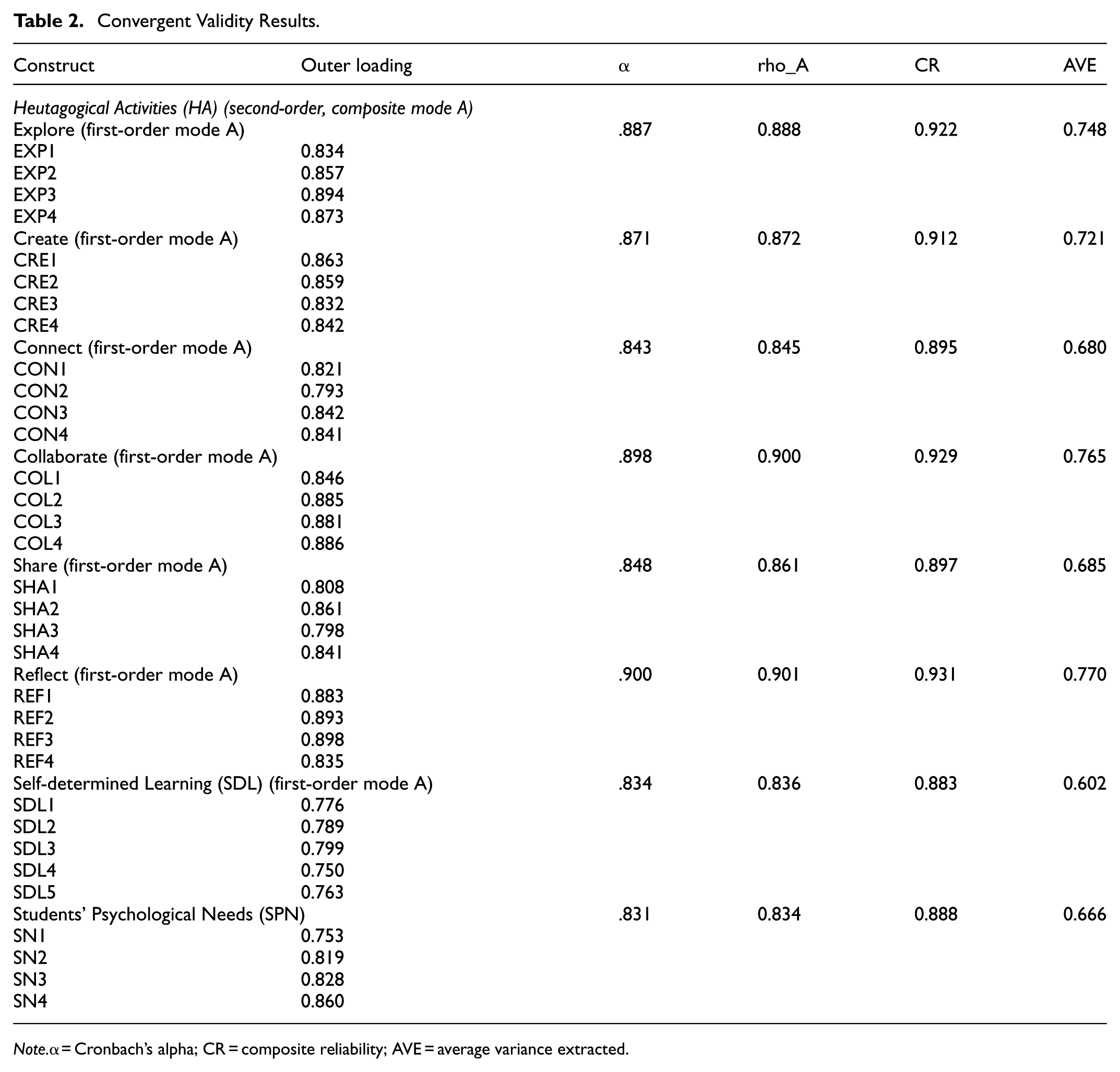
Note.α = Cronbach’s alpha; CR = composite reliability; AVE = average variance extracted.
Discriminant Validity
The discriminant validity of the model was assessed using two commonly used methods in PLS-SEM: the Fornell-Larcker criterion and the heterotrait-monotrait ratio (HTMT) of correlations. As presented in Table 3, the diagonal values of each latent variable indicated that the square root of AVE of each construct was greater than the correlation of any other constructs, supporting the adequate discriminant validity of the model. The values of HTMT ranged from 0.77 to 0.87, which were below the recommended threshold of 0.90, particularly when the constructs are conceptually very similar, further indicating the satisfactory discriminant validity of the model (Henseler et al., 2019).
Discriminant Validity Results.

Higher-Order Construct
By establishing higher-order models also known as hierarchical component models (HCMs), the number of relationships in the structural model can be reduced, increasing the parsimony and easiness in PLS path model (Hair et al., 2017). In the study, heutagogical activities (HA) contained six lower-order constructs including (1) explore; (2) create; (3) connect; (4) collaborate; (5) share; and (6) reflect. Based on the result in Table 4, the HOC validity of the model was established.
Higher-Order Construct Validity.

Assessment of the Structural Model
The values of variance inflation factors (VIF) in the constructs were examined to check for any collinearity issue in the structural model. The result indicated that the values of VIF recorded the lowest at 1.00 and highest at 2.226. The analysis showed that all the indicators attained satisfactory VIF value of below 5.0, meaning that there was no issue of collinearity in the proposed model. The second step in PLS-SEM is to assess the significance of the path coefficients that explain the hypothesized relationships among the constructs in the model (Hair et al., 2017). Based on the results (Table 5), all three direct path coefficients were significant.
Path Coefficients.

Note. Italics used for mediation. HA = heutagogical activities; SDL = self-determined learning; SPN = student psychological needs.
Mediation analysis.
First, heutagogical activities (HA) were found to have a significant direct effect on self-determined learning (SDL) (β = .594, t = 13.436, p < .01), indicating a strong positive relationship. Students’ psychological needs (SPN) were also found to have a direct effect on SDL, though with a weaker influence (β = .202, t = 4.681, p < .01). HA demonstrated the strongest direct effect on students’ psychological needs (β = .743, t = 35.771, p < .01). Additionally, the structural model showed that HA exerted a significant indirect effect on SDL through SPN (β = .150, t = 4.643, p < .01).
The results in Table 5 displayed that SPN acted as a complementary mediator because the product of the direct effect (HA → SPN) and the indirect effect (HA → SDL) resulted in a positive value (0.594 × 0.150 = 0.089).
The third step is to examine the coefficient of determination (R 2) also known as the measure of the predictive power of a model (Hair et al., 2017). It refers to the amount of variance explained in each endogenous construct. In this model, self-determined learning (SDL) had a moderate R 2 value of .572. The results showed that heutagogical activities (HA) and students’ psychological needs (SPN) collectively accounted for 57.2% of the variance in postgraduate students’ self-determined learning (SDL). Additionally, heutagogical activities were found to explain 55.2% (R 2 = .552) of the variance in students’ psychological factors, suggesting a moderate level of predictive accuracy. Figure 2 illustrates the measurement and structural model with R2 values.

Structural model with R 2 values.
According to Cohen (1988), f 2 values of 0.02, 0.15, and 0.35 indicate small, medium, and large effects respectively for an exogenous latent variable. The f 2 effect sizes are presented in Table 6. The largest f2 effect size was observed for the relationship between heutagogical activities (HA) and students’ psychological needs (SPN) (f2 = 1.233). The effect of heutagogical activities (HA) on self-determined learning (SDL) also showed a large effect size (f2 = 0.369), while the effect of students’ psychological needs (SPN) on self-determined learning (SDL) showed a small effect size (f2 = 0.043) (Table 6).
f2 Effect Sizes.

In addition to R 2, the predictive relevance (Q 2) was assessed using the cross-validated redundancy approach suggested by Chin et al. (2003). Predictive relevance is considered significant when Q 2 values are greater than zero for a specific reflective endogenous latent variable (Hair et al., 2017). Based on the results from the cross-validated redundancy approach (Table 7), SPN recorded the highest Q 2 value of 0.346, while self-determined learning (SDL) had a Q 2 value of 0.322. Both endogenous constructs had Q 2 values above zero, providing strong evidence for the predictive accuracy of the model.
Construct Cross-Validated Redundancy Result.

Note. HA = heutagogical activities; SDL = self-determined learning; SPN = student psychological needs.
Findings and Discussions
Influences of Heutagogical Activities
The findings of this study suggest that heutagogical activities can effectively promote self-determined learning among postgraduate students (Blaschke, 2014; Hase & Kenyon, 2000), consistent with previous research (e.g., Hakim et al., 2019; Rathakrishnan & Raman, 2021; Suhana et al., 2019). This aligns with the theoretical assumptions of the Stimulus-Organism-Response (SOR) model (Zhai & Usman, 2019), where heutagogical activities act as external stimuli that influence students’ internal states by fulfilling psychological needs, ultimately leading to enhanced self-determined learning outcomes. Rooted in humanism and constructivism, and further supported by Agency Theory, heutagogical activities empower students by providing autonomy, choice, and opportunities for self-determined behavior. These factors foster a sense of ownership and responsibility, which are key to cultivating self-determined learning, aligning with the study’s findings that highlight the importance of autonomy and self-reflection in postgraduate education. In addition, the findings also have significant implications from a policy perspective. The results align with global higher education trends that emphasize learner autonomy, digital adaptability, and lifelong learning, priorities that are also highlighted in Malaysia’s Higher Education Plan (2026–2035). By integrating heutagogical activities systematically into postgraduate curricula, institutions can support the development of graduates who are capable of independent inquiry, critical thinking, and continuous professional growth. These competencies are essential not only for addressing Malaysia’s aspirations for human capital development but also for preparing graduates worldwide to meet the demands of Industry 5.0 and thrive in a rapidly evolving global landscape.
It is evident that heutagogical learning, characterized by exploration, creation, connection, collaboration, sharing, and reflection (Blaschke, 2014), plays a crucial role in fostering self-determined learning among postgraduate students. Rather than functioning as isolated strategies, these activities form an integrated learning approach that enhances students’ capacity for autonomy, critical thinking, and adaptability, key attributes necessary for success in postgraduate education. Through exploration and creation, postgraduate students engage in complex research environments, formulating questions, generating ideas, and constructing personalized learning trajectories. These initial processes foster a sense of agency and intellectual curiosity, establishing a solid foundation for self-determined learning. Moreover, connection and collaboration extend these experiences beyond individual efforts by integrating postgraduate students into academic communities and professional networks. This not only enhances their intellectual and professional development but also refines their academic skills and builds confidence in managing collaborative research, critical dialog, and multidisciplinary inquiry. The sharing of academic outputs through publications, conferences, and professional platforms further supports self-determined learning by fostering ownership of their work and encouraging critical self-reflection. The feedback received helps students refine their ideas, boosting their autonomy and motivation. The iterative process of improvement strengthens self-regulation and problem-solving abilities, which are essential components of self-determined learning. At the postgraduate education level, reflection is central across all stages of the learning process. It enables students to continuously monitor, evaluate, and recalibrate their learning strategies. Reflection supports the double-loop learning principle emphasized in heutagogy (Gillaspy & Vasilica, 2021), encouraging postgraduate students not only to refine their methods but also to critically reexamine underlying assumptions and reframe long-term academic objectives. In summary, these interconnected heutagogical activities provide a cohesive framework that fosters the development of postgraduate students as self-determined learners. By engaging in exploration, creation, connection, collaboration, sharing, and reflection, postgraduate students are empowered to take proactive control of their academic journeys, demonstrating resilience, adaptability, and sustained motivation. These findings underscore the importance of designing postgraduate curricula that integrate heutagogical activities to cultivate lifelong learning capabilities essential for navigating the complexities of contemporary academic and professional environments.
The Influence of Students’ Psychological Needs
The findings of this study indicate that postgraduate students are more likely to engage in self-determined learning when their core psychological needs, autonomy, competence, and relatedness, are met (Deci & Ryan, 2000). These psychological needs are interdependent and collectively shape students’ motivation, engagement, and persistence in their learning. Autonomy, for instance, is integral to students’ sense of ownership over their learning process. When postgraduate students are given the freedom to choose their research topics, design methodologies, and set learning goals, they experience a greater sense of control, which enhances their intrinsic motivation and deepens their engagement with their academic work. Graduate education and research settings that foster autonomy, by offering meaningful choices and encouraging students to set their own goals, are crucial for enhancing self-determined learning among master’s and PhD students. By enabling students to take ownership of their academic and research activities, these environments enhance motivation, sharpen critical thinking, and deepen engagement with complex research challenges. Competence is another essential psychological need that must be fulfilled to drive and support postgraduate students’ self-determined learning. Fulfilling the need for competence enables postgraduate students to feel capable in their academic work, which in turn enhances their motivation and persistence, key components of self-determined learning. This sense of competence is cultivated through timely, constructive feedback and scaffolding that supports students in navigating complex tasks. Additionally, recognizing students’ achievements, such as through research awards, publications, or conference presentations, reinforces their sense of competence and academic success. These forms of recognition, along with mentorship opportunities, not only affirm students’ efforts but also encourage autonomy, fostering their continued learning and engagement in self-determined academic and professional growth. Relatedness, the third basic psychological need that must be fulfilled to promote self-determined learning at the postgraduate level, involves the desire to feel connected to others. This need is nurtured through strong, supportive relationships with supervisors, peers, and the broader academic community. By engaging in collaborative research projects, attending seminars, and participating in academic discussions, students are provided with opportunities to share ideas, receive feedback, and become part of a larger intellectual community. These interactions strengthen their sense of belonging, which, in turn, enhances their motivation and engagement in learning (Berry et al., 2022; Rashid et al., 2020). Furthermore, positive academic interactions contribute to the development of students’ academic identity and sense of purpose, supporting their ongoing self-determined learning.
The results of this study demonstrate the importance of addressing students’ basic psychological needs to foster self-determined learning. For Generation Z, a significant portion of today’s postgraduate population, these needs are particularly relevant. As digital natives, these students are accustomed to technology-driven learning environments, which enable them to take ownership of their learning, engage confidently in academic tasks, and connect meaningfully with peers and mentors, all key elements of self-determined learning. From a policy perspective, the findings suggest that higher education institutions should design curricula and learning environments that explicitly meet these needs. Specifically, offering opportunities for autonomy, such as allowing students to make choices in their learning paths; supporting competence through regular feedback and scaffolding; and fostering relatedness through collaborative learning and mentorship can significantly enhance postgraduate students’ motivation and academic outcomes. These strategies align with global trends in higher education that prioritize learner autonomy, lifelong learning, and the development of self-determined, adaptable learners. By integrating these elements, universities can better equip students with the skills necessary for lifelong learning, critical thinking, and independent inquiry, enabling them to meet the demands of postgraduate education and research. This approach also prepares them to navigate the complexities of Industry 5.0 and contribute to a rapidly evolving global landscape.
The Mediating Role of Students’ Psychological Needs
The findings of this study highlight the significant mediating role of postgraduate students’ psychological needs in the relationship between heutagogical activities and self-determined learning. Heutagogical activities such as exploration, creation, collaboration, and reflection are central to promoting self-determined learning; however, their effectiveness depends on the fulfillment of these psychological needs. When postgraduate students experience autonomy in their learning, feel competent through supportive feedback and develop relatedness through collaborative academic experiences, they are more likely to engage meaningfully with these activities, thereby enhancing self-determined learning outcomes (Berry et al., 2022; Rashid et al., 2020; Ryan & Deci, 2000). Conversely, when these psychological needs are not adequately fulfilled, the effectiveness of heutagogical activities in promoting self-determined learning may be compromised, as students’ motivation and active engagement are substantially weakened. For instance, students who lack autonomy may struggle to take ownership of their learning, while those who feel a lack of competence may be reluctant to engage with heutagogical activities. Additionally, students who experience low relatedness may feel disconnected from the academic community, which is integral to collaborative heutagogical activities, thereby reducing their motivation for self-determined learning. These findings align with existing research, which underscores the importance of fulfilling psychological needs in motivating postgraduate students and enhancing their learning outcomes (Buzzai et al., 2021; Elahi Shirvan & Alamer, 2022); Wang et al., 2019).
From a practical perspective, the findings underscore the importance of embedding support for students’ psychological needs within instructional practices at the postgraduate level. Lecturers and supervisors play a critical role in this process by facilitating opportunities for autonomy, such as allowing students to make decisions regarding their research directions and learning strategies. Competence can be strengthened through consistent, constructive feedback and appropriate scaffolding, enabling students to develop the skills and confidence needed to succeed. Relatedness can be fostered by promoting collaborative research activities, establishing mentoring relationships, and cultivating a supportive academic environment. By actively addressing these psychological needs, lecturers and supervisors not only enhance students’ engagement with heutagogical activities but also strengthen their intrinsic motivation, leading to improved academic outcomes. Supporting students in this way ensures they can fully benefit from self-determined learning, better preparing them to navigate academic challenges and succeed in professional environments.
Conclusion
In conclusion, the findings of this study emphasize the importance of integrating heutagogical activities in postgraduate education to foster self-determined learning. First, it is crucial for stakeholders in postgraduate education to prioritize heutagogical activities, as they play a significant role in developing students’ skills and preparing them for the challenges of Industry 5.0. These activities support students in developing not only technical expertise but also critical thinking, creativity, adaptability, and lifelong learning skills, which are essential for success in an increasingly complex and technology-driven world. Second, to support the effective implementation of heutagogical practices, universities should provide training for lecturers to design and implement instructional practices aligned with heutagogical principles. These practices should create opportunities for students to explore, create, connect, collaborate, share, and reflect throughout their learning journey. Lecturers across all disciplines must be equipped with the knowledge, skills, and motivation to facilitate these activities and encourage students to take ownership of their learning. Third, the study’s findings suggest that addressing students’ psychological needs, specifically autonomy, competence, and relatedness, is critical for enhancing self-determined learning. Universities should focus on creating learning environments that satisfy these needs, fostering intrinsic motivation and sustained self-directed learning.
However, this study has certain limitations. It did not explore specific teaching approaches, such as research-based learning, problem-based learning, or collaborative learning, nor did it examine the impact of supervision practices on postgraduate students’ self-determined learning behaviors. Future research could address these gaps by examining how these teaching approaches and supervision practices influence self-determined learning outcomes. Additionally, future research could extend the current findings by exploring how heutagogical activities and students’ psychological needs affect self-determined learning across different postgraduate programs. It would also be valuable to consider how differences in fields of study and modes of study influence the implementation and outcomes of heutagogical practices. In summary, this study identifies heutagogical activities and the fulfillment of students’ basic psychological needs as key factors influencing self-determined learning at the postgraduate level. Implementing heutagogical practices and addressing students’ psychological needs can significantly enhance postgraduate students’ learning experiences, equipping them with the skills and attributes necessary for success in their academic and professional careers.
Footnotes

Funding
The authors disclosed receipt of the following financial support for the research, authorship, and/or publication of this article: This work was supported by the Ministry of Higher Education Malaysia under the Fundamental Research Grant Scheme (FRGS) with Project Code: FRGS/1/2019/SS109/USM/02/3.
Declaration of Conflicting Interests
The authors declared no potential conflicts of interest with respect to the research, authorship, and/or publication of this article.