




Abstract
Marriage plays a key role in the exchange of resources, including education, which can affect health outcomes between partners. While the individual cognitive benefits of education are well-established, its potential spillover effects within marital relationships remain insufficiently explored, particularly in non-Western and developing contexts. Using nationally representative data from the 2014 wave of the Chinese Longitudinal Healthy Longevity Survey (CLHLS), this study investigates the associations between educational assortative marriage, spousal education, and late-life cognitive health among Chinese adults aged 65 and older. Results indicate that men in educationally homogamous marriages are significantly less likely to experience cognitive impairment than men in hypogamous unions and women in all marital arrangements. In addition, spousal education is positively associated with cognitive outcomes for men but not for women. These findings suggest that educational resources may be differentially linked to cognitive health within marriage, reflecting both personal and relational dimensions shaped by gender. The study calls for culturally and gender-sensitive public health and educational strategies in late life to promote cognitive well-being among aging populations.
Plain language summary
This study examines how a spouse’s level of education influences cognitive health in later life, focusing on adults in China aged 65 and older. The findings show that older men who marry partners with similar education levels have a lower risk of cognitive decline compared to men with less-educated spouses and to women in all types of marriages. Furthermore, men appear to benefit more from their spouse’s education than women do. These gendered differences highlight the shared, relational impact of education within marriage and underscore the need for culturally and gender-sensitive public health strategies to support cognitive well-being in aging populations.
Introduction
Marriage, as a long-term intimate relationship, profoundly influences various facets of an individual’s life, including physical, emotional, and intellectual well-being. As individuals age, their social networks tend to diminish, leading to an increased reliance on marriage for support and companionship (Curran et al., 2003). The enduring commitment inherent in marriage fosters the sharing of resources and life experiences, one of which is education.
In many societies, men and women are frequently sorted into marriages based on similar demographic and socioeconomic characteristics, a phenomenon known as marital homogamy (Qian & Lichter, 2018). Within this framework, educational assortative marriage can be defined as the tendency for individuals to marry partners with comparable levels of educational attainment. Previous research has linked educational assortative marriage to individuals’ health and well-being across various contexts (Gonzaga et al., 2010; M. Zhao & Zhang, 2025). However, there is a lack of evidence on how educational assortative marriage affects cognitive health among older adults, particularly in developing countries such as China.
In China, historical gender disparities in educational attainment have contributed to the traditional dominance of educational hypergamy, wherein women tend to marry men with higher levels of education. This pattern has been more prevalent than educational homogamy, where partners possess the same level of education, or educational hypogamy, in which women have higher educational attainment than men. Although the relationship between education and cognitive health is well established, the potential spillover effects of one partner’s education on the other partner’s cognition remain underexplored.
This article examines the association between educational assortative marriage and cognitive health among older adults in China. It also considers the influence of a spouse’s educational attainment on an individual’s cognitive outcomes. The analyses are based on the assumption that marriage provides a critical context in which spouses’ resources spill over to influence each other’s health (Bolin et al., 2002). Specifically, this study addresses the following interrelated questions. First, compared to older adults in educational homogamy, do those in educational hypergamy or educational hypogamy experience better or worse cognitive health? Second, is a spouse’s educational attainment associated with an individual’s cognitive health, independent of the individual’s own education? Finally, are there any gender differences in these relationships? In particular, is the cognitive benefit of spousal education (if any) greater for women or men?
Conceptual and Theoretical Framework
Status exchange theory and Becker’s economic model of marriage offer foundational perspectives for understanding how marital dynamics influence cognitive outcomes (Becker, 1991; Merton, 1941). Becker (1991) posits that marriage functions as a rational arrangement to maximize household utility, often by aligning with traditional gender roles—men as economic providers and women as caregivers. Within this framework, educational hypergamy may optimize household gains and be associated with more favorable cognitive outcomes. In contrast, educational hypogamy may introduce relational stress, potentially compromising the cognitive health of both partners more than either hypergamy or homogamy (Fu, 2016, 2021; Pearlin et al., 2005).
Complementing these economic and exchange-based perspectives, social cognitive theory emphasizes that educational similarity between spouses enhances cognitive coordination and shared meaning-making, which reflects the principle of “likes attract likes” (Burney, 2008). From this viewpoint, educational homogamy may promote more effective communication and mutual engagement in cognitively stimulating activities, thereby offering long-term cognitive benefits.
Among the many social relationships adults maintain, marriage is widely recognized as the most influential. The household serves as the primary context through which social factors shape health outcomes (Bartley et al., 2004). The marital resource model suggests that marriage offers advantages by facilitating access to financial resources, emotional support, and behavioral regulation (Carr & Springer, 2010; Hughes & Waite, 2009; Williams & Umberson, 2004). Empirical research further shows that married individuals report greater financial stability, reduced isolation (Albertini & Garriga, 2011; Wilmoth & Koso, 2002), and are more likely to utilize preventive health services (Deb, 2001).
Within the context of marital unions, education may function as a shared resource that shapes the cognitive trajectories of both partners over the life course. A spouse’s educational level can impact an individual’s cognitive functioning through various socioeconomic, psychological, and behavioral mechanisms. For instance, individuals married to more educated spouses typically experience higher household incomes and less financial strain (Rojas, 2011), which are associated with better cognitive outcomes (Aguila & Casanova, 2019). Furthermore, spousal education may influence health behaviors and social engagement. Older adults with more educated spouses are more likely to participate in social activities (Gruneau, 2018), which have been linked to improved cognitive function (Fu, 2015).
Taken together, these conceptual and theoretical perspectives suggest that both the level of spousal education and the educational configuration of marital unions (i.e., homogamy, hypergamy, or hypogamy) may have significant implications for cognitive functioning in later life.
Education, Spousal Education, and Cognition
Cognitive function plays a pivotal role in determining one’s quality of life and the ability to maintain independence, particularly in later stages of life (Medalia & Erlich, 2017). Education has the potential to enhance various cognitive abilities, including information processing, memory acquisition, reasoning skills, and critical thinking (Baker et al., 2011). Research indicates that individuals with higher levels of education generally maintain better cognitive function as they age (Lövdén et al., 2020). As educational attainment is typically achieved early in life, it profoundly shapes various dimensions of socioeconomic status, such as occupation and income (Mirowsky & Ross, 2003). Occupations that are cognitively stimulating may, in turn, have a positive impact on cognitive function (Andel et al., 2007). Furthermore, education can influence cognitive outcomes indirectly by affecting health behaviors, such as dietary habits and smoking (Pampel et al., 2010).
Although studies on the influence of spousal education on cognitive outcomes in older adults are limited, the existing evidence highlights its possible significance. Saenz et al. (2020) found a positive relationship between higher spousal education and cognitive function among older adults in Mexico, with no significant differences by gender. Similarly, Xu (2019) reported that higher spousal education was associated with improved cognition in older adults in the United States, with no gender differences. However, studies focusing on older Chinese populations indicate that gender may play a moderating role in how spousal education influences health outcomes and health-related behaviors. For instance, using a sample of married couples in Shanghai, China, Y. Li et al. (2013) found that spousal education appears to be more important for women’s self-rated health than for men’s. Drawing on a nationally representative sample of Chinese adults, Guo et al. (2020) further reported that wives’ education significantly reduced their husbands’ unhealthy behaviors and health risks, whereas the influence of husbands’ education on their wives was minimal. Despite these insights, the role of spousal education in shaping cognitive outcomes among Chinese older adults, particularly with respect to gender differences, remains underexplored and necessitates further investigation.
Educational Assortative Marriage, Gender, and Health
Several studies conducted in Western contexts have found that educational hypogamy—where men possess lower educational attainment than their wives—is associated with heightened risks of physical health problems and mortality among men, but not among women (Eaker et al., 1983; Suarez & Barrett-Connor, 1984). This phenomenon has been attributed to role incongruity, wherein men may struggle to reconcile their subordinate educational status with traditional expectations of being the primary breadwinner (Suarez & Barrett-Connor, 1984). However, more recent research suggests that men generally experience greater health benefits from marriage than women (Kiecolt-Glaser & Wilson, 2017; Williams & Umberson, 2004). These contrasting perspectives highlight persistent gendered patterns in the relationship between a partner’s educational attainment and individual health. However, the effects of such educational spillovers are not uniform; they vary according to broader socio-structural factors and demographic diversity.
Research on the health implications of mating in China has predominantly concentrated on mental health and psychosocial well-being, with relatively less attention given to physical health outcomes. Within this body of work, Lei et al. (2014) found that hypergamy reduces depressive symptoms and enhances life satisfaction in women but has no significant effect on men. Further research by Qin and Guo (2016) suggests that educational hypergamy positively influences life satisfaction for both genders. Additionally, educational homogamy has been associated with improved self-rated health among internal migrants in China, whereas educational hypogamy has been linked to poorer health outcomes, particularly among women (Zhang & Tan, 2021). Overall, educational assortative marriage appears to have a greater impact on women than on men in the Chinese context. Since mental health is closely tied to cognitive function over the life course (Bunce et al., 2008), it is plausible that educational assortative marriage may influence cognitive function among older Chinese adults, with potential gender differences in these effects.
The Present Study
China offers a distinctive context for investigating gender differences in the cognitive spillover effects of education. Rooted in a long-standing patriarchal tradition, Chinese society has historically exhibited pronounced inequalities in access to education and employment between men and women (Bian, 2002; Y. Liu et al., 2019). Women have historically faced systemic barriers to formal education in their youth and limited access to high-skilled occupations in adulthood. Although gender norms have evolved, contemporary Chinese society continues to impose differentiated expectations on men and women (Zuo & Bian, 2001). Notably, research on cognitive function among older adults reveals divergent gender patterns across cultural contexts: while Western studies typically report cognitive advantages among women (Ahrenfeldt et al., 2019), Chinese studies often find superior cognitive performance among men, particularly in older cohorts (Lei et al., 2012). This contrast underscores the importance of examining gender as a moderating factor in the relationship between spousal education and cognitive health within the Chinese context.
Informed by theoretical frameworks and empirical evidence concerning educational spillover effects and cognitive outcomes, this study proposes the following hypotheses:
Methods
Data and Sample
The data for this study were derived from the 2014 wave of the Chinese Longitudinal Healthy Longevity Survey (CLHLS), a nationally representative survey of older adults residing in mainland China. The CLHLS investigated information on respondents’ demographic characteristics, socioeconomic conditions (including education), social relationships, health conditions, etc. All information was obtained by in-home, face-to-face interviews, and all participants or their surrogate respondents provided a written informed consent. Notably, participants in this study were born between 1897 and 1955. Approximately 37% reported being illiterate, and 81% had received no more than 6 years of formal education. To ensure a representative sample, the CLHLS attempted to interview all centenarians in the selected counties and cities. For each centenarian, one octogenarian and one nonagenarian living nearby (in the same village or street) were randomly selected for interview, with pre-designated age and sex criteria. This sampling approach was strategically designed to ensure an equal representation of randomly selected male and female octogenarians, nonagenarians, and centenarians. For the purposes of this study, only participants who were married during the survey period were included in the analytical sample. Consequently, the final sample comprises 1,272 married men and 621 married women, all aged 65 years and older.
Dependent Variable
Cognitive function in this study was assessed using the Chinese version of the Mini-Mental State Examination (MMSE). The MMSE index used in this study consisted of 24 items (refer to Appendix A). Among these, 23 items had only two possible responses: either correct (1 point) or otherwise (0 point). As for Item #6, respondents were awarded 1 point for each food they named within 1 min, with the potential to earn up to 7 points in total. The MMSE score ranged from 0 to 30, demonstrating good internal consistency with a Cronbach’s α of .90 in the study sample. Participants were classified as cognitively impaired if their MMSE score fell below 25, consistent with established criteria in prior studies (Riedel et al., 2008; Schaller et al., 2012). This threshold has also been employed in research using the same dataset and population of Chinese older adults (An & Liu, 2016). To facilitate logistic regression analysis, a dichotomous variable for cognitive impairment was used in the analyses, with 1 denoting “cognitive impairment” (MMSE score < 25 points) and 0 representing “no impairment” (MMSE score ≥ 25 points).
Independent Variables
The primary independent variable in this study is educational assortative marriage, operationalized as the alignment between an individual’s educational attainment and that of their spouse. Drawing on the classification proposed by M. Zhao and Zhang (2025), this construct typically includes three categories: educational homogamy (spouses have equal years of schooling), hypogamy (wives have more education than their husbands), and hypergamy (wives have less education than their husbands). While this framework necessitates gender-specific modeling, the present study adopts a gender-neutral operationalization to facilitate analysis in which male and female respondents are pooled. Accordingly, we define educational assortative marriage using three mutually exclusive categories: (1) educational homogamy, where both partners have the same level of schooling; (2) lower education than the spouse, representing hypergamy for women and hypogamy for men; and (3) higher education than the spouse, corresponding to hypogamy for women and hypergamy for men. In addition, spousal education is included as another independent variable, indicated by the spouse’s total years of formal education.
Covariates
The current study took into account respondents’ demographic and socioeconomic characteristics, including age (measured in years), own education (measured in years), occupation (non-professional job vs. professional job), and category of residence (city vs. town vs. rural). Moreover, the educational background of the respondents’ parents was considered as potential covariates, focusing on whether the father and mother had received some education or had no education. Given the robust association between cognition and physical health identified in previous research (Fu, 2019), this study used activities of daily living (not/somewhat/strongly limited) as additional covariates.
Statistical Analysis
Statistical analyses were performed to compare study variable characteristics between married men and women, using t-tests for continuous variables and chi-square tests for categorical variables. The impact of educational homogamy on the risk of cognitive impairment was assessed using logistic regression models. A two-way interaction term between educational homogamy and gender was included in the model to evaluate potential moderating effects. The logistic regression model used to estimate the main and interaction effects was structured as follows:

Additionally, the effect of spousal education on cognitive impairment was analyzed in the total sample (results not shown) and separately by gender. The full logistic regression model, estimated separately for men and women, was specified as follows:

All analyses were conducted using STATA version 17.0, and results are presented as odds ratios (ORs) with corresponding 95% confidence intervals (CIs) and p-values.
Results
Descriptive Statistics and Univariate Analysis
As shown in Table 1, the descriptive and univariate analyses revealed several gender-based differences among respondents. The mean age for men (N = 1,272) was 80.46 years, whereas women (N = 621) had a mean age of 78.15 years. Educational attainment differed significantly by gender: men completed an average of 4.42 years of schooling, while women completed 2 years (p < .001). Regarding spousal education, men’s spouses averaged 2.05 years, compared to 3.69 years for women’s spouses (p < .001). Women were significantly more likely than men to marry a spouse with higher educational attainment (48.15% vs. 9.36%), whereas men were more likely to marry a spouse with lower educational attainment (59.20% vs. 12.40%). Therefore, the majority of participants in this study exhibited educational hypergamy (husband having more education than wife) rather than educational homogamy or hypogamy. Cognitive impairment was more prevalent among women (24.48%) than men (17.45%). No significant differences were found between men and women in parental education or residential category. However, a higher proportion of men reported better physical functioning than women (p = .001).
Descriptive Characteristics of Study Variables and Univariate Comparisons by Gender, CLHLS 2014.

Note. SD = standard deviation.
p < .05; **p < .01; ***p < .001.
Educational Assortative Marriage and Cognitive Impairment
Table 2 presents the main and interaction effects of educational assortative marriage and gender on the odds of cognitive impairment. The results reveal notable gender differences in the association between educational homogamy and cognitive outcomes. To facilitate interpretation, Table 3 presents the predicted odds of cognitive impairment, stratified by gender and the three types of educational assortative marriage. The six odds ratios in Table 3 are derived from Table 2 and are adjusted for age, own education, father’s and mother’s education, occupation, residential category, and activities of daily living.
Main and Interaction Effects of Educational Homogamy and Gender on the Odds of Cognitive Impairment Among Older Adults (N = 1,893), CLHLS 2014.
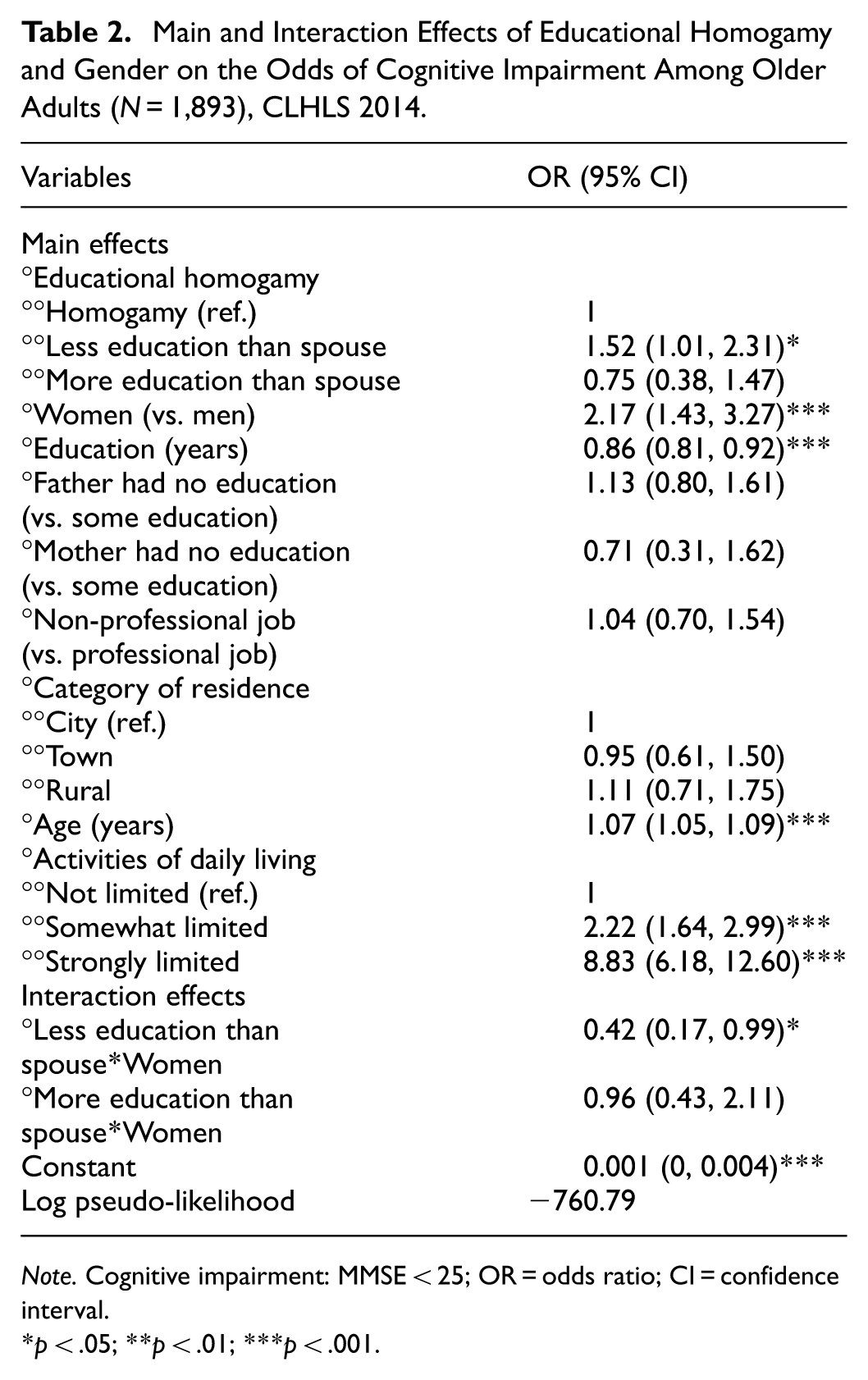
Note. Cognitive impairment: MMSE < 25; OR = odds ratio; CI = confidence interval.
p < .05; **p < .01; ***p < .001.
Interaction Effects of Educational Homogamy and Gender on the Odds of Cognitive Impairment (N = 1,893), CLHLS 2014.

Note. Cognitive Impairment: MMSE < 25. The table omits control variables including age, own education, father’s education, mother’s education, occupation, category of residence, and activities of daily living.
p < .05; **p < .01; ***p < .001.
The predicted odds of cognitive impairment for women in hypergamous unions were 1.39, based on the product of 1.52, 2.17, and 0.42. For women in hypogamous unions, the predicted odds rose to 1.56, derived from multiplying 0.75, 2.17, and 0.96. These estimates suggest that, regardless of whether women are married to more or less educated spouses, they experience a consistently higher risk of cognitive impairment compared to men in homogamous unions. Among men, those in hypogamous unions had 1.52 times higher odds of cognitive impairment compared to men in homogamous unions, controlling for all covariates (p < .05). Among women, no statistically significant differences in cognitive impairment were observed across the different types of educational assortative marriage.
A gender comparison reveals that women across all marriage types had higher odds of cognitive impairment than men in homogamous unions, after adjusting for all covariates. Notably, women in homogamous unions were 2.17 times more likely to experience cognitive impairment than men in homogamous unions (p < .001). Similarly, women in hypergamous and hypogamous unions exhibited 1.39 (p < .05) and 1.56 (p < .05) times higher odds of cognitive impairment, respectively, compared to men in homogamous unions. Overall, men in homogamous unions demonstrated a lower risk of cognitive impairment compared to both men in hypogamous unions and women across all marital types.
Spousal Education and Cognitive Impairment
Table 4 presents the odds ratios of cognitive impairment in relation to spousal education for men and women, respectively. Model 1 included individuals’ own education and all control variables, while Model 2 additionally included spousal education. A comparison between the two models illustrates the effect of spousal education on cognitive health, independent of one’s own education and other covariates. Among men, both their own and their spouse’s education levels were significantly associated with cognitive impairment. Specifically, each additional year of spousal education was associated with a 9% reduction in the odds of cognitive impairment among men (p < .05), independent of their own education, parental education, age, current socioeconomic status (SES), and activities of daily living (ADL). Notably, the addition of spousal education to the model diminished the influence of men’s own education on cognitive impairment by 2%, lowering the risk reduction from 9% to 7%. In contrast, spousal education did not show a significant association with cognitive impairment among women. However, each additional year of a woman’s own education corresponded to a 15% reduction in the odds of cognitive impairment (p < .01).
Effects of Individual and Spousal Education on the Odds of Cognitive Impairment Among Older Men (N = 1,272) and Women (N = 621), CLHLS 2014.

Note. Cognitive impairment: MMSE < 25; OR = odds ratio; CI = confidence interval.
p < .05; **p < .01; ***p < .001.
Discussion
As people age and social networks diminish, marriage becomes an increasingly vital source of support (Curran et al., 2003). Within the marital context, partners often share resources that may shape each other’s health and well-being (Bolin et al., 2002). Education is one such shared resource, as it can shape an individual’s economic opportunities and further affect health through various pathways (Aguila & Casanova, 2019; Rojas, 2011; M. Zhao & Zhang, 2025). This study examines the role of educational assortative marriage and spousal education on cognitive functioning among older adults in China. Participants in this study were born between 1897 and 1955. Over one-third were illiterate, likely due to the widespread disruption of China’s educational system during the early to mid-20th century. The findings suggest that spousal education and educational homogamy are more strongly associated with cognitive health among men than women. Notably, men appear to derive significant cognitive benefits from having more educated spouses, whereas women do not exhibit similar advantages. This gender disparity has important implications, as it underscores the need to consider structural and cultural factors that may differentially shape how men and women benefit from shared marital resources later in life.
These gendered patterns can be further illuminated through the lens of several theoretical frameworks. From a life course theory perspective, the cumulative nature of advantages and disadvantages across the lifespan helps explain how spousal education—often acquired earlier in adulthood—can shape one’s cognitive outcomes in later life (Cohen et al., 2010). Educationally advantaged marriages may provide sustained access to economic resources, knowledge, and health-promoting behaviors over time, particularly benefiting men whose life trajectories are more strongly influenced by their spouse’s social capital (Strazdins & Broom, 2004; Taylor, 2006). Cognitive reserve theory adds another layer, suggesting that intellectually stimulating environments help buffer against cognitive decline with age (Stern, 2012). A highly educated spouse may help maintain such an environment, thereby enhancing an individual’s cognitive reserve over time. However, structural and cultural gender norms in China may mediate these mechanisms unequally. While men may more readily benefit from their wives’ educational resources, women’s caregiving roles and emotional labor may constrain their ability to convert similar resources into cognitive gains (Chen et al., 2015; Y. Liu et al., 2019).
The results offer partial support for Hypothesis 1, confirming its second component but contradicting the first. Both men and women in hypogamous unions demonstrated increased odds of cognitive impairment relative to men in educationally homogamous unions. Specifically, men in hypogamous unions were 1.52 times more likely, and women 1.56 times more likely, to experience cognitive impairment than their homogamous male counterparts. However, no significant difference in cognitive impairment risk is observed between individuals in educationally homogamous versus hypergamous unions. The cognitive advantage associated with educational homogamy among men aligns with social cognitive theory, which posits that homogamous marriages may yield greater health benefits in later life than heterogeneous ones (Burney, 2008). Interestingly, whereas existing research on Chinese populations has primarily associated educational hypogamy with poorer health outcomes in women (Zhang & Tan, 2021), this study identifies a detrimental effect of educational hypogamy on cognitive outcomes in both men and women, relative to men in homogamous unions. Moreover, in contrast to earlier studies that report health advantages associated with educational hypergamy (Lei et al., 2014; Qin & Guo, 2016), the present findings indicate no such cognitive benefits for either gender.
Hypothesis 2 is not supported, as the effect of educational assortative marriage on cognitive impairment was more pronounced among men than women. In particular, men in homogamous marriages exhibited better cognitive functioning compared to men in hypogamous unions and women across all marital types. However, there was little variation in the odds of cognitive impairment among women across different marital arrangements. This lack of variation could point to structural or cultural constraints that diminish the potential cognitive benefits women might otherwise gain from spousal education, such as disproportionate caregiving burdens or less reciprocal intellectual engagement in marriage, as documented in prior research (Strazdins & Broom, 2004; Taylor, 2006). The observed gender-specific pattern diverges from previous research that found no significant gender differences in the association between spousal education and cognitive outcomes (Saenz et al., 2020; Xu, 2019). Nevertheless, the observed pattern and odds ratios align with recent research, which suggests that men derive greater cognitive benefits than women from upward marital mobility (Fu et al., 2023; Fu & Liu, 2022). Notably, women in homogamous unions were 2.17 times more likely to experience cognitive impairment than their male counterparts. This stark gender gap highlights potential structural and relational dynamics that limit women’s ability to derive equal cognitive benefits from educational similarity or spousal advantage within marriage. The persistence of gender gaps—despite comparable or even higher educational attainment among women—may reflect underlying inequalities in marital relationship quality, access to health resources, or opportunities for cognitive reserve development over the life course (Cong, 2008; Umberson & Williams, 2005).
Hypothesis 3 is supported in the case of men, as the findings reveal that men with a spouse who had a higher level of education were significantly less likely to experience cognitive impairment, regardless of their own educational attainment. This suggests that spousal education may function as a critical social and cognitive resource, particularly for Chinese men in later life. Several pathways may account for this significant relationship between spousal education and cognitive outcomes. Prior studies have shown that highly educated spouses can enhance cognitive function by facilitating knowledge exchange and encouraging cognitively stimulating activities (Andel et al., 2007; Saenz et al., 2020). Furthermore, spousal education may shape cognitive outcomes by influencing health-related behaviors, such as diet, physical activity, and adherence to medical recommendations (H. Liu & Umberson, 2008). Additionally, education plays a role in structuring advantages such as access to better employment opportunities and higher household income (Mirowsky & Ross, 2003), which accumulate over time to influence cognitive trajectories (Aguila & Casanova, 2019; Andel et al., 2007).
Hypothesis 4 is supported by the findings, as the beneficial effects of spousal education on cognitive functioning were greater for men than for women. Among men, both individual and spousal education were significantly and inversely associated with cognitive impairment. Each additional year of a spouse’s education corresponded to a 9% reduction in the odds of cognitive impairment, independent of the man’s own education. This finding lends support to the concept of educational spillover within marital relationships, particularly by showing that men’s cognitive benefits are partly attributable to their spouses’ educational attainment. In contrast, spousal education was not significantly associated with women’s cognitive impairment. Notably, women’s own education emerged as a robust protective factor, with each additional year of schooling linked to a 15% reduction in the odds of cognitive impairment. This gendered pattern underscores the importance of analyzing the association between spousal education and cognitive health through a gendered lens.
Previous studies suggest that, in China, wives are more likely than husbands to assume caregiving responsibilities, offer emotional support, and manage their partner’s health behaviors (Chen et al., 2015; Y. Liu et al., 2019). Cross-cultural research further finds that women often bear a disproportionate emotional burden in intimate relationships (Strazdins & Broom, 2004; Taylor, 2006), which may limit their capacity to access the same cognitive benefits that men obtain from a spouse’s education. Additionally, the stress associated with upward mobility and shifts in social roles—often more burdensome for women than men—may reduce the cognitive advantages otherwise gained (Janicki-Deverts et al., 2011). These dynamics underscore that while spousal education may serve as a cognitive resource for men, it may generate competing demands or even psychological strain for women, thereby complicating the benefits.
Limitations and Future Directions
Several limitations should be acknowledged in interpreting the findings of this study. First, the majority of participants had relatively low levels of formal education, which may limit the generalizability of the results to populations with higher educational attainment. Second, given the cross-sectional nature of the study and the possibility of unmeasured confounding variables (e.g., self-selection into marriage types, health-related selection), the findings should be interpreted as associative rather than causal. Third, some key study variables—such as parental education—were based on retrospective self-reports or accounts from family members. This reliance on memory may have introduced misclassification bias, potentially leading to an underestimation of observed associations (Batty et al., 2005). Nonetheless, prior research has demonstrated that retrospective reports can still offer valuable insights into long-term patterns (Hardt & Rutter, 2004). In addition, the study may be subject to measurement biases that affect the accuracy of its findings. For instance, cognitive function was assessed using the MMSE, which may disadvantage participants with limited education, language proficiency, or sensory and physical impairments (Riedel et al., 2008). These issues could contribute to the overestimation of cognitive impairment in certain subgroups within the study population. Furthermore, due to data limitations, the study did not account for confounding factors such as traumatic life events, parental health conditions, and environmental exposures, which are recognized as potential predictors of individual psychosocial outcomes across the life course (M. Li et al., 2019; Richards et al., 2017). Lastly, the analysis focused solely on formal education, omitting the possible contributions of informal cognitive engagement and mentally stimulating activities to cognitive function.
Given the limitations of the present study, future research should aim to incorporate more comprehensive measures of psychosocial and environmental factors that may influence cognitive health. With the continued global rise in educational attainment among women and shifting marriage patterns based on education (Lin et al., 2020), future studies could explore how various forms of educational assortative marriage contribute to disparities in health outcomes across cultural and gendered contexts. Investigating how the educational composition of couples influences health within various sociocultural settings could yield deeper insights into both direct and spillover effects of education on individual health. Notably, in the current study, intermediate variables such as financial stability and health behaviors exhibited limited variability across participants or introduced instability into the statistical models. As a result, they were excluded from the final analyses. Nevertheless, given the well-established associations between these factors and cognitive function (Aguila & Casanova, 2019; H. Liu & Umberson, 2008), future research involving more diverse populations should consider exploring these potential explanatory pathways. Moreover, to better understand the mechanisms underlying cognitive impairment, future research could combine neuroimaging techniques—such as brain magnetic resonance imaging (MRI)—with behavioral and social measures to investigate brain function. Additionally, future studies would benefit from evaluating informal cognitive training, lifestyle choices, financial and emotional support from spouse, and participation in intellectually enriching activities within marriage, all of which may significantly impact cognitive aging beyond formal education (Fu & Xu, 2022; Gruneau, 2018). Finally, future investigations should explore the effects of educational assortative marriage on a wider spectrum of physical health outcomes to better delineate the full extent of the educational spillover effects between spouses.
Implications for Policy and Practice
The findings of this study carry significant policy and practical implications. The observed cognitive benefits associated with both educational homogamy and individual educational attainment underscore the importance of investing in education and promoting lifelong learning as strategies for supporting cognitive health in aging populations. Due to historical constraints on formal education for some older Chinese adults, implementing adult learning initiatives may serve as an effective strategy to foster cognitive resilience and reduce disparities in cognitive functioning later in life (Fu & Xu, 2022). Existing research identifies a range of lifelong learning strategies for older adults with limited formal education, including engaging in informal online learning through social media platforms, participating in community-based educational activities, and enrolling in adult education programs such as senior citizen colleges (S. Zhao et al., 2021). Such initiatives have the potential to enhance cognitive resilience and promote sustained mental engagement and social participation among older adults. From a clinical perspective, healthcare professionals and practitioners should provide tailored educational interventions and cognitive support, paying close attention to gender-specific needs in later life (Abrahamson et al., 2018; Fu et al., 2023). Although global trends point to rising educational levels, disparities remain, particularly in less developed regions. Addressing these disparities requires deliberate policy efforts aimed at expanding both educational and cognitive health resources. Expanding the scope of lifelong learning to include diverse, accessible, and culturally meaningful pathways may prove critical for fostering cognitive resilience and promoting equitable aging.
Conclusion
This study investigated the impact of educational assortative marriage and spousal education on the risk of cognitive impairment among older adults in China. The findings indicate that men in educationally homogamous unions experience a significantly lower risk of cognitive impairment compared to men in hypogamous unions and to women across all marital arrangements. Furthermore, spousal education was positively associated with cognitive outcomes for men, whereas no such effect was observed in women. These results underscore the dual nature of education—as both a personal achievement and a shared marital resource—that differentially shapes cognitive outcomes for men and women in later life. Taken together, the findings underscore notable gender-based differences in the cognitive spillover effects of education and emphasize the importance of developing culturally and gender-sensitive public health interventions to support cognitive well-being in aging populations.
Footnotes
Appendix
Mini-Mental State Exam (MMSE) Questions, CLHLS 2014.

| Item | MMSE question | Score (total = 30) |
|---|---|---|
| Orientation | 1. What time of day is it right now (morning, afternoon, evening)? | 1 |
| 2. What is the month (Western or Chinese calendar) right now? | 1 | |
| 3. What is the date (Chinese calendar day and month) of the mid-autumn festival? | 1 | |
| 4. What is the season right now, spring, summer, fall, winter? | 1 | |
| 5. What is the name of this county or district? | 1 | |
| Naming foods | 6. Please name as many kinds of food as possible in 1 min (1 point for each food and 7 points for those who name 7 or more foods) | 7 |
| Registration | 7. Repeat the name of “table” at the first attempt | 1 |
| 8. Repeat the name of “apple” at the first attempt | 1 | |
| 9. Repeat the name of “clothes” at the first attempt | 1 | |
| Calculation | 10. $20 − $3 = ? | 1 |
| 11. $20 − $3 − $3 = ? | 1 | |
| 12. $20 − $3 − $3 − $3 = ? | 1 | |
| 13. $20 − $3 − $3 − $3 − $3 = ? | 1 | |
| 14. $20 − $3 − $3 − $3 − $3 − $3 = ? | 1 | |
| Copy a figure recall | 15. Draw a figure following a given example. |
1 |
| 17. Repeat the name of “apple” a while later | 1 | |
| 18. Repeat the name of “clothes” a while later | 1 | |
| Language | 19. Name “pen” | 1 |
| 20. Name “watch” | 1 | |
| 21. Repeat the following sentence: “What you plant, what you will get.” | 1 | |
| 22. Follow the interviewer’s instruction and take a piece of paper using the right hand. | 1 | |
| 23. Follow the interviewer’s instruction and fold the paper in the middle using both hands. | 1 | |
| 24. Follow the interviewer’s instruction and place the paper on the floor. | 1 |
Acknowledgements
The author is grateful to the participants of the CLHLS study and the members of the CLHLS study team. The CLHLS study was managed by the Center for Healthy Aging and Development Studies, Peking University. The CLHLS was supported by funds from the US National Institute on Aging (NIA), the China Natural Science Foundation, the China Social Science Foundation and the United Nations Fund for Population Activities (UNFPA).

Ethical Considerations
The CLHLS was approved by the research ethics committee of Peking University (IRB0000105213074).
Funding
The author disclosed receipt of the following financial support for the research, authorship, and/or publication of this article: This study was supported by Siena University.
Declaration of Conflicting Interests
The author declared no potential conflicts of interest with respect to the research, authorship, and/or publication of this article.