




Abstract
Street foods in Malaysia, which are enjoyed by a variety of ethnic groups, provide insights into the country’s sociocultural reality. However, relatively few studies have explored the street food names from a translation perspective. Drawing on a sociolinguistic approach, this study examines the transliteration of street food names from Chinese to Romanized languages in Malaysia and explores the reflection of cultures in transliterations. A purposive sampling method was used in Kuala Lumpur to collect the data. A total of 792 street food names with transliterations were analyzed—including rice, noodles, and others. A qualitative analysis was used to analyze the transliterations of street food names. The cultures were identified by the pronunciations in transliterations and verified by Chinese Malaysians who speak both Chinese dialects and Malay. The results revealed that there were different syllable-to-syllable spellings, alphabetic variants, capital or small letters, and various pronunciations based on Chinese dialects rather than Chinese Pinyin. The transliterations were based on Cantonese, Hokkien, Malay, Hakka, Japanese, Teochew, Indonesian, Thai, and Korean pronunciations. In conclusion, the transliterations of street food names in Malaysia reflect the different cultures of the Chinese clans, the local Malay, and overseas cultures—especially east and southeast Asian ones.
Plain language summary
Street foods refer to food and/or drinks sold by hawkers or vendors for immediate consumption on the street or at other public locations, on the street proper, or from trucks or small brick-and-mortar storefronts. Many ethnic groups in Malaysia enjoy different street foods, which offer insights into the country’s social reality. Nevertheless, only a small number of research looked at the names of street foods from a translation perspective. This study investigates the reflection of cultures in transliterations by looking at how street food names in Malaysia are transliterated from Chinese to Romanized languages using a sociolinguistic method. A purposive sample technique was applied in Kuala Lumpur to gather the data. We examined 792 street food names—including rice, noodles, and other names—that had transliterations. Street food names were transliterated and analyzed using a qualitative method. Chinese Malaysians who speak Malay and Chinese dialects confirmed the transliterations’ pronunciations, which allowed for the identification of the cultures. The findings showed variations in pronunciation depending on Chinese dialects rather than Chinese Pinyin, in capital or small letters, alphabetic variants, and syllable-to-syllable spellings. Cantonese, Hokkien, Malay, Hakka, Japanese, Teochew, Indonesian, Thai, and Korean pronunciations served as the basis for the transliterations. In conclusion, Malaysian street food names have been transliterated to reflect the many cultures of the Chinese clans, the local Malay, and other cultures, particularly those of East and Southeast Asia.
Introduction
Culture has attracted attention from food-related studies worldwide as a result of the long-established relationship between food and culture. Food means more than simple nourishment—it is a means of connecting communities, furthering culture and keeping resilience (Ertürk, 2022). Food-related items are often culture-specific and can therefore be regarded as a potential source of translation problems (Marco, 2019). However, few studies have explored food and culture from a translation perspective—leaving the relationship between food, culture, and translation remains under-researched (Chiaro & Rossato, 2015). This is partly because food terminology translation has been considered a peripheral area of professional translation and thus “not worthy of analysis” and/or academic attention (De Marco, 2015, p. 2). Nevertheless, there is a growing need to assess the food, given “the omnipresence of food and eating in every domain of life, and […] a growing need for the translation of texts related to food” (Chiaro & Rossato, 2015, p. 242). Therefore, it is necessary to reveal the connections among food, culture, and translation. Some of the studies attempted to reveal how culture and translation are associated through food-related texts in different territories (Ciribuco, 2020; Cronin, 2015; De Marco, 2015; Garzone, 2017; Li, 2019; Li et al., 2022; Marco, 2019; Moropa, 2018; Rossato, 2015). Nevertheless, with the exception of a few studies (Sulaiman, 2016; Zhu et al., 2021, 2023), there is a sizeable gap in the research that pertains to food translations in Malaysia.
The case of this study focuses on the translation of street food names in Malaysia. As a multi-ethnic and multilingual society, “Malaysia is a good example of a contact situation where languages play different roles in various domains” (Ding et al., 2019, p. 102704). This language contact evokes a sense of uniqueness within Malaysia that may evoke a difference in the food translation. Street foods refer to foods and/or drinks that are sold by hawkers or vendors for immediate consumption on a street or at other public locations (FAO, 2017), on the street proper, or from trucks and in small brick-and-mortar storefronts (Parasecoli, 2021). Malaysia is well-known as a street food paradise that the open-air food markets are arguably seen as a distinctive element of Malaysian culinary tradition (Jalis et al., 2009). Street foods items eaten by Chinese Malaysians are selected in this study not only because of the larger popularity of street foods consumed by them throughout their daily life, but also the relationship between language use (Mandarin Chinese and Chinese dialects) and the sub-Chinese ethnicity. Chinese Malaysian food names are no doubt a means to make the foods well-known to the public, which simultaneously reflects how language is used within the Chinese community (Lam et al., 2018). Therefore, the street food names consumed by Chinese Malaysians in Malaysia are selected for this study.
Language use and translation are closely related because translation is considered a shift between the source language and target language. This process is conducted based on the consideration of the language background. In the Malaysian context, even though Malay is the only national and official language of Malaysia, all ethnic groups—including the Chinese—are granted the right to speak their respective dialects and mother tongues (Ong, 2020). The dialects used in this study are variants of the Chinese language that are related to the migration of southeastern China, with specific focus on the language varieties from Hakka, Cantonese, and Hokkien. This diversity of languages spoken in the Chinese Malaysian community can be traced back to the past migration histories of various Chinese clan groups. A clan is “a group of people, usually with the same dialect or place of origins, who assemble in regular gatherings to socialize during festivals and get aid from the community” (Said & Ong, 2019, p. 33). Street food translation between Chinese and other languages is conducted by the food vendors, who speak their own clan dialects, such as Cantonese spoken mostly in Kuala Lumpur and Hokkien in Penang. In a Singapore’s case, it has been found that the transliteration of Cantonese and Hokkien is frequently observed on the signboards of Singapore’s Chinatown food stall displays due to the heritage of different family businesses (Said & Ong, 2019). Therefore, the language use of both Mandarin Chinese and Chinese dialects cannot be ignored in the translation of the Chinese community, especially in transliteration.
Transliteration (also known as “retention”) refers to the retaining of the phonetic or graphic form of the source language or adapting it to the phonetic structure, spelling, and morphology of the target language (Amenador & Wang, 2022). In this study, as in Said and Ong’s (2019) note, transliteration also means that Chinese dialects, such as Hokkien and Cantonese, are written using Romanized alphabets according to their respective pronunciations. Transliteration is frequently used in food translation studies (Amenador & Wang, 2022; Li, 2019; Zhu et al., 2021). It would be best to use transliteration in such cases where food originates from other cultures that have no equivalent (Reynolds, 2016). However, the challenge in translating street food names in Malaysia is that the transliterations are mostly conducted by non-professional food vendors without a unified standard. As seen in Chan’s (2018) finding related to different Chinese societies, there has been variations in the Chinese translation of the same proper names across the Chinese Mainland and Hong Kong due to transliteration differences. In one of the examples, the transliteration for “Sydney” is 雪梨Xue li (fruit of snow pear) in Hong Kong and 悉尼Xi ni in Chinese mainland (p. 98). The inconsistency is shown from these transliteration varieties in different Chinese societies. Therefore, the transliteration of street food names may also encounter inconsistencies in Chinese society within Malaysia.
In what follows, this study adopts a sociolinguistic approach to examine the transliteration used in translating Chinese street food names in Malaysia and the reflection of cultures in transliterations of street food names. Specifically, the research questions are: (1) How are Chinese street food names transliterated in Malaysia? (2) What cultures are reflected in the transliteration of street food names in Malaysia? The transliterations of street food names in Malaysia are often written in the Latin alphabet, such as Char Kuey Teow—these Romanized forms are considered “English language” among many Malaysians. While research question one focuses on the transliteration techniques and varieties, research question two aims to reveal the diverse cultures through the marks of similar pronunciation to the original language in Romanized form. It is hoped that incorporating methodologies from sociolinguistics and translation studies can provide insight into the transliterations of Chinese street food names in Malaysia. This study argues that cultures play a role in the variety of transliterated street food names. The issue of transliteration from the perspective of cultural reflection reveals the cultural preservation and the ways Chinese Malaysians translated food names based on their clan origins. In this way, the origins of those food names could be preserved and traceable, contributing to the cultural continuity of diverse Chinese cultures in Malaysia.
Transliteration of Food Names
Transliteration, as a translation technique, might be considered a form of borrowing when moving between languages with different writing systems (Glynn, 2021). This part reviewed the two concerns of transliteration found in previous studies.
The first concern is related to the varieties due to transliteration. Grammenidis (2008) found that the transliteration of the Greek alphabet using Latin characters was adopted to translate food names on Greek restaurant menus. Variations and inconsistencies frequently occur due to the transliteration. This inconsistency could also be seen in the transliterations of other food-related studies. Li et al. (2022) found that the inclusion of English location names in certain food names, as a sign of the food’s place of origin, were replaced with different Chinese characters to transfer their pronunciation by using transliteration. In one of their examples, the location name “Stilton” (a village and civil parish in Cambridgeshire, England) was transliterated to “斯提爾吞” Si ti er tun, “斯蒂尔顿” Si di er dun, and “斯提尔郡” Si ti er jun (p. 209). The transliterations differed in traditional (爾er) and simplified forms (尔er) of Chinese characters, as well as the different characters (提ti and 蒂di, and 吞tun, 顿dun, and 郡jun). These varieties of the same place name showed the inconsistencies of the transliterations.
These changes in varieties of transliterations could also be seen in letter spellings and pronunciations. Marco (2019) divided the borrowing technique into pure borrowing and naturalized borrowing in an English-Catalan translation corpus. Pure borrowing refers to duplicating the words borrowed from other languages, while naturalized borrowing, also called transliteration, refers to adapting to the spelling and morphology of the target language. Although it was found that pure borrowing retained the same spellings of food names, there were letter changes in naturalized borrowing—such as transliterating “pudding” to “púding” (p. 31). Mansor (2012) also divided borrowing into transliterated borrowing and nativized borrowing from food terms in Arabic literature to Malay. While transliterated borrowing retained the same sound, nativized borrowing had substitutions in its consonants and vowels.
With regards to the second concern, most studies believed that Chinese Pinyin is commonly used in transliterations from Chinese to other languages. Liao (2015) believed that it was more proper to translate Chinese Uighur local food to English. For example, 馕Nang (a kind of crusty pancake from Xinjiang, China) was transliterated to Nang according to Chinese Pinyin (p. 76). Chinese Pinyin is often used with explanations to make meanings, as the transliteration technique with Chinese Pinyin preserves the original pronunciation of the Chinese characters, and explanations provide more information related to the foods. Zhao (2016) argued that translated food names can adopt the standard structure of transliteration and annotation/explanation to spread Chinese language and cultural characteristics, such as 东坡肉Dong po rou, which can be translated into “Dongpo Pork-Inspired by Su Dongpo, the greatest poet & calligrapher in Song Dynasty” (p. 41). In Li’s (2019) case of 麻婆豆腐Ma po dou fu (stir-fried tofu in hot sauce), there were three transliterations: “Mapo” and “Ma Po” in Chinese Pinyin, and “Ma-Po” with a dash between Pinyin (p. 9). This case showed that although these names were transliterated in accordance with Chinese Pinyin, there was a difference in the combination of words. Also, in Amenador and Wang’s (2022) examples of Chinese-English transliteration, some terms in food names were also transliterated based on standard Chinese Pinyin. For example, 东坡Dong po was transliterated to “Dongpo,” 烧麦Shao mai to “Shaomai,” and 水饺Shui jiao to “Shuijiao” (p. 10). In Reynolds’s (2016) study on Taiwanese foods, the transliterations showed Chinese Pinyin in three reference sources: “textbooks,” “Yahoo! Online Dictionary,” and “Google Translate.” The food-related terms were transliterated based on Chinese Pinyin. 皮蛋Pi dan was transliterated to “Pidan” in “textbooks,” 豆花Dou hua to “douhua” in “Yahoo! Online Dictionary,” and 京Jing as Beijing mark of food origin to “jing” in “Google Translate” (pp. 19–20).
In a linguistic landscape study in Singapore, Said and Ong (2019) found that the transliteration of Cantonese and Hokkien was frequently observed on the signboards serving as a common language between hawkers and customers. Their finding signifies the importance and power of the Chinese language and dialects used in Singapore. Their study provides a reference for attention to the use of dialect in transliteration, but the study does not specifically focus on transliteration.
The existing studies showed that there were diverse transliterations due to changes in letters or in consonants and vowels; furthermore, transliteration could result in different translation versions. However, there is a knowledge gap in the transliteration of Chinese food names. Most studies focused on transliterations from Chinese to Romanized languages based on Chinese Pinyin, not Chinese dialects. The purpose of this study is to examine the transliterations based on the pronunciations of Chinese Pinyin and Chinese dialects. Thus, it contributes to the knowledge that transliteration based on Chinese dialects reflects the diverse cultures reflected in Malaysia. The speciality of this study lies in two ways: first, street food as a specific food type in translation studies—different from restaurant food, food in literary texts, and others—is less focused; second, focusing on Chinese-English translation of food names in Malaysia enriches the Chinese translation studies outside Chinese mainland.
Theoretical Framework
Transliteration has developed to be a potentially theorized concept as it has both descriptive and explanatory functions in the translation phenomenon. In order to theorize transliteration, a framework is worked out to analyze transliteration phenomena and cultural issues based on three levels.
On the first level, transliteration, or naturalized borrowing (Marco, 2019), as a kind of source-text orientated translation strategy has aroused much attention from different language pairs and genres (cf. Bazzi, 2022; Haider & Alrousan, 2022; Hu & Xu, 2003). This strategy means that the translation preserves more original cultures, leading to a foreignising trend.
On the second level, there is not only one type of transliteration, instead, the phonetic translation reveals its diversity of types. The spellings may be different even though based on the same pronunciation. In the Chinese-English case, transliteration is based on several ways: standard Chinese Pinyin (Amenador & Wang, 2022; Li, 2019), Romanized Chinese dialects (Wong, 2021; Yuan & Hou, 2024), or other different transliteration systems (Zhou, 2019). Accordingly, the historical reasons and transliteration differences result in great variation in the Chinese translation of proper names across the Mainland, Hong Kong, and Taiwan (Chan, 2018). This reflects that transliteration variety brings with geographical disparity. Therefore, focusing on Malaysia’s transliteration case has the potential to reveal the speciality of a certain place.
Third, transliteration means more than meaning. Traditionally, as transliteration does not offer meanings but sounds, the confusion point is that transliteration cannot guarantee smooth communication. But things have changed when translation is not about meaning but from phonetic form, typographic form, or some other formal feature of a text (Mossop, 2017). It means that transliterations have brought about several new perspectives beyond merely transferring meanings. For example, the English transliterations of Arab names, as Gu and Almanna (2024), reflected the exotic Arab culture and its cultural flavor. In Chinese-English translations, perhaps English transliterations have failed and are likely always to fail from a purely linguistic perspective. However, socially and historically, they successfully recreate the diversity of the concept of Mandarin in English (Zhou, 2019). In a case of food name translation, Zhu et al.’s (2024) finding reveals that the prevailing transliteration strategy is based on dialect pronunciations, reflecting its local clan cultures. Therefore, transliteration nowadays means more than its obstacles to communication, considering both its source and target readers. Its sociocultural implications, especially from its diverse pronunciations, are conducive to connecting with diverse cultures.
The three levels constitute a theoretical framework that situates transliteration and its varieties from a cultural perspective. From translation strategy and transliteration variety to cultural preservation, transliteration based on the three levels tends to be framed to serve for explaining why transliterations exist in Malaysia’s food translation landscape in relation to Malaysia’s sociolinguistic profile.
Methodology
This is a qualitative study in nature because it aims to gain insights about the transliteration of street food names in Malaysia and the reflection of cultures in transliterations. This selection of research design is in line with Sengani’s (2008) argument that “names are discourse and therefore fall within a naturalistic inquiry which is best explored through a qualitative descriptive method” (p. 393). Though it will involve the frequency of occurrences of food names and their translations, these frequencies are to substantiate the findings of the qualitative study. The research setting is Kuala Lumpur, Malaysia. It is a big city with frequent language contacts that represent the area most frequented by migrants and visitors from other countries. Specifically, the sites are the street food concentration locations Jalan Alor Food Street, the night market at Taman Connaught, Hutong Lot 10 Food Court, and hawker stalls at Petaling Street Market. These four sites include diverse food vending forms.
The purposive sampling method was used, which is criterion-based sampling (Creswell, 2007), requiring that the researcher seek out elements that meet specific inclusion and exclusion criteria. The inclusion criteria are as follows:
(a) For street food type, three types of street food (rice foods, noodle foods, and others based mainly on staple foods) were included. “Others” type of street food were dumplings, rice porridge, dim sum, and so on. This is because they were the staple foods eaten by Chinese Malaysians. Street foods with Malay or other languages were also included, such as nasi lemak (椰浆饭Ye jiang fan, fragrant rice cooked in coconut milk and pandan leaf). This is because the data of this study was confined to the street foods eaten by Chinese Malaysians.
(b) In terms of target language, street food names with transliterations were included. The justification of transliterations was based on the similar phonetic forms between the two languages. This selection was also verified by the street food vendors to ensure that the process was an imitation of pronunciations. The transliterated elements in street food names, such as place names (e.g., 怡保河粉Yi bao he fen and its transliteration Ipoh Hor Fun), were also included, as they were the components of street food names to show the origin of the food or its popularity in a certain place.
(c) With regard to source language, street food names written with simplified and traditional Chinese characters were included as the source language, such as 粿条Guo tiao and 粿條Guo tiao. This is because these two forms of writing were commonly used in Chinese Malaysian society.
Accordingly, the exclusion criteria were that street food names without transliteration, fruit and beverages, and street food names written without Chinese were left out of the scope of this study. In addition, the repetitions of street food names were also considered as these names were collected from different locations and their number could support the results.
In the data collection process, the researchers traversed the selected locations to collect their street food names. The data used in this study was the text form of street food names and their transliterations. Using a digital camera, the street food names were first recorded in pairs of transliterations that were handwritten on the stall boards or printed on the plain menus. Then the street food names in pairs of their transliterations in photographs were transcribed to textual form. The collected data were checked by two scholars who are experts in the field of food studies until reaching the consensus. Data collection and analysis were conducted simultaneously. The data was deemed to have reached saturation when no additional cultures emerged. This is explained by the fact that when more street food names are collected, the same cultures are consistently portrayed. In total, 792 street food names with transliterations were collected.
In the data analysis, to deal with research question one, the unit of analysis could cover the components and the entire food name. This is in line with Amenador and Wang’s (2022) similar study on Chinese food names: the units of analysis—such as the word, phrase, and sometimes the full food name—are supported if it is believed that cultural specificity is associated with these different ranks of transfer. The collected street food names were first categorized into certain groups of street food names—and thus the street food names that contained similar types of food names were integrated, such as containing the same elements—ingredients, location names, or brand names; then, the varieties of transliterations for the above identified elements were identified, which were checked by experts in translation studies, ensuring the consistency; finally, to deal with research question two, the diverse cultures were reflected through the pronunciations of Romanized forms of food names. Besides the identification of languages—Malay, Korean, or Japanese—for each element, the pronunciations of Romanized Chinese dialects were identified by Chinese Malaysian food vendors who can speak Chinese dialects, Malay, and English. The two elements in one food name were regarded as two if their pronunciations showed different clan origins. After attaining the consent of the participants, 10 street food vendors that both knew the origin of the street food names and could speak Chinese dialects participated in the interview. They contributed to clarifying the pronunciations and explaining some of the phenomena within the spelling. Besides, these street food vendors were selected based on different language and dialect backgrounds—Malay, Hokkien, Cantonese, Hakka, and Teochew groups—ensuring a tri-examination for the results. Finally, the age of vendors ranged between 40- and 70-years-old. This age bracket was based on the findings of previous studies that many of today’s younger generation no longer speak Chinese dialects (e.g., Albury, 2017; Wang, 2017). It is acceptable to take pictures in public areas for the purposes of data collecting and analysis. Furthermore, rather than including their identities or privacy, the food vendors who identify the pronunciations are primarily in charge of the triangulation of the data analysis. The participants’ consent has been obtained for the process. As a result, confidentiality has been maintained.
Results
The results concerned the two research questions: transliterations of street food names and reflections of cultures.
Transliterations of Street Food Names
The first research question aims to identify the transliterations of street food names. There are five scopes to be examined: one element with more types of transliterations, transliteration of ingredients, place or clan names, brand or personal names, and Malay food names. First, the results show that some elements in street food names had more than one transliteration (see Table 1).
Distribution of Transliteration Varieties of Elements in Street Food Names.

As seen in Table 1, the result showed that there were different transliterations of street food names. This highlights the diversity issue in transliterating street food names in Malaysia. The different transliterations were found in different units of analysis; it could also be found in the whole street food names, such as 老鼠粉Lao shu fen (a mouse-tail-shaped rice noodle) or in the elements of the food names. These elements included the ingredient, such as 粿条Guo tiao (a stir-fried rice noodle); the clan name, such as 广府Guang fu (Canton/Guangzhou); the cooking methods, such as 卤Lu (braise); and the allusion name, such as 宫保Gong bao (an honorary title in ancient China). 1
Second, it was found that the ingredients found in street food names accounted for the highest number of transliteration varieties. The examples of 老鼠粉Lao shu fen, 粿条Guo tiao, and 米粉Mi fen (rice noodle) and their transliterations were as follows (see Table 2).
Transliteration Varieties of Three Ingredient-based Street Food Names.
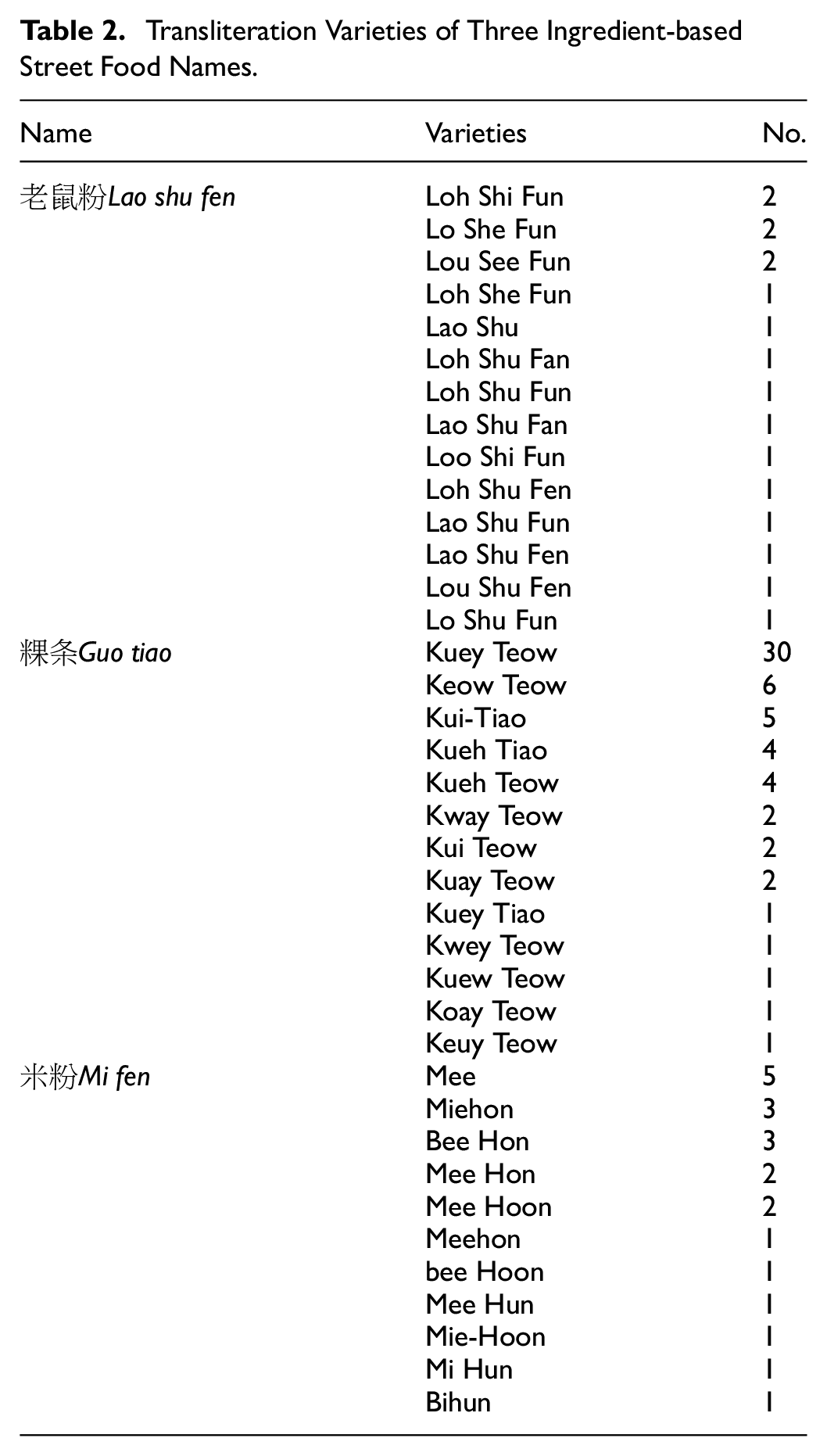
According to Table 2, it was confirmed from the commonalities that these transliterations were primarily based on Chinese dialects. The multiple transliterations were resulted from variations in letter spelling and pronunciation. Differently, the average number of transliterations used in the food name Lao shu fen revealed that none of the transliterations were dominantly used. However, the frequent use of transliteration by Kuey Teow showed that the spelling as Kuey Teow was the one that was commonly used among transliterations. The transliteration of Mi fen revealed that there were variants of m and b in “Mee,” “Mie,” “Mi,” “Bee,” “bee,” and “bi,” as well as variants of o, oo, or u in “Hon,” “hon,” “Hoon,” “Hun,” and “hun.” It was found that the primary distinctions across transliterations of these three food names were the space between syllables, alphabetic variations, capital or small letters in spelling, and various pronunciations owing to combinations of vowels and consonants.
Third, the phenomenon of multiple transliterations for names was also seen in place and clan names of street food names. A clan name is a mark for a certain ethnic group and is often marked by place names in Malaysia. Most of them showed different transliterations based on Chinese dialects and Chinese Pinyin in some place names as well (see Table 3).
Transliterations of Clan/Place Names in Street Food Names.

In Table 3, though the transliterations “Cantonese” and “Hokkien” accounted for larger numbers for the clan/place names 广府Guang fu and 福建Fu jian, respectively, there were other transliterations for these two names. From Table 3, these transliterations were different mostly in letter spellings, such as Guang, Kwong, Kong, Kwok, and Kung—as well as foo and fu. For 福建Fu jian, the differences can be seen first in the letters e in “Hokkien” and a in “Hokkian,” “Hokian,” and “Hock Kian,” then in the letters kk in “Hokkien” and “Hokkian,” k in “Hokian,” and ck K in “Hock Kian.” This showed that there was no specific standard for the changes in letters. This trait was also seen in other names, such as “Teo” and “teow,” as well as in “Chew,” “chew,” and “Chiew” in the transliterations for 潮Chao州zhou, “Hakka” and “Ha Ka” for 客家Ke jia, “Yeong Chow” and “Yong Chow” for 扬州Yang zhou—with subtle changes in one or two letters. Besides, it was also found that different pronunciations also existed, such as “Cantonese” (/kæntə’niːz/) and “Guang Fu” (/guǎngfǔ/), as well as “Hock Chew” with h sound and “Fook Chiew” with f sound—though two transliterations were for the same Chinese characters.
The transliteration “Gangnam” for 江南Jiang nan was in line with the Korean pronunciation of 강남 (/kaŋnam/), which was based on Gangnam district ( 강남구) in Seoul, South Korea. The transliterations “Java” and “Jawa” for 爪洼Zhao wa showed the difference in spelling between the English and Indonesian names for the island of Java. The transliterated place name “Nangi” for 南极Nan ji was not based on standard Chinese Pinyin Nanji. The pronunciation of “Nangi” was similar to /namgit/ in Hakka and /namgek/ in Hokkien and Cantonese (Interview).
Another finding was that some place names, especially those from China, used Chinese Pinyin in transliterations, such as 台湾 “Taiwan,” 台南 “Tainan,” 四川 “Sichuan” (a province including 万州Wanzhou district), “新疆Xinjiang,” 上海 “Shanghai,” and 隆江 “Long Jiang.” The two regions in China, 香港 “Hong Kong” and 澳门 “Macau,” maintained their initial names. However, “Macau” was originally in Portuguese based on the local Chinese dialect.
In comparison, Malaysia’s place names were transliterated using either Chinese Pinyin or Malay. For example, 三间庄San jian zhuang was a well-known spot in Kuala Lumpur for pork ball noodles. It was transliterated as “San Jian Zhuang” in standard Chinese Pinyin. The same transliteration was also seen in “Taiping” for the place name 太平Tai ping (the second largest town in the Malaysian state of Perak), although there was a difference in the spacing between the syllables. For another two place names, 怡保Yi bao (the capital city of the Malaysian state of Perak) and 金宝Jin bao (the largest town of the eponymous Kampar District, Perak, Malaysia) were transliterated to “Ipoh” and “Kampar” in Malay, respectively.
Fourth, the brand names in street food names were also transliterated mostly in Chinese dialects (see Table 4).
Transliterations of Brand Names in Street Food Names.

In Table 4, the finding revealed that transliterations of brand names frequently used Chinese dialects rather than Chinese Pinyin. The Chinese character 记Ji (a sigh or a mark) was typically transliterated as “Kee,” with the brand name “Kin Kin” being the sole exception. The transliteration “Pin Chen” for 品珍Pin zhen was based on Chinese Pinyin; however, “Chen” was a non-standard Pinyin for 珍Zhen. In addition, it was also found that there were different transliterations for the same Chinese character. For example, although both the brand names 鸿记Hong ji and 鸿泰Hong tai included the Chinese character 鸿Hong, it was transliterated to “Kong” and “Hong,” respectively. The same transliteration “Kong” was also used in 江夏Jiang xia “Kong Har” for the transliteration of Chinese character 江Jiang.
The fifth finding concerned the transliteration of Malay street food names (see Table 5). The transliterations of Malay street food names were found to be less complicated than the names of other Chinese street foods.
Malay Street Food Names and Transliterations.

In Table 5, it was found that only three street food names had more than one transliteration. “Asam” and “Assam” were two transliterations that differed by s and ss. In the same vein, “Belacan” and “Balachan” were different regarding the letters c and ch. In contrast, the difference between “Tom Yam” and “Tomyam” was in the space between the syllables and the capital letter Y. It was found that there were at most two transliteration varieties of Malay street food names. This reflected the relatively unified food names in original Malay.
Reflections of Cultures
The second research question aims to examine what cultures are reflected in the transliterations of street food names. The premise is that certain types of languages could be identified by their dialects or the same pronunciation of the original languages—that these languages are rooted in their particular cultures. There are two scopes in this section. The first concerns the types of languages in transliterations of all elements in street food names (see Table 6).
Types of Languages in Transliterations of Elements in Street Food Names.

Table 6 demonstrated that a high proportion of street food names were transliterated based on Cantonese, Hokkien, and Hakka pronunciations, showing the sub-Chinese cultures in Malaysia. There were also transliterations based on the Teochew dialect for food names. Romanized Chinese with Pinyin also existed in transliterations, which reflected a pan-Chinese identity (Ting & Ting, 2021; Wang, 2016); this is because Chinese Pinyin, together with Chinese characters, is considered the most important component of the Chinese culture. The transliterations based on Malay pronunciations were also found—this shows Malay culture in the transliterated street food names. Other Asian cultures—especially Japanese, Indonesian, Thai, and Korean—were also reflected in the transliterations of elements in street food names based on their original pronunciations.
The second scope concerns the cultures reflected in the pronunciations of the elements in street food names (see Table 7). It was found that different elements in street food names showed corresponding language dominated trends in pronunciations. Most elements in street food names were transliterated based on Cantonese pronunciation.
Cultures Reflected in Transliterations of Elements in Street Food Names.
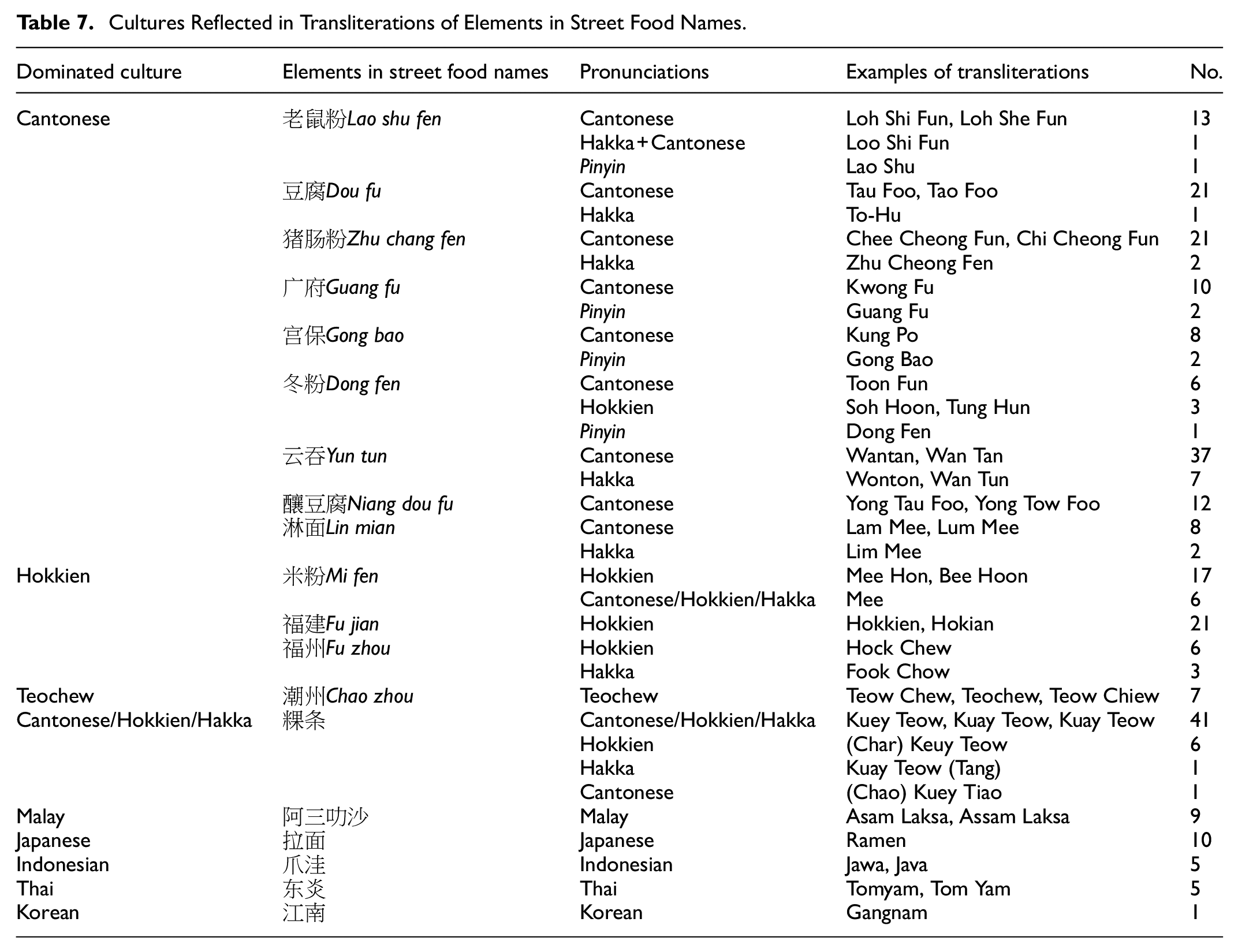
In Table 7, Cantonese culture was prominently reflected because transliterations of elements in food names were mostly based on Cantonese pronunciation. This dominant situation can be seen in the transliteration of ingredients, such as 老鼠粉Lao shu fen, 豆腐Dou fu (bean curd), and 猪肠粉Zhu chang fen (pig intestine-shaped rice noodle rolls). It can be also seen in the transliteration of clan names, such as 广府Guang fu, and allusion names, such as 宫保Gong bao. In particular, the transliterations of 老鼠粉Lao shu fen and 釀豆腐Niang dou fu (stuffed bean curd) were mostly in Cantonese pronunciation, though they were traditional Hakka foods. 3 This is an indication that cultures have been contacted and thus influenced.
Other clan cultures—such as Hokkien, Hakka, and Teochew—were also reflected. First, there were elements in street food names based more on Hokkien pronunciation in transliteration. These elements were ingredients, such as 米粉Mi fen, marked by “hon” and “hoon,” and clan names, such as 福建Fu jian and 福州Fu zhou, which were parts of the Hokkien-speaking group. Second, in comparison to Cantonese and Hokkien cultures, Hakka culture was reflected in many aspects—such as transliterating ingredient 豆腐Dou fu to “To-Hu” and 猪肠粉Zhu chang fen to “Zhu Cheong Fen.” It was also reflected in transliterating the cooking method 淋Lin (pour) to “Lim” and the place name 福州Fu zhou to “Fook Chow,” rather than “Hock Chew” in Hokkien. Third, the place name 潮州Chao zhou was transliterated to “Teow Chew,” “Teochew,” and “Teow Chiew” based on Teochew dialect, which reflected the Teochew culture.
In addition, one transliteration of a street food name could reflect different cultures. For example, the pronunciations of 粿条Guo tiao in Cantonese, Hokkien, and Hakka dialects were similar; therefore, the transliteration “Kuey Teow” could reflect Cantonese, Hokkien, or Hakka cultures (Interview). In the same vein, the different spellings (either “Kuay Teow” or “Kuay Teow”) were considered to contain three cultures. The shared cultures were differentiated by other elements in food names. For example, as Table 7 showed, 炒粿条Chao guo tiao (fried flat rice noodle) was transliterated to “Char Keuy Teow” and “Chao Kuey Tiao.” “Char Keuy Teow” reflected the Hokkien culture because “Char” was considered a Hokkien pronunciation. However, “Chao Kuey Tiao” reflected the Cantonese culture because “Chao” was considered a Cantonese pronunciation. 粿条汤Guo tiao tang (flat rice noodle soup) was transliterated to “Kuay Teow Tang,” which reflected the Hakka culture because “Tang” was a Hakka pronunciation.
An incidental finding was that transliterations, when in the same spellings as linguistically standard Chinese Pinyin, were not considered Chinese Pinyin in real life by Chinese Malaysians. Consequently, even if the signboard spellings were “Lao Shu Fen,” the street food vendors’ pronunciations were still based on the Chinese dialects that they were familiar with (Interview). Thus, Chinese Pinyin in Chinese Malaysian society indicated a process of conversion from Chinese dialects to Pinyin; however, there was an imbalance between the spellings and pronunciations.
Malay culture was also reflected in transliterating Chinese characters with Bahasa Melayu. From Table 7, “Asam Laksa” is a flavorful, tangy, and spicy Malaysian fish-based rice noodle soup. “Asam” in Malay means “tamarind” while “Laksa” refers to the rice noodles. The original Malay names were shown through the use of transliteration. Japanese culture was also reflected in the transliteration of ingredients. For example, the transliterated name “Ramen” for 拉面La mian used the original Japanese pronunciation of らーめん(/ˈrɑːmən/) to indicate the Japanese style of food. Thai culture was reflected in “Tomyam,” a popular Thai hot and sour soup that retained the original sound of ต้มยำ (tɒm’jæm) in Thai. Different from the reflections in ingredients, Indonesian culture was seen in the place name “Java,” which was transliterated (both Java and Jawa) based on Indonesian pronunciation. This was similar to the Korean place name “Gangnam” in reflecting Korean culture. Japanese, Indonesian, Thai, and Korean cultures were considered the “third culture” (Marco, 2019), in which the food cultures were neutral when compared to the Chinese and English cultures found in Malaysia.
Discussion
The findings of this study supported the possibility of transliteration, as our world is notably a transliterated space in an era of globalization, where sound is increasingly prioritized over meaning and function (cf. Gu & Almanna, 2024; Gu & Manan, 2024). On one hand, the transliterations of street food names in Malaysia used more Chinese dialects rather than Chinese Pinyin. It is found that the transliterations of this study are mostly based on Chinese dialects, which is different from the previous studies on the transliterations in Chinese Pinyin (Amenador & Wang, 2022; Li, 2019; Zhao, 2016). The finding reveals the speciality of transliteration in Chinese Malaysian society, which is different from Chinese society in Chinese mainland. The finding of using Romanized dialects is also different from other Asian countries that transliterated between English and Katakana in Japan during the Meiji Period (Sato, 2021) and the widespread esthetic use of Arabized English in Dubai (Gu & Almanna, 2024). In addition, the use of transliterations based on Chinese dialects resulted in varieties that were different in both spellings and pronunciations. At the first level of theorized transliteration, this finding is consistent with Li et al.’s (2022) and Grammenidis’s (2008) studies that discovered that transliteration, as a technique, played a role in causing diverse translations in food names. The change in letters of transliteration is similar to some of the previous studies, such as Marco’s (2019) case, which transliterated “Curry” to “Curri.” The change in letters in this study is more diverse, however, which reflects that there are no standard guidelines on the transliteration of street food names; moreover, the vendors transliterated the names based on the pronunciations of dialects they are familiar with. The transliteration variety confirms the second level of theorized transliteration that one name could have different transliterations based on dialect pronunciations in Malaysia.
On the other hand, these varieties in the transliterations of street food names reflected the different cultures of Chinese dialects, such as Cantonese, Hokkien, Hakka, Teochew, and local Malay, as well as other Asian languages, such as Japanese, Indonesian, Thai, and Korean. The Chinese clan cultures and multiple cultures in Malaysia are reflected from different languages and dialects in transliterations as a sociolinguistic approach is intended “to achieve a better understanding of the nature of the relationship and interaction between language and society” (Trudgill, 2003, p. 123). The higher frequency of the transliterations based on Cantonese is in accordance with the fact that Cantonese is dominant in Kuala Lumpur due to their populous strength (Hsiao & Lim, 2007; Wang, 2016). However, these cultures identified at a linguistic level may not be in accordance with the ethnic origins of the street foods. This means that a certain food name could be pronounced in other dialects or languages, such as the Hakka food Lao Shu Fen being pronounced as Loh Shi Fun in Cantonese. The spellings are influenced both by clan origin and their language abilities of street food vendors. Thus, the cultural fusion could be seen from this language contact and influences in pronunciations. This finding is similar to other transliteration studies in Asian countries in a broad scope. For example, Kim et al. (2023) found that Japan transliterated Korean place names using its own pronunciation, not the original Korean, in an attempt to force its identity on Korea. The decision of transliteration for food carries with it a complex meaning. Transliteration, as Garzone (2017) pointed out, is a claim of identity against the risk of assimilation that is inherent in integration—that it embodies the migrants’ attachment to, and nostalgia for, their original culture. The use of transliteration in street food names reflects the identification of different language groups and preserves the cultures of Chinese Malaysians and other Asian ethnic groups. It has become a convention and collective experience for Chinese Malaysians to use dialects in transliteration, as well as for other ethnic groups to transliterate with the same pronunciations as the original food names. This is no doubt beneficial to cultivate local communities’ cultural identity and social cohesion. Thus, the third level of theorized transliteration has been depicted. The realization that transliteration may reflect the source cultures is what accounts for the variety of transliterations from a cultural standpoint.
Transliteration in Malaysia reveals two implications in linguistics and culture. First, transliteration creates new words that are written in Romanized forms. As Yang (2005) points out, borrowing (which also includes transliteration) has long been recognized as an important part of the nativization that English has undergone. These newly created food names have the potential to be integrated into the Asian-English lexicon. This confirms Pym’s (2008) argument that translation should ideally be increasing linguistic diversity while lingua franca would appear to be reducing linguistic diversity. Second, transliteration strengthens the cultural diversity in which different cultures are preserved by maintaining original pronunciations. This is partly due to Malaysia’s multicultural social reality that Chinese people have brought with them a plethora of heritage languages—including Cantonese, Hokkien, Hakka, and Foochow—to Malaysia (Albury, 2017). Other Asian cultures—such as Indonesia, Japanese, Thai, and Korean—also exist in the form of transliterated languages in Malaysian society. Theorizing transliteration from translation strategy and variety to cultural reflection not only provides framework in dealing with Malaysia’s food translation and culture, but also provide reference for the global food translation and gloablisation of food culture. Street food names have been transliterated and have become part of the global foodscape, along with other characteristic Asian foods such as sushi (すし) from Japan, kimchi (김치) from Korea, curry (கறி) from southeast Asian countries, and European foods such as pizza from Italy. This has consequences for the language and cultural policy as a result. In terms of language policy, transliteration helps in the preservation and revitalization of minority languages, allowing policymakers to design educational materials and initiatives that support language transmission between generations. In terms of cultural policy, policymakers should ensure that varied cultural groups are fairly represented across a range of platforms and that they have equal access to opportunities and resources related to culture.
Conclusion
This study aims to examine how street food names are transliterated in Malaysia. The findings show that transliterations are based on the pronunciation of the language spoken by either the people who sell it or those who consume it. There are different spellings in the space between syllables, alphabetic variations, capital or small letters, and various pronunciations owing to combinations of vowels and consonants based on the Chinese dialects and other languages. The street food names written in Chinese characters are transliterated into a Romanized form with Chinese dialects, Pinyin, Malay, Japanese, Indonesian, Thai, and Korean. These varieties reflect the social reality of these vendors in spellings based on the pronunciations. A territory implication is shown that transliterations from Chinese to English in Malaysia mainly incorporate the elements of Chinese dialects and other languages; this differs from the food transliterations in Chinese mainland with standard Chinese Pinyin. The finding that the Cantonese dialect is frequently used in the transliterations of most street food names in Kuala Lumpur demonstrates the Cantonese position within Kuala Lumpur.
Is culture reflected in transliteration? The transliteration of street food names can be an evidence to label Malaysia as a multicultural society. This study highlights the variety of languages in transliterations, which reflects the cultural diversity in Malaysia. The Cantonese, Hokkien, Malay, Hakka, Japanese, Indonesian, Thai, and Korean cultures are reflected through transliterations. The diverse cultures are reflected in the pronunciations of the original language of the street food names. These varieties based on pronunciations, which are different from standard English, reflect the local cultural traits—especially the dialect preservation of Chinese Malaysians and the fusions of other Asian cultures in Malaysian society. This demonstrates the benefit of transliteration to cultural co-existence and cultural preservation, which labels Malaysia as a multicultural society. Thus, an analysis of transliteration offers a way of exploring diverse cultures. In particular, it allows us to conceptualize how diverse cultures are mediated in street food names through the strategy of transliteration.
This study contributes to translation studies by showing that transliteration from Chinese to other languages is used not only based on Chinese Pinyin but also on Romanized Chinese dialects and other languages. This not only enlarges the scope of transliteration theoretically but also offers a way to the revival of ethnic cultures in a multicultural society. Thus, the findings of this study also evoke the attention of language maintenance and cultural preservation studies. Practically, this study may also contribute to the food marketing industry because involving diverse cultures through transliterations on signboards shows hospitality to different consumers.
There are two limitations, which are the gray areas between food and people, as well as the similar spelling of pronunciation among Cantonese, Hokkian, Teochew, and Hakka. Over the years, a fusion of food-taking among Chinese, regardless of clans and origin, has been formed. For example, it is common for Hokkian to eat Teochew food and Cantonese food. Furthermore, some foods have similar pronunciations among Cantonese, Hokkian, Hakka, and Teochew. It is hard to identify which culture is the original, and it may even be a shared culture, too. Therefore, this study recommends that incorporating other research fields, such as dialect and area studies, has potential to enrich the findings of this study.
Footnotes
Correction (May 2026):
Article updated online to correct the affiliation of Hongxiang Zhu

Ethical Considerations
This study is in full compliance of research ethnics norms, and more specifically the codes and practices established in the SAGE OPEN Statement of Ethical Practice and Policy. It obtained the approval from the Ethics Committee for Research Involving Human Subjects (JKEUPM) with the reference number: JKEUPM-2023-637.
Funding
The authors disclosed receipt of the following financial support for the research, authorship, and/or publication of this article: This research was funded by Universiti Putra Malaysia, under the Geran Putra Inisiatif (GPI/2024/9792400).
Declaration of Conflicting Interests
The authors declared no potential conflicts of interest with respect to the research, authorship, and/or publication of this article.
Data Availability Statement
Data sharing not applicable to this article as no datasets were generated or analyzed during the current study.