



Abstract
With the widespread use of the Internet and the rise of new media, these platforms have empowered the young generation in Taiwan to independently learn, express, and communicate. They have also contributed to the prominence of the echo chamber phenomenon, and the resulting social division and mutual exclusion have gradually attracted attention from the academic community. Nevertheless, the conceptual connotation of the term echo chamber in political participation urgently needs clarification. In light of this, the study focuses on the echo chamber phenomenon of political participation among Taiwan’s youth within the context of network empowerment. Constructing the research framework based on defining and demarcating the echo chamber phenomenon, this article utilizes the theory of political socialization. The in-depth interview method is then employed to analyze and confirm the existence of the echo chamber phenomenon in Taiwan. The study reveals that the echo chamber, a term originating in digital culture, do manifest in real political engagement. Their formation is closely associated with patterns of political socialization shaped by empowerment and extensive Internet use. Both political parties and social groups engage in behaviors associated with the echo chamber, and different parties have distinct ways of utilizing the echo chamber.
Plain language summary
This study reviews existing theoretical research on the echo chamber and discusses its influence on the political participation of Taiwan’s youth. The findings indicate that the echo chamber phenomenon, which has historically been used for political communication, can also be utilized to explain youth’s use of the Internet to engage in offline actions. It facilitates the mobilization of young people to meet political demands, thus forming a new mode of political organization. From the perspective of political action and practical function, echo chambers serve as the optimal platform for political parties or social groups to unite their supporters, exert influence, and catalyze their mode of action. The echo chamber not only functions as a direct channel for information dissemination but also plays a central role in coordinating and promoting political mobilization.
Introduction
In the information age, characterized by innovative communication methods and the rise of new media, citizens now have access to a more diverse range of information than ever before. However, the abundance of information has paradoxically increased more difficult for individuals to make informed decisions. Consequently, information selection has shifted from rational neutrality to interest-driven preferences. Those with similar preferences and positions are more likely to gather and form tighter connections. Some studies suggest that individuals with similar or aligned positions are more prone to establish close connections within groups, giving them an advantage in political actions and participation, such as engaging in social movements, acts of resistance, and voting in elections (Boutyline & Willer, 2017; González et al., 2011; Kim & Bearman, 1997; Knoke, 1990; Romero et al., 2011).
The development of the Internet has significantly transformed the patterns of social movements in Taiwan. Movement organizers make use of the Internet’s characteristics, such as low cost, decentralization, real-time capabilities, and the ability to transcend temporal and spatial boundaries, to facilitate mobilization, social interaction, and communication. In the Human Development Report 2019, the importance of fairness and the need to move beyond income-based and average-level indicators are emphasized (United Nations Development Programme, 2019). The next focus is expected to be on empowerment and equal opportunities. Empowerment originated in the fields of education, psychology, and political science. It refers to the ability of individuals, groups, and communities to control their circumstances, exercise their power, and achieve their own purposes (Yair et al., 2008). Empowerment, whether individual or collective, involves enabling people to enhance their quality of life. It is regarded as a key indicator for measuring social sustainability, as individuals flourish when they feel empowered. The development of the Internet has introduced new forms of empowerment, creating a multi-level and dynamic developmental process that encompasses not only individuals and groups but also societal structures. On an individual level, in the era of the internet, new media contribute to enhancing individual autonomy and proactiveness in empowerment. This encourages individuals to engage with the internet and new media, learning to utilize new media tools to meet their own needs. It also encourages the use of technology for online interactions, facilitating participation in expression and practical actions (Kim & Beehr, 2017). From a group perspective, new media binds individuals together, forming online communities based on these new media platforms. These communities utilize their resources and stylistic positioning to attract like-minded individuals. Within the cultural space constructed on the internet, the production and dissemination of subcultural products take place. Concerning the entire societal framework, the reinforcement of decentralization and empowerment functions in the era of new media has led to the emergence of internet power, posing significant challenges to traditional social orders and power dynamics. For the generation known as the “E Generation,” the Internet has had a profound impact on values, social perspectives, and worldviews (Chen, 2020). Thus, the concept of the echo chamber, born out of the development and widespread adoption of internet technology, has entered Taiwan society and sparked considerable academic discussion.
According to current current academic research, the concept of the echo chamber is predominantly applied in the fields of communication studies or electoral research, with a focus on three aspects: the impact of communication media on shaping and constructing the media images on candidates or political parties (Guess, 2018), the influence of big data algorithms on audience groups (Colleoni et al., 2014), and the effects of echo chamber construction on political polarization (Barberá et al., 2015). In Taiwan, which is in the process of democratic transformation, although the concept of echo chamber has been widely discussed, to what extent does it align with the echo chamber construction model in previous studies? Among Taiwanese youth, often referred to as the “E Generation,” how does the echo chamber exist and take shape? More specifically, for this generation, is the echo chamber a product of construction, or a consequence of social development and reform? These questions remain open for further discussion and investigation. This study is based on the concepts of political socialization and echo chambers, and it primarily addresses the following questions: What are the existence patterns of echo chamber in Taiwan’s youth generation? and what impact will it have on Taiwan political and social development? To answer these questions, this paper conducted in-depth interviews with 13 young political participants in Taiwan through semi-structured interviews to understand the role and influence of echo chambers in the process of political action and participation. The structure of this paper is as follows. The section two discusses the concepts of network empowerment, echo chambers, and the current research process. The section three outlines the political socialization theory and echo chamber analysis framework used in this research and briefly describe the design of the research questions. The section four presents the results of the research design based on the aforementioned problems. Finally, the section five concludes by summarizing the phenomenon of echo chambers in Taiwan’s youth generation.
Definition of Concepts and Literature Review
As a relatively new academic concept, echo chamber related concepts are predominantly focused on communication studies. Therefore, the main focus of this study is to apply the analytical framework of the echo chamber to explore its influence on Taiwanese youth and to assess their broader impact on political development.
Definition of Echo Chamber
The term echo chamber is commonly used to refer to social and ideological environments shaped by similarity, often formed on social media platforms, where individuals exclude perspectives that differ significantly from their own. The echo chamber is a social space of discursive homophily, intentionally created by a person or a group of people, selecting voices to listen to that tout agreeable ideas to one’s own (Morelock & Narita, 2021). There is research on the dialogue of those who hold different positions, but the concept of political bias is more widely discussed in academic circles. Under the premise of the continuous development of the Internet, although the new media has provided individuals with a strong ability to acquire information, for example, the role of search engines in driving the flow of social information and narrowing the knowledge gap deserves attention. Not only search engines, but also the way individuals seek information is always conducted through the center of similar collective identity, so the power held by the “strong” in the context of new media empowerment once again forms the “power pyramid.” In this sense, network media does not promote equality, and individual initiative is still limited by the environment. At the same time, Cass Sustein pointed out in the early 21st century that with the rapid development of the Internet and the continuous expansion of information, people’s choice of information will depend more on their own preferences (Sunstein, 2001). Based on the rapid development of the Internet, Sustein further predicted that this one-way choice will lead people to selectively associate only with people who share their interests and receive only one-sided information (Sunstein, 2006). This has also become an important part of the concept of “echo chamber.” In other words, the phenomenon of echo chamber is closely related to political polarization. With the unidirectional and polarizing interest of the public in public affairs, it seems inevitable for the public to become politically polarized in the study of the audience of social networking sites (Du, 2017). However, there is still controversy about the connotation and composition of the concept of echo chamber. When analyzing the operation of media information related to right-wing groups and discussing related issues, Jamieson and Capella believe that the operation mode of echo chamber is to isolate members of the echo chamber from external information through a systematic mechanism (Jamieson & Cappella, 2008). The methods include: (1) By creating an opposing statement and gathering a group of supporters for the statement; (2) Developing words that are more familiar internally but less familiar externally to distinguish supporters from others; (3) Providing “Counter-explanation” to all opposing opinions, which not only refute the opinions, but also attack the opponents, thus losing the credibility of supporters; (4) Leading to a single orientation of opinion, causing supporters to rely on a single source of information, and making them resistant to any external source of information.
Jamieson and Capella’s paper had a profound impact, and the concept of echo chambers was widely discussed in the academic community after them. In addition to Jamieson’s concrete framework, Nguyen interprets this as a social epistemological structure, which is more difficult to break down than an “epistemological bubble,” and argues that it is a kind of “cult-like organization.” Nguyen points out that echo chambers arise because humans are unable to fully process the complexity of information and have to rely on and trust some people or institutions; At the same time, within an echo chamber, there tends to be only one dominant voice, and contrary opinions are actively eliminated and negated. He argues that the trust gap between the echo chamber and the outside is created by epistemologically denigrating the information and people outside the echo chamber and reinforcing the opinions and speech inside (Nguyen, 2020).
Regarding echo chambers, Nguyen summarizes it as follows: (1) Having a common idea or concept; (2) Participants are constantly inculcated with and reinforced by shared ideas, while diminishing trust in non-echo chamber members; (3) Where members actively cut off and alienate the possibility of exchanging information with those outside the echo chamber; (4) There is an internal “divergence reinforcement mechanism” to handle situations where outside information enters the echo chamber. However, the induction and construction of echo chambers are similar across different disciplines. Robson’s analysis of echo chamber is based on the observation of echo chamber phenomenon in aesthetic research groups, which can be summarized into three points: (1) The accepted views within a group, especially those of its opinion leaders, are repeatedly reinforced, while opposing opinions will be excluded or ignored; (2) The echo chamber is a “closed space” whether from a regional, cultural, or other perspective; (3) The opinions of the opinion leaders in the echo chamber are not only be continuously disseminated but also internally strengthened (Robson, 2014).
Throughout the concept construction discussed above, whether in the fields of political communication, epistemology, or aesthetic analysis, certain similarities emerge, such as “opinion leaders,”“common values,” and the “reinforcement concept.” Therefore, based on the above perspectives, the construction of echo chambers in the academic community can be summarized into five elements: (1) Core of belief: the construction of an echo chamber is based on a shared concept, idea, or individual; (2) Audience: individuals who accept the core belief will gravitate around it within the echo chamber; (3) Reinforcement: the echo chamber strengthens the existing concepts or ideas of its audience; (4) Divide: in the process of echo chamber construction, individuals develop their own discourse system; (5) Confrontation: after the formation of the echo chamber, its members use their ideas to “counter-interpret” or provide an “adversarial interpretation” of non-local echo chamber information to oppose external opinions. If the core is the center and the echo chamber is the periphery, it can be constructed in a “concentric circle” mode, as shown in Figure 1 below.

Concentric circle pattern of echo chamber.
While the framework mentioned is effective in interpreting and understanding political action and communication modes, it lacks consideration for the assumption that citizens may accept such positions because they are already predisposed to them. In this stage of the discussion, the original participants-the citizen audience-are not thoroughly examined. While this approach is suitable for communication studies, it requires a more nuanced interpretation when applied to citizen political participation. Simultaneously, there is no consensus on the extent to which echo chambers are formed, their likelihood of persistence, and their impact on democracy. This highlights the need for a more comprehensive understanding of echo chambers in the context of citizen political engagement (Dubois & Blank, 2018).
Existing Academic Research on Echo Chamber
With the rapid development of the Internet, research on echo chambers has grown significantly. Data collected by the Web of Science indicates an explosive increase in echo chamber-related publications since 2018. Clearly, the impact of echo chambers on politics has been substantial.
The Relationship Between the Echo Chamber Phenomenon and Social Interaction
The echo chamber phenomenon creates a group that is filled with similar information and viewpoints while excluding content from other fields. The psychological inclination of individual information selection drives individuals to reject exposure to alternative perspectives. Relevant research indicates that the public filters and selects social activities based on their own interests and preferences, associating with groups that share similar stances, thereby strengthening their confidence in their existing views (Cinelli et al., 2021). Under the influence of the echo chamber phenomenon, people tend to stick to information, viewpoints, and even groups that align with their preferences and interests, rejecting other information, thus forming entrenched circles that lead to isolation and opposition. Such divisions are particularly intensified in the digital age (Zhu et al., 2021).
However, there are differing opinions on the social impact of echo chambers. Some studies question whether echo chambers cause social division and ideological gaps, arguing that the effects of the echo chamber phenomenon have been exaggerated (Barberá et al., 2015). Other research suggests that in the process of breaking echo chambers, the resulting information rejection does not disappear due to extensive information interaction but rather intensifies with the increase in information volume (Settle, 2018). Therefore, it can be concluded that the impact of the echo chamber phenomenon on social interaction is both complex and multifaceted.
The Relationship Between the Echo Chamber Phenomenon and Political Polarization
As to whether the echo chamber will lead to the result of political polarization, the academic community has a relatively rich discussion. Following Sustein’s definition, Pariser’s concern is whether big data algorithms will lead directly to the creation of “monocultural content” and ultimately to the phenomenon of echo chambers (Pariser, 2011). Later, some researchers found that the existence of algorithms would lead to more customized information dissemination, resulting in ideological polarization and political polarization, and ultimately political opposition (Dylko et al., 2017, 2018). In actual cases, scholars found that the Internet greatly promoted individuals’ political participation and sense of efficacy, and directly affected their expressed will (Chan et al., 2017). The extensive use of social media platforms enables individuals to gain maximum information exposure and response at a low cost, thereby fostering the expression of personal political will and even the mobilization of political participation (Park, 2015). However, in Chinese society, the rapid development of the Internet has constrained discussion on democracy, leading to ideological antagonism and the exacerbation of the echo chamber phenomenon (Chan et al., 2019). Nevertheless, in relevant research on social media, the question of whether the echo chamber exacerbates social antagonism and ideological estrangement is still under debate (Barberá et al., 2015).
Based on relevant research cases among Chinese communities, it can be observed that the formation of the echo chamber phenomenon is influenced by factors such as community influence, information homogenization, and value identification, which lead to the emergence of the “spiral of silence” in society. The formation of opinion circles causes individuals outside these circles to remain silent or conform out of fear of isolation, resulting in more homogeneous mainstream viewpoints within the circles. This, in turn, exacerbates the closure of information within the circles and hinders the exchange and expression of diverse opinions (Gong, 2019; Yuan & Wang, 2022). Thus, it can be seen that in Chinese society, the echo chamber phenomenon not only leads to group segregation but also causes different groups to actively avoid discussions that might provoke conflict during interactions.
Analysis Architecture and Research Design
Under the traditional orientation paradigm of political participation and election research, the blue-green plate theory (The blue-green plate theory refers to a framework used to describe the political landscape in Taiwanese elections, where the electorate is divided into two main political camps or blocs based on their support for different political parties. The blue bloc: This group supports the Kuomintang, which traditionally advocates for closer relations with Chinese mainland. The green bloc: This group supports the Democratic Progressive Party, which advocates for Taiwan’s independence from China) and the political spectrum theory (The political spectrum, also known as the political coordinate system, is a tool used to measure and categorize individual political stances and ideological tendencies. It provides a framework for understanding various political beliefs and positions. In Taiwan, the political spectrum is not typically divided into traditional left-wing and right-wing ideologies but rather categorized into two main colors: blue and green). This framework projects the public stance of Taiwan onto a binary horizontal axis and allows for backward inference based on the influence of election results on each party. However, since the Sunflower student movement (The Sunflower Student Movement, also known as the March 18 Movement or the Legislative Yuan Occupation, was a major social and political protest in Taiwan from March 18 to April 10, 2014. The movement was initiated by university students and civic groups to oppose the Cross-Strait Service Trade Agreement (CSSTA) between Taiwan and Chinese mainland), the political issues have evolved. If the analysis continues to rely on the original concept, it will be limited in the dualism. In combination with the content discussed in the above literature, based on the structure of echo chamber and the sorting out of the above concepts, this study proposes that the phenomenon of echo chamber in the youth generation can be analyzed and explored according to the analysis of the related concepts of “political socialization.” Influenced by society and peers, the discussion of the young generation on the Internet is closer than that of previous generations, so it can be assumed that the echo chamber phenomenon exists among Taiwan’s youth. In addition, when the Heronsbill student movement broke out in 2014, the enthusiasm and spontaneity of the young generation in Taiwan for public affairs also produced many differences from the previous political and social movements in Taiwan (Lin, 2016), and also triggered many discussions about “polarization” and “tearing” of Taiwan society (Clark et al., 2019; Hsiao et al., 2020).
Analysis Path of Political Socialization
The formation of an individual’s outlook on life, values and worldview is not innate but developed through nurture. Similarly, the formation of personal political views is also the process of adaptation and integration of individuals with political consciousness, known as political socialization.
The term “political socialization” was first used in 1954 in Gardner Lindzey’s The Handbook of Social Psychology, although discussion of political socialization in this book is more focused on voting behavior. It also indicates that the process of the formation and development of personal political identity, personal beliefs, personal values and personal behavior patterns can be used for the study of political life (Lindzey, 1954). Regarding the main research subjects of political socialization, different scholars hold different perspectives. For example, Easton mainly focuses on two directions. One is the nature of political involvement, which tends to be party identification, political knowledge and political participation system. One is political direction (Easton et al., 1969). Sears, on the other hand, is more nuanced into belonging to a political system, political partisanship, and political participation (Sears, 1981). After that, Dennis proposed ten classic research directions of political socialization, including political socialization related to political system, the content of political socialization, political socialization in the life cycle, the problem of socialization between political generations, the cross-cultural perspective of political socialization, the differences between sub-groups and subcultures, the process of political learning, media and institutions in political socialization, and politics A study of individual differences in the degree and effect of political socialization and special forms of political socialization (Dennis, 1968). These studies were all produced in the 1960s and 1970s, and the research generated during this stage firmly established political socialization within the field of political science. However, the researches fell into a stagnation after the 1970s. There are two reasons for the research stagnation. On the one hand, the original research field of “political socialization” is very extensive, and on the other hand, the interpretation of the original theory is weak. Therefore, in the 1990s, Sears regrouped political socialization into four categories, They are political belief, political attitude, political self-identities and political patterns of behavior (Sears & Funk, 1999). For example, Wasburn (1998) summarized the influencing factors of political socialization in various processes of human life based on the above-mentioned studies (see Figure 2).

The influencing factors of political socialization in individual life process.
From the above discussion, it can be found that individuals’ political beliefs, attitudes, identification and behavior patterns are not invariable, but can be shaped by external factors. Therefore, it can be assumed that individuals’ political cognition is subject to construction and influence. This study focuses on the impact of the political socialization process of the youth generation on their participation in the echo chamber and its impact on Taiwanese society. First of all, based on family factors, environmental factors, social education and life opportunities, the younger generation tends to possess a more mature and independent personality than adolescents. Secondly, compared with the middle-aged and older generations in society, the young generation has more political passion and less political discourse power. Thirdly, the current situation of the youth generation will likely reflect the trend of Taiwan society in the future.
Research Design
Therefore, based on the dialogue and analysis of the echo chamber theory mentioned above, this paper takes the theory and the above discussion as reference to construct the interview structure of the impact of echo chamber on the young generation (see Table 1), and accordingly designs a questionnaire accordingly to conduct in-depth semi-structured interviews with relevant subjects of the young generation, so as to understand the young generation’s understanding and discussion of the relevant concepts of echo chambers.
Echo Chamber Interview Framework for the Youth Generation in Taiwan.
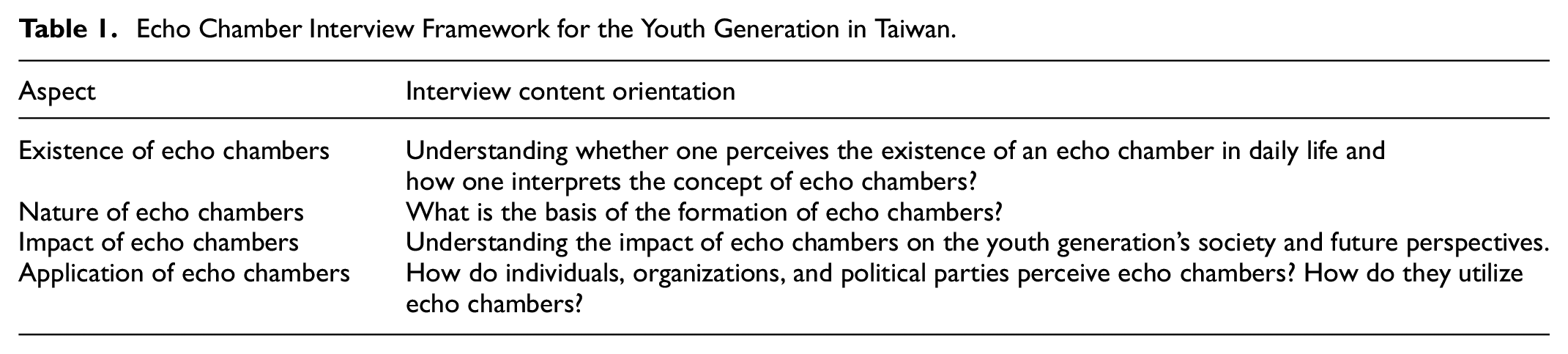
This paper focuses on the youth generation as the main research object of the echo chamber phenomenon for the following reasons: (1) Compared with the middle-aged generation, today’s youth generation has received more civic education and training, and its understanding of politics is also increasing. (2) The young generation is the most affected by Internet empowerment and has a strong connection with real life.
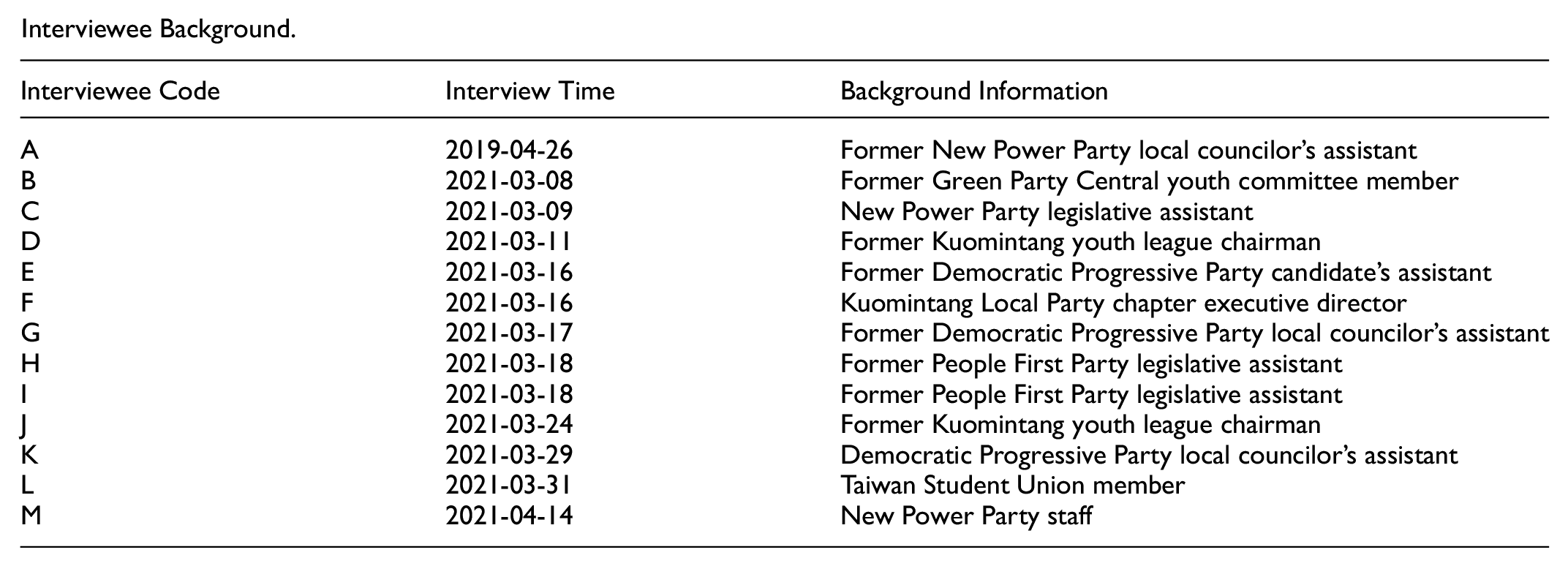
In order to answer the research questions, this paper adopts the in-depth interview method in the qualitative research method. The selection of qualitative research methods stems from the recognition that mainstream quantitative statistical methods are applicable to multiple cases (in an attempt to establish overarching principles that apply to a wide range of cases) (You, 2023). From March 2019 to April 2021, this study used the interview research method to collect and integrate the data of 13 young people who had participated in political work, covering the current mainstream political parties in Taiwan, such as the Chinese Kuomintang (KMT), the Democratic Progressive Party (DPP), the “Era Power” Party, the People First Party, and the Green Party (see Appendix). It is important to emphasize that the young people interviewed are not representative of the general youth population in Taiwan. They are deeply involved in political work, so some of their views may have limitations. However, these young generation political participants possess deep insights and experiences regarding the echo chamber phenomenon, including a wealth of observations about how it operates in political contexts. In this paper, the above youth generation is selected based on the following considerations: (1) Political participants have more access to different types of people than the general public, and they have more vivid feelings about echo chambers; (2) Political participants are more likely than the general public to experience the use of echo chambers in political operations; (3) Compared with the general public, youth political participants of different parties cover a wider range of positions and are more in-depth.
Through interviews, this paper seeks to understand and explore the influence of these young political participants on the social and political aspects of the echo chamber, and analyzes their psychological perceptions and cognition responses, so as to summarize key insights and facilitate further discussion.
Research Result
Based on the aforementioned research framework, this study examines the echo chamber of young political participants, combining their personal life experiences and political stance analysis, and summarizes the influence of the echo chamber phenomenon among Taiwan’s youth.
Existence and Nature of the Echo Chambers for the Youth Generation
Respondents generally believe that echo chambers exist and affect real life and political judgment. When it comes to understanding the concept of echo chamber, most respondents identify the concept of echo chamber as people around them with similar ideologies or values. In other words, respondents believe that the construction of echo chambers is essentially an “aggregation” of people who share similar ideas, rather than an “agitation” stimulated by personal or individual opinions. Similar values and ideologies facilitate communication between young people within the echo chamber, and peer orientation also strengthens the interactive responses there, making young people more connected.
Actors in the same echo chamber become more trusting of each other by expressing their positions on the same issues, thus forming tacit understandings. A number of respondents pointed out that the construction of echo chambers is more connected by shared positions on issues, so the formation of echo chambers is the gathering and union of those who hold the same views on a certain issue, or those who are concerned about a certain issue. When individuals and groups in the echo chamber hold different positions on other issues, they seek to unite with those who hold similar positions on other issues. In other words, the same position on a single issue can allow it to converge, while the same person may be part of different echo chambers on different issues.
I understand the echo chamber group is composed of people with similar values concerning a certain public issue, though not everyone shares the same degree of engagement (interviewee G).
It may be a group of individuals with similar positions and ideologies, who may have a certain level of mutual trust in terms of the intensity of their actions and participation or resistance, and they know each other. Even if they don’t know each other personally, they can confirm their closeness through their shared stance. This defines the echo chamber (interviewee L).
If there is an echo chamber, I think it probably consists of these people with similar ideologies, who have a tacit understanding and are connected with each other on this issue (interviewee M).
As for the influence of the echo chamber phenomenon, most respondents believe that the people within the echo chamber are not unconsciously participating but engaging consciously. Moreover, when different echo chamber audiences meet, the more vulnerable party will selectively silence their voices due to the unfavorable discussion environment, and there is no motivation to change each other’s position based on interpersonal pressure. Therefore, in most cases, young people belonging to different echo chambers are unwilling to engage in position debates with those outside their echo chamber, resulting in further audience consolidation within the echo chamber.. For example, young people tend to follow accounts that align with their own views on platforms like Facebook, Instagram, and Twitter, and join related discussion groups, forming a self-reinforcing information environment. In schools, communities, or interest groups, young people are more likely to gather together, forming small circles with similar viewpoints and values. For the young generation, the strengthening of the connection between the members of the echo chamber is not an unconscious behavior, but the result of active action.
The echo chamber, I think, is a group of people with similar values. Facebook is the best example: people with similar values are fighting on one side, while those on the other side are afraid to speak. As a result, you lose the process of hearing different voices (interviewee E).
Some of the people you interact with regularly might be your social friends, your online friends, or your own close friends. These people form your echo chamber. These friends share similar ideas with you, making you more inclined to talk to them. This is your daily communication echo chamber, and even your workplace can be an echo chamber (interviewee K).
This is a conscious state of being. I know I am in an echo chamber, but I just want to stay in the echo chamber and do not want to understand other people’s thoughts. In some ways, this is a difference in values, but changing values is difficult. Many people, including myself, do not want to change. I just find the circle I like. So, everyone in the echo chamber is conscious of it (interviewee H).
In summary, it can be found that the young generation in Taiwan believes that echo chambers are formed through the process of seeking like-minded peers via online networks. To maintain social relationships, young people do not want to engage with friends who have opposing opinions in reality, so they seek out those who share the same opinions on social media and build echo chambers. Therefore, the construction of the echo chambers is the result of the intentional and conscious actions of the youth group.
The Impact of the Echo Chambers
The influence of echo chambers on young people can be divided into two levels. The first level is the part of personal life, where the discussion is based on the respondents’ own life experience and choice decisions. For the young generation, political discussions are issue-oriented, as mentioned above. When different echo chambers (different opinions) are present, party affiliation is not an important factor affecting dialogue and exchange. In the daily life of the interviewees, when they encounter different echo chambers around them, young people usually choose two ways to deal with them: avoiding to talk about issues that may cause conflict, or simply catering to each other’s opinions to avoid conflict.
Being in the same echo chamber feels more comfortable, as everyone shares common topics to discuss. When people from different circles interact, they will become aware of their differing positions, which can lead to mutual estrangement. Personally, I enjoy making friends and do not want to lose them over certain behaviors, so I handle interactions separately, discussing different topics with different people and avoiding political discussions as much as possible (interviewee E).
For example, supporters of the Kuomintang and the Democratic Progressive Party often can’t talk to each other, but the most extreme supporters can. This is because they have already labeled each other. Especially among political workers, everyone has seen so much that their enthusiasm has been transformed into work, which is more rational and allows for dialogue (interviewee D).
I often meet people with different political leanings, but in reality, people are kind. They usually don’t push their views aggressively unless they want to promote political figures, in which case their attitudes might be tougher. Otherwise, at events like running trips or public gatherings, members of different parties and factions will exchange a few words of greeting. Most people in politics are engaged in the same work, so the common belief among ordinary people that political actors are cut off from each other does not reflect reality. This kind of separation does not happen in political circles. Maintaining good relations is an important part of the current political work. Contact with people in different echo chambers can help us understand how real politics works. Otherwise, miscalculations can occur, and it’s important to step out of our echo chambers in a timely manner. In my view, the echo chamber doesn’t really matter (interviewee F).
But when it comes to the social and political impact of the echo chamber phenomenon in Taiwan, respondents have a more negative and pessimistic view of it. Some respondents are concerned that the dialogue between different echo chambers may challenge each other’s values and identity, leading to mutual attacks on the dialogue, which is not conducive to social communication. Especially in unfamiliar environment or network environment, due to the hidden identity, the dialogue between different echo chamber audiences on the same issue often becomes more intense and aggressive, which will make social communication difficult, weaken the foundation of political dialogue, and ultimately lead to the weakening of social connection. In fact, Online echo chambers enable users with preexisting biases to find like-minded individuals for “warming up” their views, further reinforcing their beliefs. This is in direct contrast to the claim that online information can help us broadly access diverse opinions. Large online platforms, driven by commercial interests, use big data and algorithms to disseminate potentially misleading information, thereby exacerbating users’ biases.
The echo chamber phenomenon hinders social communication and can easily become a tool for conflict. As the echo chamber thickens and mobilizes the masses, it becomes easy for it to spread. The public will only believe that what they think is correct, and in the long term, this will affect their thinking patterns and erode their trust in the government (interviewee G).
The impact of the echo chamber is significant and can even exacerbate political polarization. For example, when I see discussions about Taiwan’s “independence” on Facebook, if another group presents opposing viewpoints, there will be a group of people who engage in verbal attacks. Although there are merits to the opposing viewpoints, people become unable to engage inrational discussion about the issue (interviewee E).
It has a great influence. According to my understanding, the values of traditional Chinese society was mutual assistance, such as through clans. However, after the May Fourth Movement, Chinese society was profoundly impacted by Western ideas, leading to increased individualism. Guided by a self-interest orientation, different groups converge to form larger entities, which then clash with one another. This phenomenon is evident in Taiwan, where people amplify their voices by assembling echo chambers to enhance their influence. Previously, mutual aid was the norm, but now political needs drive the formation of echo chambers (e.g., some may believe that anti-homosexual sentiments are hateful, which thickens the echo chamber). This can have negative effects on society, such as fostering populism (interviewee J).
From an individual perspective, the interviewees are concerned that echo chambers exacerbate the “blindness” of the general public. Unlike the interviewees, who have extensive political experience and can recognize the existence of echo chambers and their effect on increasing blindness, ordinary young people often do not realize the existence of echo chambers and thus find it difficult to escape their influence. This leads to limitations in political communication and potential exploitation. Throughout the interviews, many interviewees mentioned Taiwan’s 2018 same-sex marriage referendum as an example. They observed that, on social media, supporters of same-sex marriage seemed to dominate. However, the actual voting results showed that the referendum did not pass, which was unexpected. This example illustrates how echo chambers can restrict people’s awareness of alternative perspectives. The interviewees believe that echo chambers reduce the public’s attention to those outside their own echo chambers.
For example, in 2018, same-sex marriage became a hot topic in media coverage. The overwhelming online presence and the echo chamber effect on social media influenced many people’s judgments. It wasn’t until the results of the referendum were revealed that people realized that supporters of same-sex marriage were actually a minority in society. The stark contrast between the referendum results and the online clamor left many on social media in shock. Despite some pre-referendum polls indicating that opponents of same-sex marriage were twice as numerous as supporters, many ignored these findings, especially within the pro-same-sex marriage echo chambers. When the referendum results were announced, the emotional collapse of these social media echo chambers led to a surge in immigration-related statements and even post-referendum depression. This phenomenon, driven by the high online visibility and frequent activities of the pro-same-sex marriage community, made the younger generation and student groups mistakenly believe that supporting same-sex marriage was the mainstream opinion in Taiwan society.
Let me give you an example: the 2018 same-sex marriage referendum. On Facebook, a large number of people supported same-sex marriage, but what was the actual outcome? Although the number of young voters was small, looking at the voting results, many young people did not vote in support. While many people liked posts on Facebook, the actual number of voters was much lower (interviewee B).
What is more dangerous is that you may not realize there are other people and other viewpoints outside of the echo chamber, leading you to believe that this is the consensus of the majority. After all, the purpose of an echo chamber is to find and interact with like-minded people. The danger lies in mistaking a subset of opinions for the views of everyone (interviewee I).
Different parties have different echo chambers, making it difficult for them to communicate and coexist across their own echo chambers. Although they live in the same society, they feel as if they are in different worlds. On the same issue, different groups spread different positions through their respective echo chambers to gain their own political interests, creating a gap in the ideal of a civil society (interviewee L).
On significant social issues, being fixated on echo chambers can distort one’s value judgments about these issues, preventing a comprehensive understanding. This is particularly problematic when political figures intentionally influence public opinion by promoting favorable narratives. Those who are unwilling to step out of their echo chambers are exposed to only one-sided information, which in turn affects their political attitudes. Naturally, this is detrimental to a political system that aims to foster diverse discussions (interviewee F).
It can be observed from the echo chamber phenomenon that the development of the Internet and the acceleration of information dissemination make it easier for young people to obtain information and form their own positions. In the real world, to maintain interpersonal relationships, young people choose to avoid conflicts in a passive way, and are more willing to express their positions online, so that they are more willing to integrate into the echo chamber and form a group. This “sense of belonging” based on a common position makes young people more willing to act on that position. For example, in the real world, this phenomenon is quite familiar. Chinese culture emphasizes conformity, so individuals tend to align with mainstream opinions to gain acceptance and recognition. They often avoid direct conflict with others over differing viewpoints. In the field of communication studies, it has been observed that this phenomenon eventually leads to a spiral of silence, where only the mainstream opinion is voiced, growing louder and louder, while others either conform or remain silent.
The Application of Echo Chambers in Terms of Youth Empowerment
The use of echo chambers in political and social affairs enables the rapid formation of issue-based groups.
We also use the Line group approach (Line group approach refers to the use of Line, a popular social media app in Taiwan, to create and manage online communities or discussion groups for the purpose of maintaining and strengthening information silos or echo chambers. Line is similar to WhatsApp and allows users to create groups where members can communicate, share information, and discuss topics of mutual interest) to operate and connect our echo chamber, serving our constituents through information posting and content sharing. There are a lot of local people, and we connect with them through this (interviewee A).
We want to expand the echo chamber to promote our political ideas through initiatives or campaigns. After their own echo chamber is formed, members will debate, brainstorm, and reflect on whether their discussions are reasonable. Once they have refined their ideas, they will form a relatively large echo chamber and then promote it (interviewee L).
Although the echo chamber is not generally viewed positively by respondents, in the political arena, respondents from both parties acknowledged its important rolein elections and in promoting their party’s positions. The strategies adopted by different parties to engage with the echo chamber also vary.
In accordance with its long-term ruling history in Taiwan, the KMT is more accustomed to relying on the connection between local party branches and local factional forces to conduct social mobilization and development. However, following Taiwan’s democratic transformation, the party’s overall organizational structure has failed to keep pace with the modern use of the Internet, and the operation of online echo chambers remains underdeveloped. As a result, the KMT’s strategies for utilizing echo chambers among young people lag behind. Their perception of echo chambers also differs from the more conventional understanding held by youth.
In my political party, the use of echo chambers has been quite proactive, especially in the early days, with our party focusing on organizational tactics. Under party organization, many informal groups were established, such as various associations. While not directly governed by the party, they remained affiliated and regularly participated in promotional activities. During elections, these groups transitioned to electoral activities and provided manpower. For example, before elections, we organized forums where party members are invited to listen to candidates’ political views, which were then disseminated to the public through the members. However, in the past decade, this method has gradually declined because, with the advancement of online information, people no longer favor this approach (interviewee F).
My political party does utilize the echo chamber effect, but interestingly, to win elections, we should theoretically be seeking the support of the broader public. For instance, it seems unnecessary to hold activities solely for party members, as they are already within the echo chamber and unlikely to influence more people. Additionally, sometimes harsh criticism can arise within the echo chamber itself, such as when the KMT loses an election and its supporters become the fiercest critics of the party (interviewee D).
The DPP is different from the KMT in terms of its political party composition. It originated during the KMT’s ruling period and was primarily formed by social opposition forces at that time, so it is more sensitive to social trends. Because its strategy is close to the use of social media and the Internet, the construction of echo chambers is more active and positive. The DDP excels in leveraging social media and echo chambers to get the message out faster, and is more willing to give younger generations the opportunity to collaborate. In the operation of the DPP, the echo chamber is not just a group that aggregates shared ideas, but rather serves as a mobilizing network for collective action. For example, on May 24, 2024, during the incident where the public surrounded Taiwan’s legislative body, the Democratic Progressive Party’s (DPP) social mobilization strategy clearly harnessed the echo chamber effect. The incident was triggered by a congressional reform bill led by the Kuomintang (KMT) and the Taiwan People’s Party (TPP). If passed, this bill would significantly check the power of the DPP’s governance, causing dissatisfaction within the DPP. As a result, the DPP called on its supporters to protest outside the legislative, and at one point, the number of demonstrators exceeded 100,000. In this incident, the DPP fully utilized the echo chamber effect by criticizing the bill’s process as being shady and the procedures as unjust. Simultaneously, they conducted extensive reporting and sharing on the internet and mobilized support through major social media platforms like Facebook and Line groups, calling on their supporters to take to the streets and pressure the opposition parties. At first glance, it seemed that a large number of people had gathered outside Taiwan’s legislative body in support of the DPP, creating a significant show of force. However, opinion poll data indicated that the majority of the public still wanted legislative reform and supported the reform efforts led by the KMT and TPP. This reflects the actual mainstream public opinion.
Our DPP primarily utilizes the echo chamber effect through Facebook. Disseminating information on social media platforms like Facebook ensures preferential exposure and enables relatively rapid spread (interviewee E).
The DPP uses echo chambers strategically. They establish distinct echo chambers for various interests. For instance, there are specific echo chambers targeted at individuals concerned with youth affairs. Echo chambers function like networks united by shared values, which are difficult to change. Generally, an echo chamber consists of a group of similar individuals with common goals, allowing for more effective policy implementation (interviewee G).
Compared with the size advantage of the two major parties, it is not easy for small parties and social groups to gain comparable media exposure, and the group cohesion shaped by the echo chamber is beneficial to the mobilization and publicity efforts of small parties. Therefore, it is necessary for them to actively construct and utilize the echo chambers. Youth supporters of smaller parties also need to use echo chambers to promote cohesion and galvanize group action. However, the use of echo chamber places small parties to fall into a dilemma of political strategy choice: on the one hand, based on the development of political parties, they need to step outside their original echo chamber support base to gain broader opportunities. On the other hand, if they break away from their existing support circle, they risk falling into an “information bubble” due to insufficient support. Therefore, for small parties, the operation of echo chambers is both a survival strategy and a potential constraint on growth. For social groups, members of the group are already activists with similar positions under the same issue, so members of the echo chamber are not only supporters of action, but also the core agents for driving collective action.
I’m thinking of Facebook, because sometimes we send a post and it’s an echo chamber, and whoever likes you likes you. For small parties, we still have to use it, otherwise it’s impossible to attract new supporters. After all, compared with the blue and green parties, the saddest thing is that the small parties are not taken seriously, and their names rarely appear in the news. So you have to use the echo chamber, otherwise you can’t do anything, it’s ugly. The same is true of many small parties, which can only be held together by their echo chambers (interviewee H).
There have been examples of using echo chambers before, and we proposed using stakeholder support with supporter groups to push the case law. But whether such tactics would be used in the end depended on ideology. As we mentioned above, we should choose the side, not the middle, because politics basically involves choosing the sides, there is no middle. It’s like voting. It’s on opposite sides of the spectrum. But the boss did not want to give up the old supporters and did not adopt our suggestion (interviewee I).
In summary, it can be observed that different political groups have utilized the echo chamber phenomenon to construct and strengthen their own political influence. Different political groups use echo chambers differently, depending on their specific circumstances.
Discussion
Through interviews with political participants in Taiwan’s youth generation, this study shows that the echo chamber phenomenon does exist in Taiwan’s youth generation. However, its performance characteristics and definitions are different.
Existence and Nature of the Echo Chambers for the Youth Generation in Taiwan
From the respondents, it can be observed that Taiwanese youth are aware of the presence of echo chambers, which carries two significant implications. Firstly, the existence of echo chambers can be perceived; respondents can sense the different groups represented by various opinions and stances. Secondly, echo chambers can be utilized; respondents, based on their life and work experiences, have found that various political groups make use of echo chambers to extend this phenomenon from the internet to real life, influencing and changing politics.
Echo chambers have stimulated the collective networking and action capabilities of Taiwanese youth, empowering their political actions. On the other hand, the existence of echo chambers has increased the cost of issue communication for Taiwanese youth and forced them to adopt avoidance measures. From a series of social movements initiated through the internet since 2014, it can be observed that echo chambers have provided Taiwanese youth with specific stances a bridge to access information, organize, and take actions. The emergence of echo chambers also demonstrates their strong social energy, influencing and even changing Taiwanese society (Hsieh & Skelton, 2018).
In terms of structural patterns, compared to the “concentric circle” model where convergence is driven by shared beliefs or loyalty to a central leader, the echo chamber convergence model among Taiwan’s younger generation relies more heavily on shared values and ideological alignment. Such a structure is different from the previous mainstream research results. The traditional concept of the echo chamber has become more of an information barrier formed by one-way information input and filtering. However, from the current research findings, it can be seen that the selection and use of information among the young generation in Taiwan is not simply constituted by screening mechanisms and algorithms, but are driven by the political concepts shaped through the process of their own political socialization. They actively choose to accept and filter information. If we simply use the screening mechanism to explain, it will over-strengthen the role of the filter, and ignore the internal consciousness and connection between individuals. In other words, the development of technology and the Internet is the catalyst for the emergence of echo chambers, not the cause. Also, because such a drive is linked by personal values and issue-oriented, it is possible for one person to belong to several echo chambers simultaneously. This also leads to a bottom-up rather than a top-down drive model, forming a pyramid structure. While maintaining the audience, it also reinforces differentiation among the three elements, which can be reorganized, as shown in Figure 3.
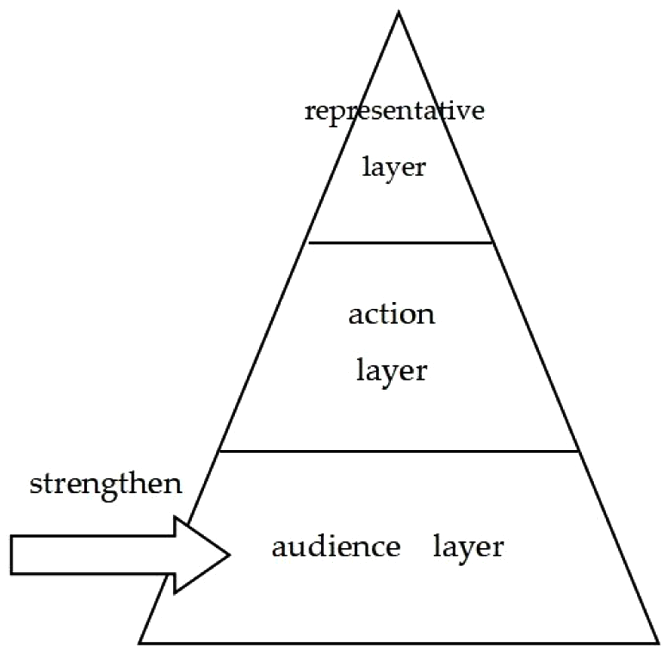
Pyramid pattern.
The young people at the bottom have similar values and ideologies, which are condensed under the topic; When young audiences feel the change of issues, they will be transformed into actions due to their high motivation, and form a middle layer based on the echo chamber and its driving core. If there is a person who can represent the ideas of the echo chamber, they become a symbol of the echo chamber and occupy the upper level. The composition of the upper echelon is not formed because its individual will is dominated by the formation, but under the influence of collective ideas. Thus, it can explain why many youth group movements in Taiwan have shown decentralized outcomes since 2013.
The Impact of the Echo Chambers in Taiwan
When talking about the impact of echo chambers on Taiwanese society, respondents’ views were also divided into two parts, one is their own experience and the other is their social observation experience. In personal experience, when encountering people with different echo chambers, respondents mostly adopted protective strategies to reduce conflicts with others and maintain good relationships around them. However, when observing social interactions, respondents found that quarrels can become very fierce, and such conflicts occur more frequently in cyberspace and social media. Here, it can be explained that when people live in an unfamiliar environment, they are more active in expressing their political positions and may simultaneously generate significant impact. But such an environment can nullify discussion by degenerating into bickering. The differences between online and offline actions, combined with relevant research on echo chambers in Chinese social networks, indicate that individuals outside of echo chambers often choose to conform to the opinions of those within the echo chambers to avoid conflicts (Gong, 2019). This can be explained as the conflict between collectivism and individual will. In Chinese communities, the tendency towards collectivism prioritizes group goals over individual ones (Burton et al., 2021), leading individuals to hide their own stances to better fit in with the group. The advent of the internet has also facilitated the expression of political will in Taiwanese society and the broader Chinese community (Skoric et al., 2016).
According to the content of the interviewees, it can be found that whether it is based on personal experience or social observation experience, the dialogue between the members of the echo chamber and those outside the echo chamber is generally negative, not based on rational dialogue but on avoidance or confrontation. This also aligns with the aforementioned argument that echo chamber construction is based on shared values and ideology.
The Application of Echo Chambers in Terms of Taiwan’s Youth Empowerment
It is important for political workers to use the echo chambers. The majority of respondents reported the use of echo chambers in their own organizations and political parties. The survival of the echo chambers rely on the Internet, so it has the efficiency of information transmission. Relying on and driven by the echo chambers, the power of the echo chamber can be mobilized to the maximum extent for action. However, for social organizations or small parties, the use of echo chambers presents a dilemma. On the one hand, the existence of echo chambers can serve as the biggest foundation for their survival, but if the echo chambers are broken, it will easily lead to the loss of original supporters; on the other hand, it will be confined to the original support groups, thus reducing the broad representation.
From past results, it can be seen that echo chambers not only enhance the mobilization capabilities of political groups but also motivate Taiwanese youth to engage in political work. The Sunflower Movement, which was oriented around echo chamber groups, greatly stimulated young people’s enthusiasm for public affairs and politics. This movement encouraged the youth to form or join political parties as a core part of their involvement in electoral politics (Ho, 2018), including participating in local village head elections (Wang, 2020). This indicates that both individuals and groups attempt to convert online echo chamber communities into tangible local impacts to strengthen their competitive edge in political contests.
Conclusion
As a relatively new concept, the term echo chamber has emerged and gained popularity in Taiwan, and has been widely used in the discussion of social sustainable development issues and social action. After reviewing the interview content from the respondents, this study revisits the research questions concerning the existence, composition, and influence of echo chamber phenomenon among Taiwan’s youth generation.
First of all, the existence of the echo chamber phenomenon in the youth generation is obvious, but according to the results of this study, its composition differs from previous research paradigms, which also indicates that the echo chamber of Taiwan’s youth particular characteristics, and can be further explored as an extension of political socialization studies.
Secondly, from the perspective of political action and practical function, echo chambers are the best platform for political parties or social groups to unite their supporters, exert their influence and mobilize their ways of action. The echo chamber not only plays the role of direct channel for information transmission, but also acts as the core role of action coordination and promotion. And this also confirms the research of some scholars.
Thirdly, in terms of political sustainability, the existence of echo chambers does not make Taiwan’s democratic discussion more effective, nor does it promote the formation of a common social consciousness, but confirms the advancement of polarization. This brings us to a serious question: How should we value echo chambers? On the positive side, the existence of echo chambers strengthens the attention and enthusiasm of the young generation toward political issues, which positively contributes to the development of democratic politics. However, if echo chambers are simply interpreted as expressions of democratization and diversity, they do not contribute positively to social unity.
In general, the echo chamber phenomenon used in political communication can also explain how online networks translate into offline actions under the condition of Internet empowerment. Echo chambers are conducive to the cohesion of young people in achieving political demands, thereby forming a new mode of political organization. Follow-up studies should pay greater attention to the problem of breaking and merging echo chambers. This includes examining how opinions can be exchanged between different echo chambers, exploring potential strategies for dismantling them, and investigating whether the influence of such efforts, which are closely related to the concept of political polarization, can be empirically measured.
Footnotes
Appendix
Interviewee Background.
| Interviewee Code | Interview Time | Background Information |
|---|---|---|
| A | 2019-04-26 | Former New Power Party local councilor’s assistant |
| B | 2021-03-08 | Former Green Party Central youth committee member |
| C | 2021-03-09 | New Power Party legislative assistant |
| D | 2021-03-11 | Former Kuomintang youth league chairman |
| E | 2021-03-16 | Former Democratic Progressive Party candidate’s assistant |
| F | 2021-03-16 | Kuomintang Local Party chapter executive director |
| G | 2021-03-17 | Former Democratic Progressive Party local councilor’s assistant |
| H | 2021-03-18 | Former People First Party legislative assistant |
| I | 2021-03-18 | Former People First Party legislative assistant |
| J | 2021-03-24 | Former Kuomintang youth league chairman |
| K | 2021-03-29 | Democratic Progressive Party local councilor’s assistant |
| L | 2021-03-31 | Taiwan Student Union member |
| M | 2021-04-14 | New Power Party staff |
Acknowledgements
The authors thank all interviewees and express their sincere gratitude.

Ethical Considerations
Although this study adopts a semi-structured interview approach, we ensured anonymity and privacy protection, and the identities of the interviewees will not be disclosed. No information that could be used to identify individuals is recorded in the verbatim transcripts of the interviews. Additionally, we obtained informed consent from the interviewees prior to conducting the semi-structured interviews. Moreover, the interviews do not pose any physical or psychological risks to the interviewees and do not involve sensitive or provocative content. Therefore, ethical review is not required.
Consent to Participate
The data in this article come from interviews with the respondents. All respondents provided verbal informed consent prior to the commencement of the formal interviews.
Consent for Publications
All interviewees gave their informed consent to participate in this study. They also consented to the publication of this article based on the interview data, with all data anonymized to protect their identities.
Author Contributions
Li: supervision, project management, manuscript writing, contacting interviewees and interviews; You: submission, revision process, manuscript drafting and conceptualization.
Funding
The authors disclosed receipt of the following financial support for the research, authorship, and/or publication of this article: This work was supported by National Social Science Fund of China under Grant 24CZZ016.
Declaration of Conflicting Interests
The author(s) declared no potential conflicts of interest with respect to the research, authorship, and/or publication of this article.
Data Availability Statement
The data analyzed in this paper comes from the author’s semi-structured interviews with the interviewees. If you need relevant data, please contact the corresponding author by email.