



Abstract
The transition from Primary to Compulsory Secondary Education (CSE) often causes difficulties for students developing reading skills in English as a second language (ESL) and can increase stress and disengagement, particularly within non-bilingual Spanish contexts. Existing research draws attention to these difficulties and the influence of ESL reading anxiety, while also highlighting the promise of Flipped Classroom (FC) methodologies and digital platforms such as Canva. This study seeks to address an existing gap in research by exploring the effects of an FC approach using Canva and Moodle on first-year CSE students’ ESL reading comprehension, perceptions, and transition experiences. A mixed-methods design was employed over twelve weeks to compare an experimental group (N = 20) engaging with the FC/Canva/Moodle model against a control group (N = 20) following traditional instructional methods. Data collection encompassed Cambridge Flyers A2 pre- and post-assessments, focus group interviews, and teacher diaries. Both cohorts showed clear improvement; however, although overall gains were not statistically significant, the experimental group demonstrated slightly superior performance in inferential reading and reported enhanced motivation, engagement, and satisfaction—largely attributed to the visual and interactive features of Canva and Moodle. The findings suggest that the integration of FC methodologies with digital tools can significantly enrich ESL reading development, encourage independent learning, and support an easier transition to secondary school. The study advocates for the gradual implementation of such approaches, ongoing professional development for educators, and robust institutional support to ensure the successful incorporation of blended learning and ICT strategies.
Introduction
In an increasingly globalized world, learning English has transitioned from being a mere option to becoming an essential skill, as reflected in the Organic Law for the Amendment of the Organic Law of Education(Gobierno de Espaũa, 2020), or LOMLOE. This legislation, which governs educational instruction in Spain, recognizes English as a key competence that students must acquire to succeed in modern society. It emphasizes that learning English is not simply about mastering a language but about developing a vital skill that unlocks a wealth of academic, professional, cultural, and personal opportunities (Baker & Fang, 2021).
It is not only related to memorizing vocabulary and grammar but about cultivating the ability to use the language effectively across diverse contexts and situations. This involves the acquisition of communicative skills that enable students to interact, comprehend, and express themselves fluently in both spoken and written English.
For this vision of English learning to materialize effectively, teachers play an indispensable role (Durán Martínez & Beltrán Llavador, 2016; Pérez Cañado, 2018), having the responsibility to ensure their approaches align with the demands of integrated content and language learning (CLIL), which requires a comprehensive analysis of the educational landscape they navigate, particularly in teaching English as a second language (L2) to first-year secondary students.
This analysis involves considering various interconnected factors, such as students’ initial competency levels in order to tailor instruction to their needs and abilities, and understanding their learning styles to design activities and strategies that maximize their potential. It also requires familiarity with the sociocultural environment, students’ motivation, and their attitudes toward learning English. Additionally, teachers must take advantage of available resources, including educational and technological materials, to plan lessons effectively and implement active, participatory methodologies in line with the curriculum.
Teachers of first-year secondary students must also navigate the challenges posed by the transition from Primary Education (PE) to Compulsory Secondary Education (CSE). Addressing the pedagogical differences between these levels (Hopwood et al., 2016), is crucial, particularly when dealing with the complexities of teaching English as a second language (ESL).
Educators need to understand the factors that influence reading comprehension and to master innovative learning methodologies, such as Blended Learning (BL), which combines in-person instruction with virtual teaching (Owen & Dunham, 2015). This approach can be further enriched through the Flipped Classroom (FC) model (Turan & Akdag-Cimen, 2020), which encourages a more dynamic and participatory learning environment. Furthermore, proficiency in using digital tools such as Canva and Moodle—platforms designed to facilitate learning, promote interaction, and assess student progress effectively—is indispensable (Cabero Almenara & Barroso Osuna, 2016).
Scientific literature highlights that English reading comprehension, coupled with the transition from PE to CSE, represents a pivotal moment in students’ lives (Moje, 2008) that can lead to stress (Zeedyk et al., 2003) and have a negative effect on academic performance (Hanewald, 2013; Rice et al., 2011). This stress stems from various factors such as changing school and reaching puberty, which involve both physical and intellectual evolution (Ganeson & Ehrich, 2009; Ng-Knight et al., 2016), cultural differences and the experience of meeting new peers and facing academic challenges, among others (McCoy et al., 2020).
This becomes harder because of the clash between two very different educational approaches. In PE a highly integrated curriculum is applied, according to which students have few specialized teachers (in Spain, where the research took place, this means Music, Physical Education and English) and most of their education is provided by a generalist teacher. In contrast, CSE puts the emphasis on literacy activities (Courtney, 2017), where each subject is taught by a different teacher, together with a lack of curricular continuity (Jaekel et al., 2017; Perfetti et al., 2005).
This transition involves major changes in the curriculum and teaching styles, which differ significantly from those of PE. Therefore, there is a need for transitional programs or educational actions designed to alleviate this problem (Strand, 2020; Topping, 2011), especially in Mathematics and English L2 subjects. In these areas, students perceive a greater gap in the learning process and less progress (Hargreaves & Galton, 1999), which can lead to disengagement.
Despite thorough planning of work in CSE schools related to the teaching of ESL during the transitional academic year (1st year of CSE), and more specifically the area of reading in ESL which is the focus of this study, difficulties have been identified, particularly when students are required to complete part of the task outside the classroom. This individual and autonomous approach to reading in ESL leads to feelings of frustration and anxiety (Horwitz, 2001).
The scientific literature on the topic shows that reading, as a means of acquiring language and communicating, is seen as an act that enables the exchange of information and ideas through the interaction between two basic elements in reading comprehension, the reader and the text. It could therefore be said that reading is the result of a combination of reading comprehension, teaching and reader characteristics (Leeser, 2007; Nuttall, 1996).
Reading comprehension, whether in the mother tongue or second languages, is a complex and multidimensional cognitive process in which the reader simultaneously derives and constructs meaning from a text as they decode the symbols and words they recognize (Lipka & Siegel, 2012; Pham et al., 2024), and its effective teaching requires educators to consider text characteristics, particularly coherence and cohesion. These aspects assist readers in navigating the discourse and grasping the connections between presented ideas (Alderson, 2000; Lim et al., 2021; Sesma et al., 2009), as well as understanding the cognitive processes involved when designing activities. Consequently, these elements can positively or negatively influence the learner’s comprehension ability. Notable among these considerations are the presence of visual elements, text structure, content, genre, readability, complexity, and length.
In relation to reader characteristics, Grabe and Stoller (2011) categorize these features into lower-level and higher-level processes, essential for written text comprehension.
Lower-level processes include linguistic skills such as pattern recognition, letter identification, lexical access and working memory activation (Perfetti et al., 2005) while those in the higher-level category include activation of the individual’s prior knowledge, inference, strategic processing, interpretation and use of contextual information (Koda, 2005).
A well-designed activity to improve reading comprehension must, however, take into account not only the elements mentioned above (the text and the reader), but also a third component relating to how the activity is carried out. Students should have access to a variety of reading comprehension strategies in a text-centered collaborative and interactive framework (Sweet & Snow, 2003).
At the textual level, it is essential to provide a wide variety of reading material adapted to the needs and levels of the students (Duke & Pearson, 2009). Alderson (2000) recommends avoiding expository texts, especially at the beginning of L2 learning, as he considers them to have a more complex structure and subject matter for comprehension compared to other text types such as narrative.
It is true that anxiety in the context of foreign language learning and reading comprehension can have a detrimental effect on students’ educational process (Elahi Shirvan & Taherian, 2021). Lack of motivation may also be an important factor (Namaziandost et al., 2022), obliging teachers to adopt a holistic approach that considers both linguistic and emotional aspects in order to promote effective ESL reading comprehension.
In order to address these challenges faced by 1st year CSE students to develop their reading skills in ESL and at the same time foster their capacity for autonomous learning, a blended learning methodology called B-learning (BL) was implemented together with the integration of digital tools.
The BL methodology involves a combination of face-to-face and distance learning which employs new technologies and ensures that the student’s progress in the learning process is monitored (Owen & Dunham, 2015). According to Fernandes et al. (2016), this methodology represents a flexible, multimodal and multidirectional redesign of learning, allowing students to go at their own pace through individualized learning processes.
Garrison and Kanuka (2004) and Yu et al. (2023) point out the multiple pedagogical benefits of BL in higher education, including greater effectiveness, satisfaction and efficiency in the learning process as a result of involving students more actively. Moreover, this methodology creates a flexible teaching environment that reinforces students’ autonomy and capacity for reflection and research, as well as allowing them to review and monitor their own learning (Donnelly, 2010; Lim & Morris, 2009).
Applying this approach, tasks traditionally carried out in face-to-face sessions are transferred to the virtual environment. This allows face-to-face sessions to focus on more interactive activities with a higher cognitive level, thereby enriching the students’ learning experience and fostering more active engagement with the study material (Lin et al., 2021).
For this reason, the Flipped Classroom (FC) methodology was employed, a teaching approach within BL that students were already somewhat familiar with, having been used occasionally towards the end of primary education. The purpose of this method is to make face-to-face sessions more effective by including activities that help develop higher-order thinking skills and facilitate knowledge construction through interactive participation.
These activities may include small group discussions, dialogue, presentations or the use of Socratic questioning to stimulate critical reflection and deep thinking (Alqahtani et al., 2023; Zainuddin & Perera, 2019). For this study, two key tools were used to facilitate and guide BL: Canva and Moodle.
With its intuitive “drag-and-drop” interface and an extensive library of multimedia resources, Canva facilitates the creation of diverse educational materials and activities adaptable to various educational levels (Romero López, 2019). According to Le et al. (2023), this platform not only boosts student motivation but also encourages visual learning, positioning it as an excellent tool for ESL teaching and learning, comparable to the FC, already utilized in previous educational periods.
In turn, Moodle provides an educational environment that promotes collaborative interaction (Brandl, 2005) by giving students access to everything that teachers have designed, such as readings, explanatory videos, discussion forums, assignments, and so on, which allows assessment of learning progress (Tsai & Talley, 2014), thus contributing toward a more effective and favorable teaching environment for students (Manoli et al., 2016). In addition, these tools also give students access to a variety of online reading resources and opportunities for interaction and the ability to create and visually present what they have learned.
Despite the progress made in active methodologies such as the Flipped Classroom (FC) and the use of digital tools like Moodle and Canva, certain areas remain underexplored in the literature, highlighting the relevance of this research paper. Firstly, while the positive impact of Blended Learning (BL) methodologies in higher education is well-documented, there is a notable scarcity of studies examining their application to English language learning as a second language (L2) during the early years of Compulsory Secondary Education (CSE), a particularly delicate period marked by both pedagogical and emotional transitions for students.
Similarly, there is a lack of research evaluating the sustained impact of digital tools on the development of ESL reading comprehension skills. Another insufficiently addressed aspect is the interplay between emotional factors, such as anxiety and lack of motivation, and the methodological approaches employed. In this regard, it is essential to investigate whether the interactive activities and flexible learning environments provided by the FC model can help alleviate negative emotions and foster more autonomous and effective learning experiences.
Moreover, the majority of studies on English teaching in CSE in Spain focus mainly on bilingual contexts, which, while valuable (Nieto Moreno de Diezmas, 2017, 2018; Recio & León, 2015), do not reflect the prevailing reality of Spanish classrooms. In these settings, bilingual education is the exception, with English primarily being taught as an independent subject with limited instructional time. This disparity between the researched contexts and the general day-to-day reality of Spanish classrooms creates a significant gap in understanding the challenges and opportunities present in non-bilingual settings.
Therefore, there is a clear need for research that specifically addresses the teaching of English in such contexts, where the complexity of second-language acquisition is influenced by factors distinct from those in bilingual environments.
The working hypothesis of this study is that the application of a BL methodology such as FC and ICTs such as Canva and Moodle improve students’ ESL reading skills and facilitates the transition from PE to CSE.
The objectives established to test this hypothesis were as follows:
(a) To assess students’ progress in the development of ESL reading comprehension skills after applying reading strategies using the FC methodology and Canva.
(b) To determine students’ perceptions of their level of learning with the FC methodology and Canva.
(c) To know students’ perceptions regarding the extent to which Canva and the FC methodology facilitate their adaptation to CSE
Method
In line with the objectives of this research, a mixed-method approach was adopted, integrating both qualitative and quantitative perspectives. The qualitative dimension was implemented through the focus group technique, enabling an in-depth exploration of students’ perceptions and experiences regarding the subject under study. Concurrently, a specific linguistic competence test was administered in a pre- and post-test format to quantitatively assess compliance with the educational standards set for level A2, as required by current legislation. The purpose of this methodology is to generate valid and reliable information, serving as a foundation for informed decision-making, in accordance with contemporary methodological principles in educational research (Bisquerra Alzina, 2019).
Description of Context and Participants
The study was performed in a CSE school located in an urban area of approximately 50,000 inhabitants. The population in the area has a medium socio-economic and cultural level according to data provided by the regional Education Authorities.
The educational experience was carried out on two groups of 20 students in the first year of CSE aged between 11 and 12, GA and GB. The reason for this relatively low number of students per group is due to the measures taken by the school to facilitate the transition of students from PE to CSE.
The study employed a purposive non-probabilistic sampling method. This approach was chosen to identify two specific groups of students who shared homogeneous and pertinent characteristics crucial to the research, such as being first-year Secondary Education students transitioning from Primary Education. The selection was carried out in collaboration with the teachers responsible for the groups, as they played a pivotal role in the implementation of the educational intervention.
The final sample comprised 40 students, divided into two cohorts: the experimental group, which underwent an intervention based on the BL methodology and the FC model, and the control group, which continued with the conventional teaching approach. This purposive selection of participants ensured the internal validity of the study by controlling external variables that could potentially affect the results, such as age differences or varying levels of English proficiency.
Prior to this, meetings were held with the two teachers, one from each group. Once they both agreed to implement the planned educational proposal, a meeting was arranged with the parents to explain the research details, who were informed they were free to decide whether they wished for their children to participate or not. Where interest was shown, the parents were requested to sign the form and provide their informed consent, which was given for all 40 participating students.
In both groups, the teaching of reading comprehension was based on a compulsory reader for the first year of CSE, “All About Britain” by Burlington Books, and the supplementary reading texts for levels A1 and A2 offered by the British Council on its website to promote the EFL learning, with implementation of different in-class and out-of-class approaches and methodologies.
In the case of GA, the improvement of reading comprehension was addressed through the BL methodology, using the Canva and Moodle platforms both in-class and out-of-class. In GB, the same reading comprehension activities were carried out as in GA but without the incorporation of digital elements, including the Canva resources designed by the GA teacher to improve reading skills. Teachers designed five visually attractive Canva activities and resources to facilitate readings and learning new vocabulary.
The work plan covered a period of 12 in-class and out-of-class sessions as detailed in Table 1 showing the full design of the proposed educational intervention, following a structured approach to improve reading comprehension skills in both groups.
In-Class and Out-of-Class Work Plan.

Instruments
To know the degree of acquisition of reading competence, it should be noted that student progress was evaluated both with the tasks performed during the face-to-face and out-of-class sessions, through observation and a teacher diary designed for this purpose, and through the comparison of the results from the reading part of two Cambridge Assessment English “Flyers” tests performed as diagnostic and final evaluations. These tests are adapted to the illustrative descriptors of the Common European Framework of Reference for Languages (CEFR), corresponding to level A2 and aligned with the current Spanish educational legislation for this stage. Moreover, they are widely accepted in educational contexts due to their proven objectivity and reliability.
Four focus groups were created randomly and respecting parity standards, two per class-group, in order to learn more about the subjective and emotional aspects of their learning, qualitative feedback providing fairly accurate information that can be used to adjust and improve future educational interventions, in addition to checking through the corresponding standardized test where they achieve the specific skills of their educational level.
Procedure
After the 12 weeks of intervention and the conclusion of all face-to-face and out-of class tasks, the Flyers final test was initially applied to evaluate the degree of acquisition of the corresponding skills. Subsequently, an analysis of the teacher’s diary and the students’ perceptions of their level of learning and transition was performed using a Focus Group methodology. The narratives were subjected to an analysis and categorization process using the Atlas.Ti7 software program, with the objective of obtaining reproducible and valid inferences that are relevant to the educational context.
Subsequently, further recoding and categorization was carried out following a mixed analysis approach combining inductive and deductive elements, the purpose of this spiral methodology being to achieve saturation, to stop the interpretation and review of the data from generating new categories. Saturation was reached after three sessions with a 97% consensus level, eliminating the need to redefine the codes. A combination of inductive and deductive analysis was used to determine the organizational structure of the code map from which the resulting categories emerged.
As indicated in Table 1, in the first session the diagnostic test was performed for both groups and depending on the results obtained five groups of four students each were formed, with a variety of profiles in terms of gender and abilities (GA, three groups with two boys and two girls plus two groups with three girls and one boy; GB, four groups with two boys and two girls and one group with three girls and one boy) and taking into account academic criteria and linguistic, pedagogical and cooperative learning skills.
To conclude, after the reading comprehension final test focus groups were set up in which the students shared their opinions and comments on the educational experience implemented over the course of the term to improve their organizational skills and their comprehension of written texts in ESL English.
The results are presented in tables that group the codes in each of the categories according to meta-categories, and the corresponding absolute frequencies are also included.
Ethical Considerations
In alignment with ethical standards for research involving minors, the study was carefully designed to minimize any potential risk to participants. All activities implemented, both in the experimental and control groups, adhered strictly to the official curriculum for the stage of education in question and did not entail any form of physical, psychological, or social harm.
The digital tools employed (Canva and Moodle) are commonly used within educational settings and were introduced through structured and supervised learning activities, ensuring a safe and supportive environment.
The cooperative nature of the intervention, along with continuous teacher guidance, fostered positive emotional experiences throughout the learning process.
The benefits of participation—including enhanced reading comprehension, increased engagement, and reduced ESL-related anxiety—were considerable, particularly in facilitating students’ transition from Primary to Secondary Education.
These outcomes were further reinforced by students’ perceptions collected through focus groups. Prior to the implementation of the intervention, informational meetings were held with participating teachers and the families of the students. Informed written consent was obtained from all parents or legal guardians, who were given full details of the project, its objectives, and procedures, as well as the guarantee of voluntary participation and the right to withdraw at any time without consequence.
Results
The socio-demographic characteristics show that in all cases the age range was between 11 and 12, with both GA and GB showing similarities in terms of their ESL training following the diagnostic test. In terms of gender, in GA, 60% of the students were boys (n = 12), while 40% were girls (n = 8); on the other hand, in GB, 45% of the students were boys (n = 9) and 55% were girls (n = 11).
Based on an analysis of the diagnostic test (Table 2), 60% of the students had a general level of English reading comprehension that would be considered low, compared to 35% who had an intermediate proficiency level and only 5% who were advanced. This disparity in reading achievement between students in the groups underlines the need to implement pedagogical and didactic interventions to improve reading skills.
Diagnostic Test Results.
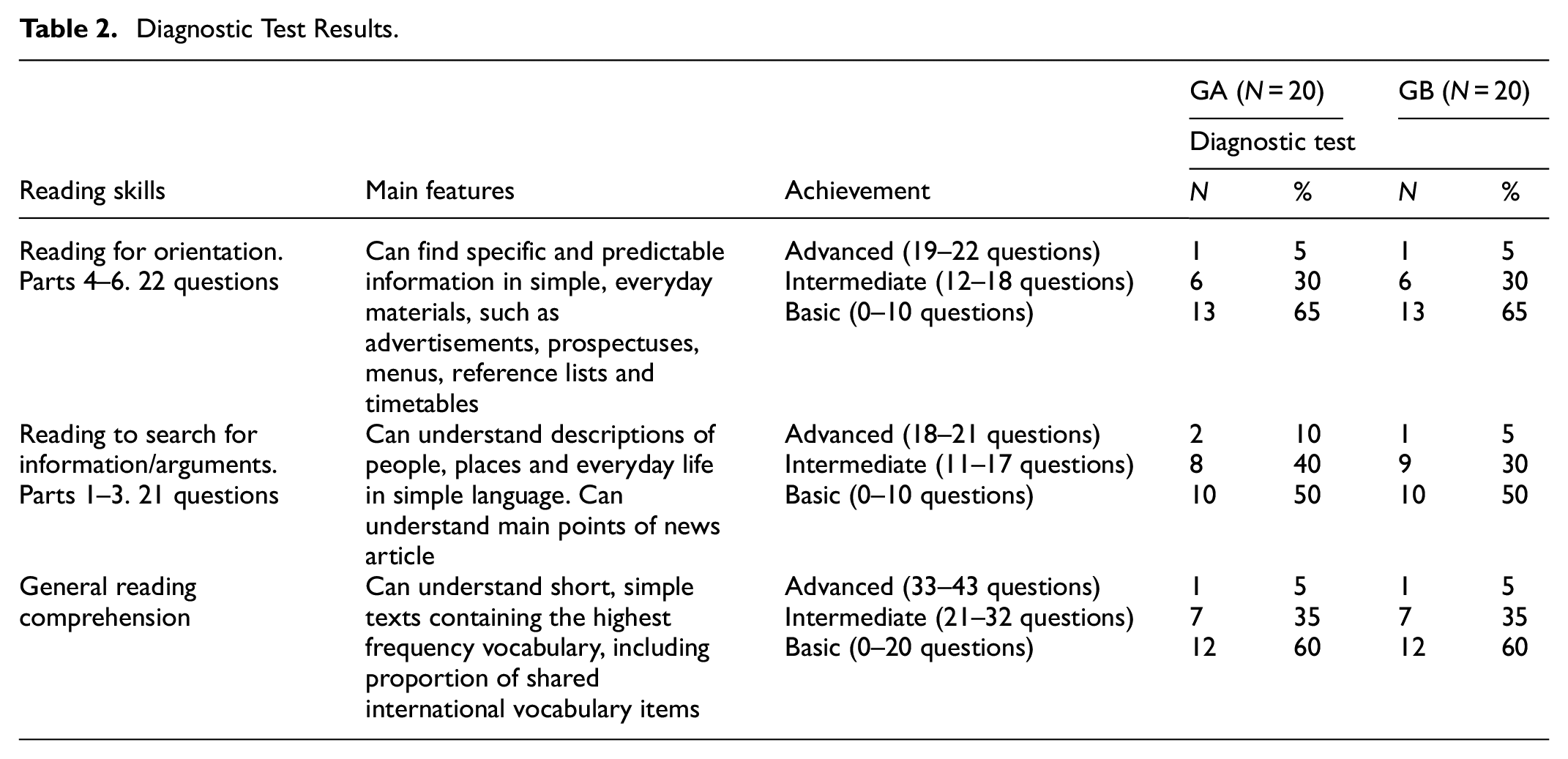
Furthermore, it should be noted that reading difficulty intensifies when it comes to tasks involving inference and meta-cognitive processes: 65% of students had a basic level in these reading skills, while only 30% had an intermediate level and 5% showed an advanced level.
Table 3 illustrates the progress of two student groups across various activities conducted both in and out of class, encompassing vocabulary tasks, guided and unguided summaries, forum participation, test-based activities, and reinforcement/extension exercises.
Teacher’s Diary: Evolution of Daily in-Class and Out-of-Class Work.,

SR = Supplementary Readings.
It is evident that students engaging in supplementary reading (SR) exhibit superior performance in vocabulary tasks and in-class summaries, as well as in forum participation and test-based activities out of class.
Moreover, in the additional reinforcement and extension activities prepared by teachers to enhance vocabulary and grammatical structure comprehension, the motivational impact of ICT on adolescent students is apparent. The use of different tools (Canva for GA and paper for GB) in reinforcement and extension activities reveals variations in the completion rates of these tasks.
The GA group, which undertakes tasks designed in Canva by the teacher, is highly engaged, completing the majority of voluntary tasks due to their visual, interactive, and digital appeal, with 70% finishing all reader tasks and 90% completing supplementary tasks. In contrast, the GB group, performing similar tasks on paper, shows less engagement. However, there is a notable increase in the number of students completing extra reading tasks (55%) compared to reader tasks (30%), attributed to the progress in vocabulary control and comprehension they experience.
In terms of student evolution in reading comprehension, as can be seen in Table 4 and applying the (CEFR) descriptors, notable progress was observed in both areas of communicative language activities and strategies. All students, that is, 100% of the group, reached an intermediate or advanced level in general reading comprehension.
Results of Students’ Reading Comprehension.

Likewise, in the section on reading for orientation, which involves the use of inference strategies, shown in Table 4, both groups achieved 100% proficiency at intermediate or advanced levels. In this respect GA stands out slightly, with 35% of students demonstrating advanced skills compared to 25% for GB.
Table 5 illustrates that Canva-Moodle provides a more comprehensive and effective educational approach compared to conventional methods. Motivation, understanding, and skill development are enhanced through the incorporation of digital tools, facilitating the acquisition of both hard and soft skills. Conversely, traditional methods lacking the use of ICT exhibit limitations in these areas.
Comparative Analysis of Educational Strategies: ICT-Enhanced Learning Versus Traditional Methods.

Overall, it is noteworthy that according to GA Canva aids in both literal and inferential comprehension, as well as written and oral expression, positively impacting their motivation. The coordination, cooperation, and immediate feedback among students, facilitated by Moodle and the integration of multimedia in classroom activities, are other significant factors. Additionally, students expressed that they: “…created posts according to our English level,” (GGAFG1) indicating that participating teachers could tailor the work to meet student needs.
In contrast, it was found that in Group GB, which relied on printed materials, despite the extensive work by teachers, students did not feel highly motivated by the tasks. Using “paper” as the sole medium for organizing and developing ideas related to oral and written communication skills was found to be unattractive. Moreover, “we couldn’t share our work!” (BGBFG2), suggesting that any task requiring collaborative skills or access to digital resources was severely limited.
The results obtained in the focus groups set out in Table 6 focus on two main themes in both GA and GB: commitment to learning engagement and satisfaction with learning process. Both groups showed a positive attitude towards the EFL reading comprehension process, and despite initial nervousness when reading English books individually, 100% of the participants managed to overcome these fears and achieved positive learning outcomes.
Students’ Perceptions of Their Level of Learning with the FC Methodology.

A positive attitude towards the ESL reading comprehension process was perceived in both groups, facilitating the transition between the two educational stages, EP and CSE. For example, despite initial experiences of nervousness when reading books in English individually, 100% of the participants overcame these fears and achieved positive learning outcomes.
There was also an implicit predisposition towards teaching through ICT tools. Both GB, who expressed interest in using Moodle and Canva, and GA, who showed satisfaction with the use of tools such as Canva to create summaries in class and carry out additional reinforcement-extension activities, had a positive attitude towards the use of ICT in the educational process. This is reflected in the exemplar quotes obtained during the study and shown in Table 6, with confidentiality and anonymity being preserved through data aggregation and the use of identity codes: G: girl; B: boy GA: group A; GB: group B; FG1: Focus group 1; FG2: Focus group 2, for example: GGAFG1 = girl, group A, Focus group 1.
Discussion
The study examined the challenges of reading comprehension in English as a Second Language (ESL) during the transition from PE to SE, a key stage in students’ academic development, as highlighted in various investigations (Moje, 2008; Zeedyk et al., 2003). To address this issue and facilitate the transition, an educational intervention was designed, combining the FC methodology with the use of digital tools, specifically Canva and Moodle.
Both quantitative and qualitative results offer significant insights into the impact of this intervention on students’ learning processes. The analysis of data collected before (initial test) and after (final test) the intervention reveals that the two groups began at similar levels, allowing any variation in results to be attributed to the applied methodology.
Although the quantitative results from the final test (Table 4) did not reveal statistically significant differences between the experimental and control groups in overall improvement (Romero López, 2019; Yu et al., 2023), the experimental group showed a slight advantage in inferential reading skills (35% at an advanced level compared to 25% in the control group).
This marginal difference may be linked to qualitative data (Table 6), where students from the experimental group specifically highlighted how the use of Canva facilitated visual organisation and the connection of ideas (“I thought it was great to use Canva… It’s very easy to use,” BGAFG2), potentially supporting the higher-order cognitive processes required for inference. In contrast, students from the control group expressed frustration with the limitations of paper-based formats for collaborative or creative tasks (“we couldn’t share our work!” BGBFG2), a perception that aligns with their comparatively lower progress in more complex tasks.
This convergence of data suggests that the use of digital tools not only motivated students but also impacted key metacognitive processes, such as the ability to associate ideas and draw implicit conclusions—both fundamental aspects of advanced reading comprehension. Furthermore, active participation in forums (Table 3) and the ability to review content at home via Moodle may have reinforced these learning processes, offering multiple opportunities for exposure, reflection, and feedback, thereby promoting the transfer of knowledge to new contexts and resulting in improved performance in inferential skills.
Academic literature affirms that the use of innovative methodologies, such as the flipped classroom, alongside digital resources, fosters more active and autonomous learning—key factors in enhancing reading comprehension (Garrison & Kanuka, 2004; Lin et al., 2021).
Regarding student learning progress perceptions (Table 6), the results from the EG indicate high satisfaction and notable engagement with the FC methodology and digital tools. These students highly valued group reading, praised the ease of use of Canva, and appreciated the opportunity to process information creatively, which boosted their motivation to improve summaries. Additionally, they reported increased confidence in their ability to comprehend texts.
In contrast, GB, which lacked access to these tools for out-of-class tasks, expressed interest in incorporating them, reinforcing the idea that the FC methodology, complemented by resources like Canva, fosters student motivation and engagement, as indicated by previous studies (Le et al., 2023).
Furthermore, the EG’s performance in out-of-class activities demonstrates improvement in reading comprehension, attributed to the use of discussion forums in Moodle and the ability to listen to the texts studied in class from home. These findings confirm the effectiveness of BL methodology, which, according to Fernandes et al. (2016), is flexible and allows students to learn at their own pace through individualized processes.
This progress contrasts with previous studies that highlight students’ difficulties with individual reading tasks outside the classroom, which often lead to frustration and anxiety (Horwitz, 2001). In other words, integrating digital tools into a collaborative learning environment can reduce these negative feelings and enhance student engagement with reading.
It is also worth noting that the final exam and analysis of discussion groups yielded similar results across both groups. This consistency can be attributed to the careful planning and implementation of specific strategies by the teachers, both inside and outside the classroom, for ESL learning (Table 2). According to O’Malley and Chamot (1990), and Cohen (2014), this is achieved through the use of integrated strategies addressing cognitive, metacognitive, and socio-affective factors.
Cognitively, all students developed essential skills, such as summarizing and inferring, necessary for processing ESL texts, as reflected in the results from the A2-level standardized exam, “Cambridge Flyers,” used to assess progress.
Regarding metacognitive components, both groups were guided to organize, monitor, and evaluate their own learning, fostering the development of autonomy. Lastly, socio-affective factors were addressed by encouraging student interaction and emotional regulation throughout the learning process. Students reported feeling like active participants in the process, setting concrete goals and persevering, even when results were not as expected, until they reached their objectives.
While this study does not directly measure the transition to SE, the responses from the EG students suggest that the FC methodology and the use of digital tools may facilitate such a transition, with EG students expressing they felt more comfortable and motivated in L2 learning, exhibiting greater confidence and autonomy in text comprehension, crucial for successfully navigating the shift to secondary education. This may help alleviate the stress associated with the transition, as proposed by Hargreaves and Galton (1999).
The integration of digital platforms into learning also encouraged collaborative work, both inside and outside the classroom, creating a support network among students and increasing their confidence in the learning process. This aligns with the research of Lotherington and Jenson (2011), which underscores students’ positive reception of ICT.
While the EG highly valued the use of these tools without perceiving them as an additional effort, the CG expressed a desire to have been given access to Canva and Moodle, demonstrating a general interest in digital approaches to learning. Studies by Abeysekera and Dawson (2015) and Campillo-Ferrer and Miralles-Martínez (2021) support the idea that combining active methodologies with digital tools enriches the educational environment, enhancing student motivation, participation, and satisfaction.
The analysis of student feedback, such as “I had a great time and I liked what I did” (EGAFG2), suggests this learning approach not only adds a valuable interactive component but also enhances teacher feedback and facilitates continuous assessment. Furthermore, studies by Hao (2016), Huang and Hong (2016), and Tang et al. (2022) confirm that Collaborative Learning applied to ESL instruction across various educational levels fosters a dynamic environment, promotes the development of soft skills, and contributes to improving reading comprehension and grammatical competence.
In the context of CSE, the focal point of this research, significant progress was observed in reading skills and the use of ICT. These improvements, attributed to the active and participatory environment generated by collaborative learning, align with previous studies that emphasize the importance of such methodologies in promoting social and emotional competencies (Chust-Pérez et al., 2024; Hebron, 2018; Jindal-Snape et al., 2020). These innovative educational practices facilitate a smoother transition to the new educational stage and help mitigate the typical school disconnection during the first year of secondary education.
Additionally, several studies (Graham et al., 2016; Mackenzie et al., 2012; Symonds & Hargreaves, 2016) demonstrate that students tend to respond positively to challenges in language learning during the transition to secondary school, particularly when playful and interactive activities are employed. Group interaction and games emerge as valuable strategies to improve oral communication and foster motivation.
However, both groups reported certain levels of anxiety, apprehension, and stress when faced with reading in a foreign language, especially at the beginning. These feelings are linked to factors such as unfamiliarity with the topics, new pronunciations, and fear of making mistakes (Çapan & Pektas, 2013; Elahi Shirvan & Taherian, 2021; Liu & Dong, 2022). Nevertheless, EG stated, “This only happened at first; after that, we relaxed and did really well” (GGAFG1), which demonstrates that the complementary use of Canva and Moodle encouraged active participation and facilitated access to resources that promote the development of ESL reading skills.
While CG mentioned, “It took a lot of effort” (BGAFG2), they ultimately mastered the tasks, underscoring not only the effectiveness of teaching strategies but also the need to integrate ICT into the educational process to meet the demands of an increasingly digital environment in students’ lives. These results reinforce the importance of designing flexible curricula tailored to student profiles to foster meaningful learning aligned with current social realities.
Limitations
It is essential to acknowledge certain limitations, such as the study’s small sample size, which complicates the generalization of the results to other educational contexts.
Although the results are promising within this particular context, we cannot confidently assume they would be replicated in schools with differing demographic characteristics or resources. To improve external validity, future studies should include larger and more geographically diverse samples.
The 12-week duration of the intervention may be insufficient to observe lasting changes. The improvements noted—particularly in student attitudes—may be temporary, and a longer timeframe might be needed to reinforce complex reading skills or fully support transition to secondary education. It would be advisable to conduct longitudinal studies spanning at least an entire academic year to assess the sustainability of the effects.
Consideration should also be given to the potential bias introduced by the novelty of the digital tools within the experimental group, which may have influenced their motivation independently of the methodology itself. Future research could mitigate this by incorporating a longer familiarisation period or by comparing different types of technological interventions.
It is also worth noting that, although the study does not directly measure students’ adaptation to SE, it can be inferred from their learning perceptions that teacher planning and engagement are crucial. Future research should address this aspect more deeply, utilizing instruments that directly assess the impact of the two methodologies employed in this study on students’ academic and emotional adaptation to the educational transition.
Longitudinal studies are crucial to analyzing the long-term impact of BL-based methodologies and digital tools on students’ reading comprehension development, and this analysis should encompass both academic performance evaluating improvements in reading skills and achievement across various subjects, as well as attitudes toward learning, observing changes in motivation, interest, and autonomy.
Furthermore, comparative analyses are relevant for assessing the effectiveness of different tools and methodologies in teaching reading comprehension in a second language. Such studies would allow the identification of approaches most suitable for different types of students, considering their learning styles, proficiency levels, and specific sociocultural contexts. For example, a comparison between gamification and more traditional approaches or contrasting the use of various digital reading platforms might be beneficial.
However, this type of research faces a significant challenge in maintaining stable groups over time. The reorganization of students when they move to the second year of secondary school prevents the necessary longitudinal follow-up to obtain conclusive data. This restructuring leads to group mixing and a loss of continuity in the study, limiting the ability to evaluate the real and long-term impact of the pedagogical interventions applied. Thus, careful planning and possibly collaboration between educational institutions are needed to ensure the feasibility of such studies.
Despite the inherent limitations of any investigation, this research provides a solid foundation for future inquiries in the field of second language acquisition, particularly in reading comprehension. While the sample size is acknowledged as a limiting factor, it is important to note that the vast majority of secondary education centers in the same geographical area as the intervention share similar characteristics with the participants of this study. These similarities are evident in key aspects such as the students’ socioeconomic status, prior language proficiency, and, initially, comparable intrinsic motivation toward learning. Due to this contextual homogeneity, the results obtained have a high potential for transferability to a wide range of educational institutions in the region, thus enhancing the relevance of the conclusions drawn.
It is important to recognize that, although the sample is not large, its representativeness within the specific geographical context allows for greater confidence in extrapolating the findings than would be the case with a heterogeneous and decontextualized sample. Moreover, this study could serve as a starting point for future research that, addressing the limitations identified, can delve deeper into the analysis of variables and processes involved in the acquisition of reading comprehension in a second language.
Contributions of the Study
The practical implications derived from the results of this study, especially in the field of reading comprehension instruction in second languages (L2) using ICT tools and BL strategies, highlight that this methodology successfully integrates the best of both face-to-face and virtual teaching (Owen & Dunham, 2015), offering greater flexibility in educational environments. The use of digital platforms not only complements face-to-face classes but also enables the completion of virtual activities that promote both student autonomy and self-directed learning.
Moreover, the use of interactive applications and platforms contributes towards increasing student motivation, a key factor in stages such as the first year of secondary school, while promoting the development of essential digital skills. ICT tools also allow for the adaptation of learning processes to different paces and learning styles, which is particularly relevant in diverse educational contexts, with the design of personalized learning pathways and individualized progress tracking facilitating more inclusive and effective teaching.
Another advantage of using ICT tools is the possibility of implementing continuous assessment systems and providing immediate feedback, leading to significant improvement in learning outcomes. However, for this type of intervention to be truly effective, it is crucial that teachers receive continuous training in the use of BL methodologies and specific digital tools for teaching reading comprehension in L2, training that should be highly practical and focused on designing pedagogically meaningful activities as well as assessing learning in digital environments.
Furthermore, as demonstrated in this study, teachers must keep up to date on new tools and pedagogical strategies emerging in the realm of digital learning (Cabero Almenara & Barroso Osuna, 2016; Cabero Almenara et al., 2015), enabling them to effectively adapt to the changing needs of students and ensure the smooth and meaningful integration of technology in the classroom.
Along this line, as shown in Table 2, the implementation of BL methodologies and digital tools must be gradual and well-planned. This process should begin with the use of simple activities and resources, progressively advancing to more complex approaches as both teachers and students become more familiar with the methodology.
Furthermore, it is essential to note that such initiatives are only possible with institutional support and collaboration among teachers, who have created spaces for the exchange of ideas, experiences, and best practices in integrating technology into the classroom (Suárez Rodríguez et al., 2013). In this case, the constant interaction between the teaching team and researchers allowed the proposed activities, as well as the diversification of the reading materials used in both the experimental and control groups, to be relevant and meaningful for the students. These activities fostered interaction, collaboration, and critical thinking, while integrating students’ personal interests and experiences.
Finally, it is important to emphasize that, unlike the experimental group, the control group, which did not benefit from the ICT intervention, lacked the opportunity to continue work outside the classroom, a limitation that hindered the development of certain key competencies and the extension of learning beyond the face-to-face environment.
Conclusions
The results of this research confirm that the implementation of a flipped classroom (FC) methodology, combined with the use of digital tools like Canva and Moodle, along with appropriate teacher planning and execution, greatly improves reading comprehension in English as a second language (L2) and helps boost student motivation and engagement.
The integration of ICT in the classroom has proven to be a highly effective tool for enhancing learning, made evident in the outcomes of the experimental group, which, although comparable to those of the control group (without ICT), display slightly superior performance. Furthermore, the use of ICT fosters greater autonomy and confidence in students’ abilities by creating a more active and engaging, learning environment, with this approach also facilitating a smoother transition between primary and secondary education.
Finally, this research highlights the essential role of teachers and the importance of solid planning for the success of educational interventions. The effective implementation of active methodologies and the proper integration of digital tools depend heavily on teachers’ training, commitment, and ability to adapt their pedagogical strategies to their students’ specific context. Careful planning and continuous monitoring of learning processes help identify difficulties and adjust interventions over time, ensuring better outcomes. Continued research in this area is crucial to advancing the design of innovative teaching proposals that contribute to more effective and motivating learning for students.
Footnotes
Acknowledgements
The authors wish to thank the participating students, their families, and the teaching staff of IES María Blasco for their cooperation and involvement throughout the study.

Ethical Considerations
This study involved human participants and was conducted in accordance with ethical guidelines. All activities were aligned with the official school curriculum and posed no harm to participants. The study was conducted in accordance with the Declaration of Helsinki and approved by the Institutional Review Board of the School Council of IES María Blasco at its meeting on 28 September 2022.
Consent to Participate
Written informed consent was obtained from the parents or legal guardians of all participants prior to the start of the study.
Funding
The author(s) received no financial support for the research, authorship, and/or publication of this article.
Declaration of Conflicting Interests
The author(s) declared no potential conflicts of interest with respect to the research, authorship, and/or publication of this article.
Data Availability Statement
Data sharing not applicable to this article as no datasets were generated or analyzed during the current study.