




Abstract
School teachers often face stress, tension, frustration, and nervous breakdowns, which can lead to major mental illnesses. Financial difficulties, inactivity, and school-related challenges can all contribute to such issues. The objective of this study is to explore the mental health problems among secondary-level teachers’ in Nepal. This study utilized a multi-stage cross-sectional survey design, employing both purposive and proportionate sampling procedures representing three regions Rasuwa (Mountain), Bhaktapur (Hill), and Chitwan (Terai) of Nepal. A total of 344 secondary-level teachers filled out survey questionnaire. Two sorts of analysis, univariate and bivariate were employed using SPSS 25 version. The study revealed that school type is significantly associated to feeling of stress, p < .05. Just a single variable of age group among secondary-level teachers demonstrated a significant association with the occurrence of nervous breakdowns, p < .001. In contrast, none variables are associated to feeling any harsh tension, frustration, depression, and unhappiness at work. Female teachers, those aged 35 to 39, and institutional school teachers reported higher level of stress each day. Majority of teachers experienced some form of harsh mental tension, frustration, and unhappiness at work. Female teachers and younger age groups such as ≤24 and 30 to 34 years reported higher mental suffering. Prolonged mental distress among educators can deteriorate in teaching quality and their roles as effective models. This pointed the necessity for targeted interventions, including counseling and stress management, particularly for high-risk groups like female teachers, aged 35 to 39, and institutional educators to enhance well-being and job performance.
Introduction
Mental health is the balanced development of the individual’s personality and emotional attitudes, enabling them to live harmoniously with their fellow beings (Park, 2015). Similarly, Roy et al. (2013) illustrate mental health as the harmonious working of the mind, which results in a well-adjusted personality typically associated with happiness, satisfaction, and normal behavior. This is reflected in one’s ways of thinking, ability to adjust in life, relationships with others, and effective functioning in various roles of daily life.
On the other hand, stress is one of the most common forms of mental health problem (Spytska, 2023). It is a natural human response to stimuli that distrust a person’s physical or mental equilibrium, prompting them to address challenges and threats in their lives (Shivakumara & Mathias, 2023). Further, stress is a pressure or worry caused by problems in one’s life (Oxford University Press, 2010). It represents a state of mental or emotional strain resulting from adverse or demanding circumstances. The teaching profession is characterized by stress due to burnout, anxiety, and depression, which significantly affect teachers’ health, well-being, and productivity (Agyapong et al., 2022). Among these challenges, stress and frustrations are often perceived as minor mental health problems by teachers. However, while these issues may seem minor, they can escalate into more serious mental illness if left unaddressed. In this regard, Black (2003) highlights stress as a significant problem among teachers, noting that they often experience overwhelming stress due to the demands of meeting student needs, completing a rigorous curriculum, and preparing students for tests. This stress can arise from various sources, including personal issues, an inability to meet high standards, or challenging working conditions. Furthermore, a study by Marais-Opperman et al. (2021) revealed that teachers with a distressed profile and a tendency to use self-blame as a coping strategy often experience poor mental health. In contrast, those with a self-efficacious profile and reliance on religion as a coping mechanism tend to have better mental health outcomes.
In Nepal, school teachers experience high levels of occupational burnout, with emotional exhaustion being influenced by material status, lifestyle, and work-related factors, where workability emerges as a significant determinant (Paudel et al., 2024). Despite the prevalence of these issues, very little has been done to reduce stress among teachers. While cognitive-behavioral therapy and meditation have been identified as effective interventions for stress management among school-teachers Paudel et al. (2022), there remains a gap in acknowledging and addressing mental health issues among teachers, particularly in the Nepalese context. In light of this background, this study aims to explore the perceived mental health problems among secondary teachers in Nepal.
The awareness of mental health issues among academics has increased, largely due to faculty members’ reports of stress, burnout, anxiety, and depression (Hammoudi Halat et al., 2023). However, despite this growing awareness, these issues persist among a significant number of teachers. Teachers often face a multitude of challenges, both in school and at home, many of which are linked to school-related cases. For instance, many teachers lack adequate physical activity and proper nutrition, suffer from chronic conditions such as asthma and diabetes, are burdened by family and financial problems, all of which contribute to high levels of stress (Kolbe et al., 2005). Importantly, these challenges are not limited to Nepal; even in developed countries, teachers encounter numerous health-deteriorating issues, including mental health problems.
The teaching profession is facing widespread stress and burnout, necessitating policy and practice interventions to address these issues (Agyapong et al., 2023). Teachers in their early careers may be particularly susceptible to mental health challenges, often linked to specific school-related features (McLean et al., 2017). However, little is known about the systematic measurement of stress, its worldwide prevalence, the contributing elements to stress, and the causes of the detrimental effects of stress on teaching (Agyapong et al., 2022). A meta-analysis reveals that exhaustion in education affects teachers’ emotional stability, extraversion, and awareness (Kim et al., 2019). This can lead to stress, absenteeism, lower classroom management efficiency, and less assessment feedback (Castillo-Gualda et al., 2019). It may also result in teachers abandoning their profession, having lower-quality relationships with children, and a positive association with depression (LaBarbera & Hetzel, 2016). According to one study, somatization disorder, anxiety disorder, low job satisfaction, and high felt stress were the most reliable indicators of major depressive disorder in teachers (Besse et al., 2015). However, further research is required to determine the primary reasons that lead to the onset of depression in teachers as well as the connections between depression and other psychological illnesses such as stress, burnout, and anxiety.
School teachers are frequently absent due to poor health, highlighting the vulnerability they face in various health issues that impact student success (Aryal, 2022). The initial observational learning processes in Nepalese schools are weakly absorbed, leading to poor role modeling in body measurements by teachers (Aryal, 2020). This issue also affects mental health promotion, as students learning from mentally disturbed teachers struggle to learn effectively. The current curriculum, recognition of the time spent on schoolwork at home, opportunities for career development, on-the-job training, and changes made without teacher input could directly affect teachers’ mental health (Mondal et al., 2011). To improve teachers’ job satisfaction and reduce work-related stress irrespective of their gender and age, it’s crucial to explore protective factors within the working environment, such as autonomy, support, and feedback. These factors can act as psychological resources, enhancing personal relationships and promoting independence in teaching practices (Barbieri et al., 2019; Jentsch et al., 2022). Higher autonomy increases teacher job satisfaction (Dou et al., 2017; Moen et al., 2013). Social support from peers fosters a sense of connection Wentzel (1998) and Jentsch et al. (2022) reduces exhaustion Collie et al. (2012) and boosts job satisfaction (Harris et al., 2007). Feedback from fellow teachers is linked to collaboration, professional development Retallick and Butt (2004) and school effectiveness (Barth, 2006).
Previous research on mental health-related problems among school teachers in Nepal has been limited in scope and depth. Most studies tend to concentrate on urban areas, leaving a significant gap in understanding the challenges faced by teachers in rural and remote regions. Moreover, cultural and contextual factors, such as societal expectations and gender roles, which may unequally affect Nepali teachers, remain underexplored. This study thus is beginning to address these gaps by adopting more comprehensive and inclusive approaches. Recent study at hand examined the prevalence of mental health issues across diverse geographic and demographic contexts, including rural schools and female teachers. By addressing these gaps, this study is sure to enhance both academic understanding and societal well-being, ultimately fostering a healthier educational environment in Nepalese schools.
Now, the context can be linked with Job Demand Resource (JD-R) Model, which is a valuable framework for understanding occupational stress in teaching by emphasizing the balance between job demands and available resources. As per JD-R model, high job demands such as heavy workloads, challenging student behavior, and curriculum pressures, when paired with insufficient resources, such as limited support or coping mechanisms, can result in teacher burnout, anxiety, and depression (Bakker & Demerouti, 2017). This model is particularly relevant to teachers in Nepal, where personal and contextual stressors, including financial pressures, health issues, and low physical activity, can exacerbate occupational stress. On the other hand, effective resources like social support and self-efficacy can buffer the effects of stress and promote better mental health outcomes (Schaufeli & Bakker, 2004). Thus, the JD-R model offers a framework for developing targeted interventions to improve teacher well-being.
Methods
Research Design
The research employed a cross-sectional survey design with a descriptive quantitative methodology, incorporating questions intended for teachers in secondary education. Purposive and proportionate approaches were employed in a multistage cluster sampling procedure to pick region-wise districts; Rasuwa, Bhaktapur, and Chitwan, schools, and teachers using a proportional simple random sampling process. The schools were selected from a list of schools in each district. Teachers were selected using a complete sample approach from 46 schools spread over 3 districts. All secondary-level teachers representing all subjects taught in secondary schools at those selected were provided a structured questionnaire to complete on their own.
The selected regions such as Rasuwa, Bhaktapur, and Chitwan represent diverse geographical like rural, urban, and semi-urban and educational contexts, ensuring comprehensive insights into secondary education challenges. Purposive sampling for districts captured this diversity, while proportionate sampling ensured representativeness across regions. Multistage cluster sampling, with simple random sampling for schools and a complete sample approach for teachers, minimized bias and ensured all subjects and experiences were included. This approach balanced rigor and feasibility, aligning with the study’s descriptive quantitative aims to generalize findings while capturing regional variations in teachers’ perspectives.
Sample and Sampling Procedure
The three districts: Rasuwa, Bhaktapur, and Chitwan representing three ecological regions such as Mountain, Hill, and Terai-were purposively selected. Simultaneously, a total of 46 schools; split of 4 from Rasuwa, 20 from Bhaktapur, and 22 from Chitwan-were selected based on the proportionate random selection method. The study’s population comprised 1,611 secondary-level teachers from 332 secondary schools, as indicated in Table 1. Although a proportional sample size was 310, we distributed a self-administrated questionnaire to 414 teachers considering the non-response rate. The final sample size was stated after receiving filled questionnaires, by the fact that 344 teachers, or 83.09% of the total, returned the questionnaires.
Population and Sample Size of Teachers and Schools.

Validity and Reliability
The research team developed the questionnaire in alignment with the study objective. The content validity, including face validity, was evaluated by three panels of experts who assessed the relevance of each item to the study objective. This evaluation was conducted both prior to and following the pilot test (Sharma et al., 2024). Similarly, the reliability of the instruments employed was assessed using Cronbach’s alpha coefficient, with values ranging from .75 to .79 across all variables. These values indicate acceptable levels of internal consistency for each domain, demonstrating that the instruments are both reliable and valid for implementation in real-world settings (Sharma et al., 2022). A pilot test of the instruments was done among non-selected teachers by taking 10% of the total sample size. Just after pilot test, the research team revised the unclear, obscure, and complex items, rewording based on the experts’ remarks. In addition, the researchers discarded the ineffective and non-functioning items.
Statistical Analysis
The study used two types of analysis: univariate and bivariate. These two analyses were chosen to provide a clear overview of the data and relationships between key variables. To enhance conciseness, we have streamlined the results section, focusing on the most relevant findings and removing redundant details. In the initial phase, the study performed univariate/descriptive (frequencies and percentages) analysis to explain the general characteristics of the respondents: secondary-level school teachers. In the second phase, we assessed the association between independent and dependent/outcome variables through bivariate (χ2 test) analysis (Sharma & Adhikari, 2022). In the bivariate analysis, (p < .05) was considered statistically significant (Sharma, 2020). Data analysis was performed using IBM SPSS Statistics version 25.
Ethical Consideration
Teachers were made aware of the goals, benefits, and possible risks of the research during the data-gathering process. Before distributing the tool, oral consent was sought from each respondent, and everyone was treated equally. Both men and women were treated with respect, and anonymity and confidentiality were upheld.
Results
Feeling of Stress at Work
Table 2 depicts to what extent socio-demographic variables are associated with the feeling of stress by secondary-level teachers during the work. The school type is significantly associated to feeling of stress at work in the last 7 days, p < .05, whereas strong evidence was not found to claim these variables such as district, sex, age group, and teaching subject are associated. Of the total, less than a quarter (22.2%) of teachers never felt any stress at work; the rest of them did feel it to some extent. Within the last 7 days of data collection, more than half (53.8%) of teachers faced some sort of stress due to their job occasionally, 17% a little every day, and nominal (7%) a much every day.
Feeling Stressed by Teachers at Work.
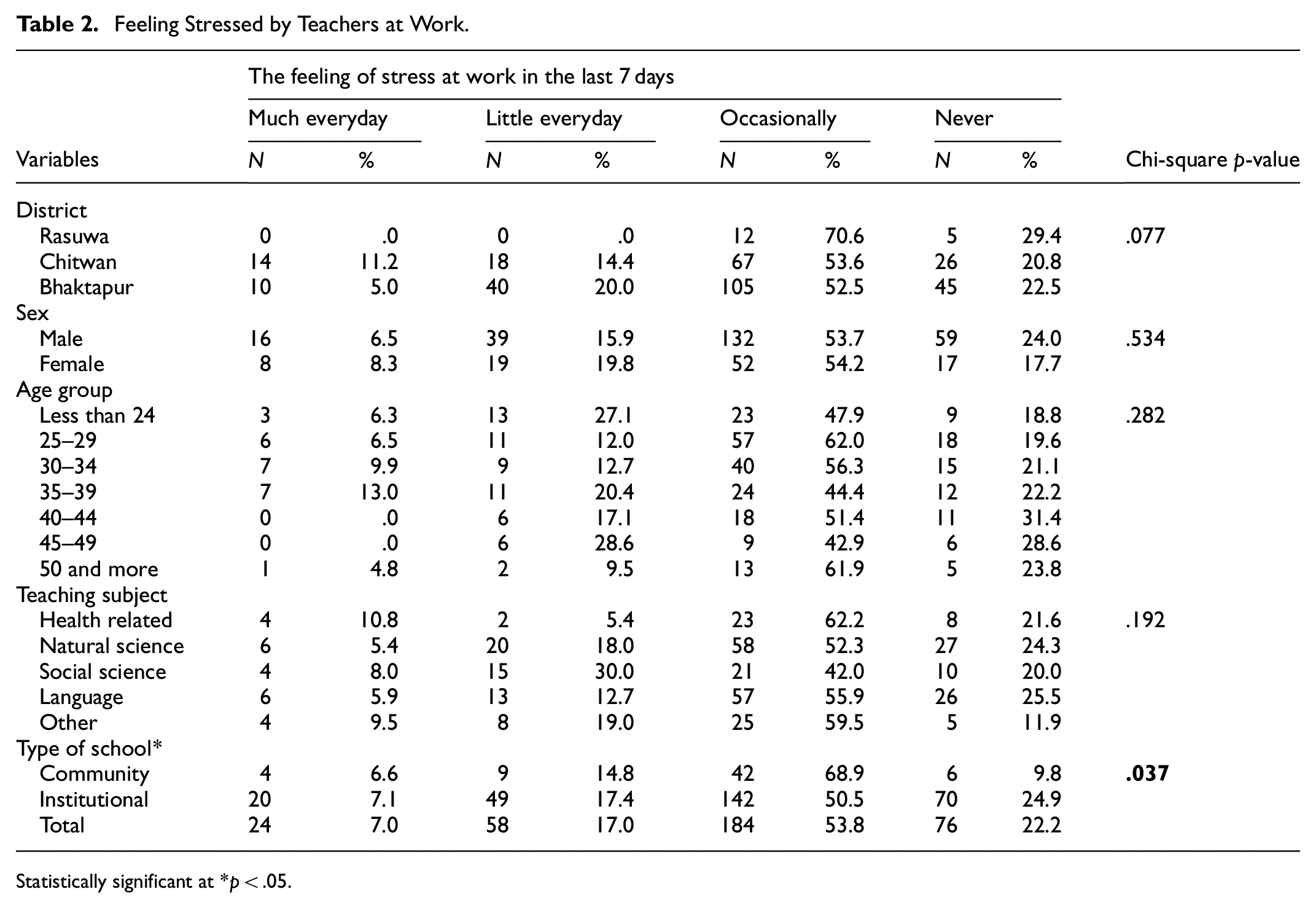
Statistically significant at *p < .05.
Stress is part of the life of many teachers in Nepal. The situation is such that female teachers (8%) face more stress every day at work than male teachers (6.5%). Individuals aged 35 to 39 years were more likely to report higher levels of stress (13%) everyday compared to other age groups. Aged teachers less likely never felt job stress than younger teachers. Similarly, teachers in Chitwan faced more stress every day than in other districts. Institutional school teachers faced more stress every day compared to the teachers of community ones.
Feeling of Mental Tension, Frustration, Depression, and Unhappiness at Work
Table 3 describes feelings of mental tension, frustration, and unhappiness at work by secondary-level teachers. None of the variables are significantly associated with experience of mental tension, frustration, depression, and unhappiness in the workplace. A total of 38.1% of teachers were lucky enough that they never faced any form of harsh mental tension, frustration, depression, or unhappiness at the workplace due to work-related tasks. However, the rest of them were experiencing some form of harsh mental tension at work. Remarkably, 57.3% occasionally encountered such problems.
Frequency of Feeling Any Form of Mental Tension at Work by Teachers.
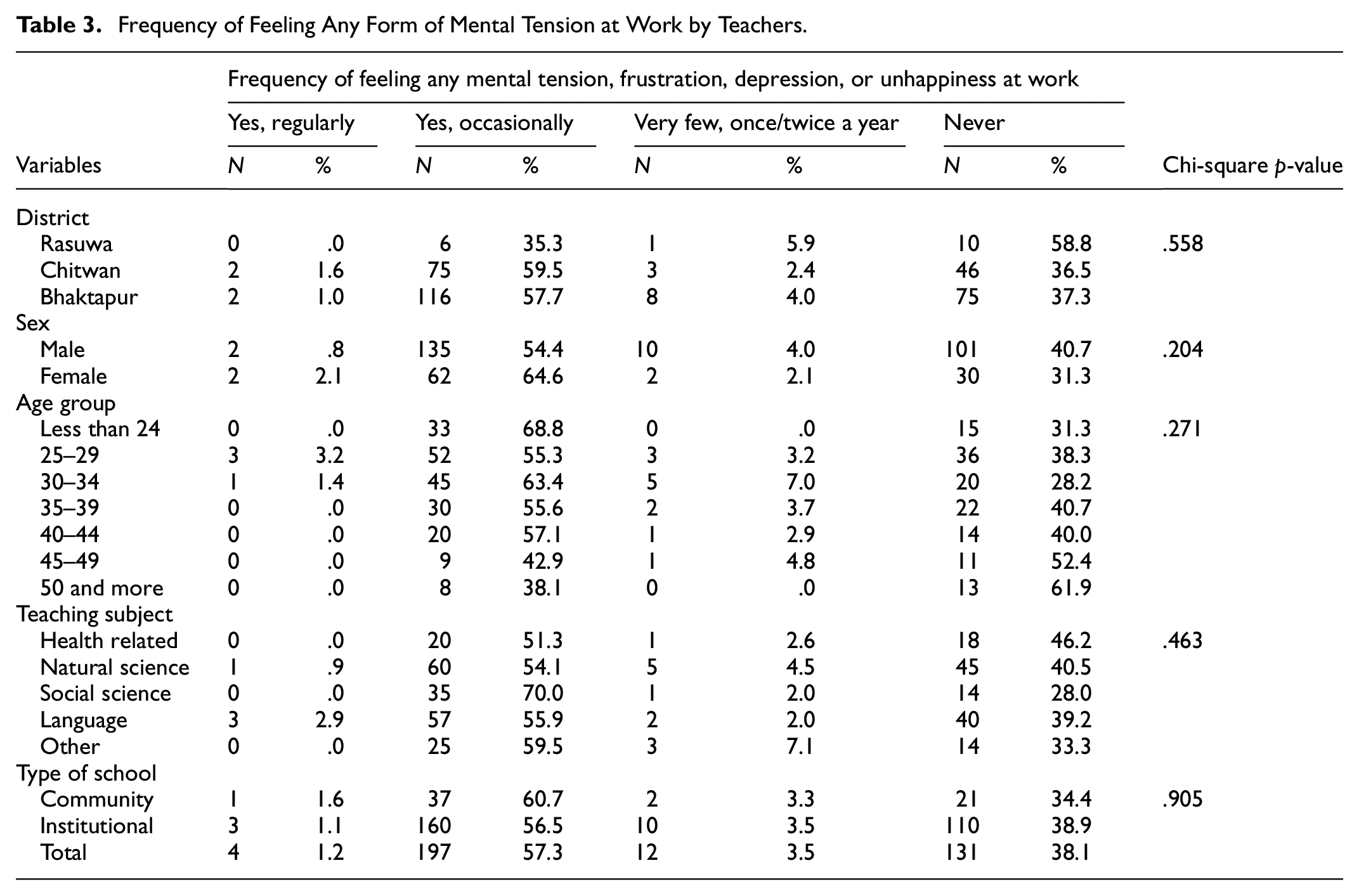
The stress scenario was poorer in Chitwan than in other districts. Of the total, 31.3% female teachers had never suffered from harsh mental tensions; the trend of male co-workers was (40.7%). In addition, the never suffered trend was seen as significantly amazingly higher among young elderly teachers such as 61.9% to ≥50 years, 52.4% between 45 and 49 years of senior teachers while 31.3% was ≤24 years, and 28.2% in 30 to 34 years of ages. A high majority (70%) of social science teachers faced harsher mental tension at the workplace occasionally than other teachers. If more than half of the teachers in total in Nepal occasionally face mental suffering at the workplace, their teaching-learning activities will certainly be degraded. Besides, they will be unable to present themselves as a healthy role model.
Frequency of Incidence of Nervous Breakdown
Table 4 shows the incidence of nervous breakdown among secondary-level teachers. The analysis revealed that only the variable of age group among secondary-level teachers demonstrated a significant association with the occurrence of nervous breakdowns (p < .001). In contrast, other variables such as district, sex, teaching subject, and school type did not provide sufficient evidence to establish a statistically significant association with nervous breakdowns.
The Situation of Nervous Breakdowns Among Teachers.

Statistically significant at ***p < .001.
Among the total sample, a substantial majority of teachers (79%) reported never having experienced any form of nervous breakdown. A smaller proportion of respondents indicated experiencing nervous breakdowns infrequently, with 11.8% reporting seldom occurrences, 7.1% indicating occasional instances, and a minimal 2.1% reporting frequent experiences of nervous breakdowns. The findings suggest that Nepalese teachers’ stress and risk of nervous breakdowns are influenced not only by school-related pressures but also by external factors such as personal circumstances, specifically their age groups.
Discussion
This study revealed that only 22.2% of participants reported that they never had had work related stress, while 53.8% faced occasionally, further 17% experienced daily at moderate levels, and 8.7% faced significant daily stress. The findings align with other studies highlighting teaching as a high-stress profession. For stance, Agyapong et al. (2022) identified three distinct burnout profiles prevalence among teachers: 25.12% to 48.37%, shaped by combinations of emotional exhaustion, depersonalization, and diminished personal accomplishment. Similarly, Kyriacou (2015) found that approximately 30% of teachers perceived their profession as extremely or very stressful. The high prevalence of stress and burnout may stem from systemic challenges such as excessive workloads, lack of administrative support, and emotional demands of student engagement. In addition, limited resources, societal expectations, and inadequate mental health infrastructure in educational settings particularly in contexts like Nepal could exacerbate these issues.
Present study notably highlighted that female and individuals aged 35 to 39 years more likely to report higher levels of stress everyday compared to male and other age groups, but these variables are not significant. Similar with present study, a study in Hong Kong found that female teachers were more likely to seek additional education, implement the Language Proficiency Requirement, foster positive working relationships, and face salary reductions as sources of work-related stress (Chan et al., 2010). It further highlighted that male and female both teachers perceive about the same amount of stress in general. However, male teachers were likelier to use music therapy, increased physical activity, or sports to relieve stress; however, female teachers were more likely to list sleeping, chatting to friends and neighbors, watching television, and shopping as their preferred methods of stress relief (Chan et al., 2010). Likely, a qualitative study with a descriptive cross-sectional design among 25 female teachers from 18 primary and junior high schools through a purposive sampling technique in Ghana showed that female teachers had high levels of stress (Addison & Yankyera, 2015). As per it, female teachers primarily experienced stress from workload and interpersonal relationships, with many feeling their performance suffered as a result.
A study done among 520 university teachers revealed that teachers who were 60 years of age or older, as well as those who had 30 years or more of experience in the classroom and those with less experience (less than 10 years), all showed lower levels of perceived stress (Teles et al., 2020). This finding contradicts with present study, which indicates that individuals aged 35 to 39 years are more likely to report higher levels of daily stress compared to other age groups. Similar with present findings and contradiction with Teles et al. (2020) a study Albino et al. (2002) highlighted the widespread perception that aging reduces mental and physical flexibility. Nonetheless, the findings are consistent with research showing that workers’ experience, together with the maturity and confidence that come with age and experience, enables individuals to make greater use of their coping mechanisms (Olmedo Montes et al., 2001). In the same way, the likelihood of occupational tension in teachers grows with their age. This could be because the teachers’ former experiences were either better than their current experiences, or it could be because the cost of living is higher now than it was in the past (Gebrekirstos, 2015). The high prevalence of occupational mental tension could be due to the poor educational system of Egypt (Kandil, 2011). Teachers have a lot of tension from their daily job load, intense verbal interactions with children, and standing for extended periods in addition to their heavy workload. It is a problem that is common among teachers in developing countries (Kaur, 2011).
Present study, regarding the nervous breakdowns found that 79% had never, 11.8% had seldom, 7.1% sometimes, 2.1% had often them. Senior teachers mostly suffered from it. Similar to their international counterparts, teachers in Canada likewise deal with high levels of stress. According to a study by Biron et al. (2008) the percentage of Quebec teachers who reported having a high level of psychological distress was 40%, twice as high as the percentage found for a general population sample from Quebec (20%). In addition, a study of 3117 teachers in 225 Australian schools found that workload, student behavior, and expectation stress are common sources of stress. The study identified five teacher profiles: Low-Burden (17%), Mixed-Burden (15%), Mixed-Burden (19%), Average-Burden (41%), and High-Burden (18%; Collie & Mansfield, 2022).
More notably, the finding of the present study aligns with those of prior studies carried out in Pokhara, Nepal. The study reported that school teachers have had partial satisfaction and mild to moderate stress from their job overall; however, their year of experience had no significant effect on their level of stress at work or job satisfaction (Mondal et al., 2011). As per this, greater physical stress was seen in the teachers who had over ten years of experience, while greater psychological stress was seen in the teachers who had between 5 and 10 years of experience. Teachers with more than 5 to <10 years of experience reported lower job satisfaction due to a lack of positive support and recognition from the school, while new teachers showed less stress (Mondal et al., 2011). Differently, present study found significant association between the school type (institutional and community teachers) to stress level, in which institutional school teachers faced more stress every day compared to the teachers of community ones.
Another pivotal finding of this study was that 38.1% of respondents never felt mental tension, whereas 57.3% experienced it occasionally, 3.5% felt it very rarely, and 1.2% reported experiencing it regularly. Female and younger teachers were more likely to encounter mental tension compared to their counterparts. In support of present findings, a cross-sectional study done on 568 Egyptian teachers, found that teachers had 100%, 67.5%, and 23.2% prevalence of occupational stress, anxiety, and depression, respectively (Desouky & Allam, 2017). In the same study, occupational stress, anxiety, and depression ratings were substantially higher in primary school teachers over 40 years of age, female teachers, and teachers with insufficient pay, teachers with greater experience, more credentials, and a heavier workload. Numerous studies have shown that teachers’ stress levels are shared with their students and coworkers. Because of this, teachers who are under stress tend to provide their students with less support Tikkanen et al. (2021) which eventually lowers student motivation and academic performance (Madigan & Kim, 2021).
This study is the first of its kind in Nepal, conducting statistical analysis considering mental health problems among secondary school teachers in Nepal. One limitation is that the study was conducted in just three districts such as Rasuwa (Mountain), Bhaktapur (Hill), and Chitwan (Terai) in Nepal. The research employed just quantitative method and eluded qualitative, which is another limitation of the study. The quantitative approach also excluded other aspects of socio-demographic variables including teaching tenure, family economic aspects. So, there might me several other aspects for mental health prevalence that needs to be resolved in a further study.
Conclusions
The study highlights the widespread prevalence of stress among secondary level teachers in Nepal, with significant variations based on socio-demographic and institutional factors. The findings reveal that school type is a key determinant of daily stress, with institutional school teachers, aged 35 to 39 and educators in Terai area (Chitwan district) report more frequent stress, while younger teachers such as ≤24 and 30 to 34 years face heightened mental suffering and stress then their counterpart. Although most teachers (79%) have not experienced nervous breakdowns, age remains a significant predictor, suggesting that mid-career educators are particularly vulnerable.
To mitigate teachers’ stress and enhance well-being schools need to implement counseling services and stress management programs, prioritizing high-risk groups such as female teachers, mid-career educators, and institutional school teachers. In addition, school needs to address excessive workloads and administrative pressures, particularly in institutional schools ensuring fair evaluation systems and fostering supportive school leadership. Further research is recommended to explore longitudinal impacts using both quantitative and qualitative approach, including all socio-demographic variables and teaching tenure.
Footnotes
Acknowledgements
We are deeply grateful to the respondents for their time, insights, and willingness to share their experiences, which were crucial to the success of this study.

Ethical Considerations
The study was reviewed and approved by the local Institutional Review Board (IRB). Written consent was obtained for each respondent for this study, no assent was needed because all respondents were above the age of 18 years.
Consent for Publication
Not applicable.
Author Contributions
BA, SM, TMP, and SP contributed to the study’s conception and design, including the data collection, analysis. SM, TMP, and SP interpreted and drafted the manuscript. BA and MKS critically revised the manuscript. All authors are agreed to submit the article in this form.
Funding
The author(s) received no financial support for the research, authorship, and/or publication of this article.
Declaration of Conflicting Interests
The author(s) declared no potential conflicts of interest with respect to the research, authorship, and/or publication of this article.
Data Availability Statement
The data can be available upon the request by corresponding author.