



Abstract
Reading comprehension constitutes an important part of the Chinese National Matriculation English Test (NMET) which influences English teaching practice greatly. Despite the focus of many studies on NMET reforms, content validity, and washback effects, there remains a notable gap in research regarding the genre of reading texts in NMET. Drawing on the systemic functional linguistics (SFL) notion of micro-genres, this study analyzes the micro-genres of the reading passages (n = 240) tested in Chinese NMET from 2004 to 2023. It reveals that these passages cover a wide range of micro-genres. However, the genre distribution is imbalanced with stories leading a dominating role while arguments, text responses and compositional reports get less attention. To improve reading comprehension tasks designed in NMET, the study calls for a more balanced distribution and diverse genres in test propositions and sheds light on the teaching practices reforms in EFL classes.
Plain language summary
This study analyzes the genres of the reading passages tested in Chinese Mainland National Matriculation Test from 2004 to 2023. It reveals that these passages cover a wide range of micro-genres. However, the genre distribution is imbalanced. To be more specific, stories lead a dominating role while arguments, text responses and compositional reports get less attention. To improve reading comprehension tasks designing in National Matriculation Test in China, this study calls for a more balanced distribution and diverse genres in test propositions and it also sheds light on the teaching practices reforms in China’s English as foreign language classes.
Keywords
Introduction
In response to China’s rapidly evolving educational landscape, the Ministry of Education (MOE) establishes educational standards and curricular goals, implemented across various educational levels. China’s English as a Foreign Language (EFL) education system spans from primary school to higher education, positioning English as a vital skill for both academic and professional success. The MOE requires English as a compulsory subject beginning in primary school, underscored by successive assessments. The Xiaoshengchu and Zhongkao examinations evaluate English proficiency at the end of primary and junior high school, respectively. For most high school graduates, the Gaokao (National College Entrance Examination) in mainland China measures overall proficiency. The Gaokao, typically conducted in June, is a highly competitive, high-stakes examination undertaken by nearly 10 million students annually (Dong et al., 2023). A mandatory part of the Gaokao, the Chinese National Matriculation English Test (NMET) functions as an essential benchmark for evaluating students’ English proficiency for college admissions. As a high-stakes examination, the NMET significantly shapes English curriculum design and teaching practices at the high school level (Madaus, 1988). It sets English proficiency benchmarks and directs the focus of EFL instruction nationwide. Consequently, the NMET impacts curriculum and classroom practices, guiding teachers to align their instruction with examination expectations.
In mainland China, for both regular high school and vocational high school students, the national entrance examination is almost the only way for them to be admitted into higher educational institutes and therefore is a high-stakes test. With such a large scale of participation, the test content of NMET plays an important role in Chinese high school English curriculum reforms and it even has an impact on the whole foreign language educational system innovations. However, China owns a vast area of territory with many provincial administrative regions which have uneven economic and educational development levels. Consequently, China’s college entrance English examination currently includes two test modes which are local provincial independent and partly uniformed NMET mode. There are seven sets of exam papers implemented in Chinese mainland NMET in the year 2023. Among these sets, four (NMET I-NMET IV) are uniformed ones which means each set is used by more than one province/region. Only three sets of exam papers from Beijing, Shanghai and Tianjin are still local provincial independent in 2023. However, there used to be more provinces/regions adopting their own independent exam papers. After the implementation of English curriculum standards nationwide, the number of provinces/regions adopting uniformed NMET has been increasing particularly in recent years. The NMET has evolved in response to educational reforms aimed at aligning with advancements in language assessment theories. Notably, the 2004 reform marked a significant shift, adjusting the structure of test papers and setting a new standard for subsequent test designs. This study’s focus on NMET papers from 2004 to 2023 reflects these changes and ensures that the analysis captures the test’s development over a critical period in EFL education. For the sake of the representativeness of the analysis, this study only takes uniform NMET papers as samples of the research target.
China has a vast population of English learners, and, the NMET has garnered significant attention from both high school students and teachers. In response to advancements in language testing theories, the design of the NMET has undergone several reforms aimed at improving its validity and reliability. In recent years, the reading comprehension section of the NMET has become more diversified, incorporating a wider range of question types and reading materials. Traditionally, the reading section primarily relied on multiple-choice questions. Over time, additional question types, such as fill-in-the-blank and short-answer questions, have been introduced, and further diversification of question formats is expected in future iterations of the test. Concurrently, the content of the reading passages has also diversified, with a broader range of genres now represented. These changes have positively influenced the design of the NMET reading test, resulting in a constructive backwash effect on high school English teaching practices.
According to the NMET structure framework (MOE, 2020), in terms of language knowledge, test-takers are required to master the basic knowledge of English phonetics, vocabulary, grammar and functional ideas as well as topics. In terms of language skills, there are certain requirements for speaking, listening, reading and writing in high school English teaching. Accordingly, the NMET consists of four parts which are speaking, listening, reading and writing. Speaking, separated from other parts, is not compulsory for most candidates. However, each section of listening, reading and writing is graded separately but only the total score is reported to candidates to determine their overall English proficiency. Among these sections, reading, which usually accounts for more than 40% of the total score, plays a significant role in NMET (R. Q. Liu & Han, 2000). In mainland China, the predominant use of Chinese in daily communication among people poses a lack of authentic listening and speaking environments for foreign language learners. Consequently, English as a foreign language (EFL) learners in China, both in rural and urban areas, commonly rely on reading authentic English materials as their primary approach to accessing authentic English sources (Huang et al., 2020). Passages in reading comprehension tasks are major sources for most Chinese EFL learners to be exposed to relatively authentic English materials during their daily studies. According to Toledo (2005), the recognition of genre-related elements is essential for completing a comprehensive reading comprehension test. The genre analysis of reading comprehension passages has, however, seldom been observed in studies on Chinese NMET. As suggested by Williams (2005), to facilitate a more effective genre analysis, it is pertinent to consider the topic and type of reading texts. Therefore, this study intends to investigate the micro-genres and their sub-classifications of the reading comprehension passages appearing in Chinese NMET over the past 20 years. In this article, the genre distribution has been summarized, classified and analyzed to explore the current state of NMET reading tasks and it also intends to provide suggestions for improving NMET reading test validity and teaching practice.
Literature Review
The concept of genre has intrigued many scholars in many fields and disciplines including applied linguistics, literature, arts and media. To analyze the form and function of nonliterary discourse, genre has gradually gained popularity as a framework in research articles, and as a tool for developing educational practices in disciplines like rhetoric, composition studies, professional writing, linguistics and English for specific purposes (ESP) (Hyon, 1996). In the realm of ESP, genre theory was pioneered by John Swales who identified the communicative purposes and structural patterns of texts within different discourse communities (Swales, 1990). It laid the foundation for understanding how genres function within specific disciplinary and professional contexts. Genre theory within SFL traces its roots to the work of Halliday and his colleagues, who proposed that texts are structured according to specific patterns and conventions that align with social and cultural contexts. These patterns and conventions are referred to as genres. However, Halliday’s view of language analysis focused more on register—the central concept in SFL—rather than genre (Alyousef & Alyahya, 2018). Register theory, one of the pillars of SFL underscores the notion that language varies according to the situational context, with the choice of vocabulary, grammar, and discourse structures reflecting the functions and participants involved (Halliday, 1978, 1985).
However, some proponents of Halliday’s work sought to separate the concept of genre from register. Among them, Jim Martin (1985, 1992, 1999, 2009, 2011) has linked genre with cultural context. Martin and his colleagues describe genres as staged, goal-oriented social processes and structural forms that cultures employ in specific circumstances to achieve diverse objectives, aligning with Halliday’s objective of connecting form, function, and social context (Martin et al., 1987). In 1992, Martin developed a model of context that consists of three levels: ideology, genre, and register. While Martin’s work aligns with Halliday’s genre theory, his research often dives deeper into genre analysis within educational and multimodal context, exploring how genres shape educational experiences and multimodal communication. In the field of second language teaching, Martin classified genres into macro-genres and micro-genres. Macro-genres are usually longer texts such as novels (Martin, 1994; Martin & Rose, 2008) whereas micro-genres are often shorter texts such as arguments and reports (Martin, 1997). In the notion of micro-genre, Martin and Rose (2008) further categorize texts based on their stages, classifying them as stories, histories, reports and explanations, procedures and procedural recounts, while providing detailed definitions of each genre. Later, in 2012, Rose and Martin shifted their focus to L2 reading. They initially propose the Reading to Learn (R2L) methodology, which is a genre-based teaching pedagogy as a central skill for learning L2 writing in school. Rose (2018) further probes into the literacy pedagogy based on R2L, emphasizing that genre knowledge is a sheer need for primary and secondary school teachers in language teaching. In his R2L learning steps, reading is identified as the foundational skill for L2 writing.
Despite the emphasis on the importance of reading in language learning in these studies, recent genre research has increasingly focused on L2 writing rather than reading. Recent studies have explored genre effects on the linguistic characteristics of L2 writing (Bi, 2020), genre-based models for assessing digital multimodal composing (Jiang et al., 2022), and the development of genre-based writing self-efficacy scales (J. Zhang et al., 2023). To improve the teaching of EFL reading and promote the improvement of EFL learners’ writing skills from the bottom up, there is a need to conduct more research on genre analysis of reading passages.
Many Chinese scholars have conducted studies on NMET with a focus on the reform of NMET (Zhao, 2016), concerning the content validity of tests (Li, 2021; Z. J. Liu & Jin, 2018; Pan & Qian, 2017) and the washback effects of the tests (H. Zhang & Bournot-Trites, 2021). However, there is a dearth of research on the reading comprehension of NMET and the genre of reading texts has been left uncharted to date. The limited research on the genre of reading passages in NMET is a significant gap that needs to be filled. Addressing this gap is essential, as it enables students to enhance their reading comprehension abilities from multiple perspectives. Exposure to a diverse array of genres equips students with the skills necessary to navigate various texts they may encounter in real-life contexts, thereby fostering greater literacy and critical thinking. Additionally, addressing this gap aligns with broader educational goals by preparing students for the complexities of communication in a globalized world. Thus, this study aims to contribute valuable insights that not only inform test design but also enrich English teaching practices, ultimately supporting students in their language learning journeys. This study aims to summarize the proportion of each genre type and the evolving trend of genres in NMET reading texts over the last 20 years and then put forward a series of suggestions regarding how to improve high school EFL reading teaching and its test design.
Research Questions
This study aims to investigate the following three questions:
(1) What are the micro-genres of the reading passages in NMET over the last 20 years?
(2) What are the changing trends in the genre of reading passages in NMET over the last 20 years?
(3) What are the pedagogical implications of teaching and NMET reading design in China?
Research Methods
Classification Framework
The micro-genre classification framework in this study is based on the genre-based literacy approach developed by Rose and Martin (2012) and combines the 2020 English curriculum standards for Chinese senior high schools. The genre-based literacy approach originates from the “Sydney School,” a term that refers to a collaborative group of researchers at the University of Sydney who have significantly influenced educational linguistics and genre-based pedagogy. The Sydney School emphasizes the importance of understanding how language functions in various social contexts, leading to the development of effective teaching strategies that incorporate genre awareness. Martin and Rose (2008) outline a diverse array of micro-genres, including stories, histories, reports, explanations, and procedures, as well as expositions, discussions, and challenges. The 2012 expansion of this framework emphasized micro-genres applicable to specific social contexts, alongside their generalized stages.
Data Collection
Data for this study consist of 240 reading comprehension passages from NMET exams conducted from 2004 to 2023, test papers derived from test books published by the MOE and data released by the Provincial Department of Education. These exams, throughout the 20-year span, were administered in a paper-based format. Exam years included a varying structure. From 2004 to 2007 each exam contained five passages with multiple-choice questions. From 2008 to 2015, NMET introduced two formats, adding fill-in-the-blank tasks to the reading comprehension section, where students completed conversation blanks with contextually logical words. Between 2013 and 2015, NMET II discontinued the second section, aligning question types with NMET I. From 2016 to 2020, three uniform NMET paper sets were issued each year, maintaining consistency in question types. Since 2021, four sets of NMET papers have been standardized across more provinces, preserving uniform question types. To ensure representativeness, this study includes all uniform NMET papers from this 20-year period.
Data Analysis
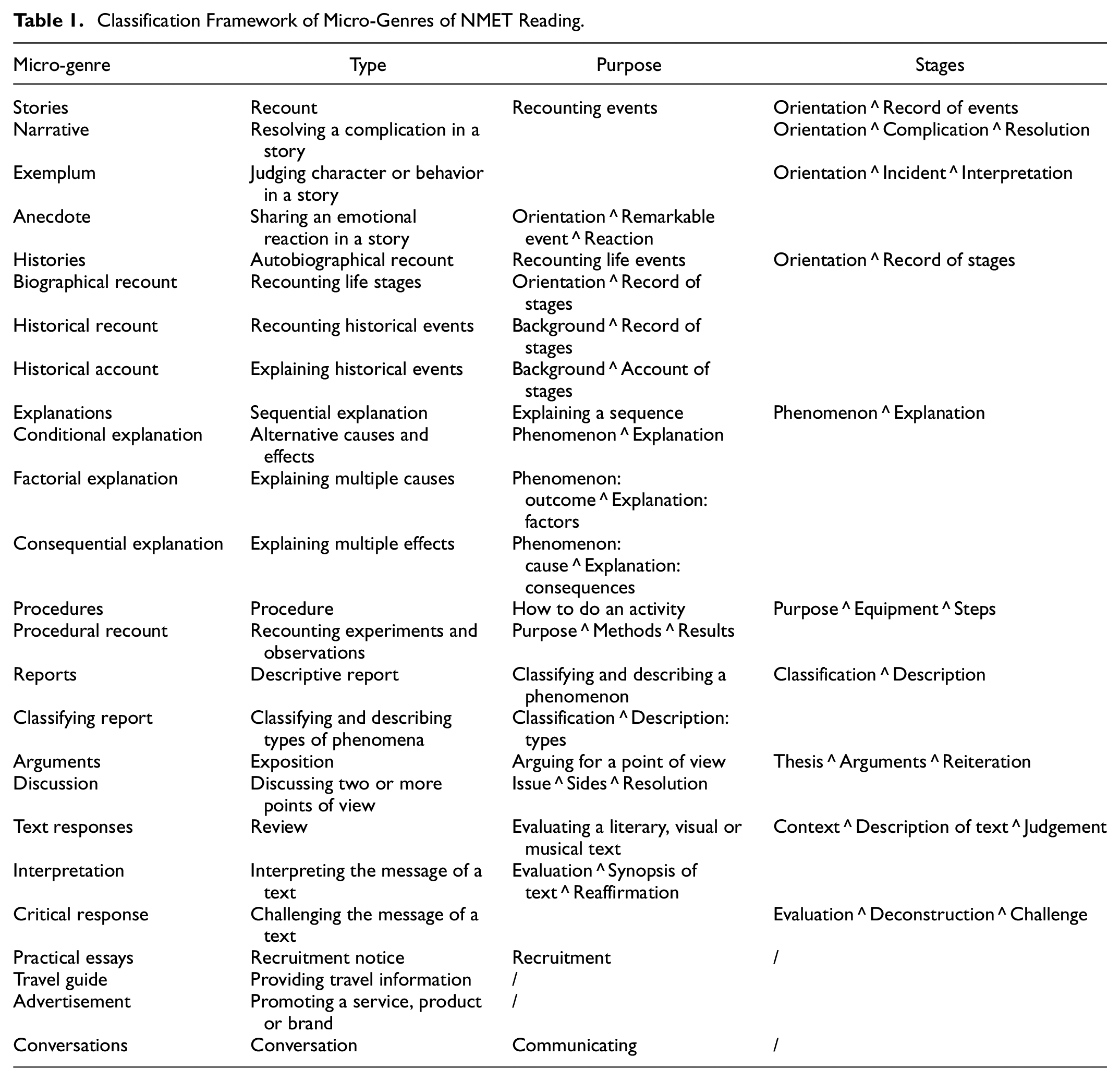
The genre classification procedure was executed in two rounds. In the first round, each passage was analyzed based on its purpose and structural stages, using Rose and Martin’s (2012) genre classification framework, which is grounded in the Write It Right project. However, given that this study focuses on reading comprehension tasks from the Chinese NMET, we found that certain genres in the NMET do not conform to the categories outlined by Rose and Martin, which primarily focus on academic and static genres. To address this discrepancy, we referred to the English curriculum standards for senior high schools (2017 edition, 2020 revision) and expanded the classification framework to include additional genres such as practical essays and conversations. The practical essays found in NMET reading tasks, including recruitment notices, travel guides, and advertisements. These genres serve practical, real-world purposes, such as providing instructions or conveying specific, action-oriented information. They are primarily informational and persuasive, designed to prompt readers to take specific actions. Similarly, conversations in the NMET do not fit the static genres outlined by Rose and Martin (2012), as they are dynamic and context-dependent, requiring students to interpret back-and-forth exchanges between speakers. Table 1 shows the final classification of micro-genres adopted in this study.
Classification Framework of Micro-Genres of NMET Reading.
In the second round of classification, each passage was re-evaluated within this revised framework. To ensure classification reliability, two independent raters classified the passages, and inter-rater reliability scores were calculated. Professionals who studied NMET reading comprehension were also consulted for some of the inconclusive results. Discrepancies were addressed through collaborative discussions, which further refined the framework to resolve ambiguities. Statistical analyses were then conducted using Microsoft Excel. This methodology supports the reliability and validity of the genre classification and the study’s overall insights.
Research Results
The micro-genres were classified with the results presented in Table 2 which showcases the genres that appear in Chinese mainland NMET in the last 20 years. The analysis reveals the presence of nine distinct micro-genres within the reading tasks. However, it is important to note that the frequency of occurrence varies significantly across these genres. The most common genre analyzed was stories which appear in every set of test papers and account for 25% of all reading tasks tested in previous NMET. This type of task appears as the narration of an event and most of the stories are attached to personal feelings. Procedures and practical essays, which took up 17.92% and 15% of the reading passages respectively, are the second most frequently occurring genres. Practical essays began to appear in tests since 2008, often as the first passage in reading comprehension tasks while procedures were frequently encountered in the fill-in-the-blank questions in Section Two of Reading Comprehension in NMET. Candidates were presented with passages explaining how an activity is performed or can be carried out when the passage genre is procedure. Practical essays exposed candidates to authentic and practical information that they commonly encounter in social contexts. Both explanations and reports accounted for 8.75%. Explanations are used to account for phenomena while reports are used to describe or classify phenomena or objects, often characterized by scientific content. The genre of arguments shared a similar percentage with the aforementioned genres, accounting for 8.33%. Arguments require candidates to demonstrate critical thinking abilities, as they typically present a point of view and aim to persuade readers through logical reasoning. Text responses and conversations were less frequently encountered in the tasks, with text responses accounting for 3.75% and conversations only comprising 2.08% of the passages. An example of a text response would be “an explanation of a point of view in the book Forgive for Good (NMET 2004).” Conversations were exclusively concentrated in Section Two of NMET between 2008 and 2012 but did not appear in other years.
Micro-Genres in NMET Reading Comprehension Passages.

Table 3 displays the four types of stories that are included in reading comprehension tasks. The data reveals that recount and anecdote are the two most frequently appearing types, accounting for 45% and 30% respectively. The recount is a factual account of an event without personal feelings, and this analysis considers news reports as a subset of the recount. For instance, “Three stories about giving back (NMET 2004B)” is an example of the recount. Anecdotes, on the other hand, express personal feelings and are often used to convey emotions. This genre type usually contains words that express the emotions of a character or describe their inner feelings. However, narrative and exemplum appear less frequently, only accounting for 13.33% and 11.67% respectively. The narrative type has a distinctive feature where there is a complication in the text that has been resolved. For example, “Dixie Heights High School students operate a coffee shop for special learning needs (NMET I 2010B).” Exemplum is a genre type to judge behavior or character, such as in the reading task “A kind family helps recover a lost wallet (NMET II 2014A).”
Types of Stories in Reading Comprehension Tasks of NMET.

Table 4 presents the distribution of the four types of histories in the past 20 years historical account, historical and biographical recount and autobiographical recount. Historical account highlights reasons and consequences. It explains the causal relationship that arises between events, which involves circumstantial and verbal realizations (Martin & Rose, 2008). An example of this type is “A History of Environmental Improvements in the United States (NMET II 2014B).” In contrast to a historical account, the historical recount emphasizes the stages of an event, with episodes supported by details of their temporal setting. An example of this is “The origin and development history of advertisement (NMET I 2011B).” Biographical recount and autobiographical recount both focus on people’s life experiences rather than successive events. A biographical recount tells a person’s whole life episode while an autobiographical recount concentrates on the author’s own life experiences. An example of the former type is “A travel writer and food critic Edie Jarolim (NMET II 2010B)” and an example of the latter type is “An introduction of the author as an enthusiastic reader (NMET II 2020D).” As shown below, historical accounts and biographical recounts take a relatively large percentage, accounting for 36% and 32% respectively. Historical recounts take the percentage of 20%. Only three passages are classified as autobiographical recounts which account for the smallest share of 12%.
Types of Histories in the Reading Comprehension Tasks in NMET.

Table 5 shows the numbers of each type of explanation and their proportions in percentage terms. There are four types of explanations: sequential explanation, conditional explanation, factorial explanation and consequential explanation, factorial explanation is the most common one which accounts for 47.62% of the explanations category. In this type, examinees are provided with passages containing multiple factors to one phenomenon. Five tasks use consequential explanation as their genre types, accounting for 23.81%. This type presents a phenomenon as a cause and then followed by consequences. An example of this type is “Benefits for working in the morning (NMET I 2018E).” Four tasks which account for 19.05% are classified as conditional explanation which requires candidates to understand alternative causes and effects to one phenomenon and the implied obligatory relations between these causations such as “Dealing with interruption under different conditions (NMET II 2017E).” Sequential explanation, whose purpose is to explain a phenomenon by a series of events succeeding each other, accounts for 9.52%. One of the tasks in this type is “Research on when a leafy plant is under attack, it doesn’t sit quietly (NMET II 2017D).”
Types of Explanations in Reading Comprehension Tasks in NMET.

Table 6 presents the two types of procedures in reading comprehension tasks: procedure and procedural recount. Among the tasks, 27 genre tasks (65.85%) are classified as the procedure that provides instructions on how to perform an activity. An example of a procedure is “Suggestions for helping children develop classic skills for future jobs (NMET I 2014E).” On the other hand, procedural recounts have appeared relatively less frequently over the past 20 years with 14 reading passages accounting for 34.15%. Unlike procedure tasks, procedural recount tasks describe how activities, particularly experiments or observations, were conducted. An example of this type is “Levin and his team’s research on the benefits of exercise to heart health (NMET II 2022B).”
Types of Procedures in Reading Comprehension Tasks in NMET.

In Rose and Martin’s (2012) genre classification, reports are classified into three types: descriptive report, classifying report and compositional report. However, in the analyzed texts, only the first two types were found. As shown in Table 7, the majority of reports in the reading tasks were descriptive reports, accounting for 95.24%. The reports genre of the reading comprehension tasks are mostly reports on the scientific study of a phenomenon. Reading tasks such as “Benefits for pet owners taking their animals to work (NMET 2005A)” are classified as descriptive reports which are used to describe and classify a phenomenon. Compared with descriptive report, classifying reports (4.76%) present a further classification of a general class. The classification criteria are essential in this type, and different criteria may classify the same phenomenon in different ways. An example of a task of this type is “Two clearly different mindsets to succeed (NMET II 2012E).”
Types of Reports in Reading Comprehension Tasks in NMET.

Exposition and discussion are two types of argument genres. Table 8 shows the numbers and proportions in percentage terms of the two types. There are 17 tasks classified as exposition with a percentage of 75%. In this type, passages present a series of arguments revolving around a point of view. For example, “Benefits of having small talk (NMET II 2018D).” Discussion seldom appears and there were only five tasks in the past 20 years with a percentage of 25% in the arguments genre. A salient difference between exposition and discussion is that discussion involves many opinions or two opposing positions and thus argumentation supports different sides. An example of this type is “Opinions on taking a gap year (NMET II 2015C).”
Types of Arguments in Reading Comprehension Tasks in NMET.

Text responses include three types review, interpretation and critical response. In Table 9, it is clear that review more frequently appeared in the tasks, which accounts for 55.56%, while both interpretation and critical response have only two tasks and accounts for 22.22%. Review is used to evaluate a text including literary, visual and musical text. There are three stages in a review: context, description of text, and judgement. Given these criteria, five tasks can be classified as review, one example is an introduction of a photograph competition and evaluations of some works (NMET III 2021A). Interpretation is used to interpret the message of a text. In the preliminary stage, an evaluation will be presented, followed by a synopsis of the text, and ended by a reaffirmation. An example of this type of task is “Jo Usmar’s favorite books (NMET II 2019A).” Varied from interpretation, the purpose of critical response is to challenge the message of a text. Therefore, the last two stages are deconstructing the text and challenging it. An example of this type is “Grandparents Answer a Call (NMET I 2016B),” in which the opinion of moving is challenged.
Types of Text Responses in Reading Comprehension Tasks in NMET.

The genre of practical essays can be classified into three types, including recruitment notice, travel guide and advertisement. The genre of advertisement accounted for 50% of all tasks, with a total number of 18. The purpose of advertisement type in these tasks is to promote services, products or websites. Travel guides less frequently appeared, which took a percentage of 41.67%. In the classification, the main purpose of a travel guide is to provide travel information for tourists, which includes information such as transportation schedules, travel itineraries, travel locations, and hotel accommodations. Only three tasks were classified as recruitment notices, making up 8.33% of the total (Table 10).
Types of Practical Essays in Reading Comprehension Tasks in NMET.
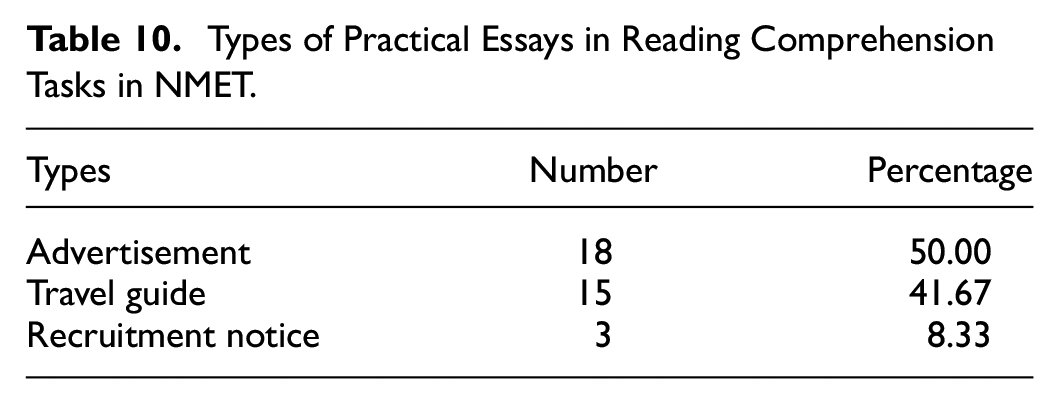
Figure 1 illustrates an uneven distribution of genres in reading comprehension passages over the past 20 years. While some genres have appeared consistently, others have been notably absent. Notably, stories have been constantly appearing in every year of the reading comprehension tasks. Histories and practical essays have also maintained a consistent presence since 2016. However, despite the gradual increase in the types of NMET reading tasks, the frequency of the report has even declined. Among the various genres, there have been notable fluctuations. The genre of stories, for instance, witnessed a significant increase in 2021 but subsequently experienced a sharp decline. However, the genre of procedures has seen a notable surge in the past 2 years. In contrast, the genre of practical essays has remained relatively stable since 2014, as it often appears in the first passage of reading comprehension tasks. It is worth highlighting those two genres, arguments and text responses, which primarily assess students’ thinking skills, have seen an increase in 2023 examinations. Arguments were rarely tested before 2018 and text responses were even more infrequent. Arguments, which were rarely tested before 2018, and text responses, which were even less frequent, have become more prevalent in recent exams. This shift reflects an increased focus on evaluating students’ analytical and critical thinking abilities.

Changing trends in the genre of reading comprehension passages in NMET.
Discussion
This study attempts to investigate the micro-genres presented in Chinese mainland NMET reading texts. It summarizes nine micro-genres: stories, histories, explanations, procedures, reports, arguments, text responses, practical essays, and conversation. Seven of these micro-genres belong to Rose and Martin’s (2012) classification, which covers major genres that students need to master for success in secondary school. This classification also provides teachers with an overview of the tasks they need to prepare their students for. Among these seven micro-genres, stories are the most common genre, while text responses are the least common one. Different genres play a crucial role in shaping students’ reading comprehension and academic performance. For instance, narrative texts such as stories and histories enhance social-cognitive potential (Eekhof et al., 2022). Reading argumentative texts can foster critical thinking by training students to identify and evaluate arguments systematically. It enhanced both analytical skills and writing proficiency (Haria & Midgette, 2014). The nine micro-genres identified in the reading comprehension tasks of the Chinese NMET were compared with results from previous research into the classification of the reading comprehension tasks in Chinese NMET and the proportion of each genre.
Gu and Wang (2008), Peng et al. (2017), and Li (2021) applied Bachman and Palmer’s (1999) task characteristic framework to analyze reading comprehension tasks in the Chinese NMET. They classified the texts into narrative essays, argumentative essays, explanatory essays, and practical essays. A significant finding across these studies was that explanatory essays accounted for the highest percentage of texts analyzed. The explanatory essays in their classification can be considered equivalent to both explanations and reports in the present study. However, our analysis reveals a different trend, with these two genres constituting a minimal percentage of the texts examined. In contrast, narrative texts, particularly stories, emerged as the most prevalent genre in the NMET. The prominence of stories can be attributed to their focus on conveying emotions and recounting events, which make them more accessible and engaging for high school students during examinations.
Several factors contribute to this discrepancy between our findings and those of prior studies. First, the time periods analyzed differ among the studies, which may influence the representation of specific genres in the test papers. Second, the analytical frameworks used in previous research may offer varying definitions of genre categories, impacting the categorization process and ultimately leading to different findings. In terms of reading skills expected to be tested, the skill of understanding the author’s intentions, attitudes, and opinions is rarely tested or is ignored in most years. This has a major bearing on the fact that argumentative essays are seldom examined. In our analysis, we similarly found that arguments were rarely examined, while text responses, which would require interpreting the author’s intentions and opinions, appeared even less frequently. As we analyze sub-classifications of each micro-genre in this study, clearer requirements for genre selection emerge. Recount, which belongs to stories, is the type of genre that is most frequently required in the tasks. However, compositional report has not been involved, which is another type of scientific genre. Therefore, this type of genre could be introduced in future reading comprehension tasks. Practical essays and conversation are two extra genre types required by English curriculum standards for senior high school (2017 edition 2020 revision), which are more closely related to social purpose.
This study also analyzed the changing trends in the genre of reading comprehension text in NMET over the past 20 years. Similarly, Dong (2010) analyzed the genre of reading comprehension texts in Chinese NMET from 2003 to 2009 and the results show that arguments took the largest proportion, whereas practical essays took the smallest. Notably, in recent years, the genre of procedures has increased significantly, the examination of arguments has been gradually gaining importance, and practical essays have appeared steadily in the previous years. Xu and Liu (2021) noted that expository texts —which either introduce concepts or explain things—dominate test papers in various parts of China. However, other informative text types such as argumentative essays, practical and procedural expository texts were less emphasized. The trend towards an increase in these micro-genres is therefore an optimistic one and remedies this problem. The examination of stories most significantly increased over the past 20 years. However, most examinations focus on recount, a more complex type of genre, narrative is seldom involved.
Overall, text response is seldom included in the NMET, despite its presence in the Ministry of Education (MOE) syllabus. Text responses can be categorized into three types: review, interpretation, and critical response. Both interpretation and critical response require students to present the author’s point of view, and these genres demand critical thinking—skills that are particularly relevant for Chinese students. Given the long-term washback effects of the NMET on students’ cognitive and academic development (H. Zhang & Bournot-Trites, 2021), reading comprehension tasks play a key role in fostering students’ critical thinking abilities. In particular, argumentative micro-genres, such as exposition, discussion, and text response, are effective in fostering this development. These genres are characterized by critical elements such as claims, evidence, and counterarguments, which require students to engage in higher-order thinking by systematically identifying, analyzing, and evaluating arguments (Haria & Midgette, 2014). Furthermore, when students apply a variety of critical reading skills, they are better equipped to navigate not only explicit information but also the implicit messages that lie between and beyond the lines of the text (Al Roomy, 2022). By incorporating these argumentative micro-genres into reading comprehension tasks, test designers and educators can provide students with opportunities to practice these skills, thereby enhancing their overall critical thinking abilities. Additionally, reading and writing have a mutually reinforcing relationship, and the presence of critical texts in reading tasks can positively impact students’ EFL writing skills. This contributes to improving their overall English proficiency. Moreover, the curriculum standards established for high schools served as the basis for the reading comprehension tasks in the Chinese NMET. These standards emphasize exposing students to diverse forms of discourse found in real-life social contexts, necessitating high school students’ exposure to a wide range of micro-genres. However, the limited variety and significantly unbalanced distribution of micro-genres in the NMET over the past 20 years may negatively impact students’ reading proficiency. Students might perceive genres that are rarely tested in the exam as less important than those that appear more frequently, potentially hindering their comprehensive understanding of different discourse forms.
Based on the previous discussion, three main implications arise in response to the third research question. First, the findings of this research highlight the importance of genre awareness in Chinese EFL pedagogy. Previous studies emphasized the role of genre-based instruction in developing students’ reading skills (Montero-Arévalo, 2019). The exploration of genres in NMET reading comprehension tasks is a foundation for integrating genre-based instruction into classroom teaching. By exposing students to a wide variety of genres, teachers can help them develop genre-specific reading strategies and linguistic features (Rose & Martin, 2012). Therefore, incorporating genre-focused instruction in the EFL curriculum can enhance student’s ability to comprehend and analyze different types of texts.
Second, the imbalanced distribution of genre types identified in Chinese NMET raises concerns about the adequacy of student’s exposure to different genres. Given the uneven distribution of reading passage genres in NMET over the past two decades, teachers may focus their instruction on only a few commonly tested genres. However, students’ reading comprehension ability can truly be improved when they can effectively handle a variety of genres. Therefore, teachers must design instructional activities and content that incorporates a variety of genres, providing students with abundant opportunities to interact with texts from different domains, including informative, persuasive and narrative texts (Rose & Martin, 2012).
Third, the current overrepresentation of stories and the neglect of other genres in the NMET indicated a need for revision in the test design. Several factors may explain the dominance of stories. Several factors may explain the dominance of stories. First, stories align well with the exam’s objective to assess key reading skills, such as narrative comprehension and inferential reasoning. Second, stories provide familiar and engaging contexts, reducing exam anxiety and enabling students to demonstrate their comprehension abilities more comfortably. Additionally, stories often reflect real-world language use, which aligns with the curriculum’s focus on practical language skills. These dimensions basically correspond to the definition of the examination objectives of the “reading” section of English curriculum standards for senior high school. In contrast, the underrepresentation of argumentative genres may stem from their inherent complexity. Argumentative texts require students to engage in higher-order thinking skills, such as critical analysis and the ability to construct coherent arguments, which may be more challenging for high school students. Additionally, the traditional focus on narrative texts in earlier educational stages may have limited exposure to argumentative writing, resulting in a lack of familiarity and comfort with this genre during examinations. It should be noted that the narrative texts remain in the realm of information acquisition, synthesis and interpretation, and do not include the goals of evaluation, reflection and critique (Xu & Liu, 2021). Therefore, test designers should aim for a more balanced and diverse distribution of genres to ensure a comprehensive assessment of students’ reading comprehension abilities. The inclusion of various genres in the test can have significant washback effects on students’ learning experiences. While stories and histories may enhance students’ ability to comprehend and analyze narrative texts, argumentative genres can foster critical thinking and analytical skills. By including a wider range of genres in reading comprehension assessments, test designers can ensure that the test reflects the multidimensional nature of reading comprehension. This aligns with the principles of construct validity, which emphasize the need for assessments to reflect the intended construct being measured (Messick, 1989). Although this study is grounded in the context of the Chinese NMET, its findings hold potential value for other Asian countries that operate within similar educational systems. Many countries in Asia, including Japan and South Korea, place a strong emphasis on high-stakes standardized exams as a key component of their educational assessment frameworks. These exams often serve as gateways to higher education and are aligned closely with national curricular standards.
Conclusions and Limitations
This study investigates the micro-genres of reading comprehension tasks in the Chinese mainland NMET over the past 20 years, using a framework based on Systemic Functional Linguistics (SFL). The findings reveal that the reading comprehension tasks in Chinese NMET encompassed a wide range of micro-genres. However, the distribution of these genres is uneven. Stories constitute the largest proportion, while a limited number of argumentative genres, such as exposition and discussion, as well as text responses including review, interpretation, and critical response, are included in the tasks. The excessive number of stories calls for a revision of test propositions to achieve a more balanced and diverse distribution of genres, as it can test students’ English reading ability more effectively. Exposition, discussion, and text response are argumentative micro-genres that include critical elements such as claims, evidence, and counterarguments. These genres are particularly effective in cultivating students’ critical thinking skills, but are less required in the Chinese NMET. This may not be appropriate for improving Chinese high school students’ EFL reading proficiency. Therefore, test designers could emphasize these three genres to raise awareness among teachers and students that these genres need equal attention. Fortunately, in recent years, there has been a growing trend in the examination of arguments, indicating a shift towards a more balanced and diverse distribution of genres. For future NMET, it is suggested that reading comprehension tasks cover a wide range of genres and their sub-types. This can not only enhance students’ understanding of more authentic reading materials but also promote improvement in their writing to some extent through more extensive reading.
However, there are also some limitations to this study. First, the research does not adopt an ethnographic approach to investigate Chinese EFL learners. By conducting interviews or administering questionnaires to students regarding the effects of reading comprehension tasks and texts on their learning, more insights could be gained. This would provide a better understanding of the extent to which students focus on reading comprehension tasks. Second, the samples analyzed in this study only include reading comprehension tasks in NMET. Due to the uneven development of education in different regions of China, integrating more samples from other self-proposed test papers in China could enhance the reliability of data on the range of micro-genres required in these examinations.
Footnotes
Declaration of Conflicting Interests
The author(s) declared no potential conflicts of interest with respect to the research, authorship, and/or publication of this article.
Funding
The author(s) disclosed receipt of the following financial support for the research, authorship, and/or publication of this article: This work was funded by the Graduate Research and Innovation Projects of Jiangsu Province [Grant Number: KYCX24_4059]

Data Availability Statement
The data are available from the corresponding author on reasonable request.