




Abstract
Remote work has become increasingly common due to the COVID-19 pandemic, but this has presented workers with new difficulties and barriers that may have an effect on their performance and productivity. In this paper, we explored the barriers to remote work and how a certain personality trait—grit: passion and perseverance in achieving long-term goals—could influence how workers copied with this reality. A total of 203 participants (69.5% female) with mean age of 41.90 (SD = 12.60) years completed an online survey, during the first COVID-19 lockdown in Portugal, investigating grit, perceived stress/anxiety, perception of remote work as a barrier, and self-reported productivity during this period. The findings suggest that grit negatively predicts the number of barriers identified during the transition to remote work and consequently positively predicts worker self-reported productivity. Thus, self-reported productivity is positively related to grit, and this relationship is mediated by the number of identified barriers. Future research should extend this study using longitudinal data, exploring the impact of core variables on career progression and the role of grit in worker resilience across various sectors and work environments, including the influence of events like the COVID-19 pandemic.
Introduction
The COVID-19 pandemic has had a significant influence on people’s lives worldwide, altering daily life routines. Governments worldwide have implemented lockdowns and social distancing measures to slow the spread of the virus, as happened in Portugal (first lockdown starting mid-March 2021). These measures implementation led to a change in mentality and stigmas associated to remote working for both companies and workers; and accelerated the massification of remote working that is, in the long run, inevitable (Bartik et al., 2020). Although remote working and flexible working hours have been proved to improve job satisfaction and productivity (e.g., Santos & Williamson, 2015), there is a huge difference between choosing that lifestyle and being forced because of a global pandemic (Muralidhar et al., 2020).
Remote working was, one of the most effective approaches to stop the spread of COVID-19 while still maintaining jobs and avoiding layoffs. It is crucial to be aware of the difficulties and challenges that employees faced (Satici et al., 2022). Since the first months of 2020, employees all around the world had to adapt to a new way of living. Adaptation in times of uncertainty is one of the main causes of stress, and people need to maintain their psychological wellbeing and while also, new routes to feel motivated and engaged in their work (Bartik et al., 2020) in a pandemic situation, such as COVID-19, characterized by adversity and uncertainty, it is reasonable to anticipate that personality traits will modulate individuals’ responses. Notably, the trait of passion and perseverance in achieving long-term goals—grit (A. L. Duckworth & Quinn, 2009), can influence an individual’s response. Gritty people tend to be more optimistic, interpreting adverse events as challenges rather than setbacks, leading to resilience; and acceptance of their current situation and conditions (A. L. Duckworth & Quinn, 2009). Grit has also been found to affect people’s productivity levels (Hodge et al., 2018). The body of research on remote work and COVID-19 is extensive, looking at psychological, social, and economic implications of working remotely (Espitia et al., 2022; Shirmohammadi et al., 2022; Tursunbayeva et al., 2022). Likewise, several studies have also looked at the significance of grit in overcoming the pandemic’s problems, including job loss and economic instability (Bono et al., 2020; de Zepetnek et al., 2021; Malureanu et al., 2021). In the present study we extended the existing research by providing valuable insights through an online survey, run during the first COVID-19 lockdown in Portugal, exploring barriers to remote work and how a particular personality trait—grit: passion and perseverance in achieving long-term goals—might influence the way how workers cope with this new reality.
Literature Review
Remote Work, Productivity and Psychological Factors
Historically remote working has been synonymous with flexibility in managing activities, and the advantages and challenges of remote work have been well established in the literature (Allen et al., 2015; Bailey & Kurland, 2002; Felstead & Henseke, 2017). Remote work was implication on work outcomes, including job satisfaction, organizational commitment and identification, stress, performance, wages, withdrawal behaviors, and firm-level metrics (Allen et al., 2015). Flexibility has been possible because have technologies changed the nature of work and allowed the ability to work from multiple locations and giving workers sense of freedom by being able to choose their own place of work (Felstead & Henseke, 2017). Nonetheless, remote working brings out unique challenges: there are no managers or teammates nearby to consult or to provide immediate responses or support, and no one is looking over one’s shoulder to keep focused on tasks. Also keeping work and home life balance can be extremely complicated (Bailey & Kurland, 1999; Wheatley, 2012). In addition, remote working has been shown to be beneficial to both companies and employees, as, it allows companies to reduce costs and increase productivity, and, allows employees to work more flexible hours without being being tied to office hours (de Menezes & Kelliher, 2011). In some cases, this can lead to a reduction in stress levels (Hartig et al., 2007) and an increase in wellbeing (Lewis & Cooper, 2005); in several studies, remote workers reported higher levels of satisfaction than other workers (Wheatley, 2012), in particular among remote workers who are parents, overall job satisfaction was higher when they had flexible schedule, and the intention to change jobs was lower (Rothausen, 1994). Remote work has been shown to increase productivity (Bloom et al., 2015; Hill et al., 1998), and employee retention and contribution to the company have also been associated with the extent of remote work applied (de Menezes & Kelliher, 2011). Although remote work was initially marketed as a way to meet social (e.g., environment) and individual needs (e.g., transportation, family, and leisure) while also reducing work-family tensions, recent developments in which whole families are locked down at home indicate a new look at the benefits and challenges of remote work.
Nonetheless, remote working has its downsides: A study explored the impact of working remotely on areas such us of wellbeing, job effectiveness and work-life balance. These three areas have been found to be crucial and interrelated with each other when exploring the impacts of remote working on individuals, supervisors and organizations (Grant et al., 2013). For example, job effectiveness can positively and negatively be influenced by wellbeing and work-life conflict. Having permanent access to technology makes it difficult to maintain a good work-life balance and can lead to overworking and lack of time to recuperation. Consistent with previous research, the authors (Hartig et al., 2007) also conclude that remote workers experience an overlap between home and work lives, eliminating the sensation of relaxation after work at home. Hence having a separate room for telework has been shown to improve the perception of space and result in higher levels of work-life balance. Furthermore, remote working can lead to feelings of isolation and loneliness. When working from home, the absence of social interaction can negatively influence the employees’ productivity (Grant et al., 2013; Muralidhar et al., 2020).
It is equally well-established that remote working effectiveness is influenced by factors such as wellbeing, work-life balance, and anxiety (Allen et al., 2015; Hartig et al., 2007; Lewis & Cooper, 2005). All these factors can be managed to improve work effectiveness and productivity. For instance, the importance and effectiveness of wellness courses in decreasing distress and improving wellbeing were evaluated, and the results showed the courses had a great impact, especially in increasing adaptative coping strategies to deal with adverse situations (Acquadro Maran et al., 2018; Szrek et al., 2019).
As noted, the current global crisis has changed how many individuals work and how their employers are operating. It is therefore essential to study how psychological factors can promote perceived wellbeing and productivity, which are of central importance for both workers and companies. Importantly, personality traits can predict job performance (Schmidt et al., 2008), and some specific traits (e.g., creativity, charisma, self-confidence, emotional intelligence, etc.) play a crucial role to succeed in specific careers.
Grit has become recognized as a crucial element that can affect success in this ever-changing environment. As a non-cognitive trait and is related to self-control and consciousness, people who demonstrate high values in these two characteristics are likely to have high values of grit. However, there are two distinct characteristics: having self-control means the person has the ability to control temptations and regulate their emotions and their behavior, yet this does not mean they consistently pursue a dominant goal (A. Duckworth & Gross, 2014). Grit it is an aspect of character and by norm, gritty people tend to be more optimistic in the way they interpret adverse events as challenges, not setbacks, and this leads to resilience (A. L. Duckworth et al., 2009). In fact, people with higher values of grit typically accept their current situation and condition and think that they could be in an even worse situation than they are (A. L. Duckworth et al., 2009). Additionally, grit is correlated to the pursuit of happiness and the motivation that is behind this pursuit. It can be said that gritty individuals seek happiness through engagement (Von Culin et al., 2014). Gritty people pursue and focus their behaviors on achieving long-term goals. This discipline requires a high level of self-regulation, so they can benefit from the wellbeing those goals provide when reached (Human-Vogel & van Petegem, 2008). The concept of grit can also be correlated to the Greek philosophies of hedonism and eudaimonism. Hedonism focuses on achieving immediate pleasure and pain avoidance, while eudaimonism focus on the meaning of self-realization in achieving long-term goals (Ryan & Deci, 2001).
Since the COVID-19 pandemic, working remotely has changed significantly, and it is now more common than ever. The effects of this trend on global value chains, remote employment, and international trade have been highlighted (Espitia et al., 2022; Tursunbayeva et al., 2022). A relevant review of the literature (Tursunbayeva et al., 2022) on remote work during the pandemic identifies both positive and negative effects on workers, organizations, and society. Despite the potential advantages of a better work-life balance, it can be difficult to distinguish between work and personal life when working remotely. Grit has become recognized as a critical component of success in this ever-changing environment. Academic engagement and success, happiness, and life satisfaction have all been shown to be positively correlated with the passion and commitment to long-term goals that grit represents. Additionally, grit is positively correlated with academic achievement and engagement, according to Hodge et al. (2018), which examines the relationship between grit, engagement, and academic outcomes for university students. Differently, other authors (Bono et al., 2020; de Zepetnek et al., 2021) emphasize the significance of grit and gratitude as protective factors in maintaining well-being during the pandemic. Grit, self-efficacy, and confidence are positively correlated with the perceived usefulness and usability of e-learning platforms during corporate training for the COVID-19 pandemic, highlighting the importance of these constructs in adjusting to remote work (Malureanu et al., 2021). These studies suggest that when examining the difficulties of working remotely during the COVID-19 pandemic grit is a fundamental concept to consider.
Overview
The COVID-19 pandemic crises has highlighted the urgency to understand the obstacles and barriers associated with the shift in labor patterns, which may persist even after the pandemic crisis. Since the work pattern is likely to continue, it is crucial to understand which barriers and obstacles can make its generalization a problem, both in terms of workers’ wellbeing and the company’s productivity. Therefore, it has never been more important to explore the characteristics that promote wellbeing in these new circumstances. The aim of this study is to investigate how the personality trait (grit) is be closely linked to the ability to manage barriers and recognize resources for the development of remote work, as well as its implications for wellbeing. Given the pandemic’s uncertainty, we hypothesis that individuals with stronger grit personality traits will be more focused on their long-term goals, and consequently less affected by the strong effects of uncertainty, enabling them to manage obstacles and barriers more effectively.
Material and Method
Sample and Procedure
During the first Covid-19 lockdown in Portugal, we conducted an online survey, from April 24th to June 1st, 2020, with the aim of researching the wellbeing of remote workers. We used a convenience sample, and participants were instructed to proceed with the survey only if they were working remotely. The survey was published on social media platforms (e.g., Facebook and LinkedIn), sent to relevant mailing lists (Católica Lisbon School of Business & Economics students) and personal contacts via WhatsApp. Out of the 326 participants who volunteered to participate and started the survey, only 247 finished it. However, we excluded from the final sample those participants who reported working fewer hours than a part-time mode requires (less than 17.5 hr/week). Thus, the final sample consisted of 203 remote workers, 69.5% of whom were females, with a mean age of 41.90 years (SD = 12.60, see Table 1 for a complete sample description), working on average 37.02 hr per week (SD = 5.43).
Socio-demographic Characterization of the Final Sample (N = 247).

Participants began the survey by completing in the grit scale, followed by the perceived anxiety/stress scale, and the Kessler psychological distress scale. After the scales, participants reported their perspectives on several questions regarding how much COVID-19 and the lockdown affected their work, barriers in the management of working from home, the number of hours they typically work remotely, and self-reported perceived productivity. Lastly, participants were asked to fill in a short demographic questionnaire, thanked and dismissed.
Measurement Instruments
Grit
Grit is defined as perseverance and passion for long-term goals (A. L. Duckworth & Quinn, 2009; Ryan & Deci, 2001). In this study, we utilized the 10-item version grit scale (e.g., “I finish whatever I begin” [Ryan & Deci, 2001]), ranging from 1 (very much like me) to 5 (not like me at all). The scores were later reverted so that higher scores indicate higher grit. The scale reported a reasonable internal consistency (α = .66).
Anxiety
Feelings of anxiety and depression were assessed using the Perceived Stress Scale, which measure the degree to which an individual appraises their life situations as stressful, unpredictable, uncontrollable, and overloading over the previous month (Cohen et al., 1983). We used the short version of this scale with four items (Karam et al., 2012), for example, “In the last month, how often have you felt that you were unable to control important things in your life”). Responses ranged from 1 (never) to 5 (very often), with higher values indicating higher anxiety levels. The scale demonstrated a good internal consistency (α = .78).
Psychological Distress
Psychological distress was measured using the Kessler Psychological Distress scale (Kessler et al., 2002), a 10-item measure to assess (e.g., “During the last 30 days, about how often did you feel tired out for no good reason?”). Responses ranged from 1 (none of the time) to 4 (all of the time), with higher values indicate higher psychological distress. The scale demonstrated good internal consistency (α = .92).
Barriers
Participants were asked to identify the barriers they experienced when working from home. They were instructed to identify as many as they wanted from a list of 13 options, which included barriers such as “time management,”“technology hiccups,”“interruptions,” or “lack of human contact/loneliness.” We created a quantitative index of the obstacles to remote work identified by each participant, ranging from 1 to 13, with higher values indicate more obstacles to remote work identified (M = 3.40, SD = 1.36).
Productivity
We measured self-reported perceived productivity by asking participants a single item, whether they felt they were being more or less productive than before, ranging from 1 (less productive) to 5 (more productive, M = 3.40, SD = 1.10).
Ethics Approval and Consent to Participate
Ethics approval of the study was granted by Faculdade de Ciências Socias e Humanas, Universidade Católica Portuguesa. All respondents voluntarily completed the online survey form and give their online consent before starting.
Results
The data collected for this study were rigorously analyzed using the Statistical Package for the Social Sciences (SPSS) to ensure comprehensive and reliable results.
All descriptive statistics and correlations between variables are reported in Table 2.
Descriptive Statistics and Intercorrelations Between All the Variables in Study (N = 203).

p < .05. **p < .01. ***p < .001.
We tested the hypothesis that grit, or the tendency to hold interest in and effort directed to achieve long-term goals, predicts self-reported productivity via a lower focus on barriers for their performance when working remotely. Because grit is related to perseverance, maintaining effort and interest despite failure and adversity, we hypothesized that grit would negatively predict the number of obstacles/barriers in the environment, anxiety, and psychological distress felt over the last month. However, only the perception of barriers, and not anxiety or psychological stress, would significantly predict self-reported productivity. To test the current hypothesis, we conducted a multiple mediation model (Model 4 [Hayes, 2017]), to examine the indirect effects of grit on self-reported productivity through the mediators, barriers, anxiety, and psychological distress. This type of analysis to understand how these variables work together to affect self-reported productivity. We run a multiple mediation model where grit was entered as the predictor; barriers, anxiety and psychological distress as the mediators, and self-reported productivity was entered as the outcome. Results showed that the link between grit and self-reported productivity was only statistically significant via the number of identified barriers in the working environment (Effect = 0.13, Boot SE = 0.06, 95% Boot CI [0.03, 0.26]). Both anxiety (Effect = 0.10, Boot SE = 0.07, 95% Boot CI [−0.01, 0.26]) and psychological distress (Effect = −0.03, Boot SE = 0.09, 95% Boot CI [−0.20, 0.14], Figure 1) did not reach statistical significance (see Table 3 for the individual regression paths).
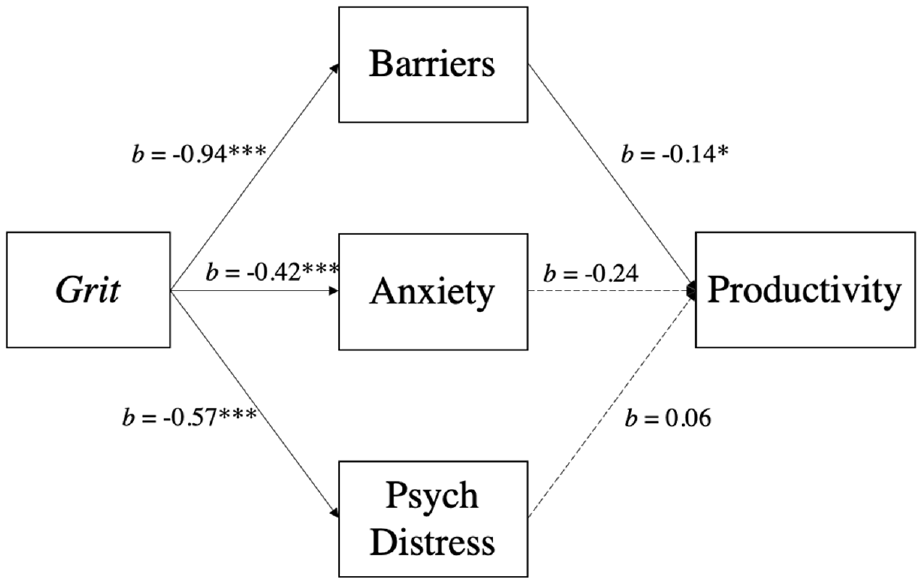
Multiple mediation model of the link between grit and self-reported productivity via perception of barriers in the environment to remote working.
Estimation of Unstandardized Regression Paths From the Predictor to the Mediators and From the Mediators to the Outcome Using PROCESS.

Thus, grittier individuals reported having fewer barriers to remote working in their environment, and consequently reported feeling more productive than before. Although grittier individuals also reported less anxiety and psychological distress, after controlling for barriers to remote working, these two indicators were not significantly related to self-reported productivity.
Discussion
This paper explores the impact of working from home during COVID-19 pandemic on self-reported productivity, specially examining the personal psychological trait—grit as a potential predictor. Our results suggest that grit improves remote productivity evaluation by negatively predicting remote work perceived barriers. The grittier people are those who report fewer barriers to remote work and therefore feel more efficient than before. Additionally, grit is negatively associated with anxiety and psychological distress. However, after controlling for perceived barriers to remote work, these two indicators did not significantly predict self-reported productivity.
Our findings are in line with previous studies that suggest remote working can increase employees’ productivity and offer greater flexibility without the constraints of office hours (de Zepetnek et al., 2021). However, our study takes a step further by exploring how certain personality traits can promote wellbeing and productivity among workers during a pandemic crisis. Specifically, we investigate how psychological characteristics affect these outcomes. Our results show that individuals who scored higher in the grit trait are more optimistic in the way they interpret the adverse events (barriers) as challenges and not as setbacks. This leads to greater resilience when dealing with a pandemic crisis, as evidenced by the negative relationship between grit and anxiety or psychological distress. In fact, people with higher values of grit normally accept their current situation and condition, and do not let the adversities get in the way of their goals (Golden & Eddleston, 2020). Individuals with high levels of grit have a high level of discipline and self-regulation, which is associated with health and psychological benefits (Joseph & Newman, 2010). Therefore, identifying people’s characteristics that enable a more effective adaptation to remote work is essential both in terms of business and public policy. Therefore, identifying people’s characteristics that enable a more effective adaptation to remote work is essential both in terms of business and public policy. In fact, this study’s findings have practical implications for employers and public policy makers. Employers can use knowledge of employees’ psychological traits to better understand how they adapt to remote work, while public policy makers can develop policies to promote remote work and support workers’ psychological well-being during disruptive events. This adaptability has undoubtedly negative repercussions on companies and, in a broader sense, on the economy.
Since this is the first study to attempts investigating the intersection between these variables, there are necessarily some limitations, as well as future research avenues that should be mentioned. Regarding limitations the study use of self-reported data, which is susceptible to bias and inaccuracy, as well as only looks at one psychological characteristic (grit), and it neglects to analyze other possible productivity predictors. These drawbacks imply that further study is required to fully comprehend the intricate connection between psychological characteristics, remote work, and productivity. Additionally, it would be interesting to do conduct an extend of this study in future research using longitudinal data and measuring the core variables in different time series and sectors. Based on this study, we believe that future studies will allow for more robust and complete conclusions on the impact of the dimensions studied on career progression and how grit can promote worker resilience. It will also be important to examine comparatively in different work environments (remote vs. on site) and to try to understand how psychological traits such us grit may be modeled by disruptive events such as the pandemic crisis COVID-19 by extending these findings to the post-pandemic period.
Conclusion
This paper addresses an outgoing topic, that is the COVID-19 outbreak, and is overall aimed to explore the remote workers barriers and how a certain personality trait—grit—could influence workers self-reported productivity. Results from an initial multiple mediation analysis revealed that grit improves self-reported productivity by reducing perceptions of remote work as a barrier. The gritter people are those who report fewer barriers to remote work and therefore feel more efficient than before. These findings provide key indications to identify individual characteristics that enable a more effective adaptation to remote work, crucial during and after pandemic crisis.
Footnotes
Declaration of Conflicting Interests
The author(s) declared no potential conflicts of interest with respect to the research, authorship, and/or publication of this article.
