




Abstract
Considering the number of older adults requiring admission to nursing homes and the stress associated with this transition, nursing home staff should provide care for relocation stress. However, no suitable scale for evaluating relocation stress in Japanese older adults is currently available. This study aimed to translate and cross-culturally adapt the Nursing Home Adjustment Scale (NHAS) from Korean to Japanese and to assess its psychometric properties for nursing home residents in Japan. This observational validation study of a measurement scale involved two steps: (1) NHAS translation to the Japanese version of NHAS (NHAS-J) and cross-cultural adaptation as recommended by the International Society for Pharmacoeconomics and Outcomes Research (ISPOR) Task Force for Translation and Cultural Adaptation, and (2) assessment of NHAS-J validity through exploratory factor analysis, confirmatory factor analysis, and convergent validity and its reliability using Cronbach’s alpha for internal consistency. This study included 120 older adults from 12 nursing homes in Japan. The NHAS-J showed satisfactory internal consistency (Cronbach’s alpha = .853). The final NHAS-J structure was categorized into four factors: acceptance of new residence, daily emotions, relationship development, and depressed mood. Confirmatory factor analysis indicated a good fit for the four-factor model. The NHAS-J also demonstrated significant convergent validity with the satisfaction with life (r = .376, p < .01), geriatric depression (r = −.620, p < .01), and generalized self-efficacy scales (r = .560, p < .01). Overall, the NHAS-J is a valid and reliable tool for measuring the level of nursing home adjustment in Japanese older adults.
Plain language summary
Why was the study done? The number of older adults requiring admission to nursing homes is increasing in Japan. As transitioning to a nursing home is a highly stressful event, attempts should be made to reduce stress and facilitate adjustment, and promotion of adjustment to nursing homes should be compared among older adults. What did the researchers do? Currently, no suitable scale is available to evaluate relocation stress in older adults in Japan. Thus, this study aimed to translate and cross-culturally adapt the Nursing Home Adjustment Scale for Japanese (NHAS-J) older adults. We recruited 120 residents from 12 nursing homes to complete the survey. The questionnaire statements were read aloud to the participants, who verbally responded, and their answers were objectively reported. What did the researcher find? The NHAS-J was cross-culturally adopted to measure adjustment in nursing-home residents. This study confirmed the validity and reliability of the NHAS-J; further, it demonstrated significant convergent validity with the scales measuring satisfaction with life, geriatric depression, and generalized self-efficacy. What do the findings mean? The NHAS-J demonstrated good validity and reliability in evaluating the level of adjustment in Japanese older adults residing in nursing homes. Thus, this scale is a useful tool for assessing and promoting adjustment among nursing-home residents.
Introduction
It is well-known that the global population of older adults is continuously rising, with the proportion of those aged >80 years showing a dramatic increase (Dicker et al., 2018). Owing to a decline in their physical and cognitive functions, the number of older adults requiring admission to nursing homes is also increasing (United Nations Department of Economic and Social Affairs Publications, 2023) . For older adults, relocating to a nursing home is a major life event that requires adaptation to a different lifestyle.
One of the most stressful events for older adults is the transition (Hertz et al., 2016; Weaver et al., 2020). Moving to a nursing home can be a confusing experience because of changes in the living environment and the disruption of previous relationships with family and friends. Moreover, older adults are compelled to shift to nursing homes due to changing circumstances (Costlow & Parmelee, 2020). During this time of transition, individuals often experience negative emotions, such as sadness, anger, helplessness, feelings of abandonment, and a sense of homelessness (Brandburg, 2007; Weaver et al., 2020). Over time, these emotions tend to subside as individuals gradually become accustomed to their new living situation and form new relationships. Previous studies have shown that control over the decision to enter the nursing home, high self-efficacy, social support, activities of daily living, and length of stay are the factors promoting adjustment to relocation in a nursing home (Yong et al., 2021). Eventually, they may come to view the nursing home as their “home” (Brandburg, 2007; Wareing & Sethares, 2021). However, not all residents can adjust successfully to their new lives, and if this condition persists, it can lead to relocation stress characterized by depression, resentment, strong resistance, and aggressive behavior. These are negative experiences for the residents. Moreover, the nursing home staff find it difficult to care for them (Brandburg, 2007). Therefore, previous studies have suggested that transitional care can help reduce the stress of transitioning to a new environment (Brandburg, 2007; Popejoy et al., 2022). To provide effective transitional care, it is important to assess the level of adjustment among residents and compare the effectiveness of different adjustment strategies. Adjustment is one of the most important processes that nursing staff could provide to help older adults experience a positive transition to the nursing home.
The Nursing Home Adjustment Scale (NHAS) was developed in Korea and has been validated in four languages: Korean, English, Turkish, Chinese, and central China Chinese version (Guo et al., 2023; Lee, 2007; Lee et al., 2015; Varer Akpinar et al., 2023; Xiao et al., 2019). These questionnaires have been developed to address adjustment issues and have demonstrated reliability and validity. The Korean, English, Chinese, central Chinese, and Turkish versions of NHAS were assessed and found to be reliable, with Cronbach’s alpha values of .837, .77, .87, .913, and .87, respectively. NHAS can assess adjustment to nursing home living, which helps the nursing home staff to provide effective transitional care and will be able to reduce the stress for nursing home residents. However, no suitable scale is available for assessing the adjustment to nursing home in the Japanese population. Thus, this study aimed to translate the NHAS into Japanese, and to cross-culturally adapt and verify the reliability and validity of the Japanese version of the Nursing Home Adjustment Scale (NHAS-J).
Methods
Design
This prospective multicenter observational cross-sectional study aimed to validate a questionnaire and comprised two steps: Step I, NHAS translation to NHAS-J; Step II, validity and reliability analyses.
Sample and Inclusion/Exclusion Criteria
We recruited participants from 12 nursing homes. Since the needed number of samples was calculated as 118 using a G Power (F test, two-tailed, effect size 1, alpha error .05, beta error .2), we recruited 120 nursing home residents. The inclusion criteria were as follows: (1) age over 60 years, and (2) ability to read and speak Japanese, with the cognitive capacity to respond to the questionnaire items. The questionnaire was just one with various items therein. Residents with dementia or those deemed unable to respond to the questionnaires by the nursing home staff were excluded. The participants were recruited using two methods: The first was by posting a notice at the nursing home recruiting participants for the research. Another method was that the nurse managers identified residents who met the criteria and invited them to participate in this study. The selection period was from October 2022 to March 2023.
Institutional Review Board Approval and Informed Consent
This study was approved by the Ethics Committee for Epidemiology of Hiroshima University (#2022-0069). We explained orally the study protocol which was in written form to the potential participants. Oral informed consent was obtained from each participant. We also explained that the participants were allowed to decline participation or withdraw at any point without consequences. The questionnaire statements were read aloud to the participants, who then verbally responded while their answers were objectively reported. Individual data collection interviews were conducted in a private room within the nursing home, each lasting approximately 30 min.
Step I: Translation of NHAS to NHAS-J
The Korean version of NHAS was developed to evaluate adjustment of older adults in a nursing home (Lee, 2007). The questionnaire consisted of 23 items, which were categorized into five dimensions: “Relocation distress symptom” (eight items), “Making friends” (four items), “Acceptance of new residence” (six items), “Difficulty in group life” (three items), and “Having self-worth” (two items). It demonstrated satisfactory validity and reliability (correlation with geriatric depression scale = −.697, Cronbach’s alpha = .837). Each item was scored on a two-point scale (Yes/No), with higher scores indicating better adjustment to the nursing home (Lee, 2007). Conversely, in the English version of the NHAS, items were measured using a five-point Likert scale ranging from 1 (strongly disagree) to 5 (strongly agree), with higher scores indicating higher levels of adjustment (Lee et al., 2015).
The translation of NHAS followed the methods recommended by the International Society for Pharmacoeconomics and Outcomes Research (ISPOR) Task Force for Translation and Cultural Adaptation (Wild et al., 2005). First, permission was obtained from the author of the Korean version to translate and use the NHAS. Next, two Korean translators fluent in Korean and Japanese independently conducted an initial forward translation from Korean into Japanese. In the reconciliation phase, our research team, comprising five professionals in the fields of geriatric nursing, home care nursing, emergency nursing, and medicine, discussed the draft of the translated NHAS-J to ensure both literal and conceptual equivalence. Backward translation from Japanese to Korean was then conducted by two Japanese individuals with proficient Korean skills. In the backward-translation review and harmonization phase, the same five researchers reviewed the backward-translated sentences to ensure semantic equivalence between the two versions and examined them to follow the cultural context. The original author of the Korean version of NHAS also confirmed the cognitive equivalence of the translated NHAS. For qualitative item analysis, the back-translated version of the NHAS was checked by two nursing home staff nurses and three nursing home residents in a pilot test. We also asked them to provide feedback on the questionnaire’s ease of use. Based on the interview feedback, we further revised the pilot version. Finally, the author of the Korean version reviewed the final revised Japanese and Korean versions to ensure conceptual and linguistic equivalence between both versions.
Step II: Validity and Reliability Analyses
Information on age, gender, length of stay in the nursing home, educational status, marital status, religion, and anxiety related to funding was collected using the questionnaire. The questionnaire also included the NHAS-J, as well as instruments to measure the satisfaction with life scale (SWLS), geriatric depression scale 15 (GDS15), and general self-efficacy scale (GSES). The SWLS was used for convergent validation of the NHAS with life satisfaction. Adaptation to nursing homes has historically been measured using the SWLS (O’Connor & Vallerand, 1994; Smith & Brand, 1975). The SWLS consists of five items with a seven-point scale, and total scores range from 5 to 35 points, with higher scores indicating a greater perception of overall life satisfaction. The Japanese version of the SWLS showed Cronbach’s alpha was .84 and .90 (Diener et al., 1985). The GDS15 was used for determining the convergent validity of the NHAS with Depressed mood. The Korean version of NHAS correlated with depression (Lee, 2007). This scale has 15 items requiring a “yes” or “no” response. The total score ranges from 0 to 15 points, with scores of 5 points or above indicating the presence of depressive symptoms and higher scores reflecting more severe levels of depressed mood. The Japanese version of the GDS15 showed Cronbach’s alpha was .83 (Yesavage & Sheikh, 1986). The GSES was used for convergent validity of the NHAS with self-efficacy. Previous studies showed the related adaptation to the nursing home and the GSES. The GSES consists of 23 items measured on a five-point Likert scale. Total scores range from 23 to 115 points, with higher scores indicating higher levels of self-efficacy. The Japanese version of the GESS showed Cronbach’s alpha was .88 (Sherer et al., 1982). To evaluate the reliability, we calculated Cronbach’s alpha values of whole items and each factor of NHAS-J.
Statistical Analysis
Descriptive statistics were calculated for participant characteristics, with means and standard deviations (SD) for continuous variables and ratios for categorical variables. Regarding the analysis of internal consistency, the NHAS-J was evaluated using Cronbach’s alpha. Item analysis included corrected item-total correlations and the change in Cronbach’s alpha if an item was deleted. A Cronbach’s alpha value (>.70) indicated excellent reliability (Cortina, 1993), whereas corrected item-total correlations ranging from .20 to .80 were considered satisfactory (Streiner et al., 2015). Convergent validity and factor structure were investigated for the NHAS-J. For analysis of convergent validity, we used Spearman’s rank correlation coefficients. To evaluate the convergence validity of the NHAS-J, life satisfaction, depressed mood, and self-efficacy were used, because all continuous variables had non-Gaussian distributions. Regarding the analysis of factor structure, exploratory factor analysis (EFA) and confirmatory factor analysis (CFA) were used to carry out the analysis of factor structure. EFA was conducted to determine the number of factors using the maximum likelihood method with Promax rotation. CFA was employed to assess the goodness-of-fit between the NHAS-J and the Korean version’s models. The χ2/df, goodness-of-fit index (GFI), comparative fit index (CFI), root mean square error of approximation (RESEA), and Akaike information criterion (AIC) were used to evaluate the goodness-of-fit indices. GFI and CFI close to 1 and RESEA < 0.08 indicate an acceptable model fit (Bentler, 1990; Marsh et al., 1998, 2004). Statistical analysis was performed using SPSS Statistics 27.0 and SPSS Amos version 29.0 (SPSS Inc., Chicago, Illinois, USA). A significance level of p < .05 (two-tailed) was considered statistically significant.
Results
Sample Characteristics
In total, 120 residents from 12 nursing homes completed the survey. The data were collected through individual interviews; thus, the study had no missing data. The characteristics of the residents are presented in Table 1. The mean age was 84.2 ± 7.9 years (mean ± SD), with the majority being females (69.2%). The average length of stay in the current home was 47.5 ± 44.1 months.
Characteristics of Nursing Home Residents (n = 120).

Note. SD = standard deviation.
Descriptive and Item Analysis of the NHAS-J
Table 2 presents the results of item distribution characteristics and corrected item-total correlations of the NHAS-J. The mean ± SD total NHAS-J score was 88.3 ± 15.7 points (range: 23–115 points). Corrected item-total correlations ranged from .216 to .675 of the original 23 items. Cronbach’s alpha coefficients for internal consistency ranged from .838 to .858 when an item was deleted. Four items (#2, #8, #10, and #20) showed higher Cronbach’s alpha values (.855–.858) than the total scale. However, no items were omitted from the whole items scale on the original Korean version of NHAS, because deleting them only marginally improved the alpha coefficient; the alpha of the overall scale was already satisfactory, and the corrected item-total correlations did not fall below .2.
Item Distribution Characteristics and Corrected Item-Total Correlations of the NHAS in Japanese (n = 120).

Note. Reverse coding items (2, 3, 4, 5, 6, 9, 12, 13, 14, 19, 20, 21, 22, 23); all internal consistency data are standardized values. NHAS = Nursing Home Adjustment Scale; SD = standard deviation.
Spearman’s rank correlation coefficients.
Cronbach’s alpha.
p < .05. **p < .01.
Validity and Reliability Analysis
Factorial Validity
Table 3 presents the results of the EFA for factor structure evaluation. The EFA, using the maximum likelihood method with Promax rotation, identified four factors. F1 included six items (#14, #17, #16, #11, #5, and #20), such as “Acceptance to live here,”“Wanting to have a good life,” and “Satisfaction with living here.”; this factor was named “Acceptance of new residence.” F2 included six items (#21, #22, #3, #23, #7, and #2) that addressed feelings of sadness, anger, crying, or calmness; thus, we named the factor “Daily emotions.” F3 included five items (#1, #18, #6, #10, and #8) concerning wanting to make friends, being close to other residents, and helping others; this factor was named “Relationship development.” F4 included six items (#12, #19, #15, #9, #4, and #13) related to feelings of loneliness, boredom, and a sense of life having no meaning; this factor was named “Depressed mood.”
Exploratory Factor Structure and Internal Correlations in Four Factors of the NHAS in Japanese (n = 120).

Note. Reverse coding items (2, 3, 4, 5, 6, 9, 12, 13, 14, 19, 20, 21, 22, 23); all internal consistency data are standardized values. NHAS = Nursing Home Adjustment Scale.
Cronbach’s alpha.
Spearman’s rank correlation coefficients.
The maximum likelihood method of Promax rotation.
p < .01.
The bold indicates clasters of each items as a factor.
Regarding the analysis of factor structure used CFA, we generated two models: as performed on that one was the Korean version’s five-factor model the other was the four-factor model, which presented the EFA results. To examine which model was more suitable, we compared the Korean version’s five-factor model and four-factor model. Upon examination, the five-factor model did not demonstrate optimal fit. Therefore, the four-factor analysis model exhibited a better fit and more meaningful factor structure than the five-factor model (Table 4; Figure 1).
Comparison of the Goodness of Fit Index Between the Five-Factor Model and the Four-Factor Analysis Model (n = 120).

Note. df = degrees of freedom; GFI = goodness of fit index; CFI = comparative fit index; RMSEA = root mean square error of approximation; AIC = Akaike information criterion.
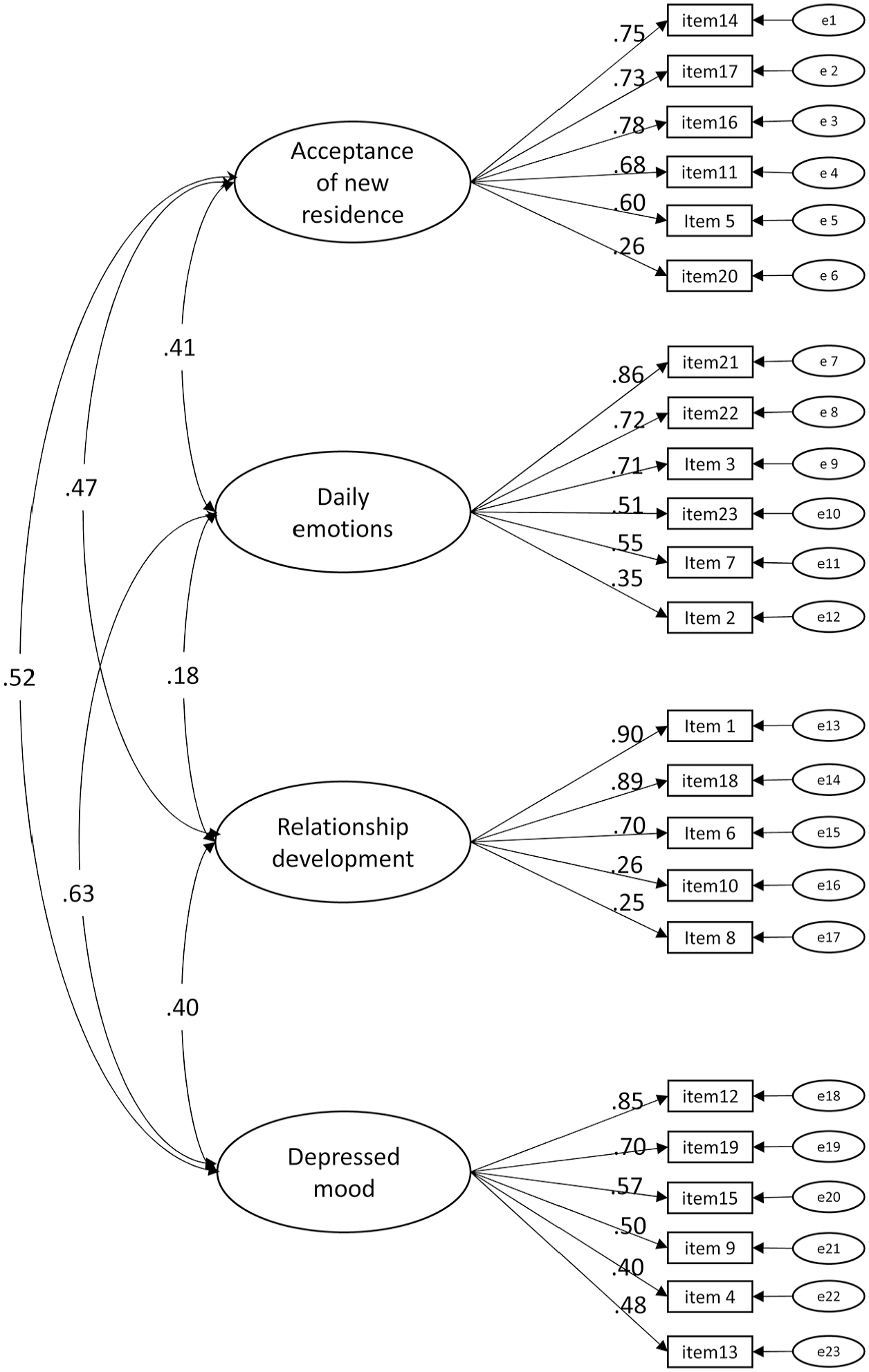
Confirmatory factor analysis of Nursing Home Adjustment Scale-Japanese version (NHAS-J).
Convergent Validity
Convergent validity analysis using the Spearman’s rank correlation coefficients indicated that the total score and subscale scores of NHAS-J significantly correlated with SWLS scores (r = .376), GDS15 scores (r = −.620), and GSES scores (r = .560) (Table 5), indicating substantial levels of convergent validity with life satisfaction, depression, and self-efficacy. Notably, F4 showed one of the strongest correlations with GDS15 (r = −.646). Additionally, there were correlations between SWLS subscales and all NHAS-J subscales (r = .192 to .321), between GDS15 subscales and all NHAS-J subscales (r = –.297 to –.646), and between GSES subscales and all NHAS-J subscales (r = .281 to .631).
Convergent Validity Comparison Results of the NHAS-J (n = 120).
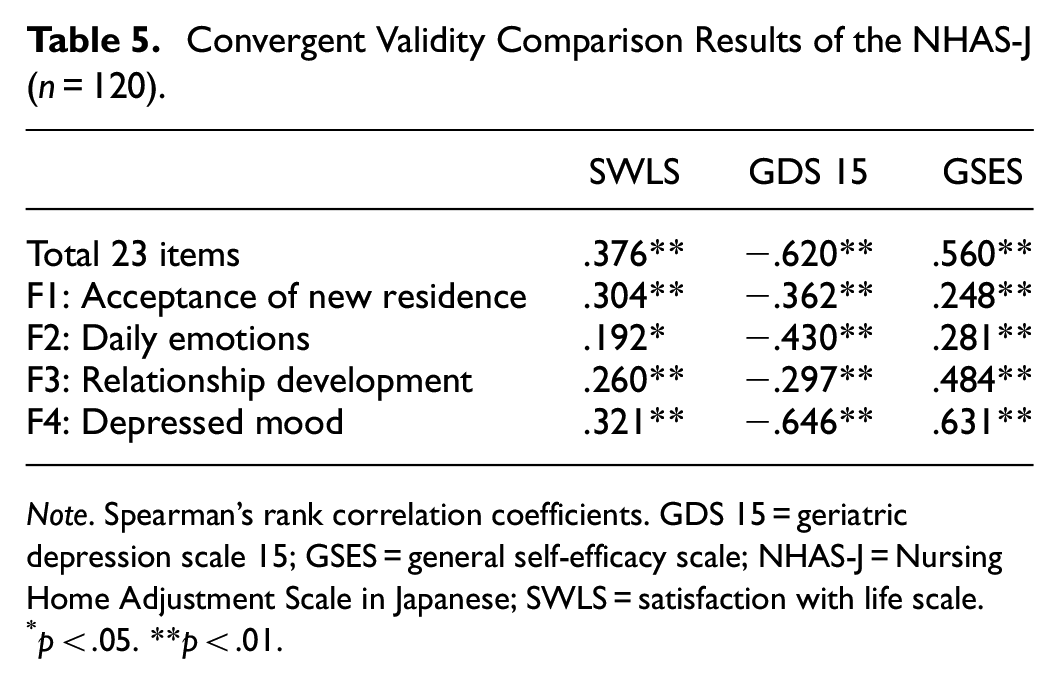
Note. Spearman’s rank correlation coefficients. GDS 15 = geriatric depression scale 15; GSES = general self-efficacy scale; NHAS-J = Nursing Home Adjustment Scale in Japanese; SWLS = satisfaction with life scale.
p < .05. **p < .01.
Reliability
Regarding the analysis of internal consistency, Cronbach’s alpha coefficients were .853 for the total score, .780 for F1, .765 for F2, .727 for F3, and .744 for F4 (Table 2).
Discussion
This multicenter prospective study investigated the cross-culturally adapted NHAS-J, which demonstrated good validity and reliability for assessing adjustment in Japanese older adults residing in nursing homes. The NHAS-J may serve as a useful tool for addressing psychometric issues associated with the transition to nursing homes among older adults. This study showed evidence for the wide application of the NHAS-J in Japanese older adults.
The study’s findings indicate that the NHAS-J exhibited good internal consistency (Cronbach’s alpha = .853). Furthermore, the four subscales of NHAS-J, namely “Acceptance of new residence,”“Daily emotions,”“Relationship development,” and “Depressed mood,” showed Cronbach’s alpha values of .780, .765, .727, and .744, respectively. Although the Cronbach’s alpha value of the total scale was comparable to that of the Korean version (Cronbach’s alpha = .837), the Cronbach’s alpha values for the NHAS-J subscales were higher than those of the Korean version (Cronbach’s alpha of each subscale of the Korean version was .420–.838) (Lee, 2007). A study conducted in the United States also reported Cronbach’s alpha values of .77 for the total score and .46 to .76 for the subscales in the English version (Lee et al., 2015). The Cronbach’s alpha values for both the total score and subscales in NHAS-J were higher than those in the Korean and English versions. However, Cronbach’s alpha values for the total score and subscale scores in the Chinese version, central Chinese version, and Turkish version were comparable to those of the NHAS-J (Guo et al., 2023; Varer Akpinar et al., 2023; Xiao et al., 2019). Cronbach’s alpha values exceeding .70 indicate good internal consistency (Cortina, 1993); in this study, both the total scale and all subscales met this criterion, demonstrating satisfactory internal correlation.
Regarding the EFA, most items exhibited factor loadings above the acceptable threshold of .30 (Streiner et al., 2015). However, items #8, #10, and #20 had factor loadings below this threshold. To maintain international comparability, no items were dropped. The structural validity of NHAS-J was assessed by identifying four factors as subscales, which differed from the number of factors in the Korean, English, Chinese, and central Chinese versions (Guo et al., 2023; Lee, 2007; Lee et al., 2015; Xiao et al., 2019). Its structure differs from that of the Korean version (Lee, 2007). The “Relocation distress symptoms” factor in the Korean version was differentiated into three factors: “Daily emotions,”“Depressed mood,” and “Acceptance of new residence.” The “Making friends” factor was differentiated into “Relationship development.” The “Difficulty in group life” factor was differentiated into “Depressed mood” and “Relationship development.” The “Having self-worth” in the Korean version was differentiated into “Depressed mood.” Conversely, the factor of “Acceptance of new residence” was constituted by almost the same items. We considered the previous theoretical, conceptual framework, which suggests that the factors of the “Acceptance of new residence” and “Relationship development” are reflected in the relocation process of reframing and forming relationships during adjustment (e.g., items #1, #5, #6, #8, #10, #11, #14, #16, #17, #18, and #20) (Brandburg, 2007). The factors of the “Daily emotions” and “Depressed mood” focus on the outcome of the transitional process, encompassing maladaptive experiences (e.g., items #2, #3, #4, #7, #9, #12, #13, #15, #19, #21, #22, and #23). These subscales align well with the theoretical framework. The four-factor model of NHAS-J exhibited a significantly better fit than the five-factor model, the Korean version, as supported by the CFA results. All indicators (GFI, CFI, and RMSEA) had acceptable values, indicating satisfactory structural validity (Bentler, 1990; Marsh et al., 1998, 2004). The CFA findings indicated that all four factors were based on the underlying concept of “Nursing home adjustment” (Brandburg, 2007). This study revealed the structure of the theoretical framework of nursing-home adjustment in Japanese culture. The theoretical framework of nursing adjustment consisted of four factors as “acceptance of new residence,”“daily emotions,”“relationship development,” and “depressed mood.” Each factor evaluated how older adults transitioning to a nursing home tried to develop new relationships as well as their day-to-day acceptance of the new environment (Brandburg, 2007). Daily emotions and depressed mood underlie the development of new relationships and acceptance of the new environment (Brandburg, 2007; Choi & Sok, 2015; Yu et al., 2016). These factors help us understand the residents’ condition and how they adapt to a new environment. These factors help the nursing home staff to easily understand which aspects should be approached to improve the adjustment of older adults to the nursing home.
This study demonstrated significant correlations with constructs related to life satisfaction, geriatric depression, and self-efficacy in terms of convergent validity. NHAS-J exhibited a negative correlation with GDS15 (r = –.620, p < .01), indicating that the scale captures aspects of a “depressive state.” Similarly, a previous study reported the geriatric depression scores had significant correlations with the NHAS-Korean version (r = –.697, p < .001) and NHAS in central China (r = −.416, p < .001) (Guo et al., 2023; Lee, 2007). In terms of life satisfaction, the NHAS-J exhibited a positive correlation with SWLS (r = .376, p < .01), consistent with the findings from the English version (r = .431, p < .001) and the Chinese version (r = .332, p < .01) of the NHAS (Lee et al., 2015; Xiao et al., 2019). However, the correlation between NHAS-J and SWLS in this study (r = .376) was lower than that reported in a previous study for the English version (Lee et al., 2015). Conversely, the correlation between NHAS and SWLS in the Chinese version was consistent with the current study’s results (Lee et al., 2015; Xiao et al., 2019). The previous study showed that when comparing SWLS scores across 13 countries, Asians tended to have lower scores than Europeans and Americans (Shimkhada et al., 2022). In terms of self-efficacy, the NHAS-J exhibited a positive correlation with GSES (r = .560, p < .01), consistent with the findings from the central Chinese version of the NHAS (r = .440, p < .001) (Guo et al., 2023). These differences in correlations between SWLS and the other GDS15/GSES scales validate the distinct scope of the scale and confirm its convergent validity. As for the subscales, the GDS15, which measures geriatric depression, exhibited significant correlations with F1 “Acceptance of new residence,” F2 “Daily emotions,” and F4 “Depressed mood” in the NHAS-J. Some previous studies have reported that nursing home residents with depression often experience difficulties in adapting to their living environment, along with negative emotions, such as loneliness, sadness, and anger (Choi & Sok, 2015; Sun et al., 2021), which may provide an explanation for these associations. Regarding the subscales, the GSES, which measures self-efficacy, exhibited significant correlations with F3 “relationship development,” and F4 “depressed mood,” in the NHAS-J. Previous studies have indicated that self-efficacy was one of the predictors of nursing-home adjustment. Residents with low self-efficacy often experienced difficulties in adjusting to their new living environment, and low self-efficacy led to depressive mood (Choi & Sok, 2015; Lee, 2007; Yong et al., 2021), which may explain the above associations.
This study demonstrated that NHAS-J had good reliability and validity, showing significant correlations with geriatric depression, general self-efficacy, and satisfaction with life. The findings of this study help residents and staff in nursing homes measure psychological adjustment and indicate that the NHAS-J might be a useful tool in Japan for assessing nursing home adjustment among residents.
Strengths and Limitations
The strength of this study is the reduced selection bias, given that we used a prospective multicenter observational design. However, the results of this study have limited generalization for three reasons. First, we were unable to recruit older adults with dementia who may experience significant difficulties in adjusting to a nursing home since informed consent could not be obtained from them; therefore, despite the potential high demand for evaluation and intervention in this population, they could not be included. Second, middle-aged people who were living in nursing homes were not included. Third, the NHAS-J may not suit individuals who are not culturally Japanese because the factor structure was altered from other language versions. Future research should aim to include a wider range of participants and encompass various nursing homes. In the future, we should develop assessment tools for adjusting to a nursing home for residents with dementia based on observation by nursing home staff. Additionally, as the nursing managers identified cognitively eligible participants, there may have been a selection bias toward the study participants.
Implications for the Practice
The present study established that NHAS-J has acceptable validity and reliability to evaluate the degree of adjustment of older adults to nursing homes. NHAS-J can be a standard tool for assessing residents transitioning to nursing homes. Moreover, NHAS-J also helps residents and the nursing home staff because it can aid early recognition of older adults with severe relocation stress, including depression, aggressive behavior, and confusion, thus allowing timely nursing intervention.
Conclusion
This study translated the NHAS-J for the measurement of adjustment levels in older adults in the nursing home and confirmed its validity and reliability. NHAS-J has the potential to be a useful tool for assisting Japanese residents in adapting to their new living environment. The NHAS-J could be used in practice to screen high-risk residents in nursing homes suffering from lower adjustment. Further, it can be used in research on nursing home adjustment to assess residents’ levels of adjustment and to evaluate effects of care programs.
Footnotes
Acknowledgements
We would like to express our sincere appreciation to the research collaborators and participants who supported this study. We are deeply grateful to Dr. Lee for granting us permission and providing valuable advice regarding the translation process. Additionally, we would like to extend our gratitude to Ms. Park, Ms. Kang, and Prof. Endo for their assistance with the translations and psychometric analysis.
Authors’ Contribution
All authors contributed to the study conception and design. Material preparation, data collection and analysis were performed by Haruka Yoshimaru, Kazuaki Tanabe, Hiroyuki Sawatari, and Chie Teramoto. The first draft of the manuscript was written by Haruka Yoshimaru and all authors commented on previous versions of the manuscript. All authors read and approved the final manuscript.
Declaration of Conflicting Interests
The author(s) declared no potential conflicts of interest with respect to the research, authorship, and/or publication of this article.
Funding
The author(s) disclosed receipt of the following financial support for the research, authorship, and/or publication of this article: This work was supported by Yuumi memorial grant.

Data Availability Statement
The data cannot be shared due to ethical reasons.