



Abstract
Elections in Nigeria are increasingly turning democratic practice into a bazaar for the highest bidder. Preparations for the 2023 General Election, especially the purchase of statements of interest and nomination forms, as well as party primaries, threaten to squeeze non-super-rich candidates out of participation. This study examines how Nigerian democracy is being manipulated into a business of the highest bidder by examining the costs of the entire process of nomination and party primaries in the All Progressives Congress and the Peoples Democratic Party. The study draws on face-to-face in-depth interviews selected on the basis of criteria such as accessibility, relevance, and quality of information. The informants were classified into different categories. The data obtained from the interviews were analyzed using thematic content analysis. Clientelism is adopted as a framework to explain this phenomenon. The study found that APC and PDP deliberately drive up the cost of nomination to displace poor and non-rich competitors. The impact is evident in the reckless use of money during the parties’ primaries where the process was conducted in dollars. Transparency is being circumvented and to restore integrity to nomination and party primaries in Nigeria, reforms that go beyond politics to include civil society, the electorate, international partners, and other stakeholders are needed.
Introduction
The arguments that champions of democracy always advance to justify the superiority and inevitability of the form of government are accountability, transparency, and people-oriented policies and programs. But the unfolding events recently depicted the opposite (Lu & Chu, 2022). The process of party recruitment, nomination, and financing, as well as primaries, is becoming an incurable headache for global key players because of the massive electoral and political corruption embedded in the process and the evasive nature of the phenomenon (Norris, 2018). Worldwide, issues of transparency and corruption are reported in parties’ nominations and primaries. This problem is manifested or more pronounced in emerging democracies, where weak institutions and a lack of political will to arrest that particular culture are worrisome (Ohman, 2018).
Nigeria is one of the emerging democracies, and the experience of the Fourth Republic is sometimes appeasing to stakeholders considering the many breakthroughs and landmark achievements that are unprecedented in the Nigerian democratic experiment. For the past 22 years, Nigeria has held six consecutive elections, and the opposition has succeeded in unseating the incumbent (Sule et al., 2022). Several other developments have been recorded, including increasing freedom of speech, expansion of the activities of civil societies, tolerance of opposition, and improved electoral process and conduct (Nwagwu et al., 2022). However, one unfortunate issue that is continuously bedevilling the Nigerian electoral process is the conduct of party primaries. Party primaries in Nigeria are enshrouded in controversies over undemocratic practices, excessive use of money by the higher bidders, subversion of the process, godfatherism, and other related hiccups (Sule, 2022).
The party primaries in preparation for the 2023 General Election, specifically by the ruling All Progressives Congress (APC) and Peoples’ Democratic Party (PDP), shocked observers and threatened to fully monetise, in advance, the Nigerian primaries and nomination (Mudashir et al., 2022). The costs of expressions of interest and nomination forms by the two giant parties revealed that poor and non-wealthy aspirants are systematically edged out of the equation, while the main event of the primaries showcased that only the super-rich can dare it (Maishanu, 2022). This scenario caused many opinion moulders to tag the Nigerian primary elections in the APC and PDP as democracy for sale. For instance, the cost of the expression of interest and nomination form for presidential aspirants in the APC is N100 million ($225504.56000), while that of the PDP is N40 million ($103732.10000) (Vanguard Newspaper, 2022b). It is a picture that displays how untenable it is for the poor and middle-income to dare the seat. Thus, this study observes that the extreme extent of the use of money the US Dollar, especially monetised the Nigerian democracy and dollarised it to the highest bidder, thereby bypassing the principles of transparency and freedom of choice accorded to the electorates and their representatives. This study examines the problem, analyses its dimensions, and presents policy recommendations.
A Framework of Analysis: Clientelism
Clientelism (is a political economy model that espouses the channels of negotiating benefits and favour in the electoral process and governance). The term, which is derived from the Latin American words “Cluere” (to listen and to obey), “Clientela” (a group of individuals who had proxies prompting for them in the public interest), and “Patronus” (the patrons who patronised the aristocrats through some clandestine arrangements), discloses that there are three major actors involved in the negotiation and favour seeking and sharing. Clientelism as a model of explaining how favour and resources are shared, promised, and allocated in pre-election, during election, and post-election is developed in several stages (Gans-Morse et al., 2014). The early phase of the study is limited to Europe (Darabont, 2010; Gans-Morse et al., 2014; Isaksson & Bigsten, 2013; Muno, 2014; Roniger, 2004; Stefes, 2006; Stocks, 2013, 2013b). This stage is presumed to be limited to Europe because most of the countries in Africa, Asia, East Europe, Latin America, and the Caribbean were either colonised by Europe or ruled by authoritarians. Democracy had yet to take full hold in these new and emerging states (Darabont, 2010). Clientelism has been practised in Europe since the Greek democracy and Roman system. Thus, it was expected that since modern liberal systems are more accountable, transparent, and representative, the practice will subside in Europe (Roniger, 2004). Unfortunately, Clientelism continues in Europe (Doublet, 2010).
The second phase is also concentrated in Europe and America (Brun, 2014; Schweizer, 2013; Szwarcberg, 2015; Tomsa & Ufen, 2013; Wang, 2014). At this stage, America made an entry into democratic practise in a liberal structure. The American democratic system is highly monetized because of societal prosperity (Ufen, 2014). However, liberal democracy upholds the values of accountability, transparency, integrity of the electoral process, and all-inclusive government, but American politics and elections are far from being accountable and transparent in terms of party financing (Schweizer, 2013). Europe in this period is overshadowed by American advancement in championing global democracy, but Europe, specifically Western European states, remains collaborative and supportive of America in pursuing liberal democracy globally (Szwarcberg, 2015). This stage is assumed to be limited to America and Europe only because the emerging democracies were not in the process of democratisation at the time (Zinn, 2019).
The third phase of the analysis of the model of Clientelism expands to capture African countries, Asia, South America, and the Caribbean (Abdallah, 2017; Aspinall & Berenschot, 2019; Aspinall & Sukmajati, 2019; Cendales et al., 2019; De Elvira et al., 2019; El Tarouty, 2015; Hilgers, 2012; Kobayashi, 2016; Kuo, 2018; Mendilow & Phelippeau, 2018; Muniz, 2015; Nichter, 2018; Ogundiya, 2009; Ojo et al., 2019; Sule et al., 2017, 2018). This phase is believed to have been the peak of Clientelism's development because democracy is in its fourth wave, as asserted by Huntington (2000). Countries in Africa, Asia, Eastern Europe, Latin America, and the Caribbean were liberated from colonialism. New states were formed, most of them under various forms of Western democratic structures ranging from parliamentary to presidential, federal, unitary, confederal, or trusteeship. Nichter, 2018). These emerging states are still battling with the process of institutionalising democracy and organising parties and elections (Hilgers, 2012). Elections and party financing in these countries are deeply involved in money politics, vote-buying, excessive spending, bribery, corruption, and other Clientele practices, as reported by Ohman (2014). This, however, does not imply that Clientelism is not active in Europe and America. This study postulates that Clientelism expanded from European practice to America and other parts of the world's democracies contemporaneously.
Clientelism manifests itself in persuasion and negotiation between patrons (politicians and godfathers), brokers (political agents and frontmen of major politicians and parties), and clients (electorates and masses). The process leads to an offer of favour in cash or kind, the promise of reward or punishment, and sanctions. In some cases, coercion and threats are used to get the electorate to succumb. In developing democracies like Indonesia and Nigeria, poverty and deprivation are considered the major motivators for easily winning the support of the electorates (Aspinall & Berenschot, 2019), while in developed democracies, cultural sentiments, personal benefits, and future anticipated recognition are the primers for negotiation and influence (Hagel, 2020). Some efforts have been made to portray the Nigerian context (Ogundiya, 2009; Olarinmoye, 2008; Post & Jenkins, 1973; Sule et al., 2018) of clientelism, mostly perpetuated by godfathers and moneybags in the electoral process.
In the Nigerian context and with the specific case of the cost of expression of interest and nomination forms and the party primaries proper, a deliberate negotiation is visible in pegging the cost of expression of interest and nomination forms at a price that only the wealthy and top political office holders can afford. This is the perceived outcome of negotiation the promise of reward, favor, and other benefits to the parties’ executives to make it appear the way it appears. In the realm of party primaries, how dollars freely flied the space of the venue of the election to the delegates expressed sadly how Clientelism is at work in Nigeria. The wealthy and prominent national politicians competed to buy delegates with dollars, a feat that monetised the entire system and the primaries. Money bags worked assiduously to propel the richest contestants in the APC and PDP to secure the Presidential ticket. In other electoral offices, the same phenomenon is reported, albeit below the squander and extravagance exhibited by presidential contests. The entire process is illustrated in the figure below to facilitate understanding of the workings of Clientelism in the Nigerian context (Figure 1).
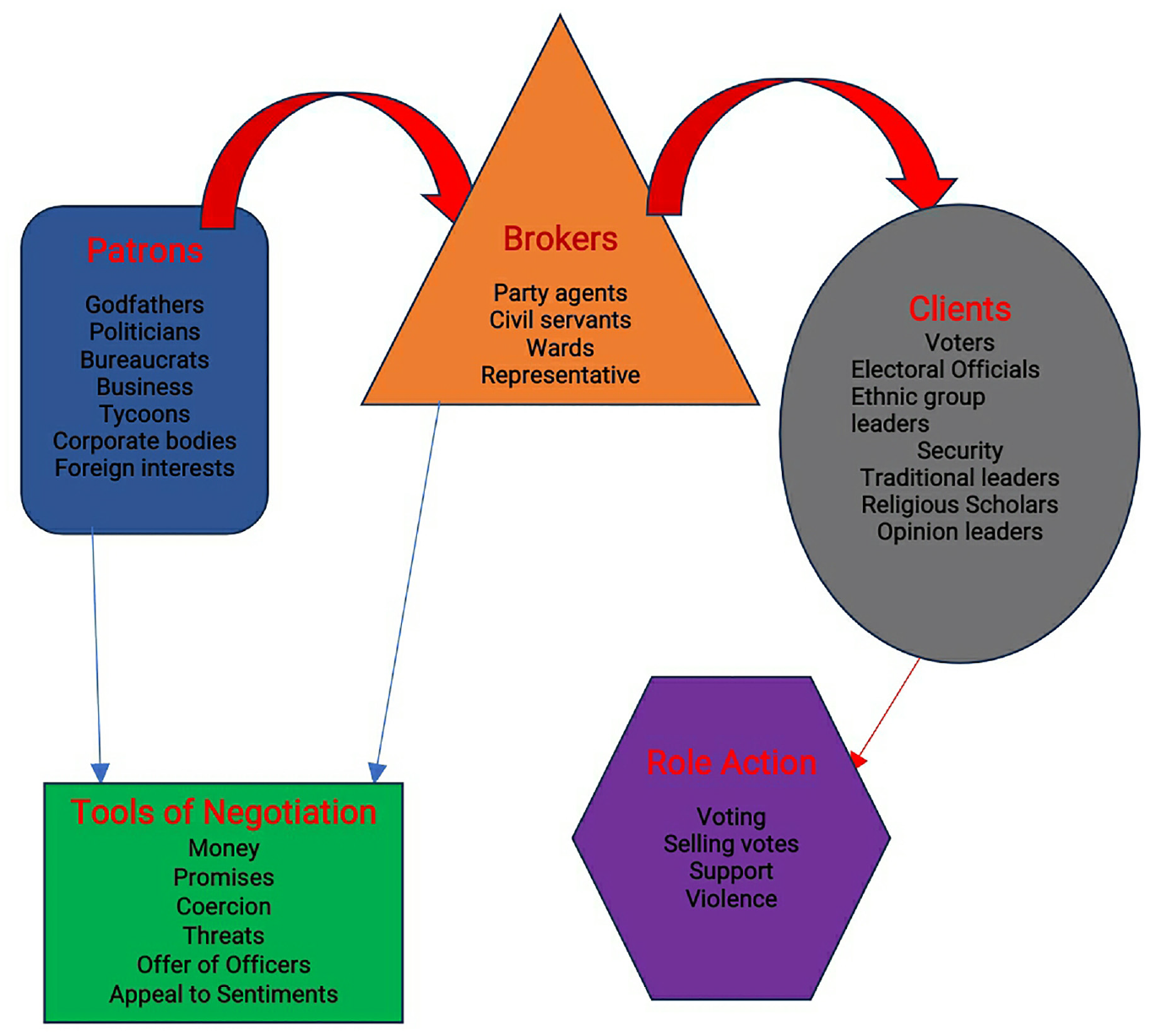
Illustrating how clientelism works during the 2023 expression of nomination and party primaries in the APC and PDP.
Literature Review
This section critically but analytically examines some vital issues related to the subject matter of the study from the existing body of literature in the area of study. The literature is reviewed thematically, consisting of issues in party primaries and money politics. The major contribution of this study and the research gap is the discovery that no previous study has delved into the aspect of the cost of expressions of interest and nomination forms as a sub-area of party financing in Nigeria. Particularly, the case of the 2023 General Election is fresh and unexploited, and the process presents an entirely different phenomenon from the previous ones. For example, this study reports the skyrocketing of the cost of forms, unprecedented in the history of Nigerian party primaries, showcasing how expensive it has become.
Party Primaries
Parties are the wheel engine of the democratic process, and they are the necessary institutions that propel political activities and electoral contests. Parties establish and institutionalise ideologies and manifestos, recruit and train new and existing members to acquire leadership skills and experience, and most importantly, offer opportunities as a platform for representation. Party primaries is a term that emanates from America and tries to explain how a transition process occurs from local party leadership to the nomination of parties’ representatives in a national power contest (Maisel, 2022). It is often used interchangeably with terms such as party leadership contests, legislative nomination races, and candidate pre-selections. The term is used differently in various countries, but the process denotes the same practice (Cross et al., 2016). Sandri and Seddone (2015) identify party primaries as the institutionalisation and promotion of intra-party democracy and internal choice and consensus. The sparks of democratic governance globally in the 21st century have enhanced internal democracy and party primaries, which have spread across all continents (Cross et al., 2016; Sandri & Seddone, 2015).
A distinction exists between party leadership selection and candidate selections. Comparatively, most world democracies select party leaders through the party caucus or executives, except in a few cases where party supporters and delegates are involved (Kenig et al., 2015). In the case of candidate selection, a study (Cross et al., 2016) stresses that more than 90% of world democracies select party candidates through delegates, who are loyal party members. Party primaries are financed solely by parties without any state intervention, unlike in many countries where general elections are supported with grants. However, party primaries are less expensive than general elections (Cross et al., 2016).
Party primaries in Nigeria are governed by some legal regulations from the 1999 Constitution and the amended Electoral Act of 2022. Articles 1 and 2 of the Independent National Electoral Commission (INEC) state the regulations for the conduct of party primaries. The regulations provide a timeline for the conduct of party primaries, procedures, laws, requirements, and other related matters (Abba & Babalola, 2017). Party primaries in Nigeria are mostly influenced by dominant factors including godfatherism, Clientelism, money politics, vote-buying, violence, forceful imposition, a lack of internal democracy, ethic chauvinism, religious sentiments, and regional affiliation (Sule, 2022). Additionally, Sule (2022) reported the heavy use of money in the process of the 2019 party primaries of the APC and PDP, to the extent of buying delegates at a cost of $5,000 by the major parties. The current study, a case of the 2023 elections, entirely takes on a new character, necessitating the extension of the earlier study by Sule (2022). The skyrocketing cost of expression of interest and nomination, excessive use of money and vote-buying, and dollarisation of the process call for a rethink and query of the concept of transparency in Nigerian democracy.
Money Politics
Democracy is an expensive form of government, and it requires huge spending by aspirants and contestants to make significant waves. The understanding of this trend led world countries to initiate legal frameworks and policies to allow expenditure in politics to a reasonable level and to prohibit excessive use of money to avoid disadvantaging less wealthy candidates. Worldwide, money plays a decisive role in determining who wins party primaries and even the general elections (February, 2016). Studies (Ohman, 2014; Piccio & Ohman, 2014; Smilow, 2014; Ufen, 2014) support the above assertion by February (2014) based on field surveys across all continents in the world that money plays a decisive factor in aiding candidates to secure party nominations, shoulder campaign expenses, and arrest a final electoral victory. This is because expenditures such as media ads, jingles, posters, billboards, rallies, and other related expenses are exorbitant due to the inflationary trend, and candidates are expected to follow these processes. The issue of incurring huge expenditures during the electoral process compels the urgent need for reforms and a legal policy framework to curb the menace with the aim of restoring the integrity and transparency of democracy globally (Ohman, 2018). Party financing is a tremendous headache for key actors in democratic good governance.
In Nigeria, money politics is palpable in all elections. During the electoral festival, huge amounts of cash change hands, and all stakeholders that cooperate are bought (Sule et al., 2018). Several factors cause money politics in Nigeria, among which are extreme levels of deprivation, scorching poverty, ignorance, a political culture of a zero-sum game where politicians strive to win at all costs, and Clientelism (Adetula, 2008; Bigman, 2011; Dauda et al., 2019). Godfathers perpetrate money politics by sharing money and bribing electoral officials, security agencies, and other relevant stakeholders (Nwagwu et al., 2022; Sule et al., 2019). For example, Sule et al. (2018) reported that the Uba family in Anambra sponsored governors’ campaign expenditures in that state using money, threats, violence, bribery, and corruption. In addition, the study (Sule et al., 2018) reports that the former Minister of Petroleum, Diezani Allison Maduekwe, paid a N34 billion bribe to INEC officials to favour the PDP in the 2015 General Election, while Dasuki, a former National Security Adviser, diverted $2.1 billion earmarked for procuring weapons to fight the Boko Haram insurgency for the PDP presidential campaign in 2015. Money politics impedes good governance in many ways. For instance, vote-buying sidelined credible candidates for the richer ones; rigging and manipulation of results; violence; strangulation of opposition; and equal political opportunities were denied to the citizens (Sule, 2022).
Methodology
This study adopted a qualitative case study approach. This is because the issue in discussion is a special case that requires an individual study, and the best method for assembling data and interpreting it in a case study report is a qualitative approach, according to Yin (2018). Data were collected from specialised, in-depth informant interviews. A total of 16 informants from five categories were interviewed. Informants were selected from five categories because of their relevance and relationship with the process of party primaries, party financing, and the Nigerian election. The first category, national executives of major parties, are directly involved in the processes under investigation in this study. The second category, the aspirants and candidates, is also directly involved, like the first category. The third category, academics, is either directly involved or indirectly, depending on their disposition. Some of them are party members or party supporters, while others are observers, researchers, and analysts. The fourth category, members of civil society, especially the Nigerian Civil Society Situation Room, represents an amalgam of more than 60 civil society groups that work directly with INEC, parties, politicians, electorates, and all stakeholders in the entire Nigerian electoral process. In the last category, INEC officials are directly involved in preparing, supervising, and regulating party primaries and party financing and, are therefore, relevant in providing information for the study.
The informants were selected based on four criteria: accessibility, quality of information, connection, and role in the process of the subject matter studied. Accessibility here means that the researchers have access to informants to interview them. Some informants may be critical but could not be easily accessed. Therefore, those who were willing to offer help in responding to interviews were consulted. The quality of information denotes the value and usability of the data expected from an informant. Those that can give an exact date, time, estimate, value, figures, and classified information are those targeted as quality informants. Those who can only offer speculations, unconfirmed information, or data are not consulted. The connection and role in the process of the subject matter means those who are actors directly involved in the electoral process, party primaries, party financing, regulations and monitoring, and investigation or analysis. The selection of 16 informants is justified by the submissions of Sharan (2009) and Creswell (2014) on a minimum of 4 informants and a maximum of 30 for a qualitative method. The informants’ categories are as follows (Table 1).
List of Informants and their Category.

Source: Field survey by the authors 2022.
The data were collected using questionnaires. Unstructured questionnaires were used to enable flexibility in responses and the free flow of ideas and information. Some informants were interviewed physically, while others were interviewed through WhatsApp calls and emails. Questionnaires were sent to them, and they responded via email, while others were called, and their responses were recorded for transcription, coding, and interpretation. Of the total informants selected, nine were interviewed physically in Abuja between August 1 and 30. While five of them were interviewed through WhatsApp calls within the aforementioned period, two of them opted to receive the unstructured questionnaires via email. They also responded within the period of the survey.
Other sources of data are documented resources where existing studies, cases, reports, and media sources were used. The collected data were analysed, discussed, and interpreted on the basis of thematic analysis. Reference was sufficiently made to previous studies to espouse the gap and contribution, and the theoretical framework or model adopted is discussed with the literature and findings.
Discussions
This section presents the data obtained from the field work and the major findings. The data were coded and grouped into themes to enable a logical expression and presentation of facts and ideas. The four major themes arrived at are as follows:
Beyond the Majority: The Cost of Party Nomination
The cost of expression of interest and nomination for the party primaries of the APC and PDP in 2019 and 2023 terrified observers and threatened to fully monetise the Nigerian electoral process by the highest bidders. Despite the spurious not too young to run law enacted before the 2019 General Election that enables the younger ones at the age of 25 to contest for Senatorial seats, it is deduced from the amount of money pegged by the two major parties as a ploy to ward off any competition from the youth and other credible candidates. The cost of tickets for the nomination displays a high rise that discourages poor party members, specifically youth and women, from contesting. For instance, from 2019 to 2023, the cost tripled, as shown in Tables 2 and 3.
Comparative Cost of Ticket for Party Primaries in APC and PDP in the 2019 Party Primaries.
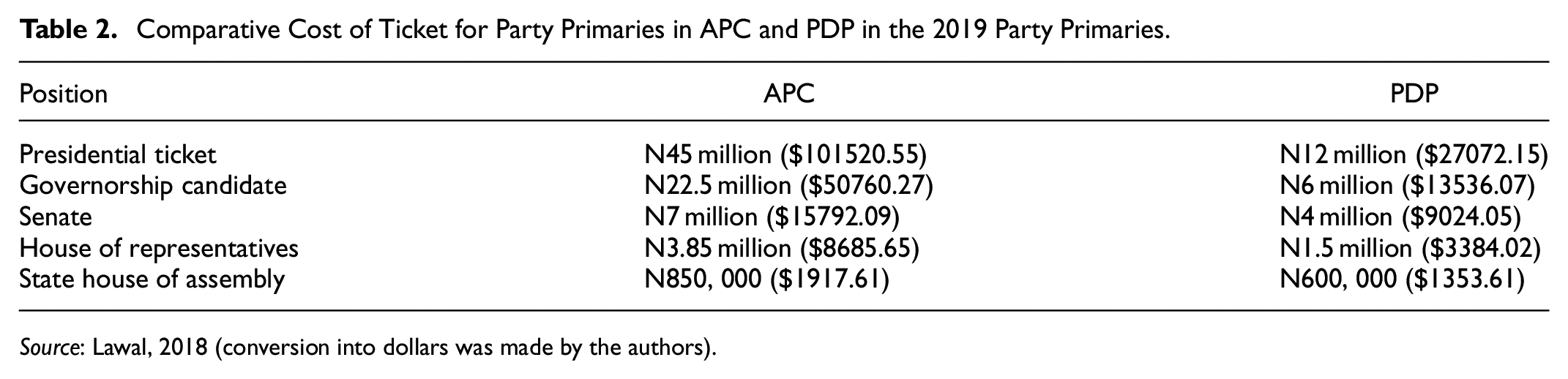
Source: Lawal, 2018 (conversion into dollars was made by the authors).
Comparative Cost of Ticket for Party Primaries in APC and PDP in the 2023 Party Primaries.

Source: Itodo, 2022 (conversion into dollars was made by the authors).
After furious lamentations by the public and stakeholders on the above-mentioned perceived attempt to monetise the party primaries and block the financially vulnerable candidates, the parties responded in more disrespectful action by doubling or even tripling the cost in the 2023 party primaries, as shown below.
The above table manifests how monetised the process of expression of interests and nomination forms for the APC and PDP in 2023 soared and appeared beyond the reach of ordinary politicians. Surprisingly, there was never a time in the history of Nigeria’s party primaries when aspirants purchased the forms, compared to 2023. About 28 aspirants purchased the form each at a cost of N100 million ($240,884), and 25 returned it (Vanguard Newspaper, 2022a). The new electoral law states that any aspiring candidate must resign from political or public office. Thus, the Minister of Labour, Central Bank of Nigeria Governor, and Minister of State for Petroleum declined submission after expending N100 million ($240,884) to acquire the form (Vanguard Newspaper, 2022b). This, according to an informant: Exhibits the highest order of embezzlement of money and abuse of public office because it is speculated that they used the privileges of their offices to secure money for purchasing the forms. (An in-depth informant interview with an informant in category C on August 26, 2022).
However, another informant has a contrary view and instead prefers: Most of the aspirants were not serious contenders. Some strong candidates sponsored them to block the chances of credible and serious contenders emerging or securing the nomination. These powerful candidates and their godfathers financed the bills of the surrogate candidates in return for a promise of reward, cash, and favor (An in-depth informant interview with an informant in category A on August 16, 2022).
Yet another candidate laments the phenomenon of the high cost of the nomination form in the 2023 party primaries of the APC and PDP: A worrisome development in Nigerian democracy one cannot expect a crop of these leaders who skinned themselves profusely to secure nomination to serve the common good and good governance (An in-depth informant interview with an informant in category E on August 11, 2022).
The annoying point is the uncourteous and insulting responses of the party leaders when confronted with the menacing issue. For instance, the APC Chairman responded that their “party nomination is not for the poor and average Nigerians; politics is for the wealthy, and if a candidate cannot mobilize supporters to raise the cost of form for him, he is not a serious contestant” (Maishanu, 2022). The APC later offered a discount of 40% to youth and female candidates, but it is far from fair to allow the weak and vulnerable groups’ access. This clearly depicts Clientelism at work in Nigerian party primaries.
Delegates or Delicates? The Dollarisation of Party Primaries
Party primaries in Nigeria vary according to the constitutions of respected parties. For the two major parties, in the APC, three methods are identified: direct primaries by all party members, delegates, or consensus. For the PDP, primaries consist of delegates and a consensus. Except for President Buhari, who was elected as the APC Presidential candidate in 2019 through direct primaries, almost all the primaries were either by consensus or delegates. APC claimed that President Buhari scored 14,842,072 million votes across the 35 states and the Federal Capital Territory (FCT) of Abuja to emerge as the party’s flagbearer in the 2019 Presidential Election (Alechenu, 2018). This is, according to an informant: A charade that is far from truth because we have observed the situation and we discovered that in most places no one came out to vote but they wrote 2,000 votes and more to claim that direct primaries have taken place. Where people come out, they multiply the number and claim a large turnout when it is not so (An in-depth informant interview with an informant in category D on August 6, 2022).
The use of delegates is the most common method of party primaries, and the delegates turned delicate in the 2023 party primaries because they appeared as properties for sale to the highest bidders. A large bazaar of money is displayed in the primaries of the APC and PDP to the extent that an informant narrates: A casual visitor into the country may assume that we are officially using the dollar as our legal tender because of the nature in which the dollar denomination freely exchanged hands during the party primaries of some major parties (An in-depth informant interview with an informant in category C on August 18, 2022).
It is reported from the arena of the convention, Eagle Square Abuja, that some aspirants offered $5,000, others $10,000, and some even $15,000 to the delegates to secure their votes (Adedayo, 2022). The scenario crashed the value of the naira against the dollar a few days before the convention. Naira was exchanged in the black market at N550 to N570 in the last 2 months before it jumped to an all-time high of N595 just 1 week before the convention of the APC and PDP because politicians were stocking dollars to buy the delegates (Mudashir et al., 2022). This development compelled many well-meaning Nigerians and stakeholders to question: There is seemingly no choice or alternative to the common electorate, as delegates are bought like a commodity in the market. In essence, the rationale for delegate or indirect primaries is even queried by many Nigerians owing to the delicate action of the delegates in the just concluded primaries. (An in-depth informant interview with an informant in category C on August 18, 2022).
What transpired in the recently concluded primaries was naked Clientelism because the delegates are involved in a negotiation through the brokers to support some candidates after a cash reward is promised. Others were promised favor and reward when victory was secured. The danger of the outcome of party primaries is that the ticket is thrown to the highest bidders instead of credible candidates, and good governance will never be achieved in this mode (Nwagwu et al., 2022). The Nigerian economy is sabotaged by the reckless actions of politicians during the primaries (Mudashir et al., 2022). The already battling economy is further battered, people lose hope of getting good leaders, bribery and electoral corruption ensue, which will drag political corruption and Clientelism.
Achieving Transparency: Beyond Policies and Below Reforms
To remedy the problem studied in this work, transparency is urgently needed, but achieving transparency is beyond policymaking since “the policymakers will never allow policies that will curtail their dubious actions and transactions,” according to an informant in category B (In-depth interview on August 11, 2022). However, an informant in category C reveals: Achieving transparency is possible and is below reforms if there is a will (In-depth interview on August 19, 2022).
The menace of electoral corruption, clientelism, and money politics can only be addressed globally and locally using sound reforms that encompass sanctions, regulations, people’s monitoring, and strong Electoral Management Bodies. Many scholars (Aluigba, 2015; Aspinall & Berenschot, 2019; Cendales et al., 2019; Coma, 2017; Davies, 2021; Diamond, 2019; Donno, 2017; Ohman, 2018; Piccio & Van Biezen, 2018; Sule et al., 2022) argue that both local and international reforms that will incorporate the citizens, local and international observers, strict regulations of maximum spending limits, effective monitoring and sanctions, and other measures should be taken immediately to curb the threat of money politics and corruption that is affecting democratic good governance and transparency. According to this view: Policymakers in Nigeria will never initiate laws that will restrain them from their corrupt practices and other dubious means. Reforms that will involve banning offenders from international travel, sanctions, voting out corrupt politicians, and avoiding the moneybags of politicians and their brokers are the way out. (In-depth interview with an informant in category B on August 8, 2022).
However, any reform will not succeed if it is inflexible and does not carry all stakeholders practically along with it. The desire to eschew illegal political dealings and financial crimes in the party primaries should go beyond reforms on paper. It is pertinent to awaken the conscience of the citizens to understand the dangers of their actions and the need to desist from such immoral acts before the situation gets out of hand. This has been aptly submitted by an informant in his view: There is an urgent need to formulate and integrate laws that will severely sanction those who violate the law. In my view, it is better to reshuffle the rules and procedures of party primaries by removing delegates from the equation and then allowing direct primaries, which will minimise the shameful scenario that we witnessed in the 2023 primaries (In-depth interview with an informant in category C on August 14, 2022).
Achieving meaningful, practical, and successful reforms in electoral integrity and minimizing corrupt practices such as buying delegates and vote-buying require a holistic approach (Norris, 2018). According to Norris, this should comprise reviewing laws, strengthening EMBs, opening up for international observers, strong domestic civil societies, informed citizens, effective monitoring, adequate sanction for deterrence, international collaboration, the signing of treaties and conventions on corruption and fraud, as well as liaison with organizations and institutions on accountability and transparency (Norris, 2018). These measures will help immensely in blocking corruption and money politics in the Nigerian context.
Conclusion
The study concludes that the 2023 party primaries in the major parties, the APC and PDP, are a threat to accountability and transparency in Nigerian democracy. Clientelism has hijacked the process of party primaries in Nigeria, as it has in all parts of the world. Party primaries are deliberately and exclusively designed to favor the rich and the ruling class. Politicians and parties are the major culprits due to the role they played in depriving the average and vulnerable groups, particularly youth and women, of securing nominations because of the exorbitant rate of the forms. The deliberately orchestrated plot to dismount all contenders that are not super rich is worsened by the shameful display of vote-buying during primaries in a dollarised process. Credible choice, good governance, and responsible representation will elude Nigerians now, and if reforms are not steadfastly introduced, they will continue. Thus, the informants strongly recommend sound tripartite reforms that will involve policies, international collaboration, and the involvement of citizens, domestic observers, and civil society in the process, in addition to effective monitoring and severe sanctions. This study is limited by periodization, financial constraints, and context. Future studies in this area, which are still not fully exploited by researchers in Nigeria, should focus on the changing or continuous dimension of Clientelism in the 2023 General election. The perspectives of vote-buying and electorates’ complicity and complacency should all be examined. In addition, the possibility of expanding the study to a comparative perspective should be contemplated by comparing Nigeria with one or two similar countries in Africa, Asia, Latin America, or the Caribbean.
Footnotes
Declaration of Conflicting Interests
The author(s) declared no potential conflicts of interest with respect to the research, authorship, and/or publication of this article.
Funding
The author(s) received no financial support for the research, authorship, and/or publication of this article.

Data Availability Statement
Data sharing not applicable to this article as no datasets were generated or analyzed during the current study.