




Abstract
In sub-Saharan African countries, teenage pregnancy received less attention and weak policy responses, and the pooled prevalence of teenage pregnancy is not yet studied. Therefore, this study aimed to determine the pooled prevalence and determinants of teenage pregnancy in sub-Saharan African countries. A total weighted sample of 96,185 teenage girls were included in the study. A multilevel modified poison regression analysis model was fitted to identify factors associated with teenage pregnancy. Finally, the Adjusted Prevalence Odds Ratio (APOR) with its 95% confidence interval was reported. Statistical significance was declared at p-value <.05. The overall pooled prevalence of teenage pregnancy in sub-Saharan Africa was 21.36% (95% CI: 21.10, 21.62%). Being 18 to 19 years (APOR = 1.70, 95% CI [1.64, 1.77]), teenager’s mother is working (APOR = 1.09, 95% CI: 1.06, 1.13), married adolescents (APOR = 5.54, 95% CI [5.01, 6.12]), media exposure (APOR = 0.96, 95% CI [0.94, 0.99]), middle and high wealth index (APOR = 0.96, 95% CI [0.93, 0.98]), and (APOR = 0.79, 95% CI [0.75, 0.83]), low-middle-income countries (APOR = 0.79, 95% CI [0.63, 0.92]), upper-middle-income (APOR = 0.61, 95% CI [0.41, 0.80]) and the Central African region (APOR = 1.46, 95% CI [1.29, 1.64]) were the factors found to be associated with teenage pregnancy. Teenage pregnancy in SSA was unacceptably high. Age, adolescent marital status, teenager’s mother’s working status, media exposure, wealth index, countries’ income, and regions of SSA had a significant association with teenage pregnancy. Therefore, addressing geographical disparities and socio-economic inequalities help to reduce teenage pregnancy.
Plain Language Summary
The purpose of this study was to investigate the pooled prevalence and determinants of teenage pregnancy in sub-Saharan African countries using the recent available standard Demographic and Health Survey datasets. We used a robust multilevel modified poison regression analysis model to identify factors associated with teenage pregnancy. Findings from this study revealed teenage pregnancy in SSA was unacceptably high. Therefore, public health policies should address geographical disparities and socio-economic inequalities to ensure healthy lives and wellbeing for adolescents and their family. However, results in this paper are obtained from a cross-sectional study design and readers should consider it while interpreting findings.
Introduction
Teenage pregnancy is defined as a teenage girl becoming pregnant before 20 years of age (Alauddin et al., 1999). Teenage pregnancy occurs in all societies but varies in magnitude across countries (Mann et al., 2020). According to World Fertility 2019 report, teenage fertility was still relatively high in 2015 to 2020 with 80 to 140 births per thousand teenage girls aged 15 to 19 years (World Fertility Report 2019, 2020). Globally, each year an estimated, 16 million teenage girls become pregnant. Of those, 12 million teenage girls aged 15 to 19 years and around 777,000 teenagers <15 years give birth annually in the developing world (UNFPA, 2018). Among all age groups pregnant mothers, about 15% of young women have childbearing before the age of 18 years (Singh & Darroch, 2000). Currently, Africa has the highest teenage pregnancy rates in the world, followed by Latin America and the Caribbean regions (Kassa et al., 2018). Sub-Saharan African (SSA) region has the highest teenage pregnancy prevalence rate (143 per 1,000 girls aged 15–19 years ) in the world at large (Gunawardena et al., 2019), of SSA countries, Niger, Mali, and Angola have the top teenage pregnancy rate (203,175, and 166 birth per thousand of teenage girls respectively; Odimegwu & Mkwananzi, 2016). Nearly 1 in 5 teenage girls in Nigeria has either given birth or is pregnant (Cortez et al., 2016). Teenage girls in rural dwellers and indigenous populations have three times more exposure to pregnancy than urban populations, among these, more than one-third (35%) are unintended pregnancies (Birhanu et al., 2019).
Teenage pregnancy is a serious public health problem, it has an immediate and long-term impact on health, education, and mental, as well as causes substantial social and economic costs to the population (Mohr et al., 2019), studies revealed that pregnancy and birth lead the teen girl to high school abstained and poor school achievement (Simkins, 1984), social discrimination (A. D. Raj, 2010). From a medical point of view, teenage girls are at risk of developing many health complications, like, eclampsia, infections, low birth weight, preterm birth, self-suicide, and maternal and neonatal death (Van Oppenraaij et al., 2009). Moreover, not all teenage pregnancies end with live birth also leads to teenage abortion (Dryburgh, 2000).
To avoid teenage pregnancy, collective efforts are needed. Despite this, in Sub-Saharan African countries, teenage pregnancy continued as a public health concern and has received less attention and weak policy responses; epidemiological information is limited. As far as we concern in the region, the pooled prevalence of teenage pregnancy is not yet studied. Unless, SSA countries put together, to reverse this problem, these countries will continue facing the high prevalence of teenage pregnancies, Therefore, this study aimed to investigate the pooled prevalence and determinants of teenage pregnancy in sub-Saharan African countries. We used more representative secondary data from each country’s recent standard Demography and Health Survey by using advanced statistical models. The findings are expected to provide a bold impact and new information on this unstudied region for other researchers, health policymakers, and stakeholders at large.
Literature Review
Studies evidenced the burden of teenage pregnancy varied across region and countries. For instance, the pooled prevalence of teenage pregnancy was 42.5% in Pakistan (Ali et al., 2022), 26% in Brazil (Azevedo et al., 2015). A systematic review and meta-analysis of 52 studies from 24 countries in Africa revealed the pooled prevalence of teenage pregnancy was 18.8%, and 19.3% in sub-Saharan Africa region (Kassa et al., 2018). Another study in the region showed Congo experienced the highest prevalence of teenage pregnancy with 44.3% and the lowest was recorded in Rwanda (7.2%; Ahinkorah et al., 2021). A study from five East Africa countries highlighted the prevalence of teenage pregnancy ranging from 18% in Kenya to 29% in Malawi, and Zambia (Wado et al., 2019).
The global picture of teenage pregnancy is complex with multiple overlapping factors. Previous studies showed that early marriage, being sexually active at early age, age at first sex, poor economic status, health service access inequality, educational attainment, exposure to media, place of residence, contraceptive use, community poverty level, and traditional cultures were some of the determinant factors for the majority of unplanned and unintended teenage pregnancies (Ali et al., 2022; Ayele et al., 2018; Birhanu et al., 2019; Kassa et al., 2018; Mathewos & Mekuria, 2018; Worku et al., 2021).
Though there are local studies conducted on the prevalence and associated factors of teenage pregnancy, there is limited evidence on the current pooled prevalence and associated factors of teenage pregnancy in the region. As a result, this study contributed to fill this gab using countries’ nationally representative, the recent available standard Demographic and Health Survey datasets. Moreover, we used a robust model to estimate the effect size.
Methods and Materials
Data Source
Secondary data analysis was conducted based on the recent Demographic and Health Survey (DHS) data of 33 sub-Saharan African countries from 2010 to 2020. DHS is a nationally representative population-based survey and is comparable across countries. Demographic and Health Survey used a two-stage stratified cluster sampling technique. In the first stage, a sample of Enumeration Areas (EA) were selected independently from each stratum with proportional allocation stratified by residence (urban & rural). In the second stage, from the selected EAs, households were taken by systematic sampling technique. The data were accessed from the DHS program official database www.measuredhs.com after permission was granted through an online request.
Source and Study Population
The source population was all teenagers who were pregnant and/or gave birth 5 years preceding each respective survey in sub-Saharan Africa, whereas those in the selected Enumeration Areas (EAs) were the study population. The sample size was determined from the individual to recode file “IR file” from the standard DHS dataset of sub-Saharan African countries with at least one survey from 2010 to 2020. A total sample size of 97,178 (weighted 96,185) teenagers were included in this study.
Study Variables
The outcome variable was teenage pregnancy taken as a binary response; 0 coded for “no” and 1 coded for “yes.” The independent variables for this study were divided into two; such as individual and community-level factors. The individual-level factors include; socio-economic and socio-demographic-related factors (age of the adolescent, adolescent’s marital status, adolescent’s educational status, mother’s occupation, adolescent’s relation to household head, wealth index, and media exposure), pregnancy-related factors (age at first sex, total children ever born), and behavioral-related factors (condom use). Community-level factors include; place of residence (urban/rural), sub-regions within SSA (Eastern Africa, Western Africa, Central Africa, and Southern Africa), and country income (lower income, lower middle income, and upper middle income).
Operational Definition
Teenage pregnancy: is the percentage of adolescent girls who have begun childbearing, that is the sum of the percentage who gave birth and/ or who are pregnant with their first child (Central Statistical Agency (Ethiopia) and ICF International, 2017).
Wealth index: is a composite measure of a household’s cumulative living standard divided into five quantiles using the wealth quantile data derived from the principal component analysis (Central Statistical Agency (Ethiopia) and ICF International). Finally, it was coded as “0” for the poor, “1” for the middle, and “2” for the rich.
Data Analysis
The data were extracted, edited, coded, and analyzed by using STATA version 16/MP software. The overall analysis in this study was carried out on weighted data to restore representativeness and complex sampling procures were also considered during the testing of statistical significance.
Factors with a p-value ≤.25 in the bi-variable were selected as candidates for the final model. Associations between dependent and independent variables were assessed and their strength was presented using adjusted prevalent odds ratio and 95% confidence intervals at a p-value of <.05.
The Poisson regression model using a sandwich variance estimator has become a practical alternative to the logistic regression model with independent binary outcomes. Modified Poisson regression, which combines a log Poisson regression model with reliable variance estimation, is a helpful substitute for log-binomial regression. Poisson regression is usually regarded as an appropriate approach for analyzing rare events. When Poisson regression is applied to binomial data, the error for the estimated odds ratio will be overestimated. However, a sandwich estimate is a robust error variance method that can be used to solve this issue. Thus, we used modified Poisson regression for this study (Zou, 2004).
Consider the case in which xi (i = 1, 2, …, n) is a binary exposure with a value of 1 if exposed and 0 if unexposed. Assume that subject “i” has an underlying risk that is a function of xi, say π(xi). Because π(xi) must be positive, the logarithm link function is a natural choice for modeling π(xi), giving:

The odds ratio (OR) is then given by exp(β). If a Poisson distribution is assumed for yi, the log-likelihood is given by;

Where C is a constant.
Ethics Consideration
Since the study was a secondary data analysis of publicly available survey data from the MEASURE DHS program, ethical approval and participant consent were not necessary for this particular study. We requested DHS Program and permission was granted to download and use the data for this study from www.measuredhs.com.
Results
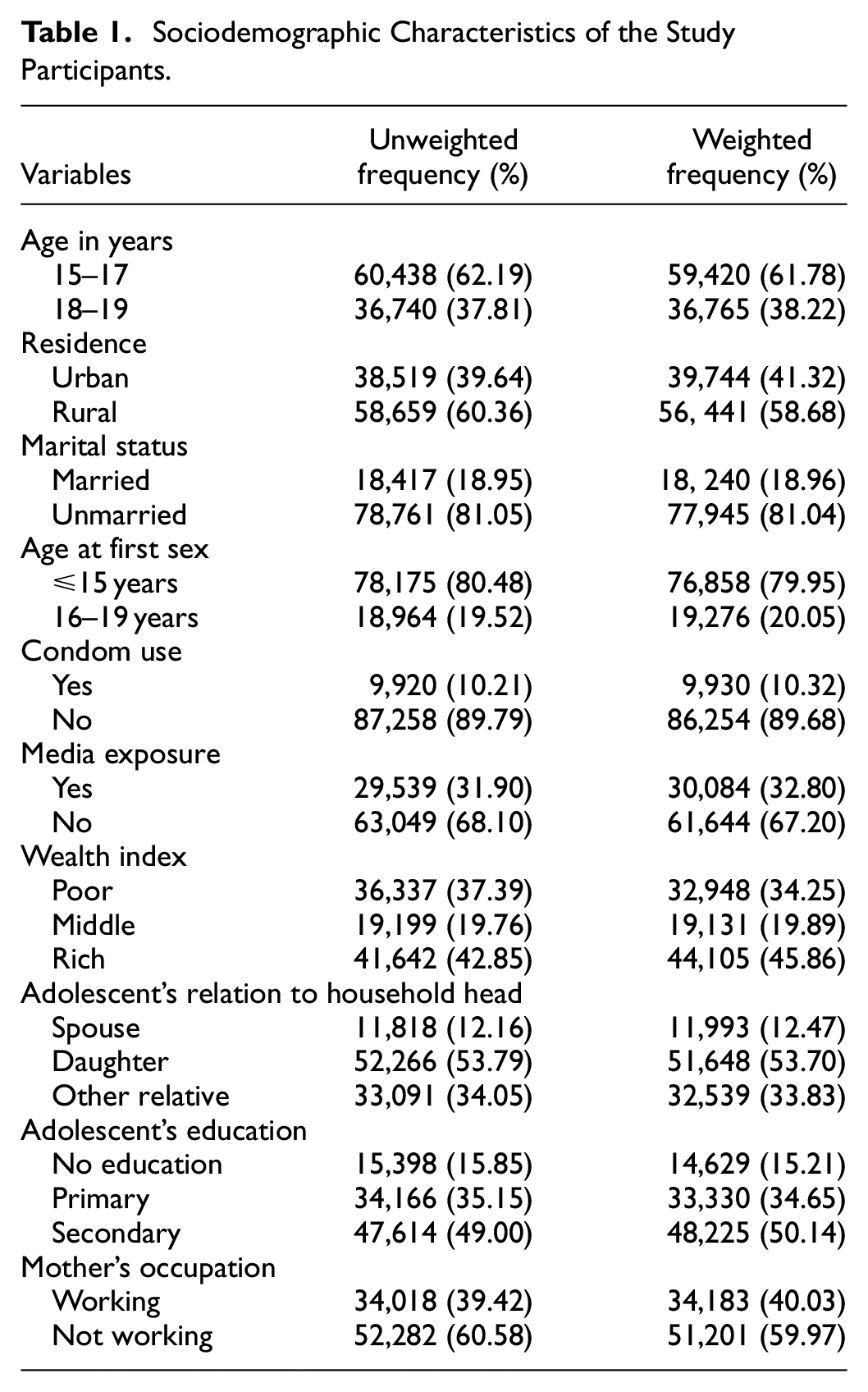
A total sample size of 97,178 (weighted 96,185) teenage girls was included in the study. More than half of the teenagers were in the age group 15 to 17, 62.19% (60,438), and about 60.36% (58,659) were rural residents. The majority of the teenage girls were never married 81.05% (78,761). Around 31.90% (29,539) of teenage girls had media exposure. The majority of the teenage girls had their first sexual exposure at the age of 15 years and younger 80.48% (78,175) and only 10.21% (9,920) were condom users. About 42.85% (41,642) of the teenage girls were from rich households while 37.39% (36,337) were from poor households. Regarding mothers’ educational status almost half of the mothers of teenage girls had secondary level education 49.00% (47,614), 15.85% (15,398) had no formal education and more than half of the mothers were working 60.58% (52,282; Table 1).
Sociodemographic Characteristics of the Study Participants.
The Pooled Prevalence of Teenage Pregnancy
The overall pooled prevalence of teenage pregnancy in sub-Saharan Africa was 21.36% (95% CI [21.10%, 21.62%]). The prevalence ranged from 38.99% in the Democratic Republic of Congo to 5.02% in Comoros (Figure 1).

Pooled prevalence of teenage pregnancy in the sub-Saharan Africa.
The prevalence odds of teenage pregnancy was 70% higher for teenagers aged 18 to 19 as compared to their counterparts (APOR = 1.70, 95% CI [1.64, 1.77]). Teenagers whose mothers were working had a 9% higher risk of pregnancy (APOR = 1.09, 95% CI [1.06, 1.13]). Married adolescents had five times higher odds of pregnancy (APOR = 5.54, 95% CI [5.01, 6.12]) as compared to those who were unmarried. The prevalence odds of pregnancy for teenagers not exposed to mass media was 4% lower than those exposed to media (APOR = 0.96, 95% CI [0.94, 0.99]). Again, the prevalence odds of pregnancy were lower for teenagers who were daughters and other relatives of the household heads as compared to spouses of the head household (APOR = 0.91, 95% CI [0.85, 0.97]) and (APOR = 0.93, 95% CI [0.89, 0.96]) respectively. Regarding wealth index teenagers from middle and higher wealth index had lower prevalence odds ratio as compared with those from poor households (APOR = 0.96, 95% CI [0.93, 0.98]) and (APOR = 0.79, 95% CI [0.75, 0.83]) respectively. Regarding countries' economies, teenagers from low-middle-income and upper-middle-income countries had lower prevalence odds of teenage pregnancy as compared to those from lower-income economies (APOR = 0.79, 95% CI [0.63, 0.92]) and (APOR = 0.61, 95% CI [0.41, 0.80]) respectively. Teenagers from Central African Countries had 1.46 times higher prevalence odds of pregnancy as compared with those from East Africa (APOR = 1.46, 95% CI [1.29, 1.64]; Table 2).
Multivariable Multilevel Modified Poison Regression Analysis Teenage Pregnancy in Sub-Saharan Africa.

Note. SSA = sub-Saharan Africa; APOR = adjusted prevalence odds ratio; CI = Confidence Interval.
Significant at .05 level. **Significant at .01. ***Significant at <.001
Discussion
Teenage pregnancy is a public health concern globally. About 16 million teenage girls in the developing world gave birth each year (Johnson & Moore, 2016). Teenage mothers have a higher risk of pregnancy-related complications including hypertensive disorders, prematurity, and anemia (Azevedo et al., 2015; Chen et al., 2007). Hence, this study determined the weighted prevalence of teenage pregnancy and associated factors in the SSA.
The overall pooled prevalence of teenage pregnancy in sub-Saharan Africa was 21.36% (95% CI [21.10%, 21.62%]). The results were comparable with reports in Colombia (21%; Aguía-Rojas et al., 2020) but lower than a report from Bangladesh (35%; Alam et al., 2018) and Pakistan 42% (Ali et al., 2022) and another study in East Africa 54.6% (Worku et al., 2021). The difference might be due to sociodemographic differences in the study population. Additionally, data from our study represent many countries and a larger sample size.
In our study higher prevalence of teenage pregnancy was reported in the Central African region. This might be because most countries in the region have been reported to have a higher prevalence of child marriage (Yaya et al., 2019).
In this study, the older adolescents had a higher prevalence odds ratio for pregnancy. This is supported by other studies in Africa (Ayele et al., 2018; Worku et al., 2021). Older adolescents show higher risk-taking behaviors which apply to pregnancy (Duell et al., 2018). Again, teenagers who were in a union marital relation and those who were spouses to the head of household had a higher prevalence of odds of pregnancy. This is supported by studies in Africa (Ahinkorah et al., 2021; Kassa et al., 2018; Petroni et al., 2017; Yaya et al., 2019). Early marriage increases fertility and literature have shown that countries with higher rates of early marriage have higher rates of fertility (Raj et al., 2009).
Regarding the wealth index, teenagers from poor households had a higher prevalence odd of pregnancy. This is consistent with findings from other studies (Ali et al., 2022; Imamura et al., 2007; Wado et al., 2019; Worku et al., 2021). Similarly, a community-level factor, the country’s economy showed that teenagers from low-middle-income and upper-middle-income countries had lower prevalence odds of teenage pregnancy as compared to those from lower-income economies. Poverty in sub-Saharan Africa is a common issue (Nwani & Osuji, 2020). It plays a significant role in child marriage, lack of sexual autonomy, lack of education, and access to reproductive health services (Ogundele et al., 2018). Poverty also increases risky sexual behaviors (Silas, 2013). These factors may be the reason for higher rates of pregnancy observed in poorer communities.
Recent research about the effects of media exposure on teenage pregnancy has indicated that it is inconclusive. Studies have shown that exposure to mass media may have positive benefits for teenagers in improving awareness (Worku et al., 2021). Other studies have shown that exposure to media can have negative effects especially adolescents exposed to explicit sexual content may have an increased chance of risky sexual behaviors (Asekun-Olarinmoye Esther et al., 2014; Escobar-Chaves et al., 2005; Lin et al., 2020).
In this study, adolescents who have working mothers have higher odds of prevalence of pregnancy. Working mothers spend more time at work and may not have relationships with their daughters. Parental neglect and lack of relationship between mothers and their daughters might be attributed to adolescent pregnancy. Poor mother-daughter interaction and parental neglect increase the risk of teenage pregnancy (Ayele et al., 2018; Mathewos & Mekuria, 2018).
The current study revealed adolescents from Central African Countries had higher prevalence odds of pregnancy as compared with those from East Africa. Some of the reasons for these regional variations might include differences in the inaccessibility of contraceptive services, the community’ negative attitude toward adolescent contraceptive use, adolescents’ lack of knowledge about sexual and reproductive health issues, and widespread sexual violence (World Health Organization, 2022).
Strength and Limitations
This study used large population-based data with a large sample size, which is representative of 33 sub-Saharan African countries. Furthermore, a modified Poisson regression analysis was applied which enabled us to model the effects of each determinant on teenage pregnancy. However, this study had also limitations as some countries had no recent DHS data and it was a cross-sectional study design.
Conclusion
Teenage pregnancy in SSA was found to be unacceptably high. Age, adolescent marital status, teenager’s mother's working status, media exposure, and wealth index were found significantly associated with teenage pregnancy at an individual level, whereas countries’ income and regions of SSA had a statistically significant association with teenage pregnancy at the community level. Therefore, addressing geographical disparities and socio-economic inequalities will help to reduce teenage pregnancy. Moreover, understanding determinants of teenage pregnancy can facilitate the development of public health policies that ensure healthy lives and wellbeing for adolescents and their family. Finally, we want to underline results in this paper are obtained from a cross-sectional study design and readers should consider it while interpreting findings. Therefore, we recommend a prospective observational study to better understand the burden and consequence of teenage pregnancy with young-adult reference.
Footnotes
Acknowledgements
The authors would like to thank the MEASURE DHS program for the on-request open access to its dataset.
Author’s Note
This research was conducted while [Mr. Belete Achamyelew Ayele] was at [
Author Contributions
All the authors MAZ, BAA, EAZ, TYY, HSH, and SAT made the conceptualization, data curation, analysis, investigation, methodology, visualization, writing, review, and editing of the whole manuscript. All the authors read and approved the final manuscript.
Declaration of Conflicting Interests
The author declared no potential conflicts of interest with respect to the research, authorship, and/or publication of this article.
Funding
The author received no financial support for the research, authorship, and/or publication of this article.
