




Abstract
Museums are traditionally considered public service settings with educational functions and practical learning resources for students. Early childhood teachers’ intention to implement class visits to museums is still very low. This paper synthesizes the theory of planned behavior model (TPB) and core determinants of the technology acceptance model (TAM) to hypothesize an extended TPB model to explain preschool teachers’ perceptions and intentions to implement museum visits. The results revealed that early childhood teachers’ intention of implementing class visits to museums was significantly influenced by attitude, perceived usefulness, and perceived behavioral control. The implications of this study are provided.
Keywords
Introduction
Museums are crucial in facilitating educational opportunities beyond the traditional classroom setting, offering children valuable learning experiences (Cooper, 2011; Glover Frykman, 2009). In 2022, the National Cultural Heritage Administration (NCHA) reported that Chinese museums curated over 30,000 educational exhibitions, attracting a total of over 578 million visitors (National Cultural Heritage Administration [NCHA], 2023). The existing body of research reveals that museum visits have been shown to effectively enhance students’ skills in various domains such as mathematics, sciences, art, literature, creativity, imagination, language, and communication skills (Dockett et al., 2011; Morentin & Guisasola, 2015b; Piscitelli & Weier, 2002). Although previous research has highlighted the significance of teachers’ perceptions in shaping their behavior intentions and subsequently impacting their practices, there remains a dearth of studies exploring the relationship between teachers’ belief systems and their intentions toward teaching behaviors, particularly in out-of-school activities such as museum visits. Considering the social contexts, the current study focused on the Museum, the representative of many museums that exist within China and most of such museums put emphasis on regional culture and antiquity (Chen & Ryan, 2020). For example, the Henan Museum covers the ancient civilizations of Henan Province (Henan Museum, 2023). We aim to investigate the elements that influence teachers’ implementation of class visits to museums, as well as examine the interrelationships among these aspects. Hence, this study contributes to the empirical evidence and theoretical foundation of the engagement between colleges and museums in the context of teacher education.
The primary avenues for young children to access museums are through family and school trips. A study conducted by Karnezou et al. (2021) demonstrated that such extracurricular excursions played a significant role in enhancing students’ information acquisition and overall learning outcomes. Although many teachers recognize the significance of museum visits, their understanding of effectively incorporating them into teaching practices needs to be more cohesive (Morentin & Guisasola, 2015a). Moreover, only limited research exists that focuses on young children’s museum visits and early childhood teachers’ attitudes toward class visits to museums (Morentin & Guisasola, 2015b). Hence, the current study addresses this gap and endeavors to construct a theoretical framework that elucidates the relationship between kindergarten teachers’ perceptions and their practices concerning museum visits by using the extended TPB model. Previous research suggests that the TPB model has an edge over other models in explaining the variables that influence a person’s use of a particular technology (Taylor & Todd, 1995), and it is a widely employed theory to predict teachers’ intentions and behaviors (Malak et al., 2018; Sahli Lozano et al., 2021; Sharma et al., 2018; Sharma & Jacobs, 2016; Teo et al., 2011). Furthermore, earlier studies showed that an individual’s behavioral attitudes and implementation were significantly influenced by the crucial variables in the TAM (M. C. Lee, 2010; Teo, 2009). Considering the strong attitude-behavioral link in the TPB and the TAM, we argue that a more comprehensive knowledge of intention and practice will be provided when the TPB and TAM models are integrated. Therefore, the findings of this study are anticipated to shed light on preschool teachers’ behavior intentions regarding out-of-school learning activities. They can be used to develop more effective intervention programs and devise quality curricula for pre-service early childhood teachers. In turn, those pre-service kindergarten teachers can implement marked museum visits and other out-of-school activities for their students in the future.
Neglected Out-of-School Excursions: Young Museum Audience in China
The success of school visits to museums for young children primarily lies in the quality of early childhood education (ECE), and China is a typical example of this aspect. Since 2010, China has focused on providing every child with equal and high-quality childcare service, and some positive changes were made (e.g., high gross enrollment rates, more ECE service in rural areas, increasing funding for ECE and more detailed regulations and monitoring systems) (Ministry of Education, 2022). However, most teachers still stick to the accustomed subject-based curriculum rather than an integrated one (Li & Chen, 2017). Out-of-school resources such as libraries and museums are neglected and underutilized. Without adequate training programs, museum trips will not become meaningful learning activities but leisure excursions (Chitima, 2022). Although Chinese policymakers strengthened the importance of out-of-school learning settings and obligated kindergartens to apply a more comprehensive curriculum by using different social and public resources (State of Council, 2020), children-centered museum programs did not flourish in China (Wong & Piscitelli, 2019).
Moreover, literature on kindergarten teachers’ attitudes toward museum visits is comparably limited. In early publications, the external factors (e.g., policies, inadequate training) significantly influence teachers’ willingness to implement class visits to museums (Morentin & Guisasola, 2015b). However, few studies found in the literature shed light on internal factors (e.g., attitudes, etc.) or combining external and internal factors that impact early childhood teachers’ perception of museum visits. Previous studies revealed that the problem behind underdeveloped out-of-school activities such as students’ museum visits is incomplete curriculum reform and a successful curriculum reform starts with high-quality teacher education (Li & Chen, 2017; Sharma & Jacobs, 2016). Korthagen (2010) stated that teacher education requires full awareness and reflection in pre-service teachers on their perceptions. Therefore, this study focused on student teachers and tried to explore how pre-service teachers understand educational outings to museums and what factors influence their willingness and practices to implement children’s museum visits.
Theory of Planned Behavior (TPB)
The theoretical framework of the current study mainly focuses on TPB proposed by Ajzen (1991). It explains that an individual’s willingness to implement any behavior is affected by three factors: behavior attitudes, important others’ perception of performing the behavior (subjective norms), and perceived behavioral control. Prior research has widely used TPB to predict teachers’ behavior intention (Malak et al., 2018; Sahli Lozano et al., 2021; Sharma et al., 2018; Sharma & Jacobs, 2016; Teo et al., 2011). Based on the TPB, these three determinants influence behavioral intention, which in turn influences practices (Ajzen, 1991). In this case, the behavioral intention is operationally defined as early childhood teachers’ intention of implementing museum visits for children. Attitudes refer to the preschool teachers’ positive or negative beliefs about class museum visits. Subjective norms refer to whether important others think museum visits should be implemented. Perceived behavior control refers to kindergarten teachers’ perception of how easy or challenging it is to implement museum visits. A plethora of research indicates that these three factors are significant predictors of teachers’ intention to perform any practices, and they have indirect effects, mediated via intention, on teaching behaviors (Kupers et al., 2023; Sharma & Jacobs, 2016; Yan et al., 2021).
In previous research, attitudes, subjective norms and perceived behavior control combined to predict teachers’ behavioral intentions (Wilson et al., 2016). Some studies reported that teachers’ attitude emerged as the most significant predictor of intentions (Sharma et al., 2015, 2018; J. Song et al., 2019). In some studies, subjective norms were reported as another significant predictor of teachers’ behavioral intentions (Ahmmed et al., 2014; J. Song et al., 2019). Prior research discussed the impact of perceived subjective norms from school administrators (Hodge et al., 2018), colleagues (Wang et al., 2015) and students’ parents (Vermeulen et al., 2012). However, the extent of perceived support from important others differed within different social contexts (Qi & Ching Ha, 2012; Young et al., 2017). As for perceived behavioral control, some research reported that it has positve relationship with behavior (Wilson et al., 2022; Yan & Sin, 2014).
In addition, prior research has found that subjective norms could take a more critical role in the early stage of specific behavior implementation, mainly when a person had limited first-hand experiences to build up and develop their belief systems (e.g., attitude, perceived behavior control, perceived usefulness) toward specific technology (Hartwick & Barki, 1994; M. C. Lee, 2010; Taylor & Todd, 1995; Teo et al., 2011). In the current study, all the participants were pre-service teachers. Considering the current curriculum and teacher education they receive, most of them need more direct or actual teaching experiences in the classrooms (Hoy & Spero, 2005). Under this circumstance, subjective norms (e.g., their teachers, family members, and peers) can be a primary source for them to obtain second-hand information and then influence their perception of teaching practices and the difficulty of implementing them (Smith & Lev-Ari, 2005). Thus, we posit that:
The Technology Acceptance Model (TAM)
Another theory integrated into the proposed model was TAM. According to previous research (Davis, Bagozzi, & Warshaw, 1989), TAM was first introduced as a theoretical extension of the theory of reasoned action (TRA) (Fishbein & Ajzen, 1975) and had great explanatory power to one’s acceptance of particular technology. A line of research has applied TAM to analyze people’s acceptance of various systems such as e-learning, digital technology, and learning management system (Joo et al., 2018; M. C. Lee, 2010; Scherer et al., 2019). In the TAM, perceived usefulness and perceived ease of use were regarded as core technology adoption determinants. Perceived usefulness refers to an individual’s perceptions of whether using a particular technology will enhance job performance. Perceived ease of use refers to an individual’s perception of whether using a particular system will be effortless (Davis, Bagozzi, & Warshaw, 1989). In this study, perceived usefulness refers to teachers’ perception of whether students’ museum visits were a practical teaching approach (Teo et al., 2011, 2016), while perceived ease of use was adapted as perceived ease of learning and operationally defined as teachers’ perception of whether learning through museum visits would be effortless (M. C. Lee, 2010; Teo, 2010).
Perceived usefulness and Perceived ease of use were reported as important variables which directly or indirectly explain one’s behavioral intentions (Marangunić & Granić, 2015). For example, some research supported the statistical siginificance of perceived usefulness to behavioral intention (Cheung & Sachs, 2006; Pynoo et al., 2012) while the results of other studies did not (Kirmizi, 2014; Teo & Milutinovic, 2015). The significant influence of perceived ease of use on perceived usefulness was supported in some studies (Atif et al., 2015; Luan & Teo, 2009). Scherer and Teo (2019) suggested that the strengths of the effects of perceived usefulness and perceived ease of use might differ because of social contexts and teacher samples. Furthermore, the TAM was often acompanied by external variables such as subjective norms and perceived behavioral control in some studies (Abdullah & Ward, 2016; Schepers & Wetzels, 2007). These external variables represent personal capablities next to contextual factors (Scherer et al., 2018).
Similar with the TPB, the TAM also attaches importance to the relationship between attitude and behavior (Triandis, 1977). Both the TPB and the TAM have been widely used in many studies to predict and understand teachers’ perceptions of behavior and the probability of implementing that behavior (Ho et al., 2013; J. Lee et al., 2010; Teo, 2012). According to previous research, the TPB model has an advantage in explaining factors that affect one’s behavioral intention and draws more attention to normative and control factors related to implementation (Ho et al., 2013; Taylor & Todd, 1995). The TAM is shown to be more suitable for the prediction of behavior (Teo et al., 2011). Chu and Chen (2016) suggested that the TAM may be more appropriate for studying personal practice. Unlike the TAM, the TPB considers social influences on intention and implementation of a particular behavior (Cheng, 2019). This study not only focuses on the inclination and adoption from individual perspective but also considers factors that influence their behavior within social contexts. Therefore, we contend that integrating the TPB and the TAM is appropriate for understanding preschool teachers’ inclination and implementation of behavior by decomposing attitudes, subjective norms, and perceived behavioral control into more specific dimensions. Many previous studies state that in the TAM, perceived usefulness directly influenced a person’s behavioral intention, and perceived ease of use indirectly influenced a person’s behavioral intention via perceived usefulness (Davis, Bagozzi, & Warshaw, 1989; Venkatesh & Davis, 2000). In addition, some studies showed that the difficulty of teaching tasks one perceived might affect his or her perceived behavioral control (Ajzen, 1991). Therefore, we derived the following hypotheses:
Facilitating Conditions
Facilitating condition is another variable investigated to understand one’s desire to perform a task. Some research shows that various supports (e.g., availability of resources, training, and administrative support) were influential in the use of a particular system or technology (Groves & Zemel, 2000). Hoy and Spero (2005) pointed out that novice teachers who received inadequate support had a shakier perception of their ability and a less optimistic view of teachers’ accomplishments. This was corroborated by the results of several studies that teachers cited barriers to teaching through museum visits that were lack of access to children-centered exhibitions or design, lack of practical support from museums, inadequate workable curriculum model for delivering museum visits (Chitima, 2022; Li & Chen, 2017; Yates et al., 2022). To investigate the influence of facilitating conditions on teachers’ intentions, it was usually integrated into the TPB and the TAM (Abdullah & Ward, 2016; Schepers & Wetzels, 2007). For example, prior studies demonstrated the direct significance of facilitating conditions in predicting perceived behavior contorl, subjective norms and perceived ease of use (Teo et al., 2011, 2016). Furthermore, some research demonstrated that teachers’ perceived ease of use was significantly influenced by facilitating conditions (e.g., quality of teaching resources) (Hoy & Spero, 2005; Teo et al., 2009). Therefore, we posit that:
The Current Study
Ajzen’s (1991) TPB guided the conceptual framework in the current study and past research has shown that one factor alone can not effectively predict one’s intention for particular behaviors (M. C. Lee, 2010). While prior research has examined the critical determinants in the TPB in predicting teachers’ intentions to implement specific learning activities and has investigated core determinants in TAM in explaining attitudes and then influencing teachers’ behavioral intention, few studies have yet theoretically integrated TAM with TPB factors together to investigate their relationship with teachers’ behavior, more specifically on implementing out-of-school activities such as class visits to museums. According to TPB, behavioral intention is a predictor that captures one’s willingness to perform a behavior (Ajzen, 1991). Considering the close relationship between behavioral intention and actual behavior (Teo, 2011; Webb & Sheeran, 2006), in this study, teachers’ intention to implement museum visit activities was used as the dependent variable. Figure 1 embodies two variables: perceived usefulness and perceived ease of learning from TAM, and their relationships remain intact. The research questions of this study were:
(1) Is the extended TPB model effective in explaining early childhood teachers’ intention for implementing class visits to museums?
(2) Are the internal and external variables significantly influential in early childhood teachers’ behavioral intention to implement museum visits?

Path analysis of the research model
Method
Data Collection and Participants
There are some guidelines and policies for in-service teachers (State of Council, 2020) and the communication between schools and museums (Kang et al., 2010). However, the collaboration between teacher education and museums is scarce and policymakers put low emphasis on pre-service teachers (State of Council, 2020). To investigate student teachers’ perceptions of educational outings to museums, this study focused on novice early childhood teachers facing future museum teaching practices. According to the academic qualification breakdown of kindergarten teachers in China, most early childhood teachers held diploma (49%) and bachelor (13%) certification (Ministry of Education of the People’s Republic of China, 2013). Therefore we focused on student teachers from universities and colleges. Final-year early childhood education students in one university and one college in the center region of China were chosen through the method for convenience sampling. From the outset, we informed all the participants that they participated in this study voluntarily and that they could quit at any time. Teachers who agreed to participate were sent survey packages online, and completed surveys were collected after 1 week of the delivery. We distributed 382 surveys in total and received 360 valid surveys in the end. Incomplete questionnaires or questionnaires with invalid or repeated answers were eliminated. In terms of demographics, 96.9% of participants were females, which closely resembled the gender ratio of early childhood educators in China (Ministry of Education of the People’s Republic of China, 2013). 74.4% of the respondents were from rural areas, and most of our participants were between 22and 25 years old. 44.2% were college students and 55.8% were university students. Regarding museum visits, 68.1% of respondents visit museums once or twice a year, and 23.3% never visit museums. Participants’ demographics are presented in Table 1.
Participants by Demographic Characteristics (N = 360).

Questionnaire
The questionnaire contained two parts to collect data. The first part consisted of demographic questions and the second part was designed to measure seven constructs with a seven-point Likert scale from “strongly disagree” (1) to “strongly agree” (7). 23 items were grouped into these seven constructs: facilitating conditions (FC) (three items), attitudes toward museum visits (ATT) (five items), subjective norm (SN) (three items), perceived behavior control (PBC) (three items), perceived usefulness (PU) (three items), perceived ease of learning (PEL) (three items) and intention of implementing class visits to museums (IN) (three items). All the items were developed and adapted from the published resources (M. C. Lee, 2010; Teo, 2010; Teo et al., 2011). The draft questionnaire was reviewed by a panel of four experts who had expertise in the TPB and TAM model, early childhood education, and was revised based on their comments and suggestions. The questionnaire was translated into Chinese and translated back to English by two groups of bilingual college students of early childhood education respectively. We refined the questionnaire to make the wording more precise, and the complete questionnaire is listed in Appendix 1.
Pilot Test
A pilot test was taken to evaluate the convergent and discriminate validities of the questionnaire. There were 112 complete surveys received through convenient sampling. Cronbach’s reliability and factor analysis were used to analyze the results of the pilot test. According to J. C. Anderson and Gerbing (1988), Cronbach’s alphas should be higher than the acceptable reliability measure of 0.7. Then, we performed the factor analysis to examine the factor loadings of each item, which should be greater than 0.5 (Fornell & Larcker, 1981). Two items that did not contribute to the reliability and showed low loadings on related factors were eliminated.
Common Method Variance (CMV) and Nonresponse Bias
All the data of this study were generated from the same participants, and the results of a cross-sectional study can be influenced by CMV (Lindell & Whitney, 2001; Whitman & Woszczynski, 2004). Hence, this study took Harmon’s one factor test (Podsakoff et al., 2012) to examine the risk of common method bias. All the variables were entered into the single factor analysis, and the results demonstrated that the first factor accounted for 30.5% of the total variance. Because no general factor explained more than 50% of the variance in those variables (Hair et al., 2006), there was no significant common method variance bias found in the present study.
Results
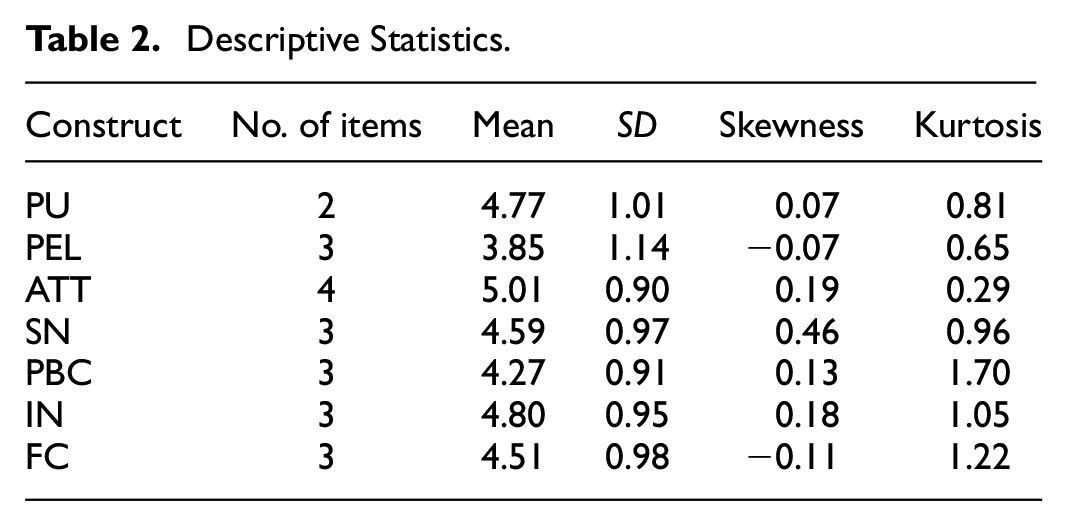
Table 2 shows the descriptive data of the seven constructs. All items ranged from strongly disagree (1) to strongly agree (7), and six out of seven constructs have mean scores above the mid-point of 4, ranging from 4.27 to 5.01. In comparison, PEL had mean scores close to 4.00. According to Skewness and Kurtosis coefficients, the distribution of means for each construct indicates a multivariate normality (Cohen et al., 2003).
Descriptive Statistics.
Analysis of the Extended TPB Model
The model assessment for validity and reliability was facilitated by three criteria: (1) the indicator reliability, (2) the composite reliability of each construct, and (3) the average variance extracted (AVE). According to Fornell and Larcker (1981), the indicator reliability was measured by its factor loading, which should be greater than 0.5. The results showed that all the factor loadings in the measurement model were higher than this lower bound, ranging from 0.621 (FC1) to 0.888 (PU2) (shown in Table 3). Therefore, the convergent validity of the measurement model was demonstrated at the item level. The composite reliability of seven constructs was assessed by the Cronbach’s alphas. Hair et al. (2012) suggested that if construct reliabilities exceed 0.7, they should be considered reasonable. As shown in Table 3, the alphas of every construct exceeded 0.7, ranging from 0.782 (perceived behavioral control) to 0.867 (intention). To meet the third condition, the AVE by each construct should exceed 0.5, which ranged from 0.549 to 0.750 in this study. All three criteria for convergent validity were fulfilled, demonstrating that the measurement model of the study was statistically valid and reliable.
Construct Reliability and Convergent Validity.

Note. QI = questionnaire items; FL = factor loading; CR = composite reliability; AVE = average variance extracted; α = Cronbach’s alpha.
Another condition for the proposed model evaluation is the discriminant validity. In the study, it is used to assess the extent to which the variance shared between constructs differs from each other (Bagozzi & Phillips, 1991). Discriminant validity can be assessed by comparing the square root of the AVEs shared between the construct (Fornell & Larcker, 1981). If it exceeds the correlations between the constructs in the proposed model, it indicates that each construct is considerably different from one another. The results (shown in Table 4) demonstrated that the square roots of the variance exceeded the correlations of other constructs. Hence, the discriminant validity appears satisfactory.
Correlation Matrics and Discriminant Validity.

Note. Fornell-Larcker criterion for discriminant validity.
This study performed a path analysis to examine the overall goodness-of-fit of the extended TPB model. In the study, AMOS 26.0 was performed and maximum likelihood estimation (MLE) procedure was used for model estimation. In previous research, the chi-square test was used to reflect the variance and covariance of the data. Other fit indices were considered in conjunction with the chi-square (Kline, 2005). As shown in Table 5, the ratio of chi-square to the degree of freedom (x2/df) was 1.657. All the fit statistics, including Tucker-Lewis index (TLI), comparative fit index (CFI), good-of-fit index (GFI), normed fit index (NFI), and relative fit index (RFI) exceeded 0.9, indicating a good model fit (J. C. Anderson & Gerbing, 1988). Furthermore, the root mean square error of approximation (RMSEA) is valued at 0.043, lower than 0.05, indicating an acceptable model fit (Hu & Bentler, 1999).
Fit Indices for the Path Model.

Hypotheses Testing for Direct Effects
All the hypotheses were examined by using the structural equation modeling (SEM) approach (Bagozzi & Phillips, 1991). The study utilized this modeling because of its capacity to examine the connections between latent and observable variables. The ability of SEM to model the relationships between constructs and their alignment with the conceptual and statistical expression of hypotheses gives it an edge over traditional data analysis techniques (Hoyle, 2011). The path coefficients of each hypothesis and variance explained (R2 value) by each path in the extended TPB model were tested (shown in Figure 1 and Table 6). Among all 14 hypotheses for direct effects, nine out of them were strongly significant at p < .001, and one was strongly significant at p < .01 (teachers’ perceived behavioral control to their behavioral intention). Teachers’ intention to implement museum visits was jointly predicted by perceived usefulness (β = .304, p < .001), attitude (β = .505, p < .001), and perceived behavioral control (β = .211, p < .01). Moreover, the explanatory power of these variables toward teachers’ willingness to implement museum visits was 58% (R2=0.58, coefficient of determination). Perceived behavioral control was strongly influenced by subjective norms (β = .524, p < .001) and perceived ease of learning (β = .261, p < .001). Perceived usefulness was affected by subjective norms (β = .586, p < .001) and perceived ease of learning (β = .189, p < .001). Perceived behavioral control was influenced by subjective norms (β = .524, p < .001) and perceived ease of learning (β = .261, p < .001).
Summary of Hypotheses Tests for Direct Effects.
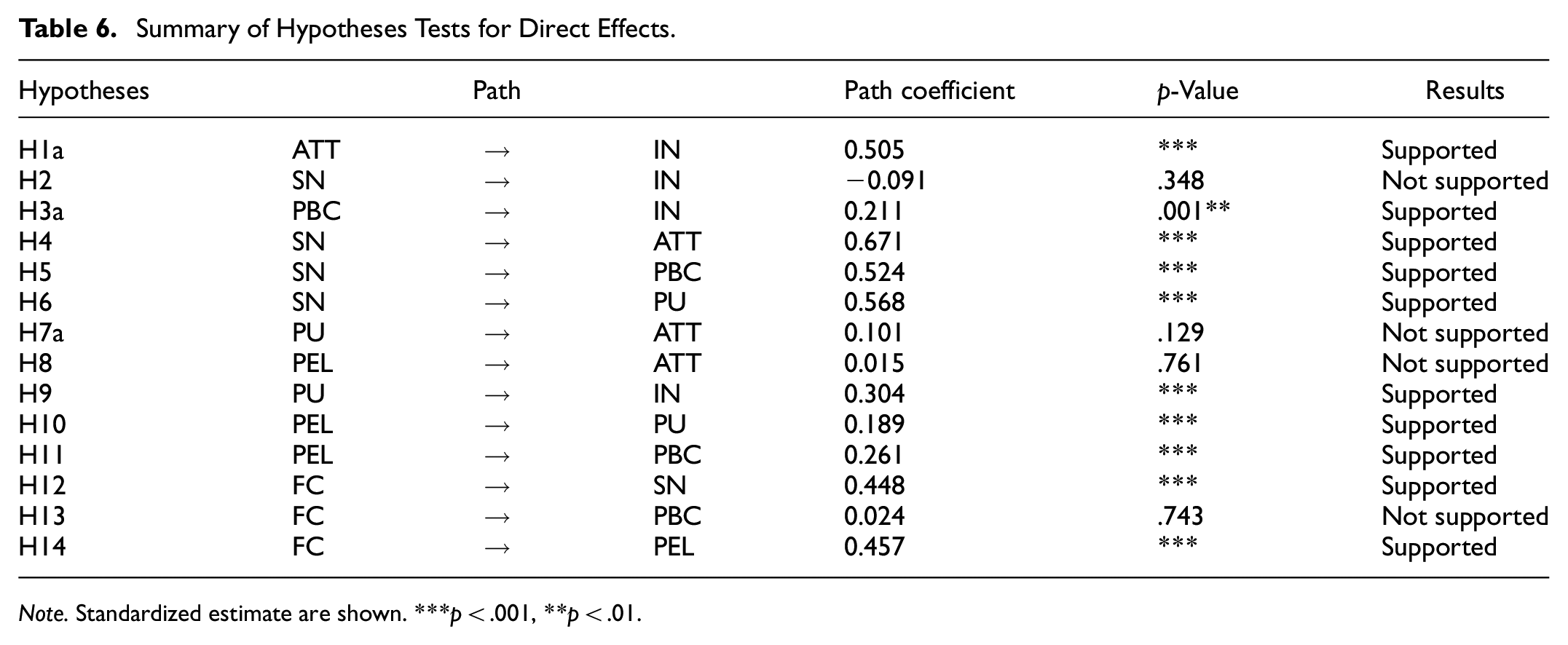
Note. Standardized estimate are shown. ***p < .001, **p < .01.
Hypotheses Testing for Indirect Effects
To further explore the indirect effects that TPB and TAM factors established on teachers’ intention to implement museum visits, the current study examined whether those factors take a mediating role in the extended model through using bootstrapping based on 5,000 bootstrap samples. From previous research, it has been proved that bootstrapping could offer a more powerful and stable method to test specific indirect effects in different kinds of mediator models (Preacher & Hayes, 2008). If the 95% bias-corrected (BC) bootstrap confidence interval (CI) does not contain zero, then the examination of the specific predictor indicates it is a mediator (Preacher & Hayes, 2008). The results (shown in Tables 7 and 8) demonstrated that some TAM and TPB factors not only directly affected teachers’ intention to implement museum visits but also acted as a mediator in the extended model. They constructed three indirect paths between subjective norms and teachers’ intention via attitude (β = .333, p < .001), perceived behavioral control (β = .109, p < .01), and perceived usefulness (β = .170, p < .001). In addition, there are two indirect paths found between perceived ease of learning and teachers’ intention. One is through perceived usefulness (β = .050, p < .01), and the other is through perceived behavioral control (β = .048, p < .01). The results of the study also revealed that facilitating conditions had a great indirect effect on teachers’ intentions through the five paths mentioned above.
Direct, Indirect and Total Effects—Estimates.

Note. Standardized estimate are shown. ***p < .001, **p < .01.
Summary of Hypotheses Tests for Indirect Effects.

Note. BC = bias corrected. 5,000 bootstrap samples, ***p < .001, **p < .01.
Discussion
The results of this study supported the proposed conceptual model and the hypotheses linking variables in the model. This model had a relatively strong explanatory power for teachers’ intention to implement museum visits (R2 = 0.58), teachers’ behavioral attitudes (R2 = 0.55), perceived behavioral control (R2 = 0.42), and perceived usefulness (R2 = 0.40). This suggested that the extended TPB model devised in this study could explain the relationships between teachers’ perceptions and their intentions to implement class visits to museums. Based on the results, some insightful findings from the proposed model are presented below.
Teachers’ Intentions to Implement Class Visits to Museums
We have examined the effects of variables in the TPB and TAM on teachers’ intention toward museum visits. The results of the study shed light on the significant underlying relationship between teachers’ attitudes and their willingness to implement it. Such strong association has been previously validated in some TPB-based studies regarding various teacher behavior and intention contexts (M. C. Lee, 2010; Sharma et al., 2018; Valtonen et al., 2018 ), and its revalidation within museum education context further proves the robustness of this connection. Compared with previous TPB-based research on teachers’ behavior intention, the results of this study indicate some common patterns. For example, attitude was the strongest predictor of teachers’ willingness in this study, and subjective norm did not show significant effects on teachers’ intentions. This was consonant with the findings of prior research (Teo et al., 2011; Zint, 2002).
Perceived usefulness was the second strongest predictor of teachers’ intention to implement class visits to museums, and it was followed by perceived behavioral control, identified as significant but the weakest predictor. Different from previous TAM-based research, in which perceived usefulness was a stronger determinant than attitude (Davis, 1989), the influence of teachers’ attitudes toward museum visits was stronger than perceived usefulness in the present study. One reason is the fact that in-service and pre-service teachers were not involved in planning the school visits to museums and planning the learning activities during the visits ((Morentin & Guisasola, 2015b). Another reason might be that teachers perceived the field trips to museums as a fun event and not as a well-planned educational experience (Chitima, 2022; J. F. Kisiel, 2003; Ottenheim & Hoogenboom, 2014; R. Tal et al., 2005) T. Tal and Morag (2007) suggested that teachers’ perceptions of what students learn from museum visits should be replaced to how the museum contributes to students’ knowledge and development, their teaching and skills.
Perceived behavioral control is another predictor that has a significant influence on teachers’ intentions, aligning with the results from previous studies implied by the application of the TPB model (Valtonen et al., 2018). Considering the significant effects that behavioral attitude, perceived usefulness, and perceived behavioral control have on teachers’ intention, a two-step strategy can be adopted to enhance teachers’ implementation of museum visits and teaching quality: first, inform pre-service teachers of the potential benefits of performing museum visits. Second, provide pre-service teachers with adequate training programs to improve their self-efficacy in implementing school visits to museums and equip them with both practical and pedagogical approaches to perform it (T. Tal & Steiner, 2006). Many studies have found that long-duration educational programs can have a strong influence on both pre-service and in-service teachers’ perceptions (e.g., perceived behavioral control) (Aaron Price & Chiu, 2018; Sandholtz & Ringstaff, 2014).
As for indirect effects, it was found that subjective norms, facilitating conditions, and perceived ease of learning showed an indirect way of influencing teachers’ intentions. This suggests that in this study, all the TAM and TPB factors are implicitly or explicitly significant. However, pre-service early childhood educators encounter some new constraints, such as the imbalance between high learning demands from young children and the unequal museum resources (facilitating conditions), the influence of important others (subjective norms), and inconvenience (perceived ease of learning). Teacher education practitioners may use effective word-of-mouth strategies to enhance novice teachers’ understanding of the museum learning experience and promote its advantages for their teaching and students’ learning.
This finding implies that when teachers feel supported and have easy access to appropriate and adequate museum resources, they will be more likely to have positive perceptions of children’s museum visits and more likely to implement them. This is in line with the results of previous research about in-service teachers (Winje & Løndal, 2021). In-service teachers focused more on support from school administrators, colleagues, and student parents (D. Anderson et al., 2006; Vermeulen et al., 2012; Wang et al., 2015). However, the results of this study demonstrated that pre-service teachers’ attitudes had a significant impact on their inclination to implement field trips to museums. As for facilitating conditions, the results demonstrated that the sufficiency of museum resources had an impact on student teachers’ intention to perform museum visits. For in-service teachers, except for museum resources, various external constraints affect their intentions to implement educational outings, including the museum locations, the relevance of museum visits to the school curriculum, time, and financial reasons (Chitima, 2022; J. Kisiel, 2005).
The Associations Between Antecedent Constructs
It is interesting to note that subjective norms strongly affected the behavior attitude while two critical determinants in TAM had no significant effects on attitudes. Meanwhile, subjective norms also showed strong effects on perceived usefulness in the study. This demonstrated that teachers’ attitudes and perceived usefulness were more likely to be influenced by environmental rather than personal reasons. It is explainable when we take the participants of this study into consideration. All the respondents are pre-service teachers and most of them lack first-hand teaching and working experiences. They seldom had opportunities to organize or implement outdoor learning activities for young children in unofficial learning contexts such as museums (Morentin & Guisasola, 2015b). Thus, pre-service teachers’ attitudes toward museum visits and their perception of the benefits of implementing visits to museums are mainly based on cognitive beliefs developed potentially through second-hand resources from important others (e.g., teachers, peers, family) (M. C. Lee, 2010).
The findings of this study also show that facilitating conditions have a significant influence on subjective norms and perceived ease of learning, and then it affects intentions in five indirect ways. Three out of them are namely by influencing subjective norms toward attitude, perceived usefulness, and perceived behavioral control. The other two are by impacting perceived ease of learning toward perceived usefulness and perceived behavioral control. This suggests that if teachers feel supported by their working and teaching environment, they are likely to feel at ease and in control of implementing class visits to museums. The relationships with subjective norms and facilitating conditions can be apparent when the actual contexts are considered. First, based on previous research about children’s museum visits, most museum staff did not develop expertise in child development, and young audiences were not fully recognized and taken care of (Bates, 2018). Second, in some areas, there were no adequate educational projects provided for teachers, which, to some extent, rendered school museum trips entertaining but educationally worthless (Chitima, 2022). The cooperation between museums and schools is commonly fragile and ineffective. As a result, teachers, especially pre-service teachers, are more likely to feel supported and seek help from important others (e.g., teachers, family, and peers). This implies the connection with facilitating conditions and subjective norms of the results in this study.
According to the findings of the significance of perceptions and facilitating conditions in influencing teachers’ inclination to the museum excursion, both schools and museums need to pay attention to the important role that teachers play in the educational outings. On the one hand, museums need not only provide young children with adequate learning materials, appropriate activity space and children-centered exhibitions (Yates et al., 2022) but also train their staff members to positively encourage teachers’ class visits and provide explicit assistance to teachers (T. Tal & Steiner, 2006). On the other hand, during the corporation held between schools and museums, teachers should be regarded as a dynamic group (R. Tal et al., 2005). Teachers’ beliefs are a crucial factor in promoting changes in teaching practices and are influenced by facilitating conditions (Karnezou et al., 2021; Teo et al., 2011). To promote such positive changes, teachers are also required to revise their prior beliefs
(Vosniadou, 2013). Hands-on learning experiences, courses in teaching methods in the museum context, and museum internships can be provided to enhance teachers’ awareness and ability to perform high-quality museum visits (Chin, 2004; Cuenca & Gilbert, 2019; Stetson & Stroud, 2014). Moreover, we noticed that the teacher programs were usually held at the local level (Seligmann, 2014). How to maximize the advantages of current training programs to serve more teachers is also necessary to be taken into consideration (Chitima, 2022; Kang et al., 2010).
Implications
Implications for Academics
As mentioned in the introduction, little has been done yet concerning predicting early childhood educators’ intentions toward outdoor learning activities such as museum visits. This study attempts to devise a fresh but stable model structure integrated with the TAM and TPB variables. The current research showed that perceived usefulness, perceived behavioral control, and attitudes play a significant role in affecting teachers’ willingness to implement museum visits. It is anticipated that this extended model may provide a theoretical basis from a different perspective to understand the underlying mechanism between teachers’ perceptions and practices over museum visits. Additionally, the empirical results show that the unified model with TAM and TPB variables has good explanatory power, and this approach may encourage future research to integrate other theoretical models to explain teachers’ intentions and practices about museum visits.
Second, the results show that all the TAM and TPB factors have strong implicit or explicit effects on teachers’ intention to implement museum visits, and teachers’ attitude is the strongest predictor among them. Further, subjective norms are essential antecedents to attitudes, and this was seldom focused on in previous research. Therefore, future research may explore what factors influence these two variables and how they can be manipulated so as to enhance eventual teachers’ practices of museum visits.
Implications for Policymakers, Museums and Teacher Education
According to the results of the current research, it seems that whether teachers come from well-developed or remote areas with limited museum resources is a significant indicator of teachers’ perceptions of museum visits. To solve the shortage of museum resources, a national museum reform started in 2021 and the development goal of building more museums has been achieved (State of Council, 2021). It led to the undisciplined pursuit of quantity and the poor quality of newly-built museums in some areas (K. Song et al., 2022). Therefore, it is necessary for policymakers to develop a complete and regulated procedure to supervise and improve both the quality and quantity of museums. This also unfolds some clear implications for museums. On the one hand, the digitalization of museum resources (e.g., online exhibitions and courses) can be promoted to serve more people, including early childhood teachers and young children (State of Council, 2023). On the other hand, museums need not only to be empowered with training to effectively cooperate with teachers and schools, but also provide various resources for young children such as children-centered exhibitions, children’s activity corner, dedicated guides and services for children, and effective learning tools, (Yates et al., 2022). According to the findings, the more teachers feel supported from the environment, the more school visits to museums are likely to be enhanced.
Moreover, in many Chinese universities, there are no specific courses provided for pre-service early childhood teachers to enhance their awareness of the importance and benefits of children’s museum visits, guide them on how to integrate those activities into curriculum design, or implement school trips for young children (State of Council, 2020). Effective educational programs can not only improve teachers’ academic and pedagogical skills but also help teachers to be well-prepared for implementing innovative learning opportunities for young children (Chitima, 2022). Therefore, it is necessary for both early childhood teacher education practitioners and museums to develop a multidisciplinary collaboration project regarding various areas such as training courses, academic internships, and thesis preparation work within both museums and university contexts. Such cooperation has been successful in some countries including the United States and Denmark (Cuenca & Gilbert, 2019; Seligmann, 2014).
Limitations
Based on the extended TPB model, we systematically examined pre-service teachers’ willingness toward students’ museum visits and the associated predictors. However, there are several limitations of this study. First, a short-term snapshot of teachers’ practices and behavior was used to conduct the whole investigation and all the participants were pre-service teachers whose teaching philosophy is malleable. Therefore, more research efforts with longitudinal studies would provide a much clearer picture of their belief system and how the influences of variables change over time. Furthermore, future research may investigate pre-service early childhood teachers’ perceptions and intentions before and after the educational intervention to examine the effectiveness of the course or training, which in turn makes a contribution to the development of teachers and the curriculum of out-of-school activities. Second, the questionnaire adopted from previous research led to a limited number of items in the construct: perceived usefulness (three items) (M. C. Lee, 2010; Teo et al., 2011). After the pilot test, one item was removed considering the reliability. To comply with the AMOS minimum limit of the item number, future research may take this into consideration when designing the questionnaire. Third, most of the respondents were female in this study and some previous research shed light on the effects of gender differences on the TAM and the TPB variables (Gefen & Straub, 1997; Liao et al., 2007). Considering the social context and the actual female teacher ratio, we did not take the gender differences into consideration. Accordingly, further research may be required to test the moderating effects of gender on teachers’ perceptions and intentions of students’ museum visits within a different social context.
Supplemental Material
sj-docx-1-sgo-10.1177_21582440241237090 – Supplemental material for Explaining Pre-Service Early Childhood Teachers’ Intention of Implementing Museum Visits: An Extension of the Theory of Planned Behavior
Supplemental material, sj-docx-1-sgo-10.1177_21582440241237090 for Explaining Pre-Service Early Childhood Teachers’ Intention of Implementing Museum Visits: An Extension of the Theory of Planned Behavior by Di Wu in SAGE Open
Footnotes
Declaration of Conflicting Interests
The author declared no potential conflicts of interest with respect to the research, authorship, and/or publication of this article.
Funding
The author disclosed receipt of the following financial support for the research, authorship, and/or publication of this article: The work was supported by the Zhengzhou Social Science (ZSS) under Grant ZSLX202331417.

Data Availability Statement
The data that support the findings of this study are available from the corresponding author upon reasonable request.
Supplemental Material
Supplemental material for this article is available online.
References
Supplementary Material
Please find the following supplemental material available below.
For Open Access articles published under a Creative Commons License, all supplemental material carries the same license as the article it is associated with.
For non-Open Access articles published, all supplemental material carries a non-exclusive license, and permission requests for re-use of supplemental material or any part of supplemental material shall be sent directly to the copyright owner as specified in the copyright notice associated with the article.
