



Abstract
This study examines the visual emotive meanings involved in three films, that is, Mulan (1998), Mulan (2009), and Mulan (2020), which are adapted from The Ballad of Mulan. By adopting the theoretical framework of visual affect, this research conducts quantitative and qualitative analyses on the emotional episodes of Mulan in the three films. The study reveals that these films construct Mulan as a personality rich in emotions. However, there are distinctively different distributions of visual affect. In Mulan (1998), Mulan is built as a tomboy disrupting the masculine tradition, while in Mulan (2009) and Mulan (2020), Mulan is constructed as a filial and dutiful woman and an inherent legendary heroine respectively. The identity development revealed in this paper could be seen as a crucial way to transforming traditional figures in adapted films, contributing to the field of adaptation study from a semiotic perspective.
Introduction
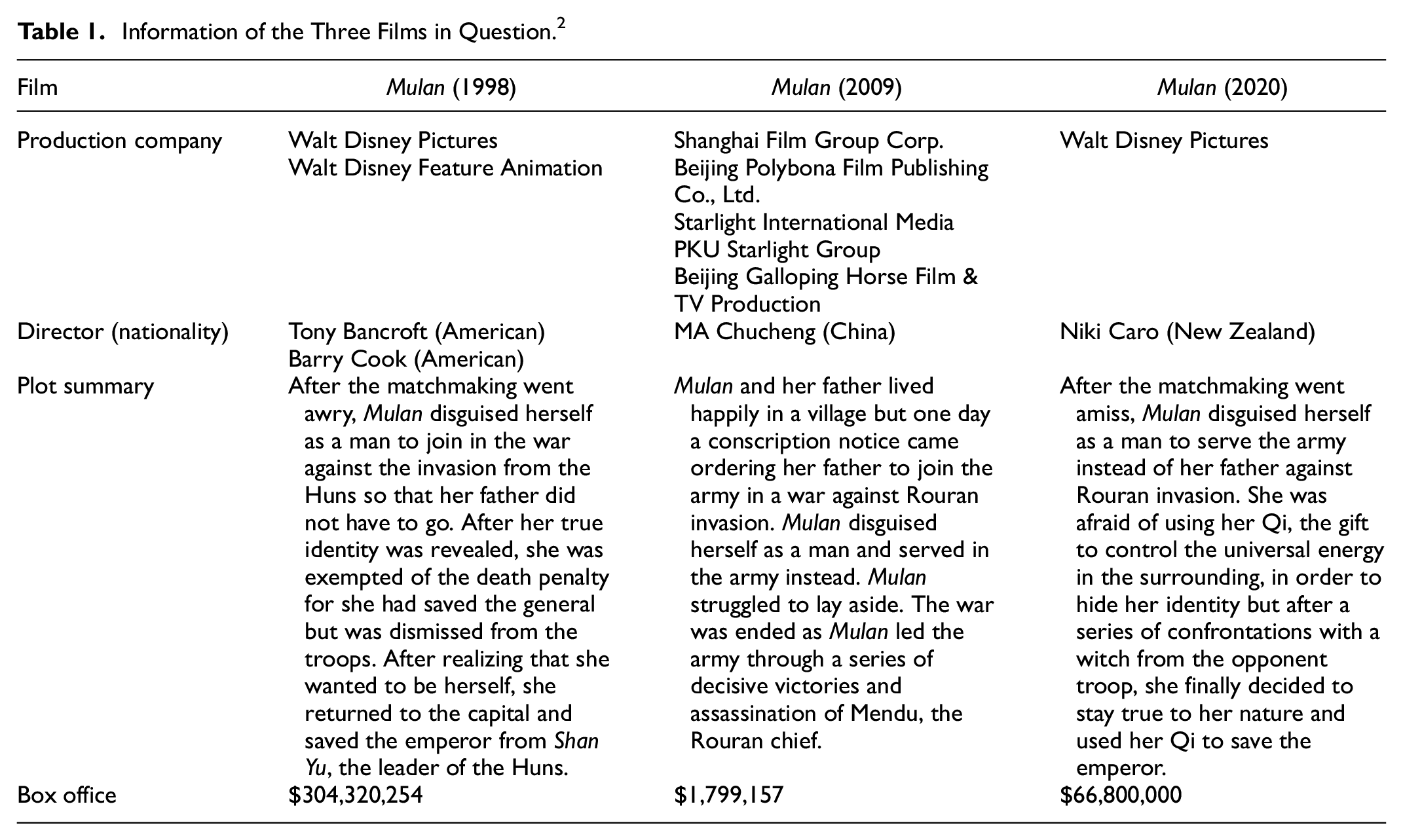
A large number of literary classics have been adapted into multimedia works in different cultures over the recent decades, among which films with their distinct advantages in visualizing literary elements have been adopted as a popular media form. Film adaptations have their advantages in reinventing literary classics since many visual elements such as music, sound effect, and moving images could be added to construct a new narrative structure and identity, which is based on interpretation of the original text or its later adapted work. For instance, Monkey King has been reconstructed into a responsible steward in different adapted films with varying contexts, plots, characters, and themes (You, 2019). Mulan has shown up as an iconic figure in front of the global audience in three films, that is, Mulan (1998), Mulan (2009), and Mulan (2020), which are adapted from The Ballad of Mulan, a well-known folksong from Northern Dynasties of China. The song recounts the story of Mulan, a girl who goes to war in place of her frail father in a time when only male can be enlisted in the army, thus becoming a heroic figure in Chinese culture. The three movies are designed to follow similar storylines (as summarized in Table 1). Mulan (2020) is produced by Walt Disney as a reproduction of the earlier animation version of Mulan (1998) (Suwastini et al., 2022), while Mulan (2009) is created by Ma Chucheng, who is a Hongkong director, to offer a Chinese narrative version different from Mulan (1998). As will be shown below, the three movies exhibit rich emotive resources of the protagonist. Therefore, a clear process of identity development of Mulan could be observed through analyzing how visual emotive meanings are presented differently in the three movies of Mulan.
Information of the Three Films in Question. 2
The connection between emotions and identity (or the concept of self) is illustrated in works of psychology (e.g., Bosma & Kunnen, 2001) and education (e.g., Schutz et al., 2020). Simply put, self-evaluations are particularly important as they represent our basic concerns, and thus are related to emotions. For instance, a person with high self-esteem may be over-reactive in situations that are regarded as threatening to their dignity. A teacher who considers himself/herself to be a caring one would tend to put on a smiling face. By the same token, this study focuses on Mulan’s emotional changes as indicators for how her identity is developed differently across the three movies, thus shedding light on how a traditional figure can be re-invented sustainably in movie adaptions.
The studies on films adapted from The Ballad of Mulan mostly revolve around their narrative structure and Mulan’s cultural identity, with the latter of particular relevance to our study. A few studies are particularly interested in how the character of Mulan is adapted in the animated film produced by Disney in 1998. Hsiung (2022), for instance, finds that the translation and adaption fit the Disney formula with clear commercial purposes. Other researches have adopted comparative approaches, contrasting different film adaptions with considerations of the cultural values underlying the shaping of Mulan’s identity (Li, 2014; Z. Wang, 2020; Zhao et al., 2022). Z. Wang (2020) posits that the construct of a war heroine as a gender-neutral leader featuring independence and individualism has been a focus of controversy. Rather than portraying Mulan as a pure eastern or western figure, Mulan has developed a mixed identity in various film adaptations, where various foreign elements such as philosophy, social class, and biographical trait are added to recreate a new character differing from that in the original story (Zhao et al., 2022). In comparison, Mulan (2009) reconstructs the woman’s identity as a postfeminist that echoes the restructuring of contemporary Chinese society (Li, 2014).
However, the semiotic resources used in the film adaptions of Mulan remain under-investigated, as the previous literature mainly draws on qualitative comparison of different movies without systemic and quantitative methodologies. A visual affect analysis on comparable elements is thus necessary to further reveal the subtle relationship between the emotive resources and the identity development of the protagonist. This paper will first review relevant literature. Second, the analytical framework of visual affect and related identity notions will be introduced. Then, we will present a semiotic analysis on how these elements are presented from quantitative and qualitative perspectives. The motivations underlying the semiotic deployment will be discussed with reference to identity development of Mulan and how western and eastern perspectives might be incorporated in film adaptions of legendary figures.
Literature Review
Film adaptation has never ceased to be a field of research interests, drawing much attention from scholars in the disciplines of translation, cinema, literature, etc. In film adaptation, a most commonly debated topic is how to adapt texts into films (Hutcheon, 2006, p. 38; Leitch, 2017, pp. 18–19). As the adapted work can differ more or less significantly from the original one, film adaptation, along with adaptation of other genres, has been examined in a continuum between fidelity and creativity (e.g., Hutcheon, 2006; Komporaly, 2014; Stam, 2000; Zhong, 2021; Zhong et al., 2021).
Apart from the perspective of faithfulness to the original works, film adaptation research could also be conducted from “analytical” or “evaluative” approaches (Leitch, 2017, p. 20). Analytical studies aim at describing the phenomena of adaptations based on categories modeled in a particular theory, or from ideological, sociological, or economic perspectives. For example, Brosch (2012), adopting a psychological approach, recognizes the use of images in the film as a tool to create cross-cultural appeal. Evaluative research tends to critique adaptations from an aesthetic perspective. Burke (2015), for instance, looks into the comic aesthetic of comic book movies, summarizing a number of fundamental elements that characterize the “Marvel way.” This study may be a contribution to the analytical line of film adaptation research.
Among the studies on adapting literacy classics into films, the movie adaptations of Mulan have been placed in the spotlight in recent years (e.g., Hsiung, 2022; Z. Wang, 2020; Yang, 2018; Zhao, et al., 2022). Some scholars concentrate on the Disney formula of recreating the legend of Mulan, and focus on how the movie successfully achieves its purpose both commercially and ideologically (Brocklebank, 2000; Hsiung, 2022; Yang, 2018).Hsiung (2022), for instance, treats the Disney version of Mulan as a phenomenon of inter-modal translation. The typical Disney techniques of tale adaptations include “individualism, the use of side-kicks (animals as supporting characters), good prevailing over evil, and romance” (Hsiung, 2022, p. 75). While in the original ballad Mulan was only concerned about her aged father, the Disney version, as Hsiung (2022) argues, emphasizes self-discovery and search for self-identity. Other researches attempt to compare different versions of onscreen Mulan and analyze the underlying identities and values (e.g., Dong, 2011; Z. Wang, 2020; Zhao et al., 2022). Z. Wang (2020, p. 13), comparing the 1938 version Mulan Joins the Army and the 1998 Disney version, posits that there is nothing special about the Disney adaptation but the 1938 version highlights “the Greater East Asian patriotic values in the Japanese occupied areas of China.”Zhao et al. (2022) examine the cultural identities in the original ballad of Mulan, the 1998 Disney version and 2020 version. They find that the two Disney adaptations of Mulan represent a cultural hybridity of Chinese, Japanese, and Western values. The 1998 version is imbued with filial piety, individualism, and masculinity whereas the 2020 version is underpinned by individualism, feminism, devotion to family, as well as Daoism.
The studies on movie adaptations of Mulan above have demonstrated the importance of identity and value analysis to the understanding of cultural appropriation of traditional figures (e.g., Liu, 2022; A. Wang, 2022). However, the studies by far are limited in two ways: first, they mostly rely on observations of the context of the movie and several qualitative features of the movies in question. Hence, the identity analyses in these studies are subject to subjective interpretations to different degrees. Second, few studies attempts to use a systemic quantitative method to support the findings. And there has been a dearth of studies that focuses on the deployment of affect resources in film adaptations.
That being said, in the field of multimodal discourse analysis, appraisal theory has been particularly useful in studying the infusion of values in varying genres such as picture books, comics, entertainment programs, etc. Feng and O’Halloran (2012), for example, explore how semiotic resources could be deployed to construct visual images in comic books. Zhong et al. (2021) probe into the visual attitudes in a comic version of Journey to the West that serves to affiliate target readers of a comic book from different cultures. Yu et al. (2020) identify the way how biospheric, altruistic, and egoistic values are shown by attitudinal meanings in ecology animation for children. Of particular importance to this study is that Jing (2021) develops a framework of visual affect under Feng and O’Halloran (2012) that draws on semiotic resources of facial expressions and bodily orientation to analyze emotive meanings in animations and live-action films. Therefore, this current study aims to add to the studies of film adaptations by using a quantitative approach to reveal different identity development processes of the same story, as well as drawing upon three Mulan movies across various times, cultures, and genres. The study has also proved the applicability of visual analytical framework sourced from linguistics.
Extending the previous appraisal investigation into picture books, comics, and films, this study attempts to answer the following research questions:
How emotions are developed in the three movie adaptations of Mulan?
How are the emotive signs related to the construction of Mulan’s identity?
What implications can we draw from the answers to the above two questions for identity development in film adaptations of traditional figures?
Analytical Framework and Data
Scholars from various linguistic traditions such as general semiotics (e.g., Peirce et al., 1932), social semiotics (e.g., Bateman & Schmidt, 2012), narratives (e.g., Chatman, 1978), and pragmatics (e.g., Gruber, 2008) have attempted to develop theoretical frameworks that are applicable to film analysis. Due to its particular focus on emotions, this study adopts the theoretical framework of appraisal theory proposed by Martin and White (2005). Appraisal is concerned with the language of evaluation, an extension of the interpersonal line of meaning under the linguistic theory called Systemic Functional Linguistics (c.f. Halliday & Matthiessen, 2014). Based on observations of various texts in secondary school texts, Martin and White (2005) propose that appraisal should consist of three major systems of meanings: ATTITUDE, ENGAGEMENT, and GRADUATION. ATTITUDE is composed of three sub-types, which are AFFECT, JUDGEMENT, and APPRECIATION. GRADUATION is concerned with the grading and intensifying of the attitudinal resources used in texts. The system of ENGAGEMENT deals with how people expand or contract the space of dialogue. The system of ATTITUDE is most relevant to the present study.
Martin and White’s (2005) theory, however, can only be applied to linguistic analysis because semiotic resources afforded in multimodal discourses (such as picture books, films, music, etc.) for realization of attitudes are different from those in verbal texts. Some scholars, following this line of thought, develops new analytical frameworks for visual analysis of images in picture books (Painter et al., 2013), news photos (Economou, 2009), comics (Feng & O’Halloran, 2012), as well as films (Jing, 2021). To develop the affect system in Martin and White (2005) further, Jing (2021) pioneers in proposing a number of theoretical frameworks, which aim to seek how emotive meanings are exploited in a semiotic lens based on movie data and is particularly relevant in our study of the three movie adaptations bearing rich emotive semiotic resources. Therefore, we use the visual affect system cited from Martinec (2001) in Jing (2021) as the basis of quantitative coding (see Figure 1). We have chosen this particular framework as the theoretical basis of our analysis because it has the potential to reveal the complicated emotive meaning hidden in the character of Mulan adapted in the three films, as the coding system matches the visual semiotic resources identified (as is shown in Appendix A). The framework offers three parameters for coding visual affect, namely, unexpectedness, value, and orientation. The combinations of the three parameters represent various emotions in everyday sense. For example, fear is a combination of “value: −passive” and “orientation: drawn-in.” Surprise is a combination of “unexpectedness: +” and “value: +.” The advantage of the three broader categories is that various kinds of emotions become comparable and emotive patterns became clearer as we could get rid of too many subtle types of emotions. How the three parameters in combinations correspond to various primary emotions is illustrated in Figure 2. Jing (2021) offers a full network of the semiotic resources of facial expressions and body movement that realize the visual affect meanings.

Network of visual affect, taken from Jing (2021).

Primary affects and their meaning options cited from Martinec (2001) in Jing (2021).
For convenience of coding and discussion, the coding for the three parameters is abbreviated from top to bottom in Figure 1 as follows: “unexpected: +,”“unexpected: −,”“value: +,”“value: −active,”“value: −passive,”“orientation: drawn-in,” and “orientation: driven-off.” The coding scheme with corresponding illustrations from the movies is listed in Appendix A. The visual affect is coded with the software Elan version 6.2 (see Figure 3).
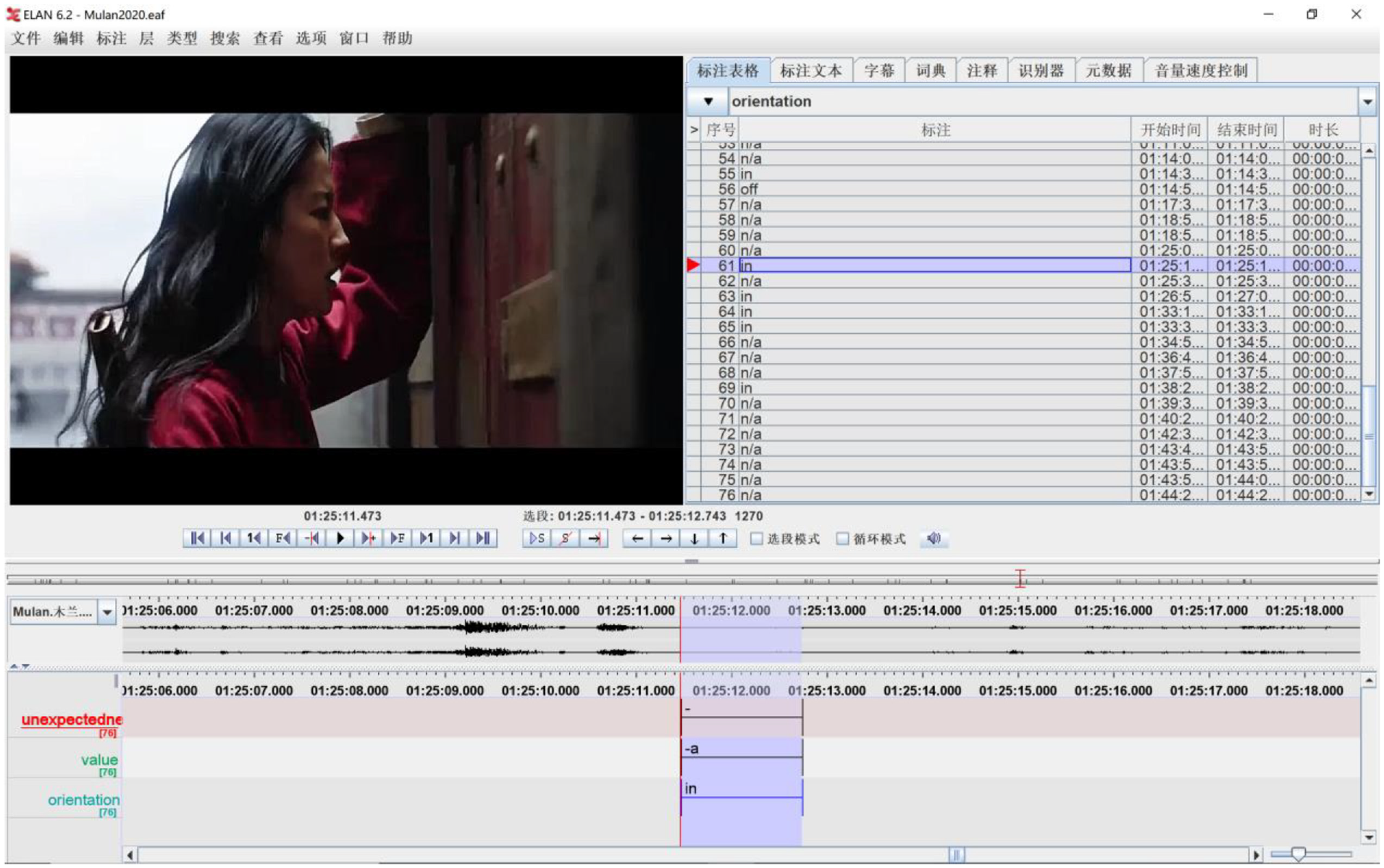
Annotating the visual affect parameters using Elan version 6.2.
The coding procedure is as follows: (i) The MP4 files of the three films are imported into the coding tool Elan. (ii) The visual affect of Mulan is coded by the authors of the present study separately. The unit of analysis is a complete process of any emotion recognized under the framework as illustrated in Figure 1. (iii) The two authors have discussions about the discrepancies. For instance, the two authors differ on whether surprise should be further distinguished as “value: +” or “value: −.” Finally, we agree that all surprise should be coded as “value: +” in combination with “unexpectedness: +.” All the discrepancies are solved to ensure objectivity of the analysis. (iv) The frequencies of the emotive codes are extracted to Excel for quantitative analysis.
To answer the second question concerning visual affect and identity development, we draw upon Schutz et al.’s (2020) model of identifying processes, as shown in Figure 4. In this model, a person, in a certain activity, would have certain expectations for the experiences based on his or her goals, standards, and beliefs. Then when certain things happen, the person’s appraisal on the things and the people would determine how he or she would respond emotionally, termed as “emotional episodes.” The emotions thus trigger the person’s certain attribution toward his or her own identity, which would bring adjustment to his or her goals or beliefs. This is how the identity (or Self-System) is continually developed through activities. For example, a teacher may have certain expectations for what should be like in classroom activities. When things go wrong, the teacher may go through emotional episodes, either defending his or her own way of teaching or making adjustments to bring things back on track. This would somehow alter his or her own belief system and finally change his or her conception of identity as a teacher.

Schutz et al.’s (2020, p. 72) model of identifying processes.
Following this line of thinking, we regard the visual affect of Mulan as emotional episodes that reflect her goals and beliefs, and ultimately her identity. Different patterns of visual affect would somehow reveal various identity development modes across the three movies, thus shining a light on the third research question: how a traditional hero could be re-invented sustainably in film adaptations over time.
The information about the three film adaptations of Mulan is provided in Table 1. The three films are all about the legendary tale of Hua Mulan, a widely known Chinese female general who is filial to family and devoted to the country and who is a role model of how women can parallel men in their contribution to domestic and national good. The three films share similar plots with a few differences summarized in Table 1.
Quantitative Findings
Figure 5 shows the frequencies of emotional episodes recognized in Mulan (1998), Mulan (2009), and Mulan (2020). As stated in section “Analytical Framework and Data,” each emotional episode represents a complete process of an emotion from upsurgence to recession realized with a combination of facial or bodily semiotic resources. The statistics in Figure 5 show that Mulan (1998) deploys a much larger number of emotional episodes, amounting to 206, than the other two versions. The number of emotional episodes in Mulan (2009) is slightly higher than that in Mulan (2020), with 86 and 76, respectively. The difference might be attributed to the fact that Mulan (1998) is an animated movie whereas both Mulan (2009) and Mulan (2020) are live-action movies. This would suggest that animated films like Mulan (1998) may rely more heavily on emotional episodes than live-action ones because it seems easier for the cartoon artist to utilize drawings of facial expressions in an exaggerated manner, as shown in McCloud (2006) on comics, thus leading to easier and clearer identification of emotional episodes. In live-action movies, by contrast, actors or actresses would often contain their facial expressions or use micro-expressions that are not recognizable by the current analytical criterion. Nevertheless, the numbers of emotional episodes in general show that all the three films portray Mulan as an emotionally expressive personality.

Occurrences of emotional episodes in Mulan (1998), Mulan (2009), and Mulan (2020).
Figure 6 compares the distributions of eight emotional parameters in three major categories of visual affect, namely, unexpectedness, value, and orientation. Overall, the three movies show similar patterns in unexpectedness and orientation. For unexpectedness, they all deploy more expected emotions than unexpected ones. As for orientation, the three films mostly use emotions that rely on no body movement (marked as “orientation: n/a”) than the other two options (marked as “orientation: drawn-in” and “orientation: driven-off”).

Distributions of visual affect parameters in Mulan (1998), Mulan (2009), and Mulan (2020).
A closer look into the subtle differences, however, reveals that Mulan (2020) and Mulan (1998) adopt more similar approaches than Mulan (2009) in visual affect. As regards unexpectedness, both Mulan (2020) and Mulan (1998) tend to use more counter-expectations to shape Mulan’s identity. For orientation, Mulan (2020) and Mulan (1998) are both less likely to use body movement (marked as “orientation: n/a”) to enhance emotions whereas Mulan (2009) is relatively more likely to use “orientation: draw-in” to strengthen emotions. For value, Mulan (2020) and Mulan (1998) use more “value: −passive,” representing emotions like fear, sadness, anxiety, etc., whereas Mulan (2009) deploys more “value: −active,” representing anger. In other words, Mulan (2009) portrays Mulan as a comparatively more ferocious and daring figure.
This somehow confirms the statement that Mulan (2020) is produced by Walt Disney as a reproduction of the earlier animation version of Mulan (1998) mentioned in the introduction. Despite the similarity between Mulan (2020) and Mulan (1998) in general, we could still observe a peculiar feature in Mulan (2020): it is the version that used “value: +” most frequently, representing positive emotions such as happiness, excitement, surprise, etc. In addition, Mulan (1998) uses more “orientation: driven-off” than Mulan (2020), meaning the animated version of Mulan is more likely to withdraw in face of complications than the live-action one. We will explain the reason in the next section.
While the three movie adaptations show different patterns of visual affect parameters quantitatively, how the emotive signs are used to develop Mulan’s identity remains unknown. The next section will report on how Mulan’s identity developed through emotional episodes as it is realized as various affect parameters along the movie timeline.
Qualitative Analysis
This section will provide qualitative explanations for the quantitative results presented in the previous section with reference to the narrative of the three movies. In order to better illustrate how emotions shape Mulan’s identity, we select five parameters that are particularly relevant to identity development, namely, “unexpectedness: +,”“value: +,”“value: −,”“orientation: draw-in,” and “orientation: driven-off.”“Unexpectedness: +” is often used to represent emotional episodes that involve counter-expectancies or complications in the story, thus often contributing to the turning point of Mulan’s perception about her identity. “Value: +” and “value: −” represent positive and negative emotions that might involve Mulan’s self-evaluation or judgement on others’ behaviors. “Orientation: draw-in” is usually used to enhance anger or thrill, through which the change of identity might be emphasized. By the same token, “orientation: driven-off” is used to strengthen fear, sadness, and depression.
Figure 7 shows how the five types of visual affect develop across the whole movie plotted along the timeline in Mulan (1998), which consists of seven general parts: matchmaking (4–14 minutes), joining the army (14–20 minutes), becoming a new soldier (27–50 minutes), fighting off the Huns (50–60 minutes), expulsion from the army (60–64 minutes), rescuing the emperor (64–79 minutes), and reunion with family (79–79 minutes). Overall, “value: −,”“unexpectedness: +,” and “orientation: driven-off” show a declining tendency in sync across the entire movie. “Value: −” and “orientation: driven-off” peak three times (at 20, 50, and 70 minutes respectively) representing three major difficulties: (i) meeting the matchmaker, (ii) training to become a qualified soldier, and (iii) expulsion from the team. The matchmaking episode indicates that Mulan does not find herself to be the traditional kind of women who should be arranged for marriage. “Value: −” in military training is for fear that her female identity could easily be revealed. Then it is the exposure of her female identity that leads to Mulan’s dismissal from the military even after she is the key to fighting off the Huns. And later, because of the female identity, nobody trusts Mulan’s words about Huns’ plan to assassin the emperor until the chief of Huns shows up on the roof. Then she participates in the fight to rescue the emperor. The matchmaking event, mistrust arising from Mulan’s female identity actually shows gender bias against women in the masculine society. Therefore, with the three peaks of negative emotions, Mulan is shaped as a fighter that breaks the shackle of the masculine tradition.
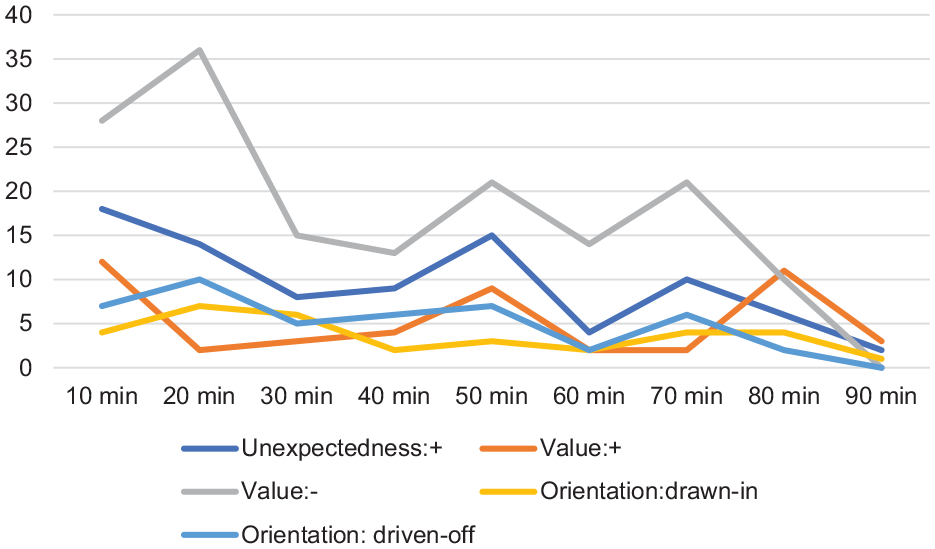
Development of visual affect in every 10 minutes in Mulan (1998).
However, the process of receiving military training comes with both sorrow and joy. This is evidenced by the second peak of “value: +” at 50 minutes along the timeline. The joy and surprise during the process of training build Mulan as a resilient and friendly character who is surrounded by several helpful friends, a small Chinese dragon and a cricket and her comrades or general in the troops. The third peak of “value: +” at 80 minutes is a result of Mulan saving the emperor and becoming recognized of her contribution.
The development of visual affect in Mulan (2009), as shown in Figure 8, is composed of six general parts: happy life with father (4–6 minutes), joining the army (6–10 minutes), becoming a new soldier (10–25 minutes), fighting off the invaders (25–92 minutes), assassinating the chief of invaders (92–101 minutes), and reunion with family (101–105 minutes). A paralleled pattern of development can be identified in “value−” and “orientation: drawn-in,” which means Mulan tends to choose taking pro-active and aggressive actions in the mood of anger, fear, or sadness. It could be implied that Mulan is more prepared in this movie and can take control over her own fate in times of military training, fighting in wars, and saying goodbye to Wentai, the other general in love with Mulan. The three peaks in “unexpectedness: +,” at 20, 50, and 80 minutes, respectively, happen when Mulan experiences significant moments of identity development. At the first peak, Mulan is unaccustomed to what happens in a military environment at first when she is new to the military service. At the second peak, Mulan, as a female full of sentiments, is particularly surprised witnessing the brutal fight between soldiers and hesitates to slaughter her enemies, hence portraying her as a compassionate character. However, upon the news about the death of Wentai, she steps up and fights off the invaders. Here, the unexpectedness helps Mulan grow into a fearless general.

Development of visual affect in every 10 minutes in Mulan (2009).
The development in “value: +” registers a peak at 10 minutes in the beginning when Mulan is living with her father. This constructs her as a filial girl showing strong attachment to the family. The next peak occurs at 60–70 minutes when Mulan is pleased after leading the troops to achieve a series of decisive victories, as she gradually learns to become a general, portraying Mulan as an able and dutiful woman. In the ending part at 110 minutes, she rejects the promotion from the emperor and earnestly returns home to reunite with her father who accompanies her to her room, thus generating a few positive emotions. This indicates that she places family and national duty prior to her personal gain, making her a loyal and selfless citizen. The overall plot shows few instances of “orientation: driven-off” except when Mulan is worried about her father, the possible revelation of her female identity, and the betrayal of the commanding chief, which echoes the construction of her identity as a family-conscious and dutiful figure.
Figure 9 shows how the visual affect develops in Mulan (2020), which could be broken into six general parts: matchmaking (4–19 minutes), joining the army (19–26 minutes), becoming a new soldier (26–57 minutes), fighting off the invaders (57–72 minutes), rescuing the emperor (77–98 minutes), and reunion with family (99–104 minutes). Two peaks of “value: −,”“unexpectedness: +” and “orientation: drawn-in” could be identified at 40 and 70 minutes respectively when she is afraid of being discovered of her female identity during military training and when she is dismissed from the troops after she decides to use her Qi, the universal energy that pervades in the cosmos that can be controlled only by martial art masters, to turn the tides in the war against the invaders. Thus, Qi could be considered as a metaphor for Mulan’s realization of her own true identity, the critical click that triggers her to stay true to herself. Therefore, we could see the second summit of “value: +” and “orientation: drawn-in” at 100 minutes indicating Mulan’s rising up to finally become a legendary figure near the end of the movie.

Development of visual affect in every 10 min in Mulan (2020).
It should be noted that there is a witch with dark magic that poses challenges to Mulan to provoke her use of Qi. The mysterious supernatural power of the witch first puts Mulan at awe (the second peak of “value: −” and “unexpectedness: +” at 70 minutes) but later helps to shape Mulan as a legendary heroine (the last peak of “value: +” at 100 minutes).
The two peaks of “orientation: driven-off” at 40 minutes and 60 minutes are recorded when Mulan risked the exposure of her female identity in the troops in one scene, and in front of the chief commander in the other. This means that Mulan in this movie possesses strong emotions and tends to lose control over them before achieving her true self.
The fluctuations in “value+” are a result of the fact that the whole movie starts depicting Mulan as a happy girl in her childhood, and as the narrative develops, Mulan becomes recognized after she uses her Qi to save her fellow soldiers and the emperor. These changes are particularly enhanced by the occurrences of “orientation: drawn-in” as they coincide with or followed the moments with positive feelings. It is not difficult to observe that Mulan is immersed in the most positive feelings when she is living as a true self of a martial art master. During the war after Mulan is inspired by the witch, she begins to use her Qi, the key to the following victories, and becomes positive in her emotions again.
Now, the motivations of the emotional development along the movie narrative are quite clear. The 1998 animated version depicts Mulan as a more ordinary girl that dares to, with the help of her buddies, get rid of the masculine tradition. She relies on the assistance of her companies and presents more fear (hence more “value: −” and “orientation: driven-off”) in face of difficulties. She has especially strong emotional interaction with her friends.
Mulan is portrayed in 2009 as a compassionate commander with strong emotional attachment to her country, her soldiers as well as her family. She is consistently torn between her female identity, loyalty, love and filial piety. Therefore, “value: +” is seldom the dominant emotion throughout the storyline until the end of the movie when she reunites with her family.
Mulan (2020) shows an evidently different patterns of emotional development before and after the use of Qi. Most notably, the emotions of fear (marked as “value: −” and “orientation: driven-off”) occurs frequently almost throughout the entire narrative. The fear is mainly due to Mulan’s anxiety over revelation of her female identity. Fear drops drastically after 70 minutes because she finally decides to stay true to her identity and exposes her female nature. This indicates that Mulan is inherently a legendary heroine as long as she could realize her true self.
In sum, Mulan (1998) portrays Mulan as a tomboy disrupting masculine traditions, Mulan (2009) presents a filial and dutiful woman, and Mulan (2020) exhibits an honorable legendary heroine. Table 2 shows different identities of Mulan in the three movie adaptations with reference to their visual affect features.
Mulan’s Identity with Visual Affect Features.

Discussion: Identity Development in Adaptations of Traditional Figures
Many famous figures and characters in Chinese literary classics have been adapted into movies such as Monkey King (from Journey to the West), Ne Za (from The investiture of the gods), Hua Mulan (from The Ballad of Mulan), etc. The past decades have witnessed continual remaking of movies based on the classic stories of the traditional figures and most of them have reaped considerable success in terms of box office numbers. Thus, it is interesting to consider how the traditional figures could be re-invented and adapted into various versions of movies with both fidelity to the original story as well as a certain degree of creativity to engage the audience.
While some movie adaptations are attempts to reach genre creativity such as turning the classic stories into comics (c.f. Zhong et al., 2021) and animated films (e.g., the Mulan 1998 version), in this study we focus on the mechanism of identity variation across different adaptations of the same traditional figure. From the quantitative and qualitative analyses above, we could observe that in the three adaptations of the same story of Mulan, different narrative threads and characters come to elicit emotional episodes that form a certain pattern to develop Mulan’s identity. Although the storyline of Mulan is already familiar to the audience, the identity development processes remain unknown, and the personalities of Mulan would still bring different kinds of feeling to the spectators. Various identities of Mulan as representations of different values would affiliate audience of different communities. For example, the 1998 version of Mulan following the Disney formula of identity development, infused with individualism and muscularity (see Hsiung, 2022; Zhao et al., 2022), may gain popularity among the audience in the west. The 2020 version of Mulan, with the cultural hybridity of individualism and Daoism (see Zhao et al., 2022) is more likely to attract global audience. The 2009 version, on the other hand, adhere more to the Chinese traditional values and may attract the Chinese population. To summarize, the recreations of the same classic hero or heroine involve different identity development paths, and identity development should be considered as a crucial machinery for adapting traditional figures in movies.
Conclusion
Drawing upon the previous linguistic-minded research on affective meanings, this study has examined how various types of emotions distribute differently across three films, Mulan (1998), Mulan (2009), and Mulan (2020), which are adapted from the Chinese literary classic, the Balad of Mulan. Specifically, the visual affect of Mulan has been coded quantitatively and qualitatively. Quantitatively speaking, the three movies, while are similar in the total frequencies of emotive signs, demonstrate distinctively different emotive patterns. Mulan (1998) and Mulan (2020) are more similar in the frequent use of “unexpectedness: +” and “value: −passive,” whereas Mulan (2009) uses more “value: +active” and “orientation: drawn-in.”Mulan (1998) and Mulan (2020) differ in that the latter uses more positive emotions (value: +).
A closer scrutiny over the development of the visual affect related to the storyline reveals that different identities are constructed through multiple emotional episodes. Mulan (1998) depicts Mulan as a tradition-breaking tomboy. Mulan (2009) shows a filial, dutiful, and loyal woman, and Mulan (2020) presents an inherent legendary heroine. Based on these observations, we argue that identity development plays a significant role in remaking traditional figures in film adaptations.
The limitation of the present study lies in that only visual affect has been analyzed, which might not be able to reveal the whole picture of the identity development process of the three adaptations. Further research could be conducted to develop semiotic frameworks for visual appreciation, visual judgment, and so forth (in the sense of appraisal theory proposed by Martin & White, 2005). Second, visual analysis of the three films could be further extended to other movies adapted from similar classic literary works so as to shine a light on whether the identity is developed in different ways.
Footnotes
Appendix
Coding Scheme of Visual Affect.

| Code | Visual semiotic resources | Examples | Explanation |
|---|---|---|---|
| Unexpected: + | Facial expression showing unexpected emotion of the character |
Sample 1 |
Mulan wakes up from a nightmare and cries out her sadness. |
| Unexpected: − | Facial expression showing expected emotion of the character |
Sample 2 |
Mulan walks along with her father, showing happiness on her face as she arrives at her room. |
| Value: + | Facial expression showing positive emotion of the character |
Sample 3 |
Mulan gives a warm hug to her sister, both laughing. |
| Value: −active | Facial expression of negative emotion initiated by the character |
Sample 4 |
Mulan shouts out a loud and angry voice, ordering her troops to go with her. |
| Value: −passive | Facial expression of negative emotion in response to what happens around |
Sample 5 |
Mulan looks at her soldiers who want to follow her and commands them to stay. |
| Orientation: drawn-in | Bodily action showing a most active gesture beyond the original course |
Sample 5 |
Mulan has to kill the General in the opposite side to fight off the invaders. |
| Orientation: driven-off | Bodily action of crouching or moving away from an external source of emotion |
Sample 6 |
Mulan is scared by the sudden appearance of the shadow of the small Chinese dragon, screaming and running away. |
| Orientation: n/a | Bodily action indicating no obvious change of orientation |
Sample 7 |
Mulan elegantly brings up a spare cup and delivers it to her father. |
Declaration of Conflicting Interests
The author(s) declared no potential conflicts of interest with respect to the research, authorship, and/or publication of this article.
Funding
The author(s) received no financial support for the research, authorship, and/or publication of this article.
Notes

Data Availability Statement
Data sharing not applicable to this article as no datasets were generated or analyzed during the current study.