




Abstract
This study investigated whether there are significant differences between reading achievements of 15-year-old students and starting age for preschool and socioeconomic factors according to the results from the PISA 2015 and 2018. The quantitative results show that there is a clear and statistically significant difference between reading test scores of Turkish students in PISA 2015 and in PISA 2018 according to the variables starting age for preschool education, highest parental educational attainment and the number of books at home. Our quantitative analysis shows that students who attended kindergartens from age four have higher average test scores in reading skills than students who cared for only in homes, either by their parents or by others.
Keywords
Introduction: Preschool Attendance and Adolescents’ Reading Comprehension
Many researchers believe that the first 5 years of the childhood play a formative role in early literacy skills, and that high-quality preschool experiences are strongly correlated with children’s later reading literacy achievements (Pullen & Justice, 2003). Large-scale, longitudinal studies are needed to verify the cause and effect relationship between preschool attendance and adolescents’ literacy attainment. A review of the literature has revealed that a number of studies were conducted on this subject matter in different countries. In a cohort study conducted with a sample size of 11,000 people in England, it was found that preschool education increased test scores moderately at the ages of 11, 14, and 16, and was more beneficial for children with disadvantaged socio-economic backgrounds (Apps et al., 2013). In another study conducted in the Eastern Asia and Pacific with a sample of4,712 children from 36 to 71 months living in Cambodia, China, Mongolia, and Vanuatu, the East Asia-Pacific Early Child Development Scales (EAP-ECDS) were used as the data collection tools. The findings demonstrated that the children in the control group who received early childhood education had significantly better cognitive, language and socio-emotional development compared to those who did not receive any early childhood education (Rao et al., 2019). The results of a study conducted in China with a final sample of7,710 observations for the seventh grade and7,074 observations for the ninth grade has revealed that preschool attendance is associated with a 0.163% increase in standard deviations for the cognitive scores of seventh-grade students while the gain is lower for the ninth-grade students (Zhang, 2017). A study conducted in Australia with a birth cohort of 5,107 infants and a kindergarten cohort of 4,983 four-years-old children provides evidence that preschool education can support cognitive development particularly for disadvantaged children by providing opportunities for learning through play, via directed learning and targeted teaching, and by providing supportive environments and interactions that support learning (Goldfeld et al., 2021). In line with these studies, a number of others have confirmed that the children with preschool attendance display a higher level of academic skills during adolescence compared to other children without preschool attendance (Magnuson et al., 2007; McCormick et al., 2021; Shapiro, 2021). Albeit rare, some studies using the retrospective method report that preschool attendance does not predict reading literacy when confounding factors such as family income, extracurricular reading, parental expectation of academic achievement and educational level, and self-education expectation are controlled. However, these studies show that it is necessary to consider the factors such as the low quality, accessibility and affordability of early childhood education; and more explicit conclusions can be reached through longitudinal studies and triangulation (Li et al., 2020).
The Right Age for Preschool
The best age to start preschool education is a topic of recurring debate among educators, educational scientists, and of course parents, as reflected in the array of school starting age policies internationally. Parents in particular are often ambivalent about the optimum age for children to start schooling and they want the best information available in order to make a final decision (Purtell et al., 2020). On one hand, they have an intense desire to find the safest and most effective way to impart children’s critical life skills and enhance their potentials in learning at nursery school or in kindergarten, while on the other hand they typically worry about their children’s possible socioemotional/behavior problems which associated with the psychological effects of parent-child separation or a tough transition (Mashburn et al., 2018; Vandesande et al., 2019) to the preschool classroom setting. Many parents make a concerted effort to maintain safe and secure attachment with their children. With this in mind, it is therefore important to crystallize an idea of the right age to enroll children on a preschool program. Given the emphasis on school starting age and early use of nonparental care in the previous literature, it was noteworthy that the very early intensive use of center-based care and education can be hazardous for a child’s social and emotional development, even if high quality care is provided (NICHD Early Child Care Research Network, 2006). A recent study has revealed that the early use of nonparental care is associated with negative sociobehavioral outcomes. The above research suggests that children who begin nonparental care earlier and in more formal settings showed low performance in cognitive outcomes and had worse scores on social and behavioral measures than did children who remained in parental care longer (Fram et al., 2012).
A number of infant and young child observations according to the Tavistock model demonstrate that many children experience painful separation feelings during adaptation to nursery school and caregivers appear unable to provide them with security and comfort. The observations also confirm that children receive scant emotional support in their struggle to overcome the painful experience of being separated from their parents (Battaglia et al., 2016; Czada, 2012; Datler et al., 2010; Frisch, 2012). To add to these findings, another study which focused on investigate the cortisol levels of toddlers during their transition to childcare suggested that children had elevated cortisol levels throughout transition, with the peak coming in the separation phase and the onset of childcare (particularly separation from parents) may be demanding for toddlers (Nystad et al., 2021). On the other hand, it should be emphasized that giving children a better start and high-quality pre-school provision at the right age provides a unique opportunity for lifelong learning. Thus far, many studies have focused on this issue. A British cohort study (n = ∼13,000) investigated the association between child care during infancy and later cognition while controlling for social selection and its findings revealed that children who benefit from early childhood programs show higher performance in cognitive outcomes than children who have not enrolled on a preschool program (Côté et al., 2013).
The results of many longitudinal studies carried out in Europe and the USA indicate that children who attended kindergartens as of age 4 have higher average test scores in mathematics and reading literacy than children who cared for only in homes, either by their parents or by others (Fram et al., 2012; Gordon et al., 2013; Temple & Reynolds, 2007). In another study in which the data from 9,185 children used were showed that early nonmaternal care was associated with higher achievement and lower behavior problem scores in childhood and adolescence (Jaffee et al., 2011). Similarly, a study of Latino children in the United States revealed that Latino children in center-based childcare improved over time in cognitive, language, and social skills, whereas children in family childcare stayed the same or lost ground in these areas over time (Ansari & Winsler, 2012).
Socioeconomic-Cultural Characteristics and Student Achievement
Educational achievement, and its relationship with socioeconomic and cultural background, is one of the enduring themes of educational studies. A long series of quantitative studies has found that different measures of socioeconomic and cultural characteristics are positively correlated with academic achievement and with educational attainment (Bhat et al., 2016; Cheadle, 2008; Cheung & Andersen, 2003; Farkas et al., 1990; Loboda et al., 2017; Perry & Mcconney, 2010). One should note that the relationship between a student’s socioeconomic background and their educational achievement seems enduring and substantial (Thomson, 2018).
Present Study
We conducted a secondary data analysis of 11,130 fifteen-year-old students who participated in PISA 2015 (n = 4731) and PISA 2018 (n = 6399) in Turkey to evaluate the possible impacts of preschool starting age and socioeconomic status for reading skills. Our aim of this study is to understand whether socioeconomic variables and cultural influences significantly predict the reading skills test scores of Turkish students in PISA 2015/2018 and discuss the results by comparing them over the years. What would be the ideal age to start preschool? To what extent do literacy environment at home, parent-child shared book reading and the number of children’s books at home affect academic success? We discuss these questions according to The PISA data set.
Specifically, this study addresses the following questions:
Do the reading scores of students differ significantly according to the preschool starting age?
Do the reading scores of students differ significantly in relation to parents’ education level?
Do the reading scores of students differ significantly according to number of books at home?
Do the variables of parental educational attainment, tangible and cultural family resources, information and communication technology predict the reading scores of students?
In order to successfully achieve the goals one-way analysis of variance (ANOVA) was used to determine whether there was a significant difference in the reading scores of the students according to the variables starting age for preschool education, the educational status of parents and the number of books at home.
Main Challenges in the Education System in Turkey and PISA
Many projects have been prepared and implemented in addition to policies, plans, targets and principles which have been defined and put into practice for improvement of the education system in Turkey; however, the expected results have not been achieved yet. The studies highlighted issues such as the high number of students in classrooms, insufficient number of teachers and pedagogues, and failure to provide equal means and opportunities in terms of access to education in Turkey (Kösterelioğlu & Bayar, 2014; Yaman, 2006). On the other hand, the insufficient share allocated to education from the central budget and the insufficient employment of teachers, along with the financing issues faced by schools, are among the other important problems experienced in the education system. Various studies have pointed out that the public resources allocated to education have increased in recent years, but Turkey still remains far behind the OECD average in terms of public spending per student (Arabacı, 2011; Kılıçaslan & Yavuz, 2019). In addition, Turkey still ranks at the bottom of the OECD country rankings in PISA studies within various categories, including reading skills in particular. Intense efforts are being made to overcome this problem and to ensure equal opportunities in terms of access to education, but no significant improvement has yet been achieved (Şener, 2018).
Turkey participated in PISA studies for the first time in 2003 in order to observe the impact of education policies on students, to make the education system more functional, and to increase the quality of education. PISA results are considered to provide important tips to identify the shortcomings in Turkish education system and benchmark with the other participating countries since the very first years of participation (Şener, 2018).
PISA reading skills data conducted and collected in 2015 and 2018 have been included in this study. Based on the review of the PISA results received in 2015, Turkey scored 428 points on average in the category of reading skills. While the general mean score of the countries participating in the project is 460 points, the average of the OECD countries is 493 points. Turkey is ranked 50th among 72 countries participating in the project and 34th among OECD countries that include 35 countries. Figure 1 provides a comparative presentation of the mean scores in reading category for the countries participating in PISA in 2015 and 2018.

Ranking of national performance in reading.
Based on the review of the PISA results received in 2018, it can be seen that Turkey scored 466 points on average in the category of reading skills. While the general average score was 453 points for the participating countries, the average of OECD countries was 487 points. Turkey is ranked 40th among 79 countries participating in the PISA survey, and only 34th among 37 OECD countries. Turkey’s average scores in PISA reading skills across the years are shown in Figure 2 together with the average scores of OECD countries and of all countries.

The average reading scores of Turkey, OECD, and all countries by years.
When the scores Turkey received in PISA 2015 and 2018 reading skills category are compared with the OECD average and the general average score of the participating countries, it is concluded that Turkey has ranked behind. Despite various efforts made in Turkey in the recent years, the inequality of opportunities in education still persists; and the socioeconomic conditions of families, the quality of teachers, and the social, cultural and economic conditions of the region stand out among the factors leading to this inequality (Güner et al., 2014).
Method
This study is a secondary data analysis of data collected by the PISA. Secondary data is data that has already been presented, and the secondary data analyst is not involved in the recruitment of participants or in the collection of the data (Andrews et al., 2012). Secondary data analysis is a research process used in various fields such as health sciences (Ekholuenetale et al., 2020; Kottner et al., 2020) and educational sciences (Logan, 2020; Wotto, 2020), which refers to the secondary analysis of existing data collected by other researchers or organizations. It should be emphasized that “the key to secondary data analysis is to apply theoretical knowledge to utilize existing data to address the research questions. Hence, the first step in the process is to develop the research questions” (Johnston, 2014).
Sample
The data used in this study were extracted from the PISA 2015 and PISA 2018 database. According to the PISA official website (http://www.pisa.oecd.org), participants were 15 years old and from Turkey. In 2015, 1,324,089 15-year-old students were educated in Turkey, however the accessible target population was 925,366 school students. For PISA 2015, schools were selected by the use of a stratified random sampling method in the Classification of Statistical Region Units Level 1 (MEB, 2015) and the students who were to participate were determined by random selection. At the end of the sampling process 187 different schools in 61 cities in Turkey participated in the exam (MEB, 2015). The sample consisted of the 5,895 students specifically, 2,938 females and 2,957 males (MEB, 2015). A total of 6,890 Turkish students from 186 different schools participated in PISA 2018 (MEB, 2019). Of these, 3,396 were female and 3,494 male, suggesting a balanced distribution in terms of gender (Erdem & Kaya, 2021).
One-Way ANOVA Test
In this study, one-way ANOVA test was used to take independent variables such as preschool starting age, parents’ level of education and the number of books at home as categorical variables and in order to analyze, in detail, the impact of the subcategories of these variables on reading skills and to demonstrate the relevant significant differences. Therefore, it was essential to review the variables though to impact students’ reading skills on an individual basis. However, the independent variables such as HISEI, WEALTH, CULTPOSS, HEDRES and ICTRES are index scores and constitute continuous variables. Multiple linear regression analysis was used to determine the power of such variables to predict students’ reading skills to a significant extent and to identify which variable was more important and study questions were prepared in line with the importance and purpose of the study.
Analysis
It should be noted that the outliers were detected using univariate and multivariate detection methods. Firstly, to identify univariate outliers, all variables were converted into Z-scores. Multivariate outliers were assessed by calculating each case’s the robust version of the Mahalanobis distance and a case is considered as a multivariate outlier if the probability associated with its D2 is 0.001 or less. Normality distribution was assessed using skewness and kurtosis. The test statistics and normality results are given in Table 1.
Test Statistics and Normality Results Obtained From PISA 2015 and PISA 2018.

Note. HISEI = the highest level of parents’ occupation; WEALTH = an indicator of family wealth; CULTPOSS = a measure of family cultural possessions; HEDRES = an indicator of availability at home of educational resources; ICTRES = an indicator of information and communications technologies; PVREAD1-2 = reading achievement in PISA 2015/2018.
We have also tested whether or not there is a level of multicollinearity between the variables. In addition, tolerance, variance inflation factor (VIF) and condition index (CI) values were also examined. As shown in Table 2, our results further suggest that the tolerance values are greater than 0.10, the VIF values are less than 10 and the CI values are less than 30, and there is no multicollinearity between the variables.
Multicollinearity Test Results of Variables From PISA 2015 and PISA 2018.

The missing values and outliers can drastically change the results of data analysis. The missing data were identified and extreme outliers were excluded from the analysis. The final analytic sample included 4,731 (PISA 2015) and 6,399 (PISA 2018) participants. Finally, one-way analysis of variance (One-Way ANOVA), A Pearson’s product-moment correlation coefficient and a multiple linear regressions analysis were used in the analysis of the data.
Findings
Possible Impacts of Preschool Starting Age on Reading Skills
One-way analysis of variance (ANOVA) was conducted in order to determine whether there are statistically significant differences between the reading skills of students according to the independent variable of preschool starting age. The results obtained from the PISA 2015 with a sample from Turkey are given in Table 3.
ANOVA Results According to the Variable of Preschool Starting Age According to PISA 2015 With a Sample From Turkey.

From the results shown in Table 3 we can observe that the scores of reading skills of the students in PISA 2015 differs significantly according to the age of starting preschool:
Additionally, the results obtained from the PISA 2018 are given in Table 4.
ANOVA Results According to the Variable of Preschool Starting Age According to PISA 2018 With a Sample From Turkey.

The findings revealed a statistically significant difference between the reading scores of the students according to PISA 2018 and the school starting age:
The students’ average scores in Reading Comprehension by their preschool starting ages are provided in Figure 3 on a comparative basis.

Students’ mean scores in reading comprehension by their preschool starting ages, PISA 2015 to 2018.
Parents’ Education Level: Another Factor Influencing Reading Achievement?
One-way analysis of variance was further conducted to analyze the relationship between the reading skills of the students and the education level of the parents. The results obtained from the PISA 2015 are given in Tables 5 and 6.
ANOVA Results: The Impacts of Maternal Education Level According to PISA 2015.

ANOVA Results: The Impacts of Paternal Education Level According to PISA 2015.

The results, given in Table 5, show that the average scores on reading skills in PISA 2015 differed significantly depending on the education level of the mother:
Our results also demonstrated that the average scores on reading skills in PISA 2015 differed significantly depending on the education level of the father:
The results obtained from the PISA 2018 are given in Tables 7 and 8.
ANOVA Results: The Impacts of Maternal Education Level According to PISA 2018.

ANOVA Results: The Impacts of Paternal Education Level According to PISA 2018.

The results suggest that the scores of reading skills of the students in PISA 2018 differs significantly according to the maternal education level:
As can be seen in Table 8, the scores of reading skills of the students in PISA 2018 differs significantly according to the fathers education level:
The Importance of the Number of Books at Home
One-way analysis of variance (ANOVA) tests were performed to ascertain whether there are significant differences between reading scores and number of books at home. The results obtained from the PISA 2015 and 2018 are given in Tables 9 and 10.
ANOVA Results: Number of Books at Home According to PISA 2015.

ANOVA Results: Number of Books at Home According to PISA 2018.

The results, given in Table 9, show that the scores of reading skills in PISA 2015 differs significantly according to the variable number of books at home:
Similarly, we found that the scores of reading skills in PISA 2018 differs significantly according to number of books around the house:
Other Family Background Variables
For purposes of this study, family background variables include variables related to the highest level of parents’ occupation (HISEI); an indicator of family wealth (WEALTH); a measure of family cultural possessions (CULTPOSS); an indicator of availability at home of educational resources (HEDRES); an indicator of information and communications technologies (ICTRES) categorized into a five-level. A Pearson’s product-moment correlation coefficient was calculated to determine whether there is a significant relationship between reading achievement in PISA 2015 (PVREAD1) and the continuous variables HISEI, WEALTH, CULTPOSS, HEDRES and ICTRES. Table 11 illustrates the results:
Correlation Results Between Variables According to PISA 2015.

p < .01.
As shown in Table 11, positive but weak correlations were found between the variables HISEI and CULTPOSS, HISEI and PVREAD1, CULTPOSS and PVREAD1, and HEDRES and PVREAD1. There were significant but moderate correlations between HISEI and WEALTH, HISEI and HEDRES, HISEI and ICTRES, WEALTH and CULTPOSS, WEALTH and HEDRES, WEALTH and PVREAD1, CULTPOSS and HEDRES, CULTPOSS and ICTRES, HEDRES and ICTRES, and ICTRES and PVREAD1. Notably, there was a strong, significant, positive correlation between WEALTH and ICTRES.
A multiple linear regressions analysis (Enter Method) were done to detect whether or not the variables the highest level of parents’ occupation, family wealth, family cultural possessions, information and communications technologies, educational resources at home predict the reading achievement. The results are given in Table 10.
As shown in Table 12, the variables of the “availability at home of educational resources” (HEDRES) and the family wealth (WEALTH) did not significantly predict the reading scores of students p > .05. The results obtained from the PISA 2015 have provided evidence that the variables of highest level of parents’ occupation (HISEI), family cultural possessions (CULTPOSS) and the information and communications technologies (ICTRES) did significantly predict the reading scores of students. The resulting standardized regression coefficient (β) indicate that ICTRES, HISEI and CULTPOSS are the most effective variables in predicting the reading achievement of students. The indicator of ICTRES was the most important predictor variable for reading scores of students. The direct effect of this variable explains 15% of the reading skills variance: R = .39, F(5,4730) = 171.122, p = .000.
Results of Multiple Linear Regression Analysis for Reading Scores in PISA 2015.

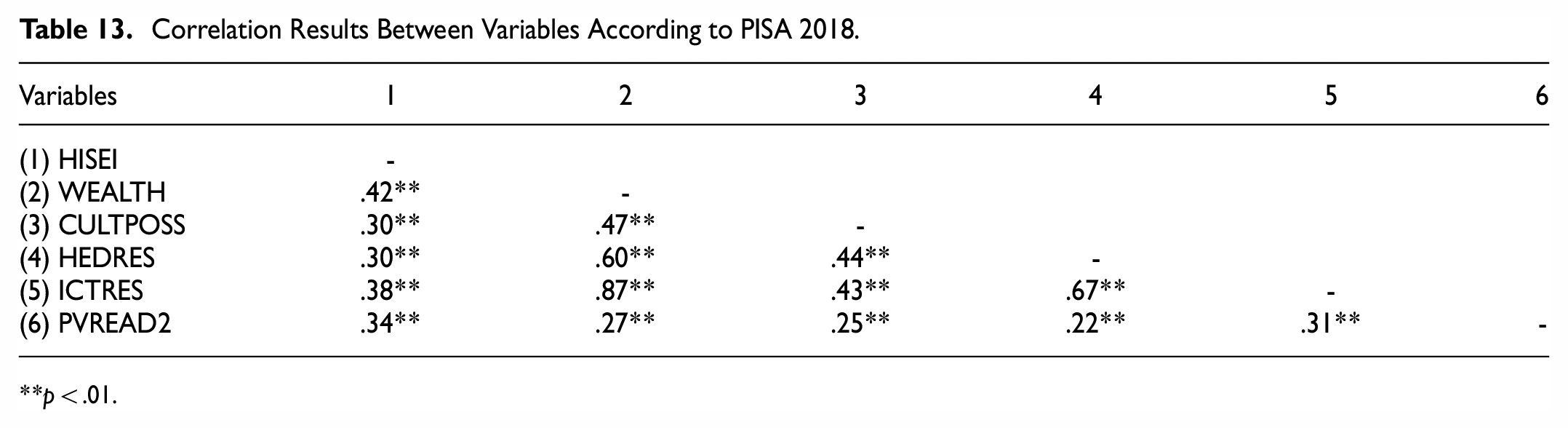
Other findings revealed a positive and weak correlations between reading achievement in PISA 2018 (PVREAD2) and the continuous variables WEALTH and PVREAD2; CULTPOSS and PVREAD2; HEDRES and PVREAD2. Table 13 demonstrate the results:
Correlation Results Between Variables According to PISA 2018.
p < .01.
Significant positive (but moderate in size) correlations were found between HISEI and CULTPOSS; HISEI and WEALTH; HISEI and HEDRES; HISEI and ICTRES, HISEI and PVREAD2, WEALTH and CULTPOSS; WEALTH and HEDRES; CULTPOSS and HEDRES; CULTPOSS and ICTRES; HEDRES and ICTRES; ICTRES and PVREAD2. Additionaly, there was a significant, positive correlation between WEALTH and ICTRES.
As shown in Table 14, the variable of the “availability at home of educational resources” (HEDRES) did not significantly predict the reading scores of students p > .05. Our results have provided evidence that the variables of highest level of the parents’ occupation (HISEI), family cultural possessions (CULTPOSS), information and communications technologies (ICTRES) and the family wealth did significantly predict the reading scores of students. The resulting standardized regression coefficient (β) suggest that ICTRES, HISEI, CULTPOSS and WEALTH are the most effective variables in predicting the reading achievement of students. It was observed that the indicator of ICTRES was the most important predictor variable for reading scores of students in PISA 2018. The direct effect of the variable explains 17% of the reading skills variance: R = .41, F(5,6398) = 253.158, p = .000.
Results of Multiple Linear Regression Analysis for Reading Scores in PISA 2018.

Presentation of Variables and Results With a Regression Analysis
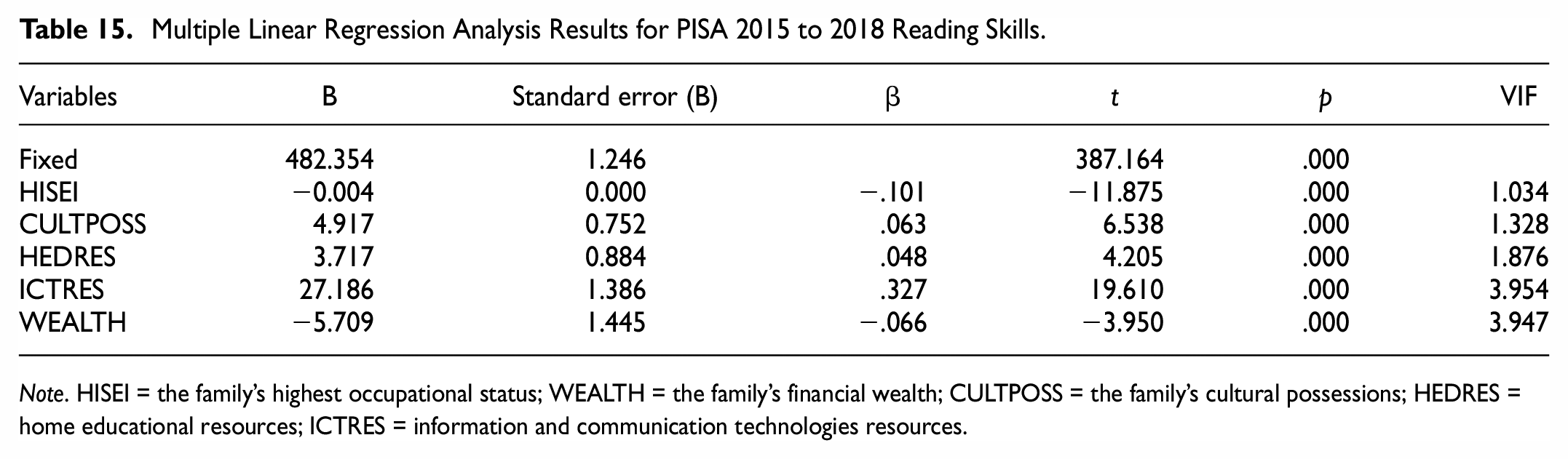
The enter method of multiple linear regression analysis was used on the sample of the PISA 2015 and PISA 2018 Turkey to determine whether the variables such as either parent’s highest occupational status, the family’s financial wealth, cultural possessions, information and communication technology resources and educational resources at home significantly predict reading skills. The results obtained are provided in Table 15.
Multiple Linear Regression Analysis Results for PISA 2015 to 2018 Reading Skills.
Note. HISEI = the family’s highest occupational status; WEALTH = the family’s financial wealth; CULTPOSS = the family’s cultural possessions; HEDRES = home educational resources; ICTRES = information and communication technologies resources.
From the review of the values provided in Table 15, it was determined all independent variables significantly predicted the reading skills, p = .000. According to the standardized regression coefficients (β) the order of significance of the variables predicting reading skills are as follows: information and communication technology resources, cultural possessions, home educational resources, the family’s financial wealth, and the family’s highest occupational status. It was identified that the variable of information and communication technology resources was the most important predictor variable. It was determined that these predictor variables explained 13% of the variance in reading skills; R = .36, F (5,12360) = 370.580, p = .000.
Discussion and Conclusions
As could be shown using one-way analysis of variance (ANOVA) and multiple linear regressions analysis, a range of factors contributed positively to reading achievement among Turkish students that had been assessed as part of the PISA project. This study demonstrates that the indicators of preschool starting age, the highest level of parents’ occupation, parents’ education level, number of books at home, family cultural possessions and information and communications technologies around the house can predict the reading achievement of students. In addition, the multiple linear regression method was used to determine whether (or not) reading skills scores from PISA 2015 and 2018 were significantly predicted by the indexes (variables) of highest parental occupation status, highest parental educational attainment, tangible assets, economic and cultural resources at home, information and communication technology. The findings reveal that reading skills scores were significantly predicted by the indexes of highest parental occupation status, cultural resources at home and information and communication technology.
The findings further revealed that the reading achievement of students who started preschool education at aged 5 and 6 years were higher than the scores of students who had never received preschool education and students who attended kindergarten as of age 4 have higher average test scores in reading skills than students who cared for only in homes, either by their parents or by others. Several of our findings appear consistent with past research especially with the results of many longitudinal studies (Ansari & Winsler, 2012; Côté et al., 2013; Fram et al., 2012; Gordon et al., 2013; Jaffee et al., 2011; Temple & Reynolds, 2007). Our other results indicated that the increases in maternal and father education will improve their children’s reading achievement and the variables of information and Communications Technologies (ICTRES), highest level of parents’ occupation (HISEI), family cultural possessions (CULTPOSS) are the most effective variables in predicting the reading achievement of students. A long series of quantitative studies has found that different measures of socioeconomic and cultural characteristics are positively correlated with academic achievement and with educational attainment. Our results support the arguments made by past researchers (Bhat et al., 2016; Cheadle, 2008; Cheung & Andersen, 2003; Farkas et al., 1990; Loboda et al., 2017; Perry & Mcconney, 2010; Thomson, 2018).
Footnotes
Declaration of Conflicting Interests
The author(s) declared no potential conflicts of interest with respect to the research, authorship, and/or publication of this article.
Funding
The author(s) received no financial support for the research, authorship, and/or publication of this article.

Data Availability Statement
Data sharing not applicable to this article as no datasets were generated or analyzed during the current study.