




Abstract
This article explores how traditional ecological knowledge in Cerekang, South Sulawesi, Indonesia, is culturally transmitted as a strategy for cultural survival amidst internal and external challenges such as social, ecological, and political changes. Traditional ecological knowledge of the Cerekang people lies from mythological construction of the La Galigo epic, which contain beliefs, collection of instructions, and rules on conservation and preservation of sacred forest and non-sacred forest. This knowledge are culturally transmitted through oral stories, rituals, daily life, and customary organization. Generally, the transmission takes place vertically, horizontally, and obliquely. The traditional, linear-vertical mode of transmission, which tends to be closed, is the most dominant pattern of cultural transmission among the Cerekang people. This study also finds out another pattern of transmission beyond the framework given, which we call as conformist transformation. However, this cultural transmission is not without bias as the transmitted messages are generic and incomplete. Therefore, a contextual education in both formal and informal settings as another mode of cultural transmission is suggested to respond to current social, political, and environmental changes in Cerekang. In order to sustain the Cerekang’s TEK, the local government policy-maker should further facilitate indigenous activities by supporting capacity building in non-formal setting and signing a decree to include TEK in formal education.
Keywords
Introduction
The Cerekang people, a small community of 870 people occupying Manurung Village in East Luwu, South Sulawesi, have historically been acknowledged as a mystic community who successfully protect their forest and river from exploitation. Recent discussions have shown how they deploy symbolic knowledge to conserve their environment (Akhmar, 2022) and how the traditional leadership plays a vital role to maintain the attitude for conservation efforts (Massa et al., 2017), while neglecting the way in which their traditional ecological knowledge is culturally transmitted to the next generation who have been exposed to modern education, globalization, and social media is relatively understudied. Because the continuity or discontinuity of traditions rely on the process of cultural transmission from generation to generation (Morin, 2016), this article also aims to shed more light on the constraints and opportunities that the Cerekang people face in transmitting their traditional ecological knowledge, while looking at the patterns of their cultural transmission both within and beyond its established framework.
Like many other indigenous communities in Indonesia, the Cerekang people have long been struggling to gain formal and non-formal recognition as a strategy to protect their sacred land, especially after the fall of Indonesian authoritarian regime in 1998 that enabled decentralization policy and regional autonomy to be implemented (Adinda, 2021; Tyson, 2010). In a local governmental level, the Cerekang people have granted an acknowledgement that protect their local wisdom and sacred land as is stated by a Regent Decree number 258/2019 issued by East Luwu Regency. According to the decree, the sacred land consists of ten areas of forest and river covering 694.8 ha, within which the Cerekang people implement their local wisdom.
The areas are considered sacred because of the ancestral stories related to them and are associated with La Galigo, an epic poem that told the story of the origin of Bugis and Makassar. Bukit Pengsimaoni, for example, is believed to be the place where Batara Guru, the first ruler of Luwu Kingdom, was descended from heaven who later met his bride named We Nyiliq Timo in Padang Ennungnge (Pelras, 1996; Bulbeck, 2013). Due to their sacredness, the area can only be accessed during the ritual with a permission from puaq, the community leader of Cerekang. Moreover, as Darmawan and Dirawan (2003) argue, the prohibition of the sacred area from being exploited signifies the importance of traditional knowledge for heritage conservation and ecological balance, which Berkes (1993) calls as traditional ecological knowledge (TEK). Although the existence of the Cerekang TEK has been acknowledged by the local government, it does not legitimate enough to guarantee them from both internal and external threats that could potentially disenfranchise their tangible and intangible heritages.
In recent years, there has been a lack of leadership in the Cerekang’s customary organization particularly after the male puaq (a customary leader whose role is to maintain relationship with the ancestors) and female puaq (a customary leader whose role is to maintain relationship with the community) passed away in 2010 and 2015 respectively. The process of choosing puaq is considered difficult because it is carried out through dreams. The puaq can only be chosen if the eight customary councils have similar dreams that give them signs to the chosen figures. In addition, the inadequate legal status of the forest has precipitated a moderate number of community members to be willing to privately own a piece of land from the sacred areas (Gunawan, 2005). Concerning with external challenges, cultural rationalization brought by modern education has made the rituals such as the one conducted by the Cerekang people was irrelevant (Peletz, 2006). This is also exacerbated with the hegemony of conservative Islamic discourse and institutions that consider such ritual practice as musyrik (idolaters). More importantly, the Cerekang people are also troubled by a mining company that has been operated since 2017, whose land concession is located just behind Pengsimaoni hill (Perkumpulan Wallacea, 2019). While regional autonomy has enabled the Cerekang people to be acknowledged by the local government, it is also paradoxically paved the way for the global free market and multinational investment that set the contestation over local power and resources in motion (Hadiz, 2010).
Responding to those internal and external threats, the Cerekang people have attempted to transmit their traditional ecological knowledge to the younger generation as one of the strategies of their cultural survival. This study assumes that the difference between generations and social conditions affect the way in which traditional ecological knowledge is transmitted. In other words, this article focuses more on the conditions and processes of the Cerekang’s cultural transmissions rather than the results and its effectiveness. Therefore, several key questions are asked in this article: What kind of traditional ecological knowledge is culturally transmitted to the Cerekang community members? How and in what ways the Cerekang people transmit wisdom and TEK both between and within generations? How are strategies of cultural survivability used by the Cerekang people mediate and adapt to changes in their surroundings? In order to contribute to the present problems faced by Cerekang people, this study also explores some of the possible strategies that can be used to enhance and smoothen the process of cultural transmissions beyond the established approach of cultural transmission. By doing so, it is expected to contribute to theoretical discussions around cultural transmission with a specific study case of an indigenous community in Indonesia.
Literature Review
Previous Studies
A comprehensive study on ecological cultural values and local wisdom of the Cerekang people is relatively scarce. Several studies about the Cerekang people only describe the aspects of cultural heritage without a systematic theoretical framework; Sarah’s (2019) documents puaq leadership values; Dianafitry (2018) describes the enrekeng ritual, a ceremony to release one’s intent (tinjaq). There are also several theses that study the Cerekang indigenous community (Anriani, 2016); Noviyanti (2018) who describes the structure of the traditional taboos of the Cerekang people and the role of the indigenous youth in forest conservation (Anas, 2019). Despite the lack of clarity in terms of framework and methodology, the data and field information they provide is very helpful for the understanding of the Cerekang people’s local wisdom. Among the few, Bulbeck (2013) is an exceptional one. Not only because he provided archaeological evidence of the area, but he also demonstrates historical and ecological condition of the Cerekang and Ussu from which the events in La Galigo took place.
Another research conducted in a different location, but is relevant to the problems and approaches posed in this article, is Pongsibanne (2014) on the transmission of pesse (empathetic) values in a school in Bugis culture. According to Pongsibanne, the transformation of culture into the education system can be done in two ways, namely revitalization and inheritance of local wisdom values. Pongsibanne refers to the concept of cultural transmission from Cavalli-Sforza and Feldman (1981) which includes three processes: (1) vertical inheritance, the transmission of cultural traits from parents to children and grandchildren; (2) horizontal inheritance, peer learning from during development, from childhood to adulthood; (3) oblique inheritance, when a person learns values from the adults around him, from formal and informal institutions. Although they do not explore cultural values as characteristic of humanities research that prioritizes historical-hermeneutic analysis, the process of cultural transmission proposed by Cavalli-Sforza and Feldman is fruitful for this study in its analytical category.
Cultural Transmission
A more detailed and thorough framework of cultural transmission is provided by Mesoudi and Whiten (2008) which they define as “the process by which information is passed from individual to individual via social learning mechanisms such as imitation, teaching or language.” Rather than just asking the “who” aspect of cultural transmission as Cavalli Sforza and Feldman (1981) did, they both extend the questions by departing from Laland’s (2004) formulation of social learning strategies; (1). What is copied, that is, what types of information are easiest to remember and most frequently sent? (2) Who copies it, that is, from whom and to whom the information is obtained and copied? (3) When it is copied, that is, in what spaces or moments the information is copied, or is copying more likely to be easier when the environment is constant or changing? (4) How is it copied, for example using imitation, emulation, spoken, or written language? (Mesoudi & Whiten, 2008, pp. 3497–3499). Laland (2004) also adds the term “contextual imitation” and innovation as a process of cultural transmission.
Moreover, Mesoudi and Whiten (2008) illustrate three chains of cultural transmission that they develop from various scholars around this subject (Table 1). This can be summarized as follow.
The transmission chain method (Mesoudi & Whiten, 2008).

Similarly, Hoppitt and Laland (2013) explore alternatives by adding more designs of cultural transmission (Figure 1) which involve multiple demonstrators (those who transmit the information) and observers (those who receive the information).

The transmission model (Hoppitt & Laland, 2013, p. 39).
It is important to note here that the message or the content of information sent from demonstrators to observers is not without misunderstanding. The effectiveness of the message is influenced by several factors such as the capacity of the actor, interest (mood), the situation, the content of the message, and even the prior knowledge. Therefore, preexisting cognitive bias is undeniable, especially if the information attracts the observers emotionally (Sperber, 1996). Likewise, the transmission of culture and behavior is not always neatly arranged along the chain. Bartlett (1932) studies on the indigenous Americans folklore shows this. Along the process of cultural transmission, there were omissions in many details. What remains was the most important element or the core of the message. In the worst condition, distortion can occur if the message is passed on between generations whose culture is distinctly different. Therefore, in a social learning strategy, it is necessary to reconstruct the core message that can easily be remembered based on the existing knowledge structure or schema.
Moreover, recent studies suggest that content-bias in the process of cultural transmission is inseparable from cultural selection (Mesoudi, 2021). Traits, wisdom, and other part of culture, can be selected for transmission. This means that one particular trait can be made favorable than other traits. Further, the content-bias during the process of cultural transmission is also influenced by the social status and prestige hold by the demonstrators (Mesoudi & Jiménez, 2020). The higher or the more prestigious the status of demonstrators, the more their messages can be accepted by the observers. Thus, the transmitted information can also be centralized in the hand of certain key figures such as cultural leaders (Verdier & Zenou, 2018), especially in a more traditional routes of cultural transmission.
Although the cultural transmission framework discussed above offers compelling models and detail questions, it neglects the material and structural conditions such as changes in environment, political economy, and power relations, which are undeniably influential to cultural changes in community and their behavior (Harris et al., 2007). Recent researches have also shown that factors like political stability (Adebayo, 2022), technological innovation and environmental degradation (Adebayo et al., 2022), the possession of social capital (Carmen et al., 2022), as well as formal and informal decision making in the local level (Sirimorok & Rusdianto, 2020) determine changes in culture and society. In addition, the majority of literature around cultural transmissions use quantitative modeling in a large-scale population level (Mesoudi & Whitten, 2008). This article, however, is an attempt to zoom-in some of the cultural transmission models by using qualitative analysis and considering structural and material factors, while also looking at other possible models beyond the given framework.
Local Wisdom and Traditional Ecological Knowledge
In this article, definition of local wisdom from Keraf (2010, pp. 279–307) is used, which includes all forms of knowledge, belief, understanding or insight as well as customs or ethics that guide human behavior in community life as part of local wisdom. Traditional ecological knowledge (TEK), in this sense, is part of local wisdom specifically related to the ethics of environmental management. Berkes (1993, p. 3) formulates the notion of TEK comprehensively; first, “TEK is a cumulative body of knowledge and beliefs, passed down between generations through cultural transmission, about [emphasis is ours] the relationship between living beings (including humans) and their environment”; Second, “TEK is an attribute of societies with historical continuity in resource use practice.” Further, traditional ecological knowledge is underpinned by reciprocity and obligations for a greater good within the community and other beings (Fienup-Riordan, 1990). It is also a communal resource-based management grounded on shared meaning and knowledge (Berkes, 1989). The concept of TEK will be used in this article to explain its relevance not only for the efforts of cultural preservation but also for the sustainability of Cerekang’s environment.
However, situating TEK in isolation without considering the changing landscape on one’s environment might result in romantic and essentialist notion of culture that views it as an ideal conception practiced in the past (Casi et al., 2021). Therefore, people, environment, and knowledge are interconnected and is viewed as a whole (McGregor, 2004) This means that the term “traditional” in TEK does not only refer to something believed and practiced in the past, but also how people acquire the knowledge in constantly changing environment (Battiste & Youngblood Henderson, 2012, p. 46).
Methodology
The main source of this research was oral stories. Oral stories which contain beliefs, myths, collection of instructions (pappaseng), and taboos (pammali) are passed down between generations and are practiced in the form of rituals and daily habits. However, when discussing the history of South Sulawesi, most scholars would also refer to lontaraq or manuscripts written in Bugis alphabets as one the main sources (Abidin, 1971). Yet, any written materials in the form of lontaraq related to the traditional wisdom of the Cerekang people is rare or might not be available. Therefore, the researchers rely mostly on oral stories and previous studies.
Research sources and materials were collected in three ways. First is through field observations, especially in the Cerekang river and around the area of sacred forests. Second, is through interviews with customary councils, community leaders, village government officials, and indigenous youth groups. Third, is through focus group discussions (FGD) with representatives of community leaders, village government, education office, school teachers, village priests, NGO activists, and other villagers.
In collecting data, we took notes as well as audio and video documentations which were then transcribed and compiled. The next steps in sequence are as follows; (1) Synchronizing the data material from various field sources, namely the relevance and suitability of the data with the research focus. (2) Confirming or rechecking the results of processing data and information with the main sources, in this case the customary councils to ensure their validity, including obtaining the consents of the sources as to whether the information that may or may not be published. (3) Describing the field findings based on the formulation of questions and design of cultural transmission from (Hoppitt & Laland, 2013; Laland, 2004; Mesoudi & Whiten, 2008), namely what, who, when and where, and how cultural values are transmitted, be it vertically, horizontally, or oblique. (4) Analyzing both internal and external constraints and opportunities faced by the Cerekang people, and their relation to the process of cultural transmission.
Generally, this research utilized descriptive-exploration method to understand the local wisdom and traditional ecological knowledge of the Cerekang people passed on to the present generation. The main focus was to explore the cultural transmission in daily life and how factors such as changing in environment, politics, and economy influence the process of cultural transmission. To gain a deeper insight of how such processes took place, the researchers used live-in method to become part of the daily lives and habits of research subjects (Spradley, 2007, pp. 68–70). This technique requires sensory sensitivity in observing, listening, digging the information, and probing technique to clarify the validity of the information.
Results and Discussions
Local Wisdom and Traditional Ecological Knowledge of the Cerekang People
Local wisdom and traditional ecological knowledge of the Cerekang people lies from the mythology which tells the story that Cerekang was a place where Batara Guru, the first ruler of Luwu Kingdom, descended from the sky and signified the beginning of human living on earth (ale lino). The mythology becomes the very foundation of the origin of the toponymy of “Cerekang,” which comes from the Bugis word “cerreq,” meaning “to descent.” Batara Guru’s story of descending from heaven to the earth is believed to resemble the process in which the water was poured down from the sky to give birth to plants, animals, rivers, and mountains (Akhmar, 2022).
It can be said that the world view of the indigenous people of To Cerakang is a mythical construction of the La Galigo epic which serves as a basis for Bugis cosmology. The descent of Batara Guru (to manurung) from the upperworld was followed by his encounter with We Nyiliq Timo (to tompo) who ascended from the underworld (river). They both married, and gave birth to Batara Lattuq which became the second generation of Batara Guru’s dynasty on earth or middleworld (ale kawa). As told in La Galigo, the dynasty existed until the sixth generation, with Sawerigading, La Galigo, Putianjala, and Anakaji as the ruler of respective generations, before they all returned to heaven (Kern, 1989).
Although Batara Guru’s dynasty had disappeared from the earth, the Cerekang people convince that they still live in Cerekang but are invisible (teng rita). The places where they reside are considered sacred as they have a sign of life of not ordinary humans (tennia rupa tau) which refers to the rulers from Batara Guru’s era. The obligation of the Cerekangs as ordinary humans (padanna rupa tau) is therefore to protect and to conserve these places whose status of sacredness is acquired from the significant events in La Galigo that, according to their beliefs, took place in, Cerekang, East Luwu, South Sulawesi (Figure 2). The Cerekang’s customary land (pangngaleq adeq) consist of forests, burial sites, and ancient residential areas (Figure 3), and is divided into ten sacred sites:

The location of Cerekang in South Sulawesi, Indonesia.

Maps of local wisdom area of the Cerekang Customary Law Communities.
Bukit Pengsimaoni (Pengsiamoni hill)
Bukit Pengsimaoni is the site where Batara Guru descended from the sky, and is also believed to be the location of Batara Guru’s palace (Bulbeck, 2013, p. 174) and the beginning of the land. The sacred hill is used by Cerekang people for a ritual to ask for safety and prosperity (maggawe). In addition, it is also a place to take holy water for the purposes of the king’s inauguration in Luwu Kingdom.
2. Padang Ennungnge
As featured in La Galigo, Padang Ennunge is a place where the sun is rising (tompoq tikka). Tompoq tikka or land of the rising sun is also a leading power controlling the area of the east (Pelras, 1996, p. 66). The moment of encounter between Batara Guru and We Nyiliq Timo was also signified by tompoq tikka. As Padang Enungnge is believed to be the first area to cultivate rice and sago, the area is also used for rituals associated with agriculture.
3. Beroe/Lengkong
Situated along the Cerekang River, Lengkong is a forest area used by the Cerekang people to conduct rituals to ask for courage. This is because of the location of an old tomb of La Massagoni, a war leader in Sawerigading’s reign who is also known as To Barani (the brave), is located here. The crocodiles living around the river are believed to be the inhabitants of underwater villages, who transform into human whenever they submerge into the deep water (Bulbeck, 2013, p. 176).
4. Welenrenge/Bukit Mangkulili
Bukit Mangkulili is a hill surrounded by fishponds This is where a giant tree (welenrenge) was located. Welenrenge is one of the most well-known episodes in La Galigo. Sawerigading used this giant tree as a main material to create a huge ship for his voyage to Tanah Cina (Enre, 1999). This place is also considered as the navel of the earth (posiq tana).
5. Tomba
Located in the west bank of the Cerekang River, Tomba consists of rain fed rice fields that stretches along the area. Tomba is known as an area for the origin of the rice, which was transformed from Sangiang Seri (granddaughter of Batara Guru) when she died and returned to heaven. Now, the place is used for ritual related to agriculture.
6. Ujung Tanae/Turungang Damar
Aside from being a historical site where La Patotoe, the father of Batara Guru and the supreme ruler of the upperworld, cut the first seed of dammar tree to be carried to Luwu (Darmawan et al., 1999), Ujung Tanae is also a headland functioning as water barrier to prevent overflow from Cerekang River.
7. Kasosoe
Kasosoe is an area of ancient cemetery of the Cerekang’s ancestors. It is also used for rituals to sharpen knowledge and intelligence.
8. Lengkong
Part of Lengkong is also an area of ancient cemetery. Lengkong is filled with nipah and mangrove, and is located in the estuary of Cerekang River. The Cerekang people are prohibited to live there, even damaging the plants and breaking the leaves. In addition, the place is also used for rituals related to the sea.
9. Aggattungeng Anceqe
Aggattungeng Anceqe is located next to Cerekang River. Like Lengkong, it is also a place to conduct rituals related to the sea.
10. Turungeng Appancang-engenge
Turungeng Appancang-engenge also has a similar landscape and functions with Lengkong.
The traditional ecological knowledge to protect and conserve these sacred areas is believed to have originated from Batara Guru’s teachings on the balance of nature. His teachings are generated through messages, such as “cultivating crops without destroying nature,”“eat the flesh of animals without causing the animals to suffer and without making the river water cloudy,”“protecting forests and rivers from damage is the same as maintaining harmonious relations with ancestors.” In the words of the Cerekang people, narékko mujamai pangngaleq adeqmu, makkasolang ri wanuammu (if you exploit your customary forest, it will cause damage to your country). This expression means that if customary forests are destroyed, the country will be hit by a disaster.
Batara Guru’s teaching is manifested through rituals conducted in sacred forest, aiming to maintain the relationship with the creator of the earth. These rituals are; (1). Mappaenre Ota; a ritual to release one’s intent (tinjaq) to the gods. 1 (2). Mappalenne Ota, a ritual to ask for safety and protection to enter the area of sacred forest. (3). Mappacekke Kampong, a ritual to prevent Cerekang Village from disaster. (4). Mappasolongang Buaja, a prayer for safety and prosperity conducted once in a year. Further, Batara Guru’s teaching is extracted by the Cerekang people into guidance to manage the forests. While pangngale ade (sacred forest) is prohibited to be utilized and cultivated, and is restricted to entry, pangngale (forest) is allowed to be utilized and cultivated. The latter is regulated under some principles; (1) Individual ownership, which means that the first person who cultivates the land becomes the owner and has the rights to legalize the status of the land to the government. (2) Collective ownership, which means that family members of the owner can join in cultivating the land for a common source of food and economy. (3) The owner of the land who is granted a piece of land closer to the area of sacred forests is not permitted to sell the land. (4) Cultivated land is utilized mainly to fulfill basic needs, while the surplus can be sold without profits.
The traditional ecological knowledge of the Cerekang people is not only about the relationship between human and land, but also between human and animal, especially crocodile. The Cerekang people convinced that crocodile, particularly the white one, is the incarnation of Sawerigading (the grandson of Batara Guru and the third generation of ruler in Luwu Kingdom). Until now, they believe that if someone steals wood or if someone exploits the sacred forest, then he/she will be punished by the white crocodile. For example, in 1998 a resident of Cerekang was killed by a crocodile and then in 2001 another incident occurred. According to what Cerekang people belief, the two people were killed by a white crocodile because they had violated customary rules regarding sacred forest areas. 2 Moreover, the shape of the white crocodile are often changing. Besides being white in color, it also often appears in large sizes, as width as the Cerekang river. That is the reason why the Cerekang people call the white crocodile or imitation crocodile as nene (grandmother), which indicates a family relationship. In 2004 and 2006, as told by the informants, a child who was playing on the bank of the Cerekang River was almost attacked by a crocodile. An old man who witnessed the incident immediately rebuked the crocodile by saying, “Grandma, it is your grandson and do not pounce him.” After being told by the old man, the crocodile immediately left and the child survived. The incident which was later recounted numerous times by the Cerekang people showed the belief that a person can be saved from being attacked by crocodiles if he greets crocodiles as grandmothers. Therefore, they are prohibited from killing crocodiles (Rusdianto, 2014).
As a result of maintaining their traditional ecological knowledge, the ecosystem of forest and water are still sustainable, and the Cerekang people are protected from forest fires, landslides and floods. For example, in April to May 2019, floods hit nine sub-districts in East Luwu. River water overflowed and inundated the surrounding villages. In Malili sub-district, the worst flooding occurred in Ussu Village and Puncak Indah Village, whereas Manurung Village was not affected at all. In summary, traditional ecological knowledge of the Cerekang people contains knowledge about space and place; history, meaning, prohibitions, and taboos (pammali) associated with the environments, especially the sacred forests. It is also endured by Batara Guru’s teaching as the foundation for conservation ethics hold among the Cerekang people. Moreover, the ethics do not only cover the teachings on how to maintain relationship between humans, but also between humans and animals as well as between humans and ancestors. These are all the main materials for cultural transmission in Cerekang.
The Cultural Transmission of the Cerekang Traditional Ecological Knowledge
The Cultural transmission of the Cerekang traditional ecological knowledge is passed down to the next generation and within generation in a form of messages and collection of instructions (papaseng) that can be easily remembered. This also includes taboo and certain prohibitions. The agents of transmission or the demonstrators are varied, ranging from parents, customary councils, to respected elders, while the recipients or observers are mainly indigenous youth. The messages are transmitted in domestically, socially, and in specific moments which bring together the elderly and younger generation. Below are the detailed descriptions that we summarized from FGD and interviews with the Cerekang people (Table 2).
Description of the Cerekang mode of cultural transmission (triangulated from FGD, interview and observation by the authors)
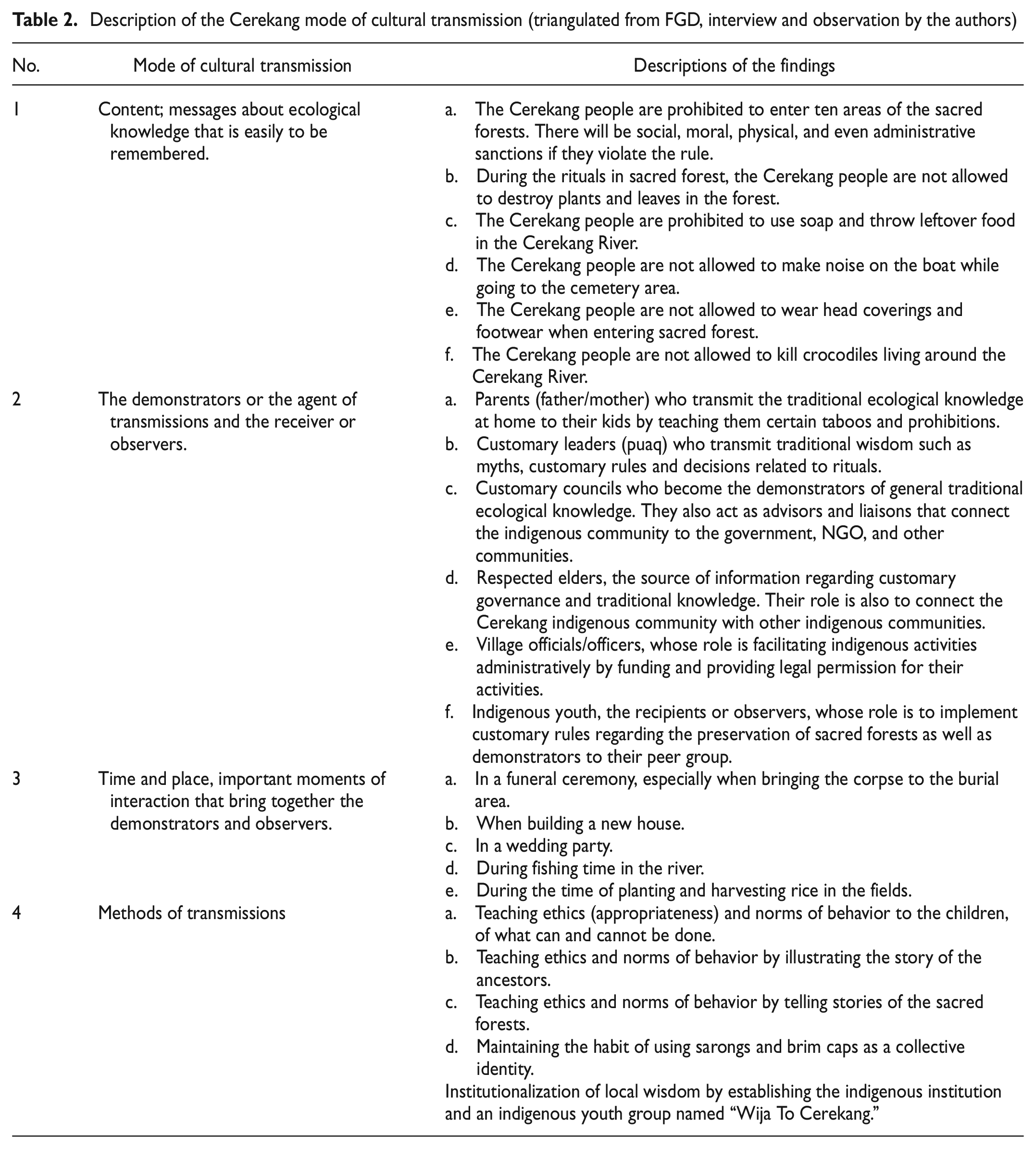
Generally, the Cerekang cultural transmission model is still traditional, linear, and household-based from grandmother to parents to children, and so on (models A − B − C). The main messages or themes that are transmitted are taboos and prohibitions. There are variations in transmission that take place outside the household, for example from customary leaders to the younger generation with a “multiple observer” pattern, where puaq (customary leaders) conduct social learning and social transmission to Wija To-Cerekang indigenous youth community as the observer (models A − B + C). Myths and local wisdom are the main themes of transmissions here. In addition to traditional institutions, village officials and respected elders (especially teachers) also play an important role in the transmission of myths and local wisdom, so that the transmission pattern that takes place is the “multiple demonstrator” model (model A + B − C + D). A more detailed analysis is as follow;
a. Traditional and linear transmission
The process of transmitting ancestral messages (paseng) takes place vertically and horizontally from parents to children, both inside and outside the household. The vertical transmission that takes place in this household tends to be closed. Parents teach certain of prohibitions and taboos (pammali) rather than the reason behind these values. Outside of the household, the transmission is carried out by parents and adults to children while the latter is involved in doing certain works such as fishing in the river.
Meanwhile, horizontal transmission takes place intuitively through makkita which means hearing, seeing and experiencing in daily practical experiences. In this process, children and teenagers learn by hearing, seeing, and experiencing various rituals in Cerekang such as funeral processions, marriages, births, house building, and other rituals related to the sacred forest. Unlike in Islamic boarding schools (pesantren) that have a special room for the community leaders to transmit the knowledge to the younger generation, the method of transmitting knowledge in Cerekang lies on social events where people across generations gather at one place.
Most of the Cerekang people rely on face-to-face verbal communication to transmit their knowledge, as their ancestors did, while also imitating behaviors from demonstrators such as the etiquette of shaking hands, the etiquette of receiving guests, and also the ethics to conserve the environment. Attempts to modify local knowledge are difficult because collective awareness limits individual freedom to act beyond the given rules.
b. Closed group transmission
It can be said that the main agents of cultural transmission are community leaders who are also parents in the nuclear family, aged between 50 to 70 years old, both in social learning and individual learning. However, the pattern of transmission from this category of demonstrator tends to be closed, since they limit the knowledge for transmission to customary rules, taboos, and prohibitions. Logical interpretation and reason behind the rules as well as details of myth are considered too taboo for children and adolescents to know. Therefore, the knowledge received by the observers or young generation is fragmented and limited, which subsequently limiting them to do something beyond what their parents have told them.
However, the community leaders are aware that today’s young generation might have different values from the previous generations due to the influence of formal education, the rise of conservative sections in the community, economic pressures, and urbanization. To anticipate this, several community leaders are collaborating with village government and NGOs to establish an organization that can be functioning to bridge young and elder generation’s understandings about traditional ecological knowledge.
c. Conformist transmission (adaptive)
A relatively new model of cultural transmission is what we call as conformist or adaptive transmission, understood as the process in which the transmission patterns and messages are contextually adapted based on the needs and changes in surrounding environments. In the context of Cerekang people, this pattern of transmission takes place by institutionalizing the traditional ecological knowledge by using two main strategies. First, is by establishing Cerekang Customary Organization whose members are respected elders. This organization is formed as a response to the stagnation of puaq leadership. Second, is by forming an indigenous youth organization named Wija To-Cerekang, which was established in 2015, in order to facilitate peer to peer or horizontal cultural transmission. This group has also established network with NGOs that have concern on sustainable environment. On a monthly basis, Wija To-Cerekang monitor the area around sacred forest to ensure that no one violates the rules to enter sacred forest outside of the ritual as well as to make sure that its conditions are still intact. They also regularly share their activities in social media such as Facebook and YouTube. In this case, the process of transmission takes place horizontally from peers to peers. However, they do not share the information about local wisdom in social media, since they are bounded by customary rules who limit their action to tell details about myth and prohibitions. Both organizations which were established in 2015, had successfully advocated the recognition of Cerekang people’s local wisdom to local government as is proven by the Regent Decree number 258/2019 issued by East Luwu Regency.
In general, the cultural transmission of traditional ecological knowledge of the Cerekang people follows Cavalli-Sforza and Feldman (1981) mode of transmissions; vertical, horizontal, and oblique transmissions. The characteristics of these transmission patterns are intragenerational and intergenerational. Messages, actors (demonstrator and observer), momentum, mediums, and channels of transmission are in the same cultural locus. The most noticeable pattern of cultural transmission of the Cerekang people is traditional-linear model that tends to be closed. However, attempts to adapt with the changing social, ecological, and political landscape is also emerging through conformist transmission.
From the perspective of social learning strategies Laland (2004), the conformity of cultural transmission of the Cerekang people is characterized by the multi-stakeholder or multi-demonstrator involvement. Learning takes place not only through imitation, but also emulation and more importantly, innovation. This process involves several transmission agents, such as parents and respected elders, as well as village government officials, related agencies, and NGOs. The cultural values are transferred by sharing general information, knowledge and understanding, for example, how to understand the rights of indigenous peoples, forestry and environmental laws and regulations, forest area mapping techniques, as well as mangrove and coral reef conservation.
The social learning of Wija To-Cerekang indigenous youth, which was initiated by the Cerekang Customary Organization in partnership with an NGO, is not included in the cultural evolution framework proposed by Mesoudi and Whiten (2008) and Laland (2004). This, however, can be explained through a socialization approach. Referring to Berns (2015), the socialization process occurs through apprenticeship, which is defined as an effort to transmit an activity that requires structured skills by means of guided participation. The stage is started from structuring, collaborating, and subsequently transferring responsibility to the observers.
However, the cultural transmission of traditional ecological knowledge in Cerekang is not without bias. Although the ancestral messages are still transmitted to the younger generation, the content of messages received by the younger generation is generic, incomplete, yet substantive, as was expressed by the indigenous youth we have interviewed. This is partly due to the traditional, linear, and closed model of transmission where hierarchy is undeniable. The social status and prestige hold by certain demonstrators (Mesoudi & Jiménez, 2020) in Cerekang plays an important role as they key holders of the information, which subsequently implies centralization of the information. This is happening especially happening after puaq (cultural leaders) in Cerekang died and their position as the key holders of information was taken over by customary organization consisting of a handful of respected elders, teachers, village officers, and indigenous youth. They then gain social status and becoming a new elite that dominate and select the information on what can and cannot be done in relation to customary knowledge and forests. Although there are some indigenous youth inside of the customary organization, the voice of the respected elders and village officers are more powerful than youth (Akhmar et al., 2021). Nevertheless, the closed transmission model does not always unfavorable. To a certain degree, it has proven success as shown by the attitude of the Cerekang people in adhering to customary rules. Customary forest areas are still sacred, protected, and even advocated at the local government policy level. They also still adhere to the taboo on eating Manurung bananas. The indigenous youth, however, accepted all these rules without receiving rational explanations from the demonstrators.
The necessity to transmit knowledge from one generation to another generation is not only stimulated by the willingness to continue the historical traditions and local wisdom, but it is also triggered by inevitable consequences of social, ecological, and political changes in Cerekang. Socially, there are numerous indigenous youths, who have been exposed to modern formal education, think that the traditional ecological knowledge of Cerekang people is old-fashioned. Although the older generation do not resist modern education, they expect these young people to understand their cultural roots. Ecologically, changes in the land use from nipah palm to fishpond that are owned by the immigrants might potentially threaten the sustainability of sacred areas, especially the Cerekang River. This, in return, has raised the awareness of the Cerekang people to conserve their sacred forest and river through cultural transmission that can clearly be seen as a strategy for their cultural survival.
The effort to transmit traditional ecological knowledge in Cerekang is also inseparable from the political contexts that surround the area. The fall of New Order authoritarian regime in 1998, which signifies the democratic transition in Indonesia, has provided the opportunity for the indigenous revivalism that was once marginalized to gain recognition, land tenure, and articulate their rights (Tyson, 2010). In contrast, it has also paved the way for a more open reception to the global free market and multinational investment that set the contestation over local power and resources in motion which is made possible by regional autonomy as a mandate from political reform in 1998 (Hadiz, 2010). Such contradiction in democracy also appears in the case of Cerekang people. On the one hand, the local government has given a recognition of the Cerekang’s local wisdom and sacred forests. On the other hand, the local government has granted a permission for mining concession that is located next to Bukit Pengsimaoni. As a response to monitor the mining activities carried out around the area of sacred forest, Wija To-Cerekang conduct regular patrol on a monthly basis to ensure that no one breaks the rules to enter the sacred forest. They also consistently post their activities in social media platforms such as Facebook and YouTube. This strategy can also be seen as conformist transmission in which the young indigenous adapt with new technologies while also bringing messages about local wisdom especially to their peers and general public.
In this sense, the use of local wisdom is “political-ecological” which distinguishes it from “political economy” (Berkes, 2008, pp. 254–258). This is in line with Greenberg and Park (1994) concept of political ecology, understood as the historical development of the relationship between society in its political and cultural ecological complexity. This is different from political economy, which reduces the relationship to a social construction while ignoring ecological relationships. This opinion is reinforced by Bauer (2008) who divides four categories in understanding political ecology: (1) how to interpret and negotiate biophysical ecology; (2) the strategy of the contesting parties in the utilization of natural resources; (3) the dialectic between ecology and society; (4) environmental policy practices. All of which are manifested in the Cerekang’s strategy for cultural transmission.
Towards a Contextual Education Based on TEK
As the traditional ecological knowledge being transmitted to younger generations is still partial and even limited, the need to further develop other modes of transmission is seen as necessary. Considering the actual conditions (social, ecological, and political changes), this article suggests a contextual pedagogy based on TEK that require multiple collaborations between multiple demonstrators of cultural transmissions. Here, we use contextual pedagogy developed by van Oers (1996) that situated the context as providing meaning in three ways; (1) As a mental environment in which the previous knowledge of the observers is brought to be appreciated, (2) As a meaningful learning setting in which the knowledge of the observers is situated along the actual conditions, (3) As an activity where the observers learn by doing followed by reflections. Such contextual pedagogy is also in line with the Cerekang’s concept of makkita; that is learning by hearing, seeing and experiencing it in everyday life.
Our findings have shown that most of the cultural transmission process takes place in non-formal pedagogical setting such in funeral ceremony, wedding ceremony, or during the harvest season. However, based on our observation of curriculum in formal elementary and middle schools that exist in Cerekang, the traditional ecological knowledge is not part of any subjects to learn at school. Therefore, the researchers suggest a contextual pedagogy that are applicable both in non-formal and formal education institution.
The learning materials that can be taught are general knowledge about ecology, especially the function of customary forest conservation, cultivation, and local wisdom. Based on the findings and the model of cultural transmission discussed above, the researchers propose relevant materials for cultural transmission through formal and informal education that the researchers discuss together with key demonstrators in Cerekang. Regarding the idea of transmitting culture through formal educational institutions, the traditional elders neither reject, nor fully support the idea. It can be developed as long as it is approved by the traditional elders (Table 3).
Contextual Education Materials for the Cerekang Cultural Transmission.

However, this proposal does not pretend to change the curriculum in formal education. It is best to it as complementary for relevant subjects at school. Besides, it can also be adapted in non-formal pedagogy such as workshops. To achieve a holistic understanding about the Cerekang’s traditional ecological knowledge and its actual condition, collaboration across multiple demonstrators is necessary.
Policy Recommendation
The local government have supported Cerekang indigenous community by recognizing the existence of their local wisdom and sacred forest through a Regent Decree. In addition, the local government have also facilitated indigenous activities by providing speedboat for Wija To-Cerekang to monitor the area around the sacred forest and river. Although these supports might temporarily protect the Cerekang’s traditional ecological knowledge, additional support is required to sustain their praxis. Therefore, the researchers suggest the local government to facilitate indigenous activities related to capacity building such as workshop about traditional ecological knowledge run by Wija To-Cerekang in collaboration with the local NGOs. Since the findings of this study also reveal that the Cerekang’s traditional ecological knowledge is not included in the curriculum within the formal school, the researchers also suggest the local government sign a decree as an imperative to support this idea. Moreover, this suggestion also requires follow-up strategies of implementation such as designing learning materials collaboratively with multiple demonstrators and observers, and capacity building for teachers to sharpen their understanding about contextual learning.
Conclusion
This article explores the traditional ecological knowledge (TEK) in Cerekang and how it is transmitted to the next generation. The knowledge transmitted is about prohibitions, taboos, and collection of instructions to protect the sacred forest and river, which are derived from their mythical constructions about their story of origin. The TEK is transmitted mainly through oral communication in daily life, rituals, and customary organization. The transmission takes place from parents to children (vertically), from peer to peer outside of the household (horizontally), and from respected elders in customary organization to the younger generation. Traditional, linear vertical is the most dominant pattern of cultural transmission in Cerekang with parents as the main demonstrators. However, this model of transmission tends to be closed and is not without bias. This study also finds out a conformist transmission model, in which the Cerekang people establish indigenous youth organization by collaborating with NGOs as a response to the lack of leadership in customary organization. This model, nonetheless, is not included in the framework of cultural transmission from Mesoudi & Whitten (2008).
This study also finds out that the social, ecological, and political conditions that motivate the cultural transmission in Cerekang. The cultural rationalization brought by modern education that might marginalize the ritual practice, the uncertain status of the sacred forest, the changing ecological land space in Cerekang that might threaten the living biodiversity, and the mining concession that operates around the area of sacred forest are among some conditions that prompt the Cerekang people to transmit their TEK by adapting to technology such as using social media strategy as a medium of campaign. Considering these factors, this article suggests a contextual pedagogy based on TEK as a strategy for cultural transmission.
However, this study is not without limitation. Because the focus of this article is on the processes, patterns and conditions that drive the cultural transmission, it does not measure the effectiveness and the successfulness of the Cerekang’s strategy of cultural transmission. Therefore, this article suggests the development of measuring success and effectiveness in cultural transmission through qualitative method as a future research agenda.
Footnotes
Declaration of Conflicting Interests
The author(s) declared no potential conflicts of interest with respect to the research, authorship, and/or publication of this article.
Funding
The author(s) disclosed receipt of the following financial support for the research, authorship, and/or publication of this article: This research was funded by Universitas Hasanuddin (Hasanuddin University), Makassar, South Sulawesi, Indonesia. However, the research results presented in this paper only represent the views of the authors, which do not necessarily represent the views of Universitas Hasanuddin.
