




Abstract
This paper reports on the findings of a baseline study that fed on to a broader investigation exploring ICT integration in the teaching of functions. The baseline study was premised on the observation that the notion of function, despite being a fundamental and central idea in the mathematics school curriculum, presents pedagogical challenges to both teachers and learners. The study used the qualitative case study design to investigate Grade 11 mathematics learners’ errors and misconceptions under hyperbolic functions at a rural high school in the Limpopo province of South Africa. Informed by the constructivist APOS theory conception levels, learners’ errors were detected from their written responses in a diagnostic test. The learners were then individually interviewed during task-based interviews to infer on the misconceptions underlying their errors. Qualitative analysis of the data revealed the following categories of misconceptions: algebraic, conceptual, asymptotic, graphical, and notational misconceptions. The study established that errors, if diagnosed and corrected, are springboards and milestones to the formulation and construction of proper mathematical ideas. To resolve learners’ misconceptions, this study recommends that teachers should use explorative and discovery pedagogical strategies to enable learners realize their own misconceptions and self-correct. Based on the findings of this study, the integration of Information and Communication Technologies (ICTs) in teaching functions as an intervention strategy will be explored.
Introduction
The concept of function is one of the fundamental mathematical notions in the high school mathematics curriculum. Though the development of the function concept can be traced back to Descartes (1596–1650), it was not until the work of Leibniz (1646–1716) that the term “function” was used and later developed by mathematicians such as Dirichlet (1805–1859) and Bourbaki (Kleiner, 1989). At the dawn of the twentieth century, mathematicians such as Klein pursued the view that “functional thinking” should be made the binding or unifying principle of school mathematics (Kleiner, 1989; Ponte, 1992). Furthermore, the function concept builds the discipline of mathematics as it is the substance that keeps together underlying mathematical relationships, operations, and procedures (Makonye & Fakude, 2016). To corroborate this argument, Ayalon and Wilkie (2019) assert that an important goal in school mathematics is for students to develop a comprehensive and multi-faceted conceptualization of function. Several fields of mathematics such as mathematical analysis, theories of differential and integral calculus, and functional analysis are built on the notion of function.
While the inclusion of functions in the school mathematics curriculum is well justified, much of the research from an educational perspective has tended to reveal difficulties related to the teaching and learning of the concept (Makonye & Fakude, 2016; Malahlela, 2017; Oscal, 2017; Sebsibe et al., 2019). Sebsibe et al. (2019), for example, argue that limited mental image of function, fragmented conceptions, and dependence on ordered pairs were some of the limitations to learner conceptualization of functions. Makonye and Fakude (2016) made a similar observation that the notion of function is often not understood by both teachers and learners. Through the theoretical lens of the APOS theory, this study qualitatively analyzed learners’ errors under hyperbolic functions and inferred on the misconceptions underlying these errors. The significance of this study is that its findings build on mathematics teacher professional knowledge and provide valuable data on further research seeking to explore on how the misconceptions can be resolved.
Functions in the South African School Mathematics Curriculum
In the South African context, the notion of function constitutes arguably the core concept in high school mathematics. According to the new South African Curriculum and Assessment Policy Statement (CAPS) for mathematics in the Further Education and Training (FET) phase, the prescribed content under functions expects learners to acquire knowledge on the concept of function and the inverse function (Department of Basic Education [DBE], 2012). The curriculum document specifies that learners should be able to identify the features of a function, including domain, range, intercepts, asymptotes, symmetry, intervals of increase and decrease and be able to convert flexibly between representations of functions, such as tables, graphs, words, and formulae (DBE, 2012). The type of functions prescribed in the curriculum document includes linear, quadratic, hyperbolic, exponential, trigonometric, cubic, and inverse functions. What is, however, concerning is that there seems to be a consistent disjuncture between the CAPS objectives (curriculum policy) and the learners’ outcomes in mathematics, particularly under functions. Analysis of DBE’s yearly diagnostic reports for the past 5 years reveal persistent learner challenges in applying function concepts like domain, range, intercepts, and asymptotes (Department of Basic Education, 2015, 2016, 2017, 2018, 2019).
This study zoomed on grade 11 learners’ errors and misconceptions under hyperbolic functions at a rural high school. Broadly defined, a hyperbola is the set points, P, in a plane such that the difference of the distance from P to two other points in the plane is a positive constant:
The focus on hyperbolic functions was informed by the view that hyperbolic functions do possess some features which are not present in other functions. The asymptotic nature of hyperbolic graphs and the fractional nature of their algebraic equation make them slightly unique from other functions. These features present pedagogical challenges to teachers and learners.
Errors and Misconceptions
It is critical to distinguish between errors and misconceptions. Generally, mathematical errors refer to the visible or observable mistakes which learners display in their solutions to mathematical problems (Arnawa & Nita, 2019; Ay, 2017; Makonye & Fakude, 2016). Makonye (2011) gives a more elaborate definition saying that an error is a mistake, slip, blunder, or inaccuracy visible in learners’ written work resulting in learners not obtaining a perfect score in routine assessments or in examinations. On the other hand, misconceptions are more structural and deeply ingrained in the sense of being caused by underlying mental structures. As Ay (2017) puts it, misconceptions are perceptions that have different or wrong meaning from experts’ opinion in the topic of field. The inaccurate meanings ultimately result in misunderstanding and misinterpretation. What this means is that as learners receive or learn new concepts, and if any misconceptions exist in previous concepts, it is likely that new concepts will include misconceptions as well. Subsequently, if the misconceptions are not resolved, the learners build a set of wrong beliefs and principles in their minds, which makes it difficult for them to assimilate and accommodate (Piaget, 1968) incoming new knowledge.
Drawing from Borasi’s (1994) view of errors as “springboards for enquiry,” this study considered learners’ errors as pointing to some important issues for further exploration in the learning of mathematics. Following the discussion in the preceding paragraph, it is critical to note that misconceptions make sense to the learners based on the conceptual connections they make in line with previously acquired knowledge (Nesher, 1987). Thus, embracing errors and misconceptions in teaching and learning becomes inevitable as they inform us of mental processes in each individual learner. Errors, for example, provide evidence that the expected learning outcome has not been achieved. The central argument propelling this study was that before exploring various possible intervention strategies to enhance learning outcomes in mathematics, teachers and researchers need an in-depth understanding of learners’ underlying misconceptions in the targeted topic.
Research Questions
The study aimed to answer the following questions:
❖ What mathematical errors do learners show in dealing with tasks on hyperbolic functions?
❖ How can the APOS theory be used to identify and explain learners’ conceptions and misconceptions on hyperbolic functions?
❖ How can learners’ conceptions and misconceptions on hyperbolic functions inform teaching of the topic in a more productive way?
Significance of the Study
The importance of this study rests on the need to ensure more productive teaching and learning of functions at high school level. Drawing from the constructivist theory of learning, errors and misconceptions must be embraced and integrated in teaching, as they inform of the mental construction process in each individual learner. Errors present evidence to the teacher on the extent to which the targeted learning outcome has not been achieved, and possibly suggest remedial action to be taken. The defining feature of this study was its conceptual orientation. Its focus was not simply to investigate learners’ ability to carry out procedural tasks, but to unearth and establish learners’ conceptions and misconceptions, which subsequently inform teachers’ instructional practices.
APOS Theory
According to Dubinsky (2000), the understanding of a mathematical concept is the result of mental construction and re-construction toward the development of mathematical objects. The construction and re-construction are achieved through mental activities of actions, processes, and objects of mathematics which are eventually organized into a schema to solve mathematical problems. In reference to these key mental constructions, Dubinsky and McDonald (2001) referred to this theory as APOS Theory.
The APOS Theory is a constructivist theory that seeks to explain how the achievement of concept learning occurs (Boriji & Voskoglou, 2016; Syaiful & Marssal, 2014) and is an extension of Piaget’s idea of reflective abstraction in explaining the development of logical thinking in children (Dubinsky, 2000). Dubinsky (2000) sought to explain the development of higher order mathematical thinking, particularly in college students. However, as Syaiful and Marssal (2014) point out, the theory has been relevant in understanding students’ learning of several topics such as calculus, abstract algebra, statistics, and others.
An action-conception, as Dubinsky (2000) puts it, is a transformation of objects perceived by an individual as an external process, and as requiring step-by-step procedures on how to execute the operation. Chimhande et al. (2017) explain the action-conception as the transformation in an individual’s thinking because of stimuli from outside. In relation to functions, the action-conception of function may include familiar objects of numbers and repeatedly carrying out manipulations on numbers. At this level, the student is limited to procedural operations involving formulae, substitution, and manipulation of algebra. For example, given:
The second level of conception is the process-conception. When an action is repeated by an individual, the individual reflects upon it and makes an internal construction called a process (Dubinsky, 2000). At this stage, the individual can think of performing a process without actually doing it, and therefore can think about reversing it and composing it with other processes. Sfard (1991) described this transition from action to process as interiorization. It can be viewed as a change from a procedural activity to some understanding of the operations involved (Syaiful & Marssal, 2014). In the context of this study, interiorization was viewed as a process that allows a learner to develop from viewing a “function” as a meaningless algebraic expression and begin to condense the processes involved in functions. From the above example, a learner who has acquired a process-level conception begins to identify critical points like intercepts, gradient, and inclination. The learner can use the critical points to sketch the graph of the function.
An object-conception is constructed from a process when an individual becomes aware of the process as a totality and realizes that transformations can act on it (Dubinsky & McDonald, 2001). Piaget used the word encapsulation to describe the transition from process to object (Arnon et al., 2014). A learner who has attained the object-conception is capable to flexibly switch from one representation to another and describe transformations acting on the function. For example, she begins to appreciate that
Finally, a schema for a mathematical concept is an individual’s collection of actions, processes and objects and other schemas which are linked by general principles to form a framework in the individual’s mind (Arnon et al., 2014; Dubinsky & McDonald, 2001). The framework so formed must be coherent as it forms the basis for which one can determine which phenomenon are in the scope of the schema and which are not. Tall and Vinner (1981) used the term “concept image” referring to the total cognitive structure associated with a concept. To sum up the discussion above, the APOS processes involved in the formation of a schema are illustrated in Figure 1.

APOS processes in formulation of a schema. From APOS Theory: A Framework for Research and Curriculum Development in Mathematics Education (p. 11), by Arnon et al. (2014), ©2014 by Springer Science & Business Media.
Application of the APOS Theory: A Genetic Decomposition
In APOS literature, a genetic decomposition of a concept is a hierarchically organized set of mental constructs which might illustrate how the concept can develop in the mind of a learner (Breidenbach et al., 1992; DeMarois & Tall, 1996; Maharaj, 2010; Syaiful & Marssal, 2014). In this study, the genetic decomposition specified the particular actions, processes, and objects that were organized into a hyperbolic function schema. The genetic decomposition was referred to as the APOS-Hyperbola.
Table 1 below presents a summary of the indicators or criteria for each level of conception of hyperbolic functions. The indicators were drawn and adapted from several other researchers who applied the APOS theoretical framework in other related mathematical topics (Chimhande et al., 2017; Dubinsky & MacDonald, 2001; Maharaj, 2010; Syaiful & Marssal, 2014). The breakdown of the content under hyperbolic functions was informed by the specific concepts and skills prescribed in the CAPS document.
Indicators for Each APOS Conception Level of Hyperbolic Functions (APOS-Hyperbola).

Research Methodology
A qualitative case study design was adopted for this study. Qualitative research stems from the interpretivist paradigm of social reality, which stresses the importance of the subjective experiences of participants in the creation of the social world (Burrel & Morgain, 1979). Denzin and Lincolin (2000) posit that qualitative case study is concerned with exploring the phenomenon from the “interior” and “taking the perspectives and accounts of research participants as a starting point” (p. 3). Rather than prescribing to a singular exclusive ontology, as in positivist research, interpretive qualitative research embraces pluralistic views of the world, suitable for the varied concept images (Tall et al., 1999) learners build on mathematical concepts such as hyperbolic functions. The study was classroom based and the participants were studied within their usual classroom setting.
The Research Site
The study was carried out at a rural secondary school in the Limpopo province in South Africa. At the time of data collection, the school had a total enrolment of 250 learners. Of these, 130 were girls and 120 boys. The school offered the following subjects at FET level: Sepedi Home Language (HL); English First Additional Language (FAL); Mathematics; Mathematical Literacy; Geography; Life Sciences; Physical Sciences; Agricultural Sciences and Life Orientation. Once learners enter FET level, they have the option to choose either Mathematics or Mathematical Literacy.
The school is located in an under-privileged rural community. It serves three villages, and some learners walk up to 5 km to school. The school had recently received a donation of 50 laptops, two overhead projectors among other ICT tools specifically for teaching and learning purposes. However, the mathematics educator indicated that he had not used the ICT tools for teaching. The mathematics teacher was qualified with a university degree and more than 5 years of experience in teaching mathematics at FET level. Data was collected 2 months after the learners had been taught the topic of functions in class.
Sampling
Purposive sampling was adopted for the study. Patton (1990) notes that in qualitative research, the researcher intentionally and purposively selects research sites and participants to achieve a research goal. Patton further argues that the qualitative standard used in choosing participants and sites is whether they are “information rich” or not (p. 16). The participants in this study were 13 Grade 11 learners at the school who were studying pure mathematics. The school had a total of 41 learners in Grade 11 and out of these, only 13 were studying pure mathematics while the others were studying Mathematical Literacy. The Grade 11 mathematics class was chosen because according to the CAPS document, the content on quadratic, hyperbolic, and exponential functions is sufficiently covered in Grade 11. All the 13 learners were doing Mathematics since Grade 10 and were taught by the same educator.
Instruments
❖ Document Analysis
Document analysis was based on the learners’ written responses in a diagnostic test. A diagnostic test is an in-depth test to discover particular strengths, weaknesses, and difficulties that a learner is experiencing in a particular topic area (Cohen & Manion, 2007). In this study, the diagnostic test was tailor-made to include question items under hyperbolic functions at each APOS conception level. The question items were drawn from a variety of sources including past examination papers and learners’ textbooks. The structure of the question items and their cognitive demand were informed by the APOS-conception levels. The Table 2 below shows the APOS item analysis of the test instrument.
APOS Item Analysis of the Diagnostic Test.

Note. A = action; P = process; O = object; S = Schema.
❖ Task-based Interviews
The learners’ written responses were triangulated by their oral responses during task-based interviews. Task-based interview, as Piaget (1975) explains, is a particular form of clinical interview designed so that interviewees interact, not only with the interviewer, but also with a task environment that is carefully designed for purposes of the interview (Goldin, 2000). During the interviews, the researcher played an active role, involving students in explaining their task solutions. The diagnostic power of task-based interview was drawn from the opportunity it rendered to question and probe learners’ thinking. Learners were afforded an opportunity to explain, justify, and clarify their written responses. The oral responses provided deeper understanding of the learners’ misconceptions and the resultant errors.
Data Analysis and Findings
Analysis of data in this study involved the identification of errors and detection of misconceptions from the learners’ written responses in the diagnostic test and their oral responses during task-based interviews. As explained in the earlier sections of this paper, mathematical errors were viewed as observable mistakes or inaccuracies in learners’ written responses as they grapple to solve mathematical problems (see section 3). The categorization of identified errors was informed by the error categorization protocol adapted from error types identified by other researchers. During error analysis, other errors emerged which did not fit into the pre-determined categories. Consequently, new error categories were developed.
This study viewed misconceptions as deeply engrained and underlying mental structures that have different or wrong meaning from experts’ opinion in a subject area. Misconceptions are not easily detectable but can be inferred from an in-depth analysis of observed errors. This study sought to unearth the misconceptions underlying learners’ errors under hyperbolic functions. To achieve this, the APOS-hyperbola (see section 7) provided the theoretical lens upon which learners’ conception levels were established. The learners’ oral responses during task-based interviews were transcribed and analyzed to infer on misconceptions under each conception level. However, the identification of misconceptions may not be done with absolute degree of accuracy since misconceptions involve internal cognitive structures. The study attempted to rigorously infer on learners’ thinking patterns based on their oral responses. The data analysis is presented in this paper in two parts. The first part is an overall APOS analysis of learners’ written responses in the diagnostic test. The second part is the analysis of learners’ errors and misconceptions under each APOS conception level.
Overall APOS Analysis of Learners’ responses in the diagnostic test
The purpose of the diagnostic test was twofold. Firstly, the test helped to establish the learners’ APOS level of conception of hyperbolic functions before an instructional intervention. Secondly, the test assisted to establish the learners’ errors and misconceptions under hyperbolic functions. The overall APOS analysis of the 13 learners’ written responses in the test is presented first.
Each learner’s response for each question item was classified under one of the four categories: “No attempt,”“Incorrect,”“Partially correct,” or “Perfectly correct.”“No attempt” means the question item was left blank. “Incorrect response” is when the approach used to answer the question was wrong and the working did not in any way lead to the solution of the problem. A “partially correct” response is when some steps of the working were done correctly, or some parts of the question were answered correctly but some were incorrectly done. A “perfectly correct” response is when the most appropriate approach was used to solve the problem and the working was correctly done.
A graphical illustration of the learners’ responses under each conception level is shown in Figure 2.

A compound bar graph showing question items and number of responses under each response category.
Figure 2 shows that question items falling under the action-conception level had a high number of perfectly correct and partially correct responses and much lower responses under “no attempt” and “incorrect response.’ At process-conception level, the number of “perfectly correct” responses drop noticeably and adds on to the partially correct responses. The graph depicts an increase in incorrect responses at process level. As we move up to the question items under object-level and schema-level, very few responses were perfectly correct. Most of them were either incorrect or partially correct.
The preceding analysis revealed that most of the learners found it difficult to operate beyond the action-conception level. Evidently, failure to possess a strong process- and object-conception of the concepts made it difficult for learners to apply what they had learnt in unfamiliar and non-routine problems. From this preliminary analysis, 11 out of the 13 learners were operating at the action-conception level and only two displayed some traits of the object and schema conception level.
Analysis of Learners’ Errors and Misconceptions and Findings
The second phase of the data analysis was an item-by-item analysis of the learners’ written responses in the test. The analysis of written responses was triangulated with the learners’ oral responses from the task-based interviews. As highlighted earlier, the purpose of the interviews was to afford learners an opportunity to explain, clarify, and justify their written responses. The learners’ transcribed interview responses provided valuable data that gave meaning and “sense” to their written responses.
The analytical approach adopted for analyzing and categorizing learners’ errors was both deductive and inductive. It was deductive in the sense the data was approached with a predetermined set of error categories. The error categories were drawn from Donaldson (1963), Hirst (2003), and Makonye (2011). However, as the analysis and categorization of errors progressed, new error categories emerged from the data. Other error categories were renamed to suit the context of the topic. Analysis of the transcribed interview data made it possible to make informed inferences on the possible misconceptions underlying the errors. The errors were grouped and classified according to the misconceptions that emerged from the data. The following misconceptions were identified: algebraic, structural, asymptotic, graphical, and notational misconceptions.
❖ Algebraic Misconceptions
Algebraic misconceptions were particularly evident under action-conception level questions. For example, under question item 1.1, learners were required to determine the

Lerato and Sekgobela’s responses to question item 1.1.
From Lerato’s response, she applied cross multiplication over addition. Clearly, the learner erroneously extrapolated that if we can cross multiply:
Sekgobela displayed an unexpected error of operational extrapolation in relation to the number 0. In the first instance, the learner got the equation:
Though algebraic misconceptions may not be directly linked to the understanding of function concepts, they negatively influence the learners’ ability to solve a given problem. In the context of hyperbolic functions, learners were confronted with algebraic fractions when determining
❖ Structural Misconceptions
It also emerged from the data that some of the errors learners made emanated from their lack of conceptual or structural understanding of the concepts under hyperbolic functions. Sfard (1997) views structural mathematics as involving fundamental objects (notions or concepts) that connect disjoint mathematical ideas. A case in point is when learners failed to justify why they substituted
I think when we say
I think it’s just a given formula that we have to use. If we need the x-intercept, we substitute 0 for y and vice-versa. It’s a given rule that we have to use I think.
It was interesting to observe that even those learners who gave perfectly correct responses could not give a mathematically sound reason why they substituted
❖ Asymptotic Misconceptions
The asymptotic nature of hyperbolic functions was another source of challenges to the learners. The learners’ responses revealed that they had either a wrong or an incomplete conception of an asymptote. Given the hyperbolic function:

Mpho’s response to question item 1.2.
Apparently, Mpho’s conception of an asymptote is a point and not a line. This could be classified as a structural error because the learner seemed to lack a correct concept image of an asymptote. Four other learners displayed similar conceptual limitations in their responses. Though they did not give their answers in coordinate form, they simply stated the vertical asymptote as a number 2 and the horizontal asymptote as 3. This could suggest that the learners might have viewed 2 as x-coordinate and 3 as the y-coordinate.
Learners who presented perfectly correct responses were asked why they equated
Prompted by these preliminary observations, learners were then asked to explain in words their own understanding of an asymptote. The following responses were commonly obtained:
The lines of asymptote tell us the quadrants in which the graph lies. The vertical and horizontal asymptote will make four quadrants, so the graph will lie in the first and third quadrants or the second and fourth quadrants.
Asymptote is an imaginary line on the graph.
I think they are dotted lines that divide the graph and help us to draw the graph.
The above extracts clearly reveal that learners had no clear mathematical understanding of what an asymptote is. Mathaphelo seemed to suggest that it is the asymptotes which determine the quadrants in which the graph lies. She perceived asymptotes as simply guiding the drawing of the graph. Precious viewed an asymptote as an imaginary line, but she could not further explain what she meant by this. Joel described them as dotted lines that divide the graph. Following up on Joel’s response, asymptotes are usually shown on a graph using dotted lines. When learners did not see the dotted line, they assumed the asymptote was not there.
Learners simply attempted to describe what they saw on a hyperbolic graph, but could not link the graph to the algebraic features of the function. They had a mechanical understanding that given:
❖ Graphical Misconceptions
One of the most prevalent shortcomings that emerged from the analysis of the learners’ responses was that their conception of functions was confined to the algebraic representation. Having determined the intercepts and the equations of asymptotes of the hyperbolic function:
Most of the learners presented graphs that depicted several representational errors. They demonstrated a fragmented understanding of the graphical representation of a hyperbolic function and could not link the algebraic form of the function to its graph. I present Pebetsi and Ledwaba’s graphs below as examples.
In Pebetsi’s sketch graph, two curves meet at the origin and approaching the vertical asymptote in opposite directions. The other curve cuts the horizontal asymptote. The learner attempted to bring out the connection between the curve and the vertical asymptote but in a disjointed and inconsistent manner. The fact that one of the curves cuts the horizontal asymptote is an indication that the concept of asymptote was not understood. When asked to explain how he sketched the graph, Pebetsi had this to say:
I first drew the horizontal and the vertical asymptote. As we can see, the x- and y-intercept is the same point, so I think the curves are intersecting at this point. Then I had to draw the graph like this.
Clearly, the learner was also confused by finding the x-and y-intercept as the same point. This may explain why the two curves were drawn meeting at the origin. Though the learner demonstrated some understanding of the asymptotes and intercepts, the concepts were viewed in isolation and not well linked.
In Ledwaba’s sketch graph, the curves of the graph are not correctly positioned. Though the learner displayed some understanding of how the graph behaves as it approaches the asymptotes, she seemed to think that the x- and y-axes are also asymptotes of
Another dominant error that emerged under this question item was the meta-cognition error. Meta-cognition error arises due to a learner’s failure to reflect on the sensibility of what s/he has done (Makonye, 2011). A case in point was when a learner erroneously obtained the x-intercept as
Graphical misconceptions arise from the traditional teaching approaches of teaching functions that are restricted to the algebraic representation of functions, with limited exposure to other forms of representation. This deficiency makes it difficult for learners to grasp the link between different representations of a function or flexibly switch between them. This observation corroborates Even’s (1998) view that the ability to identify and represent the same thing in different representations, and flexibility in moving from one representation to another, allows one to see rich relationships and develop a better conceptual understanding. This study proposed that the integration of ICTs enriches the learning contexts and provides teachers and learners with unlimited opportunities for multiple representations of functions.
❖ Notational Misconceptions
Question items under object-conception level tested the learners’ ability to interpret and apply functional notation. Specifically, learners were required to show the link between
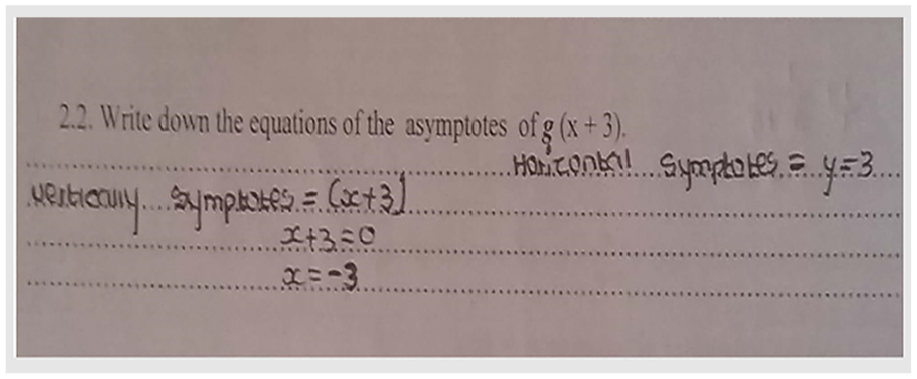
Fog’s response to question item 2.2.
Clearly, the learner was challenged by the functional notation
Question 2.2 required you to find the asymptotes of
When we are given
So, what then will you say about the horizontal asymptote?
I think it means the horizontal asymptote is equal to 3.
Do you think there is any connection between the function of
Hmmm I think there is no connection between the two because the equations are not the same and the asymptotes are different.
The above conversation does confirm the view that that the learners could not decode or interpret the meaning of
Notational misconceptions result in interpretation errors, whereby learners develop a wrong conception of the symbolic representation of a mathematical idea. This creates a barrier to the learner’s understanding of the concept. Another adverse consequence is that once learners fail to decode or encode a mathematical symbol or terminology, they end up answering unintended questions.
To sum up the findings of this study, Figure 6 below shows the broad misconceptions the learners had under hyperbolic functions, and the resultant error categories. It is, however, important to note that learners’ misconceptions and errors are neither exhaustive nor mutually exclusive. Misconceptions are intricately inter-connected and cumulative. What teachers usually detect are errors that learners display as they grapple to solve mathematical problems. Inferring on the underlying misconceptions requires conscious efforts and may not be done with absolute degree of accuracy (Figure 7).

Pebetsi and Ledwaba’s responses to question item 1.3.

Summary of findings on learners’ errors and misconceptions under hyperbolic functions.
Discussion of Findings
The study has revealed that the learners’ conception of hyperbolic functions was mainly limited to the action-conception level. There was no evidence that learners had interiorized the concepts and processes involved under hyperbolic functions. In APOS terms, interiorization is a change from a procedural activity, to be able to carry out the same activity imagining some understanding of the processes involved (Syaiful & Marssal, 2014). An example is when the learners mechanically calculated the
The findings of this study expose the weaknesses in the instructional approach used in teaching functions. Drawing from Sfard’s (1997) distinction between operational and structural mathematical knowledge, current teaching of functions generally seems to emphasize the former at the expense of the latter. Imparting operational mathematics equip learners with calculation skills of facts to perform a task at hand. Learners have no choice but to memorize the facts or procedures because they cannot store or link them to their existing cognitive structures. Subsequently, operational understanding of functions makes learners susceptible to misconceptions and limits their ability to deal with unfamiliar problem situations. This study proposes that instructional activities should be designed to facilitate mental processes of interiorization and encapsulation to broaden and deepen learner understanding of functions. To achieve this, this study makes the following recommendations.
Recommendations
Based on the findings of this study, the following recommendations are made to mathematics teachers.
❖ Learners’ errors provide valuable information on their conception of the targeted concept/s and their thinking patterns. Mathematics teachers should therefore assist learners to understand and appreciate that it is normal to make errors in learning mathematics.
❖ Misconceptions are part of the learner’s existing schema and therefore, can be resistant. To resolve the learner’s misconception, teachers should understand the misconception from the learner’s perspective and make conscious efforts to create a cognitive conflict in the learners’ mind using explorative and discovery-oriented strategies.
❖ It has emerged from this study that learners struggle to link and connect different representations of functions. The study therefore recommends that ICT tools and relevant software should be used as much as possible to expose learners to multiple external representations of functions. Proper ICT integration should aim to promote knowledge construction, and not be limited to representing information, like projecting notes or diagrams on the whiteboard.
Conclusion
Error diagnosis and analysis is a critical step toward deepening learners’ conceptual understanding. The visible errors or mistakes that teachers detect in learners’ work are manifestations of underlying alternative conceptions that learners might have developed over time. From the APOS theoretical lens, this study has established that learners’ conception of functions was confined to computational skills with no understanding of the meaning behind the calculations. This suggests that teaching of functions is restricted to algebraic or symbolic representation, making it difficult for learners to connect different functional representations. Unfortunately, the shallow conception level provides breeding ground for misconceptions to develop and accumulate. Subsequently, learners struggle to assimilate and accommodate incoming knowledge into their existing schema. The misconceptions become more deeply entrenched and resistant. To close these conceptual gaps, one innovation that has not been taken full advantage is the integration of ICTs in the teaching of functions. The next paper will report on a follow up study that sought to explore the use of ICTs in the teaching and learning of functions.
Footnotes
Declaration of Conflicting Interests
The author(s) declared no potential conflicts of interest with respect to the research, authorship, and/or publication of this article.
Funding
The author(s) received no financial support for the research, authorship, and/or publication of this article.
