




Abstract
Emboldened by the economic crisis of 2007 to 2008, a growing rhizome of socially and politically engaged spatial practices have resorted to alternative modes of producing architecture that focus more on its societal aspirations. Aiming to uncover some of the potentialities of the projects that emerged from this growing rhizome to introduce other modes of making architecture while resisting dominant ones, this paper considers the Deleuzian-Guattarian concept of the “minor” to propose an alternative reading of such projects as “minor architectures,” that is, critical practices that resist the canon and act in the crevices of the mainstream. Using ethnographic research methods on two empirical cases, namely the Floating Berlin designed by Raumlabor and Agrocité Paris designed by Atelier d’Architecture Autogérée, the paper identifies “minor” spatial tactics of making architecture that go beyond the limit(ation)s of the practice: (1) resisting the architectural object as a static entity, (2) fostering collective expression, (3) exploring potentialities by reterritorializing interstitial spaces, and (4) creating haptic and affective experiences. The paper reflects on the concept of the minor as an operational tool that could help break away from dominant systems of architectural production.
Keywords
Introduction
Since the financial crisis of 2007 to 2008, a growing rhizome of socially and politically engaged spatial practices has generated a considerable research interest (Anderson, 2014; Awan et al., 2011; Bell & Wakeford, 2008; Brenner et al., 2009; Dodd, 2019b; Kaminer, 2017; Karim, 2018; Lorne, 2017). The effects of the crisis included the collapse of housing markets, a decline in construction production, and the rise of unemployment, particularly in the construction industry (European Central Bank, 2009; International Labor Office, 2009). These effects combined with the austerity policies that governments adopted to alleviate their impact on citizens, had not only increased socio-spatial inequalities in the cities of the global north (Davies et al., 2021), it also made citizens (including architects) more susceptible and open to critiques of capitalism and pushed them to call for more democracy and socio-economic justice (Flesher Fominaya, 2017). In answer to these calls, counter-hegemonic efforts have increasingly resorted to local socially-innovative micro-spatial practices (Moulaert et al., 2010).
Indeed, the economic crisis offered an opportunity for other modes of thinking and of making architecture to flourish, particularly ones that do not necessarily rely on the logic of capitalism as the sole mode of spatial organization. While the motivations behind this emergence vary, from a desire to free the practice of architecture from limited tasks to aspirations to reclaim the social and political role of architecture, one fundamental motive of the rhizome is to resist practices that are profit driven and do not respond to the social needs of the people.
This rhizome includes a variety of emerging architectural practices and young schools of architecture that are interested in community design, including Elemental, Atelier d’Architecture Autogérée (AAA), Rural Studio, An Architektur, Architecture for Humanity, Stalker, Urban-ThinkTank, Raumlabor, Santiago Cirugeda, Rebar, Center for Urban Pedagogy, and BAVO. Motivated by a desire to reclaim the societal role of architecture, this rhizome has abandoned the focus on formal invention and esthetic pursuit. Instead, it engages with local concerns, and it argues against making architecture solely for the sake of making architecture and for improving and positively impacting society.
While many studies have addressed and celebrated the importance of the social and political engagement of these projects (Anderson, 2014; Awan et al., 2011; Fisher, 2008) and some have discussed the efficacy of these spatial practices’ political engagement (Dodd, 2019a; Kaminer, 2017), few studies have examined the spatiality of the projects and investigates how they approach space or how they operate spatially. This paper addresses that particular aspect of the topic by identifying minor spatial tactics through ethnographic research on two empirical cases: the Floating Berlin (FUB) and Agrocité Paris.
This paper, which is based on my doctoral research, discusses the potential of projects emerging from this rhizome of socially and politically engaged spatial practices to resist dominant modes of thinking and making architecture by considering the concept of the minor as a series of processes that form a mode of practice in the field of architecture. Practicing in a minor mode is practicing in a critical, revolutionary way. This concept was first developed by French philosopher Gilles Deleuze and French psychotherapist Felix Guattari in their book Kafka: Toward a minor literature (1986), in which they argued that the minor holds underlying potential and power with regard to the major. They further affirm that the minor is not in strict opposition to the major but that the two exist in a dynamic and interdependent relationship. Inspired by their work, a number of architectural theorists (Bloomer, 1993; Crawford, 2010; Frei, 2009; McCaw, 2009; Ockman, 1997; Stoner, 2012) have considered the minor and further explored the concept in their contributions to the field of architecture. Although their definitions of the minor differ, they all agree that concept involves a critical position. Exploring how the philosophical underpinnings of the minor spatially unfold in empirical cases reveals minor spatial tactics. These tactics introduce different ways of making architecture, which could be beneficial in the face of present-day agitations and challenges. In addition, this paper explores the potential of the concept of the minor to offer an alternative reading of projects that emerged from the rhizome of socially and politically engaged spatial practices.
The first section of this paper explores the contributions of different authors who have considered the minor in the field of architecture and examines the way in which they diverge. The next section sheds light on the methods employed in this study and on the data analysis process. The third section presents and discusses the minor spatial tactics that are drawn from the empirical cases. The last section discusses and reflects on the findings of the paper.
Explorations of the Minor in the Field of Architecture
In their study of the works of Franz Kafka—a German-language Czech writer—Deleuze and Guattari claim that even though Kafka uses the German language as his medium, his main ambition is to create within the major language of German a minor literature, which Bogue (2011) describes as “one that experiments with language, ignores canonical models, fosters collective action and treats the personal as something immediately social and political” (p. 110). In Kafka: towards a minor literature, Deleuze and Guattari (1986) elaborate a tripartite definition of minor literature. First, language in minor literature is “affected with a high coefficient of deterritorialization” (p. 16). Second, “everything in [minor literatures] is political” (Deleuze and Guattari, 1986, p. 17). Third, in minor literature, “everything takes on a collective value” (Deleuze and Guattari, 1986, p. 17). Thus, they conclude that “the three characteristics of minor literature are the deterritorialization of language, the connection of the individual to a political immediacy, and the collective assemblage of enunciation” (Deleuze and Guattari, 1986, p. 18). Moreover, the minor, which Deleuze and Guattari (1987) further conceptualize in A Thousand Plateaus: Capitalism and Schizophrenia, is “about subversion, escape, transformation. It is metamorphic—a ‘becoming’” (Katz, 1996, p. 491).
The concept of the minor has been explored in many disciplines other than literary criticism, such as philosophy, geography and even architectural theory. Some of these explorations have used the Deleuzian-Guattarian concept of the minor as an entry point to describe and criticize that of the major or the canon, such as Ockman’s historical analysis of the shift from a revolutionary European modern architecture in the 1920s to American corporate architecture in the 1950s and 1960s (1997). Others have used the original concept to contest some of architecture’s dominant ideas, like Bloomer’s (1993) contribution, which discards the visual as the only way to understand architecture, asserting that minor architecture is not “a style or an architecture parlante” (p. 174). Stoner (2012), for her part, deconstructed what she calls “architecture’s prevailing myths” (p. 2), in particular the myths of the object, subject, interior, and nature in the field of architecture. The concept of the minor has also been used as a conceptual framework to analyze architectural projects, as in Decroos and Schrijver’s (2019) analysis of the Caritas project designed by De Vylder Vinck Tailleu or Volz’s (2020) analysis of the recently discovered architectural archives of Australian architect Nell McCredie. Weetman’s (2018) analysis of the Australian tiny house movement is another example. Other authors claim that a singular definition of the concept of “minor architecture” is missing, such as Burns, who further argues that the concept could be used to “distinguish itself from ‘major architecture’ or the canon” (Weetman, 2018, p. 18). The concept has also been integrated into a conceptual framework to analyze artistic practices. Walker’s (2008) analysis of the work of American artist Gordon Matta-Clark and McCaw’s (2009) brief analysis of the work of Japanese artist Tadashi Kawamata are examples of this approach.
While these authors’ definitions of minor architecture differ, there is a consensus that minor architecture amounts to a more critical position. Furthermore, most of these contributions understand the minor and major not as a simple binarism nor a strictly contrasting polarity but rather as interdependent concepts that form a dynamic amalgam in constant transformation. Thus, my conceptualization of the minor in this paper draws on the work of Deleuze and Guattari and the contributions mentioned briefly in the previous section. Accordingly, minor architecture is understood as a mode of practice that is critical vis-à-vis singular authorship, obsessions over form, or the normative rules and codes set up by the canon. It emphasizes the haptic and affective experience that such architectural interventions offer, the collective process that they encourage, and their potential for transformation.
The concept of the minor offers an opportunity to explore these resurgent socially and politically engaged spatial practices from a different theoretical lens, uncovering the further potentialities of these projects to resist the dominant modes of thinking and making architecture. Considering the minor as a mode of practice, as a category of thinking in the field of architecture, the paper explores how three of its philosophical underpinnings—the notions of becoming (3.1) (leaving permanence and moving toward transience and temporality), collective enunciation (3.2) (expressing multiple voices rather than a singular individual), and deterritorialization (3.3/3.4) (subverting and unsettling existing codes and norms)—spatially unfold in two empirical cases: the FUB and Agrocité Paris. This process leads to identifying “minor” tactics of making space for an-other architecture that go beyond the limit(ation)s of the practice.
Methods
This study relies on ethnographic research conducted on two empirical cases: the FUB, designed by Raumlabor, and Agrocité Paris, designed by AAA. Selection of empirical cases was based on a list of criteria established before the field work commenced and during the preliminary research phase: (1) projects that argue for architecture’s role in the improvement of society, whether on the level of everyday life, or of urban politics, (2) projects that are self-initiated and that reclaim and reuse under-used resources, (3) projects that engage with local concerns, (4) projects that are designed for uncertainty (5) projects that are designed by “socially-oriented, politically-motivated architects who go significantly beyond the designing of material objects” (Lorne, 2017, p. 269), and (6) projects that are accessible for ethnographic research and interviews.
The ethnographic research method mainly used in this study is participant observation, which took place during workshops and activities in the context of open and public events and served to allow immersion in the day-to-day practices of the architects, organizers, and participants on-site. While conducting the empirical research, I was a participant-observer in both empirical cases. Sometimes, I remained in the background, writing down my observations, thoughts and reflections in notebooks or drawing sketches in sketchbooks. At other times, I joined other participants in activities such as tiling a floor, going on a walk, building a ramp, planting seedlings, or writing a lexicon. My position oscillated between active participant-observation and passive observation. I sought to directly experience activities and situations to observe what they are like in real life and to document my own perceptions. The data production process followed the directed strategies of data-making promoted by Scott and Garner (2013) and by Rossman and Rallis (2011). Prior to this empirical work, I did not have any connections to any persons involved with these projects.
All the observations and reflections formed during the participant-observation process were recorded in a daily log at the end of each field day. I employed several other research strategies including semi-structured interviews (40–60 minutes), mainly with the architects, other members of both projects’ organizing teams, and some participants; field notes; sketches; photographs and videos produced during the field visits; on-site walks; and the collection of any miscellaneous data (including postcards, flyers, student magazines, etc.). Data production at the FUB took place during the second open week in July 2018 and during the symposium organized there in September 2018. The collection of data at the Agrocité was carried out during a 48 hours of an urban agriculture event in May 2019 and a series of participative building workshops in June 2019.
The data produced during the field work were initially coded with field notes, interviews, photographs, magazines, brochures and all materials collected on site. The process of coding, which followed Charmaz’s (2006) and Miles et al.’s (2013) strategies, consisted of reading and rereading the data, then providing labels to segments of data that identified units of meaning. The first round of initial coding sought to categorize the tactics used in both empirical cases to create the projects. Thus, it exclusively focused on practices and observable actions in the data—hence the use of gerunds (“-ing” words).
During the second round of coding, I incorporated the minor architecture concept literature, and I was able to identify several key themes that were helpful in organizing the data produced during the field research, including “collective enunciation,” “deterritorialization,” and “becoming.” I organized my data using these themes as major categories. Because my aim was to investigate spatial practices as observable actions that materialize the ontological concept of minor architecture, I created with subcategories derived from the major categories mentioned above, which include: (1) resisting the architectural object as a static entity, (2) fostering collective expression, (3) exploring potentialities by reterritorializing interstitial spaces, and (4) creating haptic and affective spaces. These subcategories were the results of several rounds of coding and are presented in section 3.
Description of the Empirical Cases
The empirical cases examined in this paper are the FUB and Agrocité Paris. The FUB (Figure 1) is an architectural installation built by Raumlabor on the grounds of an old rainwater basin that is part of the infrastructure of the now-shutdown Tempelhof airport and is located in the Tempelhof-Schöneberg borough, south of Berlin. After the airport was closed in 2008, the city of Berlin released a master plan for the development of the airfield, including housing, commercial spaces, and a public library (Copley, 2017); it also proposed relocation of the existing rainwater basin. This plan sought to maximize the profits that can be gained from this unique piece of land. However, the proposal met with a wave of protests, manifestations and petitions organized by the citizen-led initiative “100% Tempelhofer Feld.” In 2014, Berlin residents voted against the proposal, blocking any sort of construction on the airfield and preserving one of the largest green spaces in the city (Bartlick, 2014; Das Tempelhofer Feld—Berlin.de, n.d.; Raumlabor, 2022).

Photograph of the FUB 2018.
Because the rainwater basin was closed off to the public for over 60 years, it was covered by abundant vegetation, which turned into a hidden and largely forgotten space over the years, until the Raumlabor collective noticed it when examining an aerial view of the area during preparation for their “The Great Worlds fair 2012” project at the Tempelhof airfield. Raumlabor’s engagement with the site started here. Over a period of 6 months (between April 2018 and September 2018), Raumlabor occupied and reactivated the basin by transforming it into a floating campus that hosts students and academics from more than 20 international universities, local actors, and other participants. Constructed from scaffolding material and inflatable roofs, the floating installation was built in the middle of the basin. Water is an important element shaping its design, because the project not only recuperates and filters the rainwater, but also introduced a novel way to filter the heavily polluted water of the existing basin. During a series of open weeks, the FUB was open to the public and offered workshops, lectures, walking tours, open discussions, water features where children could swim, artistic performances, and many other activities. By the end of 2018, the network of practitioners involved in the initial experimental project decided “to transition from a ‘temporary’ project into an association: Floating e.V.” (Floating e.V., 2022; Raumlabor, 2022); the association is self-organized and continues to serve as the caretaker of the rainwater basin.
Agrocité (Figure 2), an urban agricultural project initiated and designed by AAA, is one of three units of a larger project called R-Urban, the others are Recyclab and Eco-hub. After Agrocité was evicted from its original site in the commune of Colombes in 2018, when a shift in local politics resulted in the decision to temporarily use the site for parking during the renovation of nearby buildings (Van Eeckhout, 2016), the project was relocated to a dense social housing district in Gennevilliers, a neighboring commune in the north-western suburbs of Paris. The new community offered to host the project in one of its plots in the Agnettes district, as part of an urban renewal program implemented by the national agency for urban renovation (Agence Nationale pour la Rénovation Urbaine) (Tenaglia, 2021). In this new location, AAA transformed a parking lot into an urban agricultural project. Agrocité allows the inhabitants of Gennevilliers to engage in gardening, grow their own food, and learn about ecology, sustainability, and urban agriculture. The project also raises awareness of the challenges of climate change, and organizes many other activities. Agrocité is designed to attract local people to its activities, encourage them to propose their own activities, and let them gradually take charge of the project until they become its managers. One of the fundamental aims of the project is to develop resilient and rhizomatic social relationships and networks between the inhabitants and local food production organisms. The Agrocité was managed by AAA until June 2021, when the agreement linking the structure to the city ended. The town hall of Gennevilliers launched a search for a new manager, which ended in October 2021 (Tenaglia, 2021). Since January 2022, management of the Agrocité has been entrusted to the “Vergers Urbains” association, which coordinates the programing on site. (Mairie de Gennevilliers, 2022).

Photograph of Agrocité 2019.
The creators of both spatial practices discussed in this paper do not own the land where the projects were initiated. Instead, they question public/private property and ownership by rather mediating temporal and long-term use of the land where they are located, leaning toward ideas of the “new commons,” which “suggests new physical spaces of communal ownership and engagement […] but also, critically, shared heritage and shared rights therein, including social and cultural resources” (Brown et al., 2012, p. 1617).
Minor Spatial Tactics
Resisting the Architectural Object as a Static Entity
As a philosophical concept, the minor is characterized by its capacity to be constantly changing. The FUB reflects this capacity. From the program and atmospheres created on-site to the physical structures themselves, this transformative capacity unfolds on multiple levels. From this perspective, there is a certain resistance to the traditional understanding of the architectural object as a static entity. Standing in the middle of the water basin, the FUB is a project in continuous change. When asked about their main interest in the design, a member of the FUB team explained:
my main interest is to generate this […] open space and to make it a place working,[…] it means also that […] there is not a point where it is finished, so it is always going on, it needs to be a process, […] and this is really important for a place like this, that is constantly changing. (Member of the FUB team, personal communication, July 9, 2018)
This state of becoming, of being unfinished and still in progress, is visible in the structure of the FUB. Made to be temporary, the structure is built out of scaffolding materials: metallic frames, wooden planks, and perforated metallic panels. Inflatable plastic sheets were used to cover the structure, while clear corrugated plastic panels close some openings, where needed. Unlike heavy materials such as stones, bricks, or concrete, the elements employed to build the FUB are light and modular. They can be easily and quickly assembled, reassembled, rearranged, and removed. They are constant reminders of the scaffolding that is often attached to buildings during the construction process to support both people and materials. From this perspective, these materials evoke the impression of being unfinished, in the process of construction, and create a feeling of anticipation of the final product. Since its inception, the project was built with the idea that it would eventually be dismantled and that all these materials would have to find a new life and a new home in another project. A Raumlabor architect explains what guided the choice of materials as follows:
It was somehow clear [that] if we want to build something here, it needs to have a certain volume and it was pretty clear that we have to use a system that we can reuse again—for example, a wooden construction—and to take down the things again, and what are we doing with all this material?. (Member of the FUB team, personal communication, July 9, 2018)
This defined yet open structure (Figure 3) allows for constant change and transformation. It makes it possible for other elements to be plugged in as well, turning the FUB into a sort of adaptor. For instance, during the symposium, a new movable and floating platform was added to extend the auditorium’s existing terrace. Thus, the simple structure of the scaffolding frames allows for other frames to connect, be added, and so on. The adapter analogy can also be seen from another perspective as the FUB does not only allow for other structures to plug in literally but also figuratively. From this viewpoint, the project enables other universities to plug in as well with their workshops, seminars, lectures, and knowledge.

Photograph of the FUB 2018.
Over the course of approximately 6 months, the FUB hosted four open weeks, during which it was open to the public. Many students, professors, neighborhood residents, architects, artists, researchers, and other curious visitors participated in numerous events, open lectures, workshops, presentations, walking tours, and other activities. The FUB took on a different look during each event. In each of these moments, different usages and atmospheres. For instance, for a few days during the second open week, the bridge that links the greenhouse to the floating installation was transformed into a walk-through sound exhibition by artist Peter Ablinger. Wooden frames were quickly installed on the bridge, turning it into a walkway pergola, with hanging white sheets blowing in the wind (Figure 4).

Drawing of the FUB’s Auditorium 2018.
Walking in and around the FUB, one can notice a clear emphasis on process and transformation, not only figuratively but also physically. This unfolds through the temporary and light structure of the project, its adaptability, its participants and their activities, or the changing atmospheres that emerge from its spaces. The FUB is a project that moves away from the Heideggerian notion of “being-in-the-world,” toward the Deleuzian notion of “becoming-in-the-world.” It turns away from fixed, static notions of the architectural object toward processual, transformative potentialities. It is a transitional project on multiple levels: the participants, structures, objects, and connections are all transient. The constant change and transformation that characterize the FUB highlight and evoke the ambulant character of minor architecture, not only in the moving/floating nature of the structure but also in the capacity of the project to reappropriate: spaces and practices are constantly repurposed, escaping, in some way, the idea of a design built for one single purpose. The FUB becomes a campus, an artistic installation, a concert space, a water filtration system, and more.
Thus, the project escapes the prevailing understanding of what architecture is supposed to be—an ideal, perfectly polished, massive, static object. It evades what Stoner (2012) calls “the myth of architectural permanence” (p. 14) to move toward notions of temporality and transience, highlighting the transformative aspect of the minor.
On one hand, the temporary character of the project contributes to its fragility. Meaning that there is often a lot of work involved in keeping the project running. For instance, a lot of work is required in cleaning and maintaining the project especially when it is open to the public (Member of the FUB team, personal communication, July 9, 2018), as well as when unexpected things happen such as a flood (Field notes, July 10, 2018) or a sewage problem (Member of the FUB team, personal communication, July 11, 2018). On the other hand, the temporariness of the project and its state of liminality contribute to creating a bonding experience, a certain social togetherness (Toraldo et al., 2019) or what Turner (1977) refers to as “communitas,” which is essential and crucial for any meaningful action. It is from this sense of social togetherness that a desire for collective action emerges.
Nonetheless, the adaptable and flexible character of the FUB evokes Boltanski and Chiapello’s (2018) critique of personal adaptability and flexibility (p. 461). According to them: “To adjust to a connexionist world, people must prove sufficiently malleable to pass through different universes while changing properties” (Boltanski & Chiapello, 2018, p. 461). People must dispose of their permanent character and become interchangeable individuals in order to thrive in the new era of capitalism. This critique can be extended to material and spatial properties. Spatial design must become adaptable, flexible, and generic. Although the FUB presents a flexible and adaptable spatial design, it constitutes the exact opposite of a generic, meaningless architecture as it is rather a situated design that is highly sensitive to and interactive with its immediate location.
Fostering Collective Expression
In the case of Agrocité, the first initiation of the project in Colombes emerged from a collective expression. A group of residents who had been gardening in an urban wasteland formed an association with the support of AAA and together built Agrocité as part of a larger urban resilience project called R-Urban. When it was dismantled in 2017 and reassembled in 2018 in Gennevilliers, curious residents of Gennevilliers engaged with the project.
This process of fostering collective expression takes many forms in the project. It starts by encouraging the participants to attend workshops (e.g., permaculture, where a local association showed the participants how to deal with soil and how to harvest in a more sustainable way; or fertilizers, where an agricultural expert introduced the benefits of using natural and biological agricultural fertilizers) in Agrocité and test activities such as gardening (Figure 5) and by inviting them to share time with each other. By cultivating the gardens and practicing daily activities together, collective dynamics start to emerge. AAA creates an environment that allows for shared experiences and, consequently, for a collective expression to materialize, one that rewrites the urban story of the space and that can take over afterward. During the phase of testing activities, new actors interested in managing the project emerge. This leads to the creation of a self-managed association, which will eventually become responsible for the project while the initiators fade in the background and start developing new projects. The self-managed association was not yet created at the time of my fieldwork, and the participants were still considered users of Agrocité, which belongs to AAA, who supports the process of autonomization. The AAA team, the participants, as well as the ecological and social mediator were still looking for a long-term economic model that will allow Agrocité to generate income to keep itself running.
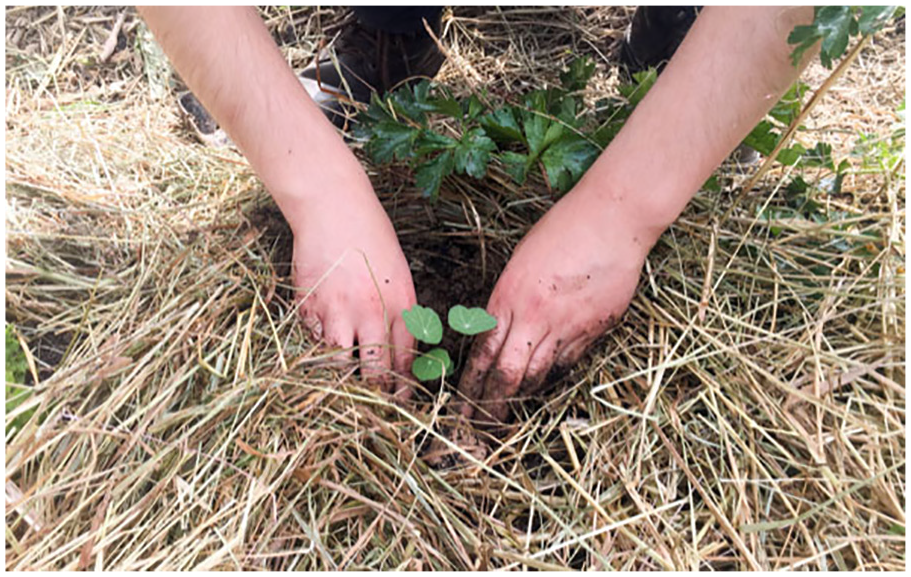
Photograph of a participant planting a seedling, 2019.
The collective expression is also apparent in the Agrocité building itself, which bears the traces of the work of many participants. Although the building is not designed in cooperation with the future users of Agrocité, they are invited to take part in participative building workshops, especially during the last phase of construction. A member of the AAA team describes their involvement in the building process as follows:
we do a lot of self-construction. We invite future users of Agrocité to participate in the finishing of the building. […] When they can do little things in the building, they really feel like the owners […], so they have to take care of it. (Member of AAA team, personal communication, May 7, 2019)
By participating in the building process of Agrocité (Figure 6), future users can appropriate the project. This is what makes them responsible for it and, consequently, what makes them take care of its different spaces. Indeed, taking responsibility for maintaining Agrocité and being part of a collective expression created and fostered on-site are key factors that will eventually turn the participants into managers of the project.

Photograph of Agrocité’s salvaged and painted windows, 2019.
With this in mind, the process of working together with the participants and allowing them to take on more responsibility for the project until they become its managers is a different way of producing architecture and approaching the relation between architect and users. This relation is not a one-way interaction but rather a collaboration that dismantles hierarchies. The project goes beyond the level of a merely participatory project, in whose users “can participate,” to reach another level of urban emancipation, where these participants can manage the project themselves and realize that they have a word in the urban development and quality of their living environment.
Although the Agrociteä Gennevilliers nourishes collective expression on-site and encourages participants to take on managerial roles and to create an association, this does not mean that no tensions arise during this process between the initiators and the participants, or between the participants themselves (Participant at the Agrocité Gennevilliers, June 8, 2019). While the initiators have an academic and intellectual background, great aspirations, and a specific vision for the project, the participants do not necessarily share the same background, nor the same vision. This is where tensions arise, since the initiators can come across as demanding concrete results, when volunteers do not have their experience nor their knowledge, but still participate voluntarily in the events. At times, this sort of unbalanced relationship leads to participants perceiving the initiators as imposing an ideal or a specific vision and being hesitant and cautious when passing on the project to other participants. This resulted in some of the volunteers leaving the Agrociteä Gennevilliers according to a participant’s account of their experience with the project (Participant at the Agrocité Gennevilliers, June 8, 2019). In addition, sometimes tensions arise between participants, as many of them do not know each other even though they live in the same neighborhood, which may cause problems when they suddenly find themselves in the position of having to “do something together.” (a Participant at the Agrocité Gennevilliers, May 7, 2019) Nonetheless, these tensions and disagreements that arise are exactly what enhances the “properly political” (Swyngedouw, 2009) aspect of the project.
In the case of the FUB, the project manifests aspects of a collective expression, which is apparent in the floating structure itself since some elements of the project have been made by students from different universities during their on-site workshops. For instance, the FUB team worked with Ecole Polytechnique Fédérale de Lausanne (EPFL) students to create a visual identity for the project. Many other participants designed other elements, some of which were floating in the basin, reminding the visitors of the different voices that participated in the project. When asked about the process of producing knowledge at the FUB, a participant stated:
the knowledge production here […] never resulted in a singular author, […] but more the practice here […] is very collaborative and there is a lot of voices involved and there is always a relay between different people and different practices and different ways of doing things. (Participant at the FUB team, personal communication, July 15, 2018)
This collaboration is not only present at the level of the knowledge production on-site but is also noticed at the level of the project’s realization. Although the FUB was initiated and designed by Raumlabor, its implementation required the support of other partners, who funded (e.g., Fonds Bauhaus heute der Kulturstiftung des Bundes, Bundeszentrale für politische Bildung, Senatsverwaltung für Kultur und Europa,…etc) the project, lent the necessary materials for construction (e.g., Tisch Gerüstbau Gmbh), or brought their students (e.g., TU Berlin, Science Po Paris, Universidad La Gran Colombia Bogotá, Bergen School of Architecture…etc) for workshops. The result of such collaborations is a project that is made collectively and expresses collective voices, challenging one of architecture’s predominant ideas of singular authorship and contesting what Stoner (2012) describes as the “rise to power of the individual voice [that] has become architecture’s strange agenda” ( p. 72).
Furthermore, this collective expression is produced by the architects who designed the project and all the other actors who are intrigued by and drawn to the FUB, have similar ideals, and have found an opportunity to express themselves through the project. A participant at the FUB describes the participants as follows:
we all kind of share the same […] value system of this project: resistance to the capitalist production of space, the need to promote safe production that is community based […] and producing relationships that [are] not consumerist […]. It is […] the inherent philosophy behind these kinds of projects that is shared by everybody here. (Participant at the FUB team, personal communication, July 15, 2018)
This collective expression is also present in the spaces of the FUB. Not only are these spaces the product of collaborative efforts between the architects, partners, participants, and other actors, they are also designed in a way to be open and modifiable and are not treated as the protected spaces of an ivory tower (Figure 7). In that sense, they offer multiple possibilities for different imaginations and allow other participants to appropriate them. Design elements such as an open and modular structural framework, lightweight materials, and movable furniture (Figure 8) play an important role in allowing freedom of use and personalization. These spaces create a rich set of diverse situations making reinvention and reconversion possible.

Photograph of posters made by students at the FUB 2018.

Photograph of chairs made of OSB panels and plastic crates, 2018.
The FUB is a collaborative project, whose organization is strongly non-hierarchical. It is rather horizontal and starts from the belief that we are all equally actors of positive urban change. Thus, it relies on the perks of networking and social relations, which can be very advantageous when it comes to finding opportunities for experimentation and intervention. However, this sort of organization can be criticized as being elitist as most of the participants were part of the intellectual and cultural sphere of Berlin.
Both Agrocité and the FUB foster and nourish a collective expression, one that aims to collectively rewrite the narrative of the interstitial spaces in which they are located and involves many voices. In this sense, both projects escape the predominant idea of singular authorship, since many actors are involved in their making.
Importantly, the projects discussed in this paper can be seen as a response to the high demands for democracy brought by the financial crisis of 2007 to 2008 in terms of distrust and dissatisfaction with democratic regimes (Flesher Fominaya, 2017; Norris, 2011). In terms of space, democracy refers to people’s right to participate in decisions involving their built environment that affect them directly and do not respond to their needs. For instance, in the case of the Agrocité, the inhabitants are invited to participate in the activities proposed, to propose new ones, and to manage the project, thus shaping the becoming of the Agrocité. The project also offers them room for reflecting on and analyzing their own built environment. Furthermore, both sites where these empirical cases are located belong to the city. Those cities give use and access rights to the members of the associations who act as a collective dynamic that maintains, manages and defends these spaces. This method of engaging with space in the city represents an alternative to public/private ownership and the capitalist production of space, shifting the focus to people rather than capital.
Exploring Potentialities by Reterritorializing Interstitial Spaces
As the minor acts in and emerges from the crevices of the mainstream or the major, minor architecture materializes spatially and arises from interstitial spaces that exist outside of the gridded territory of the city and what the city represents. According to de Solá-Morales (1997), “These strange places exist outside the city’s effective circuits and productive structures. From the economic point of view, industrial areas, railway stations, ports, unsafe residential neighborhoods, and contaminated places are where the city is no longer” (p. 26). Such spaces escape and resist the processes of traditional urban development and represent an opportunity for processes of deterritorialization to take place, allowing the emergence of alternative as well as collective spatialities and temporalities.
Deterritorialization is a movement wherein what is deterritorialized “becomes” something other than what it was—in other words, it is caught in a new set of relations. It describes a movement of “declassification” of objects, individuals, animals, gestures, or signs (inter alia). Such declassification frees them from their conventional uses and opens them up to other uses. This is rather a creative movement, whereby a territory breaks free from its old “definition.” There is no deterritorialization without a reterritorialization, and territoriality does not necessarily designate a spatial “place” but can equally designate an identity space.
With this in mind, the processes of occupying and transforming interstitial spaces in the city can be thought of as “spatial” deterritorialization. Through such processes, these spaces slowly break away from their previous codes (functions and usages) toward new ones. Both AAA and Raumlabor deterritorialized interstitial spaces in the city by freeing them from their old “definitions.” For instance, AAA transformed an existing parking lot into an Agrocité, while Raumlabor transformed a rainwater basin into a floating campus. Both sites embraced new codes, labels, functions, and usages and have thus been reterritorialized.
The process of “spatial” deterritorialization starts with looking for spaces whose potentialities have not yet been explored and that can provide room for experimentation and intervention. In the case of the FUB, the Tempelhof water basin (Figure 9) was discovered by Raumlabor by coincidence while designing the Great World’s Fairs in 2012 at the Tempelhof airfield. A few years later, an open door led a member of the FUB team to explore the area, as they explain in an interview:
It must have been in the spring when I passed by […] the Tempelhof airport, I was planning a project there. I knew from the plans, there was something here. […] I was always curious as to what [it] was […] and then I walked in here, because the door was open, […] I knew immediately that there was quite [some] value in this discovery. (Member of FUB team, personal communication, July 13, 2018)

Areal view of the rainwater basin, 2020.
The FUB’s story is part of Berlin’s history of occupying and transforming vacant and uncertain spaces. Indeed, after the fall of the Berlin wall, many vacant spaces were unable to be transformed by traditional urban development and became, according to Misselwitz (2018), “an opportunity for a new set of mainly young urban actors. Spaces were claimed, appropriated, and used with the simplest means. Whatever already existed was pragmatically appropriated and reinterpreted” (p. 63). A similar process took place at the rainwater basin, allowing the floating to emerge, as described by a member of the FUB team:
[the project] builds of course on a tradition, which is typical for Berlin, of temporary use of neglected spaces […] it’s […] a long tradition of projects […] at the same time, there is […] this novelty, […] [of] opening up a space. (member of FUB team, personal communication, July 9, 2018)
The FUB activates and opens up the previously hidden space of the rainwater basin to other people. In opening the location for other people to use and benefit from its potentialities, the aim is also to empower them to reclaim these hidden nooks in the city and assert that they, as citizens, have a say in the future of such spaces. In addition, the project calls into question the common understanding of space as either a commodity whose value fluctuates according to the market or something out of reach that can only be managed by unforeseeable forces. In this sense, the FUB is a project of spatial emancipation that reinvents the existing site, invites others to use it, and opens up conversations about its fate.
In the case of Agrocité, the discovery of the project’s site was the result of an active exercise of mapping and locating all available sites in the Paris metropolis. All interventions are preceded by a phase of locating available spaces by mapping them throughout the city and then waiting for an opportunity to intervene (Member of AAA team, personal communication, May 4, 2019). The search for potential sites is directed toward areas or neighborhoods that could benefit from such interventions. These special areas often suffer from a deterioration of their inhabitants’ quality of life, and in the case of “Les Agnettes,” where Agrocité Gennevilliers is located (Figure 10), the district was under an urban social cohesion contract for years. Although common outdoor spaces exist in these areas, they are rarely used to their full potential and are reserved mainly for circulation. A member of the AAA team describes the locations targeted by their projects as follows:
AAA wants to be in some neighborhoods that do not have any money […] and where people are very much unemployed or retired or just don’t know what to do with the city […] AAA wants to put this kind of unit within neighborhoods that are only housing neighborhoods, where nothing can take place. (Member of AAA team, personal communication, May 7, 2019)
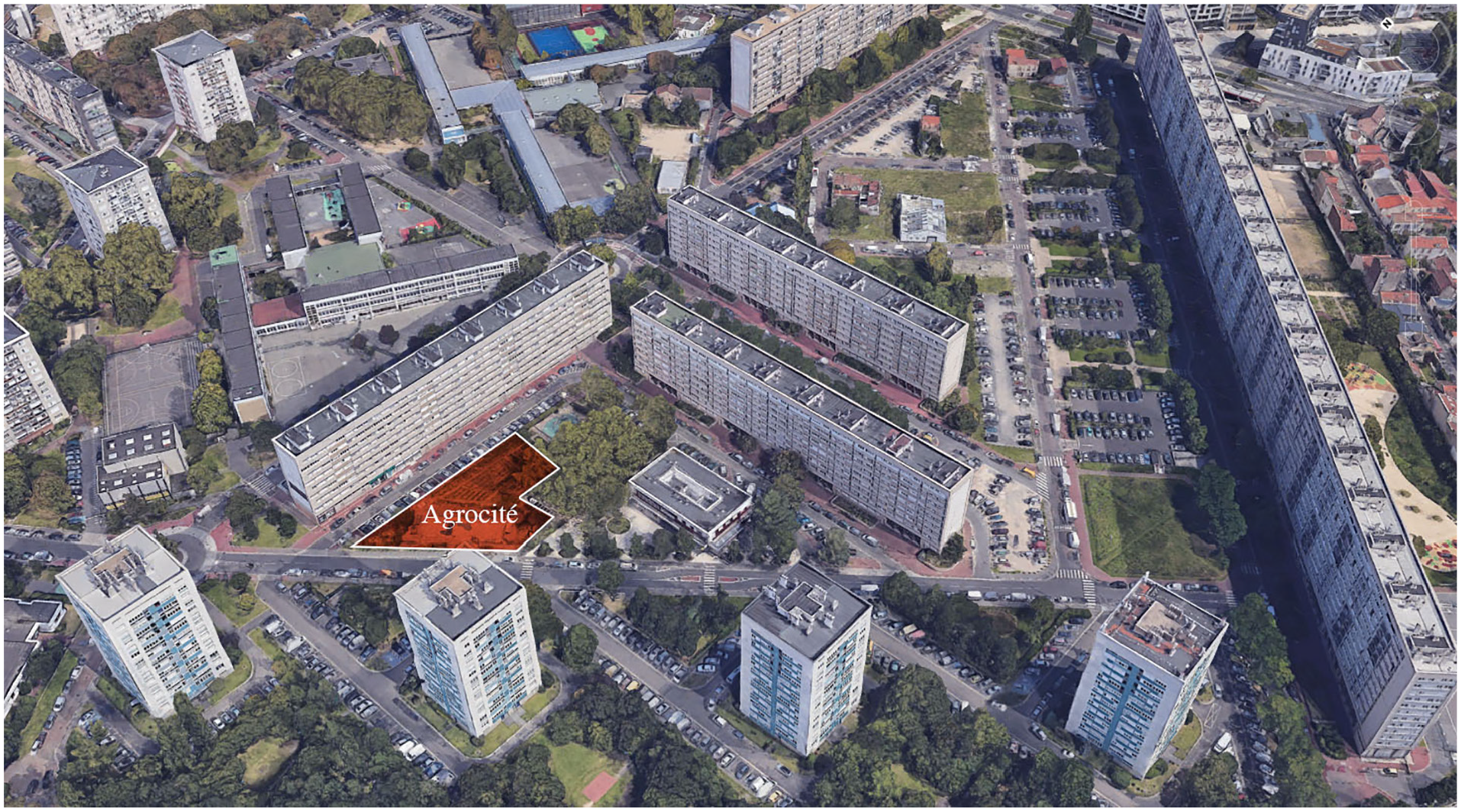
Areal view showing the location of Agrocité 2019.
Through this project, AAA is not merely transforming a parking lot into an urban agriculture project but rather encourages residents of the neighborhood with different backgrounds to create collaborative activities and practices and develop networks of closed ecological cycles of food production between urban and rural areas. During this process, AAA restores, in a way, the relation between the inhabitants and urban space. It invites the inhabitants to test activities on the site and work together, making them appropriate the space and take care of it until they eventually become fully responsible for the project. This process is gradually “spatially” emancipating the inhabitants who want to be part of Agrocité by making them understand that they have a voice and that they can use it to reclaim these spaces as their own.
Both Agrocité and the FUB emerged from interstitial spaces since they offer room for experimentation and intervention and represent a testing ground for different ideas, which would not be possible in another scenario. Although both projects reterritorialized these sites and reinvented them by employing new codes, such as a new narrative, a new usage, and a new function, they are deterritorialized: while they are part of the city, they leave the gridded territory of what it represents and means and can be thought of as heterotopias, in which upon entering, one is transported into another dimension, another temporality, and another spatiality, all in contrast to their immediate urban environment.
Seeking out these interstitial sites in the city, occupying them and turning them into a common space that everybody can share is in fact an anti-austere way of engaging with space in the city, and instead is pro-democracy. As Flesher Fominaya (2017) writes : “The financial crisis brought to a head a long-term decline in trust, legitimacy, and satisfaction with democratic regimes, fueled by an increase in demands for democracy (rising public aspirations for democracy)” ( p. 3). The spatial practices discussed in this paper respond to these demands. Whether located in an unexplored parking lot, or a forgotten water basin, both spatial practices carry the belief that all citizens have the right to access these spaces and use them as a shared space for gardening and ecological activities in the case of the Agrocité, or as a shared space for knowledge, culture, and urban experimentation in the case of the FUB. The process of reterritorializing these spaces questions the normative understanding of space as either private or public, which is based on ownership and property, by exploring communal ways of managing these spaces.
Creating Haptic and Affective Experiences
In both empirical cases, a deterritorialization characterized by a movement from the visual to the affective can be noticed. This means that there is less preoccupation with producing a polished and perfect space and more with creating an affective experience in the Deleuzian sense, one that emphasizes the bodily or embodied experience of space. This is not to say that these cases have no visual qualities; they certainly have developed an esthetic language, a visual identity that makes them distinctive. However, both empirical cases question the visual as the only mode of perceiving and understanding architecture by introducing and highlighting other modes that focus on the bodily experience of space. For instance, the entrance of the FUB is designed to be experienced. In my field notes, I describe it as follows:
From the street, the entrance seems to be hidden between trees […]. It is mysterious and invites discovery. […] A bridge, […] is suspended between tall trees and leads towards a staircase, then to an open view of the basin, where the FUB is revealed. (Field notes, July 7, 2018)
The mysterious entrance between the trees is what lures the visitors further inside, creating a sense of anticipation of what may lie ahead behind the chain-link fences and slowly unfolding more information as they move through it. This elaborate entry sequence is not a mere coincidence. When designing the FUB, Raumlabor considered actively how to stage the moment of discovery of the project by changing the main entrance and designing what the visitors would see first and smell. A member of the FUB team explains:
the idea was not to walk down this street and then over the long bridge,[…] but to have this bridge through the trees, and the view of the nice towers over there, and then to go down, through these tomato plants, and have this smell, and to enter another world. (Member of FUB team, personal communication, July 9, 2018)
The story that the architects want to tell through the entry sequence (Figure 11) permeates the entire project. Visitors are invited to walk around and discover the different spaces of the floating installation. Although this kind of walk through the project evokes Le Corbusier’s “promenade architecturale”—an important element of the modern architectural language—, Raumlabor transformed this design concept and adapted it to their project, creating a different pattern and materiality. Instead of a chronological progression that traverses different elements that highlight architectural events, the progression here relies more on the element of mystery and intrigue and frames moments of the location. The spaces are carefully designed to enhance one’s experience not only of the spaces themselves but also of the surrounding natural environment, with a focus on the element of water.

Photographs of the FUB entrance sequence, 2018.
The design of the project is not only about organizing architectural elements following a distinct narrative to frame or reveal moments of the location. What Raumlabor also designs is how the visitors move through the different spaces of the FUB and experience them. They design situations—that is, they create environments that they believe will stir up conversations that will lead to urban change. The FUB is, on its own, a situation that Raumlabor designed by erecting a floating installation in the middle of an abandoned rainwater basin with the aim to reflect on and open a discussion about the future of the location and its polluted water. However, there are other situations within this meta-situation. They include designing how people walk in the murky waters and feel the sturdiness of the concrete under their feet or how the visitors come across the hanging water filtration system made of bathtubs.
Designing situations is about experimenting, manipulating environments, and creating atmospheres and ambiances. It is a different mode of perceiving, understanding, and designing spaces that does not strictly focus on the polished and perfectly finished object as if it were the ultimate goal of design. Instead, it concentrates on what happens within and in the vicinity of this object, what new experiences can be created, what unexpected encounters can happen, what playful moments can be generated, and what imaginings can be brought to life.
In the case of Agrocité, the building escapes and moves away from the usual centrality of the visual in the design of the architectural object by following an organic approach linking the built structure and the gardens. The Agrocité building can be thought of as an organism in symbiosis with the gardens. Made out of wood, the building is another form taken by a natural and organic material that can be found in its raw state in the gardens, namely, the plants. Furthermore, the building recuperates rainwater to water the gardens, grows seeds into seedlings ready to be planted, and is also the place where the harvest from the gardens is stored, shared, cooked, and consumed. The green walls and green roof, with different plants and greenery attached to and growing on them, only enhances this organic vision, which goes hand in hand with the collaborative practices encouraged on-site that aim to develop networks of closed ecological cycles of food production between urban and rural areas.
There is a clear contrast between the cold concrete towers in the immediate surroundings and the warm wooden building of Agrocité (Figure 12). Indeed, the building is entirely made of wood, with a simple structure, a double pitched roof, and corrugated plastic sheets, creating minimal spaces that host only what is necessary. Through the building, one can notice that the point is not to protect oneself from the world but rather to experience it. Compared to the large housing slabs surrounding it, the Agrocité building seems to have a direct relation to the external environment. The transparency of the corrugated plastic sheets used on the northern façade as well as some parts of the roof and the openness of the large folding doors toward the gardens enhance the visual, olfactory, auditory, and tactile experience of one’s immediate surroundings.

Photograph of the Agrocité surrounded by towers, 2019.
Although the entrance to Agrocité is not staged like the FUB’s, entering the building offers a relatively similar affective experience, which starts with walking down the street and noticing the small wooden building amidst multiple cold concrete towers. The building stands in contrast to its immediate surroundings and arouses the curiosity of the inhabitants of the neighborhood, who sometimes come to explore it and discover what is happening there. During the winter, for instance, the lingering smell of burnt wood that emanates from the woodstove lures curious visitors inside. Through a relatively dark entrance, they make their way down a bright corridor onto large folding doors behind which the gardens are located.
Both empirical cases create an immersive environment in which users can experience the spaces created as well as the location and be transported to a different world built on vacant spaces. In this immersive environment, the users are not merely passive observers but rather active participants.
Discussion
At a time when there are major changes happening in the built environment (e.g. global pandemic, rise of inflation), we might be in need for tactics that unsettle dominant modes of spatial production. These current changes are instigating a thirst for new imaginative efforts into reconfiguring how we produce space. Thus, the paper sought to identify spatial tactics that center on practicing architecture in a minor mode, that both expand the existing ways of making architecture and resist purely hegemonic and profit-driven practices by challenging certain agreed-upon or established rules and shifting the focus toward other aspects of design. The paper presented and discussed these four tactics: first, both projects resist the architectural object as a static entity by designing structures that are in a continuous state of becoming, escape the predominant idea of permanence, and embrace notions of transience and temporality. Second, both projects call into question another predominant idea—singular authorship—by fostering a collective expression that emanates from multiple voices and encourages collaborative efforts. Third, both projects explore hidden potentialities by reterritorializing interstitial spaces that resist traditional urban development and offer room for alternative spatialities, subjectivities, and temporalities. Fourth, both projects create haptic and affective experiences that immerse and transport the visitors to other worlds, shifting the focus away from the visual as the only mode of perceiving and understanding architecture. Finally, the paper concludes by reflecting on these minor spatial tactics (in)ability to resist dominant modes of practice and carry politically resistant agencies.
First, while this paper firmly believes that architects and spatial practitioners have a degree of agency in achieving collective good and changing the world for the better, it also acknowledges that any kind of emancipatory movement is likely to carry the demons of the past with it. This means that while these spatial practices aim to resist mainstream architectural production, they often include the trademarks of the very systems they reject, participating in a new age of capitalism in a way that makes it difficult to differentiate between system and critique. For instance, concepts such as adaptability and flexibility that characterize many of these minor spatial practices (including the FUB and Agrocité), have already been incorporated in the new spirit of capitalism (Boltanski & Chiapello, 2018) under which we currently live. Boltanski and Chiapello (2018) argue that to thrive in the new capitalist world, persons have to become malleable or plastic and to strip away from their permanent character (p. 461). Similarly, in order to survive in the current new capitalist world, spatial design must become flexible, adaptable, generic, empty frames devoid of meaning.
Second, the temporary and fragile character of both the FUB and Agrocité creates additional work in terms of building maintenance. This extra work includes disassembling onsite temporary structures, finishing the construction work required for participative building workshops when there are no participants, and cleaning the entire structures after public events. The temporary and liminal character of the projects plays an instrumental part in creating a sense of social togetherness that leads toward meaningful social action (Turner, 1977; in Toraldo et al., 2019). At the same time, the temporariness and liminality of the projects contribute to their artistic condition by creating a sense of reality in which work is “enchanting” (Endrissat et al., 2015) and “meaningful” (Toraldo et al., 2019), and avoiding the harsh realities of uncertainty and low-paid labor, and the blurriness of boundaries between work and non-work.
Third, what does engaging with such minor spatial practices mean for the city? Governments and cities are increasingly retreating from their role in developing public and accessible social projects for their citizens and leaving the responsibility of city development to non-state actors. This aligns with the critique of neoliberalism within western societies that denounces the state for no longer being the sole provider of public welfare and resources (Misselwitz, 2018). To experience a social and community-oriented project under these conditions, many citizens find they have to self-organize, resist, occupy and hunt for funding in all over the city. With the rise of the creative economy and entrepreneurial cities, property owners have quickly realized the value of the improvised, impoverished, and anti-economic esthetics of these minor spatial practices and exploited and capitalized on those creative esthetics to rebrand sites and attract future buyers and tenants. A creative economy distorts spatial practices that once were anti-economic and commodifies them by turning them into profit-driven practices for rebranding cities and attracting more revenue.
Can these four spatial tactics of producing architecture in a minor mode be applied to other contexts? The tactics described in this paper are situational, contextual and specific to the projects discussed above, which means that they cannot simply be copied into another project and achieve similar results. Nevertheless, the agency, self-organization and self-initiation that these practices promote, along with their capacity to attract participants from different backgrounds and disciplines who are willing to share their knowledge, may inspire other projects and stimulate reflections, incite imaginations, and spark new conversations about the future of architecture and spatial design.
Finally, what does the minor as a theoretical framework bring to the conversation? On the one hand, taking up the minor, with its collective character, as an operational tool means contesting the present with its existing conditions, communities, and subjectivities and instead creating newly imagined and newly invented communities and subjectivities driven by a utopian call or a desire to reach social and economic justice. On the other hand, there always comes a point where the minor is absorbed by the major and thus incorporated into yet another incarnation of capitalism. This means that once the minor becomes mainstream, it loses its potential for unsettling existing power structures. Nonetheless, because of its transformative character, the minor emerges yet again in a new form from the depths of the mainstream challenging, questioning, and subverting it.
Footnotes
Acknowledgements
Warm thanks to the reviewers and the editor for bringing the paper to another level. I would also like to thank Raumlabor and Atelier d’Architecture Autogérée for welcoming me as a researcher during the fieldwork. Warm thanks to all the members of the organizing teams and the participants in both the FUB and Agrocité for sharing their knowledge and time with me. Finally, I would like to thank the Swiss National Science Foundation SNF for their financial support in writing this paper.
Author’s Note
This research was conducted while Dalal Elarji was at the Institute of Architecture and Planning at the University of Liechtenstein. She may be contacted at
Declaration of Conflicting Interests
The author declared no potential conflicts of interest with respect to the research, authorship, and/or publication of this article.
Funding
The author disclosed receipt of the following financial support for the research, authorship, and/or publication of this article: This work was supported by the Swiss National Science Foundation SNF (Schweizerischer Nationalfonds zur Förderung der wissenschaftlichen Forschung), through the Doc.Mobility program [grant number P1SKP1_194931].
