




Abstract
The present study examined how narcissistic features, self-assessed lie- and truth-related abilities, and thinking processing style influence successful lying and convincing truth-telling. To this end, 100 undergraduate students completed the NPI, REI, and LTAAS questionnaires and drew two drawings each. They then presented to a panel of four fellow student judges, 0, 1, or 2 of their drawings together with other pictures, and tried to convince the panel that they had not drawn any of the drawings. Finally, judges reported whether they believed the presenter. Results showed positive correlations between narcissism, self-assessed lying ability, and self-reported rational thinking. Intuitive thinking predicted success in lie detection. The present results enrich our understanding of situational and personal factors involved in intuitive lie detection.
Keywords
Introduction
Early reports suggested that lying is a frequent phenomenon in everyday behavior (DePaulo et al., 1996; DePaulo & Kashy, 1998; Kashy & DePaulo, 1966). Still, Serota et al. (2010) reported substantial individual differences in frequent lying, results that were recently replicated in Japan (Daiku et al., 2021). Results suggest that not everyone is lying every day.
DePaulo et al. (2003) reported that when asked about their feelings toward their everyday deception, people answered that they did not plan these lies and were not bothered. People expressed no regret or fear of being detected. However, they felt uneasy when they lied and reported experiencing more superficial and disagreeable interactions compared to interactions in which they told the truth. Most lies in the real world are small, low stakes lies that go undetected (Bond & DePaulo, 2008), and we forget them instantly. The present study focuses on individual differences in such lies.
Self-Assessed Lie- and Truth-Related Abilities
Most people tend to assign relatively low ratings to their lie-telling abilities (see Elaad, 2018 for a review) despite their lack of concern over their everyday lie-telling behavior and the fact that most lies go undetected (Bond & DePaulo, 2008). One explanation is that individuals believe that lying is challenging because the liar has to fabricate “a new and never-experienced tale,” whereas the truth-teller stands before a simple task of “telling it like it is” (Buller & Burgoon, 1996; Miller & Stiff, 1993). Although truth-telling may sometimes be very complicated, particularly when it potentially offends or insults another person, examples of “difficult lies and simple truths are more available than easily formulated lies or hard-to-tell truths” (DePaulo et al., 2003). The illusion of transparency (Gilovich et al., 1998) may also explain the low lie-telling ability ratings. The illusion refers to presenter’s feelings of being unable to prevent the exposure of their lies, and as a result, they tend to overestimate the receiver’s ability to discern their internal states and detect their lies. A third explanation is that people tend to think of themselves positively and believe they are honest. By rating low their ability to tell lies successfully, they preserve a positive self-image and reflect their belief in themselves as honest people (Elaad, 2015).
Self-assessed lie-telling abilities predicted reports of actual lying (Verigin et al., 2019; Zvi & Elaad, 2018). Specifically, self-reported good liars reported telling more lies in daily life than self-reported bad liars. In addition, self-assessed lie-telling abilities also predicted deception to a virtual partner (Elaad et al., 2020). Finally, the self-assessed lie-telling ability was correlated with deliberate countermeasure effort in the Concealed Information polygraph Test (CIT) by guilty participants (Elaad & Zvi, 2019).
Elaad and Sommerfeld (2016) reported positive correlations between more significant Conceal Information polygraph Test (CIT) skin conductance responses to critical items and enhanced self-assessed lie telling ability. Specifically, the polygraph detected better high lie-telling ability scorers than low lie-telling ability scorers. The high-scorers motivation to prove their lie-telling skills in the test may explain the results.
People tend to assign high ratings to their truth-telling abilities as well. A review of studies that used self-assessments (Elaad, 2019b) showed that people believe they are convincing truth-tellers. Such a “truth-telling bias” is consistent with the general human assumption that most communications are truthful, and there is no reason for other people to question our honest communication. In addition, the illusion of transparency contributes to high truth-telling ability assessments because feeling transparent implies that truths are easily detected. Finally, by assessing their truth-telling ability, people preserve their self-image as honest people.
Kruger and Dunning (1999) have a different view on people’s overestimated abilities. They suggested that this overestimation is partly made by people unskilled in the domain but do not realize their deficiency. Following Kruger and Dunning (1999), we may suggest that people who rate high their truth-telling ability have difficulties convincing others of their truthful messages but are not aware of their problem.
People estimate their truth-detection ability (e.g., Elaad et al., 2020). People feel that by believing others, they are correct most of the time. Furthermore, accusing a truth-teller of telling lies is an earnest matter that raises feelings of guilt and may terminate the communication. People who can believe truth-tellers feel capable of avoiding such social embarrassment.
Since people do not typically receive feedback about their lie-detection failures, they consider themselves being good lie-detectors. Indeed, Elaad (2018) showed that people tend to assign higher than average ratings to their ability to detect lies accurately. Elaad and Zvi (2019) attributed this bias to people’s tendency to think of themselves favorably. People fear being easily deceived and protect themselves by adopting the attitude that they are good lie-catchers. As a result, lie-detection ability ratings correlated positively with frequent lying reports (Zvi & Elaad, 2018).
In addition, the self-assessed ability to detect lies rests on examples of high stake lies that were detected while overlooking the many simple lies that went undetected.
Interestingly, professionals regularly engaged in detecting deceit, such as customs officials (Kraut & Poe, 1980) and federal law enforcement officers (DePaulo & Pfeifer, 1986), could not differentiate truthful from deceptive messages. The results of Bond and DePaulo (2008) support this lack of lie detection efficiency.
It may be essential to study the biased reports about lie-truth-related abilities. For example, Bandura (1977) devised the self-efficacy theory and defined self-efficacy as one’s belief in one’s ability to accomplish goals. Accordingly, studying how people judge their skills may provide further information on how such perceptions influence cognition, behavior, and emotions.
Correlating lie- and truth-related ability assessments with actual low stake deceptive behavior is scarce, and we designed the present study to contribute further in this respect.
Narcissism
Another factor that may predict deceptive communication is narcissism. As indicated before (Elaad et al., 2020), narcissism is a comprehensive personality construct characterized by a sense of entitlement, empathy scarcity, and grandiosity. Narcissists tend to be abusive and see others as tools for satisfying their own needs. They need to be esteemed by others and expect preferential treatment from them. However, despite their sense of supremacy, narcissist’s self-esteem is fragile, and they may respond with rage and hostility when their ego is threatened (Kohut, 1978; Krizan & Herlache, 2018; Ostrowsky, 2010; Raskin & Terry, 1988; Sadock et al., 2015). Narcissists scored low on the honesty-humility dimension of the six-factor HEXACO model, reflecting low levels of fairness, sincerity, and modesty (Lee & Ashton, 2005; Muris et al., 2017).
Narcissists are overrepresented among criminals and prison inmates (Bushman & Baumeister, 2002; Larson et al., 2015). Nevertheless, narcissists can be adaptive. According to the narcissism spectrum model (Krizan & Herlache, 2018), narcissists may be mapped onto a continuum that varies in extremity and expression of narcissistic traits. The diverse presentations of narcissism encompass both normal and pathological behavior.
Positive associations between narcissism and unethical behavior in everyday life situations or reported lying have been described (Azizli et al., 2016; Baughman et al., 2014; Jonason et al., 2014; Oliveira & Levine, 2008, but see also Daiku et al., 2021 for a view that narcissists tell fewer lies). Furthermore, positive attitudes toward deceptive communication may correlate positively with lie-telling success (Oliveira & Levine, 2008). It follows that narcissistic individuals believe they are more successful liars than the average person (Elaad et al., 2020; Giammarco et al., 2013; Zvi & Elaad, 2018). However, these reported success rates are biased, and we should consider them invalid indicators of their actual lying behaviors (Michels et al., 2020).
Several accounts show that narcissists tend to self-enhance desirable traits (e.g., creativeness, intelligence, and physical attractiveness; see Grijalva & Zhang, 2016 for a review), yet they do not consider themselves more moral than others. Narcissists do not cherish morality because they view shared characteristics as a mark of weakness (Grijalva & Zhang, 2016).
Using narcissistic features to predict actual deceptive behavior should be further investigated. The present study intends to contribute to this goal.
Intuitive and Rational Thinking Styles
Park et al. (2002) asked students to recall and describe an event in their life in which they had successfully detected another person’s lies. Less than 2% of the reports were of lies caught while telling them. Most of the lies were detected from information provided by a third party (38%), physical evidence (23%), or confessions (14%). More than 80% of the lies were detected 1 hour or more after the lying incident. The late exposure may suggest that rational thinking is responsible for lie detection. However, while people remember detecting rational lies better than detecting intuitive lies, they tend to make lie/truth judgments instantly and intuitively based on very little information rather than carefully considering available information. This is particularly true when the lie detection task is complicated, and the decision-maker is under time pressure. In this sense, people may be subject to simple observer bias when judging whether an individual is or is not lying.
As to lying, self-reported good liars rely on verbal strategies of deception embedded with truthful information while keeping their statements clear, simple, and plausible (Verigin et al., 2019). Therefore, we suggest that good liars use rational rather than intuitive thinking when lying. Still, memory may bias self-reports and while most lies are intuitive, most remembered successful lies are rational. Thinking style is also related to actual behavior (Witteman et al., 2009). Witteman et al. found a significant positive correlation between the rational scale scores of the Rational-Experiential Inventory (REI) questionnaire and rational performance on different tasks. They also reported a negative correlation between decision time and intuitive thinking. Specifically, the more one uses an intuitive decision style, the quicker the decision is.
The present study applied thinking style reasoning to relations between self-reported thinking style (rational and intuitive) and success in actual lie-and truth-telling and detection.
The following are the hypotheses that we examined in the present study:
Lie, and truth detection performance under low stake conditions, is based mainly on guessing and will emerge as no better than chance level.
Self-assessed lie- and truth-related abilities are biased. Therefore, self-assessed abilities will not correlate with the corresponding performance indexes.
Narcissists believe they are better liars than the average person. Therefore, positive correlations between narcissistic scores and lie-telling ability assessments would emerge. Furthermore, people with narcissistic qualities will rate themselves higher than lower narcissist scorers in all self-assessed abilities.
Narcissism predicted frequent lying. Therefore, positive correlations between narcissism and readiness to deceive a panel of judges will emerge in the present study.
People who process information rationally will be more willing to consider the base rates of truthful and deceptive messages in the present experimental situation and tend to believe presenters more than lower rational scorers who pay less attention to the base rates and make more balanced judgments (i.e., similar frequency of trusting and disbelieving decisions).
To be rational is a desirable trait with which people are happy to be associated. Therefore, rational information processing scores will positively correlate with narcissism. However, lie detection of simple lies involves intuitive thinking. Thus, reported intuitive thinking may predict lie-detection performance.
Methods
Statistical Power and Participants
We used a GPower analysis to determine the sample size. The analysis indicated that a sample of 82 participants is adequate to detect an anticipated small to medium effect size (0.3) with a power of 0.8 and α = .05. One hundred undergraduate Israeli students (85 females, Mage = 22.5 years, SD = 2.04) enrolled in an introductory psychology course participated in the experiment for academic course credit. The sample consisted of secular Jews (51), religious Jews (43), and other religions (5). One participant failed to provide this information. All participants were native Hebrew speakers. Participants signed a consent form that secured their confidentiality and anonymity and specified that they were entitled to end their participation in the study at any time without any penalty. We awarded one participant in each session additional course credit as a bonus for outstanding performance.
Materials
Narcissistic Personality Inventory
The present study used the Narcissistic Personality Inventory (NPI). The inventory (Raskin & Hall, 1979; Raskin & Terry, 1988) presents 40 statements that are answered on a 5-point scale ranging from 1 (not at all true) to 5 (very much true). Examples of NPI statements are: “I like to look at myself in the mirror”; “I am an extraordinary person”; and “I find it easy to manipulate people.” The NPI showed high internal consistency in the present sample (α = .92) and is commonly used in narcissism studies (e.g., Muris et al., 2017).
Lie- and Truth Ability Assessment Scale (LTAAS)
Zvi and Elaad (2018) presented the lie- and truth ability assessment scale (LTAAS) used in the present study. As indicated elsewhere (Elaad et al., 2020): “The scale comprises 16 statements referring to four communication abilities: to tell lies persuasively (e.g., in comparison with other people, how would you rate your ability at lying to your peers without getting caught?); to detect lies accurately (e.g., in comparison with other people, how would you rate your ability to detect lies?); to tell truths convincingly (e.g., relative to the average person, how good are you at convincing people to believe you when you are telling the truth?); and detect truths of other people (e.g., in comparison with your close acquaintances, how good are you at identifying when someone is telling the truth?).” Here, participants rated their abilities relative to specific others or the average person on a scale ranging from 0 (much less than others) to 100 (much better than others), with 50 (as good as others) serving as a middle-point.
Rational Experiential Inventory (REI)
The 24-item REI questionnaire was first introduced by Pacini and Epstein (1999) and translated into Hebrew by Ayal et al. (2011, 2012). The REI is a self-report inventory used by participants to report their tendencies to use analytical and intuitive considerations in their decision-making. The REI consists of two independent scales (of 12 items each), which provide scores for (1) engagement in and preference for cognitive activities (e.g., I have a logical mind) and (2) engagement in and preference for experiential activities (e.g., When it comes to trusting people, I can usually rely on my gut feelings). For each statement, participants reported how true the statement was for them. Reports were made on 5-point Likert scales, ranging from 1- (categorically untrue) to 5- (categorically true). Previous studies showed high internal reliability coefficients for each scale (typically above 0.85). In the present study, we computed reliability scores for each scale resulting in α = .82 for both scales. The correlation between the two scales is negligible (Ayal et al., 2011; Pacini & Epstein, 1999), and we obtained a similar low correlation in the present study, r(100) = .045, implying that the REI represents two independent information processing systems.
Procedure
The ethical committee of the university approved the study. Participants were divided into 20 sessions of five participants each. Two female experimenters (A and B) invited participants to participate in a lie-detection experiment. After signing a consent form, participants completed the NPI, the LTAAS, and the REI questionnaires. The experimenters informed participants that they would participate in an experiment designed to examine their lying and lie-detection abilities. They then seated the five participants in remote corners of two adjacent rooms, where other participants could not see what the participant was doing. The experimenters handed each participant two blank sheets of paper and pastel colors and instructed them to make two drawings. They then were informed that they would present each drawing to the other group members while denying having made that drawing. The experimenters instructed participants to do their best to convince the judges that they were telling the truth and promised participants a bonus of extra credit points if they were more convincing than their fellow participants. Finally, participants could decide whether to present both drawings to their group members, to present only one drawing or no drawing. The experimenters motivated participants to include both drawings in the test by cautioning them that they would not be eligible for a bonus if they chose not to present any of their drawings. If they chose to present a single drawing, their chances of receiving the bonus would be much lower than those who chose to include both drawings in their presentation.
Experimenter A recorded each participant’s choice, collected the drawings that the participant agreed to present, added three to five filler drawings to create a set of five drawings, and wrote the given name of that participant on top of the bundle. Sixty participants decided to present two drawings, 31 participants indicated that they would present a single drawing, and 9 participants preferred not to present any drawing at all.
The experimenters gathered the participants in one room containing four chairs with an attached writing surface. Each participant received and wore a name tag with their given name. Experimenter B explained that the purpose of the study was to investigate people’s ability to convince others of their deceptive and truthful communications and their ability to detect other people’s lies. The experimenter informed participants that they had to make five brief presentations to the fellow participants about the five drawings in the bundle and convince them that none of the drawings were their own. The experimenter promised the most successful liar an additional 1-hour course credit bonus.
Experimenter A handed a bundle of five drawings to the presenter, including the presenter’s drawings. The presenter showed the drawings to the judges in succession, and for each drawing, tried to convince them that they had not made the drawing. The presenter spoke for approximately 10 to 15 seconds about each drawing. After each presentation, the judges assessed the presenter’s truthfulness (truth/lie) and recorded their decision on a form. They indicated their confidence in their decision on an 11-point scale ranging from 0 (not at all confident) to 10 (very confident). Judges were permitted to ask the presenter questions, yet few used the opportunity. At the end of each round, the experimenters asked the judges six questions about their acquaintance with the presenter. (e.g., “How often did you speak to the presenter before the present experiment?”). They gave their answers on a 7-point scale ranging from 1 (not at all) to 7 (very much). The results section further describes the six questions.
Meanwhile, presenters estimated how many judges detected at least one lie they told. Answers ranged from 0 to 4 judges.
Results
Acquaintance Effects
Participants indicated how they saw their relations with their four group members when they served as presenters. Six questions about various aspects of their acquaintance were formulated (see Table 1). Participants gave their answers on a 7-point scale ranging from (1), not at all, to (7), very much (very often, very well). Table 1 shows low acquaintance averages. Therefore, we may conclude that the present study’s presenters and judges were not acquainted.
Acquaintance Means (and SDs) With the Presenter.
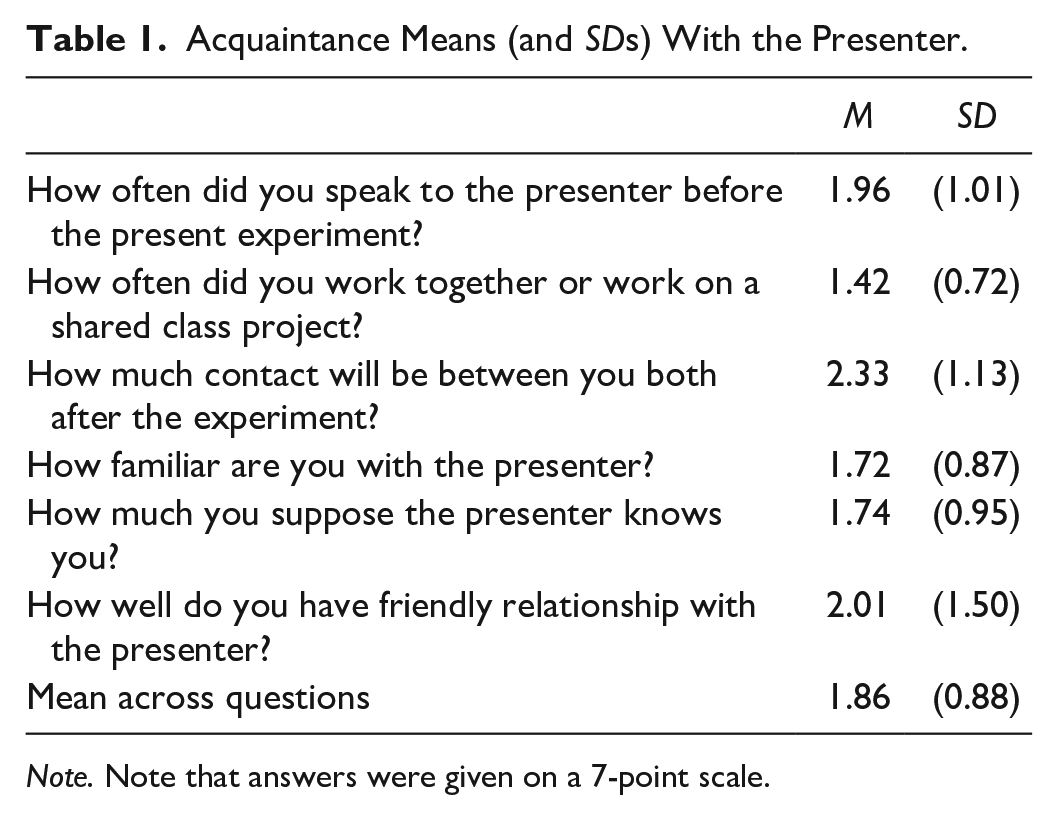
Note. Note that answers were given on a 7-point scale.
Telling and Detecting Performance
We aggregated successful and unsuccessful detection and telling performances (lies and truths) for every participant to create telling and detection indexes. Then, we transformed the successful and unsuccessful behaviors into standard scores relative to the mean and standard deviation of the scores in the session to which the participant belonged. For example, we averaged successful lie-detections of all participants in a specific session and computed the SD. Finally, we created the lie-detection z-score relative to that average and the respective SD. We selected the session as the unit for computing performance indexes because each session is independent of the other sessions, and the evolving inter-personal dynamics in each session may have influenced subsequent telling and detection behaviors. Furthermore, in each session, the gender of participants and the number of non-lying participants changed.
For every participant and each behavior, we received a z-score of true-positive (hits) and false-positive (false alarms) occurrences, which enabled us to use a method derived from Signal Detection Theory to measure the detection efficiency of each behavior across participants. We defined detection efficiency as the degree of separation between the distributions of the z scores of successful and unsuccessful behaviors. Accordingly, we generated Receiver Operating Characteristic (ROC) curves, and the areas under these ROC curves, along with the corresponding 95% confidence intervals (Bamber, 1975). The area statistic reflects the detection efficiency for participants across all possible cutoff points. The area statistic assumes values between 0 and 1 so that an area of 1 indicates that the two distributions are perfectly differentiated, whereas an area of 0.5 indicates that the two distributions cannot be differentiated at all. Table 2 presents ROC statistics computed for lie-and-truth telling and detecting behaviors. Table 2 shows no better than chance ROC areas for all four behaviors (note that the lower bounds of the ROC curve areas are below 0.5 and the upper bounds are above 0.5), and successful and unsuccessful behaviors are not significantly differentiated.
Signal Detection Statistics Computed for Telling and Detecting Behaviors.

Note. CI = confidence interval.
Nine participants were excluded because they chose not to lie.
Another way to analyze the results is by producing an individual performance index for every participant and each behavior. To this end, we computed the difference between z-successful and z-unsuccessful behaviors. The performance indexes were averaged across participants and the following results were obtained: Tell-lies performance, M = 0.06, SD = 1.47; Tell-truths performance, M = 0.08, SD = 1.47; Detect-lies performance, M = 0.01, SD = 1.31; Detect-truths performance, M = −0.37, SD = 1.94. All four performance indexes are not significantly different from 0.
The judges did not detect the small lies, neither were the truths. Presenters were unsuccessful at convincing judges for both lie and truth-telling performances.
Lie-Telling Performance of Single and Double Lie Presenters
Lie-telling performance indexes were computed separately for participants who chose to present a single drawing in the test (single-lie presenters) and participants who exposed both drawings (double-lie presenters). The mean lie-telling performance index for the 31 single-lie presenters was −0.177 (SD = 1.20). (A negative score implies that the z scores computed for unsuccessful lies are larger than the z scores obtained for successful lies.) The mean lie-telling performance index computed for the 60 double-lie presenters was 1.86 (SD = 1.58). The difference is not significant, t(89) = 1.12. However, judges were more confident in judging double-lie presenters (M = 68.5, SD = 8.21) than in judging single-lie presenters (M = 64.9, SD = 6.11), t(89) = 2.16, p = .034, d = 0.48.
Participants adhered to the base-rate distribution of lies (up to 2 of 5), distrusted 39.2% of the messages and believed 60.8% of them. Disbelieving rates were similar for both single-lie presenters and double-lie presenters. Specifically, 39% of the messages of single-lie presenters were disbelieved, and 38% of the messages of double-lie presenters were disbelieved. Notably, 39% of the messages of the nine non-liars were also disbelieved.
Self-Assessed Abilities to Tell and Detect Lies and Truths
Table 3 presents statistics of self-assessed abilities. It appears that all four self-assessed abilities were above average (the lower bound of the 95% Confidence Interval is greater than the mid-point 50). Previous studies indicated that self-assessed lie-telling abilities vary and are sometimes rated lower than average (Elaad, 2018). The present results show that self-assessed lie-telling is rated higher than average.
Means, SDs, and Other Statistics of Self-Assessed Abilities to Tell and Detect Lies and Truths.

Note. N = 100; CI = confidence intervals are based on standard error units.
A one-way repeated measures ANOVA was used to examine differences between the four self-assessed lie- and truth-related abilities. After correcting for sphericity (ε = .68), a significant ability effect (F(2.0,201.8) = 16.3, p < .001, η2 p = .14) emerged, indicating that the differences in self-assessed abilities are substantial. Truth-telling abilities are usually rated higher than other abilities (Elaad, 2009, 2015). Therefore, we performed a planned orthogonal Helmert contrast to compare truth-telling ratings with the mean ratings of the remaining three abilities. The difference is significant, (F(1,99) = 90.1, p < .001, η2 p = .48). Results indicate that the high truth-telling ability assessments are partly responsible for the obtained differences. Similarly, lie-telling abilities are typically rated lower than the other abilities. Another planned orthogonal Helmert contrast was applied to compare lie-telling ratings with the mean ratings of the remaining two abilities. Again, the difference is significant, (F(1,99) = 4.2, p < .001, η2 p = .04). Results suggest that the relatively lower assessments of the lie-telling abilities are also responsible for the differences in self-assessed abilities. Finally, no significant difference emerged in comparing lie-detection and truth-detection abilities (F(1,99) = 0.5).
Comparing self-assessed abilities with their corresponding performance index reveals substantial differences, which explains the non-existence of correlations. The correlation between lie-telling ability assessments and the lie-telling performance index was low, r(91) = .146. Similarly, truth-telling ability assessments did not correlate with the performance index in convincing judges with truthful messages, r(100) = −.007. Finally, self-assessed lie-detection and truth-detection abilities also produced low and insignificant correlations with their respective performance indexes, r(100) = −.085 and .194, respectively.
Results support the notion that self-assessed lie- and truth-related abilities are biased and suggest that people are unaware of their actual lie- and truth-related abilities. Nevertheless, people are often influenced by their biased assessments when making decisions (Bandura, 1977).
Finally, we expected that lie-telling frequency (the number of lies participants chose to tell regarding their drawings, ranged between 0 and 2) would correlate with the self-assessed ability to tell lies convincingly. However, the obtained correlation was insignificant, r(100) = 1.77, p = .078.
Narcissism
NPI scores (M = 3.08, SD = 0.54) show no unusual narcissistic features in this sample, which suggests that being a student implies some degree of adaptive personality traits such as higher cognitive abilities and a tendency to comply with standards of academic integrity (e.g., avoid cheating, plagiarism, and misrepresentation).
Lie-telling frequency correlated positively with narcissism, r(100) = .24, p = .019. Specifically, participants with higher narcissism scores tended to lie more while presenting the drawings than participants with lower narcissism scores.
Narcissism did not correlate with any of the performance indexes computed for lie- and truth-related abilities.
REI Questionnaire
An analysis of the responses to the REI questionnaire reveals that rational processing style (M = 3.50, SD = 0.52, 95% CI [3.39, 3.60]) and experiential processing style (M = 3.76, SD = 0.45, 95% CI [3.67, 3.85]) are both above average. Using a paired sample t-test, t(99) = 3.95, p < .001, shows that the mean experiential style scores were significantly higher than the mean rational style scores.
We hypothesized that a reported preference for intuitive decision-making would predict the performance index in lie detection of simple low stake lies.
Four multiple regressions, one for each performance index, were applied to test the hypothesis. The two REI scales were entered as independent variables. A significant hierarchical regression model for predicting lie-detection performance, F(2, 97) = 4.22, p = .018, explained 8% of the variance. Table 4 shows that higher levels of intuitive processing style contributed to the effect.
Statistics Describing the REI Predictions of the Four Performance Indexes.

The hierarchical regression models computed for predicting the lie- and truth-telling performance and the truth-detection performance were not significant (F(2, 88) = 0.99, F(2, 97) = 0.64, and F(2, 97) = 1.01, respectively).
Finally, the two processing style scales were correlated with truth judgment frequency. No significant correlations were obtained, r(100) = −.08 and −.01 for the rational and experiential scales, respectively. Thus, results did not support the notion that rational people will tend to consider the base rates of truthful and deceptive messages and make more truthful decisions than low rational scorers who pay less attention to the base rates and make less truthful judgments.
Estimations of the Number of Judges Who Detected the Participant’s Lies
After presenting the bundle of drawings, participants were asked to estimate how many of the four judges detected at least one lie they told. Single-lie presenters may give different answers to this question than double-lie presenters. We computed mean detection estimates made by single- and double-lie presenters to examine this notion.
Results show that participants estimated that, on average, 2.00 (SD = 1.26) and 1.78 (SD = 1.18) judges, respectively, detected at least one lie. The difference is not significant, t(89) = 0.82.
It was therefore decided to combine single- and double-lie presenters into a single sample. The estimated number of judges who detected at least one lie did not correlate with any of the four performance indexes. Results suggest that participants were not accurate in their estimations. However, these estimations correlated negatively with self-assessed lie-telling abilities (r(91) = −.238, p = .023), self-assessed lie-detecting abilities (r(91) = −.322, p = .002), self-assessed truth-telling abilities (r(91) = −.230, p = .028), and with narcissism (r(91) = −.270, p = .010).
Other Associations
Table 5 presents correlations computed for the various scales used in the present study. Narcissism, self-assessed lie-telling abilities, self-assessed lie-detecting abilities, and self-assessed truth-telling abilities are all significantly and positively correlated. Results support previously reported accounts (Elaad, 2019b; Elaad et al., 2020; Zvi & Elaad, 2018). The positive association between narcissism and the rational REI processing scale, and the significant positive association between rational thinking style and lie-telling ability assessments, are new contributions to the existing knowledge.
Correlations Between Narcissism, Self-Assessed Lie- and Truth-Related Abilities, and Thinking Styles.
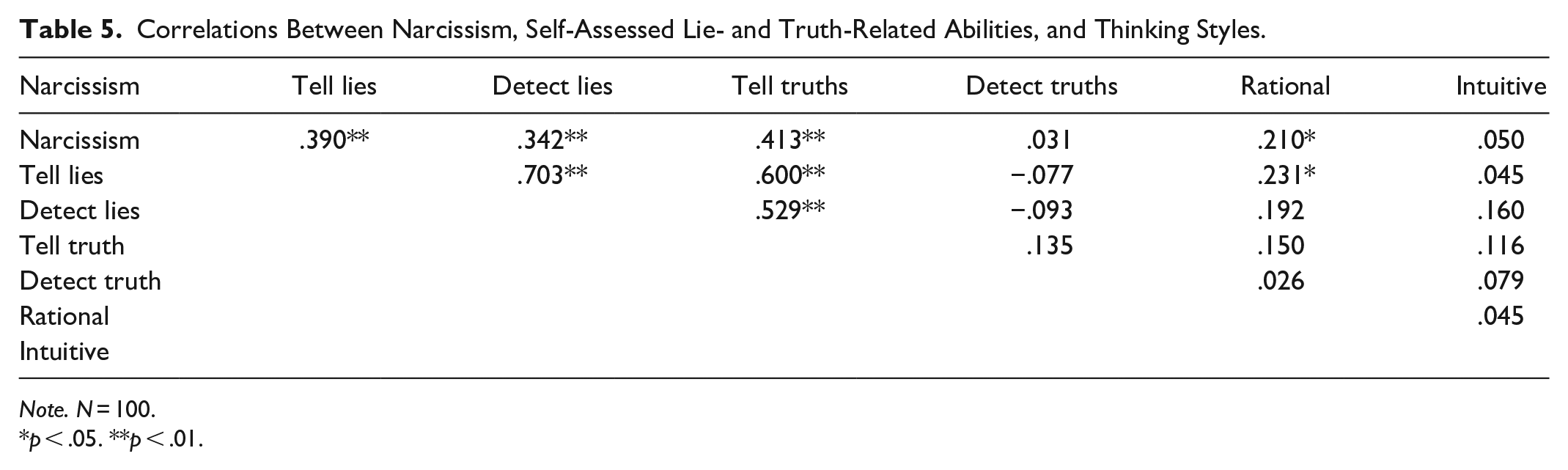
Note. N = 100.
p < .05. **p < .01.
Discussion
In the present study, participants frequently believed the messages. We expected the frequent believing behavior because of the base rates of truths (more frequent) and lies (less frequent). Specifically, participants knew in advance that presenters would lie about no more than two of five drawings. Hence, truthful messages were expected in more than 60% of the presentations. The acquaintance between presenters and judges, and different levels of trust in single- and double-lie presenters, were ruled out as possible explanations for the recurrent believing behavior.
The performance indexes used in the present study show no significant detection. Specifically, participants in the role of judges guessed. Presenters did not convince judges of their truthful messages and did not lie successfully. One explanation is that people are poor liars, truth-tellers, and poor detectors of lies and truths.
Another explanation links the results to the experimental situation. Under low stakes, we tend not to conceal lies and convince others when telling the truth. We also spend little in separating lies from truths. Finally, we may suggest that the effects are too small for the present sample to detect. It seems that all explanations can be applied here. We are poor lie catchers (Bond & DePaulo, 2008), and therefore we invest little effort in lie detection. Instead, we tend to believe the messages. The result is that small and unimportant lies with no severe consequences to which we feel no regret and no fear of being detected (DePaulo et al., 2003) go undetected. Still, Bond and DePaulo (2008) reported a small lie detection effect that we could only detect in a much larger sample.
Self-assessed abilities to tell and detect lies and tell truths are highly correlated. The exception is self-assessed truth-detecting abilities. Nevertheless, all four self-assessments failed to predict their respective performance indexes. Previous notes indicated that these self-assessments were biased (Elaad, 2018, 2019b), and except for the self-assessed lie-telling abilities, they have been rated higher than average. The current results are in line with these previous results. The belief that telling persuasive lies is difficult partly explains the relatively low self-assessments of lie-telling abilities. Lying is difficult because the liar must fabricate a new and never-experienced tale. Although the formulation of some lies is easy, difficult lies are more available than easy lies. Furthermore, people think they can consider themselves honest if they are not capable liars.
Self-assessed abilities potentially influence everyday life events. Bandura (1977) noted that perception of one’s skills influences cognition, behavior, and emotions. Bandura called this self-efficacy. The concept of self-efficacy refers to people’s belief in their ability to achieve their goals. The present results suggest that people think and act on the false conceptions that they are above average lie-detectors and are more capable than others of discerning people’s truth-telling.
Narcissism did not predict performance either. However, significant positive correlations between narcissism and self-assessments of lie-and truth-telling abilities emerged. Narcissism also showed a positive correlation with self-assessed lie-detection abilities. The current results, obtained from a sample with a clear female majority, replicated previous results (Zvi & Elaad, 2018) that examined only males and therefore suggest that gender differences are not relevant to the link between narcissism and self-assessed lying abilities. Specifically, narcissistic individuals, either males or females, tend to lie more and attribute strong lie-telling and lie-detection abilities to themselves. They are also confident that they are able truth-tellers. Other studies (Elaad et al., 2020; Giammarco et al., 2013) reported similar associations between narcissism and self-assessed lying abilities. Hence, Giammarco et al. (2013) noted that narcissistic individuals believe themselves to be better liars than the average person.
A general association between narcissism, lying, and unethical behavior in various everyday life situations has already been established (Azizli et al., 2016; Baughman et al., 2014; Jonason et al., 2014). Oliveira and Levine (2008) reported positive attitudes of narcissists toward deceptive communications. Accordingly, we found a tendency of narcissists to lie about two pictures in the present study (frequent deception).
In summary, the present results indicate a strong link between narcissism and self-assessed lie- and truth-related abilities, suggesting that these abilities are aligned with narcissism (Elaad et al., 2020).
The present results contribute to the existing knowledge by showing a positive association between narcissism, lie-telling ability assessments, and the rational REI processing scale.
Elaad (2019a) examined police investigators assigned to the role of imagined innocent suspects and reported that they tended to select plausible lies rather than less plausible truths to convince others of their innocence. In contrast, laypeople preferred to tell implausible truths. Investigators self-assessed lie- and truth-related abilities significantly higher than did laypeople. It seems that police investigators are biased toward statement plausibility because they believe that plausibility coordinates with the truth. Grounding decisions on plausibility involves a combination of rational thinking and confidence in one’s lie-telling and lie-detecting abilities. The results of Elaad’s (2019a) study contribute to a better understanding of the present significant correlation between REI rational scale scores and lie-telling ability assessments.
Finally, the present study is a laboratory study with low stakes. Participants were aware that they were participating in a deception game with no severe consequences.
A distinction between small and big lies may be helpful here. Most lies in the real world are small lies that often go undetected. In contrast, big lies that entail mental effort to maintain the fake story, remember what was said earlier to whom and under which circumstances, and convey a logical sequence of events (Vrij, 2008) are less common, but people remember them better, and therefore they are subject to the availability heuristic. The current study examined small lies with no severe consequences, which should not be confused with big lies. Therefore, the present results should be considered only in the context of small lies.
Research Limitations and Suggestions for Future Research
Slessor et al. (2014) showed that individuals trusted those in their age group. It follows that being a young student might have influenced the link between narcissistic traits, perceived lie/truth-related abilities, and lie/truth performance. Further, being a student may imply a degree of adaptive personality attributes such as higher cognitive abilities, adhering to academic standards, and the accountability to carry out tasks promptly, which may imply acting more honestly (Ruffle & Tobol, 2017). The sample of mainly female participants may have a similar effect on lie/truth performance (see a meta-analysis by Capraro, 2018). In contrast, other accounts reported that young students behave more dishonestly than a more representative sample of the population (e.g., Abeler et al., 2014; Fosgaard, 2020). Therefore, replicating the present study with a more heterogeneous sample is recommended.
The present study is mainly correlational, and the association between narcissism, lie/truth-related ability scores, and thinking styles are cross-sectional. Therefore, the direction of influence is unknown. We recommend resolving this issue in future research.
Finally, self-reports studies may suffer from social desirability and self-presentation problems which bias the ratings of the lie- and truth-telling abilities. Nevertheless, it seems that in the present study, participants believed in their ability estimates and let them guide their actions.
Footnotes
Declaration of Conflicting Interests
The author declared no potential conflicts of interest with respect to the research, authorship, and/or publication of this article.
Funding
The author received no financial support for the research, authorship, and/or publication of this article.
