




Abstract
The present study investigated how humor styles moderate the associations between rumination and mental health (depressive symptoms, satisfaction with life, and positive mental health) in community residents. Participants (N = 382) were assessed with the Ruminative Response Scale (RRS), Humor Styles Questionnaire (HSQ), Center for Epidemiological Studies Depression Scale (CES-D), Satisfaction With Life Scale (SWLS), and Positive Mental Health Scale (PMH-scale). Hayes’ PROCESS macro revealed that rumination had a direct effect on depressive symptoms and was moderated by affiliative humor, self-enhancing humor, and aggressive humor, respectively. The relationship between rumination and satisfaction with life was moderated by self-enhancing humor, aggressive humor, and self-defeating humor, respectively. Affiliative humor, self-enhancing humor, and aggressive humor were moderators in the relation between rumination and positive mental health. This study revealed that different humor styles have varying impacts between rumination and mental health. It is crucial for healthcare professionals to promote the importance of using adaptive humor styles to improve mental health.
Introduction
Rumination occurs when a person focuses on negative and repetitive thoughts of distressing symptoms and its possible causes and effects (Nolen-Hoeksema & Morrow, 1993). Rumination is considered to be a trait-like characteristic and is present as a spectrum in both the depressed and general population (Lavender & Watkins, 2004; Moberly & Watkins, 2008; Smith et al., 2009). Many studies found that a higher rumination level was correlated with depression and anxiety (Berman et al., 2011; Hamilton et al., 2011; Vanhalst et al., 2012), especially in the clinical population (Hanssen et al., 2018; Ruscio et al., 2015). The results by Wilkinson et al. (2013) found that higher rumination scores predicted significantly more depressive symptoms among healthy adolescents at a 12-month follow-up. Gan et al. (2015) revealed that rumination was a significant predictor for depressive symptoms of elderly adults in nursing homes at a 6-month follow-up. A longitudinal study found that rumination predicted a residual change of depressive symptoms in community adults (Whisman et al., 2020). Zanon et al. (2016) demonstrated that life satisfaction was negatively correlated with rumination in university students. Self-rumination was negatively associated with happiness in university students (Sariçam, 2016). These results imply that an individual who is healthy but has the tendency to ruminate may easily become depressed. In addition to focusing on the impact of rumination on depression, this study also examined the relationship between rumination and positive mental health in community adults.
Martin et al. (2003) addressed that multidimensional humor styles reflected the ways people habitually used humor in daily life, which may have adaptive and maladaptive consequences (Kuiper et al., 2004). Several studies showed that affiliative and self-enhancing humor were negatively correlated with psychological disturbances, such as perceived stress, loneliness, suicide ideation and depressive, and anxiety symptoms in university students (Cann et al., 2010; Fitts et al., 2009; Tucker, Judah et al., 2013; Tucker, Wingate et al., 2013). Dyck and Holtzman (2013) found that these two types of positive humor styles were correlated with greater well-being, while self-defeating humor was associated with worse well-being among undergraduate students. The results by Ford et al. (2014) indicated that self-enhancing and affiliative humor were positively associated with happiness, while the two negative humor styles (self-defeating and aggressive) were negatively associated with happiness in community adults. A meta-analytic study indicated that affiliative and self-enhancing humor styles were positively associated with mental health (self-esteem, life satisfaction, optimism, depression) while self-defeating humor was negatively associated with mental health. However, aggressive humor was not correlated with mental health (Schneider et al., 2018). Therefore, positive and negative humor styles may have different effects on mental health and well-being.
One study found that among undergraduate students with high rumination, those with high affiliative and/or self-enhancing humor styles scored significantly lower levels of depressive symptoms than individuals with low affiliative and/or self-enhancing humor (Olson et al., 2005). However, to our knowledge, there is a lack of investigation between the effect of rumination and humor styles on depressive symptoms among community adults. The relationships between rumination and humor styles are important for understanding the impact of rumination and humor styles on depression and positive mental health in community adults.
The first purpose of this study was to explore (1) the moderating effect of humor styles on the relationships between the rumination of mental health in community adults. The present study has the following hypotheses: (a) different humor styles may moderate the relationship between rumination and depressive symptoms. (b) different humor styles may have a moderation effect between rumination and satisfaction with life. (c) The relationship between rumination and positive mental health may be moderated by different humor styles. Figure 1 provided a conceptual model of the moderation effect of these proposed associations. The second purpose of this study was to investigate (2) the differences between rumination, humor styles and mental health in young, middle-aged, and elderly adults.

A conceptual model of the proposed relationships between study variables.
Method
Participants and Procedures
The study protocol was reviewed and approved by the Kaohsiung armed forces general hospital institutional review board. Prior to receiving assessments, written informed consent was obtained from all participants. Researches recruited 382 adults through a combination of posters, email newsletters, and online advertising in Kaohsiung city, Taiwan. Participants were excluded if they are currently receiving psychiatric medication or have a physical disease (including cancer and nervous system diseases) which may impact their perceived mental health. Of the total 382 participants, there were 146 (38.2%) men and 226 (61.8%) women. We divided these participants into three groups: young (ages 20–39; n = 148), middle-aged (ages 40–59; n = 155) and elderly adults (ages 60 and above; n = 79).
Measures
Ruminative Response Scale (RRS)
The Ruminative response scale has good internal consistency and validity and was employed to measure rumination (Nolen-Hoeksema & Morrow, 1991). The scale contains 22 items, and participants are asked to rate the extent of different aspects of rumination. These responses included focusing on self (reflection), depressive symptoms (depression-related rumination), and the causes and consequences of the mood (brooding) on a four Likert scale from 1 (“almost never”) to 4 (“almost always”). Total scores ranged from 22 to 88, with higher scores indicating higher levels of ruminative coping responses (Treynor et al., 2003). The original scale was translated into Mandarin Chinese and participants received the RSS—Chinese version. Internal reliability of this RSS is Cronbach’s α = .93.
The Humor Styles Questionnaire (HSQ)
The humor styles questionnaire (HSQ) is a 32-item self-report questionnaire which includes four subscales: affiliative humor (e.g., “I don’t often joke around with my friends”) (this was coded as a reverse item), self-enhancing humor (e.g., “Even when I am by myself, I am often amused by the absurdities of life”), aggressive humor (e.g., “If someone makes a mistake, I will often tease them about it”), and self-defeating humor (e.g., “I let people laugh at me or make fun at my expense more than I should”). Participants are asked to rate the extent to which they agree with the statements on a 7-point Likert-type scale from 1 (“Totally disagree”) to 7 (“Totally agree”). The HSQ has shown good reliability and validity and higher scores indicated that participants have a particular humor style (Martin et al., 2003). The original scale was translated into Mandarin Chinese and participants received HSQ—Chinese version. Internal reliability of the HSQ is Cronbach’s α = .76.
Center for Epidemiological Studies Depression Scale (CES-D)
The Center for epidemiological studies-depression (CES-D) scale is a 20-item questionnaire used to evaluate the frequency of depressive symptoms in the previous week. Participants are asked to rate these statements on a 4-point Likert scale ranging from 0 (rarely or none of the time) to 3 (most or all the time). Total scores can range from 0 to 60; scores of 16 and higher indicated greater depressive symptoms, suggesting such individuals at risk for clinical depression (Radloff, 1977). The Chinese version of the CES-D was used in this study (Chien & Cheng, 1985).
The Satisfaction with Life Scale (SWLS)
The Satisfaction with life scale is a 5-item questionnaire measured on a 7-point Likert-type scale and assesses global cognitive judgments of satisfaction with one’s life. Some example questions from the scale include: “In most ways my life is close to my ideal,” and “Generally speaking, my life is close to my ideal.” Higher scores indicated a higher life satisfaction (Diener et al., 1985). The original scale was translated into Mandarin Chinese and participants received SWLS—Chinese version. Internal reliability of this SWLS is Cronbach’s α = .93.
The Positive Mental Health Scale (PMH-scale)
The 9-item Positive mental health scale was used to assess emotional aspects of well-being related to positive mental health. Participants were asked to respond to statements such as “I am often carefree and in good spirits,” “All in all, I am satisfied with my life,” “I am in good physical and emotional condition,” “I feel that I am actually well equipped to deal with life and its difficulties” on a scale ranging from 0 (I disagree) to 3 (I agree) (Lukat et al., 2016). The original scale was translated into Mandarin Chinese and participants received the PMH—Chinese version. Internal reliability of this PMH-scale is Cronbach’s α = .91.
All statistical analyses were performed using SPSS 25.0 software and Hayes’ PROCESS macro. Mean standard deviation and percentages were calculated. For all significant effects, an alpha level of .05 was applied. We performed Pearson correlation among rumination, humor styles, depressive symptoms, satisfaction with life, and positive mental health. The Student’s t-test and one way ANOVA were used to examine group differences in parametric variables. Moderation analysis was performed by the means of regression analysis with bootstrapping using the Hayes PROCESS macro model 1 (Baron & Kenny, 1986; Hayes, 2013). A moderation analysis was used to assess the association between the independent variable (IV) (rumination), dependent variables (depressive symptoms, satisfaction with life, and positive mental health), and hypothesized moderator (MR) (humor styles) (Baron & Kenny, 1986). The PROCESS calculates direct, two-way interaction effects for low (−1SD), mean (M) and high (+1SD) levels of the moderators, as well as their confidence intervals (CIs) and bootstrapping application (1,000 samples). The test of slope differences was performed if the interaction was significant (Dawson, 2014). Moderation models were adjusted for the covariates of age and sex in the regression.
Results
Descriptive Statistics
Demographic characteristics and clinical measures of 382 participants are presented in Tables 1 and 2. Most participants were married (65.2%), employed (74.6%) and had an education level of senior high school (91.6%).
Characteristics of Study Participants (N = 382).

Description of Means, Standard Deviations of Clinical Measures (N = 382).

Note. CES-D = Center for Epidemiological Studies Depression Scale; SWLS = The Satisfaction with Life Scale; PMH-scale = The Positive Mental Health Scale.
Rumination had a moderate positive correlation with depressive symptoms. Rumination had a moderate negative correlation with satisfaction with life and positive mental health, respectively. Rumination was found to have a weak negative correlation with affiliative humor and self-enhancing humor subscales, and a weak positive correlation with self-defeating humor subscales. Affiliative humor and self-enhancing humor subscales had a weak negative correlation with depressive symptoms and a weak positive correlation with satisfaction with life and positive mental health, respectively.
Aggressive humor and self-defeating humor subscales had a weak positive correlation with depressive symptoms, respectively. Aggressive humor was found to have a weak negative correlation with satisfaction with life (Table 3) (Note: .10–.39 (−.10 to −.39); weak positive (negative) correlation; .40–.69 (−.40 to −.69): moderate positive (negative) correlation, Mukaka, 2012; Overholser & Sowinski, 2008).
Correlations of Clinical Characteristics of Participants (n = 382).

Note. CES-D = Center for Epidemiological Studies Depression Scale; SWLS = The Satisfaction with Life Scale; PMH-scale = The Positive Mental Health Scale.
p < .05. **p < .01
Difference in Clinical Measures of the Age and Gender Groups
The elderly group had higher scores of satisfaction with life than the young and middle-aged groups (p < .05). Females had higher scores of positive mental health than males (p < .05) (Table 4).
Distribution of Average Score of Clinical Characteristics on Age Group and Gender (n = 382).

Note. CES-D = Center for Epidemiological Studies Depression Scale; SWLS = The Satisfaction with Life Scale; PMH-scale = The Positive Mental Health Scale.
p < .05. **p < .01. ***p < .001.
Humor Styles as a Moderator of Rumination and Mental Health
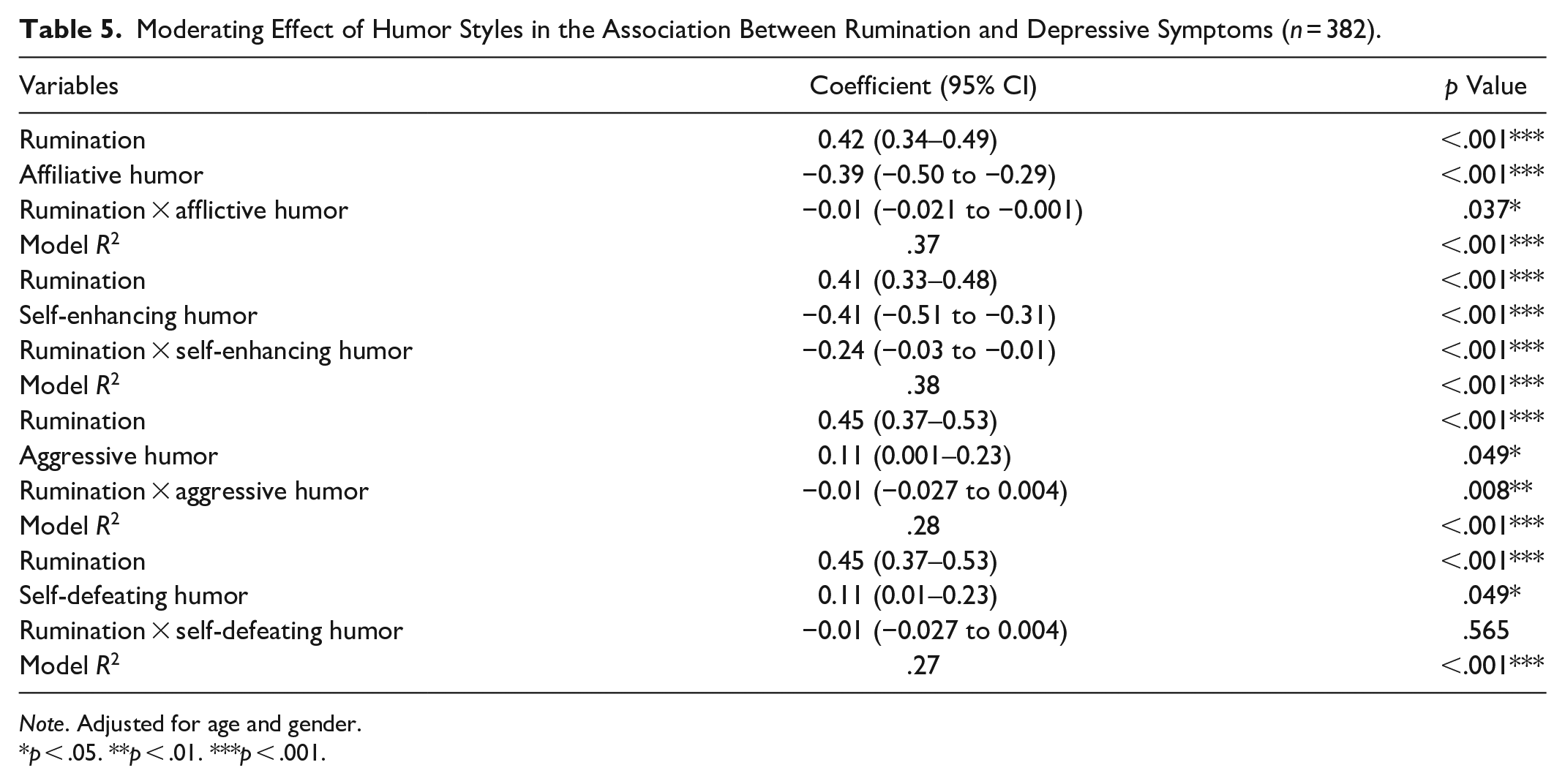
As summarized in Table 5, affiliative humor, self-enhancing humor, and aggressive humor moderated the relationship between rumination and depressive symptoms, respectively (b = −0.01, p = .037; b = −0.24, p < .001; b = −0.01, p = .008). Self-defeating humor did not moderate the relationship between rumination and depressive symptoms (b = −0.01, p = .565). The main effect of rumination was also significant in each association, respectively (b = 0.42, p < .001; b = 0.41, p < .001; b = 0.45, p < .001). The interaction effect of the affiliative humor, self-enhancing humor, aggressive humor, and rumination on depressive symptoms are shown in Figure 2, meaning that as the affiliative humor and self-enhancing humor increase, there is less negative impact between rumination and depressive symptoms, respectively and when the aggressive humor increases, there is more negative impact between rumination and depressive symptoms.
Moderating Effect of Humor Styles in the Association Between Rumination and Depressive Symptoms (n = 382).
Note. Adjusted for age and gender.
p < .05. **p < .01. ***p < .001.

Affiliative humor, self-enhancing humor, and aggressive humor as a moderator of rumination and depressive symptoms in community adults, respectively.
Based on Tables 6 and 7, it can be confirmed that self-enhancing humor, aggressive humor, and self-defeating humor moderated the relationship between rumination and satisfaction with life, respectively (b = 0.01, p < .001; b = 0.014, p = .007; b = 0.009, p = .026). Affiliative humor was not a moderator between rumination and satisfaction with life (b = −0.002, p = .663). Affiliative humor, self-enhancing humor, and aggressive humor moderated the relationship between rumination and positive mental health, respectively (b = 0.006, p = .039; b = 0.01, p < .001; b = 0.008, p = .007). The main effect of rumination was also significant in each association, respectively (b = −0.17, p < .001; b = −0.15, p < .001; b = −0.18, p < .001). The interaction effects of self-enhancing humor, aggressive humor, self-defeating humor, and rumination on satisfaction with life were shown in Figure 3, respectively, suggesting that people with higher levels of self-enhancing humor reported high rumination and higher satisfaction with life; when aggressive humor increased, there is more negative impact between rumination and satisfaction with life. People with higher levels of self-defeating humor reported low rumination and lower satisfaction with life.
Moderating Effect of Humor Styles in the Association Between Rumination and Satisfaction With Life (n = 382).

Note. Adjusted for age and gender.
p < .05. **p < .01. ***p < .001.
Moderating Effect of Humor Styles in the Association Between Rumination and Positive Mental Health (n = 382).

Note. Adjusted for age and gender.
p < .05. **p < .01. ***p < .001.
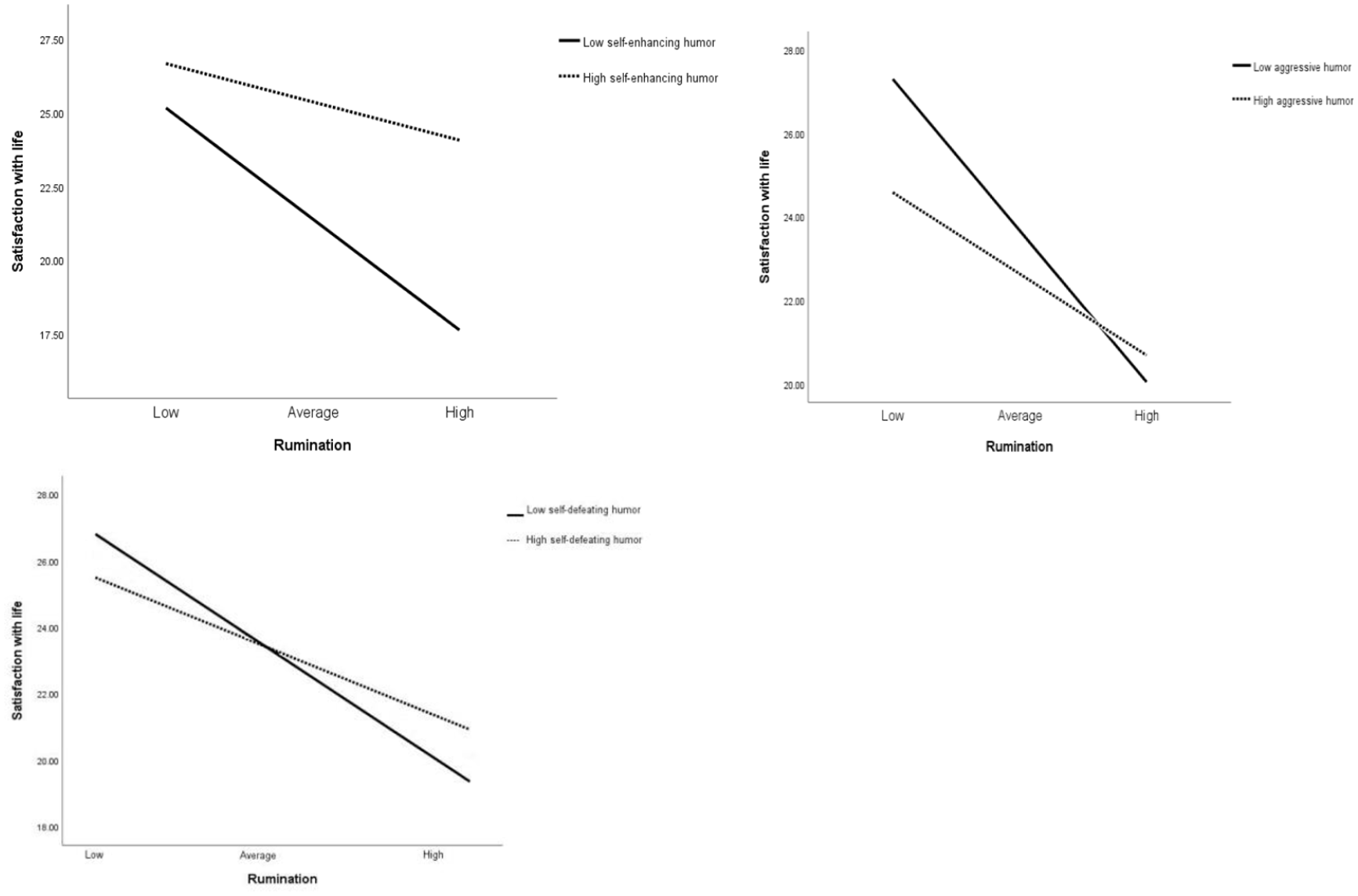
Self-enhancing humor, aggressive humor, and self-defeating humor as a moderator of rumination and satisfaction with life in community adults.
Figure 4 displayed the two-way interaction effect of affiliative humor, self-enhancing humor, and aggressive humor between rumination and positive mental health, respectively, meaning that when affiliative humor and self-enhancing humor increased, a positive impact between rumination and positive mental health also increased. Additionally, people with higher aggressive humor reported low rumination and lower positive mental health. Self-defeating humor did not moderate the relationship between rumination and positive mental health (b = 0.003, p = .180).
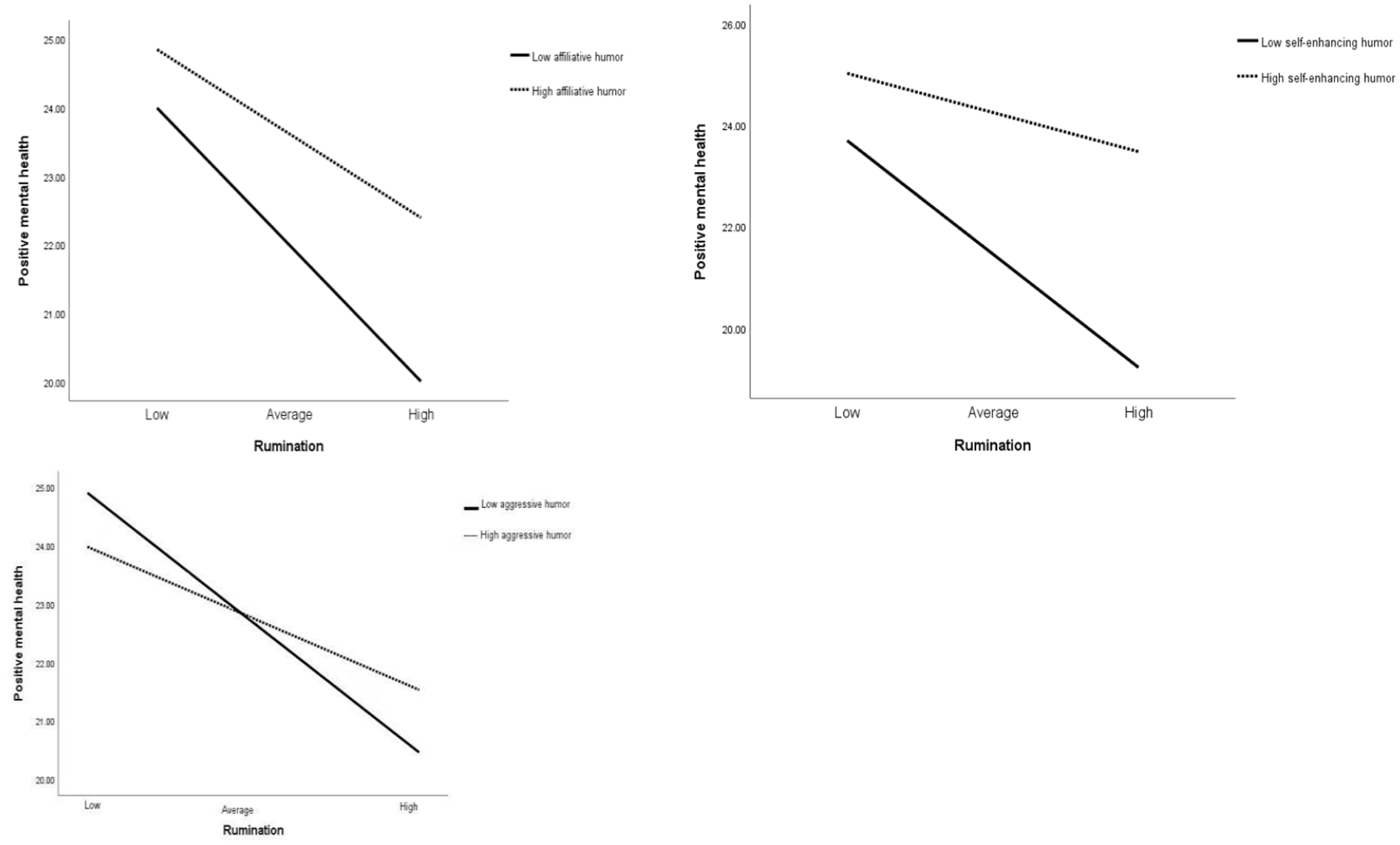
Affiliative humor, self-enhancing humor, and aggressive humor as a moderator of rumination and positive mental health in community adults, respectively.
Discussion
The present study found a direct link between rumination and humor styles and mental health (including depressive symptom, satisfaction with life, and positive mental health), and established the moderation effect of different humor styles in the association.
Consistent with previous studies, we found that among people with high rumination, those with high affiliative or/self-enhancing humor reported significantly lower depressive symptoms than those with low affiliative or/self-enhancing humor (Olson et al., 2005). Rumination was a main effect between the relationship of depressive symptoms, satisfaction with life and positive mental health. Consistent with previous studies that showed people with higher rumination were more likely to experience more depressive complaints (Berman et al., 2011; Gan et al., 2015; Hamilton et al., 2011; Vanhalst et al., 2012; Wilkinson et al., 2013), this study also found that higher depression-related rumination and brooding rumination increased the risk of developing more depressive symptoms and decrease of well-being in community adults. The depression-related rumination is focused on one’s negative mood and thinking and brooding rumination involves current distress from a self-critical perspective (Treynor et al., 2003). Rumination is a cognitive risk factor for mental health. Previous studies suggest that both rumination and negative cognitive styles were positively correlated with depressive symptoms (Ciesla & Roberts, 2007; Robinson & Alloy, 2003). Negative cognitive styles include catastrophizing, emotional reasoning, extremes, labeling, and so on as common cognitive distortions (Beck, 1963, 1987; Knapp & Beck, 2008) and irrational beliefs. The core irrational beliefs is demandingness which refers to absolutistic requirements such as “must’s and should’s” (David et al., 2010; Ellis, 1976), awfulizing beliefs, low frustration tolerance and pervasive negative evaluation about oneself and the world which would affect individuals’ mood and behavior.
In this study, we also found that among individuals with high rumination, those with positive humor styles (affiliative humor or self-enhancing humor) reported higher satisfaction with life and positive mental health, suggesting that people with higher positive humors were more likely to have a positive impact in mental health. Similarly, previous research has also found that self-enhancing humor was related to happiness (Ford et al., 2014). Affiliative humor was considered to facilitate relationships and minimize social tension. Self-enhancing humor includes a tendency for one to be amused by incongruities and have a cheerful outlook in life. These two types of positive humor were associated with emotional well-being, positive affect and negatively associated with depression, anxiety, and rumination (Martin, 2007). We also found that when aggressive humor increases, there was more negative impact between rumination and depressive symptoms, suggesting that people with high aggressive humor who reported high rumination were more likely to have depressive symptoms. When aggressive humor increased, there was more negative impact between rumination and satisfaction with life. Individuals with high self-defeating humor and high aggressive humor who reported low rumination have lower satisfaction and lower positive mental health, respectively. Other studies have similar findings that aggressive humor and self-defeating humor have negative effect on happiness and psychological well-being (Ford et al., 2014; Kuiper & McHale, 2009). In this study, we also found that when people with above a moderate level of rumination have high self-defeating humor and high aggressive humor, they have higher satisfaction with life and positive mental health, respectively. Other results indicated that aggressive humor and self-defeating humor were positively associated with neuroticism personality trait (Martin et al., 2003). The results of Miller et al. (2018) found that vulnerable narcissism and neuroticism shared similar personality characteristics. It is probable that when individuals experience more negative thinking which could lead to an increase of vulnerability, they may amplify self-rated positive mental health. The content of SWLS and PMH included satisfaction with oneself, goals and aspects of life which evaluated global satisfaction. Therefore, further research is needed to explore the moderating effect of self-defeating humor and aggressive humor between rumination and positive mental health.
Limitations
Longitudinal research is needed to examine the moderating effect of humor styles in the relationships between rumination and mental health across the lifespan in community adults. Our results require that caution be taken if trying to infer the study results to clinical samples, especially those diagnosed with severely impaired physical and mental health. The study data were acquired from an urban city and the present study sample was recruited through a non-probability sampling technique; therefore, our results may not be representative of the entire general population. Furthermore, data collected using a self-reported questionnaire might be subjected to social desirability bias.
This study demonstrated that humor styles moderated the relationship between rumination and mental health. The results of this study have important implications for psychotherapy. From a treatment perspective, study results indicated the need to target cognitive distortions toward oneself and to increase the use of positive humor styles to decrease depressive symptoms and improve well-being. Such psychological interventions or humor training may be useful for individuals who have a ruminative cognitive style (Nolen-Hoeksema, 2000; Tagalidou et al., 2019). However, future research is needed to examine the specific mechanisms through which rumination and humor styles may confer risks for mental health.
Footnotes
Declaration of Conflicting Interests
The author(s) declared no potential conflicts of interest with respect to the research, authorship, and/or publication of this article.
Funding
The author(s) disclosed receipt of the following financial support for the research, authorship, and/or publication of this article: This study was supported by Zuoying Branch of Kaohsiung Armed Forces General Hospital, Kaohsiung, Taiwan (ZBH108-36).
