



Abstract
The figure of the doctor has always been surrounded by a heroic aura, warranted by the possession of hard-earned medical knowledge and the tenacious reliance on doctors’ ability to heal and emancipate from pain and suffering. However, recent literary and visual-cultural representations of doctors have unsettled the dominant and homogenized perception of physicians as heroes. Particularly, representations in mainstream books, popular media, and comics, which have predominantly offered unilaterally positive initial portrayals of doctors as superhuman figures, eventually provided people with more nuanced and realistic representations, disclosing the “undesirable and unprofessional attitudes” of physicians and their sufferings. Ian Williams’ graphic narratives The Bad Doctor (2014, Oxford: Myriad Editions) and The Lady Doctor (2019, Oxford: Myriad Editions) serve as a critical lens to reflect on the postmodern perspective of doctor as a “wounded healer” and illuminate the problematic view of physicians as heroes. Drawing instances from the aforementioned graphic narratives, this essay aims to provide a revisionary understanding of physicians from heroes to victims of larger-than-life forces such as bureaucracy and the demands of patients. The essay scrutinizes how the verbal-visual medium of comics facilitates the envisioning and enunciating of the troubled personal and professional lives of physicians and the complexities involved in the medical profession.
In a TED x Naperville talk entitled “Doctors in distress: Saving the Lives of those who Save Lives,” physician Ed Ellison (2017) lays bare the vulnerable and ailing side of “the devoted professionals [physicians]” and emphasizes the gravity of the issue at hand by referring to a clinical survey which estimates the percentage of physicians who are suffering from symptoms of burnout. According to Ellison, the symptoms of burnout are rapidly increasing among doctors because of cultural and professional demands and the complexities of everyday work in an “unforgiving environment” (Williams, 2014). The qualities expected of physicians, specifically to be “emotionally strong and perceive any expression of vulnerability and insecurity as unbefitting” (Venkatesan & Peter, 2017, p. 198), demand them to transcend their frailties, which in turn contribute to their misery. The ruthless privatization and bureaucratization of the medical sector further erode physicians’ authority and add to their mental stress. These unexplored aspects of the medical profession find expression in Ian Williams’ graphic narratives The Bad Doctor (2014) and The Lady Doctor (2019). These texts can be read in the context of a selective history of graphic medicine and the transitions that have occurred in the representation of doctors in comics and popular media.
Revisiting Graphic Narratives and Graphic Medicine
According to Czerwiec et al. (2015), attempts to define the comics medium has emerged in part from its disregard in the United States as a low art form for most of the twentieth century (p. 32). For a long time, comics were regarded as “disposable entertainments” and as “the trashy heirs of pulp magazines, written for the masses and churned out for profit” (Czerwiec et al., 2015, p. 32). In 1960, Richard Kyle, a prominent and outspoken member of the growing book fan community, “advocated using the term ‘graphic story’ and ‘graphic novel’ to distinguish serious work from run-of-the-mill newsstand comics books” (Duncan et al., 2016, p. 64). Followingly, the term, graphic novel, referred to “longer comics with literary intent” (Duncan et al., 2016, p. 64). With the publication of Will Eisner’s (1978) A Contract with God, the term gained popularity. Subsequently, the term earned respectability with the appearance of three influential comics namely Art Spigelman’s (1980) Maus, Frank Miller’s (1986) Batman: The Dark Knight Returns, and Alan Moore and David Gibbons’ (1986) Watchmen. Underscoring the intended purpose of the term, Roger Sabin (1993) states that, “the idea of an evolution from ‘comics’ to ‘graphic novels’ had a specific purpose—to add prestige to the form and thus to sell more product” (p. 235). Put boldly, the term graphic novel represents a “name-brand that bids at a quick respectability that can somehow magically shed old stigmas and misconceptions” (Czerwiec et al., 2015, p. 30).
Coined by a British physician and comics artist Ian Williams, graphic medicine refers to “the intersection of the medium of comics and the discourse of healthcare” (Czerwiec et al., 2015, p. 1). As a subgenre of graphic narratives and as a subfield of health humanities, graphic medicine, which initially referred to comics’ role in health care, eventually became “the accepted term for this area of study and practice” (graphicmedicine.org, n.d.). As opposed to the limited scope of graphic novels, graphic medicine, as Williams (n.d.) claims, includes “graphic memoirs of illness, educational comics for both students and patients, academic papers and books, gag strips about healthcare, graphic reportage and therapeutic workshops involving comic making, as well as many other practices and source material, both fictional and non-fictional” (graphicmedicine.org).
Moreover, graphic medicine is closely tied to the field of health humanities and narrative medicine. Similar to health humanities, the interdisciplinary field of graphic medicine challenges reductionist approaches in health care. According to Williams (n.d.), the word “medicine” in the term graphic medicine does not foreground the physician and the medical profession over patients and other health professionals, rather it suggests therapuetic potential of the comics medium (graphicmedicine.org). Underscoring graphic medicine’s closer relevance to narrative medicine, Czerwiec et al. (2015) also observe, “graphic medicine combines the principles of narrative medicine with an exploration of the visual systems of comic art, interrogating the representation of physical and emotional signs and symptoms within the medium” (p. 1). However, graphic medicine in health care exceeds the expectations of medical/health humanities and narrative medicine in that the comics efficiently, viscerally, and economically convey various experiential truths of sufferers.
According to David B. Morris (2000), in the postmodern era, “discourses and social codes assume material form in stories, so that narratives provide a complex lens into the cultures and discourses that (as much as individual authors) produce them” (p. 7). The realization of narratives as a powerful medium to communicate the experiences of health and illness has led to an “innovative postmodern study of narrative in medicine” (Morris, 2000, p. 7). One of the crucial developments that recognize the significance of narratives in medicine is narrative medicine, founded by a physician and a literary scholar Rita Charon (2006), that implements a form of health care that “recognizes suffering, provides comfort, and honors the stories of illness” (p. ix). Along these lines, graphic medicine, an offshoot of narrative medicine, explores the subjective aspects of health and illness using comics medium. Williams observes the relation between narrative medicine and graphic medicine thus, “graphic medicine combines the principles of narrative medicine with an exploration of the visual system of comic art, interrogating the representation of physical and emotional signs within the medium” (Czerwiec et al., 2015, p. 1). The postmodern characteristic of graphic medicine to convey the experiential truths from the sufferer’s perspective “challenges the dominant methods of scholarship in healthcare” (Czerwiec et al., 2015, p. 2).
Graphic medicine, an interdisciplinary field which binds medicine and comics, is “an ideal way of exploring taboo and forbidden areas of illness and health care” (Czerwiec et al., 2015, p. 3), which are otherwise glossed over by the “biomedical-reductionist approach.” As Czerwiec et al. (2015) observe, graphic medicine offers “a more inclusive perspective of medicine, illness, disability, caregiving and being cared for” (p. 93). In his 2016 review of the Graphic Medicine Manifesto Venkatesan observes that graphic medicine is “an emerging area of an interdisciplinary field which explores comics” distinctive engagement with and performance of illness experience (p. 93). Graphic medicine combines “subjective feelings and perception with objective representation” and, in so doing, disrupts the standard approaches of comprehending and visualizing illness and disease (Czerwiec et al., 2015, p. 19). In giving prominence to the experiential truths of patients, caregivers, and physicians, graphic medicine unfolds “unvoiced relationships, unarticulated emotions, unspoken possibilities and even unacknowledged alternative perspectives” which are often overlooked by the traditional monolithic and reductionist medical system (Squier, 2008, p. 130). The key practitioners of graphic medicine include Michel J. Green, Kimberly R. Myers, Scott T. Smith, Susan Merrill Squier, Ian Williams, and M.K. Czerwiec. Graphic medical narratives are predominantly autobiographical memoirs and address various themes such as the doctor–patient relationship, caregiving, medical negligence, patient identity, and the bureaucratization and commercialization of health care, among other subjects.
Representation of Physicians in Popular Media and Comics
As arbitrators of life, doctors (be it healers, shamans, or modern-day physicians) stand for hope, authority, reliability, and heroism across cultures. The figure of the doctor has long been a prominent subject in literature, art, and popular culture. Deborah Lupton (2003) in Medicine and Culture observes that, the linguistic and visual representations of medicine, illness, disease and the body in elite and popular culture and medical and scientific texts are influential in the construction of both lay and medical knowledge and experience of this phenomenon. (p. 83)
With George Eliot’s novel Middlemarch, published in 1872 but set in 1829, the depictions of physicians in mainstream books “took a definitive turn from a stock comic character to the physician as a hero” (McLellan, 1996, p. 458). In addition, Luke Filde’s (1891) Victorian narrative painting, The Doctor, “helped to shape an evolving medical professional identity over the latter third of the nineteenth century” (Milligan, 2016, p. 642). The painting represents medicine as “self-sacrificing,” “altruistic, nurturing, and heroic professionalism in general” (Milligan, 2016, p. 642). From the 1920s to 1940s, “popular medical history blossomed in a remarkable number of books, films, and other media” (Hansen, 2004, p. 152). Twentieth-century novels began to explore both virtuous and diabolic aspects of the medical profession and physicians. Stories such as Sinclair Lewis’s (1925) Arrowsmith and AJ Cronin’s (1937) The Citadel portray physicians as “uncompromising idealists,” but they also paint them as greedy charlatans and avaricious individuals.
Unlike the representations of physicians in books, popular media was slow to move from attractive portrayals of physicians. Biographical movies, such as The Prisoner of Shark Island (1936), The Story of Louis Pasteur (1936), and Dr Ehrlich’s Magic Bullet (1940), portray physicians as the embodiment of superhuman qualities and feature them as exceptionally compassionate and empathetic. Documentary representations such as RPA (1995), an Australian reality docudrama, “underlines the power and benevolence of medical practitioners” (Lupton, 2003, p. 57). Similarly, television programs, such as Medic (1954–1956), Dr. Kildare (1961–1966), and Marcus Welby M.D. (1969–1976) depict the doctor as a “powerful, almost omnipotent, healer who performs his duties above or beyond normally expected capacities” (McLaughlin, 1975, p. 184). Later television series, such as Chicago Hope (1994–2000), House MD (2004–2012), Casualty (1986–present), Ben Casey (1961–1966), Grey’s Anatomy (2005–present), M*A*S*H (1972–1983), St. Elsewhere (1982–1988), ER (1994–2009), and The Good Doctor (2017–present) depict the fallible, cantankerous, drug-addicted, human side of physicians, emphasizing their changing image and reputation. The Bad Doctor and The Lady Doctor, the texts which are under consideration, deepen such contemporary representations in light-hearted, sarcastic, and subversive ways to offer a humanized and deglamourized version of physicians.
The Bad Doctor and The Lady Doctor: Texts and Contexts
Ian Williams’ The Bad Doctor and The Lady Doctor, the first and the second books respectively, in a planned series of three, chronicle the lives of general practitioners Iwan James and Lois Pritchard who work at the “Meddygfa Llangandida Health Centre” (Williams, 2014, p. 9). These narratives unfold the problematic professional and personal lives of the physicians. With a masterly use of the comics medium, Williams gives “voice to the unsettling worries and concerns that may be difficult to articulate through words alone” (Green, 2015, p. 775). Williams’ protagonists are “deliciously flawed, prone to swearing and self-doubt” and struggle to meet the bureaucratic health care system’s hectic demands (McCartney, 2019, p. 217).
The Bad Doctor’s protagonist Iwan James is portrayed as a frail, middle-aged general practitioner, a father of two grown-up sons, Andrew and Tom, who shares a “missed out” nuptial bond with his wife, Carol (Williams, 2014, p. 141). Apart from portraying Iwan’s torments as a doctor with a “bit of midlife crisis creeping in,” the narrative also provides insights into his tormented psyche resulting from obsessive compulsive disorder (OCD). In his review of the graphic narrative, Venkatesan (2016) observes that Williams employs a unique narrative technique to interknit both the past and present life of the protagonist (p. 110). His obsessions with religion and magic as a child, his “moral panics” as an adult, and the internal rituals he frames to escape the clutches of his compulsions are skillfully communicated through the symbolic use of visual and verbal language. Weighed down by his responsibility as a doctor and his veiled identity as an OCD patient, Iwan doubts his “motivations and abilities” as a physician. In short, he is portrayed as an intensely human physician for whom “even the landscape is imbued with patients’ distress” (Williams, 2014, pp. 162 & 100).
Similarly, in The Lady Doctor, Lois Pritchard (Iwan’s colleague in the health care center), works partly in the “Department of Genitourinary Medicine” (Williams, 2019, p. 26). Lois is a divorcée in her early 40s with a drinking problem bordering on addiction and a difficult relationship with her mother. Unlike Iwan, she is a “straight talker, fairly cool and logical” (Williams, 2019, p. 37). The graphic narrative portrays health care’s increasing dependence on technology and the burgeoning workload of doctors. From portraying Lois as an assertive physician to a woman who is weakened by her personal problem and professional workload, Williams paints her as human doctor mown down by unanticipated complications in life. Her illegal use of psychedelics to escape from overwhelming subjective suffering and an unprofessional act of “self- prescribing injectable antibiotics” to avoid contracting an STD after an accidental sexual encounter with a patient reveal Lois as a fallible physician (Williams, 2019, p. 207).
The therapeutic value of the comics medium is called to attention by Williams (2017) himself in one of his interviews when he characterizes comics as a source of catharsis “in the sense [that] it allowed me [him] to talk something I [he] never articulated before.” The absence of narrator’s voices in both the graphic texts “makes it easier for the reader to step inside the creator’s world” (Williams, 2014). For Williams (2014), “comics have a unique facility to enable both artist and reader to explore the difficult.” Although the illustrations are simple and minimal, the graphic narratives explore the depths of physicians’ suffering.
“pfff . . . Yeah! I Dread Seeing Him, the Poor Bastard”: Millennial Patients
Coined by William Strauss and Neil Howe (1999) in their work Generations the term “millennial” refers to people born between 1980 and 2000 who demand “holistic wellness” in the modern health landscape, insisting that doctors shift from their customary “clinical gaze” while compelling them to treat patients’ existential sufferings which have no biomedical remedies (Foucault, 1973, p. 85). Marie R. Haug (1976) refers to the statement of a general practitioner in London which in a way sums up the current state of affairs: “It is an age where people are not willing to tolerate anxiety or minor symptoms, they want alterations in their experiences of time and they turn to a GP [who has been forced to change their attitudes]” (p. 94). Williams explores this facet of the health care profession in both of his graphic novels, The Bad Doctor and The Lady Doctor, and showcases physicians’ helplessness in addressing these issues effectively. Through portraying the physicians’ encounters with a range of complaining, demanding, disapproving, and irrational patients, these narratives underscore the idea of physician as a “wounded healer.”
In The Lady Doctor, for instance, Lois is called upon to meet an “awfully distressed” patient, Doris Palmer (Williams, 2019, p. 87). Williams establishes Palmer as a desperately sobbing woman who has stumbled across her clandestine lover’s death. She admits, “My . . . (sob) lover . . . He died suddenly last week . . . And I can’t tell anyone and don’t know if I can go on living” (Williams, 2019, p. 88). This makes obvious her existential struggle and the purpose of the visit. Portraying Lois as a doctor listening to a patient’s personal and intimate predicament (caused by her lover’s death), Williams makes obvious the new demands and the stipulated role of physicians as a cleric or a priest in modern health care. Rather than fulfilling her duty as a physician, Lois performs the role of a confessor, obliged to hear the intimate affairs of Palmer. Illustrating the scene in a moment-to-moment transition, the author depicts the intense and unmanageable grief of the patient. In utilizing such a technique, the graphic narrative not only slows down the narrative progress by capturing every bit of the encounter but also portrays the same as a dull process. Noticeably, in the panels showing Lois and Palmer together, the figure of the doctor is almost pushed out of the panel (Figure 1) suggesting the reduced role of the physician in offering a solution to the patient’s problem and the limitations of modern medicine in handling such issues.
Williams, Ian. The Lady Doctor. p. 90.
In The Bad Doctor, Iwan performs a similar role to that of Lois when being visited by a bereaved patient, Derek Brown. Williams (2014) introduces Brown as a desolate patient, who is “coming up to a year” after his wife’s death (p. 113). At the beginning of the scene, Brown is presented in a close-up shot (Figure 2) to capture his sad mood, which also supplements his acute grief. In the same panel, the flat ribbon-like speech balloon that contains small vertical lines instead of words, passing behind his head (Figure 2) is an indication of his metaphorical deafness caused by grief (Figure 2). Iwan’s question, “So how’s it going?,” suggests the familiarity of the physician with the patient’s condition (Williams, 2014, 110). The patient’s laments externalize the pain caused by the “terrible nightmare” (his wife’s death) and present him as brittle and floundering in his efforts to face up to his wife’s demise (Williams, 2014, p. 111). Despite Iwan’s attempt to soothe the agony, the patient’s pain becomes more extreme throughout the panels, culminating in his vociferous comment, indicated by three ziz-zag shaped balloon-tails and the capitalization of words: “I BLAME EVERYONE” (Williams, 2014, p. 112). This suggests the patient’s failure to come to terms with the new realities of his life. The biomedical responsibility of a general practitioner is replaced with the priestly function of dealing with the personal struggles of patients, as evidenced through Iwan’s effort to make the patient fathom the reasons for his mental sufferings and convince him that his painful emotions are “normal at this stage [in early days]” (Williams, 2014, pp. 111, 112). Iwan reassures his patient and tries to normalize his grief. Reinforcing Will Eisner’s (1985) observation that “in comics, body posture and gesture occupy a position of primacy over text” (p. 103), the physician’s sitting posture, with spring-like emanata emerging above his head in the last panel, suggests the distress caused by the patient to Iwan, which is further indicated through Iwan’s own words “pfff . . . yeah! I dread seeing him, the poor bastard” (Williams, 2014, p. 113). The comment indicates that Iwan’s sympathy for the patient takes a toll on the doctor himself. Incidents from these two graphic narratives substantiate the multiple roles that GPs are ordained to perform. Besides treating several diseases, the doctors take up the role of a psychologist or a counselor to address the mental health of their patients.

Williams, Ian. The Bad Doctor. p. 109.
These incidents indicate health care’s increasing inclination toward adapting the tenets of narrative medicine and the increasing need for mental and emotional health, which in turn puts performance pressure on doctors. Predicated on close reading and the usefulness of humanistic education in the medical curriculum, narrative medicine, founded by Rita Charon, argues for narrative humility, empathetic witnessing, and listening to patients. While depicting physicians’ unsuccessful intersubjective approach toward patients, these narratives also dismantle positivistic, romantic, and idealized conceptions of medicine and of health care.
“We Start Off With Hope and Are Then Ground Down by the Reality”: Professional Demands and the Bureaucratization of Health Care
The bureaucratization of health care is characterized by the commercialization of medical services, the loss of physicians’ autonomy, and increased work pressure prevalent throughout medical practice. It qualitatively affects the practice of doctors and demands them to negotiate non-medical issues and administrative functions. Williams sheds light on increasing commercialization, “which presents medicine as a market place and views patients as consumers.” The increasing consumerism and bureaucratization in the medical profession and the resulting additional burden of purveying non-medical benefits such as gun licensing which requires the physician to “derive their authority from other sources other than the body of (medical) knowledge” have caused physicians to become increasingly dependent and vulnerable (Haug, 1976, pp. 95–96).
Depicting Iwan’s encounter with the patient Aneurin Cotter, The Bad Doctor lays bare the bureaucratic strain on doctors and the declining authority of physicians in making individual executive decisions concerning the non-medical service they provide to patients. Cotter is portrayed as a “weird guy,” who always wears shades and dresses “like the Unabomber!,” “an American terrorist” (Williams, 2014, p. 73; I. Williams, personal communication, June 15, 2020). While depicting doctors’ lack of expertise in dealing with non-medical demands, Williams also captures Iwan’s feeling of personal inconvenience and trepidation in signing Cotter’s shotgun license. The protagonist reveals his phobia of Cotter during a conversation with his friend, Arthur: “I hate seeing him in surgery, he gives me the creeps. He just seems to emanate this aura of evil!” (Williams, 2014, pp. 73, 77).
The psychological tension in Iwan’s face when he meets Cotter in his surgery is another case in point. Although the encounter is a face-to-face interaction, Iwan and the patient are pictured in separate panels to distinctly communicate their attitudes and reaction toward each other. Portraying Cotter as rude and demanding, and Iwan as panic-stricken, Williams alludes to changing power relations between doctor and patient. The shifting status of the doctor from an independent figure to a defenseless and vulnerable bureaucratic servant is further deepened through the encounter.
In a close-up shot displaying his raised eyebrows and wrinkled forehead, Iwan’s facial expression shows the doctor’s fear and unease at Cotter’s demand to sign the shotgun license. Iwan fabricates an “executive decision” to sneak away from the patient’s demand (Williams, 2014, p. 94). Iwan’s phrase, “I, er . . . can’t!” then altered to, “We, umm, stopped signing them. A practice decision”, indicates the doctor’s uneasiness and trepidation in asserting his individual disapproval of signing Cotter’s shotgun license (Williams, 2014, p. 93). The non-lexical fillers in between the words and the first person singular “I” in the phrase changed to third person plural “we” in the subsequent dialogue suggest the physician’s powerlessness to execute personalized decisions concerning the patient’s demand. The ensuing dispute with Cotter, who is determined to get his shotgun license signed by Iwan for a charge of “FORTY POUNDS” against the doctor’s wish, underlines the commodification of doctors’ services (Williams, 2014, p. 93).
This idea is further reinforced by capitalizing the words “FORTY POUNDS” and “DECISION,” in Cotter’s following question, “What prompted this ‘DECISION’?” (p. 93), indicating a connection between money and services provided by physicians (Williams, 2014, p. 93). The capitalization of the words also indicates the excessive amount that medical centers claim for non-medical benefits. Williams validates this comment in his personal mail by revealing Cotter’s thoughts thus: “Cotter is annoyed and thinks the fee extortionate” (I. Williams, personal communication, June 15, 2020). The loss of the paternalistic status of doctors is foregrounded as the patient procures power from questioning the “DECISION” (Williams, 2014, p. 93).
Demanding accountability for Iwan’s “DECISION,” the patient rebukes the doctor for his refusal to comply with his demands (Williams, 2014, p. 93). The pressure that a bureaucratic health care system exerts on doctors by saddling them with responsibilities irrelevant to their expertise is highlighted through Iwan’s comment: “It’s just a big responsibility to say someone is safe to have a shotgun . . . We just don’t know some patients very well and it can be difficult to say no . . .” (Williams, 2014, p. 94). The comment also indicates doctors’ lack of a clear basis from which to deal with non-medical issues. The portrayal of this particular encounter also hints at the clash between the expertise of doctors and the changes and expectations they encounter in a profit-oriented or “consumer-driven” health care system (I. Williams, personal communication, June 15, 2020). This narrative piece therefore offers a severe criticism of social conceptions of physicians’ ability to play the role of all-knowing specialist. The last two pairs of panels on the page, zooming in to the image of the patient and zooming out from the image of the doctor, is indicative of a growing consumerist approach in patients and the continuously reducing authority of the physician. Later, Iwan is shown desperately climbing the stairs to inform Robert and Lois of the executive decision. The picture of Iwan as a slender figure climbing the stairs represents the de-heroicized figure of the doctor.
These narratives also afford a realistic portrayal of the stress faced by the doctors in everyday practice and depict how the current system of care, characterized by profits and an increasing number of patients, creates additional stress for the doctors. Illustrating the opening scene of The Bad Doctor in a moment-to-moment transition, the artist underlines the complex nature of the medical profession. The panels encapsulating infinitesimal details and movements, which would otherwise be considered as extraneous, highlight the monotony of medical practice and the mechanized life of the protagonist. For instance, in between the panels depicting the simple event of picking up and replacing the receiver, six panels are included to capture different incidents, from Iwan informing on the phone: “Mrs Davies to see Dr James, please,” to the receptionist going back to tell the doctors, “An old fella’s collapsed at the bus stop!” (Williams, 2014, pp. 8 & 9). This implies the gradual movement of narrative, in turn indicating the mechanized life of doctors. While viewing the patient’s movements from a high angle, the artist simultaneously gives verbal expression to the protagonist’s internal point of view, suggesting Iwan’s self-disapproval for calling the patient to his surgery as he (Iwan) has been “busting for a slash for the last half-hour” (Williams, 2014, p. 9). These lines of Iwan represent a demanding and dehumanized medical environment, which does not allow doctors to prioritize their basic needs. During the consultation, Iwan is pictured as a doctor who is not able to concentrate on his patient because of his urge to take a “slash.” Iwan’s continuous tapping of a pen on the table and the patient’s speech being reduced to small vertical lines in the speech balloon implies his lack of concentration on the patient’s complaints.
Noticeably, Iwan finds time to “slash” only after a long interval, after carrying out his boss’s command. Drawing on this issue, Williams reveals the powerless condition of doctors and their victimization by a demanding health care system. The work pressure prevalent in the medical profession is further emphasized in The Lady Doctor. This graphic novel displays montages of various patients and body parts suggesting the multitude of simple-to-complex issues that doctors have to deal with on a daily basis. Williams portrays Iwan and Lois as victims of bureaucratization and the demands of a constrained health care system.
“You Are Bound to be Full of Conflicting Emotions”: The Troubled Personal Life of Doctors
Both the quasi-autobiographical and the imagined autobiographical graphic narratives gesture toward humanizing doctors through making visible their inner personal lives. In doing so, the narratives not only offer an expansive vision of the life of a physician in contemporary times but also present the doctors’ life outside the surgery. Such an approach not only brings into relief the multiple factors that determine the quality of their lives but also insistently denudes doctors of their glamor and secrecy. Williams’ graphic narratives uncover atypical lives of physicians, Iwan and Lois, and represent them as flawed and vulnerable human beings strained by their professional and private lives.
As David Small (n.d.) observes in his review of The Bad Doctor, the graphic novel “undercuts the accepted nonsense that doctors are—or should be expected to be—seraphic beings, exalted above the rest of humanity” (n.p.). One of the central themes that advances the story in The Bad Doctor is Iwan’s struggle with OCD. Williams presents Iwan as a troubled human being who is trying to do his best for his patients despite his psychological problem. Through unveiling Iwan’s past, the author narrates Iwan’s struggle with OCD and its extending grip on the protagonist. Iwan’s neurotic past is displayed in dark and dense panels, marked by the repetitive appearance of medical, satanic, mystical, and occult symbols indicating the intricacies of his illness experience.
Williams depicts the protagonist’s sufferings with an empathetic clarity through visualizing his exhausting childhood rituals, from repetitively patting his toys and wishing them goodnight, to his mental acts of encircling everything associated with him with light thread (symbolic of protecting everybody with his prayers), including Sammy, the dog, and the brake assembly to protect them from something terrible. Thus, Williams captures the protagonist’s inescapable compulsions and agonies caused by OCD. The phrase that appears at the end of his framed rituals, “And so on until, finally” indicates Iwan’s exhaustive mental sufferings (Williams, 2014, p. 32). The graphic novel also traces Iwan’s childhood rituals which burgeon into moral panics and phobias for everything related to occultism and satanism. From illustrating the failed date with his girlfriend to his self-doubt as a physician, the artist unveils the unshakable grip of OCD and troubled personal life of Iwan.
Williams comprehensively externalizes Iwan’s thoughts through his skilful use of symbolism. One of the telling instances is his calamitous date with his girlfriend, who “got a hug from Ronnie James Dio” (Williams, 2014, p. 106). The incident is depicted in two pages juxtaposed with a dark background. On the first page, when he finds a Black Sabbath CD in his girlfriend’s house, Iwan is plagued by catastrophic memories of Sammy’s (the dog) death and appalling fears connected with occultism and satanism. The sequence of benzene rings arising from the Black Sabbath CD, with a range of mental pictures embedded in it, externalize Iwan’s agonizing memories and consternation. The images within the benzene rings represent unpleasant memories of Iwan’s youth regarding his dog Sammy and his fear of things relating to occultism and satanism. Elsewhere, young Iwan blames his listening to “BLASPHEMOUS MUSIC” as the cause for Sammy’s death (Williams, 2014, p. 87). The benzene rings emerging from the CD in the first page display images of Iwan listening to the music of Black Sabbath, his shocked face on hearing the news of Sammy’s death, and the deceased dog’s face. The sequence of benzene rings also contains images, such as a satanic version of Ronnie James Dio, a Black Sabbath lead singer, the maloik sign (extending the index and little finger while holding the middle and ring finger with the thumb to present the sign of horns) popularized by the singer, and Iwan and his girlfriend kissing the satanic version of Ronnie James Dio. The next panel down displays his girlfriend lying down with the cross on her neck in an inverted position. The small-sized benzene ring inside the panel displays a focused picture of the inverted cross on her neck. Followingly, a medium-sized benzene ring displays an altered image of his girlfriend, resembling Ronnie James Dio’s iconic pose (raising both the hands and showing the maloik sign). The next page displays Iwan anxiously rushing out of a door. Simultaneously, the author also visualizes Iwan’s mental habit of cutting off his head with a guillotine “to stop it [the terrible thoughts]” (Williams, 2014, p. 107). The scene trenchantly illustrates how Iwan is plagued by his illness and the coping mechanisms he uses to manage it. By representing both the “rational logic” and the “obsession,” Williams produces a perspective shift that assists the readers in recognizing Iwan’s personal experience with OCD (Czerwiec et al., 2015, p. 127).
Through blurring the boundaries between the doctor and the patient, The Bad Doctor destabilizes the mythical heroism of the figure of the doctor. A role reversal occurs in the narrative, as Iwan’s identity changes from doctor to patient. One of the defining moments in the text is when Iwan confesses his illness to his patient Zack Mills who also suffers from OCD. Iwan confides in his patient about his illness: “If I tell you something, would you promise to keep it secret? . . . I’m about the same age as you and I had OCD when I was younger” (Williams, 2014, p. 135). Furthermore, Iwan’s comment, “I’ve had a few patients with OCD over the years but I’ve never told any of them this or any of my partners, nor my friends, and I’m not sure why I feel like sharing this with you,” is indicative of Iwan identifying himself with the patient (Williams, 2014, p. 135). The dynamics of power relations between the doctor and the patient undergo a reversal when the doctor confronts his own illness by sharing it with the patient. For a short moment, the doctor becomes the patient, and the patient becomes Iwan’s confidante.
Carl Jung coined the term “wounded healer” to delineate the idea that a doctor is compelled to treat patients because they are themselves “wounded.” According to Jung, the doctor is consciously aware of their own personal wounds. These wounds may be struck in certain situations, especially if the patient’s wounds are similar to their own. The patient’s wounds affect the wounds of the doctor. The doctor either consciously or unconsciously passes this awareness back to their patient, causing an unconscious relationship to take place between the doctor and the patient. Mills confesses, “the more complex the obsessions got, and I became convinced that I was responsible for all kind of calamities. I was spending all day in mental rituals trying to avoid some kind of catastrophe” (Williams, 2014, p. 134). The accounts of Mills resemble Iwan’s suffering as an OCD patient when he was young. For Jung, “a good half of every treatment that probes at all deeply consists in the doctor’s examining himself . . . it is his own hurt that gives a measure of his power to heal” (Stevens, 2011, p. 110). In The Bad Doctor, Iwan becomes a wounded healer when he sees his own past self, OCD-afflicted, in his patient. Through the confession of his illness, Iwan dismantles the power divide between himself and his patient, thereby establishing a democratic relationship with the patient which is untainted by the doctor’s heroic aura. With an empathetic attitude of a wounded healer, Iwan rewrites the dogmas of medical care. In essence, Williams’s The Bad Doctor deconstructs the dominant perception of doctors as infallible heroes.
In a similar vein, Williams projects Lois as a 40-year-old, “negroni-drinking, smoking, feminist sexual adventuress” (McCartney, 2019, p. 217). Most of Lois’s personal problems, such as her failed married life with Chris and her complicated bond with her mother, come up in her conversation with her friend Geeta, a restaurant critic, and Gwenno, her dead father’s girlfriend, who is “almost a mother to” Lois (Williams, 2019, p. 153). The graphic depictions of the emotional journey of Lois from a very strong to a depressed woman, who is later “healed by her psychedelic trip”, renders Lois as a fallible doctor (I. Williams, personal communication, June 15, 2020). In a personal email Williams brings out the characterization of Lois thus: I thought of her as a tough, emotionally-blunted woman (rendered emotionally cold by her mother’s departure, her marriage breakdown and her father’s death). I wanted her to start out very strong, but then she is brought down by all the drama—her mother’s appearance, heavy drinking and Gwenno’s death, and so she becomes depressed. (I. Williams, personal communication, June 15, 2020)
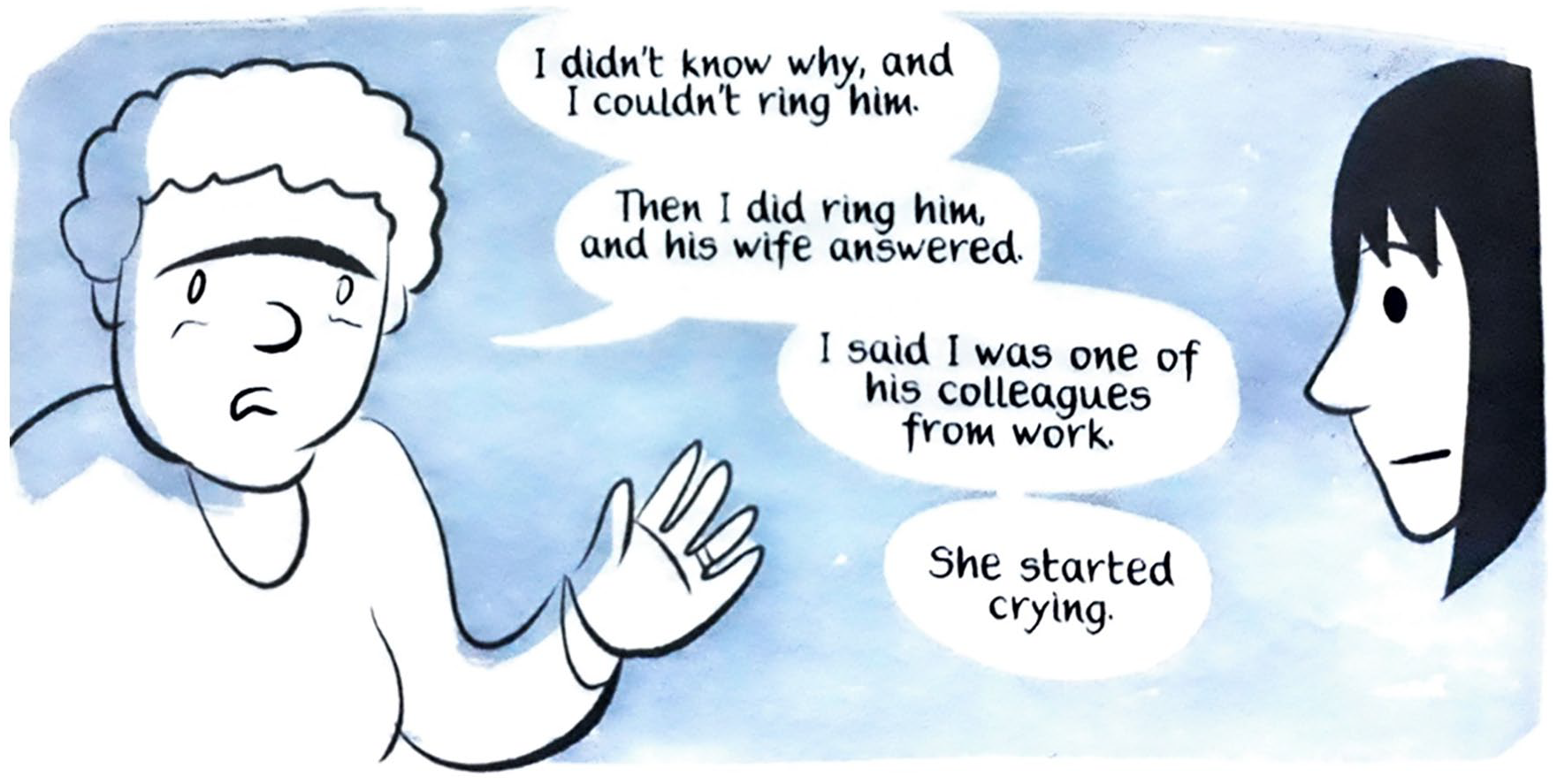
The ever-deepening crisis in the physician’s life reaches a climax when her mother, who disappeared years ago, reaches out through a letter. The illustration of the processes of opening the letter in a moment-to-moment transition intimates a crucial twist to the reader that the letter brings to Lois’ life. The changing facial reactions of Lois from panel to panel, her deep exhalation, and the obscene word scripted in bold letters on her face indicate her tremendous shock and acute discomfort while reading the letter. Subsequently, the strips of letter passing horizontally through the middle of the panels, both intermittently and continuously (Figure 3), and the patient’s speech being reduced to vertical lines, suggests her lack of active listening to them. The artistic style is an instance of the unique narrative capability of the comics medium to communicate characters’ internal frame of mind. The superimposition of a letter strip on the faces of patients (Figure 3) externalizes Lois’s flummoxed psyche caused by the unwelcomed letter from her mother.

Williams, Ian. The Lady Doctor. p. 47.
The following conversation with Geeta and Gwenno displays Lois as a heroine “bound to be full of conflicting emotions,” which is evident through her comments: “Part of me wants to tell her to piss off, but I feel very . . . confused”; “It’s like . . . she already wrote the letter, it exists . . . what is the price of ignoring it” (Williams, 2019, pp. 57 & 49, 55). Williams lays bare Lois’s deep psychic wound, caused by her bohemian mother, in one of their meetings. In an Interview with Hillary Chute (2014) Scott McCloud observes, “comics is the only form in which, past, present and future are visible simultaneously” (p. 26). Displaying Lois venting her anger to her mother, Cilla, as an expression of the extreme resentment that she has been holding on to for years, Williams calls attention to the lingering pain of being “ABANDONED” as a child by her mother (Williams, 2019, p. 102). Her painful recollection of the past is simultaneously made visible in a tier containing three horizontally arranged faded-green colored panels depicting her mother leaving for the women’s colony paying no heed to the crying child (Lois). Lois, sitting opposite her mother, head in hands, is a trenchant illustration of her agony and pain. Later, a panel depicting the same incident from her past reappears when Cilla asks Lois, “Do you . . . Do you remember me . . . From before?” (Williams, 2019, p. 111). Brushing off her question, Lois (2019) briskly replies, “Not really. Have a seat,” thus attempting to hide her pain (Williams, 2019, p. 111). Therefore, through revealing protagonists to be troubled by their past memories, Williams presents them as flawed and emotionally vulnerable human beings.
Coda
Williams’ narratives dispense a candid perspective of the protagonists’ professional lives and dismantle many of the august projections surrounding the figure of doctor. Both the graphic narratives delineate the experiential realities of being physicians and other costs of working in a bureaucratic health care system. Williams characterizes doctoring as a mechanized, debilitating, and emotionally taxing profession that prevents doctors from acting according to their discretion. The narratives expose the inadequacies of a bureaucratic and dehumanizing health care system which coerces its practitioners to capitulate to the dispiriting demands of the role and function with limited means. In doing so, Williams lends a representative voice to physicians’ subjective experiences.
Rather than portraying doctors as heroes, these narratives present the protagonists (Iwan and Lois) as the victims of their profession by foregrounding the realities of being a doctor in a modern health care system. Furthermore, by delineating how the profit-oriented, authoritarian health care system disempowers physicians, these narratives also shed light on hierarchies within the medical system and often suppressed complexities involved in doctoring. Strengthened by the structural and formal uniqueness of comics, these graphic narratives provide a detailed informal account of physicians’ suffering with a raw honesty.
Williams represents doctoring as a rigorous profession that forbids time for physicians to look after their own basic needs. Both the graphic narratives also shed light on physicians’ personal lives, which hardly garner attention in traditional literature. Deftly using the comics medium, these visual narratives delineate multiple aspects and the vulnerable contexts of physicians in provocative ways. In short, these graphic narratives offer a unique perspective as to how doctors’ personal struggles affect their professional lives and vice versa. In so doing, both The Bad Doctor and The Lady Doctor render a more humanized and deglamourized version of doctors.
Footnotes
Acknowledgements
Special thanks to Dr. Ian Williams for his encouraging comments and for several suggestions with this essay.
Declaration of Conflicting Interests
The author(s) declared no potential conflicts of interest with respect to the research, authorship, and/or publication of this article.
Funding
The author(s) received no financial support for the research, authorship, and/or publication of this article.