




Abstract
One of the traditional forms of performing arts in Lampung is Sakura. Although a considerable amount of research on Sakura performance art has been done and despite the importance of Sakura performance art, but to my knowledge no researcher has studied about the holistic understanding of this performance art in terms of its functions. This study is qualitative in nature in which the data were collected through observations, audio-recorded interviews, documents, and artifacts which were descriptively analyzed and interpreted. This study was conducted through intense and prolonged contact with informants in natural setting in four villages (Kenali, Kegeringan, Canggu, and Kuta Besi villages) in Batu Brak District, Liwa, West Lampung Regency as Sakura performance art cannot be found anywhere else. The key informants were purposively selected to take part in this study, including traditional Lampung elders, Sakura artists, and cultural experts from the four villages. Based on the results and discussion, it can be stated that the function of Sakura performance art was initially as a means of worship for harvest festival and village safety. Today, however, it has several functions such as a means of socialization, social solidarity, entertainment, and aesthetic presentation. Finally, some implications for the preservation of the Sakura performance art and recommendations for future research are also discussed.
Introduction
Lampung is a province in Indonesia located in the southernmost area on Sumatra Island. It is home of Lampung people who own a variety of cultures and traditional customs such as traditional processes/ceremonies and performing arts. However, the existence of Lampung performing arts is still less visible. Lampung people are much familiar with traditional ceremonies such as gawi, a traditional event which involves a lot of people including Lampung people and traditional Lampung elders.
The explication of the relationship between Lampung traditional customs and performing arts is inseparable because this province has a fairly old cultural history. The oldest performing arts include traditional music and dance, literary works, and folklore, for example, myths and legends. Of the many forms of performing arts, however, traditional music and dance are the most developed at the present time.
The importance of performing arts as traditional and cultural events has been studied extensively in recent years because it is believed that they contain cultural value and knowledge that can help someone in today’s era with the formation of national characters and mutual respect. Thus, one must preserve that kind of cultural products (Mustika, 2014; Thomas, 2014). Mustika, then, further states that today, however, only a few are interested in traditional performing arts, especially the younger generation.
Performing arts can be defined as theatrical, musical, and dance performances (Terblanche, 2003), and Sakura (which literally means mask in local language) is one of the traditional performing arts in Lampung. It is “a genre of masked theatre that finds its roots in traditional ritual” (Thomas, 2014, p. 32) in which little is known about the origin of the indigenous West Lampung theater, and its name Sakura remains unclear. However, it is believed that it is an orally transmitted legend from both Lampung Saibatin in West Lampung and Pepadun’s traditions i in South Lampung passed down through generations (Mustika, 2011, cited in Thomas, 2014) and based on interviews with traditional Lampung elders in West Lampung, it is stated that Sakura is the oldest dance in Lampung which initially appeared in three villages in West Lampung, namely, in Canggu Village in Batu Brak District, Kenali Village in Balalau District, and in Kegeringan Village in Balik Bukit District. In South Lampung, this masked performance is known as Tupping, whereas in West Lampung, it is known as Sakura or Sekura.
The emergence of Sakura stems from the belief of primitive communities in Liwa, West Lampung. This form of dance, with ugly masked faces in leaves or potluck, was used by Ratu Sekarmong and the Buay Tumi ii You don’t have sufficient rights to edit this element. Please add a comment for the Production Editorcommunity as a medium to worship the spirits of the ancestors in the past. It was once performed in a place considered sacred, such as a place of worship. The aim was to bring the gods, ancestral spirits, and rulers of the universe, so as to provide protection or assistance, as well as to avoid rural people from difficulties in life. That is, Sakura was made for the benefit of the village community in various activities, such as in the celebration of rice harvest celebration and village safety ceremonies (Djaenuderadjat et al., 1992).
Based on interviews with traditional Lampung elders, Sakura in its development can be divided into two types: Sakura Kamak (grotesque and ragged) and Sakura Helau (martial and clean). However, the West Lampung people call both Sakura Kamak and Sakura Helau as Sakura because it is easy to remember and generally accepted. In addition, the naming of Sakura also makes the two types of masked dances look inseparable. 1 Sakura Kamak, the oldest type, was used as a performance to worship ancestral spirits (Mustika, 2014) characterized by their dirty and ragged clothes, whereas Sakura Helau was used as a performance to worship ancestral spirits characterized by their clean and neat clothes. The latter is just the outgrowth of the first type which has several forms of performance, such as Sakura Pudak Api iii , Sakura Kebayan iv , Sakura Tuha v , Sakura Ngandung vi , Sakura Nyakak Buah vii , and Sakura Seribu Wajah viii (Mustika, 2014).
Thus, the study of Sakura masked performance has become an important aspect of investigation because it is a part of indigenous culture that must be preserved. Eryani (2012, cited in Thomas, 2014) states that Lampung administration always seeks to preserve Lampung traditions with the help of the Council of Traditional Lampung Elders to protect traditional and local cultural practices and to increase primary school students’ affection and understanding of Lampung traditions through education.
Therefore, knowledge of functions of the Sakura performance art has great importance particularly for young people. This performance art consists of several appearances and facial characters. The public celebration of the Sakura, which is called the Sakura Festival, is an annual event that falls on Eid al-Fitr. It also becomes a local tourism event and the icon of the people of Liwa, West Lampung (Mustika, 2014). Although a considerable amount of research on Sakura performance art has been done (see, for example, Fauzan, 2016; Mustika, 2014; Thomas, 2013, 2014) and despite the importance of Sakura performance art, to my knowledge no researcher has studied about the holistic understanding of Sakura performance art in terms of its functions. Hence, an additional study from a different perspective is needed to complete the existing findings and discussions about the Sakura performance art.
Literature Review
Performance, Theater, and Performing Arts
Maxx Herrmann (in Fischer-Lichte, 2014) states that performance refers to “a game in which everyone, actors and spectators, participates” (p. 18). It can also be defined as any event where all participants (e.g., actors and spectators in which their roles may switch) find themselves in the same place and at the same time to take part in a set of activities with four central characteristics, namely, mediality, materiality, semioticity, and aestheticity (Fischer-Lichte, 2014, p. 18); while theater, on the one hand, is defined as any open space for watching, such as natural spaces and man-made spaces, since the 16 century, the term “theater,” on the other hand, has now begun to primarily refer to enclosed buildings; it can also be understood as drama (Carlson, 1993, cited in Fischer-Lichte, 2014). Thus, all of the forms can be referred to as performing arts—theatrical, musical, and dance performances (Terblanche, 2003).
Sakura performance art
One of the traditional forms of performing arts in Lampung is Sakura. It is “a genre of masked theatre that finds its roots in traditional ritual” (Thomas, 2014, p. 32). Sakura was basically sacred, which can be seen from the shape of the artefact. According to Liwa people, Sakura was present in the past not as a performance art, but as a ritual performance that was sacred and had a deep meaning among the Buay Tumi community in the Skala Brak area. It is in line with what was stated by a cultural practitioner named Anton Cabara that: Jak zaman tumbai Sakukha tigunako nyin nyilu keselamatan pekon jama ngucakko nekhimakasih jama Tuhan sekhadu jak nanom pakhi jama ulih keguaian unyinni. Kepekhcayaan semacom hinji lagi tipakai di masyakhakat Liwa sappai tanno, walau sebenokhni mawat tiucakko di hadapan umum, mana masyakhakat Liwa tanno khadu makai agama Islam.
2
(In the past, Sakura was used to ask for the village safety and a ceremony to thank God after rice and/or other crops harvest time. This is still believed by the Liwa people until now, even though it is not publicly disclosed, bearing in mind that the Liwa people now practise Islam.)
Thomas (2013, cited in Liu, 2016, p. 86) states that the masked theater “has received a recent makeover as modern entertainment that references tradition by a Balinese-born artist named I Nyoman Mulyawan who has showcased his series of ‘new dance creations’ in the style of the coastal Saibatin people” and it still survives (Liu, 2016).
The Sakura performance art has been in existence since prehistoric times as stated by a traditional Lampung elder in Lampung language as follows.
Sakukha khadu wat jak zaman tumbai, sikam selaku genekhasi masyakhahat Liwa tinggal nekhusko gaoh, api si diwakhisko jak tatuha atau tamong kajjong sikam. Khanno munih ki juk adat-istiadat si wat tanno ngekhupako sebuah wakhisan secakha tukhun-temukhun.
3
(Sakura has been existing since prehistoric times. We as a generation of Liwa people just need to continue what has been passed down by our ancestors. Likewise with the customs that exist today are a legacy from generation to generation.)
Another Lampung traditional elder who is also a Sakura artist stated that:
Menukhut cekhita masyakhakat Liwa, Sakhuka khadu wat semenjak daekhakh Liwa nitunggu jama tatuha sikam jak zaman tumbai si waktu hinno masyakhakat gelakhni buay tumi. Buay tumi hinnji ngekhupako suku atau kelompok si tinggal ni daekhah Liwa khik akhikh pengakhuh Hindu nipimpin haguk jelma bebai namani Ratu Sekarmong. Kelompok tumi jama khatu Sekakhmong makai kepekhayaan animisme khik Hindu.
4
(According to Liwa people, Sakura has been in existence since the Liwa region was inhabited by our ancestors in the prehistory which at that time the community was called as Buay Tumi. It was a tribe that inhabited Liwa region and at the end of Hindu influence the Buay Tumi was led by a woman named Ratu Sekarmong. The community and Ratu Sekarmong adhered to animism and Hindu beliefs.)
Therefore, this form of performance art is part of Lampung indigenous cultural heritage which is maintained so that it can be passed on to future generations and become Lampung indigenous performance art. This helps the people of Saibatin in West Lampung define their identity: “the ancestral homeland of the Lampung people.” People come together to attend Sakura festivals to watch and take part in the performance art activity of cleansing the whole village through Sakura parade which consists of theater, dance, and music (Thomas, 2014).
In addition, an extensive collection of Sakura masks are also well stored at Lampung Museum as shown in Figures 2a and 2b below.

With Rahman Puspanegara (right-hand side) in Kembahang Village, West Lampung Regency. (Photograph taken by Ketut Satriawan in 2009).
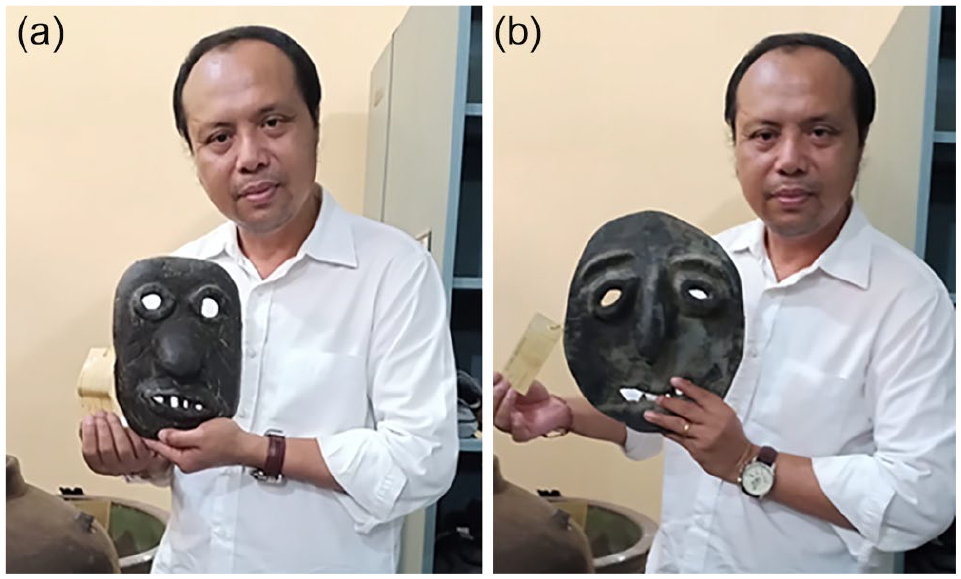
Sakura Kamak mask collection in Lampung Museum (Personally taken photograph on May 2020).
Research Question
This study, therefore, aims to address the following question:
Method
This research is qualitative in nature in which the data were collected through observations, audio-recorded interviews, documents, and artifacts (Miles et al., 2014). The data, which were collected in the forms of words, visual, and moving images, were descriptively analyzed and interpreted. This study was conducted through intense and prolonged contact with informants in natural setting in four villages in Batu Brak District, Liwa, West Lampung Regency because Sakura performance art cannot be found anywhere else. The key informants were purposively selected to take part in this study, which include traditional Lampung elders, Sakura artists, and cultural experts from four villages (Kenali, Kegeringan, Canggu, and Kuta Besi) in West Lampung Regency. To check the validity and accuracy of the information, the collected data were verified by reporting back to the key informants and by triangulating them with the data collection methods and informants. The triangulation can be said as an almost must-do method for confirming findings (Miles et al., 2014).
Results and Discussion
Since the beginning, the Sakura art has been planned by the people in Kenali, Canggu, Kegeringan, and Kuta Besi villages to become a historical performance art in the lives of Liwa people because Sakura had its own historical background in the past, and some forms of its properties, passed down from generation to generation, can still be found today. In the end, the intention of developing Sakura received a very positive response from the West Lampung local government. 5 In the development of tourism in West Lampung today, Sakura is known by its people as a public show that aims to entertain or as just a game to play. This is in line with Schechner’s (2002) statement that a performance art should be understood as a broad spectrum. In other words, it can be defined as a series of actions or human actions from a wide variety of perspectives, such as rituals, games, sports, popular entertainment, theater, performing arts, dance, and music in everyday life. By realizing that life is well structured based on a variety of repetitive daily behaviors which are socially valuable, it can be said that every day is actually a performance (Figures 3 and 4).

Sakura Helau performance in Kenali village.

Sakura Seribu Wajah.
If carefully examined, it turns out that performing arts have a very complex function in human life. Besides, a difference also exists between people living in developing countries and those living in developed countries, and performing arts are differently utilized in their lives. For example, in developing countries with agrarian cultures, their performing arts have a variety of ritual and social functions. On the contrary, in developed countries, their system of life has referred to industrial culture (Soedarsono, 2002).
In a developing country like Indonesia, Sakura can survive and develop because it has social functions in its society. Regarding this matter, Mulyadi (1984) said that a culture would survive if it had a function or role in the lives of its people; otherwise, the culture would become extinct if it were no longer used. Therefore, Sakura as a form of performing arts serves to function as expressions of the soul, feeling, and wish functioned by the Liwa people.
According to Puspanegara, Sakura in the past had a very close relationship with the life of the Buay Tumi community which is still preserved in Canggu, Kuta Besi, Kegeringan, and Kenali villages, West Lampung Regency until today as a hereditary tradition. The presence of Sakura was not merely because of the local ruler’s interests at that time; however, it was more than that. It was used as thanksgiving for crops and pekon safety (pekon means village in local language). Thus, the people of Liwa still put much trust in occult power. Even today, in general, they believe that the objects or relics left in Liwa are considered sacred. For example, a tree trunk called belasan kepampang is still believed to be able to cure sick people. This trunk is well stored in a traditional hall in Kenali village, and likewise the ones considered sacred such as Mount Pesagi which is still believed to be the tomb of one of the Buay Tumi figures. Sakura in the past had sacred meanings and values that were well respected. It also had a very important meaning of life for the people of Liwa. It was a tool or means to pray through offerings in the form of dance for salvation. The Liwa people’s beliefs in the past were very sensitive to strange events in the sense that an incident suddenly appeared to attack a village, which was beyond the reach of human’s logic. 6
The people of Liwa in general will not be separated from the belief system that has been inherited since the past such as the belief in the magical power and the spirits of people who had died or ancestors who are often still respected, especially those who can give good fortune to the family who are still alive, whether in the form of safety, wealth, and others (see Maria, 1993). The tradition of using offerings is still often carried out by some people of Liwa to be offered to people who died. This belief is still found when there is a cleaning in the cemetery just before Eid al-Fitr (a Muslim holiday celebrated to mark the end of Ramadan). As revealed by Subagya (1981), on Java Island this kind of activity is known as nyekar. This tradition has a very important meaning. It shows solidarity between the living and the dead. Those who are still alive pray for the dead and those who have died shine blessings so that strong emotional bonds occur because they still place the ancestral spirits as respected and trusted figures and they are expected to give blessings in life.
Thus, Sakura in the past clearly had a sacred meaning and served to function as a gratitude for the success of rice and other crop harvesting. It was also used to request for the safety of the village to avoid disease outbreaks. Sakura in its position was considered as a symbol or medium to convey certain intentions to the ruler of the nature. In addition, Timoer (1990) said that symbols in dance aim to achieve a purpose that functions strongly in a ritual ceremony. Therefore, it is necessary to know the symbolic meaning contained in the Sakura in the past as a symbol of the purpose of human life. 7 Today, however, it is not performed as was in the past that its function has changed.
The functions of Sakura’s performances can be understood by tracing them from the forms of its appearances. As expressed by Soedarsono (2002), the function of performing arts can be divided into two main categories, namely, the primary function and the secondary function. The former refers to the functions of performing arts: (a) as a means of ritual, (b) as a means of personal entertainment, and (c) as an aesthetic presentation (Soedarsono, 2001b). The latter serves to function as (a) a binder of solidarity of a group of people, (b) a mass communication medium, and (b) political propaganda (Soedarsono, 2001a). The Sakura performance art, in particular, serves to function as follows.
Primary Functions of Sakura Performance Art
First, the primary function of Sakura is as a means of ritual to parade around the village. This ritual is carried out by the people of Liwa, especially in Kenali and Canggu villages, as a form or effort to cleanse the village of things that are considered dirty, which is caused by the bad behavior of people, and to drive away evil spirits.
It is also stated by a former Sakura artist named Anton Cabara that:
Sakhuka yaddo diya bentuk anjak tuntunan sai digunako pakai bukekecahan pekon jak hal-hal sai tianggap mak buyun. Misalni ruh-ruh jahal sai ngekhatongi pekon. Biasani, sekumpulan mulli mekhanai mutakhi pekon daleh ngebunyi ko kekuhan pekhing, bakhang-bakhang bekas injuk kaling khik mekai obor jak batang pering sai tikeni apui.
8
(Sakura as a form of performance art is used to cleanse the village of things that are considered negative, for example, the evil spirits. Usually, a group of young people goes around the village sounding bamboo- and cans-made clappers, as well as using flaming torches made from bamboo.)
There are several causative factors why ritual ceremonies are carried out. First, the tradition is a relic from the past which is accentuated and considered sacred and therefore difficult to erase. Second, they are historical rights, which mean that a traditional dance is a means of rituals concerning the safety of people’s lives (Timoer, 1990). This ritual is carried out by the local community as a form of gratitude to God and the ancestors so that at the time of Eid al-Fitr all villagers can successfully and lovingly celebrate it (Figure 5).

Sakura paraded around in Kegeringan village in Liwa, West Lampung Regency.
Second, the primary function of Sakura performance art, Sakura Seribu Wajah (Sakura of Thousand Faces) in particular, is as a means of entertainment for the audience. The local people are looking forward to the Eid-ul-Fitr for safety, protection, and happiness. Therefore, Sakura parades around the village are considered important by the people in Kenali and Canggu villages to be held just before the Eid Al-Fitr arrives.
9
It is also emphasized by Anton Cabara that:
Sakhuka muneh digunako jadi seni hibukhan khakyat, sai ti pakai lomba cakak batang buah pas buka balak/Idul Fitri. Guwaian sinji tipakai nyambut khani balak agama Islam.
10
(Sakura is also used as an art of folk entertainment in the form of nut climbing competition on Eid al-Fitr. This event is to welcome the Islamic holiday.)
Bandem and DeBoer (2004) said that art as a form of entertainment is grouped into the form of balih-balihan, which is essentially a secular art and purely performed to entertain the audience. In the context of entertainment, the Sakura performance art is done very simply, without prioritizing the performers’ idealism. The most important thing is that the entertainment is able to provide a sense of pleasure and spiritual freshness for art lovers, both laymen and professionals. This is very reasonable because Sakura as a work of art must make a positive contribution to the community of supporters or audience. The audience come to the performance venue to see its movements, composition, and fashion. The aim is to obtain refreshment of mind, relieve stress, and enjoy the beautiful movements of Sakura art displayed in the form of cultural parades, welcoming guests, and nyakak buah (which literally means areca nut tree climbing in local language). This work is not concerned with structure and beauty. They only express themselves according to their abilities because basically the Sakura players do not have good dancing skills. The performance is humorous or comical that the audience really have fun rather than focus on the dance workmanship 11 (Figure 6).

Sakura Seribu Wajah a.k.a. Sakura Helau performed by children at Stabas Bay festival, West Lampung Regency.
A feature the rural communities in Liwa have in common is that dancing is not to seek rewards but to fulfill spiritual needs or self-satisfaction in the arts. The Sakura festival supporters do not expect rewards in the form of materials such as money or other gifts. What the players/performers get is just meals when they visit people’s houses around where the festival is held. Steamed rice and side dishes are provided by the homeowners. Not only are Sakura players provided with food by the homeowners, even guests from far away are allowed to eat as long as they visit or come to their houses politely. The aim of the Sakura performance is more as a means of entertainment, brotherhood, and village development. Therefore, showing expressions is an outpouring which is called as entertainment. An artist will be entertained when he or she is working his or her art project, and he or she will be more satisfied if his or her work is declared successful.
Finally, it serves to function as a creative dance used for aesthetic presentations. According to Soedarsono (2002), performance art is a collective art that its performance on stage demands not a small amount of money. For a dance performance, for example, dancers, dance costumes, makeup artists, music players, stage, and lighting systems are needed. However, performing arts that function as aesthetic presentations have funders or sponsorship, and the local administration of West Lampung Regency is the major funder of the performance (Soedarsono, 2002). The government does not collect any fees after the performance is done. This is all done for the sake of tourism in West Lampung. 12 The performance is a manifestation of expressions from the souls of the creators who want to provide aesthetic elements or beauty through the work of art to the audience. The work of art was created by Mulyawan and Cabara who were given a mandate by the local government to provide appreciation to the form of art, which was then worked out to the maximum based on clear ideas as actualization of idealist thoughts through its form, weight, and performance. The form refers to the structure of the Sakura work of art, and the weight of the work of art refers to the study of the connoisseur’s experience and feeling and its relevance to the idea and message that are conveyed (Djohan, 2005). The last thing to take into account is its performance, which can be investigated from its performers’ talent, skills, and equipment used. This form of Sakura performance can usually be witnessed at certain events such as the Stabas Bay festival, Krakatau festival, and on the West Lampung’s anniversary. Another aesthetic presentation of this work is its beautiful sense of art. The beauty is formed from motions, fashion, and its accompaniment.
Secondary Functions of Sakura Performance Art
Regarding the secondary functions of the Sakura performance art, it is used to welcome guests through Sakura Penyambutan Tamu (meaning: Sakura for welcoming guests performance) performance and to convey messages or as a means of socialization through Sakura Nyakak Buah performance in various forms as stated in the following excerpts.
Sakura tigunako pakai nyambut tamu sai tianggap jamma balak atau pejabat2 khik tamu jak luakh pekon atau luakh daerah, sekaligus ngenalko adat budaya Sakura.
13
(Sakura serves to function as a performance to welcome government officials and/or guests from outside the village/area and at the same time it is also a means for introducing Sakura culture (socialization) and social solidarity.)
Kik di lingkungan pemerintahan daerah Lampung Barat, Sakura tipakai nyambut tamu balak kenegaraan atawa sapa ya khia sai khatong atas nama pemerintah. Selain seno, kik wat sosialisasi pemilehan kepala daerah, sakura muneh titampilko dilon bentuk tuntunan pakai nyampaiko manat-manat program politik.
14
(In West Lampung regency administration, Sakura is used as a performance art for welcoming government officials/guests or anyone on behalf of the government. In addition, during a general election socialization or campaign, Sakura performance art is used to convey messages of political programs.)
Sakura is also used as a medium of socialization to introduce other forms of Sakura performance. In addition, it is also used for tourism promotions in West Lampung. Through its performances, it is expected that West Lampung people can preserve and develop this work of art continuously because with the spread of foreign influences in this globalization era, it is feared that Sakura will experience a decline. The forms of Sakura which are usually performed include Sakura for welcoming guests performance, Sakura Seribu Wajah cultural parades, and Sakura’s creative dance. 15
The final secondary function is that Sakura Nyakak Buah is used as a form of solidarity; it is a means to realize the sense of togetherness. By the time the Sakura festival takes place, the people of Liwa gather together to hold and watch the show. Not only do the settlers live in the area, those who have migrated outside Liwa return home for this event. This is possible because the event is held in Shawwal, when all people of Liwa are celebrating their religious holiday. On that day, all people stop doing activities or work temporarily.
The people of Liwa really look forward to the Eid al-Fitr holiday and the Sakura festival. During the celebration, they can gather around with their family members and their surrounding neighbors. This celebration also aims to forget conflicts that exist in the family and in the community, for example, about inheritance, difference of opinion/dispute, or things that are related to differences in terms of lineage or clan (buay). Until the present time, more importantly, Sakura is the only performance art that is able to unite all people in Liwa. The existence of this solidarity indirectly builds social systems, such as human activities and interactions, social relationship, and socialization with each other from time to time. 16
The characters of Sakura reflect the behavior of the surrounding community. The dancers’ behaviors are manifestations of their everyday life, such as trading, farming, and everyday social interaction, which mostly accentuate humor. This is revealed in the nature of the mutual cooperation (Indonesian language: gotong royong) of the people supporting the Sakura festival during the event. This nature is a unique characteristic of an agrarian society. The mutual cooperation includes directives carried out by the village leader in which the practical work and cooperation in helping are spontaneous activities without requests and selflessness. The manifestation of this attitude is clearly seen when people host a Sakura event and other villagers from outside their village are invited to enliven the event, lend Sakura masks to one another, and maintain security for all. 17
The Sakura festival is a meeting arena for the people of Liwa who come from every walk of life with various social classes, such as people with customary ancestry, civil servants, private employees, farmers, and traders. However, in this meeting, all the people coming from the existing social classes mingle into one and comply with the event, and do not distinguish each other. The secondary function of this Sakura Nyakak Buah is as a form of peacekeeping mission and socialization on Eid al-Fitr to foster togetherness. 18
Conclusion
Based on the results and discussion of this study, it can be stated that the function of Sakura performance art was initially as a means of worship for the harvest festival and for village safety. Today, however, it has several functions including as a means of socialization, social solidarity, entertainment, and aesthetic presentation.
As a means of socialization, Sakura is used as a medium of interaction between the government and the community, as well as interaction between citizens. Sakura as a means of social solidarity aims to build a sense of togetherness in social life, such as supporting and carrying out Sakura festival together. Sakura as a means of entertainment aims to entertain the audience, such as refreshing the mind, relieving stress, and enjoying the beauty of Sakura dance movements, when performed in the form of cultural parades, welcoming guests, or nyakak buah. As an aesthetic presentation, Sakura is the soul expressions of the creators who want to show aesthetic elements or beauty through the work of art to the audience.
This study also has some implications for the preservation of the Sakura performance art. The local government of West Lampung Regency is expected to always maintain and preserve Sakura as an identity of the regency. Therefore, it needs various efforts from various parties to make it happen. Thus, the local government is also expected to always disseminate this Sakura art to elementary and secondary education that it can continue to exist. In addition, all art studios and art communities in West Lampung and in Lampung in general are expected to include Sakura creative dance as a teaching material to help develop Lampung arts and cultural heritage.
However, this study is also with some limitations. This study is able to describe the functions of Sakura performance art; however, other aspects are in need to be investigated for future research. Therefore, studies that investigate this performance art from other points of view such as linguistic, semiotic, historical, and political are highly needed. To provide more precise findings, this performance art can be investigated through mixed-methods approach in which both quantitative and qualitative data can complement each other.
Footnotes
Acknowledgements
The author would like to express his gratitude to all informants who participated in this study and to the reviewers for their constructive comments and suggestions on the earlier version of this paper.
Declaration of Conflicting Interests
The author(s) declared no potential conflicts of interest with respect to the research, authorship, and/or publication of this article.
Funding
The author(s) received no financial support for the research, authorship, and/or publication of this article.

Notes
i.
Based on Lampung cultural tradition, native people of Lampung are divided into two categories, Lampung Saibatin and Lampung Pepadun (Puspawidjaja et al. 1987 as cited in Katubi, 2006).
ii.
Buay Tumi is the oldest Lampung tribe who inhabited the land of Lampung. But at this time no one knows who the leader or the ‘king’ of the community really was. Even the traditional leaders named Rahman Puspanegara, Alit Lekat Bandung, Amrin, Mat Agus, Salim, Habbibur Rahman Lekat Haiman Sukri, and Haidar Hadi do not know about the leader of Buay Tumi. Likewise, it is not mentioned at all in Lampung history books. However, the term Buay Tumi exists and is listed in Lampung history books. Similarly, the Liwa people in general do not know either. However, the most vivid memory the Lampung traditional elders have is only the name ‘Ratu Sekarmong’. Ratu Sekarmong or Sekarumong was a woman who became the leader of the Buay Tumi community at the end of the Hindu influence in the Skala Brak area.
iii.
Sakura Pudak Api refers to a depiction of a baby, the performers mimic a baby either crying or laughing (Mustika, 2014)
iv.
Sakura Kebayan refers to a depiction of a bride where the performers dress up like a bride (Mustika, 2014)
v.
Sakura Tuha describes an old character and the performers dress up and act like an elderly person (Mustika, 2014)
vi.
The players of Sakura Ngandung dress up like a pregnant woman (Mustika, 2014)
vii.
Sakura Nyakak Buah refers to a game of nut tree climbing and this is the core event of the Sakura festival (Mustika, 2014)
viii.
Sakura Seribu Wajah literally means Sakura of Thousand Faces.