




Abstract
Despite pedagogical, technological, and curricular advancements in the West Indian education system, there has been little success in constructively addressing the pervasive regional English language examination failures. I contend that most researchers address these second language acquisition failures by focusing on symptoms rather than causes. However, this study seeks a novel way of tackling the problem, by employing the WordTree design by analogy method, typically used in the engineering field, but adapted for this social science enquiry. The method is used to generate a fitting analogy for the current failing language education system to provide insights into underlying issues, which assist in better understanding and addressing this failure. This method finds that the failing system is analogous to that of the plantocratic system of colonial times based on their strikingly similar ideologies, practices, and attendant outcomes. Resultantly, I term this language education system, an edutocracy.1 This study expands on scholarly works in the advancing areas of curriculum as cultural practice and colonial imagination to provide a different, deeper perspective of this West Indian problem, while exploring the implications of the analogous relationship.
Keywords
Introduction
Despite a plethora of second language acquisition (SLA) research over the past few decades, little has been reported which effectively addresses the failure of vast numbers of West Indian (WI) students to acquire the second language proficiently. Much of the research specifically focuses on factors affecting SLA such as learner styles, age, affective and cognitive factors, and L1 interference (Brown, 2014; Dörnyei, 2009; Ellis, 2015), which have been treated in part by advances in the field of culturally relevant/responsive pedagogy for more meaningful student learning (Irvine, 2010; Ladson-Billings, 2006). However, the literature has mostly ignored the implications of teacher language proficiency on students’ acquisition of the target language (Denny, 2011), and unsurprisingly, there is a western bias/dominance in this research. When extrapolated to the WI 2 setting, the research employs westernized measures based on western subjects (Cook, 2015), and when the research employs WI subjects, it is often in the context of WI immigration to Western lands (McCabe, 2011; Nero & Ahmad, 2014). I contend therefore that language learning in the WI framework has been woefully neglected in the current global language debate. This article proposes to fill this lacuna in language education by reorienting the lens toward the smaller WI states while attempting to steer the narrow discussion of WI language education failure away from learner factors toward the broader and more enlightening discussion of curriculum as cultural practice and education for the shaping of a colonial imagination. This direction is more important than ever because WI officials have not approached reform in a truly systemic manner, resulting in cumulative problems for the education sector (Jules, 2015). The true sources of this language education failure require immediate examination, because communication is the life-blood of every sector in a country, which means that a proliferation of poor communicators produced through the language education system will inevitably impact every sector in these already vulnerable states, making them even more susceptible to social and economic risks.
In this article, I first provide an overview of the relevant literature, highlighting the position of this work in the current debate. Next, I describe and explain the research method used to arrive at an analogous relationship for the failing WI language education system, followed by a presentation of the findings. I use the socio-historical lens of colonialism to attend specifically to the ways in which WI education is construed as presented by the findings. I conclude with a discussion of these findings in concert with the scholarly literature to establish logical conclusions and implications which emerge from the analogous relationship.
Literature Review
Overview
Three important questions shape this review. First, what evidence is there that the WI language education system is failing? Second, why does it appear to be failing at an observable level? Finally, why does it appear to be failing at a deeper level? The goal is to demonstrate how in this unique context, where the overwhelming majority mistakenly believe that Standard English (SE) is the native language of these territories, WI researchers have failed to explore the ideological relationships between these linguistic myths and the unsatisfactory outcomes of the WI language education system. In overlooking this interplay, I argue, we overlook the root causes and as such, definitive solutions to the problem of language failure.
Evidence of Failure
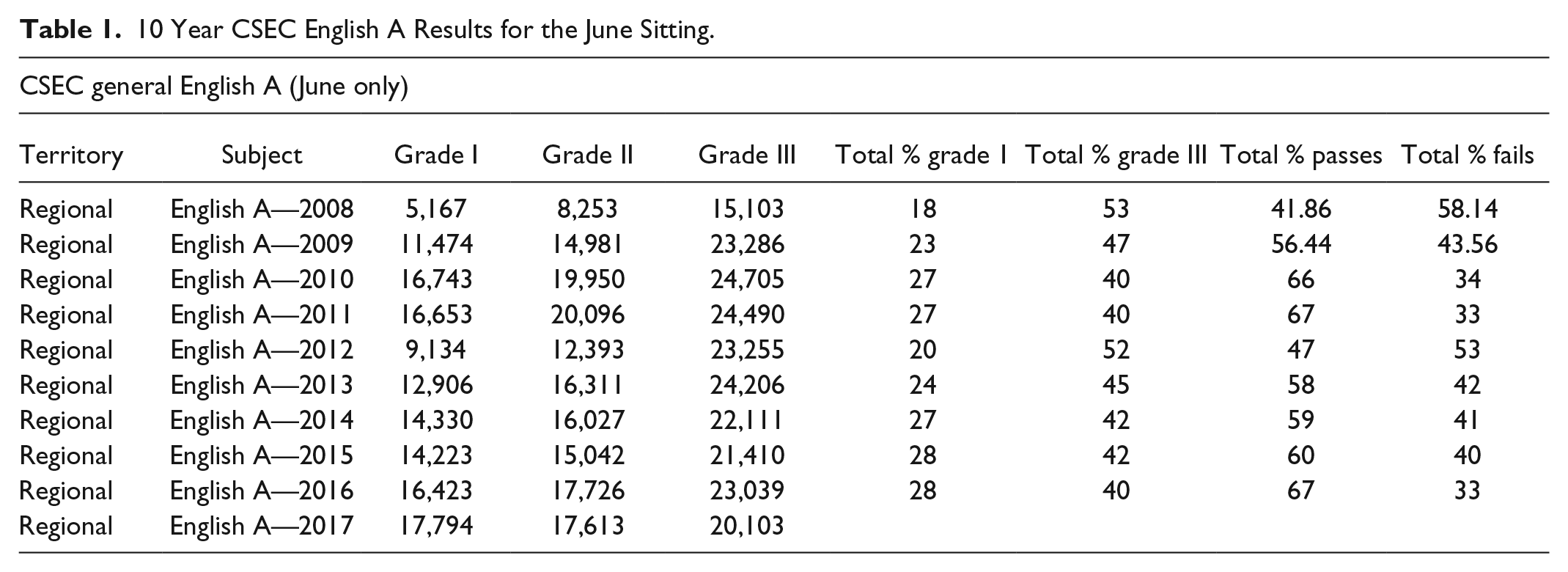
There is evidence to support the claim that the WI language education system is failing to meet its mandate to proficiently educate WI children in the target language. Based on my teaching experience and classroom observations across the region, in addition to my training of teachers from various parts of the Anglophone Caribbean I am referring to WI language education system to mean the largely academic monolingual school system operating in a primarily bidialectal/multidialectal WI setting, which is characterized mostly by high-stakes assessment in the school language, academism, chalk and talk, text-book-driven curricula, teacher-centered approaches, and passive learners. The tabular information for 10 years of results in the English language exam reveals that 33% and more of the region’s children (16 territories participate in these exams) have been failing to score a passing grade (Table 1). In addition, the majority of those who have passed obtain the minimum grade. The responses across the region regarding these results are always very similar. In Grenada, the Deputy Chief Education Officer, Michelle Peters-George, castigates teachers for student failures (C. Campbell, 2018). In Guyana, newspaper headlines lament that 50% of its Caribbean Examinations Council (CXC) entrants continue to fail English (K. Campbell, 2014); meanwhile in Jamaica, tempers flared with one principal accusing the CXC body of rigging the exam which resulted in a decline in the English exam pass rate for Jamaica, a drop from 63.9% in 2011 to 46.2% in 2012 (Hamilton, 2012). The commonalities among these comments are telling. They speak at once subtly and explicitly to the centrality of high-stakes examinations in determining students’ educational future. Each of these comments locates the discourse of failure primarily within the context of teaching, learning, and assessing as opposed to a flawed systemic ideology which characterizes education as assessment. Undeniably, examinations have a role to play in education. Creswell (2000) for example asserts that examinations define and monitor educational standards, and the results used as output measures for accountability purposes; whereas, the Scottish Examination Board (1994) illuminates the role of exams in curriculum development to ensure systematic improvement and relevance. Although stated differently, these scholars make the same core point that examinations are indicators of how well the education system, not just teachers and students, is meeting its targets. Yet, the narrow view afforded us via the window of the education officials’ previous comments demonstrates how educational institutions in the West Indies seemed to have been established as mere examining bodies, which do nothing to cater to the phenomenon of teaching or learning (Meena, 2015, p. 86), as evidenced by the way in which years of education is reduced, in the minds of Afro-WI educators, to passing examinations with little focus on critical thinking and acquisition of life skills.
10 Year CSEC English A Results for the June Sitting.
Observable Factors Affecting Failure
On the surface, it appears that the language education system is failing because of where it places its’ priorities. Education is viewed as assessment, so there is a great deal of emphasis on teaching English for the sole purpose of testing English in this system. The result of high-stakes testing in the school language is a critical determinant of socioeconomic success for most Afro-WI students, for many do not inherit finances. Although speaking to the Kenyan context, I believe that Boit et al. (2012) clearly describe the impact of high-stakes exams on children in former colonies, noting that school success is determined almost exclusively by high passing scores on exams which could be explained by “the funnel-shaped nature of the educational structure . . . The structure makes access to higher education a literal uphill task, with examinations constituting the means for climbing that hill” (p. 179). This is a colonial replica of the WI language education system where students are prepared at primary level to pass the Secondary School Entrance Examinations, and at secondary schools are trained to pass the regional school leavers’ exams, so that the job of teachers at all levels is reduced to little more than teaching slavishly to an exam syllabus, and by extension, the full gamut of education is diminished to assessment targets. Interestingly, while the discourse begins as a debate surrounding the notion of education as mere assessment, it winds its way into a discussion about conflict between educational theory and practice. Logically, if WI language education is being translated in practice to look primarily like assessment, then it contradicts our espoused theory of language education as that means by which we develop critical thinkers who are engaged and centered in the learning process. It is exactly this overt contradiction of centering a test-driven educational system to attain our educational ideals which George (2016) blames for the WI education demise. She maintains that while educationists and employers alike assert that what students need to learn in school is broader than the memorization of facts and their accurate regurgitation on an examination, employers say that they want graduates and employees who can solve problems, think critically, listen analytically, act independently, and express themselves accurately in speech and writing, a test-driven education system is unlikely to create students who demonstrate these skills, as it places high value on those teachers who can produce large numbers of students who can respond accurately to content-driven examination questions (para. 20). This approach is very much a vestige of the 19th-century Industrial Age exam-driven education system that the British bequeathed to the countries of the region as part of their colonial legacy (para. 14). It is this final statement that allows for deeper analysis into why these kinds of theory–practice conflicts exist; it relates to the ideological underpinnings of WI education.
Underlying Factors Affecting Failure
Educating for a colonial mind
The failure of WI language education is systemic. Few WI researchers have attempted to investigate the relationship between the educational ideologies that undergird the system and its failing practices in better understanding the underlying systemic issues plaguing education. A former Registrar at CXC declares that the postcolonial project in education has never fundamentally questioned its colonial inheritance; hence, he advocates that education in every historical epoch continually interrogates the purposes of education (Jules, 2015). As a WI researcher and educator, I believe that I owe it to the system to explore this question of failure more deeply through the more unconventional lens of curriculum as cultural practice in shaping the colonial imagination (Bacchus, 1994; London, 2002), as the more conventional means as previously described have failed to produce definitive answers for effective solutions.
Education under the colonizer shaped a colonial imagination to their advantage. The recent literature on globalization and education centralizes the concept of a global imagination, that is, ways of seeing the global world which connect us as global citizens. Drawing on logic, London (2002) reasons that just as the current global world depends on a global imagination to achieve its objectives, so too did the colonial world require a colonial imagination to build its empire. He contends that this colonial imagination was developed for and internalized by the colonized through curriculum and pedagogical practices, so that the curriculum was deliberately designed and dispensed to achieve a favorable objective for the colonizer, that is, continued subjugation of the colonized to maintain the status quo. I wish to contradict London and argue that the curricular result was consequential, as opposed to intended, but it was nonetheless successful and hence perversely manipulated. For the purposes of my analysis, I draw on the work of Rizvi (2000) who describes imagination as an “attempt . . . to provide a basis for the content of social relationships and the creation of categories with which to understand the world around us. What is imagined defines what we regard as normal” (pp. 222–223). Bearing this in mind, it is not difficult to reason that the shared WI world view of education was that of “sophistication, civilisation, privilege, refinement and success.” The European and the African both saw education as the cause of these results (sophistication, refinement, etc.), and the “normal” racial image evoked by these terms through a shared world view was that of a European. If Afro-WIs start from the premise that European education equates with these attributes, then certainly they will conclude that European education can give them these attributes. Unfortunately, they are made to miss the underlying assumption, the flawed ideology that props up this kind of education, that Africans start out their educational journey intellectually deficient by virtue of our “Africanness.” This collective way of thinking was masterfully shaped through the vehicle of education and schooling, such that the role of schooling as a vehicle for ideological “puppetry” has been discussed in the literature for decades (Althusser, 1970; Apple, 1985; Bernstein, 1977). Whitehead (2018) calls out schooling and schools as ideological state apparatuses that indoctrinate students into consuming prevailing ideologies through curricular offerings. In the WI scenario, the school’s curriculum has been, and is vital, in creating “Europeanized Afro-WI subjugates” who had been and still are prepared to, intentionally or unintentionally, maintain this hegemonic vision in return for individual personal gains (socioeconomic mobility through academia).
Curriculum as cultural practice
The function of the curriculum forms the basis for WI language education failure. Curriculum as cultural practice finds its roots in the ways the privileged state generated and mediated colonial imagination during a process of Empire building using education, particularly curriculum and pedagogy, as a means of establishing for the “other” a world view and a concept of self and community (London, 2002, p. 96). Education for the Afro-WI, just prior to emancipation, was the vehicle used to create a world view of dependency on a European interpretation of reality to keep the newly emancipated Africans “docile, humble and obedient” (Bacchus, 1994, p. 310). Shahjahan (2011) believes that this was achieved through a purposively designed curriculum that promoted a “monoculture of the mind” where there was no toleration of diverse ways of knowing (p. 189); hence, “the pedagogy proceeded to the drum-beat of imperial aspirations” (London, 2002, p. 109). Permit me to return to Shahjahan’s point about the monoculture of the mind. I wish to focus on its outcome, rather than its intention, based on its practice of monolingualism. We will get out what we put into the system, regardless of intent. Logically then, if we apply the language of thought hypothesis (Fodor, 1975), which says that we think through language, then it stands to reason that colonized Afro-WIs would likely develop a European way of thinking if they were taught to think through the European school language, so that whether intentionally or not, the natural consequence of monolingualism would be monoculturalism, the monoculture of the mind. I am suggesting that the natural consequence from educational practice/input has been more damaging to the system than any deliberate deceitful intention on the colonizer’s part or even any altruistic intention on the part of current Afro-WI educators, because it will be realized, intentions are not necessarily realized. What we put into the system, based on our practices, informed by our unchallenged ideologies is proving detrimental to the true sense of education.
Monoculturalism feeds into the preparation of the docile, compliant, unthinking, uncreative image of the Afro-WI the colonizers hoped to shape for their new purposes. This appeared to be the intent of Belgium’s King Leopold II (1883), when he wrote to the colonial missionaries to: teach students to read and not to reason . . . Evangelize the niggers so that they stay forever in submission to the white colonialists, so they never revolt against the restraints they are undergoing. Recite every day—“Happy are those who are weeping because the kingdom of God is for them. (para. 3)
Monoculturalism is an indoctrination based on repetition, lacking creativity, so any pedagogical practices emanating from this concept would also lack that creativity as London (2002) found in tracing the history of educational methodologies in Trinidad and Tobago. He identifies teaching methods which did not allow for reasoning, in the form of teacher talk and chalk alongside mastery of rules, memorization, and language drills; none of which encourage cognition, questioning, or problem-solving. This mental discipline methodology was so “mindless” that it became an “appropriate vehicle for the purpose, the essence of the doctrine being in conformity with colonial desire to throttle creativity and critical thinking in the education of the ‘other’ (London, 2002, p. 113). Mindless education would produce agents accepting of the collective world view of the ‘normality’ espoused, even to their own detriment. This concept of mindless education is in keeping with Whitehead’s (2018) take on education in a post-factual world. In his work, he advances the position that modern education only pays lip-service to learning and understanding but really its chief goal is to indoctrinate students into some prevailing ideology. This leaves questions unanswered by this review, which I hope to answer at the discussion stage, particularly, what ideologies influence present-day WI language education?
Rather than simply looking at how the system is failing, this article considers why. I am therefore arguing that the current monolingual education system is failing because it is a colonial hold-over, which serves to continually shape and maintain an archaic colonial imagination amid a progressive time and in a socio-political space where people hold the purpose of WI language education to higher ideals. In this work, I will use the findings in conjunction with the scholarly literature to show that despite several government-initiated pedagogical, methodological, technological, and curricular interventions to improve the poor levels of proficiency in English with which students leave school, a significant number will continue to fail as long as the larger, more abstract systemic issues are overlooked and under-investigated. I submit that in using the poor overall performance of WI students in regional English language examinations as a working example, the emerged analogies from the WordTree method will help to support a case for explaining this failure beyond the sphere of observable variables such as the English language teacher, creole (L1) interference, or even pedagogical approaches. Instead, this work will show that a more logical argument for failure can be advanced by considering the colonial ideologies, practices, and consequential outcomes on which the language education system is based.
Method
A novel research approach to analogy building was used to conduct this research. In the engineering field, the WordTree design-by-analogy method systematically leads a designer with a design problem to potential analogous solutions (Oriakhi et al., 2011). WordTree design is a way of modeling how humans reason by analogy. Humans store analogues in their memories, which are retrieved to suit a task/scenario like a design problem by identifying appropriate links between the design problem/target issue and the source analogue. Based on these links, inferences are generated. These inferences result in design/target solutions (Linsey et al., 2012).
This method is highly structured. First, I identified key problem descriptors. This is a single word action verb derived from the functions/customer needs related to a design problem. Because my research was not grounded in the design field, I identified single action verbs related to the research problem of the failing WI language education system. Linsey et al. (2012) recommend using transitive verbs for more effective stimuli, so I identified “educate,” and “fail,” but I chose only “educate” because it seemed to encapsulate the problem. As the term “failure” pointed back to failure to educate, I chose to see education as the stem (Figure 1), though I believe this was a miscalculation, as I explain later.

My brainstorming wheels. (A) Monolingual education. (B) Educate.
Next, I used the key descriptor to create word-trees. In the Linsey et al. model, a design team and a lexical database like WordNet 3 constitute the two sources of knowledge for the word-trees. In my study, I chose to use individual knowledge; namely, my own, and that of a lecturer working in a university’s writing department (she gave written consent for her participation). I also used WordNet. Unlike the team set-up in the Linsey et al. (2012) model where participants operated in the same space, the participant and I worked in individual spaces with no collaboration. This method typically employs “brainwriting” at this stage, whereby each team member is given individual sheets of sticky notes to represent each of the key descriptors identified at the start. They have a specified amount of time (determined by researcher), typically 10 min or more, depending on the number of trees, to generate word-trees from the descriptors. When time has expired, the word-trees are rotated clockwise, and the next person spends 5 min adding words to the word-trees, which could lead to further ideas later on (Linsey et al., 2012). The verbs are hierarchically structured, with more general verbs appearing at higher levels of the tree and more specific verbs at lower levels. WordNet is then used for additional results, and then, all results from brainwriting and WordNet are combined using the same level structuring approach (general to specific).
I attempted this task using an individualistic approach. I did not intend to follow the steps slavishly feeling a need for flexibility owing to the differences in the two disciplines (science vs humanities). I therefore generated my own tree (no team was used) using “educate” and then put this same word into WordNet. It came back with an unexpected generation “refine” which led me to enlist an additional human perspective to avoid the risk of becoming myopic. I wish to remind the reader that the Linsey et al. team comprised engineers, so their selection was based on their specialist knowledge. Likewise, though I was not using a team, I also engaged a specialist in the field of language education. I saw this choice as purposive expert sampling of an experienced language education professional, with 40+ years in teaching, training, and researching in the field, who specifically and customarily employed the word-tree method to teach writing genres at the highest level of education. Crossman (2019) explains that “it is common to use this form of purposive sampling technique in the early stages of a research process, when the researcher is seeking to become better informed about the topic at hand” (para. 10). Admittedly, I knew little about word-trees and learned from my participant how to restructure my own, which initially resembled a brainstorming wheel (Figure 1A). Patton (2018) adds that expert sampling involves identifying key informants who can inform an inquiry through their knowledge, experience, and expertise (p. 648). This expert choice I believe aided in the validity of this study, while also helping me, through observation, to better engage with this novel method. I did not show her my results being curious as to how our word generations would align. She had 10 min as had I. Owing to the lack of collaboration I saw her as starting fresh like those who initialized the process in the Linsey et al. (2012) study, as opposed to adding to my tree. When finished, she sent the results via an electronic format. I then combined my results along with my participant’s and the WordNet generations into a chart (Table 2), not deemed necessary in this method, but it helped me to think through the process more clearly.
Combined Results of All Generated Trees.
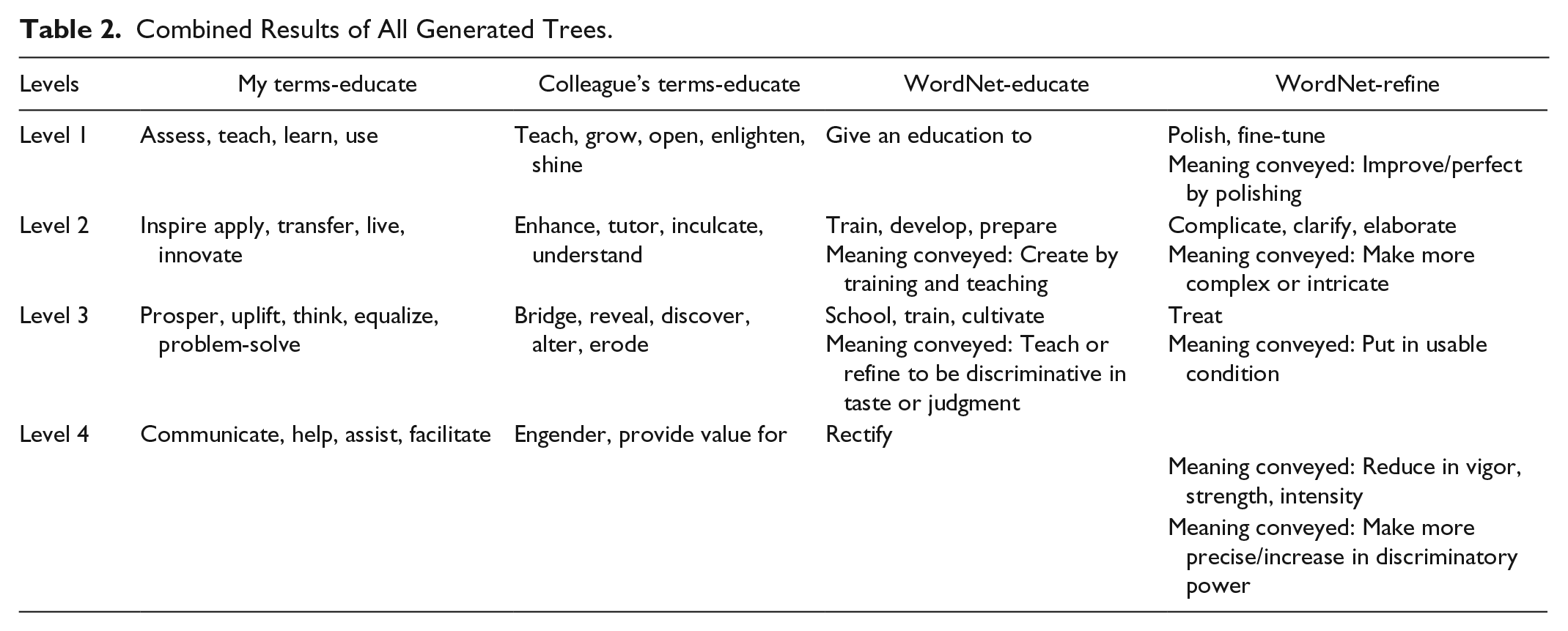
At the next stage, I analyzed the word-trees to create potential analogies. I did this by combining the three sets of individual trees into a single word-tree (Figure 2). I looked for the most general forms generated across the trees and made them the first level and then more specific terms made up the following levels until the terms were exhausted. I then attempted to map the problem to these analogues/generated terms, bearing in mind that the analogy can occur anywhere on the tree and can be verbs or nouns (Linsey et al., 2012) and that the analogy in the engineering field is written as a potential solution that shares similarities with the problem domain, while in this research it would be written as a potential problem linked to the failing WI language education system.

WordTree of amalgamated trees.
After analyzing the combined tree, I identified analogies linked to the observable problem. Linsey et al. (2012) refers to this as the most difficult stage, identifying that link between the problem and source analogue. Nevertheless, they contend that this method helps in leveraging a team’s knowledge and along with existing databases provide unexpected and effective analogies. While these researchers focused on the team approach, I focused on the result. It seems that whether a team or individual approach was used, effective unexpected analogies were generated, that is, the objective, regardless of the number of human contributors, was achieved. In addition, Linsey et al. (2012) found that even with the use of this team approach, a small percentage of the analogies turned into solutions. As a result, they propose to further research whether designer experience could be a factor. Such a view, even at the hypothetical stage, could very well suggest that it is not team-work or multiple human generations, but participant professional experience, which may be key in retrieving and mapping source analogues to target problems. I felt that having engaged an expert in the field of language education with added experience in the use of word-trees helped to counterbalance the lack of varied sources of human input. I identified analogues for feasible comparison to the failing WI language education system based on their likenesses at three core levels which mechanize any organizational system; namely (a) their guiding principles as articulated in their organizational mission, vision, and goals, all of which I categorize as the ideologies which drive the system; (b) the interpretation of these ideologies which translate into the practices of the organizational system; and (c) the output/outcome (the extent to which the ideologies align with the practice to bring about a desired result).
At the final step, I researched the analogies. In so doing, I shaped the research question as follows:
Findings and Discussion
Finding 1: Education as Teaching and Schooling
This research aimed to find an analogy with which to credibly compare the failing WI language education system using the WordTree design-by-analogy method. There were some expected results. For instance, the word “teach” was generated in the top-tier of each word-tree. This was not remarkable as education is intricately bound up with teaching. Likewise, education was very early on expressed in terms of schooling, but this problematizes the concept of education, as it appears that there is no critical distinction between schooling and education. A lack of clarity regarding these terms is a critical mistake African people make because the practice of contemporary schooling disadvantages the masses by maintaining the dominance of an elite group (Shujaa, 1994). In WI educational practice, this typically looks like a deliberate/unwitting attempt to erase the non-standard speech generally associated with African masses by ignoring the language with which students present; hence, subscribing to a policy of “eradicating vernacular dialects in favour of Standard English” (Reaser et al., 2017, p. 21), in essence, school monolingualism. To better understand our educational practices, WI educators must work backwards to trace their source, namely, the ideologies which underpin these educational theories and give rise to our classroom practice. Based on the high-level word association on the word-tree, the assumption made is that education supposedly primarily happens in schools, thereby, attaching the prestige afforded education to schooling. The other assumption which naturally follows is that knowledge/literacy is a monolingual construct and that in schools all children share a common language (Cross, 2011). In the case of the West Indies, this is assumed to be English. Therefore schooling, monolingualism, and prestige become intricately tied to the concept of education in the minds of the passively observing Afro-WI student and the wider WI community.
This reasoning suggests that at the very basest level, there is a minimalist construct of education as schooling/institutionalization planted in the African mind based on the narrow view afforded them from the educational “window.” This view is concerned primarily with the observable; specifically, classrooms, teachers, syllabuses, examinations, certificates and certification, ministries of education, inspectors and inspectorate divisions of education, education officers, education budgets, matriculation and convocation ceremonies which “equates a small aspect of education with the totality of education” and promotes a very “lop-sided and inadequate” view (Bewaji, 2008, p. 6). Shujaa (1994) felt so strongly about the murkiness of these concepts in the African mind that he challenged Africans to call into question how we approach education and schooling, because true education he advances is the means by which our values, beliefs, customs, and rituals, in essence, our cultures, are transmitted throughout the generations (p. 10), all of which tend to be Euro-centric in our WI school systems. Jules (2015), though expressing this concern differently, communicates similar worries in that despite decades of reforms in WI education in “very few cases have these efforts sought to fundamentally rethink the function of education in society and articulate the goals of education with the re-shaping of the post-independent Caribbean” (para. 1). Essentially, the reforms pushed a modernization thrust through archaic practices, so that currently, WI education is still practiced as it was in the pre-independent, colonial times, notwithstanding its espousal of education as a “fundamental contributor to human resource development, to discipline, and to economic progress in individuals, families and nationals,” as expressed by the government of Trinidad and Tobago in the Draft Plan for Educational Development 1974 and similarly echoed in educational documents throughout the region (King, 1999, para. 1). Looking through the socio-historical lens of colonialism at the modern-day educational processes, I begin to see a pattern of prejudiced ideologies and practices running alongside, not in unison, but contrary, to lofty education ideals, so that the two never converge, but result in continuous friction.
There were also unexpected results. For example, only one tree, my own, generated the term “learn.” I expected that learning would be central to the education process. This finding seems to support the view that education appears to be focused primarily on teaching and training; hence, the centrality of the teacher rather than the learner and learning. Nevertheless, this research is less concerned with the shape of WI education, and more with its rationale, which turns the spotlight on the motives of the establishers of education for Afro-WIs. The answer lays in a deliberate attempt to keep the peace for the sake of maintaining the status quo in the potentially eruptive period just prior to emancipation. Education became critical to the success of this strategy. King (1999) explains that the reforming British government viewed emancipation as removing various social controls which could lead to a collapse of the plantocracy. They needed a suitable trade-off to reinsert these controls, but to which the Africans could readily “buy in.” Education became that quid pro quo; it was a substantive offer that could help Africans out of poverty and degradation. The real motive, however, was that while slavery was to be abolished, the plantation and the plantocracy were to be maintained at all costs (King, 1999). Afro-WI education, seen as a less barbaric control mechanism, was driven by the fears and motivations of the minority elite plantocracy to preserve the status quo. Learning, critically thinking, and problem-solving were not part of the expected outcomes of education for Afro-WIs, which could explain why learning and education were not associated in the word-tree. This perhaps is better explained in line with a more current description of the Afro-American in the American context where education, disguised as schooling, “is designed to provide an ample supply of people . . . who have learned the skills needed to perform the work that is necessary to maintain the dominance of the European American elite in its social order” (Shujaa, 1994, p. 10). It stands to reason therefore that the education-afforded Africans have benefited others more than it has them (Shujaa, 1994), and so, this system was not designed with mass African successes in mind, as this would threaten the essence of elitism; therefore, any “school success” for African descendants in America has been at an individual rather than a mass group level (Shujaa, 1994). George (2016) offers parallel support through her account of the WI situation, noting that despite graduating some very bright minds in this region, the percentage of the successes of the Caribbean citizenry is very small because for most “school was something at which they couldn’t or weren’t allowed to succeed because of the very nature and structure of the test-based system” (para. 11). Ironically, this issue of testing is another very important finding which segues into the following discussion. When the added layer of being examined in a “culturally foreign” language is introduced, the situation becomes direr for the WI school-aged child.
Finding 2: Education as Assessment
This next finding was surprising and disconcerting. The first word I associated with educate was assessment, though I long believed education to mean liberation from a disadvantaged state; hence, my use of ‘inspire, prosper, uplift, and equalize’; still, my first thought was of evaluation, judgment, and testing. This might indicate the subliminal messaging of the WI education system regarding the high value placed on academic success through assessment. This was a very sobering point in the research, having learned not to take for granted that I may be strongly influenced by colonialist ideology, though aspiring to higher ideals for Afro-WI education. This fact remains that the centrality of exams problematizes education because assessment today, as in colonial times, is not attuned to key competencies in the labor sector (Jules, 2015), rather, it serves to identify, select, and “sacretize” (separate out to be placed on a pedestal) an academic elite. This was the goal of the founders of this education who aimed “to prepare academic elites for white collar jobs in the colonial tradition based on Western values” (Westfield, 2012, p. 2). One need only scan the headlines and the photo in Figure 3 to see the validity of this claim, which was no less true in Britain, from which these small states were taking its cue. In fact, Torrance (2017) argues that up until the 1960s in Britain “assessment, particularly in the form of selection tests and school examinations, was used to identify and select small numbers of students for elite education” (p. 64). He claims that the role of assessment has changed in that country for the benefit of all, which is ironic when considering that speaking as recently as 2016, George observes that in the post-colonies of Britain “ . . . parents and students are suffering under the exigencies of the19th century Industrial Age exam-driven education system that the British bequeathed to the countries of the region as part of their colonial legacy” (para. 11). Even the “motherland” attempts to get education right, while we continue to flounder.

Academic scholarship winners in Barbados 2018 permission to reproduce.
This “sacretizing” of an academic elite is not just confined to small postcolonial states, neither is it unconventional. In speaking of the metropolis, America (Au, 2015) challenges the view of meritocracy in education, theorizing that high-stakes standardized testing has always been a racial project serving the agenda of the elite to mask racism under the guise of meritocracy. Pointing to the work of Yerkes, who developed the Alpha Beta tests for the army in 1917, which concluded that Europeans were the most intelligent and African Americans the least intelligent race, Au (2015) proffers that for years these standardized tests were being used to structure racial inequalities by providing “scientific” proof of the “inherent inferiority of Black people, specific ethnicities, and the poor, among other groups” (p. 44). Standardized testing is supposed to be an objective measure, so that any wholesale failure by a particular class or color must be due to their own deficiencies. The problem is that someone had to have constructed the test, someone who has a particular kind of knowledge, bias and even exposure to the world that precludes others, and which may very well run counter to the experiences of the average test-taker, so what does objective mean in the context of European schooling and evaluation for the African experience? Omi and Winant (as cited in Au, 2015, p. 47) argue that it is this kind of standardized testing that really shaped what race means because the empirical evidence provided by these “objective tests” could allow people of European descent and the wealthy elite to mask their own structural advantages, deny the existence of systemic racism, justify racial hierarchies, and structure specific racial groups as less intelligent and inferior because they wrote the standard and inherently conformed to it. In the West Indies today with a larger percentage of African population than European, race has been substituted by social class; still the result is the same, the creation, separation, and maintenance of an elite class via high-stakes assessment. A point which is reiterated by an educator and former WI examination registrar who contends that as a region we neglect to question our colonial inheritance regarding our education system because “we have accepted and expanded [these] systems whose organizing principles and structural frameworks have assumed that a principal function of education is to sort and classify people” (Jules, 2015, para. 7). This is further underscored by Mouthpiece37 (2014) commenting on a Barbadian editorial piece regarding the publicizing of national examination scores: The educational system, in its present form, works for a few to the exclusion of most. Those who succeed have no problem with it, whatsoever. Hence there is really no motivation to fix how we transition students from primary to secondary school. Jones [then Minister of Education in Barbados] continues to contribute to the elitism found in the educational system by repeatedly focusing exclusively on the Top 10 performers in the Common Entrance Exam. This is where those who achieve low scores are stigmatized and classified as failures, perhaps psychologically impacting their entire lives.
Despite these views, I do believe that contemporary Afro-WI educators hold education to a higher standard, but in continuing to unquestioningly uphold the colonial ideologies which they inherited, they meet with the same result, classification and selection of an academic elite. The practice of test-driven monolingual education systems in a “culturally foreign language” will perpetuate this result if our ideals and our educational practices never converge because we fail to examine and challenge our ideologies, at the least, as a first step to resolution.
Monolingual education policies and practices shut the door of access to the majority WI non-standard English speakers. Any policy operating in this context must start with the language with which children present at school as a “bi-directional bridge,” one by which they can reach the standard and return to the non-standard in the appropriate context. Students cannot access the content of the education offered because they cannot communicate in the language code which unlocks this content. In his research in Cape Town, Banda (2010) claims that students challenged the monolingual discourses prescribed in language education policies in pursuit of voice by relying on all the languages at their disposal. For most WI children, there is only one such language by the time they enter school, so they need to leverage that one language to acquire the target language because its proficient use will either give or deny them access to certain powerful social networks that help to shape their identity (Norton, 2000). Monolingual education via a highly biased assessment system, serves as a constant reminder of that denial for many Afro-WIs. It brands the life of a minority as a success, but the lives of the majority as failures. It would appear therefore, like the economic disenfranchisement of the past, monolingual education, through assessment in “a culturally foreign tongue,” has become the new way of disenfranchising the majority of Afro-WIs, by continuing to assert and maintain control over their social and economic destinies in its role as “a key intermediary mechanism between school, tertiary education, and employment” (Torrance, 2017, p. 83).
Finding 3: Education as Cultural Assimilation
The term “refine” yielded the most potential for an analogous relationship with the failing WI monolingual education system. After the generation of this term by WordNet for “educate,” I ran it through the lexical database. It generated terms and phrases such as “put in a usable condition, treat, reduce in vigour, make more precise” (Table 2). Re-generating additional terms which stem from the primary word is useful as it lends to the depth and breadth of the analysis. For example, the use of these terms in mainstream discourse may appear innocuous, but when the discourse frame is shifted to include “colonial speak,” these terms take on a more offensive life. Through the lens of colonial education ideology, Afro-WIs appear to be undergoing a European “refinement” via education to become more culturally acceptable, respectable, and presentable to the cultural palates of the European.
Education through an English-only medium appears to have been the linchpin in the cultural assimilation scheme. In school, the European language is promoted and the non-standard denigrated, such that even monolingual creole speakers want to be aligned with the language of prestige. The result is typically language shift toward the standard and possibly language death of the non-standard, leaving the vernacular with no speech community (Crystal, 2000). Logically, a loss of African language is a loss of African identity, which appears to be a clear goal of European cultural assimilation. The outcome of WI education driven by the colonial ideology of European monolingual supremacy, whether initially planned, or inadvertent, is the erosion of the African identity with a simultaneous assimilation to Anglo-European culture. For example, in colonized India, universities established in that territory merely produced dozens of graduates sufficiently Westernized to be alienated from their own culture and tradition,” by making the Indian, more European in his or her manners, habits, and outlooks (Mukherji, as cited in Meena, 2015, p. 86). I reiterate that rational thought says that we will get out of a system what we put in. If Anglo-European values and knowledge forms are the basis of the education for Afro-WIs, then they will likely emerge inwardly as Anglo-European thinkers with Anglo-European values and outlooks, while being outwardly Afro-WI. The result in the post-colony has been a complicated paradox of an Afro-WI who is “outer-directed,” looking to the past colonizers’ current metropoles to shape their knowledge and values base, “despite localized ideological rejection of metropolitan control” (Carrington, 1976, p. 39). Essentially, in their quest to acculturate, an internal psychological struggle ensues for the African descendants of how they should identify. According to Viswanathan (1988), “cultural assimilation [is] . . . the most effective form of political action” (p. 85). He leaves the interpretation of this statement open to the reader. Looking through the socio-historical lens of colonialism into the education sphere, I see political action in the form of monolingual education policies, and a natural consequence of such policies is cultural assimilation, a subsuming of African customs under European cultures for more “usable” African beings who could assume the role of “interpreters between us [the British ruling class] and the millions whom we govern; a class of persons, Indian [or African, my insertion] in blood and colour, but English in taste, in opinions, in morals, and in intellect” (Macaulay, 1835, para. 29). Kelly and Altbach (1984) speak of colonial education as an “absorption into the metropole,” to discourage “separate and dependent development of the colonized in their own society and culture” (p. 4), so that even the brightest Afro-WI minds are enticed through fully paid scholarships by their own Afro-WI-led governments, to deepen their assimilation by leaving their communities and being further educated “abroad” and then remaining there to further build up the economies of these former colonialist metropoles; hence, denying their talents to their own countries (George, 2016). Education in the WI context it would appear becomes a way of shaping the Afro-WI to think and act like the former colonialist (elite agenda is prioritized) so that they acculturate to the European way of life and perpetuate the hegemonic agenda as the intermediary between the ruling class and the ruled.
Education as cultural assimilation speaks directly, if not openly, to the issue of indigenous identity. The literature presents dichotomous views regarding the impact of colonial education on indigenous identity, of which the theme of cultural hybridity (Bhabha, 1994) dominates the discourse. In a general sense, cultural hybridity is a mixing of cultures in which identities are created out of multiple cultural forms, practices, beliefs, and power dynamics (Schewnz, 2014); however, in the specific context of colonialism, the Indian and African tend toward European acculturation, adopting their manners and cultural values, while suppressing their own being (Singh, 2009). While there are valid arguments against Bhaba’s rendition of the theory of cultural hybridity, such that it argues against a purity of race and culture; yet, must start from an assumption of purity to advance the argument (Nederveen Pieterse, 2001), the central point must not be ignored. The narrative is one of culture and belonging, the place of the colonized in a space claimed by the “other,” and the issue includes a hegemonic discourse which attempts to homogenize culture and society (Sayegh, 2008), despite their obvious heterogeneity. Cultural hybridity in the context of colonial rule results in a blur between the colonizer’s enforced ideas and the formerly accepted native practices (Schewnz, 2014), leaving the colonized feeling dislocated in a “survivalist space,” a space forcibly carved out by themselves as a means of survival in the place they call home. However, not all scholars in the field indulge in the sentimentality associated with “indigenous identity erosion” due to colonialism, which makes the debate divisive and at times derisive. Sweeting and Vickers (2007), for example, argue that there is just not enough research done to make a generalization about the impact of colonialism on education in former colonies, reporting specifically that “the history of colonial education remains a vast and largely unexplored field of enquiry” (p. 1). They implicitly claim that the colonized were not passive, but complicit, in any harmful consequences endured. The implication is scathing but the fact remains that based on an observable pattern of previous behaviors, the colonizers demonstrated that the typical behavior in relation to the colonized has been rapacious, domineering, and exploitative. Such a pattern of behavior, based on observable facts, would lead the most conscionable among us to conclude that an education influenced by colonialist ideology, in behalf of the colonized, would very likely serve the interests of the former. Such a conclusion, even if philosophically skewed, is certainly not implausible or illogical. In addition, there is a plethora of literature which establishes, from the perspective of colonized people, the true impact of colonial education (see Bacchus, 1994; Bewaji, 2008; Bhabha, 1994; Kanu, 2007; London, 2002; Meena, 2015; Samaddar, 2007; Thiong’o, 1986). In practice then, education as cultural assimilation looks very much like the image formed by the very eloquent words of Thiong’o (1986), himself a product of colonized education who laments that the process annihilate[s] a people’s belief in their names, in their languages, in their environment, in their heritage of struggle, in their unity, in their capacities and ultimately in themselves. It makes them see their past as one wasteland of non-achievement and it makes them want to distance themselves from that wasteland. It makes them want to identify with that which is furthest removed from themselves. (p. 3)
The irony of this debate is that even when Afro-WIs identify with that which is furthest removed from our own cultures there is no true lateral assimilation for us in our own communities. In fact, the educational system upheld by an uncreative curriculum ensures “downward assimilation” (Waldinger & Feliciano, 2004) for the majority of Afro-WI communities, so that not only is culture and identity impacted, but at the severest level so too is mass economics, as education success is so intricately tied to employment opportunities and future economy stability (Torrance, 2017). It would seem therefore that despite the times, the outcome of Afro-WI education is in keeping with the hegemonic goal of Western cultural assimilation for the elite Afro-WI minority at the expense of shaping a strong mass African cultural identity and a fair economic system for the majority.
Conclusion
Based on the findings from the WordNet design-by-analogy model, coupled with a view through the socio-historical lens of colonialism, I have concluded that the WI language education system has been molded by plantocratic ideologies. These ideologies counteract the higher ideals espoused by and for the WI language education system today. For example, the research indicates that the ideology of the period just prior to emancipation which supported monolingual education in this bidialectal context is based on the plantocratic principles of (a) preserving the status quo in favor of the plantocracy, (b) supremacy of the European and subservience of the African, and (c) the development of a colonial imagination for the spreading of a hegemonic vision. Education, as it was conceptualized in colonial times, has changed little post-independence for WI states. It is still viewed as teaching primarily for the purpose of assessing. It continues to promote a deficit model of Afro-WI students as having with very little to contribute to the learning process because of the language they predominantly speak, which pre-supposes that they require alterations in line with an Anglicized model of sufficiency. Education in these parts is still viewed as a means of developing academic “robots,” unquestioning minds which easily slot into a social space aligned to their educational status. King (1999) supports most of what I have said here, explaining that the education systems in the British Caribbean during the second half of the 19th century were closely related to social structure and, at the same time, were deliberately fashioned to preserve the status quo and reinforce class boundaries. To answer the main research question then, it would appear in the face of this evidence that the present-day WI language education system is a colonial holdover, which can best be termed an “edutocracy.” This term is not unique to this work. It has previously been used by Erskine (2013), though somewhat differently. As a former public-school teacher, he characterized it as a combination of education and bureaucracy which highlighted the power wielded by bureaucratic administrators in local school districts in America. I, however, use this term as a fusion of education and plantocracy to describe the decision-making body of WI education officials who unquestioningly support and promote plantocratic ideologies, policies, and practices which emerge as deleterious policies, such as monolingual education in a bi/multi-dialectal context, that counteract the higher educational ideals espoused in education for the masses in postcolonial WI states. The system of plantocracy achieved its objectives for the elite and so on the surface might appear to be successful and not failing, and as such, not a comparable system with the failing WI language education system; nevertheless, both systems are comparably profitable in achieving success primarily and consistently for the elite at the expense of the masses.
The current language education system perpetuates the colonial philosophies of elitism, separatism, classism, imperialism, and capitalism. There is no room for socioeconomic equality in this model, which admittedly is challenging for any educational model. I say this considering some recent research in the field (Lavia & Mahlomaholo, 2012). These editors explain how contributors to the work wrestled with how to bring about equitable change in education in a world “marked by the injustices of the colonial aftermath” (Lavia & Mahlomaholo, 2012, p. x). They found that the postcolonial educator is bent on bringing about equality either at the expense of their primary role of providing adequate education for students or separately from that role. The point is that a balance is required. If we focus on developing and practicing education which prepares students for a national contribution before any international debut, they learn, through purposeful education, about understanding and giving back to their communities (Shujaa, 1994). If we also emphasize in our policies and practices, education that promotes plural literacies, and incorporate multidialectal interventions while erasing the lingering superiority of academics over technical–vocational debates, then equity and equality should eventually be the natural result of a this more expansive education.
Although it is not within the scope of this work to offer solutions, I feel compelled to submit some recommendations. I recommend that educated Afro-WIs take the charge in promoting a fairer educational system; despite the skewed system that led to their “success.” It was educated Afro-WIs who managed to gain political independence from the “empire,” but they failed to acquire independence of thought, because the vehicle which helped to shape that thinking remained largely colonial in form and function. Educated Afro-WIs were so unquestioningly accepting of their colonial education inheritance that they carried on business as usual and passed on the legacy, only to become the “Massas” of another hue (the edutocracy). Independence is not always freedom as illustrated that “[p]olitical independence for new nations does not necessarily mean decolonizing minds” (Lavia & Mahlomaholo, 2012, p. xi) as the “post-colonial critique of the authors shows that, although educational opportunities have grown, the system still reflects in many ways the gross inequities, disparities, and distortions of the educational system under colonialism or apartheid” (Lavia & Mahlomaholo, 2012, p. x). This is the real point. Education in the post-colony cannot afford to carry on academic business as usual if it seeks to empower and uplift the average person at the community level. The vestiges of colonial education have placed the current education system in a quandary and so re-education must work to get it out. We cannot legislate mentality, but we can educate to influence it, so postcolonial re-education will be key in decolonizing the minds of the Afro-WI. The idea is not to forget the indignities and the struggles; rather, re-educating the postcolonial mind should bring us to a place of “active acceptance,” where we are compelled to do things differently, for a different result. This acceptance should bring us to that place where we no longer speak of our enslaved experiences from a place of fear, indignity, struggle, spite, and anger (victimization rhetoric), but we reproduce and reposition these histories from a sense of strength, ingenuity, dignity, and survival (victor diction). The emotional and mental paralysis taught through this kind of “colonialised schooled academia,” passing for education, keeps us colonized.
I also recommend that as a team, we in the WI language education system start working backwards for growth and progress. As WIs, we have inherited a colonialist education system; we cannot change that, but we can chip away at it. Rather than begin the process by first attempting to institute new visions, missions, and goal statements, and rather than instituting practices we hope will align with these visions, missions, and goals for the best outcome, we should invert the process. We need to start with the outcome. Ask the questions differently, not what should we learn/teach as part of the curriculum, but what should the outcome look like? What should a well-rounded, self-assured, proudly identifiable WI student look like in real terms? What practices do we need to put in place to achieve these goals and objectives and how will these practices align with or oppose the philosophies/ideologies we already hold? What do the outcomes and practices observed reveal about our underlying ideologies? Are they working in sync or in opposition? How might we then create new visions, missions and purposes which better align with our intended outcomes and improved practices? In this way, we work back to avoid the same mistakes and move the system forward (Figures 4 and 5).

Current stage of thinking for the failing WI language education system.

Future stage of thinking for a progressive WI language education system.
The natural conclusion to this work is that a new frontier in WI language education must be ushered in, sooner rather than later. This means that comparable to the demise of the literal plantocracy in colonial times, edutocracy in postcolonial WI states must be strategically undermined and ultimately toppled, bringing down with it its plantocratic monolingual imperialist education ideologies, policies, and practices. A system must be rebuilt on a repurposed foundation of pluralistic principles and practices which are initiated by, rather than received by WIs, founded and practiced on the principles of open access, plural literacies, expansive opportunities, equality, equity, social justice, and empowerment through a language education shaped to reflect WI identities, values, cultures, visions, and missions.
Limitations
There were only two sets of human generations as opposed to a team generation. The use of team generations could have meant more varied generations which could have translated into even richer, deeper analyses. The act of only creating generations for the term “educate” and not “fail” was in hindsight short-sighted. I should not have been simply looking for a comparable system, but a comparably failing system. However, I understand that research tends to be presented as though it is wholly transparent rather than as a series of choices in need of explication (Davidson, 2009). I made a choice which on analysis I do not think impeded the result, but the use of more than one key indicator could certainly have enriched it. It is therefore advisable that more than one key term passes through the generation process for a more rounded view of the issue. Finally, due to space constraints, the analogical relationships stopped short of providing implications and detailed solutions to the underlying problems; however, this can part of future research to bring this work to a fitting conclusion using this method.
Supplemental Material
edutocracy_appendices_sage_open – Supplemental material for Edutocracy: The New West Indian Plantocracy?
Supplemental material, edutocracy_appendices_sage_open for Edutocracy: The New West Indian Plantocracy? by Stacy L. Denny in SAGE Open
Footnotes
Declaration of Conflicting Interests
The author(s) declared no potential conflicts of interest with respect to the research, authorship, and/or publication of this article.
Funding
The author(s) received no financial support for the research, authorship, and/or publication of this article.

Notes
Author Biography
References
Supplementary Material
Please find the following supplemental material available below.
For Open Access articles published under a Creative Commons License, all supplemental material carries the same license as the article it is associated with.
For non-Open Access articles published, all supplemental material carries a non-exclusive license, and permission requests for re-use of supplemental material or any part of supplemental material shall be sent directly to the copyright owner as specified in the copyright notice associated with the article.
