




Abstract
Since 2017, CARICOM member states have been divided in the positions they take on Organization of American States (OAS) resolutions addressing political instability in Venezuela. This article uses a neorealism framework to determine whether or not the provision of energy investments by Venezuela and the United States to CARICOM member countries is an attempt on their part to skew the OAS voting mechanism in their national interests. The article also examines the extent to which CARICOM member states’ response to Venezuela’s and United States’ interest in the OAS demonstrates a pattern of rationality. The findings suggest that though the OAS provides a medium for states to negotiate mutually beneficial solutions, states are rational actors and even where they do corporate, dominant states may try to manifest their self-interest.
Keywords
Introduction
In 2002, CARICOM 1 member states voted unanimously in support of the Organization of American States’ (OAS) Resolution 833, to recognize Hugo Chavez as the democratically elected government of the Bolivarian Republic of Venezuela. However, the united support they showed for the OAS’s stance for democracy crumbled when, between 2017 and 2019, they were expected to vote on four resolutions (failed U.S.-backed resolution on June 21, 2017; AG/RES. 2929; XLVIII-O/18 CP/RES. 1117 (2200/19); CP/RES. 1124 (2217/19) on the political and humanitarian crisis in Venezuela. Instead of unanimous support for Venezuela, CARICOM member states were divided, voting within three predominant blocs: pro-Venezuela, pro-United States, and abstention. It is important to examine this division as the positions taken by individual member states appears to be directly influenced by lucrative energy and investment deals received from both Venezuela and the United States between 2005 and 2019. Moreover, this emerging voting pattern is contrary to the traditional neoliberal institutionalist principle of mutual cooperation which guides the operations and functions of the OAS.
Neoliberal institutionalism posits that the anarchic nature of the international system means that states are faced with the scenario of a prisoner’s dilemma (Grieco, 1988). The prisoner’s dilemma refers to a game where states are more inclined to defect irrespective of whether or not the other state chooses to cooperate or defect. The dilemma arises because both states would be worse off from defecting than from mutual cooperation. However, international institutions such as the OAS reduces the complexity of the prisoner’s dilemma as it provides the opportunity for states to negotiate their conflicts, find mutual interest, build trust, and form mutually beneficial agreements (Keohane & Martin, 1995; Nye & Welch, 2013; Waltz, 1997, 2000). Since 1948, the operations of the OAS have been primarily informed by neoliberal institutionalism and the organization has generally reflected institutional cooperation in its facilitation of the shared interests of member states: its repulsion of Soviet interests in the Americas, the exclusion of Cuba from the OAS because of its socialist communist regime, the restoration of democratic regime in Dominican Republic in 1960, the reinstatement of Haitian President Aristide in 1994, and the adaptation of the Inter-American Democratic Charter (IADC) in 2001 (Herz, 2008; Shaw, 2004). Evidently, neoliberal institutionalism can explain CARICOM states’ unanimous vote for Resolution 833 in 2002 to restore democracy in Venezuela. However, neoliberal Institutionalism fell short in explaining the recent inability of CARICOM member states to find mutual grounds on the political and humanitarian crisis in Venezuela. This is the gap that the neorealism framework adopted in this article seeks to address.
CARICOM’s division in their support for Venezuela can be quite aptly explained through the neorealism framework. Neorealism embraces the view that the international system is anarchic, and so this framework is quite applicable in the case of CARICOM where cooperation has become difficult. For neorealists, cooperation under anarchy is challenging because (a) states are rational actors, and (b) where states do cooperate within international institutions, it is a manifestation of the hegemon’s self-interest (Mearsheimer, 1994-1995; Waltz, 2000). These two tenets of neorealism provide a framework to examine two issues: United States’ and Venezuela’s attempts to dominate the agenda of the OAS and the implications of their behavior on CARICOM members’ voting pattern. In this article, I make two claims, namely, the investments by both the United States and Venezuela in selective CARICOM countries qualify as an attempt to influence the OAS decision-making mechanism, and that these investments have served as incentives for CARICOM beneficiaries to exercise rationality, that is, to prioritize their national interests and therefore vote in favor of the donating country within the OAS. To develop this argument, this article is divided into three sections. Section “Background” provides a background outlining the intersection of the United States’ and Venezuela’s national interests in the OAS. Section “United States’ and Venezuela’s Response to CARICOM’s Energy Inefficiency” discusses the strategies used by both the United States and Venezuela to solicit the support of CARICOM member states for their respective interests in the OAS. Section “CARICOM’s Rationality Toward United States and Venezuela” examines the apparent correlation between CARICOM’s voting pattern in the OAS and investments received from Venezuela and the United States.
Background
As illustrated in Table 1, between 2017 and 2019, CARICOM member states have been divided in their support for OAS resolutions on the political and humanitarian crisis in Venezuela. On June 19, 2017, the U.S.-backed resolution calling for mediation on the Venezuelan political crisis and President Maduro’s reconsideration of his intention to rewrite the Venezuelan constitution fell short by three votes in the OAS (“Jamaica Supported Failed US-Backed Resolution on Venezuela,” 2017). In June 2018, Resolution 2929 declared that the May 28, 2018 general election in Venezuela was undemocratic as it did not meet international standards. Resolution 2929 called on Venezuelan authorities to call fresh democratic elections (OAS, 2018). In January 2019, Resolution 1117 called on member states “to not recognize the legitimacy of Nicolás Maduro’s new term as of the 10th of January of 2019” (OAS, 2019c, para. 12). Furthermore, in April 2019, Resolution 1124 called on member states “to accept the appointment of Mr. Gustavo Tarre as the National Assembly’s designated Permanent Representative, pending new elections and the appointment of a democratically elected government” (OAS, 2019b, para. 1). In light of these resolutions, the guiding questions for the next section are as follows: What was the underlying rationale for the introduction of the failed resolution by the United States? Also, what could have caused a division within a bloc of states (CARICOM) that have traditionally voted together in international organizations on issues affecting their foreign policy?
CARICOM Member States Voting Pattern on Selected OAS Resolution Between 2002 and 2019.

Note. Data for CP/RES. 833 (1349/02) from OAS (2002); for U.S.-backed failed RES. from “Jamaica Supported Failed US-Backed Resolution on Venezuela” (2017); for AG/RES. 2929 (XLVIII-O/18) from “Jamaica Supports Suspending Venezuela From OAS” (2018); for CP/RES. 1117 (2200/19) from U.S. Mission to the OAS (2019); for CP/RES. 1124 (2217/19) from OAS (2019a). OAS = Organization of American States.
Perhaps, the root cause of the division among CARICOM members over Resolutions 2929, 1117, and 1124 can be traced back to Resolution 833, passed in 2002 (OAS, 2002). In April 2002, the democratically elected government of the Bolivarian Republic of Venezuela was temporarily removed by a coup d’état, led by the military and special interest business groups (Cooper & Legler, 2006; Melean, 2003; Olivari, 2014). In response to this, the OAS secretariat invoked the 2001 IADC of the OAS which requires member states to adhere to the fundamental principles of democracy by virtue of the preservation and elimination of threats to democracy (Heine & Weiffen, 2015; Perina, n.d.). More specifically, the Secretary General drafted and tendered Resolution 833, which called for the rejection of the coup d’état, a reaffirmation for the support and recognition of the Hugo Chavez’s government, dialogue between the government and opposition, the acknowledgment of the right of the Venezuelan people to elect their government officials, and respect for human rights and freedom of expression (Heine & Weiffen, 2015).
It should be noted that inasmuch as Resolution 833 was unanimously passed and in less than 48 hr, the Chavez administration was reinstated as the official government of the Bolivarian Republic of Venezuela; the United States did not initially condemn the coup d’état (Marcano, Tyszka, & Cordero, 2007; OAS, 2002). The United States’ action leading up to the passing of Resolution 833 depicted a rational state driven by its national interests. There is evidence to suggest that the United States sponsored the opposition and its then leader—Pedro Carmona (Lusane, 2006). However, the United States eventually reversed its opposition to the Hugo Chavez–led government after failing to garner the support of key allies. The other 34 OAS members’ belief in the preservation of the IADC informed their decision to put their reservations about the Chavez regime aside and to vote for Resolution 833 (Melean, 2003; Olivari, 2014; Ramis, 2010).
Chavez’s Rise and Its Implications for United States’ Interest in Venezuela
The United States’ hostility toward Venezuela coincides with Hugo Chavez’s ascendancy to the presidency. For years, the United States depended on Venezuela for oil imports. The asymmetrical oil trading relationship between the two countries extends to 1914, after the discovery of oil. Using concessions, Venezuela invited foreign companies to invest in its extraction and the United States’ interests in Venezuelan oil remained steady until Chavez’s ascendancy to power in 1999 (Dao & Banerjee, 2003; Uk-Heon, 2010).
While on the campaign trail in 1998, Chavez continuously lamented that contrary to widespread reports, “Petróleos de Venezuela” (PDVSA) was never truly nationalized in 1976—a situation he vowed to rectify when he took office (Dao & Banerjee, 2003; Uk-Heon, 2010). The PDVSA was founded as a national company in 1976 and since then it had undergone several structural changes leading up to 1999. Between 1976 and 1982, the company was nationalized by the government. However, a second structural change was performed between 1983 and 1988 to convert PDVSA into a firm. This move also provided the company with greater autonomy by handing over power to elite technocrats and consequently limiting the power of the government (Uk-Heon, 2010). The fourth and final change took place between 1989 and 1998, where stakes within PDVSA were made available to foreign companies for purchase. Chavez’s goal of truly nationalizing the oil company threatened the elite technocrats and foreign firms (U.S. companies included), which controlled stakes in PDVSA, and its subsidiary companies (Dao & Banerjee, 2003; Uk-Heon, 2010).
Chavez’s first major task as leader of government was to wrestle the domestic share of PDVSA from the elite technocrats, resulting in his temporary removal from office (Hults, 2007). As previously mentioned, the PDVSA was restructured in 1983 to allow for greater independence from both state and foreign control (Coronel, 1984; Dick, 2005; Hults, 2007; Kozloff, 2007; Uk-Heon, 2010). The vision of an autonomous PDVSA and the premise that the company could only succeed if it functioned as an independent entity shaped the company’s strategy from 1983 through to 1998. The PDVSA, in its function as a private company, was diametrically opposed to government control (Hults, 2007; Kozloff, 2007). Notwithstanding this, the PDVSA’s management introduced the apertura strategy which opened PDVSA to partner with international oil companies (IOC; Hults, 2007; Uk-Heon, 2010). The underlying rationale was that the Venezuelan economy stood to benefit from increased revenue generated from oil sales, technology transfer, foreign investment and expansion of the oil sector (Dick, 2005; Hults, 2007).
However, PDVSA’s strategy of independent management was diametrically opposed to Chavez’s left-wing view that government should control Venezuelan oil (Hults, 2007). Chavez’s primary argument was that the independent management style of PDVSA was depriving his government of tax revenues and royalties as well as significant funding for the government planned social revolution. It is noteworthy that PDVSA contributed to 50% of the government’s gross domestic product (GDP) for decades (Uk-Heon, 2010; Yergin & Petkoff, 2011). This conflict in vision over the management of Venezuelan oil led to friction between technocrats and the government, which gradually erupted in violence in 2002. Chavez’s increasing demands on the independent management of PDVSA led to a strike by technocrats. The strike resulted in a drop in production, which spiraled into a national protest and eventual retaliation from anti-Chavez protestors. Chavez was temporarily ousted by a coup d’état and reinstated in less than 48 hr. Immediately upon returning to office, Chavez retaliated by firing 18,000 employees from the PDVSA and replaced them with persons loyal to the Bolivarian socialist revolution (Hults, 2007; “Oil’s Dark Secret,” 2006).
At the time of Chavez’s ousting in 2002, U.S. oil companies controlled significant stakes in PDVSA; for example, within the Orinoco Belt, Conoco U.S. had a 50/50 partnership with PDVSA in Petrozuata; Phillips U.S. (30%) and Texaco U.S. (40%) controlled a combined 70% stake in Hamaca (Economic Commission for Latin America and the Caribbean [ECLAC], 2001). Therefore, the evidence clearly demonstrates that Chavez’s 2001 proclamation that the foreign companies should only possess minority shares in PDVSA directly threatened United States’ interest, more specifically, its oil companies (Erkan, 2011). Moreover, in 2002, the United States’ energy security was in a crisis. The Bush administration was in the process of going to war with Iraq, and forecasts suggested that this would disrupt oil supply (Dao & Banerjee, 2003; Padgett, 2007). Furthermore, there were concerns that the United States’ prospective war with Iraq would cause increases in the price of oil. In fact, oil prices did increase from an average of US$25 per barrel to a high of US$40 (Dao & Banerjee, 2003; Looney, 2003). To circumvent the disruption in its oil supply from the Middle East, the United States planned to rely on oil supply from Venezuela (Dao & Banerjee, 2003). At the time, Venezuela accounted for 13% of United States’ oil imports (Gunson, 2002). In the event that this failed to materialize, the United States would have to resort to its oil reserves—a last option (Dao & Banerjee, 2003).
In the next section, I outline how Chavez’s threat to United States’ energy security would go on to shape future relationships between OAS CARICOM members. After successfully wrestling PDVSA from private management, Chavez formulated strategy to increase his political support in the Americas and realize his ambitions of establishing Venezuela as a regional hegemon, as well as having Venezuela elected as one of the United Nations (UN) security council’s nonpermanent 10 members (Weintraub, Hester, & Prado, 2007; Wilpert, 2007). Given that these goals could hardly be realized without political capital from other states, Chavez took particular interest in CARICOM, whose 15-member community represents a substantial voting bloc.
Gaining the future political support of CARICOM members was always going to be a daunting task; over the years, Venezuela has had a fractured relationship with CARICOM members. For example, a number of CARICOM member states (Guyana, Antigua and Barbuda, St. Kitts-Nevis, Dominica, St. Lucia) were involved in maritime border disputes with Venezuela in the 1980s (Sanders, 2015). Also, in the 1990s, Venezuela was among a group of Latin American countries which lobbied for the United States to petition the World Trade Organization (WTO) to rule that the preferential European Union (EU) market access for Caribbean bananas was illegal. The WTO ruling had adverse effects on the banana-exporting economies of St. Vincent and the Grenadines, St. Kitts and Nevis, St. Lucia, and Jamaica (Sanders, 2015). To repair the fractured relationship between Venezuela and CARICOM member states, Chavez targeted one of the greatest vulnerabilities of the already ailing economy of CARICOM countries—lack of energy security.
United States’ and Venezuela’s Response to CARICOM’s Energy Inefficiency
CARICOM member states have long suffered from lack of energy security. With the exception of the twin island Republic of Trinidad and Tobago, all other Caribbean countries are net importers of oil. For example, Figure 1 illustrates that in 2006, oil imports in the Latin America and Caribbean region accounted for 11% of GDP, whereas exports accounted for a mere 3% (Garcia Martinez & Poole, 2004). The oil deficiency of these small countries renders them energy dependent and further increases their vulnerability to oil price volatility (Garcia Martinez & Poole, 2004; Hall & Chuck-A-Sang, 2012). Fluctuating oil prices have one of the most significant effects on inflation in the CARICOM region, and this is evident in the positive correlation between increases in oil prices and increases in the cost of transportation, consumption, and electricity (Cheasty, 2016; International Monetary Fund [IMF], 2007a). Moreover, within the Caribbean, the average household energy cost amounts to 9% of GDP, compared with 2.5% in the United States (Hall & Chuck-A-Sang, 2012). These prices have negative macroeconomic effects, such as a constraint on household consumption, due to a significant reduction in household income. Given the dependence on oil imports, the governments of non-oil-producing CARICOM states have to sacrifice funds from other sectors of the economy to pay for increasing oil import bills. This consequently affects fiscal expenditure, drives up government spending, and eventually leads to a reduction in social spending (Garcia Martinez & Poole, 2004; Hall & Chuck-A-Sang, 2012).
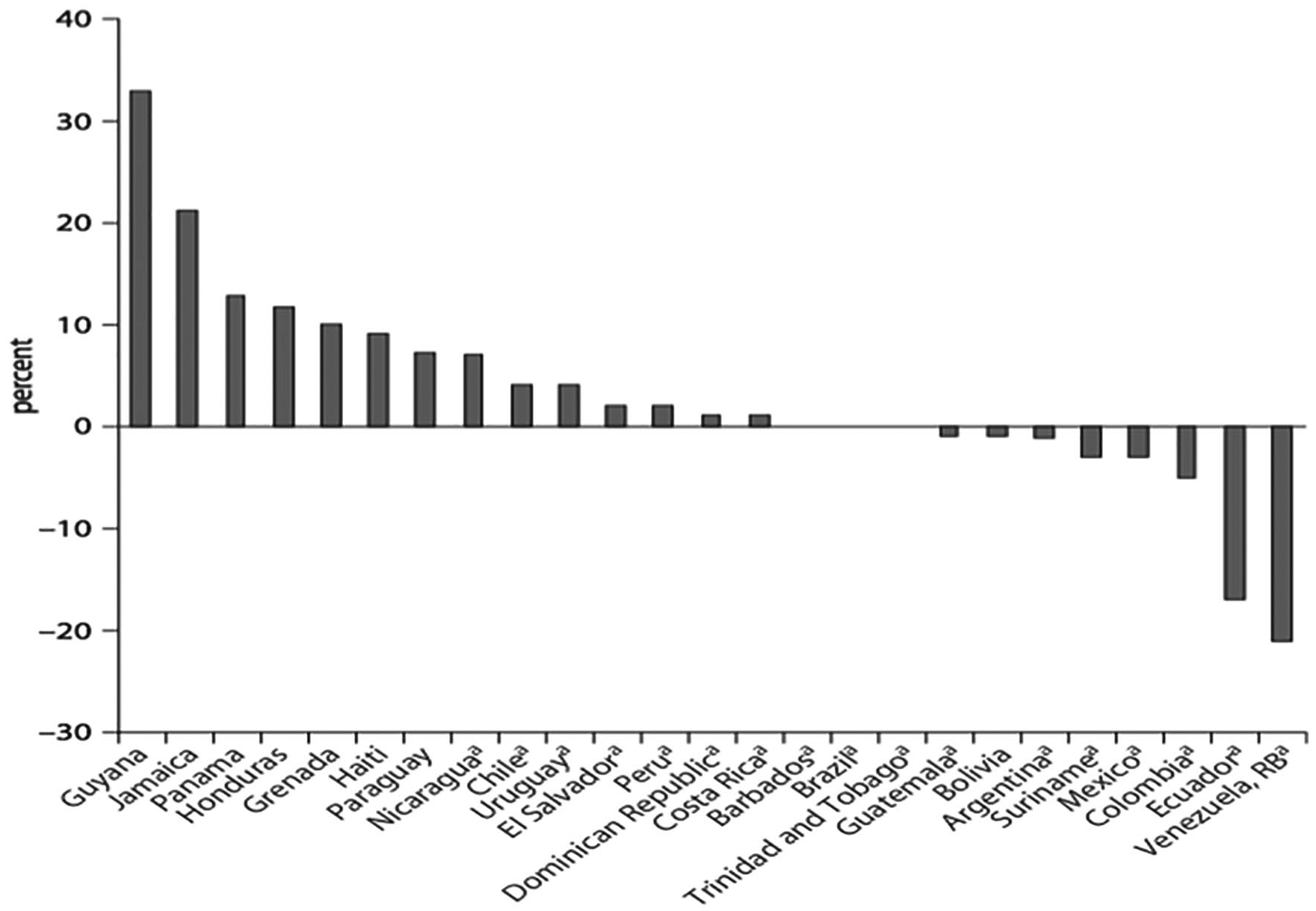
Ratio of net oil imports or exports to GDP in Latin American and Caribbean (LAC) countries.
To realize his ambitions of establishing Venezuela as a regional hegemon and addressing CARICOM’s energy deficiency, Hugo Chavez initiated the PetroCaribe energy agreement in 2005. Prior to 2005, CARICOM states, Jamaica in particular, consistently but unsuccessfully lobbied the United States for the financing of a liquefied natural gas (LNG) plant and the provision of LNG (“Jamaica and US Sign Energy Cooperation Agreement,” 2015). Whereas in the past CARICOM members had to finance their oil bill up front, under the PetroCaribe agreement, member states 2 are afforded preferential payment terms. As highlighted in Table 2, the higher the price of a barrel of oil, the lower the required down payment and the longer the time frame for payment (Goldwyn & Gill, 2016). What is particularly unique is that PetroCaribe members have the option of making term payment through cash, foods, and exchange of skilled personnel such as doctors and/or nurses (Haslam & Heidrich, 2016). Separate from oil imports, the PetroCaribe agreement by design has an investment portfolio. Proceeds from oil sales are invested domestically in member countries and serve as a concessionary loan for social development programs (Mendoza, 2016). Furthermore, the savings incurred from the long-term payment of oil is invested in a government fund used to finance critical infrastructure projects (IMF, 2016; Mendoza, 2016).
PetroCaribe Credit Financing Scheme/Agreement.

Source. Goldwyn and Gill (2016).
Venezuela’s energy diplomacy in the CARICOM did not go unnoticed. The United States reasoned that since its launch in 2005, Venezuela’s PetroCaribe had created a state of oil dependency among beneficiaries within CARICOM. The United States anticipated that in all future OAS votes on issues affecting Venezuela, CARICOM states were bound to vote in favor of Venezuela. The United States realized this and devised a strategy to wean CARICOM members off Venezuelan oil or at least create a division in CARICOM support for Venezuela. The United States’ counter strategy came when the PetroCaribe was at a vulnerable stage. PetroCaribe, while it has helped its member states to purchase oil at a significantly cheaper cost, began showing signs of vulnerability in 2013 (Schipani & Rathbone, 2015). First, the death of Hugo Chavez in 2013 raised significant doubt over his successor Nicolás Maduro’s willingness to continue the agreement (Goldwyn & Gill, 2014). Second, years of nationalizing the foreign stake in PDVSA resulted in a drastic reduction in foreign investment revenues in the sector, leaving it reeling from dated equipment, lack of technical personnel, and drilling technology that undermined the sector’s sustainability (Padgett, 2007). Third, since Chavez’s takeover of the PDVSA, it has been used to bank-roll Chavez’s domestic (Bolivarian Social Revolution) and international political interests (PetroCaribe). However, the reduction of oil prices from US$114 per barrel to a low of US$35 sent shock waves through the Venezuelan economy, which has become overwhelmingly dependent on oil for its GDP growth and export revenues (Kozloff, 2007). In 2012, oil imports from Venezuela were cut by 50% (Hidalgo, 2015). Fourth, many member states have not benefited from a reduction in electricity bills as savings from oil prices were used for budgetary support. Against these developments, there was an increasing need for CARICOM members, who were beneficiaries of PetroCaribe to find a more sustainable alternative source of renewable energy (Goldwyn & Gill, 2016).
In 2014, an assessment of energy security in Central America and the Caribbean revealed that the region was desperately in need of energy diversity. More specifically, investment in alternative energy to reduce nonproducing member states’ dependence on fossil fuels and reduce their vulnerability to fluctuating crude oil prices (Goldwyn & Gill, 2014, 2016). The United States responded to the Caribbean’s long-standing vulnerability by launching the Caribbean Energy Security Initiative (CESI; U.S. Department of State, 2014). This strategy was set in motion by the Obama administration in June 2014 at the first energy summit of the Americas hosted by the Overseas Private Investment Corporation (OPIC). The stakes were raised by the U.S. investors. Instead of competing with Venezuela by offering crude oil, the United States aligned its energy diplomacy with the needs of the Caribbean by offering diversified energy investment. OPIC provided investment to the Caribbean region in three main areas: LNG, wind and solar energy (Jamaica Information Service [JIS], 2015b). Since 2014, this has resulted in US$107 million of investments in establishing solar plants as well as a US$90 million of investment in wind energy in Jamaica (Angus, 2015; Davis, 2016a). Moreover, upon President Obama’s visit to Jamaica in April 2015, a bilateral agreement was signed between both countries for the United States to finance an LNG plant as well as supply LNG to Jamaica, which would be redistributed to other Caribbean countries (Davis, 2016b; Hines, 2016). Since 2014, Jamaica is the largest solar energy facility in CARICOM, and the CARICOM member state receiving the largest amount of LNG investment from the United States (Davis, 2016a).
The launch of the CESI, the subsequent OPIC investments in alternative energy, as well as LNG investments in Jamaica threaten to significantly erode the political capital amassed by Venezuela among some PetroCaribe members who are a part of CARICOM. These developments caused a knee-jerk reaction, triggering Maduro to immediately hold talks with PetroCaribe states in 2015, to reassure his commitment to sustaining the supply of crude oil under the PetroCaribe agreement (Parraga, 2015). Shortly after the OPIC investments and Maduro’s visit, Jamaica offered to purchase its PetroCaribe debt to Venezuela to lower its GDP debt ratio (JIS, 2015a). It can be argued convincingly that Jamaica’s act of purchasing its PetroCaribe debt was in direct response to OPIC investments.
Whereas the previous Bush and Obama administrations used subtle strategies to garner support for its agenda on Venezuela in the OAS, the present U.S. administration under the leadership of President Trump has been quite overt and indiscrete. In March 2019, President Trump invited four members of CARICOM, Bahamas, Haiti, Jamaica, and St. Lucia, to an extraordinary meeting and pledged to reward each country with investments from U.S. development lender, OPIC (OPIC, 2019; Rampton, 2019). The promise of reward would be in exchange for the states’ support for the United States’ interest in the OAS on the political and humanitarian crisis in Venezuela. All four countries have either failed to recognize Nicolás Maduro as the President of Venezuelan or backed Juan Guaido as leader of the Venezuelan National Assembly (“Venezuela in Crisis,” 2019).
CARICOM’s Rationality Toward United States and Venezuela
The series of events between 2002 and 2019 raises questions about the applicability of two key tenets of neorealism: (a) states are rational actors, and (b) where states do cooperate within international institutions, it is a manifestation of the hegemon’s self-interest (Mearsheimer, 1994-1995).
Evidence of rationality is traced back to the starting point of the energy quagmire Resolution 833 in 2002. The United States did not initially support Resolution 833 and was prepared to compromise its stance on democratic principles preached over the years. To satisfy its own self-interest, the United States was prepared to go against the collective view of the OAS on the IADC and acknowledge the 2002 coup d’état in Venezuela. The Bush administration would have preferred to recognize the coup, which would more than likely have satisfied United States’ interests. The United States’ self-interest in this case is identified as energy security which was significantly undermined when Chavez nationalized the United States’ stakes in PDVSA. Chavez’s nationalization of United States’ stakes in the PDVSA could not have come at a more sensitive time. The impending 2003 war in Iraq threatened to disrupt the U.S. oil supply from the golf region. These culminating events provided impetus for future U.S. hostility toward Venezuela.
Although the United States eventually supported the OAS’s resolution to reinstate the Chavez regime, automatic cooperation did not ensue. Instead, it triggered over a decade of competition between the main antagonists. Venezuela and the United States each launched separate strategic energy diplomatic campaigns over the subsequent years to secure political capital among CARICOM states. The antagonistic stance of the United States to the Chavez regime further transformed Venezuela into a creature of neorealism. Consequently, PetroCaribe by design was intended to serve Chavez’s ambition of elevating Venezuela to the position of a regional hegemon. It can also be argued that Chavez had hoped that by serving their energy need, CARICOM countries would vote in Venezuela’s favor in future issues affecting that country within organizations such as OAS and the UN.
To influence the votes of CARICOM members on OAS resolutions (relating to the political and humanitarian crisis in Venezuela) in its favor, the United States launched its own energy diplomacy: the CESI. This initiative strategically targeted the energy needs of vulnerable CARICOM member states such as Bahamas, Haiti, Jamaica, and St. Lucia. As highlighted in Table 3, CARICOM member states voted unanimously for Resolution 833 in 2002. However, CARICOM votes on OAS Resolutions 2929, 1117, and 1124 were split into three blocs: states that voted in “favor,” those that voted “against,” and the ones that “abstained.” The bloc which voted “against” was led by St. Vincent and the Grenadines and has been critical of fellow CARICOM member states, Jamaica in particular, for not supporting Venezuela. The underlying claim is that Venezuela has been good to PetroCaribe members within CARICOM in the past and is in dire need of CARICOM’s support. When viewed through the lens of neorealism, Jamaica’s support of the OAS resolutions is a rational response to U.S. oil diplomacy. With the decline in oil prices and corresponding economic turmoil in Venezuela, the sustainable flow of crude oil imports to satisfy Jamaica’s energy needs was threatened. Against the uncertainty of the PetroCaribe agreement, Jamaica’s energy interest was being catered for by the United States. The United States has strategically positioned Jamaica as the largest beneficiary of OPIC investment in clean energy in CARICOM and has yielded to one of Jamaica’s long-standing request by supplying the island with LNG. The U.S. investment in Jamaica’s energy sector has without a doubt surpassed the waning importance and growing uncertainty of PetroCaribe. Moreover, with Jamaica purchasing its PetroCaribe debt, the country was less obligated to cast its vote in support of Venezuela. Like Jamaica, other CARICOM member countries (particularly Bahamas, Haiti, and St. Lucia) stand to benefit from similar OPIC investment in the near future (OPIC, 2019).
CARICOM Member States’ Energy Status, PetroCaribe Membership, and Voting on OAS Resolutions.

Source. Goldwyn and Gill (2016).a
Note. OAS = Organization of American States.
Jamaica is not the only CARICOM state whose positions on the OAS resolutions were based on rationality. Other supporters of Resolutions 2929, 1117, and 1124 have taken a position based on rationality. St. Vincent and the Grenadines and Dominica are two such examples; not only do Venezuela’s oil imports account to 6% of St. Vincent and the Grenadines’ GDP, but the Venezuelan government has also been a part of the coalition of the willing that has provided critical funding to the building of the first international airport (Argyle International) in St. Vincent and the Grenadines (IMF, 2007b; SELA, 2015). In the case of Dominica, Venezuela wrote off its PetroCaribe debt of US$100 million in 2017, in the aftermath of the devastation from Hurricane Maria (Dominica News Online, 2017). It can be argued that in comparison with Jamaica, PetroCaribe funding is more critical to the economies of Dominica and St. Vincent and the Grenadines. Jamaica has been able to gamble on its relationship with Venezuela, as it has the LNG and other investments as alternative energy supplies, both Dominica and St. Vincent and the Grenadines are not afforded that same opportunity. Perhaps it is for the aforementioned reason why both Dominica and St. Vincent and the Grenadines consistently support Venezuela’s interest in the OAS.
Unlike other CARICOM members which voted for or against the OAS Resolutions 2929, 1117, and 1124, the twin island republic of Trinidad and Tobago has consistently abstained from voting. Neither the Venezuelan PetroCaribe program nor the United States’ OPIC energy program is in Trinidad and Tobago’s national interest. Perhaps Trinidad and Tobago’s continuous abstention can be attributed to the fact that the United States is a major market for its LNG export. Furthermore, both Trinidad and Tobago and Venezuela share a geographic border; it is in the interest of Trinidad and Tobago to have political and economic stability in Venezuela. This would most definitely reduce the flow of Venezuelan refugees into Trinidad and Tobago (Scruggs, 2018).
Conclusion
While historically the operations of the OAS have been predominantly explained by neoliberal institutionalism, in this most recent case of political instability in Venezuela, and the resulting divisions over OAS resolutions, neorealism is applicable. The discussion above suggests that the role of the OAS as a medium for states to negotiate their differences and find mutual agreements does not stop states with hegemonic intentions from at least attempting to influence the organization’s agenda. Although neither the United States nor Venezuela has succeeded in dominating the agenda of the OAS, both have tried through the provision of incentives to indirectly influence the OAS process in their respective national interest.
Furthermore, the neorealist postulation that states are rational actors seeking to act in their self-interest provides grounds on which to examine the division among CARICOM members on selected OAS resolutions. As explained earlier, the voting process in the OAS among CARICOM members appears to be driven by rationality. Some members of the CARICOM bloc, which account for 15 of the 35 votes within the OAS, have received favorable economic incentives from both the United States and Venezuela and have cast their votes proportionate to incentives received. Where there are no or insufficient incentives from competing larger states, CARICOM states may see no reason to be moved by rationality and may very likely choose to abstain from voting.
Footnotes
Declaration of Conflicting Interests
The author(s) declared no potential conflicts of interest with respect to the research, authorship, and/or publication of this article.
Funding
The author(s) received no financial support for the research, authorship, and/or publication of this article.
