




Abstract
The San Carlos Apache Tribe is a leading defender of Oak Flat, a large public campground on the western flanks of the Pinal Mountains east of Phoenix. Oak Flat is sacred to many Apaches and other Native Americans and is listed in the U.S. National Register of Historic Places. The Tribe is among the parties gravely concerned about the Resolution Copper Mine, a joint venture of Rio Tinto Group and BHP Billiton Ltd. to privatize and industrialize Oak Flat’s public lands and minerals. Archaeological sites, place names, stories, and ceremonial uses affirm the pre-1875 Apache occupation and ongoing significance of Oak Flat. Historical records reveal how mining proponents combined industrial and annihilationist propaganda to portray Apaches in the Pinal Mountains as subhuman impediments to civilization and profit. This inflammatory rhetoric ignited vigilante and military campaigns between 1859 and 1874 that killed over 380 Pinal Apaches—including many women and children—then confined survivors onto the San Carlos Reservation. Mining across Pinal Apache territory followed promptly, claiming additional Apache lands inside and outside reservation borders. The stark historical injustice of the Pinal Apache Genocide requires recognition and redress via the responsible governments and industries, including their successors today. The obvious first step is simple avoidance of further harm to Apaches and Oak Flat. Truth must be a hallmark for comprehensive cost–benefit assessments of proposed alterations of Indigenous homelands. Reconciliation must be a planning goal for any mining or other consumptive uses of Indigenous sacred sites.
Keywords
Whither the Roots of Resistance?
Indigenous people in North America and around the world are leading efforts to protect ecosystems and create sustainable societies (Grossman & Parker, 2012; Hindery, 2013; Willow, 2016). Such quests engage issues ranging from climate change, water security, and environmental justice to job creation and corporate influence in governmental decisions (Millet, 2015; U.S. Commission on Civil Rights, 2016). Lightening flash media reports on these controversies seldom seek ultimate sources for Indigenous resistance. Even when the roots of legitimate opposition are exposed, corporations and governments generally value industrialization over conservation and typically discount national and international policies that empower Indigenous peoples to determine their destinies and safeguard their geographical and cultural heritage (United Nations General Assembly, 2007; Welch, Riley, & Nixon, 2009).
That many Indigenous peoples show more interest in recounting historical injustices and protecting land and water than in shiny prospects for future prosperity may be because so many Indigenous territories and communities remain vulnerable and exploited relative to their non-Indigenous neighbors (Harvard Project on American Indian Economic Development, 2007; United Nations Department of Economic and Social Affairs, 2009). Numerous Indigenous peoples, including San Carlos Apaches, seem to have reached tipping points and now treat proposed harms to their homelands, communities, or sovereignties as opportunities to expose and rectify political and economic oppression.
San Carlos Apache opposition to the proposed Resolution Copper Mine (RCM) on predominantly Tonto National Forest (TNF) public land east of Phoenix (Figure 1) invites in-depth inquiry into Indigenous resistance and whether the U.S. Federal Government and RCM operators are acting in accord with established laws and policies to avoid and minimize adverse environmental and social effects from mining.

Resolution Copper Mine (RCM) impact area, nearby American Indian reservations, and Apache reservation severances enacted to accommodate industriali mining and farming.
The case study begins with Earth—the Indigenous homelands threatened by RCM and the archaeological and cultural evidence for Apache links to the RCM impact area, especially Oak Flat, the area known to Western Apaches as Chí’chil Biłdagoteel. Despite a decade of effective opposition by Apaches and environmentalists to the proposal to swap Oak Flat for RCM properties elsewhere, members of Arizona’s congressional delegation inserted provisions to privatize Oak Flat into the 2014 National Defense Authorization Act (Millet, 2015). The study continues with Wind—the pernicious propaganda propagated by governments and mining proponents, beginning circa 1859, to dehumanize Apaches and rationalize their extirpation from the Pinal Mountains. The study’s deadliest element, Fire, chronicles scorched earth campaigns that killed and removed Apache and Yavapai aboriginal landowners. Based on this explanation of what happened to the Pinal Apache stewards of the Pinal Mountains, the study argues that improving miner–Apache relations is contingent, minimally, on truthful recognition of past harms, avoidance of further injuries, and steps toward reconciliation. Federal actions to assess and minimize RCM impacts, in particular, must be complete, independently verifiable, and transparent enough to demonstrate that RCM’s social, economic, and environmental benefits unequivocally outweigh its massive and, as of late 2017, incompletely disclosed social and environmental costs.
Earth: American Indian Ties to the RCM Impact Area
San Carlos Apaches are the most vocal Oak Flat defenders among the 10 federally recognized tribes of people whose ancestors lived in and used the Pinal Mountains and the RCM impact area prior to 1875 and into time immemorial. San Carlos is one of four tribes that represent the Western Apache (Ndee) cultural tradition. The other three are the Payson Tonto Apache Tribe, the White Mountain Apache Tribe, and the Yavapai-Apache Nation (Welch & Ferguson, 2007). The six non-Apache tribes with clear cultural and historical ties to the RCM impact area represent the O’odham tradition (Gila River Indian Community and Salt River Pima Maricopa Indian Community), the Yavapai tradition (Fort McDowell Yavapai Nation and the Yavapai-Prescott Indian Tribe), the Hopi tradition (Hopi Tribe), and the Zuni tradition (Pueblo of Zuni; Colwell-Chanthaphonh & Ferguson, 2006). Historical and archaeological records seldom enable clear distinction between Apache and Yavapai identities, and Yavapai-specific evidence deserves follow-up study on par with this investigation of Pinal Apaches.
The U.S. National Environmental Policy Act, National Historic Preservation Act, and other federal and state policies require studies of RCM and comparable land alteration proposals to assess social and environmental impacts (Butzier & Stevenson, 2014; Mortimer et al., 2011). Resolution Copper (2016) lists dozens of these investigations, including many archaeological studies, but omits important archaeological reports (e.g., Buckles, 2008; Lindeman & Whitney, 2003). As a complement to studies of RCM’s archaeological impacts, TNF officials supervised an analysis of places and values important to tribes. The project included site visits to the RCM impact area and interviews with 94 representatives from the 10 affected American Indian tribes. Western Apache, Yavapai, Zuni, O’odham, and Hopi elders helped document 404 sites and 46 springs threatened by RCM and culturally significant to at least one tribe. The sites include ancestral living, gathering, and hunting areas, trails, petroglyphs, landforms, water sources, and places of religious and spiritual importance and observance (Hopkins, Colwell, Ferguson, & Hedquist, 2015).
Western Apache Territorial Culture
One indicator of the importance of the RCM impact area in Apache culture is that 65 of the 94 tribal representatives who contributed to the TNF study are Western Apache elders and younger cultural practitioners. Western Apaches are distinct from the more sensationalized Chiricahua Apaches, who maintained territories south and east of Western Apache homelands (Basso, 1983; Goodwin, 1942; Opler, 1941). Academics generally agree that Western Apaches moved westward to establish themselves in the Salt and Gila River basin uplands by the later 1600s (Bolton, 1919, pp. 162, 165, 169, 172, 180; Hämäläinen, 2008; Schroeder, 1952, pp. 143-145; Welch, Herr, & Laluk, 2017). Prior to sustained contacts with Americans, Western Apaches controlled over 11,000,000 acres of rugged mountains, deep canyons, desert basins, and stream valleys (Figure 1) (Basso, 1983; Goodwin, 1942; U.S. Indian Claims Commission, 1969).
Apache cultures and worldviews are inextricable from their lands. Western Apache social structure featured territorial bands comprised of local groups made up of extended-family households. RCM would impact lands once used by the Pinal Band, the T’iis Tsebán (Cottonwoods Gray in the Rocks People) and the Aravaipa Band, the Tsé Binesti’é (Surrounded by Rocks People; U.S. Department of Agriculture Tonto National Forest [USDA TNF], 2015). These two bands are collectively referred to as Pinal Apaches (Goodwin, 1942, p. 3).
Western Apache oral histories link specific matrilineal clans to specific clan origin places. Te’gotsugé (east of Oak Flat; Figure 2) is the origin place for the five Apache rock clans; three other clans trace their origins to Oak Flat or nearby (Goodwin, 1942, pp. 606-607, 611, 615-617; USDA TNF, 2015, section 7, p. 4). Prohibitions against marriages between clanspersons serve to broaden clan networks and, prior to the 1880s, facilitated Apache access to other group’s lands. Agave, cactus fruits, pinyon nuts, acorns, and other foods are typically available somewhere in Western Apache territory, except late in winter, but kinship and clanship ensured access whenever local foods were depleted (Basso, 1983; Goodwin, 1942, pp. 244-245). Farming complemented gathering and hunting but is only productive in restricted locations with favorable elevation, soil, and hydrologic conditions. T’iis Tsebán maintained farms along Pinal Creek and on the Salt River above Tonto Creek; Tsé Binesti’é farmed along Aravaipa Creek and the San Pedro River (Goodwin, 1942, pp. 24-25, 28). Members of the T’iis Tsebán and Tsé Binesti’é bands frequently intermarried, shared food, and traveled without fear across one another’s territories (Record, 2008, pp. 50-52).
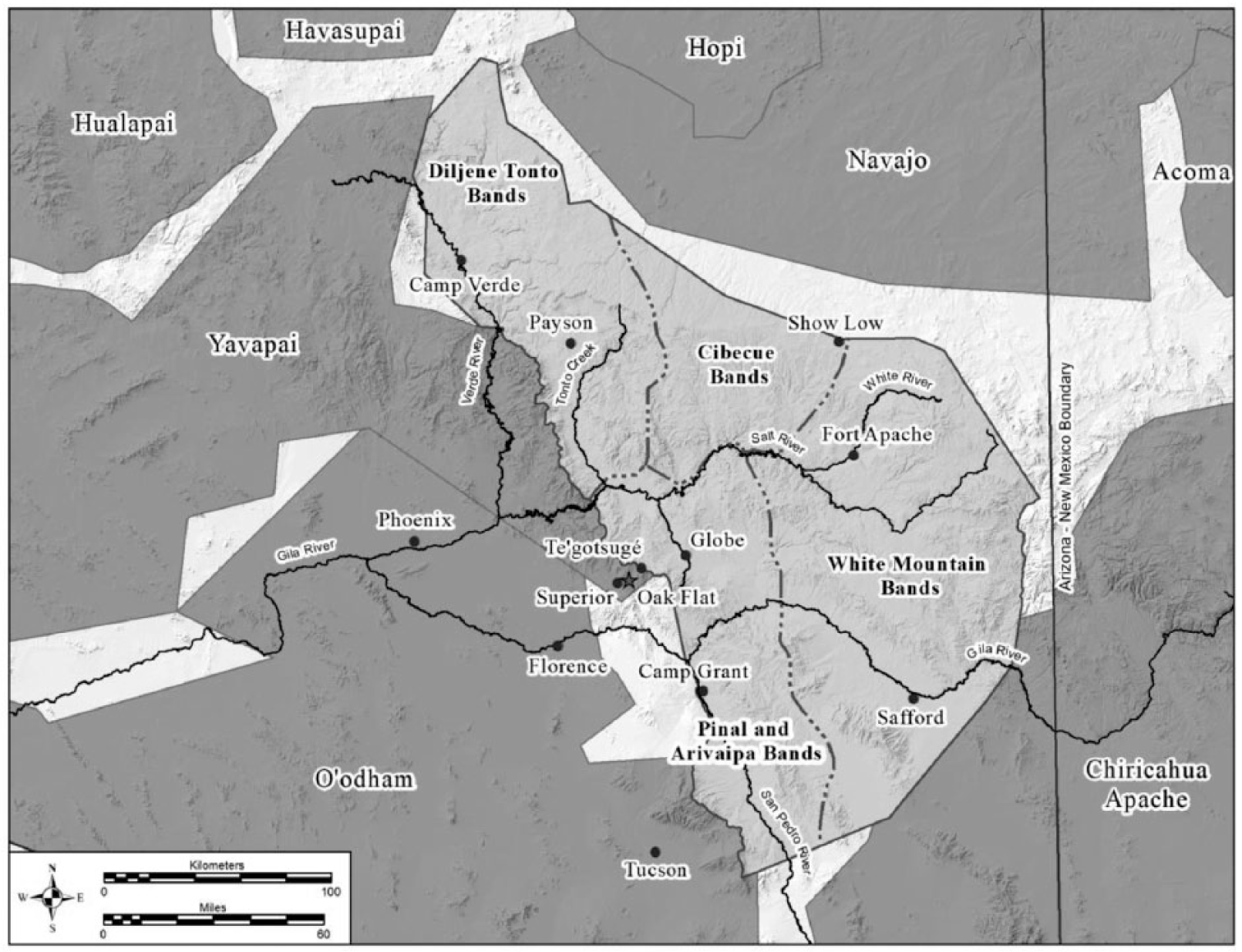
Western Apache Aboriginal Territory and band lands located therein.
Western Apaches also obtained food by raiding neighbors. Apaches distinguished raiding, armed sorties for livestock and produce, from warfare, mortal vendettas. Raiding was more common during years and seasons of food scarcity, especially January to March (Basso, 1971). Western Apaches avoided interpersonal violence to conceal raiding tactics and routes and to allow for the continued survival of farms and ranches within range of possible future strikes. Apaches and Yavapais shared the Pinal Mountains and other parts of the RCM impact area, occasionally intermarrying and cooperating in foraging and raiding (Gifford, 1932; Goodwin, 1942, p. 25; U.S. Indian Claims Commission, 1965, 1969).
Oak Flat
The stunningly beautiful, approximately 40-acre grove of majestic Emory oak trees known as Oak Flat is the most significant American Indian site within the proposed RCM impact area. Ancestors of all 10 RCM-affected tribes left behind material traces of their occupation and carried forward memories and stories (Hopkins et al., 2015). The Oak Flat vicinity is crossroads for cultures, histories, archaeologies, and spiritualities. That the English place name is a translation of the Apache name, Chí’chil Biłdagoteel (a broad flat of Emory oak trees), signals the place’s paramount significance to Western Apaches.
Western Apache cultural and archaeological sites occur across the RCM impact area, but the Chí’chil Biłdagoteel vicinity stands out as the regional hub (Buckles, 2008; Lindeman & Whitney, 2003). Apache archaeological evidence in and near Oak Flat includes pottery sherds, petroglyphs, rock piles, roasting areas, and remnants of boulder rings used as foundations for brush shelters by Apaches in the mid-1800s and probably earlier (Table 1). These materials represent campsites, food procurement and preparation localities, and spiritual sites (USDA TNF, 2015). Chí’chil Biłdagoteel is extraordinary because Apache sites elsewhere are difficult to identify and seldom occur in related clusters (Herr, 2013; Welch, 1997; Welch et al., 2017). J. Scott Wood, the TNF archaeologist for four decades, said, “there’s a good strong Apache archaeological presence up there” (Heinsius, 2015). Wood also noted the area contains “the single largest Apache archaeological site currently known” (Davidson, 2016).
Archaeological Sites with Apache Affinities in the Oak Flat National Register Historic District.

Oak Flat offers an unprecedented opportunity for collaborations among archaeologists and Western Apache scholars to fill voids in regional history and understandings of ancient Apache lifeways. Apache place names, stories, songs, and spiritual traditions relating to Chí’chil Biłdagoteel and the RCM impact area further demonstrate the region’s ancient and continuing significance, especially to Pinal Apaches (Nosie, 2016; Nosie & Rambler, 2016; Rambler, 2015). RCM threats to Oak Flat have overcome some Apaches’ reluctance to discuss Apache culture with outsiders. Upon learning of new plans for mining, a San Carlos Apache Tribe representative wrote of Oak Flat: [The] area is of traditional importance to Apaches. . . . The most effective way to respect and preserve these cultural resources is to not disturb archeological sites in any way, to keep the area natural, and to engage in activities that restore disturbed areas to natural conditions. We do not want you to promote activities that will serve to disturb this area through mining. (Cassa, 2002)
San Carlos Apache Tribe Chairman Terry Rambler (2014), a T’iis Tsebán descendant, wrote: Oak Flat is one of our religious places where our Gaan—spiritual deities and Holy People—reside. Apache people have lived, prayed, and died in the Oak Flat Area since time immemorial. We are saddened that Congress, through an 11th hour rider, has ignored the will of the people. We are concerned for our children who may never see or practice their religion in their rightful place of worship. . . . Apache people will not remain silent. We are committed to shining light on the Land Exchange and the proposed mine until we have no breath.
Wendsler Nosie, a former San Carlos chairman, said of Oak Flat: “It always has been told for generations—and it is embedded in our way—that this place has been holy and sacred” (Brave NoiseCat, 2015).
The Inter Tribal Association of Arizona (2014), representing the 10 tribes directly affected by RCM as well as 11 less affected tribes, also formally affirmed the significance of Chí’chil Biłdagoteel: Oak Flat has played an essential role in Apache, Yavapai and other tribes’ religion, traditions, and culture for centuries and is a holy site and traditional cultural property with deep tribal religious, cultural, archaeological, historical and environmental significance. . . . Oak Flat area is a place filled with power—a place where Apaches go today for prayer, to conduct ceremonies such as Holy Ground and the Sunrise Dance that celebrates a young woman’s coming of age, to gather medicines. . . . Apache elders teach their youth from the earliest of ages the meaning and significance of their sacred places, including Oak Flat.
The convergence of oral traditions, archaeological evidence, and persistent memories and feelings linked to Oak Flat soundly refutes Dale Miles’ (2015) dubious claim that Chí’chil Biłdagoteel was not and is not significant in Apache culture and history. The evidence obliged TNF to nominate, and the Keeper of the National Register to list, Oak Flat in the U.S. National Register of Historic Places. The area’s grassy basins, oak groves, boulder-studded woodlands, canyons, springs, cliffs, and cultural sites collectively embody and define a cultural landscape of historic and current uses, predominantly by Apaches, of 4,309 acres of TNF (USDA TNF, 2015).
Wind: Government Policy and Miner Propaganda Regarding Pinal Apaches
Proof of Apache occupation of the Oak Flat vicinity prior to 1875 prompts an obvious inquiry: What happened to the Pinal Apaches who had for generations used Oak Flat and other parts of the RCM impact area?
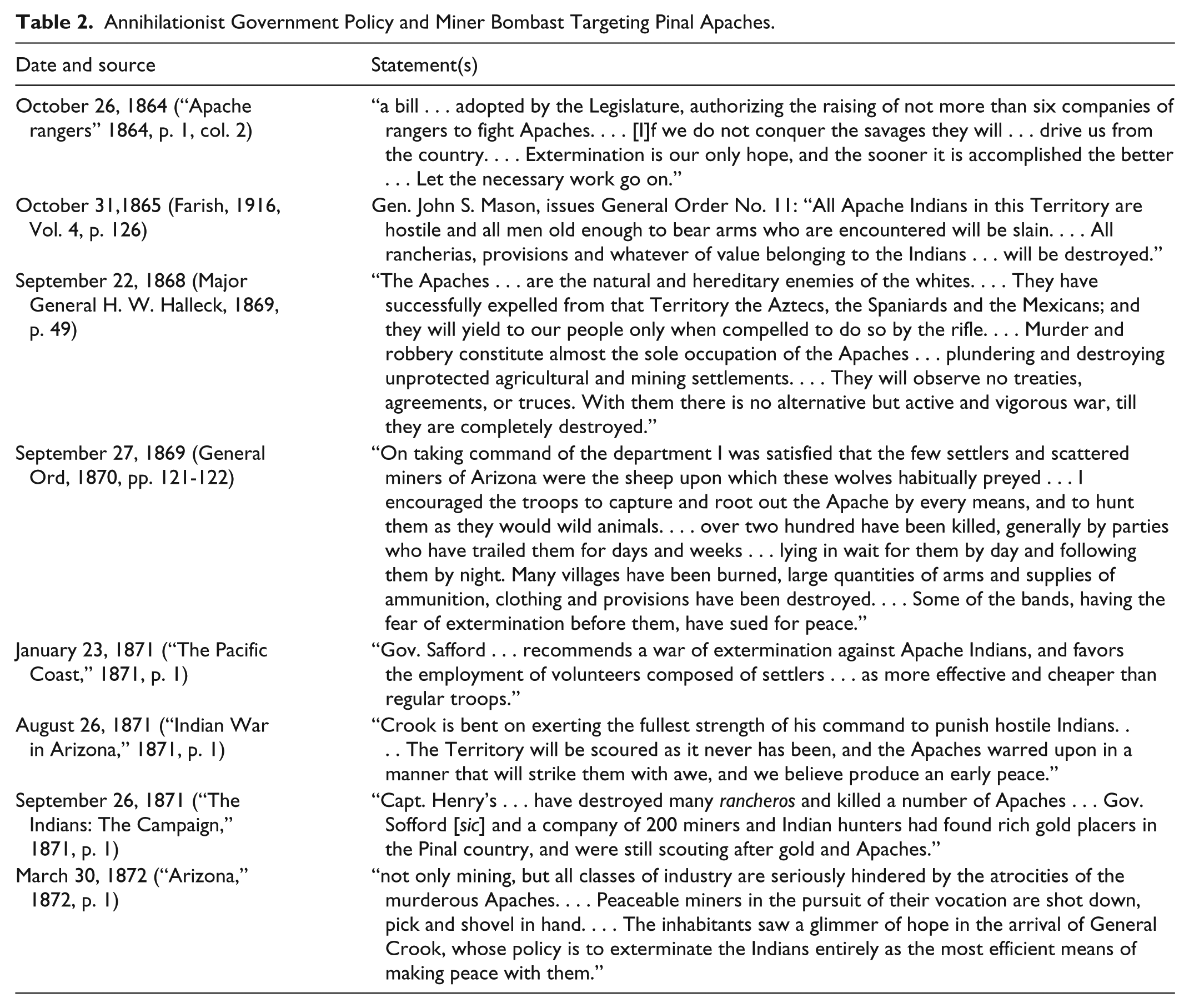
Historical facts answer this question. Apache homelands were claimed by Mexico until the 1848 treaty that ended the Mexican–American War and the 1853 Gadsden Purchase that added lands between the Gila River and today’s Mexican border (Welch, 2016). Figure 3 illustrates the original Arizona domain of Western and Chiricahua Apaches. Royce’s (1899, pp. 922-923) Polygon 689 extends eastward to the Rio Grande, depicting nonexclusive Apache territory referenced in the Treaty of Santa Fe. That treaty obliges Apaches to live exclusively under U.S. laws and jurisdiction and the United States to “designate, settle, and adjust their territorial boundaries, and . . . legislate and act as to secure the permanent prosperity and happiness of said Indians” (Kappler, 1904). Despite early cooperation among Western Apaches and newcomers (Welch, 2016), government policies abetted American encroachments into Apache lands (Table 2; Ogle, 1970).
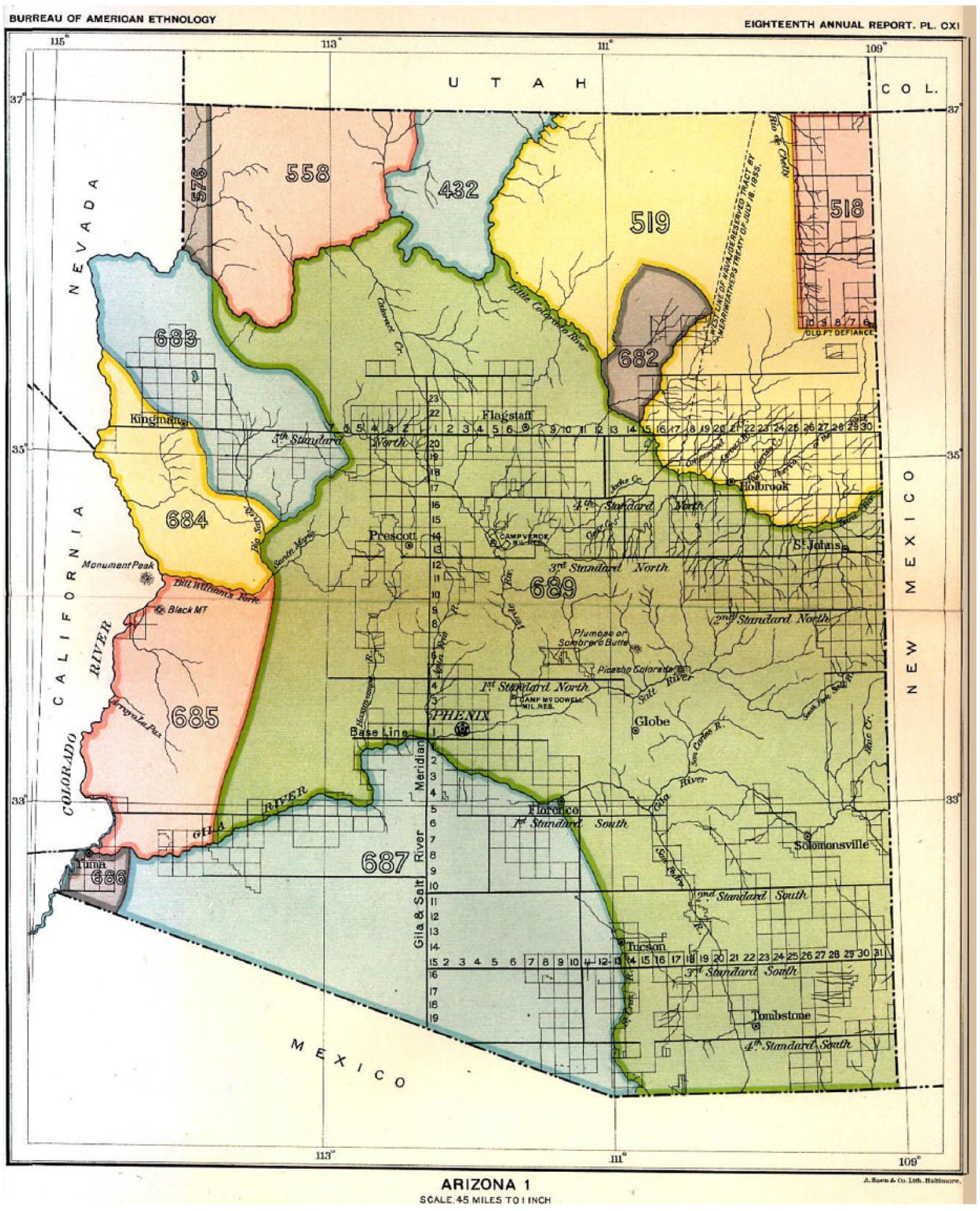
Royce’s (1899, pp. 922-923) Arizona and New Mexico map No. 1, depicting Arizona portions of Western and Chiricahua Apache homelands (overlaps with Yavapai and O’odham lands not delineated) recognized in the treaty of Santa Fe; in the public domain.
Annihilationist Government Policy and Miner Bombast Targeting Pinal Apaches.
As had been the case in California and Nevada, miners led American incursions into Arizona. The “miners’ invasion of the West that began in 1849 led to the exploration of every mountain stream and valley. Miners looked for gold and found silver in quantity as well. Congress responded with a new mining act of 1872 allowing miners to take up land claims” (Anderson, 2014, p. 310). By 1856, the United States had established Fort Buchanan, south of Tucson, and the post at the mouth of Aravaipa Creek later known as Camp Grant, to thwart Apache raids, enable strikes against Apaches, and protect miners (Thrapp, 1967). An 1859 article in the New York Times incites the incipient convergence of popular opinions, mining schemes, and government policies: The Apache is as near the lobo, or wolf of the country, as any human being can be to a beast. . . . They neither cultivate nor hunt to any extent, but exist mainly . . . by plunder. . . . This is the greatest obstacle to the operations of the mining companies. . . . [W]hipping these wild tribes . . . into submission, and driving them into reservations . . . with the penalty of death sternly enforced if they pass their limits, is the only prompt, economical, and humane process. . . . My greatest hopes for Arizona, however, rest on the army. . . . Officers of various grades are becoming interested in mines throughout that region. They . . . have connections of influence and capital. (Dunbar, 1859, p. 2)
In 1862, the U.S. Army’s departmental commander, General James Carleton, ordered Apache men to be killed wherever found (Spicer, 1962, p. 247). In 1863, miners found gold and silver near Prescott, northwest of Pinal Apache lands. The initial U.S. government commitment to maintain the travel corridor along the Mexican border through Chiricahua Apache territory soon expanded. The Pinal Apaches, Aravaipa Apaches, Tonto Apaches, and Yavapais took the brunt of American miners’ encroachments. In April 1864, the United States authorized Arizona Territorial Governor John N. Goodwin to muster the First Arizona Volunteer Infantry regiment. Over 350 men signed up to hunt Apaches (Farish, 1918; Underhill, 1983). The Miner newspaper (also The Arizona Weekly Miner) exalted mining and exhorted military and civilian campaigns against Apaches (Table 2). One example of the exhortation: Pinal Apaches . . . succeeded in stealing from the ranches a large amount of valuable stock. . . . Mr. Woolsey . . . will organize a company to hunt and punish the thieves, and if it is as successful as the party . . . which slaughtered twenty or more of them, he will have a good revenge. He . . . believes fully, as he has good reason to, in the extermination policy. (“Indian troubles,” 1864)
General Carleton’s May 1864 order, also reported in The Miner, required Apache “removal to a Reservation or by the utter extermination of their men, to insure a lasting peace and a security of life to all those who go to the country in search of precious metals” (Carleton, 1864, p. 1). Federal Government relationships with American Indians were managed by “superintendents” charged to facilitate U.S.-Native co-occupation. On March 2, 1865, Arizona’s Superintendent of Indian Affairs, Charles D. Poston (1865), appealed to the U.S. House of Representatives for additional military support for a distinctive approach to coexistence: The Spanish explorers found . . . a people . . . practicing many of the arts of civilization. . . . In antagonism to these interesting people we have the barbarous Apaches. . . . [From] Time immemorial their hand has been against every man. . . . For three centuries they have stayed the progress of civilization. . . . Their subjugation would open to our hardy miners an unexplored gold field north of the Gila. . . . A sickly sympathy for a few beastly savages should not stand in the way of the development of our rich gold fields, or the protection of our enterprising frontiersmen.
Fire!
Annihilationist rhetoric is not always backed up by deeds, but it was in Pinal Territory in the 1800s. Table 3 lists the 35 engagements with Apache fatalities; Table 4 lists the non-Apache fatalities. Both rosters rely on Berndt Kühn’s Chronicles of War (2014) to reduce bias in incident selection and fatality tabulation. As a further means to reduce vagaries in historical records and highlight contrasts between the two inventories, the roster of Apache fatalities (Table 3) only lists engagements in and adjacent to Pinal Apache territory, about 5,340 square kilometers well removed from Tonto, Cibecue, and White Mountain Apache lands (see Figure 4). Table 4 lists incidents from an area more than twice as large (about 11,500 square kilometers), and includes all Americans, Mexicans, and O’odham recorded as killed either near Pinal territory or by Pinal or Aravaipa Apaches, anywhere. In effect, the location criteria for inclusion in Table 4 were relaxed until a like number of incidents could be presented for comparison. The estimated locations of the lethal incidents were then mapped to illustrate the concerted intensity of the military–industrial extermination campaigns. The map and tables highlight contrasts between the deliberate, state-sponsored violence against Apache families and the occasional, generally opportunistic killings of non-Apache men by Pinal and Aravaipa Apaches.
Thirty-Five Lethal Attacks on Apaches in and Near Pinal Apache Territory, 1859-1874.

Source. Kühn (2014).
34 Lethal Attacks on Non-Apaches by Pinal Apaches or in Pinal Apache Territory, 1859-1874.

Source. Kühn (2014).

Government complicity with miners’ anti-Apache agenda has seldom shown restraint. The Legislature of the Territory (1864) soon authorized mining claims by U.S. Army servicemen. Bigando (1985, pp. 4-5) describes a joint, Army-prospector foray led by Captain H. Moulton and miner Calvin Jackson into the Pinal Mountains. North of the future town of Globe, the 1870 expedition staked numerous tracts, including claims for Moulton and regional commander, Lt. Col. George B. Sanborn. In another step toward convergence of military and industrial interests, General George Stoneman, the newly appointed Department Commander, ordered troops to “prosecute a relentless Winter campaign against the Pinal and Tonto branches” and “provide arms for civilians who desire to accompany them” (“The Indians in Arizona,” 1871, p. 1).
Arizonans, especially miners, wanted still more Federal Government aid. Farish (1918, Vol. 8, pp. 96-97) explains that Arizonans in the early 1870s were aroused to frenzy and demanded the immediate annihilation or capture of the Apaches. . . . Stoneman went about his work carefully. . . . Fully one-third of the Territory was, and always had been in the hands of the Apaches. . . . Stoneman was accused of spending too much time in the details of establishing new posts, and the improvement of old ones, the building of roads, etc.
Arizonans greeted Stoneman’s tactics with withering criticism in newspapers, relentless lobbying in Washington, and bloody vigilanteism.
One citizen expedition against Apaches proved pivotal. Before first light on April 30, 1871, about 150 Tucsonans and Native allies slaughtered at least 85 Pinal and Aravaipa Apaches, including about 77 women and children camped under Army protection (Colwell-Chanthaphonh, 2007; Jacoby, 2008; Kühn, 2014, p. 176; Record, 2008). The horrific event pierced Washington officials’ hazy grasp of what had been going on in Arizona. Congress swiftly ducked, ceding most authority over Indian affairs to the Executive Branch. The Army replaced Stoneman with Colonel George Crook, a seasoned Indian subjugator, and suspended operations against Apaches to allow visits by President Grant’s Peace Policy envoys. Deliberations between Apache leaders and Vincent Colyer resulted in Grant’s Executive Order of November 9, 1871, to establish the White Mountain Reservation boundaries; talks with Oliver O. Howard precipitated the December 14, 1872, Order to expand the reservation boundaries through the addition of a San Carlos Division (Figure 5 and Table 5; Welch, 2016; Figures 1, 4).

Western Apache lands initially reserved for their exclusive benefit (all polygons north of the line labeled “2nd Standard South”) and subsequent severances from those lands (polygons 541, 546, 573, 592, 602, 720) (Royce, 1899: AZ-2) (see also Figure 1); in the public domain.
Important Federal Government Acts Affecting Western Apache Lands.

Some Arizonans retreated from extermination policies, but the massacre emboldened rather than deterred both additional propaganda and miner incursions into Pinal Apache lands (Blankenburg, 1968). The Arizona Government promptly published a pamphlet to justify the Camp Grant Massacre and spur further Army killings and mining expansions: The Territory is covered with the ruins of cities and towns that were once undoubtedly inhabited by a people of industry. . . . The cause of their destruction was undoubtedly the ravages of the implacable Apache, and our people now begin to realize, that unless assistance is given them, that they only await a similar fate. (Legislature of the Territory, 1871, pp. 3-4)
By August, the New York Times reported, Gov. Spafford [sic], with 300 well-armed men and two months’ provisions, has entered the Pinal and Magallan Mountains . . . determined to prospect fully the regions from which so many parties of whites have been driven back by Apaches. (“The Indians: A Prospecting Party,” 1871, p. 1)
Crook’s General Order No. 10 (November 21, 1871) required all Apaches to remain within the boundaries of the recently established reservation or be killed. In the Tonto Basin Campaign authorized by that same order, Crook orchestrated a multipronged scouring of Tonto Apache homelands (and northern reaches of Pinal Apache land). The campaign built on previous U.S. Army operations’ effective tactics: relentless pursuits by cavalry units guided by Apache scouts, dawn ambushes, and destruction of homes, food stores, and agricultural fields (Thrapp, 1967, p. 119; Welch, 2016, pp. 94-98). The 15-month campaign killed or captured almost all Western Apaches reliant on lands beyond the newly designated reservation borders. General Orders No. 12, April 7, 1873, states that “announcement is made of the surrender of large numbers of Indians lately hostile” and directs officers “to enable the friend of any renegades still at large to bring them in upon their proper reservations. . . . [S]traggling bands . . . will be forced to surrender or be destroyed” (Bourke, 1873). “May 1, 1873 marks the date on which the United States took from the Western Apache Indians their Indian title to all of their aboriginal lands located outside of the boundaries of the reservation established by the Executive Orders” (U.S. Indian Claims Commission, 1969). By late in 1874, the sounds of Apache kids playing in their mountains and canyons were largely replaced by miners’ picks, shovels, drills, and dynamite blasts.
Aftermath
Seldom do historical documents pick up so clearly and so vividly where archaeological records end, but this is the case for the Oak Flat vicinity. Territorial newspaper articles, Indian policies, and military correspondence converge on the truth that mining was the main motivation behind the Pinal Apache extermination campaigns. Tallies from military and civilian hunts (Table 3) yield grim statistics: American campaigns killed over 380 Pinal Apaches, a reckoning that excludes the Camp Grant Massacre. Table 4 reveals that, during the same 15 years, Pinal Apaches were responsible for fewer than 70 deaths. There are gray areas in the records, but no mentions of women and children dying at the hands of Pinal Apaches have surfaced. Accounts of American aggression, however, boast about the methods of subjugation: Without judicial process or specific provocation, professional soldiers and gangs of militarized hunters stalked and murdered Apache men, women, and children, often as they slept, seldom taking prisoners. In contrast, 15 of the 34 incidents that precipitated non-Apache fatalities occurred during the season of hunger in the region’s uplands (January to March). These and many other incidents listed in Table 4 are likely attributable to intercepted Apache raiding expeditions. Stoneman (1871) quipped the Pinal Apaches “must either starve, steal, or be fed.” In another candid admission about the lopsided slaughter, General John Pope (1871) wrote, “depredations of the Apaches have been continuous for twenty-five years past, but they are insignificant in extent and generally confined to the plunder of a few sheep and mules and the occasional murder of a lonely sheepherder.”
The 1860s and early 1870s were, for Western Apaches, a cataclysmic period of loss—of life, of land, of liberty, and of sovereignties over people and territory (Lahti, 2012). The pertinent chapter (three) of Ogle’s (1970) Federal Control of the Western Apaches, 1848-1886 is titled “Extermination—A frontier panacea.” Referenced luridly elsewhere as “The Apache Wars” (see Hutton, 2016), the reality is that Americans, like the prior Spanish and Mexican incursions, invaded and annexed Western Apache territory using all available means. Western Apaches were deeply apprehensive and their responses were almost exclusively defensive. Major John C. Cremony (1868, pp. 286-287) wrote, The Apaches entertain the greatest possible dread of our discoveries of mineral wealth in their country. . . . They know and feel that wherever mineral wealth exists to such an extent as to render it available, the white man fastens upon it with ineradicable tenacity. . . . The occupation of mines involves the possession of water facilities and sufficient fuel. To occupy a water privilege in Arizona and New Mexico is tantamount to driving the Indians from their most cherished possessions, and infuriates them to the utmost extent.
The U.S. Indian Claims Commission (1965) adjudication of Western Apache and Yavapai claims to their aboriginal territories affirmed hostilities commenced simultaneously with the arrival of miners . . . and continued almost without interruption until Genera1 Crook rounded up the surviving Indians. . . . [M]ilitary commanders . . . with varying degrees of success, sent their troops out to track down, attack, kill and capture Indians. . . . Finally, following a series of meetings held by Vincent Colyer . . . a reservation was set apart. . . . Indians were directed to remove to this reservation and stay within its borders. This directive failing to be effective, General Crook, in the fall and winter of 1872-1873, waged a vigorous campaign throughout the area until virtually all the Indians had either surrendered to troops in the field or else had come into a military post. (U.S. Indian Claims Commission, 1965, pp. 79-80)
In effect, Western Apache leaders agreed to remain within their reserved lands—roughly half of the territory their people had exclusively occupied a generation prior, about 5,500,000 acres—in exchange for the balance of their land (about 5,900,000 acres; see Table 5) and solemn Federal Government guarantees of assistance (Welch, 2016, pp. 82-88). Grant’s envoys and generals laid out the initial reservation boundaries to avoid further conflicts with miners and to allow Western Apaches to sustain their families through hunting, gathering, and expanded farming and ranching operations. These facts expose all claims that Apaches were the aggressors and got what they deserved, especially such claims leveled at T’iis Tsebán and Tsé Binesti’é families, as vacuous and callous justifications of astonishingly irresponsible journalism, governance, and law enforcement, all to facilitate mining and other commodifying appropriations of Apache land.
But logics of justice, aboriginal rights, and sustainability were no match for the rapacious, race-based mind-sets that ruled Arizona for its first century. Federal and Territorial Government allegiances to the agreements made by Grant’s peace envoys to provide land sufficient to sustain Western Apache needs were short-lived. In 1875, the Federal Government closed the Camp Grant, Camp Verde, Chiricahua, and Fort Tularosa Reservations; opened these erstwhile refuges, too, to non-Indians; and set about resettling all Western and Chiricahua Apaches at San Carlos. Figure 6 shows, and Table 5 lists, the more than 2,000,000 acres taken from the White Mountain and San Carlos reservations and opened to non-Apache miners, farmers, and ranchers from 1873 to 1902.

Portion of Cox’s 1882 map of the Pioneer (Superior) Mining District.
The traces of silver and gold found during Governor Safford’s 1871 expedition (Table 2) touched off waves of prospecting and resulted in the staking of the Silver King, Hub, and Irene claims on the Pinal Mountains’ western flanks (Figure 6) (Tenney, 1927; Walker & Chilton, 1991). By 1880, stock certificates were being issued for nearby mines (Figure 7). By 1882, more than 100 additional claims had been staked and hundreds of miners occupied the Pinal and Hastings settlements, the predecessors of the Town of Superior, Resolution Copper’s headquarters (Briggs, 2015; Cox, 1882). Production data for the Magma Mine, the Superior District’s largest and longest-lived, enumerate a small fraction of the billions in wealth extracted from Pinal Apache lands: “1,299,718 short tons of copper, 36,550 short tons of zinc, approximately 686,000 ounces of gold and 34.3 million ounces of silver” (Biggs, 2015, p. 8).
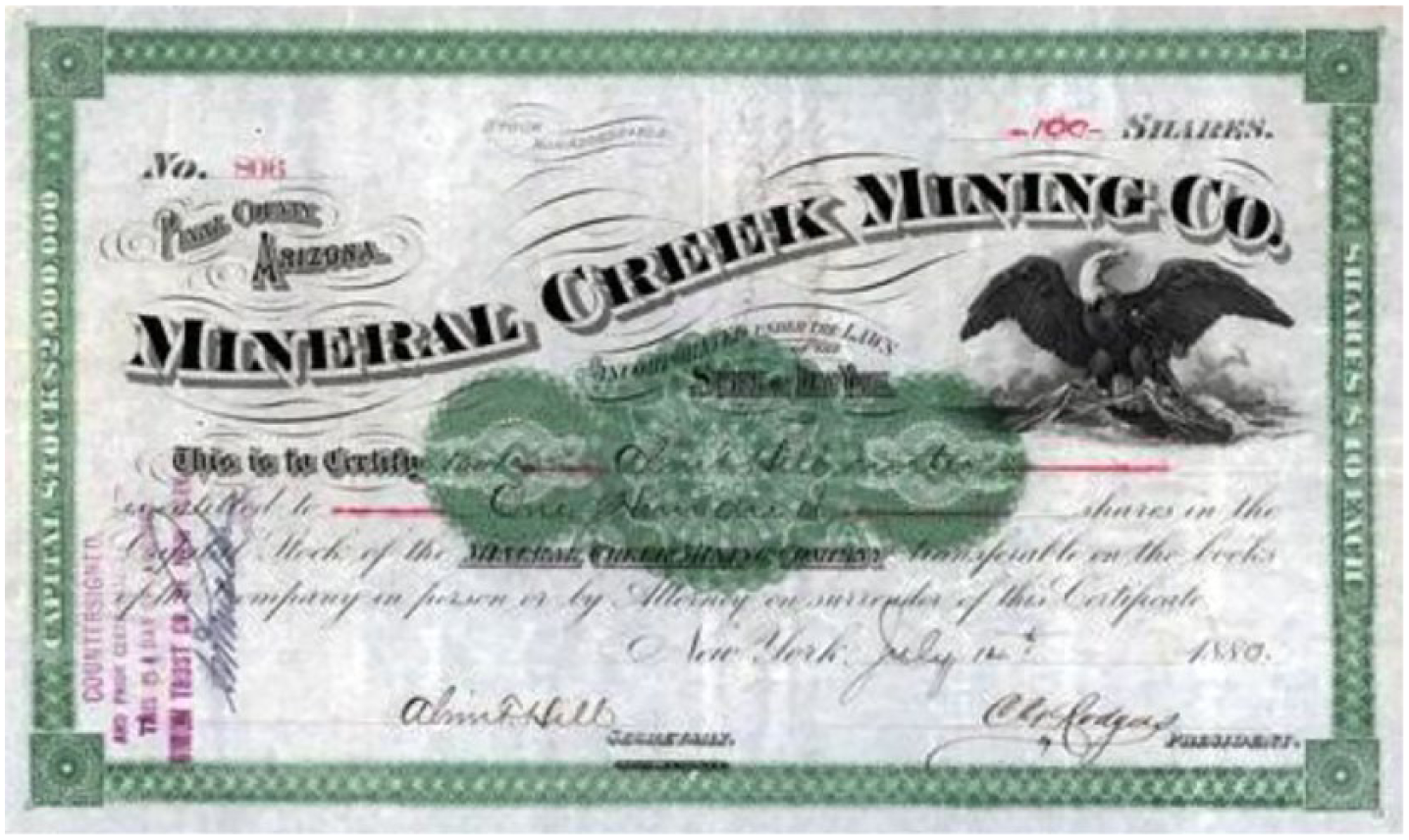
Stock certificate, mineral creek mining company, Pinal County, Arizona, 1880.
Miners and their political pawns were unapologetic about killing Apaches, destroying their possessions, or taking their lands. In a further exposition of voracious frontier mentality, the Territorial Legislature (Legislature of the Territory of Arizona, 1885) petitioned the U.S. Congress for all lands remaining in Apache hands, asserting,
that the Indians now occupying these vast reservations, comprising the richest mineral, agricultural and timber lands of the Territory, have made no use of said lands, but simply withhold the same from public use and occupation, and are a perpetual menace to the peaceful settler, retarding progress, paralyzing prosperity . . . That the San Carlos and White Mountain Reservations . . . covering the fountain heads of all our most important streams, now . . . serving as the abode and lurking places of a discontented, idle and vicious horde of savages, a curse and a plague to civilization and a danger and disgrace to the Territory. That the present apparent quietness of the Apache Indians, neither reassures or deceives . . . That your Memorialists believe that these Indians ought and should be removed from our midst to some part of the Indian Territory, where they may learn the rudiments of education and become in time peaceable. (p. 374)
Genocide?
Since codification in the 1948 Convention on the Prevention and Punishment of the Crime of Genocide (United Nations General Assembly, 1948), genocide has meant any of the following acts committed with intent to destroy, in whole or in part, a national, ethnical, racial or religious group, as such: a) Killing members of the group; b) Causing serious bodily or mental harm to members of the group; c) Deliberately inflicting on the group conditions of life calculated to bring about its physical destruction in whole or in part; d) Imposing measures intended to prevent births within the group; e) Forcibly transferring children of the group to another group.
Scholars and lawyers agree that genocide should be referenced sparingly to conserve the term’s legal, symbolic, and political potency (Bartrop, 2008). Anderson (2014, p. 12) goes further, arguing that genocide is not a generally applicable descriptor for U.S. Indian Policy because a “legitimate government must plan, organize, and implement . . . a concerted effort to kill large numbers of people or indeed to annihilate a given people.” More recently, Madley (2015) has welded the mandate to conserve the term’s potency to a framework for focused investigations using the 1948 criteria. Madley (2016) follows his own advice in an authoritative California study.
This research also adopts Madley’s framework, revealing that Federal and Territorial officials colluded with industrial boosters to remove T’iis Tsebán and Tsé Binesti’é from their rightful homelands, dead or alive. After 1874, once the Western Apaches’ self-appointed Federal trustee had the upper hand, it distributed to non-Apaches the wealth from Apache’s aboriginal and reservation lands (Welch, 2016). Beginning in the later 1870s, the U.S. government saw fit to distribute Apache children—first dozens, then hundreds—to boarding schools and non-Indian families (Adams, 1995; Jacobs, 2009). State-sponsored Apache scalp bounties may have continued in Arizona into the 1880s (“Money for Indian Scalps,” 1885).
Madley (2015, p. 132) further recommends research into those who prospered by and through genocide. The beneficiaries from the Pinal Apache Genocide, from the 1870s to the 2010s, are mining corporations. Early mining proponents planned and implemented genocide using predominantly public resources (i.e., the U.S. Army). These proponents then rushed in to claim and privatize the spoils. Their 21st-century successors now appear poised to prosper through reinvestment of profits and political influence ostensibly traceable to genocide. RCM and its parent company, Rio Tinto, remain committed to influencing U.S. Government decisions about the use of public lands and minerals, regardless of additional harms to those lands, to Native Americans, or to National Register historic sites and sacred places (see, for example, Barrios, 2017). Since the mid-1800s, miners have enlisted and rewarded government officials for complicity in relentless quests to elevate mining above other interests, including common laws, human rights, Christian values, and other moral codes. In October 2017, the U.S. filed fraud charges against Rio Tinto for misleading investors (Lynch & Hume, 2017).
Reflections and Recommendations
History, it is often said, repeats itself. Archaeologists and historians have chronicled where and how cultural groups have distributed themselves over the West’s plateaus, deserts, and mountains. Displacement, reduction, and removal have received less attention (cf. Spicer, 1962, with Welch, 2017). The Pinal Mountains reverberate with successive governmental interventions over many decades to eliminate Apaches from consideration in relation to mining proposals. In 2014, instead of respecting their oaths of office and the Apaches, a few Arizona politicians advanced the comatose RCM proposal by crafting provisions for a land exchange and impact assessment tailored to authorize further destruction and privatization of Apache sacred places and American public lands and resources (Mikkelson, 2016; Millet, 2015). In the past and in 2017, arguments that mining creates wealth, provides good jobs, and supports vital communities generally neglect the downsides. In the area surrounding Oak Flat and other world regions that have hosted numerous large mines, the local benefits of mining pale in comparison to biophysical and sociocultural costs and consequences (see Bernhardt & Palmer, 2011; Bridge, 2003).
It is also said that history belongs to the victors. This is true in the narrow sense that most published accounts of Pinal Apache history have been authored by non-Apaches. It is also true in the institutional and practical senses that Apaches and their allies must use non-Apache rules in quests to unsilence their histories, save ancestral and public lands from imminent destruction, and secure their futures (Dongoske, Pasqual, & King, 2015; Greenberg & Greenberg, 2013; Willow, 2016). The Pinal Apache Genocide helps explain Apaches’ persistent emotional and spiritual connections to Oak Flat and the depth and persistence of their opposition to RCM. Insidious forces that Jacoby (2008) calls the Violence of History have suppressed evidence that bolsters Apache claims and appeals while also marginalizing reasoned calls, like the one issued here, for overdue justice.
What nothing can or must ever be allowed to erase, however, is truth. Robust bodies of archaeological and historical evidence unequivocally confirm the presence of Pinal Apaches in the Oak Flat vicinity and across the RCM impact area. Arizona and U.S. Governments deliberately prosecuted the Pinal Apache Genocide to enable industrial mining and the distribution of resultant profits from Apache lands to industrial allies. The Pinal Apache Genocide requires recognition as both history and as a factor affecting contemporary relations among those who live and work in its dark shadow, including RCM personnel, Federal and Arizona State Government officials, and the residents of Pinal and neighboring counties. Suspicions about industrialization voiced by Apaches and other tribes’ representatives derive not only from ancient senses of sacredness but also from persistent duties to homelands and long-muted histories of severance therefrom (Deloria, 1994; Spicer, 1971). After maintaining their traditions across centuries of oppression both overt and insidious, Apache memories, stories, and claims to their lands may well emerge stronger and more resilient from the RCM controversy. Apaches take history seriously and personally and so, too, should others affected by it (Basso, 1996). That means everybody.
What history has yet to record are commitments by the proponents of the Pinal Apache Genocide and their successors to acknowledge and atone for these still-reverberating injustices. Studies of historical trauma show how past harms and oppressions travel across generations to cause major effects on Indigenous peoples’ health and wellness (Fast & Collin-Vézina, 2010; Schaepe, Angelbeck, Snook, & Welch, 2017). The Pinal Apache Genocide constitutes a moral and legal mandate for action. Using Federal and international laws (United Nations General Assembly, 2007; Welch et al., 2009), applicable RCM policies (Rio Tinto, 2010), and principles of transparency, accountability, and independent verifiability (Scott, 2014), the next U.S. Government intervention in Pinal Apache territory should be a comprehensive review of the RCM proposal. Truth and reconciliation protocols developed to address individual and collective trauma and to enable restorative justice (Scott, 2014) recommend prompt action on the part of the U.S. to engage San Carlos Apaches and other representatives of other affected tribes in respectful determinations of whether and how RCM and other mining might proceed in their homelands. In any case, the Federal Government must abandon, in Arizona and elsewhere, land management policies and practices that institutionalize conceptions of aboriginal landowners as denizens of the past and impediments to progress, caricatures that confine tribal concerns to and within physical protections for specific archaeological sites (Dongoske et al., 2015). There will never be a better, easier, or less expensive time than now for the United States of America to escape military–industrial capture, embrace its public and Indian fiduciary duties, and fulfill its higher manifest destiny as a guarantor of truth and justice for all.
This historical case study is as much about the future as the past. Asking what happened to the Pinal Apaches who created an abundant archaeological record around Oak Flat has revealed a genocide hidden in plain sight. Beyond chronicling another chapter of injustice, the study indicates clear directions for addressing the legacies of recurrent and occasionally lethal colonial encounters between industrialists and American Indians (“Dakota Access Pipeline,” 2016). The Federal Government must decide, history will record, and voters shall judge whether the foreign-owned RCM shall inflict additional harms on Apaches, other American Indians, and their homelands. The Oak Flat sacred place contains far more than copper ore. The area harbors the material and memorial proof for Pinal Apache occupation of the Pinal Mountains and for government-sponsored mass killings and race-based persecutions that haunt all American lands, lives, and institutions. The reverberant consequences of the Pinal Apache Genocide and comparable inhumanities will continue to debilitate our democracy so long as silence reigns. All who cherish justice and simple kindness should question how much and how long to accept genocide as a basis for how we treat our lands and neighbors across the American West, and beyond.
Footnotes
Acknowledgements
I gratefully acknowledge information and assistance provided by Mark Altaha, Kelly Bannister, Dinah Bear, Hugo Cardoso, Vern Grant, Saul Hedquist, Sarah Herr, Erin Hogg, Karl Hoerig, Joe Kalt, Berndt Kühn, Jami Macarty, George Nicholas, Seth Pilsk, Terry Rambler, Ramon Riley, Dave Schaepe, Ken Travous, Maria Vejar, Scott Wood, and many librarians at the University of Arizona, Arizona State Museum, Rogers School of Law, and Special Collections Library and the Arizona Historical Society. Clayton Crawford and Raul Campos expertly prepared Figures 1, 2, and  .
.
Declaration of Conflicting Interests
The author(s) declared the following potential conflicts of interest with respect to the research, authorship, and/or publication of this article: The research and writing for this article were supported in part by the Social Science and Humanities Council of Canada and the San Carlos Apache Tribe.
Funding
The author(s) disclosed receipt of the following financial support for the research, authorship, and/or publication of this article: Arizona Archaeological and Historical Society, Tucson; San Carlos Apache Tribe; Social Sciences and Humanities Research Council of Canada. Simon Fraser University’s Open Access Fund provided the open access publication fees.