




Abstract
The study evaluated 60 middle school students and 191 high school students on their willingness to recite or not recite the Pledge and their rationale. Overall, 60% of the middle school students and 68.6% of the high school students chose not to recite the loyalty oath. For the European Americans students, the most common rationale among the middle school students for reciting the Pledge was tradition; with the high school students, the most common reason for not reciting the Pledge was the voluntary nature of the Pledge ceremony. With the middle school and high school Akwesasne Mohawk students, the most common reasons for not reciting the Pledge were the voluntary nature of the Pledge ceremony and their Akwesasne Mohawk/Native American status. With their strong rejection of Pledge recitation, the Akwesasne Mohawk tribe has perpetuated a stronger socialization of their youth. However, the act of reciting the Pledge represents just one form of patriotism.
The first nationwide United States Pledge of Allegiance ceremony took place in 1892, and the Pledge ceremony is part of the United States’ historical heritage (Ellis, 2005; Guenter, 1990). Although the Pledge is part of America’s past, do middle school and high school students in the 21st century still recite the Pledge during the ceremony? Why or why not? In this study, the authors explored the aforementioned research questions.
Conceptual Framework
Identity development is a factor that may affect individuals’ decision to recite a loyalty oath during the Pledge ceremony. Although socialization is a mechanism that leaders in a society use to instruct youth and to promote the society’s ideals and traditions such as the United States Pledge of Allegiance ceremony (Engle & Ochoa, 1988; Martorella, Beal, & Bolick, 2005; Noack, 2011), adolescence is a time when youth are molding their identity (Marcia, 1966). Although some foreclosed individuals may have given no thought about specific cultural traditions such as the United States Pledge of Allegiance ceremony, other youth ask, Who am I? What do I believe? Although Marcia (1966) suggested that individuals pass through classic stages as they explore their identity (foreclosure, diffusion, moratorium, identity achievement), there is a continuum in terms of how much or how little a person within a society may commit to practicing society’s cultural traditions. During their identity explorations, some individuals may choose to completely maintain the cultural tradition of the Pledge ceremony. Other individuals may partially continue the cultural tradition by not participating in the Pledge ceremony and may believe that being respectful during the Pledge ceremony is sufficient. Meanwhile, some individuals may completely reject the cultural tradition of the Pledge ceremony.
Literature Review
History of the United States Pledge of Allegiance
Since the first nationwide Pledge ceremony in 1892, the United States Pledge of Allegiance has been a tradition in the schools (Ellis, 2005). Francis Bellamy is credited with authorship of the United States Pledge of Allegiance (Jones & Meyer, 2010). To accompany the Pledge, James Upham created a Pledge salute (Ellis, 2005; Guenter, 1990; Jones & Meyer, 2010).
The Pledge ceremony was a reaction to post Civil War conditions. James Upham (1845-1905) and Francis Bellamy (1855-1931) had experienced the United States being torn apart by Civil War (1861-1865), a war that led to more than 600,000 people losing their lives (Cayton, Perry, Reed, & Winkler, 2005; Ellis, 2005; Guenter, 1990). After the Civil War, James Upham and union veterans from the Grand Army of the Republic had noticed the decline in patriotism, and they were concerned. Although flags were widely flown during the United States Civil War (1861-1865), after the war, this was not the case (Sica, 1990). In addition, after the Civil War, a large influx of immigrants came to the United States; during the 1880s, 80% of the population of New York City was foreign born, and to help support their families, many immigrant youth did not attend school (Sica, 1990). Within a nation that had been torn apart by the Civil War, there were concerns these new immigrants might not develop feelings of loyalty to the United States; public schools were seen as a mechanism for developing this loyalty (Sica, 1990).
To promote patriotism and loyalty to the nation, James Upham and Francis Bellamy organized a national campaign to have a United States flag in every school and in every classroom; they also organized the first nationwide United States Pledge of Allegiance ceremony (Ellis, 2005; Guenter, 1990). In preparation for the national Pledge ceremony, Bellamy created a loyalty oath—the United States Pledge of Allegiance, and to emphasize the importance of a united country, Bellamy included the words, one nation indivisible, within the Pledge (Miller, 1976; U.S. Department of Veteran Affairs, n.d.). Bellamy saw the Pledge as a socialization technique similar to churches having youth recite the Lord’s Prayer from childhood to adulthood. Bellamy felt that by inculcating youth over the course of their childhood, the premise of loyalty to the nation would be inescapable and so deeply embedded in them that it would simply become a natural part of what they were (Ellis, 2005).
Over the years, court rulings have shaped how the United States Pledge of Allegiance ceremony is practiced in the schools. Because of West Virginia State Board of Education v. Barnette (1943), students are not required to participate in the Pledge ceremony (Ellis, 2005; Martin, 2008). In addition, due to Goetz v. Ansell (1973), students do not have to leave the classroom if they do not wish to participate in the Pledge ceremony; they can remain seated if they are not disruptive (Ellis, 2005; Kavett, 1976; Martin, 2008).
Research on the United States Pledge of Allegiance
Research has examined different aspects of the Pledge ceremony. One aspect is individuals’ understanding of the Pledge and their rates of participation in the Pledge ceremony. Regrettably, confusion has occurred among prekindergarten through 12th-grade students. In 1936, Moser and David asked 8,000 students from Grades 4 to 12 to write down the Pledge; not one of the students was able to write the Pledge correctly. Later, when Kavett (1976) informally evaluated elementary students and Witherell (1992) informally evaluated prekindergarten students on their understanding of the words within the Pledge, they heard phrases such as “one nation, invisible” (Kavett, 1976, p. 136) or “liberty and juice for all” (Witherell, 1992, p. 64). Likewise, in 2006, when Gaylord informally interviewed elementary students, the students were also confused about the Pledge. To explore students’ willingness to participate in the Pledge ceremony, Gaylord informally interviewed a Boston school superintendent, who stated that the Pledge was unpopular within the school district, and a Canton school superintendent, who commented that the Pledge was recited at each grade. However, Gaylord noted that “There are no numbers to prove the pledge [recitation] is waning” (para. 1).
Another aspect of the Pledge is students’ thoughts during the Pledge ceremony. Parker (2007) led 50 seminars/discussions about the Pledge with students, high school teachers, and parents; he concluded that they had given little thought to what they were promising to do. In other studies, primarily European and African American middle school and high school students were surveyed and interviewed about the Pledge ceremony; most of the participants discussed their feelings of love and loyalty for the United States (Martin, 2011, 2012, 2014). However, 9% of the middle school participants and 28% of the high school participants felt that the Pledge was a meaningless activity. In addition, some middle school and high school students were unfamiliar with the meaning of the words in the Pledge. To improve their understanding of this daily school ritual, they requested additional instruction on the United States Pledge of Allegiance.
Various factors may affect the participants’ willingness to recite the Pledge during the Pledge ceremony. One factor is brain development. While writing the Pledge, Francis Bellamy embraced ideals (Ellis, 2005; Kavett, 1976; Miller, 1976, 2008), and during Piaget’s formal operational stage, students tend to embrace ideals (Santrock, 2016; Woolfolk, 2016). Also, while writing the Pledge, Francis Bellamy included abstract ideas. Bellamy recognized that some students may not understand these ideas, but he reasoned that as they grew older, they would be better able to understand these concepts (Ellis, 2005). However, Weinstein (1957) found that by 11 to 12 years of age, children have the ability to unpack the complex associations embodied in the symbolism of a national flag such as government, people, place, as well as to recognize that ritual behaviors associated with a national flag are culturally prescribed conventions.
Akwesasne Mohawk History, Culture, and Relationships With the U.S. Government and State/Local Communities
Ethnic interactions such as the interactions between European Americans and Akwesasne Mohawks are an additional factor that could affect a person’s decision to recite or not recite the Pledge during the United States Pledge of Allegiance ceremony. Previous research has focused on primarily European American, African American, or participants of unspecified ethnicities (Kavett, 1976; Martin, 2011, 2012, 2014; Moser & David, 1936; Parker, 2007; Witherell, 1992). However, examining whether Akwesasne Mohawks choose to recite or not recite the Pledge offers an opportunity to extend existing research on the Pledge ceremony. The Akwesasne Mohawks are part of the Six Nations Iroquois League (Holm, 2010), and the Akwesasne Mohawk tribe is located on both sides of the United States/Canadian border.
The Akwesasne Mohawks’ relations with European Americans have led to the loss of their lives and land. When the Dutch created a trading post at Albany in 1614, the tribal members encountered unfamiliar illnesses such as measles, smallpox, influenza, and scarlet fever; by 1644, the population was reduced by 66% (Snow, 1996). Their original territory included nine million acres (Campbell, 1985), and treaties with the United States in 1784, 1789, and 1794 guaranteed the sovereignty and independence of the Iroquois Six Nation Confederacy (Campbell, 1985). Yet, “almost immediately” after the Treaty of 1784, U.S. citizens established illegal settlements on their land (Segwalise, 2005, p. 28). Due to coercive or fraudulent treaties during 1784 to 1838, their land shrank to 28,000 acres (Johansen, 1993; Segwalise, 2005).
Within the Akwesasne Mohawk tribe, tribal sovereignty is strongly valued (George-Kanentiio, 2008), and within the Akwesasne Mohawk society, a traditional Akwesasne Mohawk is “a person or a family who chooses to live outside the ‘mainstream’ life imposed on Native Americans by the European or European American culture or governments” (Johansen, 1993, p. xxviii). For example, although the United States guaranteed the Akwesasne Mohawk’s sovereignty, the United States’ Citizenship Act of 1924 required Native Americans to become U.S. citizens (Holm, 2010; Reid, 2004; Segwalise, 2005). However,
The Haudenosaunee [Iroquois] vigorously objected to the Citizenship Act and maintains to this day that the People of the Longhouse are not citizens of Canada or the United States, but are citizens of their own nation of the [Six Nations Iroquois] League. (Akwesasne Notes, 2005, pp. 112-113)
To strengthen the youths’ understanding of their tribe’s history, culture, and civic engagement, the Akwesasne Counselor Organization developed a series of pamphlets to educate the youth and to strengthen their tribal identity (Akweks, 1947). Later, in 1977, the Iroquois created Iroquois passports, which Iroquois delegates used to attend the 1977 United Nations conference (Barreiro, 2005). To further promote their history and their cultural traditions, in 1979, the Akwesasne Mohawks founded the Akwesasne Freedom School with grades prekindergarten through Grade 9. To obtain revenue streams to support the school and public services, the tribe has gambling operations, petroleum sales, and tobacco sales (George-Kanentiio, 2008).
The Akwesasne Mohawk reservation is located on both sides of the U.S./Canadian border, and the international border has been a defining feature in the life of the Akwesasne Mohawks. The location of the tribe led to a few large industrial companies coming to the area, but in the 1980s, due to industrial pollution, the Akwesasne Mohawk reservation was “one of the worst PCB-polluted sites in North America” (Johansen, 1993, p. 11) and “residents were warned not to eat vegetables from their own gardens” (Johansen, 1993, p. 6). As a result of the pollution, “in most areas of the Akwesasne [Mohawk reservation] people cannot drink the water” (Holm, 2010). Furthermore, although Jay’s Treaty of 1794 confirmed the Akwesasne Mohawk’s right to free passage between the United States and Canada (Holm, 2010), rural poverty has created unequal financial opportunities. Whereas some Akwesasne Mohawks have worked at the casino, other Akwesasne Mohawks have smuggled Asian immigrants into the United States for profit or have smuggled cigarettes from the United States to Canada for profit (George-Kanentiio, 2008).
Hypotheses
In this study, the researchers examined six hypotheses.
Method
Participants
This study evaluated 60 middle school and 191 high school students’ views on the United States Pledge of Allegiance via a survey. Among the middle school participants, 26 students were Akwesasne Mohawks, 22 students were European Americans, and 12 students classified themselves as other. Among the high school participants, 88 students were Akwesasne Mohawks, 80 students were European American, and 23 students classified themselves as other. In the middle school and the high school, the student population is primarily Akwesasne Mohawk and European; there are very few Hispanics, Asians, or African Americans; however, historically in the area, there has been some intermarriage between individuals of European American and Akwesasne Mohawk descent. With respect to gender, the middle school participants included 29 males and 31 females, while the high school participants included 93 males and 98 females. In terms of grade level, the middle school participants included 35 students from the seventh grade and 25 students from the eighth grade; the high school participants involved 67 students from the ninth grade, 44 students from the 10th grade, 47 students from the 11th grade, and 33 students from the 12th grade. Although having a larger number of middle school and high school participants complete the survey would have been desirable, the authors were grateful to the students who took time out of their day to provide us with their insights on the Pledge.
The Middle School and the High School
The study took place in a town in the northeastern United States, which contains a combined public elementary, middle school, and high school. Due to time restraints, the study did not include elementary students. The combined school is located next to the Akwesasne Mohawk reservation, and the high school offers electives on the Akwesasne Mohawk language and culture.
Data Collection
After the students completed the parental and the student informed consent forms, the eligible students were given time in class to complete the survey, and the survey took approximately 15 min to complete. The written survey included the United States Pledge of Allegiance along with demographic questions and the following open-ended question: While the United States Pledge of Allegiance is being recited, do you say it? Why or why not? An open-ended question was used instead of a Likert-type scale so not to bias the participants’ responses.
The survey was administered over the course of 1 week during the school day at the participants’ social studies classes. The study included responses from nine periods of seventh-grade classes, nine periods of eighth-grade classes, eight periods of ninth-grade classes, six periods of 10th-grade social studies classes, eight periods of 11th-grade classes, and five periods of 12th-grade classes. Eight social studies teachers’ classes participated in the study. The results of the survey are located in Tables 1 to 6. To access the study data, please contact the lead author.
Cross Tabulation on Middle School Versus High School Participants’ Willingness to Recite the Pledge During the United States Pledge of Allegiance Ceremony.

Two cells (25.0%) have expected count less than 5. The minimum expected count is .24.
Ethnicity Cross Tabulation on Middle School Participants’ Willingness to Recite the Pledge During the United States Pledge of Allegiance Ceremony.
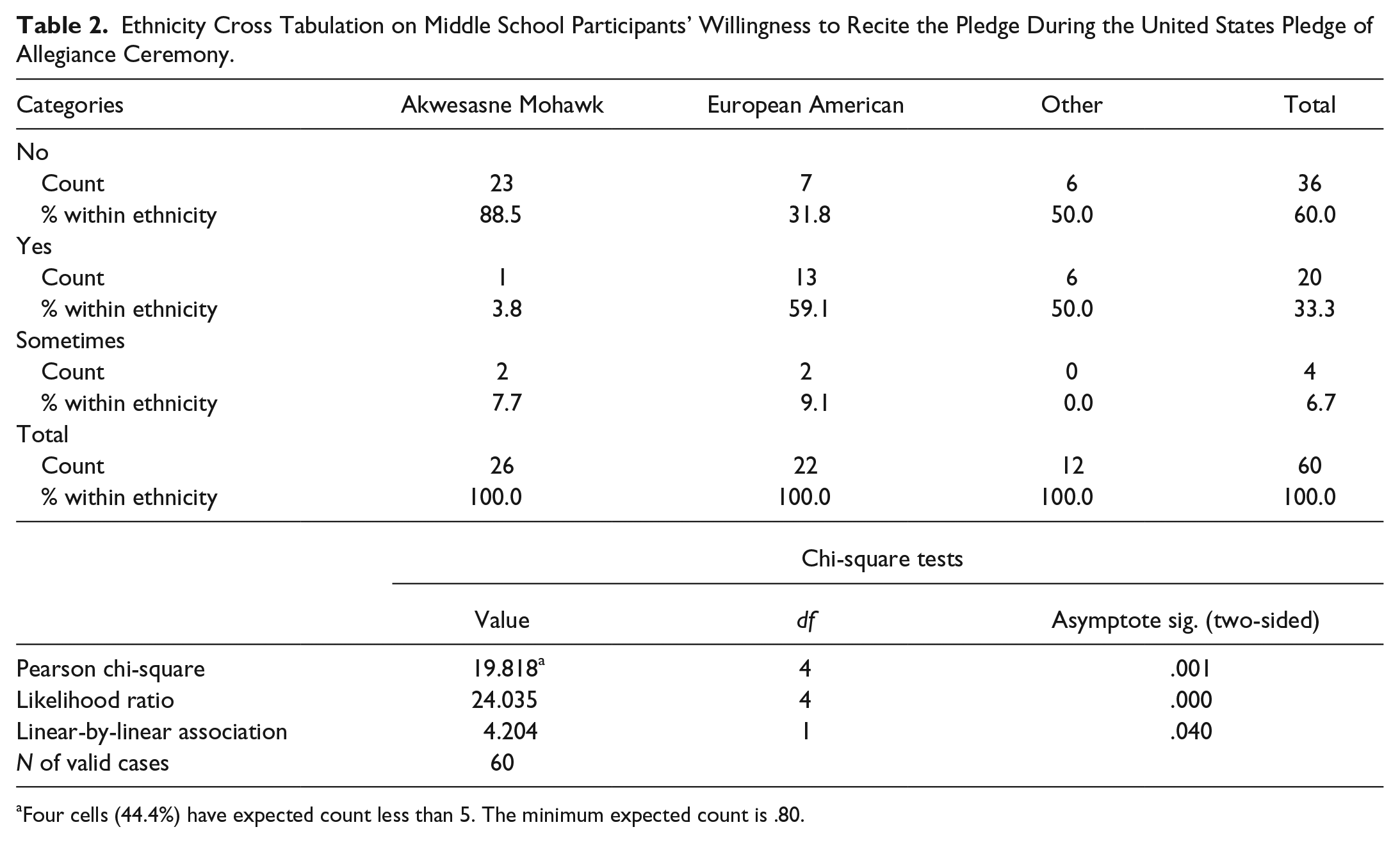
Four cells (44.4%) have expected count less than 5. The minimum expected count is .80.
Ethnicity Cross Tabulation on High School Participants’ Willingness to Recite the Pledge During the United States Pledge of Allegiance Ceremony.
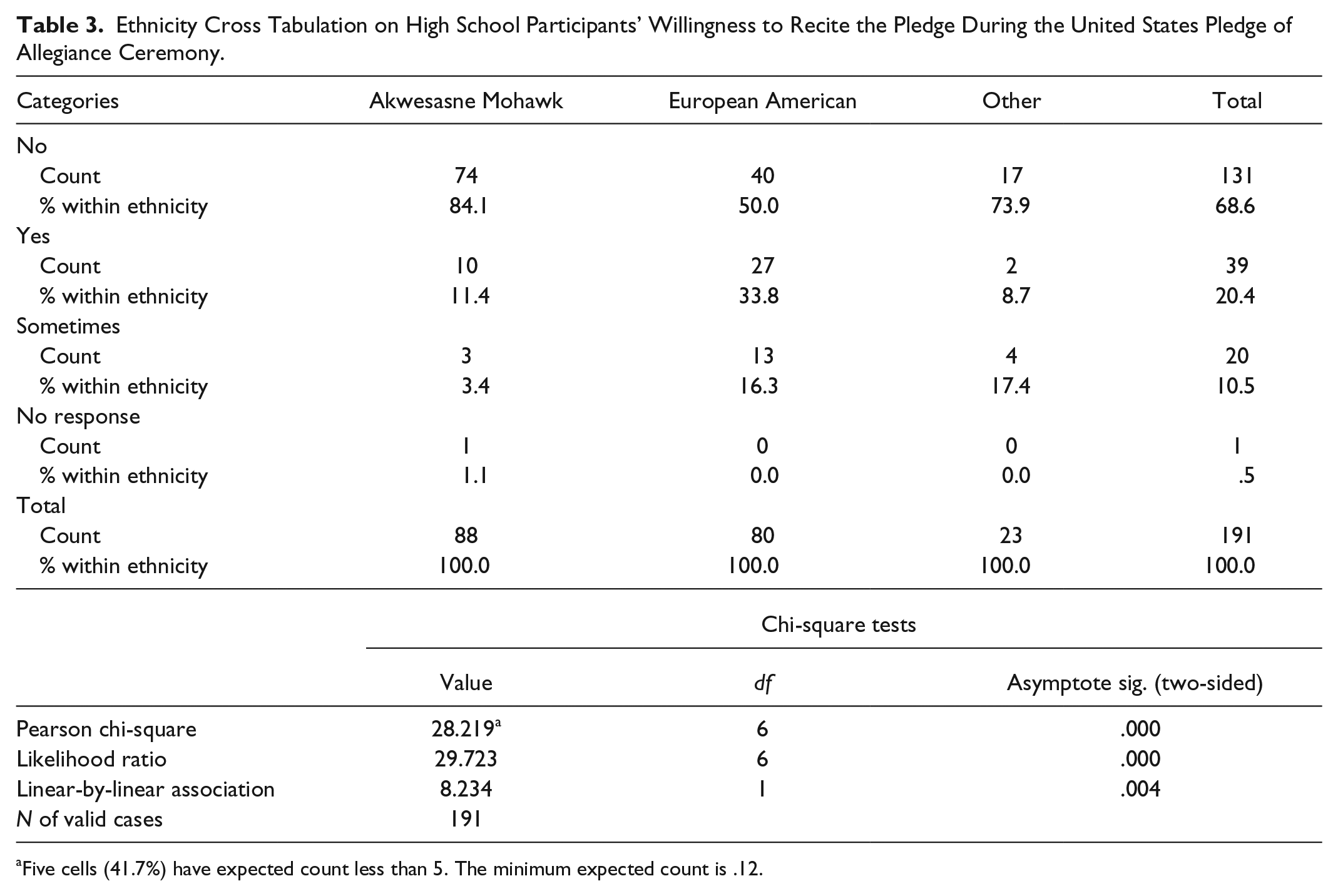
Five cells (41.7%) have expected count less than 5. The minimum expected count is .12.
Cross Tabulation on Middle School Versus High School Participants’ Reasons for Reciting the Pledge or for Not Reciting the Pledge During the United States Pledge of Allegiance Ceremony.

Zero cells (0.0%) have expected count less than 5. The minimum expected count is 6.44.
Cross Tabulation on Middle School and High School Akwesasne Mohawks’ Reasons for Reciting the Pledge or for Not Reciting the Pledge During the United States Pledge of Allegiance Ceremony.

Three cells (37.5%) have expected count less than 5. The minimum expected count is .23.
Cross Tabulation on Middle School and High School European Americans’ Reasons for Reciting the Pledge or for Not Reciting the Pledge During the United States Pledge of Allegiance Ceremony.

One cell (16.7%) has an expected count less than 5. The minimum expected count is 3.64.
Data Analysis
The constant comparative method (Creswell, 2015) was used to create codes and categories from the students’ written responses. Although the participants’ responses were often brief, the data yielded codes and categories that gradually evolved into emerging themes. To discern statistical differences among the response categories, chi-square analysis was used. Because there were some instances in which a student or a very small number of students chose not to respond to a question, these nonresponses were not included in the n and were not included in the tables’ categories.
Results
The first hypothesis specified that there were no differences between middle school students versus high school students’ willingness to recite the Pledge during the United States Pledge of Allegiance ceremony. The chi-square analysis (Table 1) revealed that no relationship was found between middle school and high school students’ willingness to recite the Pledge during the United States Pledge of Allegiance ceremony, χ2(3, N = 251) = 4.751, p = .191.
The second hypothesis suggested that there were no differences between Akwesasne Mohawk middle school students, European American middle school students, and middle school students who classified themselves as other on their willingness to recite the Pledge during the United States Pledge of Allegiance ceremony. A chi-square analysis (Table 2) showed that there was a significant relationship between their willingness to recite the Pledge and ethnicity among middle school students, χ2(4, N = 60) = 19.818, p = .001. Akwesasne Mohawk students (88.5%) and students who classified themselves as other (50%) were less likely to recite the Pledge than European American students (31.8%).
The third hypothesis stated that there were no differences between Akwesasne Mohawk high school students, European American high school students, and high school students who classified themselves as other in their willingness to recite the Pledge during the United States Pledge of Allegiance ceremony. A chi-square analysis (Table 3) disclosed that there was a significant relationship between a willingness to recite the Pledge and ethnicity among high school students, χ2(6, N = 191) = 28.219, p < .001. Akwesasne Mohawk students (84.1%) and students who classified themselves as other (73.9%) were less likely to recite the Pledge than European American students (50%).
Hypothesis 4 noted that there were no differences between middle school versus high school students’ reasons for reciting the Pledge or for not reciting the Pledge during the United States Pledge of Allegiance ceremony. The chi-square analysis (Table 4) demonstrated that there was a significant relationship between middle school and high school students’ reasons for reciting or not reciting the United States Pledge of Allegiance, χ2(3, N = 248) = 17.246, p = .001. High school students (18.3%) were more likely than middle school students (5.3%) to cite miscellaneous reasons. Middle school students (33.3%) were more likely than high school students (12%) to cite tradition.
Hypothesis 5 stated that there were no differences between middle school Akwesasne Mohawk students’ reasons versus high school Akwesasne Mohawk students’ reasons for reciting or not reciting the Pledge during the United States Pledge of Allegiance ceremony. The chi-square analysis (Table 5) discovered no relationship between middle school and high school Akwesasne Mohawk students’ reasons for reciting or not reciting the Pledge, χ2(3, N = 114) = 2.388, p = .496.
Hypothesis 6 offered that there were no differences between middle school European American students versus high school European American students’ reasons for reciting or not reciting the Pledge during the United States Pledge of Allegiance ceremony. A chi-square analysis (Table 6) established that there was a relationship between middle school and high school European American students’ reasons for reciting or not reciting the Pledge, χ2(2, N = 121) = 14.2, p = .001. High school European American students (60.6%) were more likely than middle school students (36.4%) to identify the voluntary nature of the Pledge as a reason for not reciting the Pledge during the Pledge ceremony. High school European American students (19.2%) were more likely than middle school students (4.5%) to cite miscellaneous reasons. In contrast, middle school European American students (59.1%) were more likely than high school European American students (20.2%) to cite tradition. The analysis of the middle school and high school students who classified themselves as other was discarded due to the small sample size.
Discussion
The United States Pledge of Allegiance is part of the United States’ national heritage for more than a century (Ellis, 2005). However, civic attitudes and behaviors have changed over time (Putnam, 2000). To see whether 21st-century students are still reciting the Pledge, the researchers measured their willingness to recite the Pledge during the Pledge ceremony and the rationale for their decision.
In 2006, Gaylord conducted informal interviews with school superintendents who discussed the extreme responses on students’ willingness to recite the Pledge during the Pledge ceremony. Although it has been suggested that the Pledge ceremony has become less influential since the Vietnam War, Gaylord noted that “There are no numbers to prove the pledge [recitation] is waning” (Gaylord, 2006, para. 1). Our study measured students’ willingness to recite the Pledge, and we found that 60% of the middle school students and 68.6% of the high school students chose not to recite the United States Pledge of Allegiance. This finding falls within the school superintendents’ discussions on students’ strong willingness or strong unwillingness to recite the Pledge (Gaylord, 2006). Consequently, due to the similar participation rates by middle school and high school students, our study found that there were no statistical differences between middle school and high school students’ willingness to recite the Pledge during the ceremony (Table 1).
However, ethnic differences emerged from the Pledge data. Among the middle school students, Akwesasne Mohawks (88.5%) and students who classified themselves as other (50%) were less likely to participate in the Pledge of Allegiance ceremony than European American (31.8%) students (Table 2). Similarly, among the high school students, Akwesasne Mohawks (84.1%) and students who classified themselves as other (73.9%) were less likely to participate in the Pledge of Allegiance ceremony than European American (50%) students (Table 3).
When asked about their reason for reciting or not reciting the Pledge, there were no statistical differences among the middle school and high school students (Table 4), but the most common response was not to recite the Pledge due to the voluntary nature of the Pledge ceremony. Although the chi-square analysis showed no differences between middle school versus high school Akwesasne Mohawk students’ and their reasons for reciting the Pledge (Table 5), differences did exist however, between high school European American students and middle school European American students (Table 6). Finally, due to the small number of middle school and high school students who classified themselves as other, the chi-square analysis of their responses were discarded.
The middle school and high school Akwesasne Mohawk students had similar reasons for not reciting the Pledge. Their most common reason for not reciting the Pledge was the voluntary nature of the Pledge, and prior legislation such as West Virginia State Board of Education v. Barnette (1943) and Goetz v. Ansell (1973) support this legal right. For the Akwesasne Mohawk students, their second most common rationale for not reciting the Pledge was their Akwesasne Mohawk or Native American status. The Akwesasne Mohawks tribe rejects United States citizenship, they strongly embrace tribal sovereignty, and they consider a traditionalist to be a person who rejects European or European American conventions (Akwesasne Notes, 2005; George-Kanentiio, 2008). The tribe has had negative experiences with the United States government ranging from the historic loss of land to modern day industrial pollution (Holm, 2010; Johansen, 1993; Snow, 1996), but due to the isolated location of the town, there are social benefits associated with being part of a group, the Akwesasne Mohawk tribe, along with financial benefits (George-Kanentiio, 2008; Johansen, 1993; Segwalise, 2005).
To perpetuate their culture, societies may engage in socialization (Bradley Project on America’s National Identity, 2008; Dynneson & Gross, 1982; Noack, 2011) and social competition “in which the group as a whole fights the current system to actually change the hierarchy of group membership in society” (French, Seidman, Allen, & Aber, 2006, p. 2). With strong rejection rates of Pledge recitation among both middle school and high school Akwesasne Mohawk students as well as middle school and high school students who classify themselves as Other, the Akwesasne Mohawk tribe has perpetuated a strong socialization of youth about Pledge recitation.
Reactions by Native Americans to the U.S. socialization by the educational system have been varied. Arnett (2013) states that there are pervasive feelings among Native Americans who feel that they have been rejected by the United States and their tribe. In contrast, in a case study of one male Hopi and one male Navajo student, both individuals discussed how they chose to embrace what they considered to be the best of their Native American culture and the culture of the U.S. educational system (Brunn, 1997). Meanwhile, other Native Americans have stressed the importance of self-determination (Akwesasne Notes, 2005). Murdock (1975) strongly argues that one’s citizenship and loyalty to the tribe are critical to the tribe’s self-preservation, and that because Native American tribes are sovereign nations, they should maintain their benefits, relinquish their state citizenship, and focus on advancing tribal citizenship.
The rationale for self-determination is that nonnative schools may not reflect the Native American students’ tribal language (Brunn, 1997), may promote values that differ from the tribe’s values (Gurneau, 2001), and may promote end goals that are different from the tribe’s goal of self-determination (Hare, 2007). For example, during an interview (Richheape, 2008), Andrew Windyboy discussed the emotional scars of being a Chippewa-Cree in the U.S. Native American boarding school system during the late 1960s to early 1970s. When he came to the boarding school, he did not speak or write in English and he was forced to wear a dunce cap, but could not read the word dunce in English. He was punished for speaking in his tribal language, and over time, he lost the ability to speak in his native tongue. To cultivate tribal pride, to systematically teach their tribal language, to promote their views on tribal education, and to grow the next generation of tribal members, in 1979, the Akwesasne Mohawks founded the Akwesasne Freedom School for students in prekindergarten through Grade 9 (Holm, 2010).
When the European Americans were asked to discuss their reason for reciting or not reciting the Pledge, the most common response among middle school students (59.1%) was tradition, while for the high school students (60.6%), it was a decision not to recite due to the voluntary nature of the Pledge ceremony. The middle school students’ behavior represents socialization and supports Francis Bellamy’s belief that by having youth practice the Pledge from an early age, the behavior will become a natural part of who they are. In addition, during the formal operational stage, youth tend to embrace ideals. Similarly, when Martin (2011) and Martin (2014) surveyed and interviewed African American and European American middle school students about the Pledge, the students discussed their feelings of loyalty for the United States. However, as youth progress through adolescence and identity development, there is a tendency for them to question socialization practices and to explore their identity—Who am I? What do I believe in? Our study highlights changes in the European American youths’ behaviors and attitudes about the Pledge as they progress from middle school to high school in contrast to Akwesasne Mohawk students’ steady resistance to Pledge recitation.
Although some of the students in this study exhibited less interest in the Pledge ceremony, they may have an interest in other forms of patriotism. There are a variety of ways that an individual can display his or her patriotism (Kahne & Middaugh, 2007). The act of pledging allegiance to the flag represents a form of patriotism known as commitment to country, and commitment to country is defined as the expression of love and commitment to one’s country (Kahne & Middaugh, 2007). For Akwesasne Mohawks, this commitment may be displayed by discussing their love and commitment to the Akwesasne Mohawk tribe with other tribal members and with nontribal members. With blind patriotism, the individual supports his or her government unconditionally. Meanwhile, with constructive patriotism, an individual faces an issue and evaluates the issue from different points of view. The constructive patriot may choose to ideologically support or not support the government’s stance on an issue but will not take further action on the issue. In contrast, when an issue arises, active patriotism involves the individual taking action and enacting change within society. In evaluating California high school students in terms of their patriotism, Kahne and Middaugh (2007) found that commitment to country was the most popular form of patriotism at 73% followed by constructive patriotism (68%), blind patriotism (43%), and active patriotism (41%).
Limitations and Future Research
Although this study is a starting point, it was limited to one geographical area and was limited to Akwesasne Mohawk students, European American students, and students who classified themselves as other. Consequently, the study results cannot be generalized to all Native Americans, all European Americans, or all middle school/high school students. Also, self-reporting is a study limitation. Future research could involve physically counting students as they say or choose not to say the Pledge during the Pledge ceremony. A final limitation of the study was the use of quantitative analysis. Although quantitative analysis permits the opportunity to examine whether statistically significant differences existed among the groups, future research could examine other Native American tribes as well as other racial and ethnic groups using a qualitative or mixed-methods approach.
Conclusion
Patriotism is not automatic (Ellis, 2005). It is multifaceted, and it is a culmination of cognitive, developmental, historical, and sociocultural factors that influence who we are and how we view the world. Recently, the United States Pledge of Allegiance has gained national attention. Leilani Thomas (a Native American student of unspecified tribal descent) made national news by refusing to participate in her class’ United States Pledge of Allegiance ceremony (Williams, 2016). Next, in the 2016 movie, The Congressman, which was written by former Congressman Robert Mrazek, a Congressman is asked to resign from office partially due to his refusal to participate in Congress’ United States Pledge of Allegiance ceremony (Roos et al., 2016). During the movie, the Congressman discusses aspects of the Pledge’s history, and he observes an elementary student misquoting while reciting the Pledge. Toward the end of the movie, he makes an impassioned speech to his constituents on why he refused to participate in the Pledge ceremony. These acts reinforce the need for education about the Pledge so that educators and students can make a more informed decision about the Pledge and the Pledge ceremony. In discussing the Pledge ceremony and patriotism, educators can use the Pledge ceremony as a teachable moment to address cognitive and developmental issues in an age-appropriate manner by ensuring that students understand the meaning of the words in the Pledge, the history of the Pledge, and the changes that the Pledge has undergone. Educators can discuss different ways that individuals can express patriotism as well as discuss the pros and cons of patriotism.
Footnotes
Declaration of Conflicting Interests
The author(s) declared no potential conflicts of interest with respect to the research, authorship, and/or publication of this article.
Funding
The author(s) received no financial support for the research, authorship, and/or publication of this article.