




Abstract
Designers’ internal thought processes can be externally expressed and represented through sketching and other forms of communication. Novice designers often struggle to communicate their ideas. This article reports an analysis of student design processes during conceptual and schematic design development with the intention to inform teaching and learning activities. Interior design student teams provided sketches, written journal entries, digital drawings and models, and graphic images to illustrate their collective design processes. The work was analyzed to understand the students’ representation and development of ideas. Analysis revealed that sketching, digital media, and non-graphic process work were all valuable in the students’ design process. Significantly, the strength of the design outcomes aligned more with the overall quality of conceptual process work, rather than the way in which students represented their ideas. Ultimately, student understanding of the design process varied. Teaching and learning activities should develop direct connections with design thinking processes to improve design education.
Design ideation is often synonymous with drawing. The “napkin sketch” that quickly captures a design idea for a prospective client remains part of design lore. The design thinking literature rightly emphasizes the importance of graphic representation (and re-representation), modes of ideation, and ultimately, clear communication of ideas for a strong design process. Yet, novice designers—students learning the design process—often struggle to communicate their ideas. They are unclear about how they are solving a problem, so may be unsure what to draw or how to explain their ideas. Their colleagues and instructors may be similarly uncertain what student designers are thinking and would welcome any communication that clarifies the students’ intention. Design process and communication is more complex than we often assume.
The design thinking literature primarily explores ideation as a component of the design process. Although both novice and expert designers have been used as populations in past research, the focus has frequently been more about understanding design process rather than understanding how to teach students a rigorous design process. Subsequently, the literature on design process remains only loosely connected to scholarship-of-teaching-and-learning (SOTL) research about how students learn to design in architecture and interior design curriculums. Design educators would benefit from research that specifically investigates how students are thinking and communicating (a) with themselves and (b) within a collaborative environment. The purpose of this article is to identify ways in which students visualize and represent the design thinking process across the conceptual and schematic design phases. The documentation and discussion of this information will provide a basis for design educators to shape the ways they teach the design process and support students.
As a whole, this article looks broadly at two layers of information. First, our understanding of current theory related to design ideation and re-representation provides a base for inquiry. Relevant design thinking literature—which addresses ideation and sketching as part of the design process—provides context for this research study. Second, observation and analysis of student process compares how this process aligns with existing theory. This comparison contributes to design education by linking teaching and learning with the rigorous research that explains design process. This article is structured into four sections. The “Literature Review” section of the article overviews relevant literature. The “Purpose of the Research and Research Questions” section presents the methodology of the study, including a brief explanation of the case study research design and grounded theory approach. The “Results” section addresses outcomes of the case study. Finally, as a result of the case study observation, we propose revisions to current theory. This theory provides a transition to discussion of the results in relation to the literature review. The final conclusions of this research challenge design researchers and educators to consider how design ideation is taught.
Literature Review
The concept of ideation is embedded in most design thinking literature (for an overview, see Kimbell, 2011). Schön (1983) outlined design as a series of “reflections in action” that structure and explore a problem as a means to creating a solution. The process involves manipulating tacit and explicit knowledge. The designer necessarily “understands the situation by trying to change it, and considers the resulting changes not as a defect of experimental method, but as the essence of its success” (p. 151). In other words, the designer must reframe a given problem and consider many potential solutions as a means of truly understanding the problem at hand.
Considering various ways of seeing the problem is essential to the act of designing. Cross (1999) explained that “the thinking process of the designer seems to hinge around the relationship between internal mental processes and their external expression and representation” (p. 29). Oxman (1997) linked designers’ internal and external work with psychology’s Re-Representation Hypothesis, which shows how humans externalize information to modify its meaning or form. Re-representation often involves translating an idea into drawing, textual (i.e., written), and/or verbal (i.e., spoken word) communications as a means for documenting and revising the idea itself. This process flows as a “conversation that goes on between internal and external representations” in multiple steps (Cross, 1999, p. 34). How designers communicate with themselves and with others is integral to their process for solving problems.
Modes of Communication
The common demonstration of design ideation is a loose, conceptual, lead or ink drawing that helps a designer see and order thoughts. However, designers rely on a more complicated range of generative representations. Design process work may include hand drawing, physical modeling, written lists or textual narratives, digital drawing and modeling, and verbal (spoken) discussion. Designers use sketches and process work to (a) “handle different levels of abstraction simultaneously,” (b) “enable identification and recall” of ideas and information, (c) “assist problem structuring” through attempting solutions, and (d) “promote the recognition of emergent features and properties of the solution” (Cross, 1999, pp. 34-36). Communication of design ideation, therefore, takes many forms that integrally support how a designer thinks. Regardless of the form, the internal–external exploration of ideas also provides ways to see ideas and process potential solutions (see, for example, Bar-Eli, 2013). For example, Sun, Xiang, Chai, Yang, and Zhang (2014) measured the patterns and sequence of how designers physically view information as they draw and develop a design solution. They noted that eye movement patterns during sketching activities reflect the rapid variation of a designer’s recognition of emergent ideas. They posited that the designers subsequently use those ideas as they iteratively explore solutions.
Recent articles provide exhaustive literature reviews outlining the breadth and depth of research on sketching in design (see, for example, Bar-Eli, 2013; Sun, Xiang, Chai, Wang, & Huang, 2014)—and support the base conclusions from Schön, Cross, Oxman, and others. In addition to re-representing ideas to ourselves, drawings and design process work also function as communication to other designers. Eris, Martelaro, and Badke-Schaub (2014) explained that collaborative design processes rely heavily on sketching and other forms of abstract communication, especially at the conceptual phase. Significantly, their study noted the concurrent use of visual, text (written and spoken), and physical communication as part of the design process. Gesturing, for example, played a crucial role in linking ideas shared by different participants. Jonson (2005) analyzed types of communication used in initial ideation. He suggested that written text-based communication dominates initial and early ideation in contrast to what designers have assumed. Although the forms and methods may change, the communication of ideas (to others and self) is the core purpose of ideation-based sketching, writing, and other forms of expression. This communication metaphorically expresses variation of ideas (Ingebrethsen, 2013). Oxman (1997) included aspects of controlling ideas’ consistency over time as one of drawing’s functions. Re-representation of ideas enables the designer to avoid incompatibilities between problem and solution. Importantly, as Cross (1999) concluded, “The concepts that are drafted in design sketches are there to be criticised, not admired; and they are part of the act of discovery . . . that is the activity of designing” (pp. 30, 34). The act of designing, then, relies not only on the development of a solution but also in the communication and exploration of relative strengths within multiple solutions.
Design Process
Cross and other authors rely on design process work to analyze how designers think (Cross, 2001). In their definitive review of drawing’s role in design thinking, Purcell and Gero (1998) argued that design sketches become increasingly explicit and detailed as the design solution evolves. They identified two types of transformations that occur. Design process work records lateral transformations from one idea to another and vertical transformations that add increasing detail to an existing idea (Purcell & Gero, 1998). Subsequent research on process work using digital media (e.g., computer-aided design [CAD]) has shown similar translations (Ibrahim & Rahimian, 2010; Salman, Laing, & Conniff, 2014; Sun, Xiang, Chai, Wang, et al., 2014). Beyond lateral and vertical transformations, students learn to use process work to help structure a problem. Bar-Eli (2013) suggested three distinct ways that design students use sketching: (a) realizing a design idea, (b) exploration to learn about a problem, and (c) theorizing or communicating a specific viewpoint. A designer’s conceptualization of the purpose of the design act (e.g., the end goal) affects how sketching and process work develops.
Digital Versus Hand Sketching
One branch of the literature suggests that design thinking processes are distinct when designers use digital graphics. Oxman (2006) argued that digital representation influences how designers think:
Far from Schön’s characterization of visual reasoning as a “dialogue with the materials of the problem” and “backtalk” from visual images, the intelligent and compound processes of integrated digital design media create a completely novel new design thinking . . . Digital design thinking is non-typological and non-deterministic in supporting and preferring the discrete and differentiated over the generic and the typological. More than simply a set of formal preferences, or the abandonment of traditional approaches . . . it explores new forms and relationships between the designer, image, and information. (p. 262)
Oxman set digital design thinking apart, then, not based on its processes, but based on the information that is considered and the ways that information can be evaluated and synthesized. Bilda and Demirkan (2003) argued that the character of digital representation (e.g., the quantity and type of information shown) changes how the designer views the design in progress. As a result, they concluded that hand-based drawing provides a superior method for thinking through a design problem. Salman et al. (2014) agreed that the quick transitions between two- and three-dimensional views in digital representations alter a designer’s perception. Conversely, Dorta (2008) described how the structure of software interfaces restricts the flow of a designer’s ideas and narrows the available “perceptual interpretation space” (p. 124, see also Tan, Peek, & Chattaraman, 2015). Dorta also argued that software programs, such as CAD and building information modeling (BIM) interfaces, “serve representation, but not ideation” (p. 124).
Some research, such as Madrazo (1999), suggests that digital tools improve ideation by providing a more complete understanding of the design conditions being explored. Ibrahim and Rahimian (2010) demonstrated that design students learn to conceptualize three-dimensional design ideas better when using mixed hand and digital representations. Their studies specifically demonstrated how students struggled with the dynamic use of internal and external communication that is necessary to develop and explain their work. Such internal and external communication is considered essential to design following the foundational definitions established by Cross (1999), Oxman (1997), and Schön (1983).
Stones and Cassidy (2007) argued that digital ideation processes reduce the number of ideas considered by novice designers because of formal and technical limitations of the software tools (see also Dorta, 2008). In their data, paper-based sketching resulted in nearly twice as many proposed solutions—and significantly more unique solutions. Similarly, Salman et al. (2014) showed connections between how a design idea advanced and the use of hand- and CAD-based exploration. These connections seemed to vary by student and may have been linked to how and when the students learned to use CAD systems. They conclude that additional research is needed to resolve how different design processes interrelate with the use of ideation communication methods. Although digital design tools are widely used in professional and educational settings, the implication for how those tools affect design ideation remains incompletely explored.
Designers’ thinking relies on expressing ideas to themselves and to others through multiple modes of communication (e.g., Cross, 1999; Eris et al., 2014; Oxman, 1997). A designer’s internal and external ideation (including drawn and text-based process work) seeks to address problem constraints by re-describing problems and thoughts at each step. Cross (1999) stressed that design process drawings
enable designers to handle different levels of abstraction simultaneously. Clearly this is something important in the design process. We see that designers think about the overall concept and at the same time think about detailed aspects of the implementation of that concept. (p. 35, emphasis in original)
Sketching and process work—as opposed to simple “mental synthesis”—are commonly believed to be essential to a designer’s ability to conceptualize design solutions (Bilda, Gero, & Purcell, 2006; Purcell & Gero, 1998, p. 422). Sun, Xiang, Chai, Wang, et al. (2014) argued that the brain–hand–eye interaction of sketching follows a pattern of recognition and consideration that promotes idea development. Although brain–hand–eye interaction may be important to communication, sketching is not a designer’s sole method of communicating and re-representing information. For experienced designers, sketching and other visual aspects of the ideation process may not even be required. Bilda et al. (2006) challenged experienced designers to work out a design problem with and without the ability to make visual sketches or notes. Although the participants preferred to sketch, the designs produced from either process were not significantly different in quality or detail of idea development. The abilities of a novice designer—and an experienced designer facing a complex problem—require communication strategies that re-represent ideas, support iterative ideation, and enable the expression of ideas between individual members of collaborative teams.
Application in Teaching and Learning
The application of design thinking literature to teaching and learning activities is often presumed to be important, common, and connected. A limited amount of literature demonstrates an active connection between our understanding of how people design and how people are taught to design. Although students are frequently represented as the participants in design thinking protocols, the focus is on what they do rather than on improving how design education is taught or learned. SOTL provides focused exploration for how teaching and learning activities can be improved and valued (Huber & Hutchings, 2005). This literature emphasizes methodologically sound examination of teaching and learning to improve pedagogy, curriculum, and student outcomes. Scholarship of teaching and learning goes far beyond “best practices” to examine the influence of specific activities (Hutchings, 2000; Weimer, 2006). Few peer-reviewed articles specifically connect the ideas presented in rigorous design thinking literature with how architectural design (e.g., architecture, interiors, landscape) is taught in post-secondary settings. Most address the connection between the design thinking and SOTL literatures tangentially. Two exemplars stand out for making the connection clear. Bose, Pennypacker, and Yahner (2006) presented a unique connection between the two literatures. They described a design thinking–based curricular project aimed at improving student understanding of design process. Carmel-Gilfilen and Portillo (2010) assessed students’ creative thinking and framed studio instruction methods to expand the students’ grasp of creative thinking. Similarly, Kimbell (2011, 2012) presented the application of design thinking to pedagogical development (albeit in the disciplines of service design and business). The connection between design thinking, teaching activities, and learning should be made more direct to improve design education.
Overall, the existing literature shows a complicated relationship for how a designer communicates and processes information during early design ideation. The application of that information in pedagogical settings should prepare students to use design thinking skills, such as ideation, in professional settings. As a step toward strengthening the relationship between understanding design processes and teaching design processes, this research project examined the ideation and communication skills design students used in their natural process of solving a problem.
Purpose of the Research and Research Questions
The purpose of this qualitative study was to identify ways students visualize and represent the design thinking process across the conceptual and schematic design phases. As such, the following research questions were identified:
The articulation of these five research questions guided the research design and methodological approach.
Method
To answer the research questions, the research design employed an explanatory, single case study approach, which examined student design activity from a single cross-disciplinary, advanced design studio over a 1-month period. The qualitative case study methodology was selected because it allowed the researchers to study the complex phenomena of design processes, re-representation, and ideation of novice design students (Yin, 2003). Data collection was framed to minimize disruption to the students’ natural design process to provide a realistic view of how they would work. As a result, the project focused on the conceptual and schematic design phases of a term-long design assignment rather than a short duration, controlled protocol. The primary research strategy included the collection of artifacts (i.e., physical drawings, written text, and image captures from digital files). Artifacts were retained by students throughout their process and submitted at the completion of the activity. The students were responsible for maintaining the chronology of the work and providing a daily written description of progress and design explorations. The formats for recording and submitting the artifacts varied as was appropriate to the chosen process and media of the students’ work.
Participants
The participants in this study comprised a single cohort of 13 students who were enrolled in a cross-disciplinary, capstone-level design studio in the final year of a 4-year interior design curriculum. Students at this level were assumed to have a maturing design process and independent work habits that would not require process-based direction from the studio instructor. Neither the researchers nor studio instructor had prior interaction with any of the students enrolled in the studio. The researchers and instructor had not influenced the previous instruction the students had received. The curriculum followed typical patterns in U.S.-based design education with a mixture of topical lecture courses and design studios each term over 4 years. Early studios developed knowledge of design principles, hand-based graphic communication, and simple design problems. Middle studios exposed students to more complex problems in different market segments (e.g., hospitality, residential). The capstone studios required students to address cross-disciplinary problems and propose solutions integrating a wide range of disciplinary knowledge (e.g., building codes, construction, human factors).
The program curriculum required that students complete the capstone studio in teams. The team-based character of the studio precluded student-by-student consideration of design process, but provided the rich opportunity to explore how students would design in a collaborative manner that reflects many professional practice settings. The students completed initial assignment research as a collaborative group. The collaborative research developed a shared set of information available to all students and established students’ understanding for team-based work. Four teams were subsequently formed. Teams A, B, and D were comprised of three students each, and Team C was comprised of four students. Each team was separately responsible for developing the detailed listing of project parameters, human factors, and required components (e.g., spatial needs, client desires) to solve the design problem. Teams were also responsible for shaping their own design process. The design studio was taught within a Council for Interior Design Accreditation (CIDA) accredited program at a U.S.-based, land-grant university with very high research activity.
Studio Project Overview
The studio brief aimed to integrate the students’ previous design education with broad, cross-disciplinary awareness of how a design problem relates to multiple scales. The design problem for this studio considered the idea of food insecurity at scales from individual consumption to regional issues, with a specific focus on the intermediate scales between urban form and building interiors. The students were tasked to first research background topics that typically fall outside their disciplinary knowledge (e.g., food deserts, food trends, zoning). Based on topical, demographic, and place-based research, the students identified a physical site and building within the local urban region. Their subsequent design problem entailed renovating the existing building. Each student team independently determined how the building would be used based on the joint research, but agreed that the solution must contain components supporting the local community and a market or grocery store that retailed food. Although the students provided detailed, functional development for the entire building, the teams were only required to develop schematic, spatial designs for the first and second floors.
Approximately, 6 weeks of the 15-week academic term focused on topical and background research for the project. The remaining 9 weeks of the term was focused on programming, conceptual and schematic design development, and creating presentation materials. Student work was presented to the studio instructor for daily critique. In addition, the program faculty conducted intermediate and final critiques.
Data Collection
At the beginning of the conceptual and schematic design work, the student teams were tasked to maintain a complete daily record of their preliminary design progress. Records were maintained for a 1-month period. Students were instructed to retain all graphic and written components of the process work. Graphic components varied depending upon the group, but at minimum included copies of the relevant digital files (saved at least daily) and physical files of dated and numbered development drawings. Digital files typically represented end-of-work-session screen shots, rather than images captured within the developmental process. In addition, each team provided a short written account for each day’s activities. Notations were required to cover highlights of the day’s design progress, specific design issues being addressed, descriptions of attempts at solutions, and identification of creative leaps or continued frustrations. Notation also identified the corresponding digital or physical files. Although brief, the written accounts contextualized the teams’ design processes.
The character of students’ work sessions was not prescribed. Outside of established course meeting sessions, student teams selected how to work, where and when to work, and the most effective communication approaches. The character of teams’ work sessions varied between teams and across the data collection period. The intensity of work depended on the teams (e.g., a quick start vs. a slower but longer duration effort). Although teams were expected to meet with the studio instructor at least 3 times per week, the instructor did not actively shape the teams’ process or effort. Teams were aware of the mid-project review date (which marked the end of data collection) and chose to work accordingly.
The data collection approach minimized intrusion into the students’ natural work process. As a result, the data reflect ways that the students preferred to work. This aspect of the data is less usual within the design thinking literature. The researchers recognize potential strengths for understanding students’ process in this way, as well as the limitations that result from these conditions.
Limitations
The approach to data collection in this project inherently limits the information available for analysis. The selected collection methods (i.e., artifact collection and journaling) were chosen to enable the longer duration of data collection and to capture as much as the students’ natural design process without burdening how the students worked. Data collected for this project were based on student teams’ self-reported information. Data collected did not include audio, video, or in-person observations of the communication between teams during design sessions. Collection of audio or video recordings of team work sessions would have presented an unwieldy data set over 30 days that could not be feasibly captured or analyzed with the researchers’ available resources. Instead, the student teams worked as they would normally without restrictions on location, time, or set-up. Some literature on sketching and design communication emphasizes the interrelationship of drawing, talking, and gesturing (see, for example, Eris et al., 2014). Although the research design excluded some aspects of the design communication that would be inherent to a collaborative process, collecting such data over a 1-month period was not practical. The resulting data set still provides a unique observation of the students’ design process.
Because audio and video recordings of team communications were not collected, conclusions must be drawn from the data that were gathered. Anecdotal evidence from the instructor illustrated how teams interacted in the studio class environment. We posit that communication styles, methods, and other team dynamic factors may have influenced the ideation, but we cannot definitively say one way or the other without analyzing interactions within teams.
Ethical issues
To maintain confidentiality, student names were removed from all materials before data analysis, and teams were given pseudonyms (i.e., Team “A”-“D”). Students provided written approval for the use of their work in teaching and learning research. A University Committee on Research Involving Human Subjects/Institutional Review Board determined that this study met the criteria for Exempt Research at 45 CFR 46.101(b)(1.i).
Data Analysis
Collected data were analyzed through a grounded theory approach. The grounded theory approach follows a systematic process to identify patterns and themes within a set of data, which are used to inform the development of a broader theory that can be applied to other contexts (Glaser & Strauss, 1967). Grounded theory is inherently inductive and used to discover theory, which is grounded in or derived from the data or phenomena of the study at hand (Corbin & Strauss, 2008). Grounded theory studies are typically concerned with social processes and how people interact (Blumer, 1969). As such, the grounded theory approach is complementary to the overall explanatory nature of the case study methodology. It can be leveraged to inductively and holistically understand students’ design processes and ideation modes within the context of a design studio.
Grounded theory has been criticized as a less rigorous approach than other qualitative research methodologies. This perspective may result from the frequent misuse of the grounded theory approach (Urquhart, Lehmann, & Myers, 2010). Many scholars, in multiple disciplines, argue that the term “grounded theory” has erroneously been associated with the process of simply coding data (Bryant, Hughes, Myers, Trauth, & Urquhart, 2004; Urquhart, 2007). The intended methodological process of generating a new theory, which has been derived from or grounded in the coded data, is often overlooked (Becker, 1983; Elliott & Lazenbatt, 2005). For this study, the grounded theory approach guided the structuring of archival material, the coding process, and the new theory generation.
Written and graphic materials from each team were labeled and organized into sequential streams of images and text (see Images 1-3) to explore similarities and differences between teams. Because multiple drawings often existed on the same sheet, each distinct idea and its representative drawing was counted separately regardless of its location on the sheet. The design process work was represented in three simultaneous sets of information: conceptual idea development, first-level schematic design, and second-level schematic design. The simultaneous streams revealed the interrelated and chronological consideration of ideas across varying parts of the project. The materials included hand drawings, images from CAD and BIM drawings and models, and written text entries explaining the teams’ process and design moves. Each team reviewed the presentation of their work and agreed that it represented their design process. Once the team materials were compiled and organized, drawing quantities were recorded for each of the three streams, as well as ideation type (e.g., hand drawing, digitally produced images, text, and “other” recorded images throughout the design process). Images 1, 2, and 3 are examples from the organized data.
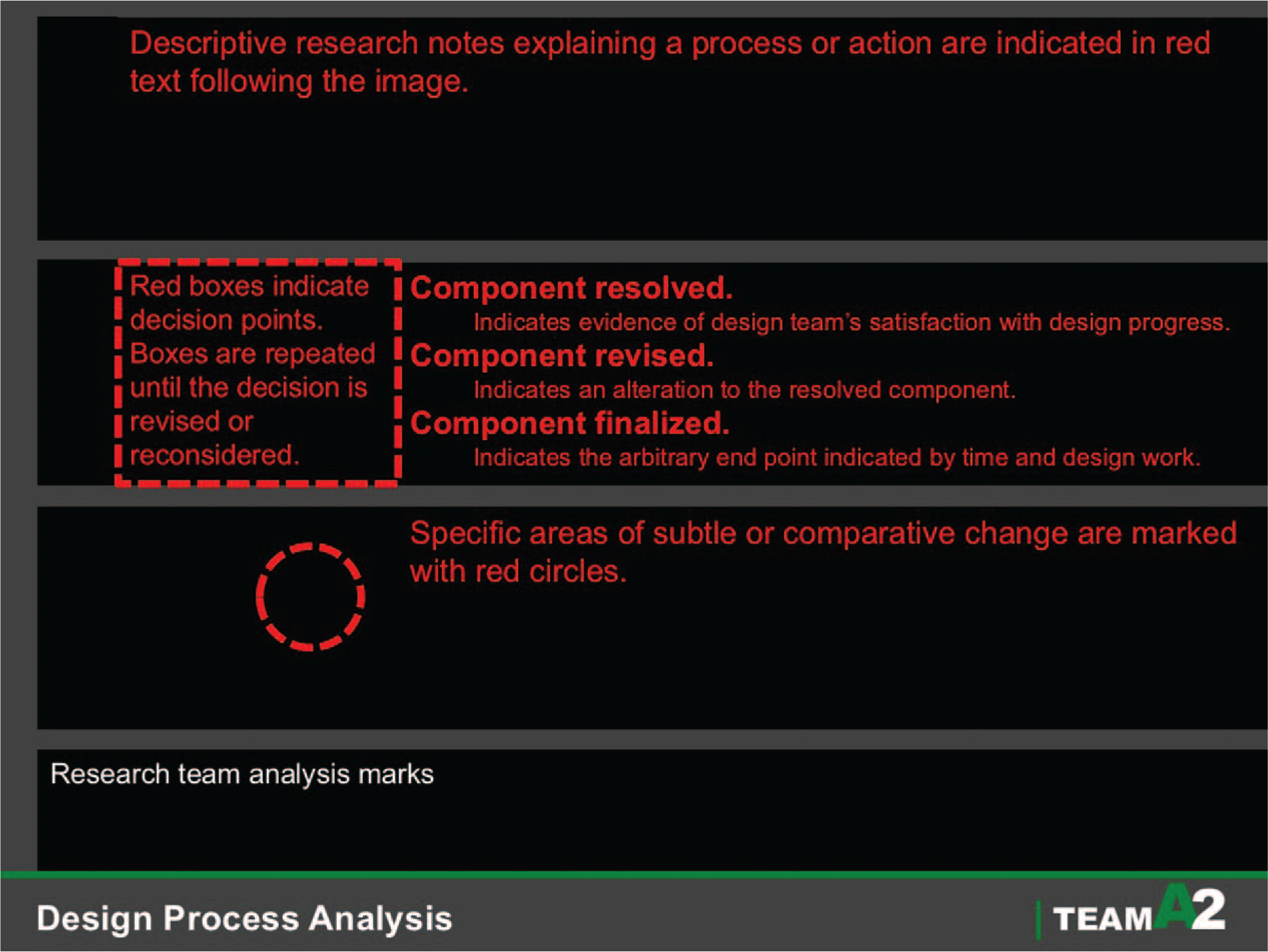
Standard format used for organizing graphic and text artifacts.

Example sheet from organization of data (Team A) showing relationship between established design idea (concept) and developing ideas for spatial organization.

Example sheet from organization of data (Team A) showing revision to conceptual ideas parallel to three-dimensional development of the design solution.
The data collection method relied on teams to submit their own work. As a result, the researchers did not have direct control over which data were submitted. We know the record was inadvertently or intentionally incomplete. For example, Teams A and B reported some process work, which did not support their ultimate solution, had been discarded and not submitted for analysis. The 1-month window into the teams’ design processes illustrated their initial development of ideas. At the end of the 4 weeks, the student teams presented their schematic designs for faculty feedback prior to finalizing their work. The archival materials do not include the subsequent revision period leading to the final project submission.
Results
In the following section, results are presented as they relate to each of the aforementioned research questions.
Visualization
Figures 1 and 2 illustrate the design processes for Teams A and D over the conceptual and schematic design phases. These two teams provide representative samples to illustrate the range of design processes within these data. The quantity of created images is not a complete record of the team’s respective processes (e.g., Eris et al., 2014; Jonson, 2005), but provides one way to visualize the teams’ work. In this data set, the number of ideas corresponds with the quantity of iteration within the process. The black and gray stacked bars display the total number of drawings produced each day for both concept development and schematic design (first and second levels), respectively. The overlaid graph shows the total amount of developmental work completed each day by hand (blue), computer (orange), or other means (green). The “other” category included lists, charts, notes, and collection of inspiration images.

Team A design process and ideation over a 1-month period.

Team D design process and ideation over a 1-month period.
From these two representative figures, it is clear that Team A produced more drawings overall than Team D. In addition, Team A revisited conceptual development throughout the duration of their design process. Furthermore, whenever Team A returned to conceptual development, they typically represented their ideas using hand-produced sketches and drawings. In comparison, Team D dealt with conceptual development for the first 2 days and did not return to it for the duration of the recorded data. The majority of Team D’s work focused on space planning (as a pragmatic exercise) using primarily digital representation. By itself, the measure of quantity of drawings and visualizations is an incomplete understanding of the teams’ design process.
Figure 3 represents these data in a different way. The pie charts illustrate the total percentage of time each team spent in design process over the 1-month period. Teams A and C exhibited similar effort foci. The majority of their effort was directed toward conceptual development. Alternatively, Teams B and D displayed a more evenly distributed amount of development work across the phases.

Percentage of total drawings in concept development, and schematic design (per floor).
These data demonstrate that visualization of the students’ design thinking processes across the conceptual and schematic design phases is possible. The archived data, the differentiation of processes, and the comparative representation of these data align with established literature about design thinking process. Aspects of the students’ design activities can be discerned from the available information.
Representation
Figures 4 and 5 below illustrate the modes students used in representing their ideas throughout the design process. Figure 4 shows the percentage of ideation mode relative to the total number of drawings per team. Figure 5 conveys the proportionate effort each team spent per ideation mode over the 1-month period. Teams A and C exhibited similar patterns in the ideation modes used to represent their ideas. Teams A and C had significantly more drawings overall than the other teams, and hand drawings represented a high percentage of their drawings. Teams B and D also followed a shared pattern, which differed from Teams A and C. Not only did Teams B and D have fewer drawings comparatively, but a greater percentage of drawings were represented by digital or other means. Review of available data suggests that the lower number of drawings corresponds to fewer considered ideas. At the same time, digital drawing modes enable the continuous revision and development of an idea in a single file. A screen capture at any one point of time may not represent multiple variations that have been obliterated in the process of continuously editing the same digital file. As a result, variations on a theme may not appear to be distinct ideas within a digital format, but would be represented by different drawings in a hand-based process. A student team working with primarily digital modes could have failed to record this effort. In addition, anecdotal observation by the studio instructor of the student teams at work suggests that use of digital media by Teams B and D did not involve extensive or continuous revision to a design idea. The authors believe that this data set accurately reflects the number of ideas considered and communicated between team members.

Total number of drawings by ideation type.

Percentage of total drawings by ideation mode (hand, other, computer).
Process
In an effort to better understand the characteristics of the students’ process, data were examined in various ways. Figure 6 illustrates the total number of drawing per ideation mode in both conceptual development and schematic design (first and second levels combined).

Comparison of total number of drawings by ideation mode (hand, other, computer) in concept versus schematic design phases.
All teams primarily used hand drawings within the conceptual phase. However, the conceptual work was not exclusively produced by hand. Several groups used other means for conceptual development, such as lists, collection of inspiration images, and research. Similarities are again evident in how Teams A and C and Teams B and D represented their ideas. For instance, Team A relied heavily on hand-drawn conceptual work, but mixed hand and digital modes nearly equally when they moved into schematic design work. In comparison, Team B also used hand-drawn images for the majority of their conceptual development, but shifted almost entirely to digital-based representations during the schematic design phase. Team C integrated relatively more “other” representations into their conceptual development, such as the collection of inspiration images. The different communication approaches used by the teams suggest uneven communication of ideas throughout the design process. Some portions of the design process show fluid collaborative development (see Figures 1 and 2). In others, teams either did not communicate graphically, or they felt unable to graphically represent their ideas. We expect that a design process will have varying intensity as ideas are explored, both internally and externally. However, the use of different communication modes by the student teams suggests that the students inconsistently expressed ideas in timely and effective ways.
Solutions
Data collection included the completed designs, as well as anecdotal feedback from the instructor surrounding the quality of the final design solutions. At the conclusion of the project, Teams A and C had stronger overall design outcomes, based on evaluation of how the solutions resolved the given problem (e.g., functional requirements, spatial development, technical response to codes and systems). The strength of the design outcome provides a barometer of the success of the student teams’ design process. A process that fails to produce an acceptable solution would generally not be considered successful even if it follows expected protocols. (At the same time, a successful design outcome could result from a suspect design process.) In this particular collaborative studio environment, the overall ideation-based communication—whether presented by hand, digitally, or otherwise—resulted in satisfactory design. The relatively stronger results from two teams align with the rigor of their processes (e.g., ideation, re-representation, and communication).
The ideation and graphic communication of Teams A and C were inherently iterative and focused on conceptual ideas. Teams A and C re-represented ideas back to themselves in documented ways. By re-representing their ideas back and forth to fellow team members, the ideas were deeply rooted into how they were thinking and the resulting outcomes. Team A’s return to conceptual idea development frequently involved extending the initial idea to address a previously unconsidered aspect of the project. In one example, the team returned to the concept as they developed custom millwork. The concept was generally used to inform the millwork form before it was detailed for functional and constructability concerns.
In contrast to Teams A and C, Teams B and D apparently communicated ideas in other modes. For unspecified reasons, these design teams recorded significantly fewer instances of graphic communication. These teams may have communicated ideas in verbal (or spoken) discussion (e.g., in a data form that was not collected). Anecdotal evidence from the studio instructor suggests that these student teams may have worked more as groups (as opposed to teams) with less shared vision for the holistic characteristic of the design solution. The corresponding decrease in integration of their design work as a holistic solution would align with collected data and relative quality of the final solutions. The information that Teams B and D did communicate in graphic forms tended to be less conceptual in nature and more focused on a specific proposed solution. Some graphic communication may have occurred in spontaneous conversations as a digital drawing or model was being manipulated. These communications would be ephemeral, such as the spoken word, in that subsequent work changes or replaces the preceding idea. The re-representative character of spoken and some digital communication has a short life span.
Ultimately, Teams B and D produced fewer graphic drawings, fewer iterations of design ideas, and their resulting design outcomes were less refined than those produced by Team A or C. Although the instructor speculated that the team dynamics and individual students’ comfort with graphics may have led to this design process, explicit reasons cannot be discerned from the available data.
Opportunities
We see two opportunities for connecting the process and literature. First, the students would benefit from understanding how the communication in ideation and re-representation supports their thought processes. Second, active discussion for how different modes of communication relate to analytical and synthetic thinking might influence the types of communication students choose to use.
The artifacts collected for the project and observations from the studio instructor suggest that the students did not have awareness of sketching and communication as an active part of their design process. Instead, the drawings and text were objects separate from the design solution. Based on this analysis, we see an opportunity to reframing the design assignment to emphasize a process over product. Students could be provided background on how drawings and other forms of communication facilitate designers’ thought processes and asked to document their own effort. This approach to studio would apply the design thinking literature in day-to-day teaching and learning activities. In the collected data, written descriptions of daily work accompanied the teams’ graphic artifacts. These descriptions reveal limited student awareness that the drawings and modeling supported or comprised their respective design processes. Although some descriptions referred to drawings, the drawings and digital models were understood to be products rather than tools to aid the design process. For example, Team C provided this description of their work on the third day:
Beginning Schematic Design and Concept Development; Concept word brainstorming; Parti Drawing: Began with a group sketching exercise, from the options presented we narrowed our concept focus to an abstraction of the 3 Es of sustainability. Challenge: How to abstract the Es and visually represent community and progress as well; Research; Client Profile: We decided to come up with a general outline of our client’s unique characteristics. Challenge: Trying not to come up with a client that would lead us to a design copying the Main Market; Homework: Research market layout, bring in your best abstraction of the 3 “e”s.
In this description, the students acknowledge the use of graphic communication to support the team’s process. The “group sketching exercise” facilitated the team’s decision making in developing a conceptual idea. Most of the written descriptions were less clear. For example, Team D described one day, “Worked on second-level blocking; individual research and sketching for second level will be prepared for the next meeting date.” Here the sketching is referenced as evidence of thought (a product) rather than as a process supporting the design work.
The information from this case also demonstrates the breadth of student design process and the relationship between communication and design product. Although the data cannot explain which methods of communication produced stronger or more complete design work, the data highlight specific opportunities to use design thinking literature to inform and improve student design process. Instruction specific to collaborative design communication (e.g., verbal and gestural expression of ideas between individuals) would expand the efforts of all the teams. The differences in process and product between Teams A and C and Teams B and D suggest specific discussion about how digital processing of information (whether as described by Ibrahim & Rahimian, 2010, or Madrazo, 1999, or Oxman, 2006) could change how some students worked. Based on students’ individual knowledge of how they think, awareness for how technology influences the information they see should change how the students approach the use of the digital interfaces.
Ultimately, the explicit discussion of re-representation and design communication as part of team-based design work would strengthen the students’ awareness of what they are doing. Anecdotal evidence suggests that students were familiar with how they worked individually, but unclear about how to translate their individual design processes to a team-based process. Simply explaining the design process in terms of re-representation and ideation would frame team-based design with shared language and processes that students may not have immediately recognized (but which they already had in common).
Theory Development
The results of this case study demonstrate a relationship between student design outcomes and the overall quality of process work and consideration of ideas during conceptual and schematic development. Previous literature investigating modes of communication substantiates the importance of externally expressing design ideas to drive the design process (see Bar-Eli, 2013; Bilda et al., 2006; Cross, 1999; Oxman, 1997; Purcell & Gero, 1998; Sun, Xiang, Chai, Wang, et al., 2014). Our results extend the previous literature by connecting these ideas into typical design studio settings and considering how students learn to design. The research presented here also anecdotally supports literature showing that graphic communication via sketching is not the dominant way that design ideation occurs, even for design students (see Eris et al., 2014; Jonson, 2005). In other words, while we acknowledge the importance of hand and digital re-representation in teaching the design process, the mode of ideation appears to be less important than the act of iteratively re-representing and communicating design ideas. Instruction that explicitly teaches students iterative re-representation has strong potential to most influence the students’ design outcomes. For design students, ideation develops stronger design solutions by helping the student respond to aspects of the problem that they cannot yet resolve using tacit or heuristic knowledge (e.g., Rowe, 1991; Schön, 1983). The design student relies on ideation and re-representation to externally record ideas to be internally considered as they move toward design solutions. It is important for students to know and recognize these steps within their own process.
These conclusions do not advocate for a specific mode of ideation, but restate the importance of idea exploration and development for design students during conceptual and schematic design work. Similarly, a specific quantity of work has not been determined to achieve a certain result. The lower quantity of process work recorded by Teams B and D does not correlate to significantly lower quality design. Although design students may be troubled that a set amount of a certain type of effort will not produce a guaranteed design solution, our results reinforce foundational characteristics of the design thinking literature.
Discussion
The students’ process work and our subsequent analyses show the complexity of how design students think through the design process. Many interior design curricula in the United States continue to feature combined hand-based and digital-based skill development. Often, students are initially instructed to design using hand-based sketches and drafting techniques. Whether out of convenience or habit, the student designers in this study initiated their conceptual design work with hand-based graphic communication. As can be expected for a collaborative project, these students also obviously communicated with spoken word, gesturing, and other body language. Although these communications were not recorded, it is clear that the students’ solutions could not have been developed without these additional layers of generative ideation. The chronological categorization of the graphic communication throughout the conceptual and schematic design work (see Figures 1 and 2) shows the relationship between teams’ communication and design progress.
Team A’s continued return to both conceptual development and hand-based graphics shows some awareness of the ideas ordering the developing solution. Their simultaneous consideration of conceptual ideas and schematic design solutions for multiple floors of the building is closer to the tacit/explicit flow of information we expect from an experienced design team. In contrast, the approach of Team D reflects a different conception of the problem. Team D acted to pragmatically plan spatial organization and fit the required pieces together. Conceptual ideas are tangential to their approach. In the end, the designs from Team A and Team D both function and meet the requirements.
For novice designers, who are learning and practicing the processes that they will use in professional work, the limited approach of Team D likely hinders learning. The students may have successfully solved the problem (and solved it in a way that may be similar to the solution proposed by Team A), but they have not demonstrated awareness of how they are working, or how they are thinking. Cross (1999), Bilda et al. (2006), and Purcell and Gero (1998) each argue that design process work is about how a designer concurrently addresses multiple levels of abstraction. The Team D process work suggests that some students are not thinking simultaneously about related issues. Education requires knowing what and why something is learned. If the assigned problem had been mathematical instead of wicked, this team’s solution would appear to be a guess, rather than the result of calculation. Design students need to acquire and practice ideation skills as they learn that the design process is about identifying solutions that help us understand problems. Furthermore, design educators must recognize strength in different design processes (as opposed to strong design results) and ensure that students are learning process.
The data may seem to suggest that Teams A and C not only did more work but also designed more. We want to be explicit in separating design and communication of ideas during a design process. The data source for this project represents part of the design communication among the team members. We would be naïve to suggest that these data capture all the design communication. Bilda, Gero, and Purcell (2006), Jonson (2005), and others are clear that design communication includes oral verbalization, written text-based exploration, and physical movement. We believe that our data demonstrate that design occurs independent of graphic representations of ideas, and that verbal communication and other ephemeral means of expressing ideas helped the teams collaboratively develop solutions.
Design, then, requires an externalized act of processing information, but not necessarily graphic communication skills (see Jonson, 2005). The process of externalizing information involves re-representation and translating ideas across forms and modes. Cross (1999) discussed sketching as a method of recording information so that it can be critically examined. Purcell and Gero (1998) noted the lateral and vertical translations of ideas through sketching. For design students, Bar-Eli (2013) framed these processes as specific ways of looking at the given problem. For novice designers learning to design, we argue a richer variety of methods should be taught and recognized as valid ways to re-represent and elaborate on ideas. Although graphic communication may continue to be particularly relevant to the creation of physical things, design education should explore specific ways to expand how verbal communication, collaborative activities, and other modes of communication are already in use, regardless of how technology is engaged.
Multiple authors disagree about the effect of digital tools on the design ideation process. Oxman (2006), Bilda and Demirkan (2003), Dorta (2008), Madrazo (1999), and Salman et al. (2014) presented differing conceptions of how designers receive and process information while manipulating digital drawings and models. The data for this project show two distinct approaches. Teams A and C integrated hand and digital communication; Teams B and D used primarily digital communication. Team A would have been inputting, re-representing, and receiving ideas in multiple formats and at multiple speeds throughout their process. Although the scale or speed of this process may differ from a team that worked primarily (or exclusively) in a digital medium, the basic processes seem similar. The relevant question appears to then be about the limitations and abilities of designers to process information. Bilda et al.’s (2006) study about designing without drawing raised questions about the mental load of a designer retaining and processing disparate information. Further research is needed to understand how type, speed, and quantity of information affect design cognition. For design education, this research and related literature suggest that students should learn to negotiate between types and methods of communication, rather than being taught that one method or mode is superior.
Furthermore, we acknowledge that shared ideation between novice designers working in a collaborative environment will require relatively more communication to establish agreed-upon parameters. Novice designers will not typically possess the tacit knowledge for collaborative design processes we expect to see in experienced designers. Students learning complex thinking often require repeated exposure to master these abilities. Design studios provide one venue for delivering this learning opportunity, but must explicitly explain the ideas. If instruction only provides a tacit example (e.g., instructor demonstration of inherent ideas without clear, specific explanation of the ideas and actions), students are unlikely to grasp the breadth and importance of the idea. Students working together would be even less likely to clearly communicate these issues between themselves. Instructors should highlight the key aspects of communication during team-based ideation and provide multiple opportunities for students to practice the skills. These opportunities should anticipate that the students will remain in the explicit stage of understanding these communication skills and ensure that the students’ practice necessarily involves repeated use of graphic, written, verbal, and gestural communication. It cannot be taken for granted that students will use or understand why these skills are relevant to the design task.
Conclusion
Overall, the student work analyzed by this research project met or exceeded course expectations. The students addressed the broad implications of food insecurity through multiple parts of the system. Their understanding was translated into a variety of physical and social interventions that could improve the local situation. The designs for the physical spaces reflected holistic understanding of relevant interiors-based knowledge. Although the degree of integration and detail development between the four teams’ solutions varied, all the work was satisfactory. Review of graphic progress work alone may not accurately reflect the breadth of communication and thought that informed their proposed solutions. Anecdotal evidence from this case study example suggests that internal team dynamics influenced the quantity and type of graphic communication necessary to develop ideas. In collaborative design environments, differences in language and definitions may necessitate more communication to reach consensus. Conversely, strong shared beliefs may reduce the need to express some ideas. Ultimately, the characteristics of a strong design process include the honest and thoughtful consideration of ideas across multiple modes. The consideration of ideas across multiple modes will require solid attention to how the ideas translate between contexts (e.g., describing a cabinetry detail in words is distinct from drawing a construction detail). This type of re-representation reveals significant information about the ideas being explored. The precise process does not matter, but design requires communicating and thinking hard about the ideas that result. Teaching and learning activities should be more directly connected with design thinking processes to improve design education.
Much of the design thinking literature addresses individual designers, but does not explicitly consider how collaborative design activities occur. We believe further investigation about how people are thinking and communicating within collaborative, team environments is crucial to understand contemporary collaborative and integrated design practice. Designers and design educators need to understand how designers engage one another in these situations. This information will help educators teach collaborative design processes. And, designers will benefit from knowing how collaborative exploration of ideas changes the ideation process and the resulting design outcomes.
The case study of this interior design studio should prompt continued consideration for how design is taught. Student design processes remain malleable and will be influenced by instructor expectations. We reach four specific concluding theoretical statements from our analysis of the data and literature. First, a student’s use of sketching and other design process work strengthens the design result. A student who does not develop ideas through iterative and re-representative actions relies on inherent skill or luck. Students should be expected to make their ideas explicit through graphic and text-based re-representation. Second, the media for the sketching and process work matters less than the use of the process. Digital communication—including ideas shared on-the-fly in real-time CAD drafting and modeling—expressed ideas that students used, refined, and integrated into the design solution. These ideas were not less important than explorations completed using hand media. Third, the quality of sketching and design process work varies in relationship to how the student is thinking, not the sketch or image that results. Sketching itself does not provide the answer. More visually appealing sketches are not necessarily better at conveying student thought. The student must be actively engaged in thinking about the problem, communicating and considering ideas, and re-integrating new information. Graphic, verbal, written, and gestural design process is important for communication of information, not merely production of artifacts to meet an educational requirement. And, finally, the studio instructor plays a vital role in promoting ideation, regardless of the communication method. If design educators value design thinking as an active, definitional approach to what designers do, then they must press their students to learn and use an intentional design thinking approach that includes ideation through re-representation, iteration, and concept-based and solution-based problem exploration.
Footnotes
Acknowledgements
The authors value the
The students in the topical studio demonstrated strong growth and any critique expressed in this article does not suggest otherwise. The authors appreciate the students, their design process records, and their diligent work in addressing the studio problem. The work presented here would not have been possible without their efforts.
Declaration of Conflicting Interests
The author(s) declared no potential conflicts of interest with respect to the research, authorship, and/or publication of this article.
Funding
The author(s) received no financial support for the research and/or authorship of this article.