




Abstract
This longitudinal study of six first-year teachers focused on conceptualizations of inquiry-based pedagogy, self-efficacy for inquiry-based teaching, and its actual enactment. Data included a self-report survey of self-efficacy for inquiry-based instruction, individual interviews at the beginning and end of the year, and five distributed classroom observations. At year’s end, self-efficacy for inquiry teaching declined, as did frequencies of concepts teachers used to describe inquiry enactment. Inquiry descriptions reflected a set of interrelated procedures more than inquiry as conceptual knowledge. Novice teachers were observed least enacting pedagogical actions that required enabling students to communicate findings and the most in student engagement; however, over time frequencies of student engagement declined. Consistent patterns were observed between shifts in self-efficacy and inquiry enactment and shifts between self-efficacy and conceptualizations of inquiry enactment. We found beginning steps toward links between teacher’s conceptualizations and classroom practice.
Keywords
New teachers face many challenges in their transition from courses and supervised teaching experiences to independent professional responsibility. During the first year, they often anticipate their new role with unrealistic idealism and probably experience high levels of self-efficacy for teaching. Shortly after, they typically sink into “survival” mode when they realize how much they must learn about school expectations and procedures. Then they begin to rebuild their self-efficacy, especially by reflecting and anticipating the next year (Gabriele & Joram, 2007). Novice teachers are often hopeful about the impact they will exert on students’ lives, but this changes when they realize their expectations might be unrealistic (Gavish & Friedman, 2010). This situation becomes more complex when teachers must align their instruction with mandated reforms such as inquiry-based instruction. In inquiry-based learning and teaching, students individually or in groups develop initiative, disciplinary and cross-disciplinary expertise, and intellectual and creative skills, through thoughtful, evidence-driven investigations of authentic questions in topics of student interest (Chichekian, Savard, & Shore, 2011). Few teachers routinely use inquiry-based instruction due to constraints including perceived time limits to cover the yearly curriculum or prepare students for examinations, low self-confidence or insufficient academic background to teach particular disciplines through inquiry, or limited understanding of inquiry-based instruction, leading to transmission of knowledge (Fogleman, McNeill, & Krajcik, 2011; Kim, Tan, & Talaue, 2013; Levy, Thomas, Drago, & Rex, 2013; Roehrig & Luft, 2004). A teacher-education challenge is to scaffold new teachers to enact inquiry-based instruction.
Teachers’ confidence in their ability to promote students’ learning was first discussed when Bandura (1977a) described important contributors to developing self-efficacy, such as mastery experiences. Hoy (2000) added variables that can affect a teacher’s sense of efficacy, including vicarious experiences (e.g., observing another teacher use specific pedagogical approaches) and social persuasion (e.g., feedback highlighting effective teaching behaviors). Despite few such experiences, new teachers generally feel high self-efficacy to teach with inquiry (Pendergast, Garvis, & Keogh, 2011) partly because they are enthusiastic about their prospective careers and still receiving support from mentors. Previous reports have addressed the general relation between teachers’ self-efficacy and classroom practices (e.g., Canrinus, Helms-Lorenz, Beijaard, Buitink, & Hofman, 2012; Klassen & Chiu, 2010) but rarely with specific regard to inquiry instruction, nor have they routinely addressed how self-efficacy to teach through inquiry changes during its actual enactment (Klassen & Chiu, 2011). Also, few studies examined relations among inquiry conceptions, enactment of inquiry-based instruction, and self-efficacy for teaching with inquiry. These were typically investigated separately, in diverse combinations, and in science education. Few investigated their interplay at different levels of schooling and in more than one discipline. The purpose of our longitudinal study was to investigate and connect first-year teachers’ self-efficacy for implementing inquiry as a pedagogical approach, their conceptualizations of inquiry, and observations of actual classroom enactment.
Theoretical Underpinnings
The construct of inquiry varies across and within disciplines and teaching-profession disciplines. An underlying principle is students’ active role in performing different tasks to co-construct their understanding and learning. Hmelo-Silver, Duncan, and Chinn (2007) described inquiry learning as acquiring content and discipline-specific reasoning skills and practices by collaboratively engaging in investigations. Enactment varies with teachers’ roles (Hmelo-Silver & Barrows, 2008; Wang, Kinzie, McGuire, & Pan, 2010) and understanding of processes of knowledge production within disciplines taught (Levy et al., 2013); therefore, several ways exist to undertake inquiry-based instruction (Keys & Bryan, 2001; Songer, Lee, & McDonald, 2003). We used a social-constructivist framework: “Education as inquiry provides an opportunity for learners to explore collaboratively topics of personal and social interest using the perspectives offered by others as well as by various knowledge domains” (Harste, 2001, p. 1). The meaning of inquiry, however, has become elastic, mainly because every academic discipline developed its own definition.
Inquiry-based teaching and learning are rooted in social constructivism and different students’ and teachers’ roles compared with those in traditional settings. Implementation challenges have been associated with teachers’ motivation, especially self-efficacy, previous research experience, as well as teacher-education that exposes student-teachers to an inquiry approach. Few examples in the teacher-education and learning-to-teach literatures illustrate what teachers know or how they enact inquiry-based practices, and those that exist mainly address secondary science (Crawford, 2000, 2007). The National Science Education Standards (NSES; National Research Council [NRC], 2000) identified five “Essential Features of Classroom Inquiry” indicative of behaviors within science instruction as inquiry:
Learner engages in scientifically oriented questions
Learner gives priority to evidence in responding to questions
Learner formulates explanations to scientific knowledge
Learner connects explanations to scientific knowledge
Learner communicates and justifies explanations. (p. 29)
Because of the associated laboratory components, science teachers have been most exposed to such instruction and use “scientific inquiry” to refer to “the diverse ways in which scientists study the natural world and propose explanations based on evidence derived from their work” (NRC, 1996, p. 23).
Only a few recent studies on inquiry-based education have addressed challenges of extrapolating inquiry from a science-weighted evidence base to other disciplines (Harris & Bain, 2011; Monte-Sano & Budano, 2013; Ohn, 2013). Social studies (e.g., history) have been the next most frequent discipline implementing forms of inquiry instruction, followed by mathematics (inquiry as problem solving), then English Language Arts (ELA) emphasizing inquiry instruction the least (Minner, Levy, & Century, 2010). Regarding national standards for inquiry-based learning in beyond science, the National Standards for History (National Center for History in the Schools, 1996) emphasized student proficiency detecting biases in historical interpretations, and the Standards for the English Language Arts asserted that evaluating and interpreting findings from various information sources was “one of the most vital skills that students can acquire” (National Council of Teachers of English, 1996, p. 28). Inquiry in history, science, and ELA all involve data analysis and interpretation, but the data emerge from different sources, for example, observations and experimentation, versus detecting biases in interpretations typically in document analysis and corroboration of sources in context (Ohn, 2013). ELA standards asserted that evaluating and interpreting findings from various information sources was “one of the most vital skills that students can acquire” (IRA & NCTE, 1996, p. 28). Teaching ELA with inquiry should foster critical consumption, production, and interpretation of written, visual, and audio texts. Unlike challenges such as lack of planning and instructional time, insufficient materials and resources, and inadequate professional development that have received considerable attention, the absence of concrete classroom examples and especially the influence of motivational constructs such as self-efficacy for inquiry-based instruction have largely been ignored.
Teachers encounter the word inquiry in multiple contexts within courses, textbooks, or professional-development workshops. Understanding inquiry is necessary, but insufficient to conceptually understanding inquiry within a discipline. Teachers must distinguish between practicing a discipline (authentic learning processes) and practicing discipline-based activities (e.g., interactive, hands-on classroom activities; Chichekian et al., 2011; Syer, Chichekian, Shore, & Aulls, 2012). Highly self-efficacious teachers might persist and be more ambitious in implementing inquiry-instruction strategies, but confidence alone insufficiently contributes to effective practices (Chichekian & Shore, 2016).
Links Between Teachers’ Conceptualizations and Enactment of Inquiry
Teachers’ conceptions of inquiry vary with emphasis given to certain features over others. For example, 45 experienced science teachers conceptualized inquiry more as engaging in scientifically oriented questions and formulating answers based on evidence, but less as evaluating or communicating results based on the quality of evidence (Kang, Orgill, & Crippen, 2008). Although inquiry processes have similarities across disciplines, conceptions of inquiry are not identical across subject domains or within broad disciplines. Breslyn and McGinnis (2012) reported differences between secondary science teachers’ conceptions and enactment of inquiry across different sciences—biology, chemistry, earth science, and physics. In earlier grades, inquiry processes may be more alike and general but, in higher grades, disciplines shape what inquiry means and unique processes of inquiry instruction. Perhaps early self-efficacy is relatively general, but later decline might reflect specific disciplines.
Teachers’ minimal experiences with inquiry have been associated with naïve and static inquiry conceptions. For example, viewing science as an accumulation of facts inhibits acceptance of inquiry (Lotter, Harwood, & Bonner, 2007); teachers who encouraged independent thought and expanded students’ problem-solving skills were more receptive. Blanchard, Southerland, and Granger (2009) observed that science teachers’ conceptions of inquiry were described in applied, practical terms of teachers’ and students’ actions. These conceptions are critical in guiding acceptance and enactment of inquiry, including the type and amount of classroom-inquiry instruction (Breslyn & McGinnis, 2012; Kang et al., 2008; Lotter et al., 2007; Wallace & Kang, 2004).
Individual teachers’ inquiry conceptions can inform teaching practices and teachers have different levels of knowledge about classroom inquiry and what it means to teach with inquiry (Breslyn & McGinnis, 2012; Crawford, 2000; Kang et al., 2008; Puntambekar, Stylianou, & Goldstein, 2007; Wallace & Kang, 2004). Ozel and Luft (2013) considered teachers’ limited knowledge about inquiry and inquiry instruction as an obstacle to classroom-inquiry enactment. Harris and Bain (2011) found that novices versus more experienced teachers were far less able to conceptualize history in meaningful and complex ways, more likely placed historical events in chronological order, and made very few connections between different events. Monte-Sano and Budano (2013) showed that novices need time to develop conceptions of subject matter that emphasize links, connections, and significance.
A few studies, mostly in science education, have begun to address beginning teachers’ conceptions and enactment of inquiry in a discipline (e.g., Lotter et al., 2007; Luft et al., 2011; Ozel & Luft, 2013). Beginning teachers immersed in the U.S. NSES (NRC, 2000) are uniquely positioned to implement some inquiry elements, even among the challenges of one’s first year of teaching (Roehrig & Luft, 2004). Although exposed to inquiry approaches in methods courses or field experiences, they may lack experiences with students (e.g., classroom management) or have limited knowledge about inquiry and inquiry instruction, which may ultimately constrain their classroom-inquiry enactment (Luft, 2009). Studying beginning teachers’ conceptions and use of inquiry can help design induction programs for those who want to use inquiry but are insufficiently prepared.
Novice Teachers’ Self-Efficacy for Enacting Inquiry
Bandura (1986, 1989) explained how positive or negative self-efficacy beliefs generally enhance or undermine performance and motivation to pursue a task or challenge (e.g., inquiry teaching). People with high self-efficacy more likely persevere to complete tasks than those with low self-efficacy, but low self-efficacy could motivate learning a novel subject. Most changes in novice teachers’ self-efficacy occur with experience and may be most malleable early in teaching (Bandura, 1977a, 1977b, 1997). Understanding how self-efficacy evolves is critical to helping teachers professionally, especially in their first year when confronted with the realities of professional and school expectations (Hong, 2012; Hoy & Spero, 2005; Yeo, Ang, Chong, Huan, & Quek, 2008). Assessing self-efficacy for inquiry-based instruction might reveal different levels of motivation regarding the quantity and quality of inquiry-based instruction. Because teacher self-efficacy often influences how information is understood, Pajares (1992) found that this filtering could lead to inconsistent redefining, distorting, or interpreting information. Consequently, change in self-efficacy might lead novice teachers to “recalibrate” the meaning of good or effective teaching and modify their expectations to avoid negative self-assessments.
Self-efficacy for inquiry instruction
There are uncertainties inherent in juxtaposing theoretical constructs that have not previously been closely linked. This study rests upon a two-legged platform. The first leg is self-efficacy, and none of hundreds of studies appears to have directly linked self-efficacy for inquiry instruction to actual enactment. The connection we offer is therefore an inference. Self-efficacy is related to many teacher characteristics that promote enhanced classroom practice in other contexts. Most prior studies linking self-efficacy and inquiry instruction investigated influences on teachers’ beliefs and implementation of reform-driven practices either from teacher-education programs (Friedrichsen, Munford, & Orgill, 2006; Wallace, Tsoi, Calkin, & Darley, 2003) or inquiry-induction programs (Roehrig & Luft, 2004). Beyond studies addressing limitations in working conditions (lack of support, difficult or inappropriate teaching assignments, inadequate preparation, insufficient materials, or unsupportive organizations) that contribute to teachers’ low professional efficacy and subsequently changing careers (Johnson, Berg, & Donaldson, 2005; Johnson & Birkeland, 2003), only a few have linked self-efficacy to teachers’ intentions to remain in the profession (Boyd, Grossman, Lankford, Loeb, & Wyckoff, 2009) and even fewer to actual classroom teaching practice (Donaldson & Johnson, 2010). Stajkovic, Lee, and Nyberg’s (2009) meta-analysis of 96 research reports observed that the notion of collective efficacy was related to enhanced group performance. This idea has been studied in teachers and is relevant to implementing inquiry instruction because of its collaborative nature.
The second leg is inquiry. There has been divergence in definitions and prescriptions for enacting inquiry instruction (NRC, 2012). Windschitl (2004) described teachers subscribing to “folk theories” of inquiry that probably oversimplify the rich, challenging nature of inquiry. Linking inquiry to self-efficacy is motivated partly by inquiry instruction being difficult (Anderson, 1996; Crawford, 1999, 2007; Reiff, 2002). Self-efficacy is therefore important to persistence in inquiry’s pursuit and realization. Being a new teacher is also a challenge, and self-efficacy fluctuates (Hoy & Spero, 2005). Woolfolk and Hoy (1990) reported that teachers’ self-efficacy affected instructional choices and strategies. The literature is replete with studies about how teachers and students think about or conceptualize inquiry; these are not equivalent to doing inquiry, although they partially overlap in broad outcomes (Syer et al., 2012). This partial overlap (e.g., in sharing or acquiring an understanding of steps or actions important in inquiry learning, but doing inquiry does not prepare one to teach using inquiry) also impels the present study. Self-efficacy for inquiry instruction, as a belief about oneself, might therefore imperfectly predict actual enactment of inquiry instruction.
The theoretical underpinnings for this study are therefore suggestive, but have not been tested in action. The challenges of inquiry instruction should add variance beyond that resulting from being a new teacher. A longitudinal study of new teachers’ actual classroom-inquiry enactment should be a fertile field for exploring links between self-efficacy and enactment of inquiry instruction, as well as the trajectory of self-efficacy for such enactment.
Research Objectives
We posed three specific questions:
How does self-efficacy for teaching with an inquiry approach fluctuate during the first year of professional practice?
How do first-year teachers conceptualize inquiry-based instruction and how are these conceptualizations related to self-efficacy?
How is actual classroom practice related to first-year teachers’ conceptions of and self-efficacy for inquiry-based instruction?
How one conceptually perceives teaching and learning influences interpretation of the meaningfulness of inquiry instruction and inquiry-learning opportunities (Chichekian et al., 2011). Implementing inquiry also varies with motivation and peer and administrative support.
Assuming that teachers’ inquiry conceptions include ways to enact inquiry (e.g., Kang et al., 2008; Wee, Shepardson, Fast, & Harbor, 2007), teachers possessing a thorough understanding of inquiry-based instruction should engage in more inquiry-oriented practices. Reciprocally, teachers’ understanding of inquiry should be enhanced by actively engaging in learning to teach with inquiry. Teachers with higher self-efficacy for inquiry instruction should be more motivated to engage and persist in inquiry instruction.
This study received research-ethics approval from our university and the teachers’ school districts.
Method
A mixed-methods (Yin, 2011) longitudinal design addressed six first-year teachers’ self-efficacy for inquiry instruction, conceptualizations of teaching with inquiry, and inquiry enactment. This was a purposeful and, to some extent, convenience sample (Miles & Huberman, 1984); the authors were from the same institution, but another department, and did not know the participants. During the last semester of a four-year teacher-education program, we had surveyed 244 senior preservice teachers about their self-efficacy for inquiry instruction and conducted focus-group interviews with 10 of them. The teacher-education program included academic and professional courses in pedagogy, curriculum, and educational foundations (e.g., methods, classroom management, educational psychology), plus practica comprising 700 hr in several classrooms. From those 244, we recruited six who remained geographically accessible and secured a full-time teaching position upon graduation—Amy, Rachel, Jim, Mitch, Eric, and Sara (pseudonyms).
Participants
Interview excerpts introduce the participants in their own words:
I don’t always think about designing my lesson to make it inquiry-based. I mean, I would like to, but in the constraints that I have, such as time, I don’t always think about it. At the same time, I have to kind of learn what I am going to teach before I teach it, so, all kinds of constraints. What am I going to be evaluating? What is it going to lead up to? I don’t teach something that I am not going to evaluate in the end. Everything needs to be important to them, and I am teaching it to them for a reason. So, I think that a major challenge for me is adapting each lesson to make it inquiry-based. I also don’t think that fully inquiry-based lessons, all of the time, are the ideal way to go because I mean, especially in grade ten, it is very material-based and there is a lot of curriculum to cover. (Amy, Grade 8, science)
Amy holds a BEd in secondary science education specialized in biology and chemistry. Observations of Amy’s first-year teaching took place in a 1,201-student public high school where she taught Grades 8 and 10 science in French, her second language.
I feel that the way that the curriculum is designed, it’s a little bit “on rails” so to speak. It’s meant to guide students’ learning in a certain point and so it’s sort of like inquiry-based learning, but it’s like on a track where students feel they’re steering, but they’re not. . . . The way that the reform is implemented and the specific materials that we have . . . it sort of creates the illusion of inquiry learning where it’s not really. (Mitch, Grade 10, science).
Mitch graduated from the BEd Secondary Education, specializing in biology and chemistry. Observations occurred in his Grade 10 science class in a suburban 970-student public high school. He taught Grade 10 science and mathematics, Grade 11 precalculus, and a Grade 11 integrative project.
I wasn’t really doing much inquiry, consciously. So I think that my self-confidence hit a low spot, but now I think that it is based on the actual perception that I have of myself as an inquiry-based teacher. I think that I am moving up in terms of efficiency and comfort level in teaching that way. For example, in the last test my students wrote, everyone passed. And I was very proud of the ability that I had to explain to them that an inquiry-based learning approach will improve their grades. (Rachel, Grade 9, history).
Rachel graduated as a secondary history and ethics teacher. Observations took place in her Grade 9 history class in a 950 private K-3 to Grade 11 school in which she had done her fourth practicum.
I’m still trying to figure out exactly what my style is and I think that’s going to take another few years. I definitely want to use inquiry more in my teaching. Right now, I just feel like students would have a lot of trouble with that. I can’t just give them a topic or ask them to pick a subject and run with it, you know, choose a question that you are interested in, that you want to inquire in, they just won’t know what to do. I don’t have plenty of experience either and that will change. (Jim, Grade 7, history).
Jim also taught social studies, specializing in history and geography. Observations occurred in a 539-student public high school in his Grade 7 International Baccalaureate (IB) history class.
I think that by being in a math-education program at university, you should be learning how to use inquiry-based strategies in your courses. I know that in science they did teach us that, which is why I am much better in teaching with inquiry in science. I didn’t take a math methods course because I was in science education and I didn’t have that option; even when I asked, I wasn’t allowed. As new teachers, we don’t always get to teach our subject, especially in science. Math and science are complementary and considered under the same discipline. . . . I should’ve been able to take both methods courses. (Eric, Grade 10, mathematics).
Eric graduated from the BEd Secondary Education specializing in biology and chemistry; he also holds a BSc in biology. Observations occurred in his Grade 10 mathematics class in the same 747-student public school where he completed his practicum.
The school staff, including the principal, is very supportive, and I don’t always take advantage of all these resources. I’m always worried about doing a good job and I don’t want to go and see the administrators and the principal because they are my superiors and I don’t want to look incompetent. But now that we are at the end of year, I’m reflecting a lot on my prior teaching and I really should have started off more strict at the beginning of the year because now I have to channel all that excitement and energy into something positive and constructive instead of just kind of being chaotic. (Sara, Grade 5, French)
Sara has a BEd in kindergarten and elementary education. Classroom observations took place in her Grade 5 French class in a 470-student public IB school.
Data Sources and Data Collection
Self-report survey
We broadly defined inquiry enactment as implementation of inquiry-based pedagogical tasks in the classroom. We identified 41 specific inquiry-based pedagogical tasks resulting in items (Appendix A), for example, enabling students to develop skills for collecting and analyzing data, communicating results, finding a research problem, and constructing knowledge (one, getting high grades, was a distractor). We named the instrument the McGill Enactment of Inquiry Questionnaire-Self-Efficacy-Teachers (MEIQ-SET). The MEIQ-SET is an adaptation of the previously validated, 79-item, criterion-referenced survey instrument, McGill Strategic Demands of Inquiry Questionnaire (MSDIQ; Shore, Chichekian, Syer, Aulls, & Frederiksen, 2012), that assessed importance ascribed to tasks involved in doing inquiry, at a fine level of granularity. The MEIQ-SET focused solely on the 41 MSDIQ items about inquiry-enactment tasks that teachers do to enable students to learn through inquiry (Appendix A). Because this study addressed teachers’ self-efficacy for classroom inquiry, we changed the stem from “How important is it in inquiry-based teaching and learning to” to “I believe that I can” (recommended by Klassen, Tze, Gordon, & Betts, 2011)—not “that I will”—the latter addresses behavior or intent. Participants rated their self-efficacy on an 11-point scale from 0 (absolutely cannot) to 10 (absolutely can). During the last BEd semester, a week before the final practicum, we administered the MEIQ-SET during class time to fourth-year Elementary (n = 106) and Secondary (n = 138) preservice teachers. Participants completed the MEIQ-SET (Time 1, T1) with their cohort, and individually at the end of their first year of professional practice (Time 2, T2).
Classroom observations
The first and third authors observed the participants 5 times at monthly intervals, averaging 5.5 hr each. Each classroom observation began with field notes regarding teacher tasks and instructional strategies. These provided insight into teachers’ implementation, scaffolding, and adapting instruction to introduce students to inquiry pedagogy. The observation tool comprised two columns: the 41 MEIQ-SET enactment items and a space to write descriptions of teacher tasks extracted directly from our field notes. On top of the form was information regarding the lesson of the day, grade level, school, and teacher’s name. Immediately after each observation, the observers independently selected descriptive segments of inquiry enactment from their field notes and transferred them to the second column on the observation form, beside the MEIQ-SET item best matching the descriptive notes.
Individual interviews
We interviewed participants after the second observation, and following the fifth, to complement self-reports (Krueger & Casey, 2009). Interview questions (Appendix B) addressed understanding of inquiry instruction and pedagogical challenges encountered when attempting to teach using inquiry. The first two questions were reflective—recognizing that being a first-year teacher is, in itself, a major challenge (Hoy & Spero, 2005) and meant to establish comfortable rapport. The next three questions addressed general inquiry understanding, including participants’ definitions, plus elaborations about specific actions undertaken to implement inquiry in their classes and whether or not support systems were present to build self-efficacy (Klassen & Chiu, 2011). This enabled exploring links between understanding and enactment implied in prior research (Kang et al., 2008; Wee et al., 2007). The last two focused on retention and self-efficacy (Boyd et al., 2009; Donaldson & Johnson, 2010; Johnson et al., 2005) plus teachers’ perceptions regarding their commitment to continue using inquiry instruction. Interview questions were pilot tested in focus groups of 12 student-teachers. We discussed understandability of the questions and how relevant the participants felt they would be to exploration of their potential use of inquiry teaching. Each 30- to 45-min interview generated evidence about inquiry understanding and challenges faced trying to implement classroom inquiry.
Data Analysis
We refined the MEIQ-SET using Principal Axis Factoring (PAF) as an extraction method for exploratory factor analysis (EFA), reducing the 41 items to the lowest number of factors that could account for common variance in the data. This enabled using descriptive statistics to determine how self-efficacy for inquiry teaching fluctuated during the first year of teaching.
Coding and analyzing conceptualizations of inquiry and observations of inquiry enactment
Because self-efficacy reflects conceptualization of a particular task (Bandura, 1997), and the MEIQ-SET items referred to specific, concrete tasks in the implementation of inquiry instruction (not abstract conceptualizations of inquiry meaning as most commonly reported), we used the MEIQ-SET items directly as our coding checklist to analyze and interpret interviewees’ inquiry definitions, and to code classroom-observation field notes. Self-efficacy, conceptualization, and enactment measures were directly comparable in relation to the same inquiry-instruction tasks.
During individual interviews, participants twice provided personal definitions of inquiry. We counted frequencies of words (e.g., discovery) or segments (e.g., students will learn on their own) as indicators of the prevalence of responses across participants. This identifies repeated ideas within extended text (Ryan & Bernard, 2000). Because raw data were used, there was minimal interpretation involved, resulting in greater reliability. We did not use a data analysis process to extract and explicate meaning because these often require knowing what words to search and prior knowledge of the data (Namey, Guest, Thairu, & Johnson, 2008). Although the underlying assumption is that more important words will be used more often (Carley, 1993), that can be misleading: Participants do not need to use a word frequently to portray important concepts (Leech & Onwuegbuzie, 2007). We nevertheless assumed that word-counts would indicate teachers’ understanding for inquiry related to self-efficacy because of our experience in the original design and validation of the MSDIQ (Shore et al., 2012). Each definition segment was matched to the closest MEIQ-SET item. The total number of concepts at the beginning was compared with the end of the first year of professional practice followed by a comparison with increases or decreases in self-efficacy.
Classroom observations of inquiry enactment were similarly coded. Two months before formal classroom observations, two authors tested the protocol by observing two classes each for Amy and Rachel. Classroom observations captured concrete examples of instruction and provided insight into how teachers planned their lessons during the days that we did not observe. After an initial sorting attempt, both observers consolidated their forms and compared results. At the end of the school day, the first author also met individually with each teacher for member-checking the consolidated observation form and notes. The total number of inquiry-based pedagogical actions observed at each visit was calculated from the first to fifth observations.
Reliability
Miles and Huberman (1984) recommended independently coding 25% of statements to assure interrater reliability. A random-generator (https://www.randomizer.org) selected 25% of conceptualizations of inquiry to be coded independently by a graduate student unfamiliar with the research. The rater was informed about the purpose of this task, provided a copy of the MEIQ-SET, and asked to follow the same procedures. Initial interrater reliability was 64%; some segments were used as inferences rather than searching for explicit expressions regarding inquiry definitions. After discussing interpretation of teachers’ responses and elaborating details of MEIQ-SET items, a second coding was performed on different transcript segments. Interrater reliability rose to 84%. Conclusions were reached through repeated illustrations of specific teaching tasks and how a particular action varied within different disciplines.
To assess the reliability of classroom observations, observers compared and reviewed categorizations after each observation. Item interrater reliability ranged from 80% to 98%, averaging 93%. Discussion and comparing field notes resolved differences. Each teacher reviewed our categorizations; member-checking reliability ranged from 80% to 98%, averaging 88%. When disagreements occurred, discussions addressed the pedagogical action and whether or not it was associated with another teaching action on the observation form. When no observations were noted for an item, the teacher agreed or disagreed and provided an example from his or her perspective.
Rationale
All six teachers graduated from the same program and acquired the same number of hours in field experience. It did not seem appropriate to provide data for individual cases and then compare those cases, given their limited expertise to teach with inquiry. Our focus was not new teachers’ development and individual differences in first-year practice but, rather, the extent of implementation of key inquiry elements by novices. First-year teachers face many challenges, and these often arise from constraints outside the actual classroom such as time management, lesson planning, and administrative duties. Therefore, we did not necessarily expect to observe authentic inquiry in these classrooms because this requires extensive preparation. One might argue that only five observations are not representative of a teacher over a whole year, but observational data over five dispersed visits versus a sequence of contiguous lessons avoids teachers preparing special lessons to please researchers and reverting to different practices when not observed.
Results
Refining the MEIQ-SET
We first conducted EFA as a data-reduction technique for the MEIQ-SET. In the social sciences, we generally expect some correlation among factors because behavior rarely functions independently of other influences. Assuming extracted factors would have nonzero correlations (Bandalos & Finney, 2010), we used Promax oblique rotation. A conservative cutoff of 0.4 determined the salient factor loadings of items (a “master” item indicated the highest correlation to a primary factor) rather than a less conservative 0.3 cutoff. With 0.4, we expected a more coherent and smaller number of items per factor. Despite risk of eliminating an item or more per factor that could be vital to the construction of the instrument, due to a specific cutoff, we examined different numbers of factor extractions to determine the best structure. The magnitude of the eigenvalues from the PAF and the proportion of common-factor variance (Table 1) suggested a six-factor model, with three items loading on two factors and seven items not loading on any. We also conducted PAF with four, five, seven, and eight-factor structures seeking a better-fitting model.
Factor Models Enactment Eigenvalues and Proportions.

Our final four-factor model yielded the most meaningful solution. Other models included at least one factor with fewer than three items—considered generally weak and unstable, more variables that did not load on a factor, and only two items with high loadings for each factor. The four-factor structure yielded three or more strongly loading items (.60 or better) on each factor. For variables loading on two factors, we assigned the factor with higher loading that fit best conceptually. Items not loading on a factor were discarded to refine and reduce the scale. Because this was an exploratory analysis, deleted items provided important information that researchers might want to retain when using the MEIQ-SET for other purposes.
In Table 2, variable loadings are listed as Enactment Factor 1 (EF1) through EF4 and were given the following names: EF1-Collecting and Analyzing Data (11 loadings), EF2-Linking Knowledge (eight loadings), EF3-Communicating Findings (five loadings), and EF4-Engagement and Problem Finding (seven loadings). PAF reduced the total number of items describing inquiry enactment to 31. Factors reflected interrelated research processes involved in inquiry teaching and learning (Aulls & Shore, 2008). EF2-Linking Knowledge, captured the essence of cognitive and social-constructivist views of education because it focused on pre-existing knowledge and how that affects acquisition of new knowledge. EF4-Engagement and Problem Finding included an emotional component related to underlying cognitive processes.
MEIQ-SET Underlying Factor Structure.

Note. MEIQ-SET = McGill Enactment of Inquiry Questionnaire-Self-Efficacy-Teachers; EF = Enactment Factor.
Item communalities are considered “high” if they are all 0.80 or greater (Costello & Osborne, 2005), but this rarely occurs in social sciences in which low to moderate communalities of .40 to .70 are more common. If an item has a communality of less than .40, it might be unrelated to other items or suggest an additional factor to explore. Our communality estimates ranged from 0.45 to 0.73. The factor correlation matrix (Table 3) revealed correlations exceeded .32, indicating enough overlapping variance for oblique rotation.
Inquiry Enactment EFA Interfactor Correlations.

Note. EFA = exploratory factor analysis; EF = Enactment Factor.
p < .01.
Two internal-consistency reliability estimates were computed: Cronbach’s alpha, and the Spearman–Brown unequal- or equal-length split-half coefficient. Alpha was calculated for the MEIQ-SET, then separately for each subscale; items were entered in their original order. For the split-half coefficient, the first half of the items were placed in the first group, the remainder in the second.
Alpha values were .97 for the instrument overall and .86 to .92 for subscales. Conventionally, a lenient cutoff of .60 is common in exploratory research; alpha should be .70 or higher to retain an item in an “adequate” scale and .80 for a “good scale.” The Spearman–Brown coefficient was .94 for the entire instrument and from .80 to .88 for subscales. A rule-of-thumb is .80 for adequate and 0.90 for good reliability. In exploratory research, cutoffs as low as .60 are common (Worthington & Whittaker, 2006).
Changes in Self-Efficacy for Teaching With Inquiry
We first asked how self-efficacy for inquiry instruction fluctuates during the first year of teaching. T1 and T2 were 1 year apart. Figure 1 illustrates the six teachers’ overall mean self-efficacy for inquiry enactment at T1 and T2. Figure 2 illustrates their mean self-efficacy for each subscale of inquiry enactment at T1 and T2.

Changes in first-year teachers’ self-efficacy for inquiry enactment from Time 1 (Fall) to Time 2 (Spring).
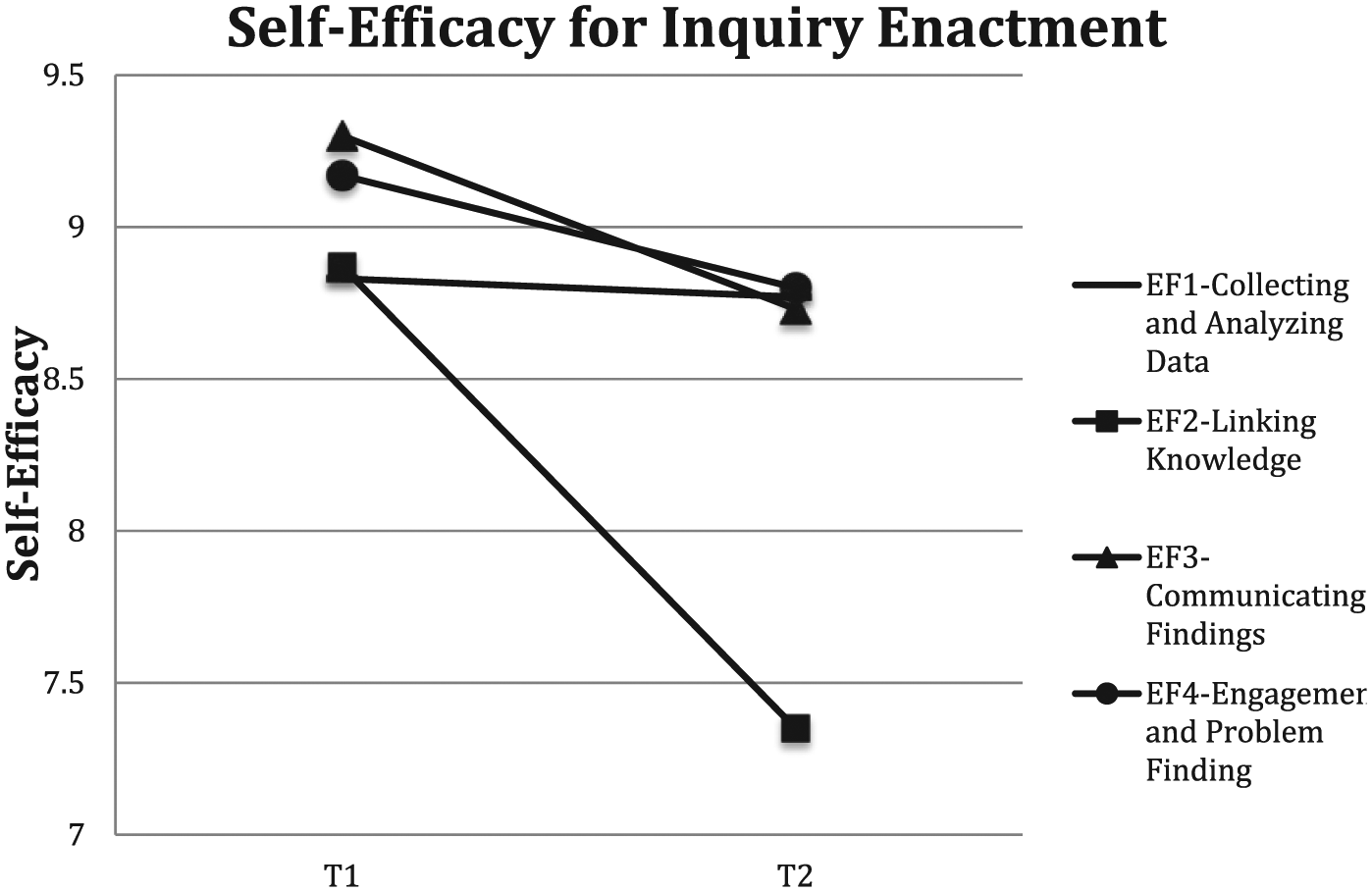
Changes in first-year teachers’ self-efficacy for enacting subscales of inquiry enactment from Time 1 (Fall) to Time 2 (Spring).
During both individual interviews, we asked how confident participants felt about inquiry-based instruction and about challenges experienced during implementation. All six teachers began the school year with enthusiasm and high self-efficacy for inquiry-based instruction (Figure 1), but self-efficacy began fading, mainly as a result of taking on more teaching tasks, but also because of learners resistance, insufficient time to cover content, evaluation, and reactions from other teachers. At T1, attitudes of school personnel and students influenced persistence to teach using inquiry. Variability in students’ interest in the subject, academic abilities, and classroom role raised doubts among first-year teachers about feasibility and decreased their self-efficacy for using classroom inquiry. All six expressed hesitation despite exposure to inquiry-based instruction, especially in teacher-education methods courses. Over the year, all six somewhat modified their teaching approach to adapt to the classroom climate, including strategies for classroom management, and lowered expectations regarding implementing classroom inquiry as a result of either curriculum design or negative student feedback.
Linking Inquiry Concepts With Self-Efficacy
To compare responses from T1 to T2, we counted frequencies of concepts used to describe inquiry and noted frequency changes observed with changes in self-efficacy. All six teachers referred to inquiry tasks touching all four subscales describing inquiry enactment. Over both interviews, teachers described inquiry mostly by referring to concepts in EF4-Engagement and Problem Finding, then EF1-Collecting and Analyzing Data, EF2-Linking Knowledge, and EF3-Communicating Findings (Figure 3). Examples of inquiry definitions included the following:

Numbers of concepts used to describe inquiry from Time 1 (Fall) to Time 2 (Spring).
“Asking students to share their definition of certain terms with the class to look at differences and similarities” (EF4, Rachel).
“Students working together to find answers; it is remarkable to see how they would get involved and ask each other if this is right or if that is wrong” (EF3, Eric).
“Encouraging autonomous learning and giving students the responsibility for their own learning” (EF2, Rachel).
“We have actually done hypotheses and observations and noting things down; you really have to work as a team. Students made their plans and then they actually built their catapult and we tested it out” (EF1, Sara)
“Students need to know where and which data sources are they going to use; I noticed that if I don’t give them notes, they don’t know what to do in class; they will listen, but they won’t remember and won’t have anything to back themselves up on; they won’t have anything to study for tests” (EF1, Jim).
Frequency shifts from T1 to T2 in Figure 3 do not necessarily indicate more or less complex understanding of inquiry instruction nor might they imply any practical importance. They may simply indicate more specialized knowledge of inquiry or a narrower focus on one of the features describing inquiry enactment.
Second, we examined frequency change in conceptualizations within subscales and compared those with changes in self-efficacy for inquiry enactment from T1 to T2. Table 4 presents change patterns within each inquiry subscale for each teacher. Most consistent change patterns occurred within EF1. Double + or − symbols indicate consistent increases or decreases in self-efficacy and conceptualizations over time. The next most consistent pattern occurred in EF3 (three teachers), followed by EF2 (two) and EF4 (two). Overall, 50% of changes displayed consistent patterns. Even at outset of their careers, first-year teachers’ self-efficacy at least partly reflected understanding of inquiry enactment.
Changes in Self-Efficacy for Inquiry Enactment and Frequencies of Conceptualizations Within Subscales From Time 1 (Fall) to Time 2 (Spring).

Note. Double + or − symbols indicate consistent increases or decreases in self-efficacy and conceptualizations of inquiry over time. Blank spaces indicate inconsistent shifts between self-efficacy and conceptualizations (e.g., +− or −+). EF = Enactment Factor.
Interplay Among First-Year Teachers’ Self-Efficacy, Actual Enactment, and Conceptualizations of Inquiry
Given that self-efficacy is a judgment of confidence to be able to perform a given task, we monitored participants’ progress in inquiry enactment by counting specific inquiry-based actions observed at each classroom visit. Although frequencies do not comprehensively indicate progress, we could compare patterns in self-efficacy for inquiry-based instruction, frequencies of concepts used to describe inquiry, and actual classroom enactment (Figure 4). Over the five classroom visits (Obs1-Obs5), the most frequently observed pedagogical actions were associated with EF4-Engagement and Problem Finding (n = 130/210, 62%), followed by EF2-Linking Knowledge (n = 121/240, 50%), EF1-Collecting and Analyzing Data (n = 165/330, 50%), and EF3-Communicating Findings (n = 45/150, 30%). The trend lines indicated overall increase of inquiry enactment in EF1, followed by EF3 and EF2, but a decrease in EF4.
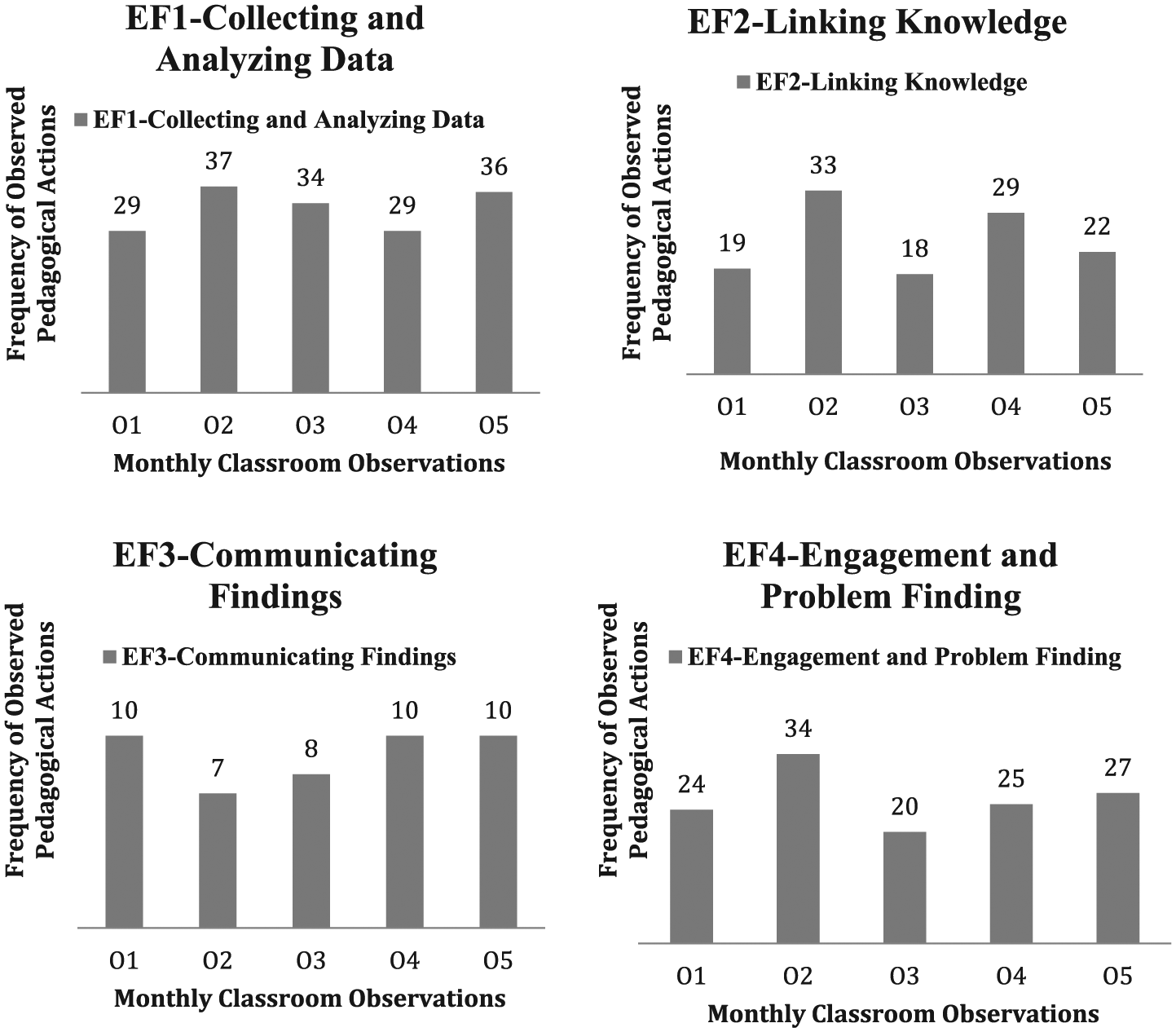
Total frequencies of observed pedagogical actions of six first-year teachers’ enactment of inquiry over five monthly classroom observations.
Following are excerpts from our classroom-observation field notes regarding first-year teachers’ inquiry enactment, each with the corresponding coded MEIQ-SET item number. These examples might seem rudimentary in terms of what one might describe as scientific or authentic inquiry and very guided, almost traditional teaching in which learners conduct scripted pseudo-experiments, resulting in a lack of student ownership; however, most teachers were not teaching the subject in which they primarily trained during teacher-education and some were even working in their second language.
EF1-Collecting and Analyzing Data
Mitch
During a lesson on motion transformation and transmission, teacher explained to students to be careful when examining a tool visually or on a diagram because there are hidden movements. He gave the example of the eggbeater and how the axes of rotation are perpendicular, implying that rotations are not happening in the same direction. Later, students observed different tools at their disposition and drew a table in which they classified each tool in either transformation or transmission (E13, E14).
Eric
What do you think will happen if I switch the ellipse to vertical?
a + b will change places. (E9)
EF2-Linking Knowledge
Sara
Teacher asked groups to formulate arguments that were for and against child labor because they would not know in advance which side they will be debating. After the debate, one student proposed to the class to write a letter to the principal raising awareness of current issues surrounding child labor. (E28)
Rachel
Rachel included a lesson about “Black History” during the month of February even though it was not part of the curriculum. As they were discussing the women in the movie “Help,” a student thought the “helpers” were slaves; Rachel clarified that they were not slaves because they were paid, but they were mistreated. (E17)
EF3-Communicating Findings
Rachel
Rachel encouraged students to think how they would formulate arguments when proposing to engage in a dispute with a powerful partner (e.g., USA vs. Canada). (E34)
Sara
Teacher asked students to communicate their findings either by writing an opinion letter or as a mini oral presentation in the form of a debate. (E35)
EF4-Engagement and Problem Finding
Eric
Teacher presents a difficult equation to resolve on an ellipse:
What would be the first step in resolving this equation?
To see if the ellipse is horizontal or vertical.
How would you know that?
By locating F1 and F2
Great! What do we do next? (E2, E4, E8)
Sara
Teacher asks students to make suggestions as to what needs to be included to make a good publicity campaign. After a round of answers (photos, repetition of words, celebrity images, key words), teacher shows examples of posters. (E6, E7)
We compared teachers’ self-efficacy from T1 to T2, frequencies of concepts describing inquiry from T1 to T2, and frequencies of inquiry-based pedagogical actions observed in five classroom visits. Double + or − indicate consistent increases or decreases in self-efficacy and observations of inquiry over time. Most consistent patterns occurred within EF2-Linking Knowledge (see rows for EF2 in Table 5), followed by EF4-Engagement and Problem Finding and EF3-Communicating Findings, and finally EF1-Collecting and Analyzing Data. Mitch displayed the most consistent pattern of changes in self-efficacy and observations of inquiry from T1 to T2, followed by Sara, Jim, and Rachel, then Eric. Amy’s self-efficacy for inquiry and observations of inquiry tasks were inconsistent (+− or −+) for each subscale. Overall, 46% of changes displayed consistent patterns.
Changes in Self-Efficacy for Inquiry Enactment and Frequencies of Observations Within Subscales From Time 1 (Fall) to Time 2 (Spring).

Note. Double + or − symbols indicate consistent increases or decreases in self-efficacy and observations of inquiry enactment over time. Blank spaces indicate inconsistent shifts between self-efficacy and inquiry enactment (e.g., +− or −+). EF = Enactment Factor.
We also examined patterns in teachers’ inquiry conceptualizations. Although less frequent, consistent patterns within EF2 and EF4 were observed comparing classroom observations with frequencies of concepts used to describe inquiry from T1 to T2 (Table 6). Amy’s (science) and Jim’s (social studies) conceptualizations of inquiry and observations of inquiry enactment were inconsistent for each subscale; 17% of changes displayed consistent patterns.
Changes in Inquiry Conceptualizations and Frequencies of Observations Within Subscales From Time 1 (Fall) to Time 2 (Spring).

Note. Double + or − symbols indicate consistent increases or decreases in inquiry conceptualizations and observations of inquiry enactment over time. Blank spaces indicate inconsistent shifts between conceptualizations and inquiry enactment (e.g., +− or −+). EF = Enactment Factor.
Most consistent patterns were observed between self-efficacy and the number of concepts used to describe inquiry, followed by self-efficacy and observations of inquiry enactment, finally conceptualizations and observations. To effectively track progress in teachers’ classroom-inquiry use, it is important to examine their inquiry conceptualizations in conjunction with their beliefs about teaching and learning a particular discipline.
Discussion and Implications
Our overarching goal was to examine teachers’ self-efficacy as an indicator of potential success for a teaching action and investigate its application within inquiry-based pedagogy. New teachers’ definitions of inquiry-based instruction and their self-efficacy for inquiry-based teaching and learning strongly predict actual classroom enactment of teaching with inquiry. This contradicts previous conclusions that teachers’ conceptualizations do not necessarily influence classroom practice (Lederman, 1999). Inquiry might be different.
The major discovery was consistent patterns among first-year teachers’ self-efficacy for inquiry instruction, conceptualizations of inquiry, and actual classroom enactment. During Year 1 of professional practice, self-efficacy for inquiry teaching generally declined as did the number of concepts used to describe inquiry enactment. Contrastingly, the observed number of inquiry-based classroom pedagogical actions displayed an irregular pattern during the year. An increase in inquiry enactment was evident in data collection and analysis (EF1) and communicating findings (EF3), and less evident in actions requiring teachers to enable students how to make links in knowledge (EF2), implying, among other possibilities, that during teacher-education, student-teachers might have been more exposed to inquiry as a set of interrelated procedures than as conceptual knowledge. The MEIQ-SET usefully captures specific instructional actions expected within inquiry-based classroom contexts. Support was found for a factor structure that included cognitive, affective, and social elements relevant to inquiry-based tasks applicable in a wider context than just science education.
Challenges of Implementing Inquiry
Because self-efficacy predicts performance (Pintrich & De Groot, 1990), we sought explanations for these self-efficacy and enactment shifts in the challenges teachers identified and influences from contextual variables (Keys & Bryan, 2001; Songer et al., 2003). An increase in self-efficacy occurred when teachers (Sara and Rachel) taught the discipline that they had chosen, used their first language to teach, and found a position in a school climate resembling their field experiences. In contrast, Eric learned to teach science but taught mathematics, Jim taught in an IB stream to which he was never previously exposed, and Amy was teaching in her second language. Highly efficacious teachers more likely try new strategies, adjust current strategies, and persist in the face of challenges (Tschannen-Moran & Hoy, 2001). Our teachers perceived challenges implementing inquiry, but differently. Those with increasing self-efficacy reported implementation challenges related to teaching and student learning. Rachel believed that perseverance was the key to inquiry, she was convinced of its value and motivated her students to embrace this pedagogical approach even when confronted with resistance. Sara worried about being perceived as incompetent because she had not yet mastered inquiry-based teaching. Her reflective capacity and willingness to adapt and to channel students’ energy into more positive and constructive learning experiences made her hopeful regarding teaching effectiveness. Both viewed inquiry-teaching challenges in terms of teacher roles.
Low self-efficacy for inquiry teaching has been associated with increased workload, learners’ resistance to social-constructivist environments, and teachers’ need to fulfill several different classroom roles (Brand & Moore, 2011). According to Melville, Fazio, Bartley, and Jones (2008), teachers with low self-efficacy are unlikely to plan activities beyond their capabilities; scaffold students with difficulties, searching for material; and teach content in appropriate ways. They also identified lack of time, lack of materials, curriculum design, and negative reactions of students (e.g., frustration, reluctance, intimidation), parents, colleagues, and colleagues as impediments to inquiry. Our four teachers whose self-efficacy declined over the year reported similar challenges. In addition, Amy stated that designing inquiry-based lessons took too much time and inquiry use was not necessary for every class; Eric complained about being denied a science-methods course; and Mitch thought the school system did not foster creativity (e.g., inquiry-weak curriculum materials). Teachers who attributed challenges to external influences were consistent with research reporting avoidance of inquiry-based instruction (Jarrett, 1999; Ramey-Gassert, Shroyer, & Staver, 1996).
Assuming that inquiry conceptions include ways to enact inquiry (Kang et al., 2008; Wee et al., 2007; Windschitl, 2003), we expected a more consistent relation between teachers’ enactment and definitions of inquiry. Our six teachers did not conceptualize the same aspects of inquiry enactment equally. Although they had learned about inquiry-based pedagogy in their methods courses and experienced enactment during field experiences, they seemed to have acquired more procedural rather than conceptual knowledge, and not both, as indicated in Figure 4 by the minimal progress of enactment in inquiry-based pedagogical actions defined under EF2-Linking Knowledge. This also implies that inquiry conceptualizations might mediate between self-efficacy and inquiry enactment, sometimes a facilitator, sometimes a barrier.
Limitations
Self-report data and voluntary participation limited data to interested and willing participants. Graduates with lower efficacy possibly refrained from volunteering.
The 11-point MEIQ-SET scale could be challenged regarding meaningful differences between intervals; however, Dawes (2002, 2008) demonstrated that an 11-point scale produced data essentially the same as five points rescaled for comparability, but with more variance than the latter. Surveys might be more appropriate for more concrete questions about inquiry enactment, but abstract ideas, such as self-efficacy levels and quality of instructional practices, might be harder to validly measure through self-reports.
Our approach to quantifying qualitative data (interview transcripts, observation protocols) to identify properties of the dataset, and reporting those properties as findings, can be considered less meaningful without also conducting some corresponding qualitative analysis providing richer insights into the context of the instruction. This study’s explanatory framework was based on statistical correlations (codes for qualitative sources). This might warrant caution when interpreting the present analyses (Hammer & Berland, 2014).
The limited number of classroom observations might not fully reflect day-to-day teachers’ practice. However, although we did not focus on qualitative variables (e.g., variability of lessons, in-depth vs. simpler tasks) to chart progress in teaching with inquiry, using frequencies of conceptualizations or inquiry-based pedagogical actions, and mapping patterns, was informative regarding development of expertise and whether or not teachers reduce or increase frequency of inquiry enactment.
We included just six teachers—one elementary and participants from different secondary disciplines: two in science, one in mathematics, and two in history—because measuring enactment through substantial classroom observations over a school year faces feasibility challenges. There is also the risk of researcher bias given the extended classroom time; however, two research assistants who never saw each other worked independently analyzing observations.
Implications for Educational Practice
Successful transition from student-teacher to teacher-inquirer is essential to curricular development in 21st-century schools. Leadership is needed from education and teacher-education. Skills and dispositions to use those skills effectively are needed, recognizing that greater protection and support are essential during induction-years. Handing beginning professionals more challenging teaching assignments because of their lower seniority could negatively impact self-efficacy and shorten careers.
First-year teachers’ inquiry enactment includes multiple components developed at different times throughout the year; supporting beginning teachers to implement inquiry-based curricula might be a worthy explicit school goal. Ultimately, preservice and induction programs can be structured to ensure that new teachers construct adequate knowledge about inquiry and are able to apply it. Challenges with curricular issues are rarely prioritized for first-year teaching practice. Polikoff (2013) suggested that curricular alignment increased with experience up to a certain point, usually 8 to 11 years, then decreased. Grossman, Wineburg, and Beers (2000) also suggested that novices may return to the lessons learned in teacher education after their first year teaching, and learning from teacher education might become more visible in novices’ practice after their first year that involves managing new settings, roles, and responsibilities. These challenges multiply when required to teach outside of their fields of training (Ingersoll, 2001). This has immediate practical implications because new teachers are expected to have a cross-disciplinary understanding of inquiry approaches.
Future Directions
Given the many challenges implementing classroom inquiry, conducting research within the context of the daily realities of teaching provides insights about a possible misalignment between inquiry conceptualizations formed in teacher-education programs and actual enactment of inquiry during one’s first teaching year. It would be interesting to know what sources (e.g., academic courses, inquiry, or field experiences) have most influenced preservice teachers’ conceptualizations of inquiry and if these sources differ for in-service teachers given that preservice teachers perceive teaching more globally. Longitudinal designs beyond 1 year could also reveal periods of flux and stability in self-efficacy at different career stages.
The trajectories we observed enhance the need for future teacher–researcher collaborations to more precisely understand how self-efficacy for inquiry teaching influences daily classroom practice. What issues contribute to teachers’ understanding of inquiry processes and how to teach with and for inquiry? What variables enhance teachers’ self-efficacy? Primary contributors to teachers’ instructional enactment can be more proximal elements of their environments (e.g., classroom climate, administrative and collegial support, or student characteristics).
Why inquiry conceptualizations were better aligned with self-efficacy than classroom-inquiry enactment is also interesting. Perhaps parallel paths between two variables are stronger when they are generated from similar sources. Self-efficacy and inquiry-instruction conceptualizations are developed relatively abstractly during teacher-education, whereas enactment (performance) is a less directly related outcome-based variable; student-teaching rarely provides extended, independent responsibility for a classroom. If consistency between motivational constructs such as self-efficacy, conceptualizations, and enactment of inquiry were demonstrated to be critical in enhancing inquiry-oriented teacher effectiveness, schools could focus on professional development that assists new teachers in reducing discrepancies observed within specific inquiry skills. Quality of instruction increases following teacher participation in professional development (Borko, 2004; Guskey, 2002), especially if focused on specific instructional practices. Future research should consider how we can successfully apply this principle to inquiry instruction.
Footnotes
Appendix A
Appendix B
Acknowledgements
The authors are grateful to Simone Viger for her commitment and invaluable help in data collection. A special thank you goes to the six teachers for participating in this research by welcoming classroom observations and allowing data to be collected during class time.
Declaration of Conflicting Interests
The author(s) declared no potential conflicts of interest with respect to the research, authorship, and/or publication of this article.
Funding
The author(s) disclosed receipt of the following financial support for the research and/or authorship of this article: This research was supported by a fellowship and a team research grant from the Fonds Québécois de la Recherche sur la Société et la Culture [Quebec Funds for Research on Society and Culture], and McGill University.