




Abstract
This study develops and tests a model that proposes economic necessity moderates the relationship between psychological contract violations (PCVs) and organizational commitment and trust in the employing organization among non-unionized manufacturing workers (N = 226). Moderated regression analyses revealed that there was a significant interaction between PCV and economic necessity in predicting both outcomes. Specifically, the findings indicated that individuals experiencing high PCV and high economic necessity did not decrease their organizational commitment like their counterparts who endorsed lower economic necessity. They did, however, experience significantly decreased trust in their employer. The findings suggest that individuals who are forced to sell their labor power and obtain what they need through the market are more likely to continue to be exploited by their employer, as they have no other options than to continue the relationship. The importance of the findings is discussed, and recommendations for future research are provided.
Introduction
Capitalism is a disciplinary system in which workers, perpetually dispossessed from the means of production, are forced to develop a work discipline that is conducive to money and market transactions to facilitate their own survival (McNally, 2011). The neoliberal agenda emerging out of the global economic crisis of the 1970s contributed to what in retrospect can be described as ongoing disciplining of workers as social programs were cut and wages reduced to stimulate economic growth following the end of the Bretton Woods system. Lilley (2011) has described neoliberalism as an “assault on unions, relentless restructuring of employment . . . wage slashing,” and the use of “intentional unemployment as means of disciplining workers and breaking organized labor” (p. 5). Despite the increased global growth that has taken place during the neoliberal phase of capitalism, particularly since China reformed their trade and economic policies in 1978, concerns about distributive justice, economic fairness, and exploitation have continued to grow in both the Global North and the Global South over the last three decades.
Exploitation was a major concern in Marx’s analyses of the capitalist agenda. His consternations included capitalism’s use of physical coercion (i.e., forced labor), exploitation by economic coercion (i.e., the employers’ interference with alternative employment opportunities), and exploitation by economic necessity. The latter presents itself as exploitation emerging from situations in which workers are forced to sell their labor power, as they have to obtain what they need through the market (Elster, 1986). Contrary to the neoclassical labor perspective, which holds that exploitation is a “non-issue” in competitive markets, as exploitation requires a wage that is less than the value of the marginal product of labor, Marx did not believe that workers enter freely into mutually agreeable contracts in an economy where workers are separated from the modes of production and the products of their labor.
The construct of psychological contracts has been used to study expectations and outcomes associated with the employment exchange dating back to the early 1960s (see Argyris, 1960; Blau, 1964; Levinson, Price, Munden, & Solley, 1962; Schein, 1965, 1978 as early examples). In short, the construct refers to individual workers’ perceptions of mutuality and agreement regarding conditions of the employment exchange (Chambel & Alcover, 2011; DelCampo, 2007; Robinson, 1996; Rousseau, 1990, 1995; Shore & Tetrick, 1994). The workers’ expectations are based on the employer’s explicit and implicit promises communicated prior to hiring (e.g., expressions of organizational policies or observations of current workers’ opportunities to advance or be promoted) or post-hire (e.g., promises of pay raises or opportunities for training and development; N. Conway & Briner, 2005).
A cognitive evaluation or recognition that the employer has not fulfilled the psychological contract is, in the psychological contract literature, referred to as psychological contract breach (PCB). Furthermore, a psychological contract violation (PCV) refers to an emotional response or feeling of injury following the recognition of an unfulfilled contract (Parzefall & Coyle-Shapiro, 2011; Rousseau, 1995). Recent studies suggest that PCB and PCVs contribute to negative outcomes such as poor citizenship behaviors (Organizational Citizenship Behaviors [OCB]), reduced job satisfaction, and intentions to quit (e.g., Blomme, van Rheede, & Tromp, 2010; Chen, Tsui, & Zhong, 2008; Dulac, Coyle-Shapiro, Henderson, & Wayne, 2008; Orvis, Dudley, & Cortina, 2008; Rigotti, 2009; Suazo, 2009; Tomprou & Nikolaou, 2011).
A major concern for scholars interested in exploitation and workplace justice arises when one considers the negative outcomes associated with PCB and PCV up against the need for the individual worker to keep and maintain their job based on economic necessity. Perceived violations may have to be “tolerated” if the worker has no other options to support self or one’s family. In other words, would workers experiencing few options for survival beyond their current job be in a position to walk away from what they perceive to be an employment relationship based on exploitation as assumed by the neoclassical labor perspective?
This study aims to clarify whether PCVs lead to reduced organizational commitment and a desire to quit, or just among those fortunate enough to be in a position to safely end their relationship with their employer. Furthermore, we seek to identify the extent to which trust in management and the employing organization is affected differently among those experiencing various degrees of economic necessity when faced with PCVs. The results should be of interest to anyone interested in workplace justice, workers’ rights, and industrial relations, as they will highlight the vulnerability of non-unionized workers in an economy that appears to be driven by employment practices seeking profits over human rights.
Theory and Hypotheses
PCVs and Organizational Commitment and Trust
The psychological contract literature has generated quite an impressive number of empirical studies on PCB and PCV and individual level outcomes associated with “unfulfilled promises.” Most of these studies conclude that PCB and/or PCV generate emotional exhaustion and job and personal dissatisfaction (e.g., Gakovic & Tetrick, 2003; Grimmer & Oddy, 2007; Orvis et al., 2008; Stoner & Gallagher, 2010). In addition, a number of empirical studies have linked PCVs to unfavorable organizational citizenship behaviors, increased intentions to quit, and reduced organizational commitment (see the following studies for recent examples: Cassar & Briner, 2011; Lapalme, Simard, & Tremblay, 2011; Ng, Feldman, & Lam, 2010; Rigotti, 2009; Suazo, 2009).
Organizational commitment is typically conceptualized as the individual worker’s psychological attachment to the employing organization. Commitment has typically been studied in Organizational Behavior/Human Resource Management (OB/HRM) and Industrial Organizational (I/O) psychology settings as the construct appears to be closely linked to turnover intentions, organizational citizenship behaviors, and job performance. A three-component model (TCM) of organizational commitment created by Meyer and Allen (1997) has recently been used to clarify the “mind sets” underlying a worker’s commitment.
The first component of Meyer and Allen’s model is affective commitment (AC) and refers to the worker’s “positive emotional attachment to the organization.” In other words, AC is meant to be the “desire” component of organizational commitment. The second component, the continuance commitment (CC), is the “need” component, and it incorporates the gains versus losses of working in an organization. “Side bets” (see Becker’s 1960 article on “side bet theory”) are considered the gains and losses that may materialize from the worker’s decision to stay or leave the employing organization. Finally, the third component is referred to as normative commitment (NC), which describes the worker’s commitment to the organization based on feelings of obligation.
Meyer and Allen’s TCM has been extensively criticized since its initial publication. Most notably, Solinger, Olffen, and Roe (2008) argue that TCM is a model for predicting turnover. They argue that the model does not capture why the workers stay with the organization, but rather why people should stay with the organization, whether they want to, need to, or ought to continue the employment relationship. It is, however, this aspect of the model, the mix of an attitude toward a target (i.e., the employing organization) and an attitude toward a behavior (i.e., leaving or staying), which makes it so useful in studies of PCV outcomes and exploitation by economic necessity because it captures the why regardless of whether they want to stay with the organization or not.
PCVs are, as earlier mentioned, affective responses that follow recognitions of PCB. These affects result from the cognitive recognition that one did not receive what was promised. These feelings of injury would naturally lead workers to question their own loyalty to the organization to which they sell their labor power. It would therefore be natural to assume that PCV would decrease organizational commitment.
Previous research on industrial relations and employment issues indicate that trust is a critical component of “healthy” workplace cooperation (Oxenbridge & Brown, 2004). Rousseau (1989) argued in one of her early seminal papers on psychological contracts that trust is a prerequisite for organizational processes to function properly and therefore both an antecedent and a consequence of the employment relationship. As Kramer (1999) argued, trust is a psychological state consisting of cognitive and affective components, and the lack of trust could lead to uncooperative relationships (McAllister, 1995; Smith, Carroll, & Ashford, 1995). Hence, voluntary employment conditions are dependent upon the worker having faith in the employing organization and that they will deliver upon their promises (Deery, Iverson, & Walsh, 2006). Robinson and Rousseau (1994) suggested that a PCV would be an antecedent of decreased trust in management, and as a cognitive recognition has to precede the affective reaction, one may assume that PCV would lead to a decreased trust in the employer.
PCV, Organizational Commitment, Trust, and Economic Necessity
The neoclassical labor economists argue that the employers and workers are equals in the exchange of a commodity (i.e., labor power), that no inherent contradiction exists, and that the invisible hand of the market regulates the employment conditions (Boyer & Smith, 2001; Kaufman, 1988). In short, the neoclassical defense of the “free markets” rests upon the assumption that competitive markets will regulate behaviors and provide checks and balances against abuse. Marx, however, argued that a person is exploited if he or she performs more work than is required to produce his or her own consumption, or where the wage is below the average product of labor.
Given the dismantling of labor following the neoliberal counter-revolution, the decline of real wages for the great majority of U.S. workers since the 1970s (Harvey, 2011), and increasing inequalities between the Global North and the Global South (e.g., McNally, 2011) and within domestic economies (Stiglitz, 2013; Wilkinson & Pickett, 2009), Marx’s arguments regarding economic exploitation should warrant a closer and more critical examination. Capitalism does, after all, force workers to sell their labor power at a price that is below the value of the product they produce. In other words, the employment exchange under capitalism violates the neoclassical argument that commodities trade at their value.
There are major concerns with respect to exploitation by economic necessity under neoliberalism, as the “exploited” are most likely to continue to be exploited in the later stages of capitalism (e.g., Dick & Nadin, 2011). First, private-sector union density in the United States has dropped to single digits since the 1970s. Hence, fewer American workers are protected by collective bargaining agreements. Second, the neoclassical assumption that workers can walk away from an abusive employment relationship and straight into another job does not appear to hold true. Structural unemployment, discriminatory employment practices, and uneven geographical developments make it difficult for millions of Americans to voluntarily leave an employer and smoothly transition into another job. Accordingly, for those workers who experience the need to maintain their current employment relationship based on the lack of available options, one may expect economic necessity to moderate the relationships between PCV and organizational commitment and trust in the employing organization. Specifically, one may assume that workers with few alternatives (i.e., high economic necessity) will have to continue to exhibit high organizational commitment. They may, however, experience decreased trust in the employer following their perceived PCV.
The full model is presented in Figure 1.

Proposed full model.
Method
Sample and Procedure
The participants in this study consisted of 226 (response rate: 60%) non-unionized workers from a manufacturing firm located in the mid-Atlantic region of the United States. The firm employs 376 full-time workers and has been in operation for 47 years. Both management and workers described the relationship as “contentious” when approached about the study. However, most of the respondents suggested that the “tension” had “eased” following a no-vote for unionization 5 years earlier. The subjects were told that the study aimed to better understand their relationship with their employer. Of the respondents, 61% identified as male and 39% as female. The mean age was approximately 48 years (SD = 11.8), and the respondents had an average tenure of 15.5 years.
Measures
Although not a part of the overall model, PCB was included in the survey to confirm it as an antecedent of PCVs. It was measured with a scale based on Morrison and Robinson’s (1997) five-item scale. Items included “almost all the promises made by my employer over the course of the last couple of years have been kept” (reverse scored), “I feel that my employer has come through in fulfilling the promises made to me when I was hired” (reverse scored), “my employer has done an excellent job of fulfilling its promises” (reverse scored), “I have not received everything promised to me in exchange for my contributions,” and “my employer has broken many of its promises to me even though I’ve upheld my end of the deal.” Responses were made on a 5-point scale ranging from 1 = strongly disagree to 5 = strongly agree. Cronbach’s α for this scale was .89.
PCV was measured with an eight-item scale developed and based on Morrison and Robinson’s (1997) definition of PCVs. Consistent with Arshad and Sparrow (2010), the respondents were asked to indicate how strongly they had experienced the following emotions: “betrayal,” “anger,” “resentfulness,” “shock,” insecurity,” “lack of trust,” “unfairness,” and “disappointment” as a result of unmet expectations from the employment relationship using a 5-point scale ranging from 1 = none at all to 5 = very strong. Items included, “Please indicate the extent to which you feel or have felt anger as a result of unmet expectations” and “Please indicate the extent to which you feel or have felt resentful toward your employer as a result of unmet expectations.” Cronbach’s α for this scale was .83.
The TCM survey administered in this study was comprised of the Affective, Continuance, and Normative Commitment Scales. Each scale had 8 items, for a total of 24 revised items derived from Allen and Meyer (1990). All items had a 5-point Likert-type scale response format (e.g., 1 = strongly disagree to 5 = strongly agree). Items included, “This organization has a great deal of personal meaning for me,” “I would feel guilty if I left my organization now,” “I really feel that I belong in this organization,” and “It is important to maintain a close relationship with this organization.” Internal consistency estimates (alpha coefficients) obtained in studies that have used these scales range from .69 to .89 for the various subscales (Allen & Meyer, 1990, 1996). Cronbach’s α for this scale was .88.
Trust in the organization was measured with a six-items scale adapted from Cook and Wall (1980) and Den Hartog, Shippers, and Koopman (2002). Items included, “One can trust management’s ability to make the right decisions regarding the future of our organization” and “I can rely on management and the organization to help me if necessary.” The items were assessed with a 5-point scale ranging from 1 = strongly disagree to 5 = strongly agree. Cronbach’s α for this scale was .84.
An 8-item scale was developed and used to assess economic necessity. Items included, “I need to keep my current job in order to maintain my economic independence,” “I have few opportunities to support my family and myself if not for my current employer,” “I cannot afford to lose my job,” and “I have alternative employment options” (reverse scored). The items were selected following a preliminary factor analysis of more than 45 items. All items had a 5-point Likert-type scale response format (e.g., 1 = strongly disagree to 5 = strongly agree). Internal consistency estimates (alpha coefficients) were .86.
Two control variables were used in the analyses. Although most studies indicate that gender does not appear to affect psychological contracts, some studies have identified gender differences with respect to contract types (e.g., transactional, relational elements). Hence, employee gender was included as a control variable (0 = male, 1 = female). Organizational tenure was also included as a control variable because it could capture the extent to which a worker may have experienced unfulfilled expectations within the organization.
Results
The means, standard deviations, intercorrelations, and reliabilities for all the variables in this study are provided in Table 1. Cronbach’s α values for the scaled variables are also included.
Means, Standard Deviations, Scale Reliabilities, and Correlations.
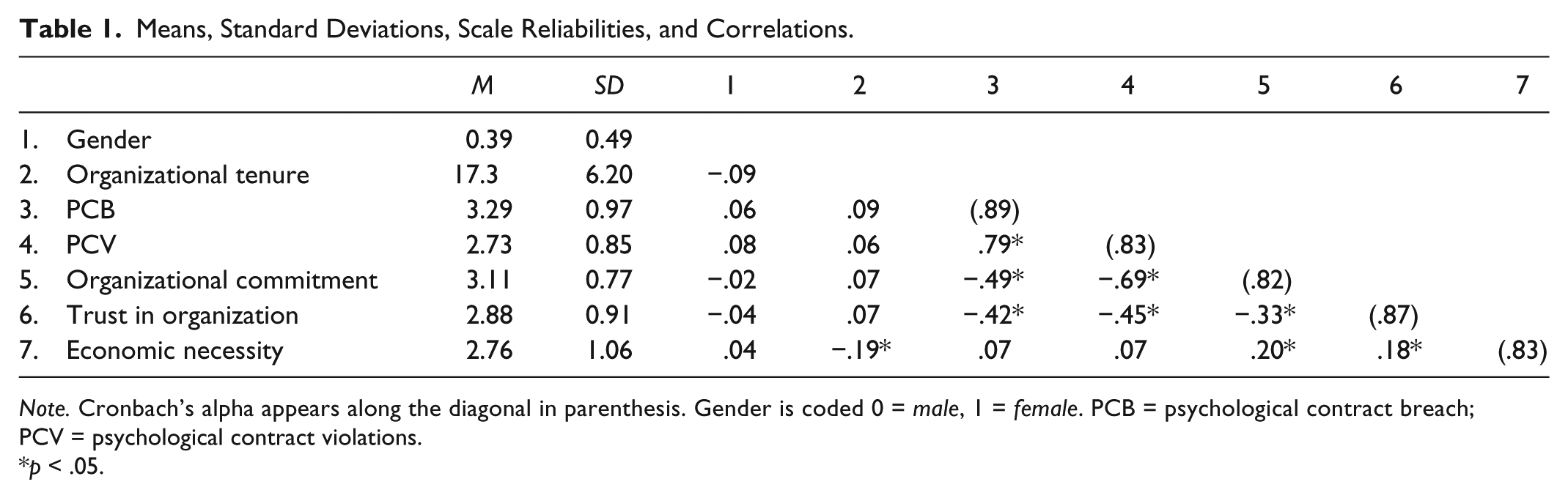
Note. Cronbach’s alpha appears along the diagonal in parenthesis. Gender is coded 0 = male, 1 = female. PCB = psychological contract breach; PCV = psychological contract violations.
p < .05.
Consistent with previous studies and the conceptualization of PCB as a necessary antecedent of PCV, PCB and PCV were strongly correlated (r = .79, p < .05) and remained statistically significant in the regression analysis (β = .76, p < .05) after controlling for gender and organizational tenure. Based on these analyses one may conclude that neither gender nor tenure contributed to how the cognitive perceptions of breach translated to the affective responses.
The regression analyses also revealed a relatively strong negative relationship between PCV and organizational commitment (β = −.66, p < .05). Individuals experiencing higher PCVs endorsed lower organizational commitment than those lower levels (or none) of violations. Hence, H1 was supported.
The analyses further revealed a strongly negative relationship with trust in the organization (β = −.51, p < .05). In other words, workers were more likely to score low on trust with high levels of perceived violations. Hence, H2 was also supported.
H3a and H3b dealt with the proposed moderation of economic necessity on the relationship between PCV and the two dependent variables from H1 and H2 (organizational commitment and trust in organization). Consistent with Aiken and West (1991), the variables used in the interaction were centered at their means to make the results more interpretable. As shown in Tables 2 and 3 and illustrated in Figures 2 and 3, the effects of PCV on organizational commitment and trust in organization varied across levels of economic necessity. Consistent with H3a, there was a significant interaction between PCV and economic necessity in predicting organizational commitment (β = .40, p < .05). Similarly, there was a significant interaction between PCV and economic necessity in predicting trust in management (β = −.33, p < .05).
Results of Regression Analyses (Hypotheses 1 and 3a).
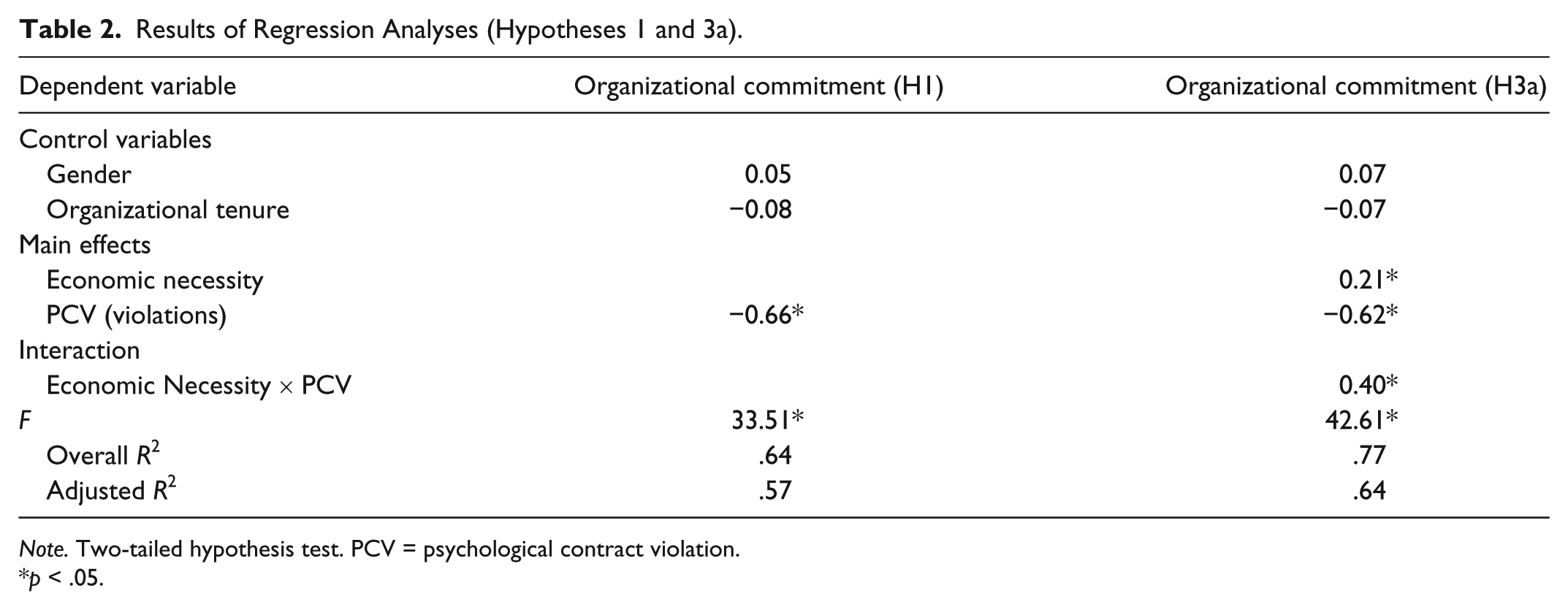
Note. Two-tailed hypothesis test. PCV = psychological contract violation.
p < .05.
Results of Regression Analyses (Hypotheses 2 and 3b).

Note. Two-tailed hypothesis test. PCV = psychological contract violation.
p < .05.

Moderation effect of psychological contract violations on organizational commitment at low and high levels of economic necessity.

Moderation effect of psychological contract violations on trust in organization at low and high levels of economic necessity.
As Figure 2 illustrates, the negative relationship between PCV and organizational commitment was significantly strengthened among workers endorsing low economic necessity, while only marginally lowered among workers endorsing high economic necessity. These findings were confirmed by the slope analysis. Among individuals with low economic necessity scored on average 3.81 on Organizational Com-mitment when endorsing low PCV compared with an average of 1.77 (t = 24.37, p < .05) when endorsing high PCV. However, individuals with high economic necessity experiencing low PCV scored on average 3.43 (almost identical to the low-instrumentality/low-PCV subjects), but these individuals’ average score on Organizational Commitment was only reduced to an average of 2.99 (t = 0.03, p < .57) when experiencing high PCV. In other words, whereas workers endorsing low economic necessity significantly reduced their Organizational Commitment, their colleagues who endorsed high economic necessity continued to exhibit high Organizational Commitment. Specifically, there were statistically insignificant differences on Organizational Commitment scores between high and low levels of economic necessity when PCV was high.
In addition, as Figure 3 illustrates, the negative relationship between PCV and trust in the employing organization was significantly strengthened among employees endorsing high economic necessity. These findings were confirmed by the slope analysis. Individuals with low economic necessity experiencing low PCV scored on average 3.56 on Trust, whereas individuals with low PCV experiencing high economic necessity scored almost identically with an average of 3.42 (t = .01, p < .75). However, whereas individuals with high economic necessity experiencing high PCV scored on average 1.92 on Trust in the employing organization, individuals with low economic necessity experiencing high PCV scored on average 3.01 (t = 0.45, p < .05). In other words, whereas there were minimal differences in terms of Trust when PCV was low between individuals with different degrees of economic necessity, the gap widened significantly as PCV increased. Specifically, there were statistically insignificant differences on the Trust scores between high and low levels of PCV among the high economic necessity subjects where workers experiencing high economic necessity decreased their trust significantly compared with their low economic necessity counterparts.
Discussion
Implications
This study has contributed to our understanding of why many workers continue to toll under modes of production even after having had their expectations about the employment exchange violated. McNally (2011) and others who allege that capitalism is a “disciplinary system” are apparently right when they maintain that when individuals are coerced to obtain what they need for survival through money and markets, they are more likely to continue to work under the same conditions that keep them exploited. Marx (1988) argued that capitalism’s subjugation of labor would keep them from recognizing that the growth and value they bring about is also keeping them enslaved. Hence, perpetually disposed from the means of productions, they will continue to exert efforts even if their human and workplace rights are violated.
The findings from this study suggest that we should pay attention to what Marx labeled exploitation. Market capitalism enables employers to keep workers disciplined and loyal to the organizational objectives when economic necessity is high. These are situations in which workers are forced to sell their labor power and obtain what they need through the market. We should also not forget that Marx also included physical coercion, still an existing reality in large portions of the world, and economic coercion, employers’ interference with alternative employment opportunities, in his conceptualization of exploitation. It is difficult to imagine that we can rectify these problems under capitalism unless employers are fined for repeatedly violating the promises they make to workers.
There are a number of other takeaways from the findings in this study with respect to both a psychological contract and economic necessity exploitation standpoint. These findings have been summarized in three major categories to make them concise and clear.
First, PCVs lead, not surprisingly, to decreased organizational commitment. The findings suggest that when workers perceive that the employing organization’s promises are not fulfilled, they typically reduce their commitment. However, the findings also suggest, contrary to previous studies that not all workers have the luxury of responding in such a fashion to violations. Workers experiencing high economic necessity appear to continue to exhibit high commitment. In other words, when workers perceive that they need the job to survive and do not have other options available, they will stay loyal to the organization. The answer to why this happens remains an open question. It is possible that the violations contribute to fear of losing the job. It is also possible, consistent with the exploitation theme in Marxist analyses, that violations discipline workers and that those with fewer options for survival will develop an obedience and loyalty to the organization as they recognize their own powerlessness. These findings suggest that workers need to band together and organize in the spirit solidarity unionism (Lynd, 2015) to protect the weakest among us, those who have no other options than to continue their relationships with the oppressive and exploiting employer.
Second, PCVs also lead to decreased trust in the employing organization. This is consistent with earlier studies. However, the results from this study indicate that those who experience higher economic necessity will experience even lower levels of trust following the cognitive and affective responses to broken promises. This suggests that they are keenly aware of the violations and that, coupled with their need for an ongoing employment relationship with the employer, these workers lose their trust in that the employer represented by management will be on their side in future exchanges, have their back during hard times, or simply make good decisions in the future.
Third, exploitation by economic necessity appears to be a concrete reality based on the results. Workers with high necessity associated with maintaining their current employment continue to exhibit organizational commitment regardless of the violations they may process cognitively and affectively. Hence, previous findings that have indicated that workers are likely to reduce their commitment following PCB/PCVs only tell us that the “average” worker decreases his or her commitment. These findings suggest that workers will continue their commitment following violations even though the trust has been significantly decreased. Unionism may resolve some of these issues, but that rests upon the assumption that we are witnessing an economic, and not a class, conflict.
Marx warned us about exploitation on numerous occasions, but it typically ignored in most contemporary discussions of employment practices. Freeing oneself from the dogma of market capitalism and rethinking what constitutes the good life, one should be able to imagine a future in which workers do not have to put up with workplace violations. This would only be possible when the subjugated masses recognize that capitalism is based on exploitation. Marx believed that self-realization and the development of a “healthy” community would be reconciled in a society in which the individual’s efforts and talents would be recognized and where one could enjoy the external manifestations of one’s self-realization. This, however, would hinge on the development of a society in which the individual would not be coerced into performing social and market valuable tasks (Elster, 1986). Hence, we would have to move beyond capitalism to resolve these problems.
Limitations of Study
Whereas the study has added to the literature on workplace exploitation and PCVs by clarifying how economic necessity affects the relationship between PCVs and organizational commitment and trust, there were limitations that should be addressed. The data were based on self-reports that were collected cross-sectionally. Hence, biases may be present due to common-method variance (CMV). Consistent with recommendations by J. M. Conway and Lance (2010) and Podsakoff, MacKenzie, Lee, and Podsakoff (2003), the study utilized existing instruments that have been proven to be both reliable and valid in previous studies in an attempt to overcome some of these problems. The extent to which CMV was a problem in the data was calculated based on the procedures described by Podsakoff and colleagues (2003). Fortunately, the results indicated that the average variance explained by the CMV was less than 1%, which is considered acceptable and fair (Podsakoff et al., 2003). The study was also designed to protect respondent anonymity as the questions asked specifically about individual behaviors and trust elements. Furthermore, the surveys utilized counterbalancing question order. A remaining concern is the utilization of self-reports; however, this is difficult to overcome as the constructs measured are latent individual constructs.
Future Studies
Future research should try to utilize longitudinal data. Causality was not addressed due to its use of cross-sectional data, so there is a possibility that those with high economic necessity most involved would be more aware of the policies, programs, and practices “promised” by the organization. Therefore, these workers could become more cognitively aware of “unfulfilled” promises and therefore experience more violations.
A similar study conducted in a unionized environment would also be interesting, as workers represented by collective bargaining agreements would also experience different levels of economic necessity. If so, exploitation may also be of concern among unionized workers. It would be particularly interesting to explore how the unions would affect these relationships, and whether the worker’s economic necessity affects decisions to unionize.
It may also be beneficial to explore the extent to which economic necessity affects psychological contract contents (e.g., transactional vs. relational elements). It is possible that economic necessity affects what workers expect from the employer and that the relationship may turn more transactional with high needs. In other words, economic necessity may reduce workers’ expectations as to what they are to receive from the employer.
Although the sample was of moderate size (N = 226), future studies could benefit from the use of larger samples and possibly a larger variety of organizations to draw comparisons between violations taking place in one context to another. It could also be beneficial to replicate this study and compare the economic necessity of salaried workers. One may look at how salaried employees perceive long workweeks without overtime compensations as violations and how these practices generate high economic necessity to repay student loans, and so on.
Finally, future studies may also consider examining the potential impact of “historical” perceptions of violations, as employees may bring with them experiences from other organizations that may affect their perceptions of PCBs and PCVs. Even though tenure with the current organization did not appear to affect these relationships, it is possible that tenure with previous organizations could affect such perceptions.
Footnotes
Declaration of Conflicting Interests
The author(s) declared no potential conflicts of interest with respect to the research, authorship, and/or publication of this article.
Funding
The author(s) received no financial support for the research and/or authorship of this article.