




Abstract
Although there have been studies that focus on the experiences of the gay and lesbian population serving in the United States military, few have focused on the experience of active duty transgender service members. Transgender individuals transgress the binary conception of gender by deviating from societal gender norms associated with assigned sex at birth. The Department of Defense has set policies and standards that reflect a binary conception of gender, with a focus on conformity. We argue that able-bodied gender variant service personnel are just as capable of serving their country as anyone else. Because of the repercussions associated with active duty transgender military personnel, our sample is small and involves nine clandestine service members and two international service members who wanted to share their stories from a different perspective. Snowball sampling was aimed at finding current active duty and reserve transgender service members. Using a combination of telephone interviews and questionnaires, data were collected from active duty transgender service personnel throughout the United States and two from international militaries that allow transgender people to serve. Data collection focused on the overall experiences of the participants along with questions regarding workplace discrimination, suggestions for policy changes, and their views about the overturn of Don’t Ask, Don’t Tell. Our findings add to a growing source of information about the transgender military experience in the U.S. armed forces and the importance of overturning discriminatory workplace policies that negatively impact transgender service members.
Keywords
Introduction
Evidence from scholarly research and other sources such as the National Transgender Discrimination Survey indicate that transgender individuals experience bias, stereotyping, and discrimination in all areas of society, both civilian and military (Bender-Baird, 2011; Grant et al., 2011; Moser, 2013). Institutions such as the Palm Center Think Tank, which produces scholarship designed to enhance the quality of public dialogue about critical and controversial public policy issues, and the Williams Institute at University of California, Los Angeles (UCLA), which advances law and public policy to increase public understanding about sexual orientation and gender identity issues, are engaging both private individuals and public policymakers in discussions about who transgender people are and why they deserve to be treated fairly, especially in workplaces, both military and private sector. According to Gates and Herman (2014), there are an estimated 15,500 transgender individuals currently serving on active duty or in the Guard or Reserve forces. They also estimate there are approximately 134,300 veterans or retirees from Guard or reserve service.
Transgender is a broad umbrella term that describes individuals who self-identify with a gender that does not match their sex assigned at birth (Maguen, Shipherd, &Harris, 2005). Some transgender individuals transition from either male to female (MTF) or female to male (FTM) with the help of counseling, hormone therapy, and/or surgery. Other transgender individuals do not desire therapeutic intervention but do present “self” in ways that do not conform to traditional gender expectations. With regard to military service, M. L. Brown and Rounsley (1996) found that more than half of the MTF patients in their practice had served honorably with or without transitioning from one gender to another. More recently, the findings from the National Transgender Discrimination Survey revealed that transgender Americans are twice more likely to serve in the armed forces than the general population (Gates & Herman, 2014).
In 1993, President Bill Clinton signed into legislation “Don’t Ask, Don’t Tell” (DADT). The intent of this policy was to make it possible for gays, lesbians, and bisexuals to serve in the armed forces just as long as they agreed to stay in the closet. Service members were not allowed to be asked about or to discuss their sexual orientation. Under this policy, a lesbian, gay, bisexual, and transgender (LGBT) service member could be kicked out of the military if they solicited or engaged in “a homosexual act or acts,” admitted that they were homosexual or bisexual, and/or attempted to marry someone of the same gender (Burrelli, 2010; Feder, 2013). Under the Obama administration, the DADT policy was officially repealed on September 20, 2011, allowing gay, lesbian, and bisexual service members to openly serve in the U.S. armed forces. However, critics of the military’s policy on transgender military service have brought up the fact that with the repeal of the DADT policy, lesbians, gays, and bisexual individuals were the beneficiaries of a civil rights milestone. At the same time, transgender individuals have been left out. Some individuals are forced to continue serving in secret rather than risk losing their jobs. If found out, they have to endure the humiliation of a military discharge along with potential loss of benefits. Other able-bodied transgender recruits are being turned away before having the opportunity to enlist in any branch of the armed forces (Ross, 2013; Yerke & Mitchell, 2013). Transgender enlisted personnel also report anxiety over double standards in the military (Parco, Levy, & Spears, 2015).
In this study, we add to the body of literature dealing with issues confronting transgender enlisted personnel, officers, and warrant officers in the armed forces of the United States. Even though the small sample size prohibits generalizations to the broader population of transgender active duty military personnel, each firsthand account reveals the challenges our participants face every day within the institutions they serve. The purpose of our study was to find out the following: (a) why they joined the military, (b) how they negotiate their gender identity within the gender expectations of the military, (c) whether and/or how they have been affected by the repeal of DADT, and (d) what kinds of discriminatory practices affect their service. We included two international transgender service personnel who shared their insights from a wholly different perspective.
Leveling the Playing Field Post-DADT
Until recently, most military studies investigating discriminatory practices and harassment dealt primarily with enlisted women and lesbians, gays, and bisexuals. A body of theoretical and empirical work began to emerge when President Clinton implemented DADT in 1993. In the past several years, major surveys sponsored by the military, the National Center for Transgender Equality, the National Gay and Lesbian Task Force, and the Palm Center include data from transgender military personnel, both active duty and retired. This information has resulted in published research that is included in this literature review. Because of discriminatory policies that are still embedded in military protocol regarding transgender service members, getting access to active duty individuals is a challenge for researchers. Recently, Kristen Beck, the Navy SEAL who honorably served 20 years before coming out as transgender, highlighted military policies banning transgender individuals from military service. In addition, high-profile cases such as the court-martial of Private First Class Chelsea Manning formerly known as Bradley Manning are challenging many policies that negatively affect the day-to-day lives of enlisted transgender military personnel (Huetteman & Stelter, 2013).
One of the earliest studies dealing with transgender individuals in the military was done by G. R. Brown (1988) whose sample included 11 MTF transgender service members, 4 of whom were veterans at the time of the interviews. Some of his findings suggest that the people in his study had a sense of duty and were patriotic, thus desiring to serve their country. Some respondents were drawn to the idea of camaraderie with other males. Others wanted to escape unhappy home situations or a sluggish work economy. The most significant finding was the subjects’ need to prove their masculinity in one of the most male-dominated social institutions in American society. He suggested their enlistment was, in fact, a way of “purging their cross-gender identifications” (G. R. Brown, 1988, p. 535). However, as the overall results of Brown’s study also suggests, transgender service members joined the military for the same reasons as the average enlistee.
In 2000, the Office of the Inspector General of the Department of Defense surveyed 71,570 active duty service members (including women) from all branches of the military. The study was commissioned in an attempt to assess the environment within military departments with regard to specific homosexual conduct policies. Bowling, Firestone, and Harris (2005) analyzed the data in an attempt to enhance the understanding of service personnel’s awareness of harassment in the military. The majority of the respondents 44,659 (62.4%) reported no awareness of harassment; however, roughly a little more than a third of the respondents 26,910 (37.6%) stated they either knew someone or knew about someone who had been harassed based on perceived sexual orientation. The U.S. Army had the highest percentage of harassment awareness of all branches of the service (Bowling et al., 2005). Not surprisingly most awareness of harassment was among junior enlisted personnel, especially women. The authors concluded that harassment occurs in the normal course of events associated with military service. Moreover, one of the consequences of DADT was that it prevented accurate information about an individual’s sexual orientation from surfacing.
Witten (2007) argues that the traditional binary view of body (male/female) has a powerful influence over ongoing military policies and procedures. The male-oriented body is the standard against which everything is measured in military contexts. When the lines between male and female blur, problems emerge through the challenges that ambiguity poses for contemporary military behavioral and medical codes that are bound by law. Specifically with regard to the issue of gender identity, policies dealing with DADT and gay/lesbian issues focus on sexuality alone. Witten questions how transgender and intersex identities will be treated by the military now that DADT has been overturned. The DADT rule only applied to homosexual, bisexual, and lesbian orientations and practices. It did not apply to gender identity and expression.
Other societies such as Canada, Israel, the CzechRepublic, Spain, and Thailand have less rigid views of the body. In 2010, Frank et al. reported that 25 nations allowed gays and lesbians to serve openly in the military. After policies changed to full inclusion, experts stated that not only was there no overall decline in readiness, morale, recruitment and retention, but there appeared to be a significant improvement in the day to day environment in foreign militaries including Great Britain and Australia. In addition, there were no instances of increased harassment of or by gay people as a result of lifting bans in the military forces. Parco et al. (2015) found a strong similarity between issues confronting transgender military personnel and those of lesbian, gay, and bisexual service members under DADT. Subjects in their study described feelings of seclusion and disconnectedness and fear of being discharged upon discovery. The authors suggest that there is a leadership dilemma for commanders with transgender members in their units based on pressure to enforce existing policy and the need to support their troops no matter their gender identity.
A survey of 445 LGBT military veterans from various branches of the armed forces revealed that most of the people in the sample concealed their sexual orientation during their time serving in various branches of the armed forces (Moradi, 2009). Thirteen individuals (3%) of the sample self-identified as transgender. This study was the first to examine the relations of sexual orientation disclosure, concealment, and harassment with military social and task cohesion within units. Findings indicate that disclosure of sexual orientation does not reduce group social and task cohesion. The link between sexual orientation disclosure and higher cohesion was consistent with a Zogby poll (Rodgers, 2006) dealing with the impact of LGBT unit members who served in Iraq and Afghanistan on personal and unit morale.
McDuffie and Brown (2010) explored the experiences of 70 veterans with gender dysphoria who sought clinical evaluations for help with their condition. Most of the people in the sample self-referred for counseling while others were referred by their commanding officers. G. R. Brown’s (1988) flight into hypermasculinity thesis was described by a majority of vets in the 2010 study as a retrospective understanding about why they joined the military. Many participants reported that enlisting was a way to purge their transgender feelings. They believed that the military would make men out of them. More than half of the 70 respondents were recipients of medical care from Veterans’ Affairs (VA) Medical Centers. Some of their medical claims involved medical and/or psychiatric disabilities incurred during their military service. The investigators found that suicidal ideation and behaviors were common among veterans in the sample.
Grant et al. (2011) gathered data on 6,450 transgender and gender nonconforming respondents from all 50 states, Washington, D.C., Puerto Rico, Guam, and the U.S. Virgin Islands. They found that most transgender people live in extreme poverty with 41% of the sample reporting that they attempted suicide. Regarding school experiences, 78% stated they were harassed, 35% were physically assaulted, 15% dropped out because of stress, and 12% were subjected to sexual violence. Ninety percent of the sample reported experiencing harassment, mistreatment, or some form of discrimination on the job, and 25% stated they had lost a job because of their gender identity. The authors concluded that nearly every system and institution (including the military) is implicated by their findings.
In a study including 141 MTF transgender veterans, Shipherd, Mizock, Maguen, and Green (2012) examined health care utilization and potential barriers to accessing care for this population. They found that use of VA Medical Centers was higher among transgender vets than in the general population of veterans. Sixteen percent of the sample reported they sought care from the VA 6 months prior to the study. Approximately 9.3% of the sample sought mental health services from VA centers and the population had higher than average levels of depression when compared with the general nonmilitary population. Veterans in the study also reported suffering from posttraumatic stress disorder (PTSD) along with the need for gender identity counseling. Documented barriers included the cost of health services and the veterans’ perceived reaction by medical providers to their gender identity issues. As Blosnich, Bossarte, and Silenzio (2012) suggest in their findings, increased social and emotional support can have a positive impact of on the overall well-being of sexual minority veterans.
Kerrigan (2012) directly explored discriminatory practices aimed at transgender military personnel. His findings supported the Palm Center position that United States military policy on gender identity should be reexamined. Both transgender vets and active duty military personnel report that they deal with many medical and psychology restrictions. Article 134 specifically gives the military broad power to discharge services members for any behavior perceived as prejudicial to good order. For example, cross-dressing behavior is punishable by a military court. As Elders and Steinman (2014) report, Kerrigan also suggests that the military consider developing a case-by-case approach when evaluating transgender individuals. Historically, the military has been a male-dominated institution, and males have been associated with waging war. For that reason, among others, women were relegated to support positions. He argues that even though DADT has been repealed and women have more opportunities for service and advancement, the military establishment continues to have difficulty distinguishing between sexuality and gender.
Utilizing data collected from the National Transgender Discrimination Survey, Harrison-Quintana and Herman (2013) examine relationships between service members/veterans and participants who did not serve in the military. Approximately 20% or 1,261 respondents had either served or were currently serving in the military. Most described experiences with harassment and/or sexual assault while in the military. Transgender veterans who participated in the survey experienced higher rates of homelessness, incarceration, and family rejection than those who did not serve. They also described challenges and barriers to obtaining health care from VA sources. Findings revealed that some nonmilitary participants wanted to serve but were rejected because of their gender identity. The authors of the study concluded that the repeal of DADT did not produce a policy solution for problems facing transgender service members and veterans. However, it is important to note that in 2013, the Veteran’s Health Administration (VHA) did enact VHA Directive 2013-003 and VHA Directive 1906 (Department of Veterans Affairs, 2013a, 2013b). Both of these directives are aimed at providing better health care for transgender and intersex veterans, addressing issues such as changing gender markers and enhancing treatment availability. Even though the VHA is beginning to address health concerns of transgender vets, based on their findings, Harrison-Quintana and Herman suggest that general military policy be revised to allow transgender people to serve openly and be treated fairly across the board.
In a study conducted by Yerke and Mitchell (2013), the authors address the importance of allowing transgender people to serve honorably with respect and dignity. Like Kerrigan (2012), the authors focus on current U.S. military policies that promote exclusion and rejection of transgender individuals. Utilizing medical and psychological rationales to prevent transgender individuals from serving their country promotes and maintains discrimination in the Armed Forces. They further argue that discrimination must be addressed because of the numbers of transgender people who are serving in the military. Comparing non-U.S. military policies with current U.S. policies, Yerke and Mitchell suggest that our policymakers should consider adopting U.K. standards for service. They argue that by overturning discriminatory policies, many active duty transgender service personnel would finally be able to access much-needed medical and/or psychological services and be protected in the same ways as their peers in Great Britain.
Matarazzo et al. (2014) conducted an extensive literature review to investigate suicide risk among LGBT military personal and veterans. The authors suggest that this issue is particularly important because suicide is second to unintended injury as a cause of death in the U.S. military. LGBT service members are particularly vulnerable to suicide given the fact that they are not only a member of the military but also identify with this population. Overall, Matarazzo et al. found that lack of social support as well as victimization also increased the risk of suicide among LGBT military service members. The review of the literature revealed that more research needs to focus on transgender veterans and active duty personnel.
Gender Diversity and the Total Institution
Total institution, a concept developed by Erving Goffman (1961), is essentially an isolated, enclosed social system with the primary purpose of controlling most aspects of its participants’ lives. Classic examples include prisons, mental hospitals, boarding schools, and military training camps. The U.S. armed forces is an institution that expects individuals to relinquish all individuality for the sake of maintaining the military complex and upholding military rules and regulations. Anyone who is engaged in military service is expected to conform with regard to dress, behavior, and even more specifically gender presentation. However, in today’s military, the diversity of individuals who join reflects the need to eliminate, alter, and/or add new policies to accommodate the ever-changing dynamics of this total institution. Currently, there are both psychological and medical regulations that prevent transgender people from enlisting and serving in the U.S. military (Department of Defense, 2010). To better understand the workplace discrimination experienced by transgender service members, the binary construction of gender and sex, together with a discussion regarding the hypermasculine nature of the military will serve as the theoretical foundation for this study.
Workplace discrimination is an issue that continues to plague the U.S. armed forces. Although DADT was officially repealed by the Obama administration on September 20, 2011, transgender service members were not accommodated or even acknowledged. Sociologically speaking, workplace discrimination faced by transgender individuals in the military can be explained, in part, by examining the binary construction of gender. In Western societies, cultures define gender as consisting of two categories, male or female. Individuals are expected to conform to specific gender roles through their overall presentation that includes everyday interactions. In addition, gender identity must align with the sex/biological binary according to the hormones, chromosomes and genitalia that an individual is born with (Ross, 2013; Witten, 2007).
As the gender identities and/or expression of some transgender individuals may not match socially dictated gender norms associated with their assigned sex at birth, they are susceptible to discriminatory policies that prevent enlisting and serving in the military. According to DeMiglio (2011), enlisting requires that potential service members undergo a physical examination where evidence of genital surgery may result in immediate disqualification. During recruitment, if an individual admits to identifying as transgender, the military considers this to be a disqualifying psychiatric condition. While on active duty, transgender service members are subjected to medical and psychological regulations that include not being allowed to physically transition and not admitting to being transgender. Transgressing these rules may result in criminal prosecution or discharge from the military and in some instances both. Another possible outcome is a simple administration discharge for medical reasons.
Embedded within the social construction of gender binary arrangements is the higher value that is placed on hypermasculine characteristics. Rosen, Knudson, and Fancher (2003) describe hypermasculinity as an ideology that expresses exaggerated, extreme, and stereotypic masculine attributes and behaviors that include the hatred of femininity, strict adherence to gender norms, dominance, control, aggression, and violence. In the case of transgender individuals, their gender identity that is viewed as not aligning with traditional gender norms is used as a rationale for not allowing them to serve. The result is a total institution structured upon hypermasculine attributes, particularly adherence to traditional gender norms, furthering discriminatory workplace policies against potential recruits and current active duty transgender individuals. According to Ross (2013), the military should rescind its categorical ban because transgender people have proven time and again that they are capable of serving in the U.S. military. Commenting on case studies that she conducted on transgender service members: The military’s ban on transgender service members is counterproductive; in many cases, the transgender service member is academically more qualified than a non-transgender service member, and these case studies vividly illustrate that transgender service members can have successful and high-achieving careers. It is detrimental to military strength to turn away qualified, willing and educated service members because of their gender identities or because they have had sex-reassignment surgeries. (Ross, 2013, p. 196)
Ross (2013) argues that instead of discriminating against capable service members because of their gender identities, the U.S. military should show the same support for transgender persons as Canada and Israel. For example, both countries sponsor policies that allow transgender people to serve openly while providing counseling, hormone replacement therapy, and/or surgery. Theoretically, examples of institutional acceptance of transgender military service members demonstrate that it is possible to redefine gender as a nonbinary social construct which will help do away with entrenched and legitimated discriminatory workplace policies in the U.S. armed forces.
Data and Method
A total of 11 active duty military personnel are included in this study that began in August 2012 and ended in July 2013. At the time of the interviews, 9 of the participants were serving in the Army, Air Force, Navy, or National Guard. Two of the participants were serving in the Fleet Air Arm of the Royal Navy and the Royal Canadian Air Force, respectively. Each individual participant was given a pseudonym and any other identifying details were disguised to ensure anonymity. Data collection included telephone interviews and questionnaires. Refer to Table 1 for a demographic profile of the participants.
Active Duty Demographic Profile.
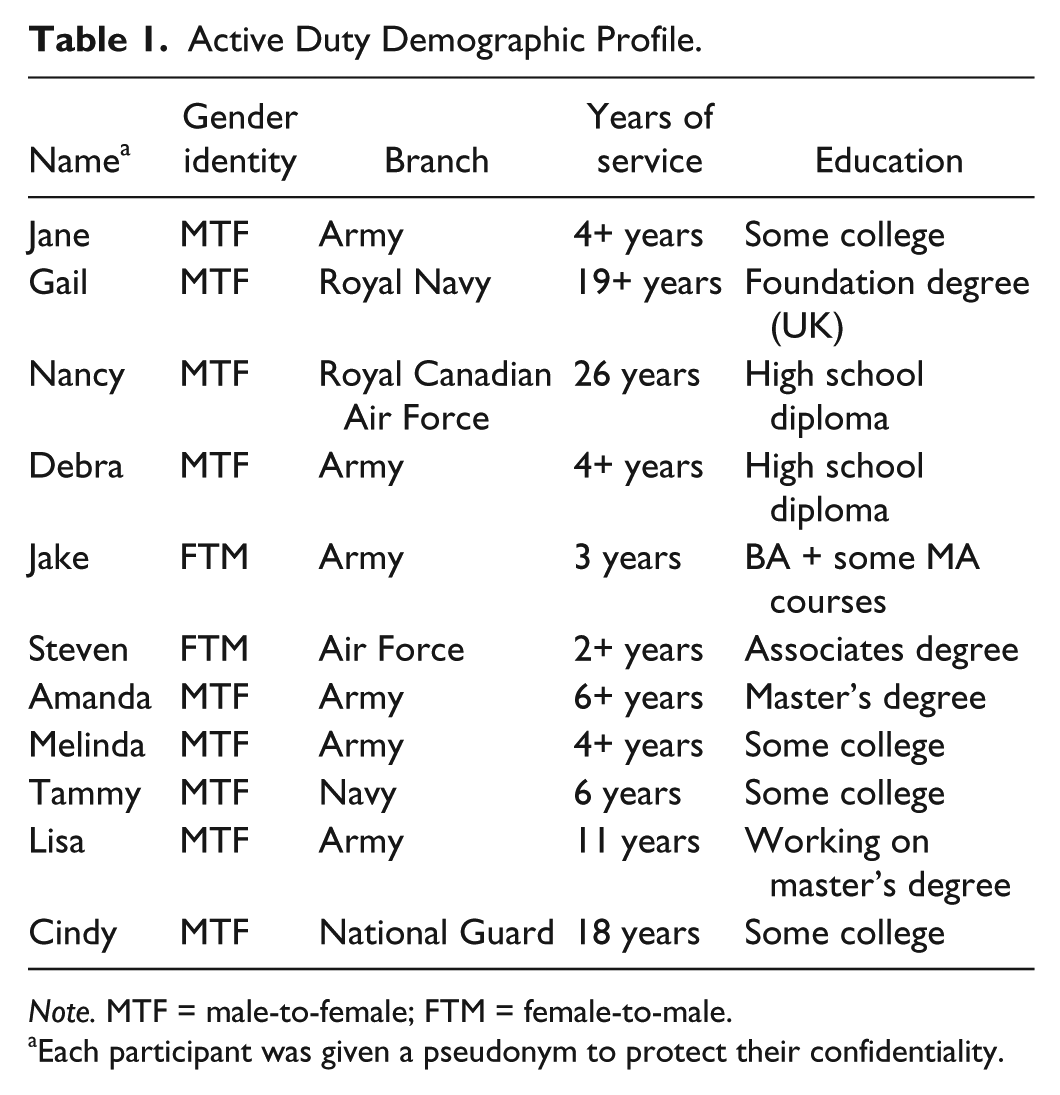
Note. MTF = male-to-female; FTM = female-to-male.
Each participant was given a pseudonym to protect their confidentiality.
Using nonprobability sampling, participants were recruited via purposive and snowball sampling techniques. The lead investigator made contact with a member of SPART*A or Service Members, Partners, Allies for Respect, and Tolerance for All, an advocacy organization for LGBT veterans and active duty service members, their families, and their allies. This individual sent out requests for participants through transgender chat rooms and other online sources. Interested individuals then contacted the lead investigator through email to express interest in participating in a phone interview or to request a questionnaire.
Phone interviews lasted from 20 min to 1 hr. Examples of research questions include the following:
Eight individuals participated in phone interviews while three of the participants responded by email. One of the phone interviews did not record properly at which time the researcher made extensive notes that were later verified by the participant for accuracy. NVivo, an updated version of the NUD*IST (Non-Numerical Unstructured Data*Indexing, Searching, and Theorizing) software program, was utilized to organize the data. NVivo looks for phrases and text keywords assigned by the researcher that pertain to specific research questions. A total of seven recorded interviews were transcribed and uploaded into NVivo. The interview that did not record properly was not included in the NVivo analysis; however, it was utilized as anecdotal data in the findings of this article.
The limitations of this study include the nature and use of purposive and snowball sampling techniques which do not require random sampling. For that reason, findings cannot be generalized to all transgender active duty individuals. More specifically, this sample of active duty transgender individuals is not representative of the transgender population in terms of race and ethnicity, class, disability, and age due to the small sample size. Second, transgender people are not allowed to serve openly in the armed forces of the United States. Therefore, it was difficult to recruit participants from the U.S. armed forces as they were afraid of being fired from their current positions. Due to this major obstacle, acquiring a larger sample size was not possible. The two participants from the Royal Navy and Royal Canadian Air Force were eager to discuss some of their experiences, both positive and negative, in hopes of facilitating change for transgender military personnel in the United States. The only tangible incentive for participating in the study was to further the discussion about workplace equity for active duty military personnel who also happen to be transgender.
Findings
Gender discrimination in the military workplace has not been sufficiently addressed for transgender service members in the U.S. armed forces. As the following interviews reveal, there is evidence of discriminatory practices within the U.S. military aimed at service members who are transgender. Participants discuss the various reasons why they joined the military. They also share some of their experiences with discriminatory practices while serving in the military. Finally, the two international participants share some of their experiences and insights.
Why Do Transgender People Enlist?
Regardless of the branch of service, the participants in this study made evident in their stories that they joined for many of the same reasons that nontransgender people join. Some service members talked about joining to receive the educational benefits offered by the military and the ability to travel, learn a new trade, and have a stable income. Steven (FTM) was struggling to attend school while working full-time when he joined the Air Force. He enlisted thinking that this experience would serve as a “happy medium” between the two: In a nutshell, I was working on my Associates degree part-time and working full-time. I was not the typical college student. I am a workaholic and I’d rather work. I liked going to school but I liked working and the military was a happy medium to achieve both. With my job, I worked ridiculous hours, strange days, and I didn’t have set days off so it’s difficult to do school. But at the same time with online college, I can kind of dictate when and where I can do my school work. I found it way easier. I can focus on it more now since being in the military. Essentially that’s why I did it . . . And then I was just kicking rocks with this Associates degree and not doing much with it so I might as well go into the military and finish up with my Bachelors. (Steven)
Like many individuals who currently enlist in the military, he did so to achieve his educational goals and to serve his country. On the other hand, Jake (FTM) went to college, but “he didn’t know what he wanted to be” after graduation. As a college student, he joined the Reserve Officers’ Training Corps (ROTC), which led to his career in the Army.
Amanda (MTF) stated that she joined the Army for the many benefits the military has to offer. Five other service members stated that they joined for some of the same reasons mentioned above but also suggested that serving in the military might be tied to their gender identity. Although the data in this study cannot be generalized to all transgender individuals who join the armed forces, research conducted by G. R. Brown (1988) and McDuffie and Brown (2010) found the flight into hypermasculinity to be important to understanding why some individuals might join. Cindy (MTF) was enlisted in the National Guard at the time of the interview.
Why did I join? Oh my god I thought that . . . I wanted to do something with my life. I wanted to travel but I figured the Army . . . you know it sounds like a cliché but it happens . . . I was hoping that the army could make a man out of me which they couldn’t and didn’t. (Cindy)
Like Jake, Cindy was not sure what she wanted to do with her life but that perhaps enlisting in a hypermasculine institution like the National Guard might help her to erase her gender identity. A warrant officer’s primary task is to serve as a technical expert to commanders and other officers.
Melinda (MTF) focused specifically on her gender identity and how this struggle might have been a defining factor as to why she enlisted: I’m 24. I’ve been in the Army since 2009, when I was 20. I’ve been dealing with gender issues since I was like seven. I always knew that I was in the wrong body or the wrong gender. About the time I was 19, I was really having big issues with my gender and I thought joining the military would make me a man or at least I’d die trying. And then the more I served the more I knew I wasn’t a man. (Melinda)
Jane (MTF) stated that although she joined for “patriotic reasons” she was also “trying to hide or overcompensate for her gender dysphoria.” Gail (MTF) joined the Royal Navy for a variety of reasons such as the hope that it would “make a man of me.” Other reasons Gail mentioned included the “opportunity to travel, have a steady paycheck, get an education, and learn a trade.” Tammy (MTF) said that by the age 4 or %, she knew she was “different” and “you know to keep it to myself and not express it.” She went on to say that she may have “subconsciously” joined the Navy to stop feeling female.
I didn’t really figure it out. I joined, like subconsciously I guess I really didn’t think about it. A lot of it was that I joined to I guess rid myself of the thoughts of being female and hopefully to masculinize me and give me some structure in my life that I didn’t have. (Tammy)
Nancy’s (MTF) perspective on joining the Royal Canadian Air Force was unique: Contrary to the common notion that transpeople join the military for a hyper-masculine experience, I joined because I wanted to be around aircraft. It didn’t work out that way, and I found myself funneled into the radar trade, where I found computers. Not quite what I was after, but it’s served me well. (Nancy)
As these service members reveal, there are multiple reasons why they joined the Armed Forces. Although some of the MTF participants in this study expressed the need to join to align their biological sex with their gender identity, this was not the overarching reason why most service members joined.
Workplace Discrimination in the Military
Transgender individuals can be discharged from the military because of their gender identity (Gates & Herman, 2014). As the data reveals, active duty transgender individuals are not only an unprotected class but they are often confronted with personal, social, and institutional barriers on a daily basis. Although each story is unique, most of the individuals interviewed for this study have endured some form of discrimination in the workplace either directly or indirectly from their co-workers and/or chain of command. However, two of the service members stated that not only had they started transitioning while serving but were able to do so free of harassment.
Amanda (MTF) stated that although she began her transition while serving, she plans to finish the process once she completes her military service. At the time of the interview, she had 10 months left on her contract. She also revealed that she has never been confronted about her gender identity. Lisa (MTF) has also served for 11 years in the Army without harassment.
I’ve been asked if I’m taking hormones. At some point I’ll have to take the physical fitness test. The males have to actually take their shirts off. At some point, this is going to come out. It’s not going to be a fun day for me. I truly believe that. I think I’m just waiting for the ball to drop. I’ll just prepare for the worst. (Lisa)
She is hopeful that policies will eventually change to alleviate fear of potential harassment that is palpable among transgender military personnel. Right now for Lisa “things are going great and life couldn’t be any better.” She revealed that she has come out to some of the people she works with.
Well secretly. Obviously I can’t be completely out about it but because I’m in the medical field, I feel as though I can. I have made some really good friends in the military like doctors and endocrinologists. I’ve made some really good friends along the way. And because of that, I’m doing it in secret but at some point I understand that I’m not going to be able to keep it secret. As of right now, it’s already showing so people are starting to ask questions and I deny the whole thing. So I keep a good group of people that do know. The ones that need to know. Other than that, the rest have no idea. They just think I’m a really feminine gay soldier which would work because the repeal of DADT has been lifted. (Lisa)
Although guardedly open about her gender identity to some of her co-workers, she realizes that being “completely out” might jeopardize her military career. When asked about her overall perception about being transgender in the military, she stated the following: And so we’re working harder every day to prove ourselves because we can’t . . . obviously we’re not good enough to be gay and we aren’t good enough to be straight so we are kind of stuck in the middle. And here we are every day in and day out trying to prove to other people that we are just like you. We just have a different mentality and a different body and they don’t see that. They see that as a problem. (Lisa)
Tammy (MTF) is worried about gossip circulating on base about her gender identity.
. . . actually I had a weird conversation with my department head on Wednesday. He came up to me saying that there were some rumors that I wanted to get surgeries and what not and I was blown away by it. So apparently somebody is putting two and two together and coming up with some really, really accurate rumors about me. But as far as right now, I haven’t heard who else knows, how it came about or anything like that. And he was supportive of it. He’s like, “Well as long as you’re not doing it right now you are fine.” (Tammy)
At the time of interview, she had been taking hormone replacement therapy (HRT) for about a year. Although she did not correlate her therapy with the rumors, it is quite possible that this might have been a contributing factor. With regard to being able to serve, Tammy stated this about her detractors.
All of their worries are about fear from their own bigotry. They don’t really realize what it actually means to be gay or transgender or anything like that so they just think of it as something completely out of the normal and they are scared of anything out of the normal. (Tammy)
Ironically, her department head stated that her being transgender was not a problem just as long as she “was not doing it right now.”
Jane (MTF) served in the Army before she joined the Army National Guard. While on active duty, she “received HRT, laser hair removal, and mental health therapy for dealing with a diagnosis of gender dysphoria.”
Nobody ever accused me of being transgender directly but it was often talked about behind my back and was pretty well known. Currently I am 100% out and often talked about which affects me in multiple ways. (Jane)
Although she did not elaborate on those “multiple ways,” she has continued to serve.
Unlike most of the other participants interviewed for this study, Debra (MTF) seemed to be struggling with her gender identity and her obligation to the Army. In fact, she made it clear to her chain of command that she wanted to be released from her military obligation.
I have tried in the past to get out but they won’t let me out. I wouldn’t tell them why I wanted out. I’d only tell them that I wanted out. Like I’ve said, I’ve been through ups and downs and depression and I haven’t been suicidal because I haven’t tried anything but I have had suicidal thoughts. (Debra)
Even though DADT had been eliminated at the time of this interview, she has been targeted by her co-workers as a homosexual and for that reason she “avoids social contact altogether.”
Now I’m not really worried about confidentiality. I’m just really tired of having to hide everything because it’s just the same thing as stress and depression because I’ve talked to a psychologist before like I said. They told me that it’s not healthy to hold everything in. (Debra)
She suggested that the only way discriminatory policies could be changed in the military was for more transgender service members to come out: Honestly I don’t know that anything can be done until it has been brought out as an issue like homosexuality. I’m sure homosexuals far out weight at least in open demographics, far out weight transgender people. Until more start coming out like homosexuals did, no one will really know that it’s an issue. (Debra)
Melinda (MTF) did not come out as transgender on her own terms. She was exposed through Facebook at her first unit and Instagram at her second unit leading to her direct experiences with discrimination.
I mean when I was found out in my first unit, everybody was like “What the fuck?” And then I was able to close out those accounts and deactivate them in enough time for people to not go down my life. And they were just like “What’s up?” I was like “I just like to crossdress.” And they were like “Ok. I mean that’s weird but . . . ” And some people had snide remarks like “Faggot” or like “Queer” and stuff like that. That wasn’t offensive to me. I pretty much played it off like when people did the snide remarks I was like “I can still beat you up” or “I can still out PTU” and stuff like that. It pretty much became a joke . . . running joke like whatever. And so I mean that’s how I had to deal with it. Because when they found out it was during deployment. I mean every soldier out there is a necessity especially in the infantry world so they didn’t do anything about it and nobody took it anywhere. (Melinda)
Steven (FTM) started taking hormones while on active duty “without the military knowing.” At the time of the interview, he was under a Personal Reliability Program (PRP), which requires individuals to notify the Air Force if they seek medical or psychological treatment off base. Nine months after starting testosterone, he went to the clinic for an unrelated issue and was questioned by the Captain who noticed that his voice was lower and that he looked “different.” A full hormone test was ordered, and he tested positive for anabolic steroids. Although he was questioned by the Captain and asked whether he was transgender, he denied the allegation. At the time of the interview, he was still waiting to find out his fate. He had this to say about his situation: They took my arming status away. I cannot do my job anymore not permanently but they took my rights away from that. Since October I’ve pretty much been pushing a broom or doing whatever my squadron needs me to do because I’m kind of the bad kid and still under investigation. I haven’t heard anything about it since. To my knowledge, there is only a handful of upper leadership that knows about my situation but word quickly spread around and rumors are flying as to what my situation is. And they are not the best of rumors at all. And I talked to some lawyers about this on base and off base, civilian lawyers and if I was just to be given a different base, a non PRP base, this whole situation wouldn’t be an issue . . . like right now, I’m with the quote unquote bad kids of my squadron. There are two guys who have raped females, three guys that have gotten DUI’s, absolute malingerers in the Air Force wanting to get out. But for some reason this squadron is not only kicking their feet but trying to help them stay in! It’s baffling. It’s absolutely baffling to me! Guidelines are pretty cut and dry when it comes to sexual assault and DUI cases. The Air Force does what they can to keep rapists and drunk drivers from being discharged but keep dragging their feet regarding what they should do with my case. You have an able-bodied person who wants to work you know . . . (Steven)
He was eventually sent to another base where he is continuing his course of hormone therapy.
Like Steven, Cindy (MTF) experienced discrimination while serving in the National Guard. At the time of the interview after 18 years of military service, she made the decision that full transition was her only option.
I had a suicide attempt while I was at drill and they were like, “Well PTSD looks really bad so why don’t you just not come back to drill anymore. If we need you, we’ll call you but we are going to try to put you out on a medical.” That was a year ago. In the meantime, I’ve transitioned fully. I wasn’t going to wait for the National Guard to figure out what they were going to do with me. I’m just kind of hanging out waiting for someone to make up their mind. I’m glad that I did it this way. I could not have lasted in-between genders. It was awful. And I knew it going in. But there is a tipping point where if you don’t do something bad things are going to happen. I tried for the longest to make it work but I couldn’t do it any longer. (Cindy)
Although fearful about the status of her retirement benefits, she recognized that her mental, emotional, and physical health had to come first.
I’m happy and you know the retirement that I would have gotten wasn’t enough. I mean any money is good these days but my sanity and living are more important than four or five hundred dollars a month. I mean at this point. I may be crying for it later. Right now I’m alive. I love where I’m at. I love being me finally and you know I sure wish the guard and the army could understand. (Cindy)
Eventually, she was diagnosed with Gender Identity Disorder (GID) rather than PTSD and forced to resign without retirement benefits.
Jake’s (FTM) story clearly illustrates that if a transgender service member has support from the chain of command, it is possible to both transition and do the required job. He “figured out that he was transgender about 6 months after he enlisted” in the Army. Shortly thereafter, he began taking testosterone and completed his top surgery. By the time he was sent to a new unit, his voice had deepened and he looked more masculine.
They were confused because they thought they were getting a female but this is a male. But my first sergeant actually knows the truth. He flat out asked me. He was like “Hey how do you identify?” and I told him. And I told him I was on hormones and everything. He is completely ok with it. Along with my commander, it’s fortunate in that aspect that they are allowing me to transition as long as it doesn’t you know interfere with my performance. (Jake)
Although he realized that he had support from his commanding officer, he was aware that telling the “wrong person” could get him “kicked out.”
I was more nervous to tell my commander than my first sergeant because my first sergeant just came out and asked me and I’d already gotten a feel for him. I knew he would be ok with it or I got the vibe that he would be ok with it. So I went ahead and told him. And plus whenever I started doing hormones, I accepted the fact that if they found out I’d accept the punishment or repercussions that came from it. Along with that, I decided that if anyone ever asked me I would not lie about it because the way I see it, it would get me in more trouble lying about it. You know if you are going to ask me, if they have a problem with it and suspect something anyway they are going to have me drug tested anyway. I’d rather just be upfront with them and honest about it. At least I have that going for me (laughing). No but it is a little nerve racking because you don’t want to tell the wrong person because they could kick you out of the military for it which is very scary. This is supposed to be my career. This is what I went to school for. Very nerve racking. So far I’ve been lucky that it has worked out ok. (Jake)
Words of Encouragement From Abroad
Two international participants were openly serving in their units. They also had the benefit of health care options needed for transition. However, this does not mean that discrimination against transgender individuals does not occur in militaries that allow transgender military personnel to openly serve. For instance, Nancy (MTF), a Corporal in the Royal Canadian Air Force, served a total of 30 years with 26 years in the regular force and 4 years in the reserves. With regard to her health care, Nancy stated that “I was able to transition completely (whatever that is) with the help of the Canadian Forces medical system. The medical care I received, both in-house and outsourced was second-to-none.” However, she also had this to say: I did have some very nasty experiences during my transition in terms of discrimination, and many of these would have been far reaching, even career ending, except for someone much higher than I who saw what was going on and got me into a much safer position. Now that I’m transitioned, I’d say that most people treat me with respect, although I think many keep their distance. I believe this to have more to do with a certain apprehensiveness on their part, a good deal of which can be dealt with by just plain being out, open and honest about who I am . . . not with any sort of in-your-face approach, which tends to put people off, but more along the line of just demonstrating by how I conduct myself and that I am just an ordinary average person with ordinary average problems. (Nancy)
Gail (MTF), a Petty Officer who had served 19 years in the Fleet Air Arm of the Royal Navy at the time of the interview, stated that she had never experienced workplace discrimination.
My squadron, base, and the Fleet Air Arm have been great. In fact the RN seems to be very supportive in general, at least now anyway. There have been a couple of individuals who have had an issue, but other than that I have received no detrimental experiences or judgments. In fact, if anything the RN has just accepted things as normal. I have worked with the higher echelons of the base and have met the 1st and 2nd Sea Lords. I have just been accepted onto the RN LGBT forum. (Gail)
In reference to the elimination of DADT, she stated that “I was shocked to see that it didn’t apply to transgender members of the U.S. military and I hope that changes soon.”
Discussion and Conclusion
On July 26, 2012 at the National Naval Officers Association (NNOA) annual conference, the Chief of Naval Operations, Admiral Jonathan Greenert discussed the importance diversity and inclusion play in the future success of the Navy. He stated that organizations that are more diverse are documented to outperform those that are not (King, 2012). In his official blog, Greenert also stated that gender should not be a barrier to service, which fully supports the integration of women into once male-dominated naval and other military occupations (Greenert, 2013). If he is serious about his commitment to inclusion and gender equity, he, along with other military leaders, is going to have to address all forms of diversity that include transgender military service members.
Army General Martin E. Dempsey joined former Defense Secretary Leon E. Panetta at a Pentagon news conference on January 24, 2013, to announce a new policy that would allow more women to serve in direct ground combat positions (Pellerin, 2013). This new policy could open up 53,000 positions that have been closed to female service members based on discriminatory occupational standards. As newer military policies address issues specifically targeting inclusion, it can be argued that transgender service members, continually discharged from military service based on their gender identity, must be given the same opportunities to enlist and serve openly in an increasingly gender-neutral U.S. armed forces.
Although the stories represented in this study differ somewhat from person to person, the active duty military service sample illustrates that workplace discrimination occurs on many levels. Other militaries around the world have made policy changes that allow transgender people to serve including Australia, Belgium, Canada, the Czech Republic, Israel, the Netherlands, Spain, Sweden, Thailand, New Zealand, and the United Kingdom. The individuals who participated in this study illustrate how frustrating one’s work life can be when trying to avoid any mention of gender identity, transition issues, and ability to do the job based on gender. One of the most devastating consequences of discrimination is not only losing a job but also the benefits that go along with military service. This is what happened to Cindy (MTF) whose release came with a change in diagnosis from PTSD to the deal breaking GID. Had Cindy been diagnosed with PTSD, she would have been entitled to disability and therefore received her retirement benefits.
Some of the stories shared by active duty military personnel in this study revealed that in some instances, policies are applied with more flexibility by senior officers. Lisa (MTF) has been lucky to serve 11 years without incidence of harassment. This does not mean that she does not worry about something happening that will jeopardize her remaining time in military service. She hopes that the repeal of DADT will somehow spur on transgender activists to demand change now. In May 2014, Defense Secretary Chuck Hagel suggested he would be open to lifting the ban on transgender military personnel. At the very least, he conceded that the policy should be reviewed on a routine basis. Lisa is grateful for whatever progress occurs, even though she realizes change governing transgender military service is long overdue. As we found in our study, individual chains of command deal with transgender military personnel differently. Some are more inclusive than others depending on how they interpret policies governing gender identity issues. This reveals confusion, chaos, and spotty enforcement regarding how policies are applied throughout the military establishment.
As our sample size was small, it is not possible to generalize whether or not FTM’s or MTF’s have an easier time serving in the armed forces. As mentioned above, we found that the chain of command determined to some extent whether or not our participants dealt with discrimination in the workplace. Jake and Steven were the only participants who identified as FTM. While Jake received some support from senior personnel in his unit and was able to transition on the job without much trouble, Steven was stripped of his arming status and was waiting to hear whether he would be able to continue his career in the Air Force. Seven of our participants, not including the two service members serving in the Royal Navy and the Royal Canadian Air Force, identified as MTF and reported having varying experiences in the workplace. While Amanda and Lisa stated at the time of the interview that they were able to serve free from harassment, Tammy and Jane continued to serve but with the constant fear that their gender identity would be discovered resulting in possible retaliation. Debra made it clear to her chain of command that she wanted to be released from her military obligation but was told that she would continue serving regardless of her gender identity. When Melinda’s gender identity became known through social media, she experienced harassment from fellow soldiers. As mentioned above, Cindy lost all of her retirement benefits when her chain of command diagnosed her with GID rather than PTSD. As the data suggest, the degree of acceptance by chain of command does seem to influence the kind of experiences transgender service members will endure in the workplace. Without a larger sample, we are unable to say whether or not MTF’s or FTM’s experience more or less discrimination in the workplace but thought that this trend in our data was worth mentioning.
Each branch of the United States military releases its own medical standards governing who can serve. Transgender individuals have been excluded based on physical and mental factors determined by the Department of Defense. Citations in medical instruction manuals list disqualifying factors for service that include abnormalities or defects of the genitalia and history of psychosexual conditions. These conditions are defined in the American Psychiatric Association’s Diagnostic and Statistical Manual (DSM) under sexual and Gender Identity Disorders (GIDs). We argue that not only are these policies discriminatory but they are also outdated and foster dangerous stereotypes about qualified military personnel who are ready and willing to serve. A commission led by former Surgeon General Dr. Joycelyn Elders and retired Rear Admiral Dr. Alan M. Steinmen concluded that there is no valid medical reason for the ban on transgender service members to continue.
Approximately 15,500 transgender military personnel are currently serving across all branches of the U.S. armed forces (Gates & Herman, 2014). Elders and Steinman (2014) also indicate that at most, 1.5% or 230 transgender personnel would potentially seek surgery paid for by the military on an annual basis. Our research study attests to the fact that there is a great deal of misinformation and confusion in both civilian and military populations about transgender individuals. Education is critical to the process of overcoming bias and discrimination aimed at the transgender population. Focusing on a better understanding of the diversity within the transgender category is a good first step. For example, transgender individuals often elect to transition which requires counseling, hormone therapy, and surgical intervention in some cases. More importantly, not everyone who identifies as transgender requires any type of treatment option and the PalmCenter has found in a series of reports and surveys that many active duty transgender military personnel have served successfully against great odds. For policies regulating transgender military service to be corrected, there will have to be a concerted and coordinated effort among transgender activists and organizations, knowledgeable medical personnel, and their military allies to consistently advocate for change.
Issues surrounding how transgender people are treated in the military must become a priority for the Department of Defense. Looking back historically, recognition of discriminatory practices resulted in the affirmative action initiative signed into law by President John F. Kennedy in 1961. The repeal of DADT was a positive step in the right direction to secure more equity for gays and lesbians in the military. The exclusion of transgender individuals makes it clear that there is much more to do before military leaders can truthfully say that their organizations are meeting the needs of a rapidly changing and increasingly diverse population of active duty service personnel. One area of concern that needs to be addressed is recruitment and retention. Current policies that restrict transgender individuals from enlisting and serving must be eliminated. The U.S. military can learn a great deal by considering the procedures implemented by other militaries around the world that allow transgender people to openly serve. Our data also suggest that there seems to be a high degree of inconsistency regarding how policies are applied within and across all military forces. Therefore, efforts should be made by the Department of Defense to develop up to date procedures that promote and maintain a safe working environment for transgender service members across all branches. Such policies would not only provide stronger leadership and professionalism but also be instrumental in reducing discrimination and providing service members the ability to serve freely without fear in the workplace. Implementing nondiscrimination policies is imperative to achieve these recommendations. If policies are created that allow for the fluidity of gender norms, a workplace free from discrimination is possible, and it is the right thing to do.
Footnotes
Acknowledgements
The authors would like to thank Brynn Tannehill for sharing her insights with us early in the development of this project. We would also like to thank the people who shared their stories with us. In addition, a representative of SPART*A was of great assistance in helping get the word out to prospective participants.
Declaration of Conflicting Interests
The author(s) declared no potential conflicts of interest with respect to the research, authorship, and/or publication of this article.
Funding
The author(s) disclosed receipt of the following financial support for the research and/or authorship of this article: Thanks to the Office of Research and Sponsored Programs at Stephen F. Austin State University that provided funds for a portion of this research project.