




Abstract
The purpose of the study is to analyze factors influencing students’ perceptions of teaching as a career choice using structural equation modeling with the goal of shaping a teacher education recruitment program. In this study, 458 students from a Midwestern university in the United States responded to an online survey about career-related factors they value, their expectation that teaching would offer those factors, and any social-influence factors that might encourage them to choose a teaching career. The effect of 10 exogenous motivation variables (value-environment, value-intrinsic, value-extrinsic, value-altruistic, expectancy-environment, expectancy-intrinsic, expectancy-extrinsic, social-media-education, social-prior-experience, and social-suggestions) on choosing a teaching career was examined. Results of our analysis showed that the factors related to expectancy-environment, expectancy-intrinsic, social-media-education, social-prior-experience, and social-suggestions were found to be significant, whereas value-related factors and expectancy-extrinsic factors were found to be insignificant.
Over the last decade, education administrators and governments of the United States, the United Kingdom, Australia, and Asia have exerted considerable efforts in recruiting and retaining qualified teachers (Watt & Richardson, 2007). Our university in the upper Midwest of the United States recently joined a national effort to increase the number of math and science teachers. As recruitment of new teachers is a major goal of our efforts, we want to develop a recruitment program—a strategy for attracting well-qualified students into teaching—which educates students about the teaching profession. Most university-based teacher education programs in the United States have specific selection criteria that guide which students are admitted to the program, but relatively few programs have a systematic program for actively recruiting students into their programs (Tenore, Dunn, Laughter, & Milner, 2010). Instead, program doors are left open and students self-select to become a teacher.
An effective recruitment strategy will be responsive to students’ perceptions of teaching as a career option. Almost all college students have spent most of their scholastic lives in formal classrooms, and their perceptions of teaching are shaped by their wealth of classroom-based experience (Haberman, 1989). The “insider” knowledge students have of the classroom may pre-dispose them to erroneously dismiss teaching as a career opportunity due to a lack of understanding the actual work of teachers. Students choose—or dismiss—a career in teaching with pre-established, strong, and sometimes misguided perceptions about the work of teaching based on their prior classroom experiences (Pajares, 1993). Students who have not had positive school-related experiences may disregard teaching as a career opportunity (Bianco, Leech, & Mitchell, 2011). Therefore, a strategy to recruit new teachers should be guided by students’ commonly held perceptions of teaching as a career option. Knowing how students generally perceive teaching will provide an effective starting place in designing a recruitment strategy that provides students with an accurate understanding of the professional demands of teaching.
The goal of this study is to better understand commonly held perceptions undergraduates have of teaching to guide the development of a recruitment strategy that addresses students’ perceptions, including their concerns, about a possible career in teaching. We recognize that perceptions of teaching are subjective, are of cultural origin, and will vary with time and place. Whereas public perceptions of schooling and teaching are surveyed regularly (Bushaw & Lopez, 2010, 2011, 2012, 2013), our searches revealed only a few published studies that researched the perceptions of teaching held by university students uncommitted to a teaching career. These studies found that students favorably disposed to teaching were inclined to place higher value on altruistic factors, such as making positive contributions to society, than those less likely to teach (Kyriacou & Coulthard, 2000) and that students were more likely to see only the intrinsic rewards of teaching (See, 2004). To understand student perceptions of teaching as a career option, we administered a survey to undergraduate university students. We used structural equation models (SEMs) to investigate the relationship between what students value in a career and what they expect teaching to provide (value- and expectancy-related constructs), the social experiences that influence their perceptions, and the likelihood of choosing a career in teaching.
Theoretical Framework
This study utilizes a survey based on the expectancy-value theory of motivation (Eccles, 1994, 2009; Eccles et al., 1983; Jozefowicz, Barber, & Eccles, 1993; Wigfield, 1994; Wigfield & Eccles, 2000). The expectancy-value theory of motivation states that individuals are motivated to make choices in light of their personal values and the expectation that a particular choice will allow those values to be fulfilled. One’s values and the expectation one has that a given choice will meet those values are highly personal and are formed through past experiences, the stereotypes that one holds, and the way a person self-perceives his or her abilities to perform well in given situations (Eccles, Adler, & Meece, 1984). Good choices are the result of understanding one’s personal values and how the array of options in a given choice will allow one to meet those values. The theory has been successfully applied to understanding choices made in academic school disciplines and sports, as well as to specific types of careers (Watt, 2002, 2006). Watt and Richardson (2007) have contended that expectancy-value motivational model was particularly useful in investigating motivating factors for choosing a teaching career. Expectancy-value theorists argue that individuals’ choices, their persistence, and their performances can be explained by their expectations of doing well in an activity and the extent to which they value that activity (Atkinson, 1957; Eccles, 2005; Eccles et al., 1983; Wigfield, 1994; Wigfield & Eccles, 1992).
This study utilized a survey instrument adapted, with permission, from one designed by Kyriacou and Coulthard (2000). Based on an expectancy-value model of motivation, the survey asks respondents to first rate the value they placed on 20 different career-related characteristics and then rate whether or not they expected a career in teaching to meet their values. The survey’s 20 different career-related characteristics are items that are perceived as characteristics generally valued in a career (Brown, 1992; Chuene, Lubben, & Newson, 1999; Kyriacou & Kobori, 1998; Kyriacou & Coulthard, 2000) and fit into one of three different categories:
Intrinsic motivations: These cover aspects of the job activity itself, such as the activity of teaching children, and an interest in using their subject matter knowledge and expertise;
Extrinsic motivations: These relate to aspects of the job that are not inherent in the work itself, such as long holidays, level of pay, and status.
Altruistic motivations: The deal with seeing teaching as a socially worthwhile and important job, a desire to help children succeed, and a desire to help society improve.
Based on a combination of exploratory and confirmatory factor analyses, Wigfield and Eccles (2000) proposed three higher order constructs for the expectancy-value theory of motivation: (a) expectancy/ability beliefs, (b) subjective task value (i.e., attainment, intrinsic, and utility values), and (c) perceived task difficulty (i.e., effort required and task difficulty).
Our Present Context and Development of Conceptual Constructs
Our present study was informed by Kyriacou and Coulthard’s (2000). It involves four different survey sections in which the respondents were asked to mark factors that they value highly in their careers, mark factors they expect teaching would provide, and designate any social-influence factors that might prompt interest in a career in teaching and their likelihood of choosing a teaching career. The value and expectancy sections consist of 20 items each, the social-influence section consists of 12 items, and finally, 1 item for the likelihood of choosing a teaching career. Using exploratory factor analysis (EFA) techniques, we found a total of 10 underlying constructs to be appropriate for this application.
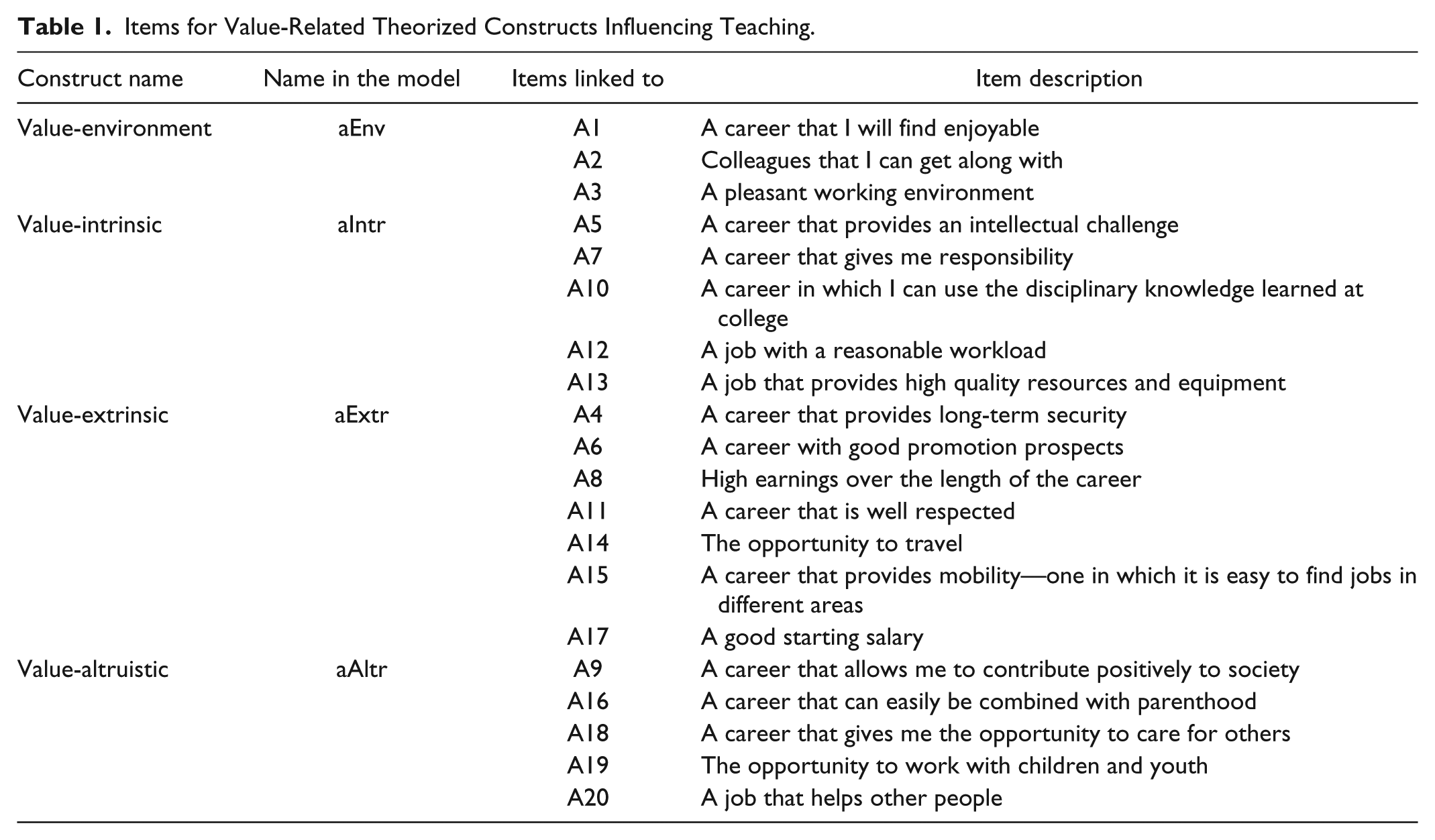
The value section (Section A) asks questions on items that are valued in a general career of their choice. The respondents were guided by the following prompt as they filled out the value section of the survey: “What factors are important to you when considering your own future career?” Using EFA, items such as “A career that I will find enjoyable,” “Colleagues that I can get along with,” and “A pleasant working environment” were found to be aligned along a construct. As these were something to do with an environment, we have named the corresponding construct as value-environment (aEnv). The items “A career that provides intellectual challenge,” “A career which gives me responsibility,” “A career in which I can use the disciplinary knowledge learned at college,” “A job with a reasonable workload,” and “A job that provides high quality resources and equipment” relate inherently to the job itself and are considered intrinsically motivated items that we named as value-intrinsic (aIntr). Items “A career that provides long-term security,” “A career with good promotional prospects,” “High earnings over the length of career,” “A career that’s well respected,” “A career that provides opportunity to travel,” “A career that provides mobility,” and “A career with good starting salary” relate to the aspects of the job that are not inherent in the work itself, are considered incentive-based or extrinsically motivated items, and were named value-extrinsic (aExtr). Finally, the items “A career that allows me to contribute positively to society,” “A career that can easily be combined with parenthood,” “The opportunity to work with children and youth,” “A career that gives me the opportunity to care for others,” and “A job that helps other people” relate to a career where one could help and care for youths, society, and others, and were considered altruistic and named value-altruistic (aAltr). A concise description of items and their associated constructs with short names are given in Table 1.
Items for Value-Related Theorized Constructs Influencing Teaching.
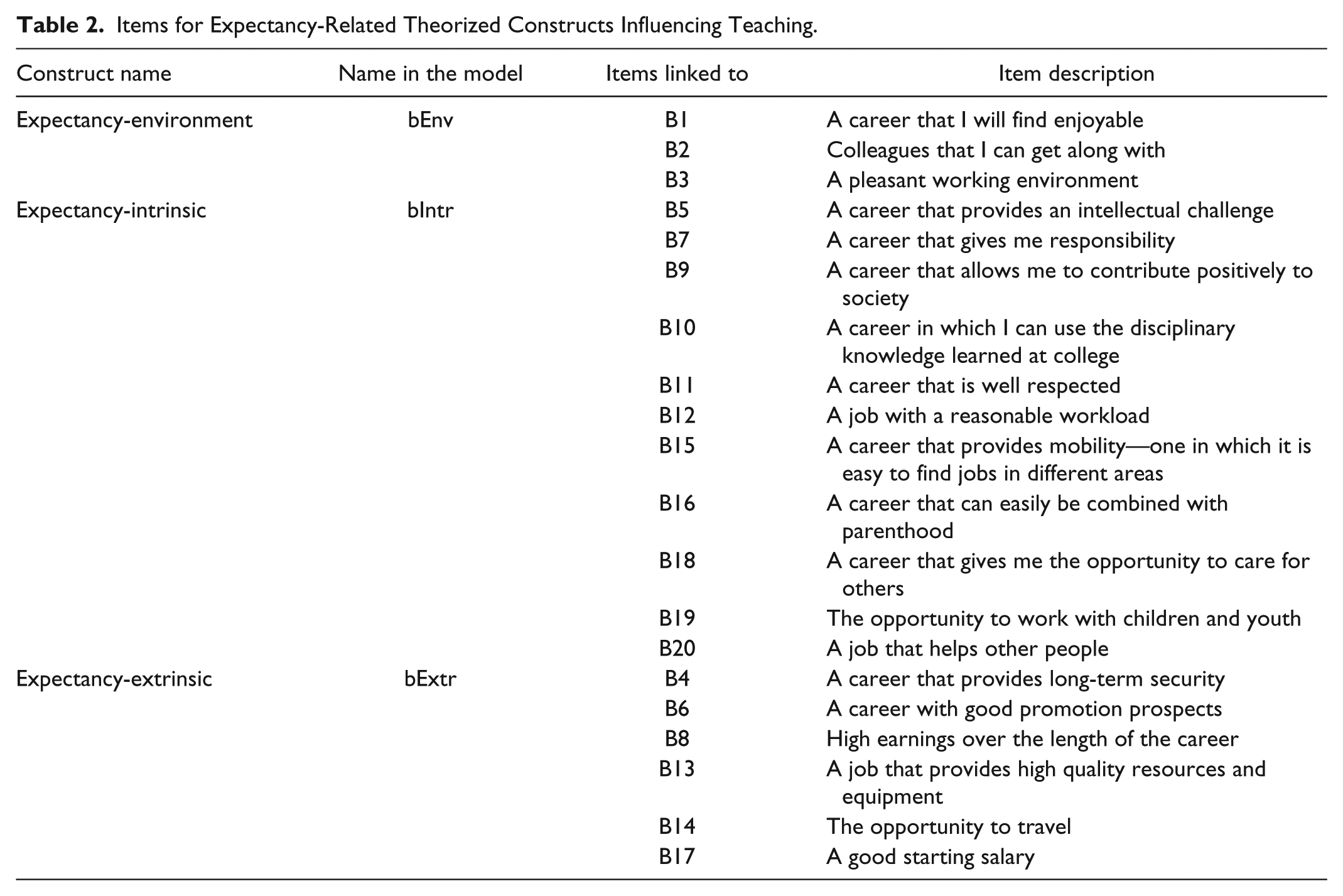
In the expectancy section (Section B), the students were asked to rate their expectation that teaching would provide the same list of factors given in the value section (Section A). The respondents were prompted by the question, “To what extent do you think a career in teaching would offer each of the following factors?” Using the EFA techniques, we found that items in this section were aligned along three constructs (instead of four as in the value section). The items “A career that I will find enjoyable,” “Colleagues that I can get along with,” and “A pleasant working environment” were also found to be aligned with a construct that was related to the environment and was named expectancy-environment (bEnv). As a career in teaching inherently deals with helping children and youth, and positively contributing to the society, we saw that the items “A career that provides intellectual challenge,” “A career which gives me responsibility,” “A career in which I can use the disciplinary knowledge learned at college,” “A career that’s well respected,” “A job with a reasonable workload,” “A career that provides mobility,” “A career that allows me to contribute positively to society,” “A career that can easily be combined with parenthood,” “The opportunity to work with children and youth,” “A career that gives me the opportunity to care for others,” and “A job that helps other people” were found to be aligned along a single construct. These items relate to the teaching job itself, are intrinsically motivated, and were named expectancy-intrinsic (bIntr). The third set of items, “A career that provides long-term security,” “A career with good promotional prospects,” “High earnings over the length of career,” “A career that provides high quality resources and equipment,” “A career that provides opportunity to travel,” and “A career with good starting salary,” are associated with the aspects of a job that are not inherent in the work itself and are considered incentive based or extrinsically motivated items. The construct along which these items were aligned was named expectancy-extrinsic (bExtr). A concise description of items in this section, their associated constructs, and their short names are given in Table 2.
Items for Expectancy-Related Theorized Constructs Influencing Teaching.
Finally, the social-influence section (Section D) is guided by the question, “How might the following factors influence your decision to become a teacher?” Using the EFA techniques, we identified three constructs that were found to be prominent. The items “The salaries teachers earn,” “The social status of teachers,” “What I know and have heard about schools,” “Dealing with disruptive students,” and “Media report on education” relate to media information on education and its people. We named this construct social-media-education (dMedia). The items “Desire to share knowledge with others,” “Previous experiences I’ve had teaching others,” “The talent I’ve for working effectively with others,” and “Teachers I’ve known” relate to prior teaching experience and desire to share with others effectively. The associated construct was named social-prior-experience (dPrior). The two items “What friends suggest I should do” and “What parent suggest I should do” relate to suggestions from friends and family. We called this construct social-suggestions (dSugg). A concise description of items in this section, their associated constructs, and their short names are given in Table 3.
Items for Social-Influence Theorized Constructs Influencing Teaching.

Definition of the Constructs
Thus, we have a total of 10 exogenous constructs that are defined as follows:
Value-environment: construct measured by environmental items that the students value highly in their career of choice.
Value-intrinsic: construct measured by intrinsically motivated items that the students value highly in their career of choice.
Value-extrinsic: construct measured by extrinsically motivated items that the students value highly in their career of choice.
Value-altruistic: construct measured by altruistically motivated items that the students value highly in their career of choice.
Expectancy-environment: construct measured by environment items that the students expect career in teaching will provide.
Expectancy-intrinsic: construct measured by intrinsically motivated items that the students expect career in teaching will provide.
Expectancy-extrinsic: construct measured by extrinsically motivated items that the students expect career in teaching will provide.
Social-media-education: construct measured by media on education items that students get through social and media influence.
Social-prior-experience: construct measured by items related to prior experience of students.
Social-suggestions: construct measured by items suggested by friends and parents.
The Research Question
Our present study attempts to answer the following research question:
We used SEM, a multivariate technique, to represent a model that incorporates the above mentioned relationships among the 11 variables: likelihood of choosing a career in teaching, the outcome variable, and the 10 exogenous constructs (value-environment, value-intrinsic, value-extrinsic, value-altruistic, expectancy-environment, expectancy-intrinsic, expectancy-extrinsic, social-media-education, social-prior-experience, and social-suggestions). Whereas multiple regressions measure only the direct relationship between the dependent and independent observed variables while controlling other variables, SEM examines simultaneous interaction among observed and latent variables under study. The SEM research model for our study is shown in Figure 1. To keep the figure simple, covariances among the exogenous constructs were not shown.

Structural equation model for the likelihood of choosing a career in teaching.
Method
Procedure and Participants
The survey was made available to more than 1,300 students who were enrolled in 13 undergraduate courses at a medium sized university at an upper Midwestern state of the United States. The survey instrument was adapted from a survey developed by Kyriacou and Coulthard (2000). Course instructors announced the survey to students and encouraged them to take part. The survey was administered using an online survey website and was available for approximately 2 months. There were 458 respondents, with 3 missing data cases resulting in 455 complete cases. With permission, we utilized the above survey data for our analysis.
There were 62% male respondents and 38% female respondents to this survey. The majority of the respondents were younger undergraduates, with 72% in the 18- to 20-year-old category, 21% in the ages of 21 to 24, and the remaining 7% were 25 years of age or older. The class ranks of the respondents were as follows: 48% were freshman, 27% sophomores, 18% juniors, 6% seniors, and 1% graduate students. Respondents were predominately White or European American with 91% of total, 1.13% African American, 1.8% Native American, 1.3% Asian or Pacific Islander, 0.9% Latino, and 0.68% multiracial. Finally, the respondents were asked to state their majors they are pursuing. The respondents were 56% from life sciences, 5% from physical sciences, 6% from mathematics, 8% from engineering, and 22% had their majors undeclared.
Measures
As mentioned in the introduction, the respondents provided their response to a multiple-item survey instrument with 20 items in the value section, 20 items in the expectancy section, 12 items in social-influence section, and 1 item in the likelihood of choosing a teaching career section. The value, expectancy, and social-influence items and their corresponding constructs we developed through EFA were given in Tables 1, 2, and 3, respectively. For the initial model, we hypothesize that the constructs measured by their items are distinct in the sense that each construct has its own set of items or indicator variables (i.e., unidimensional).
The responses to the value and expectancy sections were captured by a rating scale with numeric values in the domain (1 = completely unimportant, 2 = somewhat unimportant, 3 = somewhat important, and 4 = very important), whereas responses to the questions for social influence are again ordinal ones and are in the domain (1 = discouraging me from becoming a teacher, 2= no effect, and 3 = encouraging to become a teacher). Finally, responses to likelihood of choosing a teaching career section are captured as ordinal values of 1, 2, 3, and 4 corresponding to “very unlikely,” “unlikely,” “somewhat likely,” and “very likely,” respectively.
Results
Descriptive Statistics
The descriptive statistics of our data show that the standardized kurtosis index of all 53 variables except the indicator variable A1 are within the range of ±3.68, whereas standardized kurtosis index of A1 is 23.56. According to Kline (2011), the absolute kurtosis values greater than 10 suggest a problem, and values more than 20 could possess serious problem. The absolute skew indices of all our variables except A1 are found to be within 2.00, which indicate these variables may be skewed but not extremely skewed. However, skew index of A1 is found to be −4.27, which is beyond the recommended absolute value of 3.00 and could be cause of concern as the multivariate normality assumption among the indicator variables is violated and not handled properly (Kline, 2011).
Test of the Structural Equation Model
We tested both the measurement model and the structural model in a single step with lavaan package (Rosseel, 2012) version (05-15) in R (R Development Core Team, 2013). Although lavaan provides two default estimators for handling ordinal data (when multivariate normality assumption is violated)—the diagonally weighted least square (DWLS) estimator and the robust mean and variance adjusted weighted least square (WLSMV) estimator—we will only report the results of the WLSMV estimator as it is robust and reported to be better than the DWLS estimator.
We have used the absolute fit index (χ2) and approximate fit indices to assess our models. As the χ2 fit index is sensitive to sample size, Hair, Black, Babin, and Anderson (2010) suggested the use of the ratio of χ2 to its degrees of freedom (χ2/df) with a ratio of 3.0 or less to be an indicator of acceptable fit. Approximate fit indices include root mean square error of approximation (RMSEA) index, which is a standalone, badness of fit index (lower the better) that takes complexity of the model into account. Second, Bentler’s comparative fit index (CFI) and Tucker–Lewis index (TLI) are goodness of fit indices (higher the better) that compare a model with its baseline model.
The Initial Model
The initial model consisting of unidimensional constructs, value-environment, value-intrinsic, value-extrinsic, value-altruistic, expectancy-environment, expectancy-intrinsic, expectancy-extrinsic, social-media-education, social-prior-experience, social-suggestions, and their corresponding indicators are given in Tables 1, 2, and 3. Table 4 gives the results of the test with 455 observations, 53 indicator variables, and the recommended level of acceptable fit (Hair et al., 2010).
Fit Indices for the Initial Research Model.

Note. WLSMV = robust mean and variance adjusted weighted least square; CFI = comparative fit index; TLI = Tucker–Lewis index; RMSEA = root mean square error of approximation; CI = confidence interval.
p< .001.
It is seen that the WLSMV estimator reported χ2 value of 3,288.105 with 1,271 degrees of freedom. The CFI has a value of 0.882 and RMSEA a value of 0.059. As the CFI index is below 0.90, it indicates that the model is not a good fit and needs to be improved.
The Revised Model
So far, we have focused on the indicator variables that only link with a single factor. However, various operationalizations of intrinsic, extrinsic, and altruistic motivations have resulted in a lack of definitional precision and overlapping categorizations (Watt & Richardson, 2007). For example, B5: “A career that provides an intellectual challenge,” which could be considered a form of intrinsic motivation could also be referred to as a form of extrinsic motivation. Thus, a cross-loading link has been established so that the indicator B5 also measures the bExtr construct. Similarly, other indicators, “A career that provides mobility” (B15), “A career that’s well respected” (B11), and “A career with a reasonable workload” (B12), are allowed to measure the expectancy-extrinsic motivational construct as these factors are not needed in doing the teaching job itself. Moreover, “A career that provides long-term security” (B4) is cross-loaded to the expectancy-environment construct as having a secured job adds pleasantness to the overall environment. In this revised model, we have added a total of seven cross-loadings that have the largest modification indices and those that theoretically make sense. To keep the parsimony of the resulting model, we have minimized this ad hoc exploratory phase until we got acceptable CFI and TLI indices greater than 0.90. The detailed list of constructs, their corresponding measures, and the added cross-loadings are given in Table 5. Finally, the model fit indices of this refined model are given in Table 6.
Constructs and Their Indicators in the Revised Model.

Fit Indices for the Revised Model.

Note. WLSMV = robust mean and variance adjusted weighted least square; CFI = comparative fit index; TLI = Tucker–Lewis index; RMSEA = root mean square error of approximation; CI = confidence interval.
p< .001.
Looking at the absolute fit indices of the model, we see that WLSMV estimator reported a χ2 value of 2,663.956 with 1,264 degrees of freedom, χ2/df is 2.108 (<3.0). The approximate fit indices give a CFI value of 0.918 (>0.9), a RMSEA value of 0.049, with a 90% confidence interval of [0.047, 0.052], and the p value for RMSEA ≤ 0.05 is 0.658 indicating that the model fit is acceptable for sample size of 455 and 53 indicators (Hair et al., 2010). Performing a chi-square difference of test between the intermediate model and the final model gives a χ2 difference of 624.948 with 7 degrees of freedom and a p value < .001. All these results indicate a positive support for our revised model.
We found that all factor loadings were significant at p< .001. The measures of the indicator variables linked with the constructs, their mean, standard deviation, and the reliability coefficients are given in Table 7. It is seen that the reliability coefficients (the Cronbach’s α) ranged from a low of .71 to a high of .92 (.7 or higher is better) giving confidence in the overall internal consistency or the degree to which responses are consistent across the items within a measure (Kline, 2011).
Mean, Standard Deviation, and Reliability Coefficient of Measures.

Table 8 presents the correlation coefficients among the constructs used in the study. We found that all pair-wise correlations of the constructs are significant at p < .001. The highest correlation coefficients are found to be between aIntr and aExtr (0.769), which is much less than the recommended range <.90 (Kline, 2011), giving confidence in the discriminant validity of the model.
Correlation Coefficients of Constructs.

Testing the hypothesis
It is also seen that in addition to the statistical significance of factor loadings in the measurement equation, the cross-factor loadings are also significant. The regression coefficients (of the structural part) that we are interested in, for statistical inferences, are given in Table 9. It is seen that the regression coefficients for bEnv, bIntr, dMedia, dPrior, and dSugg are highly significant each with a p value of ≤ .003. The positive path coefficients of bEnv, dPrior, and dSugg to C1 suggest that the students who are yet to choose a career and expect teaching would provide the factors that they value highly are likely to choose a teaching career due to a pleasant career, pleasant environment, colleagues they will get along with, a career that provides long-term security, prior experience teaching, and influence from friends and parents.
Structural Part Regression Coefficient Estimates.

Second, the regression coefficients for aEnv, aIntr, aExtr, and aAltr are all non-significant at the 5% level with p values of .189, .155, .486, and .535, respectively, implying value-related factors have no influence in choosing a career in teaching. The path coefficient from the bExtr construct to C1 is also found to be non-significant at the 5% level with a p value of .804 indicating no impact of extrinsically motivated factors (in the overall model) for choosing a career in teaching.
Third, the negative path coefficient in dMedia suggests that respondents are discouraged by the information from the media about teachers’ low salary (hence low social status) and dealing with disruptive students and are less likely to choose a teaching career. The negative path coefficient in bIntr suggests that intrinsically motivated students who expect teaching would provide their valued career factors are less likely to choose a career in teaching. This may be due to the fact that the participants may not be looking for a teaching career with intellectual challenge, with responsibility, and with opportunities to contribute positively to the society and helping youths and other people if the environment in which they work is perceived to be unpleasant.
Discussion
A four-section survey instrument was utilized to better understand how undergraduate students in a Midwestern university perceive a career in teaching. The sections contain items corresponding to what factors they value in a career, whether they expect teaching to provide those factors, how social-influence factors influence their perceptions of a teaching career, and the respondents’ likelihood of choosing a teaching career.
We used EFA techniques to identify and categorize the items along 10 constructs. There were four constructs in the value section, which were related to environment, intrinsic motivation, extrinsic motivation, and altruistic motivation. In the expectancy section, which deals with teaching as a career in context, three constructs were found to be sufficient and were related to environment, intrinsic motivation, and extrinsic motivation. Finally, in the social-influence section, three constructs were identified and were related to media on education, prior teaching experience, and influence from friends and family. Our objective of the study was to examine the effect of value-environment, value-intrinsic, value-extrinsic, value-altruistic, expectancy-environment, expectancy-intrinsic, expectancy-extrinsic, social-media-education, social-prior-experience, and social-suggestions on the likelihood of choosing a career in teaching.
We have used SEM to do our analysis. Because of extreme kurtosis and skewness in one of the indicators (A1), we treated the data as ordinal (the way they were collected using survey) as the multivariate normality assumption among the indicators was violated. We have started with an initial model with each indicator loading only on one construct. The resulting output gives a CFI value of 0.882 and a RMSEA value of 0.059. For a sample size of 455 and 53 indicator variables, the recommended CFI value is ≥0.90 and recommended RMSEA value is ≤0.07 (provided CFI ≥ 0.9; Hair et al., 2010). As our CFI index value is slightly lower than the recommended value of 0.90, we needed to improve the model to see any theoretically justified respecification can be made using modification indices.
Using highest modification indices that are theoretically justified, we have included cross-loadings of seven indicators that helped to improve the model fit. For example, items “A career that provides intellectual challenge” (B5), “A career that provides mobility” (B15), “A career that’s well respected” (B11), and “A career with a reasonable workload” (B12) are allowed to measure expectancy-extrinsic motivational construct as these factors not needed in doing the teaching job itself. Similarly, “A career that provides long-term security” (B4) is cross-loaded to expectancy-environment construct, as having a secured job adds pleasantness to the overall environment.
The revised model gives a χ2 value of 2,663.956 with 1,264 degrees of freedom, χ2/df as 2.108 (<3.0), CFI value of 0.918, and a RMSEA value of 0.049, which are enough to meet the requirement for an acceptable model. All factor loadings were found to be significant and the maximum correlation coefficient between two constructs is found to be 0.769 giving confidence in the discriminant validity. The reliability coefficients (Cronbach’s α) of the exogenous constructs of the final model were found to be from a low of .71 to high .92 giving confidence in the overall internal consistency (Kline, 2011) of the model.
A critical question in SEM involves how large a sample is needed to produce trustworthy results and opinion varies on this. Typical rules of thumb include but are not limited to (a) N≥ 200, (b) N/p≥ 10 (Myers, Ahn, & Jin, 2010), where N is the sample size and p is the number of indicator variables. Thus, the first condition N≥ 200 is satisfied, which is the minimum size needed for any SEM model. With p = 53, we have N/p = 8.58, which is slightly lower than the value of 10 needed. Research also shows that required sample size is affected if the multivariate normality of data is violated, by the estimation technique used, and by the model complexity and average error variance among the reflective indicators (Hair et al., 2010). For our case, we have used robust WLSMV estimator, which is found to perform very well (Myers et al., 2010) for ordinal data (i.e., where multivariate normality is violated). Even if we have a complex model with 260 parameters to be estimated, the average error variance among reflective indicators or the convergent validity is found to be satisfactory, the maximum correlation coefficient among the constructs is found to be 0.769 (<0.90), which solidifies the discriminant validity, and the Cronbach’s alpha (reliability) for constructs has values from .71 to .92 (.7 or above is better) asserting the internal consistency of the model. Finally, as the model fit is found to be satisfactory and has met all recommended fit indices range with few theoretically justified cross-loading additions to our original proposed model, we could undoubtedly conclude our findings that for students who are yet to choose a career, the expectation of teaching offering a pleasant environment and the social influences play a prominent role in choosing a teaching career.
Implications for Recruitment
Our results show that respondents’ highly valued career factors had little relationship to their likelihood of teaching. Rather, students’ expectations of teaching and the influence of a variety of related previous experiences were the strongest predictors of increased likelihood of considering teaching as a career option. The highest positive (0.895) and significant regression path coefficient from expectancy-environment to likelihood of teaching indicates that an understanding of the teaching environment, including the items “Colleagues that I can get along with,” “A career that I find enjoyable,” and “A pleasant working environment,”, plays an important role in choosing a career in teaching. This agrees with the findings of Kyriacou and Coulthard (2000) who did not use SEMs for their study. Our results indicate that students must be confident that the working environment of schools, including other faculty and staff with whom they work, will provide a positive and collegial atmosphere, which they will enjoy. Prior experiences such as having taught others, a self-perceived talent for working with others, teachers whom they have known, and a desire to share their knowledge with others contribute to students’ openness to teaching. In addition, the positive support of parents and friends has a positive influence on students’ likelihood of considering teaching as a career.
Second, the statistically significant but negative regression path coefficient for the expectancy-intrinsic construct suggests that those who are less likely to choose a career in teaching are less likely to choose a career based on their intrinsic motivations and more likely to be guided by their expectations of extrinsic factors. One possible explanation is that students have low expectations of teaching to provide factors such as an intellectual challenge, professional responsibility, a reasonable workload, professional respect and career mobility, the ability to make positive contributions to society, the opportunity to utilize disciplinary knowledge, and the opportunity to care for others, to help others, and to work with children and youth, and to be a career that combines easily with parenthood. These are the kinds of career attributes that need to be addressed in a recruitment program so that students have accurate expectations of a career in teaching. It is possible that respondents to this survey viewed teachers as classroom technicians with little ability to exercise personal expertise and choice in working to bring about change in the lives of students.
Media reports on education have a negative impact on students’ likelihood to consider teaching. Students are discouraged by the social status of teachers, what they have heard about schools, and media reports on education. Students need a strong understanding of financial aspects of teaching such as teachers’ salaries and the amount of funding schools receive. Although teacher educators may feel somewhat helpless in rectifying broader societal issues, we feel it is important that these concerns be discussed openly and frankly with potential recruits. Finally, the idea of dealing with disruptive students has a negative influence on students’ likelihood of teaching. Recruitment programs could educate students about characteristics of teachers who effectively maintain classroom discipline so potential recruits understand that teachers can be proactive and effective in maintaining good class control.
The findings suggest that a good recruitment program will educate potential teachers about the career so they know what to expect and can make an informed choice as to whether teaching will be a fulfilling career. Potential teachers benefit from the opportunity to experience teaching situations to see whether they enjoy working with others in a teaching capacity. A recruitment program could provide interested students with these opportunities through such activities as volunteering in local school classrooms, working with children in after-school programs, or tutoring younger students who are struggling in their studies. Such opportunities would provide possible recruits to experience teaching to better discern whether the profession is one they would enjoy.
This study is limited in that results are drawn from data that are captured from students taking courses during a single semester in a single Midwestern university in the United States and does not include students’ gender or race. Another limitation is that given a response rate of 35% (458 out of 1,300) for this online survey, one must consider the possibility of self-selection. It should also be noted that arts and humanities students were underrepresented in the sample while natural sciences students were overrepresented. Finally, our target population for the survey was first- and second-year undergraduates as we believe this age group to contain a higher percentage of students still uncommitted to any career. We were successful at getting responses largely from this younger demographic, but we need to recognize that responses from older students and undergraduates further along in their studies may be different. Future research could include more representative samples from different regions of the United States and compare the factors that influence a career in teaching with respect to students’ gender, race, socio-economic status, region, and how perceptions vary among those who do intend to teach. Second, longitudinal studies could be designed to examine how change in students’ perceptions of teaching change over time.
Footnotes
Acknowledgements
The authors acknowledge Dr. Yves Rosseel, author of R-package lavaan for his valuable suggestions.
Declaration of Conflicting Interests
The author(s) declared no potential conflicts of interest with respect to the research, authorship, and/or publication of this article.
Funding
The author(s) received no financial support for the research and/or authorship of this article.