




Abstract
Owing to the cardinal and acknowledged importance of autonomy (AU) in learning, especially second-language learning, and influenced by the importance of inspecting its nature and the way it is associated with other psychological/cognitive/metacognitive factors, this research investigated the relationship among English as a foreign language (EFL) learners’ AU, creativity (CR), and critical thinking (CT). The population for this study comprised of undergraduate EFL learners, between the ages of 19 and 40 (Mage = 22 years), from which 182 male and female subjects were selected via random selection. These participants, who were receiving formal instruction mainly through English, filled out three questionnaires related to CR, CT, and AU. Pearson’s product–moment correlation coefficient was used to analyze the data obtained. The results indicated that there is a significant and positive relationship between EFL learners’ CR and AU, CR and CT, as well as their CT and AU. Considering AU as the predicted variable for this study, it was confirmed that CT makes the strongest unique contribution to explain AU. It is hoped that the results of this study will reveal the nature of AU more and will equip EFL teachers with a wider perspective on the characteristics of AU and the way CR and CT can predict and promote AU among EFL learners.
The psychological needs, mental factors, and personal peculiarities of learners are proven to be of paramount importance when we seek to develop a reliable and well-informed theory of teaching and achieve the crème de la crème out of the classroom practice (Lightbown & Spada, 2006). According to Ryan and Deci (2000, 2002), a psychological need is an inherent source of motivation for learners that generates a proactive desire to interact with the environment to advance one’s personal growth, social development, and psychological well-being. The three psychological needs central to learners are autonomy (AU), competence, and relatedness (Deci, Vallerand, Pelletier, & Ryan, 1991). Learners need to feel autonomous, competent, and related to others to grow, to make progress, and to be, by and large, well (O’Donnell, Reeve, & Smith, 2012).
AU is the psychological need to experience self-direction in the initiation and regulation of one’s behavior (Deci & Ryan, 1985). Current English as a foreign language (EFL) pedagogical trends seem to primarily focus on a student-centered methodology in which learner AU is given a great value (Akbari, 2008; Bell, 2003; Benson, 2003). This is to say that EFL learners are now given a meaningful role in pedagogic decision making by being treated as active and autonomous players (Kumaravadivelu, 2008, 2012). Accordingly, language learners are becoming the focus of curricula design (Nation & Macalister, 2010), and researchers are recognizing the significant role of learner AU in their teaching (Bell, 2003; Benson, 2003; O’Donnell et al., 2012).
AU, according to Scharle and Szabó (2000), is the freedom and ability to manage one’s own affairs, which entails the right to make decisions as well. An autonomous person, according to Paul and Elder (2008), is not dependent on others for the direction and control of one’s thinking. They assert that it is the self-authorship on one’s beliefs, values, and ways of thinking. The basis of learner AU, according to Chang (2007), is that learner accepts responsibility for his or her learning. Little (1995) argues that the pursuit of AU in a formal educational context is a matter of both learning and learning how to learn.
A very obvious reason for promoting learner AU is that teacher may not always be available for guiding or instructing. Therefore, according to Nation and Macalister (2010), AU proffers learners the capability to know “how to learn a language and how to monitor and be aware of their learning, so that they can become effective and independent language learners” (p. 38). There is an intimate relationship between AU and effective learning. In other words, the development of AU implies better language learning (Benson, 2001). The explicit recognition of AU as an important and highly influential mental attribute in the process of learning a new language gives ample justification for investigating the way it is related to the other mental and personal factors and the way it can be enriched directly or indirectly (Nosratinia & Zaker, 2013a, 2013b).
AU requires support from environmental conditions, and the key source of support for learners’ AU in the classroom is the teacher (O’Donnell et al., 2012). It is believed that when EFL teachers are AU supportive toward learners, it would directly affect the degree of AU among learners (Chan, 2001). However, to develop the sense of AU among learners, teachers need to have a broader perspective on the process of learning and the affecting factors which directly or indirectly affect the process of learning, AU in learning, and target language competence (Bell, 2003; Kumaravadivelu, 2012; Lightbown & Spada, 2006; Little, 1991). Therefore, any attempt to establish AU enhancing techniques and to know the nature of AU seems to be perfectly justified. In this regard, discovering the relationship between AU and other psychological/cognitive/metacognitive factors not only reveals the nature of AU more but also equips EFL teachers with a higher degree of knowledge and a wider perspective regarding the characteristics of learners and the way they will better progress in their learning.
The main purpose of the present study was to investigate the way AU is related to creativity (CR) and critical thinking (CT) among EFL learners. CR and CT are not only among the hot topics in the teaching English as a foreign language (TEFL) profession, but they are also widely acknowledged to be among the metacognitive factors, which substantially affect, influence, and shape the process of learning English as a second/foreign language (Connolly, 2000; Kabilan, 2000; Sarsani, 2006). The above-mentioned premise is in line with Kabilan’s (2000) statement where he argues that for learners to become proficient in a language, they clearly need to employ creative and critical thinking through the target language. Therefore, inspecting the relationship among AU, CT, and CR seems justified, indispensable, essential, and promising toward the elevation and advancement of classroom practice and teacher education.
Socrates began the tradition of CT by reflectively questioning common beliefs and expectations, and separating beliefs that are reasonable and logical from those that lack evidence or rational foundation (Zireva & Letseka, 2013). According to Kress (1985), CT is a social practice and is language itself. CT, as a high level of cognitive function, “is a purposeful, self-regulatory judgement which results in interpretation, analysis evaluation, and inference, as well as explanations of evidential, conceptual, methodological or contextual considerations upon which the judgement is based” (Astleitner, 2002, p. 53). Willingham (2008) argues that CT makes it possible to look at issues from different perspectives. Educators have also argued for the importance of promoting higher order thinking skills in English as a second language (ESL) and EFL classrooms (Chamot, 1995; Tarvin & Al-Arishi, 1991), and empirical evidence supports the effectiveness of teaching CT skills along with learning and teaching English as a second or foreign language (Chapple & Curtis, 2000).
CR is another metacognitive trait which can be justifiably included in the category of learning affecting elements (Mishan, 2005). As Pink has stated (as cited in Rao & Prasad, 2009), humankind is “entering a new age where creative thinking is becoming increasingly important” (p. 31). Thanks to the outstanding attempts made by Guilford and Torrance, the field of CR has developed as it is widely known today (Sternberg, 2009). In the modern world, CR is fundamentally important in all aspects of life, and as CR is complex in nature, different viewpoints have been put forward to explain the concept emphasizing its different aspects (Sarsani, 2006). As stated by T. I. Lubart (1999), CR is generally characterized as the ability to create new and original products which are considered appropriate for the features and limitations of a given task, where products can refer to a variety of ideas, viewpoints, and innovations. T. Lubart and Guignard (2004) believe that these products must be original because they cannot be just a mere copy of what already exists.
Humans are all born with a huge potential for CR and learning in varying degrees, and CR can be nurtured “at all ages and in all fields of human endeavor” (Sarsani, 2005, p. 47). To this end, developing CR at all levels in the education system is increasingly recognized as being critical in improving educational attainment and life skills (Agarwal, 1992). Second/foreign language teaching of course is one such educational attainment and arguably a life skill. Moreover, in the words of Carter (2004), “Discussions of creativity in relation to language teaching and learning have been extensive and continue to be a very major point of application of a wide range of theories of creativity” (p. 213).
According to Sarsani (2005), “Philosophy sees creativity as a process of change” (p. 132). Education must thus “enable people to generate and implement new ideas and to adapt positively to different changes in order to survive in the current world” (Jeffrey & Craft, 2001, p. ix). In all actuality, “Creativity is an inherent aspect of all pedagogical tasks” (Mishan, 2005, p. 83). Therefore, it seems to be quite reasonable to state that the TEFL/TESOL (teaching English to speakers of other languages) practice and its product which is second-language (L2) proficiency can be highly influenced by CR (Fahim & Zaker, 2014).
The put forward premises give ample justification for witnessing a growing body of research in our field that aims at conducting further investigation into the nature of CR, CT, and AU and the way they promote learning a new language. However, the question that is raised here is whether CR, CT, and AU are associated to each other and if so, to what extent. This issue intrigued the researchers of this study to investigate the relationship among EFL learners’ CR, CT, and AU. To fulfill this objective, the following research questions were proposed:
Assuming a significant relationship among the three variables, the following research question was posed:
Method
Participants
The participants in this research consisted of undergraduate EFL learners majoring in English translation and English literature at the Islamic Azad University, Central Tehran and Roudehen branches. In these full-time undergraduate courses, English is the main medium of instruction; however, occasional use of learners’ first language (L1; Persian) is allowed. This point is based on the fact that the initial level of English language proficiency among these undergraduate students is assumed to be intermediate to upper-intermediate, as tested by the university entrance examinations in Iran. From the above-mentioned population, 182 male and female EFL learners (134 females, 74%, and 48 males, 26%), between the ages of 19 and 40 (Mage = 22 years), were selected via cluster random sampling. There is no age limit for enrolling in these undergraduate courses; therefore, it was observed that a limited number of participants (n = 3) were fairly older than the rest of the participants.
Instruments
Three instruments utilized to collect data pertaining to the subjects’ levels of CR, CT, and AU were as follows:
A questionnaire of AU by Spratt, Humphreys, and Chan (2002);
A questionnaire of CR created by O’Neil, Abedi, and Spielberger (1992); and
A questionnaire of CT developed by Honey (2000).
Learner AU Questionnaire
To evaluate participants’ level of AU, a questionnaire of AU including 52 items was administered. The questionnaire though designed by Spratt et al. (2002), is strongly influenced by Holec’s (1981) definition of AU. Holec defines AU as “the ability to take charge of one’s own learning and where to take charge of one’s learning is to hold the responsibility for all the decisions concerning all aspects of this learning”(as cited in Spratt et al., 2002, p. 249).
Holec, according to Spratt et al. (2002), argues that ability and responsibility are functioning in five principal areas: “determining objectives; defining contents and progressions; selecting methods and techniques to be used; monitoring the procedure of acquisition; and evaluating what has happened” (p. 249). All these notions of ability and responsibility are incorporated in the questionnaire.
The questionnaire has four sections. The first section (13 items) focuses on examining students’ views of their responsibilities and those of their teachers. The second section (11 items) evaluates participants’ confidence in their ability to operate autonomously. The third section (1 item) aims to measure the levels of student motivation to learn English. The fourth section (27 items) investigates students’ practice of autonomous learning in the form of both inside and outside class activities.
Respondents were asked to indicate their answers in 20 min in a Likert-type scale, sequentially assigning values 1, 2, 3, 4, and 5 to options not at all, a little, some, mainly, and completely in Section 1. Counting 1 for “very poor” to 5 for “very good” in Section 2. Setting 5 to 1 beside the first to the last choices in Section 3; and attributing values of 1, 2, 3, and 4 to options of “never,” “rarely,” “sometimes,” and “often” in Section 4. In this regard, the result can vary from 52 to 233. It is self-evident that the higher the mark, the more autonomous the participant is.
In this study, the Persian version of this questionnaire that was translated and validated by Fahim and Sheikhy (2011) was employed to make sure the participants fully comprehended it. The reliability of AU questionnaire was estimated to be .84 using Cronbach’s alpha coefficient, which demonstrated a good degree of reliability.
CR Questionnaire
This questionnaire was originally designed by O’Neil et al. (1992) and is called the Abedi–Schumacher Creativity Test or the ACT (as cited in Cropley, 2000). According to Abedi (2002), the estimated correlation coefficient between the four subscales of the ACT and the Torrance Test of Creative Thinking (TTCT) was meaningful at .01 level of significance. Therefore, the concurrent validity of ACT was established. It is worth noting that the TTCT is one of the best known tests of CR, which consists of two sections: verbal and nonverbal or figural sections. In fact, the development of the ACT was an attempt to shorten the time needed for the administration and scoring of the TTCT. The estimated reliability of each of the subscales of the ACT was .61 to .75, which demonstrated that the test is also reliable (Auzmendi, Villa, & Abedi, 1996).
In this study, the Persian version of this questionnaire, developed and validated by Zaker (2013) based on the original test, was utilized. Zaker provides the following sections to assess and appraise the validity of the instrument: a report on content validity, checking the criterion-related validity, an analysis of the internal structure of the instrument using exploratory and confirmatory factor analyses, and a report on the reliability of the instrument including 50 items. The 50 multiple-choice items of this test have three options ranging from least to most creative responses with a range of scores between 0 and 2; therefore, the scores of the test could range from 0 to 100, and the participants are allocated 50 min to respond to the questionnaire. In this study, the internal consistency of this test was estimated to be .87 using Cronbach’s alpha coefficient.
CT Questionnaire
The CT questionnaire intends to explore what a person might or might not do when thinking critically about a subject. Developed by Honey (2000), the questionnaire aims at evaluating the three main skills of comprehension, analysis, and evaluation of the participants. This questionnaire is a Likert-type questionnaire with 30 items, which allows researchers to investigate learners’ ability in note-taking, summarizing, questioning, paraphrasing, researching, inferencing, discussing, classifying and outlining, comparing and contrasting, distinguishing, synthesizing, inductive and deductive reasoning.
The participants were asked to rate the frequency of each category they use on a 5-point Likert-type scale, ranging from never (1 point), seldom (2 points), sometimes (3 points), often (4 points), to always (5 points). The participants’ final scores are calculated by adding up the numbers of the scores. The ultimate score is computed in the possible range of 30 to150. The participants were allocated 20 min to complete the questionnaire.
In this study, the Persian version of this questionnaire was employed, which was translated and validated by Naeini (2005). In a study conducted by Nosratinia and Abbasi (2013) on EFL learners, the reliability of this questionnaire was estimated to be .79 using Cronbach’s alpha coefficient. In this study, the reliability of CT questionnaire was estimated to be .81 using Cronbach’s alpha coefficient, which demonstrated a fair degree of reliability.
Procedure
In descriptive research, the procedures should be described as accurately and completely as possible, so that the replication of research by other researchers would become possible (Best & Kahn, 2006). To achieve the purpose of this study and address the questions posed, certain procedures were pursued which are explained below.
After obtaining a formal approval for conducting the research in the universities mentioned above (see participants), for every session of administration, three available classes were codified. Next, one class was chosen randomly and the other two classes were excluded from the study. This procedure resulted in having samples selected on a cluster sampling basis, which according to Springer (2010) and Best and Kahn (2006) would increase the validity and generalizability of the findings of a descriptive study. All the EFL students in the selected class were then informed about the aim of the study and were given the choice whether to fill in the questionnaires or not. They were also informed that the information supplied by them will be treated as confidential. Before administering the questionnaires, the participants were fully briefed on the process of completing the questionnaires. This briefing was given in Persian by explaining and exemplifying the process of choosing answers. Due to the nature of this correlational study, no criterion for establishing homogeneity was adopted. Moreover, the researchers intentionally randomized the order of questionnaires administered to control the impact of order upon the completion process and validity of the data.
Thereafter, the three questionnaires were administered to the participants. The researchers randomly observed the filling out process of some individuals to make sure that they were capable of fully understanding the questions and responses. It should be added that the whole length of the class periods of 90 min was devoted to administering these questionnaires and the responses were handled with confidentiality.
Subsequently, the questionnaires were scored to specify the participants’ CT ability, the degree of AU, and the degree of CR. This was followed by the statistical analyses which will be elaborated later in the following parts. It is worth mentioning here that, of the initial 300 administered questionnaires, 182 sets of fully answered questionnaires of all the three ones were considered for statistical analyses to determine the relationship among the variables. The other 118 sets of questionnaires were excluded from the analyses due to their incomplete answers.
Results
The purpose of this study was to investigate the relationship among EFL learners’ CR, CT, and AU. Accordingly, the researchers conducted a series of pertinent calculations and statistical routines to investigate the questions raised and came up with certain results that are elaborated comprehensively in this part.
The data analysis provided both descriptive statistics and inferential statistics. Descriptive statistics such as mean, standard deviation, and standard error of the mean were obtained. Next, to check the normality of distribution, the assumptions of linear correlation were checked. Moreover, the reliability of the research instruments was estimated through Cronbach’s alpha coefficient. In view of the normal distribution of the variables in the inferential statistics, Pearson’s product–moment correlation was then applied to the data. The design of the present study is descriptive as the primary motivation of the researchers was to investigate the relationship among the three variables with no preceding manipulation (Best & Kahn, 2006; Springer, 2010; Tabachnick & Fidell, 2007). CR and CT were the predictor variables of the predicted variable, AU. Furthermore, age and gender were categorized as an intervening variable.
Checking the Assumptions of Linear Correlation
To run correlation, according to Tabachnick and Fidell (2007), the following assumptions should be checked:
Linear relation between each pair of variables,
Normality of the distribution of the variables, and
Homoscedasticity.
Linear relation between each pair of variables
To check the linearity of relations, it was needed to visually inspect the data by creating scatter plots. As there were multiple variables in the study, the researchers created a multiple scatterplot for CR, CT, and AU, which showed that there was no kind of nonlinear relationship between the scores on CR, CT, and AU, such as a U-shaped or curvilinear distribution.
Normality of the distributions
To check the normality of the distributions, the descriptive statistics of the data were obtained and are reported in Table 1. As demonstrated in Table 1, the distribution of data for CR, CT, and AU was normal as both the skewness and kurtosis ratios fell within the range of −1.96 and +1.96. This means that the distribution did not show a significant deviation from normality. Moreover, the actual shapes of the distributions for CR, CT, and AU were inspected by checking the histograms of distributions. This inspection demonstrated that scores were normally distributed.
Descriptive Statistics of the Scores of Autonomy, Creativity, and Critical Thinking.

Homoscedasticity
To check the assumption of homoscedasticity, that is, the assumption that variance of residuals for every pair of points on the independent variable is equal (Tabachnick & Fidell, 2007), the residuals plot was examined (Figure 1). As demonstrated in Figure 1, the cloud of data is scattered randomly across the plot and thus the variance is said to be homogeneous. As the assumptions of linear correlation were all observed for CR, CT, and AU, the data were analyzed by Pearson’s correlation with the aim of seeking the answers to the questions of the study.

Plot of studentized residuals for autonomy.
The First Research Question
It has been a common belief among many educators and psychologists that CR and CT are closely associated, and they both amplify and foster higher order thinking (Chamot, 1995; Kabilan, 2000; Sarsani, 2006). However, to systematically investigate the way CT and CR are associated among EFL learners, the following question was posed as the first research question of this study:
To answer this question, the data were analyzed by Pearson’s product–moment correlation coefficient. The results showed that there was a significant and positive correlation between the two variables, r = .82, n = 182, p < .05, and high levels of CT were associated with high levels of CR. This signified a large effect size (Cohen, 1992; Larson-Hall, 2010) supplemented by a very small confidence interval (CI = [0.76, 0.86]).
The Second Research Question
As discussed earlier, there is a significant body of literature which acknowledges CR and AU as highly influential factors in today’s education (Benson, 2003; Sarsani, 2005). However, to systematically investigate the relationship between CR and AU among EFL learners, the subsequent question was posed as the second research question of this study:
To answer this question, the data were analyzed by Pearson’s product–moment correlation coefficient. The results obtained showed a significant and positive correlation between the two variables, r = .66, n = 182, p < .05, and high levels of CR were associated with high levels of AU. This signified a large effect size supplemented by a very small CI = [0.57, 0.73].
The Third Research Question
By giving EFL learners the role of autonomous players in pedagogic decision making (Kumaravadivelu, 2008, 2012) and considering the empirical evidence which supports the profound impact of CT on the process of second or foreign language learning (Chapple & Curtis, 2000), another objective of the present study was investigated by analyzing the relationship between these two factors; in this regard, the third research question was posed as follows:
To answer this question, the data were analyzed by Pearson’s product–moment correlation coefficient. The results showed that there was a significant and positive correlation between the two variables, r = .73, n = 182, p < .05, and high levels of CR were associated with high levels of AU. This signified a large effect size supplemented by a very small CI = [0.66, 0.79].
The Fourth Research Question
As the correlations between the three variables, CR, CT, and AU, turned out to be significant, the researchers could legitimately opt for the multiple regression analysis between the variables to answer the following research question:
As reported in Table 2, R turned out to be .74 and R2 was .553. This means that the model explains 55.3% of the variance in AU. Table 3 reports the results of ANOVA, F(2, 179) = 110.54, p = .0005, which were considered significant.
Model Summary—R and R2.
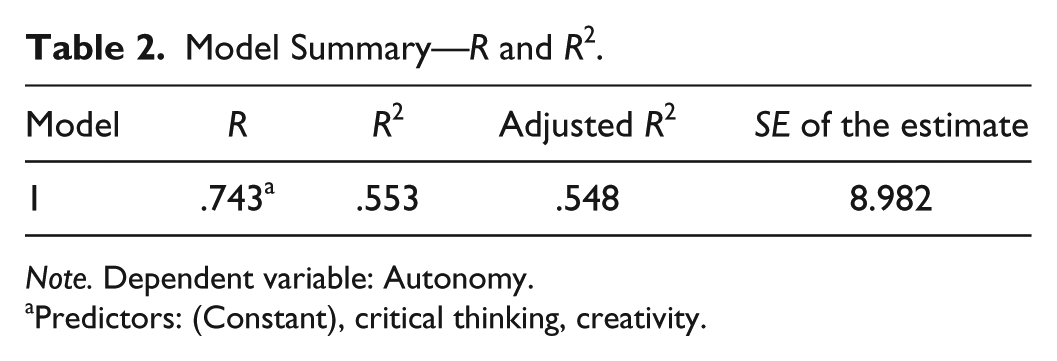
Note. Dependent variable: Autonomy.
Predictors: (Constant), critical thinking, creativity.
Regression Output: ANOVA Table.

Note. Dependent variable: Autonomy.
Predictors: (Constant), critical thinking, creativity.
Also, Table 4 demonstrates the Standardized Beta Coefficients, which signify the degree to which each predictor variable contributes to the prediction of the predicted variable. Inspection of the significance values showed that both CR and CT make statistically significant unique contributions to the equation as both significance values were less than .05. However, the comparison of beta values revealed that CT has the largest beta coefficient (β = .587, t = 6.627, p = .0005). This means that this variable makes the strongest statistically significant unique contribution to explaining AU. Therefore, it was concluded that CT could predict more significantly the AU scores of the participants.
Regression Output: Coefficients.

Ultimately, although normality of the distributions was checked for correlation in the previous sections, the residuals table (Table 5) also verified the absence of outstanding outliers as the Cook’s distance values did not exceed 1 and Mahalanobis distance values did not exceed 13.82 (Tabachnick & Fidell, 2007). Thus, the P–P plot (Figure 2) was used to visually inspect the result.
Regression Output: Residuals Statistics.

Note. Dependent variable: Autonomy.

P–P plot for diagnosing normal distribution of residual.
Discussion and Conclusion
The current study attempted to investigate the possible relationships among EFL learners’ CR, CT, and AU. Based on the pertinent data analyses carried out, the researchers observed that there were significant relationships among the above-mentioned variables. The relationship between EFL learners’ CT and CR showed a high degree of significance r = .825), which supports the notion that CR and CT as two principal metacognitive and mental factors are closely related. This finding was supported by previous research where it was reported that both CR and CT significantly intensify and contribute to the quality of mental processes and, as a result, the quality and extent of learning (Agarwal, 1992; Chamot, 1995; Chapple & Curtis, 2000; Jeffrey & Craft, 2001; Halpern, 2014; Kabilan, 2000; Ku, 2009; Scriven & Paul, 2004; Wagner, 1997). However, the results of the multiple regression analysis indicated that between CT and CR, CT plays a more important role in predicting AU among EFL learners (β = .587 > .181).
The observed significant relationship between CT and AU was in line with the results of another study conducted by Fahim and Sheikhy (2011) where a significant, though smaller, relationship was observed between CT and AU (r = .546). However, this study attempted to not only follow a more careful and systematic pattern of progress but also to compare the relationship between CT and AU with the relationship between CR and AU. This study confirmed that a significant relationship exists between CR and AU (r = .665), which indicates that CR and creative thinking can significantly contribute to the degree of AU among EFL learners. It was systematically confirmed that CR makes a large (maybe not the largest) unique contribution to explaining AU among EFL learners.
By and large, the results of the present study revealed that when there is variance in any of the observed variables, namely, CR, CT, and AU, there also exists variance in the other variable(s). Put simply, the three variables are closely and significantly interrelated. Furthermore, between CR and CT, CT is a better predictor of AU among EFL learners, as observed in this sample. These points may provide EFL teachers with a deeper understanding of learners’ CR and CT and the way their components are associated. Therefore, their basic components, that is, those of CR (fluency, flexibility, originality, imaginativeness, and elaboration) and CT (identifying and challenging assumptions, imagining, exploring, and enumerating other options, respecting evidence and reasoning, defining the context, listing reasons explicitly, and self-correction) should be considered as important factors among EFL learners. These factors, as the practical demonstrations of CT and CR, not only would encourage each other but would also promote AU and better learning among EFL learners. The above-mentioned relationship gives ample justification for integrating all of the components of CR and CT into the classroom practice through different stages (from making decision on the content to assessment and evaluation process) and the body of tasks to increase the chance of promoting AU as well as the chance of promoting learning as the direct influence of CR and CT.
Due to the importance of the above-mentioned factors, this study suggests that EFL teachers inform EFL learners of the ways through which CT, CR, and AU can contribute to a more independent, reliable, and effective learning process. In this research, it was revealed that the more creative and critical thinker the learners are, the more they are equipped to act autonomously and independently, which would result in a more personalized learning. Therefore, EFL teachers are recommended, when planning classroom activities, to include CT-, CR-, and AU-oriented activities. These activities would be based on highlighting the basic components of CT and CR, as stated in the previous paragraph. Creating an environment in which CR, CT, and AU are properly valued and in which learners take the responsibility for their own learning seems to be a considerable step toward benefiting from the potential capacities of CR, CT, and AU toward learning.
Based on the peculiarities of each context and the pedagogical objectives, EFL teachers might be able to orchestrate the instruction to arm learners with CR, CT, and AU, which are believed to bring about significant advantages for EFL learners. These attempts may include helping learners making appropriate choices and encouraging them to expand their capabilities by attempting to come up with innovative and original ideas. All in all, teachers are expected to realize their role as a contributor to the improvement of their learners’ mental capacities by exposing them to different innovative, problem-solving, and AU strategies on one hand, and by providing a way to progress gradually to be more active and responsible for their own learning, on the other hand.
Due to the fact that language learning is a multidimensional phenomenon, not only language teachers but language learners also are required to play their role properly to facilitate and optimize this complicated process. Therefore, the results of the current study have implications for language learners, encouraging them to become more creative, autonomous, and critical about their learning activities. It is hoped that the results of this study would make EFL learners more internally motivated to value autonomous learning and creative and critical thinking. Furthermore, improving thinking skills in a learning context can help learners to be equipped with tools designed to instill positive attitudes toward learning a new language and positive views of themselves as learners. When students are empowered with metacognitive skills in tandem with AU-oriented activities, they become confident, independent, autonomous, and fluent learners.
Given the content of EFL/ESL materials, in the present era and influenced by the heightened knowledge of TEFL, the language learners are also becoming the focus of curricula design (Kumaravadivelu, 2008, 2012; Nation & Macalister, 2010; Yang, 1998). This way, the results of this study would also assist syllabus designers and curriculum developers to integrate AU, CR, and CT into the body of EFL materials in a way that serves the purpose of instruction and teaching best. Moreover, possessing a higher degree of understanding regarding these metacognitive variables (CR, CT, and AU) would enable syllabus designers and curriculum developers to proffer the learners the capability to know how to learn a language, how to monitor themselves, and how to develop their learning, so that they can become effective and independent language learners (Nation & Macalister, 2010).
Syllabus designers, as providers of a great portion of the language learning setting, have a fundamental role to make the process easier. They are expected to appreciate the immense value and great potential of CR and CT for enhancing the level of learning and AU among EFL learners, which results in having intellectual, active learners that through using thinking skills can overcome their learning difficulties. Syllabus designers are strongly recommended to incorporate CR and CT tasks into EFL materials in which fluency, elaboration, identifying the problem, defining the context, enumerating choices, analyzing options, listing reasons explicitly, and self-correction are valued. This way, the learning context is given the chance to let thinking skills surface through learning activities. It is also reasonable and well-justified to incorporate CR, CT, and AU into the body of achievement and diagnostic tests where it might provide the context-sensitive teachers with a better understanding of the mental and cognitive states of the learners and the way the instruction has been successful or should be adapted. In the same vein, it is also suggested to include CR, CT, and AU in the prognostic tests of English courses, namely placement tests.
The findings of this study confirmed that CR and CT would facilitate learning a new language through promoting AU. Moreover, it was observed that, in this context, CT makes the strongest unique contribution to explain AU. However, considering the inherent lack of control or knowledge regarding the influential factors in correlational research (Best & Kahn, 2006; Springer, 2010), further studies may inspect the way other mental and personality factors interact with the variables of this study. Moreover, the same study could be conducted among other age groups regarding the difference among different age groups with respect to mental and personal qualities. This study can also be replicated employing some qualitative instruments, for example, interviews, to increase the validity and generalizability of the findings.
Footnotes
Declaration of Conflicting Interests
The author(s) declared no potential conflicts of interest with respect to the research, authorship, and/or publication of this article.
Funding
The author(s) received no financial support for the research and/or authorship of this article.