




Abstract
Notions of aboriginal cultural reclamation and healing presuppose the existence of distinctly aboriginal selves that were damaged or lost in a process of colonization and that those selves can be “restored” in some meaningful way. Such aboriginal healing has been done without a detailed examination of the selves of individuals to be assisted in this manner. This article examines the selves of four contemporary individuals with varying relationships to the concept of aboriginality using a method of mapping the self with elemental units of culture called “memes.” It is suggested that a spectrum of healthy selves is possible for people who either identify with aboriginality culturally or satisfy a racial definition of the concept. The co-evolution of the self and culture is discussed along with the utility of various definitions of what it means to be aboriginal in a North American context.
The thesis that European colonization led to the collective traumatization of people aboriginal to the American continents with a concomitant need for personal cultural reclamation has received considerable attention (Duran & Duran, 1995; Wesley-Esquimaux & Smolewski, 2004). This thesis presupposes the existence of personal selves that were so damaged and that such damage was transmitted inter-generationally. Whereas the self as a cultural construct has received general support in the literature (Harre, 1984; Lock, 1981/1990; Mead, 1912/1990), the notion of a prototypical aboriginal self that may be “reclaimed” is controversial as are the methods sometimes used to effect such reclamation (Robertson, 2011; Waldram, 2004). Such methods have included exposing individuals to depictions of genocidal massacres in an effort to “awaken” the historical trauma assumed to be present but beyond the person’s conscious awareness. Once awakened, the trauma is treated by introducing the individual to ceremonies and teachings that effect a replacement self thought to be more prototypically aboriginal and healthy (Brave Heart, 2003).
Berry (1999) postulated a range of possible aboriginal selves that included biculturation, separation, assimilation, and marginalization. Both bicultural and separate selves are based on aboriginality with the bicultural individuals valuing relationships in the larger society. Assimilated individuals lack distinctly aboriginal selves, whereas marginalized individuals are so-placed not by their own actions but by those of a racist society. Berry reported, “Research evidence clearly demonstrates that those who prefer, and are able to achieve biculturation are generally those with relatively good mental health and a positive cultural identity” (p. 8). This would support the notion that distinctive aboriginal selves are necessary for people who are defined as aboriginal, provided such people do not attempt to keep themselves separated in isolation from the larger society.
Although the notion that a distinct self may be requisite to the mental health of aboriginal people is a viable hypothesis, the structure of such a self must be defined before such a hypothesis can be tested. This article explores notions of aboriginality in self-definition using the memetic self-maps of four individuals developed in an earlier study (Robertson, 2009) while referencing the historic trauma and bicultural models. We begin by examining historical support for a cultural as opposed to racial definition of aboriginality.
Aboriginality: A Cultural or Racial Artifact
In northern Saskatchewan, one may encounter blonde Nordic-looking children at play speaking their native language, Cree. Like their darker skinned playmates, these children will likely have treaty numbers–in Canada people with legally recognized status as Indians are given numbered identity cards allowing for certain benefits flowing from treaties signed by Amerindian people and the federal government. The Canadian government’s relationship with the descendants of those who signed treaties and others recognized as having Indian status has been defined in a series of “Indian Acts.”
Canada’s initial Act to Amend and Consolidate the Laws Concerning Indians (“Indian Act,” 1876) has been characterized as a racist document that marginalized people and their descendants into poverty and second class citizenship (Bourassa, McKay-McNabb, & Hampton, 2004; Cardinal, 1969). While the Act defines an Indian as “a male of Indian blood reputed to belong to a particular band or the wife or child of such a person” (s. 3), such a person could “cease to be Indian” by becoming enfranchised into full Canadian citizenship (s. 86). Women marrying non-Indian men and men or women who obtained a university degree would automatically cease to be Indian by virtue of a presumption that they had chosen to live a non-aboriginal way of life. Conversely, non-aboriginal women who married Indian men became Indian on the presumption that they had chosen their husband’s culture. Thus, people with no aboriginal genetic ancestry along with people of mixed ancestry counted as Indians if they lived an Indian way of life. That way of life received legislative protection ensuring communal ownership of land, freedom from taxation, provisions against the seizure of property on-reserve for non-payment of debts, various income and health subsidies, and extended hunting, fishing and trapping rights.
Amerindian people in Canada have successfully argued that they should be able to keep the advantages of Indian status while having the full rights of Canadian citizenship. With this development, the definition of Indian has necessarily changed from culturally based to racially based. People of mixed ancestry who were raised in Indian bands and trace their ancestry to those aboriginal people who signed treaties with Canada or were otherwise recognized as Indians by 1985 are considered “full-blood” for the purpose of considering “blood quantum,” and people with too little “Indian blood” now “cease to be Indians.”
The Metis, a people of mixed ancestry who identified culturally as neither Amerindian nor European, were recognized as an aboriginal people in the Canadian constitution of 1982. Their definition was primarily cultural: Metis self-identify and trace their ancestry to, or are otherwise accepted by, a Metis community. Although measures of racial ancestry have not been traditionally used with respect to defining “Metis,” there has been pressure from the Canadian government to establish a “blood quantum” measure of their status (Klowak, 2011).
An essentialist cultural definition of aboriginality with recognized cultural markers fixed to conditions that existed at the time the treaties were signed would result in no aboriginal people after a few generations due to a process of education and assimilated values. Evolving cultural definitions set by living communities would allow for such change. A racial definition of aboriginality would result in a spectrum of possibilities with some aboriginal people potentially identifying with non-aboriginal communities but remaining “aboriginal” nonetheless.
Method
The self as conceptualized in this study is a cognitive structure (Greenfield, 1995; Harre, 1984; Mischel & Morf, 2003). As such cognitive representation is dependent on learned symbols, the self is necessarily a construct consisting of units of culture (Blackmore, 1999; Price, 1999). Dawkins (1976) coined the term “meme” to represent such units, and this term has come predominate over other competing terms such as “mnemotype,” “idene,” “sociogene,” “concept,” and “culturgen” (Wilson, 1999). Adding to the robustness of the concept of the meme was Dawkins’ proposal that such units exhibit attractive and repellent properties leading to the replication of beliefs at a non-rational level. Conjoint or overlapping connotative, behavioral, and emotive elements of memes as experienced by the individual were taken as providing the attractive force postulated by Dawkins (Robertson, 2010). Such attraction between memes is necessary in giving the self a measure of stability over time. Using this definition, the memes available for self-construction would be expected to vary between cultures.
The data used in this article were drawn from a larger qualitative study into the structure of the self (Robertson, 2009). Participants were volunteers recruited using print advertising supplemented by presentations to classes and community groups in one predominantly aboriginal northern community and one southern urban center in Canada. They were asked to answer the question “How would you describe yourself to explain who you are?” This question was followed by open-ended questions such as “What are you like/not like?” “What kind of person are you?” and “How did you get to be the way you are?” to generate rich and thick self-descriptions. Initial 2-hr interviews were recorded and transcribed with segmented portions given code words by the researcher representing specific units of thought. Using the method recommended by Miles and Huberman (1994), all of the segments with the same code were then grouped, and each resultant grouping or “bin” was examined for referent, connotative, affective, and behavioral dimensions. Bins that exhibited all four dimensions satisfied the definition of the term meme as used in this study, and the qualities of each meme were examined for possible positive linkages with other memes. Memes that contained reference to another meme in their definition or shared one of the four dimensions were considered so linked. Maps were then prepared showing the self-identifying memes with linkages.
The self-maps were returned to individual participants for elaboration, correction, and confirmation during a second interview held 2 to 3 months subsequent to the first. This resulted in amended maps that were again returned to the participants for further elaboration in a third interview held 5 to 6 months after the first. Participants were asked during each of these latter interviews to identify whether the maps resonated with who they were, that is, did the maps represent them at a feeling level. Participants were also asked to elaborate on any changes they had experienced to their selves during the intervening months.
The aboriginal cultures from which three of the participants were drawn (and with which the fourth identified) are rich in traditions of storytelling with emphasis on the concept of holism as is sometimes represented by the concept of the medicine wheel (Freeman, 2009; Mussel, 2005; Roberts, Harper, Bull, & Heideman-Provost, 1998). The qualitative methodology selected in this study is compatible with these traditions. The narratives of each participant were self-stories complete with opportunities to engage in metaphor and symbolism. The mapping was used to afford a holistic view of the self as understood by the individual so mapped. To ensure that this research remained relevant to the communities from which the participants were drawn, it was informed by a committee of three elders, two Metis and one Cree, with whom I consulted regularly both individually and in a “talking circle” format.
Indicators of Aboriginality in Four Individuals
Three of the individuals examined in this study had Amerindian genetic ancestry; that is, they could trace their lineage to the continent’s original inhabitants. The fourth was genetically European, but he had assimilated many cultural beliefs and practices associated with aboriginality. We examine each of their narratives and resultant self-maps individually before attempting to make any general knowledge statements.
Defining “Big Indian”
“Trevor,” a single Cree male in his twenties, delivered a series of detailed self-narratives that included being abandoned on a northern Saskatchewan trap line at age 6, being responsible for younger siblings while his parents drank, becoming involved in youth gangs, and challenging a medical doctor with respect to the over-prescription of medication to a girlfriend. His first interview produced 13 pages of single-spaced transcript that was then divided into 110 segments. Thirty-eight memes were identified as applicable to these segments, and they were applied a total of 145 times. The memes along with the number of segments that were applied to each meme (in brackets), and the connections with other memes were placed in a memetic self-map reproduced in Figure 1. Referent words representing memes were place in ovals. The number of segments pertaining to each meme is bracketed beside each meme. Themes in Trevor’s self-map were placed in rectangles with arrows flowing from those themes to associated memes. For example, the theme “Remember” was drawn circling his core self connecting a series of self-stories related to memes for addictions, dating, self-esteem, children, and being human.

Revised memetic map of Trevor resulting from his second interview (with no further changes resulting from the third interview).
Nine segments of Trevor’s initial interview were coded for a meme referenced as “learner” with that meme containing an emphasis on introspection. This led to a cultural or racial self-definition as an adolescent:
I am a big Indian . . . so then I thought, “What’s it mean to be Indian?” and I thought, “warrior,” so I did some research, and I realized back in the old days we used to go on vision quests, so I went on a vision quest . . .
Trevor became a drum keeper and played and sang at pow-wows. He took as his Indian name “Against the Wind,” which he used as a metaphor for his determination to stand up for his opinions against prevailing beliefs.
Trevor said being the child of alcoholics resulted in his self-identification as a “potential alcoholic.” He said his career as an addictions worker “was me trying make sense of myself and my childhood.” He added, “I noticed patterns of my life where I would go out with alcoholics, and there are things I wanted to address.”
Trevor’s “cautious” meme included a tendency to discount other peoples’ compliments, a trait associated with low self-esteem. He associated caution with both introversion and being single, and his unhappiness with these two aspects of himself led him to examine his own self-esteem. Although “self-esteem” might not ordinarily be thought of as a meme, in this case, it represents the quality of feeling positive about oneself, and it is something that Trevor has worked on frequently by drawing on his Indian name, using positive affirmations, and by challenging himself to attempt new behaviors.
Trevor traced his anger with people who abuse children and women to his childhood experience of protecting his younger siblings. He learned the roles of “man,” “protector,” “parent,” and “big brother” that were consistent with a gender role of being “judge, jury, and executioner.” Later, he found that he had to discard some parts of this gender role: “As a person, as a man, I had to learn–it’s okay to cry, it’s okay to laugh, it’s okay to be happy. You don’t need to be this big stoic Indian.”
Trevor embraced the Taoism he learned while taking martial arts as well as Aboriginal Spirituality. He said that both traditions guided his behaviors and relationships with others. Imbedded within his idea of spirituality is the notion that to be fully human one has to experience a full range of emotions, and he attempted to teach people to become human. He befriended prostitutes to help them “be able to feel again, being able to think about things other than their addiction.” He saw even their lies as signs of progress toward humanness “because one has to feel something such as fear to prompt the lie.” Trevor’s attempts to restore the humanity of others may be seen as the reflection of an urge toward animating solutions to problems. This meme “animator” is also reflected in his attempts to self-change, his preoccupation with monitoring and improving his self-esteem, his behavior associated with his anger, his advocacy for youth, and his pride in his accomplishments at work. A meme for self-directed learning completes a circle of who he is with an animator meme at its core.
Trevor said that the inclusion of the meme “aboriginal activist” in his initial self-map was “almost prophetic” because, although he would have not given himself that label at the time of our initial interview, he had since become politically active in his community. This tendency toward activism had been apparent at our first meeting. For example, Trevor recalled visiting a doctor with ambiguous complaints to see if he would be prescribed anti-depressant medication (he was). His interpretation of this experiment, which in part flowed from his involvement with a woman who resisted such medication, was that doctors over-prescribe to treat Indians because their medication is paid for by the federal government. By the time of our second interview, Trevor said that his activism, based on the need to eliminate poverty, “was like igniting a fire that keeps me focused on something bigger than myself.”
A Metis Mother
When asked to tell me about herself, “Tina” gave her age, the number of children she had (three at the beginning of the study), her marital status, and the fact that she likes to clean. When prompted, she expanded on the importance of family and community. Although she considered herself to be Metis, she stressed that she likes to have friends from all races and cultures. Our first interview produced 15 pages of transcript with 23 memes applied 70 times to 52 segments. By comparing descriptive codes and connecting related memes, a map of Tina’s definition of her self was artfully created (Figure 2).

Revised memetic map of Tina resulting from her second interview (with no further changes resulting from the third interview).
The meme “mother” was found in 11 segments in Tina’s initial transcript. Her behavior associated with “mother” included ensuring that her children are safe, cared for, attend school, and have many toys. She engaged in excessive worry for her children’s safety, and this led to extensive restrictions on what they were allowed to do. The meme “mother” is connected to memes for caring, anxiety, and paranoid (Tina’s word).
One characteristic of motherhood, according to Tina, is love. But this is also an emotion associated with being a daughter and a sister and is also applied to other children not her own. Had Tina described herself as a “lover,” then that might have qualified as a meme in its own right, but she did not. However, “love” is very much a theme in her life, and is represented in her self-map as a box. Themes do not necessarily exhibit the four central characteristics attributed to memes (referent, connotative, affective, and behavioral), but they may represent a characteristic or quality common to a group or a cluster of memes. Other thematic centers represented in Tina’s map include “Family Person,” “Decent Person,” “Empowered,” and “Learner.”
Tina attributed motherhood to saving her from binge drinking on two occasions. As a teenager, she rebelled against her parents, left home, dropped out of school, experimented with drugs, and drank to excess. She reported, “Getting pregnant made me sober up and smarten up.” Later, one of Tina’s children died and in her grief she began binge drinking again. She reported that she stopped binge drinking only when she discovered she was pregnant again. She was unable to say why her pregnancies had a sobering effect on her but not other women. She reiterated her opinion that it is a mother’s duty to ensure her children had a “good start in life,” and when pressed as to why she believed thus, she said, “I dunno, I guess I was raised right.”
The second most referenced meme in Tina’s map is “wife” and connections were formed between it and memes for budgeter, cleaner, and open-minded. “Wife” is also connected to the interpretive or thematic codes “Family Person” and “Love.” These two themes with their surrounding memes were presented as the core of who she was. Tina reported that she places considerable pressure on herself as a result of her status as a family member and the importance she places on that role.
The fact that she took the duties associated with motherhood seriously marked her, in her mind, as a decent person, and this theme that runs through much of her self. She was given the role of a mediator in her extended family because she can see alternative points of view. This quality of being open-minded coupled with compassion has led her to care for and befriend people of minority status. Another center in Tina’s self-map was “animator” defined by her as someone who gets things done. This meme was only mentioned explicitly in two segments, but it was implied in her self-characterizations as being “stubborn,” a “budgeter,” and as being a self-directed learner.
Figure 2 also represents the importance Tina placed on her ability to feel emotion. She had been diagnosed as suffering from an anxiety disorder and depression several years before the commencement of this study, but refused medication because she “should be feeling everything.” Like Trevor, Tina said that a repertoire of emotions such as “sad, happy, mad, confused, distant” are necessary to feel human. On reviewing her self-map, she offered the insight that depression blocked the other emotions from happening and maybe it was okay to take medication to “unblock them.” Despite the transitions in her life, she had a sense of being “the same person (she) has “always been,” but she had changed herself in positive ways as a result of having children.
The Power of “Not”
Judy was emphatic about what she is not. “I am not a social worker,” she said, even though she had a university degree in the profession and had supervised and trained social workers. She refused to define herself as a humanist although she attended gatherings of people who described themselves as such. She also chose not to identify as Metis because she was not raised in her mother’s community and did not share the culture. She refused to define herself as aboriginal or non-aboriginal preferring to describe herself as a unique individual “who can’t be put into a box.”
Judy described herself as responsible, mature, fun, kind, friendly, loyal, smart, and a pet lover. Each of these descriptors involved decision-making, and she was asked, “If the decision maker changes over time how do you know it is still you?” She replied that it is a feeling that it is still her, and the decisions she makes “feel right.” Thus, a “Feeling of Me” was drawn as forming the basis of Judy’s self represented as a bar at the base of Figure 3. From this base flowed a sense of decision-making empowerment, and this sense of empowerment leads to animation. Five of 68 segments from her initial interview were coded for the meme “animator.”
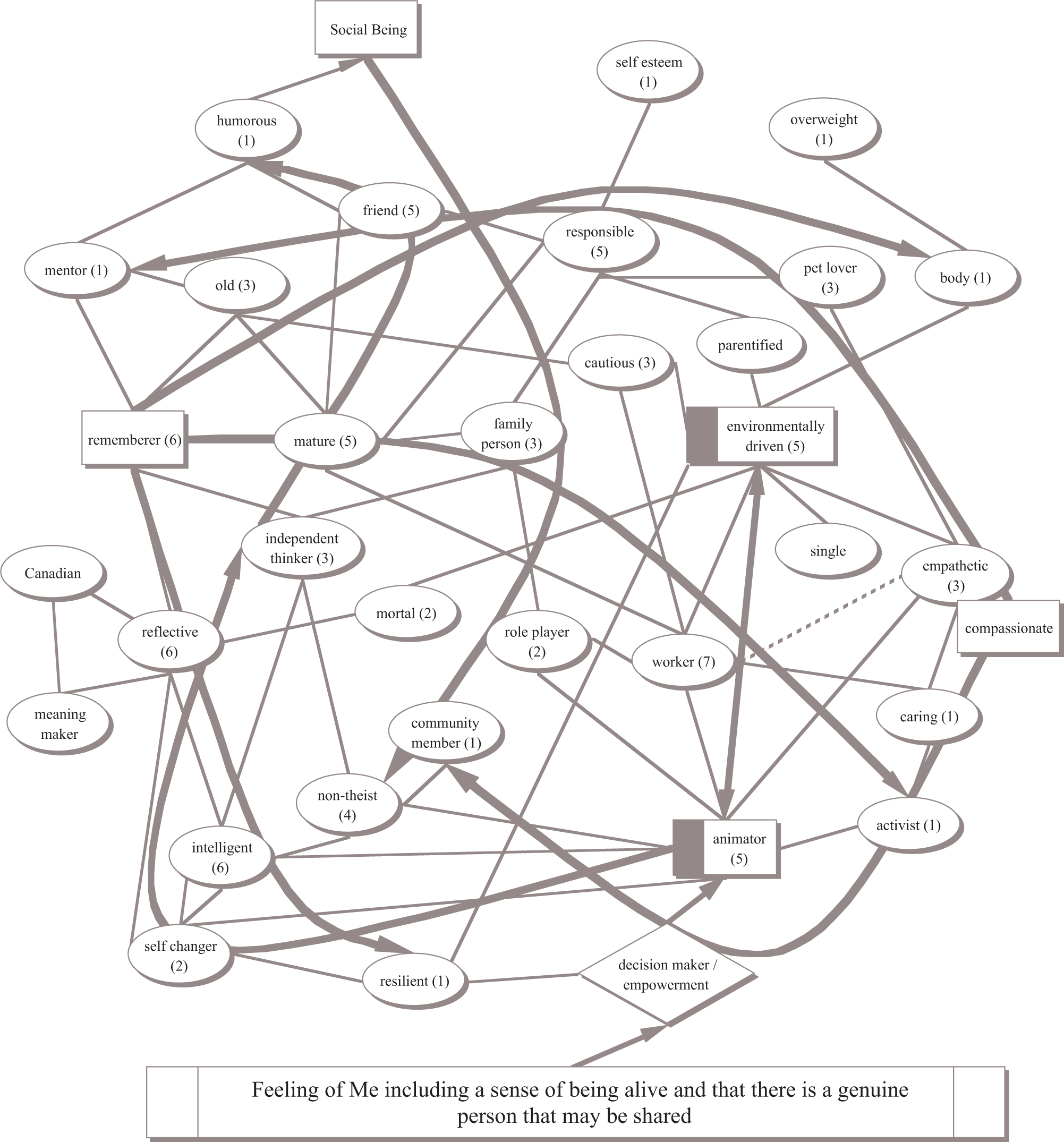
Revised memetic map of Judy resulting from her second interview (with no further changes resulting from the third interview).
Judy talked about her life as having been partly a product of environmental forces driving her in particular directions. There is a tension, therefore, between “animator” and “environmentally driven” represented as a double-headed arrow pointing in both directions. “Animator” also appeared to be a theme in Judy’s life affecting or being part of such memes as “self-changer,” “intelligent,” “reflective,” and “independent thinker.”
Judy talked about herself as a rememberer in six segments, but the theme of remembering seemed to permeate her entire self. She said by remembering reflectively we gain an understanding of who we are and why. This helps her to become resilient when facing life’s challenges. One becomes more mature as one collects experiences, and this allowed her to become more of a family person. Her memories of interactions with people in poverty led her to become a social activist. Her memories helped her establish lasting friendships.
Judy said she is not a “Catholic” despite being taught by priests and nuns in a traditional Roman Catholic school. She began questioning church teachings in Grade 10 when a priest presented instructions, as church law, on how long and in what way couples could kiss each other. She remembered thinking, “This is crap,” and she thought that if this teaching was wrong other church teachings may also be wrong. She decided she was the kind of person who needed evidence as opposed to faith, and she decided the very idea of God was not logical.
While discussing her own mortality, Judy explained basic necessities, such as having a home, are important, but accumulated possessions would give her no pleasure at all. In answer to the question “What is important?” she answered, “Awareness that you are alive, that everything that happens is meaningful and that you have the opportunity to experience it. Fun is important but possessions are not.”
Judy explained she has had more than three decades of experience in her profession, and she wants to give others the benefit of that experience, so they could then become proactive and make change faster. As a result of this insight, the idea of using mentoring to further social goals was added to the definition of the “mentor” meme. Judy explained that it is more difficult to say what you are, as opposed to what you do. For example, when people ask, “What do you do?” she finds it simpler to reply that she is a social worker, but then she added, “That is not me!”
A third theme represented in Judy’s self-map is “Social Being.” This theme was not also coded as a meme but was inferred from her discussion of contexts in which she is humorous, kind, a friend, a family person, a role-player, and a community member. Defining herself as “the family connector,” she saw herself as the person who brings her family together. While being open about her Metis heritage, she said, “Blood does not drive you. For me the Metis part is overwhelmed by a lot of things.” She defined herself “as Canadian as you can get.”
White Renegade
During the era of North American colonization, people of European ancestry who joined Native Americans in their way of life were referred to as “white renegades.” Laws were passed against this practice by both British and French administrations with imprisonment, torture, and sometimes death awaiting such individuals. Although the traditional aboriginal economy has vanished, there are still people born non-aboriginal who prefer native beliefs and practices to those of the majority culture. This is the self-story of one such individual.
At the time of this study, JohnB was a male in his 50s in a common-law marriage to an aboriginal woman. He began his interview by talking about racism as it affects aboriginal people. He said he had learned racist stereotyping from growing up in a “typical German-Catholic community in Saskatchewan.” His high school experience of knowing a non-White, non-Catholic person who “had as much right to go to heaven as anyone else,” led him to question the church’s teachings. This led to a general life theme, “Challenger of authority” pictured as connecting the memes: “cynical,” “inquisitive,” and “independent thinker” in Figure 4.
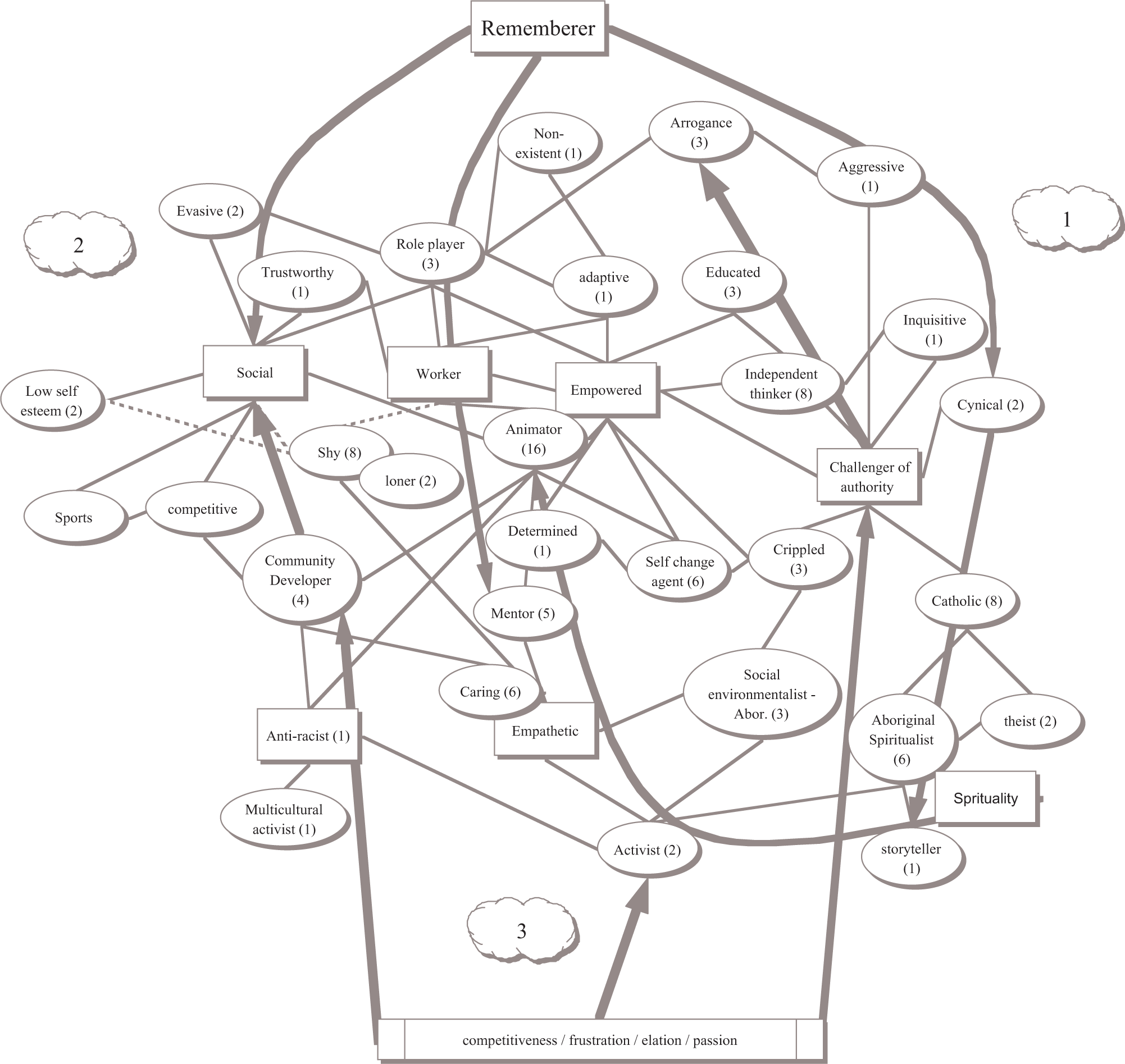
Amended memetic self-map of John Blonde following his second interview (with no further changes resulting from the third interview).
JohnB was born with a clubfoot. Despite accepting the label “cripple,” he drove himself to overcome his physical limitations in sports, thus displaying a competitive spirit associated with an initial sense of empowerment. Sixteen segments of the transcribed interview were coded for “animator.” Although initially this animator meme was associated with challenging church and parental authority and with becoming a competitor in sports, later it also became associated with social activism and self-change.
JohnB introduced non-native friends to aboriginal people in an effort to overcome negative racial stereotyping. He became active in the development of his adopted largely aboriginal community motivated by compassion. Six segments were coded for caring, and the meme was presented next to a more general theme labeled “Empathetic.” His roles as a mentor and as a person concerned with the social environment of aboriginal people were thus linked. JohnB contrasted his understanding of Aboriginal Spirituality with Catholicism:
If anything, maybe the aboriginal is purer in that they don’t have the big cathedrals, and they don’t have the pope and the governing structure and all of it. So I think it has in some sense a purer spirituality . . . Christians even from the beginning of time have been very powerful; have ruled with money, with power over people. I don’t think like that was the intent at the beginning of it . . . and that (corruption) is missing from Aboriginal Spirituality.
JohnB actualized his spirituality by connecting with nature and through mystical experiences in aboriginal ceremonies such as the sweat lodge:
It seems strange that a little white boy is going to sweats, and jokingly I call them spooks and I’m going, “Oh, they are back in there, the spooks like me” but the spirits seem to come to me always more than even aboriginal people.
When discussing an initial version of his self-map, JohnB observed that there are three or four selves pictured that are invoked dependent on context. He agreed with the suggestion that the empowered center seems to unite the other selves. As a result of this insight, Selves 1, 2, and 3 were added to represent the different “persons” JohnB presents in different contexts. The notation that his “Animator Empowered” core self would not have developed without the first two “selves” was added to JohnB’s animator meme.
JohnB explained that he still viewed himself as a kind of generalized Christian who believes that Aboriginal Spirituality is closer to original Christian teachings, but he had used the term Catholic reflexively because that is how he was raised. One interpretation of this conversation is that JohnB made a mistake, and the meme coded “Catholic” should be given a different label. Such an interpretation would flow from an assumption that there are meanings essential to certain terms, and that to be a Catholic one must believe in, for example, the infallibility of the popes. Another interpretation is that the meme which has been labeled “Catholic” in JohnB’s self evolved, but that the label remained.
I noted that JohnB had not mentioned spirituality until I asked, at the end of our first interview, “Is there any else that you can add that would help in letting me know who you are? Is there anything we’ve missed?” He admitted that he reflexively hid his spirituality from all but his closest friends. I concluded from this that spirituality appears as a theme that influences his activism and animator centers without always being apparent to others.
JohnB’s spirituality contained many references to nature, and he said he sometimes likes nature more than he likes people. He elaborated that people can get very frustrating “because they have the ability to think and to stand you up.” He said that nature is “somewhat predictable,” and violence in nature, as in a storm, can be beautiful, but violence in people is “quite ugly.” He added that it is easier to see yourself as part of a bigger process, if in awe of nature. This idea of identifying with something that is transcendent was incorporated within JohnB’s conceptualization of Aboriginal Spirituality.
Discussion
All of the participants in this research expressed the view that the maps created to represent their selves resonated with their personal felt understandings, and that these selves, while capable of change, exhibited a certain stability over time. As the range of selves included those that explicitly expressed aboriginality and those that did not, and as none of the participants were in therapy at the time of the study, we can conclude that healthy functional selves are possible within the range represented. The assumption that the selves of people with genetic aboriginal ancestry necessarily need to be re-made according to an approved template to achieve mental health (Brave Heart, 2003) is unsupported. As we shall see, none of the participants to this research fit neatly into Berry’s (1999) categories of biculturation, separation, assimilation, and marginalization although one (Trevor) came close.
Trevor assumed there such a thing as a self that may be identified with the aboriginal inhabitants of the American continents, and that he did not, as an adolescent, have one. He began a quest to find his “true self” by calling on the traditions of his ancestors. As we have seen, he sought guidance from elders, went on a vision quest, became a traditional drummer and singer, and participated in rituals such as sweat lodges, feasts, pipe ceremonies, and sun dances. The essentialism implied by this quest was tempered by his inclusion of non-aboriginal memes such as Taoism and individualistic memes such as “animator/doer.” Indeed, it was the importance he placed on the animator theme that contributed to his willingness to undertake such quests.
Trevor’s felt need to seek a self-definition as a Cree person could be interpreted as his need to fill a vacancy created by loss of culture. He initially defined himself as a “big Indian” but without other cultural markers of aboriginality. Like many who learn their aboriginality attending native studies classes at university, Trevor added those cultural markers to his identity relatively late in the development of his self. The resultant culturally evolved structure was a mixture of things he believed to be true based on a variety of sources mediated by his personal lived experience. Rather than “aboriginal” in some essentialist fashion, Trevor’s self remained uniquely individual. It is not likely that any modern aboriginal person can successfully construct their selves to not include at least some memes that were not available to their ancestors; therefore, it is likely that Berry (1999) had individuals like Trevor in mind when conceptualizing his “bicultural” and “separation” categories of aboriginal people in relation to the majority Euro-American culture. This leads to an indelicate question, “How many non-aboriginal memes can be incorporated into a self before it ceases to be aboriginal?”
While Trevor was raised in a small urban center, Tina was from an aboriginal community in northern Saskatchewan, Canada. Although she accepted herself as a Metis person, nothing in her self-map would strike one as being overtly aboriginal. Her concerns were practical and family centered. Perhaps the original Metis were not concerned with creating a distinct culture, but were simply building communities to survive in their environment. It fell to later generations to conceptualize the earlier beliefs and practices as culturally distinctive, but by the time they did so, those beliefs and practices would have necessarily changed.
It may be that Trevor’s formative years raised within a largely non-native urban community gave impetus to his need for aboriginal self-definition–the need to contrast himself with that which he was not. Although it is likely that Tina’s speech, mannerisms, and ways of doing things reflected the aboriginal community in which she was raised in some ways, such differences did not appear as distinctive cultural markers in her self-definition. As an adult, she prided herself in having friends from all cultures, races, and sexualities. Such awareness necessitates situating oneself in a culture, race, and sexuality but she was able to accomplish this without overt demonstrations of her aboriginality. It is possible that her sense of oneness with humanity and nature flowed from earlier aboriginal teachings to that effect, but she did not suggest this interpretation during this research, and indeed, such striving for distinctness could be interpreted as at variance with the principle of the unity of all.
An alternate explanation of Tina’s self-map is that it constitutes evidence of assimilation. Those making such an assumption would likely view aboriginal cultures in static or essentialist terms using terms such as cultural genocide to lament its disappearance (Duran & Duran, 1995; Smith, 1999). Such a view cannot permit aboriginal cultures to evolve to resemble the majority culture, and as cultures represent the collective selves of the people who make them up, people without sufficient aboriginality would be viewed negatively, perhaps even as “unhealthy.”
Like Tina, Judy did not feel a need to research and incorporate distinctively aboriginal views or practices into her self-structure, but unlike her she eschewed the label “Metis” describing herself as neither aboriginal nor non-aboriginal but as uniquely “Canadian.” Structurally, her self-map is similar to Tina’s with an emphasis on feelings, family, social life, and advocacy for others. Judy could have chosen to be Metis with any aboriginal rights associated with that designation, but she chose not to.
JohnB had no such choice. Had he been a woman married to an Amerindian man in the mid-20th century, he would have gained Indian status, but the reverse was never true. The result was that he defined himself as a Euro-Canadian “white boy,” but his self-definition included a rejection of many of the cultural values in which he was raised and the adoption of those that may be taken as markers of aboriginality. Like Trevor, JohnB’s self included memes associated with native spirituality and aboriginal activism. In addition, JohnB referenced a spiritual relationship with the land–a theme generally associated with aboriginality (Berry, 1999), and he noted that his paranormal experiences in sweat lodges and other ceremonies appeared to exceed those of racially defined aboriginals in the same ceremonies.
A special relationship with the land could be a mark of aboriginal spirituality–a worldview (or worldviews) based on observed evidence and conjecture originally grounded in assumptions of animism. Without codified belief systems and the resultant individualization of views, such beliefs are not viewed to constitute religions (Dennett, 2006; Hill, 2003; Mehl-Madrona, 2003). Such worldviews evolve as new evidence and understandings are admitted to consciousness. Neither Trevor nor JohnB were raised in this tradition. The process of seeking a set of beliefs that would mark one as an aboriginal person necessitates a codification including the acceptance of supernatural claims on faith beginning with the notion that certain beliefs were meant for people aboriginal to a particular continent. JohnB accepted that codified belief system as an alternative to Roman Catholicism with the implication that aboriginal spirituality, in this form, had become a new religion that may be labeled Aboriginal Spirituality. If we accept that people can have a modern way of life while maintaining cultural markers of aboriginality, such codification of beliefs and practices may be inevitable. Judy chose not to define herself as aboriginal because of the absence of such cultural markers in her worldview. If we rely on a cultural definition of aboriginality with some features considered essential or proscribed, then a person like Tina may not pass the resultant litmus test of aboriginality.
If we accept a purely racial definition, then there can be no distinctive aboriginal self. People like Judy are mistaken–it matters not how their self is constituted as long as a prescribed “blood quantum” is satisfied. Any prescribed level of genetic material to satisfy such a definition of aboriginality is likely arbitrary. Furthermore, as aboriginality prior to the 20th century was based on lifestyle, and as non-aboriginal women marrying Amerindian men took the status of their husbands until 1985, blood quantum in subsequent generations cannot be established with certainty.
Some traditional Amerindian elders have used a combination of genetic and cultural factors to define aboriginality in stating that a person of mixed racial ancestry, regardless of actual blood quantum, could choose to be “White” or “Indian” (personal interviews, A. Scott & G. Nippi, Nov. 6, 2003). Such an understanding presupposes a dichotomy between aboriginal and non-aboriginal worldviews. If, for example, European cultures are thought of as “individualist,” then aboriginal cultures are thought of as collectivist; if the European is competitive, then the Amerindian is cooperative; if the “white” is thought of as materialistic, the “Indian” is thought of as spiritual (Dyck, 1998; McCormick, 1996). Choice is available only to persons of mixed race. There is no room in such a model for someone of one race to adopt the worldview of another. JohnB would be understood as being in self-denial. Trevor’s decision to adopt an aboriginal worldview as a teenager while concomitantly maintaining non-aboriginal identifications would be disturbing to this model. At best, Trevor’s self-identification with Taoism would be seen as superfluous to his “true self”; at worst it could be viewed as a reflection on his credibility as an aboriginal person. A more fundamental problem with this model is posited by Trevor’s core self as an empowered animator. Trevor defined himself as a “doer”–as someone who assesses situations and takes immediate action. Such a worldview is not possible without a sense of individuality. Arguably, it is not possible to have a self without the sense that one is an individual, definable in some ways as separate from others. If all cultures are expressions of a balance between individualism, collectivism, and spirituality (Waldram, 2004), then any dichotomous definition of self must fail.
A fourth possible method of defining aboriginal status would involve self-declaration coupled with acceptance by an aboriginal community with both the self- and group membership a matter of negotiation. This cultural definition of aboriginality differs from the essentialist perspective by viewing culture as an evolving construct. In this study, only Tina was raised in an aboriginal community, but both she and Trevor were accepted by their respective communities as aboriginal persons. As her example illustrates, although such a definition allows for the evolution of aboriginal selves beyond delimited stereotypical markers, there can be no guarantee that such selves would be distinctive from the selves of non-aboriginal people. A range of possible selves could co-exist within such evolving cultural communities as the communities themselves evolve in different directions.
As culture is the collective expression of the people who constitute it, cultural evolution is tied to self-change. All of the participants to this study were able to recount childhood and adult transitions contributing to their self-development, but the interpretation of such transitional events was highly individualized with events often reinterpreted on further reflection. As we saw in the example of Trevor, planned transitions to effect self-change are possible with new developmental interpretations viewed as progress toward an essentialist sounding “true self.” Although such an imagined “true self” negates the feeling of having a counterfeit self as is often experienced in adolescence (Harter, 2012), the cost when tied to an essentialist view of culture is a restriction on possibilities for self-growth. Re-framing the term to preferred self allows for a wider array of developmental possibilities, but with a possible cost to one’s sense of constancy.
In summation, the self may be understood as developing experientially from the cultural units with which the individual has come into contact. Interpretations of past experience based on what becomes one’s individualized culture coupled with biological factors and normative cultural milestones lead to a self-definition that evolves while maintaining the feeling of constancy or stability. Evolutionary change occurs as existing memes are modified and new memes, compatible with existing self-defining memes, are added. The memes that constituted the selves of the individuals in this study, including the memes that constituted markers of aboriginality, were drawn from a North American pool shared between aboriginals and non-aboriginals collectively. Thus, we have people from aboriginal communities incorporating European and Asian memes into their self-structures while people from non-aboriginal communities incorporate Amerindian and Metis memes. As compared with earlier times in human history, this meme pool is huge with exponentially greater possible variations in self-expression.
Although the qualitative method used in this study is useful in delineating a range of possibilities, the results should not be taken as representative of all modern aboriginal selves or their constituent characteristics. For example, although this study gave specific attention to those who exhibited markers of aboriginality, there is no suggestion that males generally are more likely than females to exhibit such characteristics. Furthermore, the range of possible selves represented by these participants may not be exhaustive. More study is needed on the selves of aboriginal people from other parts of the American continents. It would be instructive to examine the role of elders and the intergenerational exchange of worldview on aboriginal self-development coupled with the permeation of non-aboriginal memes in indigenous cultures.
Footnotes
Declaration of Conflicting Interests
The author(s) declared no potential conflicts of interest with respect to the research, authorship, and/or publication of this article.
Funding
The author(s) received no financial support for the research and/or authorship of this article.