




Abstract
During his time as a state senator in Illinois, Barack Obama voted “Present” 129 times, a deliberate act of nonvoting that subsequently became an important campaign issue during the 2008 presidential elections. In this article, I examine the use of Present votes in the Illinois state senate. I find evidence that Present votes can largely be characterized as protest votes used as a legislative tool by the minority party. Incorporating information from Present votes into a Bayesian polytomous item-response model, I find that this information increases the efficiency of ideal point estimates by approximately 35%. There is little evidence of significant moderation by Obama when Present votes are accounted for, though my results suggest that Obama’s voting record may have moderated significantly before his subsequent election to the U.S. Senate. My results also suggest that because legislative nonvoting may occur for a variety of reasons, naive inclusion of nonvoting behavior into vote choice models may lead to biased results.
During the 2008 U.S. presidential election, Barack Obama’s prior voting record in the Illinois state senate came under scrutiny in both the Democratic primary and the general election. Opponents cited his record of voting “Present” 129 times—an unusual voting pattern permitted in Illinois that allows a legislator to sidestep an issue without having to vote Yea or Nay. This type of nonvoting behavior differs from a simple abstention, in which one does not cast a vote at all, though both abstentions and Present votes are forms of legislative nonvoting behavior more generally. Criticisms of Obama’s qualifications to be president were articulated by former New York City Mayor Rudy Giuliani at the 2008 Republican Convention: And nearly 130 times, he couldn’t make a decision. He couldn’t figure out whether to vote “yes” or “no.” It was too tough. He voted—he voted “present.” I didn’t know about this vote “present” when I was mayor of New York City. Sarah Palin didn’t have this vote “present” when she was mayor or governor. You don’t get “present.” It doesn’t work in an executive job. For president of the United States, it’s not good enough to be present.
This article examines the use of the Present vote in the 91st to 93rd Illinois state senate, the three General Assemblies in which Obama served as a state senator prior to winning his seat in the U.S. Senate. The Illinois state senate is of interest not only because of Obama’s prior service in the chamber but also because the mechanisms that drive Present votes in Illinois can be isolated in ways that are difficult to do in other legislatures. This allows us to model this behavior in ways that other studies of legislative nonvoting cannot. I focus on answering three questions. First, why do Illinois state senators vote Present? Second, is our answer to the first question consistent with the spatial theory of voting? Finally, if Present votes are indeed consistent with the spatial model of voting, do estimates of the ideological positions of the legislators change when this information is incorporated into our models?
My analysis of roll call data from the Illinois state senate suggests several conclusions. Consistent with much of the prior literature on nonvoting behavior in the U.S. Congress, I find that Present votes frequently occur in systematic ways. In particular, I find evidence that the majority of Present votes are cast as a strategy by the minority party to protest legislation that will pass irrespective of the preferences of minority party members. This answer suggests that there is information contained in Present votes that is consistent with the spatial model of voting. Incorporation of this information into models that estimate legislative preferences can enhance the efficiency of estimates considerably, but does little to change the rank ordering for most legislators in Illinois, including Obama. In contrast to the implicit claim made by Giuliani above, I find little evidence that by voting Present on difficult votes, Obama appears more moderate under an ideal point model than he otherwise would if such votes were instead ignored. 1
While my substantive focus is the Illinois state senate, my results provide a framework for examining nonvoting mechanisms more broadly in other settings. I begin by identifying a set of reasons why legislators choose not to vote. My broader theoretical claim is that by distinguishing between deliberate and idiosyncratic reasons to not vote, the deliberate decision (i.e., voting Present) can be spatially informative under certain circumstances. While I identify one such example in Illinois, the use of Present votes is prominent in other legislatures as well. Examples include the Czech, Ecuadorian, and Brazilian legislatures, each of which had Present vote rates of 6.1%, 11.6%, and 26.1% in recent years (Rosas & Shomer, 2008). Furthermore, there is strong anecdotal evidence that Present votes may sometimes admit a spatial interpretation. For example, Voeten (2001) has noted that states in the United Nations Security Council effectively vote Present on resolutions they do not approve of, allowing legislation to pass without expressions of explicit support. 2
My methodological approach to this problem builds primarily on the work of Poole and Rosenthal (1997) and Rosas and Shomer (2008). Specifically, I aim to explicitly incorporate data on Present votes into an ideal point estimator to determine the validity of Giuliani’s claim. Explicit modeling of this nature is typically difficult because the prior literature on nonvoting behavior identifies multiple reasons why legislators may choose to not vote, and each of these reasons admits a different spatial interpretation (Rosas, Shomer, & Haptonstahl, 2010). Pooling nonvoting behavior generated by different nonresponse mechanisms naively can therefore lead to badly biased ideal point estimates, a key point explored in this article. I address this problem in two ways. First, note that Present votes are positive acts whereby a legislator affirms their explicit decision not to vote. By examining only Present votes rather than pooling all forms of nonvoting behavior together, I am able to separate cases where legislators do not vote for idiosyncratic reasons (i.e., illness) from those where legislators deliberately choose not to vote. The use of explicit nonvotes is similar to the strategy used in Noury’s (2004) study of Present-Not-Voting votes in the European Parliament, but I build on this strategy by explicitly incorporating such votes in an ideal point model. Second, I show that one particular nonresponse mechanism accounts for the vast majority of present votes in the Illinois state senate.
For legislative scholars more broadly, these findings have several implications. First, this study explicitly examines ways that one might incorporate nonvoting explicitly in estimates of spatial models of voting such as NOMINATE (Poole & Rosenthal, 1985) and IDEAL (Clinton, Jackman, & Rivers, 2004a). I argue that one can do so in cases where patterns of nonvoting can be explicitly isolated to particular mechanisms that admit a spatial interpretation. The Illinois state senate is thus of interest because it presents an unusual case where this is true, and I demonstrate substantial gains in the efficiency of estimates when taking Present votes into account. However, I also demonstrate that this will not generally be true, and also provide evidence of attenuation bias that can occur if one naively attempts to do so in cases whether the requirement to isolate particular nonvoting mechanisms is not met. Second, I build on a growing literature that exploits chamber-specific procedures to draw inferences about legislative behavior. For example, Kellerman (2012) uses early day motions in the U.K. parliament to estimate ideal points, while Proksch and Slapin (2012) use legislative speech to identify intraparty preference divergence. Much like these studies, I argue that chamber-specific procedures can provide useful information to help estimate components of the spatial model—in particular, I find that estimates using Present votes are estimated with greater precision than those that ignore this data.
I begin this article with a discussion of the prior literature about strategic nonvoting in legislative settings. While this literature is not directly comparable with the act of voting Present, it is useful in elucidating the key point that in most cases there is little spatial information that can be extracted from an analysis of pooled nonvotes alone, because legislators may choose to not vote for a wide variety of reasons. I proceed by discussing a simple ideal point model that estimates legislator preferences while accounting for the spatial information from Present votes. However, it is important to emphasize that this model is specifically tailored to the nonresponse mechanism that drives Present voting in Illinois and may not be suitable in other contexts. Next, I discuss my analysis of roll call data in the Illinois state senate. I find strong evidence that Present votes are best characterized as coordinated protests against legislation that are organized by the minority party. I conclude with a discussion of the significance of these findings and possible directions for future research.
Causes of Strategic Vote Avoidance
Although this article specifically focuses on Present votes, the theoretical literature on Present votes is limited. However, this review of the literature focuses on nonvoting more broadly for two reasons. First, I attempt to identify a set of theoretical reasons why legislators may choose to not to vote, either implicitly or explicitly. This provides us with set of observable implications that one can apply in testing potential causal mechanisms underlying Present votes using data from the Illinois state senate. A second reason to do so is to contrast the mechanisms underyling vote avoidance more generally to those underlying the specific decision to vote Present. This comparison justifies my subsequent argument that while it may be reasonable to treat Present votes as spatially informative legislative choices in a spatial model of voting, doing so with nonvoting behavior more generally may be somewhat less reasonable.
Why do legislators not vote? In addition to obvious idiosyncratic reasons (i.e., illness, other meetings, etc.), I identify five reasons cited in the literature as systematic reasons why legislators may deliberately choose not to vote. These reasons include indifference, alienation, competing principals, timing, and avoidance. In identifying these different nonresponse mechanisms, I have two goals. First, I wish to identify the observable implications of each nonresponse mechanism to check the Illinois roll call data for the presence or absence of the mechanism in question. Second, I wish to show that legislators may have very different reasons for abstaining, and these reasons each suggest different spatial interpretations for a missing vote. Finally, I discuss protest as a sixth potential mechanism that has previously been ignored in the literature.
Nonvoting by indifference implies that legislators choose not to vote when the utility they receive between voting for the alternative and the status quo are very close. In practice, this concept has largely been operationalized in the prior literature as vote marginality—on lopsided votes where the outcome is certain, the probability of being a decisive vote is low. In such cases, legislators will be indifferent to voting because their vote is unlikely to affect the final outcome. 3 This mechanism receives empirical support in Cohen and Noll’s (1991) analysis of a series of roll call votes on the Clinch River nuclear reactor. Cohen and Noll found that legislators voting on Clinch River were more likely to vote when the vote was close and the outcome uncertain. Their finding was subsequently generalized in the work of Poole and Rosenthal (1997), who examine nonvoting rates systematically across all U.S. Congresses and find small vote margins to be systematically related to lower rates of nonvoting. 4 The impact of vote margin on rates of nonvoting is disputed by Rothenberg and Sanders’ (1999) analysis of the 104th House, but there is general consensus that the use of vote margin as an operationalization of indifference is reasonable. 5
Related to the principle of indifference, alienation suggests that legislators choose to not vote when the alternative and status quo both lie far from their most preferred policy (Downs, 1957; Riker & Ordeshook, 1968). Rather than taking vote marginality as the principal determinant of nonvoting, alienation suggests that legislators at the extremes of the ideological distribution are most likely to abstain because all options presented to them are highly undesirable. While I am unable to find any direct tests of the alienation hypothesis in the literature on ideal point estimation, a related article that points to its plausibility is Carroll, Lewis, Lo, Poole, and Rosenthal (2013), who find evidence that normal utility functions in ideal point models fit roll call data better than quadratic utility functions in a wide variety of legislative contexts. 6 This has important implications for the possibility of alienation because as alternatives move far away into the tails of the normal distribution, utility differences shrink, while the same shift under quadratic utility would lead to greater utility differences. Stated differently, quadratic utility is inconsistent with alienation because utility differences increase when alternatives are moved far from a legislator’s ideal point.
Under the competing principals arguments articulated by Carey (2007), legislators must balance concerns from multiple party constituencies that exert control over their political future. In their analysis of voting behavior in Argentina’s province-centric system, Jones and Hwang (2005) argue that certain bills place legislators in a competing principals dilemma across party factions. While the national leadership maintains control of the party agenda, provincial leaders exert tremendous influence over the careers and electoral prospects of their provincial delegation. This leads to situations where legislators are forced to choose between the national party position and the position of the provincial delegation—under these circumstances, legislators may choose to abstain to ensure that their vote is not counted against the party’s majority. Evidence for the competing principals hypothesis can be seen in the work of Rosas and Shomer (2008), who estimate an ideal point model in which nonvotes are recoded as minority votes in Argentina’s Federal Congress. Using the deviance information criteria (DIC) as their fit statistic, they find that a model treating nonvotes as minority votes achieves a DIC of 0.25 compared with a DIC of 0.12 for a model treating nonvoting as ignorable.
Similar to the competing principals hypothesis, Jones (2003) argues that legislators seek to avoid difficult votes. 7 In contrast to the competing principals hypothesis where issues divide party members internally, Jones focuses on the impact of difficult votes on future electoral success. More specifically, Jones finds that senators in districts with greater ideological diversity in their constituency are more likely to avoid taking positions—the implication is that position taking leads to electoral vulnerability. However, two additional findings cast some doubt on the idea that position taking makes legislators more vulnerable. First, Jones also finds that the senators with the largest margin of victory are in fact much more likely to avoid taking a position—in fact, those with the largest margin of victory are 83.7% more likely to avoid votes than those with the lowest margin. 8 Second, Rothenberg and Sanders (1999) find that legislators standing for reelection vote more frequently than those who are retiring. The implication of these contrary findings is that casting roll call votes may actually help, rather than hinder those seeking reelection.
Previous work on nonvoting has also identified the scheduling of votes as a potential factor influencing the propensity of legislators to vote. In particular, Rothenberg and Sanders (2000) argue that because legislators need to campaign in their home constituency, the time and date that a vote is scheduled can have an effect on the associated cost of voting. Rothenberg and Sanders found that nonvoting was more frequent on votes scheduled at the end of a session rather than at the beginning, reflecting the fact that many legislators need to campaign for reelection at the end of the legislative session.
Furthermore, votes scheduled in the middle of the week have higher attendance than those scheduled on Monday or Friday, reflecting the desire of legislators to spend weekends in their home districts. While this pattern is highly robust, there is no obvious spatial interpretation for this behavior as moderates and extremists alike will both abstain together for this reason.
In a preview of my results, I discuss a sixth mechanism that does not appear in my review of the literature on nonvoting. The decision not to vote may in fact represent an alternative means of protesting legislation. This is similar to the avoidance mechanism of Jones (2003), in the sense that legislators torn by competing constituency interests are protected from casting controversial votes. It differs from Jones in that those who unambiguously oppose a piece of legislation may choose to pool with those who are less certain. I argue that this mechanism best characterizes the majority of Present votes in the Illinois state senate. 9 Furthermore, this mechanism appears to occur at least occasionally in other legislatures as well, particularly in legislatures that stipulate quorum requirements. One notable example was an attempt by Republicans to stall consideration of campaign finance legislation in 1988 by exiting the Senate floor together so that a quorum could not be achieved. In effect, Republican senators abstained from consideration of the legislation in a coordinated effort. The issue came to the national spotlight when then-Senate majority leader Robert Byrd (D-WV) offered and passed a motion ordering the Sergeant-at-Arms to arrest and escort absent senators to the floor so that a quorum could be reached.
Estimation
In this section, I propose a model that allows us to examine the impact of Present votes on legislator ideal points. Ideal point models in political science have contributed much to our understanding of legislative voting patterns. Building on the spatial theory of voting (Downs, 1957; Enelow & Hinich, 1984), these models posit that legislator ideal points can each be represented on a unidimensional or multidimensional space. Each vote is associated with a Yea and Nay location in the same space. Utilities from a Yea or Nay vote on each roll call for each legislator can then be calculated through the use of some utility function and a measure of distance between the legislator’s bliss point and the bill locations. Legislators are then assumed to maximize utility given a random utility model with some random shock (McFadden, 1973). Scaling software is concerned with the estimation of these legislator and bill locations from roll call data, and popular static implementations of these procedures include NOMINATE (Poole & Rosenthal, 1985), Heckman-Snyder scores (Heckman & Snyder, 1997), and IDEAL (Clinton et al., 2004a).
It is well known in ideal point literature that the spatial model of voting with two alternatives and quadratic utility is simply a reparameterization of the traditional two-parameter item-response model that is prominent in the educational psychology literature (Clinton et al., 2004a). In this section, I extend this finding to show that the same relationship also holds true for the spatial model of voting with multiple alternatives and the polytomous Item Response Theory (IRT) model (Andrich, 1978; Rasch, 1961) that is frequently used to analyze Likert scales. 10 This model allows us to model Present votes under limited conditions that are discussed later.
Let p denote the number of legislators (i = 1, . . . , p) and q denote the number of roll call votes (j = 1,. . . , q). Each roll call allows a set of at least r=2 choices, and k denotes the choice (k = 1,. . . , r). In traditional ideal point models, the r = 2 choices that are permitted are Yea and Nay votes—this model, however, allows r to exceed two choices. Drawing on the spatial model of voting, there are three parameters of theoretical interest. The key parameter is each legislator i’s ideal point, denoted as

where

where
Decomposition of utility into these components simplifies the estimation of the desired parameters. Following Dhrymes (1978), this allows us to express the probability that legislator i votes for outcome m = k on roll call j as:

This is identical to the probability of choice under a polytomous model with different discrimination parameters for each choice. The likelihood across all p votes and q legislators in roll call matrix V can then be expressed as:

In the form written above, the choice equation is unidentified. To facilitate model identification, I constrain

where priors are normally distributed and diffuse for all parameters. The derivation presented here therefore shows that the polytomous IRT model can be interpreted as a spatial model of voting with more than one choice and valence considerations.
At this point, it is helpful to compare this model with one that is similar in spirit to the one presented here. Rosas and Shomer (2008) also model nonvoting explicitly in an item-response model, albeit under very different modeling assumptions. Specifically, Rosas and Shomer treat the propensity to not vote as a second dimension, whereas this model treats present votes as informative on the primary left-right dimension. 12 Both approaches have merit depending on the nonresponse process that is prevalent, but I provide justification for the reasonableness of the model assumptions in the Illinois senate when examining the data. However, the Rosas and Shomer assumptions will be reasonable in many legislative settings where these assumptions are not justified.
I test this model via Monte Carlo simulation. Using the data generating mechanism shown here, I generated a set of ideal point and bill parameters for p = 100 legislators, q = 500 roll call votes, and r = 4 choices for each roll call. I then use these parameters to generate a roll call matrix and attempt to recover the true ideal points using the estimator. The estimated ideal points xi correlate with the true ideal points at r = .998, suggesting that the estimator successfully recovers ideal points generated under this model.
While this test shows correct recovery of the latent trait of interest under simulated conditions, it does not mean that the assumptions underlying this model will always be reasonable for modeling nonvoting. In fact, in most cases, this estimator will yield highly biased estimates. Consider the effect of nonvoting by indifference on my estimates. 13 This theory suggests that the propensity of legislators to not vote is low when outcomes are highly certain, since their chance of being the pivotal legislator is high. However, when outcomes are certain, legislators who are both liberal and conservative are less likely to vote—in other words, there is no spatial interpretation for nonvoting by indifference. By imposing a spatial interpretation to nonvoting in a situation where no such interpretation exists, the model will place the location of the nonvoting alternative near the middle of the ideological space, since this location will minimize utility differences if legislators on both sides of the aisle are choosing it. 14 The estimated positions of legislators who abstain frequently with others will attenuate to the middle of this distribution. This problem becomes even more severe when nonvoting behavior occurring through other nonresponse mechanisms are pooled together with those caused by voting indifference.
In fact, this is exactly what occurs if one applies this model to estimate ideal points using roll calls from the 109th U.S. House. Figure 1 plots ideal points estimated under two assumptions, the standard model where nonvotes are ignored and the polytomous IRT model treating nonvotes as a third choice. Not surprisingly, the estimates match up very closely for the vast majority of legislators shown in gray. However, estimates recovered for legislators who abstained more than 100 times are highlighted and are consistent with the expectations outlined earlier. In all 13 cases, the ideal point estimated under the assumption that abstentions can be modeled as separate locations is more moderate than the one recovered under the assumption that nonvotes are ignorable.
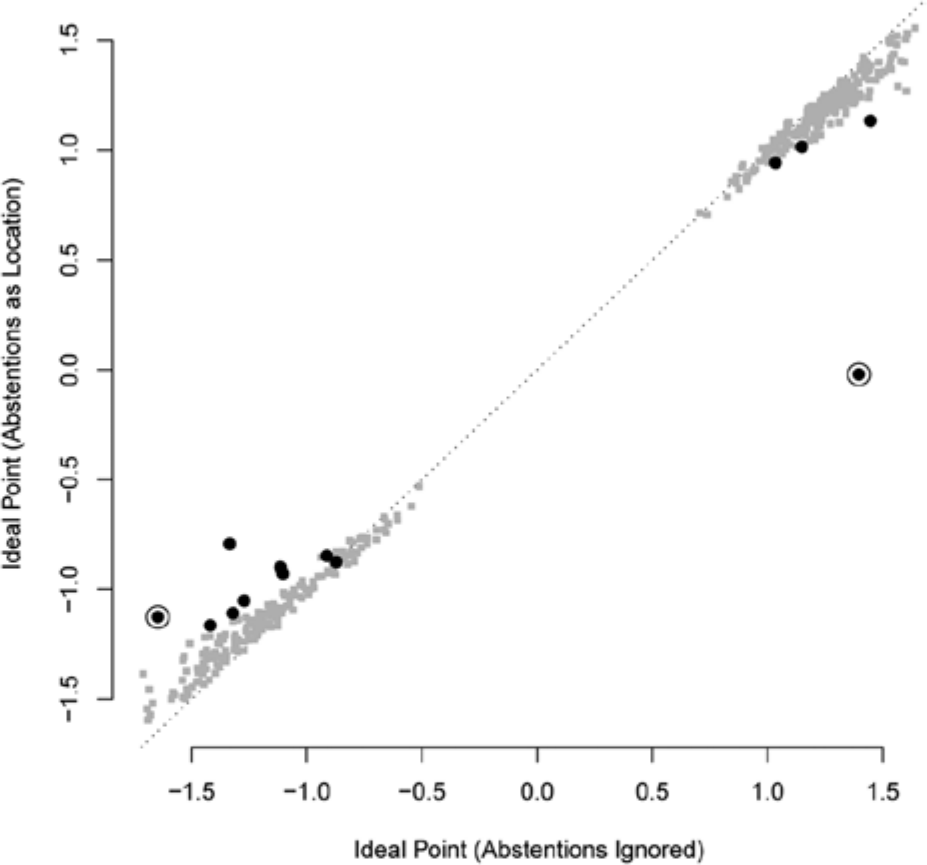
Ideal point estimates, 109th House: x-axis plots ideal points recovered when treating non-votes as missing, while y-axis plots the same ideal points under the assumption that nonvoting is spatially informative. Dotted line is a 45° line, and dark points represent estimates for legislators that abstained more than 100 times. In all cases, the estimated ideal point under the assumption that nonvoting is spatially informative is more moderate for frequent abstainers. This suggests that nonvotes occur for multiple reasons, invalidating a simple spatial interpretation for them in this particular application. The circled outlier on the right is president George W. Bush, and the circled outlier on the right is John Lewis (D-GA).
Two cases in the 109th House that are circled in Figure 1 highlight the dangers of pooling multiple causes of nonvoting together. On the right of Figure 1, one can see an outlier that represents the estimate of president George W. Bush’s ideal point, estimated using his administration’s expressed preferences on legislation from the House. 15 Bush’s ideal point under the assumption of ignorable nonvoting lies slightly to the right of the Republican median, an estimate that is largely in line with other accounts. 16 However, because Bush does not express opinions on most pieces of House legislation, his nonvoting count is extremely high. This causes his estimated ideal point to attenuate all the way to zero when nonvotes are modeled as separate locations. At this location, Bush lies far to the left of even the most liberal Republican Congressman, an estimate that is substantively implausible.
Distorted estimates of presidential ideal points are not surprising because presidents do not actually vote in the House. Nevertheless, similar results also appear for regular House members as well. One such case is John Lewis (D-GA), who is the frequent abstainer shown on the far left of Figure 1. Under the standard model where nonvoting is ignored, Lewis’s ideal point is estimated to be −1.65, ranking him as the 7th most liberal member of the House. In contrast, his ideal point under the model where nonvoting is informative places him at −1.12, ranking him as the 108th most liberal member of the House and slightly to the right of the median Democrat. 17 However, there is substantial evidence that the first estimate is more accurate—Lewis is an outspoken civil rights leader, and cites outspoken Florida liberal and New Deal supporter Claude Pepper as the political colleague that he admires most. Furthermore, there appears to be little evidence of electoral pressure to moderate, as Lewis has run unopposed since 2002. Finally, other ideal point estimates are consistent with the more liberal estimate as well—Poole’s Optimal Classification technique (2000), which estimates legislator locations nonparametrically, places Lewis as the 11th most liberal member of the U.S. House of Representatives. 18
Summarizing the discussion to this point, my review of the literature identified six mechanisms under which strategic vote avoidance might occur. In this section, I propose using the polytomous IRT model to study strategic vote avoidance further, and justify its use by demonstrating that it can be reparameterized as an ideal point model with quadratic utility and more than two choices. However, I also argue that because different mechanisms under which legislators might strategically abstain imply very different spatial interpretations, treating them as informative in a polytomous IRT model is generally not appropriate. In most cases, doing so will significantly moderate the ideal point estimates of legislators who abstain frequently—in one instance, changing the rank ordering of a legislator from the 7th to 108th most liberal member of the 109th U.S. House.
Present Votes in the 91st-93rd Illinois State Senate
In this section, I examine the uses of Present votes in the 91st-93rd Illinois State Senate, which covers most of the period that Obama served as a State Senator. Although Obama also served in the 90th senate, voting records for this period were difficult to access and are omitted from this study. 19 All voting data were obtained from the Illinois state legislature website at http://www.ilga.gov. The Illinois State Senate is comprised of 59 members, and was controlled by Republicans during the 91st and 92nd Senate before changing control to the Democrats in the 93rd. There is no supermajority required for legislation to pass, and the filibuster does not exist. In addition to standard Yea/Nay votes, the Illinois Senate allows members to vote “Present” on any legislation. Present votes are distinguished in the record from missing votes, where the senator is not available to vote, so they are unusual in that they indicate a deliberate decision not to vote Yea or Nay. However, Present Votes are not inconsequential because the Illinois Senate stipulates that all bills require the assent of an absolute majority of the chamber (i.e., 30 votes), rather than a simple plurality (i.e., more Yea than Nay votes). Present votes therefore have the same legislative effect as a No vote.
The decision to study Present votes rather than nonvoting more generally thus immediately addresses two issues raised earlier in my review of the literature. As deliberate acts of nonvoting, Present votes largely eliminate the set of cases where nonvoting occurs due to idiosyncratic reasons such as illness from consideration. 20 Present voting also eliminates the impact of vote scheduling—while Rothenberg and Sanders (2000) argue that legislators frequently abstain during periods when they spend time in their home constituency campaigning, these occasions would not be recorded as Present votes because such votes require the legislator to be on the Senate floor when the vote is cast.
Table 1 presents some descriptive statistics about general voting patterns in the Illinois Senate. These descriptive statistics illustrate two important characteristics of the data. First, many more roll calls were introduced in the 93rd Senate after the Democratic takeover, a point that is important to emphasize here because it affects the comparability of the graphics that are presented later. The 93rd Senate not only saw more roll calls, but the vast majority of those roll calls were also nonlopsided roll calls in which the losing side had more than 2.5% of the vote. Lopsided roll calls are typically uninteresting in the sense that they convey no spatial information, so the remainder of this analysis focuses solely on nonlopsided roll calls. Second, Present votes appear with some frequency in the data. Approximately 40% of all nonlopsided roll calls have at least one person voting Present, and 3.2% to 6.3% of all votes were Present votes. The key point here is that Present votes occur in sufficient frequency that they could, under certain situations, affect ideal point point estimates in a substantively significant manner.
Descriptive Statistics of Voting Present, 91st-93rd Illinois Senate.

Note. Lopsided roll calls include all roll calls where the losing side has less than 2.5% of the vote. Yea/Nay/Present votes only calculated from nonlopsided roll calls. Present vote fraction is Present votes divided by Yea/Nay votes. The Illinois Senate has 59 members at any one time.
Since Present votes have the same legislative effect as a No vote, the competing principals hypothesis suggests that senators might vote Present to kill legislation without having to cast a No vote directly (Forgette & Sala, 1999). Table 2 examines the evidence for competing principals by tabulating failed and successful roll call votes, and four key points emerge from this analysis. First, the vast majority of roll calls pass, consistent with expectations of strong party discipline (Cox & McCubbins, 2005). Second, I find little evidence in support of the hypothesis that Present votes are used to kill legislation. In examining the legislative impact of voting Present, I define a “Pivotal Present Vote” as a bill that fails to pass, but which would have passed if all senators voting Present had switched their vote to Yea. Pivotal Present votes thus define the set of roll calls where Present votes potentially “matter” in defeating a piece of legislation. Only 18 roll calls were Pivotal Present votes, which suggest that voting Present was generally an ineffective tactic at killing legislation. Third, I tabulate the total number of Present votes by Obama on nonlopsided legislation, which total 55 Present votes across all three Senates. Note that this figure is different from the 129 total Present votes attributed to Obama, as 74 of those Present votes occurred either in the 90th Senate or on legislation passing by lopsided margins. 21 Finally, Table 2 also shows how Obama’s frequency of voting Present ranked in the legislature. During the two Republican-controlled senates, Obama’s frequency of voting Present ranked him in the upper tertile, while his frequency dropped to the median during the Democrat-controlled 93rd senate.
Potential Impact of Voting Present, 91st-93rd Illinois Senate: Lopsided Roll Calls Where the Losing Side Has Less Than 2.5% of the Vote Are Excluded.
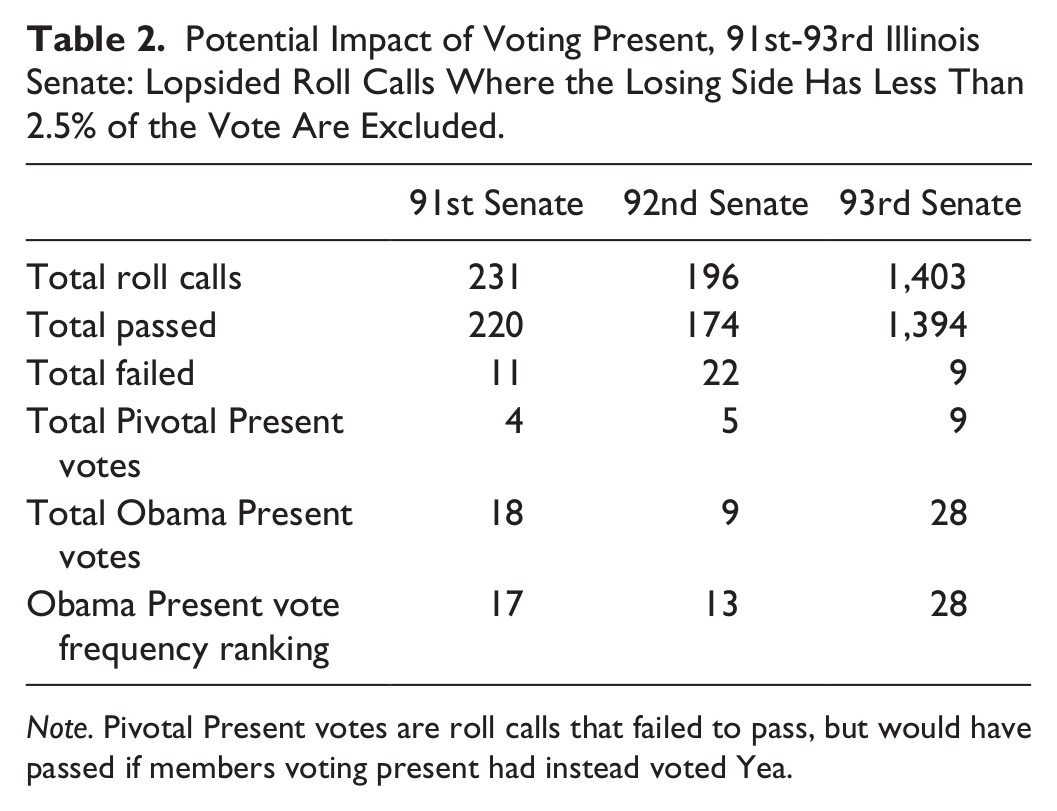
Note. Pivotal Present votes are roll calls that failed to pass, but would have passed if members voting present had instead voted Yea.
Table 3 continues this analysis by examining the 18 Pivotal Present votes in greater detail. With the potential exception of SB1704 (Pension Code Reform) and SB1963 (Consumer Protection Agency Act), none of the pivotal votes could be described as major pieces of legislation. 22 Present votes therefore rarely appear to be decisive on major legislation. Of the 18 pivotal outcomes, Obama voted Present on five of those occasions, yet even on these five occasions the legislative impact of his Present votes appears to be minimal. Obama’s Present votes in the 92nd state senate occurred on two pieces of legislation where large numbers of senators (22 and 30 senators, respectively) joined him. In the 93rd state senate, Obama voted Present on Election Code and Pension Code reform bills that narrowly failed, but the meaning of his votes here are unclear because they were votes against concurring with a House Amendment to a bill (typically a conference report), rather than a vote against the bill at third reading. The change to the Riverboat Gambling Act appears to be the sole example of a piece of legislation where Obama’s Present vote clearly mattered, yet this appears to have been a fairly minor piece of legislation.
Pivotal Present Votes, 91st-93rd Illinois Senate: Lopsided Roll Calls Where the Losing Side Has Less Than 2.5% of the Vote Are Excluded.

Note. Pivotal Present votes are roll calls that failed to pass, but would have passed if members voting present had instead voted Yea. 29 Yea votes are required to pass legislation.
A second version of the competing principals hypothesis suggests that senators might vote Present as an indirect way to oppose their party. If this is true, senators are likely to vote Present on party line roll calls that are supported by their party. I define a party line roll call as one where a majority of Democrats vote differently from a majority of Republicans, with Present votes excluded from the counts. Table 4 summarizes Obama’s voting patterns on party line votes, showing large differences in voting behavior between senates. Party line voting surged in Obama’s final term, jumping from 34 party line votes in the Republican-controlled 91st and 92nd Senate to 535 party line votes in the Democrat-controlled 93rd Senate. This increase was partly driven by the increase in total legislation in the 93rd, but even accounting for the volume of legislation the 93rd Senate was much more divided along partisan lines—38% of all roll calls in the 93rd Senate were party line votes, compared with only 8% before that. Across all three legislatures, Obama largely voted along party lines, siding with Democrats 92% of the time. Notably, although there were no instances where Obama voted Present on party line roll calls supported by Democrats in either the 91st or 92nd Senate, this occurred 16 times in the 93rd Senate. There is therefore some evidence that Obama used Present votes to indirectly oppose his party while the Democrats controlled the Senate.
Obama and Party Line Votes, 91st-93rd Illinois Senate: Lopsided Roll Calls Where the Losing Side Has Less Than 2.5% of the Vote Are Excluded.

Note. Party line votes are defined as roll calls where a majority of democrats vote differently from a majority of republicans, with Present votes excluded in the counts.
Nonvoting by indifference suggests that voting is most likely to occur when the probability of affecting the final outcome is high. If this is true, then Present votes likely to occur when the Yea and Nay sides are closely matched on a vote. Figure 2 examines the evidence for this claim by plotting the Yea–Nay margin on each roll call against the number of Present votes on each roll call, with Obama’s Present votes highlighted as darker points. While there are few votes that are close (i.e., have a Yea–Nay margin near 0), there is no evidence in any Congress that close votes are more likely to have large numbers of senators voting Present. Instead, Present votes occur most frequently when the Yea–Nay margin is around 35 votes. This trend is consistent with Obama’s pattern of voting Present in the 91st and 92nd Senate—Obama largely votes Present only when a large number of other senators are voting likewise. However, Obama’s propensity to vote Present in the 93rd Senate seems largely random.
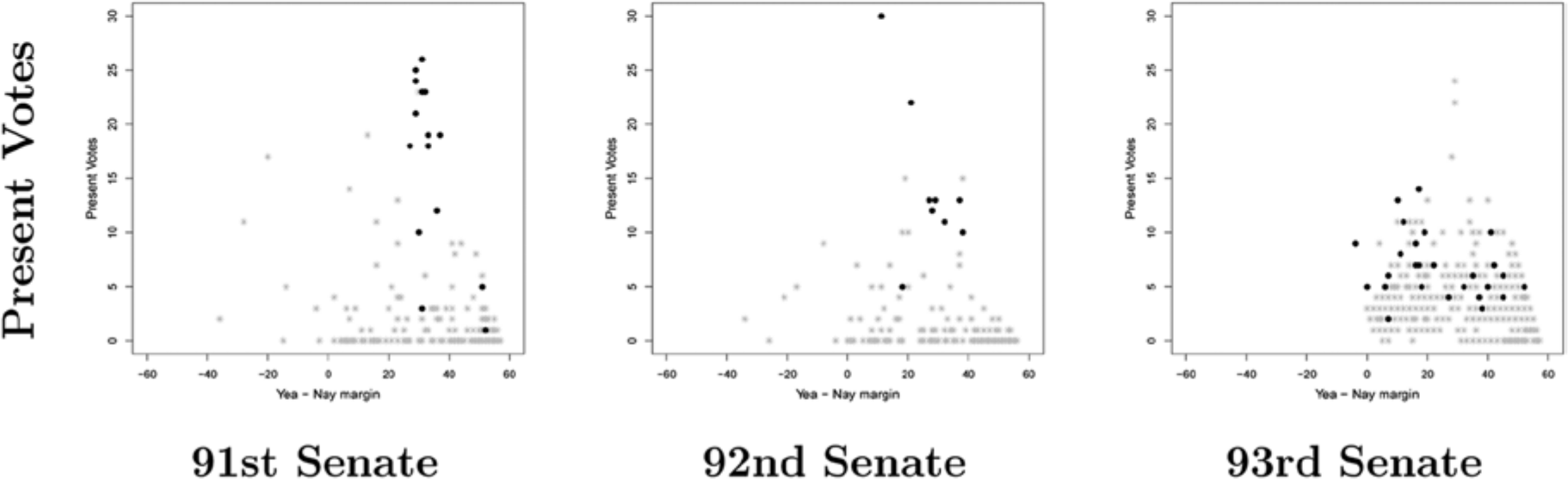
Frequency of Present votes by vote margin, 91-93 Illinois Senate: Vote margin on x-axis is defined as Yea minus Nay votes.
Although the previous graphic suggests that senators who vote Present frequently do so together, it provides little information about who votes Present together. To examine this issue, I first estimate ideal points for each Senate under the traditional assumption that Present votes are missing data. Figure 3 plots histograms of Present vote frequency by ideal point estimate. The histograms suggest that Present votes were largely used by the minority party—Democrats were particularly likely to use them in the 91st and 92nd Senate, while Republicans were likely to use them in the 93rd. Figure 3 also examines the evidence for the nonvoting by alienation mechanism. If alienation accounts for a significant portion of Present votes, one would expect to see large numbers of Present votes at the two extremes of the ideal point distribution. However, this does not appear to be the case. Finally, Figure 3 provides justification for the modeling assumption that Present votes are partially informative on the left-right dimension, since the majority of Present votes occurs along partisan lines.

Frequency of Present votes by ideal point, 91st-93rd Illinois Senate.
I also examine the evidence for Jones’ (2003) hypothesis that legislators seek to avoid position taking because votes are regularly cited against them in campaigns. This finding was disputed by Rothenberg and Sanders (1999), who instead argue that voting aids electoral success. I find little evidence that position avoidance helps reelection, as the 11 Republican senators who lost their seat between the 92nd and 93rd Senate averaged 3.73 Present votes compared with 3.85 Present votes for the entire Republican caucus. Electoral vulnerability therefore does not appear to explain the frequency of Present votes. 23
After rejecting alienation, indifference, electoral vulnerability, vote timing, and competing principals as explanations of Present votes, one is left with the conclusion that such votes are best interpreted as minority votes against legislation. Under such a mechanism, Present votes are spatially informative and can therefore be incorporated into models of ideal point estimation. Ideal point models traditionally treat Present votes as missing data. However, Present votes occur with moderate frequency and in a nonrandom manner. I therefore estimate ideal point models that incorporate Present votes in two ways. First, I estimate a model that treats Present votes as a third choice on each vote. I also estimate another model where Present votes are treated as No votes, a model motivated by the fact that Present and No votes have the same legislative effect. Ideal points estimated under these assumptions are then plotted against ideal points estimated under the traditional assumption of Present votes as missing data in Figure 4. Obama’s specific ideal point estimates under different assumptions are presented in Table 5. The relationships are strongly linear, showing little variability in the recovered ideal point estimates regardless of the model estimated.

Ideal point estimates under different assumptions, 91st-93rd Illinois Senate.
Obama Ideal Point Estimates under Different Assumptions, 91st-93rd Illinois Senate: Lopsided Roll Calls Where the Losing Side Has Less Than 2.5% of the Vote are Excluded.
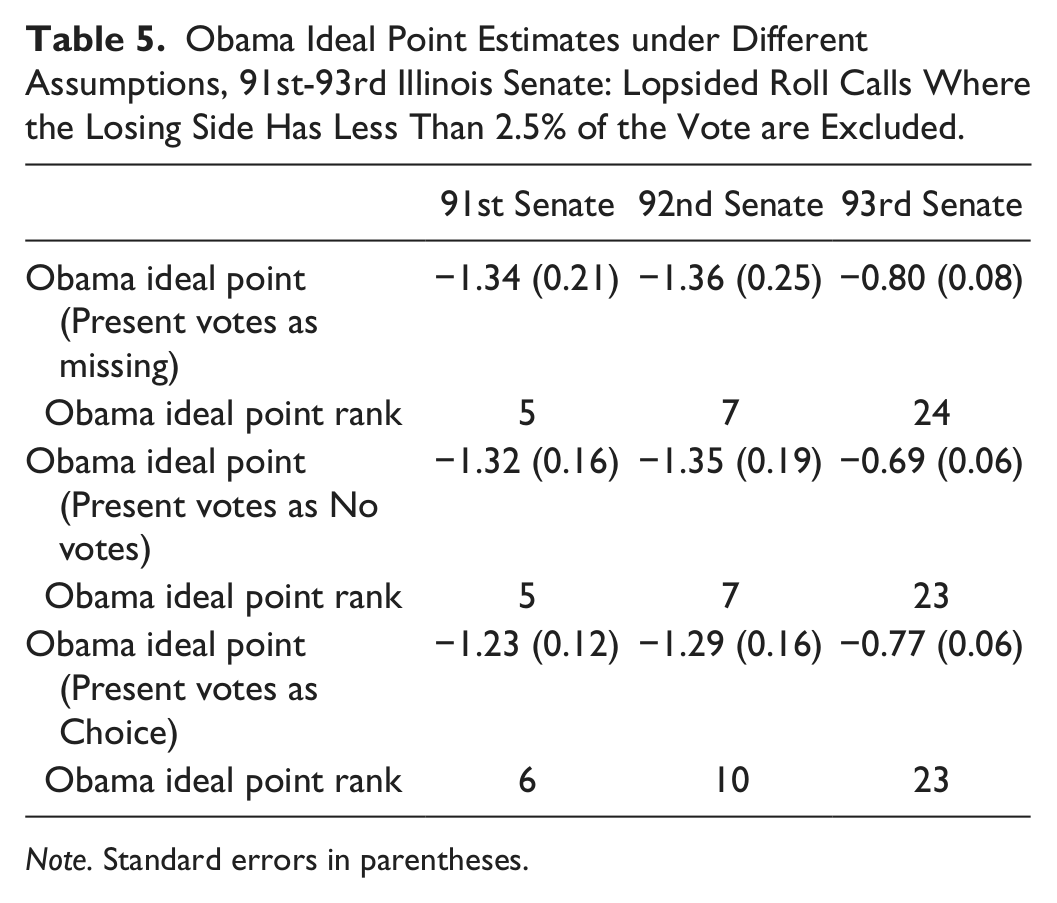
Note. Standard errors in parentheses.
Notably, Obama was criticized during the campaign for voting Present to appear moderate, yet there is little evidence of moderation in his ideal point estimates under either model of informative nonvoting presented in Table 5. The largest shift that is observed occurs in the 92nd state senate, where Obama is ranked as the 7th most liberal Illinois senator under the traditional model and the 10th most liberal when Present votes are considered as a separate choice. Note that a large shift in rank order is entirely possible—under the nonvoting-as-location model, John Lewis’s (D-GA) estimated ideal point changed his ranking from the 7th most liberal member of the House of Representatives to the 108th. No shift of any comparable magnitude occurs here. However, there is some evidence that suggests Obama may have become more moderate in the 93rd state senate, as his ideal point and ranking both moderate considerably. However, the evidence is still inconclusive because estimates across legislatures are not comparably—in particular, because the 93rd has a Democratic majority there are significantly more Democratic senator. 24 Furthermore, there is some possibility of vote selection effects that may arise as candidates campaign for higher office (Clinton, Jackman, & Rivers, 2004b).
While rank orderings largely remain unchanged when Present votes are incorporated into the model, the model obtains significant improvements in the efficiency of the estimates. Taking the 91st Senate as an example, Democrats had a mean standard error of 0.19 in the traditional model where Present votes are omitted. However, this drops to 0.13 in the model where Presents are counted as No votes, and 0.12 in the case where Presents are counted as a third location. However, the increase in efficiency is marginal for Republicans, who have a mean standard error of 0.16 under the traditional model, but mean standard errors of 0.14 and 0.15, respectively, under the models where Present votes are treated as no or separate votes, respectively. An obvious hypothesis explaining this discrepancy is the large number of Present votes cast by the minority party—this hypothesis receives strong support from the fact that the pattern is reversed in the 93rd Senate under a Democratic majority when Republican legislators vote Present much more frequently.
Summarizing the results presented here, the practice of voting Present largely appears to be a tactic employed by the minority party. When Present voting occurs, it is rarely decisive in the sense that the outcome of the vote would have changed regardless of how those who voted Present would otherwise have voted. In the few cases where Present votes are potentially decisive, the affected legislation is generally minor. Present votes also do not appear to occur for particularly controversial legislation where the Yea minus Nay margin is small—in fact, they are most likely to occur when the margin is about 30 votes.
Obama’s usage of Present votes was largely consistent with these patterns—his use of Present votes was in the upper tertile of legislators, but was not particularly unusual. The majority of Obama’s Present votes occurred on roll calls where large numbers of Democrats voted Present with him, particularly in the 91st and 92nd state senate. There is little evidence that Obama was more likely to vote Present when Present votes were potentially decisive, and little evidence that Obama was more likely to vote Present when votes were controversial. Some evidence suggests that Obama used Present votes to oppose his party on party line votes during the 93rd senate, but these votes were rarely decisive and had little impact on estimates of his ideal point. Notably, the incorporation of information from Present votes does not make Obama’s estimated ideal point more moderate. Obama consistently appears as the 5th or 6th most liberal member of the Illinois state senate in the 91st General Assembly, but he becomes the 23rd or 24th most liberal senator by the 93rd as he begins his campaign for the U.S. Senate.
Conclusion
In this article, I examine the use of Present votes in the Illinois state senate. I find that Present votes are best characterized as coordinated protest votes by minority party members against the majority. Since these votes produce cutlines that are consistent with the spatial model of voting, their inclusion into ideal point models is justifiable. These conditions are not true of nonvoting in legislatures such as the 109th House, which occurs for a wide variety of reasons with different spatial interpretations. Under these circumstances, the ideal point estimates of legislators who do not vote will frequently be greatly attenuated. These results thus suggest that because nonvoting more generally may occur for a variety of reasons, naive inclusion of nonvoting into vote choice models may lead to biased results. However, in contrast to the 109th House I find no significant attenuation of ideal point estimates when accounting for Present votes, and the efficiency of estimates improves by approximately 35% after information from Present votes is incorporated into the model. Furthermore, I find little evidence of significant moderation by Obama when Present votes are accounted for, though there is some evidence that Obama’s voting record moderated significantly before his subsequent election to the U.S. Senate.
In examining directions for future research, it is important to first compare and contrast this contribution to that of earlier work on this subject. Early work on nonvoting (Cohen & Noll, 1991; Poole & Rosenthal, 1997; Rothenberg & Sanders, 1999) examined rates of nonvoting, identifying multiple reasons why legislators might strategically avoid votes. However, these studies are limited by the fact that different nonresponse mechanisms each imply different spatial interpretations. In the context of this article, a central contribution of this earlier literature is to emphasize what should not be done—namely, pooling multiple sources of nonvoting into an ideal point model naively in models similar to what was shown earlier for the 109th House. Jones (2003) suggests that one solution to this problem is to examine only cases where legislators avoid taking positions, thereby eliminating idiosyncratic reasons for nonvoting from consideration. This approach facilitates a richer analysis of vote avoidance than is otherwise possible, but still does not completely address the pooling problem identified earlier in situations where one wishes to incorporate such information into an ideal point model.
My approach to the study of Present votes instead is similar to the working paper by Rosas et al. (2010), who attempt to determine the conditions under which nonvoting is ignorable in roll call data analysis. Rosas et al. propose three variants of the IRT model designed to incorporate information from nonvotes under the mechanisms of indifference, alienation, and competing principals, and they demonstrate that legislator ideal points can be recovered with greater accuracy under two of the three models via Monte Carlo simulation. A central theme of their paper is that vote avoidance can often usefully be incorporated into ideal point models if the nonresponse mechanism can be isolated and modeled.
Similar to Rosas et al. (2010), I begin by identifying a nonresponse mechanism and developing an ideal point model to capture the dynamics of nonresponse. However, I build upon this model in significant ways, first by showing the relationship between the polytomous IRT model and a multiple choice spatial model of voting, and also in showing the attenuation bias that can occur when nonresponses resulting from different processes pool together. I then identify the Illinois legislature as a case where a single nonresponse mechanism appears to be particularly dominant in explaining deliberate acts of nonvoting. This situation is especially intriguing in light of its relevance to the 2008 U.S. presidential campaign. In contrast to claims that suggest otherwise, I find little evidence that Present votes moderate estimates of Obama’s estimated ideal point in any way, but incorporation of such votes improves the efficiency of estimates considerably.
Moving forward, substantive applications of nonvoting models to real legislatures is clearly an important and worthwhile endeavor, especially in light of Rosas et al.’s (2010) claim that such mechanisms are not ignorable. Such applications are difficult to address in light of the pooling problems discussed earlier. This research suggests that one way to approach this problem is through cleaner identification, whereby nonvoting behavior driven largely by a single nonresponse mechanism can be isolated. This can be done not only through careful selection of the legislature to be analyzed but can also potentially be accomplished by subsetting particular votes or legislators. Careful selection of cases can therefore permit theoretical expectations of nonresponse to become more closely aligned with what is observed.
Footnotes
Acknowledgements
I would like to thank editor Timothy Nokken and two anonymous reviewers for providing feedback that substantially improved this article.
Declaration of Conflicting Interests
The author(s) declared no potential conflicts of interest with respect to the research, authorship, and/or publication of this article.
Funding
The author(s) disclosed receipt of the following financial support for the research and/or authorship of this article: I gratefully acknowledge support from the research center SFB 884 on the Political Economy of Reforms at the University of Mannheim (Project C4), funded by the German Research Foundation (DFG).