




Abstract
Urban and regional planners, in the era of globalization, require being equipped with necessary skill sets to better deal with complex and rapidly changing economic, sociocultural, political, and environmental fabrics of cities and their regions. To provide such skill sets, urban and regional planning curriculum of Queensland University of Technology, Brisbane, Australia, offers planning practice in the international context. This article, first, reports the findings of pedagogic analyses of the international field trips conducted to Malaysia, Korea, Turkey, and Taiwan. The article, then, discusses the opportunities and constraints of exposure of students to planning practice beyond the Australian context.
Keywords
Introduction
In the era of globalization with rapidly changing economic, sociocultural, political, and environmental conditions, urban and regional planners need to become more resilient, innovative, and be able to better deal with the complex and complicated nature of cities and their regions. Urban and regional planning (“planning” in short) education plays a fundamental role in training and forming planning practitioners to be able to tackle such problem. In the globalizing and rapidly changing world, transcultural engagement has demonstrated its potentialities for planning education and practice to become more attentive to the diversity and change management (Abramson, 2005). Along with this, the need to internationalize planning education has been widely recognized by various associations such as the North American Association of Collegiate Schools of Planning, Association of European Schools of Planning, Australian and New Zealand Association of Planning Schools, and Planning Institute of Australia (Frank, 2006).
Reid and Loxton (2004) stressed that from the student perspective, internationalization can mean the experience of visiting a different country, learning about contrasting ways of living and thinking, and perhaps integrating these experiences into their own value systems. This seems to reflect closely on the wider strategies of many universities, which seek to prepare students to live and work in a global and multicultural society, with cultural and environmental sensitivity, understanding, and communicative competencies (Reid & Loxton, 2004). An international field trip can be defined as an educational trip to an international destination for observing and/or taking (non)experimental research relevant to the study/project of involved students. In this perspective, these trips represent a widely regarded and useful delivery mechanism for such enriching educational experience and competencies, where students can learn via firsthand experiences (Fuller, Edmonson, France, Higgitt, & Ratinen, 2006; Houser, Brannstrom, Quiring, & Lemmons, 2011). This makes the international field trip approach one of the “optimal” models for positive learning outcomes as long as it is linked with the project started in the classroom and continued after the return from the trip (Edwards, 2009).
This article aims to explore the role of international field trips in cultivating the pedagogy of student experience in the planning practice in the light of the literature and organized field trip exercises. The article reflects on the experiences from the four consecutive international field trips organized to Malaysia (2008), Korea (2009), Turkey (2010), and Taiwan (2011) based on the analyses results of (a) student focus group interviews, (b) field trip evaluation surveys, (c) informal discussions with professors, and (d) student performance differences between student groups who participated and had not participated in international field trips. These field trips took place as part of the regional planning practice course of Queensland University of Technology (QUT), Brisbane, Australia, where some of the 4th-year undergraduate planning students attended.
The article is structured in five parts. Following this introduction, the section “Internationalization of Education, International Field Trips, and Student Performance” presents the summary of the review of the literature on internationalization of higher education, international field trips, and student performance, and highlights the benefits of expanding the planning curriculum to incorporate international elements such as field trips. “Evaluating the Learning Outcomes of International Field Trips” section reports the purpose and technical details of the course and four international field trips organized jointly by QUT and hosting universities of the visited countries between 2008 and 2011. The section “Method, Analysis, and Results” discusses the field trip outcomes in the light of information collected through student interviews, surveys, and assignment performances along with discussions with their professors. The last section concludes by highlighting the opportunities and constraints of exposure of students to regional planning practice beyond the national (Australian) context.
Internationalization of Education, International Field Trips, and Student Performance
Globalization and the ascendancy of the knowledge- and service-based marketplace have had a profound impact on the economic, sociocultural, political, and environmental contexts, and consequently resulted in a trend toward growing reflexivity within the higher education system (Yigitcanlar, 2011). According to Khan (2009), globalization requires interaction with different regions and various cultures and this is leading universities to redefine the direction of their courses and the graduate attributes to be pursued. Economic and cultural pressures associated with globalization have created a concern for a workforce that is globally aware and employable in cross-cultural settings . . . In order to remain competitive, universities feel the need to internationalize their course content. (p. 1)
According to Coates and Edwards (2009), graduates need to be conscious of increasing diversity in their social and organizational surroundings. They also need to obtain the skills and knowledge that will allow them to be better prepared for local and global citizenship. J. Knight and de Wit (1997) defined internationalization of higher education as a “proactive” response to globalization. Writing from a North American perspective, Ali and Doan (2006) referred to recent efforts to internationalize planning education to provide students with a fundamental multicultural understanding. They indicated that this emerging trend has led many universities to develop internationalization strategies, as part of an effort to recruit a greater proportion of international students and staff. However, these approaches to internationalizing higher education have been criticized by some who argue that such a shift involves more than just marketing the university to attract foreign students and staff (Wende, 2001). According to J. Knight (2003), internationalizing the university system requires “integrating an international, intercultural or global dimension into the purpose, functions or delivery of post-secondary education” (p. 2), and therefore, recommends increasing foreign research collaborations, establishing international didactic partnerships, and expanding the curriculum to incorporate international elements. While support for the internationalization of the university curriculum has increased significantly in recent years, the internationalization of higher education is arguably still in its infancy (Back, Davis, & Olsen, 1996). This, hence, invites a greater collaborative effort from academic communities.
Internationalization, originating from within the planning academy itself, is an expanding movement toward further developing international research partnerships, enhancing the international perspectives of university programs, and even incorporating specialized international planning subjects into the syllabus. The scholarly assumption appears to be that internationalizing the planning curriculum provides an opportunity to introduce diversity, multiculturalism, and cultural differentiation into education; processes that theorists such as Friedmann (1996) lamented to be understudied in planning. Other scholars, such as Goldstein, Bollens, Feser, and Silver (2006), contend that the internationalization of planning education strengthens the foundations of cross-cultural sensitivity in students, which not only ensures they are prepared to meet the expectations of a diverse marketplace but also equips students with the skills of diversity management required by modern organizations. Correspondingly, Alterman’s (1992) empirical critique of planning practice and education imply that failure to incorporate an international perspective into the university program limits students understanding of the contexts in which planning practice and education occur cross-nationally, and he recommended educating students about other countries to enhance their appreciation of planning processes.
It is evident in the literature that students who receive an internationally focused higher education are more responsive to global market forces, have enhanced social and cultural awareness, and are better prepared to cope with the ramifications of significant political change (e.g., Coates & Edwards, 2009; J. Knight, 2003). Furthermore, opportunities for international immersion can expand horizons for students, academic researchers, and the broader university institution; achieved through facilitating cooperative working relationships across partner universities and generating high-quality research products that can be used to inform professional practice as well as contribute to the advancement of the existing body of applied knowledge (P. Knight & Yorke, 2004). Some planning theorists (e.g., Abramson, 2005; Goldstein et al., 2006) argue that international immersion provides students with more marketable skills in the workplace, in particular, the ability to apply cross-cultural knowledge, and highlight the value of international field trips in expanding traditional pedagogy and practice to an international setting and understanding. Similarly, Afshar (2001) supported the view that international pedagogical experiences provide the participants with an opportunity to acquire knowledge through action across a broad range of institutional and cultural contexts; and is invaluable to the development of a reflective planning practitioner.
Abramson (2005) underlined the usefulness of a series of intense field trips integrated with a continuous relationship of academic exchange and ongoing research to engage students and academics from both countries as a means for discovering the differences in planning culture that exist across nations. He predicts that in the foreseeable future, the effectiveness of planning professionals would largely depend on the ability of their work to transcend international boundaries, and stated “as greater numbers of planning consultancies practice across national borders, the local embeddedness of actual planning conditions presents a major problem for the training of planning professionals” (p. 101). On this point, Taylor and Finley (2011) highlighted the value addition of international field trips not only by enhancing teaching and learning capabilities, developing research partnerships, and widening organizational resources; but also by equipping students with the skills and knowledge to function professionally across diverse cultures.
Similarly, Ali and Doan (2006) identified international field trips to be one of the most innovative methods of enhancing student understanding of planning processes and complexities of diverse cultural, economic, and political systems. They emphasized that this type of pedagogical experience constitutes an effective application of integrating an international perspective into the curriculum, as it creates international research partnerships for the development of intercultural skills and understanding of global processes, rather than just marketing university’s programs and students internationally.
International field trips are widely claimed and regarded as an important part of the higher education experience that students have a firsthand, hands-on, and problem-based real-world learning experience in a different setting from their own country (Hefferan, Heywood, & Ritter, 2002; Hovorka & Wolf, 2009; Pawson & Teather, 2002; Stronkhorst, 2005). To scientifically prove these claims, Houser et al. (2011) undertook an objective analysis of student comprehension and retention of course material through a comparison of test performance between students who participated in an international field trip and their peers who did not. The findings of this study revealed that international field trips improve cognitive learning. They stated, the key finding of this study is that fieldtrip students [received] significantly higher exam scores, as compared to their peers not involved in the study abroad fieldtrip . . . Fieldtrips have significant social and affective outcomes that contribute toward improved learning outcomes and test performance. (p. 526)
According to Dee, Tsui, Lee, and Yigitcanlar (2011), the importance of international planning education in facilitating a deeper understanding of cultural diversity and exposing students to new ways of thinking cannot be underestimated. In an era of globalization and wireless technology, international collaborative planning projects can equip graduates with the skills necessary for professional practice in a national or international context. (p. 72)
In summary, while there are various means that are employed by universities to internationalize their course content, an increasingly popular means of internationalizing the content of education is the incorporation of field trips into the curriculum. International field trips, thus, have the potential to play a significant role in helping universities to respond to the demands of globalization and rapidly changing economic, sociocultural, political, and environmental conditions. Depending on how well they are organized, field trips can be academically thorough and can create a cultural experience useful in the globalizing world, and the exposure provides an opportunity for students to develop their intercultural competence. As Khan (2009) stated, this is a valuable attribute for planning professionals, making them job ready for an expanding and increasingly international job market.
Evaluating the Learning Outcomes of International Field Trips
Regional planning practice course of the urban and regional planning undergraduate program at QUT offers 4th-year planning students an opportunity to develop their knowledge and skills for effective strategic planning and coordination of a positive metropolitan regional change in an international context. Since 2008, each year, this course has been choosing a metropolitan region from abroad as a case study for students to (a) demonstrate an understanding and capability to apply planning theories and principles, (b) review planning methods critically, (c) create effective strategic development frameworks, and (d) integrate and apply the practice material taught. Although organizing an international field trip is not a requirement of the Planning Institute of Australia—professional course accreditation body in Australia—this course includes an international field trip of about 2 weeks to the metropolitan region under investigation to improve student competency in addressing intercultural planning and development issues.
These international planning exercises were specifically designed to enhance teaching and learning capacities, develop teaching partnerships, and provide students with skills and competencies to function professionally in a multicultural context. As part of this course, between 2008 and 2011, four international field trips were organized to Kuala Lumpur (Malaysia), Daejeon (Korea), Gallipoli (Turkey), and Taipei (Taiwan) from Brisbane (Australia). As recommended by Edwards (2009), these international field trips were planned as “the optimal model” for positive learning outcomes by being linked with the project started in the classroom and continued after the return from the trip.
From each year’s regional planning practice class, where approximately 80 to 90 students enrolled, up to 30 of them, based on first-come-first-served method, have been chosen to participate in the international field trips (for the enrollment numbers, see Table 5). During the first three deliveries of the course (2008-2010) while international field trip participants’ project focused on the international metropolitan region they visited, a local project from the local metropolitan region (Brisbane) has been assigned to the rest of the class as their study region. At the last delivery of the course (2011), the entire class took the same international metropolitan region (Taipei) as the case study area.
Planning and preparation of field trip activities commenced about a year before the trip and continued in strong collaboration with hosting universities. Several funding resources from QUT were channeled for these trips to become as affordable as possible for the participating students. In all four field trips, while students covered the cost of their own air travel, their accommodation, meals, travel insurance, and field trip–related technical expenses were covered by QUT, and the hosting universities covered the local transportation, local seminar, and forum speakers’ expenses and venue hiring costs.
The field trip destinations were carefully selected considering the following key criteria: (a) study area providing a unique real-world planning problem that would help students to enrich their comprehension of planning issues beyond Australia; (b) data and information availability of the case study region in English; (c) good ties with the hosting institutions, which secures the local delivery and quality of lectures, workshops, site visits, and surveys; (d) participation of local university professors and students in the activities; and (e) affordability of the field trip for students. Table 1 lists the details of the international field trips and participants.
International Field Trips and Participants.

Note: QUT = Queensland University of Technology; IIUM = International Islamic University of Malaysia; HNU = Hanbat National University; ITU = Istanbul Technical University; COMU = Canakkale Onsekiz Mart University; NTPU = National Taipei University.
These field trips were collaborative exercises organized jointly by visiting (QUT) and hosting universities and scheduled for the first 2 weeks of the semester—at the last week of July and first week of August every year between 2008 and 2011. During this period, visiting students (in total 94 QUT students) worked with hosting university students (in total 78), under the supervision of professors (in total 15 from QUT, 16 from hosting universities) in collecting the relevant information for preparing regional development plan proposals in the following 12 weeks after the field trip. Regional planning practice course, in terms of outputs, consisted of a regional appraisal (field trip report), regional activity analysis report (expanded version of field trip report including review of the relevant literature), and regional development plan proposal (plan and accompanying report detailing vision, objectives, key development strategies, and actions). During the field trips, students of visiting and hosting universities worked in groups under the supervision of their professors to prepare the first output of the course (i.e., field trip report) and participated in the activities listed in Table 2.
International Field Trip Activities.

Note: Activities evolved from year to year due to the nature of projects, collaboration with hosting universities, result of learnings, and student feedback.
After the field trips, hosting university planning students kept in touch and supported QUT students with additional information and local knowledge. The regional planning practice course, at the end of the semester, culminated with the presentation of the regional development plan proposals prepared for the visited case study areas by QUT students. The hosting university students and professors were invited to attend the final presentations. However, due to time and financial constraints, attendance of the hosting university student and staff for the final event of the project in Brisbane could not be materialized.
The following section reports the evaluation method, analysis, and results of the learning outcomes from the four international field trip experiences, including assignment performance differences between the student groups who participated and who did not participate in the international field trips.
Method, Analysis, and Results
Focus group discussions, interviews, and surveys are among the commonly applied qualitative and quantitative methods in evaluating teaching and learning outcomes (e.g., Houser et al., 2011; Isoardi, 2010). To best capture and analyze the opportunities and constraints of exposure of students to international planning practice, the research methodology includes semistructured interviews with student focus groups and structured field trip evaluation surveys with students. These interviews and surveys (on top of QUT’s standard teaching and learning surveys) were conducted at the end of the semester (n = 24 and n = 77, respectively). The purpose of waiting about 3 months after each field trip was to get a much clearer and settled view from the students on what level the international collaboration improved their skills and competencies, and contributed to their professional and personal development. In addition to the focus group interview and survey techniques, a validity check was conducted by involving professors, who attended these international field trips, through informal discussions on the results of student interviews and surveys (n = 11). Finally, a performance analysis has been undertaken to measure and shed light on the achievements of international field trip participants in three of the assessment items in comparison with their peers who had not participated in international field trips.
Student Focus Group Interviews
The first analysis of the research was conducting interviews with selected student participants of international field trips. Semistructured interviews were undertaken for each field trip during the last week of the semester with randomly selected six QUT students, forming a focus group, to reflect the outcomes of international field trip experiences (n = 24).
From these conversations, we found out that almost all interviewed students view the international activity as an extremely positive contribution to their professional and personal development. Interviewee S19 (Student Number 19) put forward, [field trip] was an amazing journey in my university education, it made me open my eyes to the issues beyond Australia . . . This is a perfect experience for engaging us with an overseas real-world practice, while motivating and triggering our curiosity.
Some interviewees reflected on the contributions of learning from problem-oriented fieldwork. Interviewee S13 stated, “I gained new insights, perspectives and technical skills from this international project, as we worked on an international real-world problem-based project . . . This project broadened my vision and helped me to see the big picture.”
Some interviewees highlighted the contributions of the international social interaction on their technical abilities. Interviewee S10 stated, although the field trip was an innovative way of teaching and equipping us with technical experience, the most important aspects of it were to provide us an opportunity of working in international teams, and increasing professional self-confidence levels and developing cross-cultural social skills.
Beyond this, especially networking and building new friendships dimensions of the field trips were frequently voiced as a positive method of encouraging student learning while having a good time and making new friends.
The comments of Interviewee S23 on his personal observations and suggestions reflect most of the students’ common view on this international collaboration. As he said, the overall field trip was an invaluable experience, I have personally learned a lot from the joint work with my peers [in the visited country]. The trip provided me with an insight into international planning issues, cultural complexities, and the importance of governance within the planning framework. I would recommend the trip to all planning students. This type of field trips and experiences broaden our perspectives and create a thirst for learning more about other countries’ way of planning.
Finally, the use of new technology and techniques during the project was also mentioned along with interviewees seeing themselves getting equipped with international knowledge in the discipline area, which may lead to overseas employment opportunities.
On the downside, there were some concerns that were considered as constructive comments for the future field trips. There was a repeated comment on the length of the trip to be extended further as the field trip was found not having enough contact time with local professionals to provide students with an opportunity to engage with a wide range of discussion and in-depth analysis. According to Interviewee S18, visiting the local planning departments and learning about local planning practice within another country provides a new platform from which I can now look at planning theories and practice in my area, and challenge the accepted norms. However, it would have been great to spend more time with these experts to get a much more detail information on the case study area.
Another point was on the cultural and language differences not helping to follow and join discussions and communicate with local people and local activist group representatives. According to Interviewee S5, “the level of detail we were able to obtain and evaluate didn’t always flow down to local policies due to issues such as language differences.” Interviewee S7 agrees on this view and adds on, “the workshop and lecture contents were very good, but sometimes the language barrier was a problem for us to fully follow the lecture and join the discussion afterwards.” Interviewee S2 said, “the activities were good; however they were too focused on the government perspective and needed more focus on community groups and activists, and urban problems that need to be resolved immediately.”
The next key issue was related to the organization of the planning practice and policy development collaboration that provides enough time for students to get to know about each others’ culture and planning systems. On that matter, Interviewee S12 stated, “[we] probably need a session to explain both universities’ education in terms of planning and discussing planning processes in both countries in more detail.” On the very same subject, Interviewee S20 underlined the need for a denser collaboration by saying, “more closeness required learning from each other. Thus, this will break the cultural barriers between two university students . . . Perhaps home-stay during the field trip might be useful.”
Difficulty of arranging regular weekly contact time with hosting university students to complete the project following the field trip was raised as a concern. Interviewee S19 mentioned, cooperating with [local] students was very helpful for us . . . [Case study area] is extremely sensitive region not only historically but also environmentally and an outside view on the development and protection strategies would make a great contribution. Nevertheless, following this unique and different planning experience it was quite challenging to keep regular online meetings via emails, instant messengers or Skype to further develop the project.
Finally, beyond aforementioned issues, logistic limitations (particularly in Western standards), field trips being physically demanding for some, limited interpersonal skills of hosting university students (most likely due to cultural characteristics or shyness), involving rather a one-way knowledge transfer (concerning of hosting university students), and limited funding for students were mentioned as other key constraints of these field trips.
The following summary, listed in Table 3, was captured from the focus group interviews (2008-2011) as the main issues concerning opportunities and constraints of the field trip experiences.
Results of the Student Focus Group Interviews.

Note: Issues raised by interviewees are filtered and only highly relevant and issues raised by minimum two interviewees are included.
Student Evaluation Surveys
The second analysis was conducting structured surveys with student participants of international field trips. Survey questionnaires, consisting of 31 questions with five Likert-type scale response options, were sent to QUT students by email. The student survey response rates were 81.75%, 85.71%, 84.00%, and 76.00% for the Kuala Lumpur, Daejeon, Gallipoli, and Taipei field trips, respectively. The 4-year average response rate was 81.91% (n = 77). The combined 4-year results of the student surveys, undertaken between 2008 and 2011, are presented in Table 4.
Results of the International Field Trip Evaluation Surveys.
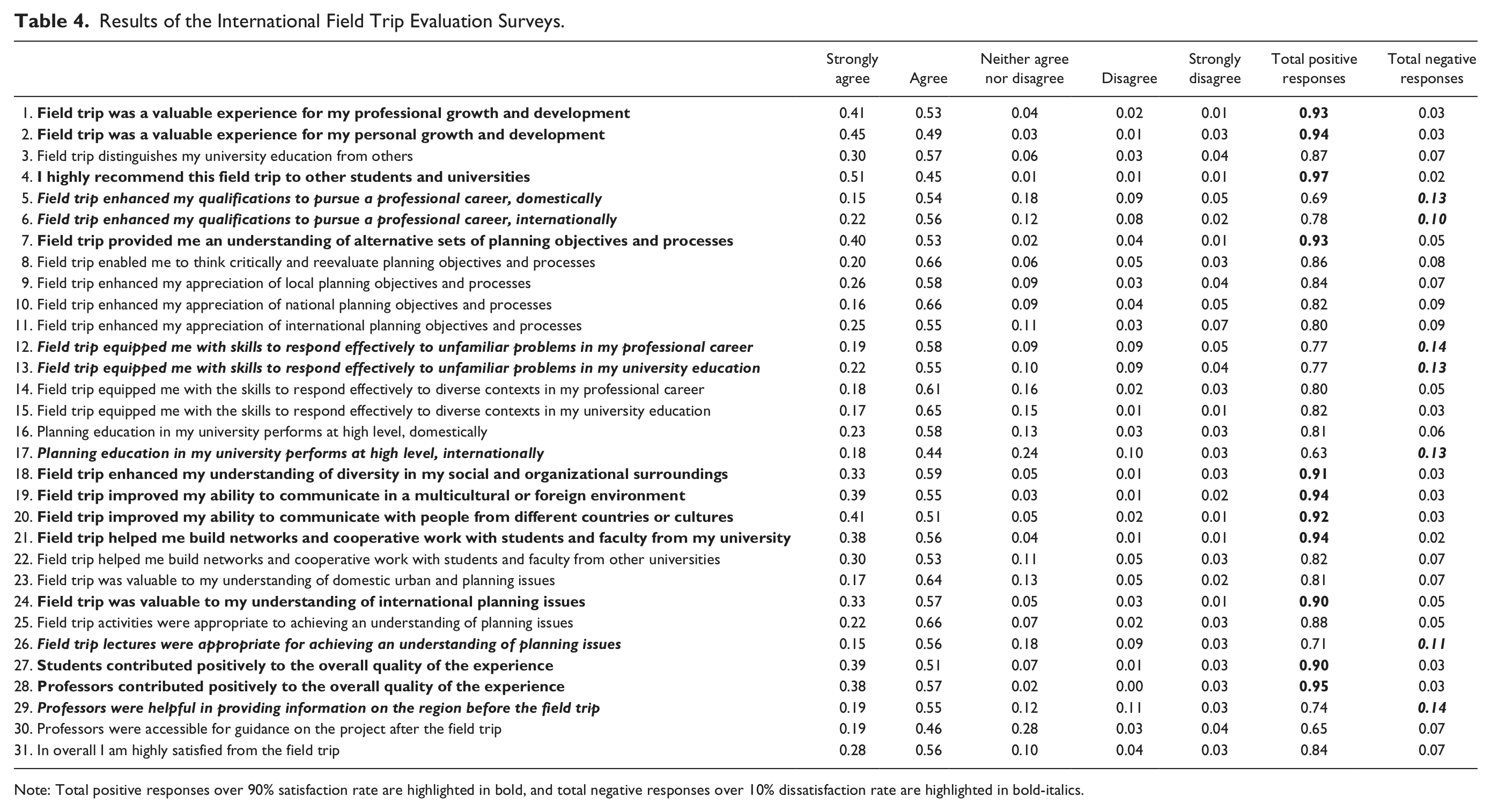
Note: Total positive responses over 90% satisfaction rate are highlighted in bold, and total negative responses over 10% dissatisfaction rate are highlighted in bold-italics.
Perfectly aligned with what McLean, Hurd, and Rogers (2007) put forward, Kuala Lumpur, Daejeon, Gallipoli, and Taipei field trips have been perceived as quite attractive, because students, particularly the “Y generations,” saw them as opportunities to combine leisure activity (e.g., traveling, seeing new places, and expanding social networks) with education (e.g., study away from university and home). The highlights of these results are illustrated in Figure 1, and the main issues from the conducted surveys between 2008 and 2011 are presented and discussed below.
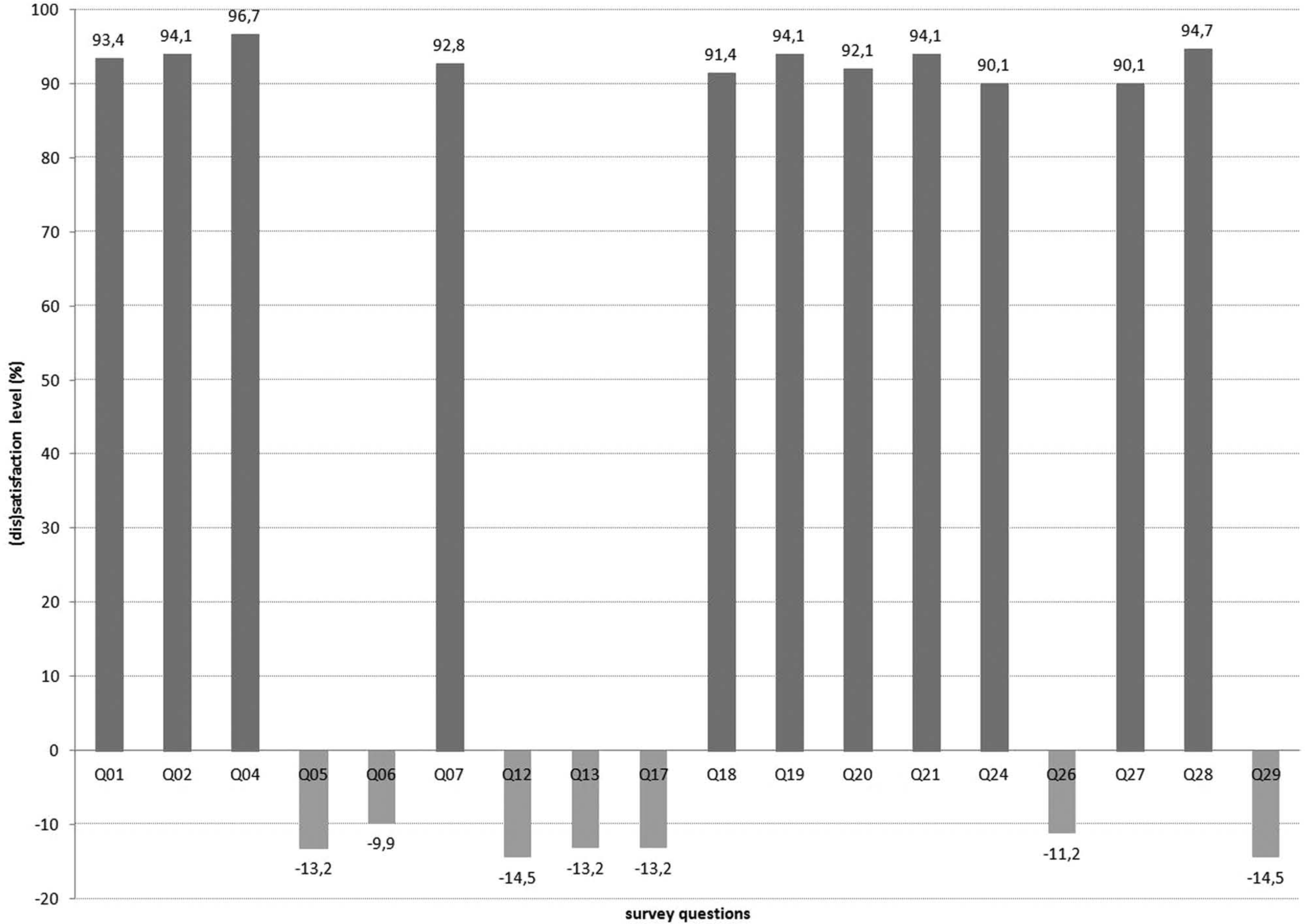
Highlights of the international field trip evaluation surveys.
In terms of overall findings of the field trips, in total, 28% of respondents had “strong agreement” on the benefits of planning field trips, whereas other 56% had “agreement” (total 84% satisfaction rate). The students almost had a consensus on (above 90% satisfaction rate) the following points:
(Q1) Field trip was a valuable experience for my professional growth and development;
(Q2) Field trip was a valuable experience for my personal growth and development;
(Q4) I highly recommend this field trip to other students and universities;
(Q7) Field trip provided me an understanding of alternative sets of planning objectives and processes;
(Q18) Field trip enhanced my understanding of diversity in my social and organizational surroundings;
(Q19) Field trip improved my ability to communicate in a multicultural or foreign environment;
(Q20) Field trip improved my ability to communicate with people from different countries or cultures;
(Q21) Field trip helped me build networks and cooperative work with students and faculty from my university;
(Q24) Field trip was valuable to my understanding of international planning issues;
(Q27) Students contributed positively to the overall quality of the experience, and;
(Q28) Professors contributed positively to the overall quality of the experience.
There was only in total 7% of combined “disagreement” (3%) and “strong disagreement” (4%) on some of the issues. The main disagreements (above 10% dissatisfaction rate) were the following (however, the satisfaction rates range between 63% and 78% for all of these issues):
(Q5) Field trip enhanced my qualifications to pursue a professional career, domestically;
(Q6) Field trip enhanced my qualifications to pursue a professional career, internationally;
(Q12) Field trip equipped me with skills to respond effectively to unfamiliar problems in my professional career;
(Q13) Field trip equipped me with skills to respond effectively to unfamiliar problems in my university education;
(Q17) Planning education in my university performs at high level, internationally;
(Q26) Field trip lectures were appropriate for achieving an understanding of planning issues, and;
(Q29) Professors were helpful in providing information on the region before the field trip.
The results of the surveys overlap perfectly well with the findings of the student focus group interviews. The survey results backed up the interview findings indicating international field trips as a significant contribution to student learning, professional and personal growth, understanding diversity and international issues, having a big picture perspective and building networks of cooperative work with increased student competency and communication abilities. These outcomes perfectly fulfill the objective of the course and the planning program at QUT. On the downside, constraints raised at the interviews and surveys point out to first, room for improvement in the organization of field trips, and second, insufficiency of just one international field trip in the entire undergraduate planning education to build student knowledge, skills, and confidence to the highest level on the international planning practice.
Professor Interviews
The third analysis of the research was conducted to capture the views of participant professors on the international field trips and at the same time check the validity of student responses collected by focus group interviews and surveys with their professors. The results from interviews and surveys were shared with professors from visiting and hosting universities and then informal discussions held with them either face-to-face or over the Internet via tele- or video-conferencing to record their feedback on and responses to the findings. In total, eight professors from the hosting universities and three from QUT participated to this exercise (n = 11).
In consensus, this group of professors confirmed the validity of student responses and agreed on the highly positive contributions of conducted international field trips to student learning and professional and personal growth. The following views, on the contribution of international field trips to student learning outcomes, most adequately summarize the opinions of the professorial group who participated in the informal discussions and provided their feedback.
According to Interviewee P3 (Professor Number 3), planning exercises jointly conducted with overseas universities are not only teaching our students the cross-cultural dimensions of the discipline, equipping them with techniques on how to better deal with the urbanization problems of the new century, and increasing their job readiness in the highly globalizing world, but also significantly contributing to their personal development by giving them confidence they need when they face new [and unfamiliar] problems, helping them to think out of the box, increasing their curiosity to learn and research, and becoming more open and respectful to the different cultures, traditions, voices, and perspectives of others.
Interviewee P8 stated, [i]n the world we live in today, taking students out of the country for a problem-oriented fieldwork is the new fashion of taking students out of classrooms for learning by experience . . . This way, the interaction and learning increases exponentially as a result of experience boosted and triggered by the new, foreign and challenging environment. And [as in this joint planning exercise] it leads to better learning outcomes than most of the traditional classroom-based instruction.
Perhaps, most remarkable comment was potentially these international collaboration to generate a new type of student/professional that not only confident in the practice of the discipline as much as the conceptual dimensions of it, but also preparing themselves for better understanding and solving the problems of global communities of the world . . . and eventually contributing to the world peace and sustainable development. (Interviewee P6)
Some issues identified from the collaborative study related to the students having more information provided about the host country prior to commencement of the trip and having some shorter days during the study tour so that students are not overwhelmed by the full trip itinerary. Another issue related to language and cultural barriers which at times prevented effective communication, however on reflection, many students came to regard this as part of the experience and a way to develop intercultural communication skills.
The final issue raised in the interviews was the financial burden of these trips to the teaching staff. All professors were volunteered to take part in these activities with no payment for their time. Beyond this, almost all hosting and visiting professors spent a reasonable amount from their pocket in these trips as the funding from their universities only covered parts of their basic expenses. This brings us to the conclusion of the necessity of these international field trips to be included in the curriculum with a significant amount of funding to secure the sustainability of these international interactions.
Student Performance Analysis
The final analysis of the research was the performance analysis. This analysis was conducted to check whether the international field trip actually contributed positively to the learning of the students. The research used the marks students received from their three assignments and the final grade of the course as the metrics of learning (similar to Houser et al., 2011). The analysis, for determining the contributions of the international field trips, compared the marks received between the students who participated in an international field trip and their peers who did not. As mentioned earlier, in the first three deliveries (2008-2010) of the regional planning practice course, local projects were assigned to the part of the class who did not participate in international field trips. Only at the last delivery (2011) of the course, students who did not attend the field trip were also asked to take the same international project. In all four deliveries of the course, the assessment criteria were kept exactly identical regardless of students’ involvement in an international project.
Table 5 depicts the student achievement differences, concerning three assignments and the final grades, between those who attended (n = 94) and had not attended (n = 243) to international field trips between 2008 and 2011. The results, for the 4-year average, indicate more than a 10% (10.34%) improved final grade for those who attended the international field trip. For the 4-year average, when each of the three assignment results were put under microscope, the highest mark increase was recorded in Assignment 1 (17.93%) that is most likely due to the nature of the assessment item (regional appraisal) being a field trip report and prepared with intense engagement of students with the case study region. The lowest increase was recorded for Assignment 2 (5.22%). This is again most likely due to the nature of assessment item (regional activity analysis report including a thorough review of the relevant literature) involving literature review that can be conducted equally as good by the students who did not participate in the international field trip. The second highest performance increase was recorded for Assignment 3 (10.60%). This also can be explained due to the nature of the assessment item (regional development plan proposal) focusing on the preparation of a development plan for the case study area.
Results of the Student Performance Analysis.
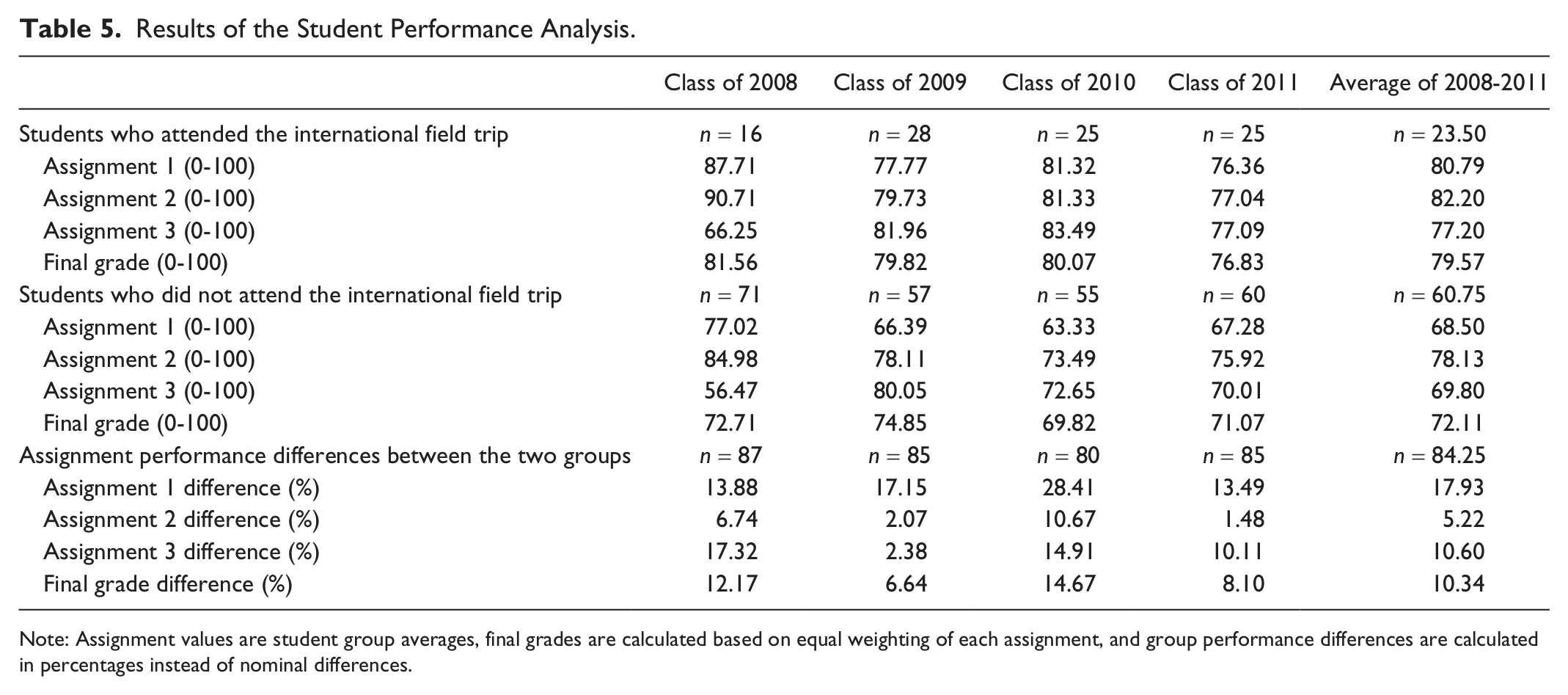
Note: Assignment values are student group averages, final grades are calculated based on equal weighting of each assignment, and group performance differences are calculated in percentages instead of nominal differences.
During all four deliveries of the course, the analysis findings point out to quite a high-level assignment score achievement of the students who participated to the international field trip compared with their peers who did not (i.e., between 1.48% and 28.41% increase). These findings are very much in line with the empirical study findings (students participated in international field trip n = 20 and who did not n = 365) of Houser et al. (2011), which indicate significant contribution of international field trip to improving test performance through engagement and new social networks.
Conclusion
The experiences from the international field trips reported in this article confirm, in line with the literature findings, that international study collaborations reinforce the realization of the key objective of urban and regional planning courses—that is, in the case of QUT: providing knowledge, skills, and hands-on experiences to students for them to be able to work under diverse urban and regional contexts and be able to respond and address complex urban and regional problems. International field trips set a new dimension in the way visiting and hosting organizations run their degree in planning and conduct courses particularly that have global implications. These international field trips exposed students to various aspects of planning, their complexities, similarities, and differences in an international context that have contributed student learning, competency, skills, and capabilities.
The interview and survey results of participating students, performance analysis of international field trip participants in comparison with their peers who did not participated in these field trips, and informal discussions with professors from visiting and hosting universities highlight the benefits of such international field trips in terms of student learning experience and exposure to different cultural contexts. From the student perspective, the experience has proven invaluable in terms of cross-cultural engagement and developing international networks as for most of the students, being involved in an international exercise was a unique experience in their education and professional career and beyond this in their personal growth. From the professors’ perspective, the exposure to different planning processes and practices gave students a new outlook on what they knew from their own country as well as some insights on international planning issues and cultural differences and barriers.
The analyses results revealed that, on one hand, exposure of students to international planning practice is a big opportunity and incorporating international field trips in the planning curriculum is an effective method for achieving a more holistic educational experience and cultivating the pedagogy of experience, while internationalizing the education. On the other hand, some of the organization and logistics constraints and challenges need attention to increase the student satisfaction and the success level of prospective international field trips.
In line with the findings of Dee et al. (2011), the key international regional planning collaboration findings highlighted in this article indicate that (a) greater depth is added to the urban and regional planning course from international study collaborations, (b) students developed intercultural skills that are an asset in professional practice when faced with diverse and complex planning issues, (c) professors extended their teaching (and also research) collaboration, and (d) Students are exposed to different planning systems and processes, which challenge existing outlooks and encourage creativity and innovation.
The outcomes of the international field trip experiences have potentials to shed some light on formulation of the 21st-century planning education considering the challenges of the rapidly changing and globalizing world. This article, besides, provides useful insights on how to develop an international field trip and combine activities mentioned earlier in the article with the trip. The evolution of the activities over time is also a useful learning for other schools planning to conduct such international activities. Finally, perhaps as stated by a field trip participant professor (Interviewee P1), such “international collaboration experience may foster professionals that contributes the world to become a better place by being open and understanding the others.”
Footnotes
Acknowledgements
I would like to thank all institutions and individuals who supported and contributed to the international field trips. I extend my gratitude particularly to Professors Alias Abdullah and Mohammed Zin (Malaysia), Sang-Ho Lee and Yoon-Taik Leem (Korea), Azime Tezer and Arzu Basaran-Uysal (Turkey), and Shih-Kung Lai and Wann-Ming Wey (Taiwan). I also would like to acknowledge the passionate work of the teaching team who took part in these field trips and helped me in successfully organizing the field trips—Severine Mayere, Shinyi Lee, Fatih Dur, Didem Dizdaroglu, Roisin McCartney, Steph Dee, and William Tsui.
Declaration of Conflicting Interests
The author(s) declared no potential conflicts of interest with respect to the research, authorship, and/or publication of this article.
Funding
The author(s) received no financial support for the research and/or authorship of this article.
Author Biography