




Abstract
This article shows how the cognitive mobilization index, designed for use in observing potential political participation, can be used as an indicator of the political climate that a particular society is going through. Following a discussion of the theoretical elaborations (and their working definitions) of the concept of cognitive mobilization, a longitudinal study of various European countries is used to consider the question of how political crises influence cognitive mobilization indexes and what effects they have on the political socialization process among the youngest cohorts.
Cognitive Mobilization
The concept of Cognitive Mobilization (CM) put forward by Inglehart (1977, 1990) states that in postindustrial societies, how citizens’ political participation is formed is affected by the fact that they are generally better educated and have increased access to information. Inglehart studies the evolution of CM and its effects in different societies to make comparative observations of how much it depends on other factors, such as economic and cultural development. To measure the influence of these factors, Inglehart combines a cross-sectional analysis of European societies (observing different levels of economic development) with, principally, a longitudinal study to determine the effect that the level of education has on different age groups, under the clear premise that levels of education and access to information are on the rise. This article considers Inglehart’s hypotheses and updates the time frame that he analyzed by a matter of decades. Extending this time period not only corroborates some of Inglehart’s conclusions but also introduces nuances and modifications in others, in the light of the analysis of new data.
Inglehart sees CM as a central aspect within a broader process. The context is that of modernization and the development of Western societies. In his work, The Silent Revolution, he defines it as follows:
We are interested in these changes insofar as they contribute to the process of Cognitive Mobilization. The essence of this process is the development of the skills needed to manipulate political abstractions and thereby to coordinate activities that are remote in space or time. Without such skills, one is more or less doomed to remain an outsider to the political life of a modern nation-state. Consequently, historical changes in the distribution of these skills have been a major factor in defining the politically relevant public. Social Mobilization is a broad process. Western countries have long since completed many of its most important stages, such as urbanisation, basic industrialisation, widespread literacy, mass military service, and universal suffrage. Nevertheless, an essential aspect continues -the very core of the process: the increasingly wide dissemination of the skills necessary to cope with an extensive political community. We use the term “Cognitive Mobilization” to refer to this central aspect of the broader process. (Inglehart, 1977, pp. 295-297)
In the model developed, the established sequence considers structural changes in various fields (economic, social, political, and cultural) that mutually affect one another: Development and economic and urban growth due to modernization run parallel to the process of a better educated and more informed population and to an end to scarcity. The end of scarcity produces a change in hierarchy of predominant values, moving from those aimed at satisfying basic needs (security) to those aimed at meeting the need for self-expression.
Of all these changes, the most significant in CM terms is that of the population being better educated and more informed. This increase is central because it means increased autonomy for subjects in terms of bureaucratized forms and classic hierarchies linked to politics (the political party, chiefly), a preference for new (unconventional) forms of participation and, in short, an approximation of the practice of direct (top-down) democracy.
Thus, the development of the concept of CM relates clearly to the classical meaning of the concept of public opinion: the discussion of public issues by informed citizens. To an extent, it takes up the idea of small political communities in which political communication occurs face-to-face and develops through direct knowledge of public issues, facilitating collective decision making.
A precursor to what could in terms of political culture be called the “cognitive mobilization theory” is the concept of “subjective political competence” as described by Almond and Verba (1964), which is used to study citizen involvement in the political system. Their interest was to establish a theory as to how citizens perceived political structures and institutions by studying their opinions. The aim was to observe to what extent people surveyed believed that they could participate in political decisions at a local level. The greater the subjective competence, the higher the probability of being politically active. The authors conclude that well-informed citizens with higher status possess greater subjective competence (defined as the extent to which citizens think that they can influence political decisions) and a higher chance of participating in politics. Alongside this sense of “political efficacy” is “political orientation” (community involvement and very politically informed).
Much of the literature on CM has focused on the link to political parties. The oldest precursors of this are found in Campbell, Gurin, and Miller (1954), who were the first to reflect on the phenomenon of party identification. For these authors, this phenomenon is psychological and it has emotional components that are formed during the process of socialization, and the main source of which is the family. They are interested in how attitudes are formed and political participation, with the political party as the main agent. Campbell and Converse (1960), however, draw the conclusion that the political party acts as a funnel model. As an agent of political socialization, this model determines the attitudes and votes of citizens, who develop a feeling of emotional identification toward a party’s “label.” The conclusion is that it is political parties that translate abstract political concepts for citizens and offer them an interpretation of reality.
Another concept closely linked to CM is “political sophistication,” as discussed by Converse (1964), who studies the degree of influence of ideology and beliefs in political behavior. The author’s aim is to determine the degree of coherence of citizens’ ideological constructs and measure their ability to understand and apply political information when assessing certain issues or deciding how to vote. The relationship between interpretation, system of beliefs, and education leads to the concept of “political sophistication.” For Converse, the most politically sophisticated are those who are most highly educated, politically involved, and well informed, while political party identification facilitated the decision-making process for voting, preferably in less politically sophisticated voters. Another important contribution is Shively’s (1979) functional model, in which political parties translate political information for citizens. This is because party identification is a cost-saving device in the decision-making process of which party to vote for. With higher levels of education, there is less need for party guidance.
Together with Inglehart, Dalton’s works have been the most influential in the research of CM. Dalton (1984) uses the concept of “cognitive mobilization” to create a classification system for political party identification that is widely used in the study of political participation (apartisans, cognitive partisans, ritual partisans, and apoliticals). Dalton defines CM as a process by which more people acquire the resources and skills that help them to face the complexities of politics and make their own decisions. The variables of level of education and interest in politics are used to create the index. For Dalton, just as for Inglehart, a progressive increase in education leads to an increase in independent citizens (high CM and low party identification). Although he observes that party identification has been positively correlated with CM, this relationship should change when younger cohorts are incorporated, as not only do they have higher levels of education, they also have greater access to political information through their exposure to the mass media.
Dalton’s work has had notable repercussions and has been widely reviewed by other authors, including the author himself (Dalton, 2007), presenting new models that analyze party identification. In general, criticism of the Dalton model comes from the empirical evidence that in some countries, party identification has not dropped in any considerable way, and has even risen. Dalton defends himself from criticism in a recent study on German voters (2010). In his review of Dalton’s works, Albright (2009) asserts that it is risky to draw any conclusions regarding the progressive drop in party identification. The problem arises when the two phenomena occur simultaneously (identification and CM based on the indicators for “interest in politics” and “level of education”), in which case it is impossible to determine whether CM is the cause (Albright, 2009, p. 251).
Berglund, Holmberg, Schmitt, and Thomassen (2005) observe that contextual factors have not been taken sufficiently into account, such as the degree of polarization between parties. Polarization may lead subjects to perceive greater ideological differences between parties and for party identification and partisanship to rise. Huber, Kernel, and Leoni (2005) assert that changes in party identification may be due more to the institutional political context than to changes in social structure, and that the degree of party identification depends on the nature of the competition between parties.
In general, it is assumed that deficiencies in the models applied in Europe are the result of the differences in the political and electoral system, the political culture, and other historic aspects. Contextual factors, for instance, have not been sufficiently developed, although some authors have pointed this out in the study of political involvement and party identification. This clearly responds to the difficulty in incorporating an excess of variables into such a study, but according to Inglehart’s concept of CM (central part of a broad process), this is essential.
It could be concluded that CM theory encompasses all works that use it as an explanatory variable of the changes that occur among younger generations in postindustrial societies, characterized at times by low levels of electoral participation and party identification. Discussion in recent years over the theory is whether there really are more or fewer “partisans” in terms of identification and whether there is more or less participation in elections for Dalton’s different categories of partisans. It is our belief that within the CM theory, its influence on voting and party identification has been overstated in many studies, particularly those referring to the United States.
Whereas for Dalton, CM is used as an independent variable to explain changes in party identification and voting, Inglehart uses it to explain contemporary political culture in terms of participation. However, in both cases, the relationships of causality are hard to establish. In Dalton’s terms, CM is what explains the changes in participation and party identification, with important criticism, as stated previously. In Inglehart’s view, CM is above all a symptom: Structural changes have their correlation in the variation of CM just as in changes in values, education, and information. In turn, by changing how citizens perceive and participate in politics (in terms of political efficacy), CM has an influence on these factors and on contextual factors. In fact, as has been seen, various articles refer to these factors as aspects that have not been sufficiently dealt with in theory and which would explain the differences between countries (political culture, history, electoral system, or political system) or between different historic moments (electoral polarization, and crisis and inflation, which are treated lightly by Inglehart).
However, here we are concerned with an interesting product of Inglehart’s studies: how political participation takes shape. Due to the effect of disassociation with parties, the rise in information and the change in priority in terms of young people’s values (more postmaterialist), electoral participation is not the only form of political expression. Unconventional forms of political action and the formation of ad hoc structures as a way of making demands are more likely in societies with a higher level of CM. Due to the effects of increased education, the generational change means an increase in “potential” political participation and, more importantly, a drop in the importance of suffrage. For a population that has moved beyond materialist values, the vote is no longer as important. There are other priority interests (environment, solidarity, identity) where unconventional forms of political expression can be used, relegating the vote to a secondary plane. Votes will be used to the extent that the issues at stake in the ballot box will affect what is hoped to be achieved according to these new values.
In short, for the purposes of this study, the conceptual and working definitions developed by Inglehart in his publications are used here. The main virtues of Inglehart’s work can be summed up in the following aspects: (a) It incorporates the concept of CM as a “potential” political action, conceived as a central aspect within a broader process of modernization of the political systems; (b) it attends to the different forms of political action (including unconventional methods); and (c) it produces a CM index that does not include its explanatory determinants (such as the level of education) in its definition and introduces two basic elements that point to the classic definition of democracy and public opinion (frequency of discussion about politics and attempts at persuasion), linking the individual level to the group level.
Method
In his study on European democracies, Inglehart (1990) establishes a series of hypotheses on the effects and evolution of CM. He basically considers three hypotheses:
Increased CM reduces the influence that political parties have on public opinion and of citizens’ identification with political parties.
Because they are better educated and more informed, young people should show a greater degree of CM. In general, this increased level of cognitive political mobilization makes them more politically sophisticated.
A generalized increase in CM and participation is caused by (a) incorporation of women, (b) higher level of education, and (c) changes in evaluative priorities toward individual self-expression, to the detriment of the needs for survival.
The second thesis is the subject of validation and study in this analysis, by extending the data series originally used by Inglehart. We give a detailed consideration of two conclusions regarding generational change and the process of political maturation among young people.
Inglehart checks these hypotheses by using Eurobarometer surveys from 1973 to 1987 and shows the trend toward greater CM in European societies. In terms of cohort analysis, people born after World War II who were young in the 1960s are the most politically mobilized. Although Inglehart observes the historical period that this highly mobilized generation lived through (May 1968, mobilizations against the war in Vietnam, the Prague Spring), he indicates that this maximum is reached through increased access to information and a higher level of education.
In his second hypothesis on generational change, Inglehart writes that younger people are less mobilized because they need a period in which to mature politically and become incorporated into public life. A cohort analysis indicates that as young people “mature,” their CM increases. This is observed in the group born between 1956 and 1965, who begin as the second least politicized group in 1973 (they were below 18 years of age), and who quickly increase in political mobilization as they become adults, so that in 1983 they have become one of the most politicized cohorts, practically on a par with the cohort born between 1946 and 1955, as Inglehart explains:
Here, life cycle effects clearly are present –but they work in the opposite direction from than specified by the “aging produces disengagement” hipótesis: People are less apt to discuss politics during their preadult years, but upon reaching adulthood, the younger and more educated cohorts show higher rates of political discusión than do the older cohorts. This explains the anomaly . . . The youngest age group is, at any given point in time, less politicized than some of the older groups not because of a reversal of trends but because it has not yet reached political maturity. (Inglehart, 1990, pp. 346-347)
This article focuses on the hypotheses regarding the increase in CM among young people. Inglehart introduces cohort analysis to determine how the progressive global increase in levels of education has an effect on the CM of societies, in such a way that an increase would be observed in the level of politicization because the younger (better educated) generations replace less educated cohorts from the adult population. Thus, regarding Inglehart’s theses, the hypotheses to test in this article are the following:
Hypothesis
Hypothesis 1: The CM index is sensitive to political crises. Times of particular political and social unrest produce an increase in CM above the structural increases expected by the effect of the rise in levels of education and greater access to information.
Hypothesis 2: Political crises distort the sequence of political maturation and its relationship with CM, with two effects:
In these periods, younger generations reach greater levels of mobilization than generations that have reached maturity due to the life cycle.
These periods alter the substitution process (with regard to maximum levels of mobilization) of previous (less well-educated) cohorts by subsequent (better educated) cohorts, as the cohorts that live through these periods in their youth retain high rates of mobilization throughout their lives.
These hypotheses are tested for the set of updated data on CM that is available in the European Barometer database: in the first hypothesis, using an analysis on admissible cases such as that of the transition to democracy experienced by Southern European countries in the 1970s (Portugal, Greece, and Spain), which reproduce the climate of political intensity and leave a political mark on a generation, and in the second, by incorporating data to the series so as to obtain a wider time frame than that used by Inglehart.
Indicators
CM is such a broad concept that reducing it to only a few indicators leads to problems. Indeed, in developing his theory, Inglehart uses different indicators to explain changes in the societies analyzed. In The Silent Revolution, the index (four levels) is obtained from frequency of discussion and attempts at persuasion (leaving education to one side, as it correlated strongly with income and occupation), but in Culture Shift, Inglehart uses “frequency of discussion,” on one hand, for the analysis of cohorts as an indicator of “potential political participation” (not CM), and discussion and instruction (five levels), on the other hand, to observe the influence on “unconventional political action” in different countries. In fact, the Eurobarometer contains two indexes: CM Index 1 (discussion and persuasion without instruction; four levels) and CM Index 2 (discussion, persuasion, and instruction; five levels). Index 1 has the greatest temporal scope, as it allows the whole series to be established up to the present day.
This index is built using the combination of answers to two questions: how often people try to convince others of their own opinions (When you hold a strong opinion, do you ever find yourself persuading your friends, relatives, or fellow workers to share your views? If so, does this happen often, from time to time, or rarely?) and how often political issues are discussed (When you get together with your friends, would you say you discuss political matters frequently, occasionally, or never?) (Table 1).
Cognitive Mobilization Index

Source: Eurobarometer (adapted from Schmitt & Scholz, 2005)
Note: DK/NA = Don’t Know/Don’t Answer
The combination of these two questions (talking about politics and trying to convince) creates four levels of CM. The highest of these represents those who show the greatest degree of mobilization and participation in social life, and the two intermediary levels refer to qualities of cognitive political participation above and below the average. The lowest refers to those with minimal social participation. Dichotomizing the index into two large categories produces “medium-high and high CM” and “medium-low and low CM.” The indicator directly expresses the degree of participation in political discussion spontaneously and individually, without it being regulated or institutionalized. However, it is associated with the expected characteristics: Those with greater capacity for political mobilization also show greater interest in politics and a high level of education and media usage.
We used the indicators that the Eurobarometer produced from their theoretical contributions and empirical tests. The CM indicator resulting from the discussion on the concept in recent decades is set out in summarized form. As indicated above, although the importance of the level of education is assumed as an indicator of political competence and capacity, the Eurobarometer dispenses with this variable due to its association with other factors that explain CM, such as social class.
However, the CM index that the Eurobarometer uses allows us to conduct empirical tests from the same data source that Inglehart used. In operative terms, this indicator separates the causes that lead to CM (education and information) from mobilization in itself and is backed up by Inglehart’s initial definitions regarding direct political participation in the agora as a place to debate public issues. Inglehart gives priority to variables that measure participation by means of conversation and discussion with others, and considers that this is a better indicator of activism than electoral participation figures. The Eurobarometer surveys include the variables “frequency of discussion on political issues” and “trying to convince others of one’s own opinion,” thus qualifying (objective) conversation with a motivational element, expressed by the intent to convince others of one’s own opinion. This then is a definition of a specific concept of participation that inserts debate about politics within the context of everyday life. This is why it is also used to detect “opinion leaders,” which in a way alludes to the notion of transmitting political information in two steps (Lazarsfeld, Berelson, & Gaudet, 1944), without the involvement of mediating bodies such as political parties.
An important advance in Inglehart’s CM indicator is that education has been removed when creating the indicator. Education ensures that people are enabled to interpret information coming from the media. It is clear that the role the media play in forming attitudes and opinions and in interpersonal communication varies from one sociocultural context to another. The media’s influence differs widely depending on citizens’ level of education, which by theoretical association with CM brings the problem of interdependence on other variables such as social class. This identification can be observed in other very similar concepts, such as the political sophistication of MacDonald, Rabinowitz, and Listhaug (1995) and the political attention of Zaller (1992). Dalton (1984) produces an index using the variables of education (degree of competence) and interest in politics (involvement and participation). Inglehart also initially includes level of education and participation in political discussion (Inglehart, 1977; Inglehart & Klingemann, 1976) as an index of CM. A society’s level of education is incorporated into how the index is built because of the strong association between education and other indicators used to build the CM index. This makes several authors conclude that the level of education should be included in the index, despite its limitations (Inglehart, 1977, 1990). However, it does not appear to be a particularly useful contribution because the different meanings of the level of education indicator mean that it relates to three different socioeconomic indicators: competence and the objective education of individuals, social class/status, and socialization (Cassel & Lo, 1997). In all cases, the importance placed on interaction between individuals is a constant in the design of indicators of CM.
Another concept incorporated into the hypothesis test is that of crisis. A crisis is a moment in which the occurrence of a certain event with a certain degree of “impact” provokes high commotion in the population. In etic terms, political crises would be moments, within a broad spectrum of phenomena, in which a substantial political change occurs, or there is major debate about the possibility of such a change, (a) of internal origin: regime change, reforms in the system, political changes of a territorial nature, and economic reforms or (b) of external origin (with regard to other countries), the result of which ranges from diplomatic tension to military intervention.
Yet, however hard we try to complete and fine-tune this typology, it comes up against a phenomenological (emic) argument. Because these events have a major impact, the question of the perception of these occurrences is a central one. And because this is a question of perception, how citizens interpret information becomes hugely relevant. In this sense, the mass media play a key role (their influence is indirect, as the meaning belongs to the receiver) and indicators could be used (monitoring the media, where the events are placed in news media, emphasis measures—number of news and information items, font size, presence of images). These aspects have been discussed in a previous article (Alaminos & Penalva, 2010), in which the mass communication theory, particularly the agenda-setting theory and the framing theory, is highly useful.
Building political climate indexes on the bases of media indicators (press distribution, content analysis, user numbers) for each country considered goes beyond the objectives of this research. However, we find it hard to question certain moments of history as political crises according to previous attempts to classify them: the European cultural revolutions of the late 1960s, the transitions to democratic regimes in Southern Europe in the second half of the 1970s, and the fall of the Berlin Wall in 1989.
Data and Sources
The data used is drawn from the Eurobarometers. 1 It is important to note that more years are considered than those studied by Inglehart and the data that the author used are included in the study. In this sense, the study replicates and extends his analysis. The Eurobarometer is a survey conducted in several European countries. For many years, the inclusion criteria were for the country to belong to the European Economic Community or the EU. However, the survey was extended to countries whose entry into the EU was pending. It is conducted every 4 months and with an average sample size of 1,000 interviews per country, a figure that varies depending on the population.
In particular, this work studies the effects on CM in two historic stages of notable political, social, and cultural unrest that had an extraordinary effect on various European societies: the mobilizations that occurred at the end of the 1960s in European countries with democratic regimes, typified by France in May 1968, and the mobilizations that occurred during the process of political transition in Mediterranean countries whose autocratic regimes came to an end in the mid-1970s (Greece, Portugal, and Spain).
Results
The results are presented as a graphic analysis. For each country, the distribution of relative frequencies of CM is charted each year in 10-year cohorts. The distributions are arranged in yearly intervals. In this way, it is possible to appreciate trends and inflections in the replacement of cohorts, and the structural relationship between them for each year. Each cohort is defined by the following age intervals, in years: 14 to 24, 25 to 34, 35 to 44, 45 to 54, 55 to 64, 65 to 74, and more than 74. Thus, graphical analysis (in a yearly base) is useful to appreciate cohort, period and aging effects.
The data is shown in three charts. Figures 1 and 2 show the two types of models (general patterns of evolution of CM and specific patterns of transition, respectively), and Figure 3 shows a mixed model of the Federal Republic of Germany and the landmark of unification in 1989, which can be compared with the processes of transition experienced by the democracies of Southern Europe.

Percentage of medium-high and high cognitive mobilization by cohorts (France, United Kingdom, and Italy, 1975-2007)
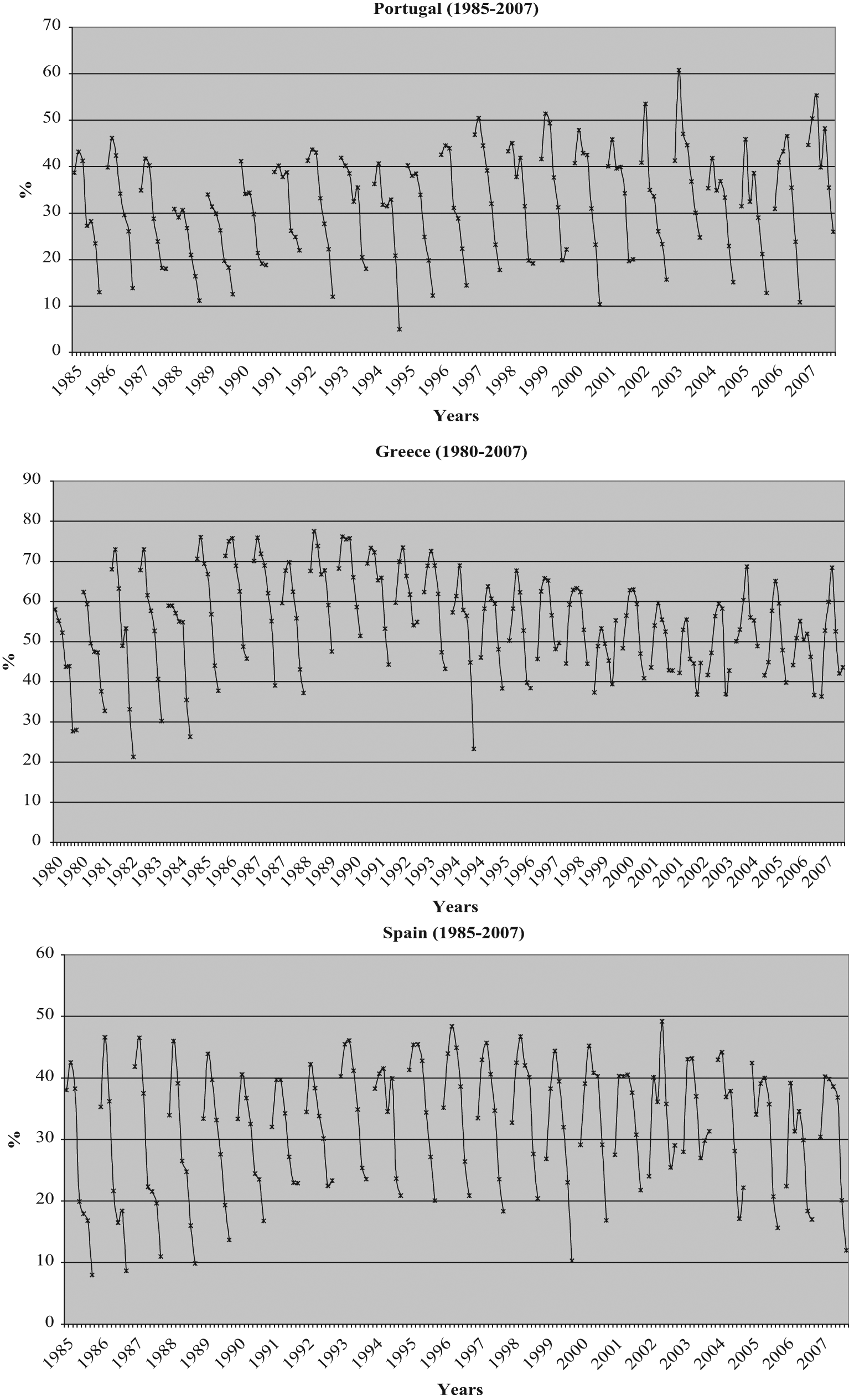
Percentage of medium-high and high cognitive political mobilization by cohorts. Portugal, Greece, and Spain

Percentage of medium-high and high cognitive political mobilization for each cohort Federal Republic of Germany (1975-2007)
The growing trend of CM indices and the postwar generation
In general terms, the new data validate Inglehart’s hypotheses. In the past four decades, the increase in the level of education and the growth of and increased access to the media have been accompanied by an increase in the level of CM. The trend is clear and the hypothesis is partially confirmed. A rising trend can be observed in all the European countries considered. The cohorts born in postwar Europe are considerably more mobilized than those born before World War II. However, no sustained growth in mobilization can be observed with each new cohort. On the contrary, the generation of the 1960s reaches a landmark in mobilization with regard to new generations, who have lower levels of participation. The maximums detected by Inglehart in the generation born in the postwar period distort this trend. These are remarkably high percentages of CM, leading to a series of considerations. First, it should be observed that they coincide with a particularly “hot” moment in history in terms of the political climate, which was characterized by a general atmosphere of social and cultural revolution throughout Europe, expressed in the form of mass protests (the war in Vietnam, May 1968 in France, the Prague Spring), and in changes in customs and social norms, of which the main protagonists were the younger generations. Second, it can be seen how this distortion is prolonged in its effects, as the cohort in question maintains high rates of political mobilization during the following decades, due to having experienced the most intense era of political socialization in those socially convulsive years. Thus, their high exposure to social and political participation remains and revolutionizes the generational structure. Subsequent generations tend to show less participation (due to there being fewer left-wing and other sociopolitical characteristics).
A very similar change dynamic, but with a different historic origin, can be observed in the countries that lived through the transition to a democratic regime in the 1970s.
The process of maturation and new generational distortions (Greece, Portugal, and Spain)
For Inglehart, the process of political maturation among young people raises their CM when they reach sufficient political competence. The effect of this maturation can be observed in the “horseshoe” shape of the time frame that marks the highest CM in cohorts aged 25 to 34 years, who were previously aged 14 to 24 years. In Portugal, Greece, and Spain, a generational delay can be seen, in the extent to which the most participatory generation is that aged 14 to 24 years at the time of the political transition to democracy. The general process leads from an ordered linear generational structure in the functional relationship with CM to another horseshoe-shaped form (nonmonotonic linear). The stability of the generational position in the 30-year period considered makes it possible to see the maturation process and change of position in the life cycle. The cases of Greece and Spain experience a process of characteristically horseshoe-shaped transformation, with young people less participatory than those of the transition and a lesser variability among generations that can be seen when the segments are shortened. The case of Portugal is an exception. Young people maintain a high level of participation and the trend is one of increased variability between generations, as can be observed in the growth of the segment.
Within this horseshoe structure, which is very clear in the data expressed in 10-year cohorts, a subprocess occurs by which the new cohort that is incorporated appears with a very low level with regard to the previous cohort. The maturation and life cycle effect means that this cohort, which is at such a low level, 10 years later reaches a similar level to that of the previous cohort. As previously in other European countries with regard to the generation of 1968, the generations that were politically socialized in the transition to democracy maintain a higher level of CM than those that succeed them. This generation, which “breaks” continuity, has higher levels of CM than those which replace it. This will have a clear statistical effect, first by weakening and then by breaking the association between age and CM. Each country shows specific features associated with the crises described.
However, this maturation process that marks a level of political participation associated with the life cycle displays nuances in moments of crisis. This can be observed by studying generational patterns in certain moments of political upheaval, where younger people have the highest levels of mobilization. This is the case of Germany in the early 1990s after the fall of the Berlin wall and the reunification process, of France with the disturbances in Paris protesting the situation of the immigrant population, and of Spain following the terrorist attacks in Madrid in 2004.
In the transnational dimension, with the data from 1982, Inglehart saw Greece as an atypical case: a country with a low economic level but high CM. He defined this as a “striking deviant case” in his cross-sectional analysis and interpreted it as an effect of the influence of the tradition of the former city-state democracies. The effect of the period of transition to democracy, which was not considered by Inglehart, could be a better explanation and could also explain the historical maximums found in our analysis: the generation that was young in the political climate of 1968 records a maximum level. Subsequent generations, with higher levels of mobilization than those born after World War II, tend to be comparatively lower than those of 1968. The same occurs for the generations that lived through those times of transition to democracy in the countries considered.
We present a mixed model, between the postwar society type of the United Kingdom, France, and Italy, and the society in transition type of Greece, Portugal, and Spain. The Federal Republic of Germany shows patterns from both models, which strengthens the hypothesis. On one hand, there is a trend of increasing political mobilization among successive postwar generations, with a sharp increase in mobilization scores for the generation involved in the 1968 mobilizations. On the other hand, the early 1990s show a change in the basic horseshoe shape in the change of cohorts, with an increase in mobilization observed in younger generations, canceling out the process of political maturation. This is a politically hot moment reflecting the reunification process after the fall of the Berlin wall in 1989.
Discussion and Conclusions
In this work, as well as the general trend of modernization that can be seen in all the societies studied, it is also possible to observe the foreseeable anomalies of each case, reflecting the historical political circumstance of each country. Inglehart’s hypotheses are subtly altered. The advantages of having a longer historical series than that which the author used means that we can state that the historic period at the end of the 1960s crossed with the general rising trend in levels of education and the availability of and access to the media. By taking other historic moments of increased political tension, we can state that the period effect explains the trends more precisely, and explains the anomalies that Inglehart found, as is the case for Greece. He interpreted this anomaly as the repercussion of the country’s classical tradition linked to political discussion in the agora.
We consider that in his works, Inglehart gave sufficient consideration to two of the three effects considered in cohort analysis: that of maturation (in terms of the process of acquiring political competence) and that of cohort (which explains how patterns of mobilization are maintained depending on the time in history when political socialization is most intense). However, he underestimated the importance of time period. The period effect affects society as a whole, corresponding to an exceptional political or social climate. We know it is not possible to determine the effect that, independently, can be attributed to the period, age, or cohort. As Glenn (2005) states, the effect of cohort (C, year of birth), the effect of age (A, year since birth), and period (P, current year) are linear and additive. Separated effects can not be estimated.
To illustrate the effect of the period and its interaction with cohort and maturation, this article includes similar political situations (in terms of the intensity of the political climate and its effects on political participation in general) such as the political transition of the European countries considered (Greece, Portugal, and Spain). Thus, considering this effect, Inglehart’s conclusions must be modified, as it can be confirmed that the historical maximum in CM of the generation of 1968 is due to the atypical context of the political climate.
Thus, even though CM effectively defines a potential for participation, whether this is activated depends on the context. Political crises raise the level of mobilization in general, but this increase occurs to a greater extent in younger cohorts, who are more qualified in cognitive terms. The level of mobilization shows a growing trend for a set of countries that already had high levels of mobilization. For another set of countries, it can be seen how this average level tends to remain stable, with changes in growth and contraction that coincide with “hot” periods or political crises. In this sense, it is not appropriate to consider as a general thesis that increases in the number of citizens with CM capacities are a direct and mechanical consequence of conditions such as education, available media, or economic development. Rather, for certain countries, CM (talking about and discussing politics with other citizens) develops circumstantially, depending on the sociopolitical context and climate. Within the average level of mobilization displayed by society, it can be seen how the indicator is sensitive to the most relevant crises, leading to discontinuous trends and altering the process of political maturation. With the consideration of contextual and circumstantial factors, the CM index would show greater utility when diagnosing, understanding, and foreseeing social mobilizations, as it considers a key element of its theoretical definition to be direct democracy and the consideration of unconventional forms of participation, which are more present at times of crisis.
Therefore, by introducing the period element, two of Inglehart’s statements need modifying: the first, which states that the level of education automatically has an influence on levels of CM by raising participation as a structural pattern, and the second, which considers the life cycle as a necessary element of political maturation. Inglehart’s theses do not give sufficient consideration to CM as a potential that is activated by reacting to circumstances to the point of producing functional discontinuous patterns in the relationship between age and CM, as well as distortions in the process of political maturation and its relationship with the life cycle. 2 Certain historic events mobilize younger generations who, according to Inglehart, should not have reached that level of political maturity. These crises clearly mark the trends of mobilization for all his biography, as these events coincide with the era of greatest political socialization. As can be deduced in the analysis, “testing” the direct democracy that Inglehart spoke of at times when the process of socialization (youth) is at its most intense allows tools and knowledge of political practice to be acquired that will be retained for the rest of one’s life. This political learning is supported by the cognitive basis of education and information but reinforces the pragmatic (rational) dimension of “political efficacy” and the identity (emotional) dimension due to the links within a group acquired in that generational experience.
There are a series of works that deals with a closely related concept, namely “political generation,” as discussed by Mannheim, which links the political experiences of each cohort in the most intense periods of socialization, as youth tends to be. We have found some studies that discuss the phenomenon of political socialization by linking the period and cohort effects, such as the works by Cavalli (2004), Hooghe (2004), Hadjar and Beck. As stated by Hooghe,
In this view, primary socialisation experiences tend to produce persistent effects, which are only marginally influenced by later socialisation experiences. This concept of persistent political self-identification is of course nothing new, as it already was formulated in Karl Mannheim’s classical thesis on the creation of “political generations” by what he called generation-defining events. (p. 334)
Hadjar and Beck (2010) also clearly explain this relationship between experiences of political crises and period effects:
Period effects are expressions of societal events, political developments, value climate and societal conditions, both on the structural and ideological level that affect all birth cohorts in a specific country . . . Causes of period effects may be very polarising election campaigns, the introduction of controversial laws, unemployment, or a general distance from politicians after political scandals. (p. 537)
It is important, in light of the discussion of concepts and the findings presented in this work, to remain open to new knowledge that is being incorporated to perfect this index. The qualitative (specifically biographical) methodology would improve knowledge of the phenomenon of CM and how it connects with the socializing effect of the period lived through (in the primary group or in the corresponding generation). Detailed knowledge of the phenomenon could put an end to the confusion detected by various authors between cause (elements that give shape to a potential mobilization) and effects (mobilization at a specific time).
Footnotes
The author(s) declared no potential conflicts of interest with respect to the research, authorship, and/or publication of this article.
The author(s) disclosed receipt of the following financial support for the research, authorship, and/or publication of this article: This research was made possible by a grant from the Ministry of Education, Government of Spain in the 2010 official announcement:” Estancias de profesores e investigadores seniors en centrosextranjeros de enseñanza superior e investigación” (Ref. PR2010-0133).