




Abstract
Lesbian, gay, bisexual, transgender, and queer (LGBTQ) youth experience disproportionate mental health challenges due to minority stress. Little research, however, has considered how social support from intragenerational friends impacts the mental health of LGBTQ youth, particularly for LGBTQ youth of color. Based mainly on qualitative interviews from a longitudinal study with 83 LGBTQ youth from California and Texas, we develop the concept of intersectional social support—how multiply marginalized individuals subjectively interpret social support and how they view social support from similar multiply marginalized others. More specifically, the findings of this study capture how the intersecting identities of age, sexuality, gender, and race can shape the meanings and experiences of receiving familial support, emotional support, informational support, and instrumental support. This study is an important contribution to understanding how intersecting identities influence how people perceive social support practices and manage their mental health.
Because of structural and interpersonal discrimination, lesbian, gay, bisexual, transgender, and queer (LGBTQ) youth experience disproportionately high rates of mental health challenges when compared to their heterosexual and cisgender peers (Connolly et al. 2016; Thoma and Huebner 2013; Zaza, Kann, and Barrios 2016). As minority stress theory posits, discrimination is a stressor shaping marginalized people’s mental health challenges (Meyer 2003). Moreover, an intersectional minority stress framework captures how the concurrent experiences of discrimination based on prejudice against LGBTQ youth of color for their sexuality, gender, and race shape the mental health challenges that the youth experience (Mallory and Russell 2021; Schmitz et al. 2020; Thoma and Huebner 2013). Social support, though, has been proven to have a positive impact on LGBTQ youth’s mental health, playing an important role in helping individuals cope with stressors and maintain a sense of well-being (McDonald 2018). However, less is known about how multiply marginalized LGBTQ youth perceive and receive social support from similar others while experiencing intersecting social stressors. This study asks: How does social support from similarly-identified friends uniquely benefit the mental health of multiply marginalized LGBTQ youth?
This study is part of a landmark longitudinal project on LGBTQ youth, family, and housing—the Family, Housing, and Me (FHAM) Project—which follows 83 LGBTQ youth (ages 16–19) in the Inland Empire of California and in South Texas. We turn to LGBTQ youth with low or ambivalent parental support and who may be vulnerable to housing instability to examine how intragenerational friendships can serve as an important social support network. Through analyzing in-depth interviews with the youth, we introduce the concept of intersectional social support as a term to describe how LGBTQ youth of similar age and sexual, gender, and racial identities can more holistically support each other through shared life experiences. We define intersectional social support as how multiply marginalized individuals subjectively interpret social support and how they view social support from similar multiply marginalized others. We highlight how youth say that intersectional social support helps with their mental health through providing a sense of belonging, improving the youth’s ability to cope with stressors and difficult situations, encouraging a positive exploration of one’s identity, and potentially providing housing alternatives.
Background
Minority Stress and Social Support
The usual developmental challenges during adolescence, such as heightened peer pressure, can be more challenging for lesbian, gay, and bisexual (LGB) youth who experience minority stress and are navigating their sexual identity while also vulnerable to anti-LGB discrimination (Russell and Fish 2016, 2019). Moreover, because of gender minority stress and the discrimination trans people face, transgender and gender-diverse youth often experience higher rates of depression and suicidality even compared with cisgender lesbian, gay, bisexual, queer, and questioning youth (Price-Feeney, Green, and Dorison 2020). Research on the mental health and minority stress of LGBTQ youth of color has also found that a combination of racist and anti-LGBTQ discrimination shapes the mental health challenges that the youth face (Schmitz et al. 2020; Thoma and Huebner 2013).
Importantly, as the stress process model demonstrates, individual’s social and economic statutes can expose them to stressors, including to discrimination stressors; however, psychosocial resources, such as social support, can moderate the effects of those stressors (Turner 2013). Social support refers to various types of assistance, care, guidance, and comfort that people receive from their social networks, including from family members, friends, and community members. This support can take many forms, such as emotional support (e.g., listening, empathizing, offering encouragement), instrumental support (e.g., providing tangible aid, such as money or transportation), and informational support (e.g., providing advice, guidance, or feedback; House 1987; Semmer et al. 2008; Shaw et al. 2004). As the buffering hypothesis shows, social support—or even the perception of social support being available—can weaken negative associations between stressors and well-being (Cohen and Wills 1985).
Specifically for LGBTQ youth, social support has been shown as a moderator for the symptoms of anxiety and depression caused by homophobia, transphobia, and anti-LGBTQ prejudice (Parra et al. 2018; Reyes et al. 2023). Remarkably, although, much of the current literature on social support for LGBTQ youth is focused on support from family, teachers, and other adults; there is limited literature that investigates friendship between LGBTQ youth themselves (Chang et al. 2021; Day et al. 2020; Muñoz-Plaza, Quinn, and Rounds 2002; Snapp et al. 2015). The lack of research in this area is notable as support from experientially similar others has its own benefits, whereby similar others can understand what someone is going through and can help with someone’s health and well-being, through empathetic emotional support and through providing informational support (Thoits 2011, 2021). Similar-other peer support can essentially provide culturally-relevant support, which can boost the effectiveness of the support (Thoits 2022). Thus, this study fills a gap in the literature through examining social support from friends and how this friendship support can potentially moderate the effects of stressors that LGBTQ youth, especially LGBTQ youth of color, face.
LGBTQ Friendships and Social Support
In the course of adolescence, friendships increase in importance and gradually come to occupy just as central a position in one’s relational network as parents (Helsen, Vollebergh, and Meeus 2000). For LGBTQ people, the concept of “chosen” family is particularly significant (Pollitt, Blair, and Lannutti 2023), as this idea refers to the tendency of LGBTQ individuals to turn to their friendship networks for support, especially when their family members are unsupportive due to homophobic and transphobic beliefs (Dewaele et al. 2011). As friendship is important for identity development for LGBTQ youth, intragenerational friendship might be crucial in finding support for one’s LGBTQ identity (Cass 1979; Floyd and Stein 2002; Galupo, Krum, et al. 2014). Moreover, friendship with similar others can be a group-level coping resource to process and buffer against the effects of minority stress (Bruce, Harper, and Bauermeister 2015; Meyer 2003).
Notably though, the current research on LGBTQ friendships mainly looks at how LGBTQ adult friendships can provide support and serve as a buffer for mental health challenges, including challenges associated with minority stress (Galupo 2007a, 2007b, 2009; Galupo, Bauerband, et al. 2014). For LGBTQ youth and social support, research mainly examines how certain family, teachers, and other adults support LGBTQ youth (Chang et al. 2021; Day et al. 2020; Muñoz-Plaza et al. 2002; Snapp et al. 2015) and how LGBTQ youth find peer support online (Austin et al. 2020; Singh 2013). There is still little research on LGBTQ intragenerational youth friendships. This gap is critical as youth often do not have the same resources, such as financial resources, as adults; therefore, intragenerational youth support can look differently compared to intergenerational support. Understanding age-related support processes is important, then, to documenting how and why intragenerational friendships can impact LGBTQ youth’s lives, including potentially how peer-to-peer support could moderate the effects of stressors on LGBTQ youth’s lives.
Furthermore, for LGBTQ youth with multiple marginalized identities, friendship may be an important tool for processing and combating intersecting experiences of oppression. For instance, the social support that queer Black people receive from House and Ball communities—communities who form family structures and participate in social events such as voguing and dance competitions—can reduce the effects of minority stressors on queer Black people’s health (Wong et al. 2014). Black LGBTQ youth create their own social support networks with similar Black peers that accept their gender and sexual identities, and these chosen families improve the youth’s help-seeking behaviors and can moderate the effects of distress related to racist and anti-LGBTQ discrimination (Hailey, Burton, and Arscott 2020). Considering the high incidence of mental health challenges for multiply marginalized LGBTQ youth, it is critical to continue to document and understand how friendships can moderate the effects of intersecting minority stressors, especially friendships that are not only of the same sexual identity but also of the same race, age, and gender. This study turns to LGBTQ youth friendship to develop an intersectional social support framework.
Intersectional Social Support
This study develops an intersectional social support framework to investigate how intersecting identities influence how youth perceive social support practices and manage their mental health. Intersectionality is an examination of intersecting social locations and how interlocking systems of oppression such as racism and sexism can shape the experiences of people with multiply marginalized identities (Collins 2000). We use intersectionality as a theoretical framework to analyze the unique social experiences of youth with multiply marginalized identities. For instance, as the multiple disadvantage model demonstrates, when people face several challenges—often shaped by racism and socioeconomic disadvantages—these multiple disadvantages negatively affect their health and well-being (Cheng and Lo Online First). In relation to youth, multiply disadvantaged youth often face greater exposure to multiple types of discrimination, which can worsen their health (Denise 2012), but both peer and family support can buffer against these multiple disadvantages (Prince, Rocha, and Nurius 2018).
Furthermore, LGBTQ people occupying multiple marginalized locations can experience intersectional minority stress (Schmitz et al. 2020). Importantly though, intersectionality is not an additive framework in understanding identities and oppression. Rather, in order to understand intersectional minority stressors, one must be attuned to how interlocking systems of oppression create unique experiences for multiply marginalized LGBTQ people. For instance, Black sexual minorities of higher socioeconomic backgrounds often experience more stigma for their race and sexuality (Shangani et al. 2020). Class does not serve as a protective barrier for Black sexual minorities in a way that class can be protective for some white sexual minorities (Shangani et al. 2020). Moreover, religious communities can often be a protective barrier to deal with racial discrimination for people of color, but simultaneously, these religious communities can be a stressor for LGBTQ youth of color because of religious anti-LGBTQ prejudices (Schmitz et al. 2020). Specifically, for LGBTQ youth, especially poor LGBTQ youth of color, experiencing multiple stressors has been documented as a potential cause of homelessness among LGBTQ youth, as youth may flee the home, school, or Child Protective Services because of experiencing conflict and multiple forms of discrimination within these institutions (Robinson 2018, 2020, 2023).
An intersectional understanding of social support could help, though, in moderating the effects of intersectional social stressors. Notably, other scholars have documented forms of intersectional support for Black women and girls in medical settings (Pennant 2022), for bisexual people of color (Flanders et al. 2019), and for Asian American LGBTQ people (Kuo et al. 2022). These forms of support address the intersectional minority stress that the individuals have in common, such as a common history of gendered racism in health settings experienced by Black women and girls or conflicts between LGBTQ identities and Asian family and cultural values (Kuo et al. 2022; Pennant 2022). We build on this intersectional support work and develop an intersectional social support framework to understand how multiply marginalized LGBTQ youth understand and experience the social support they receive and need from similar others.
Methods
This study is based on qualitative interviews with 83 LGBTQ youth (16–19 years old) in South Texas and the Inland Empire of California—two understudied places in LGBTQ research life compared to New York City, Chicago, San Francisco, and Los Angeles (Stone 2018). The Inland Empire—the area east of Los Angeles—has two counties with a total population of 4.6 million people. This region has issues with economic mobility and housing stability, with declining median earnings and increasing home foreclosures since 2000 (Brady, Maple, and Hodges 2023). The Inland Empire region is one of the most diverse in the state, with 20% of the population being immigrants, and more than half of the population identifying as Latinx (Brady et al. 2023). South Texas is the southernmost part of Texas that includes the San Antonio metro area and the Rio Grande Valley. Almost five million people live in the 41 counties of this predominately rural area. The majority of South Texas residents identify as Latinx, and 84% of residents of the Rio Grande Valley are Latinx.
All interviews in this article were conducted in the summer of 2022 and 2023. These interviews are part of a larger longitudinal study that is following the 83 youth for two years (summer 2022 to summer 2024). The broader study seeks to understand the experiences that LGBTQ youth have in relation to nonparental family members, housing, support, and a sense of safety (for more on the broader study and its methods, see McCandless-Chapman et al. 2024; Robinson, Stone, and Webb 2023). The 83 LGBTQ youth were recruited through an online prescreening survey distributed via a robust online presence on social media, paid targeted social media ads on Instagram and other platforms, and distribution by local LGBTQ organizations. The short prescreener survey included basic sociodemographic questions, the youth’s current housing situation, and three questions modified from the Multidimensional Scale of Perceived Social Support (MSPSS) (“I get the emotional help and support I need from my parents,”“I can talk about my problems with my parents,” and “One or more of my parents are supportive of my gender and sexual identity”; Dahlem, Zimet, and Walker 1991; Zimet et al. 1988). Research team members, including the authors, selected youth from the prescreening survey based on the following criteria: residence in Inland Empire or South Texas, ages 16–19 years, being housing dependent (answered “No” to the question “Do you pay rent or contribute to household expenses in your current housing?”), and having low or ambivalent parental support (answered “Strongly Disagree,”“Disagree,” or “Neither Agree or Disagree” to the MSPSS questions). Youth were not recruited based on gender identity; however, research team members did prioritize contacting youth of color. In all, 1652 people took the recruitment survey, 431 of whom met the criteria for the study. All eligible youth from the survey were contacted via text or email until 83 youth had completed their baseline interview, slightly surpassing the research goal of 40 interviews from each research site.
The inclusion criteria for this study focus on youth who are at an age, in a housing situation, and with parental relationships that make them vulnerable to housing instability. Notably, we turn to LGBTQ youth with low or ambivalent parental support and who may be vulnerable to housing instability as a methodological intervention to develop theories about social support and to examine how support from friends can assist youth. Only LGBTQ youth aged 16–19 years were recruited to follow them during a time of transition of family relations (from adolescence into early adulthood), to make cases more comparable, and to ensure all participants remain within the young adulthood age bracket at the end of the study. This research has been approved by the institutional review board (IRB) at Trinity University. Youth who are 16 and 17 years old participated in this study without parental consent, a common practice in the study of LGBTQ youth to protect them from their gender and/or sexual identity being revealed to parents (Sims and Nolen 2021). Informing parents that their teenager is involved in research as an LGBTQ person may lead to harming them, and only allowing LGBTQ youth with parental consent to participate can limit the sample to LGBTQ youth who are out and supported by their parents.
We recruited 41 LGBTQ youth in South Texas and 42 LGBTQ youth in the Inland Empire, most of whom were trans and gender-diverse youth of color who were still in high school (see Table 1). Approximately 61% of the youth reported receiving free or reduced lunch at school, suggesting that many of the youth have histories of familial poverty.
Demographics of Research Participants.
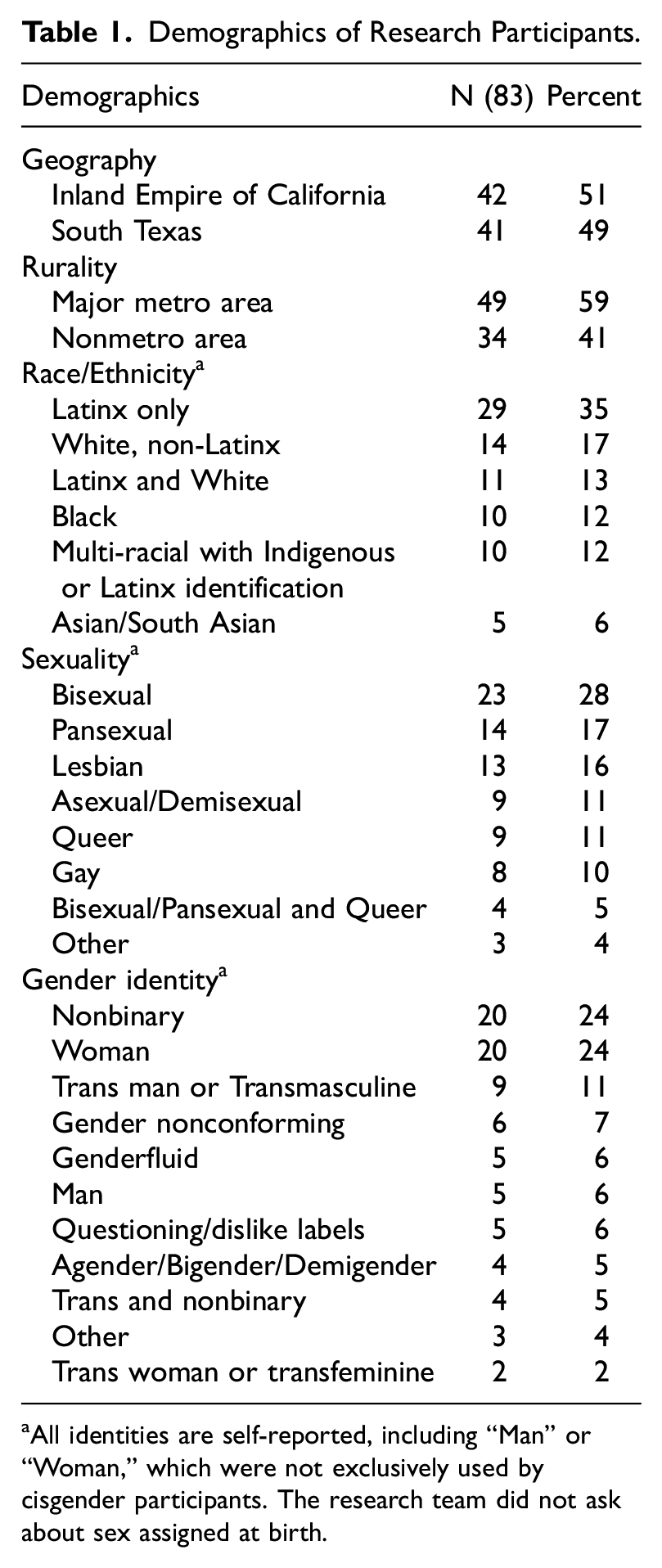
All identities are self-reported, including “Man” or “Woman,” which were not exclusively used by cisgender participants. The research team did not ask about sex assigned at birth.
The qualitative interviews in summer 2022 mapped out youth’s housing situation, family life, familial support and conflict, and interactions with other people and institutions such as school, religion, work, and friends. The interviews in 2023 focused on similar topics but just on the past year since the first interview. All interviews were semi-structured and conducted over Zoom by a person on the research team. Zoom interviews can exclude people who do not have sufficient internet access or lack technical knowledge (Lindsay 2022; Tomás and Bidet 2024) but can also extend recruitment reach and inclusivity, are more accessible, and have no travel requirements (Gray et al. 2020; Oliffe et al. 2021; Tungohan and Catungal 2022). As many youth relied on parents for transportation, Zoom allowed the research team to reach a broader demographic and allowed for some youth to use the chat feature to discuss sensitive topics.
Interviews lasted from one hour to three hours, with the majority lasting around 90–120 minutes. Each youth received a $40 Amazon gift card for each interview. All names are pseudonyms selected by the youth to maintain confidentiality. The interview questions most relevant to this article were: Could you tell me about your friends? Could you describe how important your friends are to you? Can you discuss how open you are about your gender and sexuality with your friends? And how supportive would you describe your friends are? In addition to these questions, the mention of friends appeared throughout other parts of interviews depending on the participant.
The qualitative interview data were professionally transcribed through a transcription service and cleaned by a team member, who corrected any mistakes. Transcripts were entered into NVivo and coded using flexible coding techniques to code large chunks of quotes based on the interview questions and major themes (Deterding and Waters 2021). Some flexible codes developed by the research team included codes for friendship and various supportive practices such as instrumental support, peer support, and emotional support. The research team also engaged in a detailed thematic analysis by examining the codes developed for the specific supportive practices that youth participants identified as meaningful for their well-being and sense of safety. Members of the research team performed axial coding by combining the initial friendship codes into prominent themes throughout the interviews such as “Support” and “Mental Health.” Through this process of oscillating between the small details and overarching themes, members of the research team analyzed the codes to understand the unique relationships between LGBTQ youth, support, well-being, and friendship.
Findings
Most youth mentioned the positive impact of LGBTQ friendships in their lives, contributing to their sense of safety and belonging through friends’ familial, emotional, informational, and instrumental support. In the following sections, we consider three ways through which LGBTQ youth experience the social support of LGBTQ friendship: as familial support such as acting as chosen family and affirming identities, as emotional and informational support such as validating experiences and providing tips on navigating being LGBTQ, and as instrumental support such as offering housing. In each section, LGBTQ youth articulate the importance of shared experiences and identities for social support that impacts their mental health.
“I Really Do Consider My Friends a Part of My Family”: Intersectional Familial Support
Youth in this study discussed conflict with their parents, particularly around the youth’s gender and/or sexuality. The youth also discussed how their friends became their family through providing them support, a sense of safety, and belonging. This sense of safety and belonging helped the youth’s mental health, including in coping with familial conflict. For instance, Celeste (she/her) was a 17-year-old, Filipine, lesbian, trans youth from Redlands, California, who said, “things started to go downhill, specifically in the relationship between me and my mom,” when Celeste came out as trans to her parents. This downhill relationship included Celeste “getting really nervous” whenever Celeste heard her mom’s voice, and Celeste said she would “even feel the need to hide away from my mom.” Celeste, though, also discussed the positive role that friendship played. Celeste said that one of her friend groups “is the stereotypical all the gays are congregating.” As Celeste explained, “They’re like family. They’re like found family and I love that. I love being around my friends. I feel like I can just let loose and be myself.”
Moreover, Ingrid (she/any), a 16-year-old, Chinese, lesbian youth from Chino, California, had not disclosed her sexual identity to her mother. Ingrid also said that she does not go to anyone in her home during stressful situations. She explained, “Well, I’m not sure, but because we’re in an Asian household, they are not very . . . we don’t really talk about feelings as much.” Ingrid, though, turned to her close friends who are pansexual, asexual, “have experience of being LGBTQ,” and “are supportive of my gender or sexual identity.” In specifically describing how her friends help with her mental health, Ingrid said: I think most of the support I get for mental health would be outside of family, because I don’t really speak to them about that because they don’t literally understand that mental health is a thing and can be a serious issue. So mainly my friends, I talk to my friends. They offer to listen, and they offer like advice and things like that.
For Celeste, conflict around gender and sexuality with her parents affected Celeste’s mental health, whereby Celeste said that she felt nervous and wanted to hide from her mom. Moreover, Ingrid interpreted not being able to discuss mental health in the home as part of ethnic cultural values. An intersectional social support framework can show how this issue can be unique for LGBTQ youth of color as they may view familial and cultural values in conflict with their gender and sexuality and in them wanting support for their mental health. Indeed, culture can play a vital role in the experiences of queer and trans people of color, whereby in certain Asian cultures, nonheterosexual orientations are discouraged and seen as one’s rejection of their role in society and family (Szymanski and Sung 2013). Cultural backgrounds can shape experiences of stressors. Nevertheless, for Celeste and Ingrid, friends, especially LGBTQ friends, provided a sense of safety. This sense of safety can improve a person’s well-being and mental health (Lynch 2020), and as youth might not have the resources to access mental health services, friendship can become a way to provide support and safety for the youth.
Furthermore, friends as family can support each other through taking on familial roles and in providing both gender-affirmative support and sexuality support. Ki (he/him), a 16-year-old, white, queer, gender-fluid youth from Moreno Valley, California, has two close friends. While this friendship is intragenerational, Ki refers to these friends as parents because of the caring role the friends take in Ki’s life. This caring role was contrasted to Ki’s parents, which Ki described as “not the best. They’re very, like, all of the phobics, all of the racist, transphobic, homophobic, that describes them.” During the study, Ki did not have contact with his parents. Ki described, though, how his friends were “some of the biggest supporters”: They use my pronouns. . . Actually, I have . . . one of my parents, I call them, will all the time be like, “Hey, you’re so handsome.” And I’m like, “Thank you.” Because I don’t get called handsome. I don’t get called a boy. . . . Oh, they even call me their son. And it’s the best thing ever because it’s so validating.
Ki could talk to his friends about anything, including queer dating. Ki also discussed how these same friends helped Ki with his mental health. Ki explained, “They very much are supporters of my mental health when I’m freaking out spiraling.” Ki said that the friends would “say random words to get me out of a spiral” as these random words would help Ki ground.
For youth in this study, having intersectional social support that affirmed the intersections of gender and sexuality was validating. While other youth, including non-LGBTQ youth, may also form familial bonds with friends, for LGBTQ youth, these familial friendship bonds took on a unique form of validating the very gender and sexual identities that their parents reject. Notably though, the salience of gender and sexuality in this interview—and the absence of culture and race—can demonstrate how white youth such as Ki may not need the same type of intersectional social support as youth of color. Nonetheless, in forming this familial bond through his friends validating Ki’s gender and sexuality, Ki can also rely on and trust the friends to provide emotional support when Ki is “spiraling.”
For some LGBTQ youth of color, friends of the same racial or ethnic background can function as a proxy to their own family, but being LGBTQ can complicate these friendships. Saigon (he/they), a 16-year-old, Asian American, pansexual, nonbinary youth from Moreno Valley, California, described his relationship with his parents as “distant” and that he has to “come out every other few weeks” with them about his sexuality. He has not disclosed his gender to his parents. Nevertheless, Saigon said that their friends are their chosen family: Between family and friends, I would take friends over family any day because friends understand me better than family does. Obviously, I have friends from similar walks of life, such as gender-wise, or sexuality-wise, so that does help, as well, because they bring their experience and everything into the question, and that kind of does help me figure everything out, or we’ll talk things out and try to understand. So that does really help.
Saigon said that they also had “heteronormative friends” and said, “So, a majority of them are like Asian American, as well, and grew up in a similar household. But we gradually grew apart, obviously, as I realize certain things.”
Saigon’s story shows that friendships based on shared racial or ethnic identity can be a source of culturally appropriate support, especially for Asian American youth who may have a different familial experience compared to other LGBTQ youth. However, Saigon grew apart from some of these “heteronormative” Asian American friends as he came out as pansexual and nonbinary. Saigon’s current friends, though, supported him when he “went from gay to pansexual,” and these friends “were extremely meticulous about correcting each other on the usage of pronouns.” Moreover, this gender and sexuality support—which could build a close bond—could lead to other types of critical support such as when a friend “called the emergency services” for Saigon after he overdosed. Saigon’s story shows how gender, race, and sexuality can all be important in forming various familial bonds with friends and the complexities of this intersectional familial support, as well as its life-saving mental health benefits.
“Have Tips. . . If I’m Feeling Dysphoric”: Intersectional Emotional/Informational Support
Shared experiences of gender and sexuality can allow youth to provide emotional and informational support to one another. Ben (they/them), a 19-year-old, Hispanic, nonbinary, gay youth from Fontana, California, shared that in their friendship group: there is not a single one of us that is straight or cis. . . we bond over the fact that we were born like men, but we don’t feel like men, but we want to be women, but it’s like, we also don’t feel like women. We’re all gay, so it’s just great.
Notably, Ben felt like they could not turn to their dad for emotional support because “he’s not an emotional person. I mean, he’s like a traditional Mexican man.” Ben gave, though, more details about how their friends emotionally support one another. Ben said: I talk about problems, and they’re just like, “Oh my God, I deal with that too. And, you know, here’s what I do to help myself,” and vice versa, like, I provide them some help too, you know, get them up and happy again.
LGBTQ Latinx youth may view Latinx families and culture as focusing on resilience in the face of structural racism over talking about and dealing with emotional and mental health struggles (Schmitz et al. 2020). Ben described, though, a close community of LGBTQ friends that did emotionally support Ben, and this bond is partly a result of a shared understanding of nonbinary and gay experiences. Emotional support around shared struggles can help with mental health and getting each other “happy again.”
Shared struggles may include experiences that are particular to LGBTQ life. Eddy (he/him), a 19-year-old, white, bisexual, trans man from San Antonio, Texas, stated: [My friends] are all part of the community so they all understand, at least at a base level, what my anxieties are with public and dysphoria and stuff like that. And they also have tips that if I’m feeling dysphoric about a certain thing, then they have suggestions on what could make that better. Or if I feel weird about not exactly knowing what my sexuality is, they’re able to reassure me that I don’t need to know an exact label for that.
Providing informational support through practical advice on how to manage dysphoria is a unique form of support that can be provided by others in the trans community, especially for trans youth who may not have access to gender-affirming healthcare because of their lack of family support or class resources. For Eddy, friendship, emotional and informational support, and shared experiences helped with navigating his anxieties and dysphoria. These same friends also helped Eddy in understanding his sexuality. Notably, like Ki, Eddy is also white, whereby he may just need gender and sexuality support, unlike the youth of color who often also discussed how race and culture shaped their experiences of support as well. Nonetheless, these tips and reassurances show the importance of friendship in helping youth navigate their gender and sexuality and its relation to their mental health within their everyday lives.
Several trans and nonbinary youth mentioned that their trans and nonbinary friends gave different support compared to their cisgender friends. James (he/they) was a 17-year-old, African American, homo asexual, nonbinary trans man from Moreno Valley, California, who mentioned how one group of friends, which included another nonbinary person, “understand me the most. They use my pronouns. They use my name. They’d always take the extra mile to ensure my comfort.” Oppositely, James has not told some cisgender friends about his identities because they might “be like the type to just roll their eyes and be like, ‘Oh, okay.’ Or they’d be like, ‘Oh, you’re one of those blue-hair and pronouns.’”
Furthermore, Taro (he/they) an 18-year-old, Black and Latinx, demisexual, trans man from Riverside, California, stated that he does not get good informational and emotional support around his gender identity from his cisgender friends. He explained, “My girl best friend and my guy best friend are both cis and so it’s like I can’t talk to them about that. I can’t be like, ‘Hey, girly, I’m gender dysphoric,’ and she’d be able to like, ‘I’m so sorry.’ Like, what is she gonna do?” However, with their trans and nonbinary friends, Taro said: It’s so relieving having someone understand because they’re trans and nonbinary, and they’re literally. . . Whenever I talk to them about gender dysphoria or anything like that, I feel relieved that they understand how I’m feeling because I can’t talk to my guy best friend about that.
Taro also mentioned how he finds racial and gender affirmation at his best friend’s house. As Taro explained, “I love my best friend, and I love their parents so much. [. . .] When I came out as trans, they were super accepting.” Taro went on, “My best friend’s dad, I call him my dad. He’s Mexican. So, he calls me mi hijo.”
For James and Taro, friends having different identities can shape experiences of intersectional social support. The understanding and comfort James receives from his nonbinary friend can be positive for James’s mental health as his identities are validated. Moreover, for Taro, trans and nonbinary friends can provide emotional support differently than cis friends, as trans and nonbinary friends can understand through having similar experiences. This type of experientially similar other support can improve mental health as culturally-relevant support can boost the effectiveness of emotional support (Thoits 2011, 2021, 2022). Moreover, as Black and Latinx trans youth experience more mental health challenges than white trans youth and Black and Latinx cis youth (Vance et al. 2021), this support and validation for James’s and Taro’s intersecting identities—including Taro being called son in Spanish—could potentially moderate the effect of the stressors LGBTQ youth of color face.
Some youth also explicitly mentioned race when talking about friendship and support. Luna (she/her), a 19-year-old, African American, Latino, and Mexican lesbian youth from San Antonio, Texas, described how the school discord was to “talk about homework or whatever” but was “mainly white cis male heterosexuals.” Luna only knew “two other gay people in here” and left the group chat, stating that she “no longer speaks to anybody from school.” Although Luna does not explicitly state that the whiteness of their heterosexual cis classmates was what discouraged her participation, the way that Luna noted her classmates’ race along with their gender and sexuality spotlights the importance of race, gender, and sexuality while Luna is searching for potential friends and support at school—an important institution especially if youth lack resources to access other services and institutions.
In addition, Nova (she/he/they), an 18-year-old, Black, pansexual, agender youth from Riverside, California, demonstrates how a shared racial identity brought together their LGBTQ friends: I pretty much made friends with people who are all a part of the LGBTQ community, and it really wasn’t on purpose. It just happened because we all kinda. . . well, the school I go to, it’s a Christian school and it’s very. . . it’s like. . . I don’t know how to word this. It’s, like, a very white school and it’s also. . . you know? Yeah. So we were kinda, like, people who stood out a lot. We had dyed bright hair. A lot of us were Black, and we walked around with crazy clothes and stuff like that. So, we stood out a lot.
Moreover, Nova specifically said, “I had a friend who was nonbinary and a lesbian, so all that helped me be more comfortable with identifying with something else.” Nova went on to say that they can talk to their friends about their mental health challenges “because they also go through similar issues,” but Nova also noted, “we can talk about what we’re going through together, but we can’t really communicate how to make it better.”
Milo (he/they) was a 19-year-old, Black, bisexual, gender nonconforming youth from Cibolo, Texas, who also talked about the support their friends provided but also mentioned how one white straight cis friend stood out. Milo said that for their one friend who is older, “I feel like I go to them with more things in terms of advice.” Milo also said, “But then my friends who are my age, I feel like we’re all very much exploring everything and still learning how to cope with new things or old things. And we all have a lot of generational trauma, except for one.” This one friend who Milo said does not have generational trauma is Milo’s “only white, straight, cis friend, who’s also Christian, and it’s just very interesting to me. And I’ve been friends with her for six years, but I’m just like, still baffles me how her like. . . I don’t know.”
Black LGBTQ youth such as Nova may gravitate toward similar others in white, cisgender, and heterosexual spaces due to a shared understanding of intersectional experiences of discrimination. In going through “similar experiences,” they can engage in the emotional support of validating each other’s experiences. Milo also noted how the all members of their friend group have generational trauma, which seems to be related to experiences of racism, homophobia, and transphobia, as Milo states that the one friend who does not have this trauma is white, straight, cis, and Christian. An intersectional social support framework captures these various experiences of how multiply marginalized youth view social support and the different ways they see the support helping their mental health, including helping them to cope with intersectional minority stressors.
“If You Ever Need a Place to Stay”: Intersectional Instrumental Support
Friendships also provided forms of intersectional instrumental support. This instrumental support often came in the form of housing support. Notably, as many youth in this study came from working-class backgrounds, this housing support can be all the more important in keeping youth from experiencing homelessness. For instance, Mason (he/they), a 16-year-old, Black, queer, trans, masculine youth from Winchester, California, said that “a lot of my other friends are also queer and trans or somewhere in that community, and that kind of helps me to have a lot of support.” Mason continued, “I really do consider my friends a part of my family as well. They’re always like, ‘If for some reason something happens and you need a place to stay, we are here for you.’” Notably, LGBTQ youth of color disproportionately make up the youth homelessness population (Page 2017). This anticipatory housing support—that Mason could stay with friends if needed—could make Mason more comfortable in navigating his own race, gender, and sexuality, as he knows he has a place to go if anything happens at home. This housing support from friends could help prevent Mason from ending up on the streets.
When speaking on what makes their mental health better, Ceralynn (any pronouns), a 17-year-old, Hispanic, pansexual, and genderfluid youth from Atascosa, Texas, shared: Definitely my close friends. I have a group chat with a bunch of people, and we talk about issues, not just our own, but outside of ourselves. Because most of us are white passing, and we don’t necessarily deal with things as badly as other people do.
In addition to this discussion of race and colorism, Ceralynn also described housing their friends: We have a community of gay people and trans people, and so we just deal with what we can. And we’re always like, “Hey, if you ever need a place to stay.” Because some of my [LGBTQ] friends, their parents aren’t so accepting.
For Ceralynn, the comfort and closeness of discussing social topics such as racism and colorism with their friends improved Ceralynn’s mental health. Not only does this critical consciousness demonstrate that shared racial experiences can be a source of bonding for youth but it also illustrates that LGBTQ youth of color may be equipped to provide intersectional social support to other youth of color, even when they do not share the same racial identity. Notably, though, a critical consciousness around the complexities of race and racism may be needed to form these interracial bonds and to provide support. Ceralynn acknowledged their privilege of being white passing. Nonetheless, Ceralynn and their friends’ awareness of other forms of oppression when discussing social issues highlights the potential for larger-scaled community building where LGBTQ youth of color can bond and support each other—including potentially offering housing support—while coming from different racial and ethnic communities. This housing support can be crucially important for certain poor LGBTQ youth of color who could be in a precarious position of experiencing homelessness.
Elio (he/they) was a 17-year-old, Hispanic, gay male-leaning but also nonbinary youth from Ontario, California, who talked about living with a friend when their mom kicked him out. Elio said that their dad “doesn’t like agree with my existence. It’s like he thinks who I am is wrong.” Elio also had an “altercation” with their mom when Elio’s mom found Elio’s Sanrio plushies. Elio said that their mom said, “‘No, like, you’re not a girl.’ And then like she threw them, hid them. And she was like, ‘Get out the house.’” Elio said they “went to my friend’s house” and “just whenever I felt like unsafe or unwanted, I would go there.”
Having a friend who was able to provide housing support was important for Elio. However, Elio also discussed how gender, race, and sexuality shaped his friendships. While dating someone, Elio integrated into his boyfriend’s friend group. Elio said “that friend group, it was just like. . . it was very taxing.” Elio explained, “I would have to deal with hearing them say homophobic, sexist, racist stuff, and just deal with it.” Elio also discussed how when the super straight identity became popular, friends adopting this identity affected the friend group. Elio detailed, “Straight people learned about it. And so, then they made a super straight sexuality. It was like their pride or whatever. And they had a flag, and it was so bad. And I remember posting, I was like, ‘This is so dumb,’ in my close friends story.” Elio said that a friend had “in his bio” that he was super straight, and Elio “blew up on him.” Elio recalled, “I just didn’t talk to him again after that. And so, we’ve like literally never spoken after that.” Elio also said that the entire friend group “all suddenly like blocked me. And so, I’m assuming he told them about me.”
Elio found a friend group “taxing” because of their racism, sexism, and homophobia, highlighting how these forms of discrimination can affect one’s mental health and the friendship bond. Moreover, a friend adopting a super straight identity and engaging in straight pride led not only to Elio “blowing up” but also to the dissolution of this friendship and Elio being blocked from the entire friend group. Elio’s story fully captures, then, the importance of friendship in LGBTQ youth’s lives, as these friendships can be crucial in providing life-affirming support such as housing, but also, this story shows the importance of an intersectional social support framework as gender, race, and sexuality can shape friendship groups and bonds.
Discussion and Conclusion
For this study, we developed an intersectional social support framework to demonstrate the complexities of LGBTQ youth friendships and how intersecting identities influence how people perceive social support practices and manage their mental health. With this concept, this study offers new insights into how LGBTQ youth can leverage intragenerational friendships to combat minority stress, including combatting intersectional minority stress (Schmitz et al. 2020). This study extends, then, scholarship on the benefits of social support for mental health, especially for LGBTQ youth with multiple intersecting marginalized identities. A main contribution of this study is how intersectional social support can be particularly effective in moderating the effects of intersectional social stressors compared to social support based on only one identity.
First, this study contributes to the minority stress literature to show how social support based on similar intersecting identities—age, race, gender, and sexuality—can uniquely help in combatting social stressors for multiply marginalized LGBTQ youth. Indeed, while research has shown the intersectional complexities of minority stress (Schmitz et al. 2020), little is known about the intersectional nuances of social support, especially for LGBTQ youth. Capturing these nuances can be crucially important as social support has been shown as a moderator for the symptoms of anxiety and depression caused by homophobia, transphobia, and racism (Parra et al. 2018; Reyes et al. 2023; Wong et al. 2014). The findings of this study and the concept of intersectional social support begin to fill this important gap through showing how intersecting identities influence how people perceive social support practices and how this intersectional social support can moderate the effects of multiple stressors. More specifically, the LGBTQ youth in this study said that social support from LGBTQ friends with similar sexuality, gender, and/or racial/ethnic identities helped in dealing with the intersectional stressors the youth were facing. This type of intersectional social support shows, then, how experientially similar other support can improve mental health for multiply marginalized LGBTQ youth, as culturally-relevant support can boost the effectiveness of emotional support (Thoits 2011, 2021, 2022).
Second, this study contributes to the social support and friendship literature through showing the complexities of youth providing support to each other. Current research on LGBTQ friendships and social support mainly looks at LGBTQ adult friendships (Galupo 2007a, 2007b, 2009; Galupo, Bauerband, et al. 2014) or how adults support LGBTQ youth (Chang et al. 2021; Day et al. 2020; Muñoz-Plaza et al. 2002; Snapp et al. 2015). This study fills an empirical gap by focusing on social support and LGBTQ youth friendships with each other. Through this focus, we show the importance of peer-to-peer youth support, such as how age can be a factor in providing similar-other support, but we also show the limits in youth supporting each other. For instance, friends can be important for emotional and informational support; however, the type of instrumental support youth can provide can be more limited as youth often do not have the same types of resources as adults. For example, providing housing is a type of instrumental support, but youth do not have their own homes and must rely on an accepting parent to offer their home to another friend. Moreover, youth often do not have resources to access mental health and other social services, making friendship support uniquely important in moderating the effects of stressors, especially if the youth’s parents cannot or do not help the youth access mental health services. Youth providing support to one another is complicated, and age should be taken into consideration in exploring the effectiveness and perceptions of social support.
Third, in showing how intersecting identities shape support processes, this study provides practical implications in thinking about how to better offer support to multiply marginalized individuals. For instance, this study highlights the need to build more support systems for LGBTQ youth and for their mental health. Notably, LGBTQ people often do not grow up around other LGBTQ people; therefore, unlike other marginalized groups, LGBTQ individuals normally have to actively seek out others like themselves (Garcia et al. 2020). We need new ways to connect LGBTQ people with one another to find support, including connecting LGBTQ youth with similar others. Moreover, other programs that organize peer mentoring, peer leadership training, and support groups for LGBTQ youth also need to consider organizing these groups around similar marginalized experiences to effectively provide support for the mental health of LGBTQ youth. Staff at youth-serving organizations such as high schools and nonprofit organizations should educate and affirm the importance of these friendship connections for sustaining youth’s mental health. Institutional work to help LGBTQ youth cultivate and maintain intersectional social support systems may reduce mental health disparities.
This study has several limitations. This study examined LGBTQ youth with low or ambivalent family support, whereby friendship might be more important. Future research should examine the importance of friendship when LGBTQ youth have supportive parents. Moreover, this study mainly examined LGBTQ youth’s views of social support with similar others. Future research should examine how LGBTQ youth view support with different groups (such as how a Black queer youth views support from a Black queer youth versus a white queer youth) to get at more nuances of intersectional social support. This study also only examined LGBTQ youth. Future research should work to apply the intersectional social support framework to other populations to understand the meanings people assign to social support. For instance, studies could explore intersectional social support for adult LGBTQ people. While this study is not meant to be generalizable, future research should apply the intersectional social support framework to non-LGBTQ populations who may also experience intersectional minority stress such as heterosexual Black disabled cis women to see if and how the framework can work for other populations. Studies could also explore if and how non-LGBTQ populations also may view their friends as family and how this familial friendship bond shapes their experiences of social support. This study also mainly focused on the intersections of gender, sexuality, and race. Research could also see how other social categories such as religion, class, and disability shape experiences of intersectional social support. In addition, there is a need to investigate the complex dynamics of interracial social support, examining how youth with overlapping yet distinct marginalized identities support each other, and how this dynamic can be facilitated within LGBTQ communities. For qualitative research, this project uses rich, substantive data from a large, diverse group of youth. However, more quantitative and longitudinal work can expand on this study’s qualitative focus to examine these processes in a nationally-representative sample.
The intersectional social support framework, as developed in this study, shines light on the power that LGBTQ youth enact to build intragenerational friendships to support each other while facing discrimination, prejudice, and social stressors. The LGBTQ youth in this study credit their friends’ social support in their ability to persevere in hostile home and educational settings and in contributing to more positive mental health for the youth. Importantly, the intersections of age, sexuality, gender, and race shape the experiences of this social support. A sole focus on sexuality-related support for LGBTQ people will not be able to provide the full support that youth of color, trans and gender-diverse youth, and other youth within LGBTQ communities may seek and need. To fully support all LGBTQ youth then, especially in addressing the mental health disparities they often face, we need more complex and nuanced ways of understanding and providing support. The intersectional social support framework provides one path forward in capturing what various LGBTQ youth may need to thrive and to be their whole selves.
Footnotes
Funding
The author(s) disclosed receipt of the following financial support for research, authorship, and/or publication of this article: This research received support from the National Science Foundation (#2148933, #2148934). This research also received support from a UCR Academic Senate Committee on Research Grant, from a UCR Opportunities to Advance Sustainability, Innovation, and Social Inclusion Grant, from a Trinity University Murchison Research Fellowship, and from the Mellon Foundation Initiative.
